

- Industry Size (2026)
- USD 900 Mn
- Forecast (2036)
- USD 3055.1 Mn
- CAGR (2026 to 2036)
- 13%
Collaborative Transport Network Control Tower Services Market Forecast and Outlook 2026 to 2036
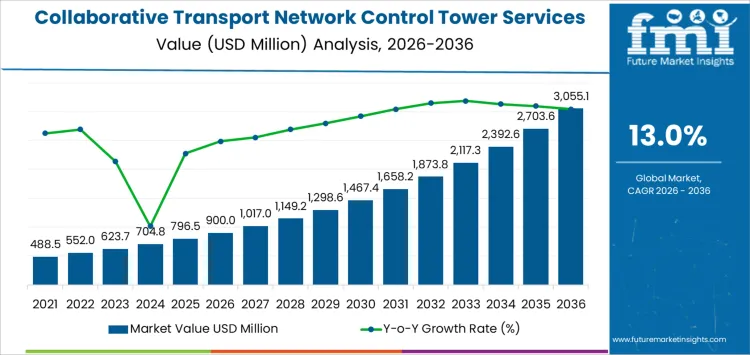
The market for collaborative transport network control tower services is expected to grow from USD 900 million in 2026 to USD 3,055.1 million by 2036, reflecting a compound annual growth rate (CAGR) of 13%. These services provide centralized visibility and control over transport operations, allowing businesses to optimize their supply chains, reduce inefficiencies, and improve decision-making across their logistics networks. The growth in this market is driven by the increasing complexity of global supply chains, the rise of e-commerce, and the demand for more efficient, transparent, and responsive transportation management systems. By enabling real-time data exchange and collaboration between different stakeholders in the transport network, control tower services help reduce delays, improve on-time deliveries, and enhance customer satisfaction.
As logistics companies face increasing pressure to reduce costs, improve speed, and maintain flexibility, the adoption of collaborative transport network control tower services is expected to rise. Furthermore, advancements in digital technologies such as cloud computing, data analytics, and artificial intelligence are enhancing the capabilities of these services, making them essential tools for modern supply chain management. As businesses continue to prioritize operational efficiency and customer satisfaction, the demand for these collaborative services will grow steadily over the next decade.
Quick Stats for Collaborative Transport Network Control Tower Services Market
- Collaborative Transport Network Control Tower Services Market Value (2026): USD 900 million
- Collaborative Transport Network Control Tower Services Market Forecast Value (2036): USD 3,055.1 million
- Collaborative Transport Network Control Tower Services Market Global Forecast CAGR (2026-2036): 13%
- Top Application by Share in Collaborative Transport Network Control Tower Services Market: E-Commerce & Retail Logistics (46%)
- Key Growth Regions in Collaborative Transport Network Control Tower Services Market: India, China, USA, Brazil, Germany
- Top Players in Collaborative Transport Network Control Tower Services Market: MercuryGate, Manhattan Associates, Oracle, SAP, Descartes Systems Group
What is the Growth Forecast for the Collaborative Transport Network Control Tower Services Market through 2036?
The inflection point mapping for the collaborative transport network control tower services market shows gradual growth with notable acceleration as the market matures. Starting at USD 900 million in 2026, the market grows to USD 1,017.94 million in 2027 and USD 1,152.51 million in 2028, reflecting steady early adoption as companies begin to realize the benefits of centralizing and optimizing transport management.
From 2028 to 2030, the market accelerates significantly, reaching USD 1,305.38 million in 2029 and USD 1,478.92 million in 2030. This acceleration indicates that the adoption of collaborative transport network control tower services gains momentum as businesses seek greater efficiency, reduced transportation costs, and improved decision-making capabilities across their logistics networks. From 2030 to 2035, the market continues to grow rapidly, with values reaching USD 1,675.12 million in 2031, USD 1,897.71 million in 2032, and USD 2,149.69 million in 2033.
By 2035, the market is projected to reach USD 2,434.58 million, and by 2036, USD 3,055.1 million. The inflection point mapping highlights how the market shifts from moderate growth in the early years to a faster growth trajectory as businesses increasingly invest in control tower services to enhance their logistics operations. The latter part of the forecast period reflects a significant acceleration as the technology becomes a standard component of modern supply chain management, driven by growing demand for efficiency, visibility, and agility in transportation networks.
Collaborative Transport Network Control Tower Services Market Key Takeaways
| Metric | Value |
|---|---|
| Industry Sales Value (2026) | USD 900 million |
| Industry Forecast Value (2036) | USD 3,055.1 million |
| Industry Forecast CAGR (2026-2036) | 13% |
What Is Driving the Demand for Collaborative Transport Network Control Tower Services Globally?
The demand for collaborative transport network control tower services is driven by increasing complexity and fragmentation in global supply chains and the need for greater visibility, coordination, and responsiveness across transport networks. Control tower services centralise real time data from carriers, shippers, warehouses, and logistics partners to provide a unified view of freight movements, inventory positions, and network performance. As businesses face rising customer expectations for faster delivery, tighter delivery windows, and seamless tracking, traditional siloed logistics planning has become less effective. Collaborative control towers help stakeholders make informed decisions, optimise routing, and adjust plans quickly in response to disruptions such as congestion, weather events, or capacity shortages. The growing adoption of digital platforms, cloud based systems, and real time telematics supports the ability of control towers to aggregate and analyse data across diverse networks. Regions with dense logistics activity-including North America, Europe, and Asia Pacific-are investing in such services to reduce costs and improve service levels while managing transport complexity.
Future demand for collaborative transport network control tower services is expected to grow as supply chains prioritise resilience, agility, and data driven decision making. Continued investment in artificial intelligence, predictive analytics, and machine learning will enhance the ability of control towers to forecast disruptions, recommend corrective actions, and balance service performance with cost efficiency. As supply chains become more interconnected and multimodal, control tower services that provide visibility across air, ocean, rail, and truck networks will be increasingly valuable. The integration of control towers with transportation management systems and enterprise planning tools will support automated workflows, performance tracking, and continuous improvement. Demand will also be influenced by how organisations respond to labour shortages, capacity volatility, and regulatory changes that affect transport operations. As competitive pressures encourage shippers and carriers to improve reliability and efficiency, collaborative control tower services will play a central role in enabling coordinated transport strategies and enhancing overall network performance.
What Are the Key Segments in Collaborative Transport Network Control Tower Services Market?
The collaborative transport network control tower services market is segmented by service type and application. Network visibility & monitoring leads the service type segment with 40% of the market share, offering real-time insights into transportation operations. E-commerce & retail logistics dominate the application segment with 46%, driven by the need for optimized, transparent, and flexible logistics solutions. The market is growing as businesses increasingly adopt control tower services to enhance efficiency, streamline operations, and improve customer service across their supply chains.
Which Service Type Drives Collaborative Transport Network Control Tower Services Market Demand Globally?
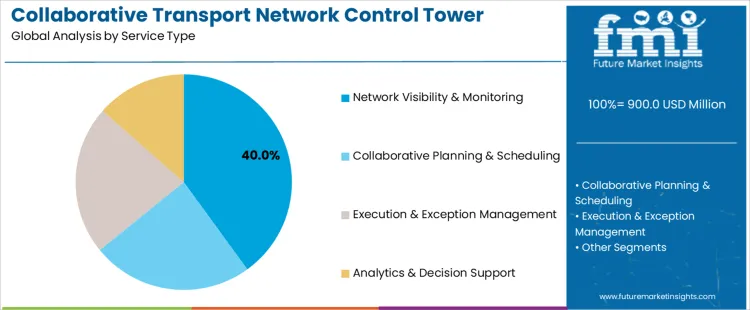
Network visibility & monitoring holds 40% of the market share. This service provides real-time tracking and monitoring of the entire transportation network, offering visibility into shipments, fleet status, and potential delays. Network visibility is crucial for companies seeking to improve operational efficiency, manage disruptions, and ensure on-time deliveries. By providing a single, comprehensive view of transportation activities, network visibility and monitoring help companies proactively address issues, optimize routes, and reduce costs. As logistics becomes increasingly complex, particularly with global supply chains and increased e-commerce volumes, the demand for real-time insights into transportation operations is growing. Companies are adopting these services to improve decision-making, enhance customer satisfaction, and maintain transparency across their transportation networks.
Which Application Drives Collaborative Transport Network Control Tower Services Market Demand Globally?
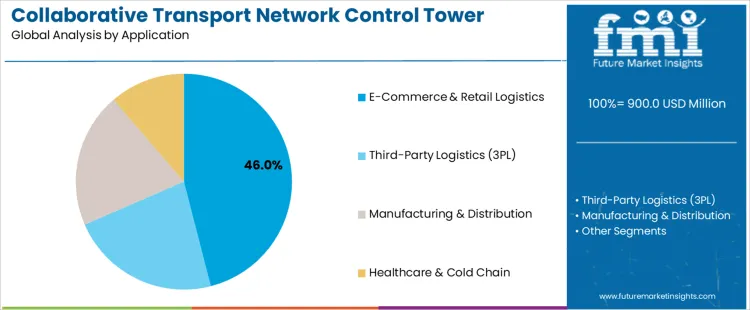
E-commerce & retail logistics leads the application segment with 46% of the market share. E-commerce businesses require fast, efficient, and transparent logistics solutions to meet growing consumer expectations for quick deliveries. Collaborative transport network control tower services are key in this sector, providing real-time visibility, better planning, and improved coordination across supply chains. These services enable e-commerce companies to optimize inventory, reduce delivery times, and respond quickly to disruptions. As e-commerce continues to expand, the need for dynamic and flexible logistics solutions is driving the adoption of control tower services. While other sectors, such as third-party logistics (3PL), manufacturing & distribution, and healthcare & cold chain, also contribute to the market, e-commerce & retail logistics remains the dominant segment due to its scale and demand for fast, reliable, and cost-effective transportation services.
What are the Key Dynamics of the Global Collaborative Transport Network Control Tower Services Market?
The global collaborative transport network control tower services market is growing as shippers, carriers and logistics providers adopt centralised visibility and coordination hubs to manage complex supply chains. Control tower services integrate data from multiple transport modes, operators and partners to monitor movements, optimise routing and coordinate response to disruptions. Growth is supported by rising e commerce volumes, demand for reliable delivery and focus on operational efficiency. Providers offer dashboards, alerts and planning support that help stakeholders coordinate activities across regions. Adoption reflects emphasis on real time supply chain insight and collaborative decision support across transport networks worldwide.
What are the Key Drivers for the Global Collaborative Transport Network Control Tower Services Market?
Increasing complexity of global supply chains encourages adoption of control tower services that bring together data from different partners and transport modes to support coordinated decision making. Growth in e commerce and omni channel distribution increases pressure on logistics visibility and reliability, motivating investment in real time monitoring and analytics. Shippers and carriers seek to reduce operational costs and improve service levels by synchronising planning, execution and response to exceptions. Advances in cloud computing and connectivity make it feasible to aggregate and analyse large volumes of transport data. Demand for resilience against disruptions such as weather events, port congestion and labour issues also supports uptake of collaborative control tower services.
What are the Restraints for the Global Collaborative Transport Network Control Tower Services Market?
One restraint is the challenge of integrating diverse data sources and systems from multiple partners into a unified control tower environment. Variation in technology maturity and data quality across participants can limit effectiveness of real time insight and decision support. Some organisations are reluctant to share sensitive operational data due to competitive or privacy concerns, which slows collaborative integration. Smaller carriers and logistics providers may lack resources to adopt or customise advanced control tower solutions. Differences in regional regulatory requirements for data handling and system interoperability can also affect implementation timelines and consistency of service.
What is the Key Trends in the Global Collaborative Transport Network Control Tower Services Market?
A key trend is increased use of advanced analytics and artificial intelligence within control tower platforms to support predictive planning, anomaly detection and scenario modelling that informs proactive decisions. Providers are embedding machine learning to recommend routing adjustments, carrier selection and resource allocation. Use of real time telematics, IoT sensors and mobile connectivity improves visibility of assets and conditions that affect transport performance. Control tower services are evolving to support cross company collaboration, enabling shared views and coordinated actions among shippers, carriers and partners. Focus on resilience strategies that anticipate disruptions and align response protocols is influencing development of next generation control tower capabilities.
What is the Country-Wise Outlook for Collaborative Transport Network Control Tower Services?
The Collaborative Transport Network Control Tower Services market is growing rapidly, driven by the increasing need for real-time visibility, efficiency, and coordination across supply chains. These services allow companies to monitor, control, and optimize their transportation networks by collaborating with different partners and stakeholders. Countries like India, China, and the USA are leading this growth, driven by the expanding e-commerce sector and the increasing complexity of global supply chains. Collaborative control tower services help streamline operations, reduce costs, and improve decision-making by providing centralized control over transportation management. As supply chains become more interconnected and data-driven, the demand for collaborative control tower services is expected to grow significantly.
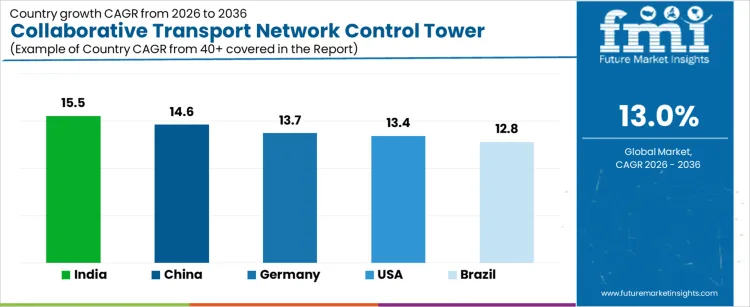
| Country | CAGR (2026–2036) |
|---|---|
| India | 15.5% |
| China | 14.6% |
| USA | 13.4% |
| Brazil | 12.8% |
| Germany | 13.7% |
What is Driving the Growth of Collaborative Transport Network Control Tower Services in India?
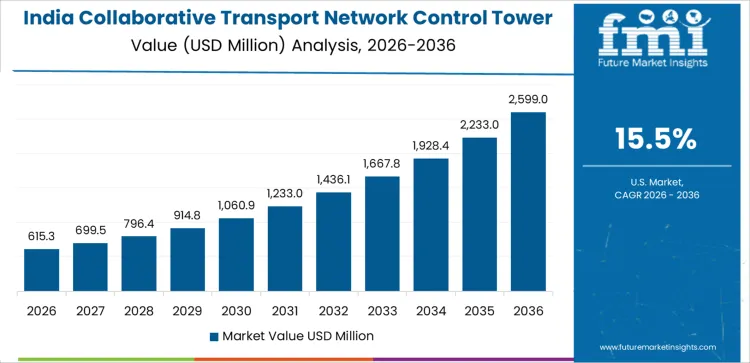
India’s Collaborative Transport Network Control Tower Services market is projected to grow at a CAGR of 15.5%. The rapid growth of India’s logistics and e-commerce sectors, along with the increasing demand for supply chain optimization, is driving the need for more efficient and coordinated transportation solutions. Collaborative control tower services provide real-time visibility, enable proactive decision-making, and enhance collaboration between various stakeholders in the supply chain. As India continues to modernize its infrastructure and embrace digital solutions, the adoption of collaborative control tower services is expected to increase, contributing to the market’s strong growth.
What is Contributing to the Growth of Collaborative Transport Network Control Tower Services in China?
China’s Collaborative Transport Network Control Tower Services market is expected to grow at a CAGR of 14.6%. The country’s rapidly expanding e-commerce sector and its strategic focus on supply chain digitalization are key drivers of this market. Collaborative control tower services offer a solution to the complex logistics challenges in China, providing centralized management and real-time control over transportation networks. The Chinese government’s push for more efficient and sustainable logistics infrastructure, along with the increasing demand for faster deliveries, is accelerating the adoption of these services. As China continues to invest in smart logistics technologies, collaborative control towers are becoming a crucial component of the logistics landscape.
What is Driving the Collaborative Transport Network Control Tower Services Market Growth in the USA?
The USA’s Collaborative Transport Network Control Tower Services market is projected to grow at a CAGR of 13.4%. The USA, with its large and complex supply chain networks, is increasingly relying on collaborative control tower services to optimize transportation efficiency. These services provide real-time visibility, better coordination across supply chain partners, and enhanced decision-making capabilities. As the e-commerce sector continues to expand and customer expectations for faster, more reliable deliveries increase, the demand for integrated logistics solutions like control tower services is growing. Additionally, the push toward digitalization and data-driven logistics solutions in the USA is further supporting the adoption of these services, driving market growth.
What is Influencing the Growth of Collaborative Transport Network Control Tower Services in Brazil?
Brazil’s Collaborative Transport Network Control Tower Services market is projected to grow at a CAGR of 12.8%. The growing e-commerce sector in Brazil, along with the increasing demand for more efficient logistics solutions, is fueling the need for collaborative transport network services. These services help businesses optimize transportation management by providing centralized visibility and coordination across supply chains. As Brazil continues to modernize its logistics infrastructure and improve its supply chain efficiency, the adoption of collaborative control tower services is expected to rise. The increased focus on sustainability and cost reduction further accelerates the market’s growth in Brazil.
What is Contributing to the Growth of Collaborative Transport Network Control Tower Services in Germany?
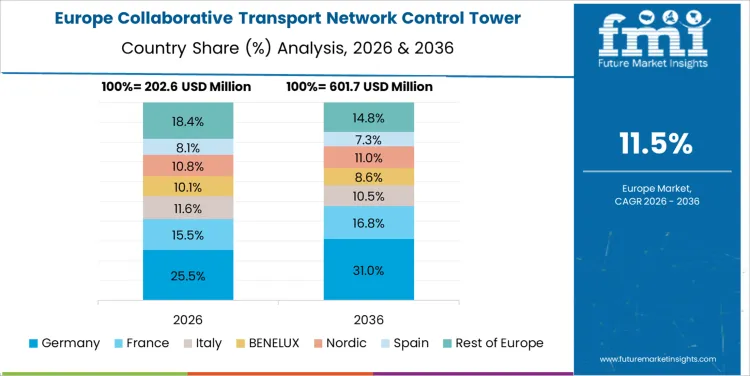
Germany’s Collaborative Transport Network Control Tower Services market is expected to grow at a CAGR of 13.7%. As a leader in logistics and supply chain innovation, Germany is increasingly adopting digital solutions to improve supply chain visibility and optimize transportation networks. Collaborative control tower services allow businesses to enhance coordination, reduce costs, and improve decision-making by integrating data across various stakeholders in the supply chain. Germany’s strong e-commerce sector, along with its focus on sustainability and operational efficiency, drives the demand for these services. As German businesses continue to embrace digital transformation, the adoption of collaborative control tower services is expected to grow, contributing to the market’s continued expansion.
What is the Competitive Landscape for the Collaborative Transport Network Control Tower Services Market?
Global demand for collaborative transport network control tower services is rising as shippers, carriers and logistics service providers seek greater visibility, coordination and optimisation across complex supply chains. Control towers act as centralised command centres that collect real time data from transportation management systems, telematics, carrier networks and demand signals to provide predictive insights, exception management and performance analytics. Growth in e commerce, omnichannel fulfilment, global sourcing and pressure to reduce logistics costs have intensified the need for end to end visibility. Companies operating across multiple regions, modes and partners benefit from control tower services that help anticipate disruptions, optimise routing and capacity, synchronise cross border operations and improve service levels. Sustainability goals tied to reduced fuel use and emissions also support investment in services that streamline transport flows and eliminate inefficiencies, particularly in North America, Europe and Asia Pacific where supply chain complexity and regulatory expectations are high.
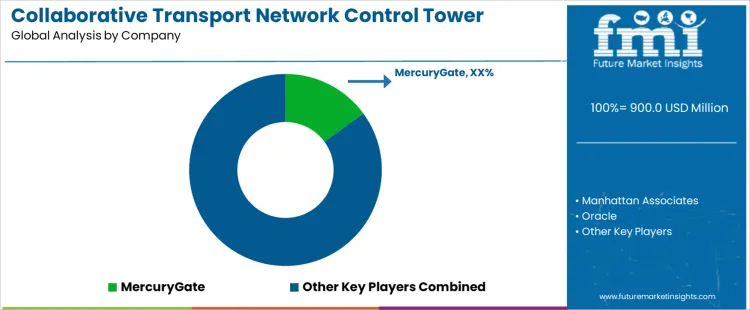
On the supply side, several established enterprise software and logistics technology firms compete to lead this evolving market. MercuryGate is recognised as a leading provider with deep capabilities in transport optimisation, multi modal planning and collaborative visibility across extended networks. Other significant competitors include Manhattan Associates, Oracle, SAP and Descartes Systems Group, each offering platforms that integrate transport management, analytics, optimisation and real time data feeds. Competition among these suppliers centres on the depth of analytics, ease of integration with existing enterprise systems, ability to support multi partner workflows, and strength of predictive and prescriptive insights. Providers that combine flexible architecture, strong data integration, robust optimisation engines and global support services are best positioned to capture growth as manufacturers, retailers and third party logistics partners continue to prioritise interconnected, collaborative control tower solutions for transport network management worldwide.
Key Players of the Collaborative Transport Network Control Tower Services Market
- MercuryGate
- Manhattan Associates
- Oracle
- SAP
- Descartes Systems Group
Scope of the Report
| Items | Values |
|---|---|
| Quantitative Units (2026) | USD Million |
| Service Type | Network Visibility & Monitoring, Collaborative Planning & Scheduling, Execution & Exception Management, Analytics & Decision Support |
| Application | E-Commerce & Retail Logistics, Third-Party Logistics (3PL), Manufacturing & Distribution, Healthcare & Cold Chain |
| Companies | MercuryGate, Manhattan Associates, Oracle, SAP, Descartes Systems Group |
| Regions Covered | North America, Latin America, Western Europe, Eastern Europe, South Asia and Pacific, East Asia, Middle East & Africa |
| Countries Covered | United States, Canada, Mexico, Brazil, Argentina, Germany, France, United Kingdom, Italy, Spain, Netherlands, China, India, Japan, South Korea, ANZ, GCC Countries, South Africa |
| Additional Attributes | Dollar by sales by service type, application, and region. Includes market trends in collaborative transport network control tower services, performance in logistics and supply chain management for various industries, demand for network visibility and real-time monitoring, cost-effectiveness, sustainability practices, regulatory compliance, market share and competitive positioning of key companies, and the role of collaborative control towers in optimizing transport networks, improving decision-making, and enhancing supply chain efficiency across sectors. |
Key Segments in the Collaborative Transport Network Control Tower Services Market
Service Type
- Network Visibility & Monitoring
- Collaborative Planning & Scheduling
- Execution & Exception Management
- Analytics & Decision Support
Application
- E-Commerce & Retail Logistics
- Third-Party Logistics (3PL)
- Manufacturing & Distribution
- Healthcare & Cold Chain
Region
- Asia Pacific
- China
- India
- Japan
- South Korea
- ASEAN
- Rest of Asia Pacific
- Europe
- Germany
- United Kingdom
- France
- Italy
- Spain
- Nordic
- BENELUX
- Rest of Europe
- North America
- United States
- Canada
- Mexico
- Latin America
- Brazil
- Chile
- Rest of Latin America
- Middle East & Africa
- Kingdom of Saudi Arabia
- Other GCC Countries
- Turkey
- South Africa
- Other African Union
- Rest of Middle East & Africa
Frequently Asked Questions
How big is the collaborative transport network control tower services market in 2026?
The global collaborative transport network control tower services market is estimated to be valued at USD 900.0 million in 2026.
What will be the size of collaborative transport network control tower services market in 2036?
The market size for the collaborative transport network control tower services market is projected to reach USD 3,055.1 million by 2036.
How much will be the collaborative transport network control tower services market growth between 2026 and 2036?
The collaborative transport network control tower services market is expected to grow at a 13.0% CAGR between 2026 and 2036.
What are the key product types in the collaborative transport network control tower services market?
The key product types in collaborative transport network control tower services market are network visibility & monitoring, collaborative planning & scheduling, execution & exception management and analytics & decision support.
Which application segment to contribute significant share in the collaborative transport network control tower services market in 2026?
In terms of application, e‑commerce & retail logistics segment to command 46.0% share in the collaborative transport network control tower services market in 2026.
Preview the report firsthand - request a free sample
Get SampleGet the brochure for pricing and purchase details.
Get PDFTable of Content
- Executive Summary
- Global Market Outlook
- Demand-side Trends
- Supply-side Trends
- Technology Roadmap Analysis
- Analysis and Recommendations
- Market Overview
- Market Coverage / Taxonomy
- Market Definition / Scope / Limitations
- Market Background
- Market Dynamics
- Drivers
- Restraints
- Opportunity
- Trends
- Scenario Forecast
- Demand in Optimistic Scenario
- Demand in Likely Scenario
- Demand in Conservative Scenario
- Opportunity Map Analysis
- Product Life Cycle Analysis
- Supply Chain Analysis
- Investment Feasibility Matrix
- Value Chain Analysis
- PESTLE and Porter’s Analysis
- Regulatory Landscape
- Regional Parent Market Outlook
- Production and Consumption Statistics
- Import and Export Statistics
- Market Dynamics
- Global Market Analysis 2021 to 2025 and Forecast, 2026 to 2036
- Historical Market Size Value (USD Million) Analysis, 2021 to 2025
- Current and Future Market Size Value (USD Million) Projections, 2026 to 2036
- Y-o-Y Growth Trend Analysis
- Absolute $ Opportunity Analysis
- Global Market Pricing Analysis 2021 to 2025 and Forecast 2026 to 2036
- Global Market Analysis 2021 to 2025 and Forecast 2026 to 2036, By Service Type
- Introduction / Key Findings
- Historical Market Size Value (USD Million) Analysis By Service Type , 2021 to 2025
- Current and Future Market Size Value (USD Million) Analysis and Forecast By Service Type , 2026 to 2036
- Network Visibility & Monitoring
- Collaborative Planning & Scheduling
- Execution & Exception Management
- Analytics & Decision Support
- Y-o-Y Growth Trend Analysis By Service Type , 2021 to 2025
- Absolute $ Opportunity Analysis By Service Type , 2026 to 2036
- Global Market Analysis 2021 to 2025 and Forecast 2026 to 2036, By Application
- Introduction / Key Findings
- Historical Market Size Value (USD Million) Analysis By Application, 2021 to 2025
- Current and Future Market Size Value (USD Million) Analysis and Forecast By Application, 2026 to 2036
- E‑Commerce & Retail Logistics
- Third‑Party Logistics (3PL)
- Manufacturing & Distribution
- Healthcare & Cold Chain
- Y-o-Y Growth Trend Analysis By Application, 2021 to 2025
- Absolute $ Opportunity Analysis By Application, 2026 to 2036
- Global Market Analysis 2021 to 2025 and Forecast 2026 to 2036, By Region
- Introduction
- Historical Market Size Value (USD Million) Analysis By Region, 2021 to 2025
- Current Market Size Value (USD Million) Analysis and Forecast By Region, 2026 to 2036
- North America
- Latin America
- Western Europe
- Eastern Europe
- East Asia
- South Asia and Pacific
- Middle East & Africa
- Market Attractiveness Analysis By Region
- North America Market Analysis 2021 to 2025 and Forecast 2026 to 2036, By Country
- Historical Market Size Value (USD Million) Trend Analysis By Market Taxonomy, 2021 to 2025
- Market Size Value (USD Million) Forecast By Market Taxonomy, 2026 to 2036
- By Country
- USA
- Canada
- Mexico
- By Service Type
- By Application
- By Country
- Market Attractiveness Analysis
- By Country
- By Service Type
- By Application
- Key Takeaways
- Latin America Market Analysis 2021 to 2025 and Forecast 2026 to 2036, By Country
- Historical Market Size Value (USD Million) Trend Analysis By Market Taxonomy, 2021 to 2025
- Market Size Value (USD Million) Forecast By Market Taxonomy, 2026 to 2036
- By Country
- Brazil
- Chile
- Rest of Latin America
- By Service Type
- By Application
- By Country
- Market Attractiveness Analysis
- By Country
- By Service Type
- By Application
- Key Takeaways
- Western Europe Market Analysis 2021 to 2025 and Forecast 2026 to 2036, By Country
- Historical Market Size Value (USD Million) Trend Analysis By Market Taxonomy, 2021 to 2025
- Market Size Value (USD Million) Forecast By Market Taxonomy, 2026 to 2036
- By Country
- Germany
- UK
- Italy
- Spain
- France
- Nordic
- BENELUX
- Rest of Western Europe
- By Service Type
- By Application
- By Country
- Market Attractiveness Analysis
- By Country
- By Service Type
- By Application
- Key Takeaways
- Eastern Europe Market Analysis 2021 to 2025 and Forecast 2026 to 2036, By Country
- Historical Market Size Value (USD Million) Trend Analysis By Market Taxonomy, 2021 to 2025
- Market Size Value (USD Million) Forecast By Market Taxonomy, 2026 to 2036
- By Country
- Russia
- Poland
- Hungary
- Balkan & Baltic
- Rest of Eastern Europe
- By Service Type
- By Application
- By Country
- Market Attractiveness Analysis
- By Country
- By Service Type
- By Application
- Key Takeaways
- East Asia Market Analysis 2021 to 2025 and Forecast 2026 to 2036, By Country
- Historical Market Size Value (USD Million) Trend Analysis By Market Taxonomy, 2021 to 2025
- Market Size Value (USD Million) Forecast By Market Taxonomy, 2026 to 2036
- By Country
- China
- Japan
- South Korea
- By Service Type
- By Application
- By Country
- Market Attractiveness Analysis
- By Country
- By Service Type
- By Application
- Key Takeaways
- South Asia and Pacific Market Analysis 2021 to 2025 and Forecast 2026 to 2036, By Country
- Historical Market Size Value (USD Million) Trend Analysis By Market Taxonomy, 2021 to 2025
- Market Size Value (USD Million) Forecast By Market Taxonomy, 2026 to 2036
- By Country
- India
- ASEAN
- Australia & New Zealand
- Rest of South Asia and Pacific
- By Service Type
- By Application
- By Country
- Market Attractiveness Analysis
- By Country
- By Service Type
- By Application
- Key Takeaways
- Middle East & Africa Market Analysis 2021 to 2025 and Forecast 2026 to 2036, By Country
- Historical Market Size Value (USD Million) Trend Analysis By Market Taxonomy, 2021 to 2025
- Market Size Value (USD Million) Forecast By Market Taxonomy, 2026 to 2036
- By Country
- Kingdom of Saudi Arabia
- Other GCC Countries
- Turkiye
- South Africa
- Other African Union
- Rest of Middle East & Africa
- By Service Type
- By Application
- By Country
- Market Attractiveness Analysis
- By Country
- By Service Type
- By Application
- Key Takeaways
- Key Countries Market Analysis
- USA
- Pricing Analysis
- Market Share Analysis, 2025
- By Service Type
- By Application
- Canada
- Pricing Analysis
- Market Share Analysis, 2025
- By Service Type
- By Application
- Mexico
- Pricing Analysis
- Market Share Analysis, 2025
- By Service Type
- By Application
- Brazil
- Pricing Analysis
- Market Share Analysis, 2025
- By Service Type
- By Application
- Chile
- Pricing Analysis
- Market Share Analysis, 2025
- By Service Type
- By Application
- Germany
- Pricing Analysis
- Market Share Analysis, 2025
- By Service Type
- By Application
- UK
- Pricing Analysis
- Market Share Analysis, 2025
- By Service Type
- By Application
- Italy
- Pricing Analysis
- Market Share Analysis, 2025
- By Service Type
- By Application
- Spain
- Pricing Analysis
- Market Share Analysis, 2025
- By Service Type
- By Application
- France
- Pricing Analysis
- Market Share Analysis, 2025
- By Service Type
- By Application
- India
- Pricing Analysis
- Market Share Analysis, 2025
- By Service Type
- By Application
- ASEAN
- Pricing Analysis
- Market Share Analysis, 2025
- By Service Type
- By Application
- Australia & New Zealand
- Pricing Analysis
- Market Share Analysis, 2025
- By Service Type
- By Application
- China
- Pricing Analysis
- Market Share Analysis, 2025
- By Service Type
- By Application
- Japan
- Pricing Analysis
- Market Share Analysis, 2025
- By Service Type
- By Application
- South Korea
- Pricing Analysis
- Market Share Analysis, 2025
- By Service Type
- By Application
- Russia
- Pricing Analysis
- Market Share Analysis, 2025
- By Service Type
- By Application
- Poland
- Pricing Analysis
- Market Share Analysis, 2025
- By Service Type
- By Application
- Hungary
- Pricing Analysis
- Market Share Analysis, 2025
- By Service Type
- By Application
- Kingdom of Saudi Arabia
- Pricing Analysis
- Market Share Analysis, 2025
- By Service Type
- By Application
- Turkiye
- Pricing Analysis
- Market Share Analysis, 2025
- By Service Type
- By Application
- South Africa
- Pricing Analysis
- Market Share Analysis, 2025
- By Service Type
- By Application
- USA
- Market Structure Analysis
- Competition Dashboard
- Competition Benchmarking
- Market Share Analysis of Top Players
- By Regional
- By Service Type
- By Application
- Competition Analysis
- Competition Deep Dive
- MercuryGate
- Overview
- Product Portfolio
- Profitability by Market Segments (Product/Age /Sales Channel/Region)
- Sales Footprint
- Strategy Overview
- Marketing Strategy
- Product Strategy
- Channel Strategy
- Manhattan Associates
- Oracle
- SAP
- Descartes Systems Group
- MercuryGate
- Competition Deep Dive
- Assumptions & Acronyms Used
- Research Methodology


