

- Industry Size (2026)
- USD 2.3 Bn
- Forecast (2036)
- USD 17.6 Bn
- CAGR (2026 to 2036)
- 22.8%
Collaborative Mobile-Manipulator Robots Market Size, Market Forecast and Outlook By FMI
The collaborative mobile-manipulator robots market scaled to USD 1.8 billion in 2025 and is poised to reach USD 2.3 billion in 2026 at a CAGR of 22.8% during the forecast period. Lifting the estimated projection to USD 17.6 billion through 2036 as manufacturing facilities transition from fixed-base robotic cells to dynamic-path material fetching and manipulation architectures.
Plant managers who previously relied on decoupled conveyor belts and stationary arms are now restructuring their floor space entirely. The core shift involves eliminating fixed transfer zones and integrating collaborative robot assets capable of self-navigating to inventory racks, grasping specific components, and delivering them directly into active assembly lines. Operators holding back on this integration risk permanently anchoring their throughput to the physical limitations of legacy conveyor routing. The structural bottleneck in legacy setups is not the precision of the arm or the navigation speed of the base, but the latency inherent in the handoff between moving inventory and picking it.
Summary of Collaborative Mobile-Manipulator Robots Market
- Collaborative Mobile-Manipulator Robots Market Definition:
- Integrated autonomous systems featuring a mobile navigation base and an articulated collaborative arm. These units break the structural constraint of stationary automation by fetching, transporting, and manipulating payloads across dynamic facility floors without safety caging.
- Demand Drivers in the Market:
- High product-mix manufacturing environments require assembly line managers to deploy flexible routing rather than fixed conveyor infrastructure.
- Labor shortages in multi-shift warehousing compel facility directors to automate discrete piece-picking across expansive inventory racks.
- Just-in-time delivery mandates push procurement executives to implement automated line-side replenishment systems that operate without human intervention.
- Key Segments Analyzed in the FMI Report:
- Hardware: Hardware is estimated to account for 55.0% share in 2026, as the physical actuators, sensors, and structural integration of the arm and base represent the primary upfront capital expenditure.
- Material Handling: Material Handling is likely to capture 40.0% share in 2026, reflecting the immediate operational need to eliminate manual cart transport between discrete manufacturing cells.
- Logistics: Logistics is projected to record 35.0% share in 2026, as fulfillment centers transition to dynamic piece-picking workflows that demand autonomous part shuttling.
- Wheeled: Wheeled mobility is set to grab 65.0% share in 2026, offering the optimal balance of speed, payload stability, and energy efficiency across flat, structured industrial floors.
- India: 27.5% CAGR, propelled by the rapid pivot of domestic contract manufacturers from manual assembly lines to flexible, automated production cells.
- Analyst Opinion at FMI:
- Rahul Pandita, Principal Analyst, Technology, at FMI, opines, "The generalist assumption dictates that mobile manipulators are simply the physical combination of an AMR and a cobot. However, the true technological and commercial barrier lies in the synchronization software. The latency between a robot arriving at a destination, stabilizing its base, and executing a precision pick is where facility managers either realize their ROI or lose it. The hardware is largely commoditized; the competitive differentiator is the integrated motion control."
- Strategic Implications / Executive Takeaways:
- Intralogistics directors must transition from isolated AMR and robotic arm silos to unified fleet management software architectures to achieve synchronized throughput.
- Original equipment manufacturers should prioritize zero-latency handoff protocols between navigation and manipulation controllers to avoid excessive task-execution delays.
- Systems integrators face the requirement to standardize deployment templates across varied facility layouts to compress currently prohibitive installation timelines.
- Methodology
- Primary Research: Direct consultation with automation architects and supply chain operations executives.
- Desk Research: Aggregation of technical safety certifications and capital equipment procurement databases.
- Market-Sizing and Forecasting: Triangulated hardware shipment volumes mapped against software licensing revenues.
- Data Validation and Update Cycle: Continuous cross-referencing with quarterly industrial automation spending indices.
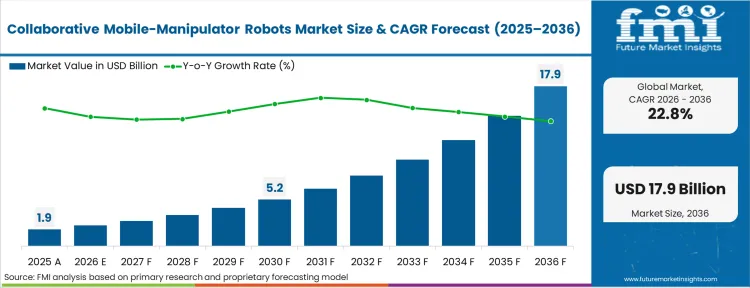
Standardization of the software API layer linking the autonomous base and the six-axis manipulation arm serves as the primary inflection gate. Once original equipment manufacturers establish vendor-agnostic communication protocols, the engineering friction required to synchronize navigation with precision grasping collapses, accelerating deployment for mid-tier manufacturing facilities.
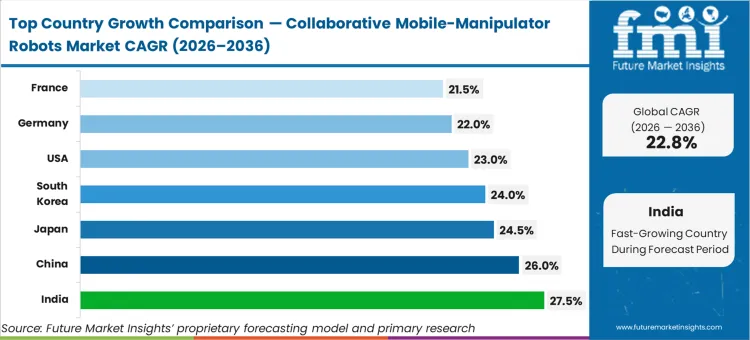
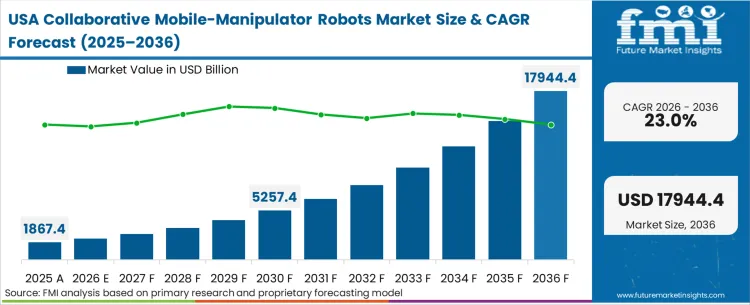
Demand for collaborative mobile manipulators in China is set to grow at 26.0%, driven by aggressive domestic electronics manufacturing modernization scaling away from pure human labor. India is expected to advance at 27.5%, while Japan tracks a 24.5% CAGR as domestic automotive assembly networks redesign their intralogistics workflows. South Korea is projected to post a 24.0% growth rate, closely followed by the United States at 23.0%, where high-throughput logistics facilities lead the transition. Germany and France follow with CAGRs of 22.0% and 21.5% respectively, reflecting a more deliberate replacement cycle within their already mature, heavily automated industrial bases. This geographical divergence stems from the distinction between greenfield factory construction in emerging manufacturing hubs versus brownfield retrofitting in legacy industrial environments.
Collaborative Mobile-Manipulator Robots Market Definition
The Collaborative Mobile-Manipulator Robots sector encompasses integrated robotic systems combining an autonomous mobile base with an articulated robotic arm, designed specifically to operate safely alongside human workers without physical caging. These systems autonomously navigate dynamic environments to transport, manipulate, pick, and place objects across various industrial and logistical settings.
Collaborative Mobile-Manipulator Robots Market Inclusions
This sector includes complete mobile manipulation systems, standalone software platforms for fleet coordination, integrated computer vision modules for precision picking, and end-of-arm tooling specifically certified for collaborative industrial robotics deployment. Maintenance, deployment consulting, and integration services provided directly by system integrators or original equipment manufacturers also fall within scope.
Collaborative Mobile-Manipulator Robots Market Exclusions
The scope explicitly excludes standalone autonomous mobile robots (AMRs) that lack manipulation arms, as well as stationary collaborative robots fixed to a single workstation. Industrial robotic arms requiring safety caging and fixed automated guided vehicles (AGVs) operating strictly on magnetic tape or pre-installed facility infrastructure are also excluded, as they lack the autonomous navigation and safe human-proximity operational profile defining this category.
Collaborative Mobile-Manipulator Robots Market Research Methodology
- Primary Research: Chief operations officers, intralogistics directors, and advanced manufacturing engineering leads within automotive and electronics production networks.
- Desk Research: Safety certification registries, vendor technical specification sheets, and robotic fleet management API documentation.
- Market-Sizing and Forecasting: Baseline metrics anchored to annual deployments of integrated mobile manipulator units and discrete mobile-base retrofits tracked across primary original equipment manufacturers.
- Data Validation and Update Cycle: Forecast trajectories cross-validated against industrial capital expenditure allocations for flexible automation and intralogistics modernization.
Segmental Analysis
Collaborative Mobile-Manipulator Robots Market Analysis by Component
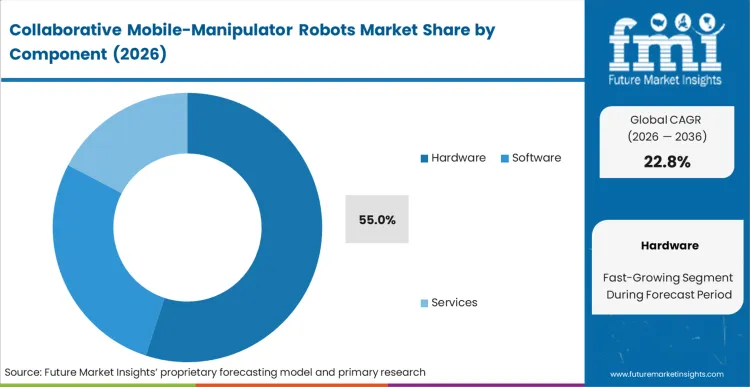
The reason Hardware commands a dominant 55.0% share of this market comes down to the sheer capital density of the physical assets required to achieve mobile manipulation. Base platforms, robotic arms, LiDAR arrays, and high-torque servomotors form an expensive, non-negotiable physical layer. According to FMI's estimates, facility managers evaluating the transition prioritize systems with robust, field-tested components, viewing the mechanical reliability of the arm and base as the primary hedge against costly downtime. While mobile robotics software dictates operational intelligence, the hardware determines the functional ceiling of payload capacity and reach. Procurement directors who under-specify their hardware to control initial capital expenditure rapidly encounter physical throughput limitations, forcing premature asset replacement rather than software upgrades.
- Capital Concentration: Physical integration of navigation bases, mechanical arms, and sensor arrays drives the initial deployment cost. Facility operators prioritize ruggedized components to ensure multi-shift durability.
- Maintenance Overhead: High-utilization moving parts require preventative replacement schedules to prevent catastrophic line stoppages. Procurement teams lock into long-term service agreements to mitigate hardware failure risks.
- Asset Lifespan: The operational durability of the arm and base dictates the long-term return on investment. Organizations must over-index on hardware robustness to outlast aggressive depreciation schedules.
Collaborative Mobile-Manipulator Robots Market Analysis by Application
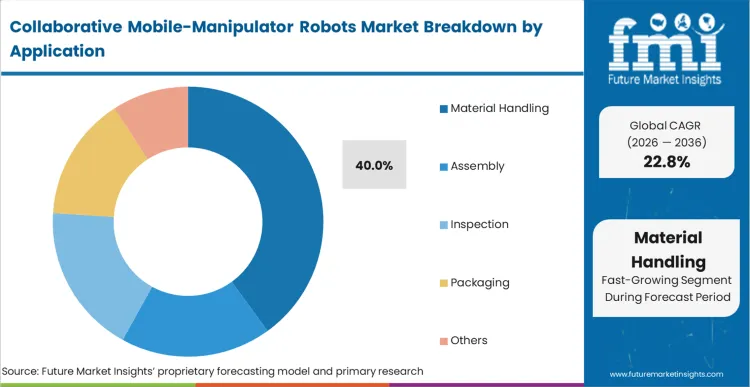
Manual cart pushing and forklift shuttling represent the most glaring inefficiencies in modern manufacturing, forcing buyers to aggressively adopt Material Handling solutions, which now capture 40.0% of the market. FMI analysts opine that the structural advantage of a mobile manipulator lies in its ability to both fetch a bin from a shelf and transport it to the exact point of consumption. In warehouse robotics environments, eliminating the human handoff between the storage rack and the transport vehicle streamlines the entire fulfillment chain. Logistics operators deploying these systems shift human labor entirely to exception handling and complex assembly, rather than basic locomotion.
- Labor Redirection: Automating the retrieval and transport of inventory removes humans from low-value walking tasks. Operations heads immediately reassign personnel to higher-margin assembly or quality assurance roles.
- Space Pptimization: Mobile manipulators operate in narrower aisles than traditional manned forklifts. Facility planners compress racking layouts to increase total inventory density per square foot.
- Workflow Continuity: Autonomous material delivery prevents line-starvation incidents caused by manual routing errors. Production managers achieve consistent assembly pacing through synchronized material arrival.
Collaborative Mobile-Manipulator Robots Market Analysis by End-User
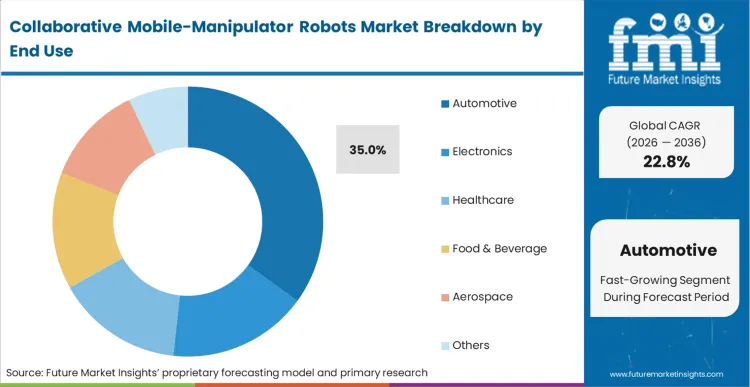
Based on FMI's assessment, robotics systems capable of navigating an active warehouse floor and directly loading a sorting bin allow supply chain engineers to continuously reconfigure operations without tearing out infrastructure. Logistics networks face extreme labor turnover and intense pressure to manage massive, highly varied parts inventories, driving the logistics segment to a 35.0% share. Fixed assembly lines and static sorting zones are giving way to flexible piece-picking environments. The commercial consequence for a logistics operator clinging to rigid conveyor systems is the inability to competitively execute on modern, high-volume e-commerce contracts that demand rapid fulfillment changeovers.
- Configuration Flexibility: Cellular distribution layouts require materials to be routed dynamically rather than linearly. Production engineers program mobile manipulators to adapt instantly to changing fulfillment sequences.
- Tool Tending: Arms mounted on autonomous bases can load and unload sortation machines without human supervision. Plant managers maximize machine utilization across lights-out, unattended shifts.
- Component Kitting: Specialized end-effectors pick diverse parts to assemble complete kits for outbound delivery. Inventory supervisors eliminate the staging errors common in manual kit preparation.
Collaborative Mobile-Manipulator Robots Market Analysis by Mobility Type
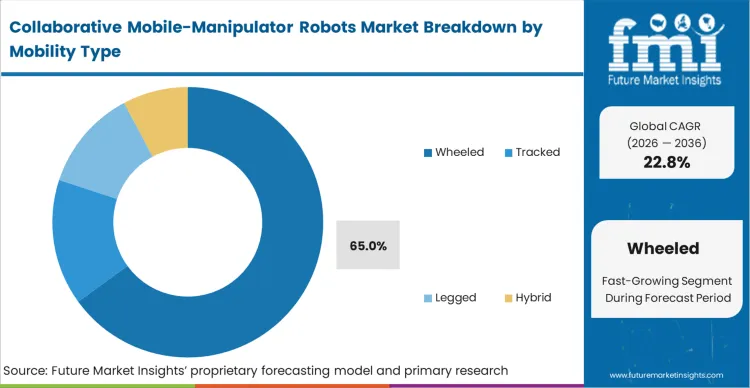
Kitting robots utilizing wheeled architectures calculate straightforward 2D path planning, simplifying the computational load on the fleet management system. Intralogistics directors favor this sub-segment because it minimizes maintenance complexities compared to legged or tracked alternatives. Wheeled mobility holds a dominant 65.0% share because modern manufacturing and fulfillment centers are fundamentally designed around flat, finished concrete floors. The friction coefficient and navigation dynamics of a wheeled base offer the highest speed-to-energy ratio for indoor intralogistics. Buyers attempting to deploy non-wheeled solutions in standard warehousing environments encounter unnecessary mechanical maintenance overhead and reduced battery life without realizing any practical navigational advantage.
- Path Planning Simplicity: Two-dimensional navigation algorithms calculate wheeled routes with minimal computational latency. Software integrators deploy and map facilities significantly faster than with complex multi-terrain platforms.
- Energy Density: Wheeled locomotion requires minimal continuous power to maintain momentum on flat surfaces. Facility managers achieve longer operational shifts and require fewer charging stations per fleet.
- Payload Stability: Four-point wheeled bases provide a rigid platform necessary for the arm to execute precision picks without tipping. Engineering leads rely on this stability to maintain high repeatability tolerances.
Collaborative Mobile-Manipulator Robots Market Drivers, Restraints, and Opportunities
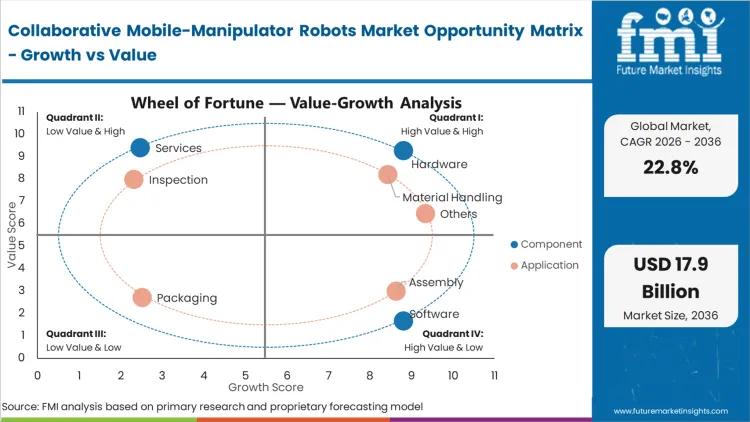
Intralogistics directors operating in multi-shift environments are actively eliminating the human bridge that has traditionally connected autonomous transport with stationary picking. While legacy facilities successfully isolated movement to AMRs and manipulation to fixed arms, severe labor shortages now make that manual handoff a critical point of failure. Closing this operational gap through integrated mobile manipulators allows major manufacturers to execute continuous, lights-out material handling. Supply chain executives who successfully deploy these combined systems insulate their production schedules from workforce volatility, whereas those who hesitate find their throughput severely bottlenecked during peak demand cycles.
Achieving a zero-latency handoff between an arriving autonomous base and an executing robotic arm remains the definitive software engineering challenge restricting immediate mass deployment. While mechanically integrating the two components is relatively straightforward, the underlying complexity of syncing discrete arm controllers with overarching fleet management software creates significant operational friction. This architectural barrier inevitably traps buyers in prolonged pilot phases, forcing systems integrators to manually custom-code API bridges tailored to specific facility layouts. Even as robotics as a service models emerge to mitigate initial integration expenses, the fundamental technical hurdle of synchronized controller communication continues to stretch deployment timelines.
Opportunities in the Collaborative Mobile-Manipulator Robots Market
- Fleet Interoperability: The lack of universal software standards creates an opening for vendor-agnostic middleware platforms. Software developers who create universal APIs allowing mixed-fleet communication can capture significant licensing revenue from large-scale integrators.
- End-effector Versatility: Rapid tool-changing mechanisms allow a single mobile manipulator to execute distinct tasks across different factory zones. Tooling manufacturers can penetrate the market by developing lightweight, multi-purpose grippers suited for autonomous automotive robotics environments.
- Edge Computing Integration: Processing vision data locally on the robot rather than the cloud eliminates latency in dynamic environments. Hardware vendors embedding dedicated edge AI accelerators directly into the mobile base can secure premium positioning with high-speed fulfillment operators.
Regional Analysis
The geographical adoption of collaborative mobile-manipulator robots reveals a sharp contrast between aggressive, greenfield scaling in emerging Asia-Pacific hubs and the intricate brownfield retrofitting required in established Western industrial centers. These distinct regional labor pressures and legacy infrastructure realities directly dictate the pace of intralogistics modernization worldwide. Based on the regional analysis, the market is segmented into Asia-Pacific, Europe, North America, and other regions across 40 plus countries.
.webp "Top Country Growth Comparison Collaborative Mobile Manipulator Robots Market Cagr (2026 2036)")
| Country | CAGR (2026 to 2036) |
|---|---|
| India | 27.5% |
| China | 26.0% |
| Japan | 24.5% |
| South Korea | 24.0% |
| United States | 23.0% |
| Germany | 22.0% |
| France | 21.5% |
Source: Future Market Insights (FMI) analysis, based on proprietary forecasting model and primary research
Asia-Pacific Collaborative Mobile-Manipulator Robots Market Analysis
Across the Asia-Pacific region, state-sponsored modernization initiatives and a massive influx of outsourced contract manufacturing are converging to fundamentally accelerate the deployment of mobile manipulation. Rather than piecemeal upgrades to older equipment, plant operators are building greenfield facilities entirely free of fixed conveyor lines, relying instead on autonomous fleets to orchestrate complex component routing. The localized production of sophisticated robotics actuators further lowers initial capital barriers, enabling semiconductor fabricators and electronics assemblers across the continent to deploy these systems at an unprecedented, infrastructure-led scale.
- India: To successfully absorb massive production volumes shifting from international brands, domestic electronics sectors are rapidly embedding flexible automation into their expanding operations. These dynamic routing solutions allow plant operators to expertly navigate the high-mix production complexities introduced by global supply chain realignments. India's aggressive capacity expansion is forecast to register a market-leading CAGR of 27.5%, by establishing fully autonomous lines that seamlessly handle outsourced industrial workflows.
- China: Sustaining dominant global export volumes requires massive electronics fabricators in Shenzhen and automotive centers in Shanghai to aggressively deploy flexible intralogistics. Expanding at a rapid CAGR of 26.0%, the Chinese market reflects an intense structural pivot away from pure manual labor toward highly adaptable, automated production hubs. By eliminating static assembly lines in favor of dynamic-routing cells, domestic plant operators capture the operational agility necessary to win lucrative, high-mix contract manufacturing bids.
- Japan: Recording a projected CAGR of 24.5% through the forecast period, Japan's adoption is structurally catalyzed by a rapidly shrinking pool of available manual labor. To counter these severe demographic constraints, legacy heavy machinery plants and automotive facilities are aggressively integrating mobile arms to autonomously execute repetitive tool tending and line-side kitting. This strategic operational pivot successfully stabilizes manufacturing throughput without relying on an evaporating human workforce.
- South Korea: Engineering directors within highly concentrated semiconductor sectors face intense pressure to maintain flawless execution in delicate cleanroom environments. Aggressively deploying mobile manipulators to transfer fragile silicon wafers across processing nodes, the domestic industry is poised to grow at a 24.0% CAGR as it eliminates the contamination risks inherent to human operators. Prioritizing extreme precision over sheer volume provides these South Korean facilities with a distinct strategic moat against emerging regional competitors.
FMI's report includes extensive analysis of emerging manufacturing ecosystems across Southeast Asia, specifically Vietnam and Thailand. These secondary markets are beginning to bypass traditional fixed-automation phases entirely, pulling advanced mobile manipulator fleets directly into newly constructed electronics assembly hubs.
Europe Collaborative Mobile-Manipulator Robots Market Analysis
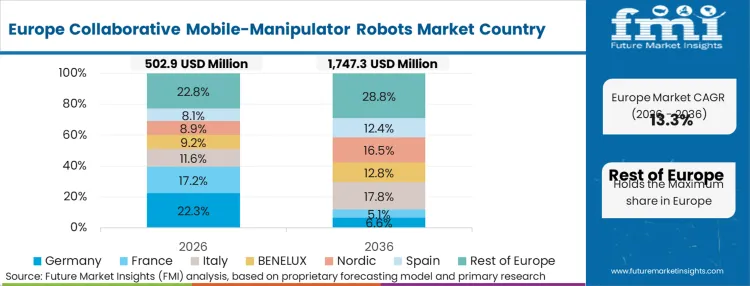
Stringent occupational safety mandates and incredibly dense, high-value manufacturing footprints strictly dictate the trajectory of Europe's intralogistics modernization. Because regional regulations heavily penalize manual ergonomic strain, facility managers actively seek collaborative platforms to eliminate hazardous material transport operations. Procurement across these established brownfield sites heavily prioritizes safety certification and spatial efficiency, forcing vendors to deliver flawless navigation through exceptionally narrow, historic layouts. The ultimate qualification barrier for integrators operating here remains the implementation of robust motion control software capable of ensuring millimeter-precise halting within heavily populated factory aisles.
- Germany: The intense necessity to transition toward highly flexible Industry 4.0 architectures places immense pressure on high-mix automotive and industrial machinery sectors. Tier-1 suppliers increasingly demand autonomous mobile arms to seamlessly shuttle customized sub-assemblies throughout constantly shifting factory layouts. Fueling a projected CAGR of 22.0% by mastering this dynamic routing creates a definitive operational gap, empowering domestic manufacturers to profitably deliver custom engineering contracts that would otherwise overwhelm static production infrastructure.
- France: Tracking a CAGR of 21.5%, the French intralogistics sector is fundamentally shaped by compact facility footprints and premium real estate costs. Operations directors are forced to deploy mobile arms capable of extracting bins from high-density shelving structures without expanding the physical dimensions of the warehouse. This transition to automated retrieval permanently alters the site's economics by effectively doubling the accessible pick rate per available square meter.
FMI's report includes analysis of adoption patterns across the Nordics and Western Europe. These regions exhibit a strong preference for multi-vendor fleet interoperability, prioritizing software-agnostic platforms over closed proprietary hardware ecosystems.
North America Collaborative Mobile-Manipulator Robots Market Analysis
Massive e-commerce volumes intersecting with chronic labor instability form the primary economic engine driving North American deployments. Fulfillment operators operate under severe throughput pressures, allocating capital explicitly to accelerate piece-picking sequences for next-day delivery timelines. Unlike Asia's manufacturing-centric demand, buyers here overwhelmingly funnel these autonomous units into distribution centers to manage highly varied sorting and palletizing workflows. Navigating unstructured environments filled with unstandardized packaging requires the aggressive integration of sophisticated vision AI, leading major logistics networks to heavily favor vendors equipped with advanced robotic changeover systems that instantly adapt hardware from single-bin extraction to bulk wrapping tasks.
- United States: Unprecedented workforce turnover and wage inflation compel mega-retailers across the country to aggressively remove human labor from the piece-picking equation. Supply chain architects are introducing sprawling fleets of mobile manipulators to independently identify, grasp, and sort unique SKUs directly into outbound shipping containers, driving the domestic market to expand at an impressive 23.0% CAGR. Logistics networks that successfully operationalize this autonomous workflow capture a massive commercial advantage by permanently slashing their per-unit fulfillment expenses.
FMI's report includes cross-border logistics analysis detailing automation deployments in Canada and Mexico. The expansion of nearshoring operations in Mexico creates an emerging secondary market for automated line-side delivery systems within new automotive assembly plants.
Competitive Aligners for Market Players
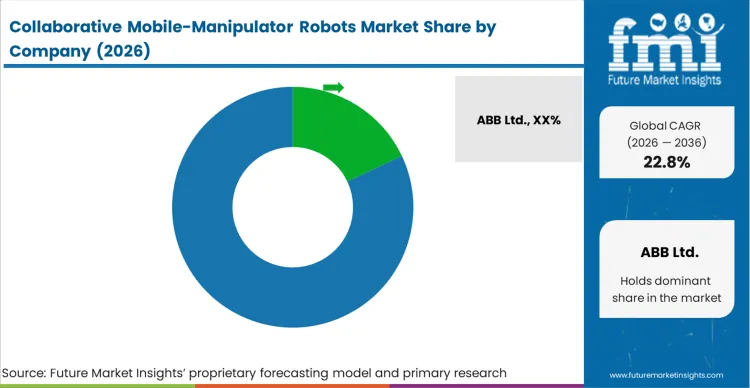
Navigating the immense engineering barrier of fusing millimeter-precise kinematics with autonomous floor navigation naturally confines this sector to a select tier of heavily capitalized automation giants. Procurement teams at top-tier manufacturing facilities do not view the base or the arm as separate entities; they evaluate the system's ability to seamlessly execute a synchronized pick without triggering collaborative safety halts. Resulting with enterprise buyers to gravitate toward entrenched incumbents like ABB Ltd., FANUC Corporation, KUKA AG, and Yaskawa Electric Corporation. These organizations possess the global support infrastructure and verified mean-time-between-failure data required to de-risk massive capital deployments. When qualifying these platforms, intralogistics directors rely almost exclusively on a single distinguishing variable: the maturity of the fleet management software and its demonstrated capacity to orchestrate complex, multi-unit workflows in live production environments without requiring constant human intervention.
Deep repositories of real-world floor data create an almost insurmountable moat for early pioneers. Entities like Boston Dynamics, Mobile Industrial Robots (MiR), and Omron Corporation leverage thousands of hours of edge-case navigation data collected across highly dynamic warehouse environments, rendering their autonomous obstacle avoidance algorithms exceptionally robust against unpredictable factory traffic. To credibly challenge this dominance, new entrants cannot simply engineer a cheaper physical platform; they must develop comprehensive digital twin architectures that allow facility engineers to virtually map, stress-test, and validate an entire automated workflow before any physical hardware arrives on site. Vendors attempting to secure enterprise contracts without providing these predictive simulation environments, relying instead on physical tactical ground robot demonstrations or manual facility mapping, face immediate disqualification during rigorous technical procurement reviews.
Enterprise procurement entities are aggressively maneuvering to prevent operational capture by single-vendor hardware ecosystems. Automotive and logistics giants purchasing fleets at scale actively demand open-API architectures, refusing to deploy any system that cannot be commanded through a centralized, vendor-agnostic control tower. This dynamic introduces a profound structural friction into the market, while dominant hardware manufacturers are economically incentivized to lock buyers into proprietary interfaces, their largest customers require absolute interoperability to mix and match robotic assets as facility needs evolve. As buyers successfully force these communication protocols open over the next decade, the premium margins currently attached to integrated physical hardware will steadily erode, transferring the bulk of the industry's commercial value directly into the overarching fleet coordination and motion-control software layers.
Key Players in Collaborative Mobile-Manipulator Robots Market
- ABB Ltd.
- FANUC Corporation
- KUKA AG
- Yaskawa Electric Corporation
- Boston Dynamics
- Mobile Industrial Robots (MiR)
- Omron Corporation
Scope of the Report
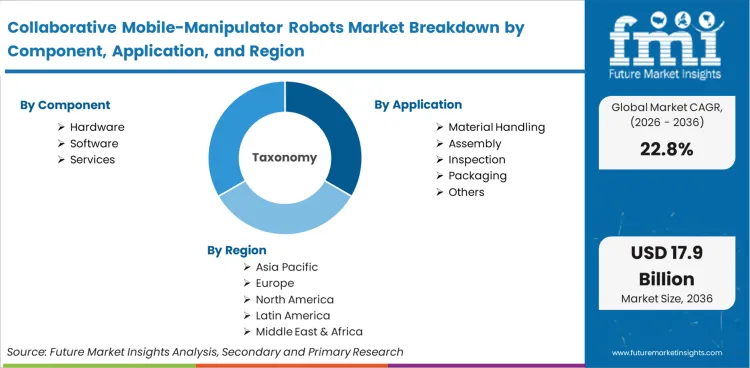
| Metric | Value |
|---|---|
| Quantitative Units | USD 2.3 billion to USD 17.6 billion, at a CAGR of 22.8% |
| Market Definition | Integrated autonomous robotic systems combining a mobile navigation base with an articulated collaborative arm, designed to safely operate alongside humans to fetch, transport, and manipulate payloads across dynamic facility environments. |
| Component Segmentation | Hardware, Software, Services |
| Payload Capacity Segmentation | Up to 5 Kg, 5–10 Kg, Above 10 Kg |
| Application Segmentation | Material Handling, Assembly, Inspection, Packaging, Others |
| End-User Segmentation | Automotive, Electronics, Healthcare, Logistics, Food & Beverage, Aerospace, Others |
| Mobility Type Segmentation | Wheeled, Tracked, Legged, Hybrid |
| Regions Covered | East Asia, Europe, North America, South Asia, Middle East and Africa, Oceania, Latin America |
| Countries Covered | China, Germany, India, United Kingdom, United States, South Korea, Japan, and 40 plus countries |
| Key Companies Profiled | ABB Ltd., FANUC Corporation, KUKA AG, Yaskawa Electric Corporation, Boston Dynamics, Mobile Industrial Robots (MiR), Omron Corporation |
| Forecast Period | 2026 to 2036 |
| Approach | Primary interviews were conducted with operations directors and intralogistics engineering leads. The baseline was anchored to global hardware shipment volumes and cross-verified against industrial capital expenditure allocations. Data validation relied on triangulating OEM financial reporting with independent manufacturing automation indices. |
Source: Future Market Insights (FMI) analysis, based on proprietary forecasting model and primary research
Segments
Component:
- Hardware
- Software
- Services
Payload Capacity:
- Up to 5 Kg
- 5-10 Kg
- Above 10 Kg
Application:
- Material Handling
- Assembly
- Inspection
- Packaging
- Others
End-User:
- Automotive
- Electronics
- Healthcare
- Logistics
- Food & Beverage
- Aerospace
- Others
Mobility Type:
- Wheeled
- Tracked
- Legged
- Hybrid
Regions:
- North America
- USA
- South America
- Brazil
- Asia Pacific
- China
- India
- Japan
- Australia
- Europe
- Germany
Bibliography
- International Federation of Robotics. (2025, January). World Robotics Press Conference 2025: Industrial robots. International Federation of Robotics.
- Association for Advancing Automation (A3). (2025, February). Industry insights report: The Rise of Mobile Manipulators: AI-Enabled Robots Find Place in More Applications. Association for Advancing Automation.
- IEEE Robotics and Automation Society. (2024, November). Mobile Manipulation Standards. Mobile Manipulation Instruction Generation From Multiple Images With Automatic Metric Enhancement. IEEE.
- Mobile Industrial Robots (MiR). (2026). MiR Fleet Enterprise: Powerful, Cyber-Secured Fleet Management for Optimized Control and Productivity.
- Boston Dynamics. (2004). Boston Dynamics Spot and Site Hub Security. Whitepaper.
This bibliography is provided for reader reference. The full FMI report contains the complete reference list with primary source documentation.
This Report Addresses
- Market intelligence to support strategic decision making across discrete hardware, fleet management software, and physical integration services within the intralogistics sector
- Market size estimation and 10-year revenue forecasts from 2026 to 2036, supported by direct hardware shipment volume triangulation and OEM financial disclosures
- Growth opportunity mapping across specific payload capacities and mobility architectures with emphasis on the standardization of API layers between mobile bases and robotic arms
- Segment and regional revenue forecasts covering critical wheeled architectures and material handling applications across stringent European collaborative safety regulatory environments
- Competition strategy assessment including fleet interoperability requirements, API openness, and the shift from pure hardware to motion control software execution
- Technology development tracking including vendor-agnostic middleware platforms, rapid end-effector tool changers, and localized edge AI computer vision processors
- Market access analysis covering ISO collaborative safety certifications, facility layout qualification hurdles, and integration timeline bottlenecks
- Market report delivery in PDF, Excel, PPT, and interactive dashboard formats for executive strategy, intralogistics facility planning, and operational benchmarking use
Frequently Asked Questions
How large is the Collaborative Mobile-Manipulator Robots in 2026?
The market is projected to reach USD 2.3 billion in 2026, marking a significant transition toward flexible intralogistics.
What will it be valued at by 2036?
It is anticipated to cross USD 17.6 billion by 2036 as autonomous fleets replace fixed-base robotic infrastructure globally.
What CAGR is projected?
A robust 22.8% CAGR is expected throughout the forecast period.
Which Component segment leads?
Hardware accounts for 55.0% of the market value due to the high capital density of physical actuators and navigation bases.
Which Application segment leads?
Material Handling commands 40.0% of the market as facility operators prioritize the elimination of manual cart transport.
Which End-User segment leads?
Logistics operations capture 35.0% of the market to offset intense labor turnover in fulfillment centers.
What drives rapid growth?
High product-mix manufacturing environments require the dynamic routing capabilities that only mobile manipulators can provide.
What is the primary restraint?
The software engineering complexity involved in achieving zero-latency handoffs between mobile bases and robotic arm controllers limits rapid deployment.
Which country grows fastest?
India leads global growth with a 27.5% CAGR, fueled by massive capacity expansion in its domestic electronics sector.
How does the Up to 5 Kg payload specification influence operations?
Lightweight arms enable higher kinematic efficiency and longer battery life for high-repetition micro-assembly tasks.
What role does edge computing play in this sector?
Localized vision processing eliminates data latency, allowing robots to execute precise picks in highly dynamic environments.
Why are enterprise buyers demanding fleet interoperability?
Large-scale operators require open-API architectures to prevent being locked into a single vendor's proprietary hardware ecosystem.
How does wheeled mobility impact deployment timelines?
The computational simplicity of 2D path planning on wheeled bases allows for significantly faster facility mapping and system rollout.
What commercial consequence faces facilities relying on manual kitting?
An inability to bid on high-mix contracts due to the error rates and latencies associated with manual staging.
How do European collaborative safety regulations shape procurement?
Stringent mandates require vendors to prove millimeter-precise stopping distances to protect human workers in crowded aisles.
Why does the Logistics sector hold 35.0% of the market?
Autonomous piece-picking is essential for maintaining throughput in distribution centers facing chronic labor instability.
What shifts when a factory moves from fixed arms to mobile manipulators?
The facility's spatial architecture becomes fundamentally more dense as fixed transfer zones and staging areas are eliminated.
How do vendors establish competitive advantage?
Providing sophisticated digital twin environments allows buyers to validate automated workflows virtually before physical installation.
Why is Hardware capital density so high?
The integration of LiDAR, high-torque servomotors, and articulated arms into a stable mobile platform necessitates premium physical components.
What dictates the growth rate in the United States logistics sector?
The 23.0% US growth rate is driven by the urgent replacement of manual labor in fulfillment centers with autonomous piece-picking fleets.
Which Mobility Type dominates the market?
Wheeled architectures hold 65.0% share because they offer the most energy-efficient locomotion on flat industrial concrete.
How are Robotics as a Service (RaaS) models impacting the sector?
RaaS shifts the financial burden from capital to operating expenditure, enabling faster piloting of advanced intralogistics systems.
Preview the report firsthand - request a free sample
Get SampleGet the brochure for pricing and purchase details.
Get PDFTable of Content
- Executive Summary
- Global Market Outlook
- Demand-side Trends
- Supply-side Trends
- Technology Roadmap Analysis
- Analysis and Recommendations
- Market Overview
- Market Coverage / Taxonomy
- Market Definition / Scope / Limitations
- Research Methodology
- Chapter Orientation
- Analytical Lens and Working Hypotheses
- Market Structure, Signals, and Trend Drivers
- Benchmarking and Cross-market Comparability
- Market Sizing, Forecasting, and Opportunity Mapping
- Research Design and Evidence Framework
- Desk Research Programme (Secondary Evidence)
- Company Annual and Sustainability Reports
- Peer-reviewed Journals and Academic Literature
- Corporate Websites, Product Literature, and Technical Notes
- Earnings Decks and Investor Briefings
- Statutory Filings and Regulatory Disclosures
- Technical White Papers and Standards Notes
- Trade Journals, Industry Magazines, and Analyst Briefs
- Conference Proceedings, Webinars, and Seminar Materials
- Government Statistics Portals and Public Data Releases
- Press Releases and Reputable Media Coverage
- Specialist Newsletters and Curated Briefings
- Sector Databases and Reference Repositories
- FMI Internal Proprietary Databases and Historical Market Datasets
- Subscription Datasets and Paid Sources
- Social Channels, Communities, and Digital Listening Inputs
- Additional Desk Sources
- Expert Input and Fieldwork (Primary Evidence)
- Primary Modes
- Qualitative Interviews and Expert Elicitation
- Quantitative Surveys and Structured Data Capture
- Blended Approach
- Why Primary Evidence is Used
- Field Techniques
- Interviews
- Surveys
- Focus Groups
- Observational and In-context Research
- Social and Community Interactions
- Stakeholder Universe Engaged
- C-suite Leaders
- Board Members
- Presidents and Vice Presidents
- R&D and Innovation Heads
- Technical Specialists
- Domain Subject-matter Experts
- Scientists
- Physicians and Other Healthcare Professionals
- Governance, Ethics, and Data Stewardship
- Research Ethics
- Data Integrity and Handling
- Primary Modes
- Tooling, Models, and Reference Databases
- Desk Research Programme (Secondary Evidence)
- Data Engineering and Model Build
- Data Acquisition and Ingestion
- Cleaning, Normalisation, and Verification
- Synthesis, Triangulation, and Analysis
- Quality Assurance and Audit Trail
- Market Background
- Market Dynamics
- Drivers
- Restraints
- Opportunity
- Trends
- Scenario Forecast
- Demand in Optimistic Scenario
- Demand in Likely Scenario
- Demand in Conservative Scenario
- Opportunity Map Analysis
- Product Life Cycle Analysis
- Supply Chain Analysis
- Investment Feasibility Matrix
- Value Chain Analysis
- PESTLE and Porter’s Analysis
- Regulatory Landscape
- Regional Parent Market Outlook
- Production and Consumption Statistics
- Import and Export Statistics
- Market Dynamics
- Global Market Analysis 2021 to 2025 and Forecast, 2026 to 2036
- Historical Market Size Value (USD Million) Analysis, 2021 to 2025
- Current and Future Market Size Value (USD Million) Projections, 2026 to 2036
- Y-o-Y Growth Trend Analysis
- Absolute $ Opportunity Analysis
- Global Market Pricing Analysis 2021 to 2025 and Forecast 2026 to 2036
- Global Market Analysis 2021 to 2025 and Forecast 2026 to 2036, By Component
- Introduction / Key Findings
- Historical Market Size Value (USD Million) Analysis By Component , 2021 to 2025
- Current and Future Market Size Value (USD Million) Analysis and Forecast By Component , 2026 to 2036
- Hardware
- Software
- Services
- Hardware
- Y-o-Y Growth Trend Analysis By Component , 2021 to 2025
- Absolute $ Opportunity Analysis By Component , 2026 to 2036
- Global Market Analysis 2021 to 2025 and Forecast 2026 to 2036, By Application
- Introduction / Key Findings
- Historical Market Size Value (USD Million) Analysis By Application, 2021 to 2025
- Current and Future Market Size Value (USD Million) Analysis and Forecast By Application, 2026 to 2036
- Material Handling
- Assembly
- Inspection
- Packaging
- Others
- Material Handling
- Y-o-Y Growth Trend Analysis By Application, 2021 to 2025
- Absolute $ Opportunity Analysis By Application, 2026 to 2036
- Global Market Analysis 2021 to 2025 and Forecast 2026 to 2036, By End Use
- Introduction / Key Findings
- Historical Market Size Value (USD Million) Analysis By End Use, 2021 to 2025
- Current and Future Market Size Value (USD Million) Analysis and Forecast By End Use, 2026 to 2036
- Automotive
- Electronics
- Healthcare
- Food & Beverage
- Aerospace
- Others
- Automotive
- Y-o-Y Growth Trend Analysis By End Use, 2021 to 2025
- Absolute $ Opportunity Analysis By End Use, 2026 to 2036
- Global Market Analysis 2021 to 2025 and Forecast 2026 to 2036, By Mobility Type
- Introduction / Key Findings
- Historical Market Size Value (USD Million) Analysis By Mobility Type, 2021 to 2025
- Current and Future Market Size Value (USD Million) Analysis and Forecast By Mobility Type, 2026 to 2036
- Wheeled
- Tracked
- Legged
- Hybrid
- Wheeled
- Y-o-Y Growth Trend Analysis By Mobility Type, 2021 to 2025
- Absolute $ Opportunity Analysis By Mobility Type, 2026 to 2036
- Global Market Analysis 2021 to 2025 and Forecast 2026 to 2036, By Region
- Introduction
- Historical Market Size Value (USD Million) Analysis By Region, 2021 to 2025
- Current Market Size Value (USD Million) Analysis and Forecast By Region, 2026 to 2036
- North America
- Latin America
- Western Europe
- Eastern Europe
- East Asia
- South Asia and Pacific
- Middle East & Africa
- Market Attractiveness Analysis By Region
- North America Market Analysis 2021 to 2025 and Forecast 2026 to 2036, By Country
- Historical Market Size Value (USD Million) Trend Analysis By Market Taxonomy, 2021 to 2025
- Market Size Value (USD Million) Forecast By Market Taxonomy, 2026 to 2036
- By Country
- USA
- Canada
- Mexico
- By Component
- By Application
- By End Use
- By Mobility Type
- By Country
- Market Attractiveness Analysis
- By Country
- By Component
- By Application
- By End Use
- By Mobility Type
- Key Takeaways
- Latin America Market Analysis 2021 to 2025 and Forecast 2026 to 2036, By Country
- Historical Market Size Value (USD Million) Trend Analysis By Market Taxonomy, 2021 to 2025
- Market Size Value (USD Million) Forecast By Market Taxonomy, 2026 to 2036
- By Country
- Brazil
- Chile
- Rest of Latin America
- By Component
- By Application
- By End Use
- By Mobility Type
- By Country
- Market Attractiveness Analysis
- By Country
- By Component
- By Application
- By End Use
- By Mobility Type
- Key Takeaways
- Western Europe Market Analysis 2021 to 2025 and Forecast 2026 to 2036, By Country
- Historical Market Size Value (USD Million) Trend Analysis By Market Taxonomy, 2021 to 2025
- Market Size Value (USD Million) Forecast By Market Taxonomy, 2026 to 2036
- By Country
- Germany
- UK
- Italy
- Spain
- France
- Nordic
- BENELUX
- Rest of Western Europe
- By Component
- By Application
- By End Use
- By Mobility Type
- By Country
- Market Attractiveness Analysis
- By Country
- By Component
- By Application
- By End Use
- By Mobility Type
- Key Takeaways
- Eastern Europe Market Analysis 2021 to 2025 and Forecast 2026 to 2036, By Country
- Historical Market Size Value (USD Million) Trend Analysis By Market Taxonomy, 2021 to 2025
- Market Size Value (USD Million) Forecast By Market Taxonomy, 2026 to 2036
- By Country
- Russia
- Poland
- Hungary
- Balkan & Baltic
- Rest of Eastern Europe
- By Component
- By Application
- By End Use
- By Mobility Type
- By Country
- Market Attractiveness Analysis
- By Country
- By Component
- By Application
- By End Use
- By Mobility Type
- Key Takeaways
- East Asia Market Analysis 2021 to 2025 and Forecast 2026 to 2036, By Country
- Historical Market Size Value (USD Million) Trend Analysis By Market Taxonomy, 2021 to 2025
- Market Size Value (USD Million) Forecast By Market Taxonomy, 2026 to 2036
- By Country
- China
- Japan
- South Korea
- By Component
- By Application
- By End Use
- By Mobility Type
- By Country
- Market Attractiveness Analysis
- By Country
- By Component
- By Application
- By End Use
- By Mobility Type
- Key Takeaways
- South Asia and Pacific Market Analysis 2021 to 2025 and Forecast 2026 to 2036, By Country
- Historical Market Size Value (USD Million) Trend Analysis By Market Taxonomy, 2021 to 2025
- Market Size Value (USD Million) Forecast By Market Taxonomy, 2026 to 2036
- By Country
- India
- ASEAN
- Australia & New Zealand
- Rest of South Asia and Pacific
- By Component
- By Application
- By End Use
- By Mobility Type
- By Country
- Market Attractiveness Analysis
- By Country
- By Component
- By Application
- By End Use
- By Mobility Type
- Key Takeaways
- Middle East & Africa Market Analysis 2021 to 2025 and Forecast 2026 to 2036, By Country
- Historical Market Size Value (USD Million) Trend Analysis By Market Taxonomy, 2021 to 2025
- Market Size Value (USD Million) Forecast By Market Taxonomy, 2026 to 2036
- By Country
- Kingdom of Saudi Arabia
- Other GCC Countries
- Turkiye
- South Africa
- Other African Union
- Rest of Middle East & Africa
- By Component
- By Application
- By End Use
- By Mobility Type
- By Country
- Market Attractiveness Analysis
- By Country
- By Component
- By Application
- By End Use
- By Mobility Type
- Key Takeaways
- Key Countries Market Analysis
- USA
- Pricing Analysis
- Market Share Analysis, 2025
- By Component
- By Application
- By End Use
- By Mobility Type
- Canada
- Pricing Analysis
- Market Share Analysis, 2025
- By Component
- By Application
- By End Use
- By Mobility Type
- Mexico
- Pricing Analysis
- Market Share Analysis, 2025
- By Component
- By Application
- By End Use
- By Mobility Type
- Brazil
- Pricing Analysis
- Market Share Analysis, 2025
- By Component
- By Application
- By End Use
- By Mobility Type
- Chile
- Pricing Analysis
- Market Share Analysis, 2025
- By Component
- By Application
- By End Use
- By Mobility Type
- Germany
- Pricing Analysis
- Market Share Analysis, 2025
- By Component
- By Application
- By End Use
- By Mobility Type
- UK
- Pricing Analysis
- Market Share Analysis, 2025
- By Component
- By Application
- By End Use
- By Mobility Type
- Italy
- Pricing Analysis
- Market Share Analysis, 2025
- By Component
- By Application
- By End Use
- By Mobility Type
- Spain
- Pricing Analysis
- Market Share Analysis, 2025
- By Component
- By Application
- By End Use
- By Mobility Type
- France
- Pricing Analysis
- Market Share Analysis, 2025
- By Component
- By Application
- By End Use
- By Mobility Type
- India
- Pricing Analysis
- Market Share Analysis, 2025
- By Component
- By Application
- By End Use
- By Mobility Type
- ASEAN
- Pricing Analysis
- Market Share Analysis, 2025
- By Component
- By Application
- By End Use
- By Mobility Type
- Australia & New Zealand
- Pricing Analysis
- Market Share Analysis, 2025
- By Component
- By Application
- By End Use
- By Mobility Type
- China
- Pricing Analysis
- Market Share Analysis, 2025
- By Component
- By Application
- By End Use
- By Mobility Type
- Japan
- Pricing Analysis
- Market Share Analysis, 2025
- By Component
- By Application
- By End Use
- By Mobility Type
- South Korea
- Pricing Analysis
- Market Share Analysis, 2025
- By Component
- By Application
- By End Use
- By Mobility Type
- Russia
- Pricing Analysis
- Market Share Analysis, 2025
- By Component
- By Application
- By End Use
- By Mobility Type
- Poland
- Pricing Analysis
- Market Share Analysis, 2025
- By Component
- By Application
- By End Use
- By Mobility Type
- Hungary
- Pricing Analysis
- Market Share Analysis, 2025
- By Component
- By Application
- By End Use
- By Mobility Type
- Kingdom of Saudi Arabia
- Pricing Analysis
- Market Share Analysis, 2025
- By Component
- By Application
- By End Use
- By Mobility Type
- Turkiye
- Pricing Analysis
- Market Share Analysis, 2025
- By Component
- By Application
- By End Use
- By Mobility Type
- South Africa
- Pricing Analysis
- Market Share Analysis, 2025
- By Component
- By Application
- By End Use
- By Mobility Type
- USA
- Market Structure Analysis
- Competition Dashboard
- Competition Benchmarking
- Market Share Analysis of Top Players
- By Regional
- By Component
- By Application
- By End Use
- By Mobility Type
- Competition Analysis
- Competition Deep Dive
- ABB Ltd.
- Overview
- Product Portfolio
- Profitability by Market Segments (Product/Age /Sales Channel/Region)
- Sales Footprint
- Strategy Overview
- Marketing Strategy
- Product Strategy
- Channel Strategy
- FANUC Corporation
- KUKA AG
- Yaskawa Electric Corporation
- Boston Dynamics
- Mobile Industrial Robots (MiR)
- Omron Corporation
- ABB Ltd.
- Competition Deep Dive
- Assumptions & Acronyms Used


