

- Industry Size (2025)
- USD 18.5 Bn
- Forecast (2035)
- USD 56.6 Bn
- CAGR (2025 to 2035)
- 11.8%
Mobile Robots Market Size and Share Forecast Outlook 2025 to 2035
The Mobile Robots Market is estimated to be valued at USD 18.5 billion in 2025 and is projected to reach USD 56.6 billion by 2035, registering a compound annual growth rate (CAGR) of 11.8% over the forecast period.
Quick Stats for Mobile Robots Market
- Mobile Robots Market Value (2025): USD 18.5 billion
- Mobile Robots Market Forecast Value (2035): USD 56.6 billion
- Mobile Robots Market Forecast CAGR: 11.8%
- Leading Segment in Mobile Robots Market in 2025: Ground (45.0%)
- Key Growth Regions in Mobile Robots Market: North America, Asia-Pacific, Europe
- Top Key Players in Mobile Robots Market: KUKA AG, ABB Ltd., Omron Corporation, Boston Dynamics, Clearpath Robotics, Mobile Industrial Robots (MiR), Geek+, Vecna Robotics
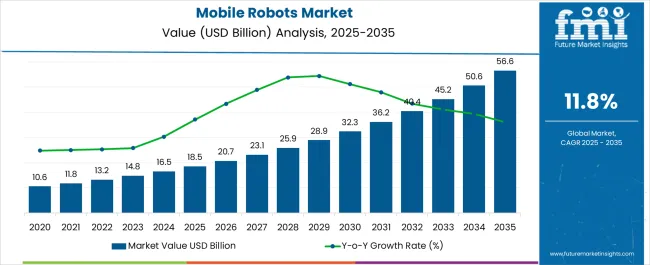
Mobile Robots Market Key Takeaways
| Metric | Value |
|---|---|
| Mobile Robots Market Estimated Value in (2025 E) | USD 18.5 billion |
| Mobile Robots Market Forecast Value in (2035 F) | USD 56.6 billion |
| Forecast CAGR (2025 to 2035) | 11.8% |
Why is the Mobile Robots Market Growing?
The Mobile Robots market is witnessing accelerated growth as automation and intelligent navigation technologies become central to industries worldwide. The current market landscape is shaped by advances in artificial intelligence, computer vision, and autonomous navigation, which are enabling robots to operate seamlessly in dynamic and complex environments. The increasing need for flexible automation across logistics, manufacturing, healthcare, and service sectors is driving widespread adoption.
Software integration has become a critical enabler, allowing mobile robots to adapt to various applications without hardware modifications. Rising labor costs, demand for faster throughput, and the requirement for safety in workplaces are further pushing investments in mobile robotic systems. Continuous advancements in battery technologies and sensors are improving performance, reliability, and operating time, enhancing the commercial viability of these systems.
The future outlook indicates strong expansion potential as mobile robots transition from pilot deployments to enterprise-wide adoption The convergence of robotics with data analytics and connected infrastructure is expected to open new opportunities, cementing their role in industrial and service automation.
Segmental Analysis
The mobile robots market is segmented by operating environment, component, application, and geographic regions. By operating environment, mobile robots market is divided into Ground, Marine, and Aerial. In terms of component, mobile robots market is classified into Sensors, Hardware, Power Supply, Control System, Actuators, Others (Electrical, Electronic, And Mechanical Components), and Software. Based on application, mobile robots market is segmented into Logistic, Domestic, Military, Entertainment, Education, And Personal, Public Relations And Inspection, Medical, Human Exoskeleton, Field, and Construction And Demolition. Regionally, the mobile robots industry is classified into North America, Latin America, Western Europe, Eastern Europe, Balkan & Baltic Countries, Russia & Belarus, Central Asia, East Asia, South Asia & Pacific, and the Middle East & Africa.
Insights into the Ground Segment
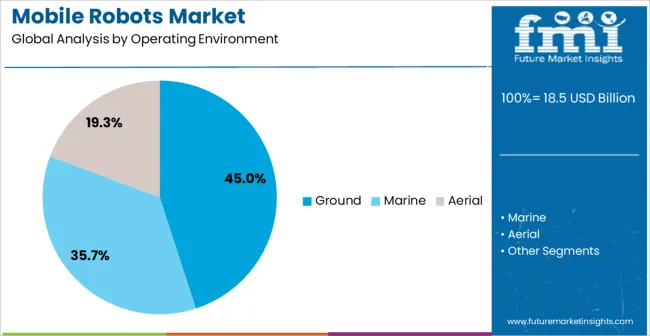
The Ground operating environment segment is projected to account for 45.00% of the Mobile Robots market revenue in 2025, positioning it as the leading category. This dominant position is being driven by the extensive deployment of ground-based robots in warehouses, manufacturing facilities, and logistics hubs where automation is essential for material handling and operational efficiency.
The preference for ground robots has been reinforced by their adaptability to structured environments, allowing them to perform repetitive tasks such as transportation, inventory movement, and delivery with consistency and precision. Technological advancements in navigation systems and obstacle detection have further enhanced their utility, enabling safe operation in busy industrial settings.
The scalability of deployment, coupled with lower operating costs compared to aerial or underwater alternatives, has strengthened the appeal of ground robots across sectors As enterprises continue to focus on operational optimization and faster supply chain processes, the ground segment is expected to sustain its leadership due to its ability to integrate seamlessly into existing infrastructures and deliver measurable productivity gains.
Insights into the Sensors Segment
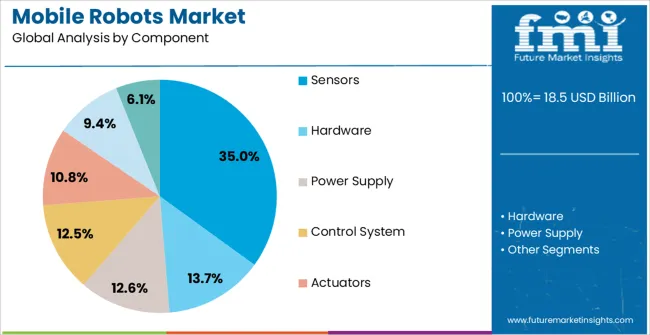
The Sensors component segment is expected to capture 35.00% of the Mobile Robots market revenue in 2025, making it the most significant component category. This prominence is being attributed to the crucial role of sensors in enabling autonomy, situational awareness, and safe navigation. Mobile robots rely on advanced sensor technologies such as LiDAR, ultrasonic, cameras, and infrared to perceive their environment and respond to dynamic conditions in real time.
The growing emphasis on precision, reliability, and safety in industrial and service applications has reinforced demand for high-performance sensing solutions. Continuous improvements in sensor miniaturization and cost efficiency are facilitating wider adoption, particularly in large-scale deployments where accuracy and consistency are critical.
The ability of sensors to support software-driven analytics and decision-making processes has elevated their importance as a core enabler of robot intelligence With the push towards higher levels of autonomy and increasing expectations for robots to operate in unstructured environments, sensors are anticipated to remain central to performance and market growth.
Insights into the Logistic Segment
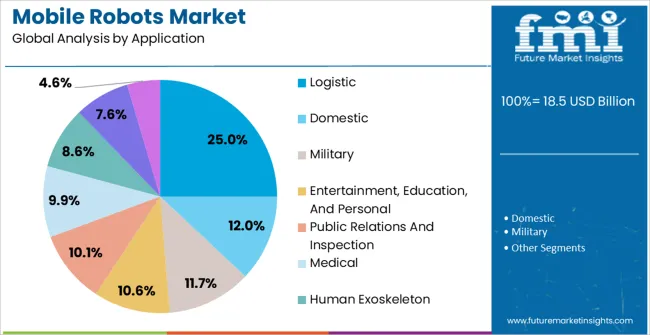
The Logistic application segment is anticipated to account for 25.00% of the Mobile Robots market revenue in 2025, securing its place as the leading application area. This leadership is being supported by the rising adoption of mobile robots in warehouses, distribution centers, and fulfillment facilities where demand for speed, accuracy, and scalability has intensified.
The logistics industry has been under growing pressure to meet rapid e-commerce expansion and same-day delivery requirements, creating a strong case for automation through mobile robots. Their ability to transport goods, manage inventory, and optimize workflows without manual intervention has enhanced efficiency while reducing labor costs and errors.
The deployment of mobile robots in logistics operations has also been facilitated by their capacity to integrate with warehouse management and enterprise systems, enabling real-time data exchange and operational visibility As global trade volumes expand and digital supply chain models evolve, logistics is expected to remain the primary driver for mobile robot adoption, with long-term opportunities in cross-border and last-mile delivery automation.
Market Overview
Mobile Robots Market: Introduction
With the introduction of the robotics industry there have been many applications and processes where it has found its use. One of the branch of these robots are the mobile robots. Mobile robots are capable of moving from one place to other in the free space and not fixed to one location.
Mobile robots are also of many types from which one is the autonomous mobile robots. These are the once which can navigate in an uncontrolled environment without the need of guidance devices.
Analysis of Mobile Robots Market By Key Countries
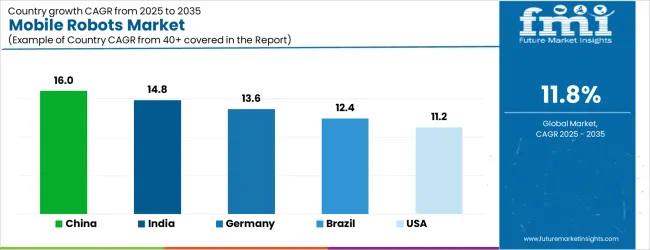
| Country | CAGR |
|---|---|
| China | 16.0% |
| India | 14.8% |
| Germany | 13.6% |
| Brazil | 12.4% |
| USA | 11.2% |
| UK | 10.1% |
| Japan | 8.9% |
Country-wise Analysis
The Mobile Robots Market is expected to register a CAGR of 11.8% during the forecast period, exhibiting varied country level momentum. China leads with the highest CAGR of 16.0%, followed by India at 14.8%. Developed markets such as Germany, France, and the UK continue to expand steadily, while the USA is likely to grow at consistent rates. Japan posts the lowest CAGR at 8.9%, yet still underscores a broadly positive trajectory for the global Mobile Robots Market. In 2024, Germany held a dominant revenue in the Western Europe market and is expected to grow with a CAGR of 13.6%. The USA Mobile Robots Market is estimated to be valued at USD 7.0 billion in 2025 and is anticipated to reach a valuation of USD 7.0 billion by 2035. Sales are projected to rise at a CAGR of 0.0% over the forecast period between 2025 and 2035. While Japan and South Korea markets are estimated to be valued at USD 928.2 million and USD 640.1 million respectively in 2025.
Key Players in the Mobile Robots Market
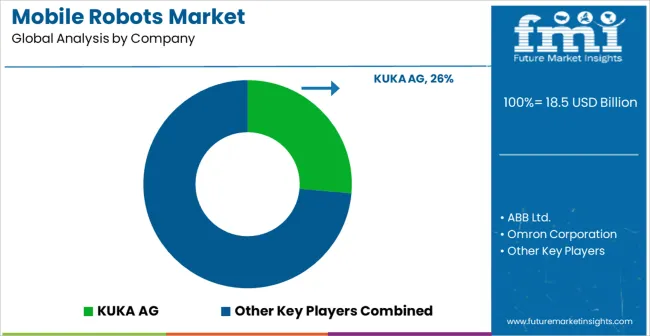
- KUKA AG
- ABB Ltd.
- Omron Corporation
- Boston Dynamics
- Clearpath Robotics
- Mobile Industrial Robots (MiR)
- Geek+
- Vecna Robotics
Scope of the Report
| Item | Value |
|---|---|
| Quantitative Units | USD 18.5 Billion |
| Operating Environment | Ground, Marine, and Aerial |
| Component | Sensors, Hardware, Power Supply, Control System, Actuators, Others (Electrical, Electronic, And Mechanical Components), and Software |
| Application | Logistic, Domestic, Military, Entertainment, Education, And Personal, Public Relations And Inspection, Medical, Human Exoskeleton, Field, and Construction And Demolition |
| Regions Covered | North America, Europe, Asia-Pacific, Latin America, Middle East & Africa |
| Country Covered | United States, Canada, Germany, France, United Kingdom, China, Japan, India, Brazil, South Africa |
| Key Companies Profiled | KUKA AG, ABB Ltd., Omron Corporation, Boston Dynamics, Clearpath Robotics, Mobile Industrial Robots (MiR), Geek+, and Vecna Robotics |
Mobile Robots Market by Segments
Operating Environment:
- Ground
- Marine
- Aerial
Component:
- Sensors
- Hardware
- Power Supply
- Control System
- Actuators
- Others (Electrical, Electronic, And Mechanical Components)
- Software
Application:
- Logistic
- Domestic
- Military
- Entertainment, Education, And Personal
- Public Relations And Inspection
- Medical
- Human Exoskeleton
- Field
- Construction And Demolition
Region:
- North America
- USA
- Canada
- Mexico
- Latin America
- Brazil
- Chile
- Rest of Latin America
- Western Europe
- Germany
- UK
- Italy
- Spain
- France
- Nordic
- BENELUX
- Rest of Western Europe
- Eastern Europe
- Russia
- Poland
- Hungary
- Balkan & Baltic
- Rest of Eastern Europe
- East Asia
- China
- Japan
- South Korea
- South Asia and Pacific
- India
- ASEAN
- Australia & New Zealand
- Rest of South Asia and Pacific
- Middle East & Africa
- Kingdom of Saudi Arabia
- Other GCC Countries
- Turkiye
- South Africa
- Other African Union
- Rest of Middle East & Africa
Frequently Asked Questions
How big is the mobile robots market in 2025?
The global mobile robots market is estimated to be valued at USD 18.5 billion in 2025.
What will be the size of mobile robots market in 2035?
The market size for the mobile robots market is projected to reach USD 56.6 billion by 2035.
How much will be the mobile robots market growth between 2025 and 2035?
The mobile robots market is expected to grow at a 11.8% CAGR between 2025 and 2035.
What are the key product types in the mobile robots market?
The key product types in mobile robots market are ground, marine and aerial.
Which component segment to contribute significant share in the mobile robots market in 2025?
In terms of component, sensors segment to command 35.0% share in the mobile robots market in 2025.
Preview the report firsthand - request a free sample
Get SampleGet the brochure for pricing and purchase details.
Get PDFTable of Content
- Executive Summary
- Global Market Outlook
- Demand-side Trends
- Supply-side Trends
- Technology Roadmap Analysis
- Analysis and Recommendations
- Market Overview
- Market Coverage / Taxonomy
- Market Definition / Scope / Limitations
- Market Background
- Market Dynamics
- Drivers
- Restraints
- Opportunity
- Trends
- Scenario Forecast
- Demand in Optimistic Scenario
- Demand in Likely Scenario
- Demand in Conservative Scenario
- Opportunity Map Analysis
- Product Life Cycle Analysis
- Supply Chain Analysis
- Investment Feasibility Matrix
- Value Chain Analysis
- PESTLE and Porter’s Analysis
- Regulatory Landscape
- Regional Parent Market Outlook
- Production and Consumption Statistics
- Import and Export Statistics
- Market Dynamics
- Global Market Analysis 2020 to 2024 and Forecast, 2025 to 2035
- Historical Market Size Value (USD Million) Analysis, 2020 to 2024
- Current and Future Market Size Value (USD Million) Projections, 2025 to 2035
- Y-o-Y Growth Trend Analysis
- Absolute $ Opportunity Analysis
- Global Market Pricing Analysis 2020 to 2024 and Forecast 2025 to 2035
- Global Market Analysis 2020 to 2024 and Forecast 2025 to 2035, By Operating Environment
- Introduction / Key Findings
- Historical Market Size Value (USD Million) Analysis By Operating Environment , 2020 to 2024
- Current and Future Market Size Value (USD Million) Analysis and Forecast By Operating Environment , 2025 to 2035
- Ground
- Marine
- Aerial
- Y-o-Y Growth Trend Analysis By Operating Environment , 2020 to 2024
- Absolute $ Opportunity Analysis By Operating Environment , 2025 to 2035
- Global Market Analysis 2020 to 2024 and Forecast 2025 to 2035, By Component
- Introduction / Key Findings
- Historical Market Size Value (USD Million) Analysis By Component, 2020 to 2024
- Current and Future Market Size Value (USD Million) Analysis and Forecast By Component, 2025 to 2035
- Sensors
- Hardware
- Power Supply
- Control System
- Actuators
- Others (Electrical, Electronic, And Mechanical Components)
- Software
- Y-o-Y Growth Trend Analysis By Component, 2020 to 2024
- Absolute $ Opportunity Analysis By Component, 2025 to 2035
- Global Market Analysis 2020 to 2024 and Forecast 2025 to 2035, By Application
- Introduction / Key Findings
- Historical Market Size Value (USD Million) Analysis By Application, 2020 to 2024
- Current and Future Market Size Value (USD Million) Analysis and Forecast By Application, 2025 to 2035
- Logistic
- Domestic
- Military
- Entertainment, Education, And Personal
- Public Relations And Inspection
- Medical
- Human Exoskeleton
- Field
- Construction And Demolition
- Y-o-Y Growth Trend Analysis By Application, 2020 to 2024
- Absolute $ Opportunity Analysis By Application, 2025 to 2035
- Global Market Analysis 2020 to 2024 and Forecast 2025 to 2035, By Region
- Introduction
- Historical Market Size Value (USD Million) Analysis By Region, 2020 to 2024
- Current Market Size Value (USD Million) Analysis and Forecast By Region, 2025 to 2035
- North America
- Latin America
- Western Europe
- Eastern Europe
- East Asia
- South Asia and Pacific
- Middle East & Africa
- Market Attractiveness Analysis By Region
- North America Market Analysis 2020 to 2024 and Forecast 2025 to 2035, By Country
- Historical Market Size Value (USD Million) Trend Analysis By Market Taxonomy, 2020 to 2024
- Market Size Value (USD Million) Forecast By Market Taxonomy, 2025 to 2035
- By Country
- USA
- Canada
- Mexico
- By Operating Environment
- By Component
- By Application
- By Country
- Market Attractiveness Analysis
- By Country
- By Operating Environment
- By Component
- By Application
- Key Takeaways
- Latin America Market Analysis 2020 to 2024 and Forecast 2025 to 2035, By Country
- Historical Market Size Value (USD Million) Trend Analysis By Market Taxonomy, 2020 to 2024
- Market Size Value (USD Million) Forecast By Market Taxonomy, 2025 to 2035
- By Country
- Brazil
- Chile
- Rest of Latin America
- By Operating Environment
- By Component
- By Application
- By Country
- Market Attractiveness Analysis
- By Country
- By Operating Environment
- By Component
- By Application
- Key Takeaways
- Western Europe Market Analysis 2020 to 2024 and Forecast 2025 to 2035, By Country
- Historical Market Size Value (USD Million) Trend Analysis By Market Taxonomy, 2020 to 2024
- Market Size Value (USD Million) Forecast By Market Taxonomy, 2025 to 2035
- By Country
- Germany
- UK
- Italy
- Spain
- France
- Nordic
- BENELUX
- Rest of Western Europe
- By Operating Environment
- By Component
- By Application
- By Country
- Market Attractiveness Analysis
- By Country
- By Operating Environment
- By Component
- By Application
- Key Takeaways
- Eastern Europe Market Analysis 2020 to 2024 and Forecast 2025 to 2035, By Country
- Historical Market Size Value (USD Million) Trend Analysis By Market Taxonomy, 2020 to 2024
- Market Size Value (USD Million) Forecast By Market Taxonomy, 2025 to 2035
- By Country
- Russia
- Poland
- Hungary
- Balkan & Baltic
- Rest of Eastern Europe
- By Operating Environment
- By Component
- By Application
- By Country
- Market Attractiveness Analysis
- By Country
- By Operating Environment
- By Component
- By Application
- Key Takeaways
- East Asia Market Analysis 2020 to 2024 and Forecast 2025 to 2035, By Country
- Historical Market Size Value (USD Million) Trend Analysis By Market Taxonomy, 2020 to 2024
- Market Size Value (USD Million) Forecast By Market Taxonomy, 2025 to 2035
- By Country
- China
- Japan
- South Korea
- By Operating Environment
- By Component
- By Application
- By Country
- Market Attractiveness Analysis
- By Country
- By Operating Environment
- By Component
- By Application
- Key Takeaways
- South Asia and Pacific Market Analysis 2020 to 2024 and Forecast 2025 to 2035, By Country
- Historical Market Size Value (USD Million) Trend Analysis By Market Taxonomy, 2020 to 2024
- Market Size Value (USD Million) Forecast By Market Taxonomy, 2025 to 2035
- By Country
- India
- ASEAN
- Australia & New Zealand
- Rest of South Asia and Pacific
- By Operating Environment
- By Component
- By Application
- By Country
- Market Attractiveness Analysis
- By Country
- By Operating Environment
- By Component
- By Application
- Key Takeaways
- Middle East & Africa Market Analysis 2020 to 2024 and Forecast 2025 to 2035, By Country
- Historical Market Size Value (USD Million) Trend Analysis By Market Taxonomy, 2020 to 2024
- Market Size Value (USD Million) Forecast By Market Taxonomy, 2025 to 2035
- By Country
- Kingdom of Saudi Arabia
- Other GCC Countries
- Turkiye
- South Africa
- Other African Union
- Rest of Middle East & Africa
- By Operating Environment
- By Component
- By Application
- By Country
- Market Attractiveness Analysis
- By Country
- By Operating Environment
- By Component
- By Application
- Key Takeaways
- Key Countries Market Analysis
- USA
- Pricing Analysis
- Market Share Analysis, 2024
- By Operating Environment
- By Component
- By Application
- Canada
- Pricing Analysis
- Market Share Analysis, 2024
- By Operating Environment
- By Component
- By Application
- Mexico
- Pricing Analysis
- Market Share Analysis, 2024
- By Operating Environment
- By Component
- By Application
- Brazil
- Pricing Analysis
- Market Share Analysis, 2024
- By Operating Environment
- By Component
- By Application
- Chile
- Pricing Analysis
- Market Share Analysis, 2024
- By Operating Environment
- By Component
- By Application
- Germany
- Pricing Analysis
- Market Share Analysis, 2024
- By Operating Environment
- By Component
- By Application
- UK
- Pricing Analysis
- Market Share Analysis, 2024
- By Operating Environment
- By Component
- By Application
- Italy
- Pricing Analysis
- Market Share Analysis, 2024
- By Operating Environment
- By Component
- By Application
- Spain
- Pricing Analysis
- Market Share Analysis, 2024
- By Operating Environment
- By Component
- By Application
- France
- Pricing Analysis
- Market Share Analysis, 2024
- By Operating Environment
- By Component
- By Application
- India
- Pricing Analysis
- Market Share Analysis, 2024
- By Operating Environment
- By Component
- By Application
- ASEAN
- Pricing Analysis
- Market Share Analysis, 2024
- By Operating Environment
- By Component
- By Application
- Australia & New Zealand
- Pricing Analysis
- Market Share Analysis, 2024
- By Operating Environment
- By Component
- By Application
- China
- Pricing Analysis
- Market Share Analysis, 2024
- By Operating Environment
- By Component
- By Application
- Japan
- Pricing Analysis
- Market Share Analysis, 2024
- By Operating Environment
- By Component
- By Application
- South Korea
- Pricing Analysis
- Market Share Analysis, 2024
- By Operating Environment
- By Component
- By Application
- Russia
- Pricing Analysis
- Market Share Analysis, 2024
- By Operating Environment
- By Component
- By Application
- Poland
- Pricing Analysis
- Market Share Analysis, 2024
- By Operating Environment
- By Component
- By Application
- Hungary
- Pricing Analysis
- Market Share Analysis, 2024
- By Operating Environment
- By Component
- By Application
- Kingdom of Saudi Arabia
- Pricing Analysis
- Market Share Analysis, 2024
- By Operating Environment
- By Component
- By Application
- Turkiye
- Pricing Analysis
- Market Share Analysis, 2024
- By Operating Environment
- By Component
- By Application
- South Africa
- Pricing Analysis
- Market Share Analysis, 2024
- By Operating Environment
- By Component
- By Application
- USA
- Market Structure Analysis
- Competition Dashboard
- Competition Benchmarking
- Market Share Analysis of Top Players
- By Regional
- By Operating Environment
- By Component
- By Application
- Competition Analysis
- Competition Deep Dive
- KUKA AG
- Overview
- Product Portfolio
- Profitability by Market Segments (Product/Age /Sales Channel/Region)
- Sales Footprint
- Strategy Overview
- Marketing Strategy
- Product Strategy
- Channel Strategy
- ABB Ltd.
- Omron Corporation
- Boston Dynamics
- Clearpath Robotics
- Mobile Industrial Robots (MiR)
- Geek+
- Vecna Robotics
- KUKA AG
- Competition Deep Dive
- Assumptions & Acronyms Used
- Research Methodology


