

- Industry Size (2026)
- USD 383.0 Mn
- Forecast (2036)
- USD 990.0 Mn
- CAGR (2026 to 2036)
- 10.0%
Empty Container Repositioning Optimization Platforms Market Size, Market Forecast and Outlook By FMI
The empty container repositioning software market was valued at USD 348.2 million in 2025. Industry value is expected to reach USD 383.0 million in 2026 surpassing USD 990.0 million by 2036, at a CAGR of 10.0% during the forecast period. This is driven by ocean carriers digitize equipment control workflows to eliminate preventable detention penalties.
Summary of Empty Container Repositioning Optimization Platforms Market
- The market is estimated at USD 383.0 million in 2026.
- The market is projected to reach USD 990.0 million by 2036.
- The market is expected to grow at a CAGR of 10.0% from 2026 to 2036.
- The forecast period represents an incremental opportunity of USD 607.0 million.
- Cloud deployment leads the segment with a 62% share.
- Reuse matching dominates the optimization function segment with a 31% share.
- Ocean carriers lead the user type segment with a 34% share.
- Port-to-port operations dominate the mode coverage segment with a 38% share.
- Subscription-based pricing leads the revenue model segment with a 57% share.
- India (11.6%), China (11.1%), and Singapore (10.8%) are among the fastest-growing markets.
- Key companies in the market include Container xChange, Avantida by e2open, Transmetrics, TetriXX, project44, BlueCargo, and MatchBox Exchange.
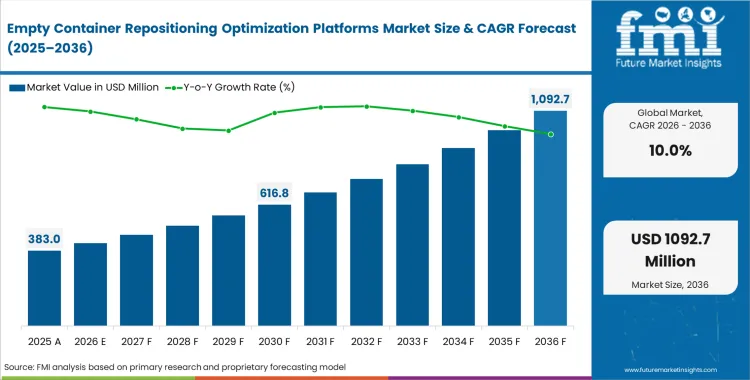
Key Takeaways, Market Size, and Forecast
- 2025 market size: USD 348.2 million
- 2026 market size: USD 383.0 million
- 2036 forecast: USD 990.0 million
- CAGR: 10.0%
- Top deployment: Cloud (62.0%)
- Top optimization function: Reuse matching (31.0%)
- Top user type: Ocean carriers (34.0%)
- Top mode coverage: Port-to-port (38.0%)
- Top pricing model: Subscription (57.0%)
- Top growth market: India (11.6% CAGR)
Key Takeaways
| Metric | Details |
|---|---|
| Industry Size (2026) | USD 383.0 Million |
| Industry Value (2036) | USD 990.0 Million |
| CAGR (2026 to 2036) | 10.0% |
Source: Future Market Insights (FMI) analysis, based on proprietary forecasting model and primary research
Departments overseeing port operations face a significant, ongoing cost burden, specifically for repositioning empty shipping containers across unbalanced international trade routes. The current reliance on outdated, static spreadsheets inevitably leads to elevated expenses, specifically unnecessary yard storage fees and costly, redundant drayage trips. A proactive approach involves enabling immediate data integration with terminal management system providers. Powerful connection allows sophisticated demurrage and detention reduction software engines to efficiently execute 'street turns', a direct container exchange, before the containers even return to designated depots. This dramatically optimizes operational flow and minimizes costly delays.
Upon the exposure of digital API endpoints for recording terminal gate events, the strategic goal of predictive inventory balancing becomes instantly commercially viable for mid-sized Non-Vessel Operating Common Carriers (NVOCCs). Technological advancement replaces inefficient, phone-based coordination between dispatchers with sophisticated, automated drop-off location switching. The dominant equipment leasing firms actively accelerate the fundamental operational shift throughout the industry by formally mandating adoption of advanced container triangulation software for management of all returned equipment. This ensures maximum asset utilization across the global supply chain.
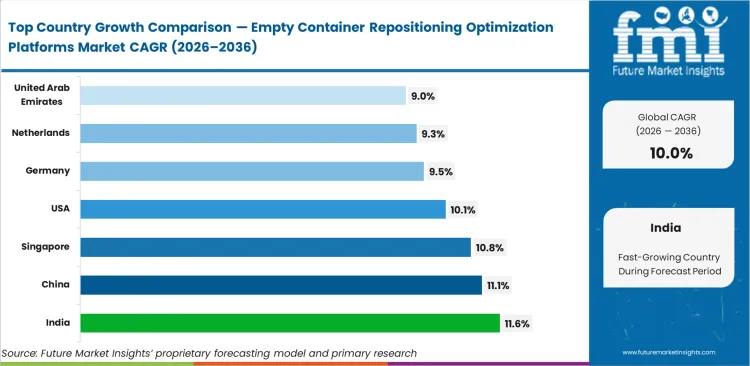
Sales through software adoption in India is expected to expand at 11.6% as severe export-import imbalances compel shipping lines to deploy algorithmic balancing. China is estimated to register a CAGR of 11.1% over the forecast period, leveraging massive throughput digitization. Singapore revenue is likely to expand 10.8%, similarly the United States at 10.1% Germany at 9.5%, Netherlands at 9.3%, and United Arab Emirates is predicted to garner a CAGR of 9.0% by 2036. Divergence separates logistics nodes relying on manual dispatcher coordination from those enforcing strict digital equipment control.
Segmental Analysis
Empty Container Repositioning Optimization Platforms Market Analysis by Deployment
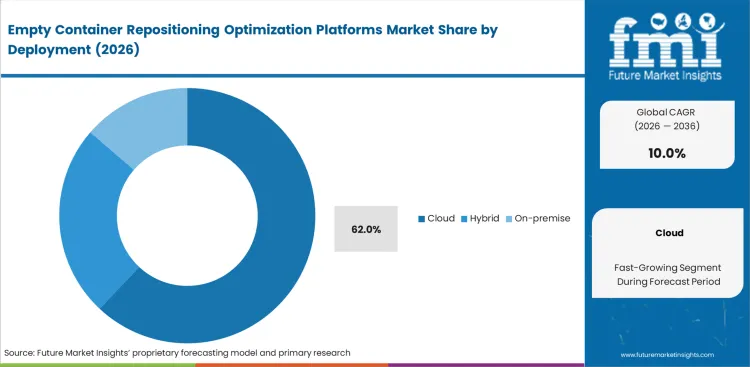
Procurement directors mandate cloud architecture to centralize equipment visibility across competing shipping lines, eliminating the blind spots that plague localized logistics planning. The cloud segment is expected to hold 62.0% revenue share in 2026, driven by critical need to resolve multi-party data fragmentation, operational requirement for rapid external partner onboarding, and commercial mandate to bypass legacy internal IT challenges.
FMI observes that port operations directors deploy a SaaS platform for empty container management precisely because moving away from localized servers allows equipment planners to execute real-time triangulation with external trucking networks rapidly. On-premise solutions actively inhibit street turns because local servers cannot ingest dynamic partner API feeds fast enough to seize fleeting container availability windows. Failing to deploy centralized matching engines leaves carriers absorbing millions in preventable detention penalties while waiting for internal batch processing to catch up with physical port reality. This distributed architecture relies heavily on constant data exchanges with container stacking machine control systems to verify exact physical box availability before committing a driver to a pickup.
- Partner onboarding: Web-based access removes installation friction for smaller drayage firms participating in triangulation. NVOCC operations managers expand street-turn networks quickly without requiring complex vendor software setups, directly integrating independent owner-operators into broader carrier equipment ecosystems seamlessly.
- Data syndication: Centralized hosting synchronizes inventory status across disparate terminal operating systems instantly. Equipment controllers avoid dispatching drivers for boxes already booked by competing shipping alliances, completely eliminating the severe cost of redundant terminal gate entries.
- Security protocol: Managed cloud environments provide unified authentication for sensitive equipment location data across international borders. Port security directors maintain strict customs compliance while safely exposing necessary routing data to verified third-party haulers executing street turns.
Empty Container Repositioning Optimization Platforms Market Analysis by Optimization Function
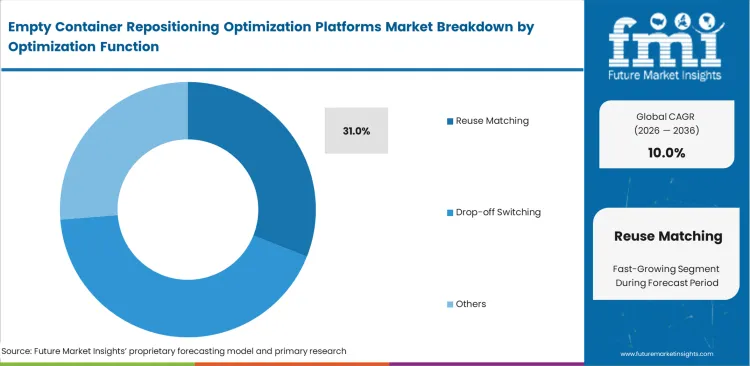
Equipment control managers deploy empty container demand forecasting software to intercept boxes before they enter congested yards, fundamentally altering inland distribution economics. The reuse matching segment is likely to account for 31.0% revenue share in 2026, supported by immediate elimination of inbound drop-off runs, drastic reduction in terminal storage fees, and measurable improvement in overall chassis utilization rates. Planners that delay deploying matching modules continue paying double drayage rates for single-cargo movements, destroying profit margins on high-volume trade lanes. Reliable matching workflows require deep integration with port equipment telemetry to confirm actual physical movements, ensuring dispatchers never send trucks for equipment that remains trapped beneath massive terminal stacks.
- Drayage cost reduction: Algorithmic pairing links an import drop-off directly with an export pickup without routing through a depot. Logistics procurement managers cut inland transportation spend immediately by avoiding empty depot runs, drastically lowering the total landed cost of containerized freight.
- Detention avoidance: Matching modules identify high-risk aging containers for prioritized reuse before penalties accrue. Equipment planners clear boxes before free-time expiration triggers expensive daily shipping line penalties, protecting tight operational margins from compounding terminal charges.
- Yard congestion relief: Successful street turns keep physical boxes completely out of saturated terminal stacks. Port operations directors achieve higher overall facility throughput without requiring additional physical acreage, delaying massive infrastructure capital expenditures through superior software utilization.
Empty Container Repositioning Optimization Platforms Market Analysis by User Type
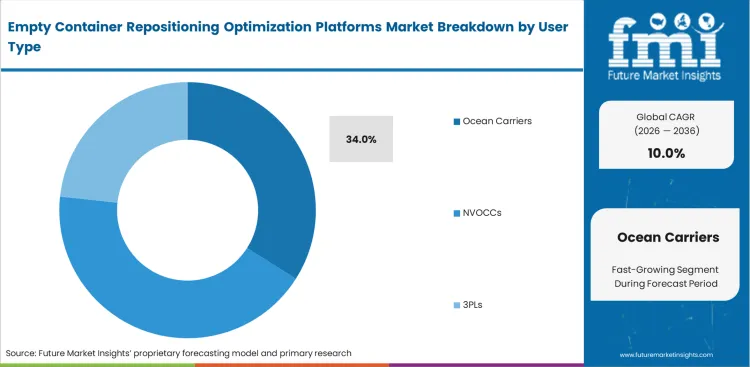
Ocean carriers bear ultimate financial responsibility for imbalanced equipment networks, forcing them to dictate the technological standard for triangulation. Companies deploy ocean carrier equipment optimization software to contain repositioning costs. The ocean carriers segment is estimated to account for 34.0% revenue share in 2026, driven by ownership of the core equipment imbalance burden, large annual repositioning capital expenditures, and need to mitigate severe regulatory emissions tracking.
Companies that resist adopting a shipping line equipment control platform suffer degraded asset velocity metrics compared to digitized competitors. Carriers increasingly push precise tracking data into freight transport management dashboards to expand partner visibility, forcing all downstream logistics providers to adopt compatible digital planning tools.
- Initial procurement: Fleet directors approve platform subscriptions to contain escalating annual repositioning budgets across global networks. Budget holders demand proven algorithmic matching capabilities before authorizing enterprise-wide software rollouts, refusing to fund experimental tools lacking established carrier integration.
- Qualification validation: Equipment planners monitor algorithm accuracy during trial periods across high-volume trade lanes extensively. Successful validation requires equipment re-use matching software for carriers to align perfectly with actual dispatcher intuition regarding localized equipment availability and seasonal volume spikes.
- Expansion criteria: IT procurement heads renew licenses only when platforms demonstrate measurable reductions in overall container dwell times. Software vendors must prove continuous ROI to secure long-term carrier enterprise contracts, tying contract renewals directly to documented detention penalty avoidance.
Empty Container Repositioning Optimization Platforms Market Analysis by Mode Coverage
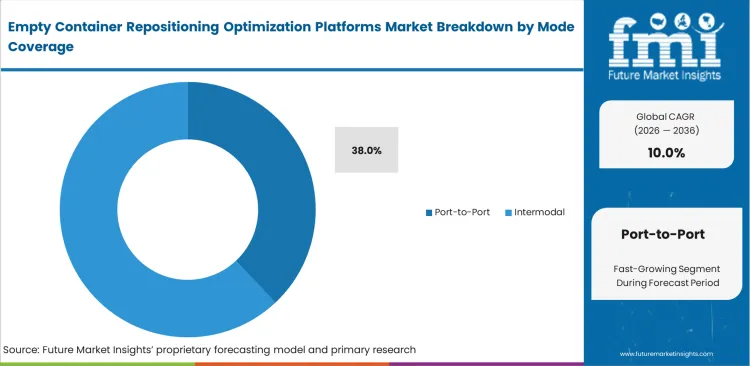
The port-to-port segment is predicted to secure 38.0% revenue share in 2026, driven by sheer volume of maritime equipment sweeps, high financial stakes of vessel slot allocation, and critical need to aggregate dispersed empty inventory rapidly. Network balancing begins at coastal entry points before extending into complex inland distribution webs, making massive maritime coordination the anchor for all downstream logistics. Maritime planners that miscalculate these primary hub movements trigger cascading inland shortages that take weeks to correct. Tracking tools linked to trailer cargo container tracking systems provide necessary feeds for these broad calculations, feeding coastal inventory data directly into global routing engines.
- Vessel allocation: Algorithms determine exactly how many empty slots a departing vessel should dedicate to repositioning boxes globally. Marine operations directors balance revenue-generating cargo against critical equipment redistribution mandates, maximizing profitability without starving high-demand manufacturing hubs of necessary shipping capacity.
- Hub consolidation: Software identifies optimal regional transshipment ports for gathering dispersed empty inventory systematically. Equipment controllers aggregate boxes efficiently for bulk transport back to high-demand manufacturing centers, lowering the per-unit repositioning cost through strategic maritime volume scaling.
- Disruption recovery: Platforms recalculate port-to-port sweeps instantly following severe weather delays, port congestion, or labor strikes. Fleet managers prevent localized equipment gluts by dynamically rerouting empty inventory mid-voyage, maintaining network fluidity despite unpredictable physical infrastructure failures.
Empty Container Repositioning Optimization Platforms Market Analysis by Pricing Model
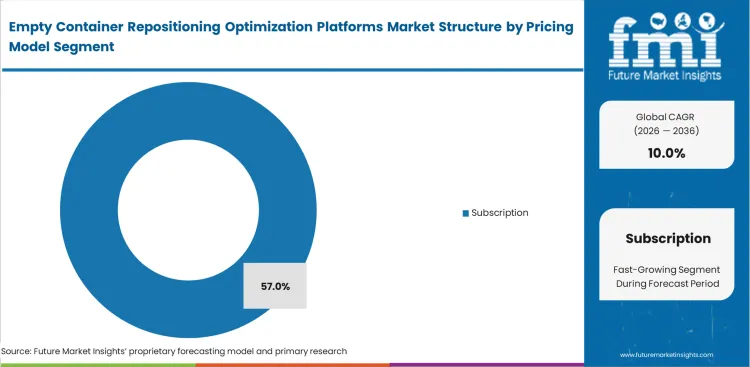
Procurement teams favor financial structures aligning software costs with continuous operational usage, protecting fragile IT budgets from unpredictable volume spikes. The subscription segment is expected to hold 57.0% revenue share in 2026, favored due to stabilization of logistics IT expenditure forecasts, inclusion of automatic algorithmic upgrades, and avoidance of massive upfront enterprise capital approvals. IT sourcing directors select predictable empty container planning platform pricing specifically because recurring monthly fees guarantee carriers receive continuous algorithm updates and expanding terminal API connections. Transaction-fee pricing often generates more total revenue during peak season congestion, making flat subscriptions a secret operational hedge for savvy buyers.
- Predictable budgeting: Monthly flat rates stabilize logistics IT expenditure forecasts across highly volatile fiscal quarters. Sourcing directors prefer known software costs over unpredictable transaction-based pricing models, shielding departmental budgets from sudden cost overruns during severe global supply chain disruptions.
- Continuous upgrades: Subscription agreements include automatic access to refined matching algorithms and new port integrations constantly. Equipment planners utilize cutting-edge predictive forecasting without requesting additional enterprise capital approvals, bypassing slow corporate procurement cycles for critical technological advancements.
- Vendor lock-in: Deeply integrated subscription workflows create massive switching barriers for major global ocean carriers. IT managers hesitate to replace established matching platforms due to anticipated operational disruptions during transition phases, granting incumbent software vendors exceptional commercial retention rates.
Empty Container Repositioning Optimization Platforms Market Drivers, Restraints, and Opportunities
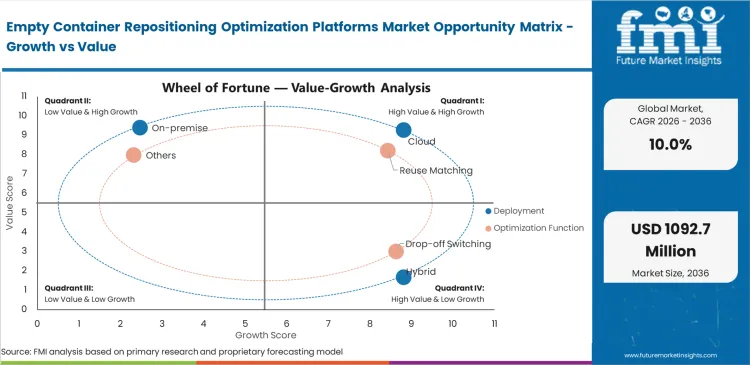
Escalating terminal storage penalties compel NVOCC equipment managers to execute automated street turns immediately. Delaying algorithmic matching adoption guarantees carriers absorb millions in preventable detention fees while empty boxes idle in congested yards. Shipping lines face severe financial pressure to maximize asset velocity, pushing fleet directors to seek the best software to reduce empty container repositioning costs across all regional operating centers. Rising operational costs transform triangulation platforms from experimental pilot projects into mandatory enterprise workflow engines, dictating competitive survival in tight-margin logistics environments.
Fragmented terminal data standards actively block seamless equipment matching even when dispatchers want to utilize algorithms. Differing API protocols across competing port operators prevent optimization platforms from building unified real-time inventory views. Resolving this friction requires tedious, custom integration work for every new terminal added to a software network. Until industry-wide data standardization emerges, equipment controllers face blind spots where algorithms cannot verify actual container availability. Connecting matching engines with real-time inventory positioning frameworks offers a partial, localized solution.
Opportunities in the Empty Container Repositioning Optimization Platforms Market
- AI-driven forecasting: Predictive algorithms anticipate localized equipment shortages weeks before physical imbalances occur. Port operations directors gain proactive drop-off location optimization for containers, preempting terminal gridlock entirely.
- Smart contract settlement: Automated billing integration resolves detention fee disputes instantly upon successful container exchange. Finance controllers eliminate manual invoice reconciliation workloads, accelerating cash flow across complex carrier networks.
- Intermodal triangulation: Expanding matching logic to encompass rail depots unlocks massive inland savings. Intermodal dispatchers execute complex rail-to-truck street turns, bypassing congested coastal terminals completely.
Regional Analysis
Based on regional analysis, the empty container repositioning optimization platforms market is segmented into North America, Latin America, Europe, Asia Pacific, and Middle East & Africa across 40 plus countries.
.webp "Top Country Growth Comparison Empty Container Repositioning Optimization Platforms Market Cagr (2026 2036)")
| Country | CAGR (2026 to 2036) |
|---|---|
| India | 11.6% |
| China | 11.1% |
| Singapore | 10.8% |
| United States | 10.1% |
| Germany | 9.5% |
| Netherlands | 9.3% |
| United Arab Emirates | 9.0% |
Source: Future Market Insights (FMI) analysis, based on proprietary forecasting model and primary research
Asia Pacific Empty Container Repositioning Optimization Platforms Market Analysis
Severe export-import imbalances across Asia Pacific manufacturing hubs force ocean carriers to deploy aggressive algorithmic inventory balancing software immediately. Regional shipping lines manage massive outbound cargo volumes against significantly lower inbound loaded flows, creating equipment deficits that destroy profit margins if handled manually. Fleet departments in this region prioritize predictive forecasting modules to secure empty containers ahead of peak manufacturing seasons, refusing to rely on unpredictable spot-market chassis availability.
Delaying software adoption leaves regional NVOCCs reliant on localized spreadsheets, severely limiting their ability to execute rapid triangulation across fragmented port networks. This analog approach results in massive container dwell times, forcing carriers to lease expensive supplementary equipment just to maintain basic schedule reliability. Platforms integrating multimodal shipment visibility platforms gain extreme traction by offering unified views across scattered regional depots, connecting inland rail heads directly with major coastal transshipment facilities.
- India: Rapid port throughput expansion breaks manual dispatcher coordination entirely, forcing the immediate adoption of an empty container optimization platform in India. India is expected to grow at a rate of 11.6% during the forecast period, supported by large inland infrastructure modernization projects, severe export-import imbalances, and new regulatory pressures to reduce port congestion. Port operations directors achieving full software integration reduce localized container dwell times significantly, securing priority berthing rights for compliant shipping alliances.
- China: Massive digital infrastructure investments at major terminals provide perfect data feeds for advanced routing algorithms seamlessly. China is predicted to expand at a CAGR of 11.1% during the forecast period, supported by aggressive state-backed port digitization mandates, unparalleled export volume scale, and intense domestic competition among regional freight forwarders. China shipping alliances utilizing empty container optimization software china workflows capture major cost advantages over analog competitors, dominating trans-Pacific pricing structures.
- Singapore: High-density transshipment workflows require flawless algorithmic coordination to prevent catastrophic terminal gridlock. Singapore is expected to register a CAGR of 10.8% during the forecast period, supported by its role as a primary global maritime crossroads, immense investments in automated port equipment, and strict operational efficiency targets. Regional planners execute complex vessel-to-vessel empty sweeps seamlessly, maintaining perfect fluidity across the world's most congested maritime chokepoints.
FMI's report includes Japan, South Korea, Australia, and ASEAN countries. Rising regional labor costs push terminal operators toward fully automated equipment handoffs, stripping manual intervention from the entire container lifecycle.
North America Empty Container Repositioning Optimization Platforms Market Analysis
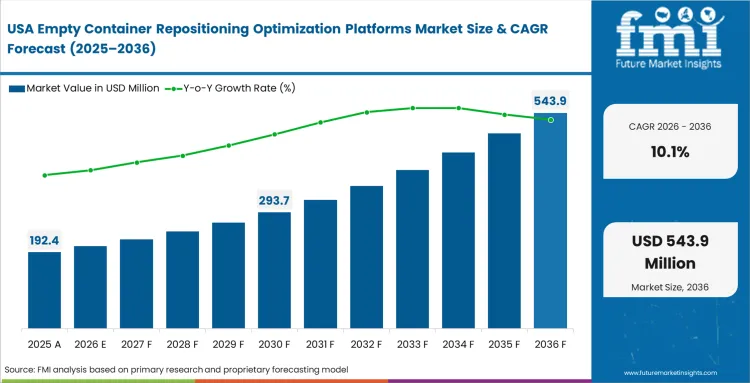
Aggressive billing compliance and severe detention penalties dictate software upgrades across North America logistics networks relentlessly. Carriers operating here face strict regulatory oversight regarding unfair demurrage charges, forcing equipment managers to maintain perfect digital audit trails for every container movement. Fleet directors deploy triangulation platforms primarily as defensive mechanisms against catastrophic terminal storage invoices, utilizing software to prove exact equipment return attempts during periods of severe port congestion.
Operations departments that fail to digitize street-turn workflows routinely surrender thousands of dollars per container in unavoidable late-return penalties. This strict regulatory and financial environment leaves trucking firms and NVOCCs no choice but to procure advanced matching engines simply to protect their baseline operating margins from predatory terminal billing practices.
- United States: Chassis shortages and fragmented trucking networks make algorithmic drop-off switching critical for daily operations. The United States is estimated to garner a CAGR of 10.1% during the forecast period, supported by intense federal scrutiny over demurrage billing practices, persistent chassis availability constraints, and the immense fragmentation of independent drayage providers. Drayage dispatchers executing successful street turns unlock significant new commercial contracts with major importing brands, bypassing congested coastal terminals entirely.
FMI's report includes Canada and Mexico. Cross-border rail integration complicate equipment matching logic for continental logistics providers, requiring highly specialized algorithmic adjustments.
Europe Empty Container Repositioning Optimization Platforms Market Analysis
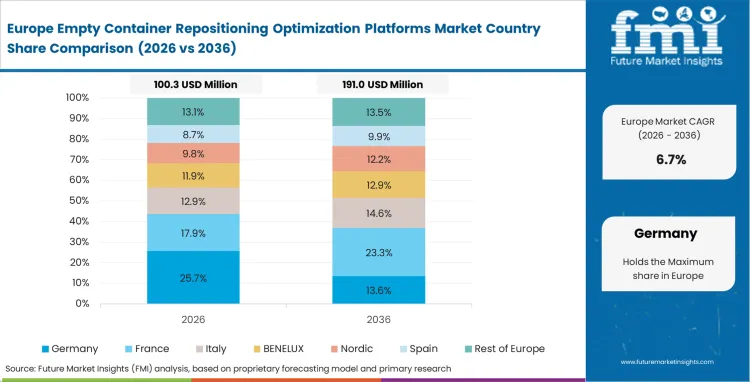
Strict sustainability mandates require Europe-based port operators to eliminate redundant empty drayage runs through digital matching aggressively. Regional authorities penalize unnecessary truck emissions heavily, pushing NVOCC operations managers to maximize container reuse before returning equipment to coastal depots. Logistics procurement directors select software vendors based specifically on their ability to document verified carbon reductions resulting from algorithmic street turns. Matching platforms operating in this region must provide perfect ESG reporting dashboards alongside standard operational metrics, proving to municipal port authorities that participating carriers actively reduce local highway congestion and diesel exhaust output.
- Germany: Deep integration between inland rail hubs and coastal ports demands complex intermodal forecasting capabilities. Germany is set to record at a CAGR of 9.5% during the forecast period, supported by severe highway emission regulations, massive investments in inland rail terminals, and intense pressure to shift freight off congested road networks. Equipment controllers utilizing advanced platforms minimize expensive highway transit miles, shifting empty container repositioning entirely onto optimized rail corridors.
- Netherlands: Highly digitized port ecosystems allow seamless API connections between software platforms and terminal operating systems instantly. Netherlands is expected to grow at a rate of 9.3% during the forecast period, supported by the immense technological maturity of the Port of Rotterdam, dense regional barge networks, and a highly collaborative logistics culture. Dutch forwarders executing automated triangulation maintain superior profit margins despite exceptionally high regional operating costs and strict labor regulations.
FMI's report includes United Kingdom, France, Italy, and Spain. Fragmented national rail standards create localized friction for pan-European equipment balancing, forcing software providers to build country-specific algorithmic workarounds.
Middle East & Africa Empty Container Repositioning Optimization Platforms Market Analysis
Rapidly modernizing logistics hubs use advanced software deployment to leapfrog legacy manual coordination methods completely. Port operations directors building new terminal infrastructure embed matching algorithms directly into initial operational blueprints, refusing to implement analog legacy systems. Regional shipping agents utilize cloud-based exchanges to overcome historical data opacity across localized trucking networks, bringing unprecedented visibility to historically fragmented trade routes. These greenfield software deployments allow emerging regional ports to compete directly with established Europe-based hubs by offering superior container turnaround times.
- United Arab Emirates: Intense competition among regional transshipment hubs drives massive adoption of predictive inventory balancing tools. The United Arab Emirates is likely to register a CAGR of 9.0% during the forecast period, supported by immense sovereign investments in port automation, aggressive expansion of free trade zones, and the region's strategic position connecting trade lanes in Asia Pacific and Europe. Logistics IT departments deploying these platforms eliminate analog dispatcher bottlenecks completely, cementing regional dominance.
FMI's report includes Saudi Arabia, South Africa, and regional developing economies. Expanding trade corridors demand flexible software architecture capable of handling unpredictable equipment flows and sudden regional geopolitical disruptions.
Competitive Aligners for Market Players
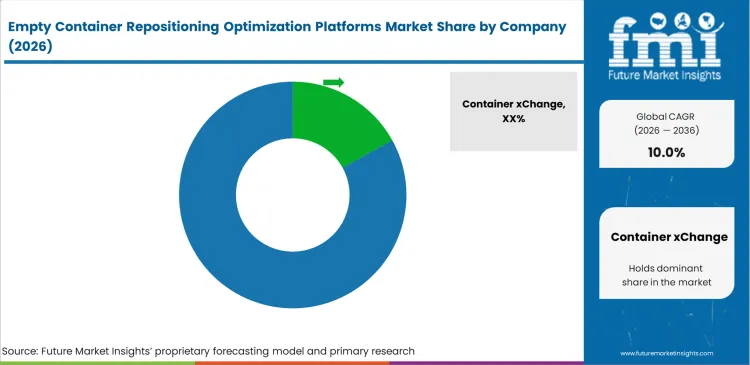
Algorithmic density determines competitive positioning within this highly specialized logistics software niche. When evaluating container xchange vs avantida by e2open, buyers prioritize deep API integrations directly into ocean carrier legacy systems, bypassing analog dispatcher resistance entirely. What differentiates empty container optimization software vendors is established network density; an optimization platform holds zero value without a critical mass of participating carriers, forwarders, and trucking firms sharing live equipment data simultaneously.
Incumbent software providers possess massive historical datasets detailing exact terminal turnaround times and seasonal imbalance patterns. Challengers entering this space cannot replicate these proprietary data lakes quickly, forcing them to compete purely on user-interface design or aggressive pricing discounts. Established platforms utilize historical data advantages to train superior machine learning models, creating a widening performance gap that new entrants struggle to close. Deploying modules connected to port-to-door container journey orchestration platforms cements incumbent stickiness.
Key Players in Empty Container Repositioning Optimization Platforms Market
- Container xChange
- Avantida by e2open
- Transmetrics
- TetriXX
- project44
- BlueCargo
- MatchBox Exchange
Scope of the Report
| Metric | Value |
|---|---|
| Quantitative Units | USD 383.0 Million to USD 990.0 Million, at a CAGR of 10.0% |
| Market Definition | Optimization platforms deploy algorithmic matching and predictive routing to balance empty shipping containers across trade networks. Software interventions eliminate manual dispatcher coordination, directly reducing redundant truck miles and minimizing terminal storage fees for ocean carriers. |
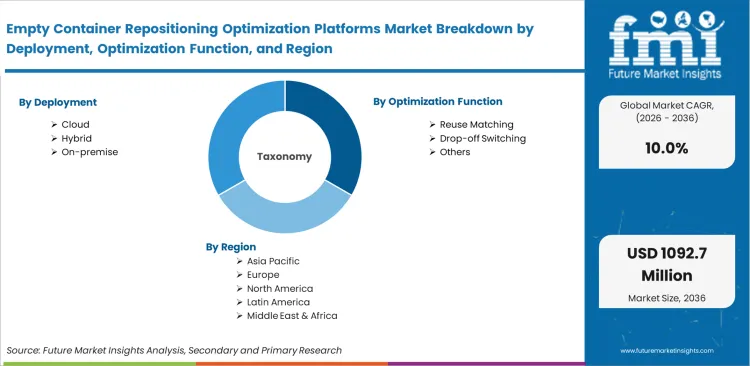
| Segmentation | Deployment, Optimization Function, User Type, Mode Coverage, Pricing Model, and Region |
| Regions Covered | North America, Latin America, Western Europe, Eastern Europe, Asia Pacific, Middle East and Africa |
| Countries Covered | United States, Canada, Brazil, Mexico, Germany, United Kingdom, France, Italy, Spain, Russia, Poland, China, Japan, South Korea, India, ASEAN, Australia, New Zealand, GCC Countries, South Africa, North Africa |
| Key Companies Profiled | Container xChange, Avantida by e2open, Transmetrics, TetriXX, project44, BlueCargo, MatchBox Exchange |
| Forecast Period | 2026 to 2036 |
| Approach | Top-down penetration model anchoring to global shipping repositioning spend |
Source: Future Market Insights (FMI) analysis, based on proprietary forecasting model and primary research
Empty Container Repositioning Optimization Platforms Market Analysis by Segments
Deployment
- Cloud
- Hybrid
- On-premise
Optimization Function
- Reuse matching
- Demand forecasting
- Inventory balancing
- Drop-off switching
- Route planning
User Type
- Ocean carriers
- NVOCCs
- Leasing firms
- Terminals
- 3PLs
Mode Coverage
- Port-to-port
- Port-to-yard
- Yard-to-customer
- Intermodal
Pricing Model
- Subscription
- Transaction fee
- Enterprise license
Region
- North America
- United States
- Canada
- Europe
- Germany
- United Kingdom
- France
- Italy
- Spain
- Asia Pacific
- China
- Japan
- South Korea
- Taiwan
- Singapore
- Latin America
- Brazil
- Mexico
- Argentina
- Middle East & Africa
- GCC Countries
- South Africa
- Israel
- Rest of Middle East & Africa
Bibliography
- United Nations Conference on Trade and Development. (2024). Review of maritime transport 2024. UNCTAD.
- USA Department of Transportation, Bureau of Transportation Statistics. (2025, January). Port performance freight statistics: 2025 annual report.
- Press Information Bureau, Government of India. (2024, July). Government engaged with shipping lines, ports, and trade bodies on empty container repositioning and logistics bottlenecks.
- Cai, J., Huang, Y., Diao, C., & Jin, Z. (2024, December). Joint optimization of empty container repositioning and inventory control applying dynamic programming and simulated annealing. Applied Soft Computing, 167, 112452.
- Wang, W., Yang, Z., Diao, C., & Jin, Z. (2024, November). Collaborative optimization of container liner slot allocation and empty container repositioning based on online booking platform. Applied Sciences, 14(23), 11092.
This bibliography is provided for reader reference. The full FMI report contains the complete reference list with primary source documentation.
This Report Addresses
- Identifies exact cost savings ocean carriers capture via predictive container inventory balancing algorithms.
- Evaluates specific terminal API integration challenges blocking widespread drop-off switching adoption.
- Quantifies cloud deployment advantages for executing rapid multi-party street turns.
- Analyzes why NVOCC equipment managers prioritize reuse matching over basic visibility tools.
- Maps precise adoption velocity across major Asian export-import transshipment hubs.
- Explains vendor lock-in mechanisms created by subscription-based routing software.
- Defines operational limits of algorithmic matching during sudden port closure events.
- Details competitive strategies utilized by incumbent vendors possessing massive historical data networks.
Frequently Asked Questions
How big is the empty container repositioning optimization platforms market?
Demand crosses USD 383.0 million in 2026. This figure highlights focused investment specifically toward algorithmic workflow software, distinguishing platform revenue from massive physical transportation expenditures.
What is the empty container repositioning platform CAGR?
Sales expand at a 10.0% CAGR through 2036. Sustained expansion tracks directly with escalating global port congestion and carrier mandates to eliminate preventable detention penalties.
What drives demand for empty container optimization software?
Escalating terminal storage penalties require NVOCC equipment managers to execute automated street turns immediately, pushing fleet directors to mandate predictive routing software across all regional operating centers.
How do empty container optimization platforms reduce costs?
Linking import drop-offs directly with export pickups cuts inland drayage costs instantly. Equipment dispatchers prioritize this function to intercept boxes before they enter congested yards.
Which companies lead the empty container repositioning platform market?
Container xChange, Avantida by e2open, Transmetrics, TetriXX, project44, BlueCargo, and MatchBox Exchange anchor this software landscape via deep API integrations directly into ocean carrier legacy systems.
What is included in the empty container repositioning platforms market?
Scope incorporates cloud-hosted matching environments, predictive inventory balancing modules, automated drop-off switching algorithms, and digital triangulation exchanges.
Container xChange vs Avantida: how do buyers compare them?
Buyers prioritize evaluating deep API integrations directly into legacy systems. An optimization platform holds zero value without a critical mass of participating carriers sharing live equipment data simultaneously.
Empty container optimization software vs TMS: what separates them?
General freight forwarding tools lack specialized algorithmic depth required for dedicated empty equipment rebalancing. Platforms replace manual dispatcher triangulation entirely with predictive inventory balancing modules.
Why does cloud deployment lead this category?
The cloud segment is expected to hold 62.0% revenue share in 2026 because triangulation requires real-time data exchange across competing carriers and trucking firms. Centralized hosting resolves localized legacy IT bottlenecks completely.
Why do ocean carriers dominate adoption metrics?
The ocean carriers segment is expected to hold 34.0% revenue share in 2026 because they bear ultimate financial responsibility for imbalanced equipment networks. Fleet directors deploy optimization tools defensively against massive repositioning budgets.
How does port-to-port routing maintain high utilization?
The port-to-port segment is expected to hold 38.0% revenue share in 2026. Maritime operations directors must execute complex coastal sweeps to aggregate dispersed empty inventory before inland distribution occurs.
Why do buyers prefer subscription pricing models?
The subscription segment is expected to hold 57.0% revenue share in 2026. IT procurement directors prefer flat monthly rates to stabilize logistics software expenditure during highly volatile seasonal supply chain crises.
What non-obvious reality complicates automated matching workflows?
Matching algorithms fail without perfect data cleanliness from importing consignees. Planners utilizing inaccurate terminal feeds continually dispatch drivers for boxes that remain physically unavailable.
Why does India lead regional growth projections?
The India market is expected to grow at a CAGR of 11.6% during the forecast period. Severe export-import imbalances break manual dispatcher coordination, forcing port operations directors to integrate automated triangulation tools rapidly.
How does the United States compare in adoption speed?
The United States market is expected to grow at a CAGR of 10.1% during the forecast period. Strict regulatory oversight regarding unfair demurrage billing forces carriers to maintain perfect digital audit trails via optimization platforms.
What internal friction slows platform integration?
Fragmented API standards across competing terminal operators prevent unified data views. Software developers must build tedious custom connections for every new facility joining their network.
How do large alliances resist single-vendor lock-in?
Carrier IT directors mandate open API architecture during software procurement. Forcing competing platforms to share localized data feeds prevents any single developer from hoarding regional equipment access.
What future capability transforms this niche by 2036?
Expanding algorithmic logic to encompass deep intermodal rail networks unlocks massive new inland savings. Planners could execute seamless rail-to-truck street turns utilizing integrated predictive modules.
What immediate commercial stake forces NVOCCs to act?
Delaying platform integration guarantees NVOCCs absorb millions in preventable detention fees. Dispatchers failing to execute automated street turns surrender high-margin freight contracts to digitized competitors.
How do challengers compete against established vendors?
New entrants lacking historical data lakes compete on superior user-interface design. Challengers offer aggressive pricing discounts to pry specific regional routing volumes away from dominant legacy platforms.
Why do on-premise solutions actively inhibit triangulation?
Localized servers process partner API feeds too slowly for real-time dispatching. Equipment planners utilizing legacy localized software consistently miss high-velocity street turn opportunities.
What limitation affects port-to-port algorithms?
Maritime routing platforms struggle to recalculate perfectly during sudden terminal gate closures. Planners miscalculating these primary hub movements trigger cascading inland shortages taking weeks to correct.
How does transaction-based pricing impact peak season operations?
Vendors charging per transaction extract massive revenue spikes during unexpected port congestion. Logistics firms exposed to this pricing face explosive software costs precisely when operational margins tighten.
Why do major leasing firms mandate digital drop-off switching?
Algorithmic drop-off controls accelerate leasing cycle turnarounds. Equipment operations managers enforce digital matching to extract maximum revenue from fixed physical container assets.
Preview the report firsthand - request a free sample
Get SampleGet the brochure for pricing and purchase details.
Get PDFTable of Content
- Executive Summary
- Global Market Outlook
- Demand-side Trends
- Supply-side Trends
- Technology Roadmap Analysis
- Analysis and Recommendations
- Market Overview
- Market Coverage / Taxonomy
- Market Definition / Scope / Limitations
- Research Methodology
- Chapter Orientation
- Analytical Lens and Working Hypotheses
- Market Structure, Signals, and Trend Drivers
- Benchmarking and Cross-market Comparability
- Market Sizing, Forecasting, and Opportunity Mapping
- Research Design and Evidence Framework
- Desk Research Programme (Secondary Evidence)
- Company Annual and Sustainability Reports
- Peer-reviewed Journals and Academic Literature
- Corporate Websites, Product Literature, and Technical Notes
- Earnings Decks and Investor Briefings
- Statutory Filings and Regulatory Disclosures
- Technical White Papers and Standards Notes
- Trade Journals, Industry Magazines, and Analyst Briefs
- Conference Proceedings, Webinars, and Seminar Materials
- Government Statistics Portals and Public Data Releases
- Press Releases and Reputable Media Coverage
- Specialist Newsletters and Curated Briefings
- Sector Databases and Reference Repositories
- FMI Internal Proprietary Databases and Historical Market Datasets
- Subscription Datasets and Paid Sources
- Social Channels, Communities, and Digital Listening Inputs
- Additional Desk Sources
- Expert Input and Fieldwork (Primary Evidence)
- Primary Modes
- Qualitative Interviews and Expert Elicitation
- Quantitative Surveys and Structured Data Capture
- Blended Approach
- Why Primary Evidence is Used
- Field Techniques
- Interviews
- Surveys
- Focus Groups
- Observational and In-context Research
- Social and Community Interactions
- Stakeholder Universe Engaged
- C-suite Leaders
- Board Members
- Presidents and Vice Presidents
- R&D and Innovation Heads
- Technical Specialists
- Domain Subject-matter Experts
- Scientists
- Physicians and Other Healthcare Professionals
- Governance, Ethics, and Data Stewardship
- Research Ethics
- Data Integrity and Handling
- Primary Modes
- Tooling, Models, and Reference Databases
- Desk Research Programme (Secondary Evidence)
- Data Engineering and Model Build
- Data Acquisition and Ingestion
- Cleaning, Normalisation, and Verification
- Synthesis, Triangulation, and Analysis
- Quality Assurance and Audit Trail
- Market Background
- Market Dynamics
- Drivers
- Restraints
- Opportunity
- Trends
- Scenario Forecast
- Demand in Optimistic Scenario
- Demand in Likely Scenario
- Demand in Conservative Scenario
- Opportunity Map Analysis
- Product Life Cycle Analysis
- Supply Chain Analysis
- Investment Feasibility Matrix
- Value Chain Analysis
- PESTLE and Porter’s Analysis
- Regulatory Landscape
- Regional Parent Market Outlook
- Production and Consumption Statistics
- Import and Export Statistics
- Market Dynamics
- Global Market Analysis 2021 to 2025 and Forecast, 2026 to 2036
- Historical Market Size Value (USD Million) Analysis, 2021 to 2025
- Current and Future Market Size Value (USD Million) Projections, 2026 to 2036
- Y-o-Y Growth Trend Analysis
- Absolute $ Opportunity Analysis
- Global Market Pricing Analysis 2021 to 2025 and Forecast 2026 to 2036
- Global Market Analysis 2021 to 2025 and Forecast 2026 to 2036, By Deployment
- Introduction / Key Findings
- Historical Market Size Value (USD Million) Analysis By Deployment , 2021 to 2025
- Current and Future Market Size Value (USD Million) Analysis and Forecast By Deployment , 2026 to 2036
- Cloud
- Hybrid
- On-premise
- Cloud
- Y-o-Y Growth Trend Analysis By Deployment , 2021 to 2025
- Absolute $ Opportunity Analysis By Deployment , 2026 to 2036
- Global Market Analysis 2021 to 2025 and Forecast 2026 to 2036, By Optimization Function
- Introduction / Key Findings
- Historical Market Size Value (USD Million) Analysis By Optimization Function, 2021 to 2025
- Current and Future Market Size Value (USD Million) Analysis and Forecast By Optimization Function, 2026 to 2036
- Reuse Matching
- Drop-off Switching
- Others
- Reuse Matching
- Y-o-Y Growth Trend Analysis By Optimization Function, 2021 to 2025
- Absolute $ Opportunity Analysis By Optimization Function, 2026 to 2036
- Global Market Analysis 2021 to 2025 and Forecast 2026 to 2036, By User Type
- Introduction / Key Findings
- Historical Market Size Value (USD Million) Analysis By User Type, 2021 to 2025
- Current and Future Market Size Value (USD Million) Analysis and Forecast By User Type, 2026 to 2036
- Ocean Carriers
- NVOCCs
- 3PLs
- Ocean Carriers
- Y-o-Y Growth Trend Analysis By User Type, 2021 to 2025
- Absolute $ Opportunity Analysis By User Type, 2026 to 2036
- Global Market Analysis 2021 to 2025 and Forecast 2026 to 2036, By Mode Coverage
- Introduction / Key Findings
- Historical Market Size Value (USD Million) Analysis By Mode Coverage, 2021 to 2025
- Current and Future Market Size Value (USD Million) Analysis and Forecast By Mode Coverage, 2026 to 2036
- Port-to-Port
- Intermodal
- Port-to-Port
- Y-o-Y Growth Trend Analysis By Mode Coverage, 2021 to 2025
- Absolute $ Opportunity Analysis By Mode Coverage, 2026 to 2036
- Global Market Analysis 2021 to 2025 and Forecast 2026 to 2036, By Pricing Model
- Introduction / Key Findings
- Historical Market Size Value (USD Million) Analysis By Pricing Model, 2021 to 2025
- Current and Future Market Size Value (USD Million) Analysis and Forecast By Pricing Model, 2026 to 2036
- Subscription
- Subscription
- Y-o-Y Growth Trend Analysis By Pricing Model, 2021 to 2025
- Absolute $ Opportunity Analysis By Pricing Model, 2026 to 2036
- Global Market Analysis 2021 to 2025 and Forecast 2026 to 2036, By Region
- Introduction
- Historical Market Size Value (USD Million) Analysis By Region, 2021 to 2025
- Current Market Size Value (USD Million) Analysis and Forecast By Region, 2026 to 2036
- North America
- Latin America
- Western Europe
- Eastern Europe
- East Asia
- South Asia and Pacific
- Middle East & Africa
- Market Attractiveness Analysis By Region
- North America Market Analysis 2021 to 2025 and Forecast 2026 to 2036, By Country
- Historical Market Size Value (USD Million) Trend Analysis By Market Taxonomy, 2021 to 2025
- Market Size Value (USD Million) Forecast By Market Taxonomy, 2026 to 2036
- By Country
- USA
- Canada
- Mexico
- By Deployment
- By Optimization Function
- By User Type
- By Mode Coverage
- By Pricing Model
- By Country
- Market Attractiveness Analysis
- By Country
- By Deployment
- By Optimization Function
- By User Type
- By Mode Coverage
- By Pricing Model
- Key Takeaways
- Latin America Market Analysis 2021 to 2025 and Forecast 2026 to 2036, By Country
- Historical Market Size Value (USD Million) Trend Analysis By Market Taxonomy, 2021 to 2025
- Market Size Value (USD Million) Forecast By Market Taxonomy, 2026 to 2036
- By Country
- Brazil
- Chile
- Rest of Latin America
- By Deployment
- By Optimization Function
- By User Type
- By Mode Coverage
- By Pricing Model
- By Country
- Market Attractiveness Analysis
- By Country
- By Deployment
- By Optimization Function
- By User Type
- By Mode Coverage
- By Pricing Model
- Key Takeaways
- Western Europe Market Analysis 2021 to 2025 and Forecast 2026 to 2036, By Country
- Historical Market Size Value (USD Million) Trend Analysis By Market Taxonomy, 2021 to 2025
- Market Size Value (USD Million) Forecast By Market Taxonomy, 2026 to 2036
- By Country
- Germany
- UK
- Italy
- Spain
- France
- Nordic
- BENELUX
- Rest of Western Europe
- By Deployment
- By Optimization Function
- By User Type
- By Mode Coverage
- By Pricing Model
- By Country
- Market Attractiveness Analysis
- By Country
- By Deployment
- By Optimization Function
- By User Type
- By Mode Coverage
- By Pricing Model
- Key Takeaways
- Eastern Europe Market Analysis 2021 to 2025 and Forecast 2026 to 2036, By Country
- Historical Market Size Value (USD Million) Trend Analysis By Market Taxonomy, 2021 to 2025
- Market Size Value (USD Million) Forecast By Market Taxonomy, 2026 to 2036
- By Country
- Russia
- Poland
- Hungary
- Balkan & Baltic
- Rest of Eastern Europe
- By Deployment
- By Optimization Function
- By User Type
- By Mode Coverage
- By Pricing Model
- By Country
- Market Attractiveness Analysis
- By Country
- By Deployment
- By Optimization Function
- By User Type
- By Mode Coverage
- By Pricing Model
- Key Takeaways
- East Asia Market Analysis 2021 to 2025 and Forecast 2026 to 2036, By Country
- Historical Market Size Value (USD Million) Trend Analysis By Market Taxonomy, 2021 to 2025
- Market Size Value (USD Million) Forecast By Market Taxonomy, 2026 to 2036
- By Country
- China
- Japan
- South Korea
- By Deployment
- By Optimization Function
- By User Type
- By Mode Coverage
- By Pricing Model
- By Country
- Market Attractiveness Analysis
- By Country
- By Deployment
- By Optimization Function
- By User Type
- By Mode Coverage
- By Pricing Model
- Key Takeaways
- South Asia and Pacific Market Analysis 2021 to 2025 and Forecast 2026 to 2036, By Country
- Historical Market Size Value (USD Million) Trend Analysis By Market Taxonomy, 2021 to 2025
- Market Size Value (USD Million) Forecast By Market Taxonomy, 2026 to 2036
- By Country
- India
- ASEAN
- Australia & New Zealand
- Rest of South Asia and Pacific
- By Deployment
- By Optimization Function
- By User Type
- By Mode Coverage
- By Pricing Model
- By Country
- Market Attractiveness Analysis
- By Country
- By Deployment
- By Optimization Function
- By User Type
- By Mode Coverage
- By Pricing Model
- Key Takeaways
- Middle East & Africa Market Analysis 2021 to 2025 and Forecast 2026 to 2036, By Country
- Historical Market Size Value (USD Million) Trend Analysis By Market Taxonomy, 2021 to 2025
- Market Size Value (USD Million) Forecast By Market Taxonomy, 2026 to 2036
- By Country
- Kingdom of Saudi Arabia
- Other GCC Countries
- Turkiye
- South Africa
- Other African Union
- Rest of Middle East & Africa
- By Deployment
- By Optimization Function
- By User Type
- By Mode Coverage
- By Pricing Model
- By Country
- Market Attractiveness Analysis
- By Country
- By Deployment
- By Optimization Function
- By User Type
- By Mode Coverage
- By Pricing Model
- Key Takeaways
- Key Countries Market Analysis
- USA
- Pricing Analysis
- Market Share Analysis, 2025
- By Deployment
- By Optimization Function
- By User Type
- By Mode Coverage
- By Pricing Model
- Canada
- Pricing Analysis
- Market Share Analysis, 2025
- By Deployment
- By Optimization Function
- By User Type
- By Mode Coverage
- By Pricing Model
- Mexico
- Pricing Analysis
- Market Share Analysis, 2025
- By Deployment
- By Optimization Function
- By User Type
- By Mode Coverage
- By Pricing Model
- Brazil
- Pricing Analysis
- Market Share Analysis, 2025
- By Deployment
- By Optimization Function
- By User Type
- By Mode Coverage
- By Pricing Model
- Chile
- Pricing Analysis
- Market Share Analysis, 2025
- By Deployment
- By Optimization Function
- By User Type
- By Mode Coverage
- By Pricing Model
- Germany
- Pricing Analysis
- Market Share Analysis, 2025
- By Deployment
- By Optimization Function
- By User Type
- By Mode Coverage
- By Pricing Model
- UK
- Pricing Analysis
- Market Share Analysis, 2025
- By Deployment
- By Optimization Function
- By User Type
- By Mode Coverage
- By Pricing Model
- Italy
- Pricing Analysis
- Market Share Analysis, 2025
- By Deployment
- By Optimization Function
- By User Type
- By Mode Coverage
- By Pricing Model
- Spain
- Pricing Analysis
- Market Share Analysis, 2025
- By Deployment
- By Optimization Function
- By User Type
- By Mode Coverage
- By Pricing Model
- France
- Pricing Analysis
- Market Share Analysis, 2025
- By Deployment
- By Optimization Function
- By User Type
- By Mode Coverage
- By Pricing Model
- India
- Pricing Analysis
- Market Share Analysis, 2025
- By Deployment
- By Optimization Function
- By User Type
- By Mode Coverage
- By Pricing Model
- ASEAN
- Pricing Analysis
- Market Share Analysis, 2025
- By Deployment
- By Optimization Function
- By User Type
- By Mode Coverage
- By Pricing Model
- Australia & New Zealand
- Pricing Analysis
- Market Share Analysis, 2025
- By Deployment
- By Optimization Function
- By User Type
- By Mode Coverage
- By Pricing Model
- China
- Pricing Analysis
- Market Share Analysis, 2025
- By Deployment
- By Optimization Function
- By User Type
- By Mode Coverage
- By Pricing Model
- Japan
- Pricing Analysis
- Market Share Analysis, 2025
- By Deployment
- By Optimization Function
- By User Type
- By Mode Coverage
- By Pricing Model
- South Korea
- Pricing Analysis
- Market Share Analysis, 2025
- By Deployment
- By Optimization Function
- By User Type
- By Mode Coverage
- By Pricing Model
- Russia
- Pricing Analysis
- Market Share Analysis, 2025
- By Deployment
- By Optimization Function
- By User Type
- By Mode Coverage
- By Pricing Model
- Poland
- Pricing Analysis
- Market Share Analysis, 2025
- By Deployment
- By Optimization Function
- By User Type
- By Mode Coverage
- By Pricing Model
- Hungary
- Pricing Analysis
- Market Share Analysis, 2025
- By Deployment
- By Optimization Function
- By User Type
- By Mode Coverage
- By Pricing Model
- Kingdom of Saudi Arabia
- Pricing Analysis
- Market Share Analysis, 2025
- By Deployment
- By Optimization Function
- By User Type
- By Mode Coverage
- By Pricing Model
- Turkiye
- Pricing Analysis
- Market Share Analysis, 2025
- By Deployment
- By Optimization Function
- By User Type
- By Mode Coverage
- By Pricing Model
- South Africa
- Pricing Analysis
- Market Share Analysis, 2025
- By Deployment
- By Optimization Function
- By User Type
- By Mode Coverage
- By Pricing Model
- USA
- Market Structure Analysis
- Competition Dashboard
- Competition Benchmarking
- Market Share Analysis of Top Players
- By Region
- By Deployment
- By Optimization Function
- By User Type
- By Mode Coverage
- By Pricing Model
- Competition Analysis
- Competition Deep Dive
- Container xChange
- Overview
- Product Portfolio
- Profitability by Market Segments (Product/Age /Sales Channel/Region)
- Sales Footprint
- Strategy Overview
- Marketing Strategy
- Product Strategy
- Channel Strategy
- Avantida by e2open
- Transmetrics
- TetriXX
- project44
- Container xChange
- Competition Deep Dive
- Assumptions & Acronyms Used


