

- Industry Size (2026)
- USD 3.47 Bn
- Forecast (2036)
- USD 7.85 Bn
- CAGR (2026 to 2036)
- 8.5%
Containerized Substation Market Market Size, Market Forecast and Outlook By FMI
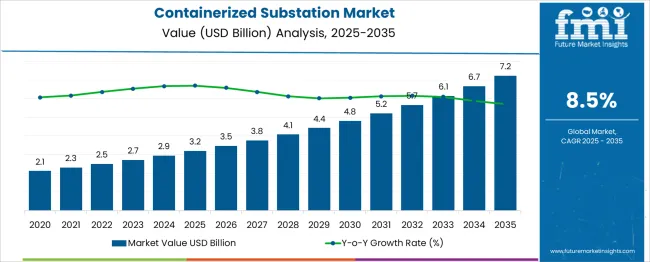
The Containerized Substation market was valued at USD 3.20 billion in 2025, projected to reach USD 3.47 billion in 2026, and is forecast to expand to USD 7.85 billion by 2036 at a 8.5% CAGR. As per FMI, the global acceleration of renewable energy installations, the expansion of mining operations in remote locations, and the demand for rapid-deployment power distribution in disaster recovery and temporary construction scenarios are sustaining procurement of factory-assembled containerised substation units across utilities, industrial, and commercial end-use sectors. FMI is of the opinion that the convergence of grid modernisation programmes, the proliferation of distributed solar and wind generation requiring grid interconnection substations, and the demand for modular data centre power distribution is converting containerised substations from niche temporary power solutions into standard procurement specifications for permanent grid infrastructure.
Summary of Containerized Substation Market Market
- Market Overview
- The Containerized Substation market is valued at USD 3.20 billion in 2025 and is projected to reach USD 7.85 billion by 2036.
- The industry is expected to grow at a 8.5% CAGR from 2026 to 2036, creating an incremental opportunity of USD 4.38 billion.
- The market is a renewable-energy-integration-driven power infrastructure category where solar and wind grid interconnection requirements, modular deployment speed advantages, and remote location accessibility define competitive positioning among containerised substation manufacturers globally.
- Demand and Growth Drivers
- Demand is driven by global acceleration of renewable energy installations requiring rapid-deployment grid interconnection substations.
- Mining operations in remote locations and disaster recovery scenarios generate demand for factory-assembled, transportable power distribution.
- Grid modernisation programmes are converting containerised substations from niche temporary solutions into standard permanent infrastructure specifications.
- China leads at 11.5% CAGR, followed by India at 10.7%, Germany at 9.8%, France at 8.9%, UK at 8.1%, USA at 7.2%, and Brazil at 6.4%.
- Product and Segment View
- The market includes voltage level, application, end use as primary segmentation dimensions.
- Medium Voltage leads by Voltage Level with 54.7% share in 2026.
- Renewable Energy Integration leads by Application with 46.2% share in 2026.
- Utilities leads by End Use with 51.9% share in 2026.
- Geography and Competitive Outlook
- China is the fastest-growing region at 11.5% CAGR, while India anchors the second-largest demand base.
- Competition is shaped by platform capability, regulatory compliance depth, and scale, with key players including ABB Ltd., Siemens AG, Eaton Corporation, General Electric, Toshiba Corporation.
- Analyst Opinion at FMI
- Nikhil Kaitwade, Principal Consultant for Oil & Gas, opines: 'FMI's analysis reveals that the containerized substation market is entering a phase where procurement decisions are increasingly shaped by regulatory compliance timelines and measurable performance thresholds. Organisations that delay investment risk falling behind competitors actively securing next-generation positions.'
- Strategic Implications / Executive Takeaways
- Solution providers must secure certified pathways with tier-1 systems to qualify for forthcoming procurement contracts.
- Capital project directors should mandate native platform compatibility in all new procurement specifications.
- Technical teams must develop specialised competencies in voltage level validation to demonstrate compliance parameters.
Containerized Substation Market Market Key Takeaways
| Metric | Details |
|---|---|
| Industry Size (2026) | USD 3.47 billion |
| Industry Value (2036) | USD 7.85 billion |
| CAGR (2026 to 2036) | 8.5% |
Source: Future Market Insights, 2026
FMI analysts observe that regional growth trajectories reflect varying renewable energy deployment intensity and grid infrastructure investment. China leads at 11.5% CAGR, driven by the scale of solar and wind farm grid interconnection substation procurement and mining sector electrification in remote western provinces. India follows at 10.7%, supported by expanding renewable energy capacity under the National Solar Mission and distribution network modernisation. Germany registers 9.8% growth as Energiewende grid integration requirements drive containerised substation procurement for wind farm connections. France maintains 8.9% growth tied to nuclear plant decommissioning and replacement renewable capacity grid interconnection. The UK sustains 8.1% growth driven by offshore wind farm onshore substation requirements. The USA registers 7.2% growth reflecting data centre power distribution and utility grid modernisation. Brazil maintains 6.4% growth as hydroelectric and solar farm grid interconnection programmes generate substation demand. Based on FMI's report, medium voltage substations command 54.7% share reflecting the concentration of renewable energy grid interconnection at distribution voltage levels. Future Market Insights analysis indicates renewable energy integration accounts for 46.2% application share.
Containerized Substation Market Market Definition
Based on FMI's report, the Containerized Substation market covers factory-assembled, transportable power distribution substations in medium, low, and high voltage configurations used for renewable energy integration, mining operations, temporary power supply, and disaster recovery applications across utilities, industrial, commercial, and telecommunications end-use sectors globally.
Containerized Substation Market Market Inclusions
Future Market Insights analysis covers containerised substations across all voltage levels, applications, end-use sectors, and component categories. The scope encompasses regional market sizes across seven key countries, forecast projections from 2026 to 2036, and full segmentation.
Containerized Substation Market Market Exclusions
The scope excludes conventional brick-and-mortar substations, mobile generator sets without integrated switchgear and transformer assemblies, and portable power distribution panels not classified as substation assemblies.
Containerized Substation Market Market Research Methodology
- Primary Research: Analysts engaged with utility grid planning engineers, renewable energy project developers, and substation OEM channel partners to map procurement triggers and modular deployment adoption timelines.
- Desk Research: Data collection aggregated IEA renewable energy deployment statistics, national grid modernisation budget allocations, and published substation order book disclosures from major power equipment manufacturers.
- Market-Sizing and Forecasting: Baseline values derive from a bottom-up aggregation of containerised substation deliveries across seven key countries, applying renewable energy capacity addition curves and grid interconnection project pipeline data.
- Data Validation and Update Cycle: Projections are cross-validated against quarterly power infrastructure revenue guidance from major substation manufacturers and national renewable energy commissioning statistics.
Why is the Containerized Substation Market Growing?
The containerized substation market is experiencing sustained growth as utilities and energy developers seek scalable and mobile power distribution solutions to meet dynamic load demands. These prefabricated substations offer significant advantages in terms of reduced on-site construction time, compact footprint, and ease of transportation, which have made them a preferred alternative to traditional substation setups.
The growing shift toward decentralized power generation, along with grid modernization initiatives, is accelerating the adoption of containerized substations across regions facing land scarcity and rapid urbanization. Their adaptability to diverse climatic and topographical conditions, coupled with advancements in switchgear integration and thermal management systems, has further strengthened their viability.
Regulatory support for electrification in off-grid and remote areas, particularly in emerging economies, is driving investments in portable substations. Moreover, the integration of smart grid components, IoT-based monitoring, and digital control systems is enhancing the performance, reliability, and remote operability of these systems, positioning them as a critical component of next-generation power distribution infrastructure.
Segmental Analysis
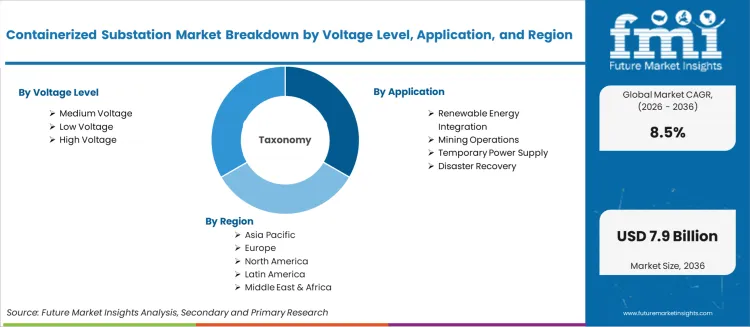
The containerized substation market is segmented by voltage level, application, end user, and component and geographic regions. The containerized substation market is divided by voltage level into Medium Voltage, Low Voltage, and High Voltage. The containerized substation market is classified into Renewable Energy Integration, Mining Operations, Temporary Power Supply, and Disaster Recovery. The end user of the containerized substation market is segmented into Utilities, Industrial, Commercial, and Telecommunications.
The containerized substation market is segmented by component into Switchgears, Transformers, Control Systems, and Protection Systems. Regionally, the containerized substation industry is classified into North America, Latin America, Western Europe, Eastern Europe, Balkan & Baltic Countries, Russia & Belarus, Central Asia, East Asia, South Asia & Pacific, and the Middle East & Africa.
Insights into the Medium Voltage Segment
The medium voltage segment is projected to hold 54.7% of the containerized substation market revenue share in 2026, making it the leading voltage level. This dominance is being driven by the growing use of medium voltage distribution in industrial and commercial facilities, where safe, efficient, and space-saving power delivery is required.
The adaptability of medium voltage systems to varied deployment scenarios, including urban load centers and remote installations, has contributed to their strong preference among utilities and infrastructure developers. Medium voltage containerized substations offer superior performance in renewable energy parks, mining operations, and temporary power sites where agility and scalability are essential.
Enhanced compatibility with modular switchgear, digital protection relays, and transformer units has made this segment more resilient and operationally efficient. The ability to meet grid code requirements while maintaining a compact and mobile structure has further increased adoption across both permanent and temporary power distribution networks, reinforcing medium voltage’s pivotal role in the evolving substation landscape.
Insights into the Renewable Energy Integration Segment
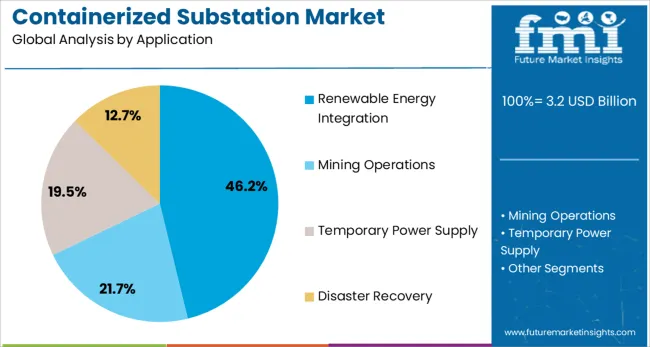
The renewable energy integration segment is expected to account for 46.2% of the total revenue share in the containerized substation market in 2026. This segment's growth is being supported by the global transition toward clean energy sources, where containerized substations are increasingly used to connect solar, wind, and hybrid energy farms to transmission networks.
Their ability to be rapidly deployed, relocated, and upgraded without major civil works aligns with the fluctuating development patterns of renewable projects. As renewable energy systems are often established in remote or geographically constrained locations, the modularity and mobility of containerized substations provide critical infrastructure support.
Enhanced grid balancing and reactive power management capabilities have enabled these substations to facilitate smooth grid integration and voltage regulation in variable generation environments. Furthermore, digital monitoring and predictive maintenance features have helped in optimizing asset performance, reducing downtime, and ensuring compliance with evolving grid codes, all of which have reinforced their value in renewable energy applications.
Insights into the Utilities Segment
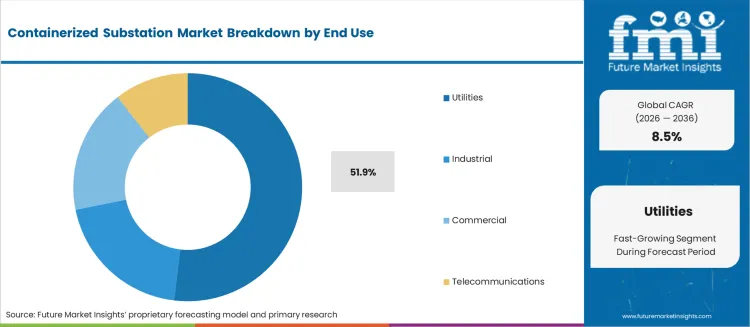
The utilities segment is projected to represent 51.9% of the containerized substation market revenue share in 2026, emerging as the dominant end user. This leading position is being supported by increasing grid expansion projects, aging substation infrastructure, and the need for fast-tracked deployments in developing and underserved regions. Utilities are increasingly leveraging containerized substations to accelerate electrification initiatives, particularly where conventional substations are impractical due to space, cost, or terrain constraints.
Their plug-and-play architecture allows utilities to rapidly deploy, energize, and integrate new grid assets with minimal disruption to existing operations. The integration of SCADA systems, real-time fault diagnostics, and load management solutions within these substations is enhancing operational visibility and reliability.
Additionally, the growing demand for peak shaving, load balancing, and contingency backup infrastructure has elevated their role in urban and rural power networks. As regulatory pressures for grid resilience and decarbonization intensify, containerized substations are becoming essential tools in utilities’ efforts to modernize and stabilize their transmission and distribution networks.
What are the Drivers, Restraints, and Key Trends of the Containerized Substation Market?
Demand is growing for compact and flexible power distribution systems that simplify deployment in remote or temporary energy sites, including renewable integration, mining operations, and emergency utility expansion.
Rapid Deployment and Operational Reliability Enhancing Adoption
Containerized substations are increasingly used where traditional brick‑and‑mortar installations are impractical-such as remote industrial zones, disaster recovery sites, or rapidly evolving renewable energy projects. These modular units enclose transformers, switchgear, and control systems within weatherproof and transport‑ready containers. Operators value standard product line designs that reduce on‑site assembly while ensuring consistent performance. Features such as pre‑tested plug‑and‑play electrical panels, skid‑mounted insulation, and built‑in safety controls deliver resilience in challenging environments. Electric utilities, micro‑grid developers, and EPC contractors use containerized substations to speed up power capacity upgrades and relieve stranded grid needs, especially in off‑grid or mobile contexts. Their mobility, safety, and scalability support accelerated deployment of distributed energy infrastructure without lengthy construction timelines.
Turnkey Service Models, Custom Configurations, and Local Partnerships Driving Scale
Market growth is being fueled by providers offering containerized substation kits bundled with installation, commissioning and maintenance services. Business models based on equipment leasing or service contracts enable developers to avoid upfront infrastructure expenditure while accessing scalable grid capacity. Suppliers are collaborating with local manufacturers, engineering firms, and utilities to tailor designs to voltage classes, climatic conditions, and site-specific standards. Standardized container frames coupled with optional modules-like integrated battery storage, SCADA systems, or power quality panels-allow customization without extensive engineering. Regional assembly hubs near high-growth areas help minimize transport delays and manage regulatory approvals more effectively. Training programs for installation crews and remote support platforms improve deployment speed and reliability. These strategies enhance adoption in industrial, commercial, and developing market segments requiring flexible electricity distribution solutions.
Accelerated Deployment in Renewable Energy Clusters
Containerized substations are gaining rapid traction in solar parks and wind installations due to their compactness and ease of integration with renewable energy assets. These units support decentralized power generation by facilitating plug-and-play connectivity to grid systems and on-site storage. Project developers value their modular design, which allows deployment in under half the time required for traditional substations. Their sealed construction improves weather resistance and thermal efficiency, especially in desert and coastal energy zones. As renewables grow in capacity and complexity, containerized substations play a key role in managing intermittent loads and ensuring seamless transmission at utility-scale or hybrid power setups. Their prefabricated architecture supports quick relocation or expansion, aligning with fluctuating project timelines. This trend also reduces permitting delays and civil work costs, making it suitable for energy clusters with evolving regulatory and environmental conditions.
Off-Grid Electrification and Industrial Expansion in Remote Areas
Containerized substations offer significant opportunity in remote and underserved regions where conventional power infrastructure is logistically or economically infeasible. Their skid-mounted or mobile configuration allows for direct transport to industrial mines, oil and gas fields, rural electrification zones, and emergency relief operations. Unlike traditional setups, these units require minimal site preparation, lowering the threshold for capital investment in isolated environments. Their compact form also facilitates airlifting or trailer mounting, accelerating electrification for remote operations. This application is particularly important for modular data centers, temporary construction hubs, and mobile hospitals, where reliable power is mission-critical but not permanently needed. Energy developers in emerging economies are using containerized substations to rapidly connect renewable microgrids to rural settlements or agricultural zones. Their self-contained design improves service continuity and eliminates the need for extensive utility buildouts, making them ideal for decentralized energy strategies and resilience planning in off-grid markets.
Analysis of Containerized Substation Market By Key Countries
.webp "Top Country Growth Comparison Containerized Substation Market Cagr (2026 2036)")
| Country | CAGR |
|---|---|
| China | 11.5% |
| India | 10.7% |
| Germany | 9.8% |
| France | 8.9% |
| UK | 8.1% |
| USA | 7.2% |
| Brazil | 6.4% |
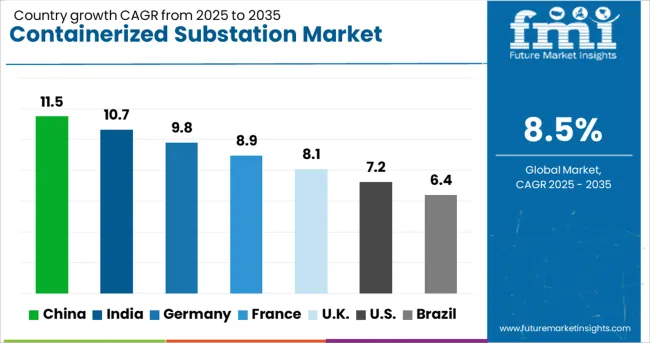
China, a BRICS nation, is anticipated to grow at an 11.5% CAGR from 2026 to 2036, with strong momentum from industrial park electrification and rapid installations in grid extension projects across inland provinces. India, also part of BRICS, follows at 10.7%, supported by expanding rural electrification efforts and growing use of containerized units in mining, construction, and renewable energy zones. Within the OECD, Germany is advancing at 9.8%, with increasing demand across decentralized energy systems and fast-track industrial developments requiring modular power solutions. France, with 8.9% growth, is scaling adoption in rail electrification corridors and urban power reinforcement sites. The United Kingdom, projected at 8.1%, maintains growth through utility partnerships and deployment of mobile substations for temporary grid stabilization and emergency response. The report covers detailed analysis of 40+ countries, and the top five countries have been shared as a reference.
China Containerized Substation Market Expansion
China is leading the global containerized substation market with a robust CAGR of 11.5%. Rapid urbanization, large-scale industrialization, and renewable energy integration are key factors driving demand. Modular substations are being adopted in remote energy projects, smart grid developments, and utility-scale solar and wind farms. Domestic manufacturers are producing prefabricated units with integrated protection systems and remote monitoring capabilities. These substations are deployed for fast electrification in both rural and industrial zones. High-speed railway projects and infrastructure corridors are boosting the use of containerized systems due to their mobility and quick deployment. Chinese state utility companies are adopting standardized designs for nationwide grid upgrades. Export demand from Africa and Southeast Asia is also rising. Technological advancements in insulation, ventilation, and weatherproofing are improving system reliability in extreme environments.
- Solar and wind farms are deploying containerized substations for fast grid connectivity.
- High-speed rail projects are incorporating compact substations at remote junctions.
- Exports of turnkey substation units are increasing to energy-deficient nations.
India Containerized Substation Market Trends
India is experiencing a strong CAGR of 10.7% in the containerized substation market, supported by nationwide electrification and renewable integration efforts. These prefabricated solutions are being used in solar parks, metro systems, and industrial corridors where land and deployment speed are critical. Government programs like Saubhagya and Smart Cities Mission are accelerating demand. Indian manufacturers are building customizable, plug-and-play substations with fault protection and SCADA compatibility. Utilities and EPC contractors prefer these systems for their reduced installation time and modular scalability. Containerized substations are gaining traction in semi-urban and hilly regions where conventional infrastructure faces challenges. The oil and gas sector is also adopting mobile substations for temporary and remote operations. Cost efficiency and faster commissioning make them attractive for private energy developers across multiple states.
- Solar clusters are using container substations for distributed generation integration.
- Public utilities are deploying mobile substations for grid stability in remote zones.
- Smart city projects are adopting modular substations for underground power networks.
Germany Containerized Substation Market Growth
In Germany, containerized substation market is growing at a steady CAGR of 9.8 percent, driven by energy transition goals and decentralized grid infrastructure. Modular substations are being implemented in wind farms, data centers, and EV charging networks. German manufacturers are focusing on engineering compact, high-efficiency systems that meet EU standards for safety and environmental performance. Utilities prefer containerized units for rapid response in maintenance and emergency power restoration. Integration with digital monitoring platforms enables real-time diagnostics and predictive maintenance. Energy-intensive sectors are investing in these substations for load balancing and voltage control. Projects involving battery storage and hydrogen production also benefit from scalable substation designs. Emphasis on recyclable materials and smart automation is contributing to sustainability. These trends are expected to sustain demand across both domestic and export markets in Europe.
- EV infrastructure developers are installing container substations at fast-charging hubs.
- Battery storage facilities are using modular substations for reliable grid interfacing.
- Real-time data integration is improving maintenance and operational planning.
France Containerized Substation Market Insights
France is witnessing a 8.9% CAGR in the containerized substation market, influenced by renewable energy integration, urban grid modernization, and industrial electrification. Local utilities and grid operators are deploying prefabricated substations to speed up network upgrades and reduce site disruption. French engineering firms are producing compact substations with low-loss transformers, integrated switchgear, and digital control systems. These units are finding use in wind energy sites, rail electrification, and backup power installations. Their modularity makes them suitable for dense urban settings where conventional substations face spatial constraints. The French government’s emphasis on carbon neutrality is encouraging investment in infrastructure that supports smart grid applications. Export opportunities in Francophone Africa are also opening up for locally manufactured units. Enhanced safety features, anti-corrosion designs, and thermal management systems are boosting long-term performance.
- Wind energy operators are deploying modular substations for efficient grid connection.
- Urban redevelopment projects are using compact units for temporary power needs.
- Substations are being exported to African countries with shared technical standards.
United Kingdom Containerized Substation Market Outlook
The United Kingdom is registering 8.1% CAGR in the containerized substation market, supported by renewable power integration, EV charging infrastructure, and energy security concerns. These systems are favored for their portability, quick setup, and compliance with UK grid codes. Utility providers and contractors are using containerized substations in wind and solar projects across Scotland and Wales. Urban substations are being upgraded using prefabricated modules that reduce on-site civil work. British manufacturers are emphasizing weatherproofing, fire resistance, and remote diagnostics to meet local safety standards. Offshore wind projects are also adopting container substations for grid tie-ins. Demand is increasing in military and emergency response applications where power mobility is critical. Public-private energy initiatives are funding smart substation deployments to improve resiliency and peak load management across regions.
- Offshore wind farms are using prefabricated substations for platform-level power delivery.
- Temporary substations are aiding grid upgrades in urban infrastructure projects.
- Substations with IoT systems are enhancing monitoring and energy load balancing.
Competitive Landscape of Containerized Substation Market
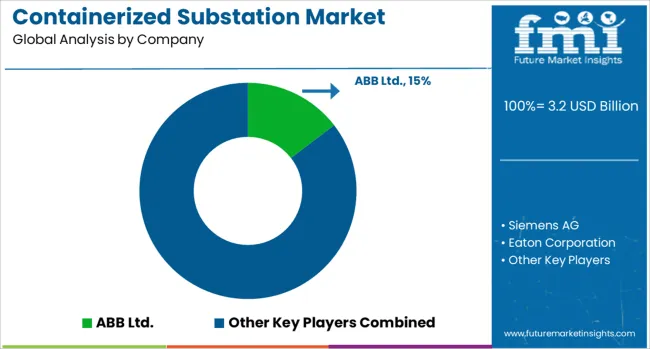
The containerized substation market features a competitive mix of global electrical giants and regionally focused power solution providers, segmented into Tier 1, Tier 2, and Tier 3 suppliers. ABB Ltd. stands out in the Tier 1 segment, known for delivering compact, turnkey substations engineered for rapid deployment across remote locations, industrial sites, and urban infrastructure projects.
Siemens AG, Eaton Corporation, and General Electric also hold significant Tier 1 positions, leveraging advanced modular power conversion technologies and integrated protection systems to meet the rigorous demands of modern grid and utility-scale applications. Tier 2 suppliers, including Toshiba Corporation, Larsen & Toubro, and Kirloskar Electric, specialize in robust, weather-resistant containerized substations designed for industrial zones and power distribution networks operating in challenging environments.
These companies focus on durability and customization to support localized power needs with flexible configurations that ensure reliability under harsh conditions. Meanwhile, Tier 3 players such as Crompton Greaves, IMESA S.p.A., and Elsewedy Electric Co S.A.E. emphasize regional and project-specific solutions, offering cost-effective, tailored containerized units adapted to unique grid specifications and space limitations. Their focus on affordability and adaptability enables deployment in diverse markets, especially in developing regions where infrastructure requirements vary widely.
Together, these suppliers drive innovation and scalability in the containerized substation market, responding to increasing demand for modular, efficient, and rapid power infrastructure deployment worldwide. The competitive landscape fosters continuous advancements in substation compactness, integration, and resilience, supporting evolving energy distribution challenges globally.
Scope of the Report
| Metric | Value |
|---|---|
| Quantitative Units | USD 3.47 billion to USD 7.85 billion, at a CAGR of 8.5% |
| Market Definition | Based on FMI's report, the Containerized Substation market covers factory-assembled, transportable power distribution substations in medium, low, and high voltage configurations used for renewable energy integration, mining operations, temporary power supply, and disaster recovery applications across utilities, industrial, commercial, and telecommunications end-use sectors globally. |
| Segmentation | Voltage Level: Medium Voltage, Low Voltage, High Voltage; Application: Renewable Energy Integration, Mining Operations, Temporary Power Supply, Disaster Recovery; End Use: Utilities, Industrial, Commercial, Telecommunications |
| Regions Covered | China, India, Germany, France, UK, USA, Brazil |
| Key Companies Profiled | ABB Ltd., Siemens AG, Eaton Corporation, General Electric, Toshiba Corporation, Larsen & Toubro, Kirloskar Electric, Crompton Greaves, IMESA S.p.A., Elsewedy Electric Co S.A.E. |
| Forecast Period | 2026 to 2036 |
| Approach | Hybrid bottom-up methodology combining installed base metrics with regulatory compliance adoption curves and primary research validation. |
Containerized Substation Market by Segments
Voltage Level:
- Medium Voltage
- Low Voltage
- High Voltage
Application:
- Renewable Energy Integration
- Mining Operations
- Temporary Power Supply
- Disaster Recovery
End User:
- Utilities
- Industrial
- Commercial
- Telecommunications
Component:
- Switchgears
- Transformers
- Control Systems
- Protection Systems
Region:
- North America
- USA
- Canada
- Mexico
- Latin America
- Brazil
- Chile
- Rest of Latin America
- Western Europe
- Germany
- UK
- Italy
- Spain
- France
- Nordic
- BENELUX
- Rest of Western Europe
- Eastern Europe
- Russia
- Poland
- Hungary
- Balkan & Baltic
- Rest of Eastern Europe
- East Asia
- China
- Japan
- South Korea
- South Asia and Pacific
- India
- ASEAN
- Australia & New Zealand
- Rest of South Asia and Pacific
- Middle East & Africa
- Kingdom of Saudi Arabia
- Other GCC Countries
- Turkiye
- South Africa
- Other African Union
- Rest of Middle East & Africa
Bibliography
- 1. International Energy Agency. (2025). Renewables 2025: Analysis and Forecast. IEA.
- 2. International Electrotechnical Commission. (2024). IEC 62271: High-Voltage Switchgear and Controlgear Standards. IEC.
- 3. World Bank Group. (2024). State of the Global Renewable Energy Market: Grid Integration Assessment. World Bank.
- 4. Organisation for Economic Co-operation and Development. (2025). Energy Investment Outlook: Grid Infrastructure Indicators. OECD Publishing.
- 5. International Renewable Energy Agency. (2025). Renewable Energy Statistics: Grid Connection Capacity. IRENA.
- 6. European Commission. (2024). Trans-European Networks for Energy: Grid Infrastructure Modernisation Report. European Commission.
This bibliography is provided for reader reference. The full Future Market Insights report contains the complete reference list with primary research documentation.
Frequently Asked Questions
How large is the Containerized Substation market in 2026?
The Containerized Substation market is estimated to be valued at USD 3.47 billion in 2026.
What will be the market size of Containerized Substation by 2036?
Market size for Containerized Substation is projected to reach USD 7.85 billion by 2036.
What is the expected CAGR for Containerized Substation between 2026 and 2036?
The Containerized Substation market is expected to grow at a CAGR of 8.5% between 2026 and 2036.
Which Voltage Level leads the Containerized Substation market in 2026?
Medium Voltage accounts for 54.7% share in 2026 by Voltage Level.
Which region is projected to grow fastest?
China is projected to grow at a CAGR of 11.5% during 2026 to 2036.
What does this report include in its scope?
The report covers market sizing, segmentation analysis, regional forecasts, competitive landscape evaluation, and forecast projections from 2026 to 2036.
How does FMI build and validate the Containerized Substation forecast?
Forecasting models apply a bottom-up methodology starting with installed base metrics and cross-validate projections against quarterly revenue volumes and industry data.
Preview the report firsthand - request a free sample
Get SampleGet the brochure for pricing and purchase details.
Get PDFTable of Content
- Executive Summary
- Global Market Outlook
- Demand-side Trends
- Supply-side Trends
- Technology Roadmap Analysis
- Analysis and Recommendations
- Market Overview
- Market Coverage / Taxonomy
- Market Definition / Scope / Limitations
- Research Methodology
- Chapter Orientation
- Analytical Lens and Working Hypotheses
- Market Structure, Signals, and Trend Drivers
- Benchmarking and Cross-market Comparability
- Market Sizing, Forecasting, and Opportunity Mapping
- Research Design and Evidence Framework
- Desk Research Programme (Secondary Evidence)
- Company Annual and Sustainability Reports
- Peer-reviewed Journals and Academic Literature
- Corporate Websites, Product Literature, and Technical Notes
- Earnings Decks and Investor Briefings
- Statutory Filings and Regulatory Disclosures
- Technical White Papers and Standards Notes
- Trade Journals, Industry Magazines, and Analyst Briefs
- Conference Proceedings, Webinars, and Seminar Materials
- Government Statistics Portals and Public Data Releases
- Press Releases and Reputable Media Coverage
- Specialist Newsletters and Curated Briefings
- Sector Databases and Reference Repositories
- FMI Internal Proprietary Databases and Historical Market Datasets
- Subscription Datasets and Paid Sources
- Social Channels, Communities, and Digital Listening Inputs
- Additional Desk Sources
- Expert Input and Fieldwork (Primary Evidence)
- Primary Modes
- Qualitative Interviews and Expert Elicitation
- Quantitative Surveys and Structured Data Capture
- Blended Approach
- Why Primary Evidence is Used
- Field Techniques
- Interviews
- Surveys
- Focus Groups
- Observational and In-context Research
- Social and Community Interactions
- Stakeholder Universe Engaged
- C-suite Leaders
- Board Members
- Presidents and Vice Presidents
- R&D and Innovation Heads
- Technical Specialists
- Domain Subject-matter Experts
- Scientists
- Physicians and Other Healthcare Professionals
- Governance, Ethics, and Data Stewardship
- Research Ethics
- Data Integrity and Handling
- Primary Modes
- Tooling, Models, and Reference Databases
- Desk Research Programme (Secondary Evidence)
- Data Engineering and Model Build
- Data Acquisition and Ingestion
- Cleaning, Normalisation, and Verification
- Synthesis, Triangulation, and Analysis
- Quality Assurance and Audit Trail
- Market Background
- Market Dynamics
- Drivers
- Restraints
- Opportunity
- Trends
- Scenario Forecast
- Demand in Optimistic Scenario
- Demand in Likely Scenario
- Demand in Conservative Scenario
- Opportunity Map Analysis
- Product Life Cycle Analysis
- Supply Chain Analysis
- Investment Feasibility Matrix
- Value Chain Analysis
- PESTLE and Porter’s Analysis
- Regulatory Landscape
- Regional Parent Market Outlook
- Production and Consumption Statistics
- Import and Export Statistics
- Market Dynamics
- Global Market Analysis 2021 to 2025 and Forecast, 2026 to 2036
- Historical Market Size Value (USD Million) Analysis, 2021 to 2025
- Current and Future Market Size Value (USD Million) Projections, 2026 to 2036
- Y-o-Y Growth Trend Analysis
- Absolute $ Opportunity Analysis
- Global Market Pricing Analysis 2021 to 2025 and Forecast 2026 to 2036
- Global Market Analysis 2021 to 2025 and Forecast 2026 to 2036, By Voltage Level
- Introduction / Key Findings
- Historical Market Size Value (USD Million) Analysis By Voltage Level , 2021 to 2025
- Current and Future Market Size Value (USD Million) Analysis and Forecast By Voltage Level , 2026 to 2036
- Medium Voltage
- Low Voltage
- High Voltage
- Medium Voltage
- Y-o-Y Growth Trend Analysis By Voltage Level , 2021 to 2025
- Absolute $ Opportunity Analysis By Voltage Level , 2026 to 2036
- Global Market Analysis 2021 to 2025 and Forecast 2026 to 2036, By Application
- Introduction / Key Findings
- Historical Market Size Value (USD Million) Analysis By Application, 2021 to 2025
- Current and Future Market Size Value (USD Million) Analysis and Forecast By Application, 2026 to 2036
- Renewable Energy Integration
- Mining Operations
- Temporary Power Supply
- Disaster Recovery
- Renewable Energy Integration
- Y-o-Y Growth Trend Analysis By Application, 2021 to 2025
- Absolute $ Opportunity Analysis By Application, 2026 to 2036
- Global Market Analysis 2021 to 2025 and Forecast 2026 to 2036, By End Use
- Introduction / Key Findings
- Historical Market Size Value (USD Million) Analysis By End Use, 2021 to 2025
- Current and Future Market Size Value (USD Million) Analysis and Forecast By End Use, 2026 to 2036
- Utilities
- Industrial
- Commercial
- Telecommunications
- Utilities
- Y-o-Y Growth Trend Analysis By End Use, 2021 to 2025
- Absolute $ Opportunity Analysis By End Use, 2026 to 2036
- Global Market Analysis 2021 to 2025 and Forecast 2026 to 2036, By Component
- Introduction / Key Findings
- Historical Market Size Value (USD Million) Analysis By Component, 2021 to 2025
- Current and Future Market Size Value (USD Million) Analysis and Forecast By Component, 2026 to 2036
- Switchgears
- Transformers
- Control Systems
- Protection Systems
- Switchgears
- Y-o-Y Growth Trend Analysis By Component, 2021 to 2025
- Absolute $ Opportunity Analysis By Component, 2026 to 2036
- Global Market Analysis 2021 to 2025 and Forecast 2026 to 2036, By Region
- Introduction
- Historical Market Size Value (USD Million) Analysis By Region, 2021 to 2025
- Current Market Size Value (USD Million) Analysis and Forecast By Region, 2026 to 2036
- North America
- Latin America
- Western Europe
- Eastern Europe
- East Asia
- South Asia and Pacific
- Middle East & Africa
- Market Attractiveness Analysis By Region
- North America Market Analysis 2021 to 2025 and Forecast 2026 to 2036, By Country
- Historical Market Size Value (USD Million) Trend Analysis By Market Taxonomy, 2021 to 2025
- Market Size Value (USD Million) Forecast By Market Taxonomy, 2026 to 2036
- By Country
- USA
- Canada
- Mexico
- By Voltage Level
- By Application
- By End Use
- By Component
- By Country
- Market Attractiveness Analysis
- By Country
- By Voltage Level
- By Application
- By End Use
- By Component
- Key Takeaways
- Latin America Market Analysis 2021 to 2025 and Forecast 2026 to 2036, By Country
- Historical Market Size Value (USD Million) Trend Analysis By Market Taxonomy, 2021 to 2025
- Market Size Value (USD Million) Forecast By Market Taxonomy, 2026 to 2036
- By Country
- Brazil
- Chile
- Rest of Latin America
- By Voltage Level
- By Application
- By End Use
- By Component
- By Country
- Market Attractiveness Analysis
- By Country
- By Voltage Level
- By Application
- By End Use
- By Component
- Key Takeaways
- Western Europe Market Analysis 2021 to 2025 and Forecast 2026 to 2036, By Country
- Historical Market Size Value (USD Million) Trend Analysis By Market Taxonomy, 2021 to 2025
- Market Size Value (USD Million) Forecast By Market Taxonomy, 2026 to 2036
- By Country
- Germany
- UK
- Italy
- Spain
- France
- Nordic
- BENELUX
- Rest of Western Europe
- By Voltage Level
- By Application
- By End Use
- By Component
- By Country
- Market Attractiveness Analysis
- By Country
- By Voltage Level
- By Application
- By End Use
- By Component
- Key Takeaways
- Eastern Europe Market Analysis 2021 to 2025 and Forecast 2026 to 2036, By Country
- Historical Market Size Value (USD Million) Trend Analysis By Market Taxonomy, 2021 to 2025
- Market Size Value (USD Million) Forecast By Market Taxonomy, 2026 to 2036
- By Country
- Russia
- Poland
- Hungary
- Balkan & Baltic
- Rest of Eastern Europe
- By Voltage Level
- By Application
- By End Use
- By Component
- By Country
- Market Attractiveness Analysis
- By Country
- By Voltage Level
- By Application
- By End Use
- By Component
- Key Takeaways
- East Asia Market Analysis 2021 to 2025 and Forecast 2026 to 2036, By Country
- Historical Market Size Value (USD Million) Trend Analysis By Market Taxonomy, 2021 to 2025
- Market Size Value (USD Million) Forecast By Market Taxonomy, 2026 to 2036
- By Country
- China
- Japan
- South Korea
- By Voltage Level
- By Application
- By End Use
- By Component
- By Country
- Market Attractiveness Analysis
- By Country
- By Voltage Level
- By Application
- By End Use
- By Component
- Key Takeaways
- South Asia and Pacific Market Analysis 2021 to 2025 and Forecast 2026 to 2036, By Country
- Historical Market Size Value (USD Million) Trend Analysis By Market Taxonomy, 2021 to 2025
- Market Size Value (USD Million) Forecast By Market Taxonomy, 2026 to 2036
- By Country
- India
- ASEAN
- Australia & New Zealand
- Rest of South Asia and Pacific
- By Voltage Level
- By Application
- By End Use
- By Component
- By Country
- Market Attractiveness Analysis
- By Country
- By Voltage Level
- By Application
- By End Use
- By Component
- Key Takeaways
- Middle East & Africa Market Analysis 2021 to 2025 and Forecast 2026 to 2036, By Country
- Historical Market Size Value (USD Million) Trend Analysis By Market Taxonomy, 2021 to 2025
- Market Size Value (USD Million) Forecast By Market Taxonomy, 2026 to 2036
- By Country
- Kingdom of Saudi Arabia
- Other GCC Countries
- Turkiye
- South Africa
- Other African Union
- Rest of Middle East & Africa
- By Voltage Level
- By Application
- By End Use
- By Component
- By Country
- Market Attractiveness Analysis
- By Country
- By Voltage Level
- By Application
- By End Use
- By Component
- Key Takeaways
- Key Countries Market Analysis
- USA
- Pricing Analysis
- Market Share Analysis, 2025
- By Voltage Level
- By Application
- By End Use
- By Component
- Canada
- Pricing Analysis
- Market Share Analysis, 2025
- By Voltage Level
- By Application
- By End Use
- By Component
- Mexico
- Pricing Analysis
- Market Share Analysis, 2025
- By Voltage Level
- By Application
- By End Use
- By Component
- Brazil
- Pricing Analysis
- Market Share Analysis, 2025
- By Voltage Level
- By Application
- By End Use
- By Component
- Chile
- Pricing Analysis
- Market Share Analysis, 2025
- By Voltage Level
- By Application
- By End Use
- By Component
- Germany
- Pricing Analysis
- Market Share Analysis, 2025
- By Voltage Level
- By Application
- By End Use
- By Component
- UK
- Pricing Analysis
- Market Share Analysis, 2025
- By Voltage Level
- By Application
- By End Use
- By Component
- Italy
- Pricing Analysis
- Market Share Analysis, 2025
- By Voltage Level
- By Application
- By End Use
- By Component
- Spain
- Pricing Analysis
- Market Share Analysis, 2025
- By Voltage Level
- By Application
- By End Use
- By Component
- France
- Pricing Analysis
- Market Share Analysis, 2025
- By Voltage Level
- By Application
- By End Use
- By Component
- India
- Pricing Analysis
- Market Share Analysis, 2025
- By Voltage Level
- By Application
- By End Use
- By Component
- ASEAN
- Pricing Analysis
- Market Share Analysis, 2025
- By Voltage Level
- By Application
- By End Use
- By Component
- Australia & New Zealand
- Pricing Analysis
- Market Share Analysis, 2025
- By Voltage Level
- By Application
- By End Use
- By Component
- China
- Pricing Analysis
- Market Share Analysis, 2025
- By Voltage Level
- By Application
- By End Use
- By Component
- Japan
- Pricing Analysis
- Market Share Analysis, 2025
- By Voltage Level
- By Application
- By End Use
- By Component
- South Korea
- Pricing Analysis
- Market Share Analysis, 2025
- By Voltage Level
- By Application
- By End Use
- By Component
- Russia
- Pricing Analysis
- Market Share Analysis, 2025
- By Voltage Level
- By Application
- By End Use
- By Component
- Poland
- Pricing Analysis
- Market Share Analysis, 2025
- By Voltage Level
- By Application
- By End Use
- By Component
- Hungary
- Pricing Analysis
- Market Share Analysis, 2025
- By Voltage Level
- By Application
- By End Use
- By Component
- Kingdom of Saudi Arabia
- Pricing Analysis
- Market Share Analysis, 2025
- By Voltage Level
- By Application
- By End Use
- By Component
- Turkiye
- Pricing Analysis
- Market Share Analysis, 2025
- By Voltage Level
- By Application
- By End Use
- By Component
- South Africa
- Pricing Analysis
- Market Share Analysis, 2025
- By Voltage Level
- By Application
- By End Use
- By Component
- USA
- Market Structure Analysis
- Competition Dashboard
- Competition Benchmarking
- Market Share Analysis of Top Players
- By Regional
- By Voltage Level
- By Application
- By End Use
- By Component
- Competition Analysis
- Competition Deep Dive
- ABB Ltd.
- Overview
- Product Portfolio
- Profitability by Market Segments (Product/Age /Sales Channel/Region)
- Sales Footprint
- Strategy Overview
- Marketing Strategy
- Product Strategy
- Channel Strategy
- Siemens AG
- Eaton Corporation
- General Electric
- Toshiba Corporation
- Larsen & Toubro
- Kirloskar Electric
- Crompton Greaves
- IMESA S.p.A.
- Elsewedy Electric Co S.A.E.
- ABB Ltd.
- Competition Deep Dive
- Assumptions & Acronyms Used


