

- Market Size (2026)
- USD 3.8 Bn
- Forecast (2036)
- USD 5.3 Bn
- CAGR (2026 to 2036)
- 3.4%
Container Weighing Systems Market Size, Market Forecast and Outlook By FMI
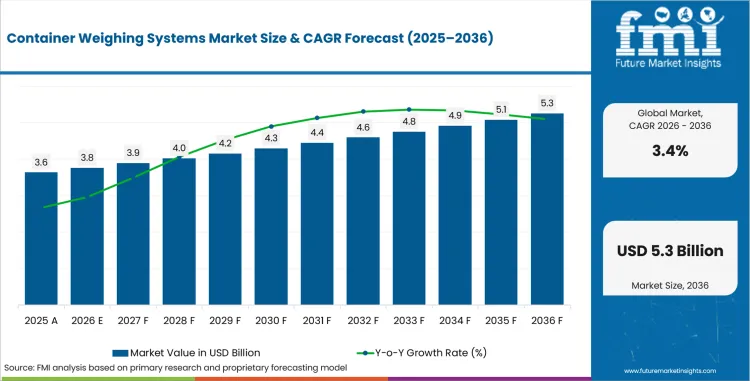
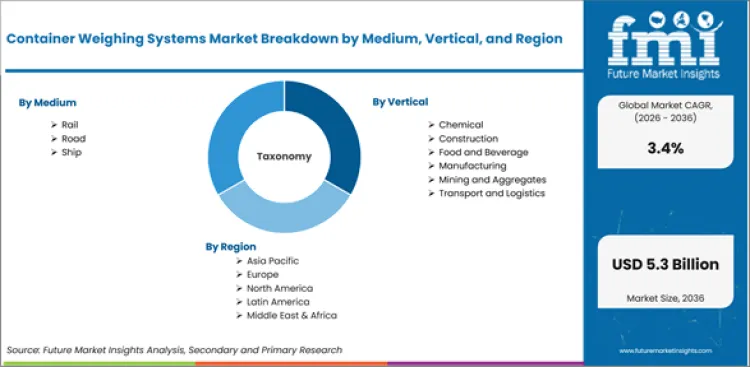
The container weighing systems market was valued at USD 3.6 billion in 2025. The market is set to reach USD 3.8 billion by 2026-end and grow at a CAGR of 3.4% between 2026-2036 to reach USD 5.3 billion by 2036. Rail will dominate with a 23.0% share, while Chemical will lead with a 18.0% share.
Key Takeaways, Market Size, and Forecast
- 2026 Market Size: USD 3.76 billion
- 2036 Market Size: USD 5.26 billion
- Forecast CAGR: 3.4% from 2026 to 2036
- Absolute $ Opportunity: USD 1.49 billion between 2026 and 2036
- Leading Component Segment: Load Cells
- Load Cells Share in 2026: 61.2%
- Fastest-growing Country: South Korea
- South Korea CAGR: 3.6% through 2036
| Parameter | Details |
|---|---|
| Market Size in 2026 (Value) | USD 3.76 billion |
| Market Forecast in 2036 (Value) | USD 5.26 billion |
| CAGR (2026 to 2036) | 3.4% |
| Years Considered | 2021 to 2036 |
| Base Year | 2025 |
| Forecast Period | 2026 to 2036 |
| Units Considered | Value (USD Billion) |
| Leading Sub-Region | South Korea |
Summary of the Container Weighing Systems Market
- Demand and Growth Drivers
- Demand for Container Weighing Systems equipment is shaped by industrial capital expenditure cycles, infrastructure investment programs, and end-use sector expansion across energy, maritime, process, and logistics applications.
- Growth reflects increasing specification requirements, aging installed base replacement, and rising procurement volumes from large-scale infrastructure and industrial projects.
- Adoption is increasing due to tightening efficiency and safety regulations, cost optimization priorities, and integration of advanced monitoring and control systems into industrial workflows.
- Product and Segment View
- Rail is expected to lead the medium segment, accounting for 23.0% of demand in 2026, supported by established procurement patterns and broad application coverage.
- Chemical holds the leading position in the vertical segment, accounting for 18.0% of demand in 2026, supported by established procurement patterns and broad application coverage.
- Load Cell Technology accounts for the largest share of the technology segment, accounting for 52.8% of demand in 2026, supported by established procurement patterns and broad application coverage.
- Geography and Competitive Outlook
- South Korea is expected to lead growth at 3.6% CAGR through 2036, supported by expanding demand and favorable market conditions.
- Japan is projected to grow at 3.5% CAGR, reflecting strong institutional demand and infrastructure development.
- Companies with established distribution networks and multi-regional presence are expected to strengthen competitive positioning over the forecast period.
- Analyst Opinion
- Nandini Roy Choudhury, Principal Consultant at FMI says, 'Companies that combine measurement precision, regulatory compliance capabilities, and integrated digital documentation with multi-port service networks are likely to strengthen competitive positions over the forecast period.'
- The container weighing systems category is evolving from fragmented supply structures toward consolidated, specification-led procurement and distribution.
- Adoption is supported by increasing awareness of performance benefits, compliance requirements, and total cost-of-ownership considerations.
- Demand is further underpinned by regional capacity investment, expanding distribution, and growing participation of organized channel partners.
Container Weighing Systems Market Definition
The container weighing systems market includes all commercially supplied equipment, components, and systems within the container weighing systems category, covering products used across industrial, energy, maritime, and infrastructure applications. The market spans OEM supply, project procurement, and aftermarket replacement.
Container Weighing Systems Market Inclusions
Market scope encompasses all commercially traded products categorized by Medium (Rail Mounted Weighing Systems, Static Rail Weighing, Dynamic In Motion Rail Weighing), Vertical (Bulk Chemical Handling, Hazardous Material Weighing, Liquid Chemical Containers), Technology (Strain Gauge Load Cells, High Accuracy Measurement, Heavy Load Handling), Weighing Mode (Stationary Measurement, High Accuracy Systems, Regulatory Compliance), Component (Force Sensors, High Precision Components, Durable Industrial Sensors). Revenue coverage spans from 2026 to 2036 across North America, Latin America, Europe, East Asia, South Asia and Pacific, and Middle East and Africa.
Container Weighing Systems Market Exclusions
The scope does not include raw unprocessed inputs not commercially traded as finished products, custom-built prototypes, or products sold outside the defined segmentation taxonomy.
Container Weighing Systems Market Research Methodology
- Primary Research:FMI analysts conducted interviews with manufacturers, distributors, procurement specialists, and end users across major markets to validate demand patterns and pricing structures.
- Desk Research:Combined data from trade associations, regulatory filings, company disclosures, and published industry datasets to establish baseline market parameters.
- Market Sizing and Forecasting:Bottom-up aggregation across product segments, end-use applications, and regional adoption curves, triangulated with top-down macroeconomic indicators.
- Data Validation:Cross-checked quarterly against production data, import-export statistics, and manufacturer-reported shipment volumes.
Why is the Container Weighing Systems Market Growing?
- Structural demand growth is driven by expanding end-use consumption, rising specification requirements, and increasing procurement volumes across organized channels.
- South Korea leads growth at 3.6% CAGR, reflecting capacity expansion, favorable conditions, and increasing adoption across primary application areas.
- Load Cells accounts for 61.2% of the component segment, supported by established demand and broad commercial adoption.
The container weighing systems market is expanding at 3.4% CAGR from 2026 to 2036 as industrial and infrastructure investment cycles generate sustained procurement. End-use sectors are upgrading installed capacity, replacing aging equipment, and investing in efficiency improvements.
Supply-side dynamics are shaped by regional manufacturing capacity, technology development, and regulatory compliance conditions. Producers are investing in product development and distribution to capture specification-driven demand growth.
Market Segmentation Analysis
- Rail is expected to lead the medium segment at 23.0% share, reflecting established commercial demand.
- Chemical holds the leading position in the vertical segment at 18.0% share, reflecting established commercial demand.
- Load Cell Technology accounts for the largest share of the technology segment at 52.8% share, reflecting established commercial demand.
The container weighing systems market is segmented by Medium, Vertical, Technology, Weighing Mode, Component. Each axis reflects distinct demand drivers, procurement patterns, and competitive dynamics.
Insights into the Rail Medium Segment
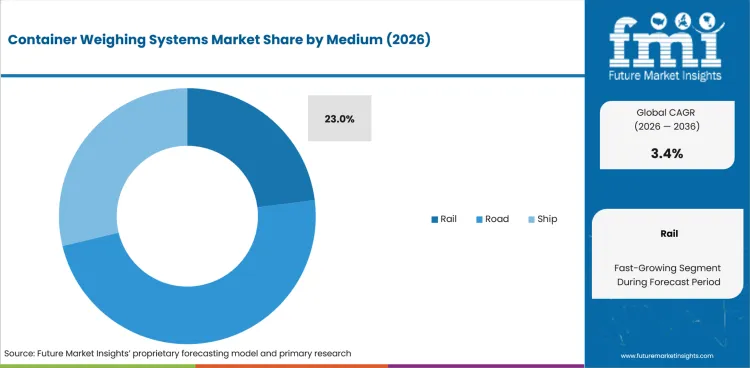
Rail holds the leading position within the medium segment, accounting for 23.0% of the segment in 2026. Demand is concentrated where established performance requirements, supply chain availability, and cost-effectiveness drive procurement. Key sub-categories include Rail Mounted Weighing Systems, Static Rail Weighing, Dynamic In Motion Rail Weighing.
Growth reflects increasing adoption across mature and emerging markets, with buyers prioritizing consistent quality, regulatory compliance, and competitive pricing.
Insights into the Chemical Vertical Segment
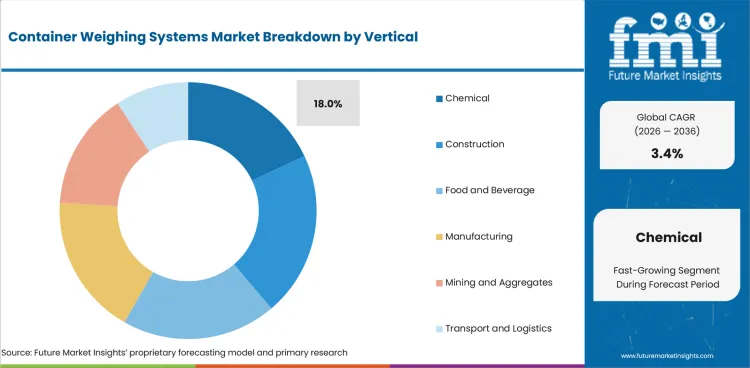
Chemical holds the leading position within the vertical segment, accounting for 18.0% of the segment in 2026. Demand is concentrated where established performance requirements, supply chain availability, and cost-effectiveness drive procurement. Key sub-categories include Bulk Chemical Handling, Hazardous Material Weighing, Liquid Chemical Containers.
Growth reflects increasing adoption across mature and emerging markets, with buyers prioritizing consistent quality, regulatory compliance, and competitive pricing.
Container Weighing Systems Market Drivers, Restraints, and Opportunities
- Expanding end-use demand and increasing specification requirements are creating structured procurement opportunities.
- Higher input costs and integration complexity in specialty segments are limiting margin expansion.
- Regulatory shifts toward compliance, sustainability, and performance standardization are opening new growth avenues.
The container weighing systems market is experiencing balanced growth driven by structural demand expansion, partially offset by cost pressures and competitive intensity.
Industrial Demand and Infrastructure Investment
Growth is anchored in capital expenditure programs, infrastructure development, and capacity expansion requiring higher-specification container weighing systems products.
Integration Cost and Complexity Pressures
Adoption of advanced systems is constrained by integration complexity, high initial capital outlay, and the need for specialized installation and maintenance expertise.
Regulatory Compliance and Efficiency Opportunities
Tightening safety, environmental, and trade compliance regulations are creating demand for products meeting higher performance and documentation thresholds.
Analysis of Container Weighing Systems Market By Key Countries
.webp "Top Country Growth Comparison Container Weighing Systems Market Cagr (2026 2036)")
| Country | CAGR |
|---|---|
| South Korea | 3.6% |
| Japan | 3.5% |
| EU | 3.4% |
| UK | 3.2% |
| USA | 3.1% |
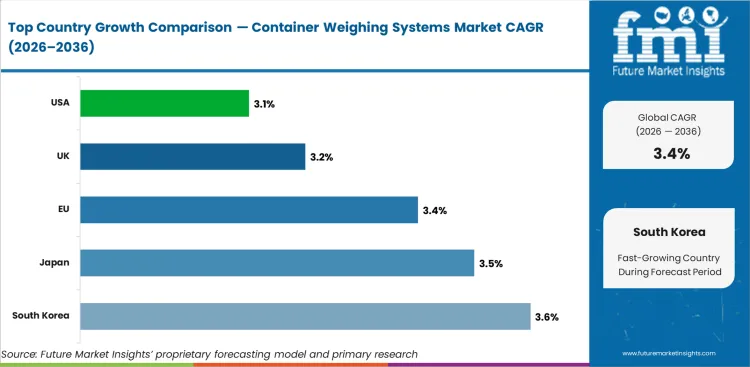
- South Korea leads growth at 3.6% CAGR, driven by expanding consumption and favorable conditions.
- Japan is projected to grow at 3.5% CAGR, supported by institutional demand and infrastructure expansion.
- EU at 3.4% CAGR reflects rising adoption and increasing supply chain investment.
The global container weighing systems market is projected to expand at 3.4% CAGR from 2026 to 2036. The analysis covers more than 30 countries, with key markets detailed below.
Demand Outlook for Container Weighing Systems Market in South Korea
Demand is concentrated in port terminal operations and maritime logistics infrastructure, where Busan and Incheon container terminal operators require load cell-based static and dynamic weighing systems to comply with IMO SOLAS Verified Gross Mass (VGM) regulations. South Korea is projected to grow at 3.6% CAGR through 2036, the fastest among covered markets, as smart port initiatives, government digital infrastructure programs, and high container throughput volumes at Busan New Port sustain structured procurement for bluetooth-enabled and rail-integrated weighing systems.
- Busan and Incheon port terminal container throughput volumes drive sustained procurement for SOLAS VGM-compliant static weighing systems.
- Smart port initiatives and government digital logistics programs are supporting adoption of bluetooth-enabled, IoT-connected container weighing solutions.
- Quality certification and after-sales service requirements in Korean port procurement create stable supplier relationships for established weighing system manufacturers.
Future Outlook for Container Weighing Systems Market in Japan
Strict JIS metrology standards and Japan Customs certification requirements define the regulatory framework for container weighing systems deployed at Japanese port terminals and rail intermodal facilities, creating high specification barriers that favor established load cell technology suppliers. Japan is projected to grow at 3.5% CAGR through 2036 as aging weighing infrastructure replacement cycles, increasing container volumes at Tokyo, Yokohama, and Kobe ports, and SOLAS VGM enforcement sustain procurement for static and rail-based container weighing systems.
- JIS metrology standards and Japan Customs certification create high compliance requirements that favor established container weighing system suppliers.
- Aging port weighing infrastructure replacement at Tokyo and Yokohama container terminals is generating steady procurement for upgraded load cell systems.
- Long equipment qualification cycles and supplier loyalty patterns in Japanese port procurement sustain durable competitive positions for certified manufacturers.
Opportunity Analysis of Container Weighing Systems Market in EU
EU enforcement of IMO SOLAS VGM regulations and European Commission digital transport corridor policies are shaping the procurement environment for container weighing systems across major European port complexes including Rotterdam, Hamburg, Antwerp, and Piraeus. The EU market is projected to grow at 3.4% CAGR through 2036 as port automation investment, intermodal rail container logistics expansion, and digital freight corridor initiatives drive adoption of load cell-based static and dynamic weighing solutions.
- SOLAS VGM enforcement across EU ports mandates verified gross mass documentation, sustaining structured demand for certified container weighing systems.
- EU digital transport corridor policies are supporting integration of automated weighing data into port community systems and customs documentation platforms.
- Rotterdam, Hamburg, and Antwerp port modernization investments are driving procurement of next-generation load cell and rail-integrated weighing systems.
In-depth Analysis of Container Weighing Systems Market in UK
Post-Brexit customs infrastructure modernization and port terminal capacity expansion at Felixstowe, Southampton, and London Gateway are generating procurement requirements for SOLAS VGM-compliant container weighing systems integrated with updated UK customs documentation platforms. The UK is projected to grow at 3.2% CAGR through 2036 as National Infrastructure Strategy port investment, digital customs integration, and increasing container throughput requirements drive adoption of static and rail-based weighing solutions.
- Post-Brexit customs infrastructure modernization is driving integration of weighing systems with UK-specific customs documentation and border control platforms.
- Felixstowe and London Gateway terminal expansion is generating procurement for next-generation load cell-based container weighing installations.
- National Infrastructure Strategy port investment allocations are supporting automation and digital transformation across UK container terminal operations.
Sales Analysis of Container Weighing Systems Market in USA
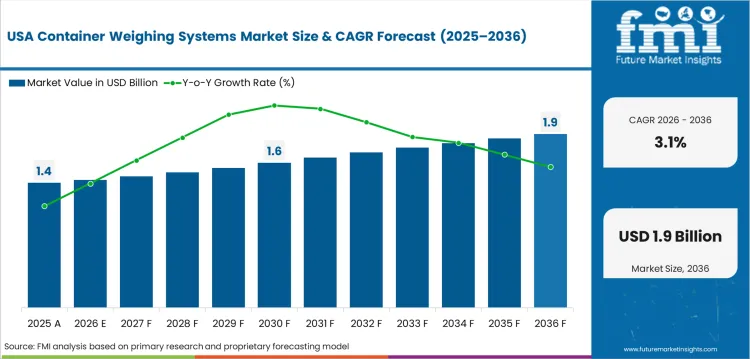
The container weighing systems market in the USA is mature, with established SOLAS VGM compliance infrastructure at major ports including Los Angeles, Long Beach, and Savannah, and installed base replacement cycles sustaining steady procurement for load cell-based static weighing systems. The USA is projected to grow at 3.1% CAGR through 2036 as port automation investment, rail intermodal expansion, and CBP (Customs and Border Protection) security compliance requirements create incremental demand for integrated weighing and documentation solutions.
- Installed base replacement cycles at Los Angeles, Long Beach, and Savannah container terminals sustain steady procurement for upgraded load cell weighing systems.
- Port automation and rail intermodal expansion are driving adoption of dynamic weighing systems integrated with terminal operating software platforms.
- CBP customs compliance and trade facilitation programs create demand for weighing systems integrated with Automated Commercial Environment (ACE) documentation.
Competitive Landscape and Strategic Positioning
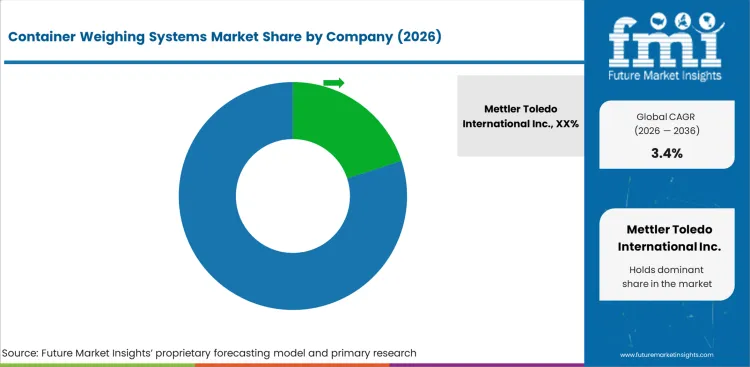
- Mettler Toledo International Inc. maintains a strong position through broad product coverage and established distribution.
- Avery Weigh Tronix and Rice Lake Weighing Systems compete on product breadth, technical capabilities, and supply chain reliability.
- Emerging players are targeting specialty applications and underserved regional markets.
Mettler Toledo International Inc. holds a leading position through integrated capabilities and broad geographic coverage.
Avery Weigh Tronix and Rice Lake Weighing Systems compete through product specialization and regional market strength.
Barriers include regulatory requirements, capital-intensive production, established supply chains, and technical certification. Priorities include cost optimization, geographic expansion, and product innovation.
Key Companies in the Container Weighing Systems Market
Key global companies leading the container weighing systems market include:
- Mettler Toledo International Inc., Avery Weigh Tronix, Rice Lake Weighing Systems, Flintec have strong infrastructure and broad product portfolios.
- Fairbanks Scales, Vishay Precision Group, Pfreundt GmbH have established regional leadership through application expertise.
- Cardinal Scale, Schenck Process, Weightron Bilanciai Ltd represent emerging participants targeting specialty applications.
Competitive Benchmarking: Container Weighing Systems Market
| Company | Product Breadth | Medium Strength | Distribution Reach | Geographic Footprint |
|---|---|---|---|---|
| Mettler Toledo International Inc. | High | High | Strong | Global |
| Avery Weigh Tronix | High | High | Strong | Global |
| Rice Lake Weighing Systems | Medium | High | Moderate | Regional |
| Flintec | Medium | High | Moderate | Regional |
| Fairbanks Scales | Medium | High | Moderate | Regional |
| Vishay Precision Group | Medium | Medium | Low | Regional |
| Pfreundt GmbH | Medium | Medium | Low | Regional |
| Cardinal Scale | Medium | Medium | Low | Regional |
| Schenck Process | Medium | Medium | Low | Regional |
| Weightron Bilanciai Ltd | Medium | Medium | Low | Regional |
Source: Future Market Insights competitive analysis, 2026.
Key Developments in Container Weighing Systems Market
- In 2025, Mettler Toledo International Inc. expanded its product portfolio with new configurations targeting high-growth application segments.
- In 2025, Avery Weigh Tronix strengthened its distribution through strategic partnerships with regional channel partners.
Key Players in the Container Weighing Systems Market
Major Global Players
- Mettler Toledo International Inc.
- Avery Weigh Tronix
- Rice Lake Weighing Systems
- Flintec
- Fairbanks Scales
- Vishay Precision Group
- Pfreundt GmbH
Emerging Players/Startups
- Cardinal Scale
- Schenck Process
- Weightron Bilanciai Ltd
- Tamtron Group
- BISON Group Ltd
- Lloyd’s Register
- Intercomp Company
- Hawk Measurement Systems
Report Scope and Coverage
| Parameter | Details |
|---|---|
| Market size by 2036 | USD 5.26 billion |
| Growth rate | 3.4% CAGR (2026 to 2036) |
| Forecast period | 2026 to 2036 |
| Base year value (2026) | USD 3.76 billion |
| By Medium | Rail Mounted Weighing Systems, Static Rail Weighing, Dynamic In Motion Rail Weighing, Truck Weighing Systems, Weighbridge Systems, On Board Truck Weighing |
| By Vertical | Bulk Chemical Handling, Hazardous Material Weighing, Liquid Chemical Containers, Material Handling, Cement and Aggregate Weighing, On Site Container Weighing |
| By Technology | Strain Gauge Load Cells, High Accuracy Measurement, Heavy Load Handling, Pressure Based Systems, Industrial Applications, Low Maintenance Systems |
| By Weighing Mode | Stationary Measurement, High Accuracy Systems, Regulatory Compliance, In Motion Weighing, Real Time Monitoring, High Throughput Operations |
| By Component | Force Sensors, High Precision Components, Durable Industrial Sensors, Display Units, Digital Interfaces, Control Systems |
| Regions covered | North America, Latin America, Europe, East Asia, South Asia and Pacific, Middle East and Africa |
| Countries covered | South Korea, Japan, EU, UK, USA, 30 plus countries |
| Key companies profiled | Mettler Toledo International Inc., Avery Weigh Tronix, Rice Lake Weighing Systems, Flintec, Fairbanks Scales, Vishay Precision Group, Pfreundt GmbH, Cardinal Scale, Schenck Process, Weightron Bilanciai Ltd |
| Approach | Hybrid bottom-up and top-down methodology starting with verified transaction data, projecting adoption velocity across segments and regions. |
Container Weighing Systems Market Segmentation By Medium, Vertical, Technology, Weighing Mode
Container Weighing Systems Market Segmented by Medium:
- Rail
- Rail Mounted Weighing Systems
- Static Rail Weighing
- Dynamic In Motion Rail Weighing
- Rail Mounted Weighing Systems
- Road
- Truck Weighing Systems
- Weighbridge Systems
- On Board Truck Weighing
- Truck Weighing Systems
- Ship
- Port Weighing Systems
- Container Crane Weighing
- Onboard Vessel Weighing
- Port Weighing Systems
Container Weighing Systems Market Segmented by Vertical:
- Chemical
- Bulk Chemical Handling
- Hazardous Material Weighing
- Liquid Chemical Containers
- Bulk Chemical Handling
- Construction
- Material Handling
- Cement and Aggregate Weighing
- On Site Container Weighing
- Material Handling
- Food and Beverage
- Packaged Goods Handling
- Bulk Food Container Weighing
- Cold Chain Logistics Weighing
- Packaged Goods Handling
- Manufacturing
- Industrial Production
- Raw Material Weighing
- Finished Goods Handling
- Industrial Production
- Mining and Aggregates
- Heavy Material Transport
- Ore Container Weighing
- Bulk Mineral Handling
- Heavy Material Transport
- Transport and Logistics
- Freight Handling
- Port Container Weighing
- Warehouse Operations
- Freight Handling
Container Weighing Systems Market Segmented by Technology:
- Load Cell Technology
- Strain Gauge Load Cells
- High Accuracy Measurement
- Heavy Load Handling
- Strain Gauge Load Cells
- Hydraulic Weighing
- Pressure Based Systems
- Robust Industrial Applications
- Low Maintenance Systems
- Pressure Based Systems
- Digital Weighing Systems
- Electronic Measurement
- Real Time Data Processing
- Automated Reporting Systems
- Electronic Measurement
Container Weighing Systems Market Segmented by Weighing Mode:
- Static Weighing
- Stationary Measurement
- High Accuracy Systems
- Regulatory Compliance
- Stationary Measurement
- Dynamic Weighing
- In Motion Weighing
- Real Time Monitoring
- High Throughput Operations
- In Motion Weighing
Container Weighing Systems Market Segmented by Component:
- Load Cells
- Force Sensors
- High Precision Components
- Durable Industrial Sensors
- Force Sensors
- Indicators and Controllers
- Display Units
- Digital Interfaces
- Control Systems
- Display Units
- Software
- Data Management Systems
- Cloud Integration
- Analytics Platforms
- Data Management Systems
Container Weighing Systems Market by Region:
- North America
- USA
- Canada
- Mexico
- Latin America
- Brazil
- Chile
- Rest of Latin America
- Western Europe
- Germany
- UK
- Italy
- Spain
- France
- Nordic
- BENELUX
- Rest of Western Europe
- Eastern Europe
- Russia
- Poland
- Hungary
- Balkan & Baltic
- Rest of Eastern Europe
- East Asia
- China
- Japan
- South Korea
- South Asia and Pacific
- India
- ASEAN
- Australia & New Zealand
- Rest of South Asia and Pacific
- Middle East & Africa
- Kingdom of Saudi Arabia
- Other GCC Countries
- Turkiye
- South Africa
- Other African Union
- Rest of Middle East & Africa
Research Sources and Bibliography
- 1. International Organization for Standardization. (2024). ISO Industrial Equipment and Metrology Standards. ISO.
- 2. International Maritime Organization. (2024). IMO SOLAS Convention: Verified Gross Mass Requirements. IMO.
- 3. Organisation for Economic Co-operation and Development. (2025). OECD Transport and Infrastructure Statistics. OECD.
- 4. World Bank. (2025). World Development Indicators: Trade and Logistics. World Bank.
- 5. United Nations Conference on Trade and Development. (2025). UNCTAD Review of Maritime Transport. UNCTAD.
This bibliography is provided for reader reference.
This Report Answers
- Estimating the size of the market and revenue potential from 2026 to 2036.
- Segmentation by medium, vertical, technology, weighing mode.
- Regional and country-level insights across more than 30 markets.
- Analysis of demand drivers, restraints, and growth opportunities.
- Competitive landscape assessment and company benchmarking.
- Identification of high-growth segments and investment opportunities.
- Supply chain analysis and procurement pattern evaluation.
- Delivery of data in PDF and Excel formats.
Frequently Asked Questions
How big is the container weighing systems market in 2026?
The global container weighing systems market is estimated to be valued at USD 3.8 billion in 2026.
What will be the size of container weighing systems market in 2036?
The market size for the container weighing systems market is projected to reach USD 5.3 billion by 2036.
How much will be the container weighing systems market growth between 2026 and 2036?
The container weighing systems market is expected to grow at a 3.4% CAGR between 2026 and 2036.
What are the key product types in the container weighing systems market?
The key product types in container weighing systems market are Rail, Road and Ship.
Which vertical segment is expected to contribute significant share in the container weighing systems market in 2026?
In terms of vertical, chemical segment is expected to command 18.0% share in the container weighing systems market in 2026.
Preview the report firsthand - request a free sample
Get SampleGet the brochure for pricing and purchase details.
Get PDFTable of Content
- Executive Summary
- Global Market Outlook
- Demand-side Trends
- Supply-side Trends
- Technology Roadmap Analysis
- Analysis and Recommendations
- Market Overview
- Market Coverage / Taxonomy
- Market Definition / Scope / Limitations
- Research Methodology
- Chapter Orientation
- Analytical Lens and Working Hypotheses
- Market Structure, Signals, and Trend Drivers
- Benchmarking and Cross-market Comparability
- Market Sizing, Forecasting, and Opportunity Mapping
- Research Design and Evidence Framework
- Desk Research Programme (Secondary Evidence)
- Company Annual and Sustainability Reports
- Peer-reviewed Journals and Academic Literature
- Corporate Websites, Product Literature, and Technical Notes
- Earnings Decks and Investor Briefings
- Statutory Filings and Regulatory Disclosures
- Technical White Papers and Standards Notes
- Trade Journals, Industry Magazines, and Analyst Briefs
- Conference Proceedings, Webinars, and Seminar Materials
- Government Statistics Portals and Public Data Releases
- Press Releases and Reputable Media Coverage
- Specialist Newsletters and Curated Briefings
- Sector Databases and Reference Repositories
- FMI Internal Proprietary Databases and Historical Market Datasets
- Subscription Datasets and Paid Sources
- Social Channels, Communities, and Digital Listening Inputs
- Additional Desk Sources
- Expert Input and Fieldwork (Primary Evidence)
- Primary Modes
- Qualitative Interviews and Expert Elicitation
- Quantitative Surveys and Structured Data Capture
- Blended Approach
- Why Primary Evidence is Used
- Field Techniques
- Interviews
- Surveys
- Focus Groups
- Observational and In-context Research
- Social and Community Interactions
- Stakeholder Universe Engaged
- C-suite Leaders
- Board Members
- Presidents and Vice Presidents
- R&D and Innovation Heads
- Technical Specialists
- Domain Subject-matter Experts
- Scientists
- Physicians and Other Healthcare Professionals
- Governance, Ethics, and Data Stewardship
- Research Ethics
- Data Integrity and Handling
- Primary Modes
- Tooling, Models, and Reference Databases
- Desk Research Programme (Secondary Evidence)
- Data Engineering and Model Build
- Data Acquisition and Ingestion
- Cleaning, Normalisation, and Verification
- Synthesis, Triangulation, and Analysis
- Quality Assurance and Audit Trail
- Market Background
- Market Dynamics
- Drivers
- Restraints
- Opportunity
- Trends
- Scenario Forecast
- Demand in Optimistic Scenario
- Demand in Likely Scenario
- Demand in Conservative Scenario
- Opportunity Map Analysis
- Product Life Cycle Analysis
- Supply Chain Analysis
- Investment Feasibility Matrix
- Value Chain Analysis
- PESTLE and Porter’s Analysis
- Regulatory Landscape
- Regional Parent Market Outlook
- Production and Consumption Statistics
- Import and Export Statistics
- Market Dynamics
- Global Market Analysis 2021 to 2025 and Forecast, 2026 to 2036
- Historical Market Size Value (USD Million) Analysis, 2021 to 2025
- Current and Future Market Size Value (USD Million) Projections, 2026 to 2036
- Y-o-Y Growth Trend Analysis
- Absolute $ Opportunity Analysis
- Global Market Pricing Analysis 2021 to 2025 and Forecast 2026 to 2036
- Global Market Analysis 2021 to 2025 and Forecast 2026 to 2036, By Medium
- Introduction / Key Findings
- Historical Market Size Value (USD Million) Analysis By Medium , 2021 to 2025
- Current and Future Market Size Value (USD Million) Analysis and Forecast By Medium , 2026 to 2036
- Rail
- Rail Mounted Weighing Systems
- Static Rail Weighing
- Dynamic In Motion Rail Weighing
- Road
- Truck Weighing Systems
- Weighbridge Systems
- On Board Truck Weighing
- Rail
- Y-o-Y Growth Trend Analysis By Medium , 2021 to 2025
- Absolute $ Opportunity Analysis By Medium , 2026 to 2036
- Global Market Analysis 2021 to 2025 and Forecast 2026 to 2036, By Vertical
- Introduction / Key Findings
- Historical Market Size Value (USD Million) Analysis By Vertical, 2021 to 2025
- Current and Future Market Size Value (USD Million) Analysis and Forecast By Vertical, 2026 to 2036
- Chemical
- Bulk Chemical Handling
- Hazardous Material Weighing
- Liquid Chemical Containers
- Construction
- Material Handling
- Cement and Aggregate Weighing
- On Site Container Weighing
- Food and Beverage
- Packaged Goods Handling
- Bulk Food Container Weighing
- Cold Chain Logistics Weighing
- Manufacturing
- Industrial Production
- Raw Material Weighing
- Finished Goods Handling
- Mining and Aggregates
- Heavy Material Transport
- Ore Container Weighing
- Bulk Mineral Handling
- Transport and Logistics
- Freight Handling
- Port Container Weighing
- Warehouse Operations
- Chemical
- Y-o-Y Growth Trend Analysis By Vertical, 2021 to 2025
- Absolute $ Opportunity Analysis By Vertical, 2026 to 2036
- Global Market Analysis 2021 to 2025 and Forecast 2026 to 2036, By Technology
- Introduction / Key Findings
- Historical Market Size Value (USD Million) Analysis By Technology, 2021 to 2025
- Current and Future Market Size Value (USD Million) Analysis and Forecast By Technology, 2026 to 2036
- Load Cell Technology
- Strain Gauge Load Cells
- High Accuracy Measurement
- Heavy Load Handling
- Hydraulic Weighing
- Pressure Based Systems
- Robust Industrial Applications
- Low Maintenance Systems
- Digital Weighing Systems
- Electronic Measurement
- Real Time Data Processing
- Automated Reporting Systems
- Load Cell Technology
- Y-o-Y Growth Trend Analysis By Technology, 2021 to 2025
- Absolute $ Opportunity Analysis By Technology, 2026 to 2036
- Global Market Analysis 2021 to 2025 and Forecast 2026 to 2036, By Weighing Mode
- Introduction / Key Findings
- Historical Market Size Value (USD Million) Analysis By Weighing Mode, 2021 to 2025
- Current and Future Market Size Value (USD Million) Analysis and Forecast By Weighing Mode, 2026 to 2036
- Static Weighing
- Stationary Measurement
- High Accuracy Systems
- Regulatory Compliance
- Dynamic Weighing
- In Motion Weighing
- Real Time Monitoring
- High Throughput Operations
- Static Weighing
- Y-o-Y Growth Trend Analysis By Weighing Mode, 2021 to 2025
- Absolute $ Opportunity Analysis By Weighing Mode, 2026 to 2036
- Global Market Analysis 2021 to 2025 and Forecast 2026 to 2036, By Component
- Introduction / Key Findings
- Historical Market Size Value (USD Million) Analysis By Component, 2021 to 2025
- Current and Future Market Size Value (USD Million) Analysis and Forecast By Component, 2026 to 2036
- Load Cells
- Force Sensors
- High Precision Components
- Durable Industrial Sensors
- Indicators and Controllers
- Display Value (USD Million)s
- Digital Interfaces
- Control Systems
- Software
- Data Management Systems
- Cloud Integration
- Analytics Platforms
- Load Cells
- Y-o-Y Growth Trend Analysis By Component, 2021 to 2025
- Absolute $ Opportunity Analysis By Component, 2026 to 2036
- Global Market Analysis 2021 to 2025 and Forecast 2026 to 2036, By Region
- Introduction
- Historical Market Size Value (USD Million) Analysis By Region, 2021 to 2025
- Current Market Size Value (USD Million) Analysis and Forecast By Region, 2026 to 2036
- North America
- Latin America
- Western Europe
- Eastern Europe
- East Asia
- South Asia and Pacific
- Middle East & Africa
- Market Attractiveness Analysis By Region
- North America Market Analysis 2021 to 2025 and Forecast 2026 to 2036, By Country
- Historical Market Size Value (USD Million) Trend Analysis By Market Taxonomy, 2021 to 2025
- Market Size Value (USD Million) Forecast By Market Taxonomy, 2026 to 2036
- By Country
- USA
- Canada
- Mexico
- By Medium
- By Vertical
- By Technology
- By Weighing Mode
- By Component
- By Country
- Market Attractiveness Analysis
- By Country
- By Medium
- By Vertical
- By Technology
- By Weighing Mode
- By Component
- Key Takeaways
- Latin America Market Analysis 2021 to 2025 and Forecast 2026 to 2036, By Country
- Historical Market Size Value (USD Million) Trend Analysis By Market Taxonomy, 2021 to 2025
- Market Size Value (USD Million) Forecast By Market Taxonomy, 2026 to 2036
- By Country
- Brazil
- Chile
- Rest of Latin America
- By Medium
- By Vertical
- By Technology
- By Weighing Mode
- By Component
- By Country
- Market Attractiveness Analysis
- By Country
- By Medium
- By Vertical
- By Technology
- By Weighing Mode
- By Component
- Key Takeaways
- Western Europe Market Analysis 2021 to 2025 and Forecast 2026 to 2036, By Country
- Historical Market Size Value (USD Million) Trend Analysis By Market Taxonomy, 2021 to 2025
- Market Size Value (USD Million) Forecast By Market Taxonomy, 2026 to 2036
- By Country
- Germany
- UK
- Italy
- Spain
- France
- Nordic
- BENELUX
- Rest of Western Europe
- By Medium
- By Vertical
- By Technology
- By Weighing Mode
- By Component
- By Country
- Market Attractiveness Analysis
- By Country
- By Medium
- By Vertical
- By Technology
- By Weighing Mode
- By Component
- Key Takeaways
- Eastern Europe Market Analysis 2021 to 2025 and Forecast 2026 to 2036, By Country
- Historical Market Size Value (USD Million) Trend Analysis By Market Taxonomy, 2021 to 2025
- Market Size Value (USD Million) Forecast By Market Taxonomy, 2026 to 2036
- By Country
- Russia
- Poland
- Hungary
- Balkan & Baltic
- Rest of Eastern Europe
- By Medium
- By Vertical
- By Technology
- By Weighing Mode
- By Component
- By Country
- Market Attractiveness Analysis
- By Country
- By Medium
- By Vertical
- By Technology
- By Weighing Mode
- By Component
- Key Takeaways
- East Asia Market Analysis 2021 to 2025 and Forecast 2026 to 2036, By Country
- Historical Market Size Value (USD Million) Trend Analysis By Market Taxonomy, 2021 to 2025
- Market Size Value (USD Million) Forecast By Market Taxonomy, 2026 to 2036
- By Country
- China
- Japan
- South Korea
- By Medium
- By Vertical
- By Technology
- By Weighing Mode
- By Component
- By Country
- Market Attractiveness Analysis
- By Country
- By Medium
- By Vertical
- By Technology
- By Weighing Mode
- By Component
- Key Takeaways
- South Asia and Pacific Market Analysis 2021 to 2025 and Forecast 2026 to 2036, By Country
- Historical Market Size Value (USD Million) Trend Analysis By Market Taxonomy, 2021 to 2025
- Market Size Value (USD Million) Forecast By Market Taxonomy, 2026 to 2036
- By Country
- India
- ASEAN
- Australia & New Zealand
- Rest of South Asia and Pacific
- By Medium
- By Vertical
- By Technology
- By Weighing Mode
- By Component
- By Country
- Market Attractiveness Analysis
- By Country
- By Medium
- By Vertical
- By Technology
- By Weighing Mode
- By Component
- Key Takeaways
- Middle East & Africa Market Analysis 2021 to 2025 and Forecast 2026 to 2036, By Country
- Historical Market Size Value (USD Million) Trend Analysis By Market Taxonomy, 2021 to 2025
- Market Size Value (USD Million) Forecast By Market Taxonomy, 2026 to 2036
- By Country
- Kingdom of Saudi Arabia
- Other GCC Countries
- Turkiye
- South Africa
- Other African Union
- Rest of Middle East & Africa
- By Medium
- By Vertical
- By Technology
- By Weighing Mode
- By Component
- By Country
- Market Attractiveness Analysis
- By Country
- By Medium
- By Vertical
- By Technology
- By Weighing Mode
- By Component
- Key Takeaways
- Key Countries Market Analysis
- USA
- Pricing Analysis
- Market Share Analysis, 2025
- By Medium
- By Vertical
- By Technology
- By Weighing Mode
- By Component
- Canada
- Pricing Analysis
- Market Share Analysis, 2025
- By Medium
- By Vertical
- By Technology
- By Weighing Mode
- By Component
- Mexico
- Pricing Analysis
- Market Share Analysis, 2025
- By Medium
- By Vertical
- By Technology
- By Weighing Mode
- By Component
- Brazil
- Pricing Analysis
- Market Share Analysis, 2025
- By Medium
- By Vertical
- By Technology
- By Weighing Mode
- By Component
- Chile
- Pricing Analysis
- Market Share Analysis, 2025
- By Medium
- By Vertical
- By Technology
- By Weighing Mode
- By Component
- Germany
- Pricing Analysis
- Market Share Analysis, 2025
- By Medium
- By Vertical
- By Technology
- By Weighing Mode
- By Component
- UK
- Pricing Analysis
- Market Share Analysis, 2025
- By Medium
- By Vertical
- By Technology
- By Weighing Mode
- By Component
- Italy
- Pricing Analysis
- Market Share Analysis, 2025
- By Medium
- By Vertical
- By Technology
- By Weighing Mode
- By Component
- Spain
- Pricing Analysis
- Market Share Analysis, 2025
- By Medium
- By Vertical
- By Technology
- By Weighing Mode
- By Component
- France
- Pricing Analysis
- Market Share Analysis, 2025
- By Medium
- By Vertical
- By Technology
- By Weighing Mode
- By Component
- India
- Pricing Analysis
- Market Share Analysis, 2025
- By Medium
- By Vertical
- By Technology
- By Weighing Mode
- By Component
- ASEAN
- Pricing Analysis
- Market Share Analysis, 2025
- By Medium
- By Vertical
- By Technology
- By Weighing Mode
- By Component
- Australia & New Zealand
- Pricing Analysis
- Market Share Analysis, 2025
- By Medium
- By Vertical
- By Technology
- By Weighing Mode
- By Component
- China
- Pricing Analysis
- Market Share Analysis, 2025
- By Medium
- By Vertical
- By Technology
- By Weighing Mode
- By Component
- Japan
- Pricing Analysis
- Market Share Analysis, 2025
- By Medium
- By Vertical
- By Technology
- By Weighing Mode
- By Component
- South Korea
- Pricing Analysis
- Market Share Analysis, 2025
- By Medium
- By Vertical
- By Technology
- By Weighing Mode
- By Component
- Russia
- Pricing Analysis
- Market Share Analysis, 2025
- By Medium
- By Vertical
- By Technology
- By Weighing Mode
- By Component
- Poland
- Pricing Analysis
- Market Share Analysis, 2025
- By Medium
- By Vertical
- By Technology
- By Weighing Mode
- By Component
- Hungary
- Pricing Analysis
- Market Share Analysis, 2025
- By Medium
- By Vertical
- By Technology
- By Weighing Mode
- By Component
- Kingdom of Saudi Arabia
- Pricing Analysis
- Market Share Analysis, 2025
- By Medium
- By Vertical
- By Technology
- By Weighing Mode
- By Component
- Turkiye
- Pricing Analysis
- Market Share Analysis, 2025
- By Medium
- By Vertical
- By Technology
- By Weighing Mode
- By Component
- South Africa
- Pricing Analysis
- Market Share Analysis, 2025
- By Medium
- By Vertical
- By Technology
- By Weighing Mode
- By Component
- USA
- Market Structure Analysis
- Competition Dashboard
- Competition Benchmarking
- Market Share Analysis of Top Players
- By Regional
- By Medium
- By Vertical
- By Technology
- By Weighing Mode
- By Component
- Competition Analysis
- Competition Deep Dive
- Mettler Toledo International Inc.
- Overview
- Product Portfolio
- Profitability by Market Segments (Product/Age /Sales Channel/Region)
- Sales Footprint
- Strategy Overview
- Marketing Strategy
- Product Strategy
- Channel Strategy
- Avery Weigh Tronix
- Rice Lake Weighing Systems
- Flintec
- Fairbanks Scales
- Vishay Precision Group
- Pfreundt GmbH
- Cardinal Scale
- Schenck Process
- Weightron Bilanciai Ltd
- Tamtron Group
- BISON Group Ltd
- Lloyd’s Register
- Intercomp Company
- Hawk Measurement Systems
- Mettler Toledo International Inc.
- Competition Deep Dive
- Assumptions & Acronyms Used


