

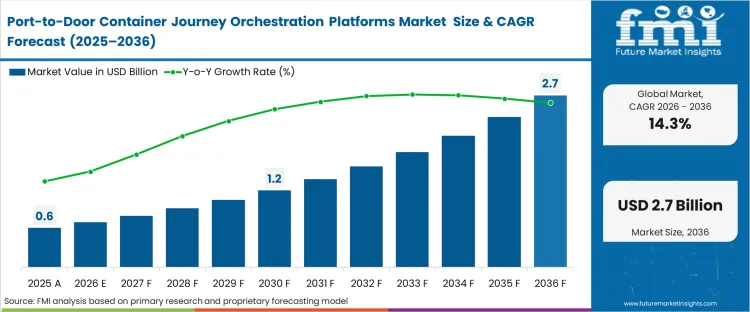
- Industry Size (2026)
- USD 0.7 Bn
- Forecast (2036)
- USD 2.8 Bn
- CAGR (2026 to 2036)
- 14.30%
Port-to-Door Container Journey Orchestration Platforms Market Size, Market Forecast and Outlook By FMI
The port-to-door container journey orchestration platforms market crossed a valuation of USD 0.6 billion in 2025. Revenue is expected to reach USD 0.7 billion in 2026 at a CAGR of 14.30% during this forecast period. Steady investment carries cumulative buildup to USD 2.8 billion through 2036 as global supply chains shift from post-event tracking to predictive bottleneck circumvention.
Supply chain executives face relentless pressure to eradicate blind spots between terminal discharge and inland warehouse arrival. Visibility gaps during drayage and rail interchange cost beneficial cargo owners thousands daily in unchecked fees. Implementing port-to-door container orchestration software alongside reliable supply chain visibility software transforms passive tracking into proactive detention control. Delays in upgrading legacy transport management systems leave importers vulnerable to compounded port congestion penalties. Buyers evaluating the ocean freight visibility platform market size realize that pure visibility holds diminishing value without automated workflow execution.
Terminal operators publishing standardized event data triggers immediate exponential value across connected multimodal networks. Once application programming interfaces securely bridge ocean carriers with inland drayage providers, proactive rerouting replaces manual exception handling. This data fluidity unlocks predictive container flow. Rigid transit transforms into an elastic routing environment.
Summary of Port-to-Door Container Journey Orchestration Platforms Market
- Port-to-Door Container Journey Orchestration Platforms Market Definition
- Digital foundational synchronizing ocean transit milestones with inland multimodal execution and documentation workflows.
- Demand Drivers in Port-to-Door Container Journey Orchestration Platforms Market
- Demurrage penalty accumulation forces beneficial cargo owners to deploy real-time inland tracking systems.
- Chassis dislocation compels drayage dispatchers to adopt predictive container availability algorithms.
- Customs clearance unpredictability pushes freight forwarders to automate document handoffs via application programming interfaces.
- Key Segments Analyzed in FMI Report
- Platform function: Real-time visibility and ETA orchestration is anticipated to account for 42.0% share in 2026, driven by continuous integration with global carrier data feeds.
- Deployment Architecture: Cloud-native SaaS is projected to hold 79.0% share, supported by rapid deployment capabilities across fragmented supply chain partners.
- Buyer Type: Large BCOs, retailers, and importers are expected to record 35.0% share, fueled by direct control mandates over inbound inventory flows.
- Journey Coverage: Port-to-door multimodal orchestration is set to capture 38.0% share, reflecting industry shift toward unbroken transit chain management.
- India: 16.4% compound growth, propelled by aggressive national logistics policy implementation.
- Analyst Opinion at FMI
- Ronak Shah, Principal Analyst, Services & Utilities, at FMI, observes that, "Standard tracking metrics capture vessel arrival times perfectly, yet miss inland demurrage exposure entirely. When ocean carriers discharge a box, terminal free-time clocks start ticking instantly regardless of downstream capacity. Large retailers lose millions annually strictly because their inland transport partners lack predictive visibility to retrieve containers before penalties accrue. These platforms effectively serve as financial defense mechanisms against severe supply chain friction."
- Strategic Implications / Executive Takeaways
- Supply chain vice presidents securing predictive visibility gain clear advantages in seasonal inventory positioning.
- Non-vessel operating common carriers adopting workflow automation avoid crippling administrative overhead during peak shipping seasons.
- Terminal operators exposing reliable event data capture priority routing status from major global retail importers.
- Methodology
- Primary Research: Qualitative interviews with digital forwarding directors and terminal IT heads reveal core adoption barriers.
- Desk Research: Analysis of port single-window mandates exposes regulatory drivers forcing platform integration.
- Market-Sizing and Forecasting: Subscription revenue models anchored to global twenty-foot equivalent unit volumes provide baseline valuation.
- Data Validation and Update Cycle: Vendor integration announcements cross-validated against carrier API documentation.
India leads at 16.4%, with massive capital investments accelerating connected logistics adoption, while China tracks at 15.2% on continuous port automation upgrades. Singapore is set to grow at 14.8% through aggressive maritime single window implementations. United Arab Emirates advances at 14.6% as free-trade zones mandate digitized cargo handoffs. Netherlands expands at 13.7% driven by Europe's strictest inland waterway coordination mandates. United States accelerates at 12.9% to combat severe chassis shortages. Germany progresses at 12.5% prioritizing rail-freight synchronization. Divergence across these hubs stems strictly from inland logistics network fragmentation versus integrated state-run corridors.
Port-to-Door Container Journey Orchestration Platforms Market Key Takeaways
| Metric | Details |
|---|---|
| Industry Size (2026) | USD 0.7 Billion |
| Industry Value (2036) | USD 2.8 Billion |
| CAGR (2026 to 2036) | 14.30% |
Source: Future Market Insights (FMI) analysis, based on proprietary forecasting model and primary research
Port-to-Door Container Journey Orchestration Platforms Market Definition
Port-to-Door Container Journey Orchestration Platforms Market functions as centralized digital connective tissue linking ocean freight milestones with inland multimodal execution. When defining what is a port-to-door container orchestration platform, analysts point to architectures that integrate terminal operating systems, carrier schedules, customs clearance events, and drayage dispatch into one unified workflow. Procurement directors utilize these tools to predict precise arrival times and proactively divert shipments around physical chokepoints.
Port-to-Door Container Journey Orchestration Platforms Market Inclusions
Inland tracking integration and predictive delivery tracking platform algorithms fall within scope. Platforms providing exception management for intermodal shifts alongside dedicated shipping container tracking modules represent core functionalities. Systems integrating directly with customs portals or offering dedicated container exception management software modules also qualify.
Port-to-Door Container Journey Orchestration Platforms Market Exclusions
Basic global positioning system hardware modules and physical telematics devices remain outside analytical scope because they lack workflow orchestration capabilities. Standalone automated container terminal operating systems lacking inland multimodal connectivity are excluded. Traditional enterprise resource planning systems without dedicated port-to-door event management architecture fall into adjacent software categories.
Port-to-Door Container Journey Orchestration Platforms Market Research Methodology
- Primary Research: Chief supply chain officers, digital freight forwarding directors, and terminal operations managers.
- Desk Research: Port authority digital mandate documents, customs API specifications, and international maritime organization registry logs.
- Market-Sizing and Forecasting: Active software-as-a-service subscription volumes across top 50 global port hubs.
- Data Validation and Update Cycle: Cross-referenced against quarterly container throughput volumes and carrier digital transaction logs.
Segmental Analysis
Port-to-Door Container Journey Orchestration Platforms Market Analysis by Platform function
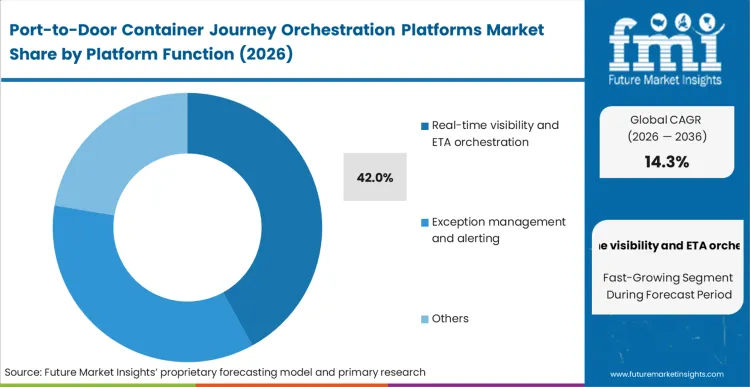
Legacy milestone tracking fails to deliver value when inland transportation capacity tightens unpredictably. FMI's analysis indicates Real-time visibility and ETA orchestration drives 42.0% share as logistics vice presidents demand predictive alerting over retrospective status updates. Modern logistics visibility software transforms static electronic data interchange signals into dynamic routing intelligence. Supply chain directors deploying these container ETA orchestration platform modules dramatically reduce buffer stock requirements by treating transit pipelines as mobile warehouses. Retailers relying on outdated systems face devastating inventory stockouts during peak promotional seasons. Visibility alone cannot prevent bottlenecks; only bidirectional logistics 4.0 communication enables actual intervention.
- Predictive diversion: Continuous algorithmic monitoring allows planners to reroute shipments before terminal congestion solidifies. Logistics managers avoid multi-day delays.
- Demurrage mitigation: Automated alerts warn drayage coordinators before port free-time expires. Procurement teams prevent margin-eroding penalty fees entirely.
- Carrier benchmarking: Historical transit data exposes chronic underperformance among specific ocean lines. Freight forwarders negotiate better seasonal capacity contracts.
Port-to-Door Container Journey Orchestration Platforms Market Analysis by Deployment architecture
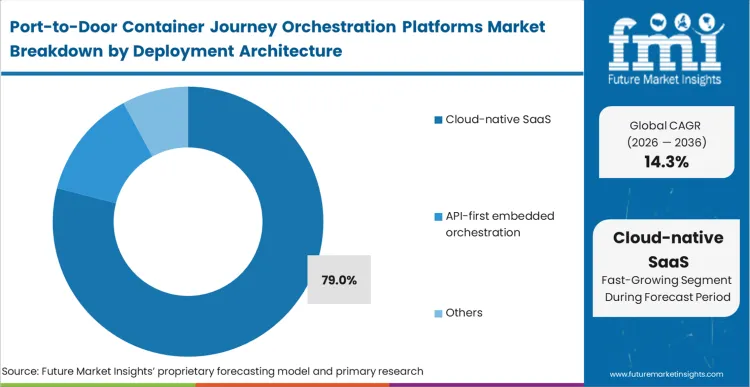
Chief information officers weigh immediate scalability against stringent internal data governance protocols. Cloud-native SaaS holds 79.0% share, and FMI observes that rapid onboarding of disparate transport partners dictates this dominance. Implementing supply chain management solutions via cloud infrastructure eliminates crippling on-premise integration delays. Multimodal carriers participating in these ecosystems require frictionless application programming interface connectivity to share status updates. Deeply embedded port equipment telemetry requires specialized parsing engines that legacy architecture cannot support. Companies clinging to on-premise servers face severe operational isolation as major shipping alliances mandate cloud-based data exchange.
- Frictionless onboarding: Browser-based access enables immediate participation from small regional trucking firms. Network density expands exponentially.
- Version uniformity: Centralized updates ensure all supply chain actors view identical compliance documentation. Customs brokers eliminate costly filing discrepancies.
- Elastic computing: Server capacity scales automatically during peak shipping weeks. IT directors prevent system crashes during critical cargo surges.
Port-to-Door Container Journey Orchestration Platforms Market Analysis by Buyer type
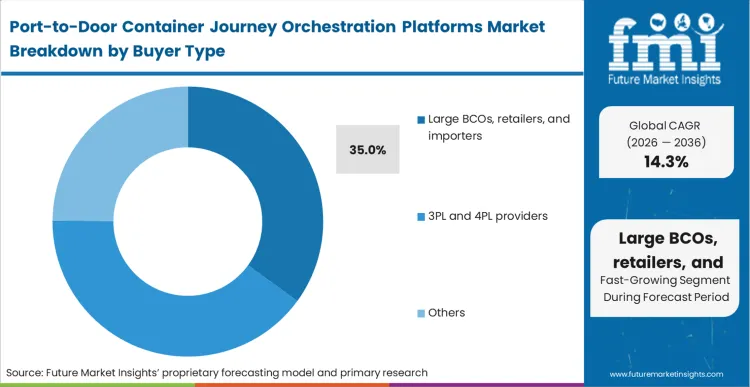
Millions in preventable friction costs evaporate when beneficial cargo owners take direct control over transit data. Large BCOs, retailers, and importers capture 35.0% share, per FMI's assessment, because outsourced tracking leaves them blind during critical disruptions. Implementing internal freight management software centralizes command over complex international vendor networks. Logistics directors utilize container visibility and orchestration software to synchronize inbound raw materials with manufacturing production schedules. What appears as simple software procurement actually represents a fundamental shift in supply chain power dynamics away from traditional forwarders. Importers delaying this digital transition continually suffer from bloated safety stock requirements.
- Inventory synchronization: Precise arrival predictions allow manufacturing plant managers to schedule labor accurately. Overtime expenses drop significantly.
- Vendor accountability: Independent tracking exposes specific suppliers causing upstream delays. Procurement officers enforce strict service level agreement penalties.
- Omnichannel routing: Retail dispatchers divert incoming ocean freight directly to e-commerce fulfillment centers. Brands bypass regional distribution nodes entirely.
Port-to-Door Container Journey Orchestration Platforms Market Analysis by Journey coverage
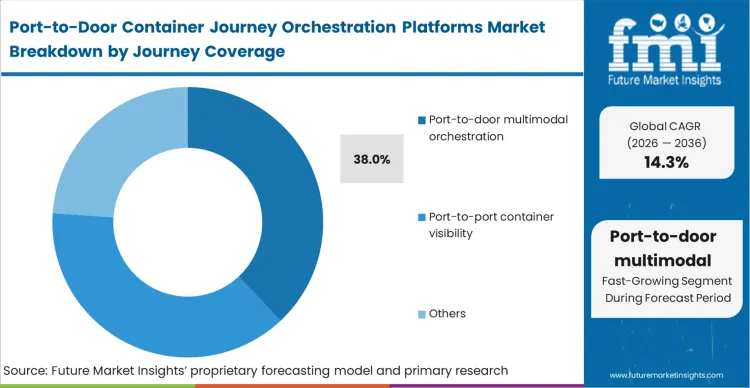
Intense pressure exists between maritime operational efficiency and inland delivery precision. Port-to-door multimodal orchestration accounts for 38.0% share, with FMI analysts noting that flawless handover execution drives this specific concentration. Integrating ocean freight forwarding milestones with domestic truck dispatch creates unbroken chain of custody records. Intermodal planners rely on container tracking software for drayage and rail to secure scarce rail capacity exactly when vessels dock. True port-to-door orchestration often reveals that inland drayage causes maximum delivery variance. Organizations attempting to piece together separate tracking modules invariably suffer data leakage during critical terminal handoffs.
- Terminal synchronization: Advanced algorithms match vessel discharge schedules with inland truck availability. Drayage operators eliminate wasteful idle time outside port gates.
- Customs acceleration: Automated document triggering speeds border clearance processes significantly. Compliance officers avoid cargo holds.
- Rail integration: Fluid data transfer connects ocean bills of lading with inland rail manifests. Intermodal coordinators secure priority train loading.
Port-to-Door Container Journey Orchestration Platforms Market Drivers, Restraints, and Opportunities
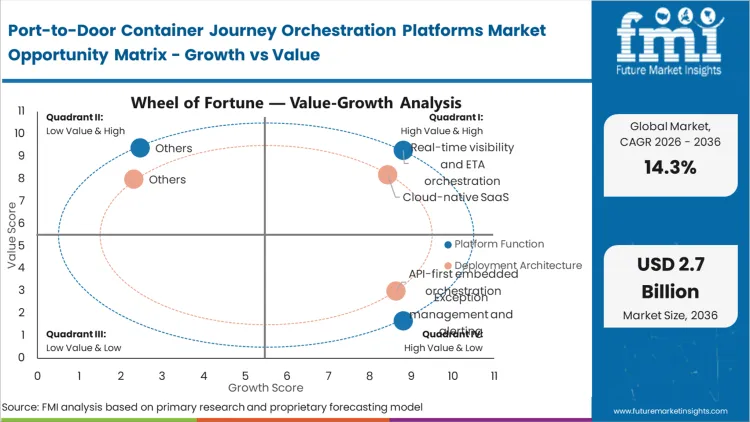
Compounding demurrage penalties force beneficial cargo owners to eradicate inland transit blind spots immediately. Logistics directors face millions in fines when containers sit uncollected at congested terminals. Implementing trailer cargo container tracking transforms passive waiting into proactive drayage dispatch. Users seeking detention and demurrage workflow automation discover that delaying this technological integration guarantees escalating transport costs and severe inventory shortages during critical retail seasons.
Fragmented data standards across competing ocean carriers prevent fluid application programming interface integration. Chief information officers struggle to normalize erratic status updates flooding their freight transport management dashboards. This friction persists because dominant shipping lines actively resist sharing proprietary telemetry formats. Middleware solutions attempt translation, but true real-time synchronization remains difficult until global maritime organizations enforce strict digital messaging protocols.
Opportunities in Port-to-Door Container Journey Orchestration Platforms Market
- Emissions accounting integration: Capturing granular carbon output data across multimodal segments. Sustainability officers achieve strict environmental reporting compliance.
- Trade finance synchronization: Linking verified transit milestones with electronic bill of lading workflow software. Chief financial officers unlock working capital faster.
- Predictive port security: Feeding seaport security management systems with verified container chain-of-custody data. Compliance teams expedite border inspections.
Regional Analysis
Based on regional analysis, port-to-door container journey orchestration platforms market is segmented into North America, Europe, Asia Pacific, Middle East and Africa, and Latin America across 40 plus countries.
.webp "Top Country Growth Comparison Port To Door Container Journey Orchestration Platforms Market Cagr (2026 2036)")
| Country | CAGR (2026 to 2036) |
|---|---|
| India | 16.4% |
| China | 15.2% |
| Singapore | 14.8% |
| United Arab Emirates | 14.6% |
| Netherlands | 13.7% |
| United States | 12.9% |
| Germany | 12.5% |
Source: Future Market Insights (FMI) analysis, based on proprietary forecasting model and primary research
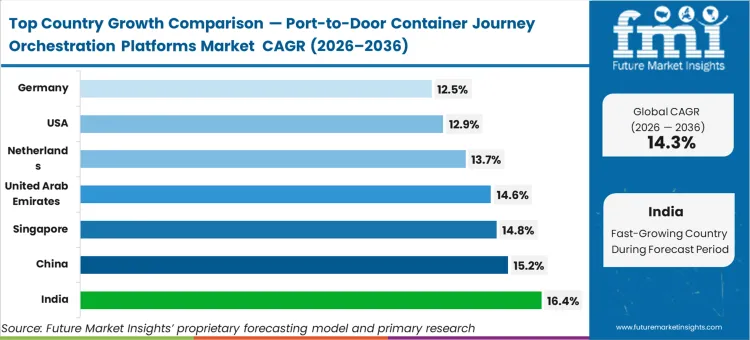
Asia Pacific Port-to-Door Container Journey Orchestration Platforms Market Analysis
Procurement directors analyzing the Asia Pacific container orchestration software market utilize immense digital density to orchestrate complex transshipment networks spanning multiple sovereign borders. Local software vendors must build hyper-localized customs integration modules to survive this environment. Regional authorities heavily subsidize international freight forwarding platform adoption to alleviate chronic port congestion, according to FMI's estimates. Massive state-backed infrastructure digitization mandates ultimately define supply chain evolution across these Asian hubs.
- India: Expanding at a 16.4% compound growth rate, India forces domestic freight operators onto standardized tracking protocols through its unified logistics interface policy rollout. Supply chain executives utilize this environment to eliminate notorious inter-state border frictions entirely.
- China: Aggressive terminal automation upgrades require pristine inbound container data streams. Port authorities mandate strict electronic pre-arrival declarations from all inbound ocean carriers to drive this 15.2% expansion.
- Singapore: Maritime single window implementation crystallizes this hub's status as a digital routing pioneer. Digital forwarding directors command premium pricing for guaranteed transshipment connections within this 14.8% growth trajectory.
Middle East and Africa Port-to-Door Container Journey Orchestration Platforms Market Analysis
Customs brokers utilize centralized portals to bypass traditional physical inspection bottlenecks. Rapid implementation of port community systems standardizes event data across competing terminals, FMI observes. Sovereign investment funds prioritize maritime technology to secure global transshipment dominance. Competition between regional free-trade zones drives aggressive digital customs integration.
- United Arab Emirates: Advancing at a 14.6% compound rate, the United Arab Emirates mandates digitized cargo handoffs across its extensive free-trade zones. Regional supply chain directors leverage this connectivity to orchestrate seamless sea-to-air freight conversions.
Europe Port-to-Door Container Journey Orchestration Platforms Market Analysis
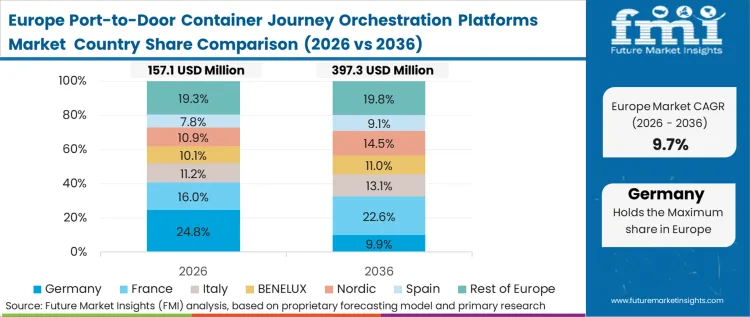
Complex inland waterway networks demand unique routing algorithms unlike standard trucking-centric models. Sustainability officers utilize precise transit data to prove strict carbon reduction compliance. Cross-border rail and barge coordination necessitates highly sophisticated transport management system integrations, in FMI's view. Stringent environmental reporting directives fundamentally alter how European importers track inland container movements.
- Netherlands: Dense inland barge networks require predictive synchronization with massive ocean vessel arrivals. Operations managers navigating this 13.7% expansion achieve significant cost reductions by diverting containers away from congested highway routes.
- Germany: Deep integration between major seaports and national rail infrastructure demands flawless event orchestration. Logistics planners capture this opportunity by securing dedicated block-train capacity weeks before vessels dock, locking in a 12.5% growth rate.
North America Port-to-Door Container Journey Orchestration Platforms Market Analysis
West Coast port labor volatility accelerates demand for elastic rerouting capabilities. Logistics directors deploy predictive platforms primarily as defensive mechanisms against catastrophic demurrage bills. Unpredictable inland rail dwell times force continuous vessel tracking to synchronize drayage dispatch, FMI highlights. Chronic chassis shortages fundamentally dictate orchestration strategies across North American logistics networks.
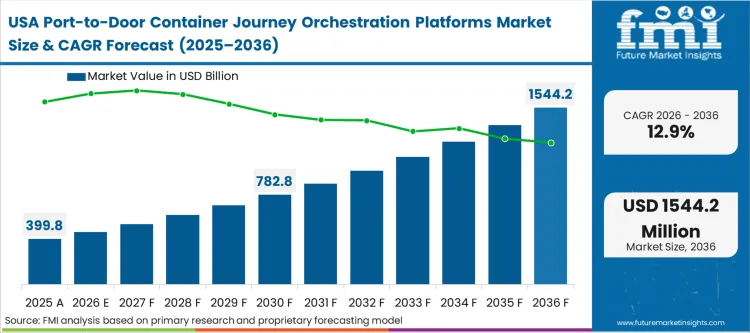
- United States: Growing at 12.9% annually, this landscape rewards agile drayage providers capable of interpreting complex terminal data feeds. Severe intermodal rail congestion compels beneficial cargo owners to take direct control over inbound visibility.
FMI's report includes United Arab Emirates analysis revealing how competition between regional free-trade zones drives aggressive digital customs integration.
Competitive Aligners for Market Players
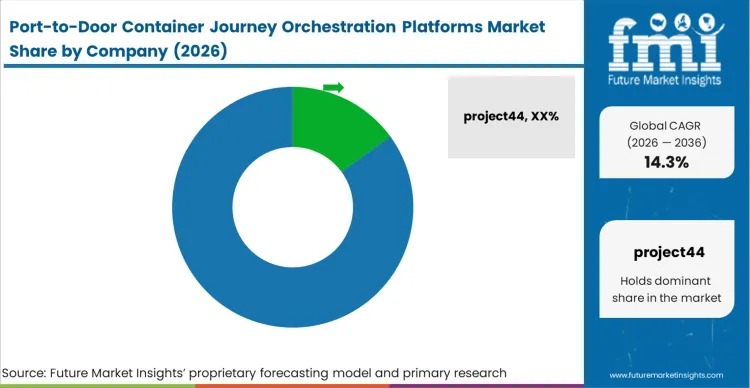
Competition within container orchestration centers entirely on application programming interface density rather than standalone software features. When assessing project44 vs FourKites ocean visibility, buyers notice both dominate evaluations by offering massive pre-built carrier integration libraries that new entrants simply cannot replicate. Procurement directors evaluating port-to-door container orchestration software vendors prioritize total connected network nodes over specialized user interface aesthetics. This dynamic creates massive barriers to entry. Establishing reliable telemetry feeds with hundreds of global shipping lines requires years of grueling technical negotiation.
Incumbents possess deep proprietary data lakes containing billions of historical transit milestones. These platforms deploy such massive datasets to train predictive supply chain analytics algorithms that accurately forecast terminal congestion weeks in advance. Challengers attempting to compete must build specialized niche capabilities. e2open maintains dominance among legacy enterprise architectures through decades of entrenched electronic data interchange relationships. Many enterprise teams request an ocean visibility software demo to test these legacy connections against modern alternatives.
Large retail importers actively resist single-vendor lock-in by utilizing aggregator modules that normalize data from multiple tracking networks. Vizion captures share by offering pure unbundled data feeds, allowing highly sophisticated shippers to ingest raw visibility metrics directly into internal custom-built dashboards. Ultimate competitive supremacy belongs to the best ocean container visibility software capable of autonomous exception resolution, securing alternative inland transport capacity entirely without human intervention to maximize ocean control tower software ROI.
Key Players in Port-to-Door Container Journey Orchestration Platforms Market
- project44
- FourKites
- e2open / INTTRA
- Kaleris
- Descartes
- Terminal49
- Vizion
Scope of the Report
| Metric | Value |
|---|---|
| Quantitative Units | USD 0.7 Billion to USD 2.8 Billion, at a CAGR of 14.30% |
| Market Definition | Digital infrastructure synchronizing ocean transit milestones with inland multimodal execution and documentation workflows. |
| Segmentation | Platform function, Deployment architecture, Buyer type, Journey coverage, and Region |
| Regions Covered | North America, Latin America, Europe, Asia Pacific, Middle East and Africa |
| Countries Covered | India, China, Singapore, United Arab Emirates, Netherlands, United States, Germany |
| Key Companies Profiled | project44, FourKites, e2open / INTTRA, Kaleris, Descartes, Terminal49, Vizion |
| Forecast Period | 2026 to 2036 |
| Approach | Subscription revenue models anchored to global twenty-foot equivalent unit volumes provide baseline valuation. |
Source: Future Market Insights (FMI) analysis, based on proprietary forecasting model and primary research
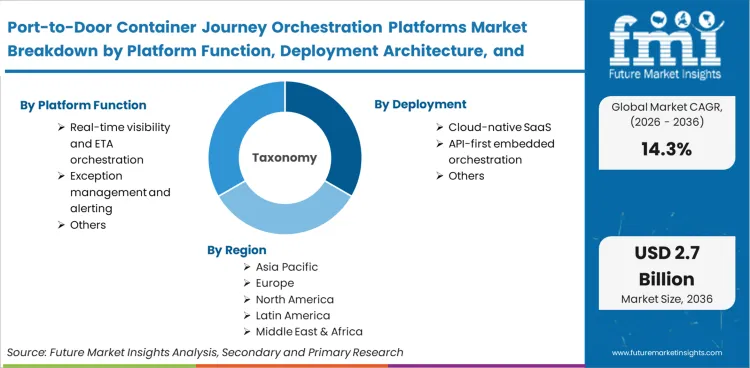
Port-to-Door Container Journey Orchestration Platforms Market Analysis by Segments
-
Platform function
- Real-time visibility and ETA orchestration
- Exception management and alerting
- Documentation and workflow collaboration
- Demurrage and detention control
- Analytics and carrier performance benchmarking
-
Deployment architecture
- Cloud-native SaaS
- API-first embedded orchestration
- Hybrid deployments with legacy TMS/ERP links
-
Buyer type
- Large BCOs, retailers, and importers
- Freight forwarders and NVOCCs
- 3PL and 4PL providers
- Ocean-carrier and terminal-linked users
-
Journey coverage
- Port-to-door multimodal orchestration
- Port-to-port container visibility
- Door-to-door multimodal visibility
- Port and terminal-only workflow management
-
Region
- North America
- Latin America
- Europe
- Asia Pacific
- Middle East and Africa
Bibliography
- Federal Maritime Commission. (2025). 63rd annual report for fiscal year 2024.
- Kastner, M., Saporiti, N., Lange, A.-K., & Rossi, T. (2024). Insights into how to enhance container terminal operations with digital twins. Computers, 13(6), Article 138.
- Ministry of Ports, Shipping and Waterways. (2024). Annual report 2024-25. Government of India.
- U.S. Department of Transportation, Bureau of Transportation Statistics. (2024). 2024 Port Performance Freight Statistics Program: Annual report to Congress.
- World Shipping Council. (2024, June 11). World Shipping Council releases containers lost at sea report – 2024 update.
This bibliography is provided for reader reference. The full FMI report contains the complete reference list with primary source documentation.
This Report Addresses
- Quantitative growth projections for predictive ETA algorithms across major transshipment hubs.
- Integration complexities between ocean carrier telemetry and inland rail management architecture.
- Adoption rates of cloud-native SaaS solutions among top-tier digital freight forwarders.
- Strategic analysis regarding chassis shortage mitigation through proactive event visibility.
- Demurrage penalty reduction models utilized by large beneficial cargo owners globally.
- Application programming interface standardization efforts driven by international shipping consortiums.
- Shifts transferring routing control from traditional NVOCCs directly to retail importers.
- Operational impacts of maritime single window mandates on regional logistics platforms.
Frequently Asked Questions
What drives Port-to-Door Container Journey Orchestration Platforms Market expansion?
Compounding demurrage penalties force logistics directors to implement predictive tracking algorithms immediately. Buyers exploring the demurrage and detention optimization software market realize that delaying adoption costs importers millions annually in avoidable terminal storage fees during severe congestion periods.
Which deployment architecture holds maximum share?
Cloud-native SaaS captures 79.0% share because multimodal networks require frictionless onboarding for thousands of independent trucking partners. Legacy on-premise systems simply cannot scale connection nodes rapidly enough.
Why do large retailers prioritize these platforms?
Large BCOs command 35.0% adoption share as they actively reclaim supply chain control from outsourced forwarders. Precise arrival data allows retail planners to synchronize warehouse labor schedules efficiently.
How does India outpace European growth rates?
India expands at 16.4% driven by aggressive state-backed unified logistics interface mandates. Netherlands grows at 13.7% focusing primarily on optimizing complex inland barge networks rather than raw digitization.
What operational friction slows universal platform adoption?
Proprietary data silos maintained by dominant ocean alliances resist standardized telemetry sharing. Middleware translation efforts remain imperfect without strict regulatory enforcement across global maritime jurisdictions.
Which function dominates platform selection criteria?
Real-time visibility and ETA orchestration leads with 42.0% share, transforming passive milestone tracking into dynamic rerouting intelligence. Procurement teams prioritize proactive alerting over retrospective reporting.
How do these systems prevent chassis dislocation?
Predictive arrival algorithms match vessel discharge schedules directly with available inland transport equipment. Drayage dispatchers secure scarce chassis units days before containers actually hit terminal tarmac.
What role do customs application programming interfaces play?
Direct integration with border agencies automates complex documentation handoffs instantly. Compliance officers eliminate clearance delays by transmitting electronic manifests while vessels remain at sea.
Why is port-to-door coverage superior?
Port-to-door multimodal orchestration secures 38.0% share by connecting disjointed ocean and inland transit records. Intermodal planners require unbroken custody chains to execute seamless rail-to-truck transfers.
How do exception management modules function?
Algorithmic monitoring detects transit anomalies before they cascade into catastrophic supply chain failures. Logistics vice presidents utilize these alerts to authorize emergency air-freight diversions autonomously.
What specific advantage do platform incumbents hold?
Established vendors boast massive pre-built carrier integration libraries compiled over years of technical negotiation. New entrants cannot replicate this digital density quickly enough to capture enterprise clients.
How does China approach orchestration adoption?
Chinese authorities push 15.2% growth through relentless terminal automation requirements. Inbound carriers must transmit pristine electronic declarations to interface with autonomous gantry crane systems.
Why are freight forwarders upgrading legacy software?
Traditional enterprise systems lack dynamic application programming interface capabilities required for modern digital forwarding. When evaluating container orchestration software vs TMS, NVOCCs risk severe client attrition without offering transparent customer-facing tracking portals.
How do demurrage engines calculate specific penalties?
Platforms digest individual carrier contracts alongside live terminal free-time countdowns. Procurement teams receive automated alerts hours before punitive storage rates activate.
What impact does predictive routing have on inventory?
Reliable transit pipelines function effectively as mobile warehouses, drastically reducing required safety stock levels. Chief financial officers unlock millions in working capital previously trapped inside buffer inventory.
How does API-first architecture differ from hybrid deployments?
API-first models allow highly customized embedding within proprietary shipper dashboards. Buyers comparing port-to-door visibility software vs tracking API models find that hybrid approaches merely bolt modern visibility tools onto aging enterprise resource planning backbones.
Why is carrier benchmarking critical for importers?
Historical transit data exposes chronic underperformance among specific ocean alliances during peak seasons. Logistics directors utilize these metrics during annual capacity contract negotiations.
How do platforms handle inland waterway tracking?
Specialized routing algorithms map complex barge schedules against deep-sea vessel arrivals. European operations managers utilize this visibility to bypass congested highway corridors entirely, answering the core question of how is orchestration different from container tracking.
What accelerates United States platform implementation?
Chronic intermodal rail congestion compels American importers to secure predictive visibility tools immediately. Expanding at 12.9%, this landscape demands agile rerouting capabilities around persistent West Coast labor disruptions.
How do automated workflows improve terminal efficiency?
Digital pre-advise messages eliminate manual data entry at busy port gates. Drayage drivers experience significantly faster turnaround times, increasing total daily container moves.
What prevents complete door-to-door visibility?
Fragmented last-mile trucking sectors often lack sophisticated telematics hardware. Teams trying to track containers from port to warehouse software struggle to extract reliable geolocation data from independent owner-operators.
How will orchestration evolve toward 2036?
Future platforms will transition from predictive alerting into fully autonomous exception resolution. Systems will automatically secure alternative inland transport capacity without requiring manual human authorization.
Preview the report firsthand - request a free sample
Get SampleGet the brochure for pricing and purchase details.
Get PDFTable of Content
- Executive Summary
- Global Market Outlook
- Demand-side Trends
- Supply-side Trends
- Technology Roadmap Analysis
- Analysis and Recommendations
- Market Overview
- Market Coverage / Taxonomy
- Market Definition / Scope / Limitations
- Research Methodology
- Chapter Orientation
- Analytical Lens and Working Hypotheses
- Market Sizing, Forecasting, and Opportunity Mapping
- Research Design and Evidence Framework
- Desk Research Programme (Secondary Evidence)
- Company Annual and Sustainability Reports
- Peer-reviewed Journals and Academic Literature
- Corporate Websites, Product Literature, and Technical Notes
- Earnings Decks and Investor Briefings
- Statutory Filings and Regulatory Disclosures
- Technical White Papers and Standards Notes
- Trade Journals, Industry Magazines, and Analyst Briefs
- Conference Proceedings, Webinars, and Seminar Materials
- Government Statistics Portals and Public Data Releases
- Press Releases and Reputable Media Coverage
- Specialist Newsletters and Curated Briefings
- Sector Databases and Reference Repositories
- FMI Internal Proprietary Databases and Historical Market Datasets
- Subscription Datasets and Paid Sources
- Social Channels, Communities, and Digital Listening Inputs
- Additional Desk Sources
- Expert Input and Fieldwork (Primary Evidence)
- Primary Modes
- Qualitative Interviews and Expert Elicitation
- Quantitative Surveys and Structured Data Capture
- Blended Approach
- Why Primary Evidence is Used
- Observational and In-context Research
- Social and Community Interactions
- Primary Modes
- Stakeholder Universe Engaged
- C-suite Leaders
- Board Members
- Presidents and Vice Presidents
- R&D and Innovation Heads
- Technical Specialists
- Domain Subject-matter Experts
- Scientists
- Physicians and Other Healthcare Professionals
- Governance, Ethics, and Data Stewardship
- Research Ethics
- Data Integrity and Handling
- Desk Research Programme (Secondary Evidence)
- Tooling, Models, and Reference Databases
- Data Engineering and Model Build
- Data Acquisition and Ingestion
- Cleaning, Normalisation, and Verification
- Synthesis, Triangulation, and Analysis
- Quality Assurance and Audit Trail
- Market Background
- Market Dynamics
- Drivers
- Restraints
- Opportunity
- Trends
- Scenario Forecast
- Demand in Optimistic Scenario
- Demand in Likely Scenario
- Demand in Conservative Scenario
- Opportunity Map Analysis
- Product Life Cycle Analysis
- Supply Chain Analysis
- Investment Feasibility Matrix
- Value Chain Analysis
- PESTLE and Porter’s Analysis
- Regulatory Landscape
- Regional Parent Market Outlook
- Production and Consumption Statistics
- Import and Export Statistics
- Market Dynamics
- Global Market Analysis 2021 to 2025 and Forecast, 2026 to 2036
- Historical Market Size Value (USD Million) Analysis, 2021 to 2025
- Current and Future Market Size Value (USD Million) Projections, 2026 to 2036
- Y-o-Y Growth Trend Analysis
- Absolute $ Opportunity Analysis
- Global Market Pricing Analysis 2021 to 2025 and Forecast 2026 to 2036
- Global Market Analysis 2021 to 2025 and Forecast 2026 to 2036, By Platform Function
- Introduction / Key Findings
- Historical Market Size Value (USD Million) Analysis By Platform Function , 2021 to 2025
- Current and Future Market Size Value (USD Million) Analysis and Forecast By Platform Function , 2026 to 2036
- Real-time visibility and ETA orchestration
- Exception management and alerting
- Others
- Real-time visibility and ETA orchestration
- Y-o-Y Growth Trend Analysis By Platform Function , 2021 to 2025
- Absolute $ Opportunity Analysis By Platform Function , 2026 to 2036
- Global Market Analysis 2021 to 2025 and Forecast 2026 to 2036, By Deployment Architecture
- Introduction / Key Findings
- Historical Market Size Value (USD Million) Analysis By Deployment Architecture, 2021 to 2025
- Current and Future Market Size Value (USD Million) Analysis and Forecast By Deployment Architecture, 2026 to 2036
- Cloud-native SaaS
- API-first embedded orchestration
- Others
- Cloud-native SaaS
- Y-o-Y Growth Trend Analysis By Deployment Architecture, 2021 to 2025
- Absolute $ Opportunity Analysis By Deployment Architecture, 2026 to 2036
- Global Market Analysis 2021 to 2025 and Forecast 2026 to 2036, By Buyer Type
- Introduction / Key Findings
- Historical Market Size Value (USD Million) Analysis By Buyer Type, 2021 to 2025
- Current and Future Market Size Value (USD Million) Analysis and Forecast By Buyer Type, 2026 to 2036
- Large BCOs, retailers, and importers
- 3PL and 4PL providers
- Others
- Large BCOs, retailers, and importers
- Y-o-Y Growth Trend Analysis By Buyer Type, 2021 to 2025
- Absolute $ Opportunity Analysis By Buyer Type, 2026 to 2036
- Global Market Analysis 2021 to 2025 and Forecast 2026 to 2036, By Journey Coverage
- Introduction / Key Findings
- Historical Market Size Value (USD Million) Analysis By Journey Coverage, 2021 to 2025
- Current and Future Market Size Value (USD Million) Analysis and Forecast By Journey Coverage, 2026 to 2036
- Port-to-door multimodal orchestration
- Port-to-port container visibility
- Others
- Port-to-door multimodal orchestration
- Y-o-Y Growth Trend Analysis By Journey Coverage, 2021 to 2025
- Absolute $ Opportunity Analysis By Journey Coverage, 2026 to 2036
- Global Market Analysis 2021 to 2025 and Forecast 2026 to 2036, By Region
- Introduction
- Historical Market Size Value (USD Million) Analysis By Region, 2021 to 2025
- Current Market Size Value (USD Million) Analysis and Forecast By Region, 2026 to 2036
- North America
- Latin America
- Western Europe
- Eastern Europe
- East Asia
- South Asia and Pacific
- Middle East & Africa
- Market Attractiveness Analysis By Region
- North America Market Analysis 2021 to 2025 and Forecast 2026 to 2036, By Country
- Historical Market Size Value (USD Million) Trend Analysis By Market Taxonomy, 2021 to 2025
- Market Size Value (USD Million) Forecast By Market Taxonomy, 2026 to 2036
- By Country
- USA
- Canada
- Mexico
- By Platform Function
- By Deployment Architecture
- By Buyer Type
- By Journey Coverage
- By Country
- Market Attractiveness Analysis
- By Country
- By Platform Function
- By Deployment Architecture
- By Buyer Type
- By Journey Coverage
- Key Takeaways
- Latin America Market Analysis 2021 to 2025 and Forecast 2026 to 2036, By Country
- Historical Market Size Value (USD Million) Trend Analysis By Market Taxonomy, 2021 to 2025
- Market Size Value (USD Million) Forecast By Market Taxonomy, 2026 to 2036
- By Country
- Brazil
- Chile
- Rest of Latin America
- By Platform Function
- By Deployment Architecture
- By Buyer Type
- By Journey Coverage
- By Country
- Market Attractiveness Analysis
- By Country
- By Platform Function
- By Deployment Architecture
- By Buyer Type
- By Journey Coverage
- Key Takeaways
- Western Europe Market Analysis 2021 to 2025 and Forecast 2026 to 2036, By Country
- Historical Market Size Value (USD Million) Trend Analysis By Market Taxonomy, 2021 to 2025
- Market Size Value (USD Million) Forecast By Market Taxonomy, 2026 to 2036
- By Country
- Germany
- UK
- Italy
- Spain
- France
- Nordic
- BENELUX
- Rest of Western Europe
- By Platform Function
- By Deployment Architecture
- By Buyer Type
- By Journey Coverage
- By Country
- Market Attractiveness Analysis
- By Country
- By Platform Function
- By Deployment Architecture
- By Buyer Type
- By Journey Coverage
- Key Takeaways
- Eastern Europe Market Analysis 2021 to 2025 and Forecast 2026 to 2036, By Country
- Historical Market Size Value (USD Million) Trend Analysis By Market Taxonomy, 2021 to 2025
- Market Size Value (USD Million) Forecast By Market Taxonomy, 2026 to 2036
- By Country
- Russia
- Poland
- Hungary
- Balkan & Baltic
- Rest of Eastern Europe
- By Platform Function
- By Deployment Architecture
- By Buyer Type
- By Journey Coverage
- By Country
- Market Attractiveness Analysis
- By Country
- By Platform Function
- By Deployment Architecture
- By Buyer Type
- By Journey Coverage
- Key Takeaways
- East Asia Market Analysis 2021 to 2025 and Forecast 2026 to 2036, By Country
- Historical Market Size Value (USD Million) Trend Analysis By Market Taxonomy, 2021 to 2025
- Market Size Value (USD Million) Forecast By Market Taxonomy, 2026 to 2036
- By Country
- China
- Japan
- South Korea
- By Platform Function
- By Deployment Architecture
- By Buyer Type
- By Journey Coverage
- By Country
- Market Attractiveness Analysis
- By Country
- By Platform Function
- By Deployment Architecture
- By Buyer Type
- By Journey Coverage
- Key Takeaways
- South Asia and Pacific Market Analysis 2021 to 2025 and Forecast 2026 to 2036, By Country
- Historical Market Size Value (USD Million) Trend Analysis By Market Taxonomy, 2021 to 2025
- Market Size Value (USD Million) Forecast By Market Taxonomy, 2026 to 2036
- By Country
- India
- ASEAN
- Australia & New Zealand
- Rest of South Asia and Pacific
- By Platform Function
- By Deployment Architecture
- By Buyer Type
- By Journey Coverage
- By Country
- Market Attractiveness Analysis
- By Country
- By Platform Function
- By Deployment Architecture
- By Buyer Type
- By Journey Coverage
- Key Takeaways
- Middle East & Africa Market Analysis 2021 to 2025 and Forecast 2026 to 2036, By Country
- Historical Market Size Value (USD Million) Trend Analysis By Market Taxonomy, 2021 to 2025
- Market Size Value (USD Million) Forecast By Market Taxonomy, 2026 to 2036
- By Country
- Kingdom of Saudi Arabia
- Other GCC Countries
- Turkiye
- South Africa
- Other African Union
- Rest of Middle East & Africa
- By Platform Function
- By Deployment Architecture
- By Buyer Type
- By Journey Coverage
- By Country
- Market Attractiveness Analysis
- By Country
- By Platform Function
- By Deployment Architecture
- By Buyer Type
- By Journey Coverage
- Key Takeaways
- Key Countries Market Analysis
- USA
- Pricing Analysis
- Market Share Analysis, 2025
- By Platform Function
- By Deployment Architecture
- By Buyer Type
- By Journey Coverage
- Canada
- Pricing Analysis
- Market Share Analysis, 2025
- By Platform Function
- By Deployment Architecture
- By Buyer Type
- By Journey Coverage
- Mexico
- Pricing Analysis
- Market Share Analysis, 2025
- By Platform Function
- By Deployment Architecture
- By Buyer Type
- By Journey Coverage
- Brazil
- Pricing Analysis
- Market Share Analysis, 2025
- By Platform Function
- By Deployment Architecture
- By Buyer Type
- By Journey Coverage
- Chile
- Pricing Analysis
- Market Share Analysis, 2025
- By Platform Function
- By Deployment Architecture
- By Buyer Type
- By Journey Coverage
- Germany
- Pricing Analysis
- Market Share Analysis, 2025
- By Platform Function
- By Deployment Architecture
- By Buyer Type
- By Journey Coverage
- UK
- Pricing Analysis
- Market Share Analysis, 2025
- By Platform Function
- By Deployment Architecture
- By Buyer Type
- By Journey Coverage
- Italy
- Pricing Analysis
- Market Share Analysis, 2025
- By Platform Function
- By Deployment Architecture
- By Buyer Type
- By Journey Coverage
- Spain
- Pricing Analysis
- Market Share Analysis, 2025
- By Platform Function
- By Deployment Architecture
- By Buyer Type
- By Journey Coverage
- France
- Pricing Analysis
- Market Share Analysis, 2025
- By Platform Function
- By Deployment Architecture
- By Buyer Type
- By Journey Coverage
- India
- Pricing Analysis
- Market Share Analysis, 2025
- By Platform Function
- By Deployment Architecture
- By Buyer Type
- By Journey Coverage
- ASEAN
- Pricing Analysis
- Market Share Analysis, 2025
- By Platform Function
- By Deployment Architecture
- By Buyer Type
- By Journey Coverage
- Australia & New Zealand
- Pricing Analysis
- Market Share Analysis, 2025
- By Platform Function
- By Deployment Architecture
- By Buyer Type
- By Journey Coverage
- China
- Pricing Analysis
- Market Share Analysis, 2025
- By Platform Function
- By Deployment Architecture
- By Buyer Type
- By Journey Coverage
- Japan
- Pricing Analysis
- Market Share Analysis, 2025
- By Platform Function
- By Deployment Architecture
- By Buyer Type
- By Journey Coverage
- South Korea
- Pricing Analysis
- Market Share Analysis, 2025
- By Platform Function
- By Deployment Architecture
- By Buyer Type
- By Journey Coverage
- Russia
- Pricing Analysis
- Market Share Analysis, 2025
- By Platform Function
- By Deployment Architecture
- By Buyer Type
- By Journey Coverage
- Poland
- Pricing Analysis
- Market Share Analysis, 2025
- By Platform Function
- By Deployment Architecture
- By Buyer Type
- By Journey Coverage
- Hungary
- Pricing Analysis
- Market Share Analysis, 2025
- By Platform Function
- By Deployment Architecture
- By Buyer Type
- By Journey Coverage
- Kingdom of Saudi Arabia
- Pricing Analysis
- Market Share Analysis, 2025
- By Platform Function
- By Deployment Architecture
- By Buyer Type
- By Journey Coverage
- Turkiye
- Pricing Analysis
- Market Share Analysis, 2025
- By Platform Function
- By Deployment Architecture
- By Buyer Type
- By Journey Coverage
- South Africa
- Pricing Analysis
- Market Share Analysis, 2025
- By Platform Function
- By Deployment Architecture
- By Buyer Type
- By Journey Coverage
- USA
- Market Structure Analysis
- Competition Dashboard
- Competition Benchmarking
- Market Share Analysis of Top Players
- By Regional
- By Platform Function
- By Deployment Architecture
- By Buyer Type
- By Journey Coverage
- Competition Analysis
- Competition Deep Dive
- project44
- Overview
- Product Portfolio
- Profitability by Market Segments (Product/Age /Sales Channel/Region)
- Sales Footprint
- Strategy Overview
- Marketing Strategy
- Product Strategy
- Channel Strategy
- FourKites
- e2open / INTTRA
- Kaleris
- Descartes
- Terminal49
- Vizion
- project44
- Competition Deep Dive
- Assumptions & Acronyms Used


