

- Industry Size (2026)
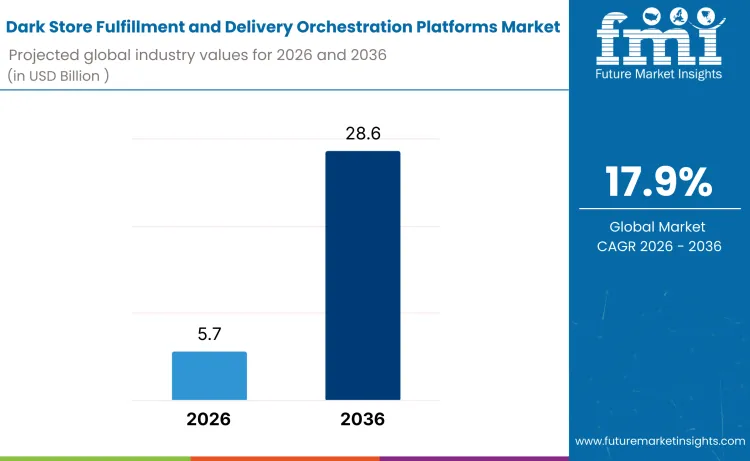
- USD 5.7 Bn
- Forecast (2036)
- USD 28.6 Bn
- CAGR (2026 to 2036)
- 17.9%
Dark Store Fulfillment and Delivery Orchestration Platforms Market Forecast and Outlook 2026 to 2036
The dark store fulfillment and delivery orchestration platforms market is valued at USD 5.7 billion in 2026 and is projected to reach USD 28.6 billion by 2036, reflecting a CAGR of 17.9%. Demand grows as retailers and quick-commerce operators expand micro-fulfillment networks to shorten delivery windows and improve order accuracy. Rising preference for rapid grocery delivery and high-frequency urban replenishment supports accelerated platform adoption.
Order and inventory management platforms lead usage because they coordinate stock levels, automate picking workflows, and synchronize upstream replenishment with real-time demand. Precise SKU tracking, slotting optimization, and integration with delivery dispatch systems reduce fulfillment latency and operational errors. Analytics engines improve forecasting accuracy and strengthen dark store throughput under volatile order volumes.
China, India, USA, and Japan emerge as key growth regions due to dense urban populations, strong digital retail ecosystems, and investment in high-velocity fulfillment models. Fabric, Takeoff Technologies, Ocado Group, Instacart Platform, and Shipday define competitive activity through modular micro-fulfillment solutions, AI-driven orchestration engines, and scalable cloud architectures that support rapid deployment across distributed dark store networks.
Quick Stats for Dark Store Fulfillment and Delivery Orchestration Platforms Market
- Market Value (2026): USD 5.7 billion
- Market Forecast Value (2036): USD 28.6 billion
- Forecast CAGR (2026 to 2036): 17.9%
- Leading Platform Type in Global Demand: Order & Inventory Management Platforms
- Key Growth Regions in Global Demand: China, India, USA, Japan
- Top Players in Global Demand: Fabric, Takeoff Technologies, Ocado Group, Instacart Platform, Shipday
Dark Store Fulfillment and Delivery Orchestration Platforms Market Key Takeaways
| Metric | Value |
|---|---|
| Market Value (2026) | USD 5.7 billion |
| Market Forecast Value (2036) | USD 28.6 billion |
| Forecast CAGR (2026 to 2036) | 17.9% |
How Are the Segments Classified in the Dark Store Fulfillment and Delivery Orchestration Platforms Market?
Demand for dark-store fulfillment and delivery-orchestration platforms is shaped by rapid-order expectations, urban density constraints, and requirements for automated inventory accuracy across high-velocity fulfillment environments. Buyers evaluate orchestration capability, system integration, picking efficiency, and workforce scheduling performance. Adoption patterns reflect expansion of hyperlocal fulfillment, increased reliance on automation, and the need for coordinated delivery flows supporting e-commerce and Omni channel operations.
Which Platform Type Accounts for the Largest Share of Global Demand?
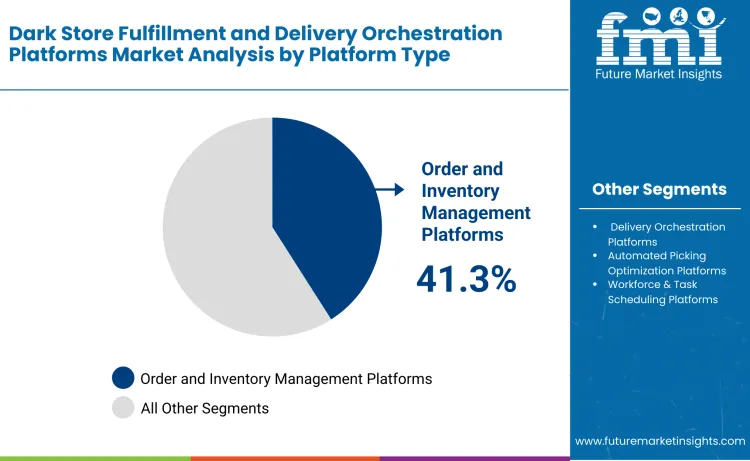
Order and inventory management platforms hold 41.3%, making them the leading platform-type segment globally. These systems maintain real-time stock visibility, reduce mispicks, and support automated replenishment within dark-store networks. Delivery-orchestration platforms coordinate driver assignment, route planning, and delivery-time optimization across fluctuating order volumes. Automated picking optimization platforms enhance pick-path efficiency and support high-throughput environments through algorithmic slotting and task sequencing. Workforce and task-scheduling platforms support labor allocation, shift planning, and operational load balancing. Platform-type distribution reflects reliance on accurate inventory data as the foundation for downstream fulfillment and delivery operations.
Key Points:
- Order and inventory systems ensure real-time stock accuracy.
- Delivery orchestration supports routing and driver coordination.
- Automated picking enhances throughput efficiency.
- Platform selection aligns with operational volume and automation needs.
Which Fulfillment Model Represents the Largest Share of Global Demand?
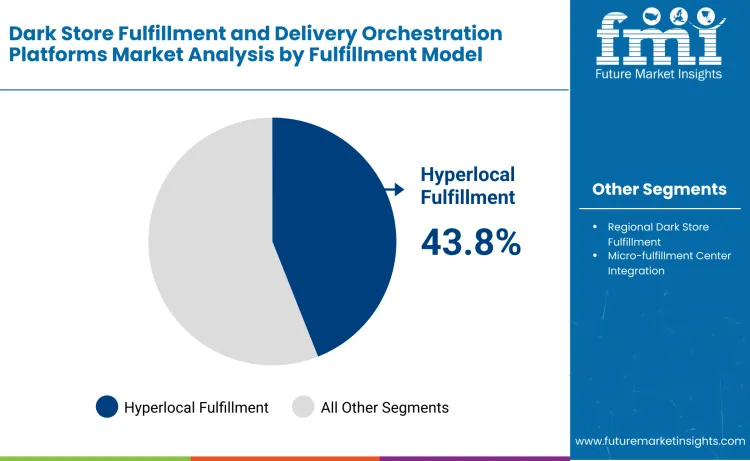
Hyperlocal fulfillment holds 43.8%, making it the largest fulfillment-model segment globally. This model enables rapid delivery windows, dense-zone efficiency, and proximity-based inventory positioning. Regional dark-store fulfillment supports larger service areas with centralized picking zones and higher SKU counts. Micro-fulfillment center integration relies on compact automated systems positioned inside or near retail sites to accelerate order turnaround. Fulfillment-model distribution reflects demand for faster delivery cycles and localized service optimization.
Key Points:
- Hyperlocal fulfillment supports rapid urban delivery windows.
- Regional dark stores handle broader zones with large assortments.
- Micro-fulfillment integration enhances automation within compact spaces.
- Model choice aligns with service radius and SKU complexity.
Which Delivery Mode Accounts for the Largest Share of Global Demand?
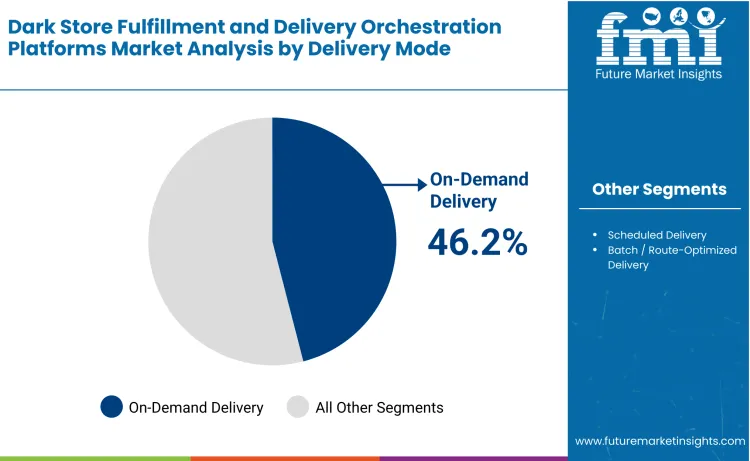
On-demand delivery holds 46.2%, making it the largest delivery-mode segment globally. Immediate dispatch capability supports food, grocery, and rapid-commerce categories requiring sub-hour windows. Scheduled delivery supports predictable replenishment, planned routing, and customer-selected time slots. Batch or route-optimized delivery enables consolidation for reduced cost and improved route density across suburban or multi-stop operations. Delivery-mode distribution reflects urgency levels, route-planning requirements, and cost-efficiency considerations.
Key Points:
- On-demand delivery supports rapid-commitment operations.
- Scheduled delivery enables predictable time-slot management.
- Batch routing improves cost efficiency through consolidation.
- Mode selection aligns with urgency, geography, and delivery density.
What are the Key Dynamics in the Dark Store Fulfillment and Delivery Orchestration Platforms Market?
Global demand rises as rapid commerce operators, grocery chains, and Omni channel retailers expand dark store networks to support fast picking, accurate inventory control, and short window delivery commitments. Platforms coordinate order batching, picker allocation, slot management, and courier assignment. Dense urban zones rely on dark stores to stabilize fulfilment speed during peak demand. Retailers integrate orchestration tools to align inventory visibility, labour optimization, and real time delivery routing across high frequency order flows.
How are rapid fulfilment models and Omni channel expansion shaping adoption of dark store orchestration platforms?
Retailers increase investment in systems that coordinate picking and delivery workflows within compact facilities positioned near high demand clusters. Grocery and convenience operators use platforms that manage SKU level visibility and dynamic inventory updates across multiple micro fulfilment locations. Rapid commerce services require orchestration engines capable of optimizing pick paths, batching rules, and sub fifteen-minute dispatch windows. Data integration with online storefronts supports accurate stock availability. Courier networks rely on real time assignment tools to minimize idle time and route fragmentation. Dark stores serving mixed order types adopt configurable workflows that sustain accuracy during fluctuating order spikes.
How do cost structures, labour dependencies, and integration complexities influence scalability?
Operators face expenditure for warehouse management software, automation components, last mile routing engines, and trained staff required for continuous operations. Labour intensity remains significant when dark stores rely on manual picking, which affects throughput predictability. Integration with legacy e-commerce systems introduces alignment challenges for order ingestion, carrier APIs, and inventory synchronization. Real estate constraints limit expansion in dense cities with high leasing costs. Seasonal demand fluctuations complicate workforce planning. Delivery orchestration platforms require continuous data quality monitoring to maintain reliable courier scheduling. Variability in local regulations for rapid commerce operations influences long term site stability and workflow design.
How is Demand for Dark Store Fulfillment and Delivery Orchestration Platforms Market Evolving Across Key Countries?
Demand for the dark store fulfillment and delivery orchestration platforms market is rising due to growth in rapid-commerce operations, increased micro-fulfilment activity, and strong interest in software-driven delivery coordination. China records a CAGR of 19.1% supported by high-frequency e-commerce usage and widespread dark-store expansion. India shows an 18.4% CAGR driven by dense hyperlocal delivery networks and rising quick-commerce adoption. USA posts a 17.2% CAGR supported by strong retail digitization and micro-fulfilment upgrades. Japan holds a 16.0% CAGR linked with structured logistics optimization. UK records a 15.3% CAGR supported by urban delivery strategies and digital retail transformation.
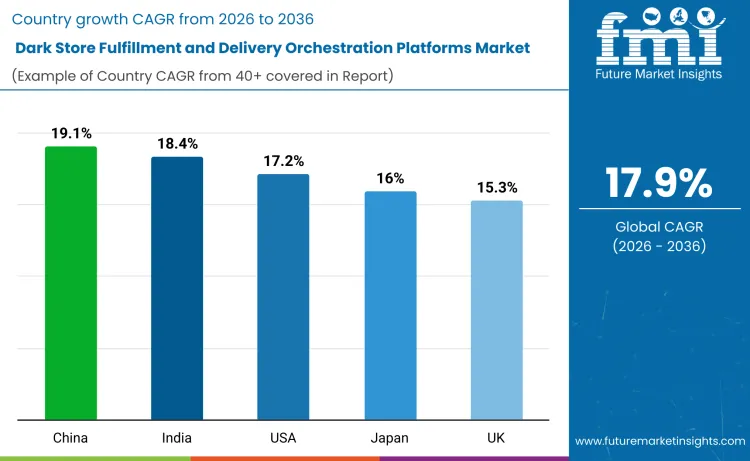
| Country | CAGR (%) |
|---|---|
| China | 19.1% |
| India | 18.4% |
| USA | 17.2% |
| Japan | 16.0% |
| UK | 15.3% |
How is China driving demand for Dark Store Fulfillment and Delivery Orchestration Platforms?
China drives demand due to rapid expansion of dark stores, strong e-commerce penetration, and high delivery intensity across major cities. The country’s CAGR of 19.1% reflects continuous adoption of orchestration platforms supporting inventory visibility, batch picking, and dynamic routing. Quick-commerce providers rely on software-driven systems to maintain sub-hour delivery performance. Retailers integrate orchestration platforms to coordinate replenishment and manage fluctuating order volumes. Large logistics ecosystems utilize real-time optimization tools to improve fleet allocation and delivery accuracy. High urban density strengthens the need for coordinated fulfilment workflows.
- Strong e-commerce and quick-commerce penetration
- Continuous adoption of real-time orchestration tools
- Retail integration for high-volume order cycles
- Dense cities requiring coordinated fulfilment systems
How is India driving demand for Dark Store Fulfillment and Delivery Orchestration Platforms?
India supports rising demand due to rapid growth in hyperlocal commerce, expanding delivery-platform ecosystems, and increased operational complexity across urban fulfilment hubs. The country’s CAGR of 18.4% reflects strong adoption of orchestration platforms for routing, picking optimization, and dark-store workload management. Quick-commerce firms depend on real-time software to meet short delivery windows across dense metropolitan areas. Retailers integrate orchestration tools to manage replenishment cycles and product availability across distributed micro-fulfilment centers. Growth in digital-payment ecosystems and mobile-first ordering accelerates platform usage across regional delivery networks.
- Strong hyperlocal and quick-commerce expansion
- Need for routing and fulfilment optimization in dense cities
- Retail adoption supporting inventory and workload control
- Digital-payment and mobile-ordering growth enhancing platform demand
How is the USA driving demand for Dark Store Fulfillment and Delivery Orchestration Platforms?
The USA drives demand through retail digitization, high same-day delivery expectations, and strong adoption of micro-fulfilment strategies. The country’s CAGR of 17.2% reflects steady integration of orchestration platforms enabling automated picking coordination, real-time inventory mapping, and delivery-slot optimization. Retail chains deploy dark-store networks to support accelerated order fulfilment. Logistics providers use orchestration platforms to manage fleets supporting short-range and scheduled deliveries. Technology firms develop advanced forecasting modules to improve service reliability. Dense urban retail markets support continuous adoption of orchestration systems across distributed fulfilment nodes.
- Broad retail digitization and micro-fulfilment expansion
- Use of orchestration tools for inventory and delivery-slot control
- Strong logistics integration for short-range deliveries
- Forecasting and automation tools supporting fulfilment accuracy
How is Japan driving demand for Dark Store Fulfillment and Delivery Orchestration Platforms?
Japan drives demand due to its structured logistics systems, compact urban layouts, and focus on operational precision. The country’s CAGR of 16.0% reflects steady adoption of orchestration platforms supporting efficient picking, fulfilment scheduling, and inventory coordination. Retailers use dark stores to maintain predictable order fulfilment timelines in dense commercial zones. Logistics operators integrate real-time orchestration tools to improve route accuracy and reduce congestion-related delays. Advanced analytics and automation systems support workflow consistency across fulfilment networks. Rising interest in convenience-focused delivery strengthens platform usage.
- Structured logistics operations requiring precision tools
- Retail reliance on dark stores for predictable fulfilment
- Use of real-time orchestration for routing and scheduling
- Strong adoption of automation in fulfilment workflows
How is the UK driving demand for Dark Store Fulfillment and Delivery Orchestration Platforms?
The UK supports demand through strong online retail adoption, urban-delivery constraints, and growing reliance on micro-fulfilment systems. The country’s CAGR of 15.3% reflects wide use of orchestration platforms enabling inventory synchronization, picking coordination, and delivery routing. Retailers operate dark stores to meet high delivery expectations in densely populated areas. Regional freight strategies encourage the use of software tools to reduce delivery inefficiencies. Logistics providers integrate orchestration solutions to manage capacity and improve fulfilment reliability. Continued expansion of convenience retail strengthens adoption across distributed fulfilment networks.
- High online-retail penetration
- Strong use of micro-fulfilment and dark-store networks
- Software-based routing and scheduling adoption
- Urban-delivery constraints supporting orchestration-tool usage
What is the competitive landscape of demand for dark store fulfillment and delivery orchestration platforms globally?
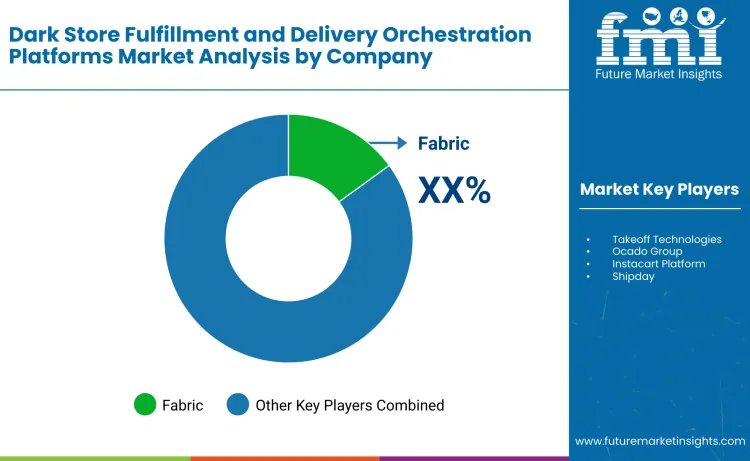
Demand for dark store fulfillment and delivery orchestration platforms grows as retailers, grocery operators, and quick-commerce services expand high-velocity order processing across urban and suburban zones. Requirements center on real-time inventory visibility, automated picking workflows, route orchestration, and integration with third-party delivery fleets. Buyers evaluate API flexibility, throughput performance, micro-fulfillment compatibility, and system scalability during peak order periods. Procurement teams emphasize data accuracy, uptime reliability, configurable workflows, and security features supporting continuous operations across multi-node networks. The global market trend reflects rising adoption of hyperlocal fulfillment models, increased automation, and broader use of software that coordinates both in-house and outsourced delivery assets.
Takeoff Technologies participates with orchestration platforms integrated into automated micro-fulfillment centers supporting rapid picking and delivery coordination. Ocado Group maintains visibility through fulfillment software and robotics systems used by global grocery chains operating dark store networks. Instacart Platform contributes enterprise fulfillment technology linked to retailer ecommerce systems and delivery routing tools. Shipday supports demand with lightweight orchestration software used by independent retailers and regional operators requiring flexible delivery management. Competitive positioning globally reflects integration depth, automation readiness, orchestration accuracy, and platform scalability supporting diverse fulfillment strategies.
Key Players in the Dark Store Fulfillment and Delivery Orchestration Platforms Market
- Fabric
- Takeoff Technologies
- Ocado Group
- Instacart Platform
- Shipday
Scope of the Report
| Items | Values |
|---|---|
| Quantitative Units | USD billion |
| Platform Type | Order & Inventory Management Platforms, Delivery Orchestration Platforms, Automated Picking Optimization Platforms, Workforce & Task Scheduling Platforms |
| Fulfillment Model | Hyperlocal Fulfillment, Regional Dark Store Fulfillment, Micro-fulfillment Center Integration |
| Delivery Mode | On-Demand Delivery, Scheduled Delivery, Batch / Route-Optimized Delivery |
| End-User | E-commerce & Quick-Commerce Companies, Grocery Chains, Retailers, Third-Party Logistics Providers (3PLs) |
| Regions Covered | Asia Pacific, Europe, North America, Latin America, Middle East & Africa |
| Countries Covered | India, China, USA, Germany, South Korea, Japan, Italy, and 40+ countries |
| Key Companies Profiled | Fabric, Takeoff Technologies, Ocado Group, Instacart Platform, Shipday |
| Additional Attributes | Dollar sales by platform type, fulfillment model, and delivery mode; adoption trends driven by rapid commerce expansion and dark store operational efficiency; integration with warehouse automation, robotic picking, and multi-node inventory visibility systems; technology advancements in route optimization, task orchestration, and real-time demand forecasting; competitive landscape of orchestration SaaS vendors and micro-fulfillment automation providers; regulatory considerations for gig-delivery labor models and urban zoning for dark stores. |
Dark Store Fulfillment and Delivery Orchestration Platforms Market by Segment
By Platform Type:
- Order & Inventory Management Platforms
- Delivery Orchestration Platforms
- Automated Picking Optimization Platforms
- Workforce & Task Scheduling Platforms
By Fulfillment Model:
- Hyperlocal Fulfillment
- Regional Dark Store Fulfillment
- Micro-fulfillment Center Integration
By Delivery Mode:
- On-Demand Delivery
- Scheduled Delivery
- Batch / Route-Optimized Delivery
By End-User:
- E-commerce & Quick-Commerce Companies
- Grocery Chains
- Retailers
- Third-Party Logistics Providers (3PLs)
Region:
- Asia Pacific
- China
- Japan
- South Korea
- India
- Australia & New Zealand
- ASEAN
- Rest of Asia Pacific
- Europe
- Germany
- United Kingdom
- France
- Italy
- Spain
- Nordic
- BENELUX
- Rest of Europe
- North America
- United States
- Canada
- Mexico
- Latin America
- Brazil
- Chile
- Rest of Latin America
- Middle East & Africa
- Kingdom of Saudi Arabia
- Other GCC Countries
- Turkey
- South Africa
- Other African Union
- Rest of Middle East & Africa
Frequently Asked Questions
What is the size of the dark store fulfillment and delivery orchestration platforms market in 2026?
The market is valued at USD 5.7 billion in 2026, supported by rising adoption of centralized dark stores for fast-order processing.
What will be the industry size by 2036?
Industry value will reach USD 28.6 billion by 2036 as retailers expand digital-first fulfillment models and integrate automated orchestration systems.
What is the CAGR for 2026 to 2036?
The dark store fulfillment and delivery orchestration platforms market expands at a 17.9% CAGR during the forecast period.
Which platform-type segment leads in 2026?
Order and inventory management platforms hold 41.3% share due to their role in synchronizing stock levels, order routing, and real-time visibility.
Which fulfillment-model segment holds the highest share?
Hyperlocal fulfillment leads with 43.8% share, reflecting demand for rapid delivery capabilities within compact service radii.
Preview the report firsthand - request a free sample
Get SampleGet the brochure for pricing and purchase details.
Get PDFTable of Content
- Executive Summary
- Market Overview
- Global Market Value, 2020 to 2026
- Global Market Forecast, 2026 to 2036
- Market Dynamics
- Drivers
- Restraints
- Opportunities
- Regulatory & Standards Landscape
- Technology & Material Innovation Outlook
- Market Segmentation Analysis
- By Optimization Function
- Real-Time Dynamic Route Planning
- Multi-Stop Batch Optimization
- Dispatch & Driver Assignment Optimization
- Demand Forecasting-Integrated Routing
- By Platform Type
- Cloud-Based Optimization Platforms
- On-Premises Platforms
- Hybrid Platforms
- By Application
- Instant Grocery & Quick-Commerce Delivery
- Dark Store & Micro-Fulfillment Routing
- Rider Fleet Routing for Hyperlocal Delivery
- Predictive Delivery Slot Optimization
- By End-User
- Quick-Commerce Companies
- Grocery Retail Chains
- Third-Party Delivery Platforms
- Independent Fleet Operators
- By Optimization Function
- Regional Outlook
- Asia Pacific
- Europe
- North America
- Latin America
- Middle East & Africa
- Country-Level Outlook
- China
- India
- USA
- Japan
- United Kingdom
- Germany
- South Korea
- Italy
- Australia & New Zealand
- ASEAN
- Brazil
- Chile
- Turkey
- South Africa
- Other GCC Countries
- Rest of Europe
- Rest of Latin America
- Rest of Middle East & Africa
- Competitive Landscape
- Market Structure Overview
- Company Positioning
- Strategic Initiatives
- Key Player Profiles
- Scope of the Report
- Research Methodology
- Assumptions & Acronyms


