

- Industry Size (2026)
- USD 33.5 Bn
- Forecast (2036)
- USD 41.8 Bn
- CAGR (2026 to 2036)
- 2.5%
Dark Tourism Market Size, Market Forecast and Outlook By FMI
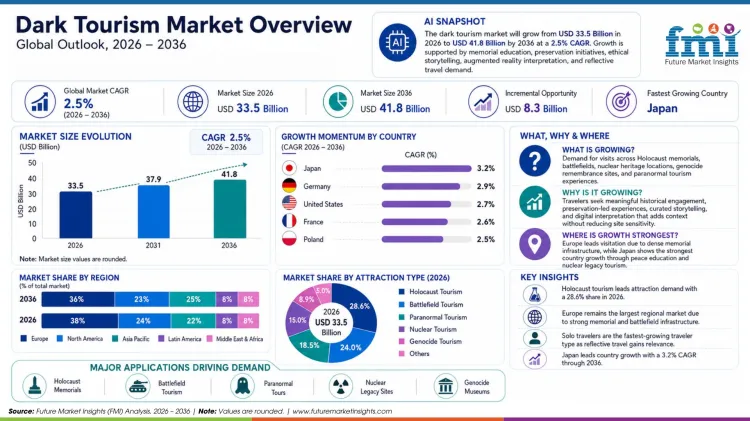
Dark tourism market is expected to expand from USD 33.5 billion in 2026 to USD 41.8 billion by 2036. The market is anticipated to register a 2.5% CAGR during the forecast period. Holocaust tourism is likely to lead with 28.6% share, while solo travelers are projected to record stronger growth as reflective travel gains relevance.
Key Takeaways, Market Size, and Forecast
- Dark tourism demand was valued at USD 32.7 billion in 2025.
- The market is likely to reach USD 33.5 billion in 2026.
- By 2036, demand is forecast to attain USD 41.8 billion.
- FMI places growth at 2.5% CAGR during 2026 to 2036.
- The market is projected to create USD 8.3 billion in absolute dollar growth.
- Holocaust tourism is likely to lead with 28.6% share in 2025.
- Japan records the fastest listed country growth at 3.2% CAGR.
- Germany follows with 2.9% CAGR, backed by memorial education programs.
Summary of the Dark Tourism Market
- Demand and Growth Drivers
- Travelers are seeking meaningful experiences tied to history and remembrance.
- Augmented reality is improving interpretation at sensitive heritage sites.
- Preservation initiatives are making site restoration part of visitor engagement.
- Educational travel keeps memorial sites relevant across younger visitor groups.
- Product and Segment View
- Holocaust tourism leads due to established memorial infrastructure.
- Battlefield tourism benefits from school tours and anniversary-based visits.
- Paranormal tourism attracts travelers seeking atmospheric night experiences.
- Solo travelers show higher interest in reflective and self-paced visits.
- Geography and Competitive Outlook
- Europe leads visitation due to Holocaust memorials and battlefield density.
- North America gains value from true crime sites and preservation investments.
- Japan posts faster growth through nuclear legacy and peace education tourism.
- Operators are focusing on ethical storytelling and curated visitor access.
- Analyst Opinion
- Ronak Shah, reviewer at Future Market Insights, opines, “Dark tourism is moving beyond passive site visitation. Operators that combine ethical interpretation, site preservation, and careful digital storytelling will gain stronger traveler trust. Visitor engagement will depend on accuracy, respect, and clear links between tourism revenue and heritage protection.”
- Dark Tourism Market Value Analysis
- Dark tourism is moving from standard heritage visits toward reflective historical engagement.
- Demand is rising as travelers look for deeper cultural and educational experiences.
- Digital interpretation is improving access without weakening memorial sensitivity.
- Spending is backed by preservation work and curated guided experiences.
Dark Tourism Market Definition
The dark tourism market encompasses travel to sites associated with death, tragedy, suffering, or the macabre, providing platforms for reflection, education, and remembrance. Attraction types include Holocaust memorials and museums documenting genocide, battlefields preserving conflict history, paranormal locations tied to ghost lore and supernatural phenomena, nuclear sites including disaster zones and test ranges, and locations connected to infamous crimes. These journeys serve as potent reminders of historical events and their enduring impact on collective consciousness, enabling travelers to forge deeper understanding of forces that have shaped societies.
Market Inclusions
The report includes global and regional market size estimates in value terms, with a forecast period from 2026 to 2036. It provides segmentation by attraction type, traveler type, and region. The analysis incorporates experiential technology trends, preservation initiative developments, ethical framework evolution, and performance benchmarking across dark tourism formats. Regional demand dynamics, country-level growth rates, and competitive positioning are also evaluated as per FMI methodology.
Market Exclusions
The scope excludes conventional heritage tourism focused on non-tragic historical sites, recreational haunted attractions designed purely for entertainment without educational context, and pilgrimage tourism not specifically tied to sites of death or disaster. Day-trip volumes without overnight accommodation impact are not separately quantified due to measurement limitations.
Research Methodology
- Primary Research: Interviews were conducted with tour operators, memorial site managers, museum curators, travel industry analysts, and cultural heritage preservation specialists.
- Desk Research: Public company filings, UNESCO World Heritage listings, tourism board statistics, academic journals, and preservation initiative documentation were reviewed.
- Market-Sizing and Forecasting: A hybrid top-down and bottom-up model was constructed, reconstructing demand from site visitation numbers, tour participation rates, and per-visitor spending across attraction categories.
- Data Validation and Update Cycle: Outputs were subjected to variance testing against tourism arrival data, preservation project investments, and structured internal review prior to publication.
Dark Tourism Market Drivers, Restraints, and Opportunities
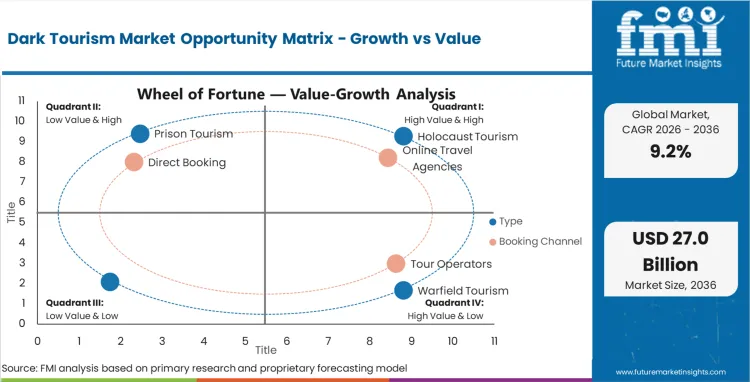
FMI analysts observe a clear stratification between conventional site visitation focused on passive viewing and enhanced experiences incorporating augmented reality, curator-led access, and preservation components. Standard offerings face pressure where generic tours fail to differentiate, while growth concentrates in experiences where educational depth, emotional resonance, and ethical engagement justify premium pricing.
- Preservation Initiatives and Private Sector Investment: USA Ghost Adventures announced its ambitious "Year of Preservation" initiative in February 2026, investing millions in restoring significant historic properties that tell overlooked and difficult stories of America's past [1]. The company's portfolio includes the Lizzie Borden House in Fall River, Massachusetts, which underwent a USD 350,000 multi-stage restoration returning original 1892 architectural elements, and the Villisca Axe Murders House in Iowa undergoing extensive renovation for public accessibility [1]. Lance Zaal, President of US Ghost Adventures, emphasized that historic preservation is not about saving old buildings but preserving the truth they carry, describing the work as a responsibility to future generations [1].
- Noctourism Expansion and Experiential Travel: Noctourism, or nocturnal tourism, represents a growing trend where travelers explore destinations after dark through moonlit hikes, stargazing, and night market visits [2]. This trend aligns with broader shifts toward immersive experiences rather than traditional sightseeing, driven by travelers seeking deeper connections with local culture and quieter, more reflective engagements with destinations [2]. A Booking.com survey found 61% of travelers choosing nighttime activities to avoid daytime heat, demonstrating practical drivers alongside experiential preferences [3].
- Memorial Site Visitation and Educational Engagement: Major dark tourism sites continue to draw substantial visitation driven by educational programming and historical interest. The Auschwitz-Birkenau Memorial and Museum reported welcoming over 1.83 million visitors in 2024, demonstrating sustained global demand for educational and immersive experiences at locations associated with profound human tragedy [4]. The Vietnam Veterans Memorial received 5,295,791 visitors in 2024, highlighting robust engagement with military history and commemorative landmarks [5]. The Manhattan Project National Historical Park recorded 74,693 recreation visits in 2024, with interest closely linked to recent cinematic portrayals of the atomic bomb's development [5].
- Immersive Technology and Digital Storytelling: The deployment of holographic and digital storytelling exhibits is transforming how institutions preserve narratives and engage global audiences when physical access is limited [6]. The National September 11 Memorial and Museum's Anniversary Digital Learning Experience engaged over 950,000 students and teachers across all 50 states and 38 countries in 2024 [6]. Technology providers collaborate with memorials and museums to deliver interactive storytelling, augmenting physical visits with digital reconstructions of pivotal moments.
- Ethical Framework Development: Ethics have become a central pillar for dark tourism operators and destination managers, evident in the rise of responsible storytelling and consultative engagement with survivor communities [7]. Tour operators increasingly partner with museums, memorial authorities, and academic experts to ensure narratives remain accurate, respectful, and grounded in local perspectives. The proliferation of true crime-inspired travel amplified by influencers has intensified scrutiny on authenticity and sensitivity, driving providers to implement clear codes of conduct for visitors [7].
Key Segments
Dark Tourism Market Analysis by Attraction Type
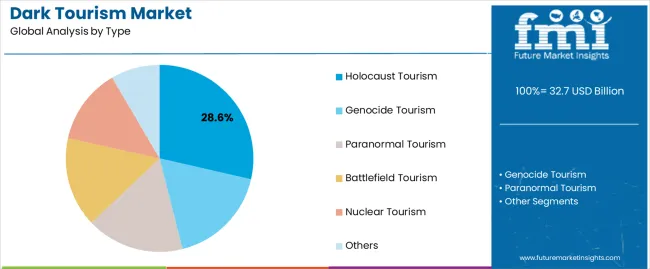
Based on FMI's dark tourism market report, demand for Holocaust tourism is estimated to lead the attraction type segment, capturing 28.6% of the market share in 2025 and maintaining dominance through 2035. Holocaust memorials and museums across Europe, including Auschwitz-Birkenau Memorial and Museum and Anne Frank House, draw sustained educational travel and commemorative visitation.
The segment's leadership reflects established infrastructure, academic partnerships, and integration into European educational curricula driving student group travel. Growth is sustained by generational transmission of memory and increasing global emphasis on genocide prevention education.
Battlefield tourism represents the second-largest segment, encompassing World War I and II sites across France, Belgium, and Germany, as well as American Civil War battlefields drawing domestic visitors. Paranormal tourism includes haunted locations and ghost tours, with operators capitalizing on supernatural curiosity.
Nuclear tourism encompasses Chernobyl exclusion zone visits and Hiroshima Peace Memorial Park, which has welcomed more than 80 million visitors since opening with record annual attendance in fiscal 2025 [8]. Genocide tourism includes sites in Cambodia, Rwanda, and the Balkans, drawing visitors seeking understanding of 20th and 21st century atrocities.
Dark Tourism Market Analysis by Traveler Type
Solo travelers represent the fastest-growing traveler type segment, drawn to reflective experiences enabling personal contemplation at memorial sites and museums. The segment's growth reflects broader trends toward individual travel and experiential tourism, with solo visitors spending more time on-site and engaging deeply with interpretive materials.
Group travelers dominate volume through educational tours, with school groups, university programs, and organized heritage tours generating consistent visitation at Holocaust memorials and battlefields.
Family travelers combine dark tourism with broader itineraries, introducing younger generations to historical sites through age-appropriate programming and interpretive materials. Couples seeking unique experiences contribute to paranormal tourism and nighttime tours, combining historical interest with atmospheric engagement.
Regional Analysis
The dark tourism market is segmented geographically across North America, Europe, Asia-Pacific, Latin America, and Middle East & Africa. Growth dynamics differ based on historical site concentration, preservation infrastructure, and traveler origin markets.
.webp "Top Country Growth Comparison Dark Tourism Market Cagr (2026 2036)")
| Country | CAGR (2026 to 2036) |
|---|---|
| Japan | 3.2% |
| Germany | 2.9% |
| United States | 2.7% |
| France | 2.6% |
| Poland | 2.5% |
Source: Future Market Insights (FMI) analysis, based on proprietary forecasting model and primary research
Europe Market Analysis
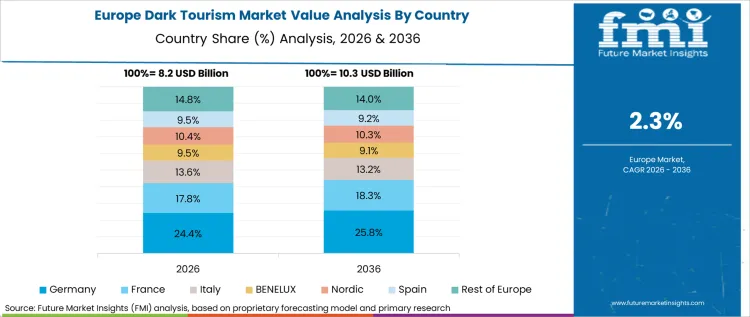
Europe represents the largest visitation market for dark tourism, driven by concentration of Holocaust memorials, World War battlefields, and established cultural tourism infrastructure. The region benefits from educational travel programs, integration of memorial visits into school curricula, and strong preservation frameworks supporting site maintenance. Rich reservoirs of dark heritage drive sustained interest, with Western holidaymakers visiting dense clusters of memorials and battlefields across Germany, Poland, and France.
Germany
Demand for dark tourism in Germany is projected to rise at 2.9% CAGR through 2036. Germany's memorial landscape includes extensive Holocaust documentation centers, former concentration camp sites, and Berlin Wall history locations drawing international visitors.
The country's approach to historical reckoning has established frameworks for respectful engagement with difficult history that inform site management and interpretation. German memorials emphasize educational programming and academic partnerships, attracting student groups and scholarly visitors alongside general tourists.
Poland
Demand for dark tourism in Poland is projected to rise at 2.5% CAGR through 2036. Auschwitz-Birkenau Memorial and Museum represents one of the most visited dark tourism sites globally, drawing millions seeking to understand Holocaust history [4].
The site's preservation requires ongoing investment and balancing of visitation volume with memorial dignity. Poland's battlefield tourism includes World War I and II sites attracting international visitors, supported by government commitment to preserving and promoting UNESCO World Heritage sites.
France
Demand for dark tourism in France is projected to rise at 2.6% CAGR through 2036. Normandy's D-Day landing beaches and American cemetery draw visitors from North America and Europe, with anniversary years generating peak visitation. World War I battlefields in northern France including Verdun and the Somme attract battlefield tourism enthusiasts and educational groups. France's wartime occupation and collaboration history is presented through museums and memorial sites throughout the country.
FMI's analysis of the dark tourism market in Europe consists of country-wise assessment including Germany, Poland, France, United Kingdom, and Italy. Readers can find memorial site tracking, educational travel analysis, and preservation initiative monitoring.
North America Market Analysis
North America holds a dominant position in the global dark tourism market, primarily due to the high concentration of globally recognized sites such as the 9/11 Memorial and Museum, Alcatraz Island, and Pearl Harbor.
This leadership is reinforced by extensive media coverage and documentaries that drive public interest in locations associated with historical tragedies. The region benefits from private sector investment in preservation and experiential tour development.
United States

Demand for dark tourism in the United States is projected to rise at 2.7% CAGR through 2036. The USA market benefits from US Ghost Adventures' "Year of Preservation" initiative investing millions in restoring significant historic properties including the Lizzie Borden House and Villisca Axe Murders House [1]. Lance Zaal emphasized that the most difficult history to preserve is often the most important to protect, describing preservation as a responsibility to future generations [1].
True crime tourism has surged following high-profile cases and media coverage, with sites associated with infamous crimes drawing curious visitors. Active preservation of landmarks by entities like the National Park Service ensures high operational standards and accessibility. The Vietnam Veterans Memorial received over 5.2 million visitors in 2024, demonstrating robust engagement with military history [5]. The Manhattan Project National Historical Park recorded significant visitation linked to recent cinematic portrayals of atomic bomb development [5].
FMI's analysis of the dark tourism market in North America consists of country-wise assessment including the United States, Canada, and Mexico. Readers can find preservation initiative tracking, true crime trend analysis, and battlefield visitation monitoring.
Asia-Pacific Market Analysis
Asia-Pacific represents an expanding dark tourism market driven by nuclear legacy sites, war memorials, and increasing domestic travel in key source markets. The region benefits from growing middle classes seeking meaningful travel experiences and government investment in memorial infrastructure.
Japan
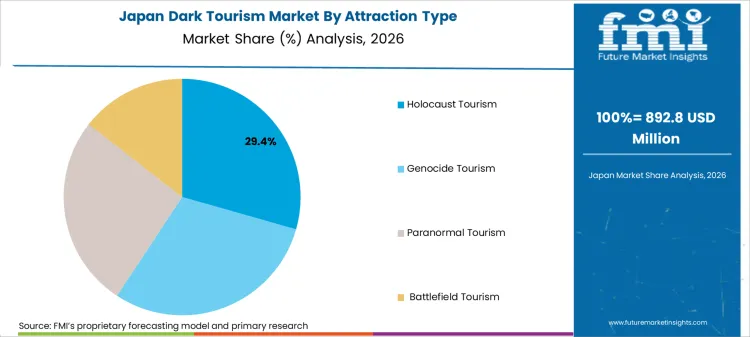
Demand for dark tourism in Japan is projected to rise at 3.2% CAGR through 2036, the highest among major markets. Hiroshima Peace Memorial Park and Museum have welcomed more than 80 million visitors since opening, with record annual attendance in fiscal 2025 [8]. Nagasaki's inclusive approach to memorial commemorations, inviting diplomatic representatives from every nation, underscores commitment to remembrance and peace education [8].
Japan's approach to nuclear legacy tourism emphasizes peace advocacy and educational programming, attracting domestic and international visitors seeking understanding of atomic bombing history and consequences. The immersive experience at Hiroshima Peace Memorial Museum educates visitors about nuclear warfare consequences and the importance of peace.
FMI's analysis of the dark tourism market in Asia-Pacific consists of country-wise assessment including Japan, China, South Korea, and Australia. Readers can find memorial visitation tracking, peace education analysis, and disaster tourism development monitoring.
Competitive Landscape for Market Players
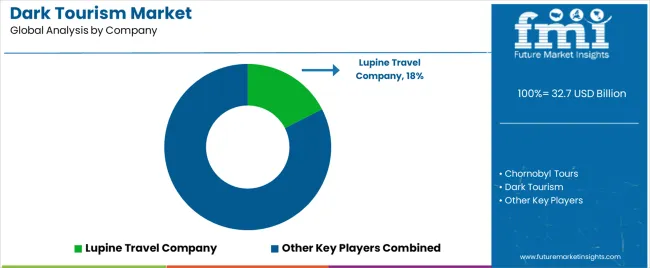
The dark tourism market is characterized by specialized tour operators with deep expertise in specific attraction categories, memorial foundations with educational missions, and hospitality companies integrating dark tourism into broader offerings. Leading firms are differentiating through preservation initiatives, experiential technology investment, and ethical storytelling frameworks.
Lupine Travel Company specializes in conflict zone tourism and nuclear site visitation, navigating complex security environments to offer immersive learning experiences. Chornobyl Tours provides guided access to the Chernobyl exclusion zone, balancing visitor interest with site preservation and radiation safety protocols. Young Pioneer Tours offers itineraries traversing conflict-affected regions, tapping into demographic eager for firsthand perspectives on global flashpoints. Dark Rome Tours provides after-hours access to historic sites, combining nocturnal tourism with ancient history.
Anne Frank House and Auschwitz-Birkenau Memorial and Museum operate as educational foundations prioritizing memorial dignity alongside visitor access. Alcatraz Cruises manages access to former prison island, combining criminal justice history with San Francisco tourism infrastructure. Atlas Obscura curates offbeat destinations including dark tourism sites through digital platform and organized tours. Haunted History Tours networks across multiple USA cities offering paranormal experiences blending entertainment with local history.
Technology providers also play a pivotal role, with VR and AR firms collaborating with memorials and museums to deliver interactive storytelling, augmenting physical visits with digital reconstructions of pivotal moments. This convergence of traditional hospitality, niche operators, and immersive tech is defining a new paradigm for how dark tourism content is curated and consumed.
Buyer behavior in this market reflects diverse motivations including educational pursuit, historical interest, paranormal curiosity, and reflective engagement. Booking patterns show increasing preference for curated experiences with documented educational value and ethical operating practices, with direct bookings and specialized tour operator channels remaining dominant.
Recent Developments:
- USA Ghost Adventures - Year of Preservation Initiative (February 2026): US Ghost Adventures announced multi-million dollar initiative restoring significant historic properties including USD 350,000 Lizzie Borden House renovation and Villisca Axe Murders House accessibility improvements [1].
- The Mob Museum - Exhibition Renovation (October 2024): The Mob Museum unveiled redesigned "The Mob in Pop Culture" exhibition examining organized crime's impact on American entertainment and media [9].
- The Real Mary King's Close - New Tour Products (October 2024): Edinburgh heritage attraction introduced "Lantern Led Tours" and "True Crime Tours" during Halloween period, exploring underground history with focus on historical crimes [10].
- Exhibition Hub - Titanic Exhibition Launch (June 2024): Exhibition Hub partnered with Fever and White Star Memories to launch "Titanic: An Immersive Voyage" featuring over 300 authentic artifacts integrated with digital storytelling [11].
Key Players in the Dark Tourism Market
- Lupine Travel Company
- Chornobyl Tours
- Young Pioneer Tours
- Aero Travels
- Atlas Obscura
- Dark Rome Tours
- Anne Frank House
- Auschwitz-Birkenau Memorial and Museum
- Alcatraz Cruises
- Haunted History Tours
Scope of Report
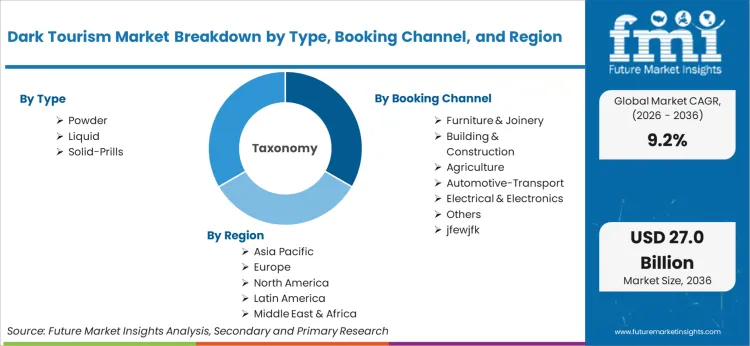
| Metric | Value |
|---|---|
| Quantitative Units | USD 33.5 billion (2026) to USD 41.8 billion (2036), at a CAGR of 2.5% |
| Market Definition | The dark tourism market comprises travel to sites associated with death, tragedy, or the macabre for educational reflection and historical understanding. |
| Attraction Type Segmentation | Holocaust Tourism, Genocide Tourism, Paranormal Tourism, Battlefield Tourism, Nuclear Tourism, Others |
| Traveler Type Segmentation | Couples, Solo, Family, Groups |
| Region Segmentation | North America, Latin America, Europe, Asia-Pacific, Middle East & Africa |
| Key Countries Covered | United States, Canada, Germany, Poland, France, United Kingdom, Italy, Japan, China, South Korea, Australia, and 40+ countries |
| Key Companies Profiled | Lupine Travel Company, Chornobyl Tours, Young Pioneer Tours, Aero Travels, Atlas Obscura, Dark Rome Tours, Anne Frank House, Auschwitz-Birkenau Memorial and Museum, Alcatraz Cruises, Haunted History Tours |
| Forecast Period | 2026 to 2036 |
| Approach | Hybrid top-down and bottom-up market modeling validated through primary interviews with tour operators and memorial site managers, supported by visitation data and preservation investment tracking |
Dark Tourism Market Analysis by Segments
Attraction Type:
- Holocaust Tourism
- Genocide Tourism
- Paranormal Tourism
- Battlefield Tourism
- Nuclear Tourism
- Others
Traveler Type:
- Couples
- Solo
- Family
- Groups
Region:
- North America
- Latin America
- Europe
- Asia-Pacific
- Middle East & Africa
Bibliography
- Travel and Tour World. (2026, February 11). USA Ghost Adventures Leads the Way in Dark Tourism with Year of Preservation Initiative. Travel and Tour World.
- National Geographic Traveller (UK). (2025, December 26). How travel will look in 2026-here's what you need to know. National Geographic.
- Tornos News. (2025, December 17). Noctourism: The Rebirth of the Night.
- Auschwitz-Birkenau Memorial and Museum. (2025). Annual Visitor Report 2024. Memorial Publications.
- National Park Service. (2025). Annual Recreation Visitation Reports 2024. USA Department of the Interior.
- National September 11 Memorial & Museum. (2025). Annual Report 2024. 9/11 Memorial & Museum.
- Kenya Association of Travel Agents. (2025, December 14). The Future of Travel: Blended Trips and AI Travel Planning in 2026. KATA.
- Tempo.co (2026, January 12). Rome Named Top Noctourism Destination for 2026. Tempo.
- The Mob Museum. (2024, October 17). The Mob Museum Unveils Redesigned "The Mob in Pop Culture" Exhibition. The Mob Museum.
- The Real Mary King's Close. (2024, October 3). Uncover Edinburgh's Dark History with Two New Tours. The Real Mary King's Close.
- Exhibition Hub. (2024, June 26). Exhibition Hub Launches "Titanic: An Immersive Voyage" in Partnership with Fever and White Star Memories. Exhibition Hub.
This Report Addresses
- Market intelligence to enable structured strategic decision-making across tour operators, memorial site managers, preservation organizations, and travel industry investors.
- Market size estimation and 10-year revenue forecasts from 2026 to 2036, including validated CAGR and absolute dollar opportunity sizing.
- Growth opportunity mapping across Attraction Type, Traveler Type, and regional demand pockets, with emphasis on Holocaust tourism dominance and experiential technology integration.
- Segment and regional forecasting covering Holocaust sites, battlefields, nuclear locations, and paranormal attractions, alongside traveler-type demand trajectories across solo, group, and family segments.
- Competition strategy assessment, including preservation initiative investment, ethical framework development, and experiential technology integration shaping visitor engagement.
- Experience and technology tracking focused on augmented reality applications, curator-led access programs, and preservation-funded restoration projects.
- Regulatory and ethical policy analysis covering survivor community engagement, academic partnership validation, and responsible storytelling frameworks influencing site operations.
- Report delivery in PDF, Excel, and presentation-ready formats to support executive planning, product development alignment, and competitive benchmarking.
Frequently Asked Questions
How large is the demand for Dark Tourism in the global market in 2026?
The dark tourism sector is estimated to be valued at USD 33.5 billion in 2026.
What will be the market size of Dark Tourism in the global market by 2036?
The market is projected to reach USD 41.8 billion by 2036.
What is the expected demand growth for Dark Tourism in the global market between 2026 and 2036?
The dark tourism sector is expected to grow at a CAGR of about 2.5% from 2026 to 2036.
Which Type is poised to lead global sales by 2026?
Holocaust Tourism is expected to be the dominant type, capturing approximately 28.6% of global market share in 2026 due to extensive educational mandates and preserved infrastructure.
What is driving demand in Poland?
Demand is driven by the modernization of site infrastructure to accommodate post-pandemic visitor rebounds and state-supported educational tourism.
What compliance standards or regulations are referenced for Poland?
Regulations from the International Auschwitz Council regarding commercial zoning and site preservation are referenced.
What is the Poland growth outlook in this report?
Dark tourism demand in Poland is expected to grow at a CAGR of 2.5% through 2036
Why is North America described as a priority region in this report?
North America is prioritized due to its high integration of digital learning technologies and broad educational outreach programs.
What type of demand dominates in North America?
Demand is dominated by educational and commemorative visits, supported by advanced digital platforms.
Does the report cover Cambodia in its regional analysis?
Yes, Cambodia is included within Asia Pacific under the regional scope of analysis.
What are the sources referred to for analyzing the Market in Cambodia?
Corporate tour activity reports and booking platform data are cited as primary reference sources.
What is the main demand theme linked to Cambodia in Asia Coverage?
Asia Pacific demand is associated with the use of digital booking platforms to access complex historical sites.
Does the report cover Rwanda in its regional analysis?
Yes, Rwanda is included within Middle East & Africa under the regional coverage framework.
Which product formats or configurations are strategically important for Europe supply chains?
Digital tour apps and modernized visitor hostels are prioritized to manage high visitor volumes.
What is Dark Tourism and What is It Mainly Used For?
Dark Tourism involves visiting sites associated with death and tragedy, used mainly for education, remembrance, and historical understanding.
What does Dark Tourism Market Mean in this Report?
Dark Tourism market refers to the global revenue generated from admissions, tours, and related educational services at historical tragedy sites.
What is Included in the Scope of this Dark Tourism Market Report?
Scope covers revenue from site admissions, guided tours, and digital content monetization at Holocaust, war, and prison sites.
What is Excluded from the Scope of this Report?
General heritage tourism, unauthorized tours, and unrelated hospitality revenues are excluded.
What does Market Forecast Mean on this Page?
Market forecast represents a model based projection built on defined assumptions for strategic planning purposes.
How does FMI Build and Validate the Dark Tourism Market Forecast?
Forecast is developed using hybrid top down and bottom up modeling validated through primary interviews and official visitor statistics.
What does Zero Reliance on Speculative Third Party Market Research Mean Here?
Primary interviews and verifiable public datasets are used instead of unverified syndicated market estimates.
Preview the report firsthand - request a free sample
Get SampleGet the brochure for pricing and purchase details.
Get PDFTable of Content
- Executive Summary
- Global Market Outlook
- Demand-side Trends
- Supply-side Trends
- Technology Roadmap Analysis
- Analysis and Recommendations
- Market Overview
- Market Coverage / Taxonomy
- Market Definition / Scope / Limitations
- Research Methodology
- Chapter Orientation
- Analytical Lens and Working Hypotheses
- Market Structure, Signals, and Trend Drivers
- Benchmarking and Cross-market Comparability
- Market Sizing, Forecasting, and Opportunity Mapping
- Research Design and Evidence Framework
- Desk Research Programme (Secondary Evidence)
- Company Annual and Sustainability Reports
- Peer-reviewed Journals and Academic Literature
- Corporate Websites, Product Literature, and Technical Notes
- Earnings Decks and Investor Briefings
- Statutory Filings and Regulatory Disclosures
- Technical White Papers and Standards Notes
- Trade Journals, Industry Magazines, and Analyst Briefs
- Conference Proceedings, Webinars, and Seminar Materials
- Government Statistics Portals and Public Data Releases
- Press Releases and Reputable Media Coverage
- Specialist Newsletters and Curated Briefings
- Sector Databases and Reference Repositories
- FMI Internal Proprietary Databases and Historical Market Datasets
- Subscription Datasets and Paid Sources
- Social Channels, Communities, and Digital Listening Inputs
- Additional Desk Sources
- Expert Input and Fieldwork (Primary Evidence)
- Primary Modes
- Qualitative Interviews and Expert Elicitation
- Quantitative Surveys and Structured Data Capture
- Blended Approach
- Why Primary Evidence is Used
- Field Techniques
- Interviews
- Surveys
- Focus Groups
- Observational and In-context Research
- Social and Community Interactions
- Stakeholder Universe Engaged
- C-suite Leaders
- Board Members
- Presidents and Vice Presidents
- R&D and Innovation Heads
- Technical Specialists
- Domain Subject-matter Experts
- Scientists
- Physicians and Other Healthcare Professionals
- Governance, Ethics, and Data Stewardship
- Research Ethics
- Data Integrity and Handling
- Primary Modes
- Tooling, Models, and Reference Databases
- Desk Research Programme (Secondary Evidence)
- Data Engineering and Model Build
- Data Acquisition and Ingestion
- Cleaning, Normalisation, and Verification
- Synthesis, Triangulation, and Analysis
- Quality Assurance and Audit Trail
- Market Background
- Market Dynamics
- Drivers
- Restraints
- Opportunity
- Trends
- Scenario Forecast
- Demand in Optimistic Scenario
- Demand in Likely Scenario
- Demand in Conservative Scenario
- Opportunity Map Analysis
- Product Life Cycle Analysis
- Supply Chain Analysis
- Investment Feasibility Matrix
- Value Chain Analysis
- PESTLE and Porter’s Analysis
- Regulatory Landscape
- Regional Parent Market Outlook
- Production and Consumption Statistics
- Import and Export Statistics
- Market Dynamics
- Global Market Analysis 2021 to 2025 and Forecast, 2026 to 2036
- Historical Market Size Value (USD Billion) Analysis, 2021 to 2025
- Current and Future Market Size Value (USD Billion) Projections, 2026 to 2036
- Y-o-Y Growth Trend Analysis
- Absolute $ Opportunity Analysis
- Global Market Pricing Analysis 2021 to 2025 and Forecast 2026 to 2036
- Global Market Analysis 2021 to 2025 and Forecast 2026 to 2036, By Attraction Type
- Introduction / Key Findings
- Historical Market Size Value (USD Billion) Analysis By Attraction Type , 2021 to 2025
- Current and Future Market Size Value (USD Billion) Analysis and Forecast By Attraction Type , 2026 to 2036
- Holocaust Tourism
- Genocide Tourism
- Paranormal Tourism
- Battlefield Tourism
- Holocaust Tourism
- Y-o-Y Growth Trend Analysis By Attraction Type , 2021 to 2025
- Absolute $ Opportunity Analysis By Attraction Type , 2026 to 2036
- Global Market Analysis 2021 to 2025 and Forecast 2026 to 2036, By Region
- Introduction
- Historical Market Size Value (USD Billion) Analysis By Region, 2021 to 2025
- Current Market Size Value (USD Billion) Analysis and Forecast By Region, 2026 to 2036
- North America
- Latin America
- Western Europe
- Eastern Europe
- East Asia
- South Asia and Pacific
- Middle East & Africa
- Market Attractiveness Analysis By Region
- North America Market Analysis 2021 to 2025 and Forecast 2026 to 2036, By Country
- Historical Market Size Value (USD Billion) Trend Analysis By Market Taxonomy, 2021 to 2025
- Market Size Value (USD Billion) Forecast By Market Taxonomy, 2026 to 2036
- By Country
- USA
- Canada
- Mexico
- By Attraction Type
- By Country
- Market Attractiveness Analysis
- By Country
- By Attraction Type
- Key Takeaways
- Latin America Market Analysis 2021 to 2025 and Forecast 2026 to 2036, By Country
- Historical Market Size Value (USD Billion) Trend Analysis By Market Taxonomy, 2021 to 2025
- Market Size Value (USD Billion) Forecast By Market Taxonomy, 2026 to 2036
- By Country
- Brazil
- Chile
- Rest of Latin America
- By Attraction Type
- By Country
- Market Attractiveness Analysis
- By Country
- By Attraction Type
- Key Takeaways
- Western Europe Market Analysis 2021 to 2025 and Forecast 2026 to 2036, By Country
- Historical Market Size Value (USD Billion) Trend Analysis By Market Taxonomy, 2021 to 2025
- Market Size Value (USD Billion) Forecast By Market Taxonomy, 2026 to 2036
- By Country
- Germany
- UK
- Italy
- Spain
- France
- Nordic
- BENELUX
- Rest of Western Europe
- By Attraction Type
- By Country
- Market Attractiveness Analysis
- By Country
- By Attraction Type
- Key Takeaways
- Eastern Europe Market Analysis 2021 to 2025 and Forecast 2026 to 2036, By Country
- Historical Market Size Value (USD Billion) Trend Analysis By Market Taxonomy, 2021 to 2025
- Market Size Value (USD Billion) Forecast By Market Taxonomy, 2026 to 2036
- By Country
- Russia
- Poland
- Hungary
- Balkan & Baltic
- Rest of Eastern Europe
- By Attraction Type
- By Country
- Market Attractiveness Analysis
- By Country
- By Attraction Type
- Key Takeaways
- East Asia Market Analysis 2021 to 2025 and Forecast 2026 to 2036, By Country
- Historical Market Size Value (USD Billion) Trend Analysis By Market Taxonomy, 2021 to 2025
- Market Size Value (USD Billion) Forecast By Market Taxonomy, 2026 to 2036
- By Country
- China
- Japan
- South Korea
- By Attraction Type
- By Country
- Market Attractiveness Analysis
- By Country
- By Attraction Type
- Key Takeaways
- South Asia and Pacific Market Analysis 2021 to 2025 and Forecast 2026 to 2036, By Country
- Historical Market Size Value (USD Billion) Trend Analysis By Market Taxonomy, 2021 to 2025
- Market Size Value (USD Billion) Forecast By Market Taxonomy, 2026 to 2036
- By Country
- India
- ASEAN
- Australia & New Zealand
- Rest of South Asia and Pacific
- By Attraction Type
- By Country
- Market Attractiveness Analysis
- By Country
- By Attraction Type
- Key Takeaways
- Middle East & Africa Market Analysis 2021 to 2025 and Forecast 2026 to 2036, By Country
- Historical Market Size Value (USD Billion) Trend Analysis By Market Taxonomy, 2021 to 2025
- Market Size Value (USD Billion) Forecast By Market Taxonomy, 2026 to 2036
- By Country
- Kingdom of Saudi Arabia
- Other GCC Countries
- Turkiye
- South Africa
- Other African Union
- Rest of Middle East & Africa
- By Attraction Type
- By Country
- Market Attractiveness Analysis
- By Country
- By Attraction Type
- Key Takeaways
- Key Countries Market Analysis
- USA
- Pricing Analysis
- Market Share Analysis, 2025
- By Attraction Type
- Canada
- Pricing Analysis
- Market Share Analysis, 2025
- By Attraction Type
- Mexico
- Pricing Analysis
- Market Share Analysis, 2025
- By Attraction Type
- Brazil
- Pricing Analysis
- Market Share Analysis, 2025
- By Attraction Type
- Chile
- Pricing Analysis
- Market Share Analysis, 2025
- By Attraction Type
- Germany
- Pricing Analysis
- Market Share Analysis, 2025
- By Attraction Type
- UK
- Pricing Analysis
- Market Share Analysis, 2025
- By Attraction Type
- Italy
- Pricing Analysis
- Market Share Analysis, 2025
- By Attraction Type
- Spain
- Pricing Analysis
- Market Share Analysis, 2025
- By Attraction Type
- France
- Pricing Analysis
- Market Share Analysis, 2025
- By Attraction Type
- India
- Pricing Analysis
- Market Share Analysis, 2025
- By Attraction Type
- ASEAN
- Pricing Analysis
- Market Share Analysis, 2025
- By Attraction Type
- Australia & New Zealand
- Pricing Analysis
- Market Share Analysis, 2025
- By Attraction Type
- China
- Pricing Analysis
- Market Share Analysis, 2025
- By Attraction Type
- Japan
- Pricing Analysis
- Market Share Analysis, 2025
- By Attraction Type
- South Korea
- Pricing Analysis
- Market Share Analysis, 2025
- By Attraction Type
- Russia
- Pricing Analysis
- Market Share Analysis, 2025
- By Attraction Type
- Poland
- Pricing Analysis
- Market Share Analysis, 2025
- By Attraction Type
- Hungary
- Pricing Analysis
- Market Share Analysis, 2025
- By Attraction Type
- Kingdom of Saudi Arabia
- Pricing Analysis
- Market Share Analysis, 2025
- By Attraction Type
- Turkiye
- Pricing Analysis
- Market Share Analysis, 2025
- By Attraction Type
- South Africa
- Pricing Analysis
- Market Share Analysis, 2025
- By Attraction Type
- USA
- Market Structure Analysis
- Competition Dashboard
- Competition Benchmarking
- Market Share Analysis of Top Players
- By Regional
- By Attraction Type
- Competition Analysis
- Competition Deep Dive
- Lupine Travel Company
- Overview
- Product Portfolio
- Profitability by Market Segments (Product/Age /Sales Channel/Region)
- Sales Footprint
- Strategy Overview
- Marketing Strategy
- Product Strategy
- Channel Strategy
- Chornobyl Tours
- Young Pioneer Tours
- Aero Travels
- Atlas Obscura
- Dark Rome Tours
- Anne Frank House
- Lupine Travel Company
- Competition Deep Dive
- Assumptions & Acronyms Used


