

- Industry Size (2026)
- USD 3.09 Bn
- Forecast (2036)
- USD 4.47 Bn
- CAGR (2026 to 2036)
- 12.5%
Cross-Border Customs and Trade Compliance Orchestration Platforms Market Size, Market Forecast and Outlook By FMI
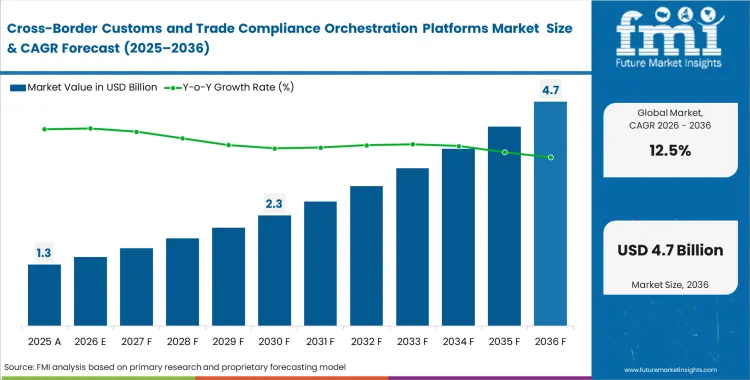
The Cross-Border Customs and Trade Compliance Orchestration Platforms Market was valued at USD 1.2 billion in 2025. Revenue is estimated to cross USD 1.3 billion in 2026 at a CAGR of 12.5% during the forecast period. Sustained investment propels cumulative revenue to USD 4.4 billion through 2036 as global border agencies transition from periodic post-clearance audits to real-time transaction-level data ingestion requirements.
Summary of Paediatric Oncology Therapeutics Market
- Market Snapshot
- The cross‑border customs and trade compliance orchestration platforms market stands at USD 1.23 billion in 2025 and is forecast to reach to USD 4.47 billion by 2036.
- Market growth is estimated at a CAGR of 12.5% between 2026 and 2036, generating an incremental value opportunity of USD 3.09 billion over the forecast timeline.
- The category is centered on compliance‑driven software that supports customs declarations, tariff and origin management, denied‑party screening, broker and government system connectivity, and coordinated trade workflows across multiple jurisdictions.
- Competitive differentiation is driven less by basic ERP linkages and more by the depth of regulatory content, real‑time filing connectivity, audit traceability, country coverage, and the strength of end‑to‑end workflow orchestration.
- Demand and Growth Drivers
- Demand is rising because customs administrations are moving from fragmented or manual processes toward digital single-window and pre-arrival filing systems, visible in ACE in the United States, ICS2 in the EU, CARM in Canada, ICEGATE in India, and TradeNet in Singapore.
- Customs filing automation is seeing stronger adoption because enterprises need fewer declaration errors, quicker clearance, and auditable workflows under tightening trade-control and tariff regimes.
- Growth is also supported by cross-border e-commerce and parcel scrutiny, which increases the volume of entry data, pre-arrival security submissions, and valuation or origin checks at borders.
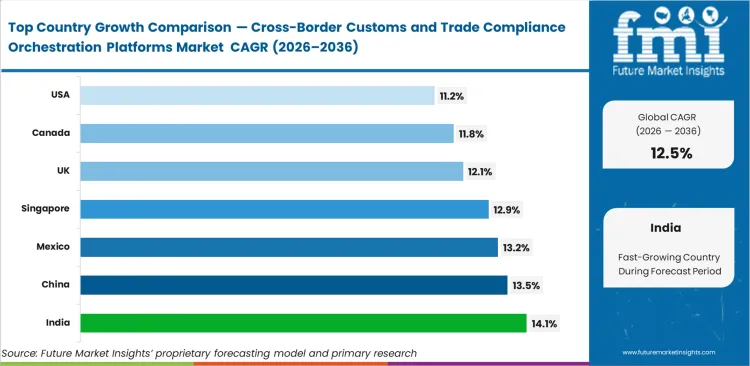
- India leads at 14.1% CAGR, followed by China at 13.5%, Mexico at 13.2%, Singapore at 12.9%, the United Kingdom at 12.1%, Canada at 11.8%, and the United States at 11.2%.
- Industry expansion is moderated by long implementation cycles, country-specific data schemas, and the fact that large shippers often still operate mixed estates of ERP modules, broker portals, and local compliance tools that take time to replace.
- Product and Segment View
- The market covers software and related services used to manage declarations, classification, screening, duty optimization, origin handling, and broker or government connectivity for cross-border trade.
- These platforms are used across importer operations, exporter compliance teams, freight forwarders, customs brokers, and multinational manufacturers coordinating multi-country trade flows.
- The Component segment is led by software, which is estimated to hold 66.0 % of the share since recurring platform licenses and regulatory content subscriptions are more valuable than project services in a developed SaaS-based market.
- Cloud dominates the Deployment segment, and is projected to have a share of 71.0% as there is a need to have rapid regulatory changes, API connectivity, and multi-country deployments.
- Customs Filing is the market leader in the Function segment, expected to hold 31.0% of the market, as statements and direct government filings are the core of trade compliance operations.
- The End Use segment is headed by Logistics Providers, which will have a share of 29.0 %, and it is backed by the freight forwarders and brokers who require unified filling, screening, and visibility among the clients and jurisdictions.
- The Enterprise Size segment is dominated by Large Enterprises, which will experience the highest share of 61.0% because they have the most exposure to regulations and the greatest cost savings of switching siloed country tools to centralized orchestration.
- The scope includes software platforms, connectivity layers, compliance content, and workflow engines, but excludes pure consulting, standalone customs brokerage labor without persistent software, and broad ERP systems that lack dedicated trade-compliance functionality.
- Geography and Competitive Outlook
- India, China, and Mexico are the fastest-growing national markets, while the United States remains a stable high-value base because installed digital customs infrastructure is already extensive.
- Competition is being shaped by broader logistics-software consolidation and product-suite expansion, especially WiseTech’s acquisition of e2open and ongoing upgrades across CargoWise, Descartes, SAP, Oracle, and ONESOURCE.
- Key companies include Descartes Systems Group, WiseTech Global, Thomson Reuters, SAP, Oracle, MIC Customs Solutions, and AEB, with Descartes currently estimated as the largest single vendor with majority of shares.
- The market remains moderately fragmented, with the top tier owning strong cross-border reach, but many country-specific specialists are still active in customs filing and compliance workflows.
Manufacturers are increasingly confronting the limitations of fragmented regulatory systems. Relying on disconnected local filing processes often leads to delays at the warehouse level, particularly when authorities reject incomplete or inconsistent data submissions before cargo even arrives at port. The need to shift toward a centralized orchestration approach is becoming difficult to defer, as the risk of operational disruption continues to rise. Regulatory bodies across the European Union and the United States now require advance digital declarations, leaving little room for manual or delayed compliance. In this environment, many buyers conclude that the cost of upgrading systems is more manageable than the potential impact of shipment delays or rejections. This reality drives rapid uptake of cross-border customs compliance orchestration platforms and related trade management software.
When national border authorities deprecate legacy electronic data interchange connections in favor of mandatory API submissions, widespread adoption accelerates. This hard regulatory cutoff forces holdout logistics providers to abandon manual entries entirely. Once authorities stop accepting non-API-based submissions, customs and trade compliance orchestration platforms shift from being optional tools to core operational requirements. Logistics leaders quickly review trade compliance platform pricing to secure foreign trade digital service frameworks before their existing broker connections fail.
India leads adoption, is expected to hold 14.1%, as its domestic customs digitization mandates force exporters into structured data compliance. China is estimated to hold 13.5%, based on massive multi‑jurisdiction trade volumes requiring continuous classification updates. Mexico is anticipated to capture 13.2%, driven by cross‑border manufacturing intensity, while Singapore is poised to garner 12.9%, due to its strategic position as a transit hub. Canada, the United Kingdom, and the United States are set to record 11.8%, 12.1%, and 11.2%, respectively over the forecast period. Established digital infrastructures in these nations mean growth stems from replacing older tools with modern trade compliance software rather than initial digitization.
Segmental Analysis
Cross-Border Customs and Trade Compliance Orchestration Platforms Market Analysis by Component
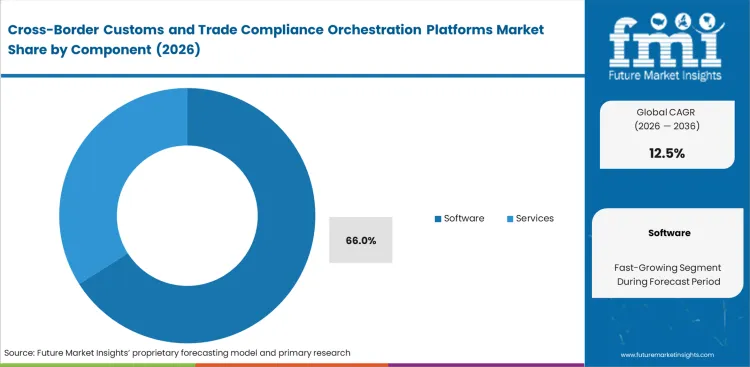
Procurement evaluations are increasingly weighted toward ongoing technical capabilities rather than one-time deployment support. Software is estimated to account for its 66.0% share largely because trade regulations are in constant flux, with authorities updating rules frequently. Supply chain leaders depend on these platforms to manage such volatility without manual intervention. Buyers expect integrated customs declaration workflows and automated freight management software that continuously update tariff libraries in the background. While software licenses represent the visible portion of revenue, sustained margin control lies in the ability to deliver continuous regulatory updates. Organizations effectively subscribe to the ongoing maintenance of classification engines aligned with revisions from the World Customs Organization. Companies relying on static databases face immediate shipment rejections when harmonized system codes change. Vendors looking to build meaningful market share must demonstrate consistent and reliable update cycles.
- • Library synchronization: Automated algorithms keep local classification systems aligned with global regulatory changes. This removes the need for manual tracking and reduces the risk of submitting outdated tariff codes.
- • Version fragmentation: Running outdated on-premise systems creates significant gaps during major regulatory updates. Delayed patching often leads to higher upgrade costs when adapting to new government API requirements.
- • Lifecycle economics: Cloud-based subscription models shift spending from capital expenditure to operating budgets, giving finance teams greater cost predictability while ensuring compliance teams always work with the latest regulatory data.
Cross-Border Customs and Trade Compliance Orchestration Platforms Market Analysis by Deployment
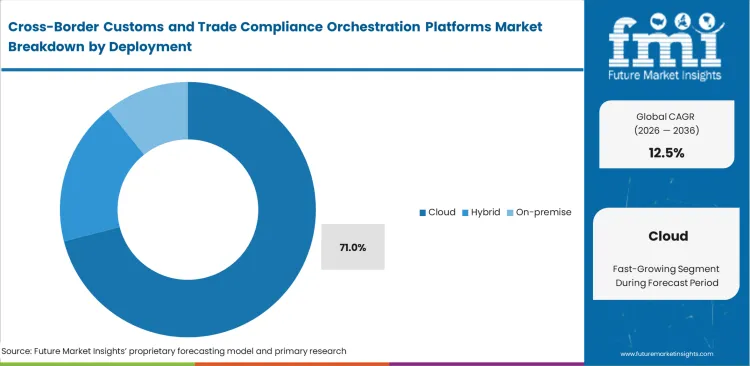
Centralized API architectures now shape deployment decisions for global manufacturers that need trade compliance systems to work across multiple jurisdictions without local infrastructure complexity. Cloud deployment is estimated to hold 71.0% share in 2026 because border agencies increasingly require direct web-based data ingestion, and that requirement weakens the case for legacy installations that depend on manual updates across regional servers. Enterprise IT architects avoid fragmented deployment models that create version gaps across countries and slow down regulatory response. A cloud-based setup allows changes in EU import rules or other filing requirements to flow through the network immediately instead of being patched server by server. Large manufacturers still keep core production systems and proprietary bills of material on-premise, but they buy logistics visibility software and customs broker integration platforms for the speed and reach that cloud connectivity provides. Separation lets them protect sensitive internal systems while still meeting the real-time data exchange standards required at borders. Companies that fail to use web-based connectivity face filing delays and latency that can disrupt time-sensitive port clearance activity.
- Network scalability: Web-hosted environments allow companies to activate new regional compliance modules quickly. Expansion directors can enter emerging markets without waiting for local server provisioning or country-level software installation.
- Connectivity maintenance: Vendor engineering teams manage the API changes required by shifting government portals. Internal IT teams avoid spending costly developer time on repeated formatting fixes across national customs gateways.
- Disaster recovery: Distributed server architectures reduce the risk of a full compliance blackout during localized outages. Logistics operations managers can maintain filing continuity even when a primary regional headquarters faces a major network disruption.
Cross-Border Customs and Trade Compliance Orchestration Platforms Market Analysis by Function
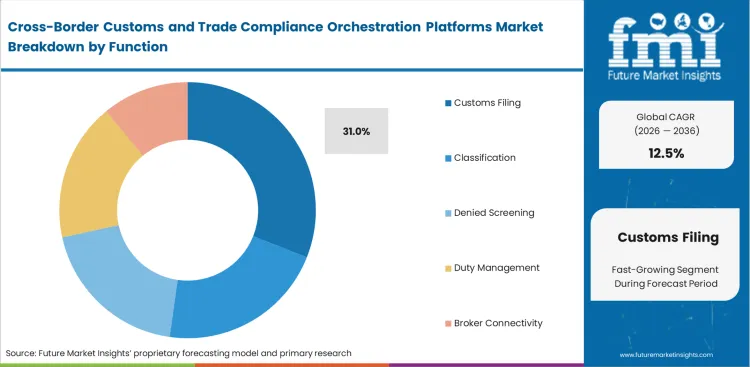
Submitting precise declaration data remains the inescapable baseline for international commerce. Import managers prioritize this function because border authorities can stop containers immediately when electronic paperwork is incomplete, inaccurate, or delayed. The system must absorb multimodal shipment visibility inputs and convert them into legally valid declarations without breaking filing timelines. Customs filing software size reflects the non-discretionary nature of this requirement in physical goods movement. Workflow failure at this stage does not stay administrative for long, because it quickly turns into port congestion, dwell time, and avoidable scrutiny from customs authorities. Customs Filing is estimated to hold 31.0% share in 2026 because no cross-border shipment can move without accurate and timely declaration submission. The operating burden has now shifted toward denied party screening, where false positives often create more warehouse delay than the underlying regulatory exposure itself. A unified denied party screening and customs platform helps companies reduce filing errors, tighten compliance control, and limit execution delays across high-volume trade flows.
- Pre-arrival clearance: Automated systems transmit comprehensive cargo details to authorities well before vessel arrival. Port operations managers secure faster offloading approvals and reduce container demurrage costs at congested maritime terminals.
- Exception handling: Intelligent workflows identify missing commercial invoice data before submission attempts begin. Customs clerks can correct specific documentation gaps quickly instead of dealing with broad rejection codes from overloaded government processing systems.
- Audit trails: Digital archives log each submitted declaration alongside the corresponding commercial documents. Corporate compliance officers can respond to retrospective government inquiries quickly by producing clear proof of accurate duty calculation and payment.
Cross-Border Customs and Trade Compliance Orchestration Platforms Market Analysis by End Use
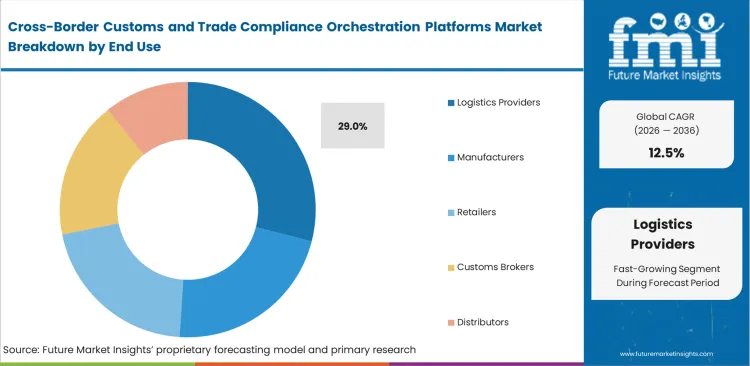
Third-party operators absorb much of the international regulatory burden for their clients because they sit at the center of cross-border data exchange. Forwarding agents manage highly inconsistent shipment information from hundreds of shippers, and that forces them to build digital logistics working model and specialized logistics provider customs software that can standardize poor-quality inputs before filing begins. Buying platforms that normalize unstructured commercial invoices ahead of border arrival because manual correction at scale quickly becomes unworkable. Operating pressure is what keeps these providers at the center of platform demand. Logistics providers account for this leadership position because they are often forced to compensate for their clients’ documentation gaps and process inconsistencies. Logistics Providers are anticipated to capture 29.0% share in 2026 as the primary data aggregators across global trade flows. Forwarders cannot scale profitably without orchestration engines that reduce manual intervention, improve filing accuracy, and keep cargo moving through increasingly complex customs environments.
- Client onboarding: Standardized mapping tools rapidly connect new shipper systems to the provider's central compliance engine. Account executives compress implementation timelines from months to weeks, accelerating time-to-revenue for newly acquired transportation contracts.
- Margin erosion: Processing manual corrections for incomplete customer declarations destroys forwarder profitability. Operations directors mandate automated platforms strictly to reduce the expensive human labor previously required to fix bad shipper data.
- Service differentiation: Offering clients predictive visibility into customs hold statuses becomes a core sales advantage. Commercial directors win lucrative enterprise contracts by proving their technical ability to navigate complex cross-border friction seamlessly.
Cross-Border Customs and Trade Compliance Orchestration Platforms Market Analysis by Enterprise Size
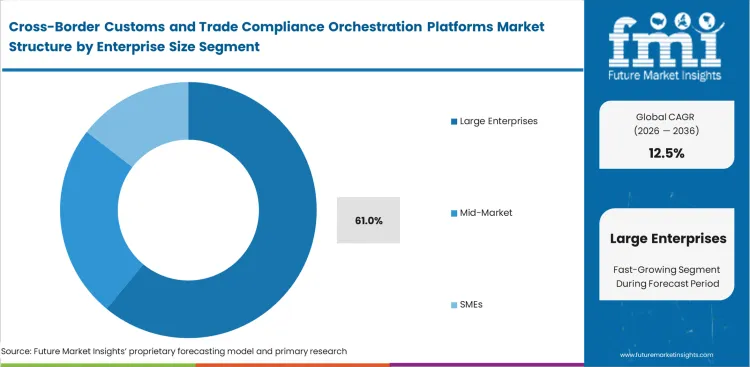
Complex multinational footprints force major corporations to move away from fragmented broker-led compliance models. Global trade directors at these firms cannot afford to manage thousands of cross-border movements each day through disconnected regional practices that create uneven control standards. They need unified command centers that apply the same screening, classification, and filing logic whether a shipment leaves Shanghai or Hamburg. Large Enterprises are expected to hold 61.0% share in 2026 because industrial-scale trade volume demands centralized automation, policy consistency, and stronger governance across jurisdictions. The next wave of incremental spending is also widening beyond this core base, as mid-market distributors crossing higher revenue and compliance thresholds begin investing in direct government connectivity and enterprise-grade trade systems. Many of these firms now evaluate an enterprise customs software demo to reduce reliance on traditional broker intermediaries and gain tighter control over filing workflows. Delaying enterprise-wide standardization leaves large organizations exposed to multi-country regulatory investigations when controls break unevenly across regions.
- Global standardization: Unified policy engines enforce identical classification rules across all international subsidiaries. Corporate risk officers eliminate the discrepancies that arise when regional offices interpret ambiguous tariff codes independently.
- Integration depth: Enterprise platforms embed directly into core financial and manufacturing resource planning systems. Supply chain architects ensure compliance checks occur automatically at purchase order creation rather than immediately before shipment.
- Volume consolidation: Aggregating global declarations through a single vendor helps enterprises secure better subscription pricing. Procurement heads improve software return on investment while simplifying complex IT vendor portfolios.
Cross-Border Customs and Trade Compliance Orchestration Platforms Market Drivers, Restraints, and Opportunities
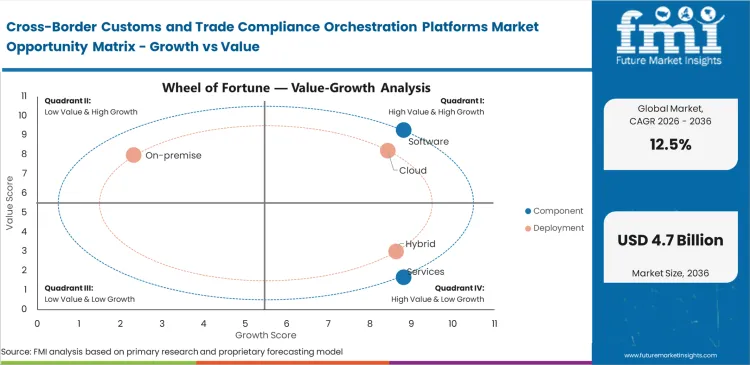
Immediate commercial consequences force action as major trading blocs implement strict advance data mandates. Supply chain directors realize that failing to transmit highly structured shipment details through frameworks like the EU's ICS2 results in immediate cargo bans. This urgency goes far beyond simple modernization initiatives. Border authorities refuse to let planes take off or ships dock without prior electronic approval. Compliance and traceability solution investments become basic operational imperatives. Buyers cannot wait for perfect internal data harmony. They must deploy automated customs filing platforms immediately to avoid total network paralysis. Regulatory enforcement shifts the conversation from return on investment to absolute survival. This compels rapid procurement decisions and widespread implementation of international freight forwarding data standards across the global trade management software ecosystem.
The primary friction slowing deployment involves deep-rooted internal master data corruption. Operations managers frequently discover that their existing part numbers map poorly to official harmonized system codes. Historical data entry relied on free-text descriptions rather than standardized nomenclatures. Software can automate the transmission of data. It cannot invent accurate classifications for poorly described components. Implementation stalls entirely while companies dedicate months to manually cleaning thousands of inventory records. Emerging AI categorization tools offer partial relief. They still require significant human oversight to validate complex engineering specifications against strict legal definitions.
Opportunities in the Cross-Border Customs and Trade Compliance Orchestration Platforms Market
- Predictive clearance routing: Systems analyze historical border delays to recommend alternative ports of entry. Logistics directors bypass congested customs checkpoints and maintain tight e commerce logistics delivery schedules.
- Free trade optimization: Advanced algorithms automatically cross-reference bills of material against complex origin rules. Procurement teams capture millions in previously abandoned duty savings using landed cost and duty optimization software without increasing their compliance headcount.
- Broker performance analytics: Dashboards track exact clearance times across various third-party agents. Supply chain managers easily identify underperforming partners and confidently renegotiate service level agreements by deploying advanced first mile delivery software integrations based on hard data.
Regional Analysis
.webp "Top Country Growth Comparison Cross Border Customs And Trade Compliance Orchestration Platforms Market Cagr (2026 2036)")
Based on regional analysis, Cross-Border Customs and Trade Compliance Orchestration Platforms is segmented into North America, Latin America, Europe, East Asia, South Asia, and Southeast Asia across 40 plus countries.
| Country | CAGR (2026 to 2036) |
|---|---|
| India | 14.1% |
| China | 13.5% |
| Mexico | 13.2% |
| Singapore | 12.9% |
| United Kingdom | 12.1% |
| Canada | 11.8% |
| United States | 11.2% |
Source: Future Market Insights (FMI) analysis, based on proprietary forecasting model and primary research
South Asia Cross-Border Customs and Trade Compliance Orchestration Platforms Market Analysis
Aggressive national digitization schedules now define how exporters operate across this region. FMI observes that government mandates are steadily removing paper-based workflows from customs administration and replacing them with centralized digital submission requirements. Regional compliance officers are under fixed timelines to connect local accounting systems with national customs portals, leaving little room for staggered implementation. Pressure compresses the adoption cycle and forces exporters to modernize faster than they would in more mature markets. Authorities are also demanding transaction-level transparency to tighten duty enforcement and reduce evasion risk. Legacy software cannot support this level of integration, speed, or data visibility. The advantage is moving toward vendors that can deploy quickly, localize effectively, and keep exporters compliant without disrupting day-to-day shipment execution.
- India: Mandatory portal integration is pushing domestic manufacturers to adopt stronger digital commerce platform connectors tied directly to customs workflows. Export managers need reliable API synchronization because outbound clearances can slow down immediately when filing systems fall out of step with government requirements. Many firms are actively assessing the Indian customs compliance software market as digital enforcement becomes stricter and manual workarounds lose viability. Demand for customs compliance software in India is projected to grow at a CAGR of 14.1% through 2036 as exporters invest to meet these tightening regulatory points. Companies that move early can avoid the processing bottlenecks that continue to delay less prepared competitors.
East Asia Cross-Border Customs and Trade Compliance Orchestration Platforms Market Analysis
Massive multi-jurisdiction trade volumes define the system requirements across this manufacturing-heavy region. Supply chain architects need compliance platforms that can absorb very high daily transaction counts without slowing classification, declaration, or clearance workflows. FMI estimates that small compliance errors become disproportionately expensive when repeated across dense export networks and large supplier bases. Buyers therefore give more weight to processing speed, high-volume classification accuracy, and workflow stability than to specialized niche features. Software that cannot convert complex manufacturing data into customs-ready formats at scale quickly becomes a liability in this operating environment.
- China: Large export programs keep Chinese manufacturers reliant on automated harmonized system matching tools, especially where shipment flows are tied to broad industrial and e-commerce platforms. Logistics directors cannot allow manual review to interrupt outbound movement when thousands of containers are dispatched each week. The pressure to maintain throughput while reducing filing inconsistency is pushing sustained investment into dedicated trade compliance systems. China is anticipated to record a CAGR of 13.5% in the sector for customs and trade compliance orchestration platforms through 2036. That growth reflects a clear operating need for software that can turn export scale into a controllable and repeatable compliance process.
Latin America Cross-Border Customs and Trade Compliance Orchestration Platforms Market Analysis
Cross-border manufacturing intensity shapes platform selection across this corridor more than broad digitization alone. Operations teams manage supply chains in parts that often move across borders several times before final assembly, so origin control and duty accuracy have direct margin implications. Buyers move away quickly from tools that cannot handle bonded warehouse requirements, repeated cross-border transfers, or maquiladora tax treatment inside one connected workflow. The demand base is therefore concentrated around platforms built for origin traceability, duty tracking, and regional trade agreement logic. Systems that require excessive manual reconciliation struggle to hold relevance in this environment.
- Mexico: Automotive and electronics production keeps Mexico under constant pressure to manage duty drawback claims and origin documentation with precision. Compliance teams rely on supply chain management modules that can handle free trade provisions and repeated part movement without creating errors that ripple into landed cost or shipment release. Industry outlook for customs compliance platforms in Mexico is estimated to hold at a CAGR of 13.2% through 2036. Nearshoring is adding more suppliers, more border crossings, and more compliance complexity to that equation. Vendors that reduce reconciliation effort will be better placed to win business from manufacturers serving North American buyers.
Southeast Asia Cross-Border Customs and Trade Compliance Orchestration Platforms Market Analysis
The region’s role as a transit and transshipment hub makes clearance speed a commercial necessity. Port operators and forwarders must submit clean digital documentation well before cargo reaches territorial waters because delay at that stage can disrupt vessel schedules, terminal slots, and downstream handoffs. Software value here depends on interoperability, throughput stability, and the ability to connect with several customs environments without slowing execution. Operators lose their edge quickly when systems cannot keep pace with neighboring authority requirements or high-frequency filing volumes. Buyers favor platforms that support fast maritime movement without creating documentation friction.
- Singapore: Multimodal transshipment activity keeps electronic data interchange capability central to customs execution in Singapore. The country’s customs and trade compliance orchestration platform market is poised to expand at a CAGR of 12.9% through 2036 as operators continue upgrading infrastructure tied to high-speed clearance. Port operations managers use predictive analytics and connected trade systems to prevent bottlenecks at terminals where cargo velocity matters as much as documentation accuracy. Spending is closely linked to Singapore’s role in carrier routing decisions, where reliability at the documentation layer directly affects network planning.
Europe Cross-Border Customs and Trade Compliance Orchestration Platforms Market Analysis
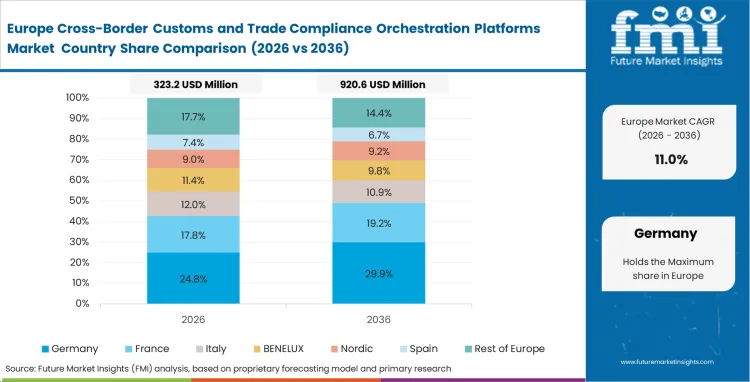
Pan-regional regulatory reform is reshaping compliance architecture across Europe faster than many older systems can adapt. Trade directors are being pushed toward centralized data ingestion frameworks that reduce reliance on fragmented national reporting routines and expose weaknesses in legacy software estates. FMI analysts note that interoperability, update responsiveness, and certification strength now matter more than country-specific customization in many buying decisions. Companies want platforms that can connect with broader control systems without disrupting daily trade execution. The commercial risk is rising for businesses that continue to rely on tools built for a more localized regulatory structure.
- United Kingdom: Regulatory divergence has made origin tracking and dual-rule compliance harder to manage for brokers, importers, and exporters working across the UK and continental Europe. Software spending is now tied more closely to the need to interpret parallel regimes without creating mismatched declarations or workflow breaks. Brokers that can handle both sides efficiently are building a stronger commercial case with international shippers. The UK customs declaration software market is expected to capture at a 12.1% CAGR. Firms that unify these workflows well can command better pricing because the operational burden remains high for companies still navigating the split structure manually.
North America Cross-Border Customs and Trade Compliance Orchestration Platforms Market Analysis
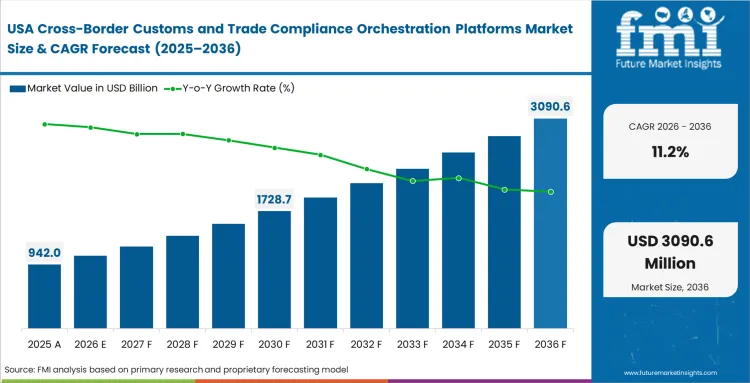
Mature digital infrastructure shifts buying priorities in North America away from first-stage digitization and toward smarter automation. Many enterprises already run established compliance systems, but those installed bases are showing their limits as buyers push for predictive classification, connected analytics, and tighter integration with broader enterprise workflows. Replacement demand when older software cannot improve labor efficiency or support better decision-making at scale. Buyers are not looking for filing capability alone. They want systems that can reduce repetitive review work, strengthen classification consistency, and fit more naturally into trade, logistics, and finance environments.
- Canada: Changes to importer bonding and duty payment procedures are forcing Canadian businesses to rethink how compliance data moves through logistics and finance systems. Financial controllers increasingly want direct portal connectivity through a modernized transport management system so tariff liabilities can be monitored with less delay and more precision. In Canada, demand for customs compliance platforms is anticipated to rise at a CAGR of 11.8%. Need is pulling software decisions closer to treasury and financial control functions rather than leaving them only with customs teams. The vendors that simplify this transition while improving visibility into duty exposure will have the strongest advantage.
- United States: Large trade volumes in the United States are making automation quality more important than basic filing capacity. Compliance leaders want connected trade management interfaces that reduce the time spent reviewing routine commercial invoices and allow experienced staff to focus on classification governance, audit readiness, and duty strategy. United States is likely to increase at a CAGR of 11.2% through 2036. The market is moving toward deeper workflow integration rather than stand-alone functionality, which is why adoption of trade compliance platforms in the Companies that embed this automation effectively can free up senior expertise without weakening control over complex trade exposure.
FMI's report includes extensive coverage of additional territories across all major trading blocs. Detailed analysis of evolving compliance regulations in Germany, Japan, and Brazil reveals how strict data residency laws directly dictate software architecture. Supply chain directors operating in these specific markets frequently reject globally standardized cloud platforms.
Competitive Aligners for Market Players
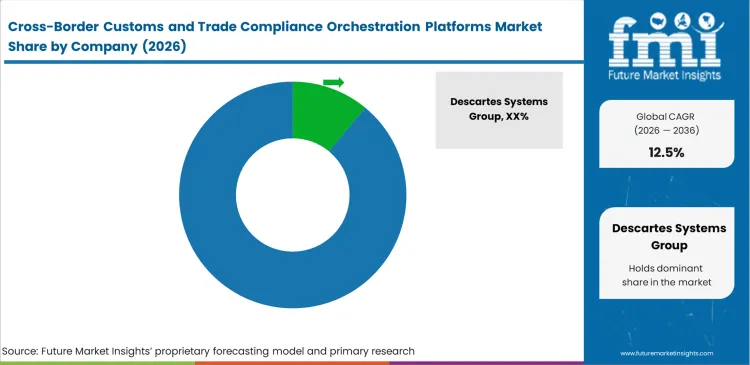
Technical strength in standard API transmission is not enough to win in this market. Descartes Systems Group and WiseTech Global hold strong positions because they have spent years building and maintaining thousands of localized customs links across national border systems. Supply chain directors do not judge vendors only on interface quality or workflow design. They look closely at the depth of pre-built connectivity into smaller and often difficult government agencies, because that determines how quickly a platform can perform in live trade environments. Logistics 4.0 frameworks may shape the shortlist, but vendor selection usually comes down to the practical value of those established digital connections. New entrants learn quickly that building a modern front end is the easier part of the task. The harder requirement is keeping active communication protocols stable across more than a hundred separate government IT environments. That connectivity depth remains one of the clearest ways to assess the top trade compliance software companies.
Incumbents also benefit from large proprietary libraries of classification history that newer vendors cannot replicate quickly. When companies such as Thomson Reuters or SAP deploy a solution, they bring algorithmic models trained on millions of successful historical clearances. The depth of record allows border security technologies to predict tariff codes with greater confidence when products fall into ambiguous or difficult classification categories. Emerging providers face a much harder starting point because their artificial intelligence models often lack the transaction history needed to support reliable automation at scale. Without a large installed base generating daily filing outcomes, their tools remain less proven in high-stakes customs workflows. Buyers tend to stay with established customs filing software providers whose models have already been tested through real audits, repeated filings, and government scrutiny.
Large logistics providers and multinational manufacturers are responding differently on the procurement side by resisting deeper dependence on any single vendor. Many procurement teams no longer want proprietary platforms that force duty management, broker connectivity, and screening into one closed stack. They are asking for open architectures that let them combine restricted party screening tools from niche specialists with broader execution engines from providers such as Oracle or AEB. That shift is changing how buyers evaluate the best customs compliance platform, because interoperability now carries as much weight as feature depth in many enterprise decisions.
Key Players in Cross-Border Customs and Trade Compliance Orchestration Platforms Market
- Descartes Systems Group
- WiseTech Global
- Thomson Reuters
- SAP
- Oracle
- MIC Customs Solutions
- AEB
Scope of the Report
| Metric | Value |
|---|---|
| Quantitative Units | USD 1.38 Billion to USD 4.47 Billion, at a CAGR of 12.5% |
| Market Definition | Cross-border trade compliance platform systems represent the centralized digital architectures that normalize, validate, and transmit international trade data directly to government regulatory bodies. These systems replace fragmented local brokerage connections with unified, API-driven frameworks. |
| Segmentation | Component, Deployment, Function, End Use, Enterprise Size, and Region |
| Regions Covered | North America, Latin America, Europe, East Asia, South Asia, Southeast Asia, Middle East and Africa |
| Countries Covered | United States, Canada, Mexico, United Kingdom, China, India, Singapore, and others |
| Key Companies Profiled | Descartes Systems Group, WiseTech Global, Thomson Reuters, SAP, Oracle, MIC Customs Solutions, AEB |
| Forecast Period | 2026 to 2036 |
| Approach | Total merchandise trade volumes requiring digital clearance anchored the baseline addressable opportunity. |
Source: Future Market Insights (FMI) analysis, based on proprietary forecasting model and primary research
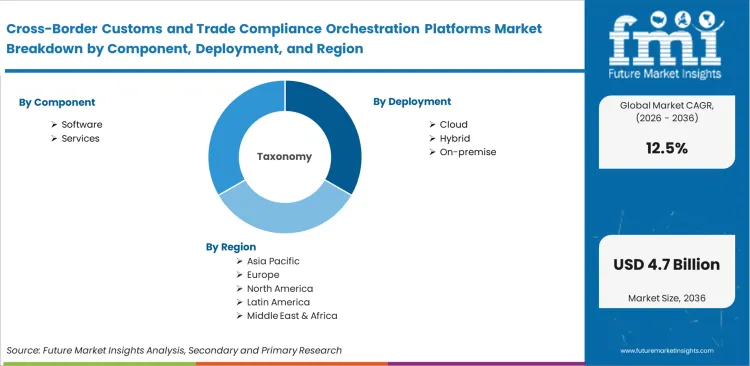
Cross-Border Customs and Trade Compliance Orchestration Platforms Market Analysis by Segments
Component
- Software
- Services
Deployment
- Cloud
- Hybrid
- On-premise
Function
- Customs Filing
- Classification
- Denied Screening
- Duty Management
- Broker Connectivity
End Use
- Logistics Providers
- Manufacturers
- Retailers
- Customs Brokers
- Distributors
Enterprise Size
- Large Enterprises
- Mid-Market
- SMEs
Region
- North America
- Latin America
- Europe
- East Asia
- South Asia
- Southeast Asia
- Middle East and Africa
Bibliography
- Canada Border Services Agency. (2025, May 16). Get started with CARM. Government of Canada.
- European Commission, Directorate-General for Taxation and Customs Union. (2026, January 15). Import Control System 2 (ICS2). European Commission.
- Nowak, S. (2025). Automating origin calculations: Key considerations for manufacturers with complex supply chains. World Customs Journal, 19(2), 82–100.
- Singapore Customs. (2026, January 27). Table Of Contents [Annual report PDF listing 2025 permit and operational data]. Government of Singapore.
- United Nations Conference on Trade and Development. (2025). ASYCUDA report 2025: The new generation of ASYCUDA for efficient, secure and sustainable trade. UNCTAD.
- USA Customs and Border Protection. (2025, May 1). ACE: The Import & Export Processing System infographic. USA Department of Homeland Security.
- World Trade Organization. (2025, April). Global trade outlook and statistics. WTO.
This bibliography is provided for reader reference. The full FMI report contains the complete reference list with primary source documentation.
This Report Addresses
- Strategic calculation methods used by supply chain directors to justify massive orchestration system investments based on avoided warehouse dwell times.
- Detailed tracking of shifting data standards across major global customs gateways and their direct impact on legacy software obsolescence.
- Comparative analysis of cloud versus on-premise deployment risks for multi-jurisdictional manufacturing enterprises managing sensitive proprietary bills of material.
- Thorough examination of how mid-market distributors bypass traditional broker dependencies through direct API connectivity with government portals.
- Assessment of third-party logistics providers' reliance on automated data normalization engines to protect tight operational profit margins.
- Structural investigation of why restricted party screening false positives generate more operational friction than actual regulatory fines.
- Geographic adoption tracking driven by aggressive national digitization mandates in high-growth export markets like India and China.
- Evaluation of incumbent vendor dominance derived from massive historical classification databases rather than pure technological superiority.
Frequently Asked Questions
What is a customs orchestration platform?
These platforms are the mandatory digital bridge between corporate enterprise resource planning software and global border agencies. They normalize unstructured supply chain data into specific regulatory formats required for legal international trade.
How big is the customs compliance software space?
Revenue is estimated to cross USD 1.38 billion in 2026. Sustained investment propels cumulative revenue to USD 4.47 billion through 2036 as global border agencies transition from periodic post-clearance audits to real-time transaction-level data ingestion requirements.
What is the difference between GTM and customs software?
General transportation and global trade management suites optimize physical freight routing and broad supply chain logistics. True customs software focuses exclusively on regulatory data validity, API integration with border agencies, and mathematically verifiable proof of accurate duty payments.
Explain the customs orchestration platform in 2026.
Global border agencies systematically dismantling manual clearance procedures forces every logistics operator into mandatory API transmissions. This shift converts optional enterprise software upgrades into absolute regulatory survival requirements, driving rapid sector expansion.
Which countries are driving customs compliance software demand?
India leads the adoption curve at 14.1% as aggressive national digitization mandates force domestic manufacturers into structured data compliance. China follows at 13.5% based on massive multi-jurisdiction trade volumes requiring continuous classification updates.
Which customs compliance platform vendors lead the sector?
Descartes Systems Group and WiseTech Global hold prominent positions. They succeed not through cleaner code, but by acquiring and aggregating thousands of localized customs connections over decades, giving them massive pre-built digital pipes into obscure national border agencies.
What are the key customs software vs trade management software distinctions?
Trade management handles the commercial logistics of moving goods. Customs software handles the legal compliance of crossing borders. Failing to utilize web-based connectivity for the latter results in unacceptable latency during time-sensitive port clearances.
What are the core import export compliance platform requirements?
Submitting precise declaration data remains the inescapable baseline for international commerce. The system must seamlessly digest inputs and convert them into legally binding declarations, while providing intelligent workflows to isolate missing commercial invoice data before transmission attempts occur.
What triggers customs single window software demand?
When national border authorities deprecate legacy electronic data interchange connections in favor of mandatory API submissions, widespread adoption accelerates. This hard regulatory cutoff forces holdout logistics providers to abandon manual entries entirely.
Why are multinational manufacturers aggressively abandoning local filing systems?
Operating fragmented local frameworks generates massive warehouse dwell times when authorities reject incomplete data packets. Buyers calculate that the cost of immediate centralization vastly outweighs the financial destruction caused by blocked maritime shipments.
How does restricted party screening impact supply chain velocity?
False positives in denied party screening cost companies immense capital in warehouse dwell time. Supply chain directors prioritize sophisticated exception handling workflows to quickly resolve specific documentation gaps instead of accepting blanket rejection codes.
What specific capability do third-party logistics providers gain from these tools?
Standardized mapping tools rapidly connect new shipper systems to the provider's central compliance engine. Account executives compress implementation timelines from months to weeks, accelerating time-to-revenue for newly acquired transportation contracts.
How do massive historical classification databases protect incumbent vendors?
Algorithmic models trained on millions of past successful clearances confidently predict tariff codes for ambiguous new products. Emerging competitors lack this training material, making their artificial intelligence tools far less reliable during government audits.
Why do large enterprises generate 61.0% of the total adoption share?
Managing thousands of cross-border movements daily requires industrialized automation. Corporate risk officers eliminate dangerous discrepancies that occur when regional offices interpret ambiguous tariff codes independently by enforcing identical classification rules globally.
What changes structurally when the European Union mandates advance digital declarations?
The penalty for non-compliance shifts from localized fines to total exclusion from the continental market. Companies urgently seek platforms certified to communicate with unified continental databases rather than fragmented national reporting tools.
Why does the United States prioritize AI-led automation integration?
Enormous historical trade volumes encourage companies to drastically reduce the human hours spent reviewing standard commercial invoices. Organizations successfully reallocate their senior trade experts away from data entry and toward strategic duty mitigation.
What consequence awaits buyers who rely on static classification databases?
Firms attempting to rely on static databases face immediate border rejections when harmonized system codes change unexpectedly. Algorithms must automatically update local classification databases against global regulatory changes to prevent compliance failures.
How do modular integration strategies combat vendor lock-in?
Procurement teams reject monolithic platforms, demanding open architectures that pair specialized restricted party screening tools with broad execution engines. This interoperability forces vendors to compete on the specific merit of individual modules.
Preview the report firsthand - request a free sample
Get SampleGet the brochure for pricing and purchase details.
Get PDFTable of Content
- Executive Summary
- Global Market Outlook
- Demand-side Trends
- Supply-side Trends
- Technology Roadmap Analysis
- Analysis and Recommendations
- Market Overview
- Market Coverage / Taxonomy
- Market Definition / Scope / Limitations
- Research Methodology
- Chapter Orientation
- Analytical Lens and Working Hypotheses
- Market Structure, Signals, and Trend Drivers
- Benchmarking and Cross-market Comparability
- Market Sizing, Forecasting, and Opportunity Mapping
- Research Design and Evidence Framework
- Desk Research Programme (Secondary Evidence)
- Company Annual and Sustainability Reports
- Peer-reviewed Journals and Academic Literature
- Corporate Websites, Product Literature, and Technical Notes
- Earnings Decks and Investor Briefings
- Statutory Filings and Regulatory Disclosures
- Technical White Papers and Standards Notes
- Trade Journals, Industry Magazines, and Analyst Briefs
- Conference Proceedings, Webinars, and Seminar Materials
- Government Statistics Portals and Public Data Releases
- Press Releases and Reputable Media Coverage
- Specialist Newsletters and Curated Briefings
- Sector Databases and Reference Repositories
- FMI Internal Proprietary Databases and Historical Market Datasets
- Subscription Datasets and Paid Sources
- Social Channels, Communities, and Digital Listening Inputs
- Additional Desk Sources
- Expert Input and Fieldwork (Primary Evidence)
- Primary Modes
- Qualitative Interviews and Expert Elicitation
- Quantitative Surveys and Structured Data Capture
- Blended Approach
- Why Primary Evidence is Used
- Field Techniques
- Interviews
- Surveys
- Focus Groups
- Observational and In-context Research
- Social and Community Interactions
- Stakeholder Universe Engaged
- C-suite Leaders
- Board Members
- Presidents and Vice Presidents
- R&D and Innovation Heads
- Technical Specialists
- Domain Subject-matter Experts
- Scientists
- Physicians and Other Healthcare Professionals
- Governance, Ethics, and Data Stewardship
- Research Ethics
- Data Integrity and Handling
- Primary Modes
- Tooling, Models, and Reference Databases
- Desk Research Programme (Secondary Evidence)
- Data Engineering and Model Build
- Data Acquisition and Ingestion
- Cleaning, Normalisation, and Verification
- Synthesis, Triangulation, and Analysis
- Quality Assurance and Audit Trail
- Market Background
- Market Dynamics
- Drivers
- Restraints
- Opportunity
- Trends
- Scenario Forecast
- Demand in Optimistic Scenario
- Demand in Likely Scenario
- Demand in Conservative Scenario
- Opportunity Map Analysis
- Product Life Cycle Analysis
- Supply Chain Analysis
- Investment Feasibility Matrix
- Value Chain Analysis
- PESTLE and Porter’s Analysis
- Regulatory Landscape
- Regional Parent Market Outlook
- Production and Consumption Statistics
- Import and Export Statistics
- Market Dynamics
- Global Market Analysis 2021 to 2025 and Forecast, 2026 to 2036
- Historical Market Size Value (USD Million) Analysis, 2021 to 2025
- Current and Future Market Size Value (USD Million) Projections, 2026 to 2036
- Y-o-Y Growth Trend Analysis
- Absolute $ Opportunity Analysis
- Global Market Pricing Analysis 2021 to 2025 and Forecast 2026 to 2036
- Global Market Analysis 2021 to 2025 and Forecast 2026 to 2036, By Component
- Introduction / Key Findings
- Historical Market Size Value (USD Million) Analysis By Component , 2021 to 2025
- Current and Future Market Size Value (USD Million) Analysis and Forecast By Component , 2026 to 2036
- Software
- Services
- Software
- Y-o-Y Growth Trend Analysis By Component , 2021 to 2025
- Absolute $ Opportunity Analysis By Component , 2026 to 2036
- Global Market Analysis 2021 to 2025 and Forecast 2026 to 2036, By Deployment
- Introduction / Key Findings
- Historical Market Size Value (USD Million) Analysis By Deployment, 2021 to 2025
- Current and Future Market Size Value (USD Million) Analysis and Forecast By Deployment, 2026 to 2036
- Cloud
- Hybrid
- On-premise
- Cloud
- Y-o-Y Growth Trend Analysis By Deployment, 2021 to 2025
- Absolute $ Opportunity Analysis By Deployment, 2026 to 2036
- Global Market Analysis 2021 to 2025 and Forecast 2026 to 2036, By Function
- Introduction / Key Findings
- Historical Market Size Value (USD Million) Analysis By Function, 2021 to 2025
- Current and Future Market Size Value (USD Million) Analysis and Forecast By Function, 2026 to 2036
- Customs Filing
- Classification
- Denied Screening
- Duty Management
- Broker Connectivity
- Customs Filing
- Y-o-Y Growth Trend Analysis By Function, 2021 to 2025
- Absolute $ Opportunity Analysis By Function, 2026 to 2036
- Global Market Analysis 2021 to 2025 and Forecast 2026 to 2036, By End Use
- Introduction / Key Findings
- Historical Market Size Value (USD Million) Analysis By End Use, 2021 to 2025
- Current and Future Market Size Value (USD Million) Analysis and Forecast By End Use, 2026 to 2036
- Logistics Providers
- Manufacturers
- Retailers
- Customs Brokers
- Distributors
- Logistics Providers
- Y-o-Y Growth Trend Analysis By End Use, 2021 to 2025
- Absolute $ Opportunity Analysis By End Use, 2026 to 2036
- Global Market Analysis 2021 to 2025 and Forecast 2026 to 2036, By Enterprise Size
- Introduction / Key Findings
- Historical Market Size Value (USD Million) Analysis By Enterprise Size, 2021 to 2025
- Current and Future Market Size Value (USD Million) Analysis and Forecast By Enterprise Size, 2026 to 2036
- Large Enterprises
- Mid-Market
- SMEs
- Large Enterprises
- Y-o-Y Growth Trend Analysis By Enterprise Size, 2021 to 2025
- Absolute $ Opportunity Analysis By Enterprise Size, 2026 to 2036
- Global Market Analysis 2021 to 2025 and Forecast 2026 to 2036, By Region
- Introduction
- Historical Market Size Value (USD Million) Analysis By Region, 2021 to 2025
- Current Market Size Value (USD Million) Analysis and Forecast By Region, 2026 to 2036
- North America
- Latin America
- Western Europe
- Eastern Europe
- East Asia
- South Asia and Pacific
- Middle East & Africa
- Market Attractiveness Analysis By Region
- North America Market Analysis 2021 to 2025 and Forecast 2026 to 2036, By Country
- Historical Market Size Value (USD Million) Trend Analysis By Market Taxonomy, 2021 to 2025
- Market Size Value (USD Million) Forecast By Market Taxonomy, 2026 to 2036
- By Country
- USA
- Canada
- Mexico
- By Component
- By Deployment
- By Function
- By End Use
- By Enterprise Size
- By Country
- Market Attractiveness Analysis
- By Country
- By Component
- By Deployment
- By Function
- By End Use
- By Enterprise Size
- Key Takeaways
- Latin America Market Analysis 2021 to 2025 and Forecast 2026 to 2036, By Country
- Historical Market Size Value (USD Million) Trend Analysis By Market Taxonomy, 2021 to 2025
- Market Size Value (USD Million) Forecast By Market Taxonomy, 2026 to 2036
- By Country
- Brazil
- Chile
- Rest of Latin America
- By Component
- By Deployment
- By Function
- By End Use
- By Enterprise Size
- By Country
- Market Attractiveness Analysis
- By Country
- By Component
- By Deployment
- By Function
- By End Use
- By Enterprise Size
- Key Takeaways
- Western Europe Market Analysis 2021 to 2025 and Forecast 2026 to 2036, By Country
- Historical Market Size Value (USD Million) Trend Analysis By Market Taxonomy, 2021 to 2025
- Market Size Value (USD Million) Forecast By Market Taxonomy, 2026 to 2036
- By Country
- Germany
- UK
- Italy
- Spain
- France
- Nordic
- BENELUX
- Rest of Western Europe
- By Component
- By Deployment
- By Function
- By End Use
- By Enterprise Size
- By Country
- Market Attractiveness Analysis
- By Country
- By Component
- By Deployment
- By Function
- By End Use
- By Enterprise Size
- Key Takeaways
- Eastern Europe Market Analysis 2021 to 2025 and Forecast 2026 to 2036, By Country
- Historical Market Size Value (USD Million) Trend Analysis By Market Taxonomy, 2021 to 2025
- Market Size Value (USD Million) Forecast By Market Taxonomy, 2026 to 2036
- By Country
- Russia
- Poland
- Hungary
- Balkan & Baltic
- Rest of Eastern Europe
- By Component
- By Deployment
- By Function
- By End Use
- By Enterprise Size
- By Country
- Market Attractiveness Analysis
- By Country
- By Component
- By Deployment
- By Function
- By End Use
- By Enterprise Size
- Key Takeaways
- East Asia Market Analysis 2021 to 2025 and Forecast 2026 to 2036, By Country
- Historical Market Size Value (USD Million) Trend Analysis By Market Taxonomy, 2021 to 2025
- Market Size Value (USD Million) Forecast By Market Taxonomy, 2026 to 2036
- By Country
- China
- Japan
- South Korea
- By Component
- By Deployment
- By Function
- By End Use
- By Enterprise Size
- By Country
- Market Attractiveness Analysis
- By Country
- By Component
- By Deployment
- By Function
- By End Use
- By Enterprise Size
- Key Takeaways
- South Asia and Pacific Market Analysis 2021 to 2025 and Forecast 2026 to 2036, By Country
- Historical Market Size Value (USD Million) Trend Analysis By Market Taxonomy, 2021 to 2025
- Market Size Value (USD Million) Forecast By Market Taxonomy, 2026 to 2036
- By Country
- India
- ASEAN
- Australia & New Zealand
- Rest of South Asia and Pacific
- By Component
- By Deployment
- By Function
- By End Use
- By Enterprise Size
- By Country
- Market Attractiveness Analysis
- By Country
- By Component
- By Deployment
- By Function
- By End Use
- By Enterprise Size
- Key Takeaways
- Middle East & Africa Market Analysis 2021 to 2025 and Forecast 2026 to 2036, By Country
- Historical Market Size Value (USD Million) Trend Analysis By Market Taxonomy, 2021 to 2025
- Market Size Value (USD Million) Forecast By Market Taxonomy, 2026 to 2036
- By Country
- Kingdom of Saudi Arabia
- Other GCC Countries
- Turkiye
- South Africa
- Other African Union
- Rest of Middle East & Africa
- By Component
- By Deployment
- By Function
- By End Use
- By Enterprise Size
- By Country
- Market Attractiveness Analysis
- By Country
- By Component
- By Deployment
- By Function
- By End Use
- By Enterprise Size
- Key Takeaways
- Key Countries Market Analysis
- USA
- Pricing Analysis
- Market Share Analysis, 2025
- By Component
- By Deployment
- By Function
- By End Use
- By Enterprise Size
- Canada
- Pricing Analysis
- Market Share Analysis, 2025
- By Component
- By Deployment
- By Function
- By End Use
- By Enterprise Size
- Mexico
- Pricing Analysis
- Market Share Analysis, 2025
- By Component
- By Deployment
- By Function
- By End Use
- By Enterprise Size
- Brazil
- Pricing Analysis
- Market Share Analysis, 2025
- By Component
- By Deployment
- By Function
- By End Use
- By Enterprise Size
- Chile
- Pricing Analysis
- Market Share Analysis, 2025
- By Component
- By Deployment
- By Function
- By End Use
- By Enterprise Size
- Germany
- Pricing Analysis
- Market Share Analysis, 2025
- By Component
- By Deployment
- By Function
- By End Use
- By Enterprise Size
- UK
- Pricing Analysis
- Market Share Analysis, 2025
- By Component
- By Deployment
- By Function
- By End Use
- By Enterprise Size
- Italy
- Pricing Analysis
- Market Share Analysis, 2025
- By Component
- By Deployment
- By Function
- By End Use
- By Enterprise Size
- Spain
- Pricing Analysis
- Market Share Analysis, 2025
- By Component
- By Deployment
- By Function
- By End Use
- By Enterprise Size
- France
- Pricing Analysis
- Market Share Analysis, 2025
- By Component
- By Deployment
- By Function
- By End Use
- By Enterprise Size
- India
- Pricing Analysis
- Market Share Analysis, 2025
- By Component
- By Deployment
- By Function
- By End Use
- By Enterprise Size
- ASEAN
- Pricing Analysis
- Market Share Analysis, 2025
- By Component
- By Deployment
- By Function
- By End Use
- By Enterprise Size
- Australia & New Zealand
- Pricing Analysis
- Market Share Analysis, 2025
- By Component
- By Deployment
- By Function
- By End Use
- By Enterprise Size
- China
- Pricing Analysis
- Market Share Analysis, 2025
- By Component
- By Deployment
- By Function
- By End Use
- By Enterprise Size
- Japan
- Pricing Analysis
- Market Share Analysis, 2025
- By Component
- By Deployment
- By Function
- By End Use
- By Enterprise Size
- South Korea
- Pricing Analysis
- Market Share Analysis, 2025
- By Component
- By Deployment
- By Function
- By End Use
- By Enterprise Size
- Russia
- Pricing Analysis
- Market Share Analysis, 2025
- By Component
- By Deployment
- By Function
- By End Use
- By Enterprise Size
- Poland
- Pricing Analysis
- Market Share Analysis, 2025
- By Component
- By Deployment
- By Function
- By End Use
- By Enterprise Size
- Hungary
- Pricing Analysis
- Market Share Analysis, 2025
- By Component
- By Deployment
- By Function
- By End Use
- By Enterprise Size
- Kingdom of Saudi Arabia
- Pricing Analysis
- Market Share Analysis, 2025
- By Component
- By Deployment
- By Function
- By End Use
- By Enterprise Size
- Turkiye
- Pricing Analysis
- Market Share Analysis, 2025
- By Component
- By Deployment
- By Function
- By End Use
- By Enterprise Size
- South Africa
- Pricing Analysis
- Market Share Analysis, 2025
- By Component
- By Deployment
- By Function
- By End Use
- By Enterprise Size
- USA
- Market Structure Analysis
- Competition Dashboard
- Competition Benchmarking
- Market Share Analysis of Top Players
- By Regional
- By Component
- By Deployment
- By Function
- By End Use
- By Enterprise Size
- Competition Analysis
- Competition Deep Dive
- Descartes Systems Group
- Overview
- Product Portfolio
- Profitability by Market Segments (Product/Age /Sales Channel/Region)
- Sales Footprint
- Strategy Overview
- Marketing Strategy
- Product Strategy
- Channel Strategy
- WiseTech Global
- Thomson Reuters
- SAP
- Oracle
- MIC Customs Solutions
- AEB
- Descartes Systems Group
- Competition Deep Dive
- Assumptions & Acronyms Used


