

- Industry Size (2026)
- USD 1.2 Bn
- Forecast (2036)
- USD 4.2 Bn
- CAGR (2026 to 2036)
- 13.7%
End-to-End Multimodal Shipment Visibility Platforms Market Size, Market Forecast and Outlook By FMI
The End-to-End Multimodal Shipment Visibility Platforms Market crossed a valuation of USD 1.0 billion in 2025. Demand is expected to hit USD 1.2 billion in 2026 at a shipment visibility software CAGR of 13.7% during this forecast period. Continuous funding propels total valuation to USD 4.2 billion through 2036 as global shippers abandon siloed carrier-portal tracking for unified API-driven telemetry networks spanning discrete transport legs. This growth cements the importance of the multimodal shipment visibility software market.
Supply chain directors at multinational manufacturers face immediate pressure to reconcile diverging transit data across fragmented ocean-to-rail handoffs. Relying on batch EDI updates creates blind spots lasting days. This forces buffer stock accumulation. Delaying API integration leaves procurement teams unable to reroute critical raw materials during port congestion events. According to FMI analysts, standard software capabilities omit how milestone latency directly inflates working capital requirements. Upgrading supply chain visibility software eliminates these blackout windows.
Summary of End-to-End Multimodal Shipment Visibility Platforms Market
- End-to-End Multimodal Shipment Visibility Platforms Market Definition:
- Software platforms ingesting tracking data across consecutive transport modes provide unified predictive arrival times. These systems aggregate signals from ocean, air, rail, and road carriers into centralized control tower interfaces, replacing fragmented manual portal queries.
- Demand Drivers in the Market:
- Port congestion events compel global supply chain directors to seek early warning exception alerts.
- Just-in-time manufacturing schedules force inventory managers to demand high-fidelity predictive transit data.
- Sustainability mandates push logistics procurement officers to calculate carbon footprints across complex multimodal routes.
- Key Segments Analyzed in the FMI Report:
- Mode Coverage: Full multimodal road-ocean-air-rail visibility is projected to account for 36.0% share in 2026, driven by enterprise requirements for seamless terminal handover tracking.
- Functionality: Real-time tracking and predictive ETA is expected to hold 31.0% share in 2026, as operators prioritize proactive disruption mitigation over retrospective analysis.
- Deployment Model: Cloud / SaaS is estimated to capture 71.0% share in 2026, benefiting from rapid API deployment capabilities across vast carrier networks to establish a cloud shipment visibility platform.
- Buyer Type: Large enterprise shippers are set to command 44.0% share in 2026, utilizing vast capital resources to untangle complex global supply chains.
- Commercial Model: Subscription-based annual contracts are poised to reach 53.0% share in 2026, providing predictable vendor revenue streams alongside continuous software updates.
- India: 15.4% compound growth, fueled by aggressive government investments in unified logistics interfaces.
- Analyst Opinion at FMI:
- Ronak Shah, Principal Analyst, Consumer Product, at FMI, suggests, "True enterprise value emerges during terminal dwell times where ocean shipments transfer onto rail networks. Procurement directors initially buy software seeking dots on maps. They quickly realize actionable data exists entirely inside handover blackout zones. Standard milestone tracking misses these moments completely. When a platform cannot predict rail loading delays immediately following vessel discharge, logistics managers remain blind to final destination impacts. Vendors dominating this space solve port-to-rail latency and prioritize it over commoditized over-the-road tracking features."
- Strategic Implications / Executive Takeaways:
- Freight forwarding CIOs must integrate native API connectivity or risk losing enterprise contracts demanding unified tracking.
- Supply chain directors gain working capital reductions by leveraging predictive ETAs to slash safety stock buffers.
- Carrier procurement teams face strict compliance mandates regarding milestone data latency from top tier shippers.
- End-to-End Multimodal Shipment Visibility Platforms Market Methodology:
- Primary Research: Global logistics directors and supply chain technology heads shape workflow insight.
- Desk Research: Carrier API documentation and port digitization roadmaps provide integration context.
- Market-Sizing and Forecasting: SaaS subscription revenue tied to cross-mode modules anchors valuation.
- Data Validation and Update Cycle: Independent IT spending surveys cross-validate procurement forecasts annually.
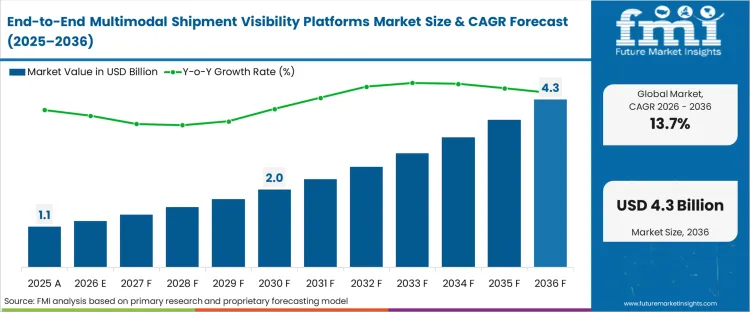
Once tier-1 logistics providers mandate real-time API integrations across subcontractor networks, baseline telemetry accuracy improves categorically. Shippers suddenly demand unified predictive ETAs and step away from disparate carrier milestone updates. FMI's analysis indicates this integration threshold forces legacy forwarders to upgrade infrastructure rapidly to compete in the real-time transportation visibility platform market.
India leads at 15.4% as domestic manufacturing expansion stresses existing port-to-hinterland transport corridors. China tracks at 14.6% driven by massive export logistics digitization. Brazil advances at 14.2% on agricultural export infrastructure modernization. United States expands at 13.1% alongside Germany climbing at 12.5%. Netherlands registers 12.2% growth, outpacing United Kingdom at 12.0%. Divergence across geographies stems from baseline API adoption rates inside domestic trucking networks rather than macro trade volumes.
End-to-End Multimodal Shipment Visibility Platforms Market Key Takeaways
| Metric | Details |
|---|---|
| Industry Size (2026) | USD 1.2 billion |
| Industry Value (2036) | USD 4.2 billion |
| CAGR (2026 to 2036) | 13.7% |
Source: Future Market Insights (FMI) analysis, based on proprietary forecasting model and primary research
End-to-End Multimodal Shipment Visibility Platforms Market Definition
The end-to-end supply chain visibility platform market tracks software architectures connecting disparate transport modalities into single unified dashboards. Core mechanisms ingest varied carrier signals, normalize raw milestone updates, and apply predictive algorithms forecasting final arrival times. Buyers utilize multimodal shipment tracking software to monitor freight traversing ocean, rail, air, and road legs consecutively. True platforms eliminate manual portal checking by aggregating API, EDI, and telematics streams. This defines the core utility of a road ocean air rail visibility platform.
End-to-End Multimodal Shipment Visibility Platforms Market Inclusions
Scope involves API-native tracking engines, control tower collaboration modules, and exception alerting tools mapping global transit routes. The assessment includes predictive ETA and exception management software factoring weather or port congestion. Cloud-based logistics visibility software integrating with existing warehouse control stacks forms primary scope coverage.
End-to-End Multimodal Shipment Visibility Platforms Market Exclusions
Hardware telematics devices physically attached to containers sit strictly outside analytical boundaries. Standalone fleet routing software governing single-mode asset utilization fails inclusion criteria because these lack cross-mode handover tracking capabilities. Basic carrier booking portals remain excluded since they do not aggregate third-party telemetry streams across fragmented networks.
End-to-End Multimodal Shipment Visibility Platforms Market Research Methodology
- Primary Research: Global logistics directors, supply chain technology heads, and freight forwarder CIOs.
- Desk Research: Carrier API documentation updates, port authority digitization roadmaps, and logistics software patent filings.
- Market-Sizing and Forecasting: SaaS subscription revenue tied to cross-mode tracking modules anchors baseline valuation.
- Data Validation and Update Cycle: Independent IT spending surveys cross-validate enterprise software procurement forecasts annually.
Segmental Analysis
End-to-End Multimodal Shipment Visibility Platforms Market Analysis by Mode coverage
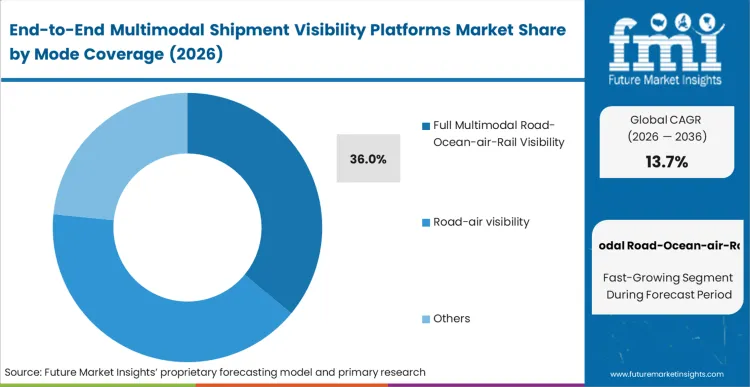
Blind spots at intermodal terminals force enterprise logistics directors to abandon fragmented tracking solutions. Full multimodal road-ocean-air-rail visibility holds 36.0% share in 2026 because unifying ocean discharge milestones with rail loading schedules prevents massive safety stock accumulation. Supply chain managers orchestrating global operations require continuous telemetry flows. Relying on isolated road-only transport management system upgrades leaves international container status unknown during extended ocean transit. As per FMI's assessment, generalists assume tracking difficulty correlates with distance traveled. Practitioners know friction concentrates entirely at terminal transfer points. Connecting air freight APIs with first mile logistics delivery software updates eliminates manual customer service interventions. Logistics operators lacking comprehensive cross-mode integration face severe penalty fees when manufacturing lines halt awaiting untracked components. Organizations are actively investing in the multimodal freight visibility software market to solve this.
- Handover transparency: Terminal dwell events trigger automatic schedule recalibrations. Supply chain directors avoid expedite shipping costs by catching port delays early.
- Carrier integration depth: Systems digest varied telemetry formats ranging from modern APIs to legacy EDI protocols. Freight IT managers build robust tracking networks despite uneven technological maturity among local carriers using carrier milestone normalization software.
- Data latency risk: Relying on batch updates leaves operators blind during critical transfer windows. Procurement teams selecting inferior visibility tools face compounding delay risks.
End-to-End Multimodal Shipment Visibility Platforms Market Analysis by Functionality
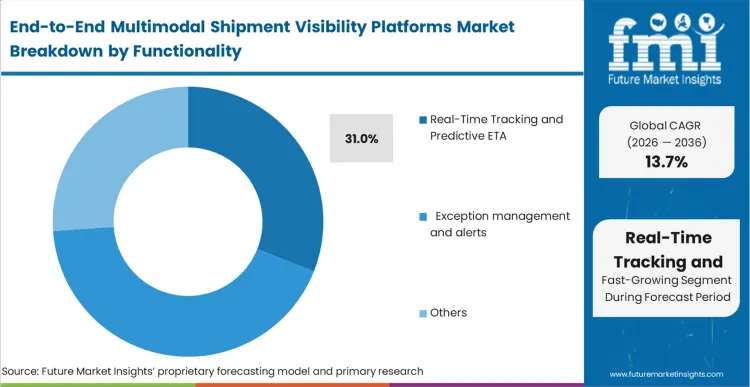
Reactive milestone monitoring fails modern just-in-time manufacturing demands. Real-time tracking and predictive ETA modules command 31.0% share in 2026 as inventory planners prioritize future arrival confidence over historical transit reports. FMI analysts note that continuous GPS polling combined with machine learning models calculates accurate delivery windows despite weather disruptions. Implementing robust freight management software fundamentally alters daily retail warehouse management systems labor scheduling. Feature lists rarely communicate how predictive algorithms must constantly unlearn outdated transit patterns when port congestion alters global routing norms permanently. Relying solely on scheduled arrival times forces warehouse managers to schedule redundant dock labor. Companies delaying predictive capability upgrades suffer deteriorating customer satisfaction scores due to chronic delivery surprises. This drives the adoption of a dedicated supply chain disruption visibility platform.
- Algorithm recalibration: Weather anomalies alter estimated arrival projections continuously. Inventory planners maintain optimal stock levels by trusting dynamic data from a freight ETA tracking platform.
- Labor optimization: Accurate dock arrival predictions streamline staff allocation. Warehouse directors reduce overtime expenditures by aligning shifts with actual vehicle approaches.
- Blindspot mitigation: AI models extrapolate probable positions during ocean dead-zones. Logistics coordinators avoid panicking over temporary signal losses.
End-to-End Multimodal Shipment Visibility Platforms Market Analysis by Deployment model
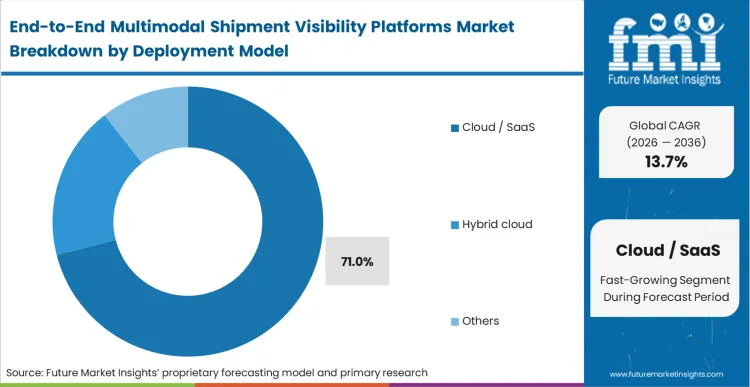
Integrating thousands of distinct carrier APIs requires massive external connectivity impossible within traditional firewalls. Cloud / SaaS architecture captures 71.0% share in 2026 because external endpoint scaling outpaces internal server capacity constraints easily. IT procurement heads select cloud environments to bypass complex on-premises software deployment cycles, heavily favoring enterprise shipment visibility SaaS. FMI's analysis indicates freight transport management solutions delivered via SaaS allow rapid onboarding of regional trucking subcontractors. Industry outsiders often mistake cloud adoption for simple cost reduction. They ignore how centralized SaaS models act as shared intelligence hubs where carrier delay patterns learned from one shipper automatically refine ETAs for everyone else on platform. Organizations sticking to localized deployment face agonizingly slow carrier onboarding timelines. Multimodal visibility platform implementation becomes drastically shorter in cloud environments.
- Ecosystem intelligence: Shared learning algorithms improve predictions globally. Data science directors leverage massive aggregated carrier datasets to refine internal models.
- API agility: Rapid integration tools connect new carriers instantly. Freight IT managers bypass lengthy bespoke development cycles.
- Vendor lock-in: Extensive carrier network connections create formidable switching barriers. CIOs face substantial operational disruption if migrating away from established SaaS networks.
End-to-End Multimodal Shipment Visibility Platforms Market Analysis by Buyer type
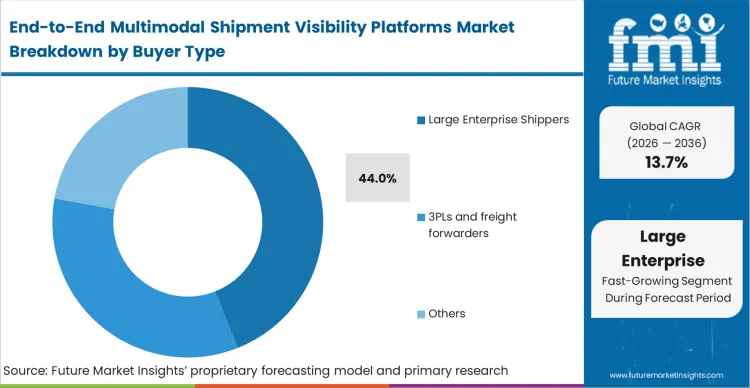
Managing vast volumes across thousands of global lanes demands automated telemetry aggregation. Large enterprise shippers generate 44.0% share in 2026, leveraging substantial IT budgets to untangle complex import networks. Global logistics vice presidents require unified dashboards to hold multinational carriers accountable to strict service level agreements. Based on FMI's projection, scaling digital logistics platforms allows these corporations to mandate API compliance from even small regional transport partners. Smaller competitors assume enterprise visibility tools exist merely for dashboard aesthetics. They completely miss how these systems directly feed automated invoice auditing engines that claw back millions in late-delivery penalties. This dynamic is equally relevant for 3PL shipment visibility software buyers. Enterprises operating without unified visibility leak working capital through excessive safety stock buffers and uncollected carrier penalties. Specialized shipment visibility software for manufacturers prevents these line-down scenarios.
- SLA enforcement: Automated transit records prove carrier delays objectively. Transportation procurement directors recover significant capital through irrefutable penalty claims.
- Network leverage: Massive shipping volumes compel carriers to comply with API mandates. Logistics vice presidents dictate technology standards to fragmented supply bases.
- Working capital reduction: Confirmed transit data allows inventory trimming safely. Finance directors free up cash previously trapped in redundant safety stock.
End-to-End Multimodal Shipment Visibility Platforms Market Analysis by Commercial model
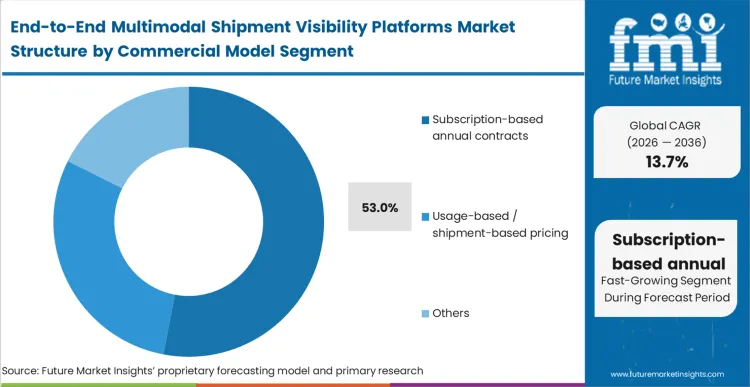
Budget predictability drives software procurement decisions among major shippers. Subscription-based annual contracts account for 53.0% share in 2026, aligning stable IT expenditures with continuous platform enhancements. Supply chain finance directors prefer fixed annual commitments over fluctuating per-shipment transaction fees, simplifying multimodal visibility software pricing. According to FMI's estimates, vendors favor subscription models to fund ongoing API maintenance across expanding carrier networks. While connected logistics architectures promise limitless scaling, practitioners realize flat-rate subscriptions often subsidize complex ocean integrations by overcharging for simple domestic road tracking volumes. Shippers opting for usage-based models face unpredictable cost spikes during peak shipping seasons or unexpected supply chain rerouting events.
- Budgetary stability: Fixed annual fees eliminate variable cost anxiety. Supply chain finance directors project technology expenditures accurately across fiscal years.
- Integration amortization: Initial setup costs spread across long-term agreements. Procurement officers justify expensive carrier onboarding by extending contract durations.
- Volume penalties: Transactional pricing punishes growth directly. Logistics managers attempting to track parcel-level data face astronomical software bills under usage-based models.
End-to-End Multimodal Shipment Visibility Platforms Market Drivers, Restraints, and Opportunities
Unpredictable port congestion events force global supply chain directors to abandon reactive milestone monitoring immediately. Relying on outdated EDI batch updates creates massive blind spots during critical vessel discharge operations. Inventory managers are left unable to confirm raw material availability. Delaying logistics 4.0 visibility upgrades means purchasing teams continually expedite emergency air freight shipments just to compensate for unknown ocean delays. Modern predictive ETA algorithms process varied telematics signals to deliver precise arrival windows. Factories can operate with minimal safety stock safely. This shift from historical tracking to proactive disruption management compels major shippers to seek the best multimodal visibility platform for shippers and mandate strict API integration from all tier-one logistics partners.
Data fragmentation among regional trucking subcontractors limits tracking fidelity significantly. Major ocean carriers and airlines provide robust API endpoints. Thousands of local final-mile transport companies lack basic supply chain management telematics capabilities. IT directors face immense friction attempting to normalize milestone formats across hundreds of technologically immature logistics partners. This barrier persists because thin margins in local transport sectors prevent rapid technology investments. Current mobile app onboarding strategies attempt to bridge this gap, yet driver compliance remains inconsistent.
Opportunities in the End-to-End Multimodal Shipment Visibility Platforms Market
- Carbon footprint tracking: Regulatory mandates compel sustainability officers to demand exact emission data per shipment. Integrating smart warehouse technologies helps platforms calculate route-specific carbon metrics using existing telematics streams.
- Contextual weather routing: Dynamic supply chain analytics algorithms reroute critical shipments automatically within a logistics control tower visibility platform market setup. Logistics coordinators avoid severe storm delays by trusting predictive climate models.
- Automated invoice auditing: Irrefutable transit data streamlines freight payment processes. Transportation finance managers eliminate manual discrepancies by linking arrival timestamps to billing systems directly.
Regional Analysis
Based on regional analysis, end-to-end multimodal shipment visibility platforms market is segmented into North America, Latin America, Western Europe, Eastern Europe, and Asia Pacific across 40 plus countries.
.webp "Top Country Growth Comparison End To End Multimodal Shipment Visibility Platforms Market Cagr (2026 2036)")
| Country | CAGR (2026 to 2036) |
|---|---|
| India | 15.4% |
| China | 14.6% |
| Brazil | 14.2% |
| United States | 13.1% |
| Germany | 12.5% |
| Netherlands | 12.2% |
| United Kingdom | 12.0% |
Source: Future Market Insights (FMI) analysis, based on proprietary forecasting model and primary research

Asia Pacific End-to-End Multimodal Shipment Visibility Platforms Market Analysis
Massive export infrastructure digitization projects reshape regional tracking dynamics fundamentally. Supply chain technology heads face intense pressure to monitor freight moving from inland manufacturing zones to coastal megaports. FMI analysts observe that integrating local trucking telematics with international ocean carrier APIs remains highly complex due to fragmented domestic transport sectors. Deploying fleet management interfaces allows shippers to capture critical milestone data during port transfer events. High API adoption rates among tier-one forwarders push smaller regional carriers toward mandatory digitalization, boosting the multimodal logistics visibility market forecast in the region.
- India: Government-led unified logistics interface mandates compel transport companies to standardize tracking protocols. Operations directors gain unprecedented port congestion visibility, driving 15.4% compound growth. This national push within the India shipment visibility software market eliminates historical blackout zones along critical freight corridors permanently.
- China: Export volume scale requires automated exception management to prevent terminal gridlock. Logistics vice presidents implement predictive ETA algorithms to orchestrate massive vessel loading schedules seamlessly. Demand expands at 14.6% as shippers connect vast inland rail networks to coastal ports efficiently.
Latin America End-to-End Multimodal Shipment Visibility Platforms Market Analysis
Agricultural export expansion exposes critical vulnerabilities in existing road-to-port infrastructure networks. Operations directors struggle with severe tracking blackout zones during lengthy hinterland transit segments. Based on FMI's projection, poor cellular coverage in remote farming regions complicates fleet telematics control units and tracking devices deployment significantly. Major commodity exporters prioritize visibility platforms capable of extrapolating vehicle positions during signal loss events.
- Brazil: Massive grain export volumes overwhelm terminal storage capacities during peak harvest seasons. Supply chain managers adopt predictive tracking to synchronize truck arrivals with vessel berthing schedules. Tracking technology investments yield 14.2% compound growth. Exporters failing to implement accurate arrival predictions face ruinous port demurrage penalties.
North America End-to-End Multimodal Shipment Visibility Platforms Market Analysis
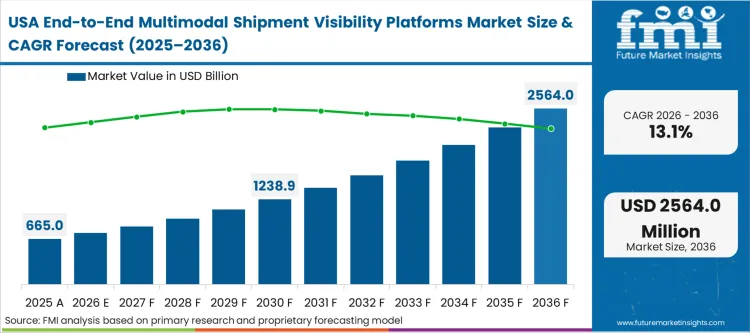
Strict retailer compliance mandates force consumer packaged goods manufacturers to upgrade tracking fidelity immediately. Procurement teams demand sub-hour ETA accuracy to avoid punitive chargebacks from major retail distribution centers. In FMI's view, mature commercial vehicle telematics penetration across domestic trucking fleets provides a strong foundation for advanced predictive analytics.
- United States: Driver shortage pressures force warehouse directors to optimize dock scheduling meticulously. Logistics planners leverage dynamic ETAs paired with inventory management software to align limited labor pools with actual truck arrivals, achieving 13.1% compound growth. Companies lacking real-time visibility suffer deteriorating supplier scorecards and subsequent contract losses.
Europe End-to-End Multimodal Shipment Visibility Platforms Market Analysis
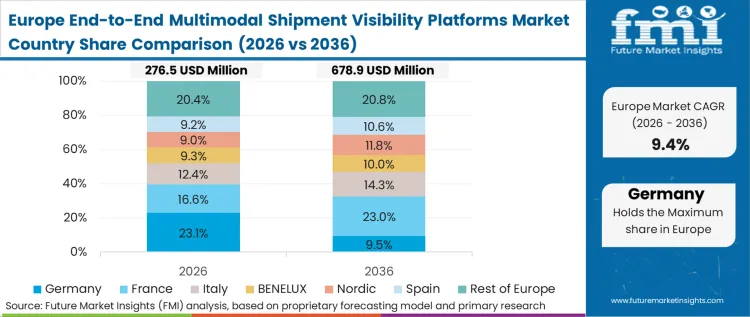
Cross-border customs friction demands precise milestone tracking across fragmented national rail networks. Logistics IT heads prioritize platforms offering deep integration with continental rail operators and short-sea shipping lines, rapidly expanding the Europe multimodal visibility software market. FMI's analysis indicates digital twin in logistics frameworks allow operators to model potential supply chain disruptions proactively.
- Germany: Deep industrial manufacturing roots require exact component delivery timing to prevent assembly line stoppages. Automotive supply chain directors utilize predictive tracking networks to orchestrate complex pan-European inbound logistics flows, registering 12.5% growth. Competitors lacking unified visibility struggle to maintain just-in-time production schedules.
- Netherlands: Massive port throughput volumes require flawless hinterland connectivity coordination. Terminal operations managers deploy advanced exception alerting tools to clear container backlogs rapidly, driving 12.2% compound growth.
- United Kingdom: Post-Brexit customs delays compel shippers to track cross-channel freight meticulously. Logistics planners rely on predictive analytics to navigate unpredictable border friction, advancing at 12.0%. Real-time data connectivity fundamentally alters how domestic retailers manage buffer inventory levels.
FMI's report includes France, Italy, Spain, Mexico, Canada, and Japan. Advanced data sharing agreements between port authorities and independent software vendors accelerate global tracking normalization efforts significantly.
Competitive Aligners for Market Players
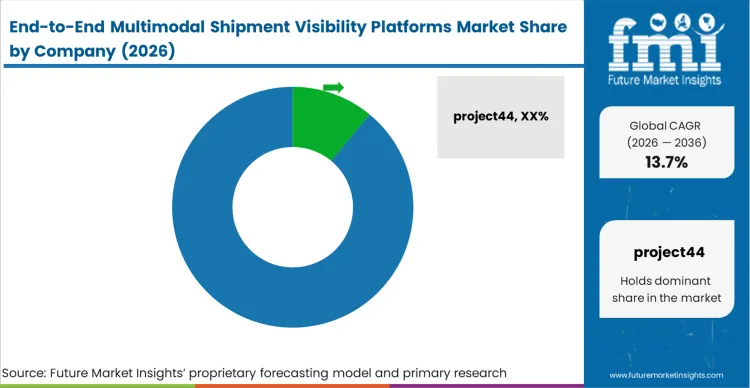
Network density determines software viability far more than standalone algorithm sophistication. Shipment visibility platform key players like project44 and FourKites dominate evaluations by presenting thousands of pre-integrated carrier connections to prospective buyers. Freight IT directors select platforms based on immediate carrier coverage rather than future development roadmaps. When Descartes MacroPoint demonstrates deep integration with legacy freight forwarding software, established shippers bypass newer startups lacking those critical historical EDI links. Competition hinges on lowering carrier onboarding friction among global shipment visibility software vendors.
Established players also have an advantage because they have spent years building historical transit datasets across lanes, carriers, and regions. That data helps companies such as Shippeo and Transporeon improve ETA accuracy and strengthen delay prediction models. New entrants may have capable products, though it takes time to build the same level of data maturity and service coverage. Many shippers are cautious about relying on less proven systems for critical international freight movement. Comparisons between project44, FourKites, and Shippeo often come back to network maturity, historical data depth, and the ability to manage carrier follow-up consistently across fragmented transport networks.
Major logistics operators resist vendor lock-in by standardizing internal API ingestion layers independent of any single visibility provider. SAP and e2open face pressure as massive global shippers demand modular architectures allowing easy swapping of underlying tracking engines, prompting active searches for SAP global track and trace alternatives. Shippers increasingly utilize multiple regional visibility specialists connected through internal data lakes rather than forcing one global vendor to track every obscure lane. Heavy investment targets edge computing nodes to process telematics data locally. This shifts power dynamics between software providers and hardware manufacturers significantly.
Key Players in End-to-End Multimodal Shipment Visibility Platforms Market
- project44
- FourKites
- Descartes MacroPoint
- Shippeo
- Transporeon
- SAP
- e2open
Scope of the Report
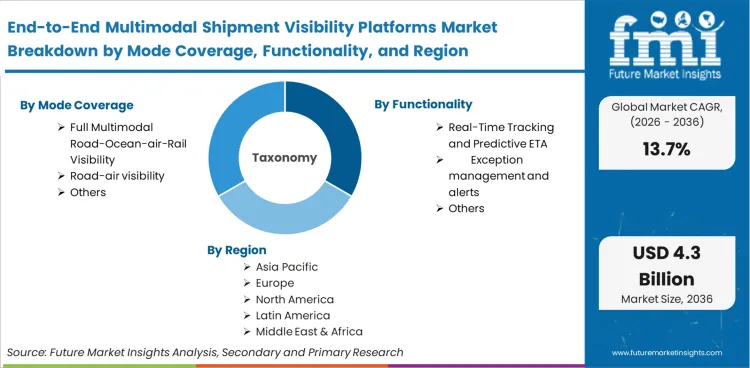
| Metric | Value |
|---|---|
| Quantitative Units | USD 1.2 billion to USD 4.2 billion, at a CAGR of 13.7% |
| Market Definition | Software platforms ingesting tracking data across consecutive transport modes provide unified predictive arrival times. These systems aggregate signals from ocean, air, rail, and road carriers into centralized control tower interfaces, replacing fragmented manual portal queries. |
| Segmentation | Mode coverage, Functionality, Deployment model, Buyer type, Commercial model, Region |
| Regions Covered | North America, Latin America, Western Europe, Eastern Europe, Asia Pacific |
| Countries Covered | United States, Canada, Mexico, Brazil, Germany, United Kingdom, France, Italy, Spain, China, Japan, India |
| Key Companies Profiled | project44, FourKites, Descartes MacroPoint, Shippeo, Transporeon, SAP, e2open |
| Forecast Period | 2026 to 2036 |
| Approach | SaaS subscription revenue tied to cross-mode tracking modules anchors baseline valuation. |
Source: Future Market Insights (FMI) analysis, based on proprietary forecasting model and primary research
End-to-End Multimodal Shipment Visibility Platforms Market Analysis by Segments
Mode coverage:
- Full multimodal road-ocean-air-rail visibility
- Road-ocean visibility
- Road-air visibility
- Road-rail visibility
- Parcel plus final-mile extensions
Functionality:
- Real-time tracking and predictive ETA
- Exception management and alerts
- Control tower collaboration
- Carrier milestone normalization
- Analytics and performance benchmarking
- Carbon and delay-risk visibility
Deployment model:
- Cloud / SaaS
- Hybrid cloud
- On-premises
Buyer type:
- Large enterprise shippers
- 3PLs and freight forwarders
- Retail and e-commerce operators
- Manufacturing supply-chain teams
- Pharma and cold-chain operators
Commercial model:
- Subscription-based annual contracts
- Usage-based / shipment-based pricing
- Hybrid platform plus services pricing
Region:
- North America
- United States
- Canada
- Latin America
- Brazil
- Mexico
- Western Europe
- Germany
- United Kingdom
- France
- Italy
- Spain
- Eastern Europe
- Poland
- Russia
- Asia Pacific
- China
- India
- Japan
- Australia
Bibliography
- Bureau of Transportation Statistics. (2024, October 10). August 2024 freight transportation services index (TSI) up 1.1% from the previous month and up 1.0% from the same month last year. U.S. Department of Transportation.
- Dasaklis, T. K., Kopanaki, E., Chountalas, P. T., Rachaniotis, N. P., Voutsinas, T. G., Giannakis, K., & Chondrokoukis, G. (2024). Exploring the implementation challenges of the electronic freight transport information (eFTI) regulation: An empirical perspective from Greece. Logistics, 8(1), 30.
- Digital Container Shipping Association. (2024, March 21). TPM24 takeaways: Shaping future shipping with DCSA standards.
- Federal Maritime Commission. (2024, February 23). FMC publishes final rule on detention and demurrage billing practices.
- FIATA. (2024, August 2). FIATA advances digital transformation, multimodal transport, and Euro-Asian rail at key conferences in Central Asia.
This bibliography is provided for reader reference. The full FMI report contains the complete reference list with primary source documentation.
This Report Addresses
- Port congestion visibility limits affecting global manufacturers during maritime discharge sequences.
- Software integration challenges concerning legacy EDI systems connecting with modern API endpoints.
- Vendor switching costs associated with established multimodal tracking platforms.
- Predictive ETA accuracy impacts on automotive just-in-time assembly schedules.
- Carbon footprint calculation requirements mandated by emerging sustainability compliance laws.
- Control tower collaboration tools bridging communication gaps between shippers and forwarders.
- Data latency risks originating from fragmented regional trucking subcontractor networks.
- Usage-based pricing hurdles penalizing massive parcel tracking volume expansions.
Frequently Asked Questions
What tracking volume sustains software valuation figures?
Enterprise spending on predictive tracking modules drives USD 1.2 billion valuation targets. Procurement heads abandon manual tracking processes rapidly to unlock working capital trapped inside massive inventory buffers.
Why do multimodal tracking platforms capture enterprise budgets?
Global shippers demand seamless visibility across ocean and rail transfer points. Standalone road tracking tools fail entirely during complex intermodal operations, forcing CIOs toward comprehensive platforms.
How does deployment architecture shape software adoption?
Cloud infrastructure accounts for 71.0% share since connecting thousands of carrier APIs requires immense external networking capability. Internal servers simply cannot scale connections fast enough.
Why do real-time tracking modules dominate feature procurement?
Predictive ETA calculations hold 31.0% share by enabling proactive disruption mitigation. Inventory planners require dynamic algorithms to adjust dock labor schedules during severe weather events.
What differentiates India and China expansion trajectories?
India advances at 15.4% through government-mandated logistics interface integration. China registers 14.6% growth via massive export terminal digitalization efforts.
How do API limitations restrict regional tracking?
Local final-mile transport operators often lack sophisticated telematics hardware. This technology gap forces platform vendors to ingest highly fragmented, low-quality milestone data.
What structural friction delays total visibility platform adoption?
Carrier resistance to constant location monitoring creates massive onboarding hurdles. Subcontractors frequently disable tracking applications, resulting in critical data blackout zones.
Why do subscription models outpace transactional pricing?
Finance directors demand cost predictability. Usage-based pricing severely penalizes shippers attempting to track millions of individual parcels during peak retail seasons.
How does terminal dwell visibility alter inventory strategy?
Accurate port discharge notifications allow supply chain managers to reroute connecting rail freight instantly. Catching delays early prevents factory shutdowns without requiring excess safety stock.
Why do large enterprises dictate platform standards?
Multinational corporations leverage vast shipping volumes to compel API compliance from fragmented carrier networks. Smaller shippers cannot force transport providers to upgrade tracking capabilities.
What prevents startups from dominating tracking markets?
Incumbents possess deep historical datasets necessary to train accurate predictive machine learning models. Startups lack sufficient lane-level history to generate reliable ETA calculations immediately.
How do sustainability mandates drive software upgrades?
New carbon reporting regulations require precise emission tracking per shipment. Modern visibility tools calculate route-specific footprints using existing GPS telematics streams automatically.
What operational risk follows incomplete API integration?
Relying exclusively on batch EDI updates causes massive blind spots lasting days. Procurement teams remain unaware of critical material delays until ocean vessels actually arrive.
Why do retail operators demand sub-hour tracking accuracy?
Distribution centers impose severe financial penalties for missed delivery windows. Retail suppliers utilize predictive visibility to dodge massive chargebacks stemming from late truck arrivals.
How does edge computing impact tracking architecture?
Processing telematics data locally reduces expensive cellular transmission costs. Shippers deploy edge devices to maintain tracking integrity across remote agricultural export routes.
What vendor lock-in dynamics affect procurement strategies?
Extensive carrier network connections require years to establish properly. Migrating away from established SaaS networks causes catastrophic operational disruption for massive global shippers.
Why do control towers fail without predictive algorithms?
Aggregating historical transit data provides zero actionable intelligence during live disruptions. Supply chain coordinators require predictive models to orchestrate alternative routing strategies effectively.
How does weather integration refine arrival predictions?
Algorithms correlate storm paths against planned vessel routes constantly. Inventory planners receive updated ETA projections automatically when severe weather alters transit speeds.
What role do digital twin frameworks play?
Advanced modeling simulates potential port strikes or rail failures virtually. Logistics directors test varied contingency plans before actual disruptions impact physical freight movement.
Why do forwarders build internal ingestion layers?
Third-party logistics providers must normalize data originating from dozens of competing visibility platforms. Internal data lakes prevent over-reliance on any single external software vendor.
How do automated audits utilize transit data?
Confirmed arrival timestamps validate carrier invoices objectively. Finance departments eliminate manual discrepancy investigations by connecting visibility platforms directly to payment engines.
What forces European cross-border tracking adoption?
Fragmented national rail networks create massive customs friction points. Automotive manufacturers utilize deep API integration to maintain just-in-time production schedules across borders.
Preview the report firsthand - request a free sample
Get SampleGet the brochure for pricing and purchase details.
Get PDFTable of Content
- Executive Summary
- Global Market Outlook
- Demand-side Trends
- Supply-side Trends
- Technology Roadmap Analysis
- Analysis and Recommendations
- Market Overview
- Market Coverage / Taxonomy
- Market Definition / Scope / Limitations
- Research Methodology
- Chapter Orientation
- Analytical Lens and Working Hypotheses
- Market Structure, Signals, and Trend Drivers
- Benchmarking and Cross-market Comparability
- Market Sizing, Forecasting, and Opportunity Mapping
- Research Design and Evidence Framework
- Desk Research Programme (Secondary Evidence)
- Company Annual and Sustainability Reports
- Peer-reviewed Journals and Academic Literature
- Corporate Websites, Product Literature, and Technical Notes
- Earnings Decks and Investor Briefings
- Statutory Filings and Regulatory Disclosures
- Technical White Papers and Standards Notes
- Trade Journals, Industry Magazines, and Analyst Briefs
- Conference Proceedings, Webinars, and Seminar Materials
- Government Statistics Portals and Public Data Releases
- Press Releases and Reputable Media Coverage
- Specialist Newsletters and Curated Briefings
- Sector Databases and Reference Repositories
- FMI Internal Proprietary Databases and Historical Market Datasets
- Subscription Datasets and Paid Sources
- Social Channels, Communities, and Digital Listening Inputs
- Additional Desk Sources
- Expert Input and Fieldwork (Primary Evidence)
- Primary Modes
- Qualitative Interviews and Expert Elicitation
- Quantitative Surveys and Structured Data Capture
- Blended Approach
- Why Primary Evidence is Used
- Field Techniques
- Interviews
- Surveys
- Focus Groups
- Observational and In-context Research
- Social and Community Interactions
- Stakeholder Universe Engaged
- C-suite Leaders
- Board Members
- Presidents and Vice Presidents
- R&D and Innovation Heads
- Technical Specialists
- Domain Subject-matter Experts
- Scientists
- Physicians and Other Healthcare Professionals
- Governance, Ethics, and Data Stewardship
- Research Ethics
- Data Integrity and Handling
- Primary Modes
- Tooling, Models, and Reference Databases
- Desk Research Programme (Secondary Evidence)
- Data Engineering and Model Build
- Data Acquisition and Ingestion
- Cleaning, Normalisation, and Verification
- Synthesis, Triangulation, and Analysis
- Quality Assurance and Audit Trail
- Market Background
- Market Dynamics
- Drivers
- Restraints
- Opportunity
- Trends
- Scenario Forecast
- Demand in Optimistic Scenario
- Demand in Likely Scenario
- Demand in Conservative Scenario
- Opportunity Map Analysis
- Product Life Cycle Analysis
- Supply Chain Analysis
- Investment Feasibility Matrix
- Value Chain Analysis
- PESTLE and Porter’s Analysis
- Regulatory Landscape
- Regional Parent Market Outlook
- Production and Consumption Statistics
- Import and Export Statistics
- Market Dynamics
- Global Market Analysis 2021 to 2025 and Forecast, 2026 to 2036
- Historical Market Size Value (USD Million) Analysis, 2021 to 2025
- Current and Future Market Size Value (USD Million) Projections, 2026 to 2036
- Y-o-Y Growth Trend Analysis
- Absolute $ Opportunity Analysis
- Global Market Pricing Analysis 2021 to 2025 and Forecast 2026 to 2036
- Global Market Analysis 2021 to 2025 and Forecast 2026 to 2036, By Mode Coverage
- Introduction / Key Findings
- Historical Market Size Value (USD Million) Analysis By Mode Coverage , 2021 to 2025
- Current and Future Market Size Value (USD Million) Analysis and Forecast By Mode Coverage , 2026 to 2036
- Full Multimodal Road-Ocean-air-Rail Visibility
- Road-air visibility
- Others
- Full Multimodal Road-Ocean-air-Rail Visibility
- Y-o-Y Growth Trend Analysis By Mode Coverage , 2021 to 2025
- Absolute $ Opportunity Analysis By Mode Coverage , 2026 to 2036
- Global Market Analysis 2021 to 2025 and Forecast 2026 to 2036, By Functionality
- Introduction / Key Findings
- Historical Market Size Value (USD Million) Analysis By Functionality, 2021 to 2025
- Current and Future Market Size Value (USD Million) Analysis and Forecast By Functionality, 2026 to 2036
- Real-Time Tracking and Predictive ETA
- Exception management and alerts
- Others
- Real-Time Tracking and Predictive ETA
- Y-o-Y Growth Trend Analysis By Functionality, 2021 to 2025
- Absolute $ Opportunity Analysis By Functionality, 2026 to 2036
- Global Market Analysis 2021 to 2025 and Forecast 2026 to 2036, By Deployment Model
- Introduction / Key Findings
- Historical Market Size Value (USD Million) Analysis By Deployment Model, 2021 to 2025
- Current and Future Market Size Value (USD Million) Analysis and Forecast By Deployment Model, 2026 to 2036
- Cloud / SaaS
- Hybrid cloud
- Others
- Cloud / SaaS
- Y-o-Y Growth Trend Analysis By Deployment Model, 2021 to 2025
- Absolute $ Opportunity Analysis By Deployment Model, 2026 to 2036
- Global Market Analysis 2021 to 2025 and Forecast 2026 to 2036, By Buyer Type
- Introduction / Key Findings
- Historical Market Size Value (USD Million) Analysis By Buyer Type, 2021 to 2025
- Current and Future Market Size Value (USD Million) Analysis and Forecast By Buyer Type, 2026 to 2036
- Large Enterprise Shippers
- 3PLs and freight forwarders
- Others
- Large Enterprise Shippers
- Y-o-Y Growth Trend Analysis By Buyer Type, 2021 to 2025
- Absolute $ Opportunity Analysis By Buyer Type, 2026 to 2036
- Global Market Analysis 2021 to 2025 and Forecast 2026 to 2036, By Commercial Model
- Introduction / Key Findings
- Historical Market Size Value (USD Million) Analysis By Commercial Model, 2021 to 2025
- Current and Future Market Size Value (USD Million) Analysis and Forecast By Commercial Model, 2026 to 2036
- Subscription-based annual contracts
- Usage-based / shipment-based pricing
- Others
- Subscription-based annual contracts
- Y-o-Y Growth Trend Analysis By Commercial Model, 2021 to 2025
- Absolute $ Opportunity Analysis By Commercial Model, 2026 to 2036
- Global Market Analysis 2021 to 2025 and Forecast 2026 to 2036, By Region
- Introduction
- Historical Market Size Value (USD Million) Analysis By Region, 2021 to 2025
- Current Market Size Value (USD Million) Analysis and Forecast By Region, 2026 to 2036
- North America
- Latin America
- Western Europe
- Eastern Europe
- East Asia
- South Asia and Pacific
- Middle East & Africa
- Market Attractiveness Analysis By Region
- North America Market Analysis 2021 to 2025 and Forecast 2026 to 2036, By Country
- Historical Market Size Value (USD Million) Trend Analysis By Market Taxonomy, 2021 to 2025
- Market Size Value (USD Million) Forecast By Market Taxonomy, 2026 to 2036
- By Country
- USA
- Canada
- Mexico
- By Mode Coverage
- By Functionality
- By Deployment Model
- By Buyer Type
- By Commercial Model
- By Country
- Market Attractiveness Analysis
- By Country
- By Mode Coverage
- By Functionality
- By Deployment Model
- By Buyer Type
- By Commercial Model
- Key Takeaways
- Latin America Market Analysis 2021 to 2025 and Forecast 2026 to 2036, By Country
- Historical Market Size Value (USD Million) Trend Analysis By Market Taxonomy, 2021 to 2025
- Market Size Value (USD Million) Forecast By Market Taxonomy, 2026 to 2036
- By Country
- Brazil
- Chile
- Rest of Latin America
- By Mode Coverage
- By Functionality
- By Deployment Model
- By Buyer Type
- By Commercial Model
- By Country
- Market Attractiveness Analysis
- By Country
- By Mode Coverage
- By Functionality
- By Deployment Model
- By Buyer Type
- By Commercial Model
- Key Takeaways
- Western Europe Market Analysis 2021 to 2025 and Forecast 2026 to 2036, By Country
- Historical Market Size Value (USD Million) Trend Analysis By Market Taxonomy, 2021 to 2025
- Market Size Value (USD Million) Forecast By Market Taxonomy, 2026 to 2036
- By Country
- Germany
- UK
- Italy
- Spain
- France
- Nordic
- BENELUX
- Rest of Western Europe
- By Mode Coverage
- By Functionality
- By Deployment Model
- By Buyer Type
- By Commercial Model
- By Country
- Market Attractiveness Analysis
- By Country
- By Mode Coverage
- By Functionality
- By Deployment Model
- By Buyer Type
- By Commercial Model
- Key Takeaways
- Eastern Europe Market Analysis 2021 to 2025 and Forecast 2026 to 2036, By Country
- Historical Market Size Value (USD Million) Trend Analysis By Market Taxonomy, 2021 to 2025
- Market Size Value (USD Million) Forecast By Market Taxonomy, 2026 to 2036
- By Country
- Russia
- Poland
- Hungary
- Balkan & Baltic
- Rest of Eastern Europe
- By Mode Coverage
- By Functionality
- By Deployment Model
- By Buyer Type
- By Commercial Model
- By Country
- Market Attractiveness Analysis
- By Country
- By Mode Coverage
- By Functionality
- By Deployment Model
- By Buyer Type
- By Commercial Model
- Key Takeaways
- East Asia Market Analysis 2021 to 2025 and Forecast 2026 to 2036, By Country
- Historical Market Size Value (USD Million) Trend Analysis By Market Taxonomy, 2021 to 2025
- Market Size Value (USD Million) Forecast By Market Taxonomy, 2026 to 2036
- By Country
- China
- Japan
- South Korea
- By Mode Coverage
- By Functionality
- By Deployment Model
- By Buyer Type
- By Commercial Model
- By Country
- Market Attractiveness Analysis
- By Country
- By Mode Coverage
- By Functionality
- By Deployment Model
- By Buyer Type
- By Commercial Model
- Key Takeaways
- South Asia and Pacific Market Analysis 2021 to 2025 and Forecast 2026 to 2036, By Country
- Historical Market Size Value (USD Million) Trend Analysis By Market Taxonomy, 2021 to 2025
- Market Size Value (USD Million) Forecast By Market Taxonomy, 2026 to 2036
- By Country
- India
- ASEAN
- Australia & New Zealand
- Rest of South Asia and Pacific
- By Mode Coverage
- By Functionality
- By Deployment Model
- By Buyer Type
- By Commercial Model
- By Country
- Market Attractiveness Analysis
- By Country
- By Mode Coverage
- By Functionality
- By Deployment Model
- By Buyer Type
- By Commercial Model
- Key Takeaways
- Middle East & Africa Market Analysis 2021 to 2025 and Forecast 2026 to 2036, By Country
- Historical Market Size Value (USD Million) Trend Analysis By Market Taxonomy, 2021 to 2025
- Market Size Value (USD Million) Forecast By Market Taxonomy, 2026 to 2036
- By Country
- Kingdom of Saudi Arabia
- Other GCC Countries
- Turkiye
- South Africa
- Other African Union
- Rest of Middle East & Africa
- By Mode Coverage
- By Functionality
- By Deployment Model
- By Buyer Type
- By Commercial Model
- By Country
- Market Attractiveness Analysis
- By Country
- By Mode Coverage
- By Functionality
- By Deployment Model
- By Buyer Type
- By Commercial Model
- Key Takeaways
- Key Countries Market Analysis
- USA
- Pricing Analysis
- Market Share Analysis, 2025
- By Mode Coverage
- By Functionality
- By Deployment Model
- By Buyer Type
- By Commercial Model
- Canada
- Pricing Analysis
- Market Share Analysis, 2025
- By Mode Coverage
- By Functionality
- By Deployment Model
- By Buyer Type
- By Commercial Model
- Mexico
- Pricing Analysis
- Market Share Analysis, 2025
- By Mode Coverage
- By Functionality
- By Deployment Model
- By Buyer Type
- By Commercial Model
- Brazil
- Pricing Analysis
- Market Share Analysis, 2025
- By Mode Coverage
- By Functionality
- By Deployment Model
- By Buyer Type
- By Commercial Model
- Chile
- Pricing Analysis
- Market Share Analysis, 2025
- By Mode Coverage
- By Functionality
- By Deployment Model
- By Buyer Type
- By Commercial Model
- Germany
- Pricing Analysis
- Market Share Analysis, 2025
- By Mode Coverage
- By Functionality
- By Deployment Model
- By Buyer Type
- By Commercial Model
- UK
- Pricing Analysis
- Market Share Analysis, 2025
- By Mode Coverage
- By Functionality
- By Deployment Model
- By Buyer Type
- By Commercial Model
- Italy
- Pricing Analysis
- Market Share Analysis, 2025
- By Mode Coverage
- By Functionality
- By Deployment Model
- By Buyer Type
- By Commercial Model
- Spain
- Pricing Analysis
- Market Share Analysis, 2025
- By Mode Coverage
- By Functionality
- By Deployment Model
- By Buyer Type
- By Commercial Model
- France
- Pricing Analysis
- Market Share Analysis, 2025
- By Mode Coverage
- By Functionality
- By Deployment Model
- By Buyer Type
- By Commercial Model
- India
- Pricing Analysis
- Market Share Analysis, 2025
- By Mode Coverage
- By Functionality
- By Deployment Model
- By Buyer Type
- By Commercial Model
- ASEAN
- Pricing Analysis
- Market Share Analysis, 2025
- By Mode Coverage
- By Functionality
- By Deployment Model
- By Buyer Type
- By Commercial Model
- Australia & New Zealand
- Pricing Analysis
- Market Share Analysis, 2025
- By Mode Coverage
- By Functionality
- By Deployment Model
- By Buyer Type
- By Commercial Model
- China
- Pricing Analysis
- Market Share Analysis, 2025
- By Mode Coverage
- By Functionality
- By Deployment Model
- By Buyer Type
- By Commercial Model
- Japan
- Pricing Analysis
- Market Share Analysis, 2025
- By Mode Coverage
- By Functionality
- By Deployment Model
- By Buyer Type
- By Commercial Model
- South Korea
- Pricing Analysis
- Market Share Analysis, 2025
- By Mode Coverage
- By Functionality
- By Deployment Model
- By Buyer Type
- By Commercial Model
- Russia
- Pricing Analysis
- Market Share Analysis, 2025
- By Mode Coverage
- By Functionality
- By Deployment Model
- By Buyer Type
- By Commercial Model
- Poland
- Pricing Analysis
- Market Share Analysis, 2025
- By Mode Coverage
- By Functionality
- By Deployment Model
- By Buyer Type
- By Commercial Model
- Hungary
- Pricing Analysis
- Market Share Analysis, 2025
- By Mode Coverage
- By Functionality
- By Deployment Model
- By Buyer Type
- By Commercial Model
- Kingdom of Saudi Arabia
- Pricing Analysis
- Market Share Analysis, 2025
- By Mode Coverage
- By Functionality
- By Deployment Model
- By Buyer Type
- By Commercial Model
- Turkiye
- Pricing Analysis
- Market Share Analysis, 2025
- By Mode Coverage
- By Functionality
- By Deployment Model
- By Buyer Type
- By Commercial Model
- South Africa
- Pricing Analysis
- Market Share Analysis, 2025
- By Mode Coverage
- By Functionality
- By Deployment Model
- By Buyer Type
- By Commercial Model
- USA
- Market Structure Analysis
- Competition Dashboard
- Competition Benchmarking
- Market Share Analysis of Top Players
- By Regional
- By Mode Coverage
- By Functionality
- By Deployment Model
- By Buyer Type
- By Commercial Model
- Competition Analysis
- Competition Deep Dive
- project44
- Overview
- Product Portfolio
- Profitability by Market Segments (Product/Age /Sales Channel/Region)
- Sales Footprint
- Strategy Overview
- Marketing Strategy
- Product Strategy
- Channel Strategy
- FourKites
- Descartes MacroPoint
- Shippeo
- Transporeon
- project44
- Competition Deep Dive
- Assumptions & Acronyms Used


