

- Industry Size (2026)
- USD 820.0 Mn
- Forecast (2036)
- USD 1995.3 Mn
- CAGR (2026 to 2036)
- 9.3%
Low-VOC TPE Platforms for Premium Automotive Interior Specifications Market Forecast and Outlook 2026 to 2036
The low-VOC thermoplastic elastomer platforms for premium automotive interior specifications are valued at USD 820.0 million in 2026 and are forecasted to reach USD 1,995.3 million by 2036, registering a CAGR of 9.3%. Expansion is rooted in tightening interior air-quality limits and material approval frameworks rather than increases in component count per vehicle. Cabin emission thresholds, odor panel evaluations, and fogging tests now function as primary gating criteria during interior material selection. Thermoplastic elastomers engineered with reduced extractable, controlled plasticizer volatility, and high polymer purity are increasingly specified to meet these requirements. Demand concentrates around elastomer systems that preserve softness, color stability, and mechanical integrity while maintaining emission compliance across long service lives and diverse climate conditions.
Growth momentum is reinforced by structural changes in vehicle development programs rather than surface-level interior refresh cycles. Interior materials are locked into platforms early, often before exterior styling is finalized, because emission performance requires extended validation under heat aging and real-time cabin simulation. Electrified vehicles amplify this effect, since reduced drivetrain noise heightens sensitivity to interior odors and material feel. Adoption strengthens where elastomer platforms demonstrate consistent low-emission behavior across global manufacturing locations without reformulation. Material strategies increasingly prioritize emission repeatability, long-term aging stability, and cross-plant consistency, positioning low-VOC TPE platforms as foundational interior materials rather than interchangeable trim solutions.
Quick Stats for Low-VOC TPE Platforms for Premium Automotive Interior Specifications Market
- Low-VOC TPE Platforms for Premium Automotive Interior Specifications Market Value (2026): USD 820.0 million
- Low-VOC TPE Platforms for Premium Automotive Interior Specifications Market Forecast Value (2036): USD 1,995.3 million
- Low-VOC TPE Platforms for Premium Automotive Interior Specifications Market Forecast CAGR (2026 to 2036): 9.3%
- Leading TPE Platform Type: Styrenic Block Copolymer (SBC) TPE
- Fastest-Growing Countries: China, India, Germany, USA, South Korea
- Key Players: Avient Corporation, BASF SE, Covestro, Kuraray, Celanese
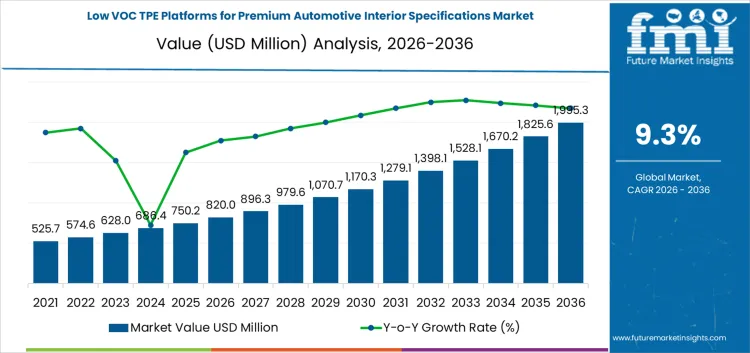
Low-VOC TPE Platforms for Premium Automotive Interior Specifications Market Key Takeaways
| Metric | Value |
|---|---|
| Market Value (2026) | USD 820.0 million |
| Market Forecast Value (2036) | USD 1,995.3 million |
| Forecast CAGR (2026 to 2036) | 9.3% |
Why is the Demand for Low-VOC TPE Platforms for Premium Automotive Interior Specifications Market Growing Globally?
Demand for low-VOC thermoplastic elastomer platforms for premium automotive interior specifications is growing globally due to intensifying regulatory limits on vehicle cabin emissions and rising consumer expectations for high quality, low odor interiors. Premium automotive segments emphasize refinement, comfort, and perception of material quality, which increases specification of TPE compounds with significantly reduced volatile organic compound release. Regulators in multiple regions enforce stringent VOC emission standards for automotive interiors to protect occupant health and meet air quality benchmarks, which motivates OEMs and tier-1 suppliers to adopt compliant TPE platforms early in design cycles.
Growth in electric and luxury vehicle production strengthens use of advanced elastomer systems that deliver tactile performance, aesthetic continuity, and low odor without compromising durability or fit-finish criteria. Low-VOC TPE platforms also support integration with interior lighting, soft trim, and tactile touch surfaces where sensory perception influences perceived value. Advances in polymer chemistry improve balance of mechanical properties, colorability, and processability while maintaining ultra-low emission profiles. Automotive manufacturers increasingly adopt validated material systems that support global regulatory harmonization and enhance brand reputation. Expansion of global production footprints and localized specification requirements further reinforce adoption of controlled emission TPE technologies in premium interior assemblies worldwide.
How Is the Global Low-VOC TPE Platforms for Premium Automotive Interior Specifications Market Structured?
Global demand for low-VOC thermoplastic elastomer platforms in premium automotive interiors is shaped by stringent cabin air-quality requirements, elevated consumer expectations for tactile comfort, and OEM-driven sustainability objectives. Interior materials are increasingly evaluated for emissions performance alongside durability, aesthetics, and processing efficiency. TPE platforms are selected for their balance of softness, recyclability, and integration flexibility across complex interior geometries. Adoption is concentrated in vehicle segments where regulatory compliance, sensory perception, and long-term material stability must align with premium brand positioning.
Which TPE Platform Type Holds the Largest Share in Premium Automotive Interiors?
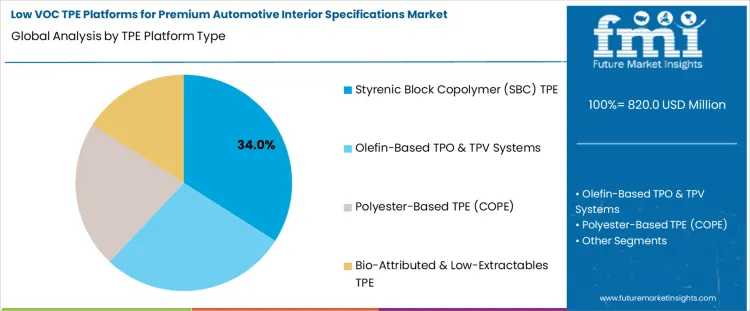
Styrenic block copolymer TPE platforms account for the largest share at 34.0%, reflecting their widespread use in interior components requiring soft-touch feel, elasticity, and consistent surface finish. SBC-based TPEs offer formulation flexibility, colorability, and compatibility with low-VOC additive systems, making them suitable for dashboards and trim elements. Olefin-based TPO and TPV systems represent 28.0%, supported by their thermal stability, durability, and lower inherent odor profiles, particularly in applications exposed to temperature cycling. Polyester-based TPEs account for 22.0%, favored where higher mechanical strength and abrasion resistance are required in premium interiors. Bio-attributed and low-extractables TPEs hold 16.0%, reflecting emerging adoption driven by sustainability narratives and reduced emissions performance.
Key Points
- SBC TPEs lead due to softness and formulation adaptability
- Olefin-based systems balance durability and VOC performance
- Bio-attributed platforms support sustainability-driven specifications
Which VOC Control Strategy Is Most Widely Implemented in Low-VOC TPE Platforms?
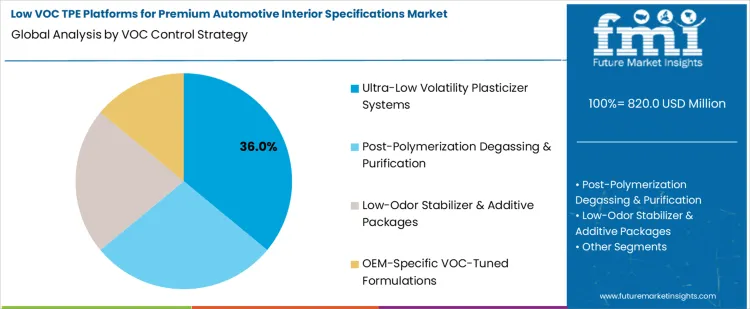
Ultra-low volatility plasticizer systems represent the leading VOC control strategy at 36.0%, reflecting their effectiveness in reducing fogging and interior emissions without compromising material flexibility. These systems are critical for meeting automotive interior air-quality standards over extended vehicle lifecycles. Post-polymerization degassing and purification processes account for 28.0%, used to remove residual monomers and low-molecular-weight species that contribute to odor and emissions. Low-odor stabilizer and additive packages hold 22.0%, supporting long-term thermal and oxidative stability while minimizing volatile release. OEM-specific VOC-tuned formulations represent 14.0%, reflecting customized material development aligned with brand-specific testing protocols and cabin environment requirements.
Key Points
- Low-volatility plasticizers dominate due to direct emission reduction
- Degassing processes improve baseline material purity
- OEM-tuned systems address proprietary interior standards
Which Interior Application Segment Drives the Highest Demand for Low-VOC TPE Platforms?
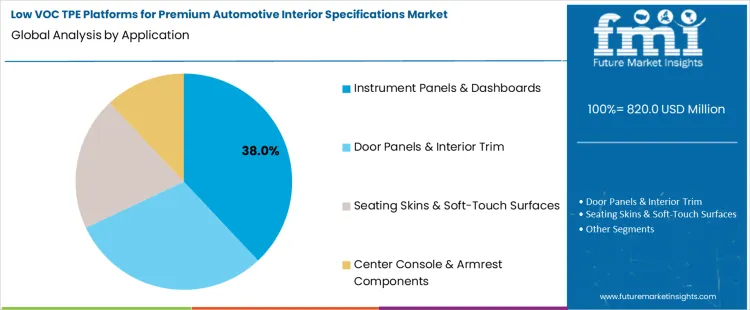
Instrument panels and dashboards account for 38.0% of global demand, driven by their large surface area, occupant proximity, and stringent emission testing requirements. These components require materials that maintain low odor and fogging levels while delivering premium tactile and visual quality. Door panels and interior trim represent 30.0%, supported by extensive use of soft-touch and decorative surfaces across vehicle cabins. Seating skins and soft-touch surfaces account for 20.0%, where comfort, durability, and VOC control must coexist under prolonged contact and thermal exposure. Center console and armrest components hold 12.0%, constrained by lower material volumes and more localized performance requirements.
Key Points
- Instrument panels lead due to exposure and regulatory scrutiny
- Door panels drive volume across multiple trim levels
- Seating surfaces balance comfort with emissions control
What are the Key Dynamics in the Low-VOC TPE Platforms for Premium Automotive Interior Specifications Market?
Global demand rises as automotive OEMs and tier suppliers adopt low-VOC thermoplastic elastomer (TPE) platforms to meet stringent interior air quality targets and premium comfort expectations. Low-VOC TPEs support soft-touch surfaces, seals, gaskets, and trim components that deliver tactile quality without high emissions, enhancing occupant perception of refinement and wellness. Adoption aligns with regulatory limits on interior emissions, rising consumer sensitivity to in-cab air quality, and electrification trends that draw attention to non-powertrain cabin attributes across North America, Europe, Asia-Pacific, and other key automotive markets.
How do regulatory requirements and premium interior performance expectations shape adoption?
Regulatory frameworks in major regions restrict volatile organic compound emissions from vehicle interiors to protect occupant health and satisfy indoor air quality standards. OEMs integrate low-VOC TPE platforms into dashboards, door panels, consoles, and soft touch areas to achieve cabin air quality targets within multi-material interior systems. Premium vehicle segments place strong emphasis on tactile feel, noise damping, and long-term durability while minimizing perceptible odors over extended ownership periods. Tier suppliers collaborate with designers and material scientists to tailor TPE formulations that balance softness, thermal stability, and low emissions with injection molding, extrusion, and over-molding processing. Consumer expectations for refined, healthy cabin environments reinforce deployment of low-VOC elastomer systems in both luxury and performance EV segments.
How do cost pressures, processing adaptation, and global regulatory variation influence market scalability?
Low-VOC TPE platforms often require specialized polymer grades, additives, and compounding processes that increase material cost relative to standard elastomers, influencing pricing strategies and part sourcing decisions. Processing adaptation involves optimizing molding parameters and VOC monitoring protocols to ensure emission compliance without compromising cycle times or part quality. Variability in global regulatory limits and testing methodologies for cabin emissions complicates harmonized material qualification and validation for multinational vehicle programs. Supply chain considerations for consistent low-VOC raw materials and additive packages affect planning and cost stability. Long-term market growth depends on continued innovation in cost-effective, high-performance elastomer systems and alignment of emission standards that support broader adoption in premium automotive interior specifications worldwide.
How Is Demand for Low-VOC TPE Platforms for Premium Automotive Interior Specifications Evolving Globally?
Demand for low-VOC TPE platforms for premium automotive interior specifications is increasing globally due to stricter cabin air quality standards, OEM sustainability targets, and rising consumer expectations for interior comfort. China leads with a 9.9% CAGR, supported by premium vehicle production growth and regulatory focus on in-cabin emissions. India follows at 9.6%, driven by localization of premium interiors and evolving emission norms. Germany records 9.4%, reflecting engineering-led material qualification and regulatory discipline. USA posts a 9.1% CAGR, shaped by OEM interior redesign programs and VOC compliance requirements. South Korea records 8.9%, supported by innovation in soft-touch interior materials. Growth reflects transition toward TPE platforms engineered for low emissions, durability, and aesthetic performance.
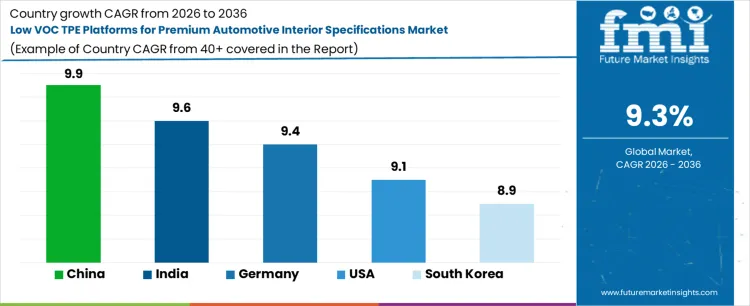
| Country | CAGR (%) |
|---|---|
| China | 9.9% |
| India | 9.6% |
| Germany | 9.4% |
| USA | 9.1% |
| South Korea | 8.9% |
What is driving strong adoption of low-VOC TPE platforms in China’s premium automotive interiors?
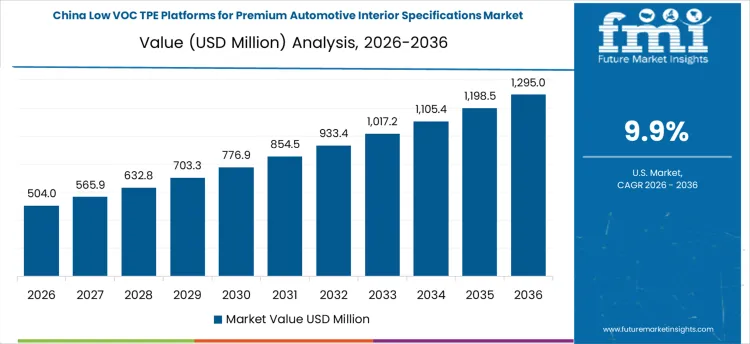
China demand is driven by rapid expansion of premium and electric vehicle production with heightened focus on interior air quality. CAGR of 9.9% reflects adoption of low-VOC TPE platforms in dashboards, door panels, seals, and touch surfaces. OEMs prioritize materials that meet cabin emission limits while delivering soft-touch aesthetics. Regulatory testing protocols reinforce low-emission material selection. Domestic compounders expand low-VOC formulations compatible with high-volume manufacturing. Integration with automated interior assembly lines supports adoption. Growth remains scale-driven and compliance-aligned, supported by premiumization trends and tightening interior material standards.
- Expansion of premium and electric vehicle production
- Regulatory focus on in-cabin air quality
- Use in dashboards and soft-touch components
- Scaling of domestic low-VOC TPE compounding
How is India sustaining growth in low-VOC TPE adoption for automotive interiors?
India demand reflects localization of premium vehicle interiors and gradual tightening of emission and quality standards. CAGR of 9.6% is supported by adoption of low-VOC TPE platforms in seating components, trims, and interior seals. OEMs balance cost efficiency with emission compliance. Rising consumer awareness of interior comfort influences material choice. Domestic suppliers develop regionally optimized TPE formulations. Compatibility with injection and extrusion processes supports adoption. Growth remains manufacturing-led and cost-aligned, supported by premium segment expansion and evolving regulatory expectations.
- Localization of premium interior components
- Growing awareness of cabin comfort and emissions
- Cost-sensitive adoption of compliant materials
- Development of regionally optimized TPE platforms
What factors support Germany’s steady expansion in low-VOC TPE platforms?
Germany demand reflects strong regulatory oversight, engineering precision, and leadership in premium automotive design. CAGR of 9.4% is supported by adoption of low-VOC TPE platforms in high-end interior applications requiring consistent tactile and visual quality. OEMs emphasize validated emission performance, thermal stability, and long-term durability. Material qualification processes remain rigorous. Compounders invest in advanced formulation and testing. Collaboration between OEMs and material suppliers accelerates integration. Growth remains technology-led and quality-focused, aligned with premium interior benchmarks and compliance frameworks.
- Stringent regulatory and testing requirements
- Emphasis on tactile and aesthetic consistency
- Rigorous material qualification processes
- Strong OEM and supplier collaboration
What is shaping demand growth in the USA for low-VOC TPE platforms?
USA demand is shaped by OEM interior redesign cycles, sustainability commitments, and regulatory VOC limits. CAGR of 9.1% reflects adoption of low-VOC TPE platforms in interior trims, consoles, and sealing systems. Automakers prioritize materials that reduce cabin odor and emissions. Consumer expectations for interior comfort influence material upgrades. Domestic compounders offer application-specific low-emission TPE grades. Growth remains OEM-led and compliance-focused, supported by material replacement programs and premium vehicle demand.
- Interior redesign and material replacement programs
- Focus on odor reduction and emission compliance
- Adoption across trims and sealing applications
- Availability of application-specific TPE grades
Why is South Korea showing measured growth in low-VOC TPE platform adoption?
South Korea demand reflects strong automotive manufacturing capabilities and emphasis on interior material innovation. CAGR of 8.9% is supported by adoption of low-VOC TPE platforms in premium vehicle interiors targeting global export standards. OEMs focus on soft-touch feel, durability, and emission compliance. Advanced compounding and processing technologies support formulation precision. Material validation aligns with international requirements. Growth remains innovation-driven and quality-aligned, supported by export-oriented vehicle production and continuous interior material development.
- Export-oriented premium vehicle production
- Emphasis on soft-touch and durability
- Advanced compounding and processing capabilities
- Alignment with global interior emission standards
What is the competitive landscape for low-VOC TPE platforms for premium automotive interior specifications globally?
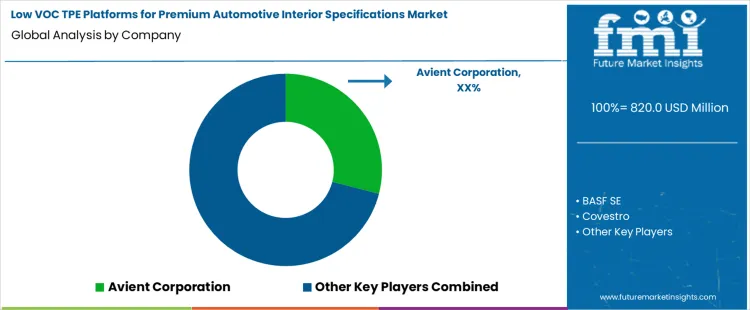
Demand for low-VOC TPE platforms for premium automotive interior specifications is driven by tightening cabin air quality standards, OEM sustainability targets, and consumer expectations for odor-free interiors. These TPE materials are used in instrument panels, door trims, soft-touch surfaces, seals, and interior skins requiring low emissions, tactile quality, and long-term durability.
Buyers evaluate VOC and fogging performance, thermal aging resistance, scratch and mar resistance, color stability, and compatibility with injection molding and overmolding processes. Procurement teams prioritize suppliers with validated compliance to global automotive interior standards, stable compounding quality, and capability to support multi-platform vehicle programs. Trend in the global market reflects electrification-driven interior redesigns, premiumization of mid-segment vehicles, and stricter OEM material qualification protocols.
Avient Corporation holds leading positioning through specialty low-VOC TPE compounds engineered for premium interior applications and OEM approval frameworks. BASF SE supports demand with advanced TPE and elastomer solutions aligned with stringent emission and fogging requirements. Covestro contributes material platforms focused on interior comfort, surface quality, and regulatory compliance.
Kuraray supplies high-purity elastomer technologies used in odor-sensitive automotive interior components. Celanese participates through engineered thermoplastic elastomers optimized for durability, aesthetics, and low-emission performance. Competitive differentiation depends on emission control consistency, surface feel quality, long-term aging performance, and ability to meet evolving OEM interior material standards.
Key Players in the Low-VOC TPE Platforms for Premium Automotive Interior Specifications Market
- Avient Corporation
- BASF SE
- Covestro
- Kuraray
- Celanese
Scope of the Report
| Items | Values |
|---|---|
| Quantitative Units | USD million |
| TPE Platform Type | Styrenic Block Copolymer (SBC) TPE; Olefin-Based TPO & TPV Systems; Polyester-Based TPE (COPE); Bio-Attributed & Low-Extractables TPE |
| VOC Control Strategy | Ultra-Low Volatility Plasticizer Systems; Post-Polymerization Degassing & Purification; Low-Odor Stabilizer & Additive Packages; OEM-Specific VOC-Tuned Formulations |
| Application | Instrument Panels & Dashboards; Door Panels & Interior Trim; Seating Skins & Soft-Touch Surfaces; Center Console & Armrest Components |
| Regions Covered | Asia Pacific, Europe, North America, Latin America, Middle East & Africa |
| Countries Covered | China, India, Germany, USA, South Korea, and 40+ countries |
| Key Companies Profiled | Avient Corporation; BASF SE; Covestro; Kuraray; Celanese |
| Additional Attributes | Dollar sales by TPE platform type and application; adoption trends for low-odor and low-extractables TPE platforms in premium automotive interiors; VOC emission, fogging, and odor panel performance metrics; compatibility with injection molding, overmolding, and soft-touch surface finishing; material durability, scratch resistance, and tactile consistency considerations; OEM interior air-quality standards and regulatory compliance influencing low-VOC TPE platform selection. |
Low-VOC TPE Platforms for Premium Automotive Interior Specifications Market by Segment
By TPE Platform Type:
- Styrenic Block Copolymer (SBC) TPE
- Olefin-Based TPO & TPV Systems
- Polyester-Based TPE (COPE)
- Bio-Attributed & Low-Extractables TPE
By VOC Control Strategy:
- Ultra-Low Volatility Plasticizer Systems
- Post-Polymerization Degassing & Purification
- Low-Odor Stabilizer & Additive Packages
- OEM-Specific VOC-Tuned Formulations
By Application:
- Instrument Panels & Dashboards
- Door Panels & Interior Trim
- Seating Skins & Soft-Touch Surfaces
- Center Console & Armrest Components
By Region:
- Asia Pacific
- China
- Japan
- South Korea
- India
- Australia & New Zealand
- ASEAN
- Rest of Asia Pacific
- Europe
- Germany
- United Kingdom
- France
- Italy
- Spain
- Nordic
- BENELUX
- Rest of Europe
- North America
- United States
- Canada
- Mexico
- Latin America
- Brazil
- Chile
- Rest of Latin America
- Middle East & Africa
- Kingdom of Saudi Arabia
- Other GCC Countries
- Turkey
- South Africa
- Other African Union
- Rest of Middle East & Africa
Frequently Asked Questions
How big is the Low VOC TPE platforms for premium automotive interior specifications market in 2026?
The global Low VOC TPE platforms for premium automotive interior specifications market is estimated to be valued at USD 820.0 million in 2026.
What will be the size of Low VOC TPE platforms for premium automotive interior specifications market in 2036?
The market size for the Low VOC TPE platforms for premium automotive interior specifications market is projected to reach USD 1,995.3 million by 2036.
How much will be the Low VOC TPE platforms for premium automotive interior specifications market growth between 2026 and 2036?
The Low VOC TPE platforms for premium automotive interior specifications market is expected to grow at a 9.3% CAGR between 2026 and 2036.
What are the key TPE platform types in the Low VOC TPE platforms for premium automotive interior specifications market?
The key TPE platform types in Low VOC TPE platforms for premium automotive interior specifications market are styrenic block copolymer (SBC) TPE, olefin-based TPO & TPV systems, polyester-based TPE (COPE), and bio-attributed & low-extractable TPE.
Which VOC control strategy segment to contribute significant share in the Low VOC TPE platforms for premium automotive interior specifications market in 2026?
In terms of VOC control strategy, the ultra-low volatility plasticizer systems segment is expected to command a 36.0% share in the Low-VOC TPE platforms for premium automotive interior specifications market in 2026.
Preview the report firsthand - request a free sample
Get SampleGet the brochure for pricing and purchase details.
Get PDFTable of Content
- Executive Summary
- Global Market Outlook
- Demand-side Trends
- Supply-side Trends
- Technology Roadmap Analysis
- Analysis and Recommendations
- Market Overview
- Market Coverage / Taxonomy
- Market Definition / Scope / Limitations
- Market Background
- Market Dynamics
- Drivers
- Restraints
- Opportunity
- Trends
- Scenario Forecast
- Demand in Optimistic Scenario
- Demand in Likely Scenario
- Demand in Conservative Scenario
- Opportunity Map Analysis
- Product Life Cycle Analysis
- Supply Chain Analysis
- Investment Feasibility Matrix
- Value Chain Analysis
- PESTLE and Porter’s Analysis
- Regulatory Landscape
- Regional Parent Market Outlook
- Production and Consumption Statistics
- Import and Export Statistics
- Market Dynamics
- Global Market Analysis 2021 to 2025 and Forecast, 2026 to 2036
- Historical Market Size Value (USD Million) Analysis, 2021 to 2025
- Current and Future Market Size Value (USD Million) Projections, 2026 to 2036
- Y-o-Y Growth Trend Analysis
- Absolute $ Opportunity Analysis
- Global Market Pricing Analysis 2021 to 2025 and Forecast 2026 to 2036
- Global Market Analysis 2021 to 2025 and Forecast 2026 to 2036, By TPE Platform Type
- Introduction / Key Findings
- Historical Market Size Value (USD Million) Analysis By TPE Platform Type , 2021 to 2025
- Current and Future Market Size Value (USD Million) Analysis and Forecast By TPE Platform Type , 2026 to 2036
- Styrenic Block Copolymer (SBC) TPE
- Olefin-Based TPO & TPV Systems
- Polyester-Based TPE (COPE)
- Bio-Attributed & Low-Extractables TPE
- Styrenic Block Copolymer (SBC) TPE
- Y-o-Y Growth Trend Analysis By TPE Platform Type , 2021 to 2025
- Absolute $ Opportunity Analysis By TPE Platform Type , 2026 to 2036
- Global Market Analysis 2021 to 2025 and Forecast 2026 to 2036, By VOC Control Strategy
- Introduction / Key Findings
- Historical Market Size Value (USD Million) Analysis By VOC Control Strategy, 2021 to 2025
- Current and Future Market Size Value (USD Million) Analysis and Forecast By VOC Control Strategy, 2026 to 2036
- Ultra-Low Volatility Plasticizer Systems
- Post-Polymerization Degassing & Purification
- Low-Odor Stabilizer & Additive Packages
- OEM-Specific VOC-Tuned Formulations
- Ultra-Low Volatility Plasticizer Systems
- Y-o-Y Growth Trend Analysis By VOC Control Strategy, 2021 to 2025
- Absolute $ Opportunity Analysis By VOC Control Strategy, 2026 to 2036
- Global Market Analysis 2021 to 2025 and Forecast 2026 to 2036, By Application
- Introduction / Key Findings
- Historical Market Size Value (USD Million) Analysis By Application, 2021 to 2025
- Current and Future Market Size Value (USD Million) Analysis and Forecast By Application, 2026 to 2036
- Instrument Panels & Dashboards
- Door Panels & Interior Trim
- Seating Skins & Soft-Touch Surfaces
- Center Console & Armrest Components
- Instrument Panels & Dashboards
- Y-o-Y Growth Trend Analysis By Application, 2021 to 2025
- Absolute $ Opportunity Analysis By Application, 2026 to 2036
- Global Market Analysis 2021 to 2025 and Forecast 2026 to 2036, By Region
- Introduction
- Historical Market Size Value (USD Million) Analysis By Region, 2021 to 2025
- Current Market Size Value (USD Million) Analysis and Forecast By Region, 2026 to 2036
- North America
- Latin America
- Western Europe
- Eastern Europe
- East Asia
- South Asia and Pacific
- Middle East & Africa
- Market Attractiveness Analysis By Region
- North America Market Analysis 2021 to 2025 and Forecast 2026 to 2036, By Country
- Historical Market Size Value (USD Million) Trend Analysis By Market Taxonomy, 2021 to 2025
- Market Size Value (USD Million) Forecast By Market Taxonomy, 2026 to 2036
- By Country
- USA
- Canada
- Mexico
- By TPE Platform Type
- By VOC Control Strategy
- By Application
- By Country
- Market Attractiveness Analysis
- By Country
- By TPE Platform Type
- By VOC Control Strategy
- By Application
- Key Takeaways
- Latin America Market Analysis 2021 to 2025 and Forecast 2026 to 2036, By Country
- Historical Market Size Value (USD Million) Trend Analysis By Market Taxonomy, 2021 to 2025
- Market Size Value (USD Million) Forecast By Market Taxonomy, 2026 to 2036
- By Country
- Brazil
- Chile
- Rest of Latin America
- By TPE Platform Type
- By VOC Control Strategy
- By Application
- By Country
- Market Attractiveness Analysis
- By Country
- By TPE Platform Type
- By VOC Control Strategy
- By Application
- Key Takeaways
- Western Europe Market Analysis 2021 to 2025 and Forecast 2026 to 2036, By Country
- Historical Market Size Value (USD Million) Trend Analysis By Market Taxonomy, 2021 to 2025
- Market Size Value (USD Million) Forecast By Market Taxonomy, 2026 to 2036
- By Country
- Germany
- UK
- Italy
- Spain
- France
- Nordic
- BENELUX
- Rest of Western Europe
- By TPE Platform Type
- By VOC Control Strategy
- By Application
- By Country
- Market Attractiveness Analysis
- By Country
- By TPE Platform Type
- By VOC Control Strategy
- By Application
- Key Takeaways
- Eastern Europe Market Analysis 2021 to 2025 and Forecast 2026 to 2036, By Country
- Historical Market Size Value (USD Million) Trend Analysis By Market Taxonomy, 2021 to 2025
- Market Size Value (USD Million) Forecast By Market Taxonomy, 2026 to 2036
- By Country
- Russia
- Poland
- Hungary
- Balkan & Baltic
- Rest of Eastern Europe
- By TPE Platform Type
- By VOC Control Strategy
- By Application
- By Country
- Market Attractiveness Analysis
- By Country
- By TPE Platform Type
- By VOC Control Strategy
- By Application
- Key Takeaways
- East Asia Market Analysis 2021 to 2025 and Forecast 2026 to 2036, By Country
- Historical Market Size Value (USD Million) Trend Analysis By Market Taxonomy, 2021 to 2025
- Market Size Value (USD Million) Forecast By Market Taxonomy, 2026 to 2036
- By Country
- China
- Japan
- South Korea
- By TPE Platform Type
- By VOC Control Strategy
- By Application
- By Country
- Market Attractiveness Analysis
- By Country
- By TPE Platform Type
- By VOC Control Strategy
- By Application
- Key Takeaways
- South Asia and Pacific Market Analysis 2021 to 2025 and Forecast 2026 to 2036, By Country
- Historical Market Size Value (USD Million) Trend Analysis By Market Taxonomy, 2021 to 2025
- Market Size Value (USD Million) Forecast By Market Taxonomy, 2026 to 2036
- By Country
- India
- ASEAN
- Australia & New Zealand
- Rest of South Asia and Pacific
- By TPE Platform Type
- By VOC Control Strategy
- By Application
- By Country
- Market Attractiveness Analysis
- By Country
- By TPE Platform Type
- By VOC Control Strategy
- By Application
- Key Takeaways
- Middle East & Africa Market Analysis 2021 to 2025 and Forecast 2026 to 2036, By Country
- Historical Market Size Value (USD Million) Trend Analysis By Market Taxonomy, 2021 to 2025
- Market Size Value (USD Million) Forecast By Market Taxonomy, 2026 to 2036
- By Country
- Kingdom of Saudi Arabia
- Other GCC Countries
- Turkiye
- South Africa
- Other African Union
- Rest of Middle East & Africa
- By TPE Platform Type
- By VOC Control Strategy
- By Application
- By Country
- Market Attractiveness Analysis
- By Country
- By TPE Platform Type
- By VOC Control Strategy
- By Application
- Key Takeaways
- Key Countries Market Analysis
- USA
- Pricing Analysis
- Market Share Analysis, 2025
- By TPE Platform Type
- By VOC Control Strategy
- By Application
- Canada
- Pricing Analysis
- Market Share Analysis, 2025
- By TPE Platform Type
- By VOC Control Strategy
- By Application
- Mexico
- Pricing Analysis
- Market Share Analysis, 2025
- By TPE Platform Type
- By VOC Control Strategy
- By Application
- Brazil
- Pricing Analysis
- Market Share Analysis, 2025
- By TPE Platform Type
- By VOC Control Strategy
- By Application
- Chile
- Pricing Analysis
- Market Share Analysis, 2025
- By TPE Platform Type
- By VOC Control Strategy
- By Application
- Germany
- Pricing Analysis
- Market Share Analysis, 2025
- By TPE Platform Type
- By VOC Control Strategy
- By Application
- UK
- Pricing Analysis
- Market Share Analysis, 2025
- By TPE Platform Type
- By VOC Control Strategy
- By Application
- Italy
- Pricing Analysis
- Market Share Analysis, 2025
- By TPE Platform Type
- By VOC Control Strategy
- By Application
- Spain
- Pricing Analysis
- Market Share Analysis, 2025
- By TPE Platform Type
- By VOC Control Strategy
- By Application
- France
- Pricing Analysis
- Market Share Analysis, 2025
- By TPE Platform Type
- By VOC Control Strategy
- By Application
- India
- Pricing Analysis
- Market Share Analysis, 2025
- By TPE Platform Type
- By VOC Control Strategy
- By Application
- ASEAN
- Pricing Analysis
- Market Share Analysis, 2025
- By TPE Platform Type
- By VOC Control Strategy
- By Application
- Australia & New Zealand
- Pricing Analysis
- Market Share Analysis, 2025
- By TPE Platform Type
- By VOC Control Strategy
- By Application
- China
- Pricing Analysis
- Market Share Analysis, 2025
- By TPE Platform Type
- By VOC Control Strategy
- By Application
- Japan
- Pricing Analysis
- Market Share Analysis, 2025
- By TPE Platform Type
- By VOC Control Strategy
- By Application
- South Korea
- Pricing Analysis
- Market Share Analysis, 2025
- By TPE Platform Type
- By VOC Control Strategy
- By Application
- Russia
- Pricing Analysis
- Market Share Analysis, 2025
- By TPE Platform Type
- By VOC Control Strategy
- By Application
- Poland
- Pricing Analysis
- Market Share Analysis, 2025
- By TPE Platform Type
- By VOC Control Strategy
- By Application
- Hungary
- Pricing Analysis
- Market Share Analysis, 2025
- By TPE Platform Type
- By VOC Control Strategy
- By Application
- Kingdom of Saudi Arabia
- Pricing Analysis
- Market Share Analysis, 2025
- By TPE Platform Type
- By VOC Control Strategy
- By Application
- Turkiye
- Pricing Analysis
- Market Share Analysis, 2025
- By TPE Platform Type
- By VOC Control Strategy
- By Application
- South Africa
- Pricing Analysis
- Market Share Analysis, 2025
- By TPE Platform Type
- By VOC Control Strategy
- By Application
- USA
- Market Structure Analysis
- Competition Dashboard
- Competition Benchmarking
- Market Share Analysis of Top Players
- By Regional
- By TPE Platform Type
- By VOC Control Strategy
- By Application
- Competition Analysis
- Competition Deep Dive
- Avient Corporation
- Overview
- Product Portfolio
- Profitability by Market Segments (Product/Age /Sales Channel/Region)
- Sales Footprint
- Strategy Overview
- Marketing Strategy
- Product Strategy
- Channel Strategy
- BASF SE
- Covestro
- Kuraray
- Celanese
- Avient Corporation
- Competition Deep Dive
- Assumptions & Acronyms Used
- Research Methodology


