

- Industry Size (2026)
- USD 87.3 Mn
- Forecast (2036)
- USD 434.4 Mn
- CAGR (2026 to 2036)
- 17.4%
Automotive Immersion Cooling Dielectric Fluid Market Size, Market Forecast and Outlook By FMI
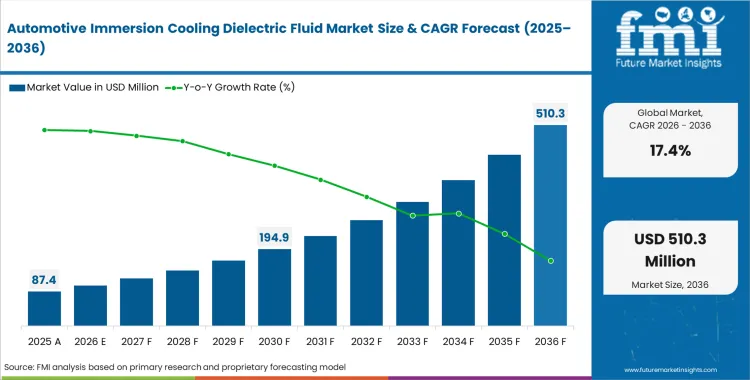
The automotive immersion cooling dielectric fluid market surpassed a value of USD 74.4 million in 2025. Revenue is projected to reach USD 87.3 million in 2026 and grow to USD 434.4 million by 2036, registering a CAGR of 17.4% during the forecast period. Expansion is driven by ultra-fast charging programs that are pushing indirect cooling systems beyond practical thermal limits in high-performance EV battery packs.
Summary of Automotive Immersion Cooling Dielectric Fluid Market
- The market is forecast to reach USD 434.4 million by 2036.
- The market is expected to grow at a CAGR of 17.4% from 2026 to 2036.
- The market was estimated at USD 74.4 million in 2025.
- The market is projected to generate an incremental opportunity of USD 348.5 million over the forecast period.
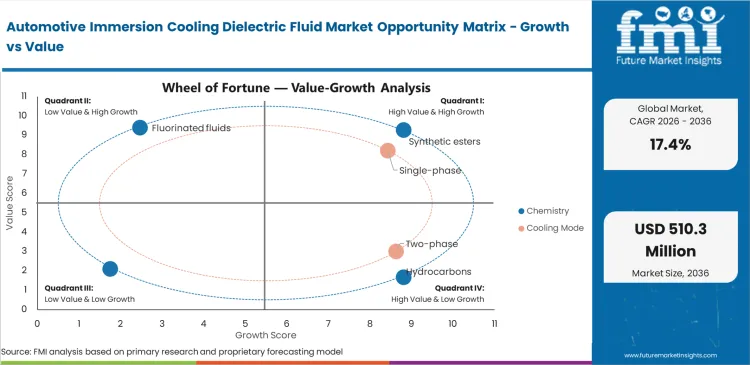
- Synthetic esters lead by chemistry with a 42.0% share.
- Single-phase dominates by cooling mode with a 74.0% share.
- Passenger EVs lead by vehicle type with a 63.0% share.
- OEM fill leads by sales channel with a 69.0% share.
- Battery packs dominate by application with a 58.0% share.
- China is the fastest-growing market at 19.8%, followed by the United Kingdom at 18.9% and Germany at 18.4%.
- The market is driven by rising EV fast-charging requirements, need for improved thermal management and safety, and growing adoption of direct immersion cooling systems.
- Key companies in the market include TotalEnergies, Shell, Castrol, Lubrizol, M&I Materials, Engineered Fluids, and Cargill.
Conventional cooling layouts are losing effectiveness as battery packs become denser and charging windows continue to shorten. Cell-to-pack designs reduce the room available for heat-management hardware just as faster charging raises thermal stress inside the enclosure. Automakers now face a broader engineering decision. Expanding indirect systems with heavier metals and more complex layouts may still work in some platforms, yet direct-contact cooling is increasingly viewed as a stronger long-term option. This shift involves far more than fluid selection, since every exposed pack component must be requalified, including seals, conductors, coatings, and existing EV battery pack thermal interface materials. Commercial adoption is still being delayed more by qualification time for submerged electrical parts used with EV coolants than by fluid capability alone. Suppliers that complete validation earlier are likely to improve their chances of securing future platform volumes.
Wider adoption is expected to build once fluid durability meets vehicle-life expectations. Sealed immersion systems add design complexity, so automakers need confidence that dielectric strength and chemical stability will remain intact across most of the vehicle service life without maintenance intervention. Once that durability is established, older indirect architectures lose some appeal because they create more packaging burden and depend more heavily on conventional EV battery heating systems to manage temperature variation. FMI’s analysis suggests that long-life validation is likely to become one of the key turning points for this market as EV thermal design becomes more closely tied to charging speed, pack safety, and system efficiency.
China is projected to expand at a CAGR of 19.8% during 2026 to 2036 as domestic EV programs move toward ultra-fast charging and higher thermal loads. Demand in the United Kingdom is estimated to rise at a CAGR of 18.9%, supported by prototype development and performance engineering strength. Germany is expected to register 18.4% CAGR through 2036 as premium EV platforms require tighter cooling control. France is likely to grow at 17.6% CAGR during 2026 to 2036 as battery programs place greater weight on pack-level thermal safety. Demand in the United States is projected to increase at 16.8% CAGR through 2036, supported by larger EV platforms with stronger heat rejection needs. South Korea is anticipated to record 16.2% CAGR, while Japan is forecast to expand at 15.4%, reflecting more cautious qualification cycles.
Segmental Analysis
Automotive Immersion Cooling Dielectric Fluid Market Analysis by Chemistry
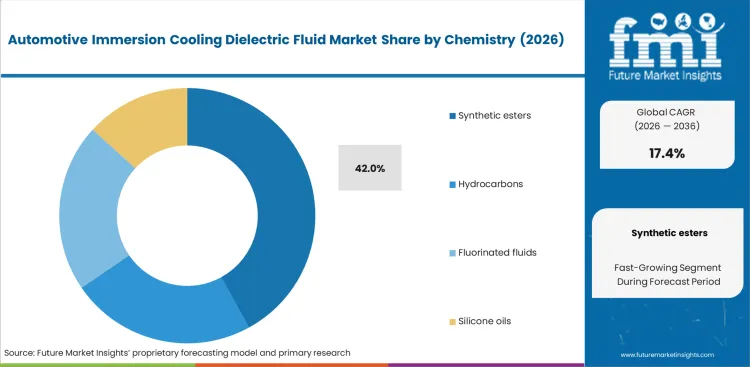
Synthetic esters are estimated to account for 42.0% share in 2026 because they offer a better balance between thermal performance and flash-point protection than highly refined hydrocarbons. Formulation work in this category requires close control over oxidation resistance, material compatibility, and dielectric stability under repeated charging stress. Fluid selection also changes enclosure engineering because ester chemistries often require different seal and polymer combinations than legacy systems. Traditional battery thermal plates do not address localized cell hot spots as effectively as direct-contact immersion designs. Seal incompatibility can therefore turn a routine chemistry shift into a full hardware redesign with elevated failure risk. That makes chemistry choice a system-level decision rather than a fluid substitution exercise.
- Initial specification: Fast-charging duty cycles expose the heat rejection limits of cold-plate systems and push developers toward direct-contact ester cooling.
- Validation testing criteria: Material screening programs immerse polymers, adhesives, and wire insulation for extended periods to confirm dimensional and chemical stability.
- Long-term contract expansion: Broader platform adoption follows only after pilot data shows stable fluid behavior across repeated thermal cycling conditions.
Automotive Immersion Cooling Dielectric Fluid Market Analysis by Cooling Mode
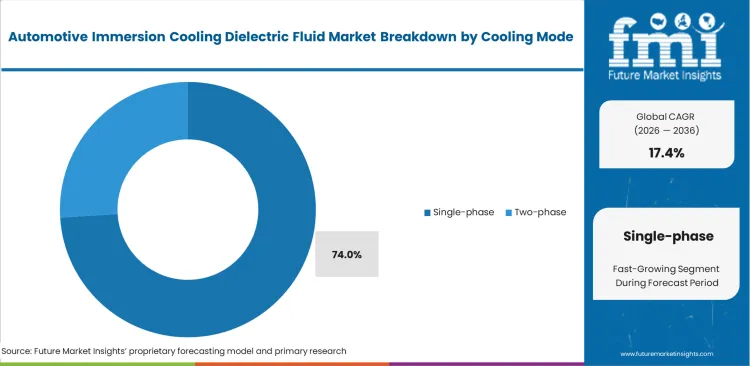
Cooling architecture depends heavily on enclosure integrity, pump strategy, and pressure control inside high-voltage battery systems. Single-phase fluid circulation avoids boiling-condensation cycles and simplifies pack design, which keeps it firmly positioned for near-term scale-up. Single-phase architectures are expected to hold 74.0% share in 2026 because they work with standard pumps, familiar sealing methods, and lower pressure-management complexity. Two-phase designs can raise heat-transfer efficiency on paper, but vapor recovery and enclosure control remain difficult under automotive vibration and packaging constraints. Mass-market vehicle programs therefore continue favoring simpler fluid circulation over higher theoretical thermal performance. Delayed migration away from indirect loops also leaves automakers carrying heavier and less responsive EV thermal systems in platforms where charging speed is becoming a visible purchase factor. That is why single-phase systems remain the more practical path for production deployment.
- Vaporization pressure avoidance: Single-phase operation removes sudden internal pressure spikes and reduces the need for heavy pressure-relief hardware.
- Residual cavitation risk: High pump speeds through narrow internal gaps can still create localized pressure drops that damage surfaces over time.
- Full envelope capture: Uniform cooling depends on eliminating stagnant flow zones that allow isolated hot spots to persist inside modules.
Automotive Immersion Cooling Dielectric Fluid Market Analysis by Vehicle Type
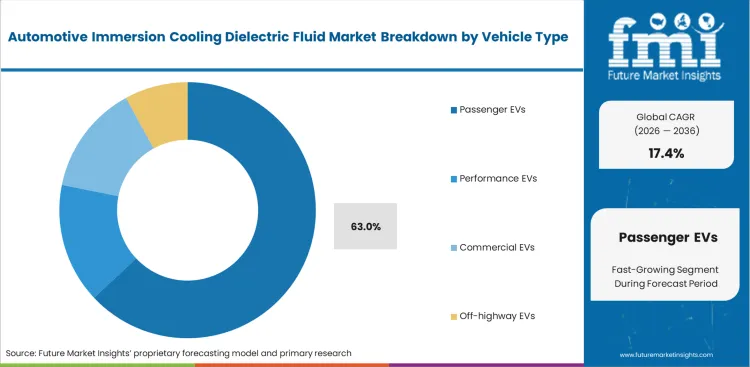
Commercial scale for immersion cooling will come largely from high-volume passenger platforms rather than limited specialty programs. Consumer demand for longer range and shorter charging times is pushing thermal designs beyond the limits of indirect systems. Passenger EVs are anticipated to capture 63.0% share in 2026 as mainstream vehicle programs pursue tighter cell packing and faster charging acceptance. Direct-contact cooling supports that shift by improving heat extraction while allowing more compact battery layouts. Transitioning to flooded pack designs also raises major material demands because battery pack sealants must remain stable for the full life of the vehicle in chemically aggressive environments. Cost curves will not improve meaningfully until large passenger platforms absorb those engineering changes at scale. Premium passenger models are therefore becoming the key proving ground for broader rollout.
- Component elimination savings: Immersion designs can remove cold plates, thermal gap fillers, and glycol routing hardware from the battery structure.
- Hidden compatibility expenses: Flooded pack layouts require upgrades to internal polymers, adhesives, and sealing materials across the enclosure.
- Lifecycle warranty reduction: More stable cell temperatures reduce premature degradation and support lower long-term battery replacement exposure.
Automotive Immersion Cooling Dielectric Fluid Market Analysis by Sales Channel
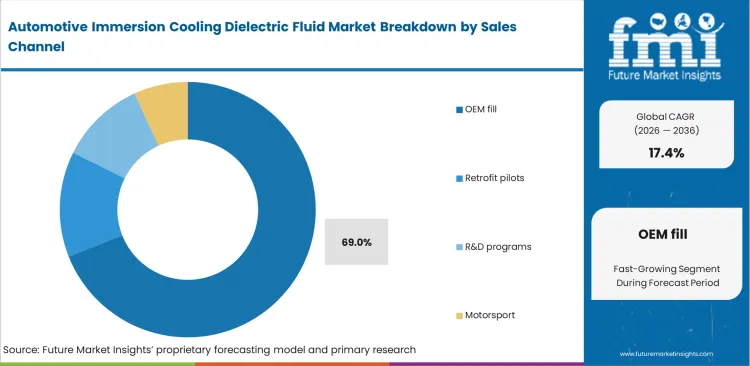
Direct-contact immersion systems leave little room for conventional aftermarket participation. Factory control over fill quality, air removal, and contamination prevention is central to pack safety, and OEM fill channel is set to represent 69.0% share in 2026. Dielectric filling is handled as a controlled vacuum-assisted manufacturing step rather than a service procedure. Systems are also designed around lifetime fluid use, which keeps replacement demand limited outside tightly managed OEM pathways. Field handling errors can introduce air pockets, moisture, or particulates that compromise electrical isolation inside electric vehicle fluids environments. Proprietary formulations and narrow process windows further reduce the feasibility of non-factory participation. Channel concentration is therefore expected to remain high as long as fluid purity and fill precision stay critical to pack performance.
- Formulation exclusivity agreements: Fluid suppliers work directly with automakers on proprietary blends that are difficult for third parties to replicate.
- Bulk logistics constraints: Large-volume transport of moisture-sensitive dielectric fluids requires tightly controlled handling and incoming quality checks.
- Closed-loop recovery planning: End-of-life vehicle volumes will create future requirements for fluid extraction, recovery, and controlled recycling.
Automotive Immersion Cooling Dielectric Fluid Market Analysis by Application
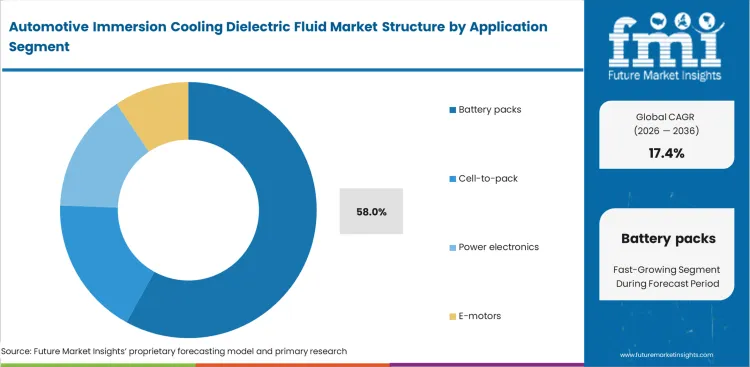
Battery pack immersion improves heat removal at the cell level and reduces the need for bulky interfaces between cells and external cooling hardware. Battery packs are forecast to command 58.0% share in 2026 because spacing limits inside pack architecture make direct-contact cooling especially valuable in this application. Fluid developers still face a constant trade-off between stronger thermal conductivity and stable electrical resistance. Removing air gaps and thermal interfaces also increases system dependence on uninterrupted internal circulation. A pack running with inadequate automotive coolants flow can move quickly toward cell venting and major electrical failure. Application demand therefore stays concentrated where thermal stress is highest and packaging margins are tightest.
- Peak load dissipation: Direct contact with the fluid helps absorb rapid thermal spikes during fast charging and heavy acceleration events.
- Low-temperature flow resistance: Cold-weather viscosity increases can restrict circulation and must be managed without sacrificing high-temperature protection.
- Dielectric breakdown thresholds: Particulate contamination lowers resistance, making strict debris control essential during module assembly and filling.
Automotive Immersion Cooling Dielectric Fluid Market Drivers, Restraints, and Opportunities
A major thermal constraint is shaping the shift from 400-volt to 800-volt vehicle architectures. Pressure to deliver passenger EVs that recover substantial range within very short charging windows is raising heat loads beyond what conventional cold-plate systems can manage efficiently. Direct-contact thermal fluid systems address this packaging constraint by using space between cells as an active cooling path rather than relying only on external hardware. Automakers that delay this transition risk limiting real-world fast-charging performance in next-generation platforms, especially when battery protection strategies force charging speeds downward under high thermal stress. That risk is pushing faster validation of dielectric fluids and immersion cooling test systems so vehicle programs can align charging capability with performance expectations.
Material compatibility validation remains one of the main obstacles to wider deployment. Immersion cooling places active high-voltage components in continuous contact with fluids, which means adhesives, wire insulation, busbar coatings, and elastomeric seals must remain stable over long service lives. Materials that deliver strong heat-transfer performance can still create long-term reliability problems when they interact poorly with critical polymers inside sealed battery enclosures. This forces engineering teams to requalify a broad range of small internal parts, slowing development timelines and raising validation costs. Reliability concerns around insulation degradation and electrical failure continue to make fluid approval standards highly demanding, which keeps proven compatibility data at the center of commercial adoption.
Opportunities in the Automotive Immersion Cooling Dielectric Fluid Market
- Integrated thermal sensor networks: Battery management system designers develop localized sensors tracking fluid degradation and moisture ingress in real time. This capability allows automakers to predict failures before they occur, reducing warranty claims.
- Dual-use motor and battery cooling: Powertrain architects engineer unified circuits pumping identical specialized dielectric liquid through electric motors and main battery packs. Consolidating immersion cooling loops removes redundant pumps and drastically lowers total vehicle weight.
- Bio-based ester commercialization: Chemical suppliers formulate sustainable, plant-derived dielectric fluids matching performance of synthetic variants. Brands secure eco-friendly materials to satisfy strict corporate sustainability mandates without sacrificing thermal safety limits.
Regional Analysis
Based on regional analysis, automotive immersion cooling dielectric fluid market is segmented into North America, Latin America, Europe, Asia Pacific, and Middle East and Africa across 40 plus countries.
.webp "Top Country Growth Comparison Automotive Immersion Cooling Dielectric Fluid Market Cagr (2026 2036)")
| Country | CAGR (2026 to 2036) |
|---|---|
| China | 19.8% |
| United Kingdom | 18.9% |
| Germany | 18.4% |
| France | 17.6% |
| United States | 16.8% |
| South Korea | 16.2% |
| Japan | 15.4% |
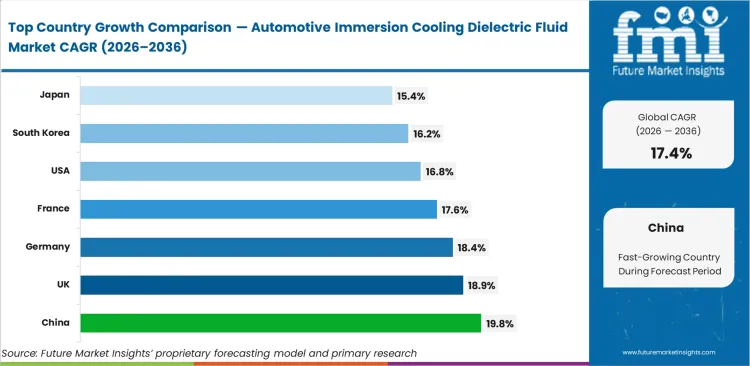
Source: Future Market Insights (FMI) analysis, based on proprietary forecasting model and primary research
Asia Pacific Automotive Immersion Cooling Dielectric Fluid Market Analysis
Automakers are under pressure to support vehicles compatible with new 480 kW charging infrastructure while keeping battery temperatures within safe limits. Cold-plate improvements no longer solve the full thermal load in premium EV platforms, which is pushing manufacturers toward direct liquid immersion systems. Battery programs with higher charging targets are giving more weight to dielectric fluids that can manage heat more evenly across densely packed cell layouts. Seal reliability also remains a core requirement, since coupling performance directly influences assembly consistency and long-term fluid containment.
- China: Ultra-fast charging deployment and a large electric vehicle base are expected to strengthen demand for immersion cooling dielectric fluids in China. Demand in China is projected to expand at a CAGR of 19.8% during 2026 to 2036. Local manufacturers are moving toward direct-contact thermal systems to reduce charging constraints at high-power public stations. This shift supports faster charging performance on premium models and reinforces domestic demand for advanced thermal fluid systems.
- South Korea: Battery design in South Korea is increasingly aligning cell chemistry, pack layout, and fluid performance within the same development cycle. Demand for automotive immersion cooling dielectric fluids in South Korea is anticipated to rise at a CAGR of 16.2% during 2026 to 2036. Premium EV programs are expected to adopt direct-contact cooling to improve thermal efficiency and reduce pack weight. Stronger alignment between battery engineering and fluid selection is likely to support wider use in export-oriented vehicle platforms.
- Japan: Validation standards in Japan are expected to keep adoption more measured as manufacturers continue to prioritize long service life and material stability. Demand for automotive immersion cooling dielectric fluids in Japan is likely to progress at a CAGR of 15.4% during 2026 to 2036. Material compatibility testing remains a key condition before direct-contact fluids move into broader vehicle programs. Once qualification is completed, adoption is expected to build gradually across next-generation electric models with reliability-led positioning.
Analysis of emerging manufacturing hubs across Southeast Asia reveals increasing requirements for highly specialized fluid handling capabilities within local battery assembly plants.
Europe Automotive Immersion Cooling Dielectric Fluid Market Analysis
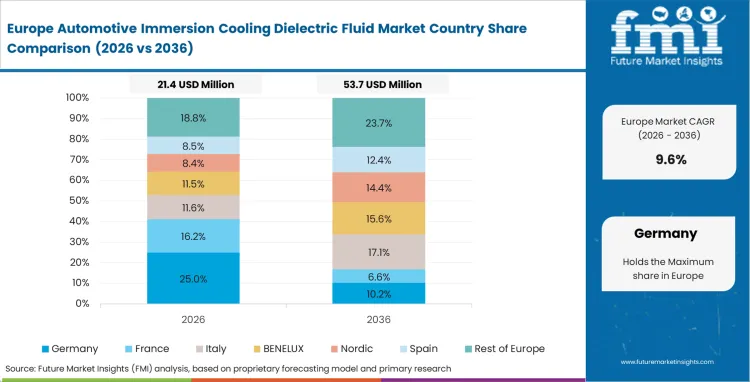
Luxury vehicle programs built around 800-volt architectures are reshaping thermal management needs across Europe. Sustained high-speed driving places heavier thermal stress on battery systems, especially in performance-oriented electric platforms. Direct liquid contact is gaining relevance where automakers need to preserve peak power delivery without accelerating cell degradation. This shift is also raising scrutiny around fluid durability, coupling stability, and long-run thermal consistency under demanding operating conditions.
- United Kingdom: Performance engineering capabilities in the United Kingdom are expected to support early adoption of immersion cooling dielectric fluids in high-specification EV programs. Demand for automotive immersion cooling dielectric fluids in the United Kingdom is projected to expand at a CAGR of 18.9% during 2026 to 2036. Low-volume performance platforms are likely to serve as testing grounds for more advanced fluid behavior under extreme thermal stress. Knowledge developed in these programs is expected to support broader use in premium and later-volume vehicle architectures.
- Germany: Premium automotive manufacturing in Germany is likely to strengthen demand for immersion cooling dielectric fluids as battery systems move toward tighter thermal control. Sales of automotive immersion cooling dielectric fluids in Germany are anticipated to rise at a CAGR of 18.4% during 2026 to 2036. Flagship electric platforms are expected to place more emphasis on direct-contact cooling where power delivery, charging stability, and cell protection must be balanced together. Adoption in Germany is likely to build through performance-led vehicle programs where thermal reliability remains a core engineering requirement.
- France: Battery safety, system validation, and compliance-driven engineering are expected to shape demand for immersion cooling dielectric fluids in France. Demand in France is likely to advance at a CAGR of 17.6% during 2026 to 2036. Manufacturers are expected to favor direct-contact cooling systems where stronger thermal control can support battery protection and fire-risk mitigation goals. Steady integration is likely across passenger EV platforms as thermal safety standards and platform efficiency targets become more closely aligned.
Adjacent markets scaling battery production facilities across Eastern Europe represent critical expansion nodes for localized dielectric fluid blending.
North America Automotive Immersion Cooling Dielectric Fluid Market Analysis
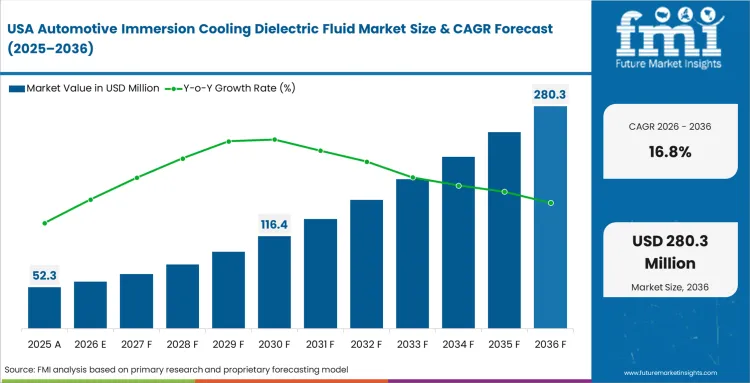
Long-range electric trucks and sport utility vehicles are raising thermal management demands across battery platform design. Heavy payload movement and sustained cabin cooling place added pressure on battery systems during real-world operation. Direct liquid contact is gaining attention where manufacturers need to control heat buildup without causing sharp range erosion under load. This requirement is also increasing focus on component reliability inside fluid-exposed power electronics environments.
- United States: Rising penetration of electric trucks and larger utility vehicles is expected to support demand for automotive immersion cooling dielectric fluids in the United States. Demand in the United States is projected to expand at a CAGR of 16.8% during 2026 to 2036. Heavy-duty electric platforms are likely to require stronger thermal control where towing loads, battery output, and cabin comfort must be managed together. Broader use of immersion fluids is expected to depend on balancing thermal performance with acceptable system cost across larger vehicle programs.
Expanding manufacturing corridors in Mexico feature tier-one suppliers assembling advanced battery modules for North American industry. Cross-border supply chain integration remains essential for chemical formulators supporting regional automotive production.
Competitive Aligners for Market Players
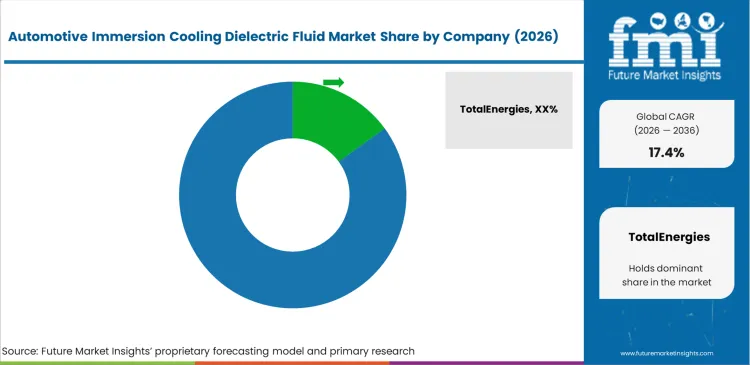
Competitive intensity in automotive immersion cooling follows a different logic from conventional lubricant categories, since fluid chemistry must align closely with battery pack design. Early advantage usually comes from involvement during pack development, where fluid behavior is assessed alongside cell spacing, insulation systems, seal materials, and thermal pathways. Supplier selection depends less on headline thermal performance and more on the ability to demonstrate stable long-duration interaction with pack materials under demanding vehicle operating conditions. Any supplier approaching this category as an extension of legacy insulating oils is likely to face rejection during automotive qualification.
Sustained position in this market depends heavily on material compatibility knowledge built through repeated testing. Immersion cooling fluid suppliers gain an edge when they can show how specific formulations interact with plastics, elastomers, coatings, and other pack components over extended service life. Such evidence is difficult to replicate quickly, since modeled assumptions cannot fully replace long-cycle validation data. Once a fluid is approved alongside associated filtration and system-control requirements, switching to an alternate chemistry often becomes difficult because pack architecture, validation work, and production planning begin to center on that approved formulation.
Longer-term market structure is still moving away from complete dependence on single-source chemistry programs. As vehicle platforms mature, manufacturers are expected to define tighter dielectric performance windows and cleaner qualification benchmarks, creating more room for dual-sourcing strategies within standardized pack designs. Competitive pressure then shifts toward manufacturing consistency, contamination control, and reliable global supply rather than resting only on early formulation ownership. Strong suppliers are likely to hold their position by combining proven material compatibility with scalable delivery discipline across multiple vehicle programs.
Key Players in Automotive Immersion Cooling Dielectric Fluid Market
- TotalEnergies
- Shell
- Castrol
- Lubrizol
- M&I Materials
- Engineered Fluids
- Cargill
Scope of the Report
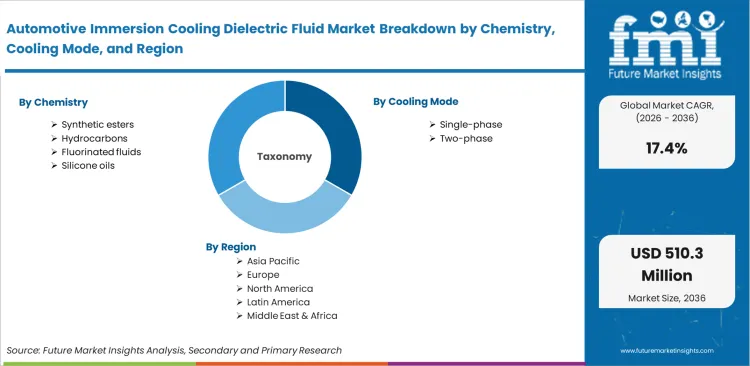
| Metric | Value |
|---|---|
| Quantitative Units | USD 87.3 million to USD 434.4 million, at a CAGR of 17.4% |
| Market Definition | Automotive immersion cooling dielectric fluid functions as a direct-contact thermal management medium submerging heat-generating electric vehicle components. These specialized liquids prevent thermal runaway by absorbing heat directly from battery cells without causing electrical shorts. |
| Segmentation | Chemistry, Cooling mode, Vehicle type, Sales channel, Application, Region |
| Regions Covered | North America, Latin America, Europe, Asia Pacific, Middle East and Africa |
| Countries Covered | China, United Kingdom, Germany, France, United States, South Korea, Japan |
| Key Companies Profiled | TotalEnergies, Shell, Castrol, Lubrizol, M&I Materials, Engineered Fluids, Cargill |
| Forecast Period | 2026 to 2036 |
| Approach | Baseline volume anchors to declared EV factory-fill capacities and verified pilot program supply contracts across global production hubs. |
Source: Future Market Insights (FMI) analysis, based on proprietary forecasting model and primary research
Automotive Immersion Cooling Dielectric Fluid Market Analysis by Segments
Chemistry
- Synthetic esters
- Hydrocarbons
- Fluorinated fluids
- Silicone oils
Cooling mode
- Single-phase
- Two-phase
Vehicle type
- Passenger EVs
- Performance EVs
- Commercial EVs
- Off-highway EVs
Sales channel
- OEM fill
- Retrofit pilots
- R&D programs
- Motorsport
Application
- Battery packs
- Cell-to-pack
- Power electronics
- E-motors
Region
- North America
- United States
- Canada
- Europe
- Germany
- United Kingdom
- France
- Italy
- Spain
- Asia Pacific
- China
- Japan
- South Korea
- Taiwan
- Singapore
- Latin America
- Brazil
- Mexico
- Argentina
- Middle East & Africa
- GCC Countries
- South Africa
Bibliography
- Liu, Z., Kabirzadeh, P., Wu, H., Fu, W., Qiu, H., Miljkovic, N., Li, Y., & Wang, P. (2024). Machine learning enhanced control co-design optimization of an immersion cooled battery thermal management system. Journal of Applied Physics, 136(2), 025001.
- Kumaran, A. T., & Hemavathi, S. (2024). Optimization of lithium-ion battery thermal performance using dielectric fluid immersion cooling technique. Process Safety and Environmental Protection, 189, 768-781.
- Hemavathi, S., Thiru Kumaran, A., Srinivas, S., & Prakash, A. S. (2024). Synthetic ester-based forced flow immersion cooling technique for fast discharging lithium-ion battery packs. Journal of Energy Storage, 97, 112852.
- Wahab, A., Najmi, A.-U.-H., Senobar, H., Amjady, N., Kemper, H., & Khayyam, H. (2025). Immersion cooling innovations and critical hurdles in Li-ion battery cooling for future electric vehicles. Renewable and Sustainable Energy Reviews, 211, 115268.
- Tai, L. D., & Lee, M.-Y. (2025). Advances in the battery thermal management systems of electric vehicles for thermal runaway prevention and suppression. Batteries, 11(6), 216.
This bibliography is provided for reader reference. The full FMI report contains the complete reference list with primary source documentation.
This Report Addresses
- Powertrain engineers shifting from indirect cold plates to direct immersion cooling.
- Qualification timelines restricting widespread adoption of dielectric synthetic esters.
- Heat rejection limits triggered by sub-10-minute fast charging network expansion.
- Material science challenges involving polymer swelling inside flooded battery packs.
- Weight reduction benefits realized by eliminating heavy aluminum thermal hardware.
- Single-phase stability outperforming complex two-phase boiling architectures.
- Supply chain exclusivity agreements locking aftermarket competitors out of factory fills.
- Extreme charging loads driving integration into premium passenger EV platforms.
Frequently Asked Questions
What is the forecast for the automotive immersion cooling dielectric fluid market by 2036?
The market is projected to reach USD 434.4 million by 2036. Continued investment in ultra-fast charging architectures pushes total valuation upward as automakers exhaust heat rejection limits of traditional indirect cold plates.
Why are synthetic esters used in EV immersion cooling fluids?
Formulators specify synthetic esters because they offer superior flash points compared to refined hydrocarbons, ensuring safety during extreme thermal events. They balance critical heat transfer capabilities with oxidation resistance over thousands of charge cycles.
How does automotive battery immersion cooling work?
Sub-10-minute fast charging generates localized cell heat loads indirect cold plates cannot dissipate quickly enough. Companies rely on direct fluid contact to instantly absorb massive thermal spikes and prevent localized cell venting.
Why use dielectric fluid in EV battery immersion cooling?
Powertrain architects select specialized dielectric fluids because they avoid extreme internal pressure spikes while preventing electrical shorts. Pumping stable, non-conductive liquids requires only standard mechanical pumps and conventional sealing techniques, minimizing enclosure weight.
Who are the leading suppliers in the automotive immersion cooling dielectric fluid market?
Leading suppliers include TotalEnergies, Shell, Castrol, Lubrizol, M&I Materials, Engineered Fluids, and Cargill. These companies secure early advantages by establishing active pilot programs integrating fluids into early-stage Cell-to-Pack designs.
How do OEMs qualify immersion cooling fluids for EV batteries?
Severe qualification timelines for material compatibility dictate deployment. Submerging high-voltage components requires validation that chosen fluids will not degrade wire insulation, dissolve adhesives, or swell elastomeric seals over ten-year lifespans.
Which country will lead automotive immersion cooling dielectric fluid demand?
China mandates aggressive ultra-fast charging infrastructure, forcing OEMs to adopt advanced thermal fluids avoiding throttling. Battery engineers adopt immersion cooling rapidly, driving regional demand at a 19.8% CAGR through 2036.
Why is aftermarket fluid volume practically zero?
Factory assembly requires specialized vacuum-assisted filling preventing air entrapment and ensuring absolute electrical isolation. Systems operate as sealed units for life of vehicles, eliminating routine service dealership fluid swaps.
What cost savings offset the premium fluid price?
Direct liquid contact allows engineers to eliminate heavy aluminum cold plates, complex glycol routing tubes, and expensive thermal interface pastes. Hardware reduction offsets higher initial costs of dielectric formulations.
How do engineers prevent cavitation in single-phase systems?
High pump speeds required to force fluid through narrow cell gaps create localized pressure drops. Fluid dynamics engineers must design specific flow paths preventing micro-bubbles from eroding internal component surfaces over time.
What happens if incompatible elastomers are specified?
Dielectric fluids acting as slow solvents on incompatible seals cause polymers to swell and fail. Containment loss leads to immediate degradation and electrical failure across flooded vehicle architectures.
Why target passenger EVs over commercial platforms first?
Brands target passenger vehicles because consumer demand for 400-mile ranges forces engineers to maximize cell density. Scaling technology through premium sedans drives cost-reduction curves necessary for broader platform adoption.
How do chemical suppliers secure long-term contracts?
Suppliers embed themselves during initial R&D phases by providing extensive material interaction testing data. Once automakers validate specific fluid blends, they lock chemical suppliers in for duration of vehicle platforms.
What role do predictive modeling tools play?
Material science teams use predictive software to virtually identify incompatible polymer-fluid pairings before physical testing. Virtual modeling narrows testing matrices but does not eliminate OEM demands for physical long-term aging validation.
Why exclude water-glycol mixtures from this category?
Standard water-glycol mixtures conduct electricity and require physical separation from battery cells. Automotive immersion dielectric fluids are specifically engineered for direct contact with active high-voltage components without causing electrical shorts.
What characterizes the United Kingdom's adoption curve?
Dense clusters of motorsport and performance EV engineering firms validate early-stage thermal concepts locally. Advanced R&D hubs push adoption developing bespoke fluid formulations before licensing them to mainstream global automakers.
How do companies manage supplier lock-in?
Companies actively force primary chemical formulators to establish secondary manufacturing locations and cross-license intellectual property. Maturing platforms eventually define standardized specifications allowing dual-sourcing for identical vehicle lines.
What prevents third-party blenders from competing?
Chemical manufacturers develop highly proprietary fluid blends directly with individual automakers. Specific formulations cannot be reverse engineered easily without voiding precise material compatibility warranties established during factory qualification.
Why are thermal interface materials eliminated?
Immersing battery packs removes need for bulky thermal paste between cells and cold plates. Fluid acts as interface directly, creating unified modules relying entirely on liquid circulation for survival.
How does cold weather affect immersion fluids?
Sub-zero temperatures drastically increase fluid viscosity, hindering circulation upon vehicle startup. Fluid engineers balance high-temperature stability with low-temperature pumpability ensuring consistent thermal protection across all extreme climates.
What drives European luxury automaker adoption?
Continuous high-speed driving on unrestricted highways generates continuous heat loads traditional cooling cannot manage. European platform directors integrate immersion cooling specifically maintaining peak power delivery without degrading battery cell lifespan.
How do OEMs manage end-of-life fluid recovery?
Firms draft strict protocols safely extracting and recycling degraded dielectric liquids. As early immersion-cooled vehicles reach end-of-life, suppliers implement closed-loop recovery logistics handling specialized materials.
What risk do metal shavings pose during assembly?
Microscopic metal debris from manufacturing suspends in dielectric fluids, severely lowering electrical resistance. Quality control inspectors establish strict particulate limits, rejecting assembly processes risking introduction of conductive contaminants.
Why do North American heavy trucks require immersion?
Towing heavy loads while maintaining cabin climate control pushes large battery packs to thermal limits. Powertrain architects leverage immersion cooling ensuring heavy-duty consumer vehicles avoid range loss under sustained strain.
Preview the report firsthand - request a free sample
Get SampleGet the brochure for pricing and purchase details.
Get PDFTable of Content
- Executive Summary
- Global Market Outlook
- Demand-side Trends
- Supply-side Trends
- Technology Roadmap Analysis
- Analysis and Recommendations
- Market Overview
- Market Coverage / Taxonomy
- Market Definition / Scope / Limitations
- Research Methodology
- Chapter Orientation
- Analytical Lens and Working Hypotheses
- Market Structure, Signals, and Trend Drivers
- Benchmarking and Cross-market Comparability
- Market Sizing, Forecasting, and Opportunity Mapping
- Research Design and Evidence Framework
- Desk Research Programme (Secondary Evidence)
- Company Annual and Sustainability Reports
- Peer-reviewed Journals and Academic Literature
- Corporate Websites, Product Literature, and Technical Notes
- Earnings Decks and Investor Briefings
- Statutory Filings and Regulatory Disclosures
- Technical White Papers and Standards Notes
- Trade Journals, Industry Magazines, and Analyst Briefs
- Conference Proceedings, Webinars, and Seminar Materials
- Government Statistics Portals and Public Data Releases
- Press Releases and Reputable Media Coverage
- Specialist Newsletters and Curated Briefings
- Sector Databases and Reference Repositories
- FMI Internal Proprietary Databases and Historical Market Datasets
- Subscription Datasets and Paid Sources
- Social Channels, Communities, and Digital Listening Inputs
- Additional Desk Sources
- Expert Input and Fieldwork (Primary Evidence)
- Primary Modes
- Qualitative Interviews and Expert Elicitation
- Quantitative Surveys and Structured Data Capture
- Blended Approach
- Why Primary Evidence is Used
- Field Techniques
- Interviews
- Surveys
- Focus Groups
- Observational and In-context Research
- Social and Community Interactions
- Stakeholder Universe Engaged
- C-suite Leaders
- Board Members
- Presidents and Vice Presidents
- R&D and Innovation Heads
- Technical Specialists
- Domain Subject-matter Experts
- Scientists
- Physicians and Other Healthcare Professionals
- Governance, Ethics, and Data Stewardship
- Research Ethics
- Data Integrity and Handling
- Primary Modes
- Tooling, Models, and Reference Databases
- Desk Research Programme (Secondary Evidence)
- Data Engineering and Model Build
- Data Acquisition and Ingestion
- Cleaning, Normalisation, and Verification
- Synthesis, Triangulation, and Analysis
- Quality Assurance and Audit Trail
- Market Background
- Market Dynamics
- Drivers
- Restraints
- Opportunity
- Trends
- Scenario Forecast
- Demand in Optimistic Scenario
- Demand in Likely Scenario
- Demand in Conservative Scenario
- Opportunity Map Analysis
- Product Life Cycle Analysis
- Supply Chain Analysis
- Investment Feasibility Matrix
- Value Chain Analysis
- PESTLE and Porter’s Analysis
- Regulatory Landscape
- Regional Parent Market Outlook
- Production and Consumption Statistics
- Import and Export Statistics
- Market Dynamics
- Global Market Analysis 2021 to 2025 and Forecast, 2026 to 2036
- Historical Market Size Value (USD Million) Analysis, 2021 to 2025
- Current and Future Market Size Value (USD Million) Projections, 2026 to 2036
- Y-o-Y Growth Trend Analysis
- Absolute $ Opportunity Analysis
- Global Market Pricing Analysis 2021 to 2025 and Forecast 2026 to 2036
- Global Market Analysis 2021 to 2025 and Forecast 2026 to 2036, By Chemistry
- Introduction / Key Findings
- Historical Market Size Value (USD Million) Analysis By Chemistry , 2021 to 2025
- Current and Future Market Size Value (USD Million) Analysis and Forecast By Chemistry , 2026 to 2036
- Synthetic esters
- Hydrocarbons
- Fluorinated fluids
- Silicone oils
- Synthetic esters
- Y-o-Y Growth Trend Analysis By Chemistry , 2021 to 2025
- Absolute $ Opportunity Analysis By Chemistry , 2026 to 2036
- Global Market Analysis 2021 to 2025 and Forecast 2026 to 2036, By Cooling Mode
- Introduction / Key Findings
- Historical Market Size Value (USD Million) Analysis By Cooling Mode, 2021 to 2025
- Current and Future Market Size Value (USD Million) Analysis and Forecast By Cooling Mode, 2026 to 2036
- Single-phase
- Two-phase
- Single-phase
- Y-o-Y Growth Trend Analysis By Cooling Mode, 2021 to 2025
- Absolute $ Opportunity Analysis By Cooling Mode, 2026 to 2036
- Global Market Analysis 2021 to 2025 and Forecast 2026 to 2036, By Vehicle Type
- Introduction / Key Findings
- Historical Market Size Value (USD Million) Analysis By Vehicle Type, 2021 to 2025
- Current and Future Market Size Value (USD Million) Analysis and Forecast By Vehicle Type, 2026 to 2036
- Passenger EVs
- Performance EVs
- Commercial EVs
- Off-highway EVs
- Passenger EVs
- Y-o-Y Growth Trend Analysis By Vehicle Type, 2021 to 2025
- Absolute $ Opportunity Analysis By Vehicle Type, 2026 to 2036
- Global Market Analysis 2021 to 2025 and Forecast 2026 to 2036, By Sales Channel
- Introduction / Key Findings
- Historical Market Size Value (USD Million) Analysis By Sales Channel, 2021 to 2025
- Current and Future Market Size Value (USD Million) Analysis and Forecast By Sales Channel, 2026 to 2036
- OEM fill
- Retrofit pilots
- R&D programs
- Motorsport
- OEM fill
- Y-o-Y Growth Trend Analysis By Sales Channel, 2021 to 2025
- Absolute $ Opportunity Analysis By Sales Channel, 2026 to 2036
- Global Market Analysis 2021 to 2025 and Forecast 2026 to 2036, By Application
- Introduction / Key Findings
- Historical Market Size Value (USD Million) Analysis By Application, 2021 to 2025
- Current and Future Market Size Value (USD Million) Analysis and Forecast By Application, 2026 to 2036
- Battery packs
- Cell-to-pack
- Power electronics
- E-motors
- Battery packs
- Y-o-Y Growth Trend Analysis By Application, 2021 to 2025
- Absolute $ Opportunity Analysis By Application, 2026 to 2036
- Global Market Analysis 2021 to 2025 and Forecast 2026 to 2036, By Region
- Introduction
- Historical Market Size Value (USD Million) Analysis By Region, 2021 to 2025
- Current Market Size Value (USD Million) Analysis and Forecast By Region, 2026 to 2036
- North America
- Latin America
- Western Europe
- Eastern Europe
- East Asia
- South Asia and Pacific
- Middle East & Africa
- Market Attractiveness Analysis By Region
- North America Market Analysis 2021 to 2025 and Forecast 2026 to 2036, By Country
- Historical Market Size Value (USD Million) Trend Analysis By Market Taxonomy, 2021 to 2025
- Market Size Value (USD Million) Forecast By Market Taxonomy, 2026 to 2036
- By Country
- USA
- Canada
- Mexico
- By Chemistry
- By Cooling Mode
- By Vehicle Type
- By Sales Channel
- By Application
- By Country
- Market Attractiveness Analysis
- By Country
- By Chemistry
- By Cooling Mode
- By Vehicle Type
- By Sales Channel
- By Application
- Key Takeaways
- Latin America Market Analysis 2021 to 2025 and Forecast 2026 to 2036, By Country
- Historical Market Size Value (USD Million) Trend Analysis By Market Taxonomy, 2021 to 2025
- Market Size Value (USD Million) Forecast By Market Taxonomy, 2026 to 2036
- By Country
- Brazil
- Chile
- Rest of Latin America
- By Chemistry
- By Cooling Mode
- By Vehicle Type
- By Sales Channel
- By Application
- By Country
- Market Attractiveness Analysis
- By Country
- By Chemistry
- By Cooling Mode
- By Vehicle Type
- By Sales Channel
- By Application
- Key Takeaways
- Western Europe Market Analysis 2021 to 2025 and Forecast 2026 to 2036, By Country
- Historical Market Size Value (USD Million) Trend Analysis By Market Taxonomy, 2021 to 2025
- Market Size Value (USD Million) Forecast By Market Taxonomy, 2026 to 2036
- By Country
- Germany
- UK
- Italy
- Spain
- France
- Nordic
- BENELUX
- Rest of Western Europe
- By Chemistry
- By Cooling Mode
- By Vehicle Type
- By Sales Channel
- By Application
- By Country
- Market Attractiveness Analysis
- By Country
- By Chemistry
- By Cooling Mode
- By Vehicle Type
- By Sales Channel
- By Application
- Key Takeaways
- Eastern Europe Market Analysis 2021 to 2025 and Forecast 2026 to 2036, By Country
- Historical Market Size Value (USD Million) Trend Analysis By Market Taxonomy, 2021 to 2025
- Market Size Value (USD Million) Forecast By Market Taxonomy, 2026 to 2036
- By Country
- Russia
- Poland
- Hungary
- Balkan & Baltic
- Rest of Eastern Europe
- By Chemistry
- By Cooling Mode
- By Vehicle Type
- By Sales Channel
- By Application
- By Country
- Market Attractiveness Analysis
- By Country
- By Chemistry
- By Cooling Mode
- By Vehicle Type
- By Sales Channel
- By Application
- Key Takeaways
- East Asia Market Analysis 2021 to 2025 and Forecast 2026 to 2036, By Country
- Historical Market Size Value (USD Million) Trend Analysis By Market Taxonomy, 2021 to 2025
- Market Size Value (USD Million) Forecast By Market Taxonomy, 2026 to 2036
- By Country
- China
- Japan
- South Korea
- By Chemistry
- By Cooling Mode
- By Vehicle Type
- By Sales Channel
- By Application
- By Country
- Market Attractiveness Analysis
- By Country
- By Chemistry
- By Cooling Mode
- By Vehicle Type
- By Sales Channel
- By Application
- Key Takeaways
- South Asia and Pacific Market Analysis 2021 to 2025 and Forecast 2026 to 2036, By Country
- Historical Market Size Value (USD Million) Trend Analysis By Market Taxonomy, 2021 to 2025
- Market Size Value (USD Million) Forecast By Market Taxonomy, 2026 to 2036
- By Country
- India
- ASEAN
- Australia & New Zealand
- Rest of South Asia and Pacific
- By Chemistry
- By Cooling Mode
- By Vehicle Type
- By Sales Channel
- By Application
- By Country
- Market Attractiveness Analysis
- By Country
- By Chemistry
- By Cooling Mode
- By Vehicle Type
- By Sales Channel
- By Application
- Key Takeaways
- Middle East & Africa Market Analysis 2021 to 2025 and Forecast 2026 to 2036, By Country
- Historical Market Size Value (USD Million) Trend Analysis By Market Taxonomy, 2021 to 2025
- Market Size Value (USD Million) Forecast By Market Taxonomy, 2026 to 2036
- By Country
- Kingdom of Saudi Arabia
- Other GCC Countries
- Turkiye
- South Africa
- Other African Union
- Rest of Middle East & Africa
- By Chemistry
- By Cooling Mode
- By Vehicle Type
- By Sales Channel
- By Application
- By Country
- Market Attractiveness Analysis
- By Country
- By Chemistry
- By Cooling Mode
- By Vehicle Type
- By Sales Channel
- By Application
- Key Takeaways
- Key Countries Market Analysis
- USA
- Pricing Analysis
- Market Share Analysis, 2025
- By Chemistry
- By Cooling Mode
- By Vehicle Type
- By Sales Channel
- By Application
- Canada
- Pricing Analysis
- Market Share Analysis, 2025
- By Chemistry
- By Cooling Mode
- By Vehicle Type
- By Sales Channel
- By Application
- Mexico
- Pricing Analysis
- Market Share Analysis, 2025
- By Chemistry
- By Cooling Mode
- By Vehicle Type
- By Sales Channel
- By Application
- Brazil
- Pricing Analysis
- Market Share Analysis, 2025
- By Chemistry
- By Cooling Mode
- By Vehicle Type
- By Sales Channel
- By Application
- Chile
- Pricing Analysis
- Market Share Analysis, 2025
- By Chemistry
- By Cooling Mode
- By Vehicle Type
- By Sales Channel
- By Application
- Germany
- Pricing Analysis
- Market Share Analysis, 2025
- By Chemistry
- By Cooling Mode
- By Vehicle Type
- By Sales Channel
- By Application
- UK
- Pricing Analysis
- Market Share Analysis, 2025
- By Chemistry
- By Cooling Mode
- By Vehicle Type
- By Sales Channel
- By Application
- Italy
- Pricing Analysis
- Market Share Analysis, 2025
- By Chemistry
- By Cooling Mode
- By Vehicle Type
- By Sales Channel
- By Application
- Spain
- Pricing Analysis
- Market Share Analysis, 2025
- By Chemistry
- By Cooling Mode
- By Vehicle Type
- By Sales Channel
- By Application
- France
- Pricing Analysis
- Market Share Analysis, 2025
- By Chemistry
- By Cooling Mode
- By Vehicle Type
- By Sales Channel
- By Application
- India
- Pricing Analysis
- Market Share Analysis, 2025
- By Chemistry
- By Cooling Mode
- By Vehicle Type
- By Sales Channel
- By Application
- ASEAN
- Pricing Analysis
- Market Share Analysis, 2025
- By Chemistry
- By Cooling Mode
- By Vehicle Type
- By Sales Channel
- By Application
- Australia & New Zealand
- Pricing Analysis
- Market Share Analysis, 2025
- By Chemistry
- By Cooling Mode
- By Vehicle Type
- By Sales Channel
- By Application
- China
- Pricing Analysis
- Market Share Analysis, 2025
- By Chemistry
- By Cooling Mode
- By Vehicle Type
- By Sales Channel
- By Application
- Japan
- Pricing Analysis
- Market Share Analysis, 2025
- By Chemistry
- By Cooling Mode
- By Vehicle Type
- By Sales Channel
- By Application
- South Korea
- Pricing Analysis
- Market Share Analysis, 2025
- By Chemistry
- By Cooling Mode
- By Vehicle Type
- By Sales Channel
- By Application
- Russia
- Pricing Analysis
- Market Share Analysis, 2025
- By Chemistry
- By Cooling Mode
- By Vehicle Type
- By Sales Channel
- By Application
- Poland
- Pricing Analysis
- Market Share Analysis, 2025
- By Chemistry
- By Cooling Mode
- By Vehicle Type
- By Sales Channel
- By Application
- Hungary
- Pricing Analysis
- Market Share Analysis, 2025
- By Chemistry
- By Cooling Mode
- By Vehicle Type
- By Sales Channel
- By Application
- Kingdom of Saudi Arabia
- Pricing Analysis
- Market Share Analysis, 2025
- By Chemistry
- By Cooling Mode
- By Vehicle Type
- By Sales Channel
- By Application
- Turkiye
- Pricing Analysis
- Market Share Analysis, 2025
- By Chemistry
- By Cooling Mode
- By Vehicle Type
- By Sales Channel
- By Application
- South Africa
- Pricing Analysis
- Market Share Analysis, 2025
- By Chemistry
- By Cooling Mode
- By Vehicle Type
- By Sales Channel
- By Application
- USA
- Market Structure Analysis
- Competition Dashboard
- Competition Benchmarking
- Market Share Analysis of Top Players
- By Region
- By Chemistry
- By Cooling Mode
- By Vehicle Type
- By Sales Channel
- By Application
- Competition Analysis
- Competition Deep Dive
- TotalEnergies
- Overview
- Product Portfolio
- Profitability by Market Segments (Product/Age /Sales Channel/Region)
- Sales Footprint
- Strategy Overview
- Marketing Strategy
- Product Strategy
- Channel Strategy
- Shell
- Castrol
- Lubrizol
- M&I Materials
- Engineered Fluids
- Cargill
- TotalEnergies
- Competition Deep Dive
- Assumptions & Acronyms Used


