

- Market Size (2026)
- USD 128.6 Mn
- Forecast (2036)
- USD 361.4 Mn
- CAGR (2026 to 2036)
- 10.9%
Liquid Immersion Cooling Fluid Compatibility Test Equipment Market Size, Forecast, and Outlook By FMI
Summary of the Liquid Immersion Cooling Fluid Compatibility Test Equipment Market
- Demand and Growth Drivers
- Rising AI server density is increasing the need for fluid and material qualification before immersion systems move into wider data center use.
- Growth is supported by formal validation work across seals and , plastics and storage components used in immersion environments.
- Supplier qualification programs are expanding the use of controlled testing for fluid stability and long-duration exposure checks.
- Product and Segment View
- Material compatibility leads test demand because immersion programs begin with fluid approval across exposed materials and critical hardware surfaces.
- Synthetic hydrocarbons and benchtop systems lead segment demand due to wider single -phase use and early -stage screening needs.
- Qualification work and fluid manufacturers hold leading shares because validation cycles stay deeperrun longer across formulation and deployment approval stages.
- Geography and Competitive Outlook
- The United States is expected to remain stay a key revenue center due to large AI infrastructure activity and deeper lab validation budgets.
- China and India are expected to post faster growth because each country is expanding digital infrastructure and placing more focusincreasing attention on high-density cooling methods.
- Companies with strong capability in analytical instruments and immersion-specific validation support are likely to strengthen their presence over the forecast period.
- Analyst Opinion
- Nikhil Kaitwade, Principal Consultant at FMI says, “Companies that can support repeatable compatibility testing across fluid chemistry and hardware qualification are likely to strengthen their position over the forecast period. Demand depends on how quickly immersion cooling moves from pilot use into broader deployment across AI and high-density computing environments.”
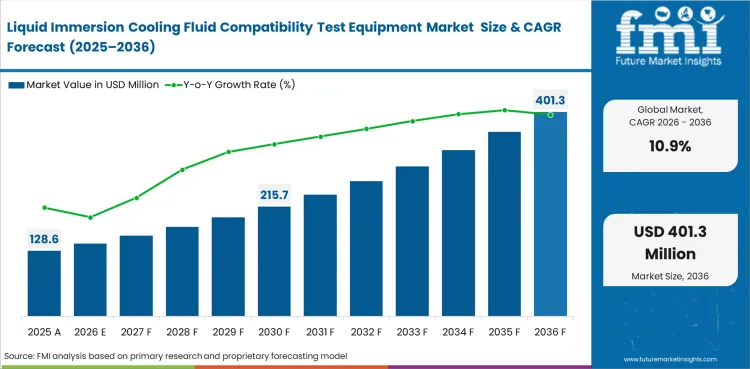
Key Takeaways, Market Size, and Forecast
- The liquid immersion cooling fluid compatibility test equipment market was valued at USD 116.0 million in 2025.
- By 2036, the liquid immersion cooling fluid compatibility test equipment market is expected to reach USD 361.4 million.
- From 2026 to 2036, the market is projected to expand at a CAGR of 10.9%.
- The market is expected to create an incremental opportunity of USD 232.8 million between 2026 and 2036.
- In 2026, material compatibility is forecasted to account for 24.0% of the test type segment.
- Fluid manufacturers are projected to hold 27.0% of total end-use demand in 2026.
- China and India are predicted to rank among the faster-growing national markets through 2036.
Liquid Immersion Cooling Fluid Compatibility Test Equipment Market Value Analysis
- The market is moving from a narrow lab category into a more defined part of immersion cooling validation spending.
- Demand is being driven by the need to check how dielectric fluids interact with wetted materials and exposed components over time.
- Adoption is supported by higher server power density and by the need for better proof before immersion systems are approved for wider use.
- Spending is linked to equipment that can measure fluid stability and material change under controlled test conditions.
Liquid Immersion Cooling Fluid Compatibility Test Equipment Market Definition
The liquid immersion cooling fluid compatibility test equipment market includes instruments and test systems used to evaluate how dielectric immersion fluids interact with hardware materials, seals, plastics, coatings, connectors, storage devices, and related components used in immersion-cooled computing environments.
Liquid Immersion Cooling Fluid Compatibility Test Equipment Market Inclusions
Market scope includes benchtop systems, modular test rigs, pilot validation setups, dielectric measurement systems, corrosion tools, thermal aging chambers, oxidation test systems, and contamination analysis instruments that are used for immersion fluid compatibility work.
Liquid Immersion Cooling Fluid Compatibility Test Equipment Market Exclusions
The scope excludes immersion cooling tanks, production servers, dielectric fluids sold for live operating duty, cooling distribution units, chillers, and general data center thermal management equipment. It excludes broad electronics test systems that are not configured for immersion fluid compatibility work.
Liquid Immersion Cooling Fluid Compatibility Test Equipment Market Research Methodology
- Primary Research: FMI assessed supplier positioning across analytical instrument makers, environmental test equipment providers, immersion validation specialists, and fluid qualification programs active in this niche space.
- Desk Research: The study used non-commercial guidance, public technical documents, and official supplier updates tied to immersion cooling fluid validation, material compatibility, and data center cooling direction.
- Market Sizing and Forecasting: The market was sized through a bottom-up allocation of spending across fluid formulators, OEM validation labs, specialist test providers, and operator qualification centers.
- Data Validation: Forecast assumptions were checked against immersion qualification activity, public infrastructure direction, and active vendor participation across 2024 to 2026.
Why is the Liquid Immersion Cooling Fluid Compatibility Test Equipment Market Growing?
- Higher AI and HPC density is increasing the need for immersion-ready validation before wider deployment.
- Fluid qualification work is becoming more formal across storage, sealing, and other immersed components.
- More pilot deployments are creating repeat demand for screening and long-duration compatibility testing.
The market for liquid immersion cooling fluid compatibility test equipment is growing because immersion cooling places the fluid in direct contact with hardware. Engineers need clear evidence that the fluid will not damagecan maintain seals compatibility, plastics or storage components during long operating cycles. That need supports demand for controlled screening tools and contamination analysis platforms. Growth is strongest where immersion projects are moving from early pilot work programs toward formal qualification and wider deployment.
Fluid developers are spending more on repeated lab work because each formulation must be tested across multiple material sets and hardware combinations. Hardware OEMs are adding more compatibility checks because product approval depends on long-duration stability and reliable field behavior. Immersion system suppliers are placing more weight on validated fluid and -hardware combinations before commercial rollout. This gives the market a stronger solid technical base and supports steady growth in test equipment demand.
Data center operators are placing moreincreasing focus on dense compute environments and cooling efficiency. This supports interest in immersion cooling for selected applications such as AI clusters and systems with very high thermal loads. Each new immersion program increases the need for reliable compatibility work before field deployment begins. That creates a direct path for more spending on purpose-builtdedicated validation equipment.
Market Segmentation Analysis
Material compatibility is expected to lead test demand with 24.0% share in 2026, supported by early-stage approval needs.
- Synthetic hydrocarbons and elastomers are projected to lead their segments with 32.0% and 28.0% shares in 2026.
- Benchtop systems are projected to account for 36.0% of the equipment format segment in 2026.
- Semi-automated systems and qualification and acceptance are projected to hold 44.0% and 31.0% shares in 2026.
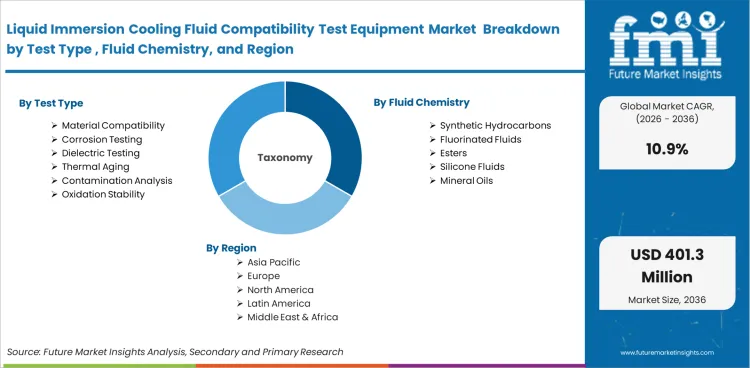
The market is segmented by test type, fluid chemistry, material under test, equipment format, automation level, application stage, end use, and region. Test type includes Material Compatibility, Corrosion Testing, Dielectric Testing, Thermal Aging, Contamination Analysis, and Oxidation Stability. Fluid chemistry includes Synthetic Hydrocarbons, Fluorinated Fluids, Esters, Silicone Fluids, and Mineral Oils. Material under test includes Elastomers, Plastics, Metals, Coatings, PCB Assemblies, and Storage Devices. Equipment format includes Benchtop Systems, Modular Rigs, Pilot Systems, and Integrated Labs. Automation level includes Manual Systems, Semi-automated Systems, and Fully Automated Systems. Application stage includes R&D Screening, Qualification and Acceptance, Pre-deployment Validation, Failure Analysis, and Periodic Monitoring. End use includes Fluid Manufacturers, Hardware OEMs, Immersion System Suppliers, Hyperscale Operators, Third-party Labs, and Research Institutes.
Insights into the Test Type Segment
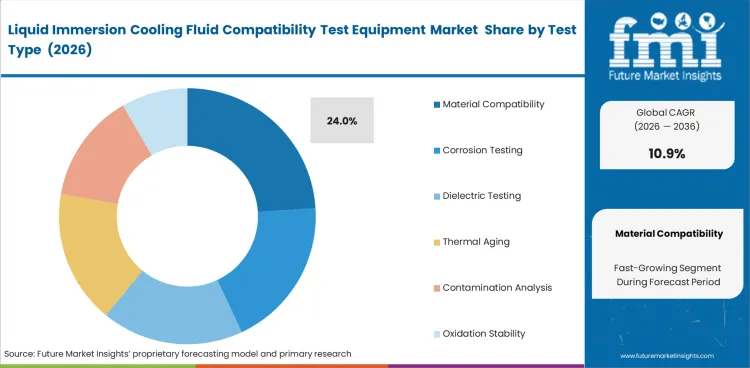
- Material compatibility is expected to account for 24.0% share in 2026. This segment leads because most immersion programs begin with basic confirmation that the fluid will not causecan maintain material stability across swelling or surface change across exposed materialssurfaces.
- Corrosion testing and dielectric testing follow closelyhold the next positions because engineers need more than one proof pointmultiple validation checks before moving a fluid into wider qualification work.
Insights into the Fluid Chemistry Segment
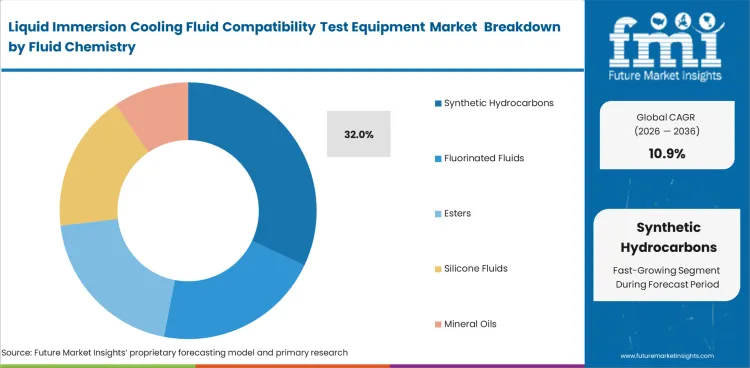
- Synthetic hydrocarbons are projected to represent 32.0% of the market in 2026. This segment leads because single-phase immersion systems have stronger current commercial use and hydrocarbon fluids hold a large place in those deployments.
- Fluorinated fluids are gaining interest in specific two-phase applications. , though sSynthetic hydrocarbons continue to support the wider installed base and pilot baseprograms.
Insights into the Material Under Test Segment
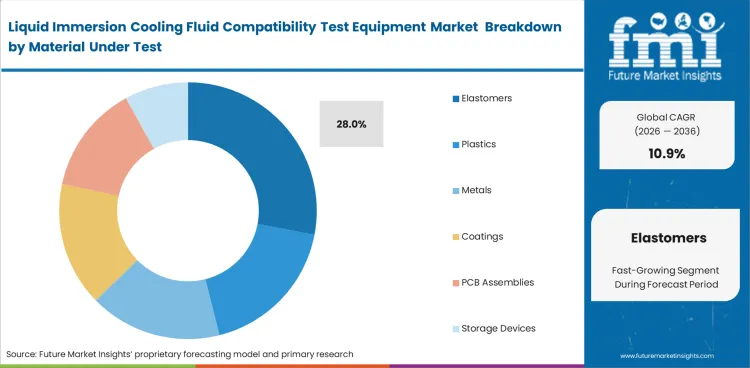
- Elastomers are expected to contribute 28.0% share in 2026. This segment leads because seals and gasket materials face direct exposure and often decidestrongly influence whether a fluid can move from lab approval into practical system use.
- Plastics and coatings hold aaccount for large secondary share because immersion systems rely on stable contact performance across housings and treated surfaces.
Insights into the Equipment Format Segment
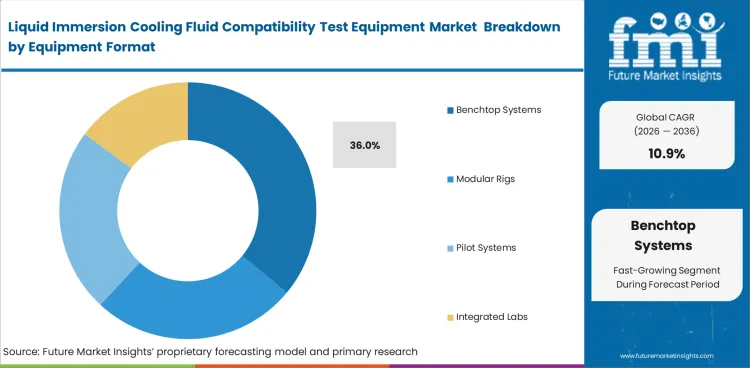
- Benchtop systems are projected to hold 36.0% share in 2026. This segment leads because most compatibility programs begin with controlled small-batch testing before pilot-scale work starts.
- Benchtop formats support faster setup and easier method development, which makes them a practical choice for fluid developers and OEM labs.
Insights into the Automation Level Segment
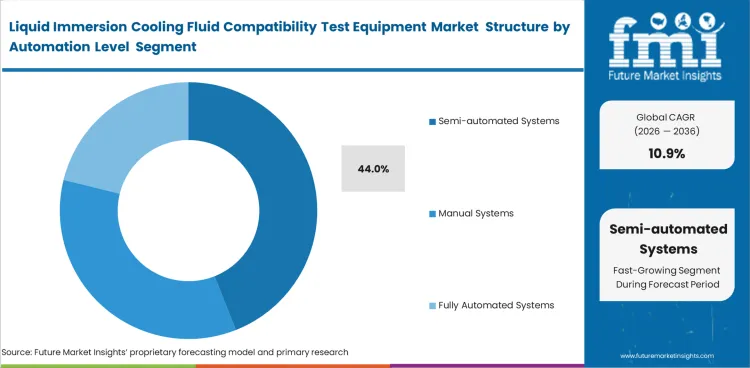
- Semi-automated systems are expected to account for 44.0% share in 2026. This segment leads because labs need repeatable testing and data capture and they still need manual control during sample preparation and inspection work.
- Fully automated systems are gaining relevance in larger qualification centers, though semi-automated systems offer match current market a better fit across current market demand.
Insights into the Application Stage Segment
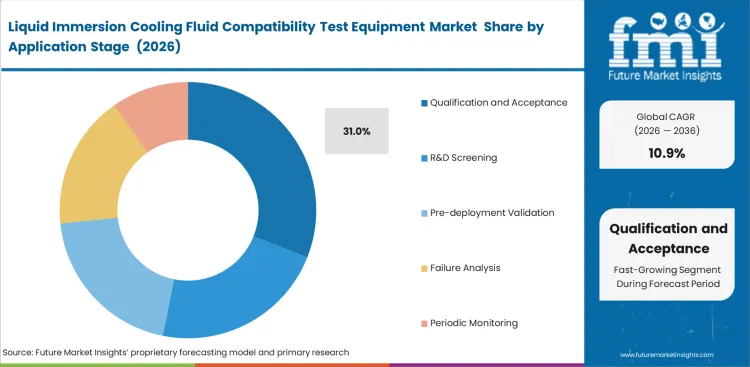
- Qualification and acceptance are expected to hold 31.0% share in 2026. This stage leads because formal approval work pulls together the deepest mix of soak studies and , dielectric checks and with long-duration exposure testing.
- R&D screening covers a broad volume of activity, though qualification work carries heavier greater technical depth and higher equipment intensity.
Liquid Immersion Cooling Fluid Compatibility Test Equipment Market Drivers, Restraints, and Opportunities
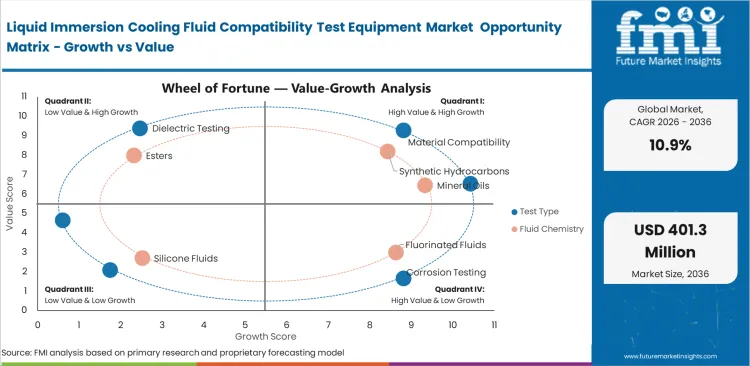
- Formal qualification practice is increasing the need for repeatable immersion fluid compatibility testing.
- The installed immersion base is still limited compared with broader data center cooling methods.
- Wider AI infrastructure growth is opening more opportunity for validation tools linked to dense compute environments.
The market is expanding because compatibility testing is becoming a required step in immersion cooling projects. Engineers need proof on fluid behavior across seals and , plastics and storage components before product approval can move aheadmoves forward. This gives more value toincreases demand for controlled analytical systems and to test setups that can support longer exposure work.
A key restraint comes from the narrow- installed immersion base. Many operators are still prioritizing direct-to-chip liquid cooling before moving into wider immersion deployment. This keeps a large share of demand inside pilot labs and selected qualification centers. Equipment demand therefore depends on steady conversion from pilot testing into broader deployment activity.
Opportunity is strongest in programs linked to AI, HPC, and other high-density computing environments. These systems place more pressure on cooling efficiency and thermal control, which supports interest in immersion methods. As more suppliers move toward qualified fluid-hardware combinations, the market for compatibility test equipment is likely to deepen across both product development and deployment support.
Material Exposure Validation
Demand is driven by the need to measure what happens to wetted materials over time. Swelling and g, mass change and dielectric drift all carry direct impact on hardware life and service reliability. Equipment that can capture these changes in a repeatable way is moving becoming closer central to to the center of immersion approval work.
Limited Installed Base
Growth is moderated by the fact that immersion cooling is still a selective deployment choice across the wider data center base. Air cooling and direct-to-chip systems continue to account for larger installed volumes. This slows the pace of broad equipment adoption and keeps the market focused on specialist validation centers.
Qualified Fluid-Hardware Pairing
A clear trend in this market is the move toward approved fluid-hardware pairings. Open Compute Project guidance recommends placing the tested material in a Soxhlet extractor for 72 hours and verifying that sealing weight and volume do not change by more than 5%, followed by a 2-month monitored verification process for positive screening results. Chemours said Samsung completed nearly a year of testing before qualifying Opteon two-phase immersion cooling fluid and the program used a commercial-scale 48U immersion cooling tank.
Analysis of Liquid Immersion Cooling Fluid Compatibility Test Equipment Market by Key Countries
.webp "Top Country Growth Comparison Liquid Immersion Cooling Fluid Compatibility Test Equipment Market Cagr (2026 2036)")
| Country | CAGR |
|---|---|
| United States | 11.2% |
| China | 12.3% |
| India | 13.1% |
| Singapore | 11.7% |
| Japan | 10.4% |
| South Korea | 10.8% |
| Germany | 10.1% |
Source: FMI analysis based on primary research and proprietary forecasting model
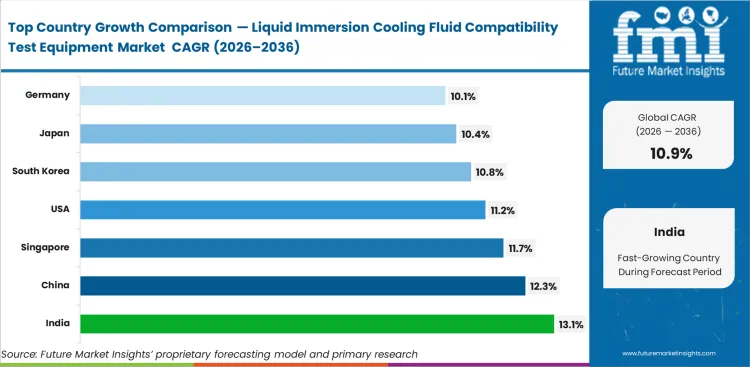
Liquid Immersion Cooling Fluid Compatibility Test Equipment Market CAGR Analysis by Country
- India is expected to lead major country growth with a 13.1% CAGR through 2036.
- China is projected to grow at 12.3% CAGR due to large data center expansion and stronger focus on efficient cooling infrastructure.
- Singapore is forecast to post 11.7% CAGR as efficiency-led policy and selective new capacity support advanced cooling validation.
- The United States is projected to hold 11.2% CAGR, supported by AI infrastructure activity and stronger engineering budgets.
- South Korea, Japan, and Germany are expected to post steady growth through the forecast period due to dense computing demand and stronger engineering discipline.
The global market is projected to rise at a 10.9% CAGR over the forecast period. Country growth differs based on data center build pace, and engineering intensity.
Demand Outlook for Liquid Immersion Cooling Fluid Compatibility Test Equipment Market in the United States
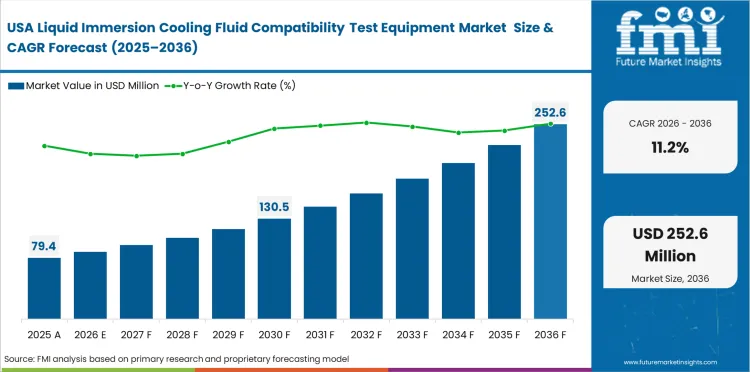
The USA liquid immersion cooling fluid compatibility test equipment market is projected to grow at a CAGR of 11.2% through 2036. Demand is supported by large AI infrastructure activity, and deeper supplier participation across immersion cooling programs. The country continues to holds an important role because fluid developers and immersion system providers carry a stronger base of qualification work here.
- AI infrastructure activity supports larger validation demand.
- Stronger engineering budgets improve adoption of specialist test systems.
- Supplier concentration supports faster movement from pilot work into qualification programs.
Sales Analysis of Liquid Immersion Cooling Fluid Compatibility Test Equipment Market in China
The China liquid immersion cooling fluid compatibility test equipment market is projected to grow at a CAGR of 12.3% through 2036. Demand is linked to large digital infrastructure expansion with wider high-density compute use and stronger national focus on energy-efficient data center operation. China is expected stay to remain one of the faster-growing major markets in this category because immersion cooling interest is rising alongside heavier server loads.
- Large data center expansion increases the addressable validation base.
- Dense compute environments support stronger interest in immersion cooling.
- Growth in local system development raises the need for fluid-material compatibility work.
In-depth Analysis of Liquid Immersion Cooling Fluid Compatibility Test Equipment Market in India
The India liquid immersion cooling fluid compatibility test equipment market is projected to grow at a CAGR of 13.1% through 2036. Demand is rising as digital infrastructure expands and more operators place valuefocus on efficient cooling options for heavier compute loads. India is expected to remain stay the fastest-growing market in this study because it combines new infrastructure development with an earlier adoption stage.
- New data center capacity supports fresh validation demand.
- Higher interest in efficient cooling helps immersion-related testing activity.
- Earlier adoption stage supports a faster growth curve over the forecast period.
Opportunity Analysis of Liquid Immersion Cooling Fluid Compatibility Test Equipment Market in Singapore
The Singapore liquid immersion cooling fluid compatibility test equipment market is projected to grow at a CAGR of 11.7% through 2036. Demand is supported by strict efficiency attention and stronger need for proven cooling methods in constrained infrastructure settings. The market remains is smaller in absolute size, though the country holds strong value as an early validation center for advanced cooling programs.
- Efficiency priorities increase the need for proven hardware and fluid behavior.
- New capacity support raises demand for advanced cooling validation.
- Singapore offers a strong test case for high-efficiency deployment models.
Future Outlook for Liquid Immersion Cooling Fluid Compatibility Test Equipment Market in Japan
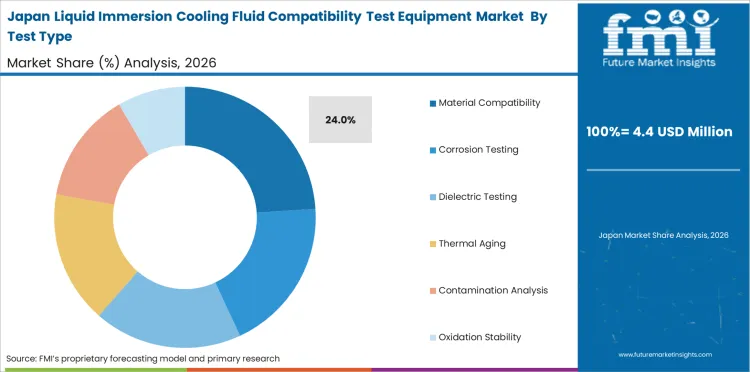
The Japan liquid immersion cooling fluid compatibility test equipment market is projected to grow at a CAGR of 10.4% through 2036. Demand is supported by steady compute growth with a mature engineering base and stronger attention to reliability before wider deployment of new cooling methods. Japan remains is a stable market where careful qualification work carries more weight than fast rollout speedhas high importance.
- Reliable engineering practice supports repeat demand for compatibility testing.
- Compute growth widens the need for advanced thermal management options.
- Market activity depends on disciplined validation rather than rapid commercial expansion.
In-depth Analysis of Liquid Immersion Cooling Fluid Compatibility Test Equipment Market in South Korea
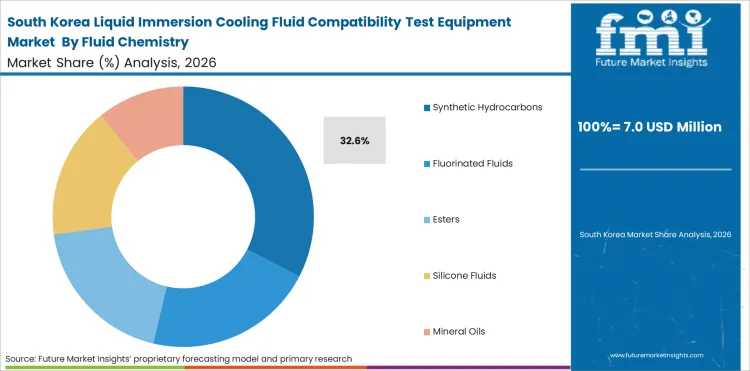
The South Korea liquid immersion cooling fluid compatibility test equipment market is projected to grow at a CAGR of 10.8% through 2036. Demand is supported by high electronics density and growing interest in efficient cooling for advanced digital infrastructure. The country offers a good fit foris well suited to specialist compatibility testing because component quality and qualification standards carry high importance.
- Advanced electronics activity supports strong validation discipline.
- Dense compute demand raises the case for immersion-related test work.
- High quality standards support specialist equipment use in qualification programs.
Sales Outlook for Liquid Immersion Cooling Fluid Compatibility Test Equipment Market in Germany
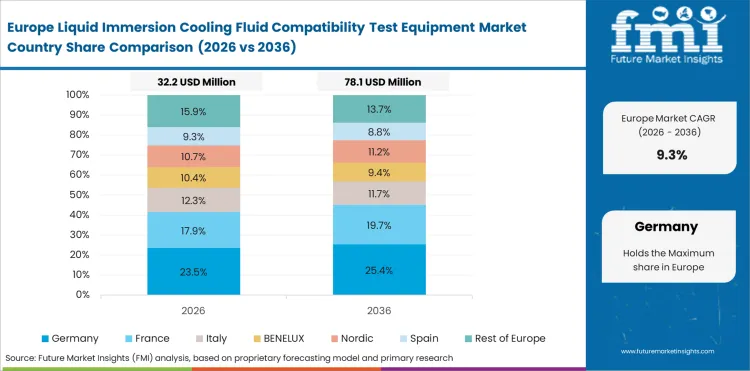
The Germany liquid immersion cooling fluid compatibility test equipment market is projected to grow at a CAGR of 10.1% through 2036. Demand is supported driven by strong laboratory capability and growing interest in efficient cooling methods across advanced digital infrastructure. Germany remains is important for suppliers that offer stable and repeatable testing tools.
- Strong lab capability supports adoption of specialist test systems.
- Validation discipline improves demand for controlled compatibility workflows.
- Efficient cooling interest supports gradual expansion across the forecast period.
Competitive Landscape and Strategic Positioning
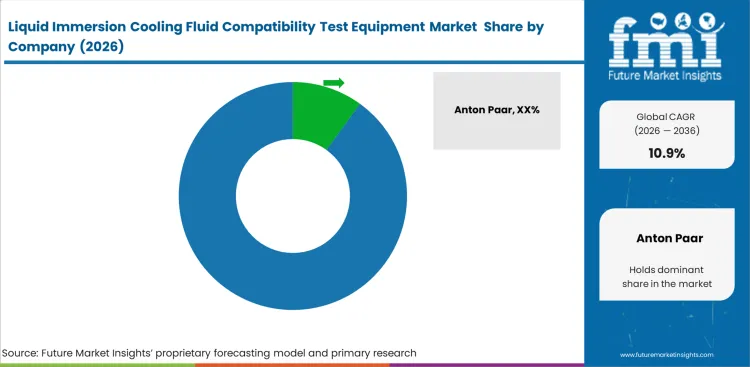
- The market remains fragmented with a mix of analytical instrument suppliers, environmental test equipment providers, and immersion-focused validation specialists.
- Leading companies compete on method reliability and their ability to support fluid chemistry and material testing in one workflow.
- Specialist suppliers can win where accounts need immersion-specific validation knowledge and flexible program support.
Competition in this market depends on technical fit inside qualification workflows. Labs need equipment that can support fluid property analysis and controlled aging under repeatable conditions. Large instrument suppliers hold an advantage through wider lab access and stronger installed bases across industrial testing environments.
Specialist immersion companies carry offer a different strength. They understand how fluid behavior affects real hardware use and how qualification work connects to deployment readiness. This gives them a stronger role in ecosystem testing as well asand pilot validation programs. The market is therefore split between broad instrument capability and immersion-specific application depth.
Barriers include narrow category size and the fact that many accounts buy several instruments and build their own workflow around them.. Strategic priorities include stronger method support and deeper links between fluid developers and immersion system suppliers.
Key Companies in the Liquid Immersion Cooling Fluid Compatibility Test Equipment Market
Key global companies leading the liquid immersion cooling fluid compatibility test equipment market include:
- Anton Paar, AMETEK Brookfield, Metrohm, and Weiss Technik. These companies offer strong lab instrument capability across fluid analysis, controlled exposure work, and thermal test environments.
- Q-Lab, Intertek, and UL Solutions hold relevance through materials exposure capability, reliability workflows, and application support linked to qualification programs.
- Submer, GRC, and MIDAS carry specialist value in immersion-centered testing support, ecosystem validation, and approved fluid-hardware program development.
Competitive Benchmarking: Liquid Immersion Cooling Fluid Compatibility Test Equipment Market
| Company | Fluid Property Testing | Materials Exposure Capability | Immersion Application Depth | Geographic Footprint |
|---|---|---|---|---|
| Anton Paar | High | Medium | Moderate | Global |
| AMETEK Brookfield | High | Medium | Moderate | Global |
| Metrohm | High | Medium | Moderate | Global |
| Weiss Technik | Medium | High | Moderate | Global |
| Q-Lab | Medium | High | Moderate | Global |
| Intertek | Medium | High | Strong | Global |
| UL Solutions | Medium | High | Strong | Global |
| Submer | Low | High | Strong | Multi-region |
| GRC | Low | Medium | Strong | Global |
| MIDAS | Low | Medium | Moderate | North America, Europe |
Source: Future Market Insights competitive analysis, 2026.
Key Developments in the Liquid Immersion Cooling Fluid Compatibility Test Equipment Market
- In September 2025, MIDAS and Oleon announced approval of Qloe fluids for use in MIDAS immersion systems after extensive testing.
- In February 2025, GRC and Cisco announced validation of the first phase of a joint enterprise solution based on Cisco UCS and GRC immersion systems.
Key Players in the Liquid Immersion Cooling Fluid Compatibility Test Equipment Market
Major Global Players
- Anton Paar
- AMETEK Brookfield
- Metrohm
- Weiss Technik
- Q-Lab
- Intertek
- UL Solutions
Emerging Players / Specialists
- Submer
- GRC
- MIDAS
- LiquidStack
- Oleon
Report Scope and Coverage
| Parameter | Details |
|---|---|
| Quantitative Units | USD 128.6 million to USD 361.4 million, at a CAGR of 10.9% from 2026 to 2036 |
| Market Definition | Equipment used to test compatibility between immersion cooling fluids and hardware materials or components |
| Regions Covered | North America, Europe, East Asia, South Asia, Southeast Asia |
| Countries Covered | United States, China, India, Singapore, Japan, South Korea, Germany |
| Key Companies Profiled | Anton Paar, AMETEK Brookfield, Metrohm, Weiss Technik, Q-Lab, Intertek, UL Solutions |
| Forecast Period | 2026 to 2036 |
| Approach | Bottom-up specialist validation equipment sizing cross-checked against immersion qualification activity and public infrastructure direction |
Liquid Immersion Cooling Fluid Compatibility Test Equipment Market by Segments
Liquid Immersion Cooling Fluid Compatibility Test Equipment Market by Test Type
- Material Compatibility
- Corrosion Testing
- Dielectric Testing
- Thermal Aging
- Contamination Analysis
- Oxidation Stability
Liquid Immersion Cooling Fluid Compatibility Test Equipment Market by Fluid Chemistry
- Synthetic Hydrocarbons
- Fluorinated Fluids
- Esters
- Silicone Fluids
- Mineral Oils
Liquid Immersion Cooling Fluid Compatibility Test Equipment Market by Material Under Test
- Elastomers
- Plastics
- Metals
- Coatings
- PCB Assemblies
- Storage Devices
Liquid Immersion Cooling Fluid Compatibility Test Equipment Market by Equipment Format
- Benchtop Systems
- Modular Rigs
- Pilot Systems
- Integrated Labs
Liquid Immersion Cooling Fluid Compatibility Test Equipment Market by Automation Level
- Manual Systems
- Semi-automated Systems
- Fully Automated Systems
Liquid Immersion Cooling Fluid Compatibility Test Equipment Market by Application Stage
- R&D Screening
- Qualification and Acceptance
- Pre-deployment Validation
- Failure Analysis
- Periodic Monitoring
Liquid Immersion Cooling Fluid Compatibility Test Equipment Market by End Use
- Fluid Manufacturers
- Hardware OEMs
- Immersion System Suppliers
- Hyperscale Operators
- Third-party Labs
- Research Institutes
Liquid Immersion Cooling Fluid Compatibility Test Equipment Market by Region
- North America
- United States
- Canada
- Europe
- Germany
- United Kingdom
- France
- Rest of Europe
- East Asia
- China
- Japan
- South Korea
- South Asia
- India
- Rest of South Asia
- Southeast Asia
- Singapore
- Rest of Southeast Asia
Research Sources and Bibliography
- Oleon. (2025, September 17). Oleon and MIDAS join forces to advance sustainable immersion cooling for data centers
- Green Revolution Cooling. (2025, February 4). Cisco and Green Revolution Cooling form engineering alliance.
- Open Compute Project. (2026, March). Guidelines for using dielectric heat transfer fluids in two-phase cold plate-based liquid-cooled racks.
- International Energy Agency. (2025, April 10). Energy and AI. IEA.
- Chemours. (2025, August 13). Samsung Electronics successfully qualifies Chemours Opteon two-phase immersion cooling fluid. Chemours.
This Report Answers
- What is the current and future size of the liquid immersion cooling fluid compatibility test equipment market?
- How fast is the market expected to grow between 2026 and 2036?
- Which test type is likely to lead the market by 2026?
- Which end-use segment is expected to account for the highest demand by 2026?
- What factors are driving market demand globally?
- How are immersion qualification practices influencing equipment demand?
- Why are fluid manufacturers expected to remain a major demand center?
- Which countries are projected to show the fastest growth through 2036?
- What is driving expansion in China, India, and the United States?
- Who are the key companies active in the market?
- How does FMI estimate and validate the market forecast?
Frequently Asked Questions
What is the global market demand for liquid immersion cooling fluid compatibility test equipment in 2026?
In 2026, the global market for liquid immersion cooling fluid compatibility test equipment is expected to be worth USD 128.6 million.
How big will the liquid immersion cooling fluid compatibility test equipment market be in 2036?
By 2036, the market is expected to be worth USD 361.4 million.
How much is demand expected to grow between 2026 and 2036?
Between 2026 and 2036, the market is expected to grow at a CAGR of 10.9%.
Which test type is likely to lead the market by 2026?
Material compatibility is expected to lead the market with an estimated 24.0% share in 2026.
Which end-use segment is expected to lead demand by 2026?
Fluid manufacturers are expected to account for the highest demand with an estimated 27.0% share in 2026.
What is driving demand growth in China?
Demand in China is linked to large digital infrastructure expansion, stronger high-density compute use, and growing interest in efficient cooling methods.
What is driving demand growth in India?
Demand in India is supported by rising data center capacity, expanding digital infrastructure, and stronger interest in efficient cooling for dense compute environments.
Preview the report firsthand - request a free sample
Get SampleGet the brochure for pricing and purchase details.
Get PDFTable of Content
- Key Takeaways
- Market Size and CAGR
- Top Growth Driver
- Fastest Growing Segment
- Leading Region
- Key Companies
- Emerging Opportunities
- Executive Summary
- Global Market Outlook
- Demand-side Trends
- Supply-side Trends
- Technology Roadmap Analysis
- Analysis and Recommendations
- Analyst Perspective (What is happening? Why now? What should investors know?)
- Key Questions Answered
- How large is the market?
- What is the CAGR?
- What are key trends?
- Which region dominates?
- Who are the leaders?
- Market Overview
- Market Coverage / Taxonomy
- Market Definition / Scope / Limitations
- Research Methodology
- Chapter Orientation
- Analytical Lens and Working Hypotheses
- Market Structure, Signals, and Trend Drivers
- Benchmarking and Cross-market Comparability
- Market Sizing, Forecasting, and Opportunity Mapping
- Research Design and Evidence Framework
- Desk Research Programme (Secondary Evidence)
- Expert Input and Fieldwork (Primary Evidence)
- Tooling, Models, and Reference Databases
- Data Engineering and Model Build
- Quality Assurance and Audit Trail
- Market Background
- Market Dynamics (Drivers, Restraints, Opportunity, Trends)
- Scenario Forecast (Optimistic, Likely, Conservative)
- Impact Analysis
- AI Impact
- Sustainability Impact
- Regulatory Impact
- Technology Impact
- Consumer / Buyer Analysis
- Purchase Drivers
- Adoption Barriers
- Buyer Journey
- Opportunity Map Analysis
- Product Life Cycle Analysis
- Supply Chain Analysis
- Investment Feasibility Matrix
- Value Chain Analysis
- PESTLE and Porter's Analysis
- Regulatory Landscape
- Regional Parent Market Outlook
- Production and Consumption Statistics
- Import and Export Statistics
- Global Market Analysis and Forecast, 2021 to 2036
- Historical Market Size Value (USD Million) & Volume (Unit) Analysis, 2021 to 2025
- Current and Future Market Size Value (USD Million) & Volume (Unit) Projections, 2026 to 2036
- Y-o-Y Growth Trend Analysis
- Absolute $ Opportunity Analysis
- Global Market Pricing Analysis, 2021 to 2036
- Global Market Analysis and Forecast, By Test Type, 2021 to 2036
- Introduction / Key Findings
- Historical Market Size Value (USD Million) & Volume (Unit) Analysis By Test Type, 2021 to 2025
- Current and Future Market Size Value (USD Million) & Volume (Unit) Analysis and Forecast By Test Type, 2026 to 2036
- Material Compatibility
- Corrosion Testing
- Dielectric Testing
- Thermal Aging
- Contamination Analysis
- Oxidation Stability
- Material Compatibility
- Y-o-Y Growth Trend Analysis By Test Type, 2021 to 2025
- Absolute $ Opportunity Analysis By Test Type, 2026 to 2036
- Global Market Analysis and Forecast, By Fluid Chemistry, 2021 to 2036
- Introduction / Key Findings
- Historical Market Size Value (USD Million) & Volume (Unit) Analysis By Fluid Chemistry, 2021 to 2025
- Current and Future Market Size Value (USD Million) & Volume (Unit) Analysis and Forecast By Fluid Chemistry, 2026 to 2036
- Synthetic Hydrocarbons
- Fluorinated Fluids
- Esters
- Silicone Fluids
- Mineral Oils
- Synthetic Hydrocarbons
- Y-o-Y Growth Trend Analysis By Fluid Chemistry, 2021 to 2025
- Absolute $ Opportunity Analysis By Fluid Chemistry, 2026 to 2036
- Global Market Analysis and Forecast, By Material Under Test, 2021 to 2036
- Introduction / Key Findings
- Historical Market Size Value (USD Million) & Volume (Unit) Analysis By Material Under Test, 2021 to 2025
- Current and Future Market Size Value (USD Million) & Volume (Unit) Analysis and Forecast By Material Under Test, 2026 to 2036
- Elastomers
- Plastics
- Metals
- Coatings
- PCB Assemblies
- Storage Devices
- Elastomers
- Y-o-Y Growth Trend Analysis By Material Under Test, 2021 to 2025
- Absolute $ Opportunity Analysis By Material Under Test, 2026 to 2036
- Global Market Analysis and Forecast, By Equipment Format, 2021 to 2036
- Introduction / Key Findings
- Historical Market Size Value (USD Million) & Volume (Unit) Analysis By Equipment Format, 2021 to 2025
- Current and Future Market Size Value (USD Million) & Volume (Unit) Analysis and Forecast By Equipment Format, 2026 to 2036
- Benchtop Systems
- Modular Rigs
- Pilot Systems
- Integrated Labs
- Benchtop Systems
- Y-o-Y Growth Trend Analysis By Equipment Format, 2021 to 2025
- Absolute $ Opportunity Analysis By Equipment Format, 2026 to 2036
- Global Market Analysis and Forecast, By Automation Level, 2021 to 2036
- Introduction / Key Findings
- Historical Market Size Value (USD Million) & Volume (Unit) Analysis By Automation Level, 2021 to 2025
- Current and Future Market Size Value (USD Million) & Volume (Unit) Analysis and Forecast By Automation Level, 2026 to 2036
- Semi-automated Systems
- Manual Systems
- Fully Automated Systems
- Semi-automated Systems
- Y-o-Y Growth Trend Analysis By Automation Level, 2021 to 2025
- Absolute $ Opportunity Analysis By Automation Level, 2026 to 2036
- Global Market Analysis and Forecast, By Application Stage
- Introduction / Key Findings
- Historical Market Size Value (USD Million) & Volume (Unit) Analysis By Application Stage, 2021 to 2025
- Current and Future Market Size Value (USD Million) & Volume (Unit) Analysis and Forecast By Application Stage, 2026 to 2036
- Qualification and Acceptance
- R&D Screening
- Pre-deployment Validation
- Failure Analysis
- Periodic Monitoring
- Qualification and Acceptance
- Y-o-Y Growth Trend Analysis By Application Stage, 2021 to 2025
- Absolute $ Opportunity Analysis By Application Stage, 2026 to 2036
- Global Market Analysis and Forecast, By End Use
- Introduction / Key Findings
- Historical Market Size Value (USD Million) & Volume (Unit) Analysis By End Use, 2021 to 2025
- Current and Future Market Size Value (USD Million) & Volume (Unit) Analysis and Forecast By End Use, 2026 to 2036
- Fluid Manufacturers
- Hardware OEMs
- Immersion System Suppliers
- Hyperscale Operators
- Third-party Labs
- Research Institutes
- Fluid Manufacturers
- Y-o-Y Growth Trend Analysis By End Use, 2021 to 2025
- Absolute $ Opportunity Analysis By End Use, 2026 to 2036
- Global Market Analysis and Forecast, By Region, 2021 to 2036
- Introduction
- Historical Market Size Value (USD Million) & Volume (Unit) Analysis By Region, 2021 to 2025
- Current Market Size Value (USD Million) & Volume (Unit) Analysis and Forecast By Region, 2026 to 2036
- North America
- Latin America
- Western Europe
- Eastern Europe
- East Asia
- South Asia and Pacific
- Middle East & Africa
- Market Attractiveness Analysis By Region
- North America Market Analysis and Forecast, By Country, 2021 to 2036
- Historical Market Size Value (USD Million) & Volume (Unit) Trend Analysis By Market Taxonomy, 2021 to 2025
- Market Size Value (USD Million) & Volume (Unit) Forecast By Market Taxonomy, 2026 to 2036
- By Country
- USA
- Canada
- Mexico
- By Test Type
- By Fluid Chemistry
- By Material Under Test
- By Equipment Format
- By Automation Level
- By Application Stage
- By End Use
- By Country
- Market Attractiveness Analysis
- By Country
- By Test Type
- By Fluid Chemistry
- By Material Under Test
- By Equipment Format
- By Automation Level
- By Application Stage
- By End Use
- Key Takeaways
- Latin America Market Analysis and Forecast, By Country
- Historical Market Size Value (USD Million) & Volume (Unit) Trend Analysis By Market Taxonomy, 2021 to 2025
- Market Size Value (USD Million) & Volume (Unit) Forecast By Market Taxonomy, 2026 to 2036
- By Country
- Brazil
- Chile
- Rest of Latin America
- By Test Type
- By Fluid Chemistry
- By Material Under Test
- By Equipment Format
- By Automation Level
- By Application Stage
- By End Use
- By Country
- Market Attractiveness Analysis
- By Country
- By Test Type
- By Fluid Chemistry
- By Material Under Test
- By Equipment Format
- By Automation Level
- By Application Stage
- By End Use
- Key Takeaways
- Western Europe Market Analysis and Forecast, By Country
- Historical Market Size Value (USD Million) & Volume (Unit) Trend Analysis By Market Taxonomy, 2021 to 2025
- Market Size Value (USD Million) & Volume (Unit) Forecast By Market Taxonomy, 2026 to 2036
- By Country
- Germany
- UK
- Italy
- Spain
- France
- Nordic
- BENELUX
- Rest of Western Europe
- By Test Type
- By Fluid Chemistry
- By Material Under Test
- By Equipment Format
- By Automation Level
- By Application Stage
- By End Use
- By Country
- Market Attractiveness Analysis
- By Country
- By Test Type
- By Fluid Chemistry
- By Material Under Test
- By Equipment Format
- By Automation Level
- By Application Stage
- By End Use
- Key Takeaways
- Eastern Europe Market Analysis and Forecast, By Country
- Historical Market Size Value (USD Million) & Volume (Unit) Trend Analysis By Market Taxonomy, 2021 to 2025
- Market Size Value (USD Million) & Volume (Unit) Forecast By Market Taxonomy, 2026 to 2036
- By Country
- Russia
- Poland
- Hungary
- Balkan & Baltic
- Rest of Eastern Europe
- By Test Type
- By Fluid Chemistry
- By Material Under Test
- By Equipment Format
- By Automation Level
- By Application Stage
- By End Use
- By Country
- Market Attractiveness Analysis
- By Country
- By Test Type
- By Fluid Chemistry
- By Material Under Test
- By Equipment Format
- By Automation Level
- By Application Stage
- By End Use
- Key Takeaways
- East Asia Market Analysis and Forecast, By Country
- Historical Market Size Value (USD Million) & Volume (Unit) Trend Analysis By Market Taxonomy, 2021 to 2025
- Market Size Value (USD Million) & Volume (Unit) Forecast By Market Taxonomy, 2026 to 2036
- By Country
- China
- Japan
- South Korea
- By Test Type
- By Fluid Chemistry
- By Material Under Test
- By Equipment Format
- By Automation Level
- By Application Stage
- By End Use
- By Country
- Market Attractiveness Analysis
- By Country
- By Test Type
- By Fluid Chemistry
- By Material Under Test
- By Equipment Format
- By Automation Level
- By Application Stage
- By End Use
- Key Takeaways
- South Asia and Pacific Market Analysis and Forecast, By Country
- Historical Market Size Value (USD Million) & Volume (Unit) Trend Analysis By Market Taxonomy, 2021 to 2025
- Market Size Value (USD Million) & Volume (Unit) Forecast By Market Taxonomy, 2026 to 2036
- By Country
- India
- ASEAN
- Australia & New Zealand
- Rest of South Asia and Pacific
- By Test Type
- By Fluid Chemistry
- By Material Under Test
- By Equipment Format
- By Automation Level
- By Application Stage
- By End Use
- By Country
- Market Attractiveness Analysis
- By Country
- By Test Type
- By Fluid Chemistry
- By Material Under Test
- By Equipment Format
- By Automation Level
- By Application Stage
- By End Use
- Key Takeaways
- Middle East & Africa Market Analysis and Forecast, By Country
- Historical Market Size Value (USD Million) & Volume (Unit) Trend Analysis By Market Taxonomy, 2021 to 2025
- Market Size Value (USD Million) & Volume (Unit) Forecast By Market Taxonomy, 2026 to 2036
- By Country
- Kingdom of Saudi Arabia
- Other GCC Countries
- Türkiye
- South Africa
- Other African Union
- Rest of Middle East & Africa
- By Test Type
- By Fluid Chemistry
- By Material Under Test
- By Equipment Format
- By Automation Level
- By Application Stage
- By End Use
- By Country
- Market Attractiveness Analysis
- By Country
- By Test Type
- By Fluid Chemistry
- By Material Under Test
- By Equipment Format
- By Automation Level
- By Application Stage
- By End Use
- Key Takeaways
- Key Countries Market Analysis
- USA
- Pricing Analysis
- Market Share Analysis, 2025
- By Test Type
- By Fluid Chemistry
- By Material Under Test
- By Equipment Format
- By Automation Level
- By Application Stage
- By End Use
- Canada
- Pricing Analysis
- Market Share Analysis, 2025
- By Test Type
- By Fluid Chemistry
- By Material Under Test
- By Equipment Format
- By Automation Level
- By Application Stage
- By End Use
- Mexico
- Pricing Analysis
- Market Share Analysis, 2025
- By Test Type
- By Fluid Chemistry
- By Material Under Test
- By Equipment Format
- By Automation Level
- By Application Stage
- By End Use
- Brazil
- Pricing Analysis
- Market Share Analysis, 2025
- By Test Type
- By Fluid Chemistry
- By Material Under Test
- By Equipment Format
- By Automation Level
- By Application Stage
- By End Use
- Chile
- Pricing Analysis
- Market Share Analysis, 2025
- By Test Type
- By Fluid Chemistry
- By Material Under Test
- By Equipment Format
- By Automation Level
- By Application Stage
- By End Use
- Germany
- Pricing Analysis
- Market Share Analysis, 2025
- By Test Type
- By Fluid Chemistry
- By Material Under Test
- By Equipment Format
- By Automation Level
- By Application Stage
- By End Use
- UK
- Pricing Analysis
- Market Share Analysis, 2025
- By Test Type
- By Fluid Chemistry
- By Material Under Test
- By Equipment Format
- By Automation Level
- By Application Stage
- By End Use
- Italy
- Pricing Analysis
- Market Share Analysis, 2025
- By Test Type
- By Fluid Chemistry
- By Material Under Test
- By Equipment Format
- By Automation Level
- By Application Stage
- By End Use
- Spain
- Pricing Analysis
- Market Share Analysis, 2025
- By Test Type
- By Fluid Chemistry
- By Material Under Test
- By Equipment Format
- By Automation Level
- By Application Stage
- By End Use
- France
- Pricing Analysis
- Market Share Analysis, 2025
- By Test Type
- By Fluid Chemistry
- By Material Under Test
- By Equipment Format
- By Automation Level
- By Application Stage
- By End Use
- India
- Pricing Analysis
- Market Share Analysis, 2025
- By Test Type
- By Fluid Chemistry
- By Material Under Test
- By Equipment Format
- By Automation Level
- By Application Stage
- By End Use
- ASEAN
- Pricing Analysis
- Market Share Analysis, 2025
- By Test Type
- By Fluid Chemistry
- By Material Under Test
- By Equipment Format
- By Automation Level
- By Application Stage
- By End Use
- Australia & New Zealand
- Pricing Analysis
- Market Share Analysis, 2025
- By Test Type
- By Fluid Chemistry
- By Material Under Test
- By Equipment Format
- By Automation Level
- By Application Stage
- By End Use
- China
- Pricing Analysis
- Market Share Analysis, 2025
- By Test Type
- By Fluid Chemistry
- By Material Under Test
- By Equipment Format
- By Automation Level
- By Application Stage
- By End Use
- Japan
- Pricing Analysis
- Market Share Analysis, 2025
- By Test Type
- By Fluid Chemistry
- By Material Under Test
- By Equipment Format
- By Automation Level
- By Application Stage
- By End Use
- South Korea
- Pricing Analysis
- Market Share Analysis, 2025
- By Test Type
- By Fluid Chemistry
- By Material Under Test
- By Equipment Format
- By Automation Level
- By Application Stage
- By End Use
- Russia
- Pricing Analysis
- Market Share Analysis, 2025
- By Test Type
- By Fluid Chemistry
- By Material Under Test
- By Equipment Format
- By Automation Level
- By Application Stage
- By End Use
- Poland
- Pricing Analysis
- Market Share Analysis, 2025
- By Test Type
- By Fluid Chemistry
- By Material Under Test
- By Equipment Format
- By Automation Level
- By Application Stage
- By End Use
- Hungary
- Pricing Analysis
- Market Share Analysis, 2025
- By Test Type
- By Fluid Chemistry
- By Material Under Test
- By Equipment Format
- By Automation Level
- By Application Stage
- By End Use
- Kingdom of Saudi Arabia
- Pricing Analysis
- Market Share Analysis, 2025
- By Test Type
- By Fluid Chemistry
- By Material Under Test
- By Equipment Format
- By Automation Level
- By Application Stage
- By End Use
- Türkiye
- Pricing Analysis
- Market Share Analysis, 2025
- By Test Type
- By Fluid Chemistry
- By Material Under Test
- By Equipment Format
- By Automation Level
- By Application Stage
- By End Use
- South Africa
- Pricing Analysis
- Market Share Analysis, 2025
- By Test Type
- By Fluid Chemistry
- By Material Under Test
- By Equipment Format
- By Automation Level
- By Application Stage
- By End Use
- USA
- Market Structure Analysis
- Competition Dashboard
- Competition Benchmarking
- Market Share Analysis of Top Players
- By Regional
- By Test Type
- By Fluid Chemistry
- By Material Under Test
- By Equipment Format
- By Automation Level
- By Application Stage
- By End Use
- Emerging Startups
- Innovation Benchmarking
- Competition Analysis
- Competition Deep Dive
- Anton Paar
- Overview
- Product Portfolio
- Profitability by Market Segments (Product/Region/Sales Channel)
- Sales Footprint
- Strategy Overview
- Marketing Strategy
- Product Strategy
- Channel Strategy
- AMETEK Brookfield
- Metrohm
- Weiss Technik
- Q-Lab
- Intertek
- UL Solutions
- Submer
- GRC
- MIDAS
- LiquidStack
- Oleon
- Anton Paar
- Case Studies
- Success Stories
- Recent Developments
- Competition Deep Dive
- Assumptions & Acronyms Used


