

- Industry Size (2026)
- USD 841.6 Mn
- Forecast (2036)
- USD 1391.7 Mn
- CAGR (2026 to 2036)
- 5.2%
Demand for Automated Test Equipment in United Kingdom Forecast and Outlook 2026 to 2036
The automated test equipment market in the United Kingdom is expected to grow from USD 841.6 million in 2026 to USD 1,391.7 million by 2036, at a CAGR of 5.2%. Procurement priorities will be shaped by a focus on long-term reliability and return on investment, as companies aim to ensure the efficiency and accuracy of their testing processes. Buyer risk aversion will drive a preference for established, trusted suppliers with proven performance. Vendor lock-in may increase as equipment becomes more integrated into production lines, raising switching costs for buyers who are reluctant to disrupt operational stability. The costs associated with changing suppliers, whether for reasons of technology upgrades or service continuity, will play a significant role in decision-making. As a result, companies will need to offer strong value propositions, focusing on not only the upfront costs but also long-term service agreements, to remain competitive in this growing market.
Quick Stats for the Demand for Automated Test Equipment in United Kingdom
- Automated Test Equipment in United Kingdom Value (2026): USD 841.6 million
- Automated Test Equipment in United Kingdom Forecast Value (2036): USD 1,391.7 million
- Automated Test Equipment in United Kingdom Forecast CAGR (2026 to 2036): 5.2%
- Automated Test Equipment in United Kingdom Leading Segment: Semiconductor ATE (55% share)
- Key Growth Regions of Automated Test Equipment in United Kingdom: England
- Top Players of Automated Test Equipment in United Kingdom: Teradyne, National Instruments, Chroma ATE, Astronics Corporation, Star Technologies
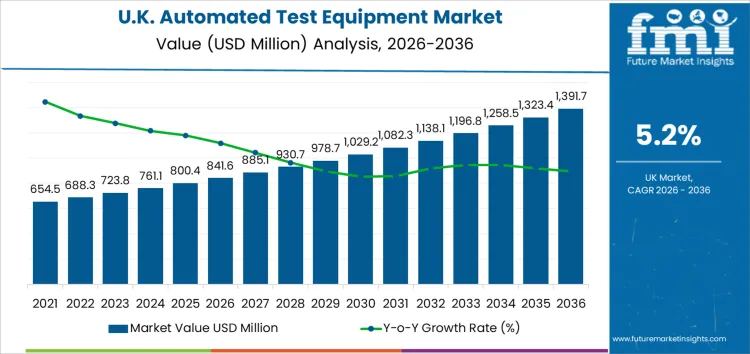
What is the Growth Forecast for Automated Test Equipment in United Kingdom through 2036?
Demand for automated test equipment in the United Kingdom is expected to grow steadily through the forecast period, supported by increasing reliance on precision testing in electronics manufacturing, industrial automation, and high-tech product development. As devices become more complex and quality standards tighten, companies are investing more in automated testing solutions to improve reliability, reduce defects, and maintain consistent production efficiency. Growth is also supported by wider adoption of automation in manufacturing environments where speed, accuracy, and repeatability are critical.
Elasticity analysis indicates that demand for automated test equipment remains linked to broader macroeconomic conditions, particularly trends in GDP growth, manufacturing output, and capital investment in technology. During periods of industrial expansion, demand typically strengthens as manufacturers upgrade testing systems to support higher volumes and more advanced product designs. In contrast, economic slowdowns may delay equipment purchases as companies prioritize cost control and limit discretionary capital spending. Even with these fluctuations, the outlook remains resilient, driven by long-term trends in industrial modernization, the move toward smarter production systems, and the increasing importance of robust testing across key UK technology sectors.
Key Takeaways for Demand for Automated Test Equipment in United Kingdom
| Metric | Value |
|---|---|
| Industry Sales Value (2026) | USD 841.6 million |
| Industry Forecast Value (2036) | USD 1,391.7 million |
| Industry Forecast CAGR (2026 to 2036) | 5.2% |
Why is Demand for Automated Test Equipment in United Kingdom Growing?
Demand for automated test equipment in the United Kingdom has strengthened as technology manufacturers expanded production of complex electronic systems and sought greater test precision. Historically, manual and semi automatic testing processes sufficed for simpler circuitry and lower volumes. UK producers in sectors such as telecommunications, automotive electronics, aerospace, and consumer devices increasingly require test platforms that can handle high pin counts, mixed signal environments, and rapid throughput. Automated test equipment (ATE) supports repeatable test cycles, which helps assure product quality and reduces defect rates.
Engineering and quality assurance teams value ATE for its ability to integrate with design validation workflows and capture detailed performance data. The rise of embedded systems and multifunction modules in modern products made conventional test methods less effective, pushing manufacturers toward automated solutions that deliver accuracy and consistency. These operational realities drove capital investment in ATE across test laboratories and production lines, where reducing test cycle times contributes directly to manufacturing efficiency.
Looking ahead, demand for automated test equipment in the United Kingdom is expected to continue rising as product complexity and compliance requirements evolve. Electronics manufacturers will face increasing pressure to validate functionality in systems incorporating high speed digital interfaces, wireless connectivity, and power management features. ATE suppliers that specialise in flexible platforms capable of handling diverse test protocols will find opportunities as UK firms seek scalable solutions. Test equipment that supports software defined instrumentation and remote diagnostics may appeal to organisations aiming to modernise operations and reduce dependency on manual intervention.
Original equipment manufacturers (OEMs) and contract manufacturers will evaluate ATE investments in the context of lifecycle cost, coverage breadth, and adaptability to future product variants. For suppliers targeting this market, emphasis on modular architectures and service support frameworks will differentiate offerings. Continued uptake of automated test solutions is likely as manufacturers balance throughput demands with quality assurance and regulatory compliance in increasingly competitive technology segments.
What Are the Key Segments in the Demand for Automated Test Equipment in the United Kingdom?
Demand for automated test equipment (ATE) in the United Kingdom is driven by both type and application. Semiconductor ATE leads the type segment with 55%, while semiconductor applications dominate the application segment at 50%. Other types, such as PCB test equipment, system-level test equipment, and RF & wireless ATE, also contribute to the market. These trends reflect the growing demand for high-precision testing solutions in the semiconductor, telecommunications, and industrial automation sectors, where quality control and performance validation are critical.
What Is the Type Segment of Demand for Automated Test Equipment in the United Kingdom?
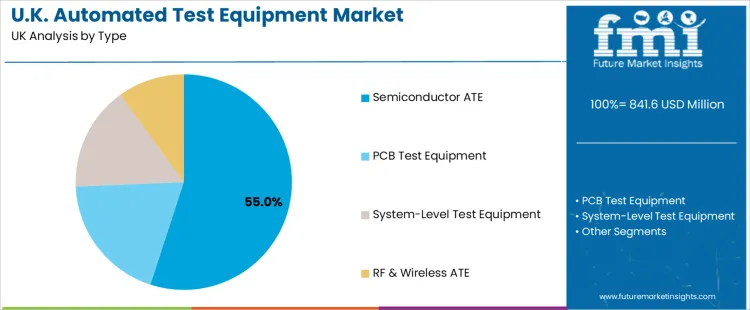
The type segment for automated test equipment in the United Kingdom is predominantly led by semiconductor ATE, which holds a 55% share of the market. Semiconductor ATE is essential for the testing of chips and integrated circuits, ensuring that these components meet stringent quality and performance standards before they are used in electronic devices. The demand for semiconductor ATE is primarily driven by the increasing use of semiconductors in consumer electronics, automotive systems, and industrial automation, where precise and reliable performance is non-negotiable. As new technologies such as 5G, AI, and IoT continue to grow, the need for more advanced semiconductor ATE solutions is expected to rise.
PCB test equipment, though a smaller segment, remains crucial for the testing of printed circuit boards used in a wide variety of electronic products. The growing complexity of PCBs, driven by the miniaturization of electronic devices, demands more sophisticated testing equipment to ensure quality and reliability. System-level test equipment (SLTE) is also important, particularly in industrial automation applications, where it is used to verify the operation of entire systems rather than individual components.
SLTE allows manufacturers to assess the integration and performance of various parts of a system, ensuring that all components work together seamlessly. RF & wireless ATE, while representing a smaller portion of the market, plays a key role in the development and testing of wireless communication devices, including smartphones, routers, and other IoT devices. The increasing reliance on wireless communication across industries is expected to drive growth in this segment.
What Is the Application Segment of Demand for Automated Test Equipment in the United Kingdom?
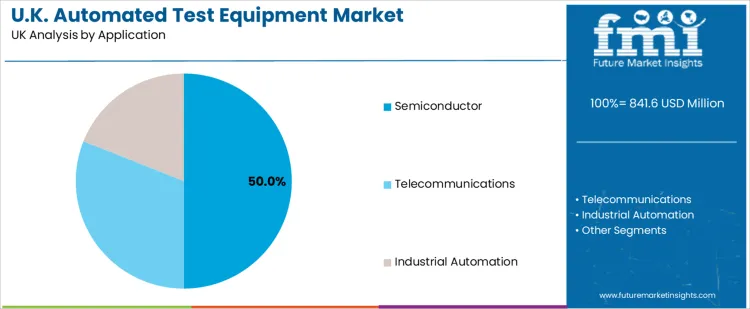
The application segment for automated test equipment in the United Kingdom is dominated by semiconductor applications, which account for 50% of the market share. The semiconductor industry relies heavily on automated testing to ensure that integrated circuits and chips meet quality standards, especially given the increasing complexity of modern electronic devices. The demand for semiconductor ATE is driven by the expansion of the electronics market, particularly in sectors like consumer electronics, automotive, and telecommunications, where performance and reliability are paramount. Automated test equipment is critical for detecting defects and verifying the functionality of semiconductor devices during production.
Telecommunications follow as another significant application for ATE, particularly in the testing of network equipment and communication devices. As the telecom industry transitions to 5G and beyond, the demand for high-precision testing equipment to ensure the performance of telecommunications infrastructure and devices continues to grow. Industrial automation, while representing a smaller portion of the market, remains a key application for system-level test equipment, which ensures the functionality of complex automated systems used in manufacturing, robotics, and control systems. The need for system-level testing in industrial automation is driven by the push toward Industry 4.0 and the increasing integration of smart systems in factories and production lines.
RF & wireless ATE serves a niche yet critical application in the telecommunications and electronics sectors, ensuring that wireless devices meet regulatory standards and performance expectations. As the UK’s industrial and telecommunications sectors continue to evolve, the demand for automated test equipment across these applications is expected to expand, driven by the need for higher quality, reliability, and performance in electronic and communication devices.
What are the Key Dynamics in the Demand for Automated Test Equipment in the United Kingdom?
Demand for Automated Test Equipment (ATE) in the United Kingdom is driven by the need for precision, repeatability, and efficiency in electronics and systems testing. ATE solutions are critical for validating performance, reliability, and compliance across semiconductor, telecommunications, automotive electronics, aerospace, defence, and industrial automation sectors. Growth in advanced electronics production, accelerated adoption of connected devices, and complexity of embedded systems increase reliance on automated testing during development and manufacturing. Procurement patterns are influenced by product lifecycles, quality standards, and certification requirements that mandate rigorous testing protocols.
What are the Key Drivers for Automated Test Equipment Demand in the United Kingdom?
Several factors support demand for Automated Test Equipment in the United Kingdom. Increasing integration of electronic components in automotive systems (including ADAS and EV electronics), telecommunications infrastructure upgrades, and expansion of 5G technologies create demand for high throughput and high accuracy ATE systems. Industry emphasis on reducing time to market encourages manufacturers to adopt automated test platforms that streamline validation and production testing. Regulatory standards for safety and electromagnetic compatibility oblige manufacturers to demonstrate compliance using defined test regimes. Rising investment in research and development facilities, prototyping labs, and contract test houses reinforces ATE procurement across sectors.
What are the Restraints on Automated Test Equipment Demand in the United Kingdom?
Despite broad applicability, the ATE market in the United Kingdom faces several restraints. High initial capital investment for advanced test systems and associated infrastructure can be a barrier for small and medium sized enterprises, especially where budgets are constrained. Long procurement and integration cycles, including customisation for specific test requirements, can extend project timetables and increase total cost of ownership. Skills gaps in test engineering and system integration may limit effective utilisation of sophisticated ATE platforms. Market fragmentation, where different product generations require disparate test solutions, adds complexity for buyers seeking scalable test strategies.
What are the Key Trends in Automated Test Equipment Demand in the United Kingdom?
Key trends shaping ATE demand in the United Kingdom include the shift toward modular and software defined test architectures that allow reconfiguration across product families and reduce hardware dependency. Adoption of cloud enabled test data analytics and remote test management supports distributed engineering teams and improves throughput insights. There is notable growth in mixed signal and RF test capabilities to address requirements of 5G, IoT, and wireless communication devices. Integration of machine learning assisted test optimisation reduces cycle times and enhances defect detection. Collaborative engagements between suppliers and manufacturers to co develop tailored test solutions, including bespoke fixtures and custom software, are becoming more prevalent as companies seek competitive differentiation through test performance and uptime.
What is the Country-Wise Demand for Automated Test Equipment in the United Kingdom?
The demand for automated test equipment (ATE) in the United Kingdom varies by region, with England leading the market. England’s demand is driven by its advanced electronics, automotive, and telecommunications industries, where ATE plays a crucial role in ensuring product reliability and performance. Scotland, Wales, and Northern Ireland follow with steady demand growth, supported by similar industries in their respective regions, including aerospace, manufacturing, and electronics. As the need for higher efficiency, reduced time-to-market, and product precision continues to rise, the demand for automated test equipment is expected to grow across all regions. England remains the largest market, while other regions exhibit increasing demand due to their expanding industrial base and technological advancements.
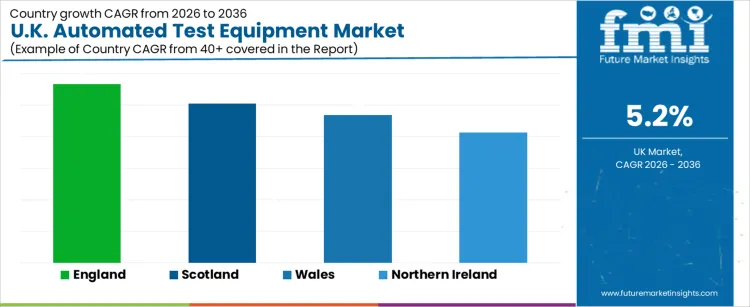
| Country | CAGR (2026 to 2036) |
|---|---|
| England | 5.7% |
| Scotland | 5.1% |
| Wales | 4.7% |
| Northern Ireland | 4.1% |
What is Driving the Demand for Automated Test Equipment in England?
The demand for automated test equipment in England is projected to grow at a CAGR of 5.7% from 2026 to 2036. England's large and diverse industrial sectors, including electronics, telecommunications, and automotive manufacturing, are the primary drivers for ATE adoption. As industries continue to advance technologically, the need for high-precision testing solutions that can handle increased product complexity is becoming more critical. ATE is essential in verifying the functionality, performance, and durability of products during production, reducing the likelihood of defects, and improving overall production efficiency. The increasing demand for consumer electronics, automotive components, and telecommunication equipment, coupled with the ongoing trend of automation in manufacturing processes, is expected to continue driving demand for ATE in England. Additionally, as industries push towards faster product development cycles, the adoption of automated testing systems will play a vital role in meeting the demand for quicker, more accurate results.
How is the Demand for Automated Test Equipment Performing in Scotland?
In Scotland, the demand for automated test equipment is expected to grow at a CAGR of 5.1% from 2026 to 2036. Scotland's growing electronics, aerospace, and automotive industries are key contributors to this demand. As Scottish manufacturers and technology companies work to develop more complex products, the need for efficient, reliable testing solutions is increasing. Automated test equipment is critical in industries such as aerospace, where precise measurements and certifications are required for components, and automotive, where product reliability is essential. Additionally, the rise of smart devices and renewable energy technologies is fueling the need for automated testing in Scotland’s growing tech sectors. With the push for higher production quality and efficiency, Scottish companies are increasingly adopting ATE to streamline testing processes and reduce costs associated with manual inspections. The steady adoption of these systems, driven by both industrial expansion and technological advancements, suggests sustained growth in Scotland’s ATE market.
What Are the Growth Drivers for Automated Test Equipment in Wales?
The demand for automated test equipment in Wales is projected to grow at a CAGR of 4.7% through 2036. The rise of Wales' advanced manufacturing, electronics, and automotive industries is helping to drive this demand. As Wales continues to integrate automation into its industrial processes, the need for automated testing systems to monitor product quality, reduce production errors, and ensure compliance with regulatory standards becomes more crucial. The growing importance of testing in sectors such as telecommunications, where performance and signal integrity must be verified, is contributing to the rising adoption of ATE. Additionally, the increase in electric vehicle manufacturing and the subsequent need for high-precision testing of electronic components are further supporting the demand for automated test equipment in Wales. The trend toward higher product customization and demand for rapid testing solutions is expected to maintain steady growth in the region.
What is the Outlook for Automated Test Equipment Demand in Northern Ireland?
Northern Ireland’s demand for automated test equipment is expected to grow at a CAGR of 4.1% from 2026 to 2036. While Northern Ireland represents the smallest market compared to other regions in the UK, the adoption of ATE is steadily increasing due to the expansion of its manufacturing and electronics sectors. With a growing focus on improving product reliability, increasing automation, and reducing manual labor in testing procedures, businesses in Northern Ireland are turning to automated test systems. Key industries such as aerospace, defense, and electronics are increasingly adopting ATE to ensure product quality and compliance with international standards. As Northern Ireland continues to focus on innovation and technology adoption within its industrial base, the demand for automated test equipment is expected to grow, supported by the need for improved precision and faster turnaround times in production environments.
What is the Competitive Landscape for Demand for Automated Test Equipment in the United Kingdom?
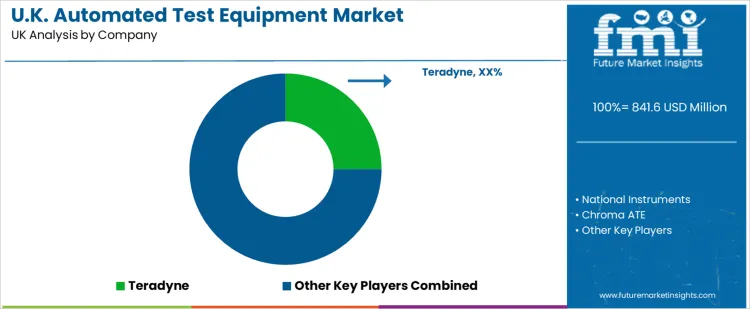
The demand for automated test equipment (ATE) in the United Kingdom is driven by the growing complexity of electronic devices, increasing automation in production lines, and the need for higher accuracy and efficiency in testing systems. Industries such as telecommunications, aerospace, automotive, and semiconductor manufacturing rely heavily on ATE systems to ensure the quality and reliability of their products. Teradyne, a leading player in the UK market, offers cutting-edge test solutions that cater to high-throughput testing needs and integrate seamlessly with modern manufacturing systems. Their offerings, detailed in comprehensive technical documents, are known for their flexibility, scalability, and performance in testing complex electronic systems, making them highly preferred in high-end testing environments.
National Instruments competes by providing modular ATE systems that are favored for their configurability and integration with a wide range of hardware and software tools. Their test solutions are designed to support industries requiring specialized testing capabilities, such as defense and electronics manufacturing. Chroma ATE, with its extensive portfolio, offers automated testing systems specifically geared toward the power electronics and automotive industries, with key selling points including precision, reliability, and adaptability for diverse testing conditions. Astronics Corporation, known for its test and measurement solutions, focuses on sectors like aerospace, with products that support both in-line and off-line testing, offering advanced features like automated testing for avionics and other critical components. Star Technologies provides robust ATE solutions focused on signal integrity, RF testing, and high-frequency testing, meeting the growing demands of the telecommunications and electronics markets in the UK.
In the United Kingdom, procurement decisions are shaped by considerations of system compatibility, scalability, and return on investment. Test equipment suppliers provide extensive technical documentation that helps manufacturers and suppliers evaluate performance specifications, integration capabilities, and long-term service contracts. As test requirements evolve, companies in the UK seek automated solutions that reduce testing time, lower operational costs, and ensure high-quality output across multiple production stages. Buyers also factor in post-purchase support and service, as uptime and equipment reliability are critical in maintaining continuous manufacturing workflows. As the demand for faster, more efficient testing solutions rises, companies competing in the UK ATE market continue to innovate, offering tailored solutions that meet specific industry needs while ensuring compliance with local standards and regulations.
Key Players of the Demand for Automated Test Equipment in United Kingdom
- Teradyne
- National Instruments
- Chroma ATE
- Astronics Corporation
- Star Technologies
Scope of the Report
| Items | Values |
|---|---|
| Quantitative Units (2026) | USD Million |
| Type | Semiconductor ATE, PCB Test Equipment, System-Level Test Equipment, RF & Wireless ATE |
| Application | Semiconductor, Telecommunications, Industrial Automation |
| End Use | Consumer Electronics, Automotive, Aerospace & Defense, Telecommunications, Industrial Automation |
| Companies | Teradyne, National Instruments, Chroma ATE, Astronics Corporation, Star Technologies |
| Regions Covered | United Kingdom |
| Countries Covered | England, Scotland, Wales, Northern Ireland |
| Additional Attributes | Dollar by sales by type, application, end use, and region. Includes market trends towards automation, precision testing, and the role of automated test equipment in enhancing manufacturing and product quality across industries. |
Key Segments of Demand for Automated Test Equipment in United Kingdom
Type
- Semiconductor ATE
- PCB Test Equipment
- System-Level Test Equipment
- RF & Wireless ATE
Application
- Semiconductor
- Telecommunications
- Industrial Automation
End Use
- Consumer Electronics
- Automotive
- Aerospace & Defense
- Telecommunications
- Industrial Automation
Countries
- England
- Scotland
- Wales
- Northern Ireland
Bibliography
- Department for Science, Innovation and Technology. (2024). UK electronics manufacturing strategy and advanced instrumentation priorities. UK Government.
- International Electrotechnical Commission. (2024). IEC 61010-1: Safety requirements for electrical equipment for measurement, control, and laboratory use. IEC.
- Organisation for Economic Co-operation and Development. (2024). Automation, testing infrastructure, and productivity in advanced manufacturing. OECD Publishing.
Frequently Asked Questions
How big is the demand for automated test equipment in united kingdom in 2026?
The demand for automated test equipment in united kingdom is estimated to be valued at USD 841.6 million in 2026.
What will be the size of automated test equipment in united kingdom in 2036?
The market size for the automated test equipment in united kingdom is projected to reach USD 1,391.7 million by 2036.
How much will be the demand for automated test equipment in united kingdom growth between 2026 and 2036?
The demand for automated test equipment in united kingdom is expected to grow at a 5.2% CAGR between 2026 and 2036.
What are the key product types in the automated test equipment in united kingdom?
The key product types in automated test equipment in united kingdom are semiconductor ate, pcb test equipment, system-level test equipment and rf & wireless ate.
Which application segment is expected to contribute significant share in the automated test equipment in united kingdom in 2026?
In terms of application, semiconductor segment is expected to command 50.0% share in the automated test equipment in united kingdom in 2026.
Preview the report firsthand - request a free sample
Get SampleGet the brochure for pricing and purchase details.
Get PDFTable of Content
- Executive Summary
- UK Market Outlook
- Demand-side Trends
- Supply-side Trends
- Technology Roadmap Analysis
- Analysis and Recommendations
- Market Overview
- Market Coverage / Taxonomy
- Market Definition / Scope / Limitations
- Market Background
- Market Dynamics
- Drivers
- Restraints
- Opportunity
- Trends
- Scenario Forecast
- Demand in Optimistic Scenario
- Demand in Likely Scenario
- Demand in Conservative Scenario
- Opportunity Map Analysis
- Product Life Cycle Analysis
- Supply Chain Analysis
- Investment Feasibility Matrix
- Value Chain Analysis
- PESTLE and Porter’s Analysis
- Regulatory Landscape
- Regional Parent Market Outlook
- Production and Consumption Statistics
- Import and Export Statistics
- Market Dynamics
- UK Market Analysis 2021 to 2025 and Forecast, 2026 to 2036
- Historical Market Size Value (USD Million) Analysis, 2021 to 2025
- Current and Future Market Size Value (USD Million) Projections, 2026 to 2036
- Y-o-Y Growth Trend Analysis
- Absolute $ Opportunity Analysis
- UK Market Pricing Analysis 2021 to 2025 and Forecast 2026 to 2036
- UK Market Analysis 2021 to 2025 and Forecast 2026 to 2036, By Type
- Introduction / Key Findings
- Historical Market Size Value (USD Million) Analysis By Type , 2021 to 2025
- Current and Future Market Size Value (USD Million) Analysis and Forecast By Type , 2026 to 2036
- Semiconductor ATE
- PCB Test Equipment
- System-Level Test Equipment
- RF & Wireless ATE
- Semiconductor ATE
- Y-o-Y Growth Trend Analysis By Type , 2021 to 2025
- Absolute $ Opportunity Analysis By Type , 2026 to 2036
- UK Market Analysis 2021 to 2025 and Forecast 2026 to 2036, By Application
- Introduction / Key Findings
- Historical Market Size Value (USD Million) Analysis By Application, 2021 to 2025
- Current and Future Market Size Value (USD Million) Analysis and Forecast By Application, 2026 to 2036
- Semiconductor
- Telecommunications
- Industrial Automation
- Semiconductor
- Y-o-Y Growth Trend Analysis By Application, 2021 to 2025
- Absolute $ Opportunity Analysis By Application, 2026 to 2036
- UK Market Analysis 2021 to 2025 and Forecast 2026 to 2036, By End Use
- Introduction / Key Findings
- Historical Market Size Value (USD Million) Analysis By End Use, 2021 to 2025
- Current and Future Market Size Value (USD Million) Analysis and Forecast By End Use, 2026 to 2036
- Consumer Electronics
- Automotive
- Aerospace & Defense
- Telecommunications
- Industrial Automation
- Consumer Electronics
- Y-o-Y Growth Trend Analysis By End Use, 2021 to 2025
- Absolute $ Opportunity Analysis By End Use, 2026 to 2036
- Market Structure Analysis
- Competition Dashboard
- Competition Benchmarking
- Market Share Analysis of Top Players
- By Regional
- By Type
- By Application
- By End Use
- Competition Analysis
- Competition Deep Dive
- Teradyne
- Overview
- Product Portfolio
- Profitability by Market Segments (Product/Age /Sales Channel/Region)
- Sales Footprint
- Strategy Overview
- Marketing Strategy
- Product Strategy
- Channel Strategy
- National Instruments
- Chroma ATE
- Astronics Corporation
- Star Technologies
- Teradyne
- Competition Deep Dive
- Assumptions & Acronyms Used
- Research Methodology


