

- Industry Size (2026)
- USD 0.7 Bn
- Forecast (2036)
- USD 2.3 Bn
- CAGR (2026 to 2036)
- 12.6%
Rental and Subscription Product Logistics Orchestration Platforms Market Size, Market Forecast and Outlook By FMI
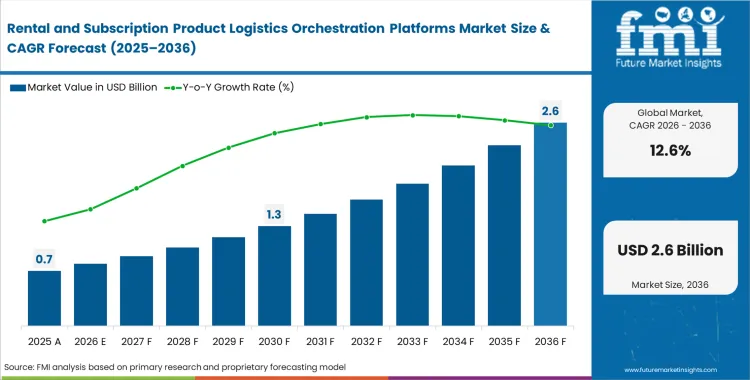
The Rental and Subscription Product Logistics Orchestration Platforms Market stood at USD 0.6 billion in 2025 and is projected to reach USD 0.7 billion in 2026, expanding at a CAGR of 12.6% through the forecast period. The market is expected to reach USD 2.3 billion by 2036 as retailers and product-service providers transition toward subscription and rental models that require continuous inventory circulation.
Summary of Rental and Subscription Product Logistics Orchestration Platforms Market
- Market Snapshot
- The Rental and Subscription Product Logistics Orchestration Platforms Market is valued at USD 0.6 billion in 2025 and is projected to reach USD 2.3 billion by 2036.
- The market is forecast to grow at 12.6% CAGR from 2026 to 2036, creating an incremental opportunity of USD 1.5 billion over the period.
- The category covers software platforms that coordinate outbound shipment, recurring replenishment or swap events, reverse pickup, inspection, cleaning, repair, restock, and resale for rented or subscription-based physical goods.
- The market remains a workflow-heavy software niche where competitiveness depends on policy engines, carrier integration, asset visibility, exchange automation, and value recovery from returned inventory.
- Demand and Growth Drivers
- Demand is being lifted by the scale of retail returns, with NRF and Happy Returns projecting USD 890 billion in returns in 2024 and retailers estimating a 16.9% overall return rate.
- Software demand is rising further because online returns are especially burdensome, with the 2025 NRF/Happy Returns outlook pointing to a 19.3% online return rate.
- Broader digital commerce expansion supports platform spending, with U.S. e-commerce sales reaching USD 1,233.7 billion in 2025, up 5.4% year over year.
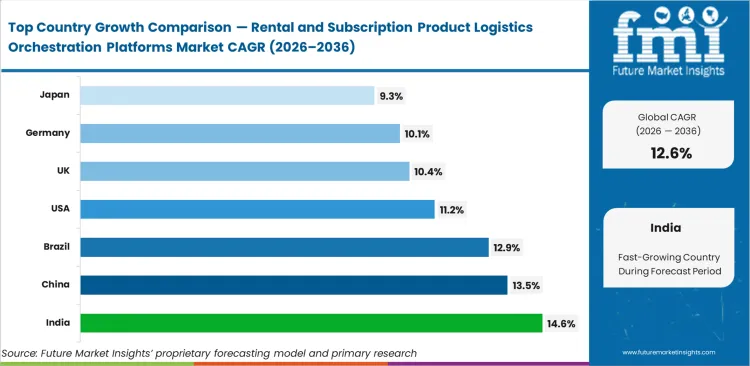
- Regional expansion is anchored by high-growth markets like India (14.6% CAGR) and China (13.5% CAGR), driven by digital-commerce intensity. Mature enterprise software budgets and circular-policy adoption support steady growth across the United States (11.2%), the United Kingdom (10.4%), and Germany (10.1%).
- Growth is moderated by the operational complexity of grading, cleaning, refurbishment, and inventory synchronization, which raises implementation effort compared with standard post-purchase software.
- Product and Segment View
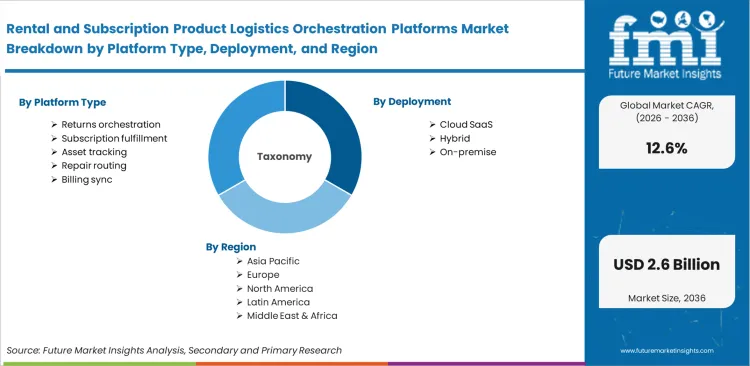
- The market includes orchestration software for returns, subscription cycles, asset status tracking, repair routing, customer policy enforcement, and commerce-system synchronization across recurring physical-product programs.
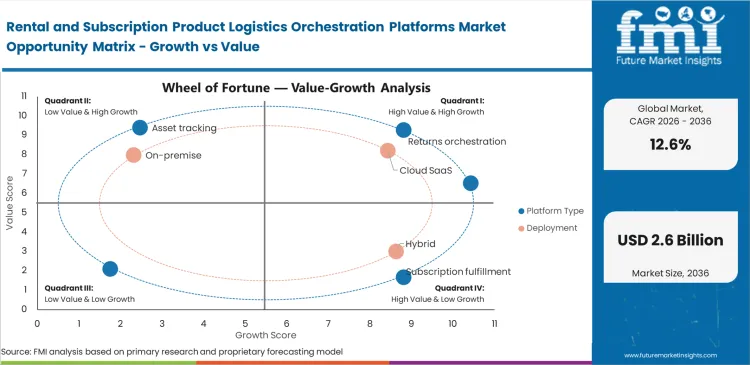
- Returns orchestration leads the Platform Type segment with 31.0% share, reflecting the high frequency of reverse-flow decisions in rental and subscription programs.
- Cloud SaaS leads the Deployment segment with 69.0% share, supported by faster integration with storefronts, ERPs, and carrier APIs.
- Exchanges lead the Workflow segment with 27.0% share, since swap-first logic helps preserve revenue better than straight refunds in recurring programs.
- Fashion rental leads the End Use segment with 38.0% share, backed by circular-fashion adoption and the need to coordinate cleaning, inspection, and recirculation.
- Enterprise brands lead the Buyer Type segment with 44.0% share, because larger operators carry the integration burden of omnichannel inventory, recurring customer accounts, and multi-node reverse logistics.
- Scope includes software used for shipped rentals, refill-like subscriptions with returnable assets, swap cycles, grading, repair, and recirculation. It excludes parcel carriers, standalone billing software, generic WMS tools, and pure rental marketplaces without orchestration software.
- Geography and Competitive Outlook
- India, China, and Brazil are the fastest-growing markets, while the United States remains the most stable high-value demand base as it combines scale in e-commerce, high return rates, and larger enterprise software budgets.
- Competition is shaped by post-purchase automation, exchange conversion, reverse-routing intelligence, and asset-recovery workflows rather than by transportation capacity alone.
- Key vendors include CaaStle, Loop, Narvar, ZigZag, AfterShip, ReverseLogix, and Blue Yonder, with Blue Yonder’s position strengthened by its 2025 acquisition of Optoro.
- The market is moderately fragmented, and the leading player is estimated at significant share, reflecting a still-diverse vendor base spread across rental specialists and broader returns-tech providers.
Rental models introduce operational complexity that traditional fulfillment systems cannot absorb. Chief operating officers are under pressure to manage assets that cycle repeatedly through customers, requiring precise tracking of condition and value at every stage. Attempting to run these workflows on standard warehouse systems leads to delays in inspection, refurbishment, and redeployment, breaking the economics of the model. Logistics teams are increasingly investing in orchestration platforms that tie return flows directly to billing logic, eliminating delays in damage charges and preventing revenue loss.
Platform adoption typically becomes unavoidable once subscriber volumes reach a scale where manual processes can no longer maintain control. At that point, asset loss, delayed returns, and inconsistent quality begin to impact customer experience and margins. Structured platforms improve forecasting accuracy, allowing businesses to operate with leaner inventory while maintaining service levels.
India leads geographic expansion at 14.6% as domestic retail conglomerates rapidly experiment with circular business models to capture middle class consumers. China follows closely at 13.5% driven by heavy integration of secondary commerce into dominant digital lifestyle applications. Brazil expands at 12.9% as logistics networks formalize reverse freight capabilities. United States operations advance at 11.2% reflecting mature enterprise brands scaling their existing pilot programs globally. United Kingdom infrastructure advances at 10.4% while Germany progresses at 10.1%. Japan records 9.3% compound growth reflecting early foundational efficiency in asset recovery.
Segmental Analysis
Rental and Subscription Product Logistics Orchestration Platforms Market Analysis by Platform Type
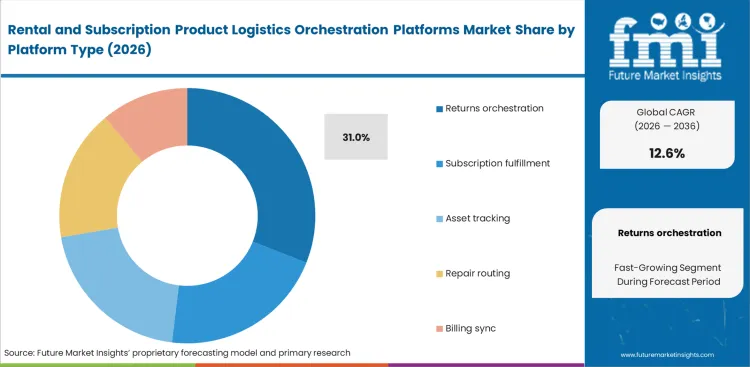
Returns orchestration holds 31.0% as because brands urgently need to control this exact chokepoint. Logistics directors deploy specialized portals that dictate exactly how, when, and where a customer can surrender an asset. Generalist systems fail here because they cannot handle conditional logic based on the item type; a heavy furniture piece requires a scheduled freight pickup, while a leased dress needs a simple drop off code. Executives evaluating a return grading and restock platform realize that if the return process is not orchestrated flawlessly, the asset sits in a customer closet, generating zero revenue while depreciating in value.
- Routing logic: Algorithms direct incoming items to specific regional depots based on the exact type of refurbishment required rather than simple geographic proximity.
- Fraud prevention: Systems flag serial returners or customers who frequently damage high value items, allowing brands to adjust access tiers dynamically.
- Carrier integration: Platforms aggregate multiple regional couriers to ensure the lowest possible reverse freight cost for every single transaction.
Rental and Subscription Product Logistics Orchestration Platforms Market Analysis by Deployment
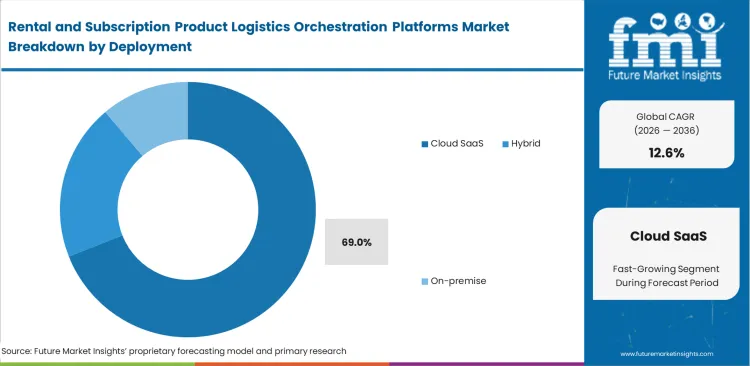
Circular business models inherently require intense collaboration between disparate physical entities that do not share corporate IT infrastructure. Cloud SaaS captures 69.0% share because it provides the only viable method for a brand to directly connect its inventory ledger with independent dry cleaners, electronics repair shops, and third party logistics warehouses. Chief information officers actively block on premise solutions for these workflows to avoid creating massive security vulnerabilities when granting access to external partners. The reliance on robust logistics visibility software hosted in the cloud ensures that a brand can instantly add or remove localized service providers without initiating complex internal IT projects.
- Partner portals: Web based interfaces allow small, independent repair shops to log inspection results directly into the brand central database without complex integration.
- Scalable compute: Server capacity automatically ramps up during peak return windows, such as the end of a retail season, preventing system crashes.
- Remote updates: Software vendors push critical compliance updates globally, ensuring all nodes adhere to changing environmental waste regulations simultaneously.
Rental and Subscription Product Logistics Orchestration Platforms Market Analysis by Workflow
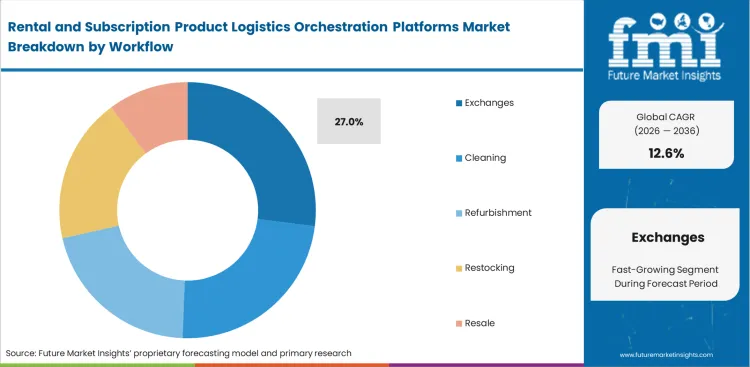
Managing the transition between users defines the efficiency of rental and subscription operations. Exchanges are expected to account for 27.0% share in 2026, as companies focus on synchronizing outbound delivery with inbound returns to maintain service continuity. Each exchange event requires simultaneous coordination of inventory allocation, return tracking, and asset readiness. When these actions are not linked in real time, organizations are forced to hold excess inventory to avoid stockouts, increasing capital lock-in. Specialized orchestration platforms eliminate this disconnect by integrating exchange workflows into a single system, improving asset utilization and reducing idle stock.
- Cross docking automation: Warehouse systems immediately route high demand items from the receiving dock directly to the outbound shipping lane, bypassing storage racks.
- Condition gating: Workflows automatically pause the shipment of a replacement item until the courier scans the barcode of the returning asset at the drop off point.
- Velocity tracking: Analytics engines measure the exact number of hours an item spends in transit versus the time it spends actually generating revenue in the field.
Rental and Subscription Product Logistics Orchestration Platforms Market Analysis by End Use
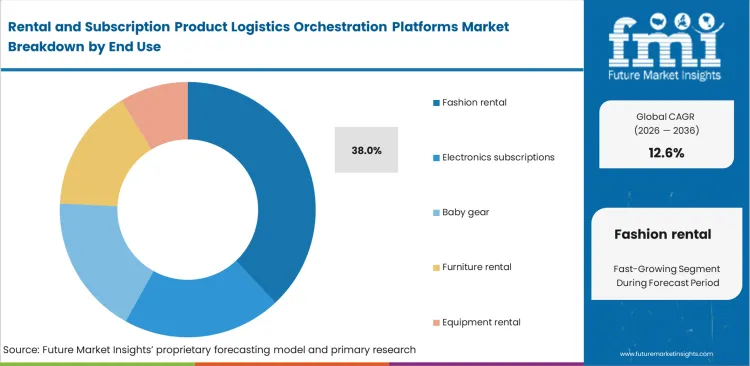
Fashion rental captures 38.0% share as highly capitalized startups and legacy retailers aggressively build capacity for continuous wardrobe rotation. Operations directors rely on circular fashion rental logic to manage the complex reality of textile degradation. A single dress might require minor stitching after three uses, heavy stain removal after five, and permanent retirement after ten. Fashion rental logistics software tracking this exact lifecycle prevents brands from shipping unacceptable garments to premium subscribers, a failure that instantly causes account cancellation.
- Garment serialization: RFID tags or unique barcodes link the physical history of a specific shirt to its digital twin, tracking every single wash cycle it endures.
- Triage routing: Intake applications instruct warehouse workers to route garments either to light steaming, heavy chemical cleaning, or immediate disposal based on real time visual inspection.
- Seasonality forecasting: Algorithms predict when specific styles will experience return surges, allowing facilities to staff appropriately for sudden waves of inbound winter coats.
Rental and Subscription Product Logistics Orchestration Platforms Market Analysis by Buyer Type
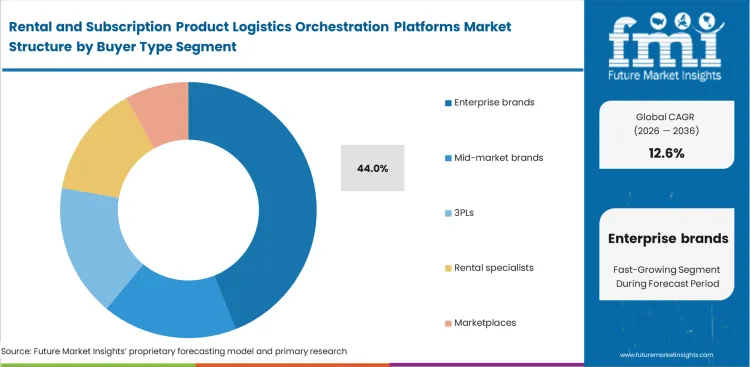
Large enterprises are leading adoption, with the segment expected to account for 44.0% share in 2026, as established retailers expand into rental and subscription models. While these organizations have scale and capital, they often rely on external platforms to manage the complexity of reverse flows rather than building systems internally. Integration with existing fulfillment infrastructure remains critical, as orchestration platforms must operate alongside legacy systems without disrupting core operations.
- System decoupling: IT architects use middleware to isolate the high frequency transaction data of these operations from the slower, highly rigid central enterprise resource planning systems.
- Multi brand consolidated returns: Conglomerates design platforms that allow customers to return items from several different sub brands into a single consolidated shipping box.
- Financial reconciliation: Accounting teams utilize automated reports to properly depreciate the value of physical assets on corporate balance sheets over time.
Rental and Subscription Product Logistics Orchestration Platforms Market Drivers, Restraints, and Opportunities
The intense pressure to improve corporate sustainability metrics forces massive retailers to shift revenue models from linear consumption to circular utilization. Brands can no longer rely on superficial environmental marketing; regulators and institutional investors demand verifiable proof of product lifecycle extension. This mandate drives immediate demand for multi cycle product recirculation software that tracks exactly how many times an asset is reused, repaired, and recirculated. Supply chain executives utilize these platforms not just for operational control, but to generate the auditable data required to prove compliance with incoming international waste reduction legislation.
Severe limitations in physical warehouse infrastructure act as a major restraint on digital deployment. While a brand can easily purchase an advanced orchestration platform, the rental logistics platform ROI deteriorates when their existing third party logistics providers lack the floor space, specialized cleaning equipment, and trained labor required to physically process reverse flows at scale. Chief operating officers are forced to delay software rollouts because their physical fulfillment nodes collapse under the complexity of inspecting, grading, and repairing thousands of disparate individual items. Software logic cannot overcome the absence of physical refurbishment capacity.
Rental and Subscription Product Logistics Orchestration Platforms Market Opportunities
- Secondary market integration: Platform architects link systems directly to apparel re-commerce channels. Operations directors automatically list heavily depreciated assets for permanent secondhand sale exactly when repair costs exceed projected future revenue.
- Predictive maintenance: Engineers embed IoT tracking directly into high value electronics and equipment. Service managers dispatch repair parts proactively before the customer even notices a performance degradation using specialized refurbishment routing software for returns.
- Hyperlocal processing: Logistics leaders route returned items utilizing returned rental inventory directly to nearby retail store backrooms for immediate cleaning and staging. Inventory planners dramatically reduce shipping costs by keeping physical assets circulating within a specific city radius.
Rental and Subscription Product Logistics Orchestration Platforms Market Regional Analysis
Based on regional analysis, Rental and Subscription Product Logistics Orchestration Platforms Market is segmented into North America, Europe, Asia Pacific, and Latin America across selected countries.
.webp "Top Country Growth Comparison Rental And Subscription Product Logistics Orchestration Platforms Market Cagr (2026 2036)")
| Country | CAGR (2026 to 2036) |
|---|---|
| India | 14.6% |
| China | 13.5% |
| Brazil | 12.9% |
| United States | 11.2% |
| United Kingdom | 10.4% |
| Germany | 10.1% |
| Japan | 9.3% |
Source: Future Market Insights (FMI) analysis, based on proprietary forecasting model and primary research
Rental and Subscription Product Logistics Orchestration Platforms Market Asia Pacific Analysis
Urban consumption patterns across Asia Pacific are shifting toward access-based models, increasing the frequency of returns, exchanges, and asset circulation. High population density supports distributed logistics architectures, where localized hubs handle rapid turnaround instead of centralized warehouses. Companies are building dense last-mile networks to manage continuous bidirectional flows, particularly in retail and consumer electronics. This requires logistics systems designed for speed, visibility, and coordination across multiple small nodes rather than bulk movement.
- India: Domestic retail groups are building circular service models to capture demand from urban middle-income consumers. Growth in India is expected at a CAGR of 14.6% through 2036, supported by expansion of two-wheeler-based courier networks that enable fast pickup and return cycles. Companies are prioritizing mobile-first logistics systems to support independent delivery operators. Network design focuses on high-frequency movement within cities rather than long-haul efficiency.
- China: Heavy integration of secondary commerce into dominant digital lifestyle applications drives immense volume. Supply chain leaders utilize advanced sorting robotics to manage massive return surges. Expanding at 13.5% annually. The ecosystem requires robust exchange automation for subscription products capable of handling extreme transaction velocities during major digital shopping festivals.
- Japan: Japan’s market reflects a CAGR of 9.3% through 2036, supported by established recovery and refurbishment practices. Companies are focusing on precision handling of high-value goods, including electronics and premium consumer products. Quality control standards are strict, requiring detailed inspection and grading processes. Logistics systems are optimized for accuracy and consistency rather than scale expansion.
Rental and Subscription Product Logistics Orchestration Platforms Market Latin America Analysis
Logistics networks across the continent are aggressively formalizing their reverse freight capabilities to support emerging circular startups. Retailers recognize that traditional linear sales models price many consumers out of premium goods, making alternative access a critical growth vector. Supply chain leaders actively deploy on-demand logistics frameworks to overcome historically fragmented last mile delivery infrastructure, ensuring reliable retrieval of valuable physical assets.
- Brazil: Logistics networks formalize their reverse freight capabilities to support new fashion and equipment ventures. Procurement officers prioritize platforms that integrate tightly with local courier networks. Advancing at a 12.9% CAGR. Software vendors succeeding here must offer highly flexible routing logic that adapts to unpredictable regional transit delays.
Rental and Subscription Product Logistics Orchestration Platforms Market North America Analysis
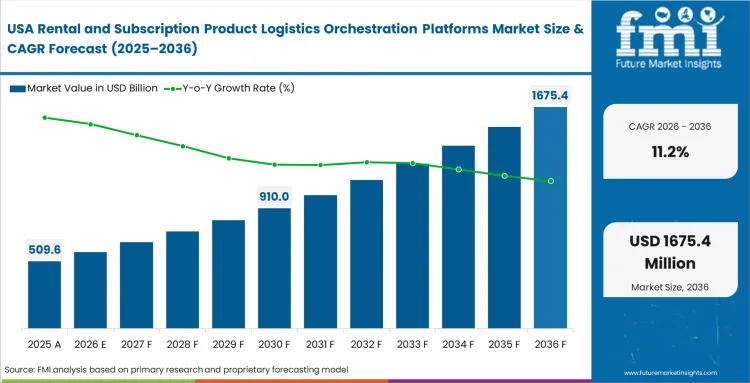
Established retailers are integrating circular models into core operations to compete with specialized rental and resale platforms. Reverse logistics is being treated as a core capability, requiring systems that manage continuous inflow and outflow of goods. Investment is focused on automating refurbishment, grading, and redistribution processes within centralized facilities.
- United States: The United States is set to record a CAGR of 11.2% through 2036 in this market. Retail and apparel companies are scaling rental and subscription models into national operations, increasing demand for structured reverse logistics systems. Centralized refurbishment hubs are being automated to reduce processing time and labor dependency. Platform providers are competing on their ability to improve grading efficiency at intake points.
Rental and Subscription Product Logistics Orchestration Platforms Market Europe Analysis
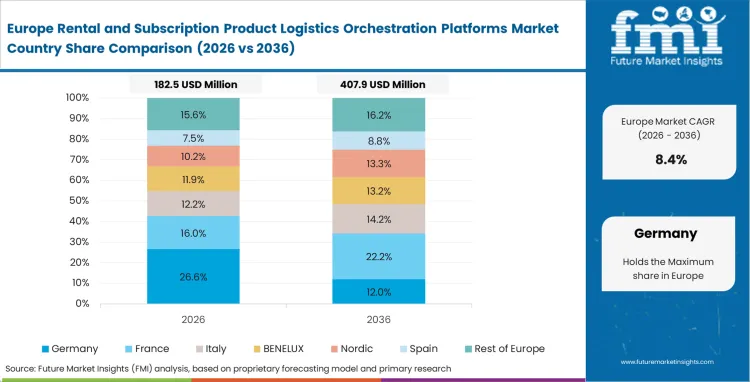
Regulatory pressure across Europe is accelerating adoption of circular logistics systems, particularly in textiles and electronics. Companies are required to track product lifecycles and recovery outcomes with high accuracy to comply with environmental standards. Logistics platforms are being designed to support audit requirements, carbon tracking, and material traceability across multiple markets.
- United Kingdom: Strict incoming environmental regulations propel brands to track asset lifecycles meticulously. Operations directors actively utilize online clothing rental share analysis capabilities to benchmark their own efficiency. Expanding at 10.4% steadily. Platform vendors must provide robust carbon accounting metrics alongside standard operational tracking.
- Germany: Germany’s market is progressing with a CAGR of 10.1% during 2026 to 2036, supported by demand from industrial and equipment leasing sectors. Companies require precise tracking and grading systems to manage high-value assets. Platforms are being customized to handle complex repair and routing workflows, reflecting strong engineering requirements.
Integration of circular economy reporting frameworks also heavily influences the European software procurement strategy, linking primary usage phases directly with eventual resale dispositions.
Rental and Subscription Product Logistics Orchestration Platforms Market Competitive Aligners for Market Players
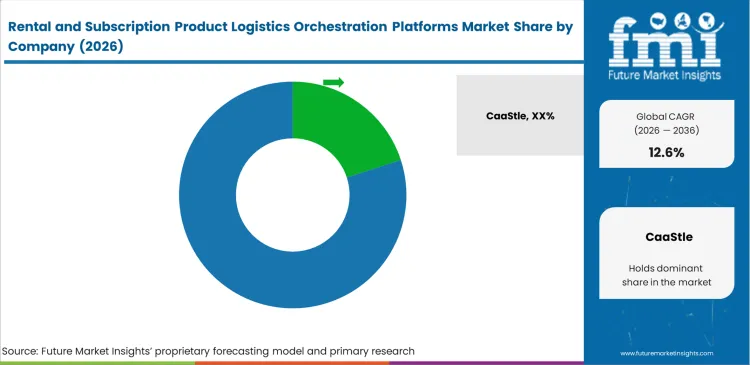
Legacy supply chain software providers struggle significantly to adapt their monolithic architectures to the fluid reality of circular business models. Giants like Blue Yonder attempt to capture this space by bolting reverse modules onto their existing forward fulfillment engines. Chief operating officers frequently find these adapted tools too rigid to handle the nuance of a used item return, where an asset might need a quick steam, a major repair, or permanent retirement. Buyers evaluating the rental logistics software implementation cost often face challenging implementations when facility workers reject the poorly designed interfaces required for high speed item grading within legacy ERP systems.
Pure play startups exploit this agility gap by designing circular commerce software explicitly for the life of a recirculated asset. Companies like CaaStle and Loop build their entire architecture around the concept that a return is not a failure, but a scheduled event. Strategic buyers prefer these specialized vendors because their platforms include pre built logic for complex scenarios, such as prorating a fee when a customer returns an item late but in pristine condition. These agile vendors frequently utilize reusable apparel e-commerce mailers as physical touchpoints that sync directly with their digital tracking environments.
The most competitive tactic involves offering white label enterprise rental logistics SaaS as a fully managed service rather than just selling software. Vendors combine their end-to-end multimodal shipment visibility platforms with dedicated physical warehouse space, effectively taking the entire burden of cleaning, repairing, and restocking off the retailer hands. Retail vice presidents hesitant to disrupt their efficient forward hubs frequently sign these comprehensive contracts. By controlling both the software and the physical facility, these specialized operators build a strong data advantage regarding exact item durability and optimal refurbishment techniques prior to shifting items to secondary market liquidation channels.
Key Players
- CaaStle
- Loop
- Narvar
- ZigZag
- AfterShip
- ReverseLogix
- Blue Yonder
Scope of the Report
| Metric | Value |
|---|---|
| Quantitative Units | USD 0.7 billion to USD 2.3 billion, at a CAGR of 12.6% |
| Market Definition | Specialized software solutions designed to manage the continuous bidirectional flow of physical goods. These systems track individual asset condition, coordinate return shipping, manage refurbishment routing, and synchronize physical receipt events directly with recurring customer billing ledgers. |
| Segmentation | Platform Type, Deployment, Workflow, End Use, Buyer Type, Region |
| Regions Covered | North America, Latin America, Europe, Asia Pacific, Middle East and Africa |
| Countries Covered | United States, Canada, Brazil, Mexico, Germany, United Kingdom, France, Italy, Spain, China, Japan, India, ASEAN, ANZ, GCC |
| Key Companies Profiled | CaaStle, Loop, Narvar, ZigZag, AfterShip, ReverseLogix, Blue Yonder |
| Forecast Period | 2026 to 2036 |
| Approach | Annual recurring revenue figures from pure play reverse orchestration vendors served as the foundational baseline for valuation models. Independent facility processing volume reports from specialized cleaning and refurbishment centers cross validated the projected software deployment scale. |
Source: Future Market Insights (FMI) analysis, based on proprietary forecasting model and primary research
Analysis by Segments
Platform Type:
- Returns orchestration
- Subscription fulfillment
- Asset tracking
- Repair routing
- Billing sync
Deployment:
- Cloud SaaS
- Hybrid
- On-premise
Workflow:
- Exchanges
- Cleaning
- Refurbishment
- Restocking
- Resale
End Use:
- Fashion rental
- Electronics subscriptions
- Baby gear
- Furniture rental
- Equipment rental
Buyer Type:
- Enterprise brands
- Mid-market brands
- 3PLs
- Rental specialists
- Marketplaces
Region:
- North America
- Latin America
- Europe
- Asia Pacific
- Middle East and Africa
Bibliography
- Census Bureau, USA Department of Commerce. (2026, March 10). Quarterly retail e-commerce sales: 4th quarter 2025.
- European Environment Agency. (2024, May 21). Management of used and waste textiles in Europe’s circular economy.
- Islam, M. T., Khan, M. I., & Ali, A. (2025). Circular business models: A state-of-the-art systematic literature review and future opportunities. Sustainable Futures.
- National Retail Federation. (2024, December 5). 2024 consumer returns in the retail industry.
- Nilsson, F. R., & Hazen, B. (2025). Designing logistics processes to support sustainable business-to-consumer rental models. The International Journal of Logistics Management.
This bibliography is provided for reader reference and is not exhaustive. The full report contains all source materials and granular documentation.
This Report Addresses
- The critical operational failure points when legacy forward distribution software attempts to manage complex bidirectional asset flows.
- The exact volume threshold where manual spreadsheet tracking of rented inventory causes catastrophic revenue leakage.
- How cloud based partner portals enable rapid integration with highly localized, independent cleaning and repair facilities.
- The necessity of linking physical condition grading scans directly to recurring customer billing ledgers.
- The transition from fast fashion consumption toward high frequency wardrobe as a service models requiring intense textile triage.
- The impact of incoming European environmental mandates on the deployment of auditable product lifecycle tracking systems.
- The strategic advantage pure play circular startups hold over legacy software giants relying on bolted on reverse modules.
- The utilization of secondary commerce channels to permanently offload assets when refurbishment costs exceed future value.
Frequently Asked Questions
What is a rental and subscription product logistics orchestration platform?
It comprises specialized software solutions designed to manage the continuous bidirectional flow of physical goods. Providers architect physical and digital infrastructure allowing organizations to track individual asset condition, coordinate return shipping, manage refurbishment routing, and synchronize physical receipt events directly with recurring customer billing ledgers.
How large is the market in 2025, 2026, and 2036?
The valuation stood at USD 0.6 billion in 2025. Demand increases to USD 0.7 billion in 2026 and expands to USD 2.3 billion by 2036. This scale illustrates that specialized reverse logistics platforms are becoming mandatory core infrastructure rather than niche operational experiments.
What is driving demand for rental logistics software?
High customer acquisition costs force brands to maximize the lifetime value of individual physical assets through repeated usage cycles. Simultaneously, manual inspection processes at return depots create massive labor bottlenecks that erode the profitability of pilot programs, forcing automated tracking adoption.
Why is fashion rental the leading end use segment?
Securing 38.0% share, apparel demands intense operational agility due to sizing complexities and severe sanitation needs. Software must track individual garment degradation meticulously to prevent shipping unacceptable items to premium subscribers.
How is rental logistics orchestration different from standard returns software?
Standard returns software treats a return as a failure and a final step. Orchestration software treats a return as the core engine of revenue generation, incorporating complex condition grading, repair routing, and immediate billing synchronization to prepare the asset for its next user.
Which workflows matter most in recurring product logistics?
Accounting for 27.0% share, exchanges represent the highest frequency interaction. Systems must instantly allocate an outbound replacement while simultaneously opening a receiving ticket for the return to prevent massive buffer stock requirements.
Which countries are growing fastest?
Expanding at a 14.6% CAGR, India sees rapid experimentation from domestic conglomerates seeking to serve aspirational consumers via access models. China follows at 13.5% utilizing advanced sorting robotics to handle massive return surges.
Which companies are active in this market?
Key players driving the recurring commerce logistics platform sector include CaaStle, Loop, Narvar, ZigZag, AfterShip, ReverseLogix, and Blue Yonder.
What features should buyers evaluate before selecting a vendor?
Buyers must evaluate open API architectures, automated damage chargeback controls, real time tracking, dynamic routing logic for localized repairs, and system decoupling capabilities from rigid ERP systems.
How do circular economy policies affect platform demand?
Strict mandates regarding textile and electronic waste force brands to utilize tracking platforms as mandatory compliance tools. Systems must generate auditable carbon and lifecycle data to protect the brand from massive incoming environmental taxation.
Preview the report firsthand - request a free sample
Get SampleGet the brochure for pricing and purchase details.
Get PDFTable of Content
- Executive Summary
- Global Market Outlook
- Demand-side Trends
- Supply-side Trends
- Technology Roadmap Analysis
- Analysis and Recommendations
- Market Overview
- Market Coverage / Taxonomy
- Market Definition / Scope / Limitations
- Research Methodology
- Chapter Orientation
- Analytical Lens and Working Hypotheses
- Market Structure, Signals, and Trend Drivers
- Benchmarking and Cross-market Comparability
- Market Sizing, Forecasting, and Opportunity Mapping
- Research Design and Evidence Framework
- Desk Research Programme (Secondary Evidence)
- Company Annual and Sustainability Reports
- Peer-reviewed Journals and Academic Literature
- Corporate Websites, Product Literature, and Technical Notes
- Earnings Decks and Investor Briefings
- Statutory Filings and Regulatory Disclosures
- Technical White Papers and Standards Notes
- Trade Journals, Industry Magazines, and Analyst Briefs
- Conference Proceedings, Webinars, and Seminar Materials
- Government Statistics Portals and Public Data Releases
- Press Releases and Reputable Media Coverage
- Specialist Newsletters and Curated Briefings
- Sector Databases and Reference Repositories
- FMI Internal Proprietary Databases and Historical Market Datasets
- Subscription Datasets and Paid Sources
- Social Channels, Communities, and Digital Listening Inputs
- Additional Desk Sources
- Expert Input and Fieldwork (Primary Evidence)
- Primary Modes
- Qualitative Interviews and Expert Elicitation
- Quantitative Surveys and Structured Data Capture
- Blended Approach
- Why Primary Evidence is Used
- Field Techniques
- Interviews
- Surveys
- Focus Groups
- Observational and In-context Research
- Social and Community Interactions
- Stakeholder Universe Engaged
- C-suite Leaders
- Board Members
- Presidents and Vice Presidents
- R&D and Innovation Heads
- Technical Specialists
- Domain Subject-matter Experts
- Scientists
- Physicians and Other Healthcare Professionals
- Governance, Ethics, and Data Stewardship
- Research Ethics
- Data Integrity and Handling
- Primary Modes
- Tooling, Models, and Reference Databases
- Desk Research Programme (Secondary Evidence)
- Data Engineering and Model Build
- Data Acquisition and Ingestion
- Cleaning, Normalisation, and Verification
- Synthesis, Triangulation, and Analysis
- Quality Assurance and Audit Trail
- Market Background
- Market Dynamics
- Drivers
- Restraints
- Opportunity
- Trends
- Scenario Forecast
- Demand in Optimistic Scenario
- Demand in Likely Scenario
- Demand in Conservative Scenario
- Opportunity Map Analysis
- Product Life Cycle Analysis
- Supply Chain Analysis
- Investment Feasibility Matrix
- Value Chain Analysis
- PESTLE and Porter’s Analysis
- Regulatory Landscape
- Regional Parent Market Outlook
- Production and Consumption Statistics
- Import and Export Statistics
- Market Dynamics
- Global Market Analysis 2021 to 2025 and Forecast, 2026 to 2036
- Historical Market Size Value (USD Million) Analysis, 2021 to 2025
- Current and Future Market Size Value (USD Million) Projections, 2026 to 2036
- Y-o-Y Growth Trend Analysis
- Absolute $ Opportunity Analysis
- Global Market Pricing Analysis 2021 to 2025 and Forecast 2026 to 2036
- Global Market Analysis 2021 to 2025 and Forecast 2026 to 2036, By Platform Type
- Introduction / Key Findings
- Historical Market Size Value (USD Million) Analysis By Platform Type , 2021 to 2025
- Current and Future Market Size Value (USD Million) Analysis and Forecast By Platform Type , 2026 to 2036
- Returns orchestration
- Subscription fulfillment
- Asset tracking
- Repair routing
- Billing sync
- Returns orchestration
- Y-o-Y Growth Trend Analysis By Platform Type , 2021 to 2025
- Absolute $ Opportunity Analysis By Platform Type , 2026 to 2036
- Global Market Analysis 2021 to 2025 and Forecast 2026 to 2036, By Deployment
- Introduction / Key Findings
- Historical Market Size Value (USD Million) Analysis By Deployment, 2021 to 2025
- Current and Future Market Size Value (USD Million) Analysis and Forecast By Deployment, 2026 to 2036
- Cloud SaaS
- Hybrid
- On-premise
- Cloud SaaS
- Y-o-Y Growth Trend Analysis By Deployment, 2021 to 2025
- Absolute $ Opportunity Analysis By Deployment, 2026 to 2036
- Global Market Analysis 2021 to 2025 and Forecast 2026 to 2036, By Workflow
- Introduction / Key Findings
- Historical Market Size Value (USD Million) Analysis By Workflow, 2021 to 2025
- Current and Future Market Size Value (USD Million) Analysis and Forecast By Workflow, 2026 to 2036
- Exchanges
- Cleaning
- Refurbishment
- Restocking
- Resale
- Exchanges
- Y-o-Y Growth Trend Analysis By Workflow, 2021 to 2025
- Absolute $ Opportunity Analysis By Workflow, 2026 to 2036
- Global Market Analysis 2021 to 2025 and Forecast 2026 to 2036, By End Use
- Introduction / Key Findings
- Historical Market Size Value (USD Million) Analysis By End Use, 2021 to 2025
- Current and Future Market Size Value (USD Million) Analysis and Forecast By End Use, 2026 to 2036
- Fashion rental
- Electronics subscriptions
- Baby gear
- Furniture rental
- Equipment rental
- Fashion rental
- Y-o-Y Growth Trend Analysis By End Use, 2021 to 2025
- Absolute $ Opportunity Analysis By End Use, 2026 to 2036
- Global Market Analysis 2021 to 2025 and Forecast 2026 to 2036, By Buyer Type
- Introduction / Key Findings
- Historical Market Size Value (USD Million) Analysis By Buyer Type, 2021 to 2025
- Current and Future Market Size Value (USD Million) Analysis and Forecast By Buyer Type, 2026 to 2036
- Enterprise brands
- Mid-market brands
- 3PLs
- Rental specialists
- Marketplaces
- Enterprise brands
- Y-o-Y Growth Trend Analysis By Buyer Type, 2021 to 2025
- Absolute $ Opportunity Analysis By Buyer Type, 2026 to 2036
- Global Market Analysis 2021 to 2025 and Forecast 2026 to 2036, By Region
- Introduction
- Historical Market Size Value (USD Million) Analysis By Region, 2021 to 2025
- Current Market Size Value (USD Million) Analysis and Forecast By Region, 2026 to 2036
- North America
- Latin America
- Western Europe
- Eastern Europe
- East Asia
- South Asia and Pacific
- Middle East & Africa
- Market Attractiveness Analysis By Region
- North America Market Analysis 2021 to 2025 and Forecast 2026 to 2036, By Country
- Historical Market Size Value (USD Million) Trend Analysis By Market Taxonomy, 2021 to 2025
- Market Size Value (USD Million) Forecast By Market Taxonomy, 2026 to 2036
- By Country
- USA
- Canada
- Mexico
- By Platform Type
- By Deployment
- By Workflow
- By End Use
- By Buyer Type
- By Country
- Market Attractiveness Analysis
- By Country
- By Platform Type
- By Deployment
- By Workflow
- By End Use
- By Buyer Type
- Key Takeaways
- Latin America Market Analysis 2021 to 2025 and Forecast 2026 to 2036, By Country
- Historical Market Size Value (USD Million) Trend Analysis By Market Taxonomy, 2021 to 2025
- Market Size Value (USD Million) Forecast By Market Taxonomy, 2026 to 2036
- By Country
- Brazil
- Chile
- Rest of Latin America
- By Platform Type
- By Deployment
- By Workflow
- By End Use
- By Buyer Type
- By Country
- Market Attractiveness Analysis
- By Country
- By Platform Type
- By Deployment
- By Workflow
- By End Use
- By Buyer Type
- Key Takeaways
- Western Europe Market Analysis 2021 to 2025 and Forecast 2026 to 2036, By Country
- Historical Market Size Value (USD Million) Trend Analysis By Market Taxonomy, 2021 to 2025
- Market Size Value (USD Million) Forecast By Market Taxonomy, 2026 to 2036
- By Country
- Germany
- UK
- Italy
- Spain
- France
- Nordic
- BENELUX
- Rest of Western Europe
- By Platform Type
- By Deployment
- By Workflow
- By End Use
- By Buyer Type
- By Country
- Market Attractiveness Analysis
- By Country
- By Platform Type
- By Deployment
- By Workflow
- By End Use
- By Buyer Type
- Key Takeaways
- Eastern Europe Market Analysis 2021 to 2025 and Forecast 2026 to 2036, By Country
- Historical Market Size Value (USD Million) Trend Analysis By Market Taxonomy, 2021 to 2025
- Market Size Value (USD Million) Forecast By Market Taxonomy, 2026 to 2036
- By Country
- Russia
- Poland
- Hungary
- Balkan & Baltic
- Rest of Eastern Europe
- By Platform Type
- By Deployment
- By Workflow
- By End Use
- By Buyer Type
- By Country
- Market Attractiveness Analysis
- By Country
- By Platform Type
- By Deployment
- By Workflow
- By End Use
- By Buyer Type
- Key Takeaways
- East Asia Market Analysis 2021 to 2025 and Forecast 2026 to 2036, By Country
- Historical Market Size Value (USD Million) Trend Analysis By Market Taxonomy, 2021 to 2025
- Market Size Value (USD Million) Forecast By Market Taxonomy, 2026 to 2036
- By Country
- China
- Japan
- South Korea
- By Platform Type
- By Deployment
- By Workflow
- By End Use
- By Buyer Type
- By Country
- Market Attractiveness Analysis
- By Country
- By Platform Type
- By Deployment
- By Workflow
- By End Use
- By Buyer Type
- Key Takeaways
- South Asia and Pacific Market Analysis 2021 to 2025 and Forecast 2026 to 2036, By Country
- Historical Market Size Value (USD Million) Trend Analysis By Market Taxonomy, 2021 to 2025
- Market Size Value (USD Million) Forecast By Market Taxonomy, 2026 to 2036
- By Country
- India
- ASEAN
- Australia & New Zealand
- Rest of South Asia and Pacific
- By Platform Type
- By Deployment
- By Workflow
- By End Use
- By Buyer Type
- By Country
- Market Attractiveness Analysis
- By Country
- By Platform Type
- By Deployment
- By Workflow
- By End Use
- By Buyer Type
- Key Takeaways
- Middle East & Africa Market Analysis 2021 to 2025 and Forecast 2026 to 2036, By Country
- Historical Market Size Value (USD Million) Trend Analysis By Market Taxonomy, 2021 to 2025
- Market Size Value (USD Million) Forecast By Market Taxonomy, 2026 to 2036
- By Country
- Kingdom of Saudi Arabia
- Other GCC Countries
- Turkiye
- South Africa
- Other African Union
- Rest of Middle East & Africa
- By Platform Type
- By Deployment
- By Workflow
- By End Use
- By Buyer Type
- By Country
- Market Attractiveness Analysis
- By Country
- By Platform Type
- By Deployment
- By Workflow
- By End Use
- By Buyer Type
- Key Takeaways
- Key Countries Market Analysis
- USA
- Pricing Analysis
- Market Share Analysis, 2025
- By Platform Type
- By Deployment
- By Workflow
- By End Use
- By Buyer Type
- Canada
- Pricing Analysis
- Market Share Analysis, 2025
- By Platform Type
- By Deployment
- By Workflow
- By End Use
- By Buyer Type
- Mexico
- Pricing Analysis
- Market Share Analysis, 2025
- By Platform Type
- By Deployment
- By Workflow
- By End Use
- By Buyer Type
- Brazil
- Pricing Analysis
- Market Share Analysis, 2025
- By Platform Type
- By Deployment
- By Workflow
- By End Use
- By Buyer Type
- Chile
- Pricing Analysis
- Market Share Analysis, 2025
- By Platform Type
- By Deployment
- By Workflow
- By End Use
- By Buyer Type
- Germany
- Pricing Analysis
- Market Share Analysis, 2025
- By Platform Type
- By Deployment
- By Workflow
- By End Use
- By Buyer Type
- UK
- Pricing Analysis
- Market Share Analysis, 2025
- By Platform Type
- By Deployment
- By Workflow
- By End Use
- By Buyer Type
- Italy
- Pricing Analysis
- Market Share Analysis, 2025
- By Platform Type
- By Deployment
- By Workflow
- By End Use
- By Buyer Type
- Spain
- Pricing Analysis
- Market Share Analysis, 2025
- By Platform Type
- By Deployment
- By Workflow
- By End Use
- By Buyer Type
- France
- Pricing Analysis
- Market Share Analysis, 2025
- By Platform Type
- By Deployment
- By Workflow
- By End Use
- By Buyer Type
- India
- Pricing Analysis
- Market Share Analysis, 2025
- By Platform Type
- By Deployment
- By Workflow
- By End Use
- By Buyer Type
- ASEAN
- Pricing Analysis
- Market Share Analysis, 2025
- By Platform Type
- By Deployment
- By Workflow
- By End Use
- By Buyer Type
- Australia & New Zealand
- Pricing Analysis
- Market Share Analysis, 2025
- By Platform Type
- By Deployment
- By Workflow
- By End Use
- By Buyer Type
- China
- Pricing Analysis
- Market Share Analysis, 2025
- By Platform Type
- By Deployment
- By Workflow
- By End Use
- By Buyer Type
- Japan
- Pricing Analysis
- Market Share Analysis, 2025
- By Platform Type
- By Deployment
- By Workflow
- By End Use
- By Buyer Type
- South Korea
- Pricing Analysis
- Market Share Analysis, 2025
- By Platform Type
- By Deployment
- By Workflow
- By End Use
- By Buyer Type
- Russia
- Pricing Analysis
- Market Share Analysis, 2025
- By Platform Type
- By Deployment
- By Workflow
- By End Use
- By Buyer Type
- Poland
- Pricing Analysis
- Market Share Analysis, 2025
- By Platform Type
- By Deployment
- By Workflow
- By End Use
- By Buyer Type
- Hungary
- Pricing Analysis
- Market Share Analysis, 2025
- By Platform Type
- By Deployment
- By Workflow
- By End Use
- By Buyer Type
- Kingdom of Saudi Arabia
- Pricing Analysis
- Market Share Analysis, 2025
- By Platform Type
- By Deployment
- By Workflow
- By End Use
- By Buyer Type
- Turkiye
- Pricing Analysis
- Market Share Analysis, 2025
- By Platform Type
- By Deployment
- By Workflow
- By End Use
- By Buyer Type
- South Africa
- Pricing Analysis
- Market Share Analysis, 2025
- By Platform Type
- By Deployment
- By Workflow
- By End Use
- By Buyer Type
- USA
- Market Structure Analysis
- Competition Dashboard
- Competition Benchmarking
- Market Share Analysis of Top Players
- By Regional
- By Platform Type
- By Deployment
- By Workflow
- By End Use
- By Buyer Type
- Competition Analysis
- Competition Deep Dive
- CaaStle
- Overview
- Product Portfolio
- Profitability by Market Segments (Product/Age /Sales Channel/Region)
- Sales Footprint
- Strategy Overview
- Marketing Strategy
- Product Strategy
- Channel Strategy
- Loop
- Narvar
- ZigZag
- AfterShip
- ReverseLogix
- Blue Yonder
- CaaStle
- Competition Deep Dive
- Assumptions & Acronyms Used


