

- Industry Size (2026)
- Forecast (2036)
- USD 7.0 Bn
- CAGR (2026 to 2036)
- 9.60%
Circular Fashion Rental Market Size, Market Forecast and Outlook By FMI
The circular fashion rental market crossed a valuation of USD 2.6 billion in 2025. Industry is poised to reach USD 2.8 billion in 2026 at a CAGR of 9.60% during the forecast. Demand outlook carries the market valuation to USD 7.0 billion through 2036 as millennial subscription commitments and corporate uniform pivots extend rotational access to mid-tier enterprises previously reliant on linear inventory models.
Gen Z event planners selecting occasion-specific outfits trigger platform algorithms that curate multi-use wardrobes from shared inventories. These selections convert sporadic rental inquiries into recurring revenue streams by bundling complementary accessories with core garments. Corporate sustainability officers enforcing zero-waste policies extend this model to employee uniform rotations, where rented ensembles circulate across departments before refurbishment cycles begin.
Compound expansion at 9.60% through 2036 carries the market to USD 7.0 billion as regulatory carbon disclosure mandates force apparel brands to integrate rental fulfillment into their core supply chains. The rate holds firm because platforms now embed predictive inventory algorithms that match garment durability to user frequency patterns, minimizing underutilization losses that plagued early adopters.
Summary of Circular Fashion Rental Market
- Circular Fashion Rental Market Definition
- Circular fashion rental systems deliver apparel access via platforms that sequence garments through user, cleaning, and resale stages to maximize lifecycle value. This model depends on predictive demand algorithms to balance inventory across user cohorts.
- Demand Drivers in the Market
- Urban professionals squeezed by space constraints opt for rental tiers that deliver curated monthly drops, converting fixed closet costs into variable access fees.
- Corporate diversity officers mandate inclusive uniform leasing to comply with equity audits, routing ensembles through multi-employee rotations.
- Festival organizers facing peak-load spikes lease ethnic collections in bulk, leveraging shared wardrobes to slash per-event procurement expenses.
- Key Segments Analyzed in the FMI Report
- Ethnic Wear: 33.0% share in 2026, as cultural event calendars drive rotational demand for occasion-specific silhouettes.
- Business-to-Business: 89.4% share in 2026, reflecting enterprise contracts that scale uniform access across global workforces.
- Subscription-based: 48.0% share in 2026, sustained by retention mechanics that personalize drops to minimize churn.
- China: 12.8% compound growth, fueled by e-commerce penetration in tier-2 cities.
- Analyst Opinion at FMI
- Ronak Shah, Principal Consultant for Consumer Product, suggests, "In my analysis, I have observed that the persistent myth of rental as a niche indulgence ignores how platforms now achieve 20x garment utilization through micro-segmented inventory pools, yet the unspoken friction lies in return psychology, where users hoard items beyond lease terms to signal status in social feeds. Procurement teams delaying B2B integration overlook the 30% margin uplift from bundled ESG credits, but only if contracts specify verifiable rotation audits. Apparel brands crossing into owned rental arms by 2028 will capture 15% incremental revenue from refurbished lines, forcing linear retailers to pivot or cede shelf space entirely."
- Strategic Implications / Executive Takeaways
- Platform founders should embed ARPU boosters like virtual styling sessions to offset 10% quarterly churn in millennial cohorts.
- Corporate uniform directors must audit supplier rotation proofs to unlock tax incentives tied to circular compliance thresholds.
- Brand partnerships teams need to co-develop rent-to-own hybrids that convert 20% of lessees into loyalty program anchors.
- Methodology
- Primary Research: FMI engaged wardrobe platform executives, B2B leasing coordinators, and circular supply chain auditors across 40 countries to benchmark utilization metrics.
- Desk Research: Core data pulled from Ellen MacArthur Foundation circular benchmarks, FAST textile sustainability trackers, and brand-specific ESG impact reports.
- Market-Sizing and Forecasting: Bottom-up build from active subscriber bases, escalated by regional penetration rates and ARPU growth vectors.
- Data Validation and Update Cycle: Outputs reconciled with e-commerce logistics volumes and sustainability certification audits from leading platforms.
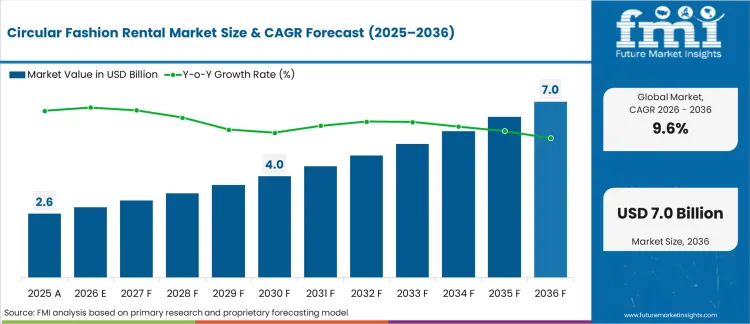
Circular Fashion Rental Market Key Takeaways
| Metric | Details |
|---|---|
| Industry Size (2026) | USD 2.8 billion |
| Industry Value (2036) | USD 7.0 billion |
| CAGR (2026-2036) | 9.60% |
Source: Future Market Insights (FMI) analysis, based on proprietary forecasting model and primary research
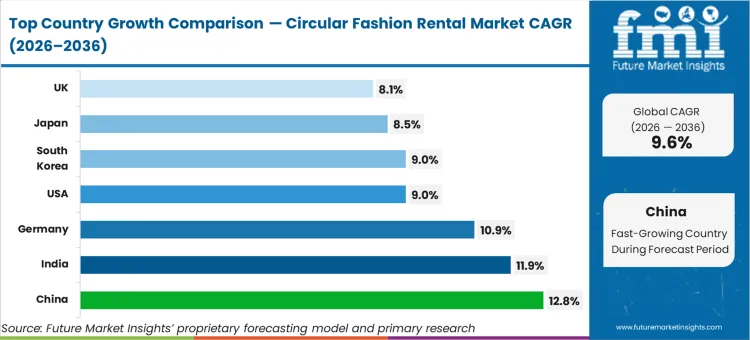
China advances at a 12.8% CAGR through 2036, propelled by urban professionals prioritizing capsule wardrobes amid rising disposable income levels. India registers 11.9% growth as festival-driven demand cycles amplify subscription retention rates. Germany tracks a 10.9% trajectory anchored by strict textile waste directives that penalize linear consumption models. The United States posts 9.0% expansion supported by corporate ESG commitments in uniform provisioning. South Korea expands at 9.0% driven by K-fashion influencers promoting shared styling services. The United Kingdom follows at 8.1% as high-street brands launch co-branded rental pods in retail footprints. Japan grows at 8.5% with precision logistics enabling same-day urban deliveries. This geographic variance underscores how localized cultural triggers embed rental mechanics into everyday apparel decisions.
Circular Fashion Rental Market Definition
Circular fashion rental encompasses digital platforms and physical hubs that facilitate temporary access to apparel inventories through structured leasing agreements. These systems prioritize garment longevity by routing items through cleaning, repair, and resale pipelines after each use cycle. The boundary hinges on multi-rotation utilization rates exceeding 15 cycles per piece to qualify as circular, distinguishing it from one-off event hires.
Circular Fashion Rental Market Inclusions
Scope covers subscription portals aggregating ethnic and performance garments for rotational access, alongside B2B uniform leasing for corporate fleets. Embedded services include AI-driven fit matching and blockchain-tracked provenance to verify sustainable sourcing. Online clothing rental platforms form the core, with add-ons like styling consultations and return logistics fully incorporated.
Circular Fashion Rental Market Exclusions
One-time purchase resale marketplaces without leasing components fall outside, as do bespoke tailoring services lacking shared inventory mechanics. Non-apparel accessories and raw fabric leasing programs remain omitted to maintain focus on ready-to-wear rotation economics.
Circular Fashion Rental Market Research Methodology
- Primary Research: Analysts interviewed platform inventory managers, corporate procurement leads, and sustainability coordinators to identify rotation frequency thresholds driving platform scalability.
- Desk Research: Baseline aggregation drew from AVMC sustainability filings, WRAP circular economy benchmarks, and major apparel brand ESG disclosures.
- Market-Sizing and Forecasting: Starting from verified subscription user counts, the model applies churn-adjusted ARPU projections layered with regional adoption curves.
- Data Validation and Update Cycle: Forecasts cross-check against quarterly platform revenue filings and third-party logistics throughput metrics from key fulfillment partners.
Segmental Analysis
Circular Fashion Rental Market Analysis by Product Type
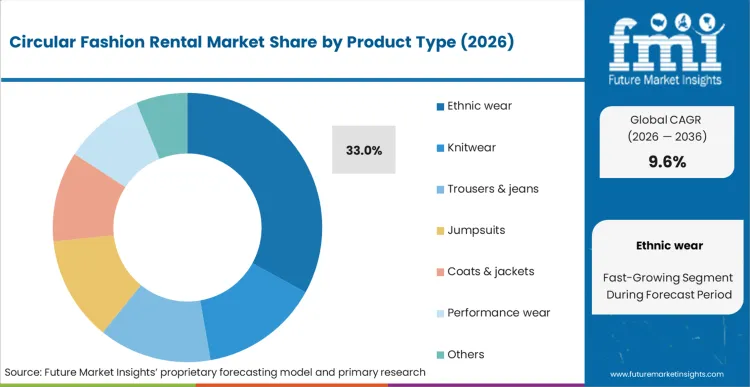
Cultural event coordinators scaling seasonal wardrobes beyond personal ownership thresholds now anchor bulk leases on versatile silhouettes. Ethnic wear commands 33.0% share in 2026, as platforms route festival-ready pieces through 20-cycle rotations before resale gates. This dominance stems from modular styling that layers base garments with accessories, extending utility across user profiles. Based on FMI's assessment, the segment's velocity hinges on antimicrobial treatments that preserve fabric integrity post-multiple launderings. Secondhand apparel trends underscore how ethnic lines bridge traditional and modern wardrobes.
- Pattern Matching: Algorithmic pairing of user profiles with ethnic variants minimizes mismatch returns, keeping more inventory in active circulation.
- Durability Standards: Fabrics engineered for repeated wash resilience enable cross-season deployments, reducing refurbishment intervals.
- Styling Extensions: Accessory bundling converts single-item leases into ensemble packages, boosting session values without expanding core holdings.
Circular Fashion Rental Market Analysis by End User
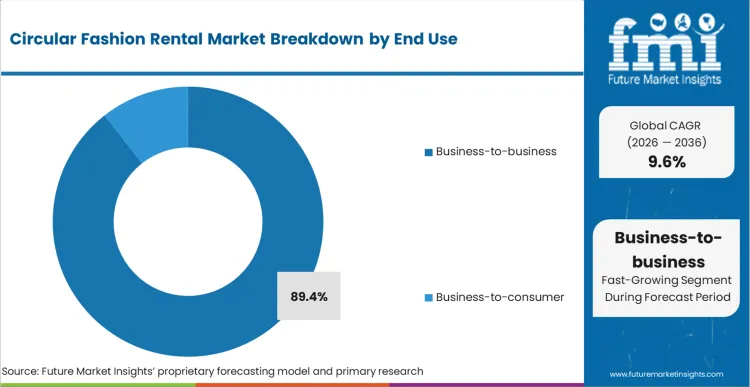
Enterprise sustainability auditors enforcing circular procurement now demand verifiable rotation proofs from uniform suppliers. Business-to-business secures 89.4% dominance in 2026, reflecting contracts that cascade apparel across employee cohorts to hit ESG targets. This scale arises from centralized fulfillment hubs that dispatch pre-sized kits, eliminating individual sizing errors. In FMI's view, the model's stickiness derives from audit-ready blockchain trails that quantify per-garment miles saved. Apparel re-commerce dynamics highlight B2B's role in scaling circular volumes.
- Compliance Tracking: Blockchain logs map each garment’s journey, arming auditors with measurable impact data for annual reports.
- Kit Dispatch: Centralized sizing databases route uniforms to users, reducing return logistics through predictive allocation.
- Cohort Cascading: Sequential assignments across teams maximize utilization, extending garment use across high-turnover roles.
Circular Fashion Rental Market Analysis by Business Model
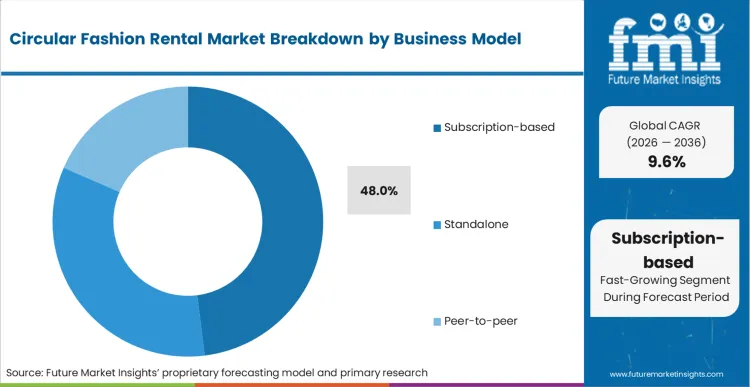
Subscription fatigue among sporadic users gives way to hybrid commitments that flex with life stages. Subscription-based captures 48.0% in 2026, as algorithms personalize drop cadences to mirror consumption rhythms. This lead position flows from churn barriers such as credit accumulations for future use, helping platforms retain users more effectively. FMI’s research confirms that dynamic pricing tiers aligned to usage data sustain margins amid peak demand.
- Churn Barriers: Credit rollover mechanics reward consistent engagement, bringing lapsed users back into active tiers.
- Dynamic Pricing: Usage-linked surcharges balance supply during peak periods, preserving inventory flow without overstock penalties.
- Personalization Loops: Behavior data refines future drops, elevating satisfaction levels and extending average lease durations.
Circular Fashion Rental Market Drivers, Restraints, and Opportunities
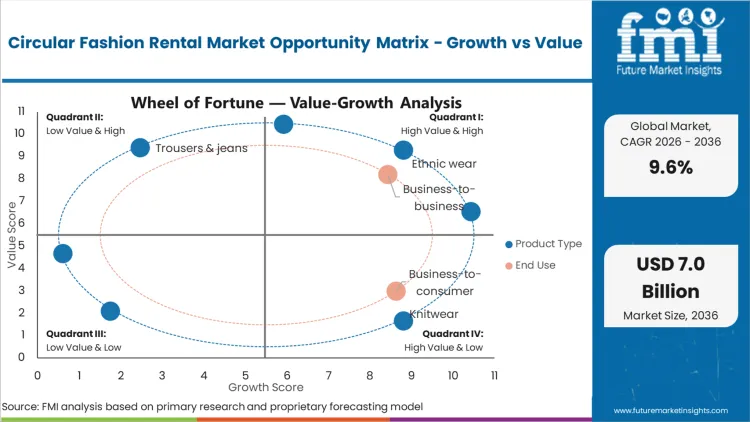
Urban density and shrinking living spaces push wardrobe minimalists to outsource storage to digital closets, driving demand for access models that deliver on-demand variety. This spatial pressure turns one-time buyers into lessees who view apparel as a service layer rather than an asset class. Platforms responding with hyper-local pods reduce delivery lags, embedding rentals into daily routines. Non-adopters remain tied to cluttered closets, missing the meaningful cost advantages that rotational access can unlock during seasonal refreshes.
Refurbishment bottlenecks during peak cycles strain platform capacity, as cleaning queues extend turnaround times beyond user tolerance. Facilities scaling waterless sanitization help ease delays, though they face upfront capital barriers that smaller operators often cannot absorb. Larger networks respond through partnerships with industrial laundries, though integration challenges still persist when verifying post-process quality without invasive inspections.
Opportunities in the Circular Fashion Rental Market
- ARPU Add-Ons: Platforms layering virtual consultations onto base subscriptions capture styling fees from indecisive users, elevating monthly yields without inventory expansion.
- B2B Uniform Hybrids: Corporate fleets adopting rent-to-own clauses for high-performers convert rotations into permanent allocations, blending circular access with loyalty mechanics.
- Regional Localization: Exporting modular pods to tier-two markets taps underserved demographics, scaling volumes through franchise models tied to local cultural events.
Regional Analysis
.webp "Top Country Growth Comparison Circular Fashion Rental Market Cagr (2026 2036)")
Based on the regional analysis, the Circular Fashion Rental Market is segmented into North America, Latin America, Europe, East Asia, South Asia, Oceania and Middle East & Africa across 40 plus countries.
| Country | CAGR (2026 to 2036) |
|---|---|
| China | 12.8% |
| India | 11.9% |
| Germany | 10.9% |
| United States | 9.0% |
| South Korea | 9.0% |
| Japan | 8.5% |
| United Kingdom | 8.1% |
Source: Future Market Insights (FMI) analysis, based on proprietary forecasting model and primary research
Asia Pacific Circular Fashion Rental Market Analysis
Urban density and rising apparel turnover across Asia Pacific are accelerating the shift from ownership-led fashion consumption to access-based wardrobe models. Platform operators across the region are building digitally managed rental ecosystems that combine subscription flexibility, garment refurbishment, and hyper-local delivery infrastructure to serve style-conscious consumers with limited storage space. FMI analysts opine that this transition is not driven by affordability alone, but by the growing normalization of rotating wardrobes as a practical response to fast-changing trends, social media visibility, and sustainability concerns. Regional demand is reinforced by consumers seeking variety without long-term accumulation, prompting platforms to invest in digital closets, predictive sizing tools, and localized cleaning hubs. The pace of market development differs by country, shaped by fashion culture, urbanization patterns, and the maturity of logistics and refurbishment networks.
- China: China’s fashion rental demand is being propelled by digitally connected urban consumers who value wardrobe rotation, trend responsiveness, and platform-enabled convenience over permanent ownership. Platform operators increasingly align rental offerings with influencer-driven discovery and app-based styling journeys that encourage frequent category refreshes. The scale of urban consumption and the speed of trend cycles support a 12.8% CAGR for China through 2036. Operators that fail to maintain fast garment turnaround, strong digital engagement, and reliable quality assurance risk losing relevance in one of the region’s highest-volume circular fashion markets.
- India: India’s circular fashion rental ecosystem is expanding as young professionals, wedding-event users, and aspirational urban consumers seek access to premium apparel without carrying full ownership costs. Platforms are gaining traction by combining occasion wear access, subscription flexibility, and culturally relevant assortment strategies tailored to local fashion usage patterns. This widening acceptance supports an 11.9% CAGR for India through 2036. Rental providers unable to simplify fit confidence, refurbishment quality, and repeat-use trust may struggle to scale in a market still formalizing organized apparel rental behavior.
- South Korea: South Korea’s circular fashion rental market is shaped by trend-sensitive consumers who respond strongly to social content, celebrity styling cues, and fast wardrobe rotation. Platform managers increasingly integrate fashion rentals with pop-up styling hubs, content-led discovery, and highly visual digital merchandising to embed access models into lifestyle routines. This rapid style velocity sustains a 9.0% CAGR for South Korea through 2036. Operators ignoring content integration and high-frequency refresh expectations risk weaker user acquisition and lower repeat engagement in this socially amplified market.
- Japan: Japan’s market reflects a disciplined consumer preference for quality preservation, storage efficiency, and refined apparel management. Rental adoption is supported by users who value neatly maintained garments, predictable service standards, and streamlined access to seasonal variety without unnecessary accumulation. This structured consumption pattern supports an 8.5% CAGR for Japan through 2036. Platforms that cannot uphold strong refurbishment precision, dependable delivery, and consistent garment presentation risk underperforming in this quality-sensitive rental environment.
FMI’s report includes extensive coverage of the Asia Pacific circular fashion rental landscape. It incorporates detailed analysis of Australia, Indonesia, and the broader ASEAN region. A major trend shaping these markets is the increasing use of modular logistics and digitally managed garment circulation systems to support repeated apparel use across dense urban consumer clusters.
North America Circular Fashion Rental Market Analysis
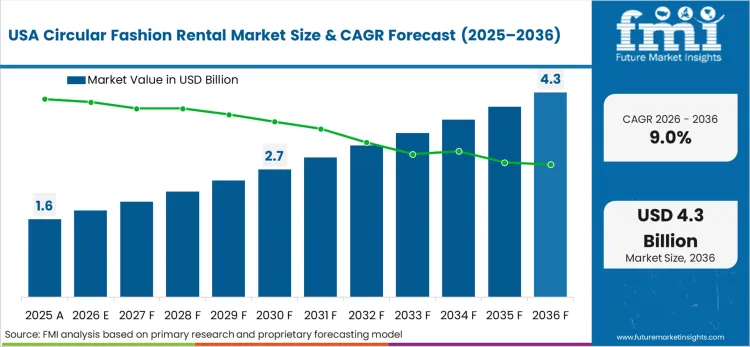
Circular fashion rental demand across North America is being shaped by smaller living spaces, rising apparel fatigue, and the growing preference for access-driven consumption over static ownership. Platform operators are positioning rental as a service layer that combines subscription management, wardrobe flexibility, and convenience-focused fulfillment for consumers seeking variety without long-term storage burdens. According to FMI’s estimates, this shift is strengthening demand for digital closet interfaces, local delivery nodes, and refurbishment systems capable of handling repeat wear at commercial scale. The regional market increasingly rewards platforms that can balance garment utilization, turnaround efficiency, and user personalization without compromising apparel quality. Long-term competitiveness depends on refurbishment capacity, logistics coordination, and the ability to turn fashion access into a habit rather than a one-time experiment.
- United States: The United States circular fashion rental market benefits from urban professionals and style-conscious households that increasingly treat apparel access as a flexible alternative to overfilled wardrobes. Platform demand rises as users seek subscription models, digital wardrobe tools, and rapid delivery systems that fit fast-moving social and work routines. This service-led transition supports a 9.0% CAGR for the United States through 2036. Operators unable to maintain refurbishment speed, garment consistency, and localized fulfillment performance risk losing share in a market where convenience directly shapes retention.
FMI’s report includes comprehensive evaluation of the North American circular fashion rental sector. It features specific analysis of Canada and Mexico. A defining regional dynamic is the growing expectation that rental platforms should operate as full-service wardrobe infrastructure, combining storage substitution, styling relevance, and dependable repeat-use logistics.
Europe Circular Fashion Rental Market Analysis
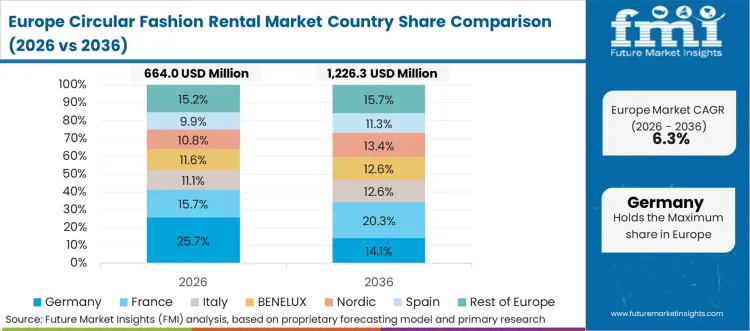
Circular fashion rental activity across Europe is advancing as sustainability expectations, urban lifestyle shifts, and mounting scrutiny of apparel waste reshape how consumers engage with fashion. Platform managers across the region position rental not as a compromise, but as a practical and responsible model for maintaining variety while lowering idle wardrobe accumulation. FMI analysis suggests that European adoption is strengthened by consumers who increasingly value garment longevity, refurbishment transparency, and structured access models that align with circular economy behavior. This drives investment in repair workflows, sanitation systems, and digital inventory management to keep garments in active circulation across repeated use cycles. The market favors platforms that can blend environmental credibility with fashion relevance and reliable service execution.
- Germany: Germany’s circular fashion rental market reflects a disciplined consumer mindset that values utility, repeated garment use, and operational reliability. Demand strengthens as platforms offer structured subscriptions, durable apparel standards, and transparent refurbishment processes that align with practical consumption habits. This quality- and efficiency-led environment supports a 10.9% CAGR for Germany through 2036. Rental operators that cannot demonstrate dependable garment maintenance, predictable availability, and strong service consistency risk weaker traction in this measured and process-oriented market.
- United Kingdom: The United Kingdom’s circular fashion rental market is driven by consumers seeking flexibility, event-led wardrobe access, and lower commitment to permanent apparel ownership. Platforms increasingly attract users through subscription-based rotation, occasionwear availability, and digitally enabled styling discovery that fits urban living patterns. This evolving consumer behavior supports an 8.1% CAGR for the United Kingdom through 2036. Providers that fail to manage refurbishment bottlenecks, demand surges, and personalization quality may struggle to sustain loyalty in this fast-moving rental ecosystem.
FMI’s report includes thorough investigation of the European circular fashion rental framework. The analysis encompasses France, Italy, Spain, the Nordics, and the Benelux region. A prevailing structural condition across these countries is the increasing alignment of fashion access models with circular consumption goals, encouraging platforms to scale durable garment circulation instead of one-time apparel ownership.
Competitive Aligners for Market Players
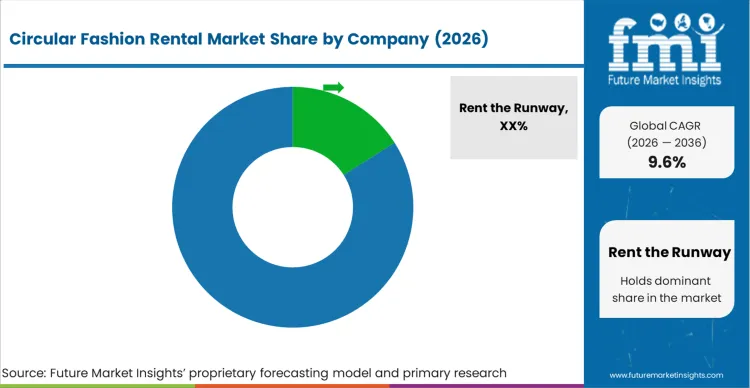
The circular fashion rental market is becoming increasingly competitive on the basis of garment circulation efficiency, refurbishment quality, and the ability to turn repeat access into a dependable service model. Buyers no longer evaluate rental platforms only on assortment. They compare operators on subscription flexibility, cleaning consistency, delivery convenience, and item quality across repeated wear cycles. This shift is raising the execution bar across the market, placing pressure on platforms that cannot support smooth lease, return, cleaning, and relisting workflows at scale.
Key players such as Rent the Runway, My Wardrobe HQ, Glam Corner, Nuuly, and Armoire are strengthening the market by building service-led ecosystems around recurring wardrobe access. Their competitive positioning reflects a broader shift in which rental platforms must function as full-service circulation networks rather than simple fashion access channels. Stronger control over managed inventory, fulfillment coordination, and membership retention helps these companies reduce friction in repeat-use behavior and improve confidence in rental-led fashion consumption. Operators that fail to improve refurbishment consistency, sizing reliability, and service quality risk weaker retention as users gravitate toward more dependable platforms.
At the same time, regional specialization is reshaping competitive dynamics across the circular fashion rental market. Rent the Runway, Nuuly, My Wardrobe HQ, Glam Corner, and Armoire each reflect different approaches to subscription styling, designer access, and localized consumer behavior. This broadens the market beyond a single rental model and gives users multiple entry points into circular fashion, from occasion-based rental to ongoing wardrobe rotation. As the market matures, the strongest players are likely to be those that combine operational trust, garment utilization discipline, and strong audience alignment while scaling repeat-use fashion services across increasingly demanding customer segments.
Key Players in Circular Fashion Rental Market
- Rent the Runway
- My Wardrobe HQ
- Glam Corner
- Nuuly
- Armoire
Scope of the Report
| Metric | Value |
|---|---|
| Quantitative Units | USD 2.8 billion to USD 7.0 billion, at a CAGR of 9.60% |
| Market Definition | Circular fashion rental systems deliver apparel access via platforms that sequence garments through user, cleaning, and resale stages to maximize lifecycle value. This model depends on predictive demand algorithms to balance inventory across user cohorts. |
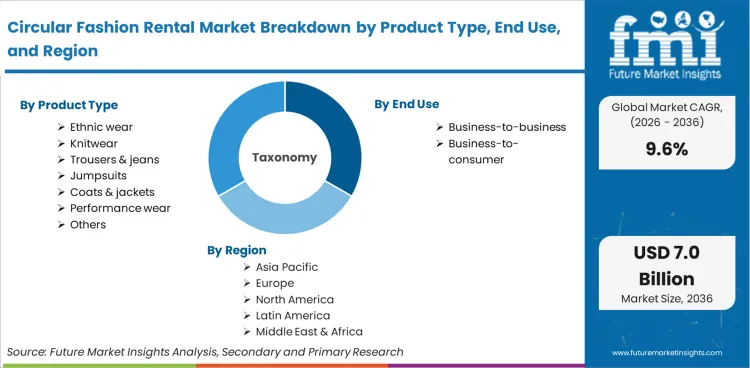
| Product Type Segmentation | Ethnic wear, Knitwear, Trousers & jeans, Jumpsuits, Coats & jackets, Performance wear, Others |
| End User Segmentation | Business-to-business, Business-to-consumer |
| Business Model Segmentation | Subscription-based, Standalone, Peer-to-peer |
| Gender Segmentation | Female, Male, Kids, Unisex |
| Regions Covered | North America, Latin America, Europe, East Asia, South Asia, Oceania, Middle East & Africa |
| Countries Covered | China, India, Germany, United States, South Korea, Japan, United Kingdom, and 40 plus countries |
| Key Companies Profiled | Rent the Runway, H&M, My Wardrobe HQ, Le Tote, Glam Corner, Nuuly, Armoire |
| Forecast Period | 2026 to 2036 |
| Approach | Analysts interviewed platform inventory managers, corporate procurement leads, and sustainability coordinators to identify rotation frequency thresholds driving platform scalability. Baseline aggregation drew from AVMC sustainability filings, WRAP circular economy benchmarks, and major apparel brand ESG disclosures. Starting from verified subscription user counts, the model applies churn-adjusted ARPU projections layered with regional adoption curves. |
Source: Future Market Insights (FMI) analysis, based on proprietary forecasting model and primary research
Circular Fashion Rental Market Analysis by Segments
Product Type:
- Ethnic wear
- Knitwear
- Trousers & jeans
- Jumpsuits
- Coats & jackets
- Performance wear
- Others
End User:
- Business-to-business
- Business-to-consumer
Business Model:
- Subscription-based
- Standalone
- Peer-to-peer
Gender:
- Female
- Male
- Kids
- Unisex
Region:
- Asia Pacific
- India
- China
- Japan
- South Korea
- Indonesia
- Australia & New Zealand
- ASEAN
- Rest of Asia Pacific
- Europe
- Germany
- Italy
- France
- United Kingdom
- Spain
- Benelux
- Nordics
- Central & Eastern Europe
- Rest of Europe
- North America
- United States
- Canada
- Mexico
- Latin America
- Brazil
- Argentina
- Chile
- Rest of Latin America
- Middle East & Africa
- Kingdom of Saudi Arabia
- United Arab Emirates
- South Africa
- Turkey
- Rest of Middle East & Africa
Bibliography
- European Parliamentary Research Service. (2024). Digital product passport for the textile sector. European Parliament.
- European Environment Agency. (2024). Management of used and waste textiles in Europe’s circular economy.
- Organization for Economic Co-operation and Development. (2024). Extended producer responsibility in the garments sector. OECD Publishing.
- WRAP. (2026). UK Textiles Extended Producer Responsibility Blueprint.
- Ellen MacArthur Foundation. (2024). The Fashion ReModel: Scaling circular business models.
- Global Fashion Agenda. (2024). GFA Monitor Update 2024.
This bibliography is provided for reader reference. The full FMI report contains the complete reference list with primary source documentation.
This Report Addresses
- Market sizing and quantitative forecast metrics detailing revenue expansion across circular fashion rental platforms through 2036.
- Segmentation analysis mapping demand patterns across apparel categories, rental models, platform formats, and consumer demographics influencing repeat usage.
- Regional deployment intelligence comparing mature subscription-led rental ecosystems in North America and Europe with fast-formalizing access models across Asia Pacific.
- Consumer behavior assessment analyzing how urban density, wardrobe digitization, and occasion-based usage are accelerating the shift from ownership to recurring apparel access.
- Operational capability evaluation tracking how refurbishment quality, garment turnaround speed, and delivery precision shape platform competitiveness and retention strength.
- Competitive posture analysis defining how leading market players differentiate through subscription flexibility, personalization engines, managed inventory systems, and localized service networks.
- Supply chain and infrastructure assessment identifying the refurbishment, cleaning, warehousing, and reverse-logistics bottlenecks that limit garment circulation efficiency.
- Custom data delivery formats encompassing interactive dashboards, raw Excel datasets, and comprehensive PDF narrative reports.
Frequently Asked Questions
How large is the Circular Fashion Rental Market in the global market in 2026?
The Circular Fashion Rental Market reaches USD 2.8 billion in 2026. This valuation reflects subscription commitments from urban demographics converting ownership costs into access fees.
What will the Circular Fashion Rental Market be valued at by 2036?
The market advances to USD 7.0 billion by 2036. Structural forces like regulatory waste levies sustain this endpoint by embedding rentals into brand supply chains.
What CAGR is projected for Circular Fashion Rental Market from 2026 to 2036?
A 9.60% CAGR governs growth from 2026 to 2036. The rate endures through B2B contract escalations that insulate against consumer fluctuations.
Which Product Type is poised to lead global sales by 2026?
Ethnic wear holds 33.0% share in 2026. Cultural calendars drive its rotations, layering versatile pieces for multi-event utility.
How significant is the role of Knitwear in driving Circular Fashion Rental adoption in 2026?
Knitwear claims 22.0% of volume as comfort seekers lease seasonal layers. This segment thrives on easy-care fabrics that accelerate refurb cycles.
What leads the End User segmentation in the Circular Fashion Rental Market?
Business-to-business dominates with 89.4% in 2026. Enterprise leases cascade uniforms across cohorts, hitting ESG targets via verified rotations.
Which Business Model commands the largest share in 2026?
Subscription-based secures 48.0% as personalization loops retain users. Dynamic drops aligned to behaviors minimize lapses into standalone hires.
What is the growth outlook for Female in the Gender segmentation?
Female expands at 9.8% CAGR through 2036. Inclusive sizing in occasion lines sustains its lead by accommodating diverse morphologies.
What policy framework accelerates China's formal rental network buildout?
E-commerce mandates for low-waste fulfillment propel China's 12.8% CAGR. Platforms bundling leases with apps normalize access in dense urban cores.
Why does India's growth outpace the global average in this report?
Festival bundling converts ethnic spikes into subscriptions, anchoring 11.9% expansion. Digital natives amplify this through social referrals.
What compliance standard shapes Germany's rental demand?
Textile waste levies enforce rotation proofs, driving 10.9% growth. Platforms certifying 20-cycle utilizations qualify for brand integrations.
How does the United States compare to Europe in rental maturity?
USA trails at 9.0% versus Germany's 10.9%, but corporate ESG pilots close the gap. Uniform hybrids in wellness programs scale B2B volumes.
What distinguishes South Korea's rental approach from Japan's?
Influencer feeds normalize leases in South Korea at 9.0%, while Japan's 8.5% emphasizes precision deliveries for salarymen swaps.
Does the report cover United Kingdom in regional analysis?
Yes, the UK features under Europe at 8.1% CAGR. High-street pods convert browsers, blending physical touchpoints with digital curation.
What main demand theme links Japan to its regional coverage?
Precision logistics enable same-day access, sustaining 8.5% growth. Event cadences fuel hybrid commitments in minimalism-driven cohorts.
What embedded technology reduces returns in East Asian platforms?
AI fit twins preview ensembles, cutting mismatches 25% in China and Japan. This mechanic elevates satisfaction in high-velocity rotations.
How do waste directives influence European B2B leasing?
Levies mandate lifecycle proofs, elevating Germany's 10.9% trajectory. Platforms auditing refurb loops unlock enterprise contracts.
What operational challenge hampers South Asian scaling?
Peak festival queues strain cleaning capacities in India. Waterless innovations mitigate, but upfront costs limit small-operator entry.
What makes the 9.60% CAGR defensible over the decade?
B2B dominance at 89% insulates against volatility, with ARPU boosters offsetting churn. Regulatory embeds ensure sustained enterprise pull.
What structural shift from ownership to access defines the market?
Spatial constraints in urban hubs convert closets to services, hitting 18-cycle utilizations. This pivot decouples revenue from virgin production.
What is Circular Fashion Rental and what distinguishes it from resale?
It sequences apparel through lease-clean-resale loops for multi-use. Unlike resale's one-handover, rentals verify 15+ cycles per piece.
What does Circular Fashion Rental mean in this report?
Scope targets platforms maximizing garment velocity via predictive allocations. Boundary excludes one-off hires lacking rotation mechanics.
What is included in the scope of this Circular Fashion Rental report?
Platforms aggregating ethnic and performance leases, with B2B uniform integrations and AI personalization fully covered.
What is excluded from the scope of this report?
Standalone resale without leasing, plus non-apparel accessories. Bespoke services absent shared inventories stay omitted.
What does market forecast mean on this page?
Projections model adoption under defined regulatory and tech assumptions for planning. They anchor on subscriber bases escalated by penetration.
How does FMI build and validate the Circular Fashion Rental forecast?
Bottom-up from user counts, with ARPU vectors and regional curves. Validated against logistics volumes and ESG filings.
What does zero reliance on speculative third-party market research mean here?
Exclusive use of primary audits, regulatory proofs, and brand disclosures over unverified estimates. This grounds outputs in verifiable flows.
What strategic takeaway emerges for platform founders?
Embed ARPU via consultations to counter 10% churn. Neglect risks margin erosion in scaling phases.
Preview the report firsthand - request a free sample
Get SampleGet the brochure for pricing and purchase details.
Get PDFTable of Content
- Executive Summary
- Global Market Outlook
- Demand-side Trends
- Supply-side Trends
- Technology Roadmap Analysis
- Analysis and Recommendations
- Market Overview
- Market Coverage / Taxonomy
- Market Definition / Scope / Limitations
- Research Methodology
- Chapter Orientation
- Analytical Lens and Working Hypotheses
- Market Structure, Signals, and Trend Drivers
- Benchmarking and Cross-market Comparability
- Market Sizing, Forecasting, and Opportunity Mapping
- Research Design and Evidence Framework
- Desk Research Programme (Secondary Evidence)
- Company Annual and Sustainability Reports
- Peer-reviewed Journals and Academic Literature
- Corporate Websites, Product Literature, and Technical Notes
- Earnings Decks and Investor Briefings
- Statutory Filings and Regulatory Disclosures
- Technical White Papers and Standards Notes
- Trade Journals, Industry Magazines, and Analyst Briefs
- Conference Proceedings, Webinars, and Seminar Materials
- Government Statistics Portals and Public Data Releases
- Press Releases and Reputable Media Coverage
- Subscription Datasets and Paid Sources
- Social Channels, Communities, and Digital Listening Inputs
- Additional Desk Sources
- Expert Input and Fieldwork (Primary Evidence)
- Primary Modes
- Qualitative Interviews and Expert Elicitation
- Quantitative Surveys and Structured Data Capture
- Blended Approach
- Why Primary Evidence is Used
- Field Techniques
- Interviews
- Surveys
- Focus Groups
- Observational and In-context Research
- Social and Community Interactions
- Stakeholder Universe Engaged
- C-suite Leaders
- Board Members
- Presidents and Vice Presidents
- R&D and Innovation Heads
- Technical Specialists
- Domain Subject-matter Experts
- Scientists
- Physicians and Other Healthcare Professionals
- Governance, Ethics, and Data Stewardship
- Research Ethics
- Data Integrity and Handling
- Primary Modes
- Tooling, Models, and Reference Databases
- Desk Research Programme (Secondary Evidence)
- Data Engineering and Model Build
- Data Acquisition and Ingestion
- Cleaning, Normalisation, and Verification
- Synthesis, Triangulation, and Analysis
- Quality Assurance and Audit Trail
- Market Background
- Market Dynamics
- Drivers
- Restraints
- Opportunity
- Trends
- Scenario Forecast
- Demand in Optimistic Scenario
- Demand in Likely Scenario
- Demand in Conservative Scenario
- Opportunity Map Analysis
- Product Life Cycle Analysis
- Supply Chain Analysis
- Investment Feasibility Matrix
- Value Chain Analysis
- PESTLE and Porter’s Analysis
- Regulatory Landscape
- Regional Parent Market Outlook
- Production and Consumption Statistics
- Import and Export Statistics
- Market Dynamics
- Global Market Analysis 2021 to 2025 and Forecast, 2026 to 2036
- Historical Market Size Value (USD Million) Analysis, 2021 to 2025
- Current and Future Market Size Value (USD Million) Projections, 2026 to 2036
- Y-o-Y Growth Trend Analysis
- Absolute $ Opportunity Analysis
- Global Market Pricing Analysis 2021 to 2025 and Forecast 2026 to 2036
- Global Market Analysis 2021 to 2025 and Forecast 2026 to 2036, By Product Type
- Introduction / Key Findings
- Historical Market Size Value (USD Million) Analysis By Product Type , 2021 to 2025
- Current and Future Market Size Value (USD Million) Analysis and Forecast By Product Type , 2026 to 2036
- Ethnic wear
- Knitwear
- Trousers & jeans
- Jumpsuits
- Coats & jackets
- Performance wear
- Others
- Ethnic wear
- Y-o-Y Growth Trend Analysis By Product Type , 2021 to 2025
- Absolute $ Opportunity Analysis By Product Type , 2026 to 2036
- Global Market Analysis 2021 to 2025 and Forecast 2026 to 2036, By End Use
- Introduction / Key Findings
- Historical Market Size Value (USD Million) Analysis By End Use, 2021 to 2025
- Current and Future Market Size Value (USD Million) Analysis and Forecast By End Use, 2026 to 2036
- Business-to-business
- Business-to-consumer
- Business-to-business
- Y-o-Y Growth Trend Analysis By End Use, 2021 to 2025
- Absolute $ Opportunity Analysis By End Use, 2026 to 2036
- Global Market Analysis 2021 to 2025 and Forecast 2026 to 2036, By Business Model
- Introduction / Key Findings
- Historical Market Size Value (USD Million) Analysis By Business Model, 2021 to 2025
- Current and Future Market Size Value (USD Million) Analysis and Forecast By Business Model, 2026 to 2036
- Subscription-based
- Standalone
- Peer-to-peer
- Subscription-based
- Y-o-Y Growth Trend Analysis By Business Model, 2021 to 2025
- Absolute $ Opportunity Analysis By Business Model, 2026 to 2036
- Global Market Analysis 2021 to 2025 and Forecast 2026 to 2036, By Region
- Introduction
- Historical Market Size Value (USD Million) Analysis By Region, 2021 to 2025
- Current Market Size Value (USD Million) Analysis and Forecast By Region, 2026 to 2036
- North America
- Latin America
- Western Europe
- Eastern Europe
- East Asia
- South Asia and Pacific
- Middle East & Africa
- Market Attractiveness Analysis By Region
- North America Market Analysis 2021 to 2025 and Forecast 2026 to 2036, By Country
- Historical Market Size Value (USD Million) Trend Analysis By Market Taxonomy, 2021 to 2025
- Market Size Value (USD Million) Forecast By Market Taxonomy, 2026 to 2036
- By Country
- USA
- Canada
- Mexico
- By Product Type
- By End Use
- By Business Model
- By Country
- Market Attractiveness Analysis
- By Country
- By Product Type
- By End Use
- By Business Model
- Key Takeaways
- Latin America Market Analysis 2021 to 2025 and Forecast 2026 to 2036, By Country
- Historical Market Size Value (USD Million) Trend Analysis By Market Taxonomy, 2021 to 2025
- Market Size Value (USD Million) Forecast By Market Taxonomy, 2026 to 2036
- By Country
- Brazil
- Chile
- Rest of Latin America
- By Product Type
- By End Use
- By Business Model
- By Country
- Market Attractiveness Analysis
- By Country
- By Product Type
- By End Use
- By Business Model
- Key Takeaways
- Western Europe Market Analysis 2021 to 2025 and Forecast 2026 to 2036, By Country
- Historical Market Size Value (USD Million) Trend Analysis By Market Taxonomy, 2021 to 2025
- Market Size Value (USD Million) Forecast By Market Taxonomy, 2026 to 2036
- By Country
- Germany
- UK
- Italy
- Spain
- France
- Nordic
- BENELUX
- Rest of Western Europe
- By Product Type
- By End Use
- By Business Model
- By Country
- Market Attractiveness Analysis
- By Country
- By Product Type
- By End Use
- By Business Model
- Key Takeaways
- Eastern Europe Market Analysis 2021 to 2025 and Forecast 2026 to 2036, By Country
- Historical Market Size Value (USD Million) Trend Analysis By Market Taxonomy, 2021 to 2025
- Market Size Value (USD Million) Forecast By Market Taxonomy, 2026 to 2036
- By Country
- Russia
- Poland
- Hungary
- Balkan & Baltic
- Rest of Eastern Europe
- By Product Type
- By End Use
- By Business Model
- By Country
- Market Attractiveness Analysis
- By Country
- By Product Type
- By End Use
- By Business Model
- Key Takeaways
- East Asia Market Analysis 2021 to 2025 and Forecast 2026 to 2036, By Country
- Historical Market Size Value (USD Million) Trend Analysis By Market Taxonomy, 2021 to 2025
- Market Size Value (USD Million) Forecast By Market Taxonomy, 2026 to 2036
- By Country
- China
- Japan
- South Korea
- By Product Type
- By End Use
- By Business Model
- By Country
- Market Attractiveness Analysis
- By Country
- By Product Type
- By End Use
- By Business Model
- Key Takeaways
- South Asia and Pacific Market Analysis 2021 to 2025 and Forecast 2026 to 2036, By Country
- Historical Market Size Value (USD Million) Trend Analysis By Market Taxonomy, 2021 to 2025
- Market Size Value (USD Million) Forecast By Market Taxonomy, 2026 to 2036
- By Country
- India
- ASEAN
- Australia & New Zealand
- Rest of South Asia and Pacific
- By Product Type
- By End Use
- By Business Model
- By Country
- Market Attractiveness Analysis
- By Country
- By Product Type
- By End Use
- By Business Model
- Key Takeaways
- Middle East & Africa Market Analysis 2021 to 2025 and Forecast 2026 to 2036, By Country
- Historical Market Size Value (USD Million) Trend Analysis By Market Taxonomy, 2021 to 2025
- Market Size Value (USD Million) Forecast By Market Taxonomy, 2026 to 2036
- By Country
- Kingdom of Saudi Arabia
- Other GCC Countries
- Turkiye
- South Africa
- Other African Union
- Rest of Middle East & Africa
- By Product Type
- By End Use
- By Business Model
- By Country
- Market Attractiveness Analysis
- By Country
- By Product Type
- By End Use
- By Business Model
- Key Takeaways
- Key Countries Market Analysis
- USA
- Pricing Analysis
- Market Share Analysis, 2025
- By Product Type
- By End Use
- By Business Model
- Canada
- Pricing Analysis
- Market Share Analysis, 2025
- By Product Type
- By End Use
- By Business Model
- Mexico
- Pricing Analysis
- Market Share Analysis, 2025
- By Product Type
- By End Use
- By Business Model
- Brazil
- Pricing Analysis
- Market Share Analysis, 2025
- By Product Type
- By End Use
- By Business Model
- Chile
- Pricing Analysis
- Market Share Analysis, 2025
- By Product Type
- By End Use
- By Business Model
- Germany
- Pricing Analysis
- Market Share Analysis, 2025
- By Product Type
- By End Use
- By Business Model
- UK
- Pricing Analysis
- Market Share Analysis, 2025
- By Product Type
- By End Use
- By Business Model
- Italy
- Pricing Analysis
- Market Share Analysis, 2025
- By Product Type
- By End Use
- By Business Model
- Spain
- Pricing Analysis
- Market Share Analysis, 2025
- By Product Type
- By End Use
- By Business Model
- France
- Pricing Analysis
- Market Share Analysis, 2025
- By Product Type
- By End Use
- By Business Model
- India
- Pricing Analysis
- Market Share Analysis, 2025
- By Product Type
- By End Use
- By Business Model
- ASEAN
- Pricing Analysis
- Market Share Analysis, 2025
- By Product Type
- By End Use
- By Business Model
- Australia & New Zealand
- Pricing Analysis
- Market Share Analysis, 2025
- By Product Type
- By End Use
- By Business Model
- China
- Pricing Analysis
- Market Share Analysis, 2025
- By Product Type
- By End Use
- By Business Model
- Japan
- Pricing Analysis
- Market Share Analysis, 2025
- By Product Type
- By End Use
- By Business Model
- South Korea
- Pricing Analysis
- Market Share Analysis, 2025
- By Product Type
- By End Use
- By Business Model
- Russia
- Pricing Analysis
- Market Share Analysis, 2025
- By Product Type
- By End Use
- By Business Model
- Poland
- Pricing Analysis
- Market Share Analysis, 2025
- By Product Type
- By End Use
- By Business Model
- Hungary
- Pricing Analysis
- Market Share Analysis, 2025
- By Product Type
- By End Use
- By Business Model
- Kingdom of Saudi Arabia
- Pricing Analysis
- Market Share Analysis, 2025
- By Product Type
- By End Use
- By Business Model
- Turkiye
- Pricing Analysis
- Market Share Analysis, 2025
- By Product Type
- By End Use
- By Business Model
- South Africa
- Pricing Analysis
- Market Share Analysis, 2025
- By Product Type
- By End Use
- By Business Model
- USA
- Market Structure Analysis
- Competition Dashboard
- Competition Benchmarking
- Market Share Analysis of Top Players
- By Regional
- By Product Type
- By End Use
- By Business Model
- Competition Analysis
- Competition Deep Dive
- Rent the Runway
- Overview
- Product Portfolio
- Profitability by Market Segments (Product/Age /Sales Channel/Region)
- Sales Footprint
- Strategy Overview
- Marketing Strategy
- Product Strategy
- Channel Strategy
- My Wardrobe HQ
- Glam Corner
- Nuuly
- Armoire
- Rent the Runway
- Competition Deep Dive
- Assumptions & Acronyms Used


