

- Industry Size (2026)
- USD 303.1 Mn
- Forecast (2036)
- USD 1205.0 Mn
- CAGR (2026 to 2036)
- 14.8%
Circular Phosphorus Recovery Granule Fertilizer Market Forecast and Outlook 2026 to 2036
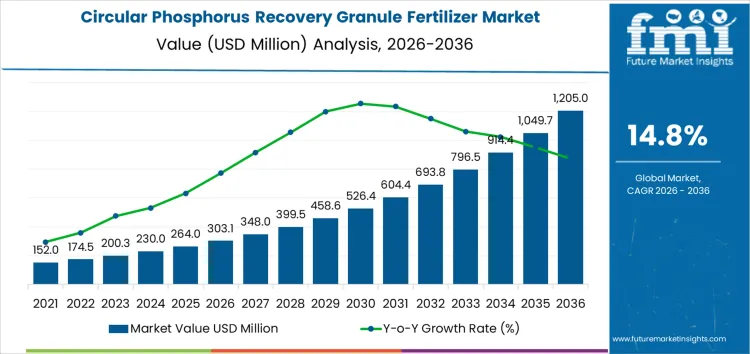
The circular phosphorus recovery granule fertilizer market is valued at USD 303.1 million in 2026 and is projected to reach USD 1,205 million by 2036, growing at a compound annual growth rate (CAGR) of 14.8%. The industry is strategically important as the global focus on sustainability intensifies, particularly in the agriculture sector, which is under pressure to reduce phosphorus waste and reliance on mined resources. Commercially, this space will see increasing buyer intent from agricultural companies seeking to align with environmental regulations and sustainability goals. Decision-makers will be driven by the need to maintain cost-effective, long-term nutrient management solutions while addressing rising input costs. With regulatory frameworks evolving, early adoption of circular phosphorus solutions may offer a competitive edge, positioning companies as leaders in sustainable farming practices. Suppliers that can balance performance, cost efficiency, and environmental compliance will stand to gain significant market share, ensuring that these fertilizers play a pivotal role in the future of crop production.
Quick Stats of the Circular Phosphorus Recovery Granule Fertilizer Market
- Circular Phosphorus Recovery Granule Fertilizer Market Value (2026): USD 303.1 million
- Circular Phosphorus Recovery Granule Fertilizer Market Forecast Value (2036): USD 1,205 million
- Circular Phosphorus Recovery Granule Fertilizer Market Global Forecast CAGR (2026-2036): 14.8%
- Circular Phosphorus Recovery Granule Fertilizer Market Leading Segment: Sales Channel (Ag-Retailers) 60%
- Key Growth Regions in Circular Phosphorus Recovery Granule Fertilizer Market: Netherlands
- Top Players in Circular Phosphorus Recovery Granule Fertilizer Market: OCP, EuroChem, Mosaic, PhosAgro, Nutrien, ICL Group
What is the Growth Forecast for the Circular Phosphorus Recovery Granule Fertilizer Market through 2036?
The rolling CAGR analysis for the circular phosphorus recovery granule fertilizer market reveals robust growth during the forecast period, with notable acceleration in the early years followed by more stable growth as the market matures. In the initial phase from 2026 to 2031, the market will experience significant acceleration, growing from USD 303.1 million in 2026 to USD 604.3 million in 2031. This increase reflects the early-stage adoption of circular phosphorus recovery technologies, driven by the rising demand for sustainable agricultural solutions and eco-friendly fertilizers. As awareness of the finite nature of phosphorus resources grows, alongside increasing regulatory pressures for sustainable practices, demand for phosphorus recovery granules will rise. The CAGR during this period will be substantial, reflecting both market expansion and consumer shift toward sustainable farming inputs.
From 2031 to 2036, the growth will continue but at a more stable rate. The market value will rise from USD 604.3 million in 2031 to USD 1,205 million by 2036, with a steady but less rapid pace of growth compared to the initial years. As the technology becomes more established and integrated into mainstream agricultural practices, the pace of innovation will moderate, leading to more predictable and stable market expansion. While growth will persist, it will be driven by continued adoption in larger agricultural markets and incremental improvements in recovery technologies. The overall rolling CAGR will reflect a strong but stabilizing demand for circular phosphorus recovery systems as they become integral to sustainable farming.
Circular Phosphorus Recovery Granule Fertilizer Market Key Takeaways
| Metric | Value |
|---|---|
| Industry Sales Value (2026) | USD 303.1 million |
| Industry Forecast Value (2036) | USD 1,205.0 million |
| Industry Forecast CAGR (2026-2036) | 14.8% |
What Is Driving the Demand for Circular Phosphorus Recovery Granule Fertilizer?
Historical demand for phosphorus fertilizers has been shaped by long-standing reliance on mined phosphate rock to supply essential nutrients for crop growth, with conventional fertilizer production using about 88% of mined phosphorus resources. These resources are finite and unevenly distributed globally, creating supply vulnerability and price volatility for agricultural sectors that depend on phosphorus inputs. Phosphorus that enters the environment through wastewater, manure, and food waste historically represented a lost nutrient burden rather than an asset, contributing to eutrophication of waterways and environmental concerns. Research and practice in phosphorus recovery began to explore chemical and biological methods to capture phosphorus from waste streams, such as crystallization of struvite and extraction from wastewater sludge, yielding materials with plant-available phosphorus that can be repurposed as fertilizer. These efforts responded to dual needs: conserving a critical nutrient resource and reducing environmental impacts from nutrient runoff. The emerging field of circular phosphorus recovery sought to valorize P from secondary sources into agronomic products rather than relying solely on phosphate rock.
Future demand for circular phosphorus recovery granule fertilizer is expected to grow as agricultural systems shift toward nutrient recycling and sustainable nutrient management. A circular phosphorus economy framework supports technologies that capture and reuse phosphorus in fertilizer-ready forms, potentially enhancing nutrient autonomy and aligning with environmental objectives. Regulatory emphasis on nutrient runoff reduction and water quality protection is driving adoption of phosphorus recovery infrastructure, creating feedstock streams for recovered P products. Granule-forming processes that convert recovered phosphorus into uniform, field-ready fertilizer formats could improve application precision and meet agronomic requirements for specialty crops and soils. Broader nutrient recycling markets are projected to expand with rising investment in waste treatment and nutrient recovery technologies that support fertilizer production from waste streams. Growth factors include increasing global concern over phosphate rock depletion, opportunities to reduce dependency on imported synthetic fertilizers, and advances in recovery chemistry that produce forms such as struvite or phosphate granules suitable for agriculture. Technical challenges such as cost-effective recovery at scale, quality assurance for agronomic performance, and integration with existing fertilizer markets may influence adoption rates. Continued innovation in circular fertilizer chemistry and supportive policy frameworks are likely to shape demand for phosphorus recovery granule fertilizers in future nutrient management practices.
What are the Leading Segments in the Global Circular Phosphorus Recovery Granule Fertilizer Market?
The global circular phosphorus recovery granule fertilizer market is segmented by source and sales channel. Among sources, animal manure leads the market, capturing 50% of the share, followed by food waste, wastewater sludge, and crop residue. Animal manure is the dominant source due to its high phosphorus content and its availability as a by-product of livestock farming. On the sales channel side, ag-retailers dominate the market, holding 60% of the share, followed by direct-to-farmer, online marketplaces, and cooperatives. Ag-retailers lead the market due to their established distribution networks, providing easy access to fertilizers for large-scale agricultural operations.
What Drives the Growth of Animal Manure in the Circular Phosphorus Recovery Granule Fertilizer Market?
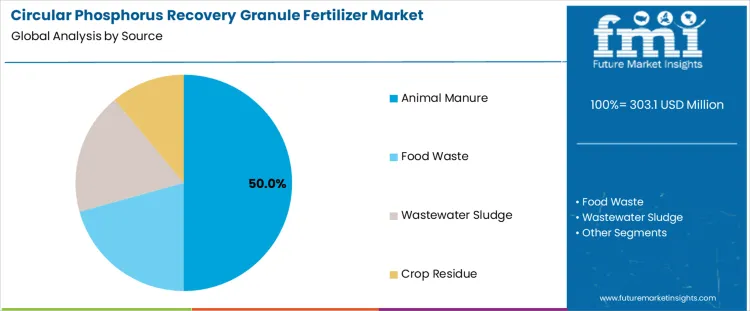
Animal manure is the leading source in the circular phosphorus recovery granule fertilizer market, holding 50% of the share. This demand is driven by the abundance of animal manure from livestock farms, which is rich in essential nutrients like phosphorus, nitrogen, and potassium. The recovery of phosphorus from manure and its conversion into high-quality granule fertilizers is an effective way to recycle waste while reducing environmental pollution. As the agricultural industry increasingly seeks sustainable, circular solutions, animal manure provides an abundant, renewable source of phosphorus.
Furthermore, as farmers and regulatory bodies push for more sustainable and eco-friendly farming practices, the use of manure-derived fertilizers aligns with both environmental goals and cost-efficiency. The ability to recover phosphorus from animal manure and create premium fertilizers also helps address the growing concern about the depletion of phosphorus resources. As circular economy principles gain traction, the demand for animal manure-based phosphorus recovery fertilizers will continue to grow, making it a key segment in the market.
What is Driving the Demand for Ag-Retailers in the Circular Phosphorus Recovery Granule Fertilizer Market?
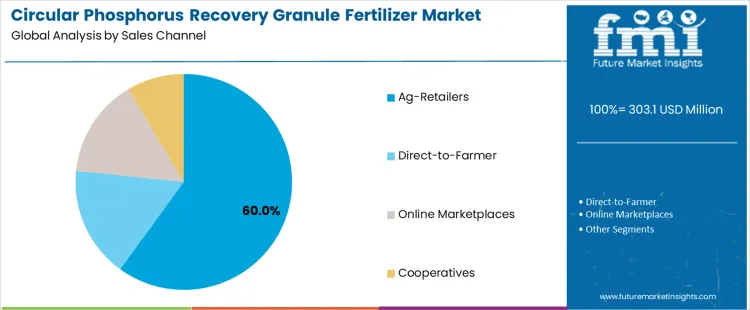
Ag-retailers are the leading sales channel in the circular phosphorus recovery granule fertilizer market, capturing 60% of the share. This demand is largely driven by ag-retailers' ability to provide specialized fertilizers to a wide range of farmers, from small-scale to large agricultural operations. Ag-retailers play a critical role in supplying high-quality, sustainable fertilizers, including those derived from recovered phosphorus, which aligns with the growing emphasis on sustainable agriculture.
Their established relationships with farmers, along with their extensive distribution networks, make ag-retailers the preferred channel for selling circular phosphorus recovery fertilizers. As demand for environmentally responsible and circular agricultural practices rises, ag-retailers are essential in delivering these products to the market. They not only provide access to sustainable fertilizers but also offer the expertise and support necessary to help farmers implement best practices in nutrient management. With the increasing push toward circular economy models in agriculture, ag-retailers will continue to be a dominant force in the distribution of circular phosphorus recovery granules.
What are the Key Dynamics in the Circular Phosphorus Recovery Granule Fertilizer Market?
The circular phosphorus recovery granule fertilizer market is defined by efforts to capture and reuse phosphorus from waste streams and return it to agricultural systems. Recovery technologies extract phosphorus from sewage sludge, manure, or food waste and convert it into granule forms suitable for precision nutrient management. Farmers assess products for phosphorus bioavailability, granule uniformity, and ease of application. Regulations on nutrient runoff and sustainable soil fertility influence adoption. Supply chain logistics, processing infrastructure, and feedstock access shape market activity for recovered phosphorus inputs.
What are the Main Drivers Supporting Growth in this Market?
Growing concern over finite phosphorus resources drives interest in circular recovery solutions. Agriculture’s reliance on phosphorus for crop nutrition highlights the value of recycled phosphorus granules with defined nutrient content and consistent release patterns. Policies that limit phosphorus losses to water bodies and restrict waste disposal create incentives for recovery and reuse. Advances in extraction and granulation improve product quality and nutrient retention. Collaboration between waste treatment facilities and fertilizer manufacturers expands feedstock access. Demand for soil fertility products that align with environmental and regulatory goals supports market growth.
What Restraints Are Limiting Market Expansion?
High capital requirements for phosphorus recovery and granulation facilities can limit participation by smaller operators. Variability in waste stream composition affects consistency of recovered phosphorus and may complicate quality control. Transporting feedstock from urban centers to processing sites and moving granule products to farms increases cost and logistics burden. Perceptions of performance uncertainty relative to conventional phosphate fertilizers can restrain adoption among some growers. Regulatory differences for recycled nutrient products across jurisdictions add complexity for suppliers planning multi-region distribution.
What Emerging Trends Are Shaping Future Development in this Market?
Technological improvements in filter media, chemical extractants, and thermal processes are increasing phosphorus recovery efficiency and granule uniformity. Data driven nutrient management tools are used to match granule applications with soil test results, supporting targeted phosphorus use. Partnerships between municipalities, agricultural cooperatives, and recovery technology firms are emerging to secure stable feedstock and scale production. Research on co products from recovery streams, such as magnesium or calcium compounds, expands value creation. Interest in integrated nutrient recycling systems continues to influence how growers and waste managers coordinate phosphorus stewardship.
What is the Country-Wise Analysis of the Circular Phosphorus Recovery Granule Fertilizer Market?
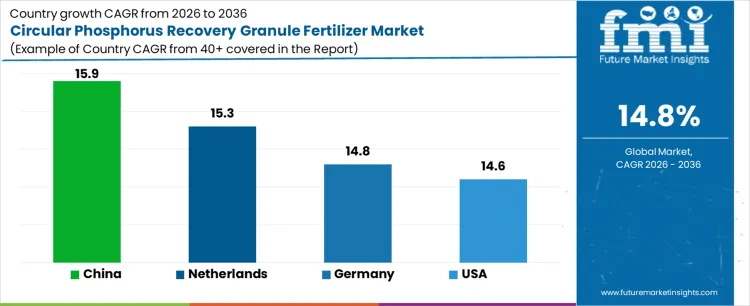
The circular phosphorus recovery granule fertilizer market is growing rapidly as part of the global movement towards sustainable agriculture and waste recycling. Circular phosphorus recovery refers to the process of reclaiming phosphorus from organic waste and using it to create high-quality, nutrient-rich fertilizers. This approach not only helps reduce dependency on mined phosphorus but also minimizes environmental pollution. Developed markets such as the Netherlands, Germany, and the USA are seeing strong demand for these fertilizers due to their focus on circular economy principles and sustainability. Emerging markets like China are also witnessing significant growth, driven by the country's increasing emphasis on environmental sustainability and reducing the environmental impact of traditional farming practices. As global concerns about resource depletion and environmental sustainability continue to rise, the market for circular phosphorus recovery granule fertilizers is expected to expand significantly.
| Country | CAGR (2026-2036) |
|---|---|
| Netherlands | 15.3% |
| Germany | 14.8% |
| China | 15.9% |
| USA | 14.6% |
What is the Growth Outlook for the Circular Phosphorus Recovery Granule Fertilizer Market in the Netherlands?
The circular phosphorus recovery granule fertilizer market in the Netherlands is projected to grow steadily, with a projected CAGR of 15.3% from 2026 to 2036. The Netherlands is a global leader in sustainability, particularly in the agricultural sector. As part of its commitment to circular economy principles, the Netherlands has been a pioneer in adopting phosphorus recovery technologies. Dutch farmers are increasingly turning to circular fertilizers that utilize recycled phosphorus to enhance soil health while minimizing environmental impact. With strong government support for sustainable farming practices and a growing focus on reducing the environmental footprint of agriculture, the market for circular phosphorus recovery granule fertilizers is expected to continue growing. The Netherlands’ advanced infrastructure for recycling organic waste and its focus on reducing phosphorus pollution further position the country as a key player in this market.
What is the Market Outlook for the Circular Phosphorus Recovery Granule Fertilizer Market in Germany?
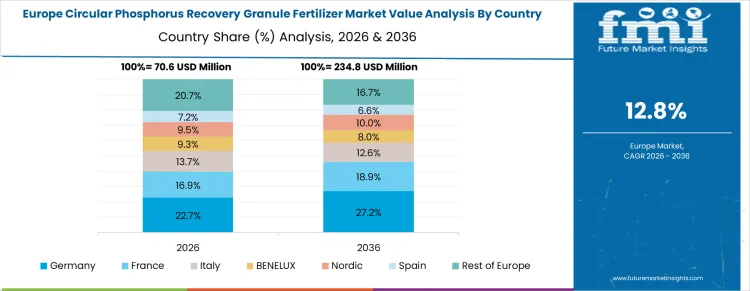
Germany is expected to experience steady growth in the circular phosphorus recovery granule fertilizer market, with a projected CAGR of 14.8% from 2026 to 2036. Germany’s strong commitment to sustainability and circular economy practices is driving the adoption of innovative fertilizers that are produced using recycled phosphorus. As the country faces increasing pressure to reduce the environmental impact of traditional farming and manage phosphorus resources more efficiently, the demand for circular phosphorus recovery fertilizers is rising. The German government’s policies promoting sustainable agriculture and waste recycling, combined with growing consumer demand for eco-friendly agricultural solutions, will continue to support market growth. Germany’s well-developed waste management infrastructure and focus on reducing nutrient pollution will be key drivers in the growth of this market.
What is the Growth Forecast for the Circular Phosphorus Recovery Granule Fertilizer Market in China?
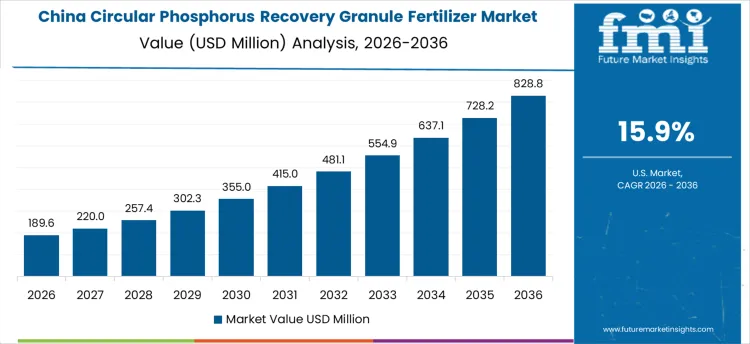
China is projected to experience strong growth in the circular phosphorus recovery granule fertilizer market, with a projected CAGR of 15.9% from 2026 to 2036. China’s agricultural sector, one of the largest in the world, is facing significant challenges related to phosphorus resource depletion and environmental pollution caused by overuse of chemical fertilizers. As the country seeks to improve the sustainability of its agricultural practices, there is growing interest in technologies that recover phosphorus from waste and convert it into valuable fertilizers. The Chinese government has increasingly supported green farming solutions, and the shift towards circular phosphorus recovery granules aligns with China’s broader goals of reducing pollution and optimizing nutrient use in agriculture. The combination of government policy, growing consumer demand for eco-friendly products, and the need for more sustainable farming practices will drive the continued growth of this market in China.
What is the Market Outlook for the Circular Phosphorus Recovery Granule Fertilizer Market in the USA?
The circular phosphorus recovery granule fertilizer market in the USA is projected to grow steadily, with a projected CAGR of 14.6% from 2026 to 2036. In the U.S., sustainable agriculture is becoming a major focus, driven by concerns over resource depletion, environmental pollution, and the need to improve soil health. Circular phosphorus recovery fertilizers, which recycle phosphorus from waste and turn it into nutrient-rich fertilizers, are gaining traction as part of this movement. The U.S. government’s support for sustainable farming practices and nutrient management, coupled with growing consumer awareness of the environmental impact of traditional fertilizers, will continue to drive the adoption of these circular fertilizers. The U.S. market for phosphorus recovery granules is expected to grow as farmers increasingly seek sustainable alternatives to traditional fertilizers that reduce waste and enhance soil productivity.
What are the Growth Prospects for the Circular Phosphorus Recovery Granule Fertilizer Market Globally?
Globally, the circular phosphorus recovery granule fertilizer market is poised for significant growth due to the increasing adoption of sustainable agricultural practices and the need to conserve phosphorus resources. As global concerns about the depletion of natural phosphorus reserves grow, more countries are turning to innovative solutions like phosphorus recovery from organic waste. This technology not only helps reduce the environmental impact of conventional farming but also promotes a more sustainable and efficient use of resources. Both developed and emerging markets are driving the growth of this market, with governments and agricultural sectors increasingly prioritizing sustainability. The global shift towards circular economies, combined with rising consumer demand for eco-friendly fertilizers, is expected to propel the market for circular phosphorus recovery granules, contributing to more sustainable and resource-efficient farming practices worldwide.
What is the Competitive Landscape for the Circular Phosphorus Recovery Granule Fertilizer Market?
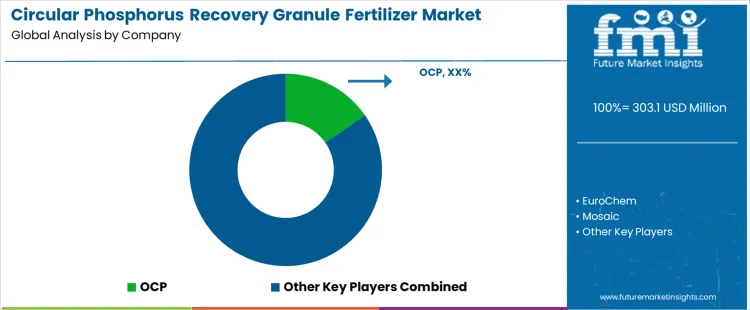
The circular phosphorus recovery granule fertilizer market is growing as the agricultural industry seeks sustainable solutions to recycle phosphorus, reduce waste, and improve soil health. OCP leads the market with its innovative circular phosphorus recovery granule fertilizers, offering high-performance products that recover phosphorus from waste and transform it into valuable fertilizer, contributing to the circular economy. Their focus on sustainability, resource efficiency, and innovative nutrient management has positioned them as a dominant player in this market. EuroChem, Mosaic, and PhosAgro are significant competitors, each providing specialized fertilizers that incorporate recovered phosphorus to improve agricultural productivity and reduce reliance on mined phosphorus. EuroChem focuses on sustainable phosphorus management, while Mosaic and PhosAgro offer advanced fertilizer products that help maintain soil fertility while minimizing environmental impact.
Nutrien and ICL Group further contribute to the competitive landscape by offering their own phosphorus recovery and granulation technologies. Nutrien provides a wide range of sustainable fertilizers, including those with recycled phosphorus, while ICL Group emphasizes innovative solutions for nutrient recycling and sustainable farming. These companies compete by focusing on product innovation, sustainability, and the growing demand for fertilizers that support efficient nutrient use and environmental responsibility. As the need for sustainable phosphorus management and circular farming practices intensifies, the market for circular phosphorus recovery granule fertilizers is expected to expand, driving further innovation and competition in the sector.
Key Players of the Circular Phosphorus Recovery Granule Fertilizer Market
- OCP
- EuroChem
- Mosaic
- PhosAgro
- Nutrien
- ICL Group
Scope of the Report
| Items | Values |
|---|---|
| Quantitative Units (2026) | USD million |
| Source | Animal Manure, Food Waste, Wastewater Sludge, Crop Residue |
| Technology | Anaerobic Digestion, Pyrolysis, Chemical Precipitation, Composting |
| Sales Channel | Ag retailers, direct to farmer, Online Marketplaces, Cooperatives |
| Companies | OCP, EuroChem, Mosaic, PhosAgro, Nutrien, ICL Group |
| Regions Covered | North America, Latin America, Western Europe, Eastern Europe, South Asia & Pacific, East Asia, Middle East & Africa |
| Countries Covered | United States, Canada, Mexico, Brazil, Argentina, Germany, France, United Kingdom, Italy, Spain, Netherlands, China, India, Japan, South Korea, ANZ, GCC Countries, South Africa |
| Additional Attributes | Dollar by sales by source, technology, sales channel, and region. Includes analysis of market trends in circular phosphorus recovery granule fertilizer adoption, performance in phosphorus management and fertilizer efficiency, cost structures and production technologies, regulatory and environmental considerations around nutrient recovery and recycling, adoption patterns across agricultural segments, competitive positioning of key companies, innovations in phosphorus recovery and granulation technologies, and assessment of impact on crop nutrient use, soil phosphorus balance, and sustainability outcomes. |
Circular Phosphorus Recovery Granule Fertilizer Market Segmentation
Source
- Animal Manure
- Food Waste
- Wastewater Sludge
- Crop Residue
Technology:
- Anaerobic Digestion
- Pyrolysis
- Chemical Precipitation
- Composting
Sales Channel:
- Ag-Retailers
- Direct-to-Farmer
- Online Marketplaces
- Cooperatives
Region:
- Asia Pacific
- China
- Japan
- South Korea
- India
- Australia & New Zealand
- ASEAN
- Rest of Asia Pacific
- Europe
- Germany
- United Kingdom
- France
- Italy
- Spain
- Nordic
- BENELUX
- Rest of Europe
- North America
- United States
- Canada
- Mexico
- Latin America
- Brazil
- Chile
- Rest of Latin America
- Middle East & Africa
- Kingdom of Saudi Arabia
- Other GCC Countries
- Turkey
- South Africa
- Other African Union
- Rest of Middle East & Africa
Frequently Asked Questions
How big is the circular phosphorus recovery granule fertilizer market in 2026?
The global circular phosphorus recovery granule fertilizer market is estimated to be valued at USD 303.1 million in 2026.
What will be the size of circular phosphorus recovery granule fertilizer market in 2036?
The market size for the circular phosphorus recovery granule fertilizer market is projected to reach USD 1,205.0 million by 2036.
How much will be the circular phosphorus recovery granule fertilizer market growth between 2026 and 2036?
The circular phosphorus recovery granule fertilizer market is expected to grow at a 14.8% CAGR between 2026 and 2036.
What are the key source types in the circular phosphorus recovery granule fertilizer market?
The key source types in circular phosphorus recovery granule fertilizer market are animal manure, food waste, wastewater sludge and crop residue.
Which sales channel segment will contribute significant share in the circular phosphorus recovery granule fertilizer market in 2026?
In terms of sales channel, Ag-retailers segment to command 60% share in the circular phosphorus recovery granule fertilizer market in 2026.
Preview the report firsthand - request a free sample
Get SampleGet the brochure for pricing and purchase details.
Get PDFTable of Content
- Executive Summary
- Global Market Outlook
- Demand-side Trends
- Supply-side Trends
- Technology Roadmap Analysis
- Analysis and Recommendations
- Market Overview
- Market Coverage / Taxonomy
- Market Definition / Scope / Limitations
- Market Background
- Market Dynamics
- Drivers
- Restraints
- Opportunity
- Trends
- Scenario Forecast
- Demand in Optimistic Scenario
- Demand in Likely Scenario
- Demand in Conservative Scenario
- Opportunity Map Analysis
- Product Life Cycle Analysis
- Supply Chain Analysis
- Investment Feasibility Matrix
- Value Chain Analysis
- PESTLE and Porter’s Analysis
- Regulatory Landscape
- Regional Parent Market Outlook
- Production and Consumption Statistics
- Import and Export Statistics
- Market Dynamics
- Global Market Analysis 2021 to 2025 and Forecast, 2026 to 2036
- Historical Market Size Value (USD Million) Analysis, 2021 to 2025
- Current and Future Market Size Value (USD Million) Projections, 2026 to 2036
- Y-o-Y Growth Trend Analysis
- Absolute $ Opportunity Analysis
- Global Market Pricing Analysis 2021 to 2025 and Forecast 2026 to 2036
- Global Market Analysis 2021 to 2025 and Forecast 2026 to 2036, By Source
- Introduction / Key Findings
- Historical Market Size Value (USD Million) Analysis By Source , 2021 to 2025
- Current and Future Market Size Value (USD Million) Analysis and Forecast By Source , 2026 to 2036
- Animal Manure
- Food Waste
- Wastewater Sludge
- Crop Residue
- Animal Manure
- Y-o-Y Growth Trend Analysis By Source , 2021 to 2025
- Absolute $ Opportunity Analysis By Source , 2026 to 2036
- Global Market Analysis 2021 to 2025 and Forecast 2026 to 2036, By Technology
- Introduction / Key Findings
- Historical Market Size Value (USD Million) Analysis By Technology, 2021 to 2025
- Current and Future Market Size Value (USD Million) Analysis and Forecast By Technology, 2026 to 2036
- Anaerobic Digestion
- Pyrolysis
- Chemical Precip.
- Composting
- Anaerobic Digestion
- Y-o-Y Growth Trend Analysis By Technology, 2021 to 2025
- Absolute $ Opportunity Analysis By Technology, 2026 to 2036
- Global Market Analysis 2021 to 2025 and Forecast 2026 to 2036, By Sales Channel
- Introduction / Key Findings
- Historical Market Size Value (USD Million) Analysis By Sales Channel, 2021 to 2025
- Current and Future Market Size Value (USD Million) Analysis and Forecast By Sales Channel, 2026 to 2036
- Ag-Retailers
- Direct-to-Farmer
- Online Marketplaces
- Cooperatives
- Ag-Retailers
- Y-o-Y Growth Trend Analysis By Sales Channel, 2021 to 2025
- Absolute $ Opportunity Analysis By Sales Channel, 2026 to 2036
- Global Market Analysis 2021 to 2025 and Forecast 2026 to 2036, By Region
- Introduction
- Historical Market Size Value (USD Million) Analysis By Region, 2021 to 2025
- Current Market Size Value (USD Million) Analysis and Forecast By Region, 2026 to 2036
- North America
- Latin America
- Western Europe
- Eastern Europe
- East Asia
- South Asia and Pacific
- Middle East & Africa
- Market Attractiveness Analysis By Region
- North America Market Analysis 2021 to 2025 and Forecast 2026 to 2036, By Country
- Historical Market Size Value (USD Million) Trend Analysis By Market Taxonomy, 2021 to 2025
- Market Size Value (USD Million) Forecast By Market Taxonomy, 2026 to 2036
- By Country
- USA
- Canada
- Mexico
- By Source
- By Technology
- By Sales Channel
- By Country
- Market Attractiveness Analysis
- By Country
- By Source
- By Technology
- By Sales Channel
- Key Takeaways
- Latin America Market Analysis 2021 to 2025 and Forecast 2026 to 2036, By Country
- Historical Market Size Value (USD Million) Trend Analysis By Market Taxonomy, 2021 to 2025
- Market Size Value (USD Million) Forecast By Market Taxonomy, 2026 to 2036
- By Country
- Brazil
- Chile
- Rest of Latin America
- By Source
- By Technology
- By Sales Channel
- By Country
- Market Attractiveness Analysis
- By Country
- By Source
- By Technology
- By Sales Channel
- Key Takeaways
- Western Europe Market Analysis 2021 to 2025 and Forecast 2026 to 2036, By Country
- Historical Market Size Value (USD Million) Trend Analysis By Market Taxonomy, 2021 to 2025
- Market Size Value (USD Million) Forecast By Market Taxonomy, 2026 to 2036
- By Country
- Germany
- UK
- Italy
- Spain
- France
- Nordic
- BENELUX
- Rest of Western Europe
- By Source
- By Technology
- By Sales Channel
- By Country
- Market Attractiveness Analysis
- By Country
- By Source
- By Technology
- By Sales Channel
- Key Takeaways
- Eastern Europe Market Analysis 2021 to 2025 and Forecast 2026 to 2036, By Country
- Historical Market Size Value (USD Million) Trend Analysis By Market Taxonomy, 2021 to 2025
- Market Size Value (USD Million) Forecast By Market Taxonomy, 2026 to 2036
- By Country
- Russia
- Poland
- Hungary
- Balkan & Baltic
- Rest of Eastern Europe
- By Source
- By Technology
- By Sales Channel
- By Country
- Market Attractiveness Analysis
- By Country
- By Source
- By Technology
- By Sales Channel
- Key Takeaways
- East Asia Market Analysis 2021 to 2025 and Forecast 2026 to 2036, By Country
- Historical Market Size Value (USD Million) Trend Analysis By Market Taxonomy, 2021 to 2025
- Market Size Value (USD Million) Forecast By Market Taxonomy, 2026 to 2036
- By Country
- China
- Japan
- South Korea
- By Source
- By Technology
- By Sales Channel
- By Country
- Market Attractiveness Analysis
- By Country
- By Source
- By Technology
- By Sales Channel
- Key Takeaways
- South Asia and Pacific Market Analysis 2021 to 2025 and Forecast 2026 to 2036, By Country
- Historical Market Size Value (USD Million) Trend Analysis By Market Taxonomy, 2021 to 2025
- Market Size Value (USD Million) Forecast By Market Taxonomy, 2026 to 2036
- By Country
- India
- ASEAN
- Australia & New Zealand
- Rest of South Asia and Pacific
- By Source
- By Technology
- By Sales Channel
- By Country
- Market Attractiveness Analysis
- By Country
- By Source
- By Technology
- By Sales Channel
- Key Takeaways
- Middle East & Africa Market Analysis 2021 to 2025 and Forecast 2026 to 2036, By Country
- Historical Market Size Value (USD Million) Trend Analysis By Market Taxonomy, 2021 to 2025
- Market Size Value (USD Million) Forecast By Market Taxonomy, 2026 to 2036
- By Country
- Kingdom of Saudi Arabia
- Other GCC Countries
- Turkiye
- South Africa
- Other African Union
- Rest of Middle East & Africa
- By Source
- By Technology
- By Sales Channel
- By Country
- Market Attractiveness Analysis
- By Country
- By Source
- By Technology
- By Sales Channel
- Key Takeaways
- Key Countries Market Analysis
- USA
- Pricing Analysis
- Market Share Analysis, 2025
- By Source
- By Technology
- By Sales Channel
- Canada
- Pricing Analysis
- Market Share Analysis, 2025
- By Source
- By Technology
- By Sales Channel
- Mexico
- Pricing Analysis
- Market Share Analysis, 2025
- By Source
- By Technology
- By Sales Channel
- Brazil
- Pricing Analysis
- Market Share Analysis, 2025
- By Source
- By Technology
- By Sales Channel
- Chile
- Pricing Analysis
- Market Share Analysis, 2025
- By Source
- By Technology
- By Sales Channel
- Germany
- Pricing Analysis
- Market Share Analysis, 2025
- By Source
- By Technology
- By Sales Channel
- UK
- Pricing Analysis
- Market Share Analysis, 2025
- By Source
- By Technology
- By Sales Channel
- Italy
- Pricing Analysis
- Market Share Analysis, 2025
- By Source
- By Technology
- By Sales Channel
- Spain
- Pricing Analysis
- Market Share Analysis, 2025
- By Source
- By Technology
- By Sales Channel
- France
- Pricing Analysis
- Market Share Analysis, 2025
- By Source
- By Technology
- By Sales Channel
- India
- Pricing Analysis
- Market Share Analysis, 2025
- By Source
- By Technology
- By Sales Channel
- ASEAN
- Pricing Analysis
- Market Share Analysis, 2025
- By Source
- By Technology
- By Sales Channel
- Australia & New Zealand
- Pricing Analysis
- Market Share Analysis, 2025
- By Source
- By Technology
- By Sales Channel
- China
- Pricing Analysis
- Market Share Analysis, 2025
- By Source
- By Technology
- By Sales Channel
- Japan
- Pricing Analysis
- Market Share Analysis, 2025
- By Source
- By Technology
- By Sales Channel
- South Korea
- Pricing Analysis
- Market Share Analysis, 2025
- By Source
- By Technology
- By Sales Channel
- Russia
- Pricing Analysis
- Market Share Analysis, 2025
- By Source
- By Technology
- By Sales Channel
- Poland
- Pricing Analysis
- Market Share Analysis, 2025
- By Source
- By Technology
- By Sales Channel
- Hungary
- Pricing Analysis
- Market Share Analysis, 2025
- By Source
- By Technology
- By Sales Channel
- Kingdom of Saudi Arabia
- Pricing Analysis
- Market Share Analysis, 2025
- By Source
- By Technology
- By Sales Channel
- Turkiye
- Pricing Analysis
- Market Share Analysis, 2025
- By Source
- By Technology
- By Sales Channel
- South Africa
- Pricing Analysis
- Market Share Analysis, 2025
- By Source
- By Technology
- By Sales Channel
- USA
- Market Structure Analysis
- Competition Dashboard
- Competition Benchmarking
- Market Share Analysis of Top Players
- By Regional
- By Source
- By Technology
- By Sales Channel
- Competition Analysis
- Competition Deep Dive
- OCP
- Overview
- Product Portfolio
- Profitability by Market Segments (Product/Age /Sales Channel/Region)
- Sales Footprint
- Strategy Overview
- Marketing Strategy
- Product Strategy
- Channel Strategy
- EuroChem
- Mosaic
- PhosAgro
- Nutrien
- ICL Group
- OCP
- Competition Deep Dive
- Assumptions & Acronyms Used
- Research Methodology


