

- Industry Size (2026)
- USD 6.8 Bn
- Forecast (2036)
- USD 18.6 Bn
- CAGR (2026 to 2036)
- 10.6%
Circular Economy Logistics Design and Implementation Services Market Size, Market Forecast and Outlook By FMI
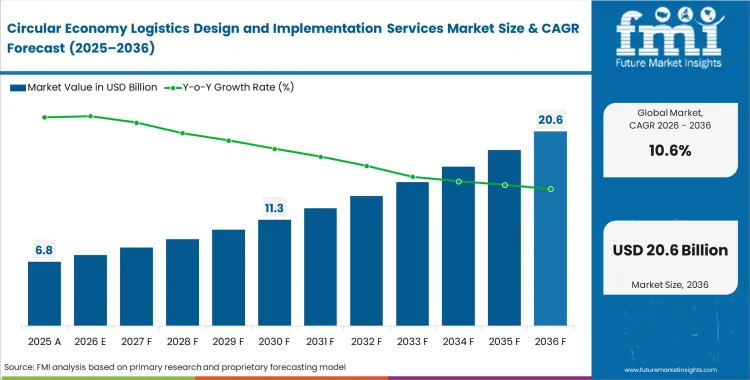
The Circular Economy Logistics Design and Implementation Services Market was valued at USD 6.1 billion in 2025 and is expected to exceed USD 6.8 billion in 2026, expanding at a CAGR of 10.6% through the forecast period. The market is projected to reach USD 18.6 billion by 2036 as extended producer responsibility regulations move beyond reporting requirements toward enforceable recovery quotas, increasing reliance on specialized circular logistics design and implementation services.
Summary of Circular Economy Logistics Design and Implementation Services Market
- Market Snapshot
- The circular economy logistics design and implementation services market is valued at USD 6.1 billion in 2025 and is projected to reach USD 18.6 billion by 2036.
- The market is forecast to grow at 10.6% CAGR from 2026 to 2036, creating an incremental opportunity of about USD 11.8 billion.
- This is a services-led market built around redesigning logistics for return, reuse, repair, refurbishment, remanufacturing, and recovery loops moving beyond a freight-only or recycling-only category.
- Demand and Growth Drivers
- Demand is increasing as service providers reposition circularity as an operating model to prevent a standalone ESG initiative, with HFS (2025) outlining active service lines including circular supply chain consulting, reverse supply chain-as-a-service, return logistics, refurbishment management, recycling orchestration, and remanufacturing logistics.
- Capgemini’s 2025 circular supply chain perspective highlights that these systems extend beyond the point of sale into reuse and remanufacturing loops, requiring coordinated management of both forward and reverse flows across end-of-use and end-of-life stages.
- The World Economic Forum (2025) identifies circular logistics and reverse supply chains as core enablers of scalable circular business models, reinforcing their role in operational execution rather than strategy alone.
- Europe is adding structural demand as tightening EU regulations around packaging sustainability and broader circular economy targets increase the need for network redesign, implementation support, compliance reporting, and reverse-flow capability.
- Growth remains constrained by fragmented asset recovery infrastructure, limited visibility across reverse data flows, and the lack of integrated processes linking returns, repair, refurbishment, and secondary distribution.
- Product and Segment View
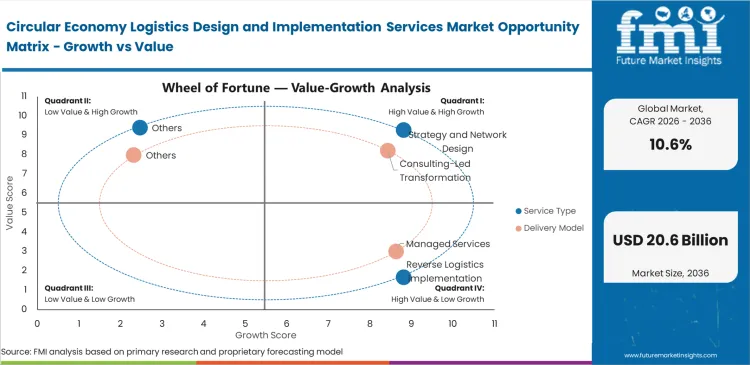
- Strategy and network design is expected to account for 27.0% share in the Service Type segment in 2026, as most enterprises begin with diagnostics, target operating model definition, and loop economics before scaling execution.
- Consulting-led transformation continues to dominate early-stage adoption, with the Delivery Model projected to reach 36.0% share in 2026, aligning with HFS (2025) findings that consulting remains a significant portion of supply chain spend before programs transition into managed operations.
- Return and recovery networks form the first operational layer for most organizations, positioning the Use Case segment at 29.0% share in 2026 as reverse flows become formalized across supply chains.
- Large enterprises are set to represent 52.0% share in the Client Type segment in 2026, reflecting their ability to absorb integration costs, redesign multi-region supply chains, and meet stricter regulatory and reporting requirements.
- Consumer goods and retail continue to anchor demand, with the End Use segment expected to account for 24.0% share in 2026, supported by active deployment of packaging return systems, recommerce models, returns optimization, and product recovery initiatives.
- Geography and Competitive Outlook
- India and China continue to record the fastest growth, while the United States remains the largest demand center, reflecting the combined impact of manufacturing scale, circularity headroom, and enterprise transformation spending capacity.
- Competitive positioning is defined by the ability to design circular networks, execute reverse-flow infrastructure at scale, ensure digital traceability, manage packaging return systems, and convert pilot programs into multi-country managed operations.
- Accenture is estimated to hold the leading single-company share, within a market that remains fragmented as consulting firms, logistics integrators, and managed-service providers compete across different layers of the circular logistics value chain.
Chief supply chain officers face pressure to architect closed-loop material flows before raw material scarcity halts production lines. Delaying infrastructure overhauls risks total exclusion from major retail vendor lists requiring verifiable recycled content inputs. Sourcing leaders recognize an immediate imperative to deploy specialized circular logistics design services. Conventional linear distribution channels lack the bidirectional visibility necessary for complex recovery tracking. Integrators specializing in reverse logistics design capture massive contract values by converting theoretical sustainability targets into operational fulfillment nodes, accelerating broader circular supply chain transformation across global manufacturing bases.
Regulatory enforcement is shifting capital allocation priorities, with organizations moving away from incremental efficiency improvements toward full-scale circular logistics transformation. Companies investing early in recovery infrastructure and network design gain cost advantages by reducing dependence on external recycling markets and securing stable material loops. Delayed adoption increases exposure to compliance penalties and higher recovery costs.
India leads geographic expansion at 12.4% as domestic manufacturers preemptively build recovery infrastructure to bypass global supply chain volatility. China tracks closely at 11.5% driven by centralized mandates requiring industrial closed-loop integration. United States operations are expected to grow at 10.7% as retail giants force suppliers to adopt closed-loop logistics consulting frameworks. Germany expands at 10.1% while United Kingdom infrastructure advances at 9.8%. France records 9.6% compound growth. Japan progresses at 8.9% reflecting an already mature industrial symbiosis framework requiring fewer baseline system overhauls.
Segmental Analysis
Circular Economy Logistics Design and Implementation Services Market Analysis by Service Type
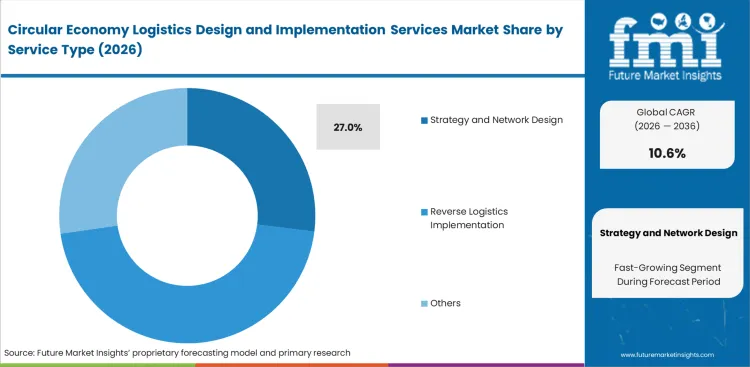
Strategy and Network Design holds 27.0% share as enterprises realize legacy forward networks cannot simply run backward. Chief operating officers engage specialists providing reverse logistics design consulting to map entirely new warehouse management systems optimized for heterogeneous return streams. FMI's assessment indicates pure infrastructure mapping dominates initial spending phases. Most organizations underestimate how radically unpredictable collection volumes destroy traditional facility utilization metrics. What generalists miss regarding strategic planning is that successful engagements actively design out transport requirements entirely by creating localized processing ecosystems. Executives skipping this blueprint phase face catastrophic margin erosion when variable return freight outstrips recovered material value.
- Route optimization: Engineers deploy dynamic algorithms adjusting collection schedules based on predicted material accumulation to prevent fixed timetables. Fleet managers reduce empty-mile transit costs significantly.
- Node positioning: Network architects evaluate existing distribution centers against ideal recovery locations. Facility planners avoid massive capital expenditure by identifying shared-use industrial symbiosis opportunities.
- Disposition logic: Consultants establish rigid triage protocols dictating whether an item enters repair, refurbishment, or recycling streams. Operations directors prevent low-value scrap from clogging high-cost remanufacturing centers.
Circular Economy Logistics Design and Implementation Services Market Analysis by Delivery Model
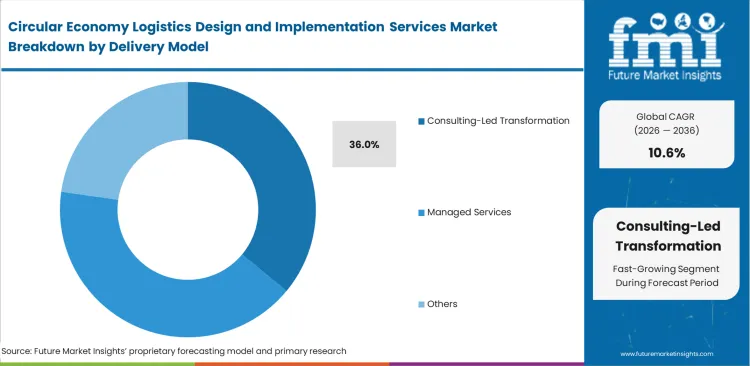
Enterprises approaching circular transformation typically lack internal capability to redesign end-to-end supply chains, making consulting-led transformation the dominant delivery model. The segment is projected to hold 36.0% share in 2026, as organizations require coordinated redesign across systems, operations, and partner networks moving beyond isolated upgrades. Success depends on maintaining continuity from strategy through execution, as fragmented implementation often fails to scale beyond pilot phases.
- Executive alignment: Change management specialists establish cross-functional steering committees enforcing operational shifts. Chief sustainability officers overcome departmental resistance holding up network integration.
- Vendor synchronization: Consultants manage massive RFP processes selecting optimal physical logistics partners including logistics visibility software providers. Procurement heads avoid contracting with carriers incapable of handling variable condition freight.
- Process mapping: Analysts document every touchpoint a product encounters during its reverse journey. Quality assurance directors identify exact moments where material degradation occurs during transit.
Circular Economy Logistics Design and Implementation Services Market Analysis by Use Case
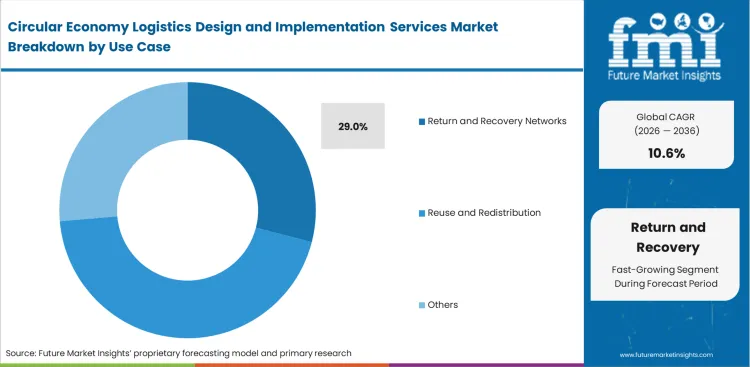
Reclaiming high-value post-consumer goods requires dedicated physical infrastructure distinct from traditional retail supply lines. Return and Recovery Networks account for 29.0% share as brands desperately build dedicated channels to recapture critical components. Operations managers recognize that integrating reusable packaging return systems demands specialized consolidation hubs designed by teams expert in remanufacturing logistics consulting. Based on FMI's assessment, establishing these primary collection nodes represents a fundamental prerequisite for any advanced sustainability ambition. Many brands publicly announce ambitious remanufacturing goals without possessing any mechanism to actually retrieve their sold products. Companies aggressively investing in dedicated recovery channels create an insurmountable barrier for competitors relying on fragmented third-party collection schemes.
- Consumer collection: System designers create frictionless drop-off points encouraging end-user participation. Brand managers secure consistent feedstock volumes required for downstream processing.
- Consolidation routing: Logistics engineers aggregate low-volume returns into high-density freight shipments. Transportation directors minimize per-unit recovery costs essential for program viability.
- Condition grading: Facility architects design specialized intake zones where incoming assets undergo rapid automated evaluation. Triage managers accelerate high-value components toward refurbishment while diverting scrap immediately.
Circular Economy Logistics Design and Implementation Services Market Analysis by Client Type
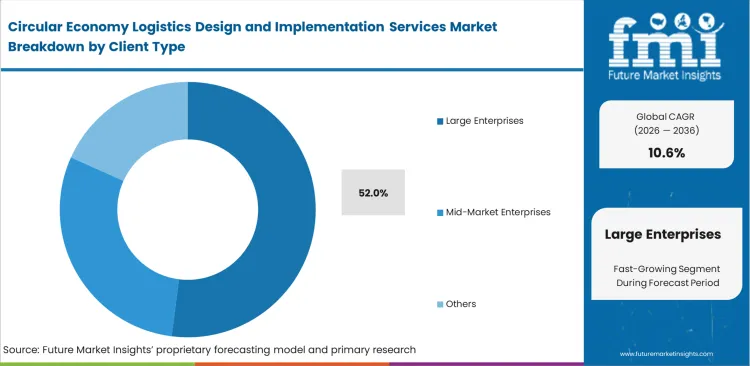
Large Enterprises command 52.0% share because their operational scale makes circular transformation a board-level existential priority. Chief compliance officers mandate e-commerce packaging EPR compliance software integration to avoid crippling regional trade restrictions. FMI's analysis indicates multinational corporations leverage their immense procurement weight to force entire supplier ecosystems into compliance through mandated circular recovery operations services. Despite possessing vast resources, immense organizational inertia often makes large enterprises the slowest actors to actually implement physical network changes. Smaller agile competitors capturing localized recovery networks consistently outmaneuver massive corporations attempting centralized global return solutions.
- System integration: IT directors connect isolated regional ERP systems into unified global visibility platforms. Corporate leaders gain comprehensive oversight regarding worldwide material recovery metrics.
- Supplier mandates: Procurement executives rewrite standard vendor contracts requiring participation in unified take-back architectures. Operations officers force upstream partners to absorb downstream recovery responsibilities.
- Capital deployment: Finance chiefs authorize massive infrastructure investments establishing proprietary sorting facilities. Enterprise leaders secure long-term processing capacity before regional competitors lock up available assets.
Circular Economy Logistics Design and Implementation Services Market Analysis by End Use
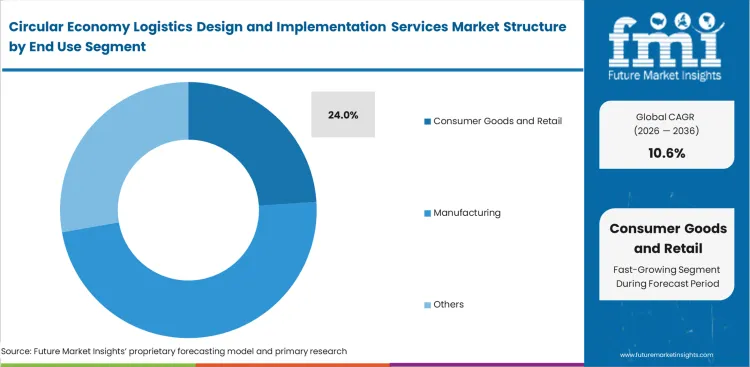
Consumer goods and retail sectors are leading adoption due to high packaging volumes and regulatory scrutiny. The segment is expected to account for 24.0% share in 2026, as brands redesign packaging and recovery systems to meet circularity requirements. High product turnover requires efficient reverse logistics to prevent operational disruption at retail locations.
- Store-level retrieval: Logistics planners establish rapid sweep routines clearing accumulated packaging from retail locations. Store managers maintain floor space efficiency while participating in recovery programs.
- Consumer incentivization: Marketing directors integrate digital deposit return schemes directly into brand loyalty applications. Digital product owners drive higher return rates through gamified financial rewards.
- Sanitation protocols: Operations specialists design industrial washing networks necessary for reusable container cycles. Quality control officers ensure returned assets meet stringent health standards before refilling.
Circular Economy Logistics Design and Implementation Services Market Drivers, Restraints, and Opportunities
Tightening extended producer responsibility regulations are shifting from voluntary targets to enforceable financial penalties, forcing sustainability leaders to accelerate implementation of take-back and closed-loop material programs. Delays now carry direct risk in the form of compliance fines, restricted market access, and loss of eligibility with key retail partners. Organizations can no longer depend on aggregated recycling claims, as regulators increasingly require item-level traceability that proves materials are recovered and reintegrated into production cycles. This shift is driving demand for specialized consulting and implementation services that can design verifiable, end-to-end circular networks within compressed timelines.
Fundamental infrastructure incompatibility acts as a severe operational friction slowing rapid deployment. Chief operating officers discover legacy distribution centers optimized for rapid outbound pallet shipment completely collapse when flooded with unpredictable unsorted single-item returns. Retrofitting these facilities requires massive capital expenditure and prolonged operational disruption. While specialized third-party sorting hubs offer a temporary bridge, zero localized processing capacity exists to handle industry-wide transition volumes. Network planners struggle to secure adequate facility space, delaying holistic transformation despite intense board-level pressure to launch programs.
Opportunities in the Circular Economy Logistics Design and Implementation Services Market
- Data monetization: Service lifecycle management application architects gather unprecedented component reliability data from returned assets. Product design directors leverage this intelligence to engineer more durable next-generation iterations.
- Secondary revenue: Supply chain leaders establish lucrative internal business units selling recovered raw materials back to primary vendors. Finance chiefs offset initial recovery infrastructure costs through consistent secondary commodity sales.
- Specialized recovery: Facility planners invest heavily in repair and refurbishment logistics consulting to extract maximum value from returned technical assets. Regional directors utilize reverse supply chain as a service platforms to monetize end-of-life hardware without owning physical sorting real estate.
Regional Analysis
Based on regional analysis, Circular Economy Logistics Design and Implementation Services Market is segmented into North America, Europe, Asia Pacific, and Rest of World across 40 plus countries.
.webp "Top Country Growth Comparison Circular Economy Logistics Design And Implementation Services Market Cagr (2026 2036)")
| Country | CAGR (2026 to 2036) |
|---|---|
| India | 12.4% |
| China | 11.5% |
| United States | 10.7% |
| Germany | 10.1% |
| United Kingdom | 9.8% |
| France | 9.6% |
| Japan | 8.9% |
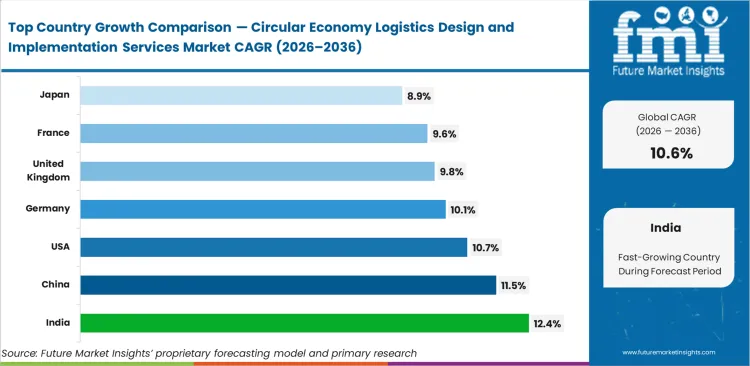
Source: Future Market Insights (FMI) analysis, based on proprietary forecasting model and primary research
Asia Pacific Circular Economy Logistics Design and Implementation Services Market Analysis
Industrial policy across Asia Pacific is shifting logistics design from linear export models to closed-loop domestic systems. Governments are reducing dependence on imported raw materials by enforcing recovery and reuse within national boundaries. This is changing how logistics networks are structured, with increased focus on reverse flows, material traceability, and localized processing. Manufacturing hubs are integrating recovery channels directly into production ecosystems, where waste streams are treated as input sources for future output. Service providers are being engaged to design systems that connect collection, sorting, and reintegration without relying on external supply chains.
- India: Manufacturers are building domestic recovery loops to reduce exposure to global raw material price volatility and supply disruptions. Procurement officers shield production lines from global commodity price shocks. Compound growth tracks at 12.4%. This localization creates huge opportunities for domestic logistics integrators to dominate regional contracts.
- China: China is projected to witness 11.5% CAGR during 2026 to 2036. State-led mandates require integration of secondary materials into industrial production, forcing redesign of logistics and plant-level intake systems. Facilities are being reconfigured to handle recycled inputs alongside virgin materials, supported by centralized compliance tracking. Companies that fail to align with these requirements risk exclusion from state procurement programs. Domestic logistics systems are evolving to ensure steady movement of recovered materials across industrial clusters.
- Japan: Japan’s Circular Economy Logistics Design and Implementation Services Market reflects a CAGR of 8.9% through 2036, supported by established industrial symbiosis systems. Companies are focusing on refining existing recovery and redistribution networks rather than building new infrastructure. Logistics design emphasizes efficiency gains, precision in material flows, and integration with global operations. Experience in managing closed-loop systems allows Japanese firms to extend these models into international markets through consulting and system exports.
North America Circular Economy Logistics Design and Implementation Services Market Analysis
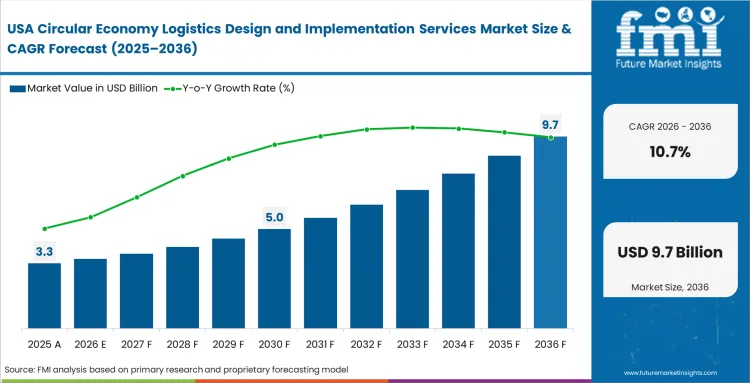
Retail consolidation forces massive supplier compliance regarding packaging and product end-of-life management. Gigantic retail networks mandate that vendors utilize specialized retail logistics frameworks to clear secondary materials from distribution centers. Procurement directors at tier-one suppliers face a stark choice: implement compliant take-back architecture or lose shelf space entirely. As per FMI's projection, this dynamic bypasses federal legislative gridlock by using pure commercial leverage to drive demand for circular logistics managed services. True power center dictating network design sits with massive retailers rather than traditional regulatory bodies.
- United States: Retail giants force suppliers into unified take-back architectures. Supply chain vice presidents scramble to fund unexpected reverse network requirements. Progressing at 10.7% over the forecast period. Integrators successfully navigating these complex multi-vendor retail mandates secure entrenched multi-year recurring revenue streams.
Europe Circular Economy Logistics Design and Implementation Services Market Analysis
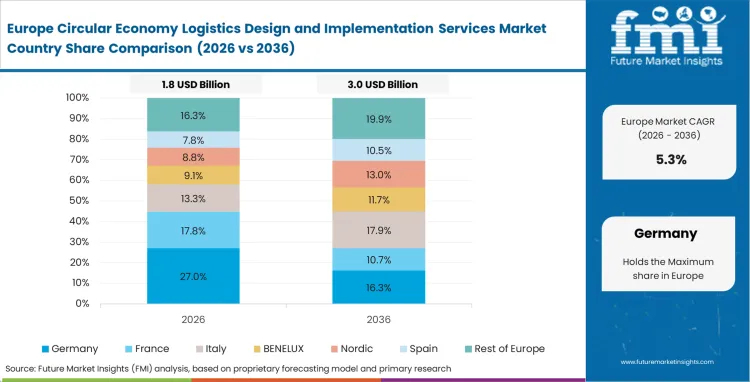
Regulatory frameworks across Europe are directly influencing logistics design, with clear mandates on material recovery, waste reduction, and recycled content usage. Companies are restructuring supply chains to comply with taxation on virgin materials and restrictions on waste disposal. Logistics systems must support traceability, reporting, and controlled material movement across national borders. Service providers are engaged to design infrastructure that aligns operational flows with compliance requirements while maintaining cost efficiency.
- Germany: Strict packaging laws compel immediate heavy investments into automated sorting capabilities. Operations directors seek advanced robotics to handle complex material separation. Expanding at 10.1% steadily. Deep engineering expertise positions German integrators as premier exporters of complex recovery network technology.
- United Kingdom: The United Kingdom is forecast to record a CAGR of 9.8% through 2036 in this market. Post-Brexit regulatory divergence is requiring localized logistics frameworks to manage waste and material flows within national boundaries. Companies are establishing domestic processing capacity to avoid cross-border compliance delays. Demand for specialized consulting services is increasing as businesses adapt to evolving environmental standards.
- France: France is anticipated to register a CAGR of 9.6% through 2036. Regulations restricting disposal of unsold goods are forcing companies to redesign inventory and reverse logistics processes. Businesses are integrating liquidation, redistribution, and recycling channels into unified systems. Logistics service providers are developing rapid sorting and routing frameworks to ensure compliance while maintaining operational efficiency across retail and manufacturing sectors.
Competitive Aligners for Market Players
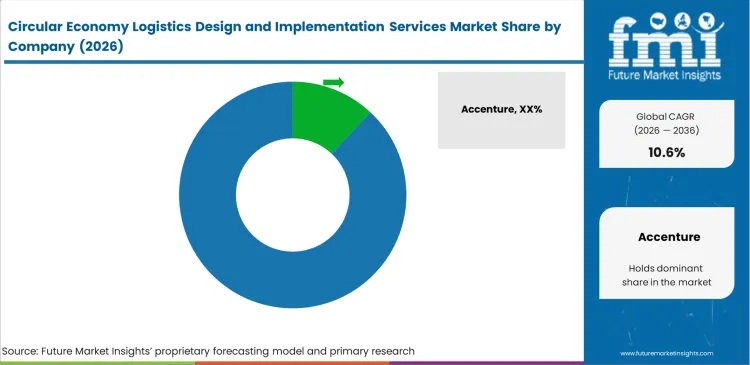
Global consulting firms continue to dominate early-stage circular transformation by leveraging existing C-suite relationships and positioning reverse network design as a core enterprise risk and compliance priority. Firms such as Accenture, Capgemini, and EY secure large transformation mandates by translating complex regulatory frameworks into actionable operating models, including facility design, recovery flows, and compliance structures. Executive teams increasingly evaluate consulting partners based on their ability to interpret evolving regulations and convert them into executable network blueprints, leaving smaller logistics specialists to compete for downstream implementation roles.
At the execution layer, providers with established physical infrastructure hold a clear advantage. Organizations like DHL Supply Chain bring existing warehouse networks, transport capacity, and trained labor pools that enable immediate scaling of recommerce and recovery operations. Buyers prioritize partners that can handle unpredictable return volumes across storage, grading, and processing without requiring new infrastructure buildouts. Pure software-led entrants often face scaling constraints, as digital optimization alone cannot replace the need for physical handling, movement, and processing of returned goods.
Massive retail buyers resist vendor lock-in by forcing competing logistics providers onto unified data platforms. When evaluating how do companies implement circular supply chains, procurement directors refuse to let one integrator control both their physical assets and their underlying material provenance data. They split contracts, awarding strategic planning to one consultancy while giving physical implementation to a separate operator. FMI observes that successful challengers bypass traditional enterprise sales motions by targeting hyperlocal returns pick-up and consolidation services, building localized density that massive global operators find too expensive to service efficiently.
Key Players in Circular Economy Logistics Design and Implementation Services Market
- Accenture
- Capgemini
- EY
- Kearney
- DHL Supply Chain
- PwC
- KPMG
Scope of the Report
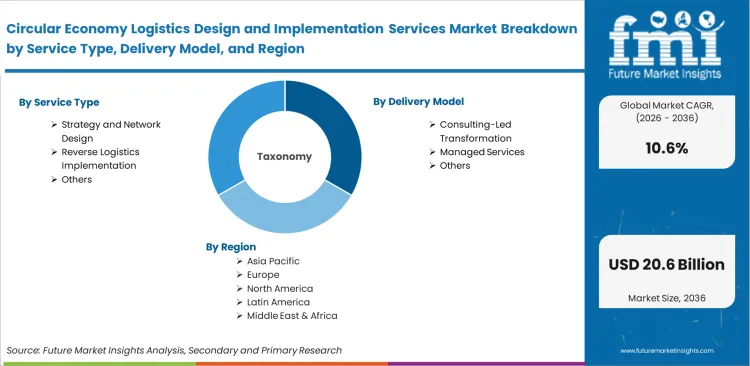
| Metric | Value |
|---|---|
| Quantitative Units | USD 6.80 billion to USD 18.62 billion, at a CAGR of 10.6% |
| Market Definition | Specialized engineering, consulting, and operational frameworks designed to construct bidirectional material flows. Providers establish physical networks and digital tracking capabilities necessary to recover and reintegrate downstream products back into upstream production cycles. |
| Segmentation | Service Type, Delivery Model, Use Case, Client Type, End Use, Region |
| Regions Covered | North America, Latin America, Europe, Asia Pacific, Middle East and Africa |
| Countries Covered | United States, Canada, Brazil, Mexico, Germany, United Kingdom, France, Italy, Spain, China, Japan, India, ASEAN, ANZ, GCC |
| Key Companies Profiled | Accenture, Capgemini, EY, Kearney, DHL Supply Chain, PwC, KPMG |
| Forecast Period | 2026 to 2036 |
| Approach | Primary input from tier-one network design architects established baseline engagement complexity metrics. Valuation models anchored on publicly disclosed enterprise transformation contract values. |
Source: Future Market Insights (FMI) analysis, based on proprietary forecasting model and primary research
Circular Economy Logistics Design and Implementation Services Market Analysis by Segments
Service Type
- Strategy and Network Design
- Reverse Logistics Implementation
- Take-Back Program Design
- Circular Packaging Systems
- Managed Circular Operations
Delivery Model
- Consulting-Led Transformation
- Managed Services
- Project-Based Implementation
- Technology Integration
- Outcome-Based Programs
Use Case
- Return and Recovery Networks
- Reuse and Redistribution
- Repair and Refurbishment Flows
- Remanufacturing Support
- Packaging Return Loops
Client Type
- Large Enterprises
- Mid-Market Enterprises
- Public Sector
- Producer Responsibility Organizations
- Multi-Client Industry Consortia
End Use
- Consumer Goods and Retail
- Manufacturing
- Automotive
- Electronics
- Healthcare and Medtech
Region
- North America
- Latin America
- Europe
- Asia Pacific
- Middle East and Africa
Bibliography
- Capgemini. (2025). Excerpt: HFS Horizons intelligent supply chain services, 2025. Capgemini.
- European Union. (2024, July 24). Regulation on packaging and packaging waste. EUR-Lex.
- European Commission. (2024). A new circular economy action plan. EUR-Lex.
- EY. (2025, November 24). Excerpt: HFS Horizons intelligent supply chain services, 2025. EY.
- Kearney. (2024, June 3). Driving resilience in the chemicals supply chain. Kearney.
This bibliography is provided for reader reference. The full FMI report contains the complete reference list with primary source documentation.
This Report Addresses
- Contract value acceleration regarding complex closed-loop supply chain transformation engagements.
- Specific pain points chief sustainability officers face when architecting verifiable bidirectional networks.
- Localized processing requirements driving massive facility infrastructure investments across Asian manufacturing hubs.
- Regulatory compliance pressure forcing consumer goods brands to implement strict packaging take-back loops.
- Vendor lock-in risks associated with proprietary centralized enterprise resource planning software integration.
- Hidden operational costs undermining traditional facility utilization metrics during high-volume return surges.
- Strategic advantages incumbent carriers hold regarding physical asset deployment and transportation capacity.
- European taxation frameworks accelerating automated sorting robotics deployment across critical recovery hubs.
Frequently Asked Questions
What is the baseline valuation for circular economy logistics design services?
Valuation reached USD 6.15 billion in 2025, reflecting massive early-stage consulting engagements. This baseline signals a permanent shift from theoretical sustainability planning toward hard capital expenditure as enterprises construct dedicated bidirectional material flow infrastructure.
How fast is demand expanding globally?
Sales advance at a 10.6% CAGR through 2036. This sustained trajectory confirms organizations are moving beyond pilot programs and actively scaling verifiable material recovery systems across their entire global operational footprint.
What total revenue potential does this sector represent by 2036?
Cumulative revenue builds to USD 18.6 billion by 2036. This scale illustrates how integrated reverse networks are becoming core operational requirements rather than specialized niche capabilities within enterprise distribution frameworks.
What are circular logistics services and why do they lead deployment?
Holding 27.0% share, this segment dominates because legacy forward logistics models completely fail when reversed. Chief operating officers require entirely new architectural blueprints to handle unpredictable, unsorted return volumes before committing capital to physical processing centers.
What makes consulting-led transformation the primary delivery model?
Capturing 36.0% share, holistic consulting leads because isolated software patches cannot solve complex bidirectional flow challenges. Enterprises rely on external integrators to synchronize change management, software deployment, and physical facility redesign simultaneously.
What is closed-loop logistics consulting focused on resolving?
Accounting for 29.0% share, physical collection nodes represent the fundamental prerequisite for all advanced circular initiatives. Brands cannot achieve remanufacturing or materials recovery goals without first establishing frictionless channels to retrieve discarded assets.
How do large enterprises dictate implementation patterns?
Commanding 52.0% share, massive conglomerates leverage immense procurement power to force entire supplier ecosystems into compliance. Their requirement for auditable global material tracking forces standardization across fragmented regional take-back operations.
Why does India present the fastest growth trajectory?
Tracking at 12.4% compound growth, India expands rapidly as domestic manufacturers aggressively localize recovery loops. Procurement officers preemptively build these networks to insulate critical production lines from international supply chain shocks and virgin material scarcity.
What structural difference exists between European and North American adoption?
European adoption relies heavily on strict legislative taxation forcing compliance, while North American expansion utilizes commercial leverage driven by massive retail networks demanding unified vendor take-back participation to maintain shelf space.
How does automated sorting integration change facility economics?
Advanced robotics and localized triage logic push disposition decisions to edge collection nodes. Operations directors prevent low-value scrap from consuming expensive central processing capacity, dramatically reducing overall reverse transportation costs.
Why are circular logistics services growing despite high deployment costs?
Existing distribution centers optimize for rapid outbound pallet shipping and collapse when flooded with single-item returns. Retrofitting these massive hubs requires enormous capital, yet regulatory penalties for inaction far exceed these heavy transition costs.
Why do major brands struggle with vendor lock-in during network design?
Integrators supplying proprietary tracking software effectively capture all material provenance data. Procurement directors who fail to mandate interoperable platforms discover extreme switching costs when attempting to transition physical processing contracts to competing logistics providers.
How does specialized packaging compliance alter fast-moving consumer goods networks?
Intense retail pressure forces brands to implement rapid sweep routines clearing accumulated secondary packaging. Logistics planners must establish highly efficient return flows preventing empty containers from overwhelming valuable backroom retail storage space.
What competitive advantage do incumbent carriers hold over digital challengers?
Huge real estate portfolios and established transportation fleets allow incumbents to physically store, grade, and process immediate return volume surges. Startups utilizing pure software algorithms cannot physically move discarded appliances from consumer residences.
How does localized processing alter strategic capital deployment?
Network architects evaluate shared-use industrial symbiosis opportunities over massive centralized hubs. Facility planners actively design out transport requirements, creating regional processing ecosystems that mitigate high variable return freight costs.
Why are liquidation services becoming critical for French retail operations?
National anti-waste laws mandate total destruction bans on unsold inventory. Inventory managers must integrate rapid triage protocols directly with charity redistribution networks to maintain legal compliance without disrupting primary forward sales channels.
What role does condition grading play in remanufacturing viability?
Facility architects design specialized intake zones accelerating high-value components toward refurbishment while immediately diverting scrap. Triage managers use these automated evaluations to maintain profitability within complex consumer electronics recovery channels.
How do extended producer responsibility directives impact long-term strategy?
Directives transitioning from voluntary targets to punitive financial regulations force chief sustainability officers to secure long-term processing capacity immediately. Delaying implementation exposes organizations to millions in potential compliance fines across restricted regional territories.
What drives secondary revenue generation within closed-loop systems?
Supply chain leaders establish internal business units to sell recovered raw materials back to primary vendors. Finance chiefs leverage consistent secondary commodity sales to offset massive initial investments required for physical sorting infrastructure.
How does dynamic route optimization improve collection efficiency?
Engineers deploy algorithms adjusting schedules based on predicted material accumulation rather than fixed timetables. Fleet managers reduce empty-mile transit costs significantly, keeping variable freight expenses below recovered material values.
What prevents piecemeal implementation from achieving scale?
Siloed initiatives often conflict during execution when strategic teams hand off blueprints to unprepared operational staff. Integrators maintaining continuity from board-level strategy down to facility layout guarantee higher programmatic success rates.
How do digital deposit return schemes influence consumer participation?
Marketing directors integrate digital incentives directly into brand loyalty applications. Digital product owners drive significantly higher localized return rates through gamified financial rewards, securing consistent feedstock volumes for downstream processing.
Preview the report firsthand - request a free sample
Get SampleGet the brochure for pricing and purchase details.
Get PDFTable of Content
- Executive Summary
- Global Market Outlook
- Demand-side Trends
- Supply-side Trends
- Technology Roadmap Analysis
- Analysis and Recommendations
- Market Overview
- Market Coverage / Taxonomy
- Market Definition / Scope / Limitations
- Research Methodology
- Chapter Orientation
- Analytical Lens and Working Hypotheses
- Market Structure, Signals, and Trend Drivers
- Benchmarking and Cross-market Comparability
- Market Sizing, Forecasting, and Opportunity Mapping
- Research Design and Evidence Framework
- Desk Research Programme (Secondary Evidence)
- Company Annual and Sustainability Reports
- Peer-reviewed Journals and Academic Literature
- Corporate Websites, Product Literature, and Technical Notes
- Earnings Decks and Investor Briefings
- Statutory Filings and Regulatory Disclosures
- Technical White Papers and Standards Notes
- Trade Journals, Industry Magazines, and Analyst Briefs
- Conference Proceedings, Webinars, and Seminar Materials
- Government Statistics Portals and Public Data Releases
- Press Releases and Reputable Media Coverage
- Specialist Newsletters and Curated Briefings
- Sector Databases and Reference Repositories
- FMI Internal Proprietary Databases and Historical Market Datasets
- Subscription Datasets and Paid Sources
- Social Channels, Communities, and Digital Listening Inputs
- Additional Desk Sources
- Expert Input and Fieldwork (Primary Evidence)
- Primary Modes
- Qualitative Interviews and Expert Elicitation
- Quantitative Surveys and Structured Data Capture
- Blended Approach
- Why Primary Evidence is Used
- Field Techniques
- Interviews
- Surveys
- Focus Groups
- Observational and In-context Research
- Social and Community Interactions
- Stakeholder Universe Engaged
- C-suite Leaders
- Board Members
- Presidents and Vice Presidents
- R&D and Innovation Heads
- Technical Specialists
- Domain Subject-matter Experts
- Scientists
- Physicians and Other Healthcare Professionals
- Governance, Ethics, and Data Stewardship
- Research Ethics
- Data Integrity and Handling
- Primary Modes
- Tooling, Models, and Reference Databases
- Desk Research Programme (Secondary Evidence)
- Data Engineering and Model Build
- Data Acquisition and Ingestion
- Cleaning, Normalisation, and Verification
- Synthesis, Triangulation, and Analysis
- Quality Assurance and Audit Trail
- Market Background
- Market Dynamics
- Drivers
- Restraints
- Opportunity
- Trends
- Scenario Forecast
- Demand in Optimistic Scenario
- Demand in Likely Scenario
- Demand in Conservative Scenario
- Opportunity Map Analysis
- Product Life Cycle Analysis
- Supply Chain Analysis
- Investment Feasibility Matrix
- Value Chain Analysis
- PESTLE and Porter’s Analysis
- Regulatory Landscape
- Regional Parent Market Outlook
- Production and Consumption Statistics
- Import and Export Statistics
- Market Dynamics
- Global Market Analysis 2021 to 2025 and Forecast, 2026 to 2036
- Historical Market Size Value (USD Million) Analysis, 2021 to 2025
- Current and Future Market Size Value (USD Million) Projections, 2026 to 2036
- Y-o-Y Growth Trend Analysis
- Absolute $ Opportunity Analysis
- Global Market Pricing Analysis 2021 to 2025 and Forecast 2026 to 2036
- Global Market Analysis 2021 to 2025 and Forecast 2026 to 2036, By Service Type
- Introduction / Key Findings
- Historical Market Size Value (USD Million) Analysis By Service Type , 2021 to 2025
- Current and Future Market Size Value (USD Million) Analysis and Forecast By Service Type , 2026 to 2036
- Strategy and Network Design
- Reverse Logistics Implementation
- Others
- Strategy and Network Design
- Y-o-Y Growth Trend Analysis By Service Type , 2021 to 2025
- Absolute $ Opportunity Analysis By Service Type , 2026 to 2036
- Global Market Analysis 2021 to 2025 and Forecast 2026 to 2036, By Delivery Model
- Introduction / Key Findings
- Historical Market Size Value (USD Million) Analysis By Delivery Model, 2021 to 2025
- Current and Future Market Size Value (USD Million) Analysis and Forecast By Delivery Model, 2026 to 2036
- Consulting-Led Transformation
- Managed Services
- Others
- Consulting-Led Transformation
- Y-o-Y Growth Trend Analysis By Delivery Model, 2021 to 2025
- Absolute $ Opportunity Analysis By Delivery Model, 2026 to 2036
- Global Market Analysis 2021 to 2025 and Forecast 2026 to 2036, By Use Case
- Introduction / Key Findings
- Historical Market Size Value (USD Million) Analysis By Use Case, 2021 to 2025
- Current and Future Market Size Value (USD Million) Analysis and Forecast By Use Case, 2026 to 2036
- Return and Recovery Networks
- Reuse and Redistribution
- Others
- Return and Recovery Networks
- Y-o-Y Growth Trend Analysis By Use Case, 2021 to 2025
- Absolute $ Opportunity Analysis By Use Case, 2026 to 2036
- Global Market Analysis 2021 to 2025 and Forecast 2026 to 2036, By Client Type
- Introduction / Key Findings
- Historical Market Size Value (USD Million) Analysis By Client Type, 2021 to 2025
- Current and Future Market Size Value (USD Million) Analysis and Forecast By Client Type, 2026 to 2036
- Large Enterprises
- Mid-Market Enterprises
- Others
- Large Enterprises
- Y-o-Y Growth Trend Analysis By Client Type, 2021 to 2025
- Absolute $ Opportunity Analysis By Client Type, 2026 to 2036
- Global Market Analysis 2021 to 2025 and Forecast 2026 to 2036, By End Use
- Introduction / Key Findings
- Historical Market Size Value (USD Million) Analysis By End Use, 2021 to 2025
- Current and Future Market Size Value (USD Million) Analysis and Forecast By End Use, 2026 to 2036
- Consumer Goods and Retail
- Manufacturing
- Others
- Consumer Goods and Retail
- Y-o-Y Growth Trend Analysis By End Use, 2021 to 2025
- Absolute $ Opportunity Analysis By End Use, 2026 to 2036
- Global Market Analysis 2021 to 2025 and Forecast 2026 to 2036, By Region
- Introduction
- Historical Market Size Value (USD Million) Analysis By Region, 2021 to 2025
- Current Market Size Value (USD Million) Analysis and Forecast By Region, 2026 to 2036
- North America
- Latin America
- Western Europe
- Eastern Europe
- East Asia
- South Asia and Pacific
- Middle East & Africa
- Market Attractiveness Analysis By Region
- North America Market Analysis 2021 to 2025 and Forecast 2026 to 2036, By Country
- Historical Market Size Value (USD Million) Trend Analysis By Market Taxonomy, 2021 to 2025
- Market Size Value (USD Million) Forecast By Market Taxonomy, 2026 to 2036
- By Country
- USA
- Canada
- Mexico
- By Service Type
- By Delivery Model
- By Use Case
- By Client Type
- By End Use
- By Country
- Market Attractiveness Analysis
- By Country
- By Service Type
- By Delivery Model
- By Use Case
- By Client Type
- By End Use
- Key Takeaways
- Latin America Market Analysis 2021 to 2025 and Forecast 2026 to 2036, By Country
- Historical Market Size Value (USD Million) Trend Analysis By Market Taxonomy, 2021 to 2025
- Market Size Value (USD Million) Forecast By Market Taxonomy, 2026 to 2036
- By Country
- Brazil
- Chile
- Rest of Latin America
- By Service Type
- By Delivery Model
- By Use Case
- By Client Type
- By End Use
- By Country
- Market Attractiveness Analysis
- By Country
- By Service Type
- By Delivery Model
- By Use Case
- By Client Type
- By End Use
- Key Takeaways
- Western Europe Market Analysis 2021 to 2025 and Forecast 2026 to 2036, By Country
- Historical Market Size Value (USD Million) Trend Analysis By Market Taxonomy, 2021 to 2025
- Market Size Value (USD Million) Forecast By Market Taxonomy, 2026 to 2036
- By Country
- Germany
- UK
- Italy
- Spain
- France
- Nordic
- BENELUX
- Rest of Western Europe
- By Service Type
- By Delivery Model
- By Use Case
- By Client Type
- By End Use
- By Country
- Market Attractiveness Analysis
- By Country
- By Service Type
- By Delivery Model
- By Use Case
- By Client Type
- By End Use
- Key Takeaways
- Eastern Europe Market Analysis 2021 to 2025 and Forecast 2026 to 2036, By Country
- Historical Market Size Value (USD Million) Trend Analysis By Market Taxonomy, 2021 to 2025
- Market Size Value (USD Million) Forecast By Market Taxonomy, 2026 to 2036
- By Country
- Russia
- Poland
- Hungary
- Balkan & Baltic
- Rest of Eastern Europe
- By Service Type
- By Delivery Model
- By Use Case
- By Client Type
- By End Use
- By Country
- Market Attractiveness Analysis
- By Country
- By Service Type
- By Delivery Model
- By Use Case
- By Client Type
- By End Use
- Key Takeaways
- East Asia Market Analysis 2021 to 2025 and Forecast 2026 to 2036, By Country
- Historical Market Size Value (USD Million) Trend Analysis By Market Taxonomy, 2021 to 2025
- Market Size Value (USD Million) Forecast By Market Taxonomy, 2026 to 2036
- By Country
- China
- Japan
- South Korea
- By Service Type
- By Delivery Model
- By Use Case
- By Client Type
- By End Use
- By Country
- Market Attractiveness Analysis
- By Country
- By Service Type
- By Delivery Model
- By Use Case
- By Client Type
- By End Use
- Key Takeaways
- South Asia and Pacific Market Analysis 2021 to 2025 and Forecast 2026 to 2036, By Country
- Historical Market Size Value (USD Million) Trend Analysis By Market Taxonomy, 2021 to 2025
- Market Size Value (USD Million) Forecast By Market Taxonomy, 2026 to 2036
- By Country
- India
- ASEAN
- Australia & New Zealand
- Rest of South Asia and Pacific
- By Service Type
- By Delivery Model
- By Use Case
- By Client Type
- By End Use
- By Country
- Market Attractiveness Analysis
- By Country
- By Service Type
- By Delivery Model
- By Use Case
- By Client Type
- By End Use
- Key Takeaways
- Middle East & Africa Market Analysis 2021 to 2025 and Forecast 2026 to 2036, By Country
- Historical Market Size Value (USD Million) Trend Analysis By Market Taxonomy, 2021 to 2025
- Market Size Value (USD Million) Forecast By Market Taxonomy, 2026 to 2036
- By Country
- Kingdom of Saudi Arabia
- Other GCC Countries
- Turkiye
- South Africa
- Other African Union
- Rest of Middle East & Africa
- By Service Type
- By Delivery Model
- By Use Case
- By Client Type
- By End Use
- By Country
- Market Attractiveness Analysis
- By Country
- By Service Type
- By Delivery Model
- By Use Case
- By Client Type
- By End Use
- Key Takeaways
- Key Countries Market Analysis
- USA
- Pricing Analysis
- Market Share Analysis, 2025
- By Service Type
- By Delivery Model
- By Use Case
- By Client Type
- By End Use
- Canada
- Pricing Analysis
- Market Share Analysis, 2025
- By Service Type
- By Delivery Model
- By Use Case
- By Client Type
- By End Use
- Mexico
- Pricing Analysis
- Market Share Analysis, 2025
- By Service Type
- By Delivery Model
- By Use Case
- By Client Type
- By End Use
- Brazil
- Pricing Analysis
- Market Share Analysis, 2025
- By Service Type
- By Delivery Model
- By Use Case
- By Client Type
- By End Use
- Chile
- Pricing Analysis
- Market Share Analysis, 2025
- By Service Type
- By Delivery Model
- By Use Case
- By Client Type
- By End Use
- Germany
- Pricing Analysis
- Market Share Analysis, 2025
- By Service Type
- By Delivery Model
- By Use Case
- By Client Type
- By End Use
- UK
- Pricing Analysis
- Market Share Analysis, 2025
- By Service Type
- By Delivery Model
- By Use Case
- By Client Type
- By End Use
- Italy
- Pricing Analysis
- Market Share Analysis, 2025
- By Service Type
- By Delivery Model
- By Use Case
- By Client Type
- By End Use
- Spain
- Pricing Analysis
- Market Share Analysis, 2025
- By Service Type
- By Delivery Model
- By Use Case
- By Client Type
- By End Use
- France
- Pricing Analysis
- Market Share Analysis, 2025
- By Service Type
- By Delivery Model
- By Use Case
- By Client Type
- By End Use
- India
- Pricing Analysis
- Market Share Analysis, 2025
- By Service Type
- By Delivery Model
- By Use Case
- By Client Type
- By End Use
- ASEAN
- Pricing Analysis
- Market Share Analysis, 2025
- By Service Type
- By Delivery Model
- By Use Case
- By Client Type
- By End Use
- Australia & New Zealand
- Pricing Analysis
- Market Share Analysis, 2025
- By Service Type
- By Delivery Model
- By Use Case
- By Client Type
- By End Use
- China
- Pricing Analysis
- Market Share Analysis, 2025
- By Service Type
- By Delivery Model
- By Use Case
- By Client Type
- By End Use
- Japan
- Pricing Analysis
- Market Share Analysis, 2025
- By Service Type
- By Delivery Model
- By Use Case
- By Client Type
- By End Use
- South Korea
- Pricing Analysis
- Market Share Analysis, 2025
- By Service Type
- By Delivery Model
- By Use Case
- By Client Type
- By End Use
- Russia
- Pricing Analysis
- Market Share Analysis, 2025
- By Service Type
- By Delivery Model
- By Use Case
- By Client Type
- By End Use
- Poland
- Pricing Analysis
- Market Share Analysis, 2025
- By Service Type
- By Delivery Model
- By Use Case
- By Client Type
- By End Use
- Hungary
- Pricing Analysis
- Market Share Analysis, 2025
- By Service Type
- By Delivery Model
- By Use Case
- By Client Type
- By End Use
- Kingdom of Saudi Arabia
- Pricing Analysis
- Market Share Analysis, 2025
- By Service Type
- By Delivery Model
- By Use Case
- By Client Type
- By End Use
- Turkiye
- Pricing Analysis
- Market Share Analysis, 2025
- By Service Type
- By Delivery Model
- By Use Case
- By Client Type
- By End Use
- South Africa
- Pricing Analysis
- Market Share Analysis, 2025
- By Service Type
- By Delivery Model
- By Use Case
- By Client Type
- By End Use
- USA
- Market Structure Analysis
- Competition Dashboard
- Competition Benchmarking
- Market Share Analysis of Top Players
- By Regional
- By Service Type
- By Delivery Model
- By Use Case
- By Client Type
- By End Use
- Competition Analysis
- Competition Deep Dive
- Accenture
- Overview
- Product Portfolio
- Profitability by Market Segments (Product/Age /Sales Channel/Region)
- Sales Footprint
- Strategy Overview
- Marketing Strategy
- Product Strategy
- Channel Strategy
- Capgemini
- EY
- Kearney
- DHL Supply Chain
- PwC
- KPMG
- Accenture
- Competition Deep Dive
- Assumptions & Acronyms Used


