

- Industry Size (2026)
- USD 3.84 Bn
- Forecast (2036)
- USD 9.17 Bn
- CAGR (2026 to 2036)
- 9.10%
Circular Economy Refillable Personal Care Dispensers Market Size, Market Forecast and Outlook By FMI
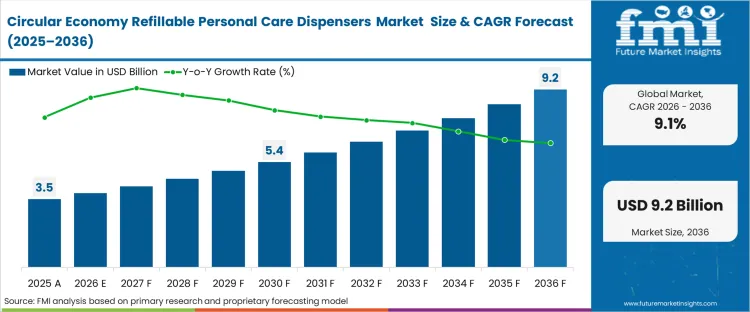
The circular economy refillable personal care dispensers market was valued at USD 3.52 billion in 2025. Sales are poised to cross USD 3.84 billion in 2026 at a CAGR of 9.10% during the forecast period. Consistent investment pushes the valuation to USD 9.17 billion through 2036 as consumer brands restructure their refillable cosmetic dispenser packaging architectures to decouple functional dispense mechanisms from durable aesthetic housings.
Procurement directors at tier-one beauty conglomerates are abandoning the standard cost-per-unit metric in favour of total lifecycle economics. The decision now centres on justifying the high initial tooling capital for a durable keeper pack against the logistics savings of shipping lightweight, low waste modular packaging. Failing to establish a standardised inner pod architecture leaves brands vulnerable to fragmented supply chains and higher long-term resin taxes. This transition highlights the core refillable beauty packaging trends 2026, moving value away from single-use aesthetics toward precision-engineered locking mechanisms.
Summary of Circular Economy Refillable Personal Care Dispensers Market
- Circular Economy Refillable Personal Care Dispensers Market Definition
- This market tracks the transition from disposable aesthetic packaging to decoupled architectures, where durable outer housings are retained by consumers, and internal formulation reservoirs are replaced. It defines the engineered boundary between single-use compliance and true multi-cycle material retention.
- Demand Drivers in the Market
- Extended producer responsibility tax structures compel packaging engineers to separate heavy decorative plastics from lightweight functional fluid bladders.
- Premium beauty consumers obligate brand managers to deliver sustainability narratives without compromising the tactile weight and prestige feel of the daily use product.
- Retail merchandising constraints push supply chain directors to adopt flat-pack shipping for replenishment stock to maximize shelf yield.
- Key Segments Analyzed in the FMI Report
- Airless pumps: Airless pumps are expected to hold 31.0% share in 2026, driven by the absolute requirement to protect active skincare ingredients from oxidation during the cartridge swap process.
- PP-based systems: PP-based systems are anticipated to grab 34.0% in 2026, as molders prioritize mono-material architectures to simplify the end-of-life recycling matrix for the refill pods.
- Replaceable cartridge/pod: Replaceable cartridge/pod formats are poised to account for 38.0% in 2026, offering the cleanest consumer experience with the lowest risk of formula cross-contamination.
- Skincare: Skincare is likely to garner 36.0% in 2026, owing to the high margin profile that easily absorbs the initial premium of the durable skincare packaging keeper pack.
- India: 11.8% compound growth, driven by an expanding direct-to-consumer ecosystem bypassing legacy retail constraints.
- Analyst Opinion at FMI
- Ismail Sutaria, Principal Analyst, Packaging, at FMI, suggests, "The visible shift toward refillable cosmetic dispenser packaging masks the actual economic battleground. The real margin is not in selling the heavy, beautifully crafted outer case. The durable pack is effectively a loss leader designed to place a proprietary mechanical lock on the consumer's bathroom counter. Once the outer shell is in place, the brand secures absolute lock-in for the lightweight, high-margin consumable pod, changing the personal care sector from a point-of-sale battle to an installed-base business."
- Strategic Implications / Executive Takeaways
- Tooling engineers must design standardized pod interfaces to capture volume from mid-tier brands unwilling to fund custom proprietary molds.
- Supply chain directors should pivot distribution models to prioritize direct-to-consumer subscription fulfilment for the lightweight replenishment cartridges.
- Brand managers face the critical constraint of consumer fatigue, requiring intuitive, zero-spill pod replacement mechanisms to prevent abandonment of the durable outer pack.
The key enabler for accelerating adoption is establishing a standardized interface between the inner pod and the outer pump actuator. Once packaging molders establish cross-compatible locking threads, contract fillers no longer require proprietary tooling for every independent brand launch. Independent formulators can then specify off-the-shelf inner pods that perfectly mate with their custom outer cases, drastically accelerating the launch cycle and improving the overall cost of refillable personal care packaging.
India tracks a 11.8% CAGR, leading the global transition. China follows closely at 10.9%, ahead of Brazil at 9.6%. The United Kingdom is expected to expand at 8.7%, with the United States trailing slightly at 8.3%. France is estimated to advance at 8.1%, while Germany registers a 7.9% rate. The divergence across this range reflects a split between rapid premiumization in emerging markets leveraging new direct-to-consumer fulfilment models, versus European markets where integration is heavily gated by stringent cosmetic compatibility testing.
Circular Economy Refillable Personal Care Dispensers Market Key Takeaways
| Metric | Details |
|---|---|
| Industry Size (2026) | USD 3.84 billion |
| Industry Value (2036) | USD 9.17 billion |
| CAGR (2026-2036) | 9.10% |
Source: Future Market Insights (FMI) analysis, based on proprietary forecasting model and primary research
Circular Economy Refillable Personal Care Dispensers Market Definition
This market encompasses circular economy refillable personal care dispensers engineered for repeated consumer use, where the functional dispensing mechanism and outer aesthetic housing are retained, while the consumable formulation is replenished via independent inner cartridges, pouches, or localized bulk systems. It excludes single-use recyclable formats and standard disposable pump bottles, focusing strictly on systems designed for multi-cycle physical retention by the end user.
Circular Economy Refillable Personal Care Dispensers Market Inclusions
The scope includes durable glass, aluminum, and heavy-wall polymer keeper packs paired with specific refill inserts such as snap-in pods, screw-in cartridges, and spouted pouches designed to refill durable containers. It also covers the specialized engineered actuators required to cleanly pierce or engage these modular refill pod cartons without exposing sensitive cosmetic formulations to external oxygen or microbial contamination, widely used in reusable dispenser packaging for skincare.
Circular Economy Refillable Personal Care Dispensers Market Exclusions
The analysis specifically excludes municipal bulk chemical dispensers and automated liquid packaging refill kiosks designed for household cleaning products or industrial janitorial supplies. These are excluded because cosmetic and skincare formulations require different sanitary tolerances, oxygen barrier properties, and viscosity management systems that industrial bulk infrastructure cannot provide.
Circular Economy Refillable Personal Care Dispensers Market Research Methodology
- Primary Research: Procurement directors at tier-one personal care conglomerates, lead packaging engineers at custom injection molders, and sustainability compliance officers at contract manufacturing facilities.
- Desk Research: European harmonized packaging compliance databases, corporate sustainability audit filings, material science patent registries for polymer locking mechanisms, and life cycle assessment publications.
- Market-Sizing and Forecasting: The baseline anchors to the capital expenditure volumes of top-tier injection molders dedicated to multi-component durable housing molds versus single-use high-cavitation tooling.
- Data Validation and Update Cycle: Forecasts are triangulated against the procurement volume changes reported by major contract formulation fillers transitioning lines from standard bottles to modular pod systems.
Segmental Analysis
Circular Economy Refillable Personal Care Dispensers Market Analysis by Dispenser Type
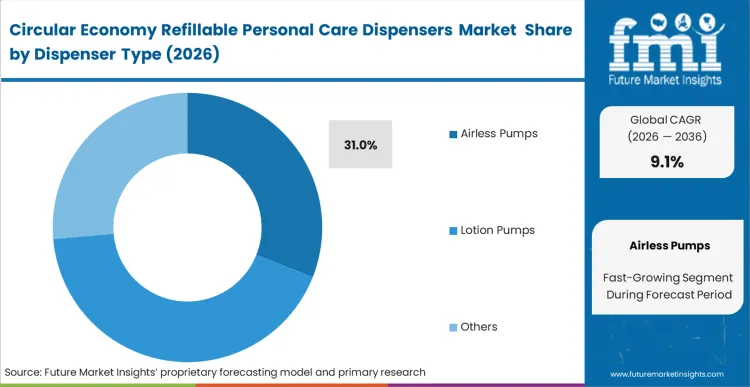
The decision facing formulation chemists specifically requires them to choose dispensing mechanisms that prevent oxidation during the moment the consumer swaps out the old pod for the new one. Airless pumps hold 31.0% of the market because they solve this exact contamination gap, making airless refillable dispenser systems non-negotiable for high-end formulations. Without an airless system, exposing active ingredients like retinol or Vitamin C to the environment during a refill process rapidly degrades the product's efficacy.
According to FMI's estimates, the integration of zero waste refill packaging heavily relies on this capability to maintain clinical claims. Consumers who experience product degradation due to improper sealing immediately abandon the system, a dynamic equally relevant when adopting refillable lotion pump packaging for viscous body creams.
- Formula protection: The sealed internal piston prevents oxygen ingress during the physical swap. Active ingredients remain stable, ensuring the brand can honor clinical efficacy claims across multiple refill cycles.
- Viscosity clearance: High-viscosity creams clear the internal chamber cleanly without leaving residual waste in the discarded pod. This validation validates the sustainability claim by preventing valuable product from entering the waste stream.
- Actuation lock: Engineered thread systems ensure the pump cannot be depressed unless the new pod is perfectly seated. This prevents consumers from accidentally pumping air into the line and breaking the vacuum seal.
Circular Economy Refillable Personal Care Dispensers Market Analysis by Material
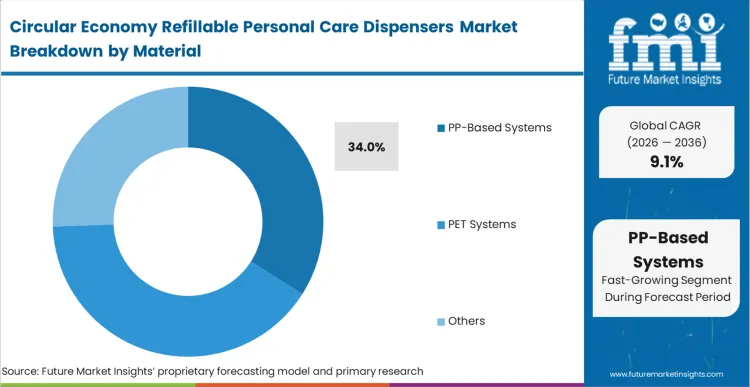
PP-based systems are estimated to hold a 34.0% share in 2026 owing to their unique ability to function as both the rigid outer housing and the flexible inner mechanism, enabling true mono-material construction. Packaging engineers specifying a mono-material refill pump dispenser can eliminate the metal springs and glass balls traditionally required in pump and dispenser packaging.
In FMI's view, this simplifies the procurement matrix while drastically reducing the hidden compliance costs associated with mixed-material end-of-life taxes. When brands use polypropylene for the durable case, the actuator, and the inner refill bladder, the entire unit passes seamlessly through mechanical recycling streams without requiring the consumer to disassemble the parts. Buyers who specify complex, multi-resin architectures incur immediate extended producer responsibility penalties and struggle to validate their recyclability claims.
- Tooling consolidation: Engineers cut single-material molds that handle both high-rigidity parts and living hinges. Procurement directors leverage bulk resin purchasing to offset the higher cycle times of complex multi-part injection.
- Recycling stream purity: Post-consumer recovery facilities recognize the clean PP signature without manual sorting. Brands avoid the hidden municipal taxation levied against unrecyclable mixed-material formats.
- Lifecycle parity: Total carbon assessments reveal mono-material systems outperforming glass hybrids once shipping weight is factored in. Sustainability officers use this data to justify the transition away from heavy aesthetic glass.
Circular Economy Refillable Personal Care Dispensers Market Analysis by Refill Model
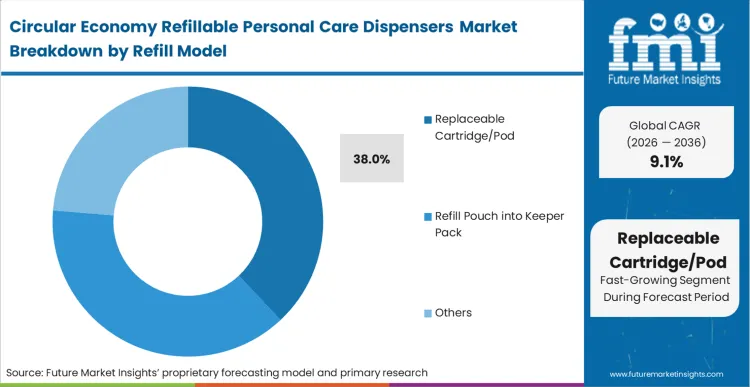
A messy or complex replenishment process is the primary commercial failure mode, which is why the replaceable cartridge/pod model dominates at 38.0% share. When consumers are asked to pour high-viscosity lotions from a refill pouch into a narrow-necked durable bottle, spillage and cross-contamination inevitably occur. Refill cartridge dispensers for personal care eliminate the pouring step entirely.
As per FMI's projection, airless packaging formats using modular snap-in cartridges guarantee that the fresh formula never touches the old dispensing pathway. The old pod clicks out, the new pod clicks in, and the system is instantly primed. Brands that rely on pour-in pouches routinely see consumer repurchase rates drop off after the first cycle due to the operational friction of cleaning the reusable keeper pack.
- Contamination barrier: The sealed pod prevents consumer interaction with the bulk fluid. This eliminates the risk of tap water or airborne bacteria spoiling unpreserved cosmetic formulations.
- Residue build-up: Pour-in models leave a film of old product that oxidizes inside the reusable bottle. The modular pod approach swaps the entire internal contact surface, mitigating residual chemical breakdown.
- Replacement mechanics: Consumers must be able to perform the swap intuitively without instructions. Brands that engineer tactile, audible click-lock mechanisms secure much higher lifetime retention rates for the durable outer pack.
Circular Economy Refillable Personal Care Dispensers Market Analysis by End Use
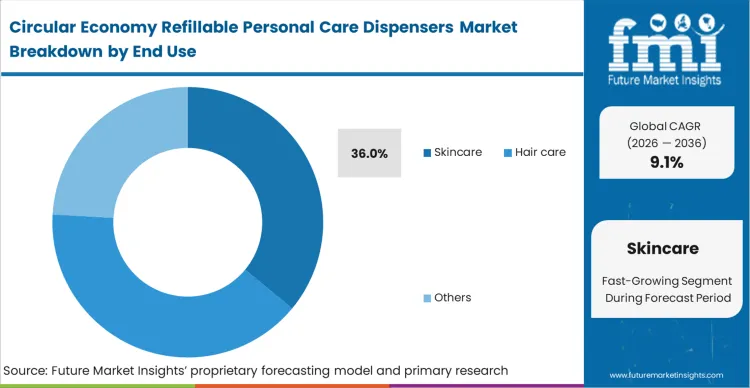
A clear tension exists between the high cost of durable keeper packs and the margin profile of everyday commodity products, pushing refillable skincare pump packaging to lead adoption with 36.0% share. Luxury facial creams and targeted serums carry retail prices that easily absorb the upfront capital required for a heavy-wall glass or weighted polymer outer case.
Based on FMI's assessment, the airless packaging share analysis shows early adopters concentrated heavily in prestige skincare, where consumers already expect complex, engineered dispensing experiences. Daily-use formats like refillable body wash dispenser systems, refillable shampoo dispenser packaging, and refillable deodorant packaging systems struggle to justify a thirty-dollar durable dispenser without massive economies of scale. Skincare brands that delay modular integration find themselves outmaneuvered by indie labels that use the permanent aesthetic fixture to lock consumers into a high-margin loop.
- Prestige tier: Luxury serums initiate the transition to justify high retail price points. Early adopters condition the consumer base to expect durable vanity fixtures rather than disposable plastic.
- Masstige migration: Mid-tier daily moisturizers follow once contract molders standardize the internal pod dimensions. Procurement volumes increase, dropping the unit cost of the outer actuator.
- Commodity lag: High-volume body care requires aggressive supply chain optimization to make the math work. These segments convert last, relying on ultra-lightweight flexible pouches rather than rigid inner cartridges.
Circular Economy Refillable Personal Care Dispensers Market Analysis by Channel / Positioning
The trajectory of this market is shaped by prestige and masstige brands, which hold a 42.0% share, rapidly conditioning consumers to view premium refillable cosmetic bottles and pumps as a baseline expectation rather than a niche novelty. These brands utilize the tactile weight of the outer housing to communicate value, while the inner cartridge is optimized strictly for logistical efficiency.
FMI analysts estimate that airless pumps deployed in these premium tiers set the engineering standard that mass market players will eventually have to meet. A prestige brand can fund the custom tooling necessary for a flawless magnetic closure or a perfectly damped twist-lock mechanism. Brands attempting to launch premium formulations in single-use plastics are increasingly penalised by luxury retail buyers who refuse to allocate shelf space to non-modular formats.
- Tactile validation: Prestige brands engineer heavy-wall outers that mimic the thermal mass of solid glass or metal. Consumers interpret the weight as a proxy for formulation quality, reinforcing brand equity.
- Margin degradation: Brands pushing single-use premium plastics face pushback from key retail partners. Buyers strip shelf placement from lines that fail to meet new departmental zero-waste merchandising mandates.
- Compliance minimums: Retailer consortiums dictate exactly what constitutes an acceptable refill system. Brands must meet these rigid specifying standards to maintain their distribution footprint in major beauty halls.
Circular Economy Refillable Personal Care Dispensers Market Drivers, Restraints, and Opportunities
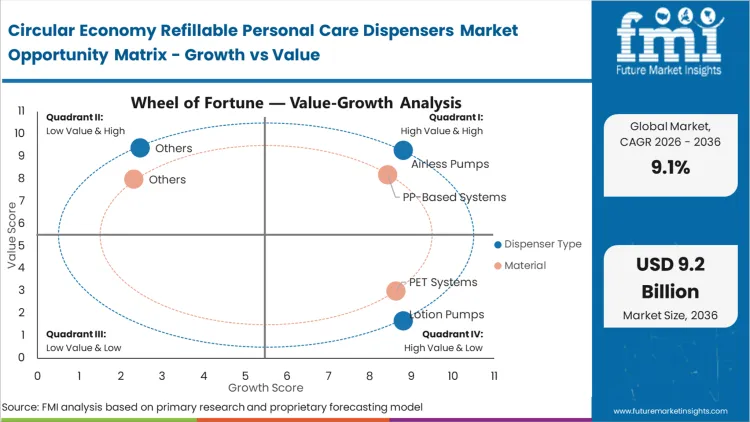
The pressure of emerging refillable packaging regulations for cosmetics compels packaging procurement directors to strip weight and complex resins out of their recurring fulfilment, transitioning the heavy, decorative elements of the lotion pump into a one-time purchase, brands drastically lower the tax burden associated with shipping and disposing of single-use plastics. The true ROI of refillable personal care packaging becomes apparent when the initial capital expenditure for the durable pack is offset by the consistent margin expansion realised on every lightweight refill pod sold over the consumer's lifetime.
The single biggest organizational friction slowing adoption revolves around design challenges in refillable pumps and the required re-engineering of the contract filling line. Standard high-speed filling equipment is designed to drop fluid into rigid bottles, not to handle delicate, thin-walled refill cartridges. This installed base switching cost requires contract manufacturers to invest heavily in specialized pucks and handling equipment. The persistent contamination risk in refillable cosmetic packaging forces brands into longer lead times and rigorous microbial testing, temporarily choking supply agility.
Opportunities in the Circular Economy Refillable Personal Care Dispensers Market
- Material standardization: Contract molders who develop open-source, patent-free locking threads allow independent brands to source compatible pods from multiple geographic regions. Mid-tier formulators capture this by eliminating sole-supplier dependency.
- Direct fulfillment: The lightweight nature of the inner cartridge radically alters postal economics. DTC indie brands capture massive margins by moving replenishment away from physical retail directly into automated letterbox subscription models.
- Mono-material engineering: Advanced polymer science enables the creation of highly durable springs and valves without relying on metal. Engineers specifying these all-plastic pumps and trigger spray systems guarantee absolute compliance with emerging chemical recycling mandates.
Regional Analysis
Regional insights show that the Circular Economy Refillable Personal Care Dispensers Market spans more than 40 countries, distributed across North America, Latin America, Europe, East Asia, South Asia, Oceania, and the Middle East & Africa.
.webp "Top Country Growth Comparison Circular Economy Refillable Personal Care Dispensers Market Cagr (2026 2036)")
| Country | CAGR (2026 to 2036) |
|---|---|
| India | 11.8% |
| China | 10.9% |
| Brazil | 9.6% |
| United Kingdom | 8.7% |
| United States | 8.3% |
| France | 8.1% |
| Germany | 7.9% |
Source: Future Market Insights (FMI) analysis, based on proprietary forecasting model and primary research
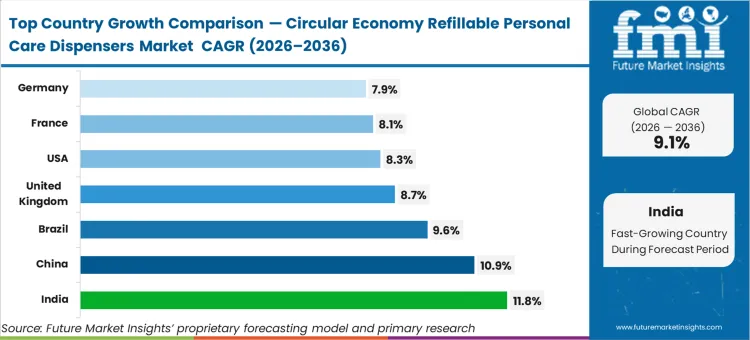
Asia Pacific Circular Economy Refillable Personal Care Dispensers Market Analysis
Regulatory frameworks in Asia Pacific are rapidly modernizing, but the true driver is the lack of legacy single-use infrastructure, allowing new brands to build entirely on modular architectures. Procurement directors in this region do not have to unwind decades of capital investment in disposable bottle molding. Instead, they leverage the massive scale of local injection moulders who are rapidly perfecting mono-material pp airless pump dispensers for both domestic consumption and export. According to FMI's estimates, the ability to launch premium refillable formats natively through dominant e-commerce platforms allows these brands to bypass the physical merchandising constraints that slow down Western markets.
- India: India refillable personal care packaging demand expands rapidly as beauty premiumization allows new direct-to-consumer brands to define the premium aesthetic entirely around heavy, reusable vanity cases. E-commerce fulfillment managers leverage the lightweight refill pods to drastically cut last-mile shipping costs outside major metropolitan centers. India is set to grow at a 11.8% CAGR over the forecast period. Companies that establish the dominant pod architecture now will secure exclusive contract manufacturing partnerships that lock out late-arriving competitors.
- China: Demand for refillable dispensers in China is set to grow at a 10.9% compound rate. The sheer scale of domestic beauty consumption in China forces a rapid transition to modular formats to alleviate municipal waste infrastructure constraints. Packaging engineers are leveraging local China refillable skincare packaging suppliers to scale automated assembly lines for complex inner cartridges faster than any other region. This rapid scale-up transitions the region from a component supplier for Western brands to the primary testing ground for next-generation tactile locking mechanisms.
Latin America Circular Economy Refillable Personal Care Dispensers Market Analysis
Sourcing patterns in Latin America are heavily defined by the dominance of direct-selling networks and massive door-to-door distribution models. This physical logistics constraint makes the lightweight refill cartridge vital, as independent sales representatives cannot physically carry bulk quantities of heavy glass or thick-walled plastic bottles. Based on FMI's assessment, the adoption of metal-free pumps and modular pods directly increases the volume of product a single representative can distribute in a given cycle, altering the unit economics of the dominant sales channel.
- Brazil: Brazil's reliance on massive network marketing organizations dictates that primary packaging must be hyper-optimized for decentralized, individual distribution. Supply chain planners mandate lightweight refill pouches to maximize the inventory capacity of independent representatives navigating complex urban geographies. The Brazilian sector is poised to expand at a 9.6% CAGR through 2036. The reliance on these networks positions Brazilian procurement teams years ahead of North American counterparts in optimizing high-viscosity flexible pouch systems.
Europe Circular Economy Refillable Personal Care Dispensers Market Analysis
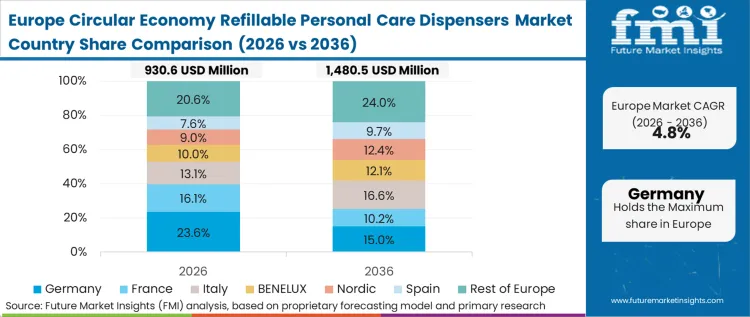
The Europe refillable cosmetic dispensers market is defined by cost structures and aggressive margin dynamics where extended producer responsibility schemes are no longer theoretical. Operations heads in Europe face immediate financial penalties for placing mixed-material, single-use plastics into the market, forcing a rapid pivot toward modular architectures. As per FMI's projection, the North American transition is less punitive but driven aggressively by retail consortiums dictating shelf-space allocations based on verifiable personal care packaging waste reduction.
- United Kingdom: The UK is forecast to register a CAGR of 8.7% for the refillable personal care dispenser market. Procurement practices in the UK are heavily gated by intense retailer scrutiny and consolidated high-street chemist networks demanding documented waste reduction. Supply chain directors are forced to qualify fully repulpable or highly recyclable inner pods to secure prime end-cap placements. This environment strips away vanity metrics, forcing brands to deliver functional, leak-proof pod systems that survive rigorous third-party retail audits.
- France: The French landscape is set to achieve a CAGR of 8.1%. France's deeply entrenched luxury cosmetic sector operates under stringent compatibility testing protocols that delay the rollout of novel refill materials. Formulation chemists require multi-year stability data before allowing high-value serums to interact with new PCR or mono-material pod linings. Once these materials clear the validation hurdle, the standard is immediately exported globally across the brand's entire portfolio.
- Germany: Germany's aggressive packaging waste legislation transforms the adoption of modular formats from a marketing initiative into a strict financial calculation. Operations directors immediately qualify mono-material pod systems to avoid the crippling municipal recovery taxes levied against traditional mixed-resin pumps. A CAGR of 7.9% is expected for Germany over the forecast period. The operational efficiency achieved through this mandatory transition frees up capital for advanced formulation R&D rather than wasteful single-use tooling.
FMI's report includes extensive analysis of neighbouring markets across the Nordic region and Southern Europe. These secondary markets largely import the compliance standards validated in Germany and France, ensuring that a single engineered pod architecture can secure multi-national distribution without requiring localized tooling variations.
North America Circular Economy Refillable Personal Care Dispensers Market Analysis
North America adoption patterns diverge sharply from European compliance-driven models by relying entirely on voluntary corporate sustainability targets and consumer convenience metrics. Brand managers operating without federal extended producer responsibility mandates must justify modular hardware investments purely through customer retention economics. FMI analysts note this structural reality forces packaging engineers to prioritize seamless digital integration over raw material reduction. Procurement directors evaluate durable keepers based on their ability to facilitate automated home delivery rather than their performance in municipal recycling streams. Complex in store refill stations struggle to gain traction against deeply ingrained habits of direct-to-door replenishment. Success in this geography requires bridging premium physical hardware with frictionless digital reordering.
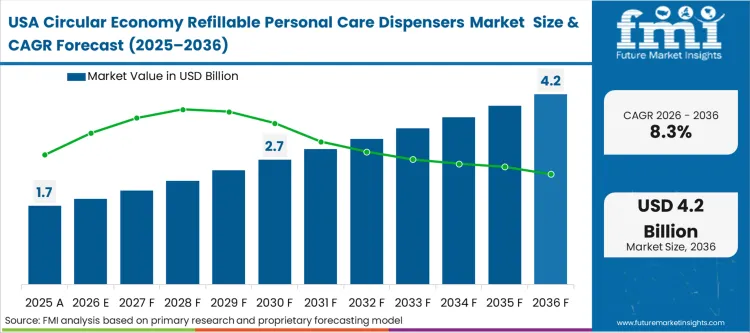
- United States: Supplier innovation across United States markets consistently outpaces actual consumer habit formation, creating a structural bottleneck where sophisticated durable packs are deployed but buyers fail to repurchase corresponding cartridges. Brand managers must invest heavily in subscription models to automate replenishment cycles and bypass physical retail friction entirely. FMI estimates the United States sector to expand at an annual growth rate of 8.3%. Operations teams deploying digital auto-replenishment architectures solve retention drop-offs that plague manual repurchase workflows. Organizations successfully digitizing this loop capture recurring revenue streams that fundamentally alter enterprise valuation.
FMI's report includes extensive coverage of Canadian and Mexican cosmetic packaging landscapes. Canadian provincial recycling mandates push local formulators toward standardized cartridge dimensions to ensure compatibility with emerging municipal recovery guidelines. Mexican supply chains reflect a different trajectory entirely, focusing heavily on affordable twist-off components designed specifically for masstige retail channels. Cross-border logistics dictate how quickly North American contract fillers harmonize these diverging regional packaging standards.
Competitive Aligners for Market Players
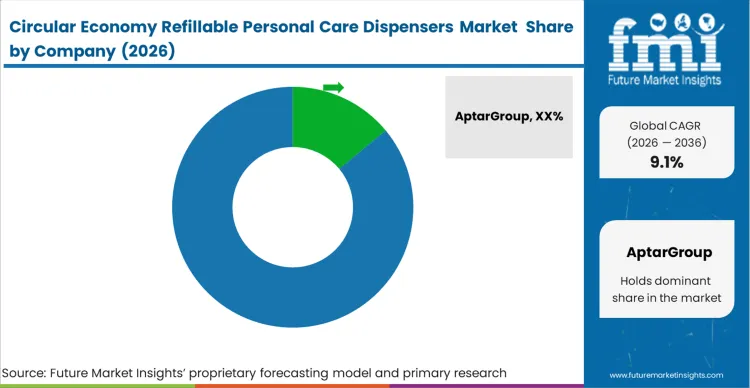
The highly concentrated nature of this market stems directly from the extreme engineering tolerances required to make two separate pieces of plastic click together perfectly across millions of units. Major refillable cosmetic pump manufacturers like AptarGroup and Silgan Dispensing hold their positions because they have already capitalized the massive multi-cavity injection molds capable of hitting these micrometer tolerances. Procurement directors referencing a verified supplier list for refillable personal care dispensers will not risk a product launch on an unproven mold, utilizing this engineering precision as the primary variable to distinguish qualified from unqualified vendor partners.
To replicate the advantage of incumbents, challengers must build more than just a functional pump; they must develop an entire ecosystem of cross-compatible components before they can even pitch custom refillable dispenser packaging for beauty brands. Incumbents possess deep libraries of pre-qualified beauty and personal care packaging solutions where a single standard inner pod fits dozens of different external actuator designs. An independent refillable airless bottle supplier must construct a similar modular platform from scratch to remain competitive.
Large beauty conglomerates actively resist lock-in by pushing for open-source thread standards and cross-compatible pod geometries. The tension between brands demanding interoperability and dominant vendors protecting their proprietary cosmetic packaging ecosystems will dictate the pace of consolidation. As contract fillers begin to mandate standardized pucks for their high-speed lines, the market will trend toward a handful of dominant internal architectures, forcing vendors to compete purely on the aesthetic differentiation of the durable outer case.
Key Players in Circular Economy Refillable Personal Care Dispensers Market
- AptarGroup
- Silgan Dispensing
- Albéa
- Quadpack
- Lumson
- HCP Packaging
- Berlin Packaging (Raepak heritage)
Scope of the Report
| Metric | Value |
|---|---|
| Quantitative Units | USD 3.84 billion to USD 9.17 billion, at a CAGR of 9.10% |
| Market Definition | This market tracks the change from disposable aesthetic packaging to decoupled architectures, where durable outer housings are retained by consumers and internal formulation reservoirs are replaced. It defines the engineered boundary between single-use compliance and true multi-cycle material retention. |
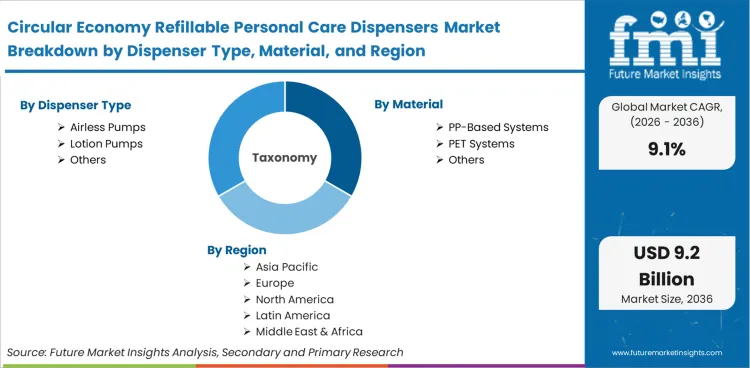
| Dispenser type Segmentation | Airless pumps, Lotion pumps, Spray dispensers, Dropper-doser systems, Refill cartridge dispensers |
| Material Segmentation | PP-based systems, PET systems, Glass-aluminum hybrid systems, Mono-material PE/PP systems, PCR resin systems |
| Refill model Segmentation | Replaceable cartridge / pod, Refill pouch into keeper pack, Twist-off inner cup refill, Bulk in-store refill system, Bag-in-box backbar refill |
| End use Segmentation | Skincare, Hair care, Body care, Deodorants, Hand and hygiene care |
| Channel / positioning Segmentation | Prestige and masstige brands, Mass retail brands, Salon / professional brands, DTC indie brands, Hotel and amenity systems |
| Regions Covered | North America, Latin America, Europe, East Asia, South Asia, Oceania, Middle East & Africa |
| Countries Covered | India, China, Brazil, United Kingdom, United States, France, Germany, and 40 plus countries |
| Key Companies Profiled | AptarGroup, Silgan Dispensing, Albéa, Quadpack, Lumson, HCP Packaging, Berlin Packaging (Raepak heritage) |
| Forecast Period | 2026 to 2036 |
| Approach | Primary interviews targeted procurement directors and lead packaging engineers at top-tier cosmetic conglomerates to assess capital flow into multi-component tooling. The data foundation anchors to the observable shift in high-cavitation injection molding equipment orders. Forecasts were cross-validated by tracking the volume of product lines actively transitioning away from single-use formats at major contract filling facilities. |
Source: Future Market Insights (FMI) analysis, based on proprietary forecasting model and primary research
Circular Economy Refillable Personal Care Dispensers Market Analysis by Segments
Dispenser type:
- Airless pumps
- Lotion pumps
- Spray dispensers
- Dropper-doser systems
- Refill cartridge dispensers
Material:
- PP-based systems
- PET systems
- Glass-aluminum hybrid systems
- Mono-material PE/PP systems
- PCR resin systems
Refill model:
- Replaceable cartridge / pod
- Refill pouch into keeper pack
- Twist-off inner cup refill
- Bulk in-store refill system
- Bag-in-box backbar refill
End use:
- Skincare
- Hair care
- Body care
- Deodorants
- Hand and hygiene care
Channel / positioning:
- Prestige and masstige brands
- Mass retail brands
- Salon / professional brands
- DTC indie brands
- Hotel and amenity systems
Region:
- North America
- United States
- Canada
- Europe
- Germany
- United Kingdom
- France
- Italy
- Spain
- Asia Pacific
- China
- Japan
- South Korea
- Taiwan
- Singapore
- Latin America
- Brazil
- Mexico
- Argentina
- Middle East & Africa
- GCC Countries
- South Africa
- Israel
Bibliography
- Ellen MacArthur Foundation. (2024, October). The Global Commitment 2024 Progress Report. Global Commitment Publications.
- European Commission. (2025, January). Packaging Waste Regulation. EC Environment Topics.
- Kazançoğlu, İ., Secgin, Y., Mangla, S. K., & Kazançoğlu, Y. (2024, April). Drivers and barriers influencing consumers’ intention to purchase cosmetics with refillable packaging. Packaging Technology and Science.
- Lumson. (2024). Sustainability Report 2024. Lumson Corporate.
- Morel, S., Farah, N., Genay, S., Lannoy, D., & Odou, P. (2024, June). Cosmetic packaging: European regulatory aspects and sustainability. Cosmetics.
- Quadpack. (2025, January). Impact report 2024. Quadpack Packbase.
- Zdonek, I., & Jaworska, A. (2024, November). Determinants of the intention to use refills in the cosmetic industry. Sustainability.
This bibliography is provided for reader reference. The full FMI report contains the complete reference list with primary source documentation.
This Report Addresses
- Market intelligence to support strategic decision making across durable outer housings and modular refill cartridges
- Market size estimation and 10-year revenue forecasts from 2026 to 2036, supported by high-cavitation molding capital expenditure analysis
- Growth opportunity mapping across PP-based systems and airless pumps with emphasis on the standardization of the interface between the inner pod and outer actuator
- Segment and regional revenue forecasts covering replaceable cartridge models across aggressive European extended producer responsibility frameworks
- Competition strategy assessment including extreme engineering tolerances and cross-compatible component libraries
- Capability development tracking including patent-free locking threads and precision multi-component tooling
- Market access analysis covering rigorous third-party retail audits and chemical recycling mandates
- Market report delivery in PDF, Excel, PPT, and interactive dashboard formats for executive strategy, lifecycle packaging procurement, and operational benchmarking use
Frequently Asked Questions
Tell me the size of the refillable personal care dispensers market in 2026?
The valuation reaches USD 3.84 billion in 2026. This figure illustrates the massive capital move away from single-use plastics as major beauty conglomerates fundamentally restructure their primary supply chains.
What will it be valued at by 2036?
The sector will advance to USD 9.17 billion by 2036. This expansion reflects the point at which modular, multi-component architectures completely displace legacy disposable pumps in premium and masstige retail channels.
What CAGR is projected?
A compound annual growth rate of 9.10% is expected during the forecast period. This pace is governed by the time it takes contract manufacturers to upgrade filling lines to handle lightweight internal cartridges rather than traditional rigid bottles.
What are refillable personal care dispensers?
These are primary packaging architectures engineered for repeated consumer use, where the functional dispensing mechanism and outer aesthetic housing are retained. The consumable formulation is replenished via independent inner cartridges, eliminating the need to discard heavy plastic actuators.
How do refillable cosmetic dispensers work?
The system decouples the durable outer pack from the consumable formula. A consumer purchases the premium keeper pack once, then buys lightweight inner pods or pouches that click or screw into the reusable housing, seamlessly engaging the pump pathway without exposing the liquid to air.
What regulations support refillable cosmetic packaging in Europe?
Extended Producer Responsibility (EPR) frameworks and the Packaging and Packaging Waste Regulation (PPWR) directly penalize the placement of mixed-material, single-use plastics into the European market. These legislative pressures force molders to innovate mono-material systems to bypass crippling municipal taxation.
Which companies lead refillable dispenser packaging for personal care?
Tier-one packaging molders like AptarGroup, Silgan Dispensing, Albéa, and Quadpack dominate the landscape. They hold their positions because they have capitalized the massive multi-cavity injection molds capable of hitting the extreme micrometer tolerances required for leak-proof pod interfaces.
What is the ROI of refillable personal care packaging?
The return on investment is realized by shifting from a point-of-sale transaction to a recurring revenue model. While the durable keeper pack requires high initial tooling capital, the brand achieves margin expansion on every lightweight, low-shipping-cost refill pod sold over the consumer's lifetime.
What is the primary contamination risk in refillable cosmetic packaging?
Exposing sensitive active ingredients to oxygen or airborne bacteria during the refill process rapidly degrades product efficacy. Formulators demand airless refillable systems to ensure the fresh formula never touches the old dispensing pathway, completely mitigating residual chemical breakdown.
What are the main design challenges in refillable pumps?
The core engineering challenge is guaranteeing that two separate plastic pieces, the inner pod and outer actuator, click together perfectly across millions of units without leaking. This requires extreme precision tooling and standardised locking threads to prevent consumers from accidentally pumping air into the vacuum seal.
How does refillable vs recyclable cosmetic packaging compare strategically?
Recyclable packaging still generates immense single-use waste and incurs high logistics costs during the recovery phase. Refillable packaging retains the heaviest, most carbon-intensive components (glass, metal springs, heavy plastics) with the consumer, drastically shrinking the shipping weight and end-of-life tax burden of the replenishment cycle.
Which Dispenser type segment leads?
Airless pumps maintain dominance because they protect the active ingredients from oxygen exposure during the physical pod swap. Brands specify this mechanism to ensure highly sensitive skincare formulations do not degrade when the consumer interacts with the refill process.
Which Material segment leads?
PP-based systems lead the material choices as packaging engineers prioritize true mono-material construction. By utilizing polypropylene for both the rigid outer case and the flexible inner bladder, brands eliminate the municipal taxation penalties levied on complex mixed-resin components.
Which Refill model segment leads?
The replaceable cartridge / pod model captures the largest share by eliminating the messy pouring step associated with flexible pouches. This drop-in engineering prevents formula cross-contamination and ensures the consumer completes the replenishment loop without frustration.
Which country grows fastest?
India expands at a 11.8% compound rate, outpacing the 10.9% trajectory in China. The key difference is India's rapidly scaling direct-to-consumer ecosystem, which allows new brands to build entirely on modular architectures without unwinding legacy brick-and-mortar retail constraints.
Why does the standardization of the pod interface matter?
If every beauty brand requires a proprietary locking thread for their refill cartridge, contract fillers must absorb massive tooling costs for custom line pucks. Open-source thread dimensions eliminate this bottleneck, allowing smaller masstige brands to launch modular formats using off-the-shelf components.
How do incumbents protect their market position against new molders?
Tier-one packaging molders leverage their massive libraries of pre-qualified modular components. A new molder must prove their inner cartridge perfectly engages with an array of outer actuators across millions of cycles, a capital-intensive barrier that prevents fragmented competition.
Why do pour-in pouch systems face high consumer abandonment rates?
Consumers tasked with pouring thick lotions from a flexible pouch into a narrow-necked durable bottle inevitably spill product or trap water inside the reusable housing. This operational friction causes the formula to oxidize, leading the consumer to abandon the durable pack entirely after the first cycle.
How does luxury retail positioning influence the heavy-wall keeper pack?
Prestige cosmetics use the physical weight of the packaging as a direct proxy for formulation quality. By investing heavy capital into a weighted glass or dense polymer outer shell, brands condition consumers to view the reusable fixture as a vanity asset rather than disposable waste.
What advantage do DTC indie brands hold in this transition?
Direct-to-consumer brands sidestep the physical merchandising requirements of traditional high-street retail. They optimize the refill cartridge strictly for letterbox dimension tolerances, drastically cutting last-mile shipping costs and maximizing recurring subscription margins.
How do stringent cosmetic compatibility tests delay adoption in France?
French formulation chemists demand exhaustive multi-year stability data before allowing premium serums to interact with novel PCR or ultra-thin mono-material pod linings. This requirement guarantees the chemistry does not leach into the plastic, slowing the initial rollout but establishing the global safety standard.
What dictates the transition pace for mass-market body care?
Commodity body washes carry extremely thin retail margins that cannot easily absorb the upfront cost of a heavy engineered dispenser. Adoption in this tier requires contract molders to scale production enough to drive the per-unit cost of the durable pump down to parity with legacy disposables.
Preview the report firsthand - request a free sample
Get SampleGet the brochure for pricing and purchase details.
Get PDFTable of Content
- Executive Summary
- Global Market Outlook
- Demand-side Trends
- Technology Roadmap Analysis
- Analysis and Recommendations
- Market Overview
- Market Coverage / Taxonomy
- Market Definition / Scope / Limitations
- Research Methodology
- Chapter Orientation
- Analytical Lens and Working Hypotheses
- Market Structure, Signals, and Trend Drivers
- Benchmarking and Cross-market Comparability
- Market Sizing, Forecasting, and Opportunity Mapping
- Research Design and Evidence Framework
- Peer-reviewed Journals and Academic Literature
- Corporate Websites, Product Literature, and Technical Notes
- Earnings Decks and Investor Briefings
- Statutory Filings and Regulatory Disclosures
- Technical White Papers and Standards Notes
- Trade Journals, Industry Magazines, and Analyst Briefs
- Conference Proceedings, Webinars, and Seminar Materials
- Government Statistics Portals and Public Data Releases
- Press Releases and Reputable Media Coverage
- Specialist Newsletters and Curated Briefings
- Sector Databases and Reference Repositories
- FMI Internal Proprietary Databases and Historical Market Datasets
- Subscription Datasets and Paid Sources
- Social Channels, Communities, and Digital Listening Inputs
- Additional Desk Sources
- Expert Input and Fieldwork (Primary Evidence)
- Primary Modes
- Field Techniques
- Interviews
- Surveys
- Focus Groups
- Observational and In-context Research
- Social and Community Interactions
- Stakeholder Universe Engaged
- C-suite Leaders
- Board Members
- Presidents and Vice Presidents
- R&D and Innovation Heads
- Technical Specialists
- Domain Subject-matter Experts
- Scientists
- Physicians and Other Healthcare Professionals
- Governance, Ethics, and Data Stewardship
- Research Ethics
- Data Integrity and Handling
- Field Techniques
- Tooling, Models, and Reference Databases
- Primary Modes
- Data Engineering and Model Build
- Data Acquisition and Ingestion
- Cleaning, Normalisation, and Verification
- Synthesis, Triangulation, and Analysis
- Quality Assurance and Audit Trail
- Market Background
- Market Dynamics
- Drivers
- Restraints
- Opportunity
- Trends
- Scenario Forecast
- Demand in Optimistic Scenario
- Demand in Likely Scenario
- Demand in Conservative Scenario
- Opportunity Map Analysis
- Product Life Cycle Analysis
- Supply Chain Analysis
- Investment Feasibility Matrix
- Value Chain Analysis
- PESTLE and Porter’s Analysis
- Regulatory Landscape
- Regional Parent Market Outlook
- Production and Consumption Statistics
- Import and Export Statistics
- Market Dynamics
- Global Market Analysis 2021 to 2025 and Forecast, 2026 to 2036
- Historical Market Size Value (USD Million) Analysis, 2021 to 2025
- Current and Future Market Size Value (USD Million) Projections, 2026 to 2036
- Y-o-Y Growth Trend Analysis
- Absolute $ Opportunity Analysis
- Global Market Pricing Analysis 2021 to 2025 and Forecast 2026 to 2036
- Global Market Analysis 2021 to 2025 and Forecast 2026 to 2036, By Dispenser Type
- Introduction / Key Findings
- Historical Market Size Value (USD Million) Analysis By Dispenser Type , 2021 to 2025
- Current and Future Market Size Value (USD Million) Analysis and Forecast By Dispenser Type , 2026 to 2036
- Airless Pumps
- Lotion Pumps
- Others
- Airless Pumps
- Y-o-Y Growth Trend Analysis By Dispenser Type , 2021 to 2025
- Absolute $ Opportunity Analysis By Dispenser Type , 2026 to 2036
- Global Market Analysis 2021 to 2025 and Forecast 2026 to 2036, By Material
- Introduction / Key Findings
- Historical Market Size Value (USD Million) Analysis By Material, 2021 to 2025
- Current and Future Market Size Value (USD Million) Analysis and Forecast By Material, 2026 to 2036
- PP-Based Systems
- PET Systems
- Others
- PP-Based Systems
- Y-o-Y Growth Trend Analysis By Material, 2021 to 2025
- Absolute $ Opportunity Analysis By Material, 2026 to 2036
- Global Market Analysis 2021 to 2025 and Forecast 2026 to 2036, By Refill Model
- Introduction / Key Findings
- Historical Market Size Value (USD Million) Analysis By Refill Model, 2021 to 2025
- Current and Future Market Size Value (USD Million) Analysis and Forecast By Refill Model, 2026 to 2036
- Replaceable Cartridge/Pod
- Refill Pouch into Keeper Pack
- Others
- Replaceable Cartridge/Pod
- Y-o-Y Growth Trend Analysis By Refill Model, 2021 to 2025
- Absolute $ Opportunity Analysis By Refill Model, 2026 to 2036
- Global Market Analysis 2021 to 2025 and Forecast 2026 to 2036, By End Use
- Introduction / Key Findings
- Historical Market Size Value (USD Million) Analysis By End Use, 2021 to 2025
- Current and Future Market Size Value (USD Million) Analysis and Forecast By End Use, 2026 to 2036
- Skincare
- Hair care
- Others
- Skincare
- Y-o-Y Growth Trend Analysis By End Use, 2021 to 2025
- Absolute $ Opportunity Analysis By End Use, 2026 to 2036
- Global Market Analysis 2021 to 2025 and Forecast 2026 to 2036, By Region
- Introduction
- Historical Market Size Value (USD Million) Analysis By Region, 2021 to 2025
- Current Market Size Value (USD Million) Analysis and Forecast By Region, 2026 to 2036
- North America
- Latin America
- Western Europe
- Eastern Europe
- East Asia
- South Asia and Pacific
- Middle East & Africa
- Market Attractiveness Analysis By Region
- North America Market Analysis 2021 to 2025 and Forecast 2026 to 2036, By Country
- Historical Market Size Value (USD Million) Trend Analysis By Market Taxonomy, 2021 to 2025
- Market Size Value (USD Million) Forecast By Market Taxonomy, 2026 to 2036
- By Country
- USA
- Canada
- Mexico
- By Dispenser Type
- By Material
- By Refill Model
- By End Use
- By Country
- Market Attractiveness Analysis
- By Country
- By Dispenser Type
- By Material
- By Refill Model
- By End Use
- Key Takeaways
- Latin America Market Analysis 2021 to 2025 and Forecast 2026 to 2036, By Country
- Historical Market Size Value (USD Million) Trend Analysis By Market Taxonomy, 2021 to 2025
- Market Size Value (USD Million) Forecast By Market Taxonomy, 2026 to 2036
- By Country
- Brazil
- Chile
- Rest of Latin America
- By Dispenser Type
- By Material
- By Refill Model
- By End Use
- By Country
- Market Attractiveness Analysis
- By Country
- By Dispenser Type
- By Material
- By Refill Model
- By End Use
- Key Takeaways
- Western Europe Market Analysis 2021 to 2025 and Forecast 2026 to 2036, By Country
- Historical Market Size Value (USD Million) Trend Analysis By Market Taxonomy, 2021 to 2025
- Market Size Value (USD Million) Forecast By Market Taxonomy, 2026 to 2036
- By Country
- Germany
- UK
- Italy
- Spain
- France
- Nordic
- BENELUX
- Rest of Western Europe
- By Dispenser Type
- By Material
- By Refill Model
- By End Use
- By Country
- Market Attractiveness Analysis
- By Country
- By Dispenser Type
- By Material
- By Refill Model
- By End Use
- Key Takeaways
- Eastern Europe Market Analysis 2021 to 2025 and Forecast 2026 to 2036, By Country
- Historical Market Size Value (USD Million) Trend Analysis By Market Taxonomy, 2021 to 2025
- Market Size Value (USD Million) Forecast By Market Taxonomy, 2026 to 2036
- By Country
- Russia
- Poland
- Hungary
- Balkan & Baltic
- Rest of Eastern Europe
- By Dispenser Type
- By Material
- By Refill Model
- By End Use
- By Country
- Market Attractiveness Analysis
- By Country
- By Dispenser Type
- By Material
- By Refill Model
- By End Use
- Key Takeaways
- East Asia Market Analysis 2021 to 2025 and Forecast 2026 to 2036, By Country
- Historical Market Size Value (USD Million) Trend Analysis By Market Taxonomy, 2021 to 2025
- Market Size Value (USD Million) Forecast By Market Taxonomy, 2026 to 2036
- By Country
- China
- Japan
- South Korea
- By Dispenser Type
- By Material
- By Refill Model
- By End Use
- By Country
- Market Attractiveness Analysis
- By Country
- By Dispenser Type
- By Material
- By Refill Model
- By End Use
- Key Takeaways
- South Asia and Pacific Market Analysis 2021 to 2025 and Forecast 2026 to 2036, By Country
- Historical Market Size Value (USD Million) Trend Analysis By Market Taxonomy, 2021 to 2025
- Market Size Value (USD Million) Forecast By Market Taxonomy, 2026 to 2036
- By Country
- India
- ASEAN
- Australia & New Zealand
- Rest of South Asia and Pacific
- By Dispenser Type
- By Material
- By Refill Model
- By End Use
- By Country
- Market Attractiveness Analysis
- By Country
- By Dispenser Type
- By Material
- By Refill Model
- By End Use
- Key Takeaways
- Middle East & Africa Market Analysis 2021 to 2025 and Forecast 2026 to 2036, By Country
- Historical Market Size Value (USD Million) Trend Analysis By Market Taxonomy, 2021 to 2025
- Market Size Value (USD Million) Forecast By Market Taxonomy, 2026 to 2036
- By Country
- Kingdom of Saudi Arabia
- Other GCC Countries
- Turkiye
- South Africa
- Other African Union
- Rest of Middle East & Africa
- By Dispenser Type
- By Material
- By Refill Model
- By End Use
- By Country
- Market Attractiveness Analysis
- By Country
- By Dispenser Type
- By Material
- By Refill Model
- By End Use
- Key Takeaways
- Key Countries Market Analysis
- USA
- Pricing Analysis
- Market Share Analysis, 2025
- By Dispenser Type
- By Material
- By Refill Model
- By End Use
- Canada
- Pricing Analysis
- Market Share Analysis, 2025
- By Dispenser Type
- By Material
- By Refill Model
- By End Use
- Mexico
- Pricing Analysis
- Market Share Analysis, 2025
- By Dispenser Type
- By Material
- By Refill Model
- By End Use
- Brazil
- Pricing Analysis
- Market Share Analysis, 2025
- By Dispenser Type
- By Material
- By Refill Model
- By End Use
- Chile
- Pricing Analysis
- Market Share Analysis, 2025
- By Dispenser Type
- By Material
- By Refill Model
- By End Use
- Germany
- Pricing Analysis
- Market Share Analysis, 2025
- By Dispenser Type
- By Material
- By Refill Model
- By End Use
- UK
- Pricing Analysis
- Market Share Analysis, 2025
- By Dispenser Type
- By Material
- By Refill Model
- By End Use
- Italy
- Pricing Analysis
- Market Share Analysis, 2025
- By Dispenser Type
- By Material
- By Refill Model
- By End Use
- Spain
- Pricing Analysis
- Market Share Analysis, 2025
- By Dispenser Type
- By Material
- By Refill Model
- By End Use
- France
- Pricing Analysis
- Market Share Analysis, 2025
- By Dispenser Type
- By Material
- By Refill Model
- By End Use
- India
- Pricing Analysis
- Market Share Analysis, 2025
- By Dispenser Type
- By Material
- By Refill Model
- By End Use
- ASEAN
- Pricing Analysis
- Market Share Analysis, 2025
- By Dispenser Type
- By Material
- By Refill Model
- By End Use
- Australia & New Zealand
- Pricing Analysis
- Market Share Analysis, 2025
- By Dispenser Type
- By Material
- By Refill Model
- By End Use
- China
- Pricing Analysis
- Market Share Analysis, 2025
- By Dispenser Type
- By Material
- By Refill Model
- By End Use
- Japan
- Pricing Analysis
- Market Share Analysis, 2025
- By Dispenser Type
- By Material
- By Refill Model
- By End Use
- South Korea
- Pricing Analysis
- Market Share Analysis, 2025
- By Dispenser Type
- By Material
- By Refill Model
- By End Use
- Russia
- Pricing Analysis
- Market Share Analysis, 2025
- By Dispenser Type
- By Material
- By Refill Model
- By End Use
- Poland
- Pricing Analysis
- Market Share Analysis, 2025
- By Dispenser Type
- By Material
- By Refill Model
- By End Use
- Hungary
- Pricing Analysis
- Market Share Analysis, 2025
- By Dispenser Type
- By Material
- By Refill Model
- By End Use
- Kingdom of Saudi Arabia
- Pricing Analysis
- Market Share Analysis, 2025
- By Dispenser Type
- By Material
- By Refill Model
- By End Use
- Turkiye
- Pricing Analysis
- Market Share Analysis, 2025
- By Dispenser Type
- By Material
- By Refill Model
- By End Use
- South Africa
- Pricing Analysis
- Market Share Analysis, 2025
- By Dispenser Type
- By Material
- By Refill Model
- By End Use
- USA
- Market Structure Analysis
- Competition Dashboard
- Competition Benchmarking
- Market Share Analysis of Top Players
- By Regional
- By Dispenser Type
- By Material
- By Refill Model
- By End Use
- Competition Analysis
- Competition Deep Dive
- AptarGroup
- Overview
- Product Portfolio
- Profitability by Market Segments (Product/Age /Sales Channel/Region)
- Sales Footprint
- Strategy Overview
- Marketing Strategy
- Product Strategy
- Channel Strategy
- Silgan Dispensing
- Albéa
- Quadpack
- Lumson
- HCP Packaging
- AptarGroup
- Competition Deep Dive
- Assumptions & Acronyms Used


