

- Industry Size (2026)
- USD 805.0 Bn
- Forecast (2036)
- USD 1685.0 Bn
- CAGR (2026 to 2036)
- 7.7%
Personal & Home Care Market Size, Market Forecast and Outlook By FMI
In 2025, the personal & home care market crossed a valuation of USD 755.0 billion and is projected to reach USD 805.0 billion in 2026 and USD 1,685.0 billion by 2036, reflecting a CAGR of 7.7%. Demographic shifts and omnichannel physics pull forward upgrade timing. Buyers reprioritize spending toward verifiably sustainable formulations and dedicated home care services, shaping retail procurement frameworks.
Absolute dollar growth of USD 880.0 billion over the decade signals structural expansion rather than simple inflationary pressure. Pricing discipline and mix dictate category expansion as elasticity pushes private-label penetration across mass channels. The personal consumption expenditures on services rose USD 108.7 billion in November 2025, demonstrating sustained volume resilience against macroeconomic headwinds [1]. Suppliers recalibrate unit economics, shifting production capacity toward premium personal care appliances with documented efficacy.
Summary of Personal & Home Care Market
- Personal & Home Care Market Definition
- Formulated consumer goods spanning human hygiene and residential maintenance applications.
- Demand Drivers in the Market
- Expanding elderly populations requiring specialized skin and incontinence items.
- Increased discretionary income in emerging economies funding premium beauty purchases.
- Heightened hygiene awareness embedding household sanitization into daily routines.
- Key Segments Analyzed in the FMI Report
- Product Type: Skin care (28%) versus hair care, bath & shower, oral care, deodorants, and household cleaners.
- Channel of Distribution: Supermarkets / hypermarkets (37% of total volume) versus online / e-commerce, specialty retail, and pharmacies.
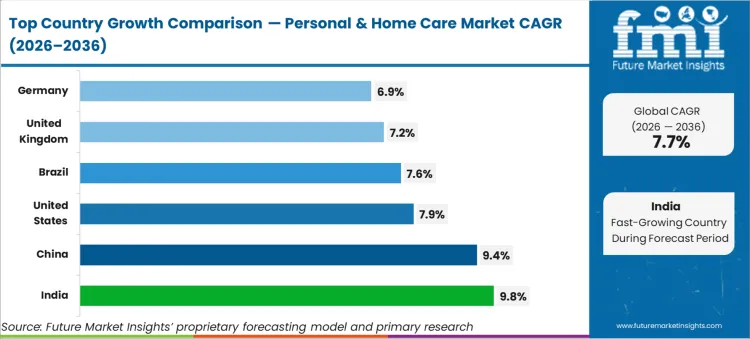
- Geography: High-growth Asia-Pacific (India 9.8%, China 9.4%) versus mature North America and Europe (United States 7.9%, United Kingdom 7.2%, Germany 6.9%).
- Analyst Opinion at FMI
- Ronak Shah, Principal Consultant for Consumer Product at Future Market Insights, opines, “Through our latest research, we have observed that tightening extended producer responsibility frameworks are compelling rapid material transitions. Multi-layer laminates and complex assemblies are losing favor in favor of recyclable mono-material formats. The industry’s next growth phase will depend on harmonizing barrier performance, aesthetic differentiation, and post-consumer recovery efficiency within a single packaging architecture.”
- Strategic Implications/Executive Takeaways
- Divest non-core regional brands to fund high-growth prestige acquisitions.
- Invest in sustainable packaging formats to bypass incoming regulatory penalties.
- Reconfigure supply chains to isolate production from international shipping bottlenecks.
- Methodology
- Validated through first-hand corporate production and capacity data.
- Zero reliance on speculative third-party market research reports.
- Based on verifiable industrial benchmarks and verified sources.
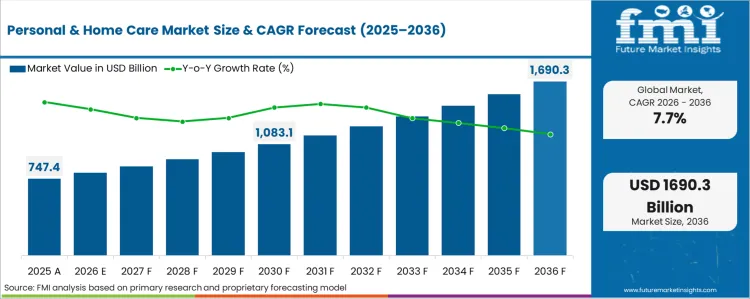
Across India, China, United States, Brazil, United Kingdom, and Germany, growth concentrates where supply chain localization aligns with demographic consumption patterns. India posts 9.8% CAGR and United Kingdom records 7.2% CAGR. Lead time volatility redirects spend to localized capacity and interchangeable beauty and personal care packaging formats.
Personal & Home Care Market Key Takeaways
| Metric | Details |
|---|---|
| Industry Size (2026) | USD 805.0 Billion |
| Industry Value (2036) | USD 1,685.0 Billion |
| CAGR (2026-2036) | 7.7% |
Personal & Home Care Market Definition
The Personal & Home Care market represents the global production, distribution, and retail sale of formulated consumer goods intended for personal hygiene, cosmetic enhancement, and household cleaning. It measures revenues generated across physical and digital retail channels, covering mass-market and premium product tiers. Market valuation captures branded and private-label sales of body care, beauty, and home maintenance formulations purchased through pharmacies, supermarkets, specialty stores, and direct-to-consumer platforms.
Personal & Home Care Market Inclusions
The scope includes skin care products, hair care treatments, deodorants, oral hygiene formulations, and related personal grooming items. It also covers household surface cleaners, fabric detergents, dishwashing liquids, disinfectants, and sanitizing solutions. Both prestige beauty lines and everyday hygiene essentials are included, with revenues accounted across brick-and-mortar retail and e-commerce channels.
Personal & Home Care Market Exclusions
The scope excludes regulated medical devices, prescription dermatological therapies, and clinical treatments. Heavy-duty industrial cleaning chemicals used in manufacturing or institutional settings are not considered. Professional salon services, spa labor charges, and cosmetic procedures fall outside product-based valuation. Dietary supplements and ingestible vitamins are excluded, as they belong to the nutraceutical category rather than topical or household care segments.
Personal & Home Care Market Research Methodology
- Primary Research: Interviews with procurement directors, formulation chemists, packaging engineers, and retail buyers to triangulate capacity utilization and shelf-space allocation.
- Desk Research: Review of corporate annual reports, investor presentations, customs trade data, and regulatory compliance filings to map regional supply chains.
- Market-Sizing and Forecasting: Top-down macroeconomic modeling combined with bottom-up SKU tracking, adjusted for regional price elasticity and demographic changes.
- Data Validation and Update Cycle: Multi-tiered internal peer review verifying unit assumptions against independent supply chain disclosures prior to publication.
Segmental Analysis
Personal & Home Care Market Analysis by product Type
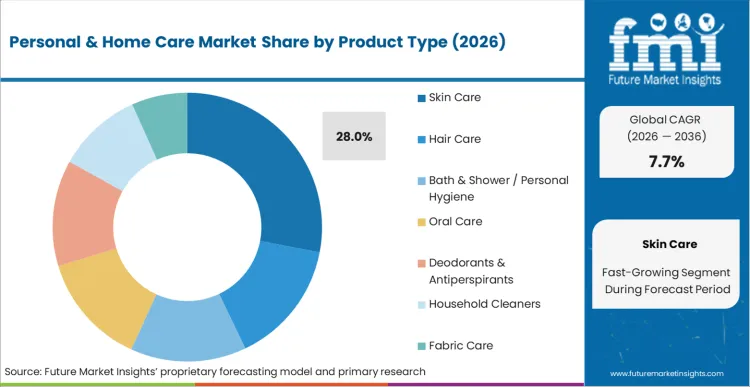
Skin care commands 28% share of the volume in 2026. Demographic aging pulls forward demand for advanced formulations, and younger cohorts adopt multi-step prevention routines. Procurement teams face pressure to source active compounds to meet escalating efficacy claims. Manufacturers pivot production lines toward dermatologically tested SKUs to capture premium margins. Suppliers secure long-term contracts for organic personal care compounds to bypass synthetic chemical price spikes.
- Clinical alignment trigger: Increased consumer scrutiny forces brands to substitute synthetic chemicals with bio-derived alternatives.
- Demographic utilization pull: Aging consumer bases necessitate gentle formulations for compromised skin barriers. Product developers reformulate legacy lines to omit harsh surfactants, lifting brand loyalty among senior cohorts.
- Format efficiency shift: Resource constraints compel manufacturers to launch concentrated or waterless variants. Transition scales up following successful regional pilot tests, compressing freight expenses.
Personal & Home Care Market Analysis by Channel of Distribution
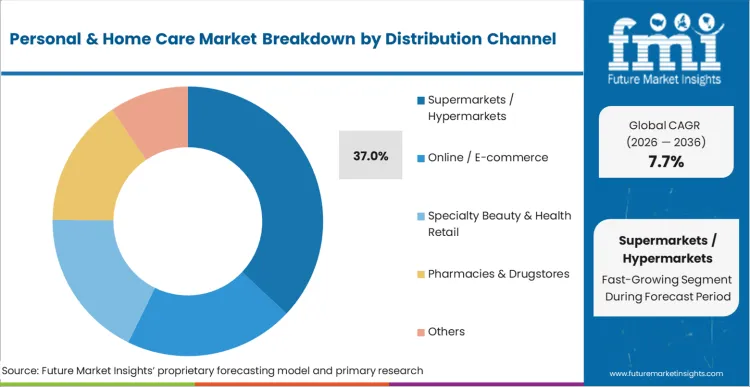
Supermarkets and hypermarkets capture 37% share of distribution in 2026. Large-format retailers utilize immense buying power to negotiate favorable terms and command expansive shelf space. Physical stores provide tactile experiences crucial for fragrance evaluation. Digital platforms offer endless aisles, and physical outlets maintain dominance through immediate product availability. Account managers fund aggressive promotional campaigns to retain premium placement. Retailers harmonize digital applications with physical inventory systems to enable seamless click-and-collect fulfillment.
- Merchandising density constraint: Limited physical shelf space intensifies competition among established FMCG conglomerates. Account managers fund promotional campaigns during quarterly resets, squeezing margins for secondary players.
- Omnichannel integration path: Retailers are integrating digital commerce platforms with physical inventory systems, deploying real-time tracking and automated replenishment tools to reduce stockouts, improve fulfillment accuracy, and strengthen performance during peak seasonal demand periods.
- Private-label encroachment: Inflationary pressures push consumers toward retailer-owned brands offering comparable efficacy. Store buyers expand proprietary lines in basic categories, capturing volume from branded goods.
Personal & Home Care Market Drivers, Restraints, and Opportunities
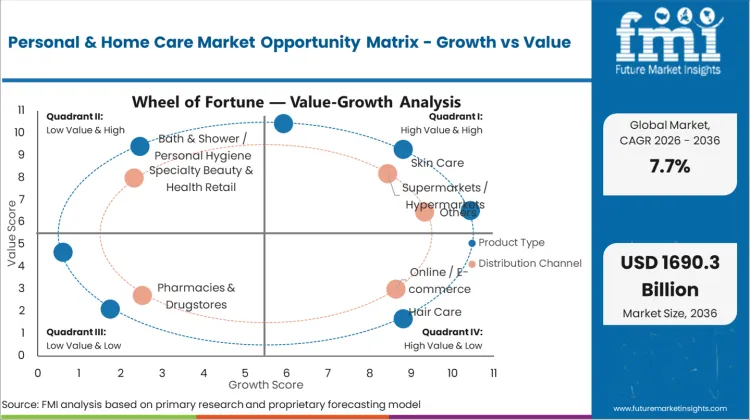
Global demographic aging fundamentally alters product consumption physics, transforming occasional purchases into essential daily recurring volume. Medical advancements prolong lifespans, drastically expanding senior cohorts requiring specialized hygiene formats, barrier creams, and mobility-assistive solutions. 5.1 million people receive Medicaid-covered home care services annually, creating massive secondary demand for supportive incontinence care products [11]. Families managing elderly relatives seek reliable items to maintain dignity and prevent skin degradation. Manufacturers respond by recalibrating supply chains to prioritize adult care categories over traditional baby care lines, securing long-term volume stability in mature economies.
Unprecedented input cost inflation and stringent environmental regulations severely compress operating margins across mass-market segments. Petrochemical derivatives exhibit extreme price volatility. According to FMI's estimates, 4,347,700 home health and personal care aide jobs recorded in 2024 signify structural employment shifts, limiting disposable income among frontline care buyers [5]. Procurement directors struggle to pass escalating material costs onto price-sensitive consumers without triggering volume declines. Brands mitigate exposure by lightweighting bottles, reformulating with cheaper bio-based alternatives, and aggressively promoting concentrated formats that reduce logistics overhead.
- Packaging compliance mandate: Regulatory bans on single-use plastics force sweeping redesigns for beauty and personal care packaging formats. R&D teams engineer biodegradable systems, evidenced by Aveda and AeroFlexx partnering in February 2026 to launch curbside recyclable prestige packaging [6].
- Caregiver product bundling: Millions of family caregivers seek integrated product kits covering bathing, sanitation, and odor control. Marketing departments create unified care bundles for pharmacies, simplifying procurement for non-professional buyers.
- Industrial equipment integration: Conglomerates upgrade manufacturing lines to handle viscous natural ingredients and reduce water usage. Capital expenditure flows toward advanced mixing technologies, highlighted by ITT Inc. acquiring SPX FLOW for USD 4.775 billion in March 2026 [4].
Regional Analysis
Based on the regional analysis, the Personal & Home Care market is segmented into North America, Latin America, Europe, East Asia, South Asia, Oceania and Middle East & Africa across 40+ countries. The full report also offers market attractiveness analysis based on regional trends.
.webp "Top Country Growth Comparison Personal & Home Care Market Cagr (2026 2036)")
| Country | CAGR (2026 to 2036) |
|---|---|
| India | 9.8% |
| China | 9.4% |
| United States | 7.9% |
| Brazil | 7.6% |
| United Kingdom | 7.2% |
| Germany | 6.9% |
Source: Future Market Insights (FMI) analysis, based on proprietary forecasting model and primary research
Asia Pacific Personal & Home Care Market Analysis
Asia Pacific represents immense volume expansion driven by rapid urbanization, escalating disposable incomes, and heightened hygiene awareness. Domestic players leverage deep understanding of local formulations to outmaneuver Western conglomerates. FMI analysts opine that surging domestic manufacturing capacity ensures stable supply lines. Companies upgrade production facilities to handle unprecedented scale, focusing on affordable sachets alongside premium fragranced personal care products offerings. Procurement aligns with vast distributor networks penetrating tier-two and tier-three cities, unlocking previously inaccessible consumer bases.
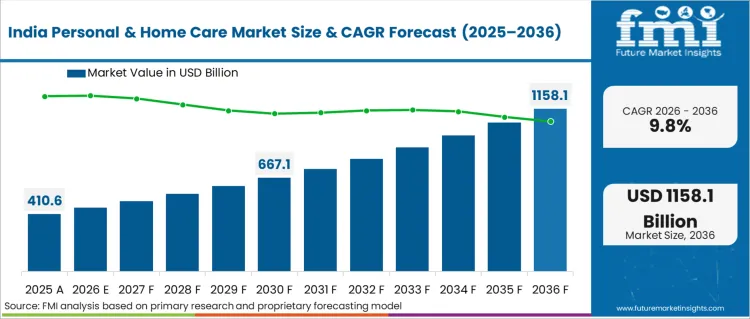
- India: Demand for personal & home care in India is set to grow at 9.8% CAGR through 2036, supported by rising middle-class affluence before procurement and budgeting cycles translate into higher deployment volumes. Rising consumer purchasing power accelerates transition from unbranded to branded goods, establishing dominant household care positions. Surging domestic manufacturing capacity ensures stable supply lines.
- China: Sales of personal & home care in China are projected to grow at 9.4% CAGR from 2026 to 2036 as robust e-commerce ecosystems and livestream shopping formats expand, creating a clearer pathway from spending intent to purchase orders. Domestic brands aggressively capture market share through rapid product iteration cycles, utilizing extensive digital distribution networks. Speed-to-market advantages allow agile firms to dominate digital retail spaces.
FMI’s report includes a detailed growth analysis and country-wise assessment across Asia Pacific. Japan and South Korea demonstrate opportunistic pathways for premium skincare and advanced healing skin care products adoption. Formulators must monitor stringent local chemical compliance standards to prevent costly border rejections.
North America Personal & Home Care Market Analysis
North America exhibits robust, value-driven growth anchored by strong premiumization trends and widespread adoption of organic personal care routines. Mature infrastructure supports seamless omnichannel distribution, spanning mega-pharmacies to direct-to-consumer digital brands. As per FMI's projection, 32,200 residential care communities across domestic markets fuel bulk institutional purchasing of adult hygiene goods [12]. Manufacturers aggressively acquire niche indie brands to inject growth into stagnant legacy portfolios. Supply chains prioritize sustainable sourcing to appease eco-conscious demographics while navigating complex state-level chemical regulations.
- United States: The United States personal & home care sector is expected to grow at 7.9% CAGR during 2026 to 2036 because robust healthcare spending supports massive institutional purchasing, which lifts utilization rates and justifies product refresh decisions. In October 2025, Addus HomeCare acquired personal care operations of Del Cielo Home Care Services, reflecting broader market consolidation [7]. Integrated delivery networks demand standardized product efficacy.
FMI’s report includes a detailed growth analysis and country-wise assessment for North America. Canada and Mexico present strategic nearshoring opportunities to bypass volatile trans-Pacific shipping routes. Suppliers should evaluate localized filling operations to hedge against rising cross-border freight costs.
Latin America Personal & Home Care Market Analysis
Latin America demonstrates resilient demand fueled by deeply ingrained beauty cultures and expanding modern retail formats. Volatile macroeconomic conditions compel consumers to seek exceptional value, driving intense brand competition across mass channels. According to FMI's estimates, beauty and wellness sales rely heavily on extensive direct-selling networks traversing complex geographic terrain. Regional conglomerates integrate vertically to shield operations from currency fluctuations and import tariffs. Formulators adapt products to withstand diverse climates, creating resilient and long-lasting hair and skin solutions.
- Brazil: Brazil is expected to grow 7.6% CAGR in personal & home care demand over 2026 to 2036 as strong cultural emphasis on personal grooming sustains high per-capita consumption rates, tightening the link between operational constraints and adoption-led investment. Unilever sold its Home Care business in Colombia and Ecuador in February 2026, redirecting resources to fortify core Brazilian operations [8]. Focused capital allocation defends dominant market shares.
FMI’s report includes a detailed growth analysis and country-wise assessment across Latin America. Argentina and Chile offer strategic footholds for regional production hubs aiming to bypass import restrictions. Formulators should prioritize locally abundant raw materials to mitigate supply chain disruptions and reduce production costs.
Europe Personal & Home Care Market Analysis
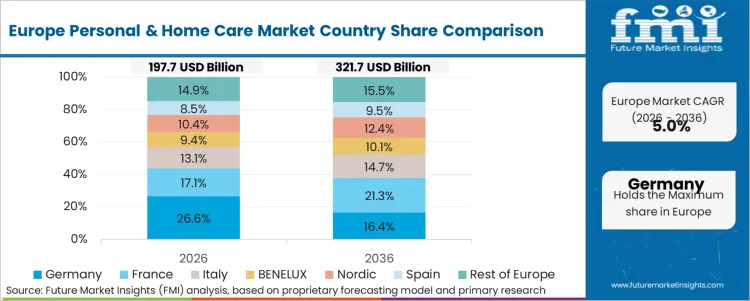
Europe operates under stringent regulatory frameworks, driving profound shifts toward sustainable personal care packaging and highly scrutinized chemical compositions. Mature consumer bases exhibit extreme brand loyalty but readily switch for demonstrable ecological benefits. Retailers enforce strict supplier codes, delisting products failing to meet aggressive carbon reduction targets. Manufacturers consolidate operations to fund massive R&D programs required to engineer fully circular product lifecycles.
- United Kingdom: In the United Kingdom, the personal & home care market is forecast to advance at 7.2% CAGR through 2036, with growth anchored in rising consumer preference for cruelty-free fragranced products that converts into measurable budget allocation. Interim HealthCare expanded local in-home personal care in the Midlands during 2025, demonstrating growing service integration [9]. Retailers prioritize brands offering transparent ethical supply chains.
- Germany: Demand for personal & home care in Germany is anticipated to climb at 6.9% CAGR over the forecast period as powerful discount supermarket chains control vast retail volumes, helping suppliers align positioning with local buying triggers. Rigorous environmental standards force brands to innovate concentrated, low-water product variants, necessitating advanced herbal personal care products formulations. Operational efficiency determines supplier survival.
FMI’s report includes a detailed growth analysis and country-wise assessment for Europe. France and Italy represent vital hubs for prestige cosmetics and luxury fragrance manufacturing. Buyers must anticipate incoming legislative mandates targeting microplastics to avoid costly product recalls and reformulation delays.
Competitive Aligners for Market Players
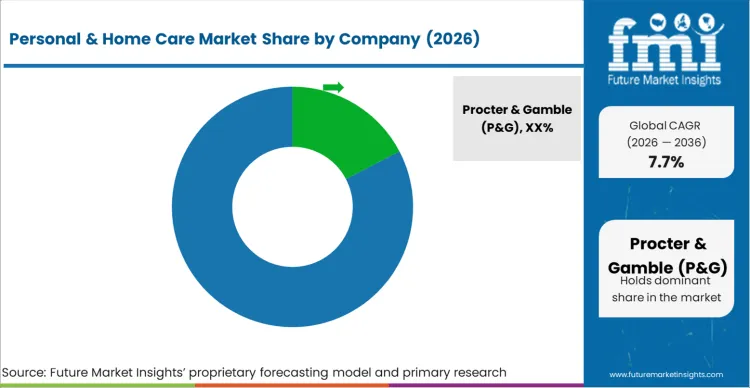
Fierce margin compression forces global FMCG giants to ruthlessly prune underperforming brands and acquire high-margin disruptors. Established players leverage immense balance sheets to execute transformative acquisitions. In October 2025, Kimberly-Clark announced a USD 48.7 billion acquisition of Kenvue, fundamentally altering competitive scale within consumer health and personal care sectors [10]. Smaller competitors must defend niches through hyper-specialization or face integration into sprawling corporate portfolios.
Raw material volatility mandates profound shifts in supply chain architecture. Sourcing teams pivot away from petroleum-derived surfactants toward bio-based alternatives to stabilize costs and appease regulators. Superior processing technology dictates ultimate unit cost efficiency.
Retail consolidation transfers immense pricing power to mega-chains and massive e-commerce platforms. Manufacturers construct sophisticated direct-to-consumer data engines to bypass traditional gatekeepers and own customer relationships.
Recent Developments
The report includes full coverage of key trends from competitive benchmarking. Some of the recent developments covered in the reports:
- In February 2026, Essity completed the acquisition of Edgewell Personal Care’s feminine care business for USD 340 million [2].
- In June 2025, Unilever signed an agreement to acquire men’s personal care brand Dr. Squatch from Summit Partners [3].
Key Players in Personal & Home Care Market
- Procter & Gamble (P&G)
- Unilever
- L'Oréal Groupe
- Colgate-Palmolive
- Reckitt (formerly Reckitt Benckiser)
- The Estée Lauder Companies
- Godrej Consumer Products
Scope of the Report
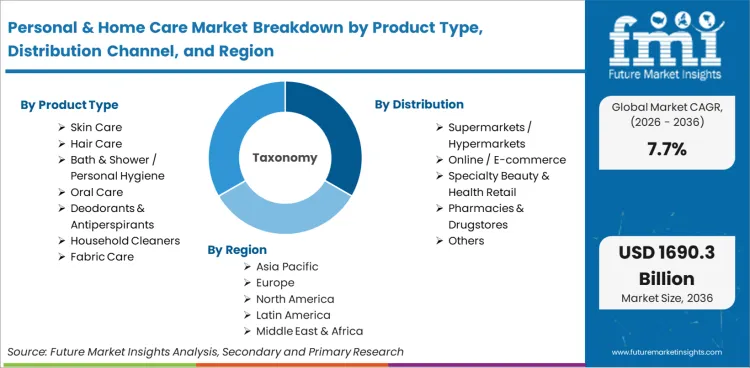
| Metric | Value |
|---|---|
| Quantitative Units | USD 805.0 Billion (2026) to USD 1,685.0 Billion (2036), at a CAGR of 7.7% |
| Market Definition | Personal and home care encompasses global production, trade, and consumption of formulated consumer goods designed for body hygiene, cosmetic enhancement, and residential environment maintenance. |
| Product Type Segmentation | Skin Care, Hair Care, Bath & Shower / Personal Hygiene, Oral Care, Deodorants & Antiperspirants, Household Cleaners, Fabric Care |
| Distribution Channel Segmentation | Supermarkets / Hypermarkets, Online / E-commerce, Specialty Beauty & Health Retail, Pharmacies & Drugstores, Others |
| Regions Covered | North America, Latin America, Europe, East Asia, South Asia, Oceania, Middle East and Africa |
| Countries Covered | United States, Canada, Mexico, Brazil, Argentina, Germany, France, United Kingdom, Italy, Spain, China, India, Japan, South Korea, Indonesia, Australia and 40 plus countries |
| Key Companies Profiled | Procter & Gamble (P&G), Unilever, L'Oréal Groupe, Colgate-Palmolive, Reckitt (formerly Reckitt Benckiser), The Estée Lauder Companies, Godrej Consumer Products |
| Forecast Period | 2026 to 2036 |
| Approach | Top-down macroeconomic modeling combined with bottom-up SKU tracking, adjusted for regional price elasticity and demographic changes. |
Personal & Home Care Market Analysis by Segments
Product Type
- Skin Care
- Hair Care
- Bath & Shower / Personal Hygiene
- Oral Care
- Deodorants & Antiperspirants
- Household Cleaners
- Fabric Care
Distribution Channel
- Supermarkets / Hypermarkets
- Online / E-commerce
- Specialty Beauty & Health Retail
- Pharmacies & Drugstores
- Others
Region
- Asia Pacific
- India
- China
- Japan
- South Korea
- Indonesia
- Australia & New Zealand
- ASEAN
- Rest of Asia Pacific
- Europe
- Germany
- Italy
- France
- United Kingdom
- Spain
- Benelux
- Nordics
- Central & Eastern Europe
- Rest of Europe
- North America
- United States
- Canada
- Mexico
- Latin America
- Brazil
- Argentina
- Chile
- Rest of Latin America
- Middle East & Africa
- Kingdom of Saudi Arabia
- United Arab Emirates
- South Africa
- Turkey
- Rest of Middle East & Africa
Bibliography
- [1] BEA. (2025). Personal consumption expenditures growth.
- [2] Essity. (2026). Completed acquisition of Edgewell Personal Care’s feminine care business.
- [3] Unilever. (2025). Agreement to acquire men’s personal care brand Dr. Squatch.
- [4] ITT Inc. (2026). Acquisition of SPX FLOW for personal care markets.
- [5] BLS. (2025). Employment of home health and personal care aides.
- [6] Estée Lauder. (2026). Aveda + AeroFlexx refillable packaging innovation.
- [7] Addus HomeCare. (2025). Acquired personal care operations of Del Cielo.
- [8] Unilever. (2026). Sold Home Care business in Colombia and Ecuador.
- [9] Interim HealthCare. (2025). Local expansion offering in-home personal care.
- [10] Kimberly-Clark. (2025). Cash-and-stock deal to acquire Kenvue.
- [11] KFF. (2026). Medicaid home care (HCBS) users.
- [12] CDC. (2026). Residential care communities FastStats.
This bibliography is provided for reader reference and is not exhaustive. The full report contains the complete reference list and detailed citations.
This Report Addresses
- Market intelligence to enable structured strategic decision making across mature and emerging FMCG economies.
- Market size estimation and 10-year revenue forecasts from 2026 to 2036, supported by validated capacity and trade benchmarks.
- Growth opportunity mapping across skin, hair, and household categories with emphasis on sustainable transitions.
- Segment and regional revenue forecasts covering varied distribution channels and demographic consumption patterns.
- Competition strategy assessment including integration models, cost survivability positioning, and compliance capability benchmarking.
- Product reformulation and emission compliance tracking across multiple sovereign jurisdictions.
- Regulatory impact analysis covering packaging material mandates and chemical formulation thresholds.
Frequently Asked Questions
How large is the demand for Personal & Home Care in the global market in 2026?
Demand for Personal & Home Care in the global market is estimated to be valued at USD 805.0 billion in 2026.
What will be the market size of Personal & Home Care in the global market by 2036?
Market size for Personal & Home Care is projected to reach USD 1,685.0 billion by 2036.
What is the expected demand growth for Personal & Home Care in the global market between 2026 and 2036?
Demand for Personal & Home Care in the global market is expected to grow at a CAGR of 7.7% between 2026 and 2036.
Which Product Type is poised to lead global sales by 2026?
Skin Care is expected to be the dominant form, capturing 28% of global market share in 2026 due to robust anti-aging formulation adoption.
How significant is the role of Supermarkets / Hypermarkets in driving Personal & Home Care adoption in 2026?
Supermarkets represent a critical segment, projected to hold a substantial 37% share of total volume in 2026 as broad distribution networks guarantee immediate shelf availability.
What is driving demand in India?
Rising middle-class affluence accelerates transition from unbranded to branded personal care products, alongside rapid expansion of modern retail infrastructure.
What compliance standards or regulations are referenced for India?
Local chemical ingredient thresholds and environmental packaging guidelines dictate permissible cosmetic formulations.
What is the India growth outlook in this report?
India is projected to grow at a CAGR of 9.8% during 2026 to 2036.
Why is North America described as a priority region in this report?
Growth is driven by powerful premiumization trends, extensive institutional purchasing for assisted living facilities, and rapid independent brand acquisitions.
What type of demand dominates in North America?
Replacement-driven demand for sophisticated anti-aging compounds and eco-conscious household cleaners dominates regional consumption.
What is China growth outlook in this report?
China is projected to expand at a CAGR of 9.4% during 2026 to 2036.
Does the report cover United States in its regional analysis?
United States is included within North America under the regional scope of analysis.
What are the sources referred to for analyzing United States?
Official statistics tracking residential care communities and corporate acquisition filings are cited as primary reference sources.
What is the main demand theme linked to United States in its region coverage?
North American demand is associated with institutional adult care purchasing and consolidation of legacy hygiene portfolios.
Does the report cover Brazil in its regional analysis?
Brazil is included within Latin America under the regional coverage framework.
What is the main Brazil related demand theme in its region coverage?
Volume defense through core operational focus and protection against currency volatility remain central themes.
Does the report cover United Kingdom in its regional analysis?
United Kingdom is included within Europe under the regional coverage framework.
What is the main United Kingdom related demand theme in its region coverage?
Rising consumer preference for cruelty-free fragranced products converts into measurable budget allocation.
Which product formats or configurations are strategically important for Asia Pacific supply chains?
Affordable sachets and ultra-concentrated household formats are prioritized to maximize diverse consumer penetration.
What is Personal & Home Care and what is it mainly used for?
Personal and home care encompasses formulated goods utilized for human bodily hygiene, cosmetic enhancement, and physical household maintenance.
What does Personal & Home Care mean in this report?
Personal and home care market refers to global production, trade, and consumption of cosmetic and cleaning products across mass and premium retail channels.
What is included in the scope of this Personal & Home Care report?
Scope covers skin care, detergents, deodorants, oral hygiene, and physical plus digital retail distribution channels.
What is excluded from the scope of this report?
Prescription dermatological treatments, heavy industrial chemicals, and professional salon services are strictly excluded.
What does market forecast mean on this page?
Market forecast represents a model-based projection built on defined assumptions for strategic planning purposes.
Preview the report firsthand - request a free sample
Get SampleGet the brochure for pricing and purchase details.
Get PDFTable of Content
- Executive Summary
- Global Market Outlook
- Demand-side Trends
- Supply-side Trends
- Technology Roadmap Analysis
- Analysis and Recommendations
- Market Overview
- Market Coverage / Taxonomy
- Market Definition / Scope / Limitations
- Research Methodology
- Chapter Orientation
- Analytical Lens and Working Hypotheses
- Market Structure, Signals, and Trend Drivers
- Benchmarking and Cross-market Comparability
- Market Sizing, Forecasting, and Opportunity Mapping
- Research Design and Evidence Framework
- Desk Research Programme (Secondary Evidence)
- Company Annual and Sustainability Reports
- Peer-reviewed Journals and Academic Literature
- Corporate Websites, Product Literature, and Technical Notes
- Earnings Decks and Investor Briefings
- Statutory Filings and Regulatory Disclosures
- Technical White Papers and Standards Notes
- Trade Journals, Industry Magazines, and Analyst Briefs
- Conference Proceedings, Webinars, and Seminar Materials
- Government Statistics Portals and Public Data Releases
- Press Releases and Reputable Media Coverage
- Specialist Newsletters and Curated Briefings
- Sector Databases and Reference Repositories
- FMI Internal Proprietary Databases and Historical Market Datasets
- Subscription Datasets and Paid Sources
- Social Channels, Communities, and Digital Listening Inputs
- Additional Desk Sources
- Expert Input and Fieldwork (Primary Evidence)
- Primary Modes
- Qualitative Interviews and Expert Elicitation
- Quantitative Surveys and Structured Data Capture
- Blended Approach
- Why Primary Evidence is Used
- Field Techniques
- Interviews
- Surveys
- Focus Groups
- Observational and In-context Research
- Social and Community Interactions
- Stakeholder Universe Engaged
- C-suite Leaders
- Board Members
- Presidents and Vice Presidents
- R&D and Innovation Heads
- Technical Specialists
- Domain Subject-matter Experts
- Scientists
- Physicians and Other Healthcare Professionals
- Governance, Ethics, and Data Stewardship
- Research Ethics
- Data Integrity and Handling
- Primary Modes
- Tooling, Models, and Reference Databases
- Desk Research Programme (Secondary Evidence)
- Data Engineering and Model Build
- Data Acquisition and Ingestion
- Cleaning, Normalisation, and Verification
- Synthesis, Triangulation, and Analysis
- Quality Assurance and Audit Trail
- Market Background
- Market Dynamics
- Drivers
- Restraints
- Opportunity
- Trends
- Scenario Forecast
- Demand in Optimistic Scenario
- Demand in Likely Scenario
- Demand in Conservative Scenario
- Opportunity Map Analysis
- Product Life Cycle Analysis
- Supply Chain Analysis
- Investment Feasibility Matrix
- Value Chain Analysis
- PESTLE and Porter’s Analysis
- Regulatory Landscape
- Regional Parent Market Outlook
- Production and Consumption Statistics
- Import and Export Statistics
- Market Dynamics
- Global Market Analysis 2021 to 2025 and Forecast, 2026 to 2036
- Historical Market Size Value (USD Million) Analysis, 2021 to 2025
- Current and Future Market Size Value (USD Million) Projections, 2026 to 2036
- Y-o-Y Growth Trend Analysis
- Absolute $ Opportunity Analysis
- Global Market Pricing Analysis 2021 to 2025 and Forecast 2026 to 2036
- Global Market Analysis 2021 to 2025 and Forecast 2026 to 2036, By Product Type
- Introduction / Key Findings
- Historical Market Size Value (USD Million) Analysis By Product Type , 2021 to 2025
- Current and Future Market Size Value (USD Million) Analysis and Forecast By Product Type , 2026 to 2036
- Skin Care
- Hair Care
- Bath & Shower / Personal Hygiene
- Oral Care
- Deodorants & Antiperspirants
- Household Cleaners
- Fabric Care
- Skin Care
- Y-o-Y Growth Trend Analysis By Product Type , 2021 to 2025
- Absolute $ Opportunity Analysis By Product Type , 2026 to 2036
- Global Market Analysis 2021 to 2025 and Forecast 2026 to 2036, By Distribution Channel
- Introduction / Key Findings
- Historical Market Size Value (USD Million) Analysis By Distribution Channel, 2021 to 2025
- Current and Future Market Size Value (USD Million) Analysis and Forecast By Distribution Channel, 2026 to 2036
- Supermarkets / Hypermarkets
- Online / E-commerce
- Specialty Beauty & Health Retail
- Pharmacies & Drugstores
- Others
- Supermarkets / Hypermarkets
- Y-o-Y Growth Trend Analysis By Distribution Channel, 2021 to 2025
- Absolute $ Opportunity Analysis By Distribution Channel, 2026 to 2036
- Global Market Analysis 2021 to 2025 and Forecast 2026 to 2036, By Region
- Introduction
- Historical Market Size Value (USD Million) Analysis By Region, 2021 to 2025
- Current Market Size Value (USD Million) Analysis and Forecast By Region, 2026 to 2036
- North America
- Latin America
- Western Europe
- Eastern Europe
- East Asia
- South Asia and Pacific
- Middle East & Africa
- Market Attractiveness Analysis By Region
- North America Market Analysis 2021 to 2025 and Forecast 2026 to 2036, By Country
- Historical Market Size Value (USD Million) Trend Analysis By Market Taxonomy, 2021 to 2025
- Market Size Value (USD Million) Forecast By Market Taxonomy, 2026 to 2036
- By Country
- USA
- Canada
- Mexico
- By Product Type
- By Distribution Channel
- By Country
- Market Attractiveness Analysis
- By Country
- By Product Type
- By Distribution Channel
- Key Takeaways
- Latin America Market Analysis 2021 to 2025 and Forecast 2026 to 2036, By Country
- Historical Market Size Value (USD Million) Trend Analysis By Market Taxonomy, 2021 to 2025
- Market Size Value (USD Million) Forecast By Market Taxonomy, 2026 to 2036
- By Country
- Brazil
- Chile
- Rest of Latin America
- By Product Type
- By Distribution Channel
- By Country
- Market Attractiveness Analysis
- By Country
- By Product Type
- By Distribution Channel
- Key Takeaways
- Western Europe Market Analysis 2021 to 2025 and Forecast 2026 to 2036, By Country
- Historical Market Size Value (USD Million) Trend Analysis By Market Taxonomy, 2021 to 2025
- Market Size Value (USD Million) Forecast By Market Taxonomy, 2026 to 2036
- By Country
- Germany
- UK
- Italy
- Spain
- France
- Nordic
- BENELUX
- Rest of Western Europe
- By Product Type
- By Distribution Channel
- By Country
- Market Attractiveness Analysis
- By Country
- By Product Type
- By Distribution Channel
- Key Takeaways
- Eastern Europe Market Analysis 2021 to 2025 and Forecast 2026 to 2036, By Country
- Historical Market Size Value (USD Million) Trend Analysis By Market Taxonomy, 2021 to 2025
- Market Size Value (USD Million) Forecast By Market Taxonomy, 2026 to 2036
- By Country
- Russia
- Poland
- Hungary
- Balkan & Baltic
- Rest of Eastern Europe
- By Product Type
- By Distribution Channel
- By Country
- Market Attractiveness Analysis
- By Country
- By Product Type
- By Distribution Channel
- Key Takeaways
- East Asia Market Analysis 2021 to 2025 and Forecast 2026 to 2036, By Country
- Historical Market Size Value (USD Million) Trend Analysis By Market Taxonomy, 2021 to 2025
- Market Size Value (USD Million) Forecast By Market Taxonomy, 2026 to 2036
- By Country
- China
- Japan
- South Korea
- By Product Type
- By Distribution Channel
- By Country
- Market Attractiveness Analysis
- By Country
- By Product Type
- By Distribution Channel
- Key Takeaways
- South Asia and Pacific Market Analysis 2021 to 2025 and Forecast 2026 to 2036, By Country
- Historical Market Size Value (USD Million) Trend Analysis By Market Taxonomy, 2021 to 2025
- Market Size Value (USD Million) Forecast By Market Taxonomy, 2026 to 2036
- By Country
- India
- ASEAN
- Australia & New Zealand
- Rest of South Asia and Pacific
- By Product Type
- By Distribution Channel
- By Country
- Market Attractiveness Analysis
- By Country
- By Product Type
- By Distribution Channel
- Key Takeaways
- Middle East & Africa Market Analysis 2021 to 2025 and Forecast 2026 to 2036, By Country
- Historical Market Size Value (USD Million) Trend Analysis By Market Taxonomy, 2021 to 2025
- Market Size Value (USD Million) Forecast By Market Taxonomy, 2026 to 2036
- By Country
- Kingdom of Saudi Arabia
- Other GCC Countries
- Turkiye
- South Africa
- Other African Union
- Rest of Middle East & Africa
- By Product Type
- By Distribution Channel
- By Country
- Market Attractiveness Analysis
- By Country
- By Product Type
- By Distribution Channel
- Key Takeaways
- Key Countries Market Analysis
- USA
- Pricing Analysis
- Market Share Analysis, 2025
- By Product Type
- By Distribution Channel
- Canada
- Pricing Analysis
- Market Share Analysis, 2025
- By Product Type
- By Distribution Channel
- Mexico
- Pricing Analysis
- Market Share Analysis, 2025
- By Product Type
- By Distribution Channel
- Brazil
- Pricing Analysis
- Market Share Analysis, 2025
- By Product Type
- By Distribution Channel
- Chile
- Pricing Analysis
- Market Share Analysis, 2025
- By Product Type
- By Distribution Channel
- Germany
- Pricing Analysis
- Market Share Analysis, 2025
- By Product Type
- By Distribution Channel
- UK
- Pricing Analysis
- Market Share Analysis, 2025
- By Product Type
- By Distribution Channel
- Italy
- Pricing Analysis
- Market Share Analysis, 2025
- By Product Type
- By Distribution Channel
- Spain
- Pricing Analysis
- Market Share Analysis, 2025
- By Product Type
- By Distribution Channel
- France
- Pricing Analysis
- Market Share Analysis, 2025
- By Product Type
- By Distribution Channel
- India
- Pricing Analysis
- Market Share Analysis, 2025
- By Product Type
- By Distribution Channel
- ASEAN
- Pricing Analysis
- Market Share Analysis, 2025
- By Product Type
- By Distribution Channel
- Australia & New Zealand
- Pricing Analysis
- Market Share Analysis, 2025
- By Product Type
- By Distribution Channel
- China
- Pricing Analysis
- Market Share Analysis, 2025
- By Product Type
- By Distribution Channel
- Japan
- Pricing Analysis
- Market Share Analysis, 2025
- By Product Type
- By Distribution Channel
- South Korea
- Pricing Analysis
- Market Share Analysis, 2025
- By Product Type
- By Distribution Channel
- Russia
- Pricing Analysis
- Market Share Analysis, 2025
- By Product Type
- By Distribution Channel
- Poland
- Pricing Analysis
- Market Share Analysis, 2025
- By Product Type
- By Distribution Channel
- Hungary
- Pricing Analysis
- Market Share Analysis, 2025
- By Product Type
- By Distribution Channel
- Kingdom of Saudi Arabia
- Pricing Analysis
- Market Share Analysis, 2025
- By Product Type
- By Distribution Channel
- Turkiye
- Pricing Analysis
- Market Share Analysis, 2025
- By Product Type
- By Distribution Channel
- South Africa
- Pricing Analysis
- Market Share Analysis, 2025
- By Product Type
- By Distribution Channel
- USA
- Market Structure Analysis
- Competition Dashboard
- Competition Benchmarking
- Market Share Analysis of Top Players
- By Regional
- By Product Type
- By Distribution Channel
- Competition Analysis
- Competition Deep Dive
- Procter & Gamble (P&G)
- Overview
- Product Portfolio
- Profitability by Market Segments (Product/Age /Sales Channel/Region)
- Sales Footprint
- Strategy Overview
- Marketing Strategy
- Product Strategy
- Channel Strategy
- Unilever
- L'Oréal Groupe
- Colgate-Palmolive
- Reckitt (formerly Reckitt Benckiser)
- The Estée Lauder Companies
- Godrej Consumer Products
- Procter & Gamble (P&G)
- Competition Deep Dive
- Assumptions & Acronyms Used


