

- Industry Size (2026)
- USD 493.0 Mn
- Forecast (2036)
- USD 1116.0 Mn
- CAGR (2026 to 2036)
- 8.5%
Modular Refill-Pod Cartons Market Forecast and Outlook 2026 to 2036
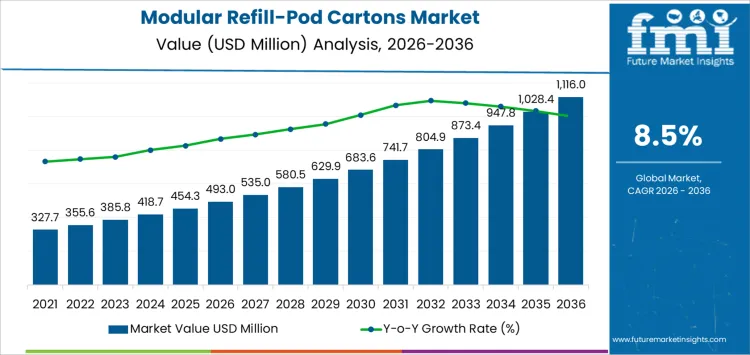
In 2026, the modular refill-pod cartons market is valued at USD 493 million and is projected to reach USD 1,116 million by 2036, reflecting a CAGR of 8.5%. Between 2026 and 2031, the market enters an acceleration phase, with annual additions increasing from roughly USD 45 million to about USD 78 million. This growth is supported by rising adoption in household, personal care, and cleaning product refill systems, driven by modular packaging designs and increasing brand initiatives promoting sustainability and refillable formats.
From 2031 to 2036, growth momentum moderates slightly as the market moves from approximately USD 787 million to USD 1,116 million. Absolute yearly gains continue to expand, reflecting volume scaling, repeat purchases, and broader integration across established refillable product lines. During this phase, growth is fueled by standardized carton designs, efficient supply chain adoption, and increased consumer acceptance of refillable pods. The deceleration is relative, indicating a transition from rapid adoption to sustained, high-volume growth without any sharp slowdown in demand.
Quick Stats of the Modular Refill-Pod Cartons Market:
- Modular Refill-Pod Cartons Market Value (2026): USD 493.0 million
- Modular Refill-Pod Cartons Market Forecast Value (2036): USD 1,116.0 million
- Modular Refill-Pod Cartons Market Forecast CAGR (2026–2036): 8.5%
- Leading End Use: Personal Care / Homecare refill systems (45%)
- Key Growth Regions: India, China, USA, Brazil, Germany, Japan
- Top Players: DS Smith / Albea, Amcor, UFlex, Local partners, Toppan
What is the Growth Forecast for the Modular Refill-Pod Cartons Market through 2036?
During 2026 to 2031, the modular refill-pod cartons market increases from USD 493 million to roughly USD 737 million, representing an early-stage growth phase driven by selective adoption in personal care, household cleaners, and foodservice segments. Growth in this period is influenced by brand experimentation with modular refill systems, where packaging efficiency, product protection, and consumer convenience are key considerations. Annual value additions grow steadily as manufacturers refine carton compatibility with multiple pod sizes, improve structural integrity, and expand pilot deployments without fully scaling across all SKUs.
Between 2031 and 2036, the market expands from approximately USD 737 million to USD 1,116 million, showing a more pronounced acceleration in absolute value creation. This phase reflects broader commercial rollout and normalization across mass-market refillable programs, subscription-based packaging, and private-label products. Growth is reinforced by higher carton penetration per SKU, repeat procurement, and integration into automated filling and distribution systems. Earlier growth relied on targeted adoption, while later expansion is driven by portfolio-wide deployment, supply chain standardization, and increased consumer acceptance of modular refill concepts across global product lines.
Modular Refill Pod Cartons Market Key Takeaways
| Metric | Value |
|---|---|
| Market Value (2026) | USD 493.0 million |
| Forecast Value (2036) | USD 1,116.0 million |
| Forecast CAGR (2026–2036) | 8.5% |
How Are Convenience and Sustainability Driving the Modular Refill-Pod Cartons Market from 2026 to 2036?
Modular refill pod cartons gained adoption as consumer goods and personal care brands shifted toward refillable packaging to reduce waste and improve convenience. Household cleaning products, beverages, and personal care liquids used pre-measured pods housed in cartons that fit standard dispensing systems. Historical demand reflected early adoption in environmentally conscious markets and subscription-based distribution. Buyers valued carton rigidity, pod protection, and stackability for retail shelving. Adoption aligned with brand sustainability commitments and consumer preference for single-use reduction without compromising ease of handling or dosing accuracy.
From 2026 to 2036 demand is expected to expand with growth in refill programs, automated dispensing stations, and direct-to-consumer subscription services. Manufacturers focus on cartons that support pod integrity, moisture protection, and efficient packing in standard shipping cases. Buyers assess compatibility with existing dispensing systems, recyclability, and material footprint. Demand depends on integration into circular packaging initiatives, consumer adoption of refillable formats, and alignment with retailer shelving and point-of-sale requirements across urban and regional distribution networks.
What Is the Demand for the Modular Refill-Pod Cartons Market by End Use and Packaging Format from 2026 to 2036?
From 2026 to 2036, the modular refill-pod cartons market expands as personal care and homecare brands shift toward refillable systems that reduce waste while maintaining product presentation. Personal care and homecare refill systems account for 45% of end-use demand as consumers adopt compact, easy-to-use pods for lotions, soaps, detergents, and cleaners. Demand reflects steady uptake driven by repeat consumption cycles, convenience, and operational efficiency in packaging lines. Refillable pod formats provide both portion control and hygienic handling, supporting sustainability narratives without compromising brand aesthetics or product protection. Adoption is gradual, emphasizing integration with existing dispensing systems and standardized pod dimensions.
Why do personal care and homecare refill systems account for 45% of demand in the modular refill-pod cartons market from 2026 to 2036?
Personal care and homecare refill systems account for 45% of demand because these categories rely on repeated use of liquid, powder, or gel formulations that benefit from modular dispensing. Consumption intensity remains high in households and retail environments where pods reduce packaging waste and simplify handling. Procurement decisions emphasize carton durability, pod alignment, and compatibility with refill stations or home dispensers. Buyers favor systems that maintain hygienic separation between pods while supporting easy removal and replacement. Price sensitivity remains moderate since the convenience and sustainability benefits offset incremental packaging costs. Demand remains stable through 2036 as refillable systems expand across established product lines and subscription services.
Pod refill usage continues due to repeat purchase behavior in homecare routines. Adoption aligns with growing sustainability initiatives and brand campaigns promoting packaging circularity. Specification focus includes carton rigidity, pod fit precision, and closure integrity. Demand persists through 2036 as modular systems standardize across personal care and homecare refill programs.
Why do modular carton systems (holder + pods) represent 50% of demand in the modular refill-pod cartons market by packaging format from 2026 to 2036?
Modular carton systems represent 50% of demand because they combine structural support with controlled pod dispensing. Consumption is strong in personal care, homecare, and cosmetic refill programs where pods require secure positioning within a holder. Usage remains steady as these systems integrate with retail displays and home-use dispensers. Procurement favors designs that support uniform pod placement, stacking, and labeling. Buyers prioritize structural integrity, ease of access, and consistent pod fit. Price sensitivity stays moderate since modular systems improve handling efficiency and reduce pod damage. Demand persists through 2036 as holder-based systems become the default solution for pod packaging across multiple refillable categories.
Modular cartons also simplify assembly, storage, and shelf presentation. Usage aligns with subscription, e-commerce, and in-store refill programs. Specification control focuses on material strength, holder alignment, and closure performance. Demand remains resilient as modular carton systems gain preference for scalable and sustainable pod packaging solutions.
What are the Key Dynamics of the Modular Refill-Pod Cartons Market?
How Are Modular Refill Pod Cartons Being Applied Across Consumer and Retail Packaging Systems?
Use appears in product formats where compact refill delivery and ease of use are critical. Personal care brands adopt refill pod cartons to reduce primary container waste for liquid soaps and lotions. Beverage and single serve coffee suppliers use them to support portioned dispensing at home or in offices. Household cleaning brands integrate modular cartons for concentrated pods that simplify dosing. Retailers include them in multipacks to enhance shelf visibility while reducing in store handling. These applications reflect operational and environmental priorities rather than decorative or promotional packaging alone.
What Functional and Operational Conditions Support Adoption of Modular Refill Pod Cartons?
Selection aligns with environments that emphasize portion control, refill convenience, and shelf efficiency. Brands favor cartons that standardize pod alignment for automated packing and dispensing. Retail operations benefit from stackable modular formats that reduce display footprint. Consumers value easy to open and reseal cartons for repeated use. Packaging designers select materials compatible with moisture and barrier requirements of concentrated formulations. These conditions arise from packaging functionality, process efficiency, and user experience considerations across home, retail, and institutional applications.
Which Practical Considerations Influence Limits on Broader Use of Modular Refill Pod Cartons?
Material compatibility affects barrier performance for sensitive liquid or powdered contents. Cost per unit can be higher compared with bulk refill packs. Carton size and pod fit require precise tooling, limiting rapid format changes. Consumer acceptance depends on perceived ease of dispensing. Recycling and end of life handling vary by material composition. Storage and transport requirements for modular cartons add planning complexity. These factors lead to selective adoption where convenience, protection, and operational efficiency justify incremental cost and design constraints.
What is the Demand for Modular Refill Pod Cartons by Country?
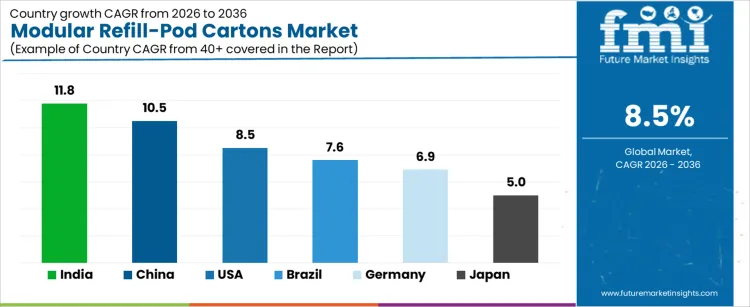
| Country | CAGR (%) |
|---|---|
| USA | 8.50% |
| Germany | 6.90% |
| China | 10.50% |
| India | 11.80% |
| Brazil | 7.60% |
| Japan | 5.00% |
The demand for modular refill pod cartons varies across countries, driven by convenience packaging adoption, single serve product growth, and sustainability initiatives. India leads with an 11.80% CAGR, supported by expanding beverage and personal care sectors and increasing preference for refillable packaging formats. China follows at 10.50%, driven by large scale manufacturing and adoption of modular cartons in retail distribution. The USA grows at 8.50%, reflecting steady uptake in coffee pods, personal care, and household products. Brazil records 7.60%, shaped by rising retail penetration and packaged product consumption. Germany posts 6.90%, supported by established refillable packaging adoption, while Japan grows at 5.00%, reflecting mature markets and steady product replacement demand.
How Is Sustainable Packaging Driving Growth in the United States?
In the United States, revenue from the Modular Refill-Pod Cartons Market is expanding at a CAGR of 8.50% through 2035, driven by increasing adoption of modular refillable packaging for personal care, household, and food products. Brands are integrating refill pod cartons to reduce single-use packaging and improve consumer convenience. Demand is concentrated in cosmetics, liquid detergents, and beverage refill packs distributed through retail and direct to consumer channels. Domestic carton manufacturers are scaling production using recyclable materials compatible with existing filling and carton assembly lines. Stable consumer demand, recurring refill cycles, and organized retail programs are sustaining predictable procurement across packaging users nationwide.
- Personal care and household product brands are adopting modular refill cartons to reduce single-use packaging
- Refillable packaging formats improve consumer convenience and repeat purchase behavior
- Domestic manufacturers are scaling production using recyclable and compatible materials
- Recurring refill cycles sustain predictable procurement volumes
How Do Regulatory and Quality Standards Shape Demand in Germany?
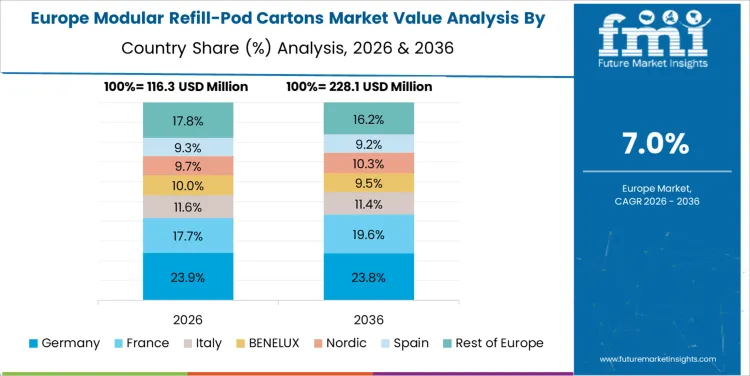
Germany continues to record steady growth in the Modular Refill-Pod Cartons Market at a CAGR of 6.90% through 2035, supported by regulatory standards and sustainable packaging initiatives. Manufacturers are integrating modular refill cartons for cosmetics, liquid products, and specialty food items to comply with environmental guidelines. Demand remains concentrated on refillable personal care and household products. Technical expertise in carton design ensures proper sealing, stacking, and refill alignment. Stable production volumes and compliance driven procurement practices are sustaining measured adoption across domestic packaging operations nationwide.
- Regulatory compliance and environmental guidelines drive adoption of refillable carton formats
- Cosmetics and household product refills remain core application segments
- Technical carton design expertise ensures sealing and stacking reliability
- Compliance oriented procurement sustains steady adoption levels
How Is E-Commerce and Retail Expansion Accelerating Adoption in China?
In China, revenue from the Modular Refill-Pod Cartons Market is growing at a CAGR of 10.50% through 2035, driven by rapid growth in e-commerce retail and refillable packaging adoption. Brands are adopting modular refill cartons to improve logistics efficiency and encourage repeat purchases. Demand is strong across personal care, liquid detergents, and beverage refill packs distributed through online and offline channels. Domestic manufacturers are scaling production using recyclable paperboard and carton materials. High retail volume, structured procurement, and consumer awareness are sustaining rapid adoption across major packaging hubs nationwide.
- E-commerce and retail expansion support modular refill carton adoption
- Personal care and liquid detergent refills drive high volume usage
- Domestic production scaling improves availability of recyclable cartons
- Consumer awareness and repeat purchases sustain consistent demand
How Is Organized Manufacturing Supporting Growth in India?
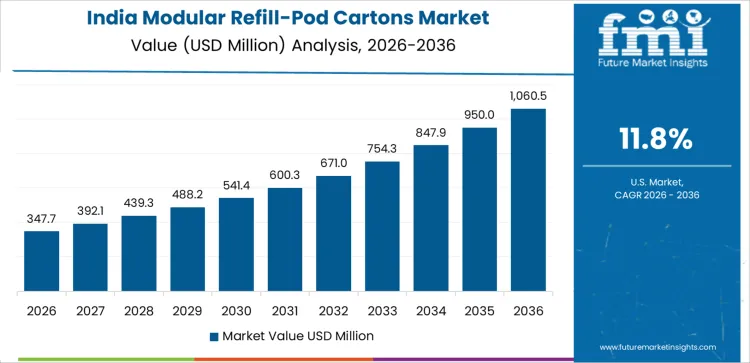
India is witnessing strong expansion in the Modular Refill-Pod Cartons Market at a CAGR of 11.80% through 2035, supported by growth in organized manufacturing and increasing adoption of refillable packaging. Manufacturers are integrating modular refill cartons for beverages, personal care, and household products. Demand is rising across urban retail markets and subscription channels. Domestic carton converters are offering cost-aligned, recyclable solutions suitable for high volume production. Expanding retail penetration and refill program adoption are sustaining robust procurement across packaging operations nationwide.
- Organized manufacturing growth increases demand for modular refill carton formats
- Urban retail and subscription channels support high volume usage
- Domestic converters provide cost-aligned recyclable carton solutions
- Refill program adoption sustains procurement momentum
How Are Consumer Goods Shipments Supporting Adoption in Brazil?
Brazil is seeing steady growth in the Modular Refill-Pod Cartons Market at a CAGR of 7.60% through 2035, supported by expansion of packaged product distribution and retail networks. Brands are adopting modular refill cartons for personal care, household, and beverage refills. Demand is concentrated in organized retail and regional distribution hubs. Imports supply some specialty carton materials, while local converters expand assembly and finishing capacity. Growth in packaged goods availability is sustaining recurring procurement across carton packaging operations nationwide.
- Packaged product distribution drives demand for refillable modular cartons
- Personal care and beverage refills remain primary applications
- Local converters expand assembly and finishing capacity
- Retail growth sustains recurring procurement volumes
How Does Mature Retail Packaging Demand Influence Stability in Japan?
Japan is maintaining measured growth in the Modular Refill-Pod Cartons Market at a CAGR of 5.00% through 2035, supported by mature retail packaging demand and preference for reliable refillable formats. Brands apply modular refill cartons selectively for personal care, beverage, and specialty liquid products. Demand remains focused on durability, sealing performance, and consistent refill alignment. Domestic suppliers emphasize precision in carton assembly and material consistency. Stable consumption patterns and replacement driven purchasing are sustaining predictable procurement across established packaging operations nationwide.
- Mature retail markets favor selective adoption of refillable modular cartons
- Personal care and specialty liquids anchor baseline demand
- Domestic suppliers ensure precise assembly and material consistency
- Replacement driven purchasing sustains procurement continuity
What Is Driving the Demand for Modular Refill Pod Cartons and Which Companies Shape Packaging Deployment?
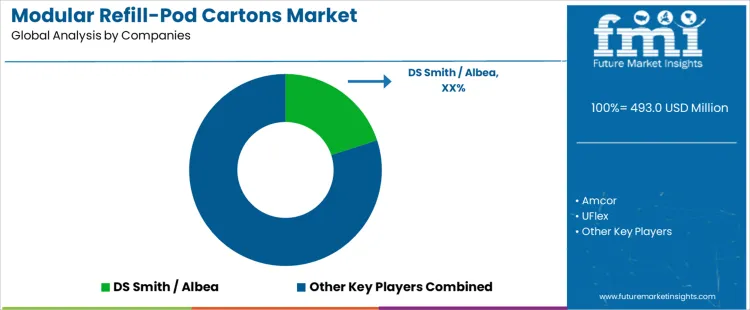
Modular refill pod cartons are gaining traction as consumer goods brands shift toward refillable formats that reduce primary packaging waste and simplify storage. Personal care, home cleaning, and beverage categories rely on compact cartons that house single or multiple pods, enabling refill stations, subscription packs, and retail ready displays. DS Smith and Albea support adoption through modular carton structures designed for automated packing and easy shelf replenishment. Amcor contributes through multilayer carton solutions compatible with barrier and moisture sensitive pods. UFlex participates through laminated and coated carton structures suited for high volume filling lines. Local partners supply regionally adapted cartons that meet distribution and recycling requirements, while Toppan enhances branding and graphic integration on modular surfaces.
Design and material selection are governed by structural integrity, ease of opening, protective barrier properties, and compatibility with automated dispensers or in store refill systems. Brands favor cartons that maintain pod stability during shipping and minimize material use without compromising presentation. Buyers prioritize sustainable sourcing, recyclability, and traceable supply chains. Usage spans refill packs for laundry capsules, beverage pods, and personal care concentrates. Demand visibility tracks consumer preference for reusable and refillable systems, expansion of subscription and eco-friendly programs, and ongoing innovation in modular carton design to align with circular packaging initiatives.
Key Players in the Modular Refill Pod Cartons Market
- DS Smith / Albea
- Amcor
- UFlex
- Local partners
- Toppan
Scope of the Report
| Items | Values |
|---|---|
| Quantitative Units (2026) | USD million |
| End-use / Application | Personal Care / Homecare refill systems; Cosmetics & Luxury refills; Food Pods / Portioning; E-commerce refill bundles; Household refills; Others |
| Packaging Format / Type | Modular Carton Systems (holder + pods); Shelf-ready Refill Boxes; Pod Cartons; Small Refill Cartons; Others |
| Material | Recycled Board + Coated Inserts; High-board & barrier liners; Laminated Paperboard; Recycled Paperboard; Others |
| Technology | Click-in Pod Technology / RFID-enabled refill recognition; Precision Die-cut & Assembly; Automated Pod Insertion; Glue-less Assembly; Others |
| Regions Covered | Asia Pacific; Europe; North America; Latin America; Middle East & Africa |
| Countries Covered | China; Japan; South Korea; India; Australia & New Zealand; ASEAN; Germany; United Kingdom; France; Italy; Spain; Nordic; BENELUX; United States; Canada; Mexico; Brazil; Chile; Kingdom of Saudi Arabia; Other GCC Countries; Turkey; South Africa; Other African Union; plus remaining countries across each region |
| Key Companies Profiled | DS Smith / Albea; Amcor; UFlex; Local partners; Toppan |
| Additional Attributes | Dollar by sales across end-use applications and carton types; adoption of modular systems combining pod holders and refill cartons; use of recycled, laminated, and coated paperboard for moisture and barrier protection; integration with automated pod filling and dispensing lines; expansion through subscription, retail-ready, and e-commerce refill programs; standardization of pod dimensions and carton designs; recyclability and sustainable sourcing considerations; branding and graphic integration across modular cartons; role of precision die-cut, glue-less, and RFID-enabled technologies in improving functional performance; adoption across household, personal care, and food pod refill segments |
Modular Refill Pod Cartons Market Segmentation
Device Type
- Microprocessor KAFO (e.g., C Brace)
- Microprocessor AFO
- Upper Extremity Powered Orthosis
- Medical Exosuit/Exoskeleton (Orthosis use)
Control / Actuation
- Sensor Based Stance/Swing Control (MP joints)
- Powered Actuators (knee/hip/ankle)
- FES Assisted Orthoses (MP controlled)
- Passive Assist with MP Monitoring/Locking
Application
- Neurologic Gait Impairment (SCI, Stroke)
- Musculoskeletal/Trauma & Post op
- Neurodegenerative (MS, ALS, PD)
- Pediatric (CP, other)
End User
- Rehab Hospitals & Neurorehab Centers
- Prosthetics & Orthotics (P&O) Clinics
- Acute Hospitals & Trauma Centers
- Homecare / Outpatient Programs
Region
- Asia Pacific
- China
- Japan
- South Korea
- India
- Australia & New Zealand
- ASEAN
- Rest of Asia Pacific
- Europe
- Germany
- United Kingdom
- France
- Italy
- Spain
- Nordic
- BENELUX
- Rest of Europe
- North America
- United States
- Canada
- Mexico
- Latin America
- Brazil
- Chile
- Rest of Latin America
- Middle East & Africa
- Kingdom of Saudi Arabia
- Other GCC Countries
- Turkey
- South Africa
- Other African Union
- Rest of Middle East & Africa
Frequently Asked Questions
How big is the modular refill-pod cartons market in 2026?
The global modular refill-pod cartons market is estimated to be valued at USD 493.0 million in 2026.
What will be the size of modular refill-pod cartons market in 2036?
The market size for the modular refill-pod cartons market is projected to reach USD 1,116.0 million by 2036.
How much will be the modular refill-pod cartons market growth between 2026 and 2036?
The modular refill-pod cartons market is expected to grow at a 8.5% CAGR between 2026 and 2036.
What are the key product types in the modular refill-pod cartons market?
The key product types in modular refill-pod cartons market are personal care / homecare refill systems, cosmetics & luxury refills, food pods / portioning, e-commerce refill bundles, household refills and others.
Which packaging format / type segment to contribute significant share in the modular refill-pod cartons market in 2026?
In terms of packaging format / type, modular carton systems (holder + pods) segment to command 50.0% share in the modular refill-pod cartons market in 2026.
Preview the report firsthand - request a free sample
Get SampleGet the brochure for pricing and purchase details.
Get PDFTable of Content
- Executive Summary
- Global Market Outlook
- Demand-side Trends
- Supply-side Trends
- Technology Roadmap Analysis
- Analysis and Recommendations
- Market Overview
- Market Coverage / Taxonomy
- Market Definition / Scope / Limitations
- Market Background
- Market Dynamics
- Drivers
- Restraints
- Opportunity
- Trends
- Scenario Forecast
- Demand in Optimistic Scenario
- Demand in Likely Scenario
- Demand in Conservative Scenario
- Opportunity Map Analysis
- Product Life Cycle Analysis
- Supply Chain Analysis
- Investment Feasibility Matrix
- Value Chain Analysis
- PESTLE and Porter’s Analysis
- Regulatory Landscape
- Regional Parent Market Outlook
- Production and Consumption Statistics
- Import and Export Statistics
- Market Dynamics
- Global Market Analysis 2021 to 2025 and Forecast, 2026 to 2036
- Historical Market Size Value (USD Million) Analysis, 2021 to 2025
- Current and Future Market Size Value (USD Million) Projections, 2026 to 2036
- Y-o-Y Growth Trend Analysis
- Absolute $ Opportunity Analysis
- Global Market Pricing Analysis 2021 to 2025 and Forecast 2026 to 2036
- Global Market Analysis 2021 to 2025 and Forecast 2026 to 2036, By End-use / Application
- Introduction / Key Findings
- Historical Market Size Value (USD Million) Analysis By End-use / Application , 2021 to 2025
- Current and Future Market Size Value (USD Million) Analysis and Forecast By End-use / Application , 2026 to 2036
- Personal Care / Homecare refill systems
- Cosmetics & Luxury refills
- Food Pods / Portioning
- E-commerce refill bundles
- Household refills
- Others
- Y-o-Y Growth Trend Analysis By End-use / Application , 2021 to 2025
- Absolute $ Opportunity Analysis By End-use / Application , 2026 to 2036
- Global Market Analysis 2021 to 2025 and Forecast 2026 to 2036, By Packaging Format / Type
- Introduction / Key Findings
- Historical Market Size Value (USD Million) Analysis By Packaging Format / Type, 2021 to 2025
- Current and Future Market Size Value (USD Million) Analysis and Forecast By Packaging Format / Type, 2026 to 2036
- Modular Carton Systems (holder + pods)
- Shelf-ready Refill Boxes
- Pod Cartons
- Small Refill Cartons
- Others
- Y-o-Y Growth Trend Analysis By Packaging Format / Type, 2021 to 2025
- Absolute $ Opportunity Analysis By Packaging Format / Type, 2026 to 2036
- Global Market Analysis 2021 to 2025 and Forecast 2026 to 2036, By Material
- Introduction / Key Findings
- Historical Market Size Value (USD Million) Analysis By Material, 2021 to 2025
- Current and Future Market Size Value (USD Million) Analysis and Forecast By Material, 2026 to 2036
- Recycled Board + Coated Inserts
- High-board & barrier liners
- Laminated Paperboard
- Recycled Paperboard
- Others
- Y-o-Y Growth Trend Analysis By Material, 2021 to 2025
- Absolute $ Opportunity Analysis By Material, 2026 to 2036
- Global Market Analysis 2021 to 2025 and Forecast 2026 to 2036, By Technology
- Introduction / Key Findings
- Historical Market Size Value (USD Million) Analysis By Technology, 2021 to 2025
- Current and Future Market Size Value (USD Million) Analysis and Forecast By Technology, 2026 to 2036
- Click-in Pod Technology / RFID-enabled refill recognition
- Precision Die-cut & Assembly
- Automated Pod Insertion
- Glue-less Assembly
- Others
- Y-o-Y Growth Trend Analysis By Technology, 2021 to 2025
- Absolute $ Opportunity Analysis By Technology, 2026 to 2036
- Global Market Analysis 2021 to 2025 and Forecast 2026 to 2036, By Region
- Introduction
- Historical Market Size Value (USD Million) Analysis By Region, 2021 to 2025
- Current Market Size Value (USD Million) Analysis and Forecast By Region, 2026 to 2036
- North America
- Latin America
- Western Europe
- Eastern Europe
- East Asia
- South Asia and Pacific
- Middle East & Africa
- Market Attractiveness Analysis By Region
- North America Market Analysis 2021 to 2025 and Forecast 2026 to 2036, By Country
- Historical Market Size Value (USD Million) Trend Analysis By Market Taxonomy, 2021 to 2025
- Market Size Value (USD Million) Forecast By Market Taxonomy, 2026 to 2036
- By Country
- USA
- Canada
- Mexico
- By End-use / Application
- By Packaging Format / Type
- By Material
- By Technology
- By Country
- Market Attractiveness Analysis
- By Country
- By End-use / Application
- By Packaging Format / Type
- By Material
- By Technology
- Key Takeaways
- Latin America Market Analysis 2021 to 2025 and Forecast 2026 to 2036, By Country
- Historical Market Size Value (USD Million) Trend Analysis By Market Taxonomy, 2021 to 2025
- Market Size Value (USD Million) Forecast By Market Taxonomy, 2026 to 2036
- By Country
- Brazil
- Chile
- Rest of Latin America
- By End-use / Application
- By Packaging Format / Type
- By Material
- By Technology
- By Country
- Market Attractiveness Analysis
- By Country
- By End-use / Application
- By Packaging Format / Type
- By Material
- By Technology
- Key Takeaways
- Western Europe Market Analysis 2021 to 2025 and Forecast 2026 to 2036, By Country
- Historical Market Size Value (USD Million) Trend Analysis By Market Taxonomy, 2021 to 2025
- Market Size Value (USD Million) Forecast By Market Taxonomy, 2026 to 2036
- By Country
- Germany
- UK
- Italy
- Spain
- France
- Nordic
- BENELUX
- Rest of Western Europe
- By End-use / Application
- By Packaging Format / Type
- By Material
- By Technology
- By Country
- Market Attractiveness Analysis
- By Country
- By End-use / Application
- By Packaging Format / Type
- By Material
- By Technology
- Key Takeaways
- Eastern Europe Market Analysis 2021 to 2025 and Forecast 2026 to 2036, By Country
- Historical Market Size Value (USD Million) Trend Analysis By Market Taxonomy, 2021 to 2025
- Market Size Value (USD Million) Forecast By Market Taxonomy, 2026 to 2036
- By Country
- Russia
- Poland
- Hungary
- Balkan & Baltic
- Rest of Eastern Europe
- By End-use / Application
- By Packaging Format / Type
- By Material
- By Technology
- By Country
- Market Attractiveness Analysis
- By Country
- By End-use / Application
- By Packaging Format / Type
- By Material
- By Technology
- Key Takeaways
- East Asia Market Analysis 2021 to 2025 and Forecast 2026 to 2036, By Country
- Historical Market Size Value (USD Million) Trend Analysis By Market Taxonomy, 2021 to 2025
- Market Size Value (USD Million) Forecast By Market Taxonomy, 2026 to 2036
- By Country
- China
- Japan
- South Korea
- By End-use / Application
- By Packaging Format / Type
- By Material
- By Technology
- By Country
- Market Attractiveness Analysis
- By Country
- By End-use / Application
- By Packaging Format / Type
- By Material
- By Technology
- Key Takeaways
- South Asia and Pacific Market Analysis 2021 to 2025 and Forecast 2026 to 2036, By Country
- Historical Market Size Value (USD Million) Trend Analysis By Market Taxonomy, 2021 to 2025
- Market Size Value (USD Million) Forecast By Market Taxonomy, 2026 to 2036
- By Country
- India
- ASEAN
- Australia & New Zealand
- Rest of South Asia and Pacific
- By End-use / Application
- By Packaging Format / Type
- By Material
- By Technology
- By Country
- Market Attractiveness Analysis
- By Country
- By End-use / Application
- By Packaging Format / Type
- By Material
- By Technology
- Key Takeaways
- Middle East & Africa Market Analysis 2021 to 2025 and Forecast 2026 to 2036, By Country
- Historical Market Size Value (USD Million) Trend Analysis By Market Taxonomy, 2021 to 2025
- Market Size Value (USD Million) Forecast By Market Taxonomy, 2026 to 2036
- By Country
- Kingdom of Saudi Arabia
- Other GCC Countries
- Turkiye
- South Africa
- Other African Union
- Rest of Middle East & Africa
- By End-use / Application
- By Packaging Format / Type
- By Material
- By Technology
- By Country
- Market Attractiveness Analysis
- By Country
- By End-use / Application
- By Packaging Format / Type
- By Material
- By Technology
- Key Takeaways
- Key Countries Market Analysis
- USA
- Pricing Analysis
- Market Share Analysis, 2025
- By End-use / Application
- By Packaging Format / Type
- By Material
- By Technology
- Canada
- Pricing Analysis
- Market Share Analysis, 2025
- By End-use / Application
- By Packaging Format / Type
- By Material
- By Technology
- Mexico
- Pricing Analysis
- Market Share Analysis, 2025
- By End-use / Application
- By Packaging Format / Type
- By Material
- By Technology
- Brazil
- Pricing Analysis
- Market Share Analysis, 2025
- By End-use / Application
- By Packaging Format / Type
- By Material
- By Technology
- Chile
- Pricing Analysis
- Market Share Analysis, 2025
- By End-use / Application
- By Packaging Format / Type
- By Material
- By Technology
- Germany
- Pricing Analysis
- Market Share Analysis, 2025
- By End-use / Application
- By Packaging Format / Type
- By Material
- By Technology
- UK
- Pricing Analysis
- Market Share Analysis, 2025
- By End-use / Application
- By Packaging Format / Type
- By Material
- By Technology
- Italy
- Pricing Analysis
- Market Share Analysis, 2025
- By End-use / Application
- By Packaging Format / Type
- By Material
- By Technology
- Spain
- Pricing Analysis
- Market Share Analysis, 2025
- By End-use / Application
- By Packaging Format / Type
- By Material
- By Technology
- France
- Pricing Analysis
- Market Share Analysis, 2025
- By End-use / Application
- By Packaging Format / Type
- By Material
- By Technology
- India
- Pricing Analysis
- Market Share Analysis, 2025
- By End-use / Application
- By Packaging Format / Type
- By Material
- By Technology
- ASEAN
- Pricing Analysis
- Market Share Analysis, 2025
- By End-use / Application
- By Packaging Format / Type
- By Material
- By Technology
- Australia & New Zealand
- Pricing Analysis
- Market Share Analysis, 2025
- By End-use / Application
- By Packaging Format / Type
- By Material
- By Technology
- China
- Pricing Analysis
- Market Share Analysis, 2025
- By End-use / Application
- By Packaging Format / Type
- By Material
- By Technology
- Japan
- Pricing Analysis
- Market Share Analysis, 2025
- By End-use / Application
- By Packaging Format / Type
- By Material
- By Technology
- South Korea
- Pricing Analysis
- Market Share Analysis, 2025
- By End-use / Application
- By Packaging Format / Type
- By Material
- By Technology
- Russia
- Pricing Analysis
- Market Share Analysis, 2025
- By End-use / Application
- By Packaging Format / Type
- By Material
- By Technology
- Poland
- Pricing Analysis
- Market Share Analysis, 2025
- By End-use / Application
- By Packaging Format / Type
- By Material
- By Technology
- Hungary
- Pricing Analysis
- Market Share Analysis, 2025
- By End-use / Application
- By Packaging Format / Type
- By Material
- By Technology
- Kingdom of Saudi Arabia
- Pricing Analysis
- Market Share Analysis, 2025
- By End-use / Application
- By Packaging Format / Type
- By Material
- By Technology
- Turkiye
- Pricing Analysis
- Market Share Analysis, 2025
- By End-use / Application
- By Packaging Format / Type
- By Material
- By Technology
- South Africa
- Pricing Analysis
- Market Share Analysis, 2025
- By End-use / Application
- By Packaging Format / Type
- By Material
- By Technology
- USA
- Market Structure Analysis
- Competition Dashboard
- Competition Benchmarking
- Market Share Analysis of Top Players
- By Regional
- By End-use / Application
- By Packaging Format / Type
- By Material
- By Technology
- Competition Analysis
- Competition Deep Dive
- DS Smith / Albea
- Overview
- Product Portfolio
- Profitability by Market Segments (Product/Age /Sales Channel/Region)
- Sales Footprint
- Strategy Overview
- Marketing Strategy
- Product Strategy
- Channel Strategy
- Amcor
- UFlex
- Local partners
- Toppan
- DS Smith / Albea
- Competition Deep Dive
- Assumptions & Acronyms Used
- Research Methodology


