

- Industry Size (2026)
- USD 12.99 Bn
- Forecast (2036)
- USD 31.05 Bn
- CAGR (2026 to 2036)
- 9.0%
Modular Power Pods Forecast and Outlook 2026 to 2036
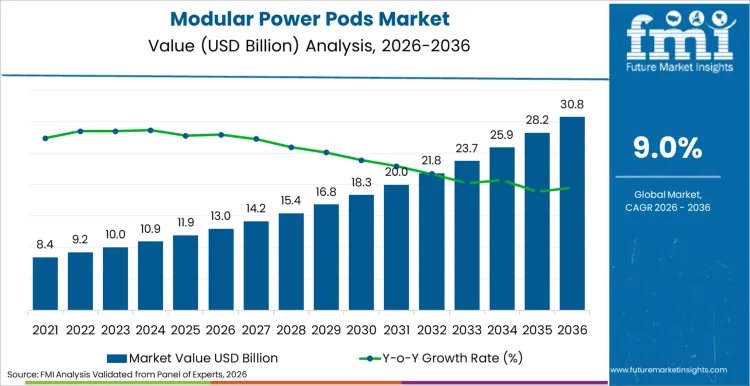
The global modular power pods sector is on track to achieve a valuation of USD 31.05 billion by 2036, accelerating from USD 12.99 billion in 2026 at a CAGR of 9.0%. As per Future Market Insights, this expansion reflects the increasing adoption of distributed power architectures across commercial, industrial, and residential applications.
The market transformation accelerated significantly in 2025 when major technology companies began deploying modular solutions to address AI infrastructure bottlenecks. Phil Inagaki, Managing Partner and Chief Investment Officer at Xora Innovation, stated: 'Gruve's Inference Infrastructure Fabric combines modular state-of-the-art pods with a distributed network architecture to enable rapid capacity deployment.' This sentiment captures the industry's shift toward flexible power provisioning.
Regulatory developments have also shaped market dynamics. In November 2024, the Bureau Veritas Marine et Offshore organization granted Type Approval Certification to PowerTech Systems' PowerModule, establishing new compliance standards for marine applications. The updated UL 2755:2025 Outline of Investigation for Prefabricated Modular Data Center Systems has streamlined safety compliance as deployment risks evolve.
What changed fundamentally in 2026 was the recognition that traditional power infrastructure could not accommodate the rapid scaling requirements of AI workloads. Organizations began prioritizing modular approaches that offer deployment flexibility and operational redundancy. This shift represents a departure from the fixed infrastructure investments that characterized previous years.
What Does the Summary of Modular Power Pods Market Reveal?
What Is Growth Outlook for Modular Power Pods as per Future Market Insights Projection?
The market is expected to maintain strong momentum with a 9.0% CAGR through 2036, driven by increasing demand for scalable power solutions across multiple sectors. Growth acceleration is particularly pronounced in Asia-Pacific regions where industrialization and renewable energy adoption create favorable conditions.
FMI Research Approach: Primary research with industry stakeholders combined with analysis of regulatory frameworks and technology adoption patterns.
How Do FMI Analysts Perceive Modular Power Pods to Evolve?
FMI analysts are of the opinion that the market will transition from niche applications toward mainstream adoption as organizations recognize the cost and operational advantages of modular architectures. The evolution includes integration with renewable energy systems and smart grid technologies.
FMI Research Approach: Longitudinal analysis of deployment patterns and technology integration trends across diverse industry verticals.
Which Country Holds Largest Share in Global Modular Power Pods?
Asia-Pacific leads the global market, accounting for approximately 38% of total market value in 2026. China's manufacturing capabilities and India's infrastructure development initiatives contribute significantly to this regional dominance.
FMI Research Approach: Country-level market sizing based on industrial capacity, policy frameworks, and infrastructure investment data.
How Large Will Modular Power Pods Be by 2036?
The market will reach USD 31.05 billion by 2036, representing a near-tripling of market size from the 2026 baseline. This growth trajectory reflects both market penetration increases and price point optimization.
FMI Research Approach: Scenario modeling incorporating technology cost curves, adoption rates, and competitive dynamics.
What Is Definition of Modular Power Pods?
Modular power pods are prefabricated, self-contained power distribution and generation units designed for scalable deployment across various applications. These systems integrate power generation, distribution, and control functions within standardized modules that can be rapidly deployed and interconnected.
FMI Research Approach: Industry standard analysis and stakeholder interviews to establish consistent market definitions.
What are Globally Unique Trends Shaping Modular Power Pods?
Key trends include the integration of artificial intelligence for predictive maintenance, the development of hybrid renewable-conventional systems, and the emergence of plug-and-play deployment models that minimize installation complexity.
FMI Research Approach: Patent analysis, technology roadmap evaluation, and expert consultations to identify emerging trends.
Modular Power Pods Market Key Takeaways
| Metric | Value |
|---|---|
| Expected Value (2026E) | USD 12.99 billion |
| Projected Value (2036F) | USD 31.05 billion |
| CAGR (2026 to 2036) | 9.0% |
Source: Future Market Insights (FMI) analysis, based on proprietary forecasting model and primary research
What Factors are Propelling Adoption of Modular Power Pods?
The primary driver propelling market adoption is the exponential growth in data center power requirements, particularly for AI and machine learning workloads. Organizations are discovering that traditional power infrastructure cannot accommodate the rapid scaling needed for these applications. Scott Brookshire, Chief Technology Officer and Co-Founder at OpenColo By American Cloud, explained this challenge when discussing modular solutions: 'Gruve's modular compute for inferencing enables us to utilize stranded power capacity in our data center.'
Legislative and regulatory drivers are creating additional momentum. The European Union's Green Deal implementation has established targets for renewable energy integration that favor modular approaches. Similarly, the Infrastructure Investment and Jobs Act in the United States includes provisions that support distributed power generation technologies. These policy frameworks create favorable conditions for modular power pod deployment.
Technology adoption drivers include the maturation of battery storage systems and power electronics that enable efficient modular operation. The development of standardized interfaces and communication protocols has reduced integration complexity, making modular solutions more attractive to end users. Additionally, advances in power management software allow for sophisticated coordination between multiple pods, optimizing overall system performance.
Industrial manufacturing requirements are also driving adoption, particularly in sectors requiring rapid facility expansion or temporary power solutions. The ability to deploy power infrastructure in parallel with facility construction reduces project timelines and capital requirements.
How Is the Modular Power Pods Market Segmented?
The overall segmentation outlook reveals a market that is increasingly dominated by commercial and industrial applications, while residential adoption shows strong growth potential as costs decline and product offerings mature.
Why Does Commercial and Industrial Segment Hold a Dominant Share?
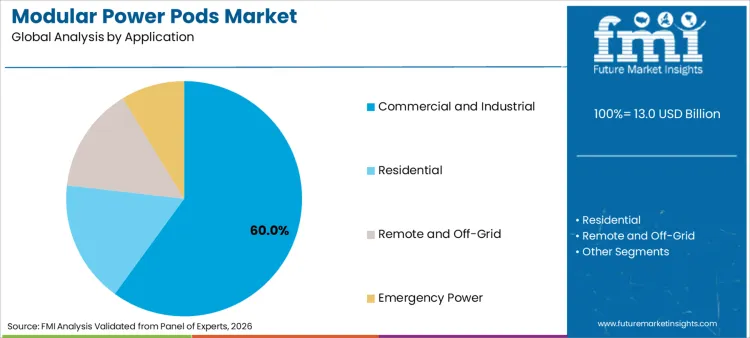
The commercial and industrial segment accounts for approximately 60% of total market value, driven by the critical power requirements of data centers, manufacturing facilities, and large-scale retail operations. Huawei's PowerPOD 3.0 launch in May 2022 exemplifies this focus, specifically targeting data center applications with footprint and power optimization features. Similarly, Flex's partnership with NVIDIA announced in February 2026 demonstrates the segment's emphasis on modular systems designed for rapid deployment and scalability.
The segment's dominance stems from the substantial power requirements and the economic justification for modular approaches in commercial settings. Organizations in this segment typically have dedicated facilities management teams capable of operating sophisticated power systems, making them natural early adopters of modular technologies.
Why is Residential Segment Showing Strong Growth Potential?
The residential segment represents 25% of market share but is experiencing accelerated growth as product offerings become more consumer-friendly. Bluetti's planned release of the Apex 300 stackable, modular portable power station in Q2 2025 illustrates the trend toward residential applications.
Nature's Generator's power pods, designed as external battery packs for solar generators, demonstrate how modular concepts are being adapted for home use. This segment's growth is driven by increasing interest in energy independence, backup power requirements, and the integration of residential solar installations with storage systems.
What Trends are Shaping Industry Evolution?
Consumer psychology is shifting toward viewing power infrastructure as a service rather than a fixed asset. This mental model change supports modular approaches where capacity can be adjusted based on changing requirements. Organizations increasingly prefer solutions that offer operational flexibility over traditional fixed installations.
Material innovation trends include the development of advanced composite enclosures that provide environmental protection while minimizing weight and cost. Power electronics improvements are enabling higher power density, allowing more capability within each modular unit.
Digital transformation is manifesting through the integration of IoT sensors and cloud-based monitoring systems within modular power pods. EasyCabin's Power Pod, launched in March, incorporates emissions monitoring and fuel cost optimization features that exemplify this digital integration trend.
Supply chain evolution includes the standardization of key components across multiple manufacturers, reducing costs and improving interoperability. The development of regional assembly centers allows for faster delivery while maintaining quality control standards.
The emergence of hybrid deployment models combines traditional grid connections with modular backup and peak shaving capabilities. This approach allows organizations to optimize their power costs while maintaining operational resilience.
How Will Modular Power Pods Expansion Unfold Across Key Global Regions?
Regional growth patterns reflect distinct economic and regulatory environments, with Asia-Pacific leading at 9.5% CAGR, followed by Rest of World at 10.0%, North America at 8.5%, and Europe at 8.0%. FMI opines that these regional variations stem from different infrastructure maturity levels, regulatory frameworks, and industrial development priorities.
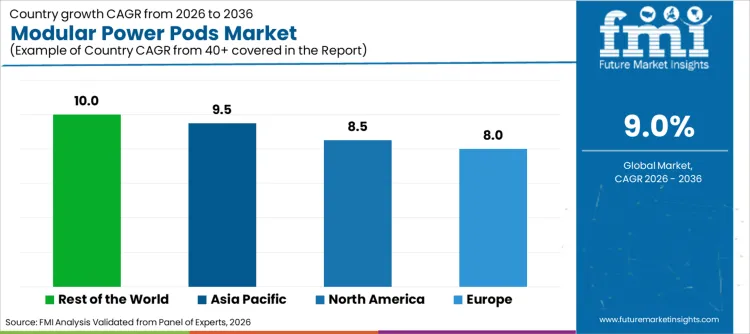
| Region | CAGR (2026 to 2036) |
|---|---|
| North America | 8.5% |
| Europe | 8.0% |
| Asia Pacific | 9.5% |
| Rest of the World | 10.0% |
Source: FMI analysis
How Is Asia-Pacific Driving 9.5% Growth in Modular Power Pods?
Asia-Pacific's leadership position reflects the region's rapid industrialization and aggressive renewable energy targets. China's manufacturing sector provides both demand for modular power solutions and production capabilities that support global market growth. Huawei's development of multiple power pod solutions, including PowerPOD 3.0 and FusionPower6000, demonstrates Chinese companies' significant investment in this technology sector. The company's focus on data center and EV charging applications aligns with China's infrastructure modernization priorities.
India's Smart Cities Mission has created substantial demand for flexible power infrastructure that can adapt to evolving urban requirements. The country's renewable energy capacity additions, exceeding 15 GW annually in recent years according to government data, require modular solutions that can integrate with variable generation sources. Japan's post-Fukushima energy security focus has led to increased interest in distributed power systems that enhance grid resilience. South Korea's digital transformation initiatives, particularly in manufacturing, require power infrastructure that can scale rapidly with changing technology requirements. The region benefits from established electronics manufacturing ecosystems that support power pod component production, creating cost advantages that accelerate adoption across multiple market segments.
How Is North America Driving 8.5% Growth in Modular Power Pods?
North America's growth trajectory centers on data center expansion and grid modernization initiatives. The region's hyperscale data center development, particularly for AI applications, requires power solutions that can be deployed rapidly to meet accelerating compute demands. Gruve's USD 50 million Series A funding round in February 2026 illustrates investor confidence in AI infrastructure solutions, with the company's modular approach specifically designed for rapid capacity deployment.
The Infrastructure Investment and Jobs Act has allocated substantial funding for grid resilience improvements, creating opportunities for modular power solutions that enhance system reliability. Texas's experience with winter storm power outages has heightened awareness of the need for distributed power resources that can operate independently during grid failures. California's wildfire-related public safety power shutoffs have created demand for backup power solutions that can maintain critical operations during extended outages.
The region's mature renewable energy markets, particularly in solar and wind, require flexible power management systems that can accommodate variable generation patterns. Corporate sustainability commitments are driving demand for modular solutions that can integrate renewable generation with traditional power sources, allowing organizations to optimize their energy profiles.
How is Europe Driving 8.0% Growth in Modular Power Pods?
Europe's market development is shaped by aggressive renewable energy mandates and grid modernization requirements. The European Green Deal's target of carbon neutrality by 2050 has created regulatory pressure for flexible power systems that can accommodate high renewable penetration. France-based PowerTech Systems' achievement of Bureau Veritas Type Approval Certification in November 2024 demonstrates European companies' focus on meeting stringent regulatory standards while expanding market reach.
Germany's Energiewende has created one of the world's most complex power grids, requiring sophisticated balancing solutions that modular power pods can provide. The country's industrial sector, particularly automotive and chemical manufacturing, requires power infrastructure that can adapt to changing production requirements. The Netherlands' focus on circular economy principles has driven interest in modular solutions that can be relocated and repurposed rather than abandoned at end of facility life. The UK's commitment to offshore wind development requires onshore power infrastructure that can accommodate large-scale renewable integration.
Italy's focus on energy security, particularly following geopolitical developments affecting natural gas supplies, has increased interest in distributed power solutions that reduce dependence on centralized generation. Nordic countries' leadership in digitalization creates demand for power infrastructure that can support extensive IoT and automation deployments across industrial and commercial facilities.
How Is Rest of World Driving 10.0% Growth in Modular Power Pods?
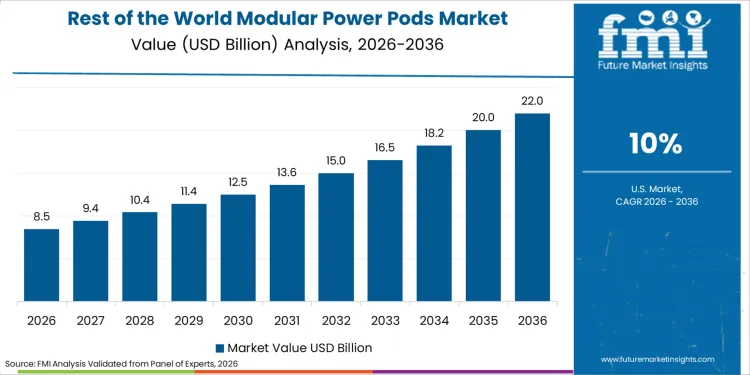
The Rest of World region shows the highest growth rate, driven by infrastructure development in emerging economies and unique deployment requirements in challenging environments. Australia's market development illustrates this trend, with Bunnings' introduction of flat-pack modular pods through its partnership with Melbourne-based Elsewhere Pods demonstrating how modular concepts are being adapted for diverse applications beyond traditional power systems.
Brazil's industrial development and mining operations in remote areas require power solutions that can be deployed rapidly without extensive infrastructure development. The country's commitment to renewable energy, with hydroelectric and solar capacity expansions, creates opportunities for modular systems that can provide grid balancing services. India's rural electrification initiatives require cost-effective solutions that can provide reliable power to distributed communities, making modular approaches attractive for their scalability and standardization benefits.
South Africa's power supply challenges have created demand for backup and peak-shaving solutions that can maintain industrial operations during load shedding events. The Middle East's focus on economic diversification away from oil dependence has led to substantial investments in renewable energy and industrial development that require flexible power infrastructure. Sub-Saharan Africa's infrastructure development, supported by international development financing, increasingly favors modular approaches that can be deployed incrementally as economic conditions allow, providing better risk management for large-scale power projects.
What Strategic Moves Are Defining the Competitive Landscape?
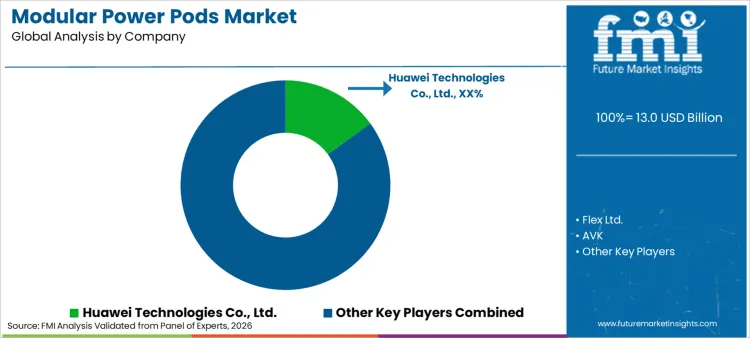
The competitive environment is characterized by rapid product development cycles and strategic partnerships that combine complementary technologies. Established power equipment manufacturers are acquiring modular capabilities while technology companies expand into power infrastructure. The landscape shows increasing collaboration between traditional power companies and software developers to create integrated solutions.
Manufacturing strategies emphasize standardization to achieve economies of scale while maintaining flexibility for customer-specific requirements. Companies are establishing regional production facilities to reduce delivery times and transportation costs. Quality control standards are becoming more stringent as applications expand into mission-critical environments.
Flex's partnership development exemplifies the strategic approach, combining its manufacturing capabilities with specialized technology providers to create comprehensive solutions. The company's collaboration with NVIDIA on modular data center systems and partnership with LG for thermal management demonstrates how companies are building ecosystem relationships to address complex customer requirements.
Recent Developments:
- In February 2026, Flex announced partnerships with NVIDIA for modular data center development and LG for advanced thermal management solutions. In February 2026, Gruve completed a USD 50 million Series A funding round, bringing total funding to USD 87.5 million for its AI infrastructure platform. In February 2026, Ondas Inc. announced the acquisition of UK-based Rotron Aero to integrate advanced propulsion and UAS technologies into its autonomous technology portfolio.
Who Are the Key Players in Modular Power Pods?
- Huawei Technologies Co., Ltd.
- Flex Ltd.
- AVK
- WB Power Services Lt
- EasyCabin
- Bluetti
- Nature's Generator
- Modular Power Solutions (MPS)
- PowerTech Systems
- Picotronix
- EV Power Pods
- Gruve
Market Definition
Modular power pods are prefabricated, self-contained electrical power systems designed for rapid deployment and scalable operation across diverse applications. These systems integrate power generation, distribution, conditioning, and control functions within standardized enclosures that can operate independently or in coordinated networks. The modular design enables flexible capacity scaling through the addition or removal of individual units based on changing power requirements.
Inclusions encompass factory-assembled power pods with integrated generation capabilities, battery storage systems designed for modular expansion, prefabricated electrical distribution pods, and hybrid systems combining multiple power sources within modular architectures. The market includes both grid-connected systems that provide peak shaving and backup capabilities, and off-grid solutions for remote or temporary applications.
Exclusions comprise traditional fixed electrical infrastructure, permanently installed power generation equipment, and custom-built power systems that lack standardized modular interfaces. The market excludes individual components such as generators or batteries when sold separately, and conventional UPS systems that do not incorporate modular expansion capabilities.
Scope of Report
| Items | Values |
|---|---|
| Quantitative Units | USD 12.99 billion |
| Product Type | Power Generation Pods, Battery Storage Pods, Power Distribution Pods, Hybrid Power Pods |
| Application | Commercial and Industrial, Residential, Remote and Off-Grid, Emergency Power |
| Regions Covered | North America, Europe, Asia Pacific, Rest of the World |
| Companies | Huawei Technologies Co., Ltd., Flex Ltd., AVK, WB Power Services Ltd, EasyCabin, Bluetti, Nature's Generator, Modular Power Solutions (MPS), PowerTech Systems, Picotronix, EV Power Pods, Gruve |
How Is Modular Power Pods Categorised by Segments?
By Product Type:
- Power Generation Pods
- Battery Storage Pods
- Power Distribution Pods
- Hybrid Power Pods
By Application:
- Commercial and Industrial
- Residential
- Remote and Off-Grid
- Emergency Power
By Region:
- North America
- Europe
- Asia-Pacific
- Rest of World
Bibliography
- Bureau Veritas. (2024, November). Marine and Offshore Certification Standards Update. Bureau Veritas Technical Publications.
- UL Solutions. (2025). UL 2755:2025 Outline of Investigation for Prefabricated Modular Data Center Systems. Underwriters Laboratories.
- International Renewable Energy Agency. (2025, February). Renewable Energy Capacity Statistics 2025. IRENA Publications.
- USA Department of Energy. (2025, January). Infrastructure Investment and Jobs Act: Energy Sector Implementation. DOE Publications.
Frequently Asked Questions
How big is the modular power pods market in 2026?
The global modular power pods market is estimated to be valued at USD 13.0 billion in 2026.
What will be the size of modular power pods market in 2036?
The market size for the modular power pods market is projected to reach USD 30.8 billion by 2036.
How much will be the modular power pods market growth between 2026 and 2036?
The modular power pods market is expected to grow at a 9.0% CAGR between 2026 and 2036.
What are the key product types in the modular power pods market?
The key product types in modular power pods market are commercial and industrial, residential, remote and off-grid and emergency power.
Which segment to contribute significant share in the modular power pods market in 2026?
In terms of , segment to command 0.0% share in the modular power pods market in 2026.
Preview the report firsthand - request a free sample
Get SampleGet the brochure for pricing and purchase details.
Get PDFTable of Content
- Executive Summary
- Global Market Outlook
- Demand-side Trends
- Supply-side Trends
- Technology Roadmap Analysis
- Analysis and Recommendations
- Market Coverage / Taxonomy
- Market Definition / Scope / Limitations
- Market Background
- Market Dynamics
- Drivers
- Restraints
- Opportunity
- Trends
- Scenario Forecast
- Demand in Optimistic Scenario
- Demand in Likely Scenario
- Demand in Conservative Scenario
- Opportunity Map Analysis
- Product Life Cycle Analysis
- Supply Chain Analysis
- Investment Feasibility Matrix
- Value Chain Analysis
- PESTLE and Porter’s Analysis
- Regulatory Landscape
- Regional Parent Market Outlook
- Production and Consumption Statistics
- Import and Export Statistics
- Market Dynamics
- Global Market Analysis 2021 to 2025 and Forecast, 2026 to 2036
- Historical Market Size Value (USD Million) Analysis, 2021 to 2025
- Current and Future Market Size Value (USD Million) Projections, 2026 to 2036
- Y-o-Y Growth Trend Analysis
- Absolute $ Opportunity Analysis
- Global Market Pricing Analysis 2021 to 2025 and Forecast 2026 to 2036
- Global Market Analysis 2021 to 2025 and Forecast 2026 to 2036, By Application
- Introduction / Key Findings
- Historical Market Size Value (USD Million) Analysis By Application , 2021 to 2025
- Current and Future Market Size Value (USD Million) Analysis and Forecast By Application , 2026 to 2036
- Commercial and Industrial
- Residential
- Remote and Off-Grid
- Emergency Power
- Commercial and Industrial
- Y-o-Y Growth Trend Analysis By Application , 2021 to 2025
- Absolute $ Opportunity Analysis By Application , 2026 to 2036
- Global Market Analysis 2021 to 2025 and Forecast 2026 to 2036, By Region
- Introduction
- Historical Market Size Value (USD Million) Analysis By Region, 2021 to 2025
- Current Market Size Value (USD Million) Analysis and Forecast By Region, 2026 to 2036
- North America
- Latin America
- Western Europe
- Eastern Europe
- East Asia
- South Asia and Pacific
- Middle East & Africa
- Market Attractiveness Analysis By Region
- North America Market Analysis 2021 to 2025 and Forecast 2026 to 2036, By Country
- Historical Market Size Value (USD Million) Trend Analysis By Market Taxonomy, 2021 to 2025
- Market Size Value (USD Million) Forecast By Market Taxonomy, 2026 to 2036
- By Country
- USA
- Canada
- Mexico
- By Application
- By Country
- Market Attractiveness Analysis
- By Country
- By Application
- Key Takeaways
- Latin America Market Analysis 2021 to 2025 and Forecast 2026 to 2036, By Country
- Historical Market Size Value (USD Million) Trend Analysis By Market Taxonomy, 2021 to 2025
- Market Size Value (USD Million) Forecast By Market Taxonomy, 2026 to 2036
- By Country
- Brazil
- Chile
- Rest of Latin America
- By Application
- By Country
- Market Attractiveness Analysis
- By Country
- By Application
- Key Takeaways
- Western Europe Market Analysis 2021 to 2025 and Forecast 2026 to 2036, By Country
- Historical Market Size Value (USD Million) Trend Analysis By Market Taxonomy, 2021 to 2025
- Market Size Value (USD Million) Forecast By Market Taxonomy, 2026 to 2036
- By Country
- Germany
- UK
- Italy
- Spain
- France
- Nordic
- BENELUX
- Rest of Western Europe
- By Application
- By Country
- Market Attractiveness Analysis
- By Country
- By Application
- Key Takeaways
- Eastern Europe Market Analysis 2021 to 2025 and Forecast 2026 to 2036, By Country
- Historical Market Size Value (USD Million) Trend Analysis By Market Taxonomy, 2021 to 2025
- Market Size Value (USD Million) Forecast By Market Taxonomy, 2026 to 2036
- By Country
- Russia
- Poland
- Hungary
- Balkan & Baltic
- Rest of Eastern Europe
- By Application
- By Country
- Market Attractiveness Analysis
- By Country
- By Application
- Key Takeaways
- East Asia Market Analysis 2021 to 2025 and Forecast 2026 to 2036, By Country
- Historical Market Size Value (USD Million) Trend Analysis By Market Taxonomy, 2021 to 2025
- Market Size Value (USD Million) Forecast By Market Taxonomy, 2026 to 2036
- By Country
- China
- Japan
- South Korea
- By Application
- By Country
- Market Attractiveness Analysis
- By Country
- By Application
- Key Takeaways
- South Asia and Pacific Market Analysis 2021 to 2025 and Forecast 2026 to 2036, By Country
- Historical Market Size Value (USD Million) Trend Analysis By Market Taxonomy, 2021 to 2025
- Market Size Value (USD Million) Forecast By Market Taxonomy, 2026 to 2036
- By Country
- India
- ASEAN
- Australia & New Zealand
- Rest of South Asia and Pacific
- By Application
- By Country
- Market Attractiveness Analysis
- By Country
- By Application
- Key Takeaways
- Middle East & Africa Market Analysis 2021 to 2025 and Forecast 2026 to 2036, By Country
- Historical Market Size Value (USD Million) Trend Analysis By Market Taxonomy, 2021 to 2025
- Market Size Value (USD Million) Forecast By Market Taxonomy, 2026 to 2036
- By Country
- Kingdom of Saudi Arabia
- Other GCC Countries
- Turkiye
- South Africa
- Other African Union
- Rest of Middle East & Africa
- By Application
- By Country
- Market Attractiveness Analysis
- By Country
- By Application
- Key Takeaways
- Key Countries Market Analysis
- USA
- Pricing Analysis
- Market Share Analysis, 2025
- By Application
- Canada
- Pricing Analysis
- Market Share Analysis, 2025
- By Application
- Mexico
- Pricing Analysis
- Market Share Analysis, 2025
- By Application
- Brazil
- Pricing Analysis
- Market Share Analysis, 2025
- By Application
- Chile
- Pricing Analysis
- Market Share Analysis, 2025
- By Application
- Germany
- Pricing Analysis
- Market Share Analysis, 2025
- By Application
- UK
- Pricing Analysis
- Market Share Analysis, 2025
- By Application
- Italy
- Pricing Analysis
- Market Share Analysis, 2025
- By Application
- Spain
- Pricing Analysis
- Market Share Analysis, 2025
- By Application
- France
- Pricing Analysis
- Market Share Analysis, 2025
- By Application
- India
- Pricing Analysis
- Market Share Analysis, 2025
- By Application
- ASEAN
- Pricing Analysis
- Market Share Analysis, 2025
- By Application
- Australia & New Zealand
- Pricing Analysis
- Market Share Analysis, 2025
- By Application
- China
- Pricing Analysis
- Market Share Analysis, 2025
- By Application
- Japan
- Pricing Analysis
- Market Share Analysis, 2025
- By Application
- South Korea
- Pricing Analysis
- Market Share Analysis, 2025
- By Application
- Russia
- Pricing Analysis
- Market Share Analysis, 2025
- By Application
- Poland
- Pricing Analysis
- Market Share Analysis, 2025
- By Application
- Hungary
- Pricing Analysis
- Market Share Analysis, 2025
- By Application
- Kingdom of Saudi Arabia
- Pricing Analysis
- Market Share Analysis, 2025
- By Application
- Turkiye
- Pricing Analysis
- Market Share Analysis, 2025
- By Application
- South Africa
- Pricing Analysis
- Market Share Analysis, 2025
- By Application
- USA
- Market Structure Analysis
- Competition Dashboard
- Competition Benchmarking
- Market Share Analysis of Top Players
- By Regional
- By Application
- Competition Analysis
- Competition Deep Dive
- Huawei Technologies Co., Ltd.
- Overview
- Product Portfolio
- Profitability by Market Segments (Product/Age /Sales Channel/Region)
- Sales Footprint
- Strategy Overview
- Marketing Strategy
- Product Strategy
- Channel Strategy
- Flex Ltd.
- AVK
- WB Power Services Lt
- EasyCabin
- Bluetti
- Nature's Generator
- Modular Power Solutions (MPS)
- PowerTech Systems
- Picotronix
- EV Power Pods
- Gruve
- Huawei Technologies Co., Ltd.
- Competition Deep Dive
- Assumptions & Acronyms Used
- Research Methodology


