

- Industry Size (2026)
- USD 3.1 Bn
- Forecast (2036)
- USD 6.5 Bn
- CAGR (2026 to 2036)
- 7.6%
Modular Zero-Waste Kitchen Appliance Market Size, Market Forecast and Outlook By FMI
The modular zero-waste kitchen appliance market was valued at USD 2.9 billion in 2025. The industry is poised to cross USD 3.1 billion in 2026 at a CAGR of 7.6% during the forecast period. Increasing investment propels the valuation to USD 6.5 billion through 2036 as waste-reduction capabilities move from standalone countertop novelties into architectural necessities mandated by premium residential developers.
Integrated organic‑waste diversion has moved from a discretionary upgrade to a foundational component of contemporary kitchen planning, with buyers allocating under‑counter space between sustainable processing systems and traditional cold‑storage units as part of the initial renovation scope. This early‑stage commitment preserves the ability to conceal ventilation, plumbing, and auxiliary infrastructure behind millwork, supporting the flush, handle‑less aesthetic that now defines premium residential interiors. The shift embeds hidden operational modules into standard design specifications and accelerates momentum across the zero‑waste kitchen appliance category as dimensional uniformity strengthens adoption.
Market growth gains durability as tier‑1 manufacturers align appliance footprints, enabling integrated composting units to occupy cabinet volumes historically reserved for refrigeration drawers or wine coolers, thereby removing specification friction for builders and developers. High‑density projects increasingly transition from centralized refuse solutions to in‑unit processing, altering baseline infrastructure expectations for new construction.
Summary of Modular Zero-Waste Kitchen Appliance Market
- Modular Zero-Waste Kitchen Appliance Market Definition
- This market tracks integrated, architecturally flush equipment designed to process organic waste, extend food viability, and reduce utility consumption at the point of use within modern kitchen environments.
- Demand Drivers in the Market
- Premium residential developers compel kitchen studios to specify energy-efficient built-in kitchen appliances to hit stringent building sustainability certifications without sacrificing aesthetic minimalism.
- Urban spatial constraints force homeowners to replace bulky freestanding waste bins with under-counter pneumatic or dehydrating processors.
- Rising municipal tariffs on unsorted organic waste push high-density multifamily property managers to incentivize in-unit volume reduction capabilities.
- Key Segments Analyzed in the FMI Report
- Refrigeration & food-preservation modules: Refrigeration & food-preservation modules are expected to hold 31.2% share in 2026, as extending the viability of fresh produce delivers the most immediate return on investment for the household.
- Built-in / fully integrated: Built-in / fully integrated formats are expected to grab 68.4% share in 2026, driven by the absolute dominance of handle-less, concealed aesthetics in premium residential design.
- Residential households: Residential households account for 82.6% share, forming the bulk of the installation base through individual kitchen remodels and upgrades.
- Food preservation & spoilage reduction: Food preservation & spoilage reduction secures 34.8% share, representing the path of least resistance for consumers transitioning to zero-waste principles.
- Kitchen studios / project sales: Kitchen studios / project sales capture 37.5% share, functioning as the primary gatekeepers for complex, multi-module architectural installations.
- India: India is set to register 9.4% CAGR, enabled by a massive shift from traditional kitchen layouts to standardized modular cabinetry in tier-1 urban real estate.
- Analyst Opinion at FMI
- Ronak Shah, Principal Analyst, Consumer Product, at FMI, opines, "The widespread assumption is that buyers select these modules out of a deep commitment to environmental preservation. The reality on the ground is different. The primary driver is aesthetic concealment. Homeowners do not want visible trash cans or countertop compost bins ruining the visual line of their imported cabinetry. The 'zero-waste' functionality provides the moral justification for a premium architectural upgrade. When OEMs realize that design integration sells the product faster than the ecological metrics, their product development roadmaps accelerate dramatically."
- Strategic Implications / Executive Takeaways
- Tier-1 appliance manufacturers must standardize chassis dimensions across their waste-processing lines to ensure compatibility with European and North American cabinet void standards.
- Kitchen studio designers should integrate waste-processing planning into their initial CAD layouts to prevent costly post-installation plumbing retrofits.
- Regional component suppliers face an immediate need to develop low-profile ventilation mechanisms for built-in composting solutions for modern kitchens.
- Methodology
- Primary interviews with architectural specifiers and appliance product managers.
- Aggregation of residential building code requirements and municipal waste diversion mandates.
- Sizing anchored to premium kitchen remodel volume and customized cabinetry penetration rates.
- Validation via tier-1 OEM shipment volumes for fully integrated product lines.
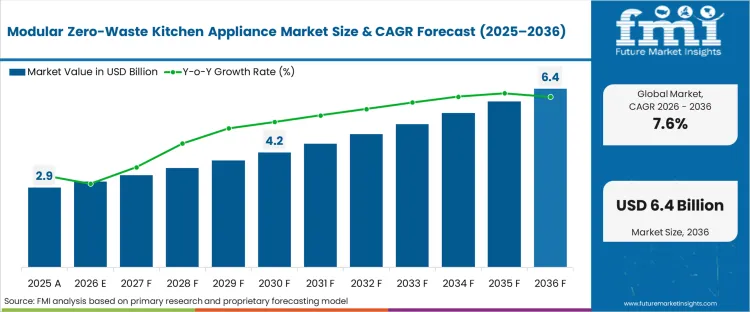
Modular Zero-Waste Kitchen Appliance Market Key Takeaways
| Metric | Details |
|---|---|
| Industry Size (2026) | USD 3.1 billion |
| Industry Value (2036) | USD 6.5 billion |
| CAGR (2026–2036) | 7.6% |
Source: Future Market Insights (FMI) analysis, based on proprietary forecasting model and primary research
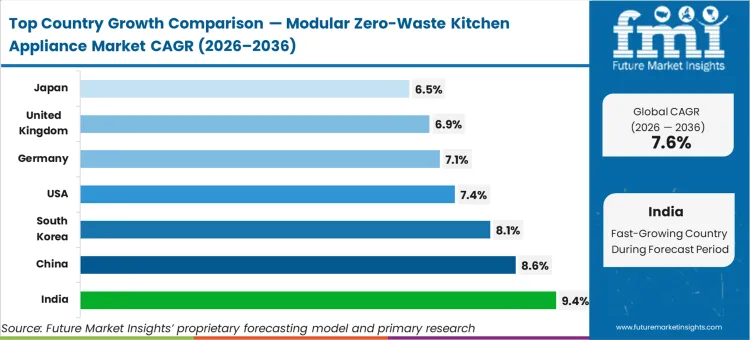
India leads the geographic expansion with a 9.4% CAGR, driven by the rapid transition from traditional wet kitchens to organized modular setups in urban real estate. China follows at 8.6%, reflecting state-sponsored incentives for domestic appliance upgrades. South Korea expands at 8.1%, supported by its highly developed residential organic waste separation requirements. The United States and Germany track at 7.4% and 7.1% respectively, constrained slightly by mature replacement cycles but buoyed by premium remodel activity. The United Kingdom registers 6.9% growth as spatial constraints force the integration of multi-function modules. Japan rounds out the top tier at 6.5%, growing slower purely because compact, highly efficient built-in systems already penetrate its housing stock deeply. The divergence across this range stems directly from whether a country's residential construction sector views these modules as premium upgrades or baseline code requirements.
Modular Zero-Waste Kitchen Appliance Market Definition
These circular built-in kitchen systems encompass residential and light-commercial equipment explicitly designed to fit within standardized architectural cabinetry while actively reducing organic, water, or energy waste. They are dimensionally standardized components, ranging from vacuum-sealing preservation drawers to under-counter composting units, that integrate physically and digitally into a cohesive kitchen ecosystem.
Modular Zero-Waste Kitchen Appliance Market Inclusions
This sector includes under-counter organic waste processors, flush-mount vacuum preservation drawers, integrated water filtration systems, and fully integrated refrigeration units with active spoilage-delay technology. The scope specifically covers sustainable modular kitchen appliances and domestic culinary hardware engineered for flush installation, requiring direct hardwiring or plumbing integration into residential or boutique hospitality environments.
Modular Zero-Waste Kitchen Appliance Market Exclusions
Standalone countertop appliances, freestanding white goods, and centralized building-level waste management systems are excluded. A countertop blender or a freestanding side-by-side refrigerator is excluded because it does not integrate physically into the cabinetry architecture. Commercial restaurant equipment is excluded because its spatial requirements, voltage demands, and maintenance cycles operate on an entirely different procurement logic than residential modular formats.
Modular Zero-Waste Kitchen Appliance Market Research Methodology
- Primary Research: FMI analysts interview residential project developers, kitchen studio procurement directors, and tier-1 appliance OEM product managers to understand specification shifts and installation constraints.
- Desk Research: We aggregate data from architectural hardware dimensional standards, regional residential building codes regarding waste diversion, and corporate sustainability disclosures from major appliance groups.
- Market-Sizing and Forecasting: The baseline anchors to regional residential remodel permits and new-build housing starts, specifically tracking the penetration rate of customized millwork versus standard freestanding appliance footprints.
- Data Validation and Update Cycle: Forecasts are cross-validated against shipment data reported by the Association of Home Appliance Manufacturers and regional equivalents, filtering for integrated SKUs.
Segmental Analysis
Modular Zero-Waste Kitchen Appliance Market Analysis by Product Type
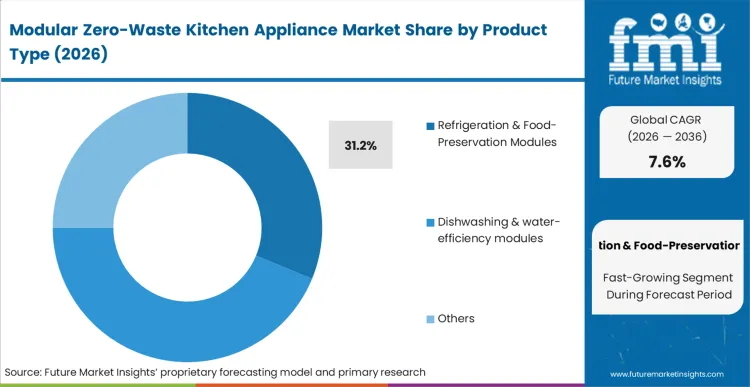
A standard standalone refrigerator no longer satisfies the operational requirements of a household focused on reducing organic waste. FMI analysts opine that consumers readily invest in vacuum-sealing drawers and a modular food preservation appliance because these modules require zero behavioral change; the technology performs the waste reduction passively. This segment allows manufacturers to command a severe premium over standard cooling equipment. Refrigeration & food-preservation modules capture 31.2% of the market in 2026 because they shift the focus from mere cold storage to active spoilage delay. Buyers opting for traditional cold storage immediately face higher grocery attrition rates and rapid organic degradation. The customized chilling environment fundamentally alters how households approach bulk purchasing and meal planning.
- Initial trigger: Homeowners recognize the compounding financial loss of discarded fresh produce during their routine kitchen assessments.
- Validation phase: Buyers evaluate specific module capabilities, prioritizing independent climate zones and vacuum-integration over total cubic capacity.
- Expansion path: Households that successfully integrate preservation modules frequently expand into matching blast-chiller or specialized dry-aging components.
Modular Zero-Waste Kitchen Appliance Market Analysis by Installation Type
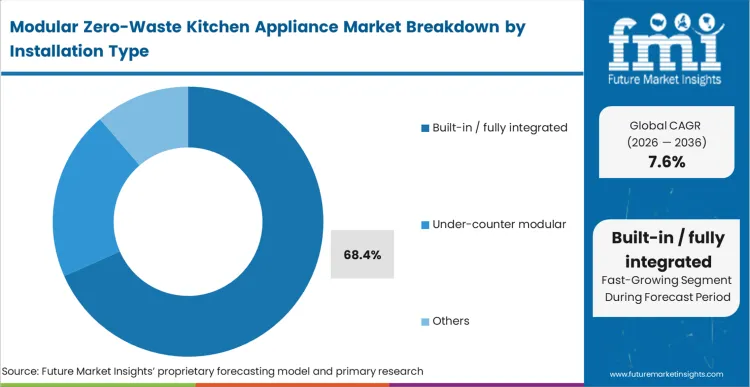
The reality of premium residential real estate mandates that operational utility cannot disrupt visual minimalism, allowing built-in sustainable kitchen appliances segment to secure 68.4% share in 2026. This installation format is not a design preference; it is a rigid specification requirement set by architects and kitchen studios. According to FMI's estimates, OEMs operating in the adjacent built-in kitchen appliance market that fail to offer flush-hinge, panel-ready chassis are completely locked out of the lucrative project sales channel. The engineering complexity of venting an active organic processor inside a sealed wooden box dictates the higher price point. If a developer attempts to value-engineer a project by substituting freestanding units, they immediately degrade the perceived property valuation.
- Capital outlay: The upfront cost sits heavily in the specialized cabinetry modifications and hidden ventilation routing required for safe operation.
- Operational reality: Hidden placement eliminates acoustic disruption and visual clutter in open-plan living environments.
- Lifecycle comparison: Integrated formats outlast freestanding alternatives because they are physically protected by the surrounding architecture, offsetting the higher initial installation expense.
Modular Zero-Waste Kitchen Appliance Market Analysis by End Use
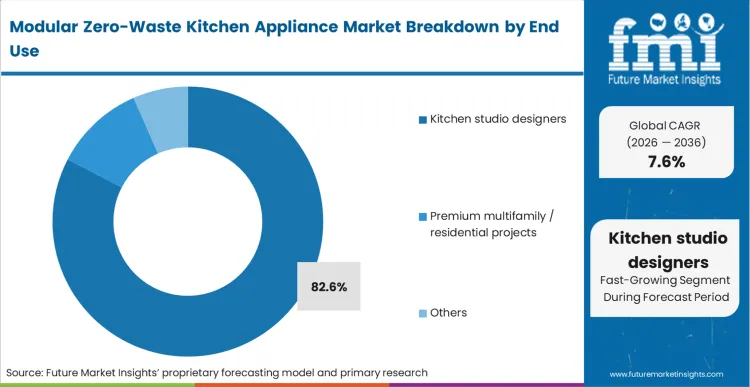
Kitchen studio designers segment account for 82.6% of the market in 2026, by reflecting their central role in determining lower‑cabinet allocation within modular kitchen plans. Their specifications require households to prioritize limited base‑cabinet space between traditional storage and integrated organics processing paired with water‑efficient dishwashing modules, reshaping the workflow of the domestic environment and shifting waste handling into the primary preparation zone. FMI’s projection indicates that modular appliance demand in apartment developments supports sustained volume, as individual homeowners absorb the cost of specialized disposal systems across a typical ten‑year residency. Deferred integration ultimately increases retrofit expense, as plumbing modifications necessitate the removal of premium countertop installations.
- Prevention focus: Integrated processing prevents organic odors and fruit flies from establishing a presence in tightly sealed urban apartments.
- Residual exposure: Homeowners must still manually clear processed compost blocks or maintain grey-water filters, presenting an ongoing maintenance requirement.
- Maximum realization: To extract the full sanitary benefit, the household must commit to strict separation of organics at the point of chopping and preparation.
Modular Zero-Waste Kitchen Appliance Market Analysis by Waste-Reduction Function
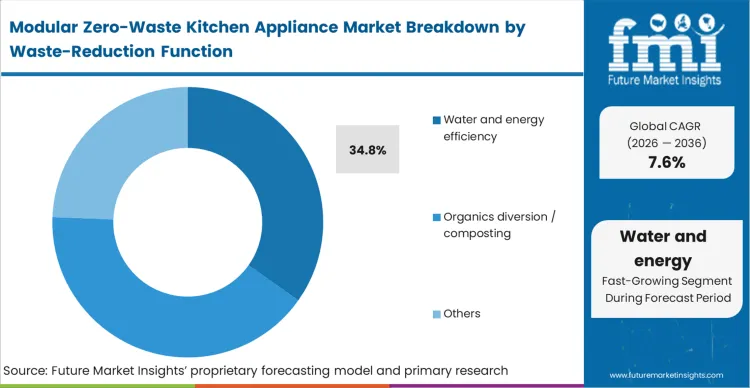
Food‑preservation and spoilage‑reduction capabilities have shifted from premium enhancements to essential cost‑mitigation features as municipal penalties intensify for excessive organic‑bin weight. The function accounts for 34.8% of the market and operates by slowing the degradation cycle, thereby reducing total waste volume and limiting household exposure to escalating food expenses and tariff‑linked disposal costs. FMI attributes the strength of this segment to the perception that preventing spoilage delivers immediate financial value, whereas composting is viewed as an additional household task. Homes that omit active preservation technology increase their susceptibility to rising food prices and progressively stringent municipal waste‑management charges.
- Manufacturing base: Tier-1 refrigeration brands monopolize this space due to the massive R&D required for micro-climate control.
- Component availability: Advanced ethylene scrubbers and specialized vacuum pumps remain constrained by supply-chain bottlenecks in specialized electronics.
- Horizon view: By 2036, passive preservation elements will be entirely standardized, pushing high-end demand toward active, AI-monitored inventory tracking.
Modular Zero-Waste Kitchen Appliance Market Analysis by Sales Channel
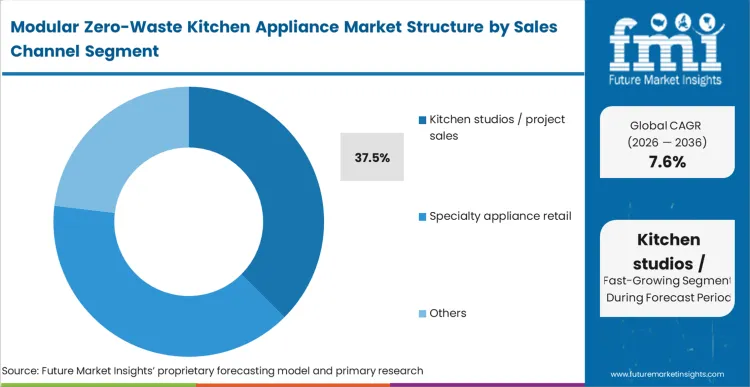
A significant gap persists between products available through online retail and those that can be successfully installed within residential environments, directing 37.5% of sales toward kitchen studios and project‑based channels. These settings function as technical gatekeepers, validating that modular under-counter systems meet precise electrical‑load requirements and plumbing‑clearance constraints. FMI indicates that direct purchases of complex built‑in units from specialty retail frequently generate job‑site delays when cabinet dimensions fail to align with appliance chassis specifications, whereas the studio model mitigates this risk. Buyers attempting to circumvent this channel to reduce margin exposure often incur greater expense through unplanned custom‑carpentry adjustments. Factors contributing to this segment’s share include installation‑risk mitigation, dimensional and load‑compatibility assurance, project‑workflow stability, and reduced remediation costs for end users.
- Baseline threshold: Standard retail channels handle replacement sales where the cabinet void is already established and measured.
- Edge friction: Direct-to-consumer online sales frequently stall during the pre-installation site survey when ventilation requirements are discovered.
- Standardization authority: Kitchen studios dictate the final specification, holding the power to reject any appliance brand that complicates the installation process.
Modular Zero-Waste Kitchen Appliance Market Drivers, Restraints, and Opportunities
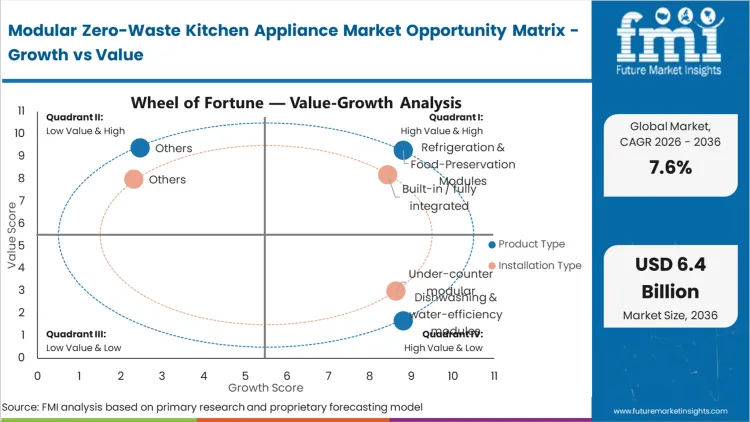
Stringent residential sustainability standards are driving project developers to incorporate food‑waste‑reducing kitchen systems into baseline unit specifications. In premium multifamily properties, reliance on centralized waste infrastructure no longer supports top‑tier ecological ratings, prompting a shift toward in‑unit processing capabilities and positioning panel‑ready under‑counter organics processors and advanced preservation‑oriented refrigeration as mandatory procurement items. Deferred integration weakens overall building positioning and limits access to sustainability‑linked financing incentives.
Simultaneous deployment of multiple active processing systems introduces substantial spatial constraints within standard kitchen footprints. Dehydrating compost units, vacuum‑preservation drawers, and dedicated filtration modules occupy extensive lower‑cabinet volume, displacing core storage capacity in urban environments with fixed square‑footage limits. Manufacturer responses involving combination technologies and reduced‑depth chassis alleviate some pressure, yet these compact configurations frequently reduce total processing capability.
Opportunities in the Modular Zero-Waste Kitchen Appliance Market
- Retrofit compatible chassis: The millions of existing standard 60cm cabinet voids offer a massive installation base. Appliance manufacturers engineering specialized organics processors that perfectly slide into these legacy dimensions without custom carpentry capture the lucrative replacement cycle.
- Subscription maintenance models: The ongoing requirement for specialized filters, enzymatic pods, and vacuum bags creates a recurring revenue stream. Tier-1 OEMs that lock these consumables into automated digital replenishment cycles secure the customer long after the initial hardware sale.
- Builder-grade consolidation: The fragmented nature of specifying individual modules slows down project timelines. Distributors bundling refrigeration, water management, and waste processing into pre-configured, single-SKU architectural pods win volume contracts from developers looking to source from top modular zero-waste kitchen appliance suppliers.
Regional Analysis
.webp "Top Country Growth Comparison Modular Zero Waste Kitchen Appliance Market Cagr (2026 2036)")
Based on the regional analysis, the Modular Zero-Waste Kitchen Appliance Market is segmented into North America, Latin America, Western Europe, Eastern Europe, East Asia, South Asia & Pacific, and the Middle East & Africa across 40 plus countries.
| Country | CAGR (2026 to 2036) |
|---|---|
| India | 9.4% |
| China | 8.6% |
| South Korea | 8.1% |
| United States | 7.4% |
| Germany | 7.1% |
| United Kingdom | 6.9% |
| Japan | 6.5% |
Source: Future Market Insights (FMI) analysis, based on proprietary forecasting model and primary research
Asia Pacific Modular Zero-Waste Kitchen Appliance Market Analysis
The physical transformation of the urban housing stock from traditional layouts to standardized, fitted cabinetry dictates the rapid adoption curve across this region. This is not driven by an ecological awakening, but by the modernization of real estate infrastructure, allowing modular appliances to bypass the freestanding phase entirely. FMI analysts opine that consumers in newly built high-rises are adopting built-in preservation and waste technologies simply because the kitchen studios bundle them seamlessly into the baseline aesthetic. The integration of smart modules becomes a marker of modern domestic functionality.
- India: The modular zero-waste kitchen appliance market in India is projected to witness growth at a CAGR of 9.4%, fueled by a rapid shift toward organized, branded modular kitchen installations in tier-1 urban real estate. Buyers here are leapfrogging traditional freestanding white goods straight into concealed, architecturally flush systems. Domestic developers integrating these zero-waste modules into their premium apartments successfully differentiate their properties in a highly saturated luxury housing market.
- China: Urban households utilize these incentives to replace aging refrigeration with multi-zone, waste-reducing modules. The resulting trajectory points toward a near-total standardization of intelligent, waste-mitigating cabinetry in tier-1 city housing projects. The modular zero-waste kitchen appliance market in China expands at an 8.6% CAGR, relying heavily on state-sponsored incentive programs aimed at upgrading domestic appliance efficiency.
- South Korea: South Korea's strict municipal mandates on organic waste separation and weight-based disposal tariffs make in-home volume reduction a financial necessity. Homeowners must deploy dehydrating or grinding modules to avoid escalating penalty fees for wet waste. FMI estimates the zero-waste appliance sector in South Korea to expand at an annual growth rate of 8.1%. The on-the-ground reality is that these appliances function as essential utility management tools, not optional luxury upgrades.
- Japan: Spatial absolute constraints in Japanese urban housing demand that any new appliance physically replace an existing function rather than add a new footprint. Consumers here rely heavily on highly engineered, under-sink processors that share plumbing runs with compact dishwashers. The Japanese landscape is set to achieve a CAGR of 6.5%, because the market is already highly optimized for space and efficiency. The ceiling for outsized growth is lower, limiting competitive entry for bulky foreign appliance brands.
FMI's report includes market assessments for Australia, New Zealand, and Southeast Asian emerging economies. The penetration of modular systems in these secondary markets closely tracks the expansion footprint of international kitchen hardware franchises and regional cabinet distributors.
North America Modular Zero-Waste Kitchen Appliance Market Analysis
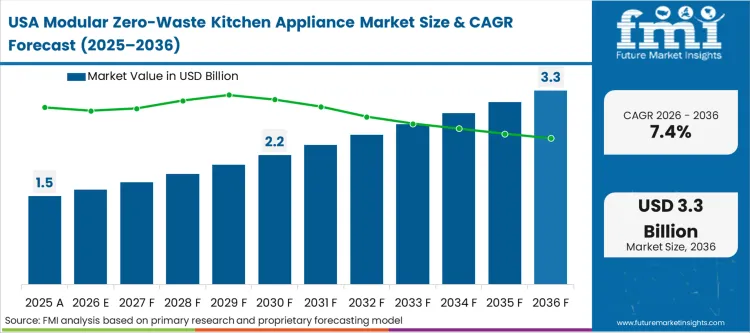
Capital availability and the sheer size of suburban kitchen footprints allow North American consumers to specify highly complex, multi-module setups without sacrificing primary storage. The decision is heavily economics-led, driven by the desire to increase total property valuation through high-end, panel-ready kitchen renovations. According to FMI's estimates, buyers in this region treat organic processors and vacuum sealers as premium aesthetic upgrades rather than functional necessities.
- United States: The dominance of the professional-grade home kitchen aesthetic encourages the installation of dedicated appliance zones, such as secondary prep sinks with integrated compost processors. Homeowners undergoing major remodels willingly specify these modules to match their high-end cooking ranges. Demand for modular systems in the United States is estimated to result in market revenue expansion at a CAGR of 7.4%. Consumers attempting to retrofit these systems without a comprehensive remodel face severe electrical and plumbing routing challenges that inflate installation costs.
FMI's report includes market tracking for Canada. Growth in Canada urban centers mirrors the US trajectory, albeit with a stronger emphasis on energy-efficient module ratings mandated by provincial building codes.
Europe Modular Zero-Waste Kitchen Appliance Market Analysis
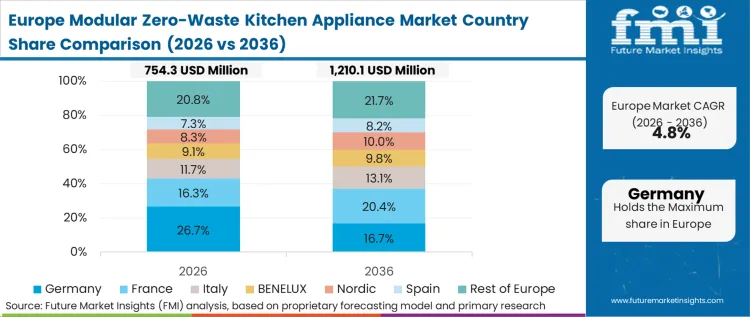
Stringent extended producer responsibility frameworks and municipal waste directives strictly govern how European households process their domestic output. The regulatory environment actively penalizes inefficient waste sorting, pushing the requirement for localized processing back onto the consumer. Based on FMI's assessment, kitchen studios in this region operate under intense pressure to fit these necessary processing capabilities into exceptionally tight historic building envelopes.
- Germany: Germany’s stringent building‑sustainability codes are driving residential developers to adopt appliance‑level energy and water‑management systems as standard specifications. Procurement teams increasingly select water‑recycling dishwashers and high‑efficiency preservation drawers to satisfy certification thresholds, positioning the German modular‑unit segment for a projected 7.1% CAGR. This compliance‑intensive environment restricts market access for lower‑tier manufacturers lacking the required energy‑performance documentation, with regulatory‑driven specification pressure contributing, developer procurement standards, and certification‑documentation requirements of the market influence.
- United Kingdom: The United Kingdom’s constrained residential footprint directs households and kitchen designers toward appliances capable of consolidating multiple waste‑reduction functions within a single 60 cm chassis. Design teams navigate the trade‑off between organic‑diversion systems and essential refrigeration capacity, supporting a forecast 6.9% CAGR for zero‑waste modules market in the country. Successful integration reduces reliance on exterior bins, alleviating logistical challenges common in terraced housing.
FMI's report includes analysis for France, Italy, Spain, and the Nordic region. The Nordic countries represent the leading edge of this transition, where zero-waste modules are already treated as baseline architectural utilities rather than premium additions.
Competitive Aligners for Market Players
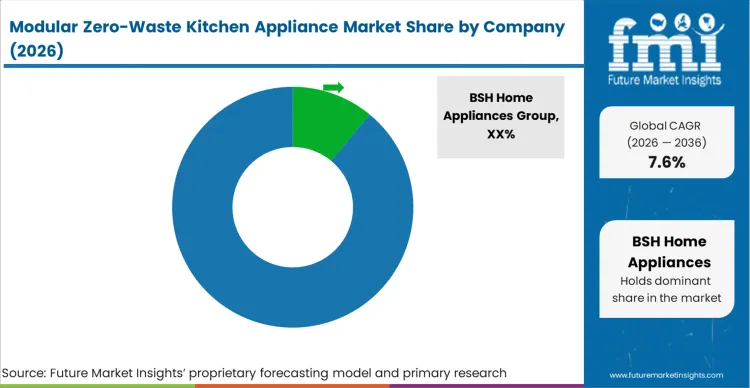
The absolute requirement for flawless physical integration into standard architectural cabinetry dictates the concentrated nature of this space. BSH Home Appliances Group, Samsung Electronics, and Miele dominate because they possess the deep channel relationships with kitchen studios necessary to ensure their dimensional specifications become the default standard. Buyers and specifiers separate qualified from unqualified vendors entirely based on installation tolerance; if an appliance requires a carpenter to alter a standard 60cm void, the studio will drop the brand.
To remain entrenched, major zero-waste kitchen appliance manufacturers like Whirlpool Corporation and Electrolux Group leverage their vast proprietary service networks and standardized part ecosystems. The advantage persists because a built-in appliance is vastly more difficult to service than a freestanding one; studios will not specify a brand that cannot guarantee rapid, in-home technical support. A challenger attempting to break into this circular kitchen appliance market must build a flawless digital integration layer and a rapid-response service infrastructure, not just a superior composting mechanism.
Large property developers actively resist being locked into a single OEM's proprietary module ecosystem, demanding standardized power and plumbing interfaces. This tension defines the trajectory toward 2036: manufacturers want proprietary smart-home lock-in, while builders demand modular interchangeability to protect themselves against supply chain shocks. Consequently, the industry is moving toward a rigid consolidation of exterior dimensions, even as the internal processing technologies fragment and specialize.
Key Players in Modular Zero-Waste Kitchen Appliance Market
- BSH Home Appliances Group
- Samsung Electronics
- Whirlpool Corporation
- Electrolux Group
- Miele
- Fisher & Paykel Appliances
- InSinkErator
Scope of the Report
| Metric | Value |
|---|---|
| Quantitative Units | USD 3.1 billion to USD 6.5 billion, at a CAGR of 7.6% |
| Market Definition | This market tracks integrated, architecturally flush equipment designed to process organic waste, extend food viability, and reduce utility consumption at the point of use within modern kitchen environments. |
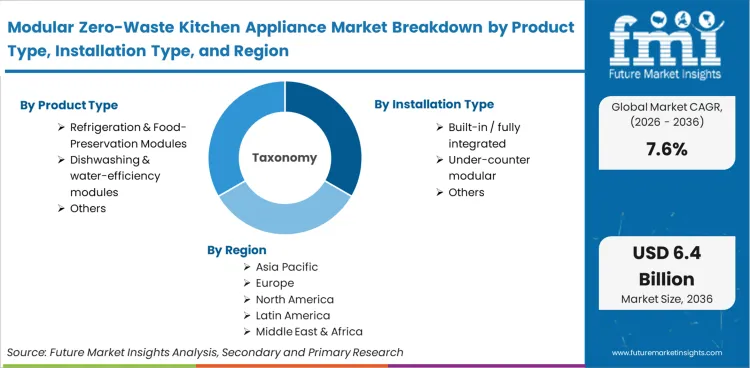
| Product Type Segmentation | Refrigeration & food-preservation modules, Dishwashing & water-efficiency modules, Cooking & induction modules, Food-waste processing modules, Ventilation & air-quality modules |
| Installation Type Segmentation | Built-in / fully integrated, Under-counter modular, Countertop companion units |
| End Use Segmentation | Residential households, Premium multifamily / residential projects, Small commercial / boutique hospitality kitchens |
| Waste-Reduction Function Segmentation | Food preservation & spoilage reduction, Water and energy efficiency, Organics diversion / composting, Repairability and lifespan extension, Refill / dispense / portion control |
| Regions Covered | North America, Latin America, Western Europe, Eastern Europe, East Asia, South Asia & Pacific, Middle East & Africa |
| Countries Covered | India, China, South Korea, United States, Germany, United Kingdom, Japan, and 40 plus countries |
| Key Companies Profiled | BSH Home Appliances Group, Samsung Electronics, Whirlpool Corporation, Electrolux Group, Miele, Fisher & Paykel Appliances, InSinkErator |
| Forecast Period | 2026 to 2036 |
| Approach | Primary interviews were conducted with kitchen studio directors and appliance product managers. The data baseline anchors to premium remodel permits and modular cabinetry penetration rates. Forecasts were cross-validated against regional OEM shipment volumes for integrated product lines. |
Source: Future Market Insights (FMI) analysis, based on proprietary forecasting model and primary research
Modular Zero-Waste Kitchen Appliance Market Analysis by Segments
Product Type:
- Refrigeration & food-preservation modules
- Dishwashing & water-efficiency modules
- Cooking & induction modules
- Food-waste processing modules
- Ventilation & air-quality modules
Installation Type:
- Built-in / fully integrated
- Under-counter modular
- Countertop companion units
End Use:
- Residential households
- Premium multifamily / residential projects
- Small commercial / boutique hospitality kitchens
Waste-Reduction Function:
- Food preservation & spoilage reduction
- Water and energy efficiency
- Organics diversion / composting
- Repairability and lifespan extension
- Refill / dispense / portion control
Sales Channel:
- Kitchen studios / project sales
- Specialty appliance retail
- Direct-to-consumer online
- Builder / developer channel
Region:
- North America
- United States
- Canada
- Europe
- Germany
- United Kingdom
- France
- Italy
- Spain
- Asia Pacific
- China
- Japan
- South Korea
- Taiwan
- Singapore
- Latin America
- Brazil
- Mexico
- Argentina
- Middle East & Africa
- GCC Countries
- South Africa
- Israel
Bibliography
- Clark, Q. M., Kanavikar, D. B., & Donnelly, P. J. (2025, January). Exploring the potential of AI-driven food waste management strategies for household environments. Frontiers in Artificial Intelligence.
- Hagejärd, S., Femenías, P., & Pettersen, I. N. (2025, June). User perspectives on circular value propositions for kitchen furniture and appliances. Circular Economy and Sustainability.
- Mehrotra, A., et al. (2024, November). Zero-waste solutions in hospitality: Technology alignment for sustainable food systems. Journal of Sustainable Tourism.
- Wang, S., Zhang, Y., & Li, H. (2024, January). A user-centric approach to smart food waste reduction systems using sensors and cloud data. Sensors.
- Knorr, D., Khoo, C. S., & Augustin, M. A. (2024, March). From kitchen scraps to delicacies: Food waste valorization in sustainable food systems. Food & Function.
This bibliography is provided for reader reference. The full FMI report contains the complete reference list with primary source documentation.
This Report Addresses
- Market intelligence to support strategic decision making for buyers looking to request quote for sustainable built-in kitchen appliances
- Market size estimation and 10-year revenue forecasts from 2026 to 2036, supported by modular cabinetry penetration tracking
- Growth opportunity mapping across specific installation and product type dimensions, tracking the repairable kitchen appliances market shift
- Segment and regional revenue forecasts covering flush-mount vacuum systems and under-counter dehydrators across high-density urban regulatory environments
- Competition strategy assessment including dimensional standardization, digital integration layers, and rapid-response service infrastructure requirements
- Technology development tracking including the modular induction cooktop market trajectory and ethylene scrubbing systems discussed in this article
- Market access analysis covering premium architectural specifications, kitchen studio qualification hurdles, and municipal waste diversion mandates
- Market report delivery in PDF, Excel, PPT, and interactive dashboard formats for executive strategy, product roadmap planning, and operational benchmarking use
Frequently Asked Questions
what is the market size of modular zero-waste kitchen appliances in 2026?
The valuation reaches USD 3.1 billion in 2026. This signals that integrated waste reduction has successfully transitioned from a niche ecological interest into a highly monetized architectural specification for premium housing.
What will it be valued at by 2036?
It is projected to achieve a valuation of USD 6.5 billion by 2036. This doubling reflects the absolute standardization of these capabilities within the residential replacement cycle, moving beyond luxury upgrades into baseline code compliance.
What CAGR is projected?
A CAGR of 7.6% is forecast through 2036. This rate tracks the speed of premium kitchen remodel cycles and new multi-family starts, rather than generic appliance replacement, as these modules require fundamental cabinetry changes to install.
what are modular zero-waste kitchen appliances?
They are purpose-built, architecturally flush equipment—like under-counter composters and vacuum-seal preservation drawers-designed to process organic waste and reduce utility consumption without disrupting the visual minimalism of a modern kitchen.
how do zero-waste kitchen appliances reduce food waste?
By attacking the timeline of organic degradation passively via multi-zone micro-climate control, or by dehydrating and grinding wet scraps at the point of preparation, preventing the immediate need for municipal disposal.
which appliances are best for a zero-waste kitchen?
The core setup relies heavily on refrigeration modules equipped with advanced ethylene scrubbers to delay spoilage, paired with an integrated under-counter dehydrator to compress unavoidable organic scraps into stable compost blocks.
explain the modular zero-waste kitchen appliance market in simple terms?
It is the business of replacing standalone trash bins and standard white goods with hidden, highly efficient machines built directly into kitchen cabinets, designed specifically to make food last longer and turn scraps into compost automatically.
What is the primary restraint?
The severe spatial conflict beneath the standard kitchen counter stalls adoption. Integrating a dehydrating compost unit and a water purification system directly consumes the physical real estate previously dedicated to essential cookware storage.
Which country grows fastest?
India expands at 9.4%, driven by a massive shift toward organized, branded modular kitchens in tier-1 cities. Compared to Germany's 7.1% rate, which relies on replacing existing built-in units, India is leapfrogging traditional freestanding setups directly into concealed, zero-waste ecosystems.
How do European extended producer responsibility frameworks affect this sector?
These regulatory frameworks penalize inefficient waste sorting at the municipal level, pushing the financial burden onto households. This dynamic forces European homeowners to view under-counter organics processors as essential utility management tools rather than optional luxury upgrades.
modular zero-waste kitchen appliances vs smart kitchen appliances - what is the difference?
The smart kitchen appliances market focuses on digital connectivity, recipe algorithms, and remote control. The zero-waste modular segment strictly focuses on physical flush-mount integration and the actual reduction of organic/water waste, though the two frequently overlap in premium tiers.
composting appliance vs food waste disposer - how do buyers choose?
A traditional disposer grinds waste and flushes it into the municipal sewer, which many modern building codes now prohibit. An integrated composting appliance dehydrates or ferments the organics into a dry, odor-free block, keeping the waste entirely out of the plumbing infrastructure.
repairable appliances vs conventional appliances - why does this matter here?
Because modular units are physically embedded in expensive custom cabinetry, their lifespan must match the millwork. Buyers refuse to specify conventional units that cannot be easily serviced in place, accelerating demand for highly repairable, modular component designs.
How do kitchen studios control market access for appliance brands?
Studios act as technical gatekeepers, prioritizing brands that offer flawless physical integration and panel-ready chassis. If an OEM's under-counter module requires non-standard plumbing routing or complex ventilation cuts, the studio will simply remove that brand from their approved vendor list.
Why do passive preservation modules outsell active composting modules?
Passive systems like ethylene-absorbing crispers require zero behavioral change from the user. Composting modules, while effective, still require the homeowner to actively separate wet waste and manually empty processed blocks, creating an ongoing operational chore.
What role do municipal waste tariffs play in South Korea?
South Korea's weight-based disposal tariffs make in-home volume reduction a financial necessity. The 8.1% CAGR in this country is directly tied to homeowners deploying dehydrating modules to permanently avoid escalating municipal penalty fees for heavy organic waste.
Why are direct-to-consumer online sales structurally limited here?
Online purchases frequently fail during the pre-installation phase when homeowners realize their existing cabinetry lacks the requisite ventilation or electrical load. The complexity of built-in integration heavily favors the kitchen studio channel, which absorbs the site-survey risk.
What competitive advantage do incumbent OEMs hold over challengers?
Tier-1 manufacturers leverage massive proprietary service networks. Because built-in appliances are vastly more difficult to extract and repair than freestanding units, specifiers will strictly avoid challenger brands that cannot guarantee rapid, in-home technical support.
How does urban spatial constraint shape the UK market?
The architectural reality of terraced housing forces consumers to prioritize highly condensed, multi-function chassis. UK designers must carefully specify single units that combine waste reduction with essential storage, limiting the penetration of massive, single-function processors.
Why are countertop appliances excluded from this market scope?
Countertop units do not integrate physically or digitally into the architectural cabinetry. Their procurement logic is entirely different, functioning as discretionary retail purchases rather than complex, hardwired architectural specifications.
What makes the North American adoption pattern distinct?
Driven by abundant capital and larger suburban kitchen footprints, North American buyers specify these modules as premium aesthetic upgrades without sacrificing primary storage. The decision is tied to increasing property valuation rather than solving immediate spatial or regulatory constraints.
How does the builder channel consolidate demand?
Major residential developers refuse to specify fragmented, individual modules. They award volume contracts to distributors that can supply pre-configured, single-SKU architectural pods that combine refrigeration, water management, and waste processing into one rapid-install unit.
What hidden costs emerge in the operational phase?
While the modules reduce waste tariffs, they introduce new recurring expenses. Homeowners must continuously purchase OEM-specific enzymatic pods, carbon filters, and specialized vacuum bags, creating a permanent subscription-like relationship with the manufacturer.
What does the 2036 end-state look like for this sector?
By 2036, discrete waste processing modules will vanish into the background architecture of the home. Much like the dishwasher transitioned from a luxury novelty to a standardized utility, integrated organic diversion and water recycling will become invisible, baseline requirements in all premium housing.
Preview the report firsthand - request a free sample
Get SampleGet the brochure for pricing and purchase details.
Get PDFTable of Content
- Executive Summary
- Global Market Outlook
- Demand-side Trends
- Supply-side Trends
- Technology Roadmap Analysis
- Analysis and Recommendations
- Market Overview
- Market Coverage / Taxonomy
- Market Definition / Scope / Limitations
- Research Methodology
- Chapter Orientation
- Analytical Lens and Working Hypotheses
- Market Structure, Signals, and Trend Drivers
- Benchmarking and Cross-market Comparability
- Market Sizing, Forecasting, and Opportunity Mapping
- Research Design and Evidence Framework
- Desk Research Programme (Secondary Evidence)
- Company Annual and Sustainability Reports
- Peer-reviewed Journals and Academic Literature
- Corporate Websites, Product Literature, and Technical Notes
- Earnings Decks and Investor Briefings
- Statutory Filings and Regulatory Disclosures
- Technical White Papers and Standards Notes
- Trade Journals, Industry Magazines, and Analyst Briefs
- Conference Proceedings, Webinars, and Seminar Materials
- Government Statistics Portals and Public Data Releases
- Press Releases and Reputable Media Coverage
- Specialist Newsletters and Curated Briefings
- Sector Databases and Reference Repositories
- FMI Internal Proprietary Databases and Historical Market Datasets
- Subscription Datasets and Paid Sources
- Social Channels, Communities, and Digital Listening Inputs
- Additional Desk Sources
- Expert Input and Fieldwork (Primary Evidence)
- Primary Modes
- Qualitative Interviews and Expert Elicitation
- Quantitative Surveys and Structured Data Capture
- Blended Approach
- Why Primary Evidence is Used
- Field Techniques
- Interviews
- Surveys
- Focus Groups
- Observational and In-context Research
- Social and Community Interactions
- Stakeholder Universe Engaged
- C-suite Leaders
- Board Members
- Presidents and Vice Presidents
- R&D and Innovation Heads
- Technical Specialists
- Domain Subject-matter Experts
- Scientists
- Physicians and Other Healthcare Professionals
- Governance, Ethics, and Data Stewardship
- Research Ethics
- Data Integrity and Handling
- Primary Modes
- Tooling, Models, and Reference Databases
- Desk Research Programme (Secondary Evidence)
- Data Engineering and Model Build
- Data Acquisition and Ingestion
- Cleaning, Normalisation, and Verification
- Synthesis, Triangulation, and Analysis
- Quality Assurance and Audit Trail
- Market Background
- Market Dynamics
- Drivers
- Restraints
- Opportunity
- Trends
- Scenario Forecast
- Demand in Optimistic Scenario
- Demand in Likely Scenario
- Demand in Conservative Scenario
- Opportunity Map Analysis
- Product Life Cycle Analysis
- Supply Chain Analysis
- Investment Feasibility Matrix
- Value Chain Analysis
- PESTLE and Porter’s Analysis
- Regulatory Landscape
- Regional Parent Market Outlook
- Production and Consumption Statistics
- Import and Export Statistics
- Market Dynamics
- Global Market Analysis 2021 to 2025 and Forecast, 2026 to 2036
- Historical Market Size Value (USD Million) Analysis, 2021 to 2025
- Current and Future Market Size Value (USD Million) Projections, 2026 to 2036
- Y-o-Y Growth Trend Analysis
- Absolute $ Opportunity Analysis
- Global Market Pricing Analysis 2021 to 2025 and Forecast 2026 to 2036
- Global Market Analysis 2021 to 2025 and Forecast 2026 to 2036, By Product Type
- Introduction / Key Findings
- Historical Market Size Value (USD Million) Analysis By Product Type , 2021 to 2025
- Current and Future Market Size Value (USD Million) Analysis and Forecast By Product Type , 2026 to 2036
- Refrigeration & Food-Preservation Modules
- Dishwashing & water-efficiency modules
- Others
- Refrigeration & Food-Preservation Modules
- Y-o-Y Growth Trend Analysis By Product Type , 2021 to 2025
- Absolute $ Opportunity Analysis By Product Type , 2026 to 2036
- Global Market Analysis 2021 to 2025 and Forecast 2026 to 2036, By Installation Type
- Introduction / Key Findings
- Historical Market Size Value (USD Million) Analysis By Installation Type, 2021 to 2025
- Current and Future Market Size Value (USD Million) Analysis and Forecast By Installation Type, 2026 to 2036
- Built-in / fully integrated
- Under-counter modular
- Others
- Built-in / fully integrated
- Y-o-Y Growth Trend Analysis By Installation Type, 2021 to 2025
- Absolute $ Opportunity Analysis By Installation Type, 2026 to 2036
- Global Market Analysis 2021 to 2025 and Forecast 2026 to 2036, By End Use
- Introduction / Key Findings
- Historical Market Size Value (USD Million) Analysis By End Use, 2021 to 2025
- Current and Future Market Size Value (USD Million) Analysis and Forecast By End Use, 2026 to 2036
- Kitchen studio designers
- Premium multifamily / residential projects
- Others
- Kitchen studio designers
- Y-o-Y Growth Trend Analysis By End Use, 2021 to 2025
- Absolute $ Opportunity Analysis By End Use, 2026 to 2036
- Global Market Analysis 2021 to 2025 and Forecast 2026 to 2036, By Waste-Reduction Function
- Introduction / Key Findings
- Historical Market Size Value (USD Million) Analysis By Waste-Reduction Function, 2021 to 2025
- Current and Future Market Size Value (USD Million) Analysis and Forecast By Waste-Reduction Function, 2026 to 2036
- Water and energy efficiency
- Organics diversion / composting
- Others
- Water and energy efficiency
- Y-o-Y Growth Trend Analysis By Waste-Reduction Function, 2021 to 2025
- Absolute $ Opportunity Analysis By Waste-Reduction Function, 2026 to 2036
- Global Market Analysis 2021 to 2025 and Forecast 2026 to 2036, By Sales Channel
- Introduction / Key Findings
- Historical Market Size Value (USD Million) Analysis By Sales Channel, 2021 to 2025
- Current and Future Market Size Value (USD Million) Analysis and Forecast By Sales Channel, 2026 to 2036
- Kitchen studios / project sales
- Specialty appliance retail
- Others
- Kitchen studios / project sales
- Y-o-Y Growth Trend Analysis By Sales Channel, 2021 to 2025
- Absolute $ Opportunity Analysis By Sales Channel, 2026 to 2036
- Global Market Analysis 2021 to 2025 and Forecast 2026 to 2036, By Region
- Introduction
- Historical Market Size Value (USD Million) Analysis By Region, 2021 to 2025
- Current Market Size Value (USD Million) Analysis and Forecast By Region, 2026 to 2036
- North America
- Latin America
- Western Europe
- Eastern Europe
- East Asia
- South Asia and Pacific
- Middle East & Africa
- Market Attractiveness Analysis By Region
- North America Market Analysis 2021 to 2025 and Forecast 2026 to 2036, By Country
- Historical Market Size Value (USD Million) Trend Analysis By Market Taxonomy, 2021 to 2025
- Market Size Value (USD Million) Forecast By Market Taxonomy, 2026 to 2036
- By Country
- USA
- Canada
- Mexico
- By Product Type
- By Installation Type
- By End Use
- By Waste-Reduction Function
- By Sales Channel
- By Country
- Market Attractiveness Analysis
- By Country
- By Product Type
- By Installation Type
- By End Use
- By Waste-Reduction Function
- By Sales Channel
- Key Takeaways
- Latin America Market Analysis 2021 to 2025 and Forecast 2026 to 2036, By Country
- Historical Market Size Value (USD Million) Trend Analysis By Market Taxonomy, 2021 to 2025
- Market Size Value (USD Million) Forecast By Market Taxonomy, 2026 to 2036
- By Country
- Brazil
- Chile
- Rest of Latin America
- By Product Type
- By Installation Type
- By End Use
- By Waste-Reduction Function
- By Sales Channel
- By Country
- Market Attractiveness Analysis
- By Country
- By Product Type
- By Installation Type
- By End Use
- By Waste-Reduction Function
- By Sales Channel
- Key Takeaways
- Western Europe Market Analysis 2021 to 2025 and Forecast 2026 to 2036, By Country
- Historical Market Size Value (USD Million) Trend Analysis By Market Taxonomy, 2021 to 2025
- Market Size Value (USD Million) Forecast By Market Taxonomy, 2026 to 2036
- By Country
- Germany
- UK
- Italy
- Spain
- France
- Nordic
- BENELUX
- Rest of Western Europe
- By Product Type
- By Installation Type
- By End Use
- By Waste-Reduction Function
- By Sales Channel
- By Country
- Market Attractiveness Analysis
- By Country
- By Product Type
- By Installation Type
- By End Use
- By Waste-Reduction Function
- By Sales Channel
- Key Takeaways
- Eastern Europe Market Analysis 2021 to 2025 and Forecast 2026 to 2036, By Country
- Historical Market Size Value (USD Million) Trend Analysis By Market Taxonomy, 2021 to 2025
- Market Size Value (USD Million) Forecast By Market Taxonomy, 2026 to 2036
- By Country
- Russia
- Poland
- Hungary
- Balkan & Baltic
- Rest of Eastern Europe
- By Product Type
- By Installation Type
- By End Use
- By Waste-Reduction Function
- By Sales Channel
- By Country
- Market Attractiveness Analysis
- By Country
- By Product Type
- By Installation Type
- By End Use
- By Waste-Reduction Function
- By Sales Channel
- Key Takeaways
- East Asia Market Analysis 2021 to 2025 and Forecast 2026 to 2036, By Country
- Historical Market Size Value (USD Million) Trend Analysis By Market Taxonomy, 2021 to 2025
- Market Size Value (USD Million) Forecast By Market Taxonomy, 2026 to 2036
- By Country
- China
- Japan
- South Korea
- By Product Type
- By Installation Type
- By End Use
- By Waste-Reduction Function
- By Sales Channel
- By Country
- Market Attractiveness Analysis
- By Country
- By Product Type
- By Installation Type
- By End Use
- By Waste-Reduction Function
- By Sales Channel
- Key Takeaways
- South Asia and Pacific Market Analysis 2021 to 2025 and Forecast 2026 to 2036, By Country
- Historical Market Size Value (USD Million) Trend Analysis By Market Taxonomy, 2021 to 2025
- Market Size Value (USD Million) Forecast By Market Taxonomy, 2026 to 2036
- By Country
- India
- ASEAN
- Australia & New Zealand
- Rest of South Asia and Pacific
- By Product Type
- By Installation Type
- By End Use
- By Waste-Reduction Function
- By Sales Channel
- By Country
- Market Attractiveness Analysis
- By Country
- By Product Type
- By Installation Type
- By End Use
- By Waste-Reduction Function
- By Sales Channel
- Key Takeaways
- Middle East & Africa Market Analysis 2021 to 2025 and Forecast 2026 to 2036, By Country
- Historical Market Size Value (USD Million) Trend Analysis By Market Taxonomy, 2021 to 2025
- Market Size Value (USD Million) Forecast By Market Taxonomy, 2026 to 2036
- By Country
- Kingdom of Saudi Arabia
- Other GCC Countries
- Turkiye
- South Africa
- Other African Union
- Rest of Middle East & Africa
- By Product Type
- By Installation Type
- By End Use
- By Waste-Reduction Function
- By Sales Channel
- By Country
- Market Attractiveness Analysis
- By Country
- By Product Type
- By Installation Type
- By End Use
- By Waste-Reduction Function
- By Sales Channel
- Key Takeaways
- Key Countries Market Analysis
- USA
- Pricing Analysis
- Market Share Analysis, 2025
- By Product Type
- By Installation Type
- By End Use
- By Waste-Reduction Function
- By Sales Channel
- Canada
- Pricing Analysis
- Market Share Analysis, 2025
- By Product Type
- By Installation Type
- By End Use
- By Waste-Reduction Function
- By Sales Channel
- Mexico
- Pricing Analysis
- Market Share Analysis, 2025
- By Product Type
- By Installation Type
- By End Use
- By Waste-Reduction Function
- By Sales Channel
- Brazil
- Pricing Analysis
- Market Share Analysis, 2025
- By Product Type
- By Installation Type
- By End Use
- By Waste-Reduction Function
- By Sales Channel
- Chile
- Pricing Analysis
- Market Share Analysis, 2025
- By Product Type
- By Installation Type
- By End Use
- By Waste-Reduction Function
- By Sales Channel
- Germany
- Pricing Analysis
- Market Share Analysis, 2025
- By Product Type
- By Installation Type
- By End Use
- By Waste-Reduction Function
- By Sales Channel
- UK
- Pricing Analysis
- Market Share Analysis, 2025
- By Product Type
- By Installation Type
- By End Use
- By Waste-Reduction Function
- By Sales Channel
- Italy
- Pricing Analysis
- Market Share Analysis, 2025
- By Product Type
- By Installation Type
- By End Use
- By Waste-Reduction Function
- By Sales Channel
- Spain
- Pricing Analysis
- Market Share Analysis, 2025
- By Product Type
- By Installation Type
- By End Use
- By Waste-Reduction Function
- By Sales Channel
- France
- Pricing Analysis
- Market Share Analysis, 2025
- By Product Type
- By Installation Type
- By End Use
- By Waste-Reduction Function
- By Sales Channel
- India
- Pricing Analysis
- Market Share Analysis, 2025
- By Product Type
- By Installation Type
- By End Use
- By Waste-Reduction Function
- By Sales Channel
- ASEAN
- Pricing Analysis
- Market Share Analysis, 2025
- By Product Type
- By Installation Type
- By End Use
- By Waste-Reduction Function
- By Sales Channel
- Australia & New Zealand
- Pricing Analysis
- Market Share Analysis, 2025
- By Product Type
- By Installation Type
- By End Use
- By Waste-Reduction Function
- By Sales Channel
- China
- Pricing Analysis
- Market Share Analysis, 2025
- By Product Type
- By Installation Type
- By End Use
- By Waste-Reduction Function
- By Sales Channel
- Japan
- Pricing Analysis
- Market Share Analysis, 2025
- By Product Type
- By Installation Type
- By End Use
- By Waste-Reduction Function
- By Sales Channel
- South Korea
- Pricing Analysis
- Market Share Analysis, 2025
- By Product Type
- By Installation Type
- By End Use
- By Waste-Reduction Function
- By Sales Channel
- Russia
- Pricing Analysis
- Market Share Analysis, 2025
- By Product Type
- By Installation Type
- By End Use
- By Waste-Reduction Function
- By Sales Channel
- Poland
- Pricing Analysis
- Market Share Analysis, 2025
- By Product Type
- By Installation Type
- By End Use
- By Waste-Reduction Function
- By Sales Channel
- Hungary
- Pricing Analysis
- Market Share Analysis, 2025
- By Product Type
- By Installation Type
- By End Use
- By Waste-Reduction Function
- By Sales Channel
- Kingdom of Saudi Arabia
- Pricing Analysis
- Market Share Analysis, 2025
- By Product Type
- By Installation Type
- By End Use
- By Waste-Reduction Function
- By Sales Channel
- Turkiye
- Pricing Analysis
- Market Share Analysis, 2025
- By Product Type
- By Installation Type
- By End Use
- By Waste-Reduction Function
- By Sales Channel
- South Africa
- Pricing Analysis
- Market Share Analysis, 2025
- By Product Type
- By Installation Type
- By End Use
- By Waste-Reduction Function
- By Sales Channel
- USA
- Market Structure Analysis
- Competition Dashboard
- Competition Benchmarking
- Market Share Analysis of Top Players
- By Regional
- By Product Type
- By Installation Type
- By End Use
- By Waste-Reduction Function
- By Sales Channel
- Competition Analysis
- Competition Deep Dive
- BSH Home Appliances Group
- Overview
- Product Portfolio
- Profitability by Market Segments (Product/Age /Sales Channel/Region)
- Sales Footprint
- Strategy Overview
- Marketing Strategy
- Product Strategy
- Channel Strategy
- Samsung Electronics
- Whirlpool Corporation
- Electrolux Group
- Miele
- Fisher & Paykel Appliances
- BSH Home Appliances Group
- Competition Deep Dive
- Assumptions & Acronyms Used


