

- Industry Size (2026)
- USD 4.99 Bn
- Forecast (2036)
- USD 11.27 Bn
- CAGR (2026 to 2036)
- 8.4%
Modular Energy Control System Market Size, Market Forecast and Outlook By FMI
In 2025, the modular energy control system market was valued at USD 4.60 billion. Based on Future Market Insights' analysis, demand for modular energy control systems is estimated to grow to USD 4.99 billion in 2026 and USD 11.27 billion by 2036. FMI projects a CAGR of 8.5% during the forecast period. Growth is steady due to grid modernization programs, distributed energy integration, and rising utility-scale deployments, while capital intensity and long procurement cycles in energy infrastructure moderate expansion pace.
Recent modular battery energy storage and control platform launches are accelerating market expansion by reducing deployment timelines, lowering integration complexity, and enabling utilities and commercial operators to scale distributed energy assets in phased investments rather than large upfront installations. In September 2025, Honeywell International Inc. launched the Ionic Modular All-in-One, a compact battery energy storage system designed to deliver scalable capacity from 250 kWh to 5 MWh, integrating advanced controls to support real-time grid stability and energy cost optimization.
Summary of Modular Energy Control System Market
- Market Definition
- Modular energy control systems are scalable hardware and software platforms that manage, automate, and optimize electricity flows across distributed and grid-connected energy assets.
- Demand Drivers
- Rapid utility-scale renewable deployment is increasing the need for integrated control platforms that stabilize variable solar and wind output.
- Commercial and industrial operators are investing in modular control systems to reduce peak demand charges and improve energy cost visibility.
- Grid modernization mandates and resilience funding in major economies are accelerating procurement of automated control and storage-integrated platforms.
- Key Segments Analyzed
- Component: Hardware leads with a 58% share in 2026, driven by demand for controllers, power electronics, and integrated battery management units.
- Application: Utility-scale projects account for a 45% share, reflecting large-format deployments linked to renewable parks and grid services.
- Geography: Asia Pacific represents the fastest-expanding regional cluster, supported by large-scale renewable additions and storage integration mandates.
- Analyst Opinion at FMI
- Nikhil Kaitwade, principal consultant of Industrial Automation at Future Market Insights, opines, ‘CXOs will find that modular energy control platforms are shifting from optional efficiency upgrades to core infrastructure investments tied directly to grid compliance and cost optimization.’
- Strategic Implications/Executive Takeaways
- Prioritize partnerships with battery and inverter manufacturers to secure integrated hardware contracts in utility-scale tenders.
- Develop scalable software architectures that allow phased expansion from pilot to multi-megawatt installations.
- Align product roadmaps with grid code revisions and ancillary service market requirements in target countries.
- Methodology
- Market estimates are derived using a hybrid bottom-up and top-down modeling approach validated against disclosed project capacities.
- Segment shares are cross-verified through company revenue disclosures and procurement data.
- Forecasts are updated in line with renewable capacity additions and announced storage investment pipelines.
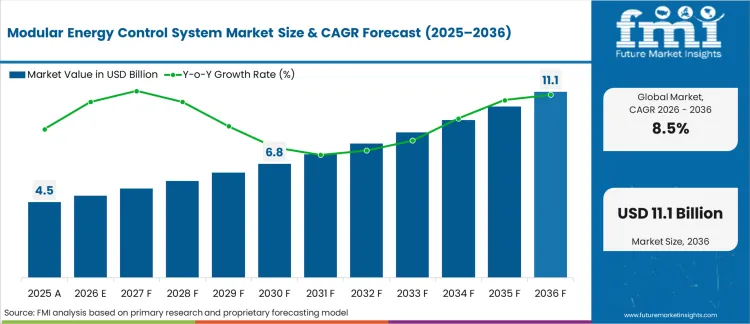
| Metric | Value |
|---|---|
| Estimated Value (2026E) | USD 4.99 billion |
| Forecast Value (2036F) | USD 11.27 billion |
| CAGR (2026 to 2036) | 8.4% |
Source: FMI analysis based on primary research and proprietary forecasting model
Commenting on the strategic relevance of autonomous energy management, Jim Masso, President of Honeywell Process Solutions, stated, "Adopting autonomous solutions can be crucial for companies to manage energy costs, better integrate renewables and ultimately optimize energy consumption. [1]"
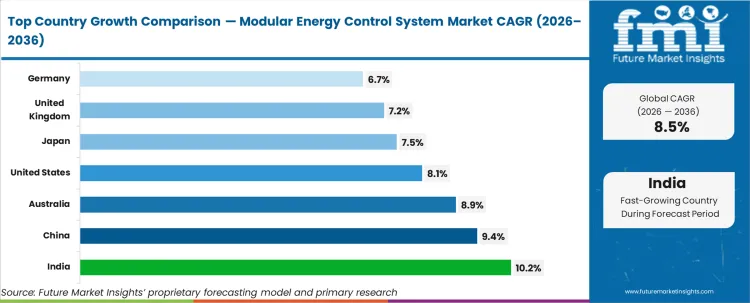
India is projected to register the fastest growth, expanding at a CAGR of 10.2% through 2036, supported by accelerated renewable capacity additions and state-led grid modernization programs. China follows with a CAGR of 9.4%, driven by large-scale battery storage integration across utility-scale solar and wind installations. The United States is expected to grow at a CAGR of 8.1%, underpinned by federal incentives for distributed energy storage and grid resilience upgrades. Germany, along with other mature Western European markets, is forecast to expand at a CAGR of 6.7%, where demand is largely replacement-driven rather than expansion-led; high grid penetration and stringent permitting processes act as structural constraints on rapid capacity additions.
Modular Energy Control System Market Definition
The modular energy control system market covers pre-engineered hardware and software platforms used to monitor, manage, and optimize electricity flows across distributed energy assets. These include controllers, power electronics, sensors, and energy management software assembled in modular units that can be scaled as demand increases. Their primary function is to balance power supply and demand, integrate renewable sources, and maintain grid stability. Key end-uses include utility-scale renewable projects, commercial facilities, and industrial energy management applications.
Modular Energy Control System Market Inclusions
The report covers global and regional market sizing for the modular energy control system market, with forecasts spanning 2026 to 2036 and valuation checkpoints for 2025 and 2026. It provides segment-level analysis by component and application, with regional breakdowns across major economies. The study also assesses pricing and cost trends, value chain dynamics, and trade flows for key hardware elements, alongside an evaluation of procurement models and policy drivers shaping deployment decisions.
Modular Energy Control System Market Exclusions
The scope excludes standalone power generation equipment such as wind turbines, solar photovoltaic modules, and gas generators unless integrated within a modular control architecture. It also omits fully packaged battery manufacturing systems and downstream finished energy products sold to end consumers. The study focuses strictly on modular energy control hardware and associated software platforms used for system-level monitoring, automation, and energy optimization, not broader grid infrastructure construction projects.
Modular Energy Control System Market Research Methodology
- Primary Research: FMI analysts conducted structured interviews with energy storage system integrators, utility procurement managers, power electronics manufacturers, EPC contractors, and grid automation specialists to validate demand patterns and pricing benchmarks.
- Desk Research: Public disclosures such as annual reports, investor presentations, regulatory filings, grid modernization policy documents, and energy capacity statistics from government agencies were reviewed to establish baseline demand and capacity additions.
- Market-Sizing and Forecasting: A hybrid model combining bottom-up aggregation of project-level installations with top-down validation against national energy investment data was used to estimate market size and forecast growth.
- Data Validation and Update Cycle: All estimates were cross-checked against company revenue disclosures and policy rollout timelines, with periodic revisions aligned to major regulatory updates and capital expenditure announcements.
Segmental Analysis
Modular Energy Control System Market Analysis by Component
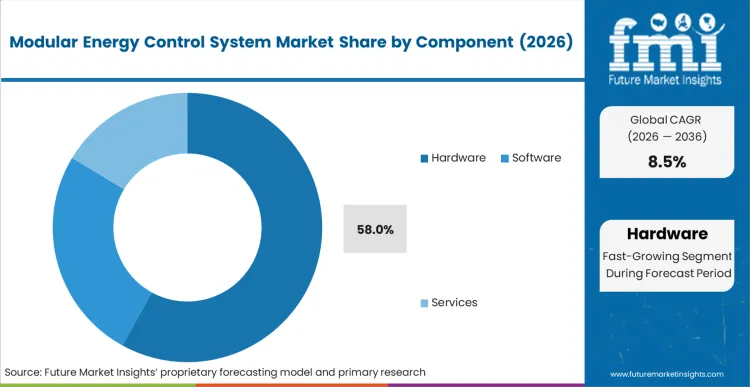
Based on FMI's modular energy control system market report, hardware will hold a 58% share in 2026. Hardware dominates due to its capital-intensive nature, encompassing controllers, inverters, battery management systems, and power conversion units required in every installation. End users prioritize hardware because it directly determines system reliability, grid compliance, and integration capability across renewable and storage assets.
- Capacity Expansion: Siemens expanded its USA electrical equipment manufacturing footprint in 2023 to support grid modernization demand, reinforcing hardware supply depth [2].
- Integrated Platforms: Schneider Electric introduced EcoStruxure-based microgrid control upgrades in 2024 to combine power electronics with advanced monitoring in one architecture [3].
- Grid Procurement Cycles: Utility tenders increasingly bundle hardware with compliance-certified control modules, raising upfront equipment share in total project cost [4].
Modular Energy Control System Market Analysis by Application
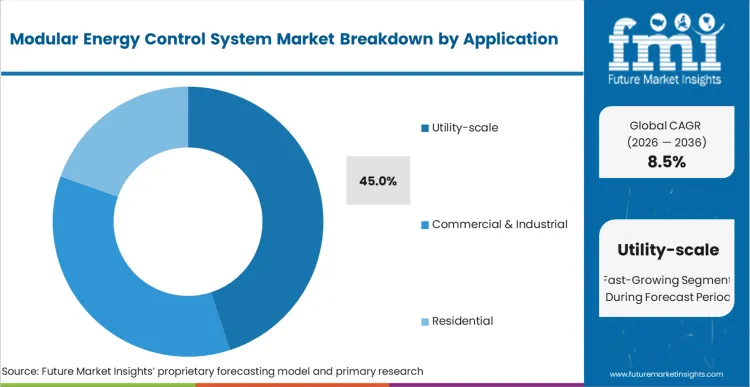
Utility-scale systems are estimated to hold a 45% share in 2026. Utility-scale projects dominate as grid operators require centralized control platforms capable of managing multi-megawatt renewable and storage clusters. These systems address frequency regulation, load balancing, and dispatch coordination at scale.
- Storage Deployment: NextEra Energy reported over 3 GW of battery storage additions in 2023, necessitating advanced utility-grade control integration [5].
- Grid Code Compliance: The European Network of Transmission System Operators updated grid connection requirements in 2023, tightening control and monitoring standards [6].
- Transmission Upgrades: USA Department of Energy grid resilience funding in 2024 allocated capital toward large-scale automation and control integration [7].
Modular Energy Control System Market Drivers, Restraints, and Opportunities
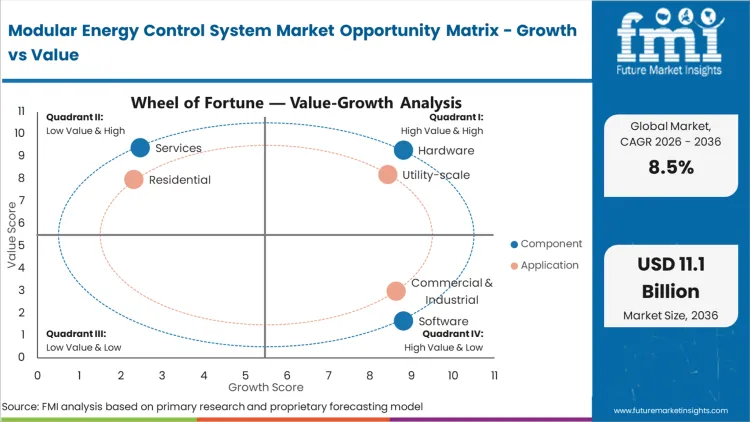
Future Market Insights’ analysis indicates that the modular energy control system market has moved from niche industrial automation use toward grid-integrated infrastructure deployment. Historically, installations were limited to pilot microgrids and industrial load management projects.
FMI analysts observe a structural transition from standalone supervisory control units toward integrated hardware-software platforms embedded within battery energy storage systems and renewable parks. Demand for basic monitoring-only controllers is flattening, particularly in mature industrial facilities.
Growth is concentrated in multi-megawatt utility and commercial storage deployments where advanced control suites command higher per-unit pricing. While next-generation systems carry premium costs, they consolidate hardware, analytics, and grid compliance functions, supporting revenue expansion even when unit volumes scale gradually.
- Grid code tightening: Updated interconnection requirements such as ENTSO-E’s Requirements for Generators and evolving IEEE 1547 standards in the United States are pushing utilities to adopt certified, modular control architectures that ensure frequency response and voltage regulation compliance.
- Utility-scale storage expansion: Rapid battery energy storage deployments in India, China, and the United States are creating demand for scalable control platforms capable of dispatch coordination and load balancing across multi-site installations.
- Capital allocation constraints: In mature European markets, permitting timelines and grid congestion limit rapid expansion, leading operators to prioritize retrofit and optimization projects rather than new greenfield installations.
Regional Analysis
The regional assessment covers India, China, Australia, the United States, Japan, the United Kingdom, and Germany, representing the primary growth engines for renewable integration and grid-edge orchestration. Geographically, the market is segmented into Asia Pacific, North America, and Europe to reflect distinct regulatory frameworks, grid flexibility requirements, and energy storage deployment patterns. The full report provides comparative market attractiveness analysis across these countries and regions.
.webp "Top Country Growth Comparison Modular Energy Control System Market Cagr (2026 2036)")
| Country | CAGR (2026 to 2036) |
|---|---|
| India | 10.2% |
| China | 9.4% |
| Australia | 8.9% |
| United States | 8.1% |
| Japan | 7.5% |
| United Kingdom | 7.2% |
| Germany | 6.7% |
Source: Future Market Insights analysis, supported by a proprietary forecasting model and primary research
Asia Pacific Modular Energy Control System Market Analysis
Asia Pacific is the global scale engine for modular energy control systems, where high renewable build rates and grid flexibility gaps convert pilots into multi-site rollouts. Key players include Huawei Digital Power, which leverages inverter-plus-storage integration, Sungrow Power Supply, known for utility-scale storage control stacks, and Schneider Electric, which competes through standardized microgrid control platforms for C&I and utility operators.
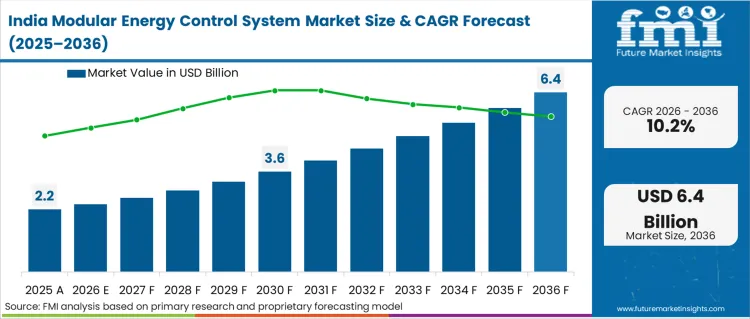
- India: FMI estimates the modular energy control systems market in India to expand at an annual growth rate of 10.2% through 2036. Growth is anchored in policy-led grid flexibility procurement, where storage-linked control platforms become mandatory for dispatch, metering, and performance compliance. In June 2025, the Ministry of Power approved a 30 GWh Viability Gap Funding (VGF) scheme financed through the Power System Development Fund, directly improving project bankability for grid-scale storage and its control layer [8]. India also extended the inter-state transmission charge waiver for energy storage projects until June 2028, improving delivered economics for storage and control deployments that sit behind renewable interconnections [9].
- China: China modular energy control systems sector is poised to expand at a CAGR of 9.4% through 2036. The market is shifting from mandate-driven storage additions toward market mechanisms that reward controllability, response speed, and verified performance. In February 2024, China’s NDRC outlined a flexibility plan that includes expanding pumped hydro and upgrading coal flexibility, alongside building a framework to promote market-driven growth of new energy storage, which raises the value of control and dispatch optimization systems [11].
- Australia: The market for modular energy control systems in Australia is likely to post a CAGR of 8.9% through 2036. Growth is driven by the rapid transition from coal-fired baseload generation to decentralized renewables, necessitating massive utility-scale battery deployments. The integration of distributed energy resources (DER) and virtual power plants (VPPs) relies heavily on these modular control architectures to aggregate residential and commercial storage systems, providing critical grid stability during peak demand events.
- Japan: Sales of modular energy control systems in Japan are on track to record a CAGR of 7.5% through 2036. The nation's distinct vulnerability to natural disasters has positioned energy resilience as a top priority for both the government and the private sector. The Ministry of Economy, Trade and Industry (METI) heavily incentivizes the development of localized microgrids and solar-plus-storage installations, creating a robust demand pipeline for modular control systems that can seamlessly island commercial facilities during grid outages.
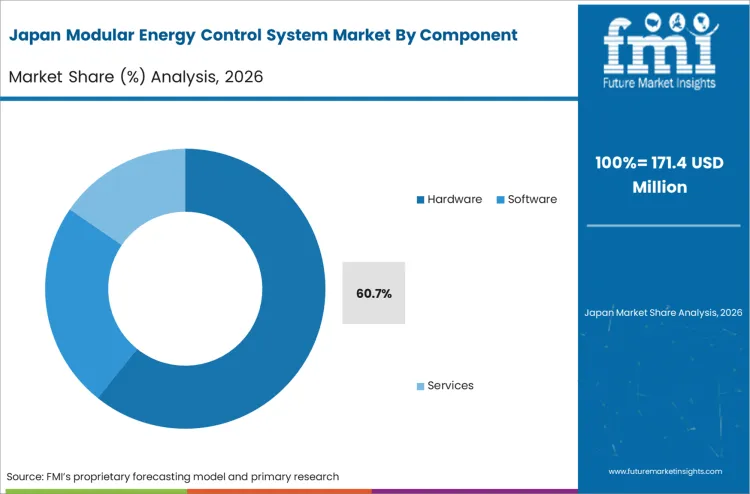
The comprehensive FMI report provides an in-depth analysis of the broader Asia Pacific ecosystem, extending beyond these core markets to identify highly lucrative opportunities in South Korea and Vietnam. South Korea is rapidly expanding its energy storage mandates for public buildings and renewable generation sites, requiring sophisticated, modular control integration to meet national safety and efficiency targets. Vietnam is experiencing a surge in industrial microgrids to combat grid curtailment issues, driving demand for reliable energy orchestration platforms across its sprawling manufacturing zones.
North America Modular Energy Control System Market Analysis
North America is the global proving ground for grid-edge orchestration, where modular control systems link distributed resources to utility reliability requirements. Key players include Honeywell, which positions automation-led storage platforms for C&I users, GE Vernova, which integrates grid automation with utility controls, and Tesla, which pairs utility-scale storage with proprietary control software. Competitive advantage hinges on interconnection compliance and utility-grade cybersecurity readiness.
- United States: Demand for modular energy control systems in the United States is set to grow at a CAGR of 8.1% through 2036. Growth is tied to resilience investment and market access for aggregated distributed resources, both of which require standardized controls, telemetry, and settlement-grade data. On October 18, 2023, the USA Department of Energy announced up to USD 3.46 billion in Grid Resilience and Innovation Partnerships (GRIP) investments spanning 58 projects across 44 states, accelerating deployments where modular automation and control upgrades are embedded in grid hardening and modernization scopes [13]. FERC’s Order No. 2222 is designed to enable aggregated distributed energy resources to participate in organized wholesale markets, increasing demand for control platforms that can manage fleets, enforce operating constraints, and report performance [14].
FMI’s extensive report gets in-depth on the North American landscape by analyzing additional high-potential markets like Canada and Mexico. Canada represents a highly lucrative hub driven by its push to integrate wind and solar assets into its massive legacy hydropower grids, alongside strong government funding for off-grid community microgrids requiring advanced modular control. Mexico is witnessing a steady rise in commercial and industrial (C&I) solar-plus-storage installations, where businesses rely on sophisticated control systems to mitigate severe grid instability and avoid peak demand charges.
Europe Modular Energy Control System Market Analysis
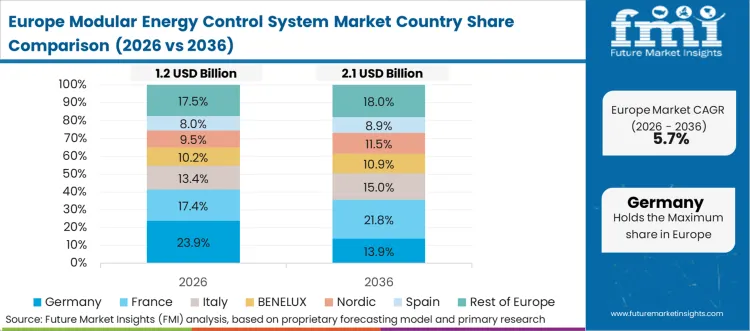
Europe is the regulatory laboratory for modular energy control systems, where grid codes, congestion, and permitting constraints push operators toward performance-led optimization. Key players include Siemens, strong in grid automation hardware, Schneider Electric, positioned in microgrids and energy management software, and ABB, which competes through power electronics and control integration. Differentiation centers on grid-code compliance, digital monitoring, and retrofit-ready architectures.
- United Kingdom: The UK modular energy control systems industry is projected to witness growth at a CAGR of 7.2% through 2036. The UK is a global leader in offshore wind deployment, creating profound grid balancing challenges that are increasingly met through extensive utility-scale battery storage networks. National Grid ESO's advanced suite of frequency response services, such as Dynamic Containment and the Capacity Market, strictly requires ultra-fast, modular control software capable of sub-second response times. This regulatory and market structure highly incentivizes operators to invest in premium control systems that can seamlessly stack revenue streams and maximize the asset lifecycle of grid-connected storage portfolios.
- Germany: Over the forecast period, modular energy control systems in Germany are set for a CAGR of 6.7% through 2036. The market is driven more by integration and retrofit economics than greenfield volume, as operators prioritize controllable solar-plus-storage and congestion-aware dispatch. Germany’s Federal Ministry for Economic Affairs and Climate Action released its electricity storage strategy in December 2023, signaling a national push to remove barriers and accelerate storage integration, which increases the role of standardized control and monitoring platforms [16]. Germany’s innovation auctions increasingly reward hybrid configurations; the federal regulator reported that the innovation auction ending 1 September 2025 awarded 490 MW, and all successful bids were solar installations combined with storage, reinforcing utility-grade control requirements for hybrid performance [17].
FMI report provides an in-depth look at the wider European market, analyzing lucrative hubs outside of Germany and the UK. Italy is rapidly emerging as a critical focal point, where generous government incentives for agrivoltaics and commercial storage are driving the need for decentralized, modular control systems. Spain is recognized as a high-potential hub experiencing a rise in hybrid renewable projects, heavily supported by national mandates to smoothly integrate solar and wind assets into its evolving grid architecture.
Competitive Aligners for Market Players
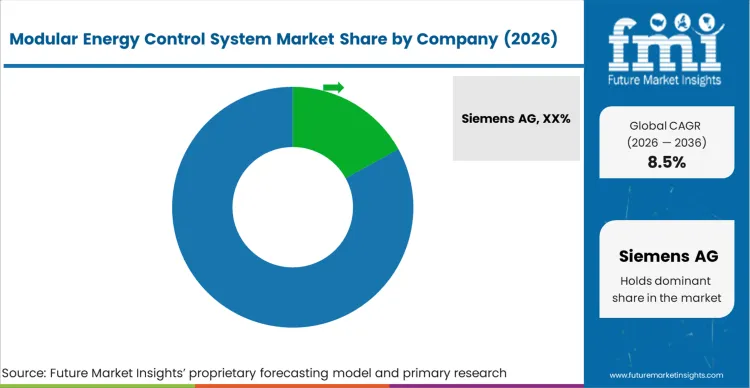
The modular energy control system market is structurally fragmented, with competition split across grid software, automation controls, power electronics, and system integration. No single vendor dominates end-to-end deployments across utility-scale and behind-the-meter projects because buyers procure by function, such as controller hardware, grid software, cybersecurity layer, and commissioning services. The primary competitive variable is interoperability plus compliance, meaning how reliably a platform integrates storage, renewables, and legacy SCADA while meeting grid-code, cybersecurity, and performance verification requirements.
Companies with structural advantages tend to be those that can bundle controls, software, and lifecycle services into bankable project scopes. Large automation and electrification groups benefit from installed base in substations and industrial sites, established utility relationships, and validated libraries for grid-support functions. Their portfolios also reduce integration risk for EPCs by standardizing commissioning workflows, update cycles, and remote diagnostics across multi-site fleets.
Buyer leverage is typically strongest on utility and large C&I programs, where customers run multi-vendor frameworks, stage pilots before fleet rollouts, and require performance guarantees tied to availability and response time. Utilities manage supplier dependency by splitting awards across hardware and software vendors, and by insisting on open interfaces for telemetry and dispatch. This procurement structure limits short-term pricing power on equipment, while shifting margin capture toward commissioning, cybersecurity hardening, and multi-year software and services contracts.
Recent Developments
- In January 2026, ABB launched ReliaHome Flex, a modular energy management system for home electrification, allowing scalable addition of high-demand appliances without service upgrades, managed via app for real-time insights/automations [18].
- In September 2025, Sermatec unveiled the 835kWh Modular Energy Storage System, a scalable (up to 6.68MWh) lithium-based BESS with 1P104S pack architecture, intelligent EMS, liquid cooling, and multi-scenario applications (e.g., time-shift, frequency regulation) [19].
Key Players Profiled
- Siemens AG
- Schneider Electric SE
- ABB Ltd.
- Honeywell International Inc.
- Emerson Electric Co.
- Rockwell Automation, Inc.
- Mitsubishi Electric Corporation
- General Electric Company
- Eaton Corporation
- Hitachi Energy Ltd.
- Toshiba Corporation
- Fuji Electric Co., Ltd.
- S&C Electric Company
- Schweitzer Engineering Laboratories, Inc.
- Woodward, Inc.
Scope of the Report
| Metric | Value |
|---|---|
| Quantitative Units | USD 4.99 billion (2026) to USD 11.27 billion (2036), at a CAGR of 8.4%, with 2025 historic value of USD 4.60 billion |
| Market Definition | The modular energy control system market comprises the global development, deployment, and maintenance of scalable, standardized hardware and software platforms for monitoring, controlling, and optimizing energy generation, storage, and consumption assets. |
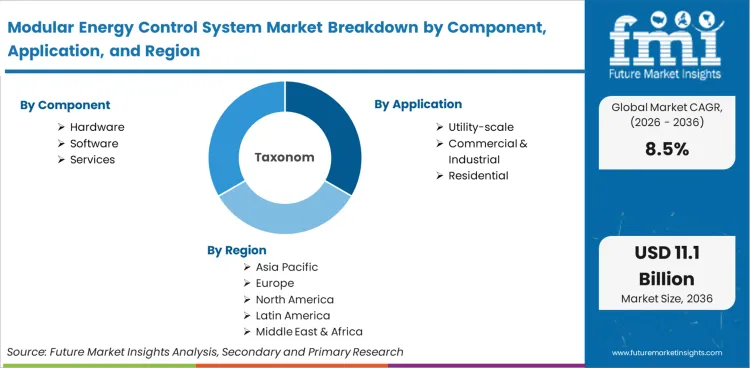
| Component Segmentation | Hardware, Software, Services |
| Application Segmentation | Utility-Scale, Commercial & Industrial, Residential |
| Regions Covered | North America, Latin America, Europe, Asia Pacific, Middle East & Africa |
| Countries Covered | United States, Canada, Mexico, Brazil, Germany, France, United Kingdom, Italy, Spain, China, India, Japan, South Korea, Australia, and 40 plus countries |
| Key Companies Profiled | Siemens, Schneider Electric, ABB, Honeywell, Emerson, Rockwell Automation, Mitsubishi Electric, GE, Eaton, Hitachi Energy, Toshiba, Fuji Electric, S&C Electric, Schweitzer Engineering, Woodward |
| Forecast Period | 2026 to 2036 |
| Approach | Hybrid top-down and bottom-up market modeling validated through primary interviews with energy system integrators, project developers, and facility managers, supported by deployment data benchmarking and end-use industry analysis |
Modular Energy Control System Market Analysis by Segments
Component:
- Hardware
- Software
- Services
Application:
- Utility-Scale
- Commercial & Industrial
- Residential
Region:
- North America
- Latin America
- Europe
- Asia Pacific
- Middle East & Africa
Bibliography
- [1] Honeywell. (2025, September 10). Honeywell introduces all-in-one battery energy storage automation platform [Press release].
- [2] Siemens AG, USA manufacturing expansion announcement, October 2023.
- [3] Schneider Electric, EcoStruxure Microgrid Solution update, March 2024.
- [4] International Energy Agency (IEA), Electricity Grids and Secure Energy Transitions Report, 2023.
- [5] NextEra Energy, Annual Report 2023, February 2024.
- [6] ENTSO-E, Requirements for Generators Update, June 2023.
- [7] USA Department of Energy, Grid Resilience and Innovation Partnerships Program Announcement, 2024.
- [8] Government of India, Ministry of Power (PIB). Government Takes Multi-Pronged Steps to Scale Up Battery Energy Storage Systems. February 2026.
- [9] Reuters. India extends transmission charge waiver for energy storage projects until June 2028. June 10, 2025.
- [10] Government of India, Ministry of Power. Guidelines for Procurement and Utilization of Battery Energy Storage Systems… along with Ancillary Services (Resolution / PDF). March 10-11, 2022.
- [11] Reuters. China to build hydro and gas, upgrade coal fleet for a more flexible power system. February 27, 2024.
- [12] China Energy Storage Alliance (CNESA) (English site). NDRC and NEA jointly issued notice on improving generation-side capacity pricing mechanism (summary of Jan 30, 2026 action). February 2, 2026.
- [13] USA Department of Energy (Grid Deployment Office). Grid Resilience and Innovation Partnerships (GRIP) Program (Oct 18, 2023 announcement summary).
- [14] USA Federal Energy Regulatory Commission (FERC). Order No. 2222 Explainer: Facilitating Participation in Electricity Markets by Distributed Energy Resources.
- [15] IEEE Standards Association / IEEE SCC21. IEEE Std 1547-2018 overview (interconnection and interoperability requirements for DERs).
- [16] Bundesministerium für Wirtschaft und Klimaschutz (BMWK). Stromspeicher-Strategie (PDF / download page). December 2023.
- [17] Bundesnetzagentur / Federal Network Agency (Germany). Innovation auction that ended on 1 September 2025 (press release, October 8, 2025).
- [18] ABB. (2026, January 13). ABB introduces ReliaHome Flex: Modular energy management for smarter home electrification [Press release].
- [19] Sermatec. (2025, September 11). Sermatec unveils 835kWh modular energy storage system: Scalable, reliable and grid-ready.
This bibliography is provided for reader reference and is not exhaustive. The full report contains the complete reference list and detailed citations.
This Report Addresses
- Market intelligence to enable structured strategic decision-making across mature and emerging modular energy control system markets.
- Market size estimation and 10-year revenue forecasts from 2026 to 2036, supported by validated renewable energy installation and building construction benchmarks.
- Growth opportunity mapping across components and applications with emphasis on utility-scale renewable integration and EV charging infrastructure.
- Segment and regional revenue forecasts covering utility-scale, commercial and industrial, and residential applications.
- Competition strategy assessment including hardware platform capability, software functionality, and system integration partnerships.
- Regulatory impact analysis covering grid interconnection standards, cybersecurity requirements, and renewable energy policies.
- Market report delivery in PDF, Excel, PPT, and interactive dashboard formats for executive and operational use.
Frequently Asked Questions
How large is the modular energy control system market in 2025?
In 2025, the modular energy control system market was valued at USD 4.60 billion.
What will the market size be in 2026?
Demand is estimated to reach USD 4.99 billion in 2026 based on Future Market Insights' analysis.
What is the projected market size by 2036?
The market is forecast to reach USD 11.27 billion by 2036.
What is the expected CAGR for the market during the forecast period?
FMI projects a CAGR of 8.5% during the forecast period from 2026 to 2036.
How much absolute growth will the market add by 2036?
The market is expected to expand from USD 4.60 billion in 2025 to USD 11.27 billion by 2036, adding USD 6.67 billion in absolute terms.
Is the market expansion incremental or transformational?
With growth from USD 4.60 billion in 2025 to USD 11.27 billion by 2036 at an 8.5% CAGR, expansion is transformational rather than incremental.
Which component segment is poised to lead the market?
Hardware is expected to lead, accounting for approximately 58% share in 2026.
How significant is the utility-scale application segment?
Utility-scale applications are estimated to hold around 45% share in 2026, making it the dominant application segment.
How fast is the Indian market expected to grow?
India is projected to grow at a CAGR of 10.2% through 2036.
What is the expected growth rate in China?
China is forecast to expand at a CAGR of 9.4% through 2036.
How does the United States compare in terms of growth?
The United States is expected to register a CAGR of 8.1% through 2036.
What is the projected growth rate in Germany?
Germany is forecast to grow at a CAGR of 6.7% through 2036.
What is the market size difference between 2026 and 2036?
The market is expected to grow from USD 4.99 billion in 2026 to USD 11.27 billion by 2036.
What drives revenue growth over the forecast period?
Revenue growth from USD 4.60 billion in 2025 to USD 11.27 billion by 2036, at an 8.5% CAGR, is supported by increased deployment across utility-scale and commercial applications.
What does the forecast indicate about long-term market potential?
The projected rise from USD 4.60 billion in 2025 to USD 11.27 billion by 2036 reflects sustained expansion at an 8.5% CAGR over the forecast period.
Preview the report firsthand - request a free sample
Get SampleGet the brochure for pricing and purchase details.
Get PDFTable of Content
- Executive Summary
- Global Market Outlook
- Demand-side Trends
- Supply-side Trends
- Technology Roadmap Analysis
- Analysis and Recommendations
- Market Overview
- Market Coverage / Taxonomy
- Market Definition / Scope / Limitations
- Research Methodology
- Chapter Orientation
- Analytical Lens and Working Hypotheses
- Market Structure, Signals, and Trend Drivers
- Benchmarking and Cross-market Comparability
- Market Sizing, Forecasting, and Opportunity Mapping
- Research Design and Evidence Framework
- Desk Research Programme (Secondary Evidence)
- Company Annual and Sustainability Reports
- Peer-reviewed Journals and Academic Literature
- Corporate Websites, Product Literature, and Technical Notes
- Earnings Decks and Investor Briefings
- Statutory Filings and Regulatory Disclosures
- Technical White Papers and Standards Notes
- Trade Journals, Industry Magazines, and Analyst Briefs
- Conference Proceedings, Webinars, and Seminar Materials
- Government Statistics Portals and Public Data Releases
- Press Releases and Reputable Media Coverage
- Specialist Newsletters and Curated Briefings
- Sector Databases and Reference Repositories
- FMI Internal Proprietary Databases and Historical Market Datasets
- Subscription Datasets and Paid Sources
- Social Channels, Communities, and Digital Listening Inputs
- Additional Desk Sources
- Expert Input and Fieldwork (Primary Evidence)
- Primary Modes
- Qualitative Interviews and Expert Elicitation
- Quantitative Surveys and Structured Data Capture
- Blended Approach
- Why Primary Evidence is Used
- Field Techniques
- Interviews
- Surveys
- Focus Groups
- Observational and In-context Research
- Social and Community Interactions
- Stakeholder Universe Engaged
- C-suite Leaders
- Board Members
- Presidents and Vice Presidents
- R&D and Innovation Heads
- Technical Specialists
- Domain Subject-matter Experts
- Scientists
- Physicians and Other Healthcare Professionals
- Governance, Ethics, and Data Stewardship
- Research Ethics
- Data Integrity and Handling
- Primary Modes
- Tooling, Models, and Reference Databases
- Desk Research Programme (Secondary Evidence)
- Data Engineering and Model Build
- Data Acquisition and Ingestion
- Cleaning, Normalisation, and Verification
- Synthesis, Triangulation, and Analysis
- Quality Assurance and Audit Trail
- Market Background
- Market Dynamics
- Drivers
- Restraints
- Opportunity
- Trends
- Scenario Forecast
- Demand in Optimistic Scenario
- Demand in Likely Scenario
- Demand in Conservative Scenario
- Opportunity Map Analysis
- Product Life Cycle Analysis
- Supply Chain Analysis
- Investment Feasibility Matrix
- Value Chain Analysis
- PESTLE and Porter’s Analysis
- Regulatory Landscape
- Regional Parent Market Outlook
- Production and Consumption Statistics
- Import and Export Statistics
- Market Dynamics
- Global Market Analysis 2021 to 2025 and Forecast, 2026 to 2036
- Historical Market Size Value (USD Million) Analysis, 2021 to 2025
- Current and Future Market Size Value (USD Million) Projections, 2026 to 2036
- Y-o-Y Growth Trend Analysis
- Absolute $ Opportunity Analysis
- Global Market Pricing Analysis 2021 to 2025 and Forecast 2026 to 2036
- Global Market Analysis 2021 to 2025 and Forecast 2026 to 2036, By Component
- Introduction / Key Findings
- Historical Market Size Value (USD Million) Analysis By Component , 2021 to 2025
- Current and Future Market Size Value (USD Million) Analysis and Forecast By Component , 2026 to 2036
- Hardware
- Software
- Services
- Hardware
- Y-o-Y Growth Trend Analysis By Component , 2021 to 2025
- Absolute $ Opportunity Analysis By Component , 2026 to 2036
- Global Market Analysis 2021 to 2025 and Forecast 2026 to 2036, By Application
- Introduction / Key Findings
- Historical Market Size Value (USD Million) Analysis By Application, 2021 to 2025
- Current and Future Market Size Value (USD Million) Analysis and Forecast By Application, 2026 to 2036
- Utility-scale
- Commercial & Industrial
- Residential
- Utility-scale
- Y-o-Y Growth Trend Analysis By Application, 2021 to 2025
- Absolute $ Opportunity Analysis By Application, 2026 to 2036
- Global Market Analysis 2021 to 2025 and Forecast 2026 to 2036, By Region
- Introduction
- Historical Market Size Value (USD Million) Analysis By Region, 2021 to 2025
- Current Market Size Value (USD Million) Analysis and Forecast By Region, 2026 to 2036
- North America
- Latin America
- Western Europe
- Eastern Europe
- East Asia
- South Asia and Pacific
- Middle East & Africa
- Market Attractiveness Analysis By Region
- North America Market Analysis 2021 to 2025 and Forecast 2026 to 2036, By Country
- Historical Market Size Value (USD Million) Trend Analysis By Market Taxonomy, 2021 to 2025
- Market Size Value (USD Million) Forecast By Market Taxonomy, 2026 to 2036
- By Country
- USA
- Canada
- Mexico
- By Component
- By Application
- By Country
- Market Attractiveness Analysis
- By Country
- By Component
- By Application
- Key Takeaways
- Latin America Market Analysis 2021 to 2025 and Forecast 2026 to 2036, By Country
- Historical Market Size Value (USD Million) Trend Analysis By Market Taxonomy, 2021 to 2025
- Market Size Value (USD Million) Forecast By Market Taxonomy, 2026 to 2036
- By Country
- Brazil
- Chile
- Rest of Latin America
- By Component
- By Application
- By Country
- Market Attractiveness Analysis
- By Country
- By Component
- By Application
- Key Takeaways
- Western Europe Market Analysis 2021 to 2025 and Forecast 2026 to 2036, By Country
- Historical Market Size Value (USD Million) Trend Analysis By Market Taxonomy, 2021 to 2025
- Market Size Value (USD Million) Forecast By Market Taxonomy, 2026 to 2036
- By Country
- Germany
- UK
- Italy
- Spain
- France
- Nordic
- BENELUX
- Rest of Western Europe
- By Component
- By Application
- By Country
- Market Attractiveness Analysis
- By Country
- By Component
- By Application
- Key Takeaways
- Eastern Europe Market Analysis 2021 to 2025 and Forecast 2026 to 2036, By Country
- Historical Market Size Value (USD Million) Trend Analysis By Market Taxonomy, 2021 to 2025
- Market Size Value (USD Million) Forecast By Market Taxonomy, 2026 to 2036
- By Country
- Russia
- Poland
- Hungary
- Balkan & Baltic
- Rest of Eastern Europe
- By Component
- By Application
- By Country
- Market Attractiveness Analysis
- By Country
- By Component
- By Application
- Key Takeaways
- East Asia Market Analysis 2021 to 2025 and Forecast 2026 to 2036, By Country
- Historical Market Size Value (USD Million) Trend Analysis By Market Taxonomy, 2021 to 2025
- Market Size Value (USD Million) Forecast By Market Taxonomy, 2026 to 2036
- By Country
- China
- Japan
- South Korea
- By Component
- By Application
- By Country
- Market Attractiveness Analysis
- By Country
- By Component
- By Application
- Key Takeaways
- South Asia and Pacific Market Analysis 2021 to 2025 and Forecast 2026 to 2036, By Country
- Historical Market Size Value (USD Million) Trend Analysis By Market Taxonomy, 2021 to 2025
- Market Size Value (USD Million) Forecast By Market Taxonomy, 2026 to 2036
- By Country
- India
- ASEAN
- Australia & New Zealand
- Rest of South Asia and Pacific
- By Component
- By Application
- By Country
- Market Attractiveness Analysis
- By Country
- By Component
- By Application
- Key Takeaways
- Middle East & Africa Market Analysis 2021 to 2025 and Forecast 2026 to 2036, By Country
- Historical Market Size Value (USD Million) Trend Analysis By Market Taxonomy, 2021 to 2025
- Market Size Value (USD Million) Forecast By Market Taxonomy, 2026 to 2036
- By Country
- Kingdom of Saudi Arabia
- Other GCC Countries
- Turkiye
- South Africa
- Other African Union
- Rest of Middle East & Africa
- By Component
- By Application
- By Country
- Market Attractiveness Analysis
- By Country
- By Component
- By Application
- Key Takeaways
- Key Countries Market Analysis
- USA
- Pricing Analysis
- Market Share Analysis, 2025
- By Component
- By Application
- Canada
- Pricing Analysis
- Market Share Analysis, 2025
- By Component
- By Application
- Mexico
- Pricing Analysis
- Market Share Analysis, 2025
- By Component
- By Application
- Brazil
- Pricing Analysis
- Market Share Analysis, 2025
- By Component
- By Application
- Chile
- Pricing Analysis
- Market Share Analysis, 2025
- By Component
- By Application
- Germany
- Pricing Analysis
- Market Share Analysis, 2025
- By Component
- By Application
- UK
- Pricing Analysis
- Market Share Analysis, 2025
- By Component
- By Application
- Italy
- Pricing Analysis
- Market Share Analysis, 2025
- By Component
- By Application
- Spain
- Pricing Analysis
- Market Share Analysis, 2025
- By Component
- By Application
- France
- Pricing Analysis
- Market Share Analysis, 2025
- By Component
- By Application
- India
- Pricing Analysis
- Market Share Analysis, 2025
- By Component
- By Application
- ASEAN
- Pricing Analysis
- Market Share Analysis, 2025
- By Component
- By Application
- Australia & New Zealand
- Pricing Analysis
- Market Share Analysis, 2025
- By Component
- By Application
- China
- Pricing Analysis
- Market Share Analysis, 2025
- By Component
- By Application
- Japan
- Pricing Analysis
- Market Share Analysis, 2025
- By Component
- By Application
- South Korea
- Pricing Analysis
- Market Share Analysis, 2025
- By Component
- By Application
- Russia
- Pricing Analysis
- Market Share Analysis, 2025
- By Component
- By Application
- Poland
- Pricing Analysis
- Market Share Analysis, 2025
- By Component
- By Application
- Hungary
- Pricing Analysis
- Market Share Analysis, 2025
- By Component
- By Application
- Kingdom of Saudi Arabia
- Pricing Analysis
- Market Share Analysis, 2025
- By Component
- By Application
- Turkiye
- Pricing Analysis
- Market Share Analysis, 2025
- By Component
- By Application
- South Africa
- Pricing Analysis
- Market Share Analysis, 2025
- By Component
- By Application
- USA
- Market Structure Analysis
- Competition Dashboard
- Competition Benchmarking
- Market Share Analysis of Top Players
- By Regional
- By Component
- By Application
- Competition Analysis
- Competition Deep Dive
- Siemens AG
- Overview
- Product Portfolio
- Profitability by Market Segments (Product/Age /Sales Channel/Region)
- Sales Footprint
- Strategy Overview
- Marketing Strategy
- Product Strategy
- Channel Strategy
- Schneider Electric SE
- ABB Ltd.
- Honeywell International Inc.
- Emerson Electric Co.
- Rockwell Automation, Inc.
- Mitsubishi Electric Corporation
- Siemens AG
- Competition Deep Dive
- Assumptions & Acronyms Used


