

- Industry Size (2026)
- USD 410.0 Mn
- Forecast (2036)
- USD 755.3 Mn
- CAGR (2026 to 2036)
- 6.30%
Decoking Control System Market Forecast and Outlook 2026 to 2036
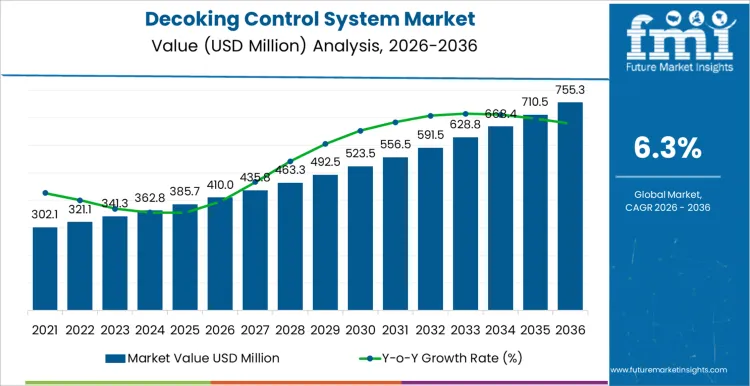
The decoking control system market is expected to expand from USD 410.0 million in 2026 to USD 755.3 million by 2036, progressing at a CAGR of 6.30%. Procurement behavior in this market is being shaped by a strong preference for risk containment rather than incremental performance gains. Purchasing decisions are typically governed by refinery safety committees and EPC specifications, where proven reliability and prior site references are weighted more heavily than cost competitiveness. Vendor shortlists are often restricted to suppliers with established installations in delayed coking units, reinforcing conservative buying patterns.
Switching costs are elevated by deep integration with distributed control systems, safety logic solvers, and operator training frameworks, making mid-cycle replacement unattractive. As a result, long-term vendor lock-in is reinforced once a control architecture is standardized across furnaces or units. Retrofit projects are evaluated cautiously, with extensive factory and site acceptance testing used to mitigate operational disruption risk. Budget approvals are influenced by lifecycle assurance, cybersecurity alignment, and local service capability rather than upfront pricing.
Quick Stats for Decoking Control System Market
- Decoking Control System Market Value (2026): USD 410.0 Million
- Decoking Control System Market Forecast Value (2036): USD 755.3 Million
- Decoking Control System Market Forecast CAGR 2026 to 2036: 6.30%
- Leading Deployment in Decoking Control System Market: Refinery Furnace Decoking (54% share)
- Key Growth Regions in Decoking Control System Market: Asia Pacific, Middle East & Africa, Europe, North America, Latin America
- Top Key Players in Decoking Control System Market: Honeywell, Emerson, Yokogawa, ABB, Siemens, Schneider Electric, Rockwell Automation, KBC (Yokogawa), L&T Technology Services
Decoking Control System Market Key Takeaways
| Metric | Value |
|---|---|
| Decoking Control System Market Value (2026) | USD 410.0 Million |
| Decoking Control System Market Forecast Value (2036) | USD 755.3 Million |
| Decoking Control System Market Forecast CAGR 2026 to 2036 | 6.30% |
How Are Refinery Safety Mandates and Cycle Optimization Driving the Decoking Control System Market?
The decoking control system market is expanding as refineries prioritize safer, more predictable operation of delayed coking units. Decoking is one of the most hazardous and operationally sensitive processes in a refinery, involving high pressures, temperatures, and abrasive coke removal. Advanced control systems are increasingly deployed to automate valve sequencing, monitor real-time pressure and temperature profiles, and prevent operator-dependent errors. For automation vendors and system integrators, demand is closely tied to risk reduction and regulatory compliance rather than discretionary efficiency upgrades.
Operational performance and throughput optimization are also shaping purchasing decisions. Refineries are seeking decoking control systems that enable consistent cycle times, minimize unplanned interruptions, and reduce coke drum switching losses. Integration of advanced sensors, logic solvers, and visualization tools allows operators to detect abnormal conditions earlier and fine-tune decoking sequences. Suppliers that can demonstrate measurable reductions in cycle variability, water usage, and equipment stress are gaining stronger acceptance during competitive evaluations.
Retrofit economics and standardization strategies are further supporting market growth. Many delayed coking units operate with legacy or partially manual control schemes, creating a strong retrofit opportunity for modern, SIL-rated decoking control systems. Refiners are increasingly standardizing control architectures across units to simplify training, maintenance, and cybersecurity management. For suppliers, competitive advantage increasingly depends on process-domain expertise, proven safety credentials, and the ability to execute brownfield upgrades with minimal downtime positioning decoking control systems as a critical enabler of safe, reliable refinery operations over the forecast period.
How Is the Decoking Control System Market Structured By Deployment and Offering?
The decoking control system market is segmented by deployment and offering, reflecting how furnace configuration, operating maturity, and asset lifecycle influence system demand. By deployment, refinery furnace decoking leads the market, as delayed coking and furnace operations require precise control to manage coke buildup and cycle timing. Other deployments include steam cracker decoking, catalytic applications, and specialized systems used in niche thermal processes. By offering, retrofit and upgrade solutions form the dominant category, while new unit installations and service and optimization offerings support capacity additions and performance tuning across existing and greenfield assets.
Why Does Refinery Furnace Decoking Lead Deployment Demand In The Decoking Control System Market?
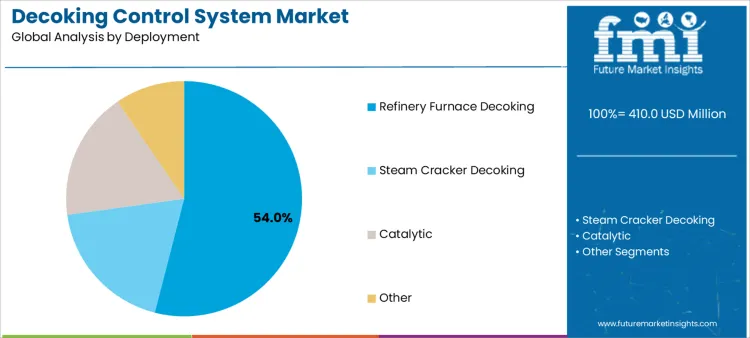
Refinery furnace decoking accounts for 54% share of the decoking control system market because coke formation is a routine operational challenge in refinery heaters and furnaces. Continuous exposure to high temperatures and heavy hydrocarbon feeds accelerates coke deposition, requiring frequent and well-controlled decoking cycles. Advanced control systems help operators optimize decoking duration, reduce fuel consumption, and minimize tube damage. Refineries prioritize precise monitoring to avoid unplanned shutdowns and extend furnace run length. Large installed base of aging furnaces further drives control system adoption. These operational intensity and asset protection needs explain why refinery furnace decoking remains the leading deployment segment.
Why Do Retrofit And Upgrade Solutions Dominate The Decoking Control System Market By Offering?

Retrofit and upgrade solutions hold 52% share of the decoking control system market because most refineries and petrochemical plants operate legacy furnaces with limited automation. Upgrading existing units with modern sensors, control logic, and analytics improves decoking efficiency without requiring full furnace replacement. Operators prefer retrofits to enhance safety, reduce coke-related failures, and improve operational visibility while managing capital expenditure. These solutions integrate with existing distributed control systems and plant infrastructure. For system providers, retrofit projects offer repeat opportunities across multiple furnaces within a single site. This focus on life-extension and performance improvement explains the dominance of retrofit and upgrade offerings.
What Are The Key Dynamics Of The Decoking Control System Market?
The decoking control system market is driven by the need to efficiently manage and automate the decoking process in refinery and petrochemical operations where coke buildup on furnace tubes reduces heat transfer efficiency and operational uptime. Decoking control systems monitor furnace conditions, regulate steam/air injection sequences, and coordinate real-time operational parameters to optimize coke removal while minimizing tube wear and energy consumption. For control system manufacturers and integrators, system reliability, precision in sequencing logic, integration with distributed control systems (DCS), and safety interlocks are key factors influencing adoption by engineering, procurement, and construction (EPC) firms and end users in refining and heavy process industries.
How Are Technology And Automation Trends Shaping This Market?
Technology and automation trends are shaping the decoking control system market through advanced process modeling, predictive analytics, and tighter integration with plant automation platforms. Model-based decoking sequences help anticipate coke formation profiles and adjust control strategies to reduce cycle time and fuel usage. Integration with historian databases and real-time performance dashboards enables operators to monitor key indicators such as furnace temperature gradients, pressure trends, and steam/air injection timing. Remote diagnostics and digital twin capabilities allow maintenance teams to simulate decoking scenarios and optimize settings before execution. For suppliers, delivering scalable control architectures that align with both legacy DCS and modern automation frameworks expands addressable opportunities.
Why Do Safety, Integration, And Qualification Challenges Restrain Market Growth?
Safety, system integration, and qualification challenges restrain growth in the decoking control system market due to the complexity and high-risk nature of furnace decoking operations. Decoking involves high temperatures, pressurized steam/air sequences, and intricately coordinated valve and burner actions that require robust safety logic and multi-layered interlocks. Integrating decoking control systems with existing plant DCS, PLCs, and fire-and-gas (F&G) safety systems demands meticulous engineering and testing to avoid operational conflicts. Extended qualification cycles such as factory acceptance tests (FAT), site acceptance tests (SAT), and staged commissioning add time and cost to deployments. Reluctance to modify established process controls in brownfield environments further slows adoption.
What is The Country-Level Growth Outlook for the Decoking Control System Market?
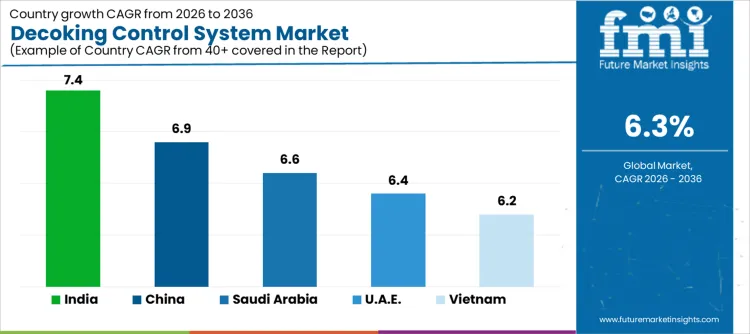
The decoking control system market is expanding as refineries modernize delayed coking units to improve operational safety, cycle efficiency, and process automation. These systems play a critical role in managing drum switching, valve sequencing, pressure control, and cutting operations during coke removal, helping reduce manual intervention and operational risk. Growth varies by country depending on refinery capacity additions, delayed coking unit upgrades, crude slate complexity, and adoption of advanced process control technologies. Higher-growth markets are driven by new refinery projects and capacity expansions, while more mature regions focus on automation upgrades and replacement of legacy control architectures.
| Country | CAGR (%) |
|---|---|
| India | 7.4 |
| China | 6.9 |
| Saudi Arabia | 6.6 |
| U.A.E. | 6.4 |
| Vietnam | 6.2 |
Why Is India Emerging As The Fastest-Growing Market For Decoking Control Systems?
India’s decoking control system market is expanding at a CAGR of 7.4% during 2026 to 2036, driven by refinery capacity expansion and increasing complexity of crude processing. New and upgraded delayed coking units are being deployed to handle heavier crude slates and improve refinery margins. Refineries are prioritizing automation of drum switching, valve sequencing, and coke cutting operations to enhance safety and reduce manual intervention. Buyers emphasize system reliability, integration with distributed control systems, and ability to operate under high-temperature and high-pressure conditions. Adoption is strong in Greenfield refinery projects as well as modernization of existing units. Procurement decisions consider lifecycle support, local engineering capability, and proven performance in similar refinery environments. Market value is driven by capital investments in downstream infrastructure and growing emphasis on operational consistency. India represents a growth-oriented market where suppliers benefit from early engagement in project design and strong aftersales support.
How Is China Sustaining Strong Demand For Decoking Control Systems?
China’s decoking control system market is growing at a CAGR of 6.9% during 2026 to 2036, supported by large-scale refinery operations and continuous upgrades to delayed coking units. Refineries are focused on improving throughput efficiency and minimizing operational risk associated with manual decoking processes. Buyers prioritize high system availability, precise sequencing control, and compatibility with existing automation platforms. Local manufacturing and engineering capabilities play an important role in supplier selection. Procurement decisions favor vendors with experience in large refinery projects and compliance with national automation standards. Replacement and upgrade projects contribute significantly to demand as legacy systems are modernized. Market value is driven by refinery scale, operational optimization initiatives, and standardization across multiple sites. China represents a volume-driven market where competitiveness depends on engineering reliability, scalability, and ability to support complex refinery networks.
Why Is Saudi Arabia Investing Steadily In Decoking Control Systems?
Saudi Arabia’s decoking control system market is expanding at a CAGR of 6.6% during 2026 to 2036, shaped by investments in refinery modernization and integration with petrochemical complexes. Delayed coking units are critical for processing heavy crude streams, making reliable control systems essential. Buyers emphasize robustness, precision, and adherence to stringent engineering specifications. Procurement decisions are typically project-based and aligned with large refinery upgrades or capacity expansions. Supplier qualification processes are rigorous, focusing on proven performance, cybersecurity, and long-term reliability. Market value is driven by large-scale refinery operations and high utilization rates. Saudi Arabia represents a mature energy market where growth is steady and supplier success depends on technical excellence, project execution capability, and alignment with long-term refinery strategies.
How Is The U.A.E. Strengthening Automation In Decoking Operations?
The U.A.E.’s decoking control system market is growing at a CAGR of 6.4% during 2026 to 2036, supported by refinery upgrades and focus on advanced process automation. Operators aim to enhance safety and efficiency by automating coke drum operations and reducing operator exposure. Buyers prioritize seamless integration with plant-wide control systems, remote monitoring, and advanced diagnostics. Adoption is driven by modernization projects rather than new builds. Procurement decisions emphasize system reliability, vendor reputation, and compliance with international standards. Market value is driven by continuous improvement initiatives and operational optimization. The U.A.E. represents a technology-focused market where success depends on delivering high-performance control systems and strong lifecycle support.
Why Is Vietnam Becoming An Emerging Market For Decoking Control Systems?
Vietnam’s decoking control system market is expanding at a CAGR of 6.2% during 2026-2036, driven by new refinery projects and industrial development. Adoption is primarily project-led, with control systems specified during the design phase of delayed coking units. Buyers emphasize reliability, ease of commissioning, and compatibility with imported refinery equipment. EPC contractors play a key role in supplier selection. Market value is driven by infrastructure development and increasing sophistication of refinery operations. Vietnam represents an emerging market where suppliers benefit from early project engagement, strong EPC relationships, and responsive technical support.
How Are Companies Competing in the Decoking Control System Market?
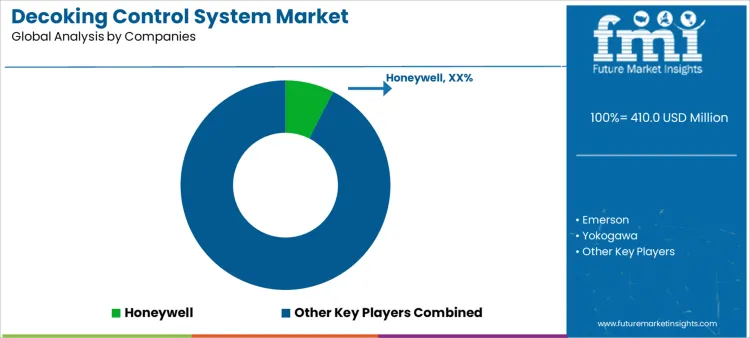
Competition in the decoking control system market centers on automation precision, integration with refinery process controls, and documented reliability in reducing coke formation while optimizing heater efficiency. Honeywell positions its decoking solutions with official product literature highlighting advanced model predictive control (MPC) and burner management integration that enhance heater throughput and decoking scheduling. Brochures emphasize real-time coke thickness estimation and seamless linkage with existing DCS (Distributed Control Systems) to minimize manual interventions.
Emerson competes through its integrated automation platforms that tie decoking controls to process analytics and asset performance management. Product materials focus on predictive algorithms that adjust fuel/air ratios dynamically to retard coke buildup and extend run lengths. Yokogawa differentiates with decoking modules built into its CENTUM and plant automation suites, with documentation underscoring low false alarms and stable operation across heater zones.
Global automation leaders emphasize cross-platform compatibility. ABB and Siemens position their decoking control modules with materials highlighting integration with plant asset management and digital twin frameworks to support preventive decoking strategies. Official guides focus on interface flexibility and support for modular heater architectures. Schneider Electric competes with decoking systems aligned with its EcoStruxure platform, emphasizing unified cybersecurity, remote monitoring, and analytics visualization.
PLC and logic integration specialists also contribute to competitive breadth. Rockwell Automation offers decoking logic packages documented for seamless operation within PlantPAx environments. KBC (Yokogawa) adds value through refinery performance consulting tied to decoking optimization and benchmarking. L&T Technology Services competes by providing customized decoking control system engineering, simulation, and retrofit support. Across the market, differentiation is built on documented control precision, predictive capabilities, and integration readiness rather than pricing alone.
Key Players in Decoking Control System Market
- Honeywell
- Emerson
- Yokogawa
- ABB
- Siemens
- Schneider Electric
- Rockwell Automation
- KBC (Yokogawa)
- L&T Technology Services
Scope of Report
| Attribute | Description |
|---|---|
| Quantitative Unit | USD Million |
| Deployment | Refinery Furnace Decoking, Steam Cracker Decoking, Catalytic, Other |
| Offering | Retrofit & Upgrades, New Unit Installations, Service & Optimization |
| Countries Covered | China, Japan, South Korea, India, Australia & New Zealand, ASEAN, Rest of Asia Pacific, Germany, United Kingdom, France, Italy, Spain, Nordic, BENELUX, Rest of Europe, United States, Canada, Mexico, Brazil, Chile, Rest of Latin America, Kingdom of Saudi Arabia, Other GCC Countries, Turkey, South Africa, Other African Union, Rest of Middle East & Africa |
| Regions Covered | Asia Pacific, Europe, North America, Latin America, Middle East & Africa |
| Key Companies Profiled | Honeywell, Emerson, Yokogawa, ABB, Siemens, Schneider Electric, Rockwell Automation, KBC (Yokogawa), L&T Technology Services |
| Additional Attributes | Dollar sales by deployment and offering are analyzed across refinery and petrochemical decoking operations. The report includes country-level demand assessment, market forecasts for 2026-2036, evaluation of automation accuracy, safety interlocks, coke removal efficiency, system reliability, digital optimization trends, retrofit adoption rates, and competitive benchmarking of distributed control and advanced process control suppliers. |
Decoking Control System Market by Key Segments
By Deployment:
- Refinery Furnace Decoking
- Steam Cracker Decoking
- Catalytic
- Other
By Offering:
- Retrofit & Upgrades
- New Unit Installations
- Service & Optimization
By Region:
- Asia Pacific
- China
- Japan
- South Korea
- India
- Australia & New Zealand
- ASEAN
- Rest of Asia Pacific
- Europe
- Germany
- United Kingdom
- France
- Italy
- Spain
- Nordic
- BENELUX
- Rest of Europe
- North America
- United States
- Canada
- Mexico
- Latin America
- Brazil
- Chile
- Rest of Latin America
- Middle East & Africa
- Kingdom of Saudi Arabia
- Other GCC Countries
- Turkey
- South Africa
- Other African Union
- Rest of Middle East & Africa
Bibliography
- International Society of Automation. (2024). ANSI/ISA-62443-2-1-2024: Security for industrial automation and control systems-Part 2-1: Security program requirements for IACS asset owners. ISA.
- National Institute of Standards and Technology. (2024). Cybersecurity Framework (CSF) 2.0: Small business quick-start guide (NIST Special Publication 1299). USA. Department of Commerce.
- USA. Chemical Safety and Hazard Investigation Board. (2025). Heater tube rupture and fire at BP-Husky Toledo Refinery (Investigation report). USA. CSB.
- Orazbayev, B., et al. (2023). Modeling and optimizing the delayed coking process. Processes, 11(2), 450.
- Zhang, Y., et al. (2025). Thermal cracking furnaces: Recent advances and future perspectives. Engineering, 52, 349-369.
Frequently Asked Questions
How big is the decoking control system market in 2026?
The global decoking control system market is estimated to be valued at USD 410.0 million in 2026.
What will be the size of decoking control system market in 2036?
The market size for the decoking control system market is projected to reach USD 755.3 million by 2036.
How much will be the decoking control system market growth between 2026 and 2036?
The decoking control system market is expected to grow at a 6.3% CAGR between 2026 and 2036.
What are the key product types in the decoking control system market?
The key product types in decoking control system market are refinery furnace decoking, steam cracker decoking, catalytic and other.
Which offering segment to contribute significant share in the decoking control system market in 2026?
In terms of offering, retrofit & upgrades segment to command 52.0% share in the decoking control system market in 2026.
Preview the report firsthand - request a free sample
Get SampleGet the brochure for pricing and purchase details.
Get PDFTable of Content
- Executive Summary
- Global Market Outlook
- Demand-side Trends
- Supply-side Trends
- Technology Roadmap Analysis
- Analysis and Recommendations
- Market Overview
- Market Coverage / Taxonomy
- Market Definition / Scope / Limitations
- Market Background
- Market Dynamics
- Drivers
- Restraints
- Opportunity
- Trends
- Scenario Forecast
- Demand in Optimistic Scenario
- Demand in Likely Scenario
- Demand in Conservative Scenario
- Opportunity Map Analysis
- Product Life Cycle Analysis
- Supply Chain Analysis
- Investment Feasibility Matrix
- Value Chain Analysis
- PESTLE and Porter’s Analysis
- Regulatory Landscape
- Regional Parent Market Outlook
- Production and Consumption Statistics
- Import and Export Statistics
- Market Dynamics
- Global Market Analysis 2021 to 2025 and Forecast, 2026 to 2036
- Historical Market Size Value (USD Million) Analysis, 2021 to 2025
- Current and Future Market Size Value (USD Million) Projections, 2026 to 2036
- Y-o-Y Growth Trend Analysis
- Absolute $ Opportunity Analysis
- Global Market Pricing Analysis 2021 to 2025 and Forecast 2026 to 2036
- Global Market Analysis 2021 to 2025 and Forecast 2026 to 2036, By Deployment
- Introduction / Key Findings
- Historical Market Size Value (USD Million) Analysis By Deployment , 2021 to 2025
- Current and Future Market Size Value (USD Million) Analysis and Forecast By Deployment , 2026 to 2036
- Refinery Furnace Decoking
- Steam Cracker Decoking
- Catalytic
- Other
- Refinery Furnace Decoking
- Y-o-Y Growth Trend Analysis By Deployment , 2021 to 2025
- Absolute $ Opportunity Analysis By Deployment , 2026 to 2036
- Global Market Analysis 2021 to 2025 and Forecast 2026 to 2036, By Offering
- Introduction / Key Findings
- Historical Market Size Value (USD Million) Analysis By Offering, 2021 to 2025
- Current and Future Market Size Value (USD Million) Analysis and Forecast By Offering, 2026 to 2036
- Retrofit & Upgrades
- New Value (USD Million) Installations
- Service & Optimization
- Retrofit & Upgrades
- Y-o-Y Growth Trend Analysis By Offering, 2021 to 2025
- Absolute $ Opportunity Analysis By Offering, 2026 to 2036
- Global Market Analysis 2021 to 2025 and Forecast 2026 to 2036, By Region
- Introduction
- Historical Market Size Value (USD Million) Analysis By Region, 2021 to 2025
- Current Market Size Value (USD Million) Analysis and Forecast By Region, 2026 to 2036
- North America
- Latin America
- Western Europe
- Eastern Europe
- East Asia
- South Asia and Pacific
- Middle East & Africa
- Market Attractiveness Analysis By Region
- North America Market Analysis 2021 to 2025 and Forecast 2026 to 2036, By Country
- Historical Market Size Value (USD Million) Trend Analysis By Market Taxonomy, 2021 to 2025
- Market Size Value (USD Million) Forecast By Market Taxonomy, 2026 to 2036
- By Country
- USA
- Canada
- Mexico
- By Deployment
- By Offering
- By Country
- Market Attractiveness Analysis
- By Country
- By Deployment
- By Offering
- Key Takeaways
- Latin America Market Analysis 2021 to 2025 and Forecast 2026 to 2036, By Country
- Historical Market Size Value (USD Million) Trend Analysis By Market Taxonomy, 2021 to 2025
- Market Size Value (USD Million) Forecast By Market Taxonomy, 2026 to 2036
- By Country
- Brazil
- Chile
- Rest of Latin America
- By Deployment
- By Offering
- By Country
- Market Attractiveness Analysis
- By Country
- By Deployment
- By Offering
- Key Takeaways
- Western Europe Market Analysis 2021 to 2025 and Forecast 2026 to 2036, By Country
- Historical Market Size Value (USD Million) Trend Analysis By Market Taxonomy, 2021 to 2025
- Market Size Value (USD Million) Forecast By Market Taxonomy, 2026 to 2036
- By Country
- Germany
- UK
- Italy
- Spain
- France
- Nordic
- BENELUX
- Rest of Western Europe
- By Deployment
- By Offering
- By Country
- Market Attractiveness Analysis
- By Country
- By Deployment
- By Offering
- Key Takeaways
- Eastern Europe Market Analysis 2021 to 2025 and Forecast 2026 to 2036, By Country
- Historical Market Size Value (USD Million) Trend Analysis By Market Taxonomy, 2021 to 2025
- Market Size Value (USD Million) Forecast By Market Taxonomy, 2026 to 2036
- By Country
- Russia
- Poland
- Hungary
- Balkan & Baltic
- Rest of Eastern Europe
- By Deployment
- By Offering
- By Country
- Market Attractiveness Analysis
- By Country
- By Deployment
- By Offering
- Key Takeaways
- East Asia Market Analysis 2021 to 2025 and Forecast 2026 to 2036, By Country
- Historical Market Size Value (USD Million) Trend Analysis By Market Taxonomy, 2021 to 2025
- Market Size Value (USD Million) Forecast By Market Taxonomy, 2026 to 2036
- By Country
- China
- Japan
- South Korea
- By Deployment
- By Offering
- By Country
- Market Attractiveness Analysis
- By Country
- By Deployment
- By Offering
- Key Takeaways
- South Asia and Pacific Market Analysis 2021 to 2025 and Forecast 2026 to 2036, By Country
- Historical Market Size Value (USD Million) Trend Analysis By Market Taxonomy, 2021 to 2025
- Market Size Value (USD Million) Forecast By Market Taxonomy, 2026 to 2036
- By Country
- India
- ASEAN
- Australia & New Zealand
- Rest of South Asia and Pacific
- By Deployment
- By Offering
- By Country
- Market Attractiveness Analysis
- By Country
- By Deployment
- By Offering
- Key Takeaways
- Middle East & Africa Market Analysis 2021 to 2025 and Forecast 2026 to 2036, By Country
- Historical Market Size Value (USD Million) Trend Analysis By Market Taxonomy, 2021 to 2025
- Market Size Value (USD Million) Forecast By Market Taxonomy, 2026 to 2036
- By Country
- Kingdom of Saudi Arabia
- Other GCC Countries
- Turkiye
- South Africa
- Other African Union
- Rest of Middle East & Africa
- By Deployment
- By Offering
- By Country
- Market Attractiveness Analysis
- By Country
- By Deployment
- By Offering
- Key Takeaways
- Key Countries Market Analysis
- USA
- Pricing Analysis
- Market Share Analysis, 2025
- By Deployment
- By Offering
- Canada
- Pricing Analysis
- Market Share Analysis, 2025
- By Deployment
- By Offering
- Mexico
- Pricing Analysis
- Market Share Analysis, 2025
- By Deployment
- By Offering
- Brazil
- Pricing Analysis
- Market Share Analysis, 2025
- By Deployment
- By Offering
- Chile
- Pricing Analysis
- Market Share Analysis, 2025
- By Deployment
- By Offering
- Germany
- Pricing Analysis
- Market Share Analysis, 2025
- By Deployment
- By Offering
- UK
- Pricing Analysis
- Market Share Analysis, 2025
- By Deployment
- By Offering
- Italy
- Pricing Analysis
- Market Share Analysis, 2025
- By Deployment
- By Offering
- Spain
- Pricing Analysis
- Market Share Analysis, 2025
- By Deployment
- By Offering
- France
- Pricing Analysis
- Market Share Analysis, 2025
- By Deployment
- By Offering
- India
- Pricing Analysis
- Market Share Analysis, 2025
- By Deployment
- By Offering
- ASEAN
- Pricing Analysis
- Market Share Analysis, 2025
- By Deployment
- By Offering
- Australia & New Zealand
- Pricing Analysis
- Market Share Analysis, 2025
- By Deployment
- By Offering
- China
- Pricing Analysis
- Market Share Analysis, 2025
- By Deployment
- By Offering
- Japan
- Pricing Analysis
- Market Share Analysis, 2025
- By Deployment
- By Offering
- South Korea
- Pricing Analysis
- Market Share Analysis, 2025
- By Deployment
- By Offering
- Russia
- Pricing Analysis
- Market Share Analysis, 2025
- By Deployment
- By Offering
- Poland
- Pricing Analysis
- Market Share Analysis, 2025
- By Deployment
- By Offering
- Hungary
- Pricing Analysis
- Market Share Analysis, 2025
- By Deployment
- By Offering
- Kingdom of Saudi Arabia
- Pricing Analysis
- Market Share Analysis, 2025
- By Deployment
- By Offering
- Turkiye
- Pricing Analysis
- Market Share Analysis, 2025
- By Deployment
- By Offering
- South Africa
- Pricing Analysis
- Market Share Analysis, 2025
- By Deployment
- By Offering
- USA
- Market Structure Analysis
- Competition Dashboard
- Competition Benchmarking
- Market Share Analysis of Top Players
- By Regional
- By Deployment
- By Offering
- Competition Analysis
- Competition Deep Dive
- Honeywell
- Overview
- Product Portfolio
- Profitability by Market Segments (Product/Age /Sales Channel/Region)
- Sales Footprint
- Strategy Overview
- Marketing Strategy
- Product Strategy
- Channel Strategy
- Emerson
- Yokogawa
- ABB
- Siemens
- Schneider Electric
- Rockwell Automation
- KBC (Yokogawa)
- L&T Technology Services
- Honeywell
- Competition Deep Dive
- Assumptions & Acronyms Used
- Research Methodology


