

- Industry Size (2026)
- USD 1.2 Bn
- Forecast (2036)
- USD 3.1 Bn
- CAGR (2026 to 2036)
- 10.3%
Modular E-Commerce System Market Forecast and Outlook 2026 to 2036
The modular e-commerce system market is expected to grow steadily from 2026 to 2036. In 2026, the market value is expected to be USD 1.2 billion, with consistent growth anticipated, reaching USD 3.1 billion by 2036. The compound annual growth rate (CAGR) for the market is forecasted at 10.3%, driven by the increasing adoption of customizable, flexible e-commerce solutions across industries. Modular systems enable businesses to scale efficiently, adapt to changing consumer demands and technological advancements, and fuel their widespread use.
The market's growth will be driven by the ongoing shift toward digital transformation and the growing demand for tailored e-commerce solutions. As businesses seek more efficient and scalable e-commerce platforms, the adoption of modular systems will continue to rise, supported by the growing emphasis on flexibility, integration capabilities, and improved customer experiences. Over the forecast period, the market will witness a steady increase in demand as e-commerce continues to evolve and expand globally.
Quick Stats of the Modular E-Commerce System Market
- Modular E-Commerce System Market Value (2026): USD 1.2 billion
- Modular E-Commerce System Market Forecast Value (2036): USD 3.1 billion
- Modular E-Commerce System Market Global Forecast CAGR (2026 to 2036): 10.3%
- Modular E-Commerce System Market Leading Segment: Technology (Modular die-cut systems & adaptive sizing) 55%
- Key Growth Regions in Modular E-Commerce System Market: China
- Top Players in Modular E-Commerce System Market: DS Smith, Smurfit Kappa, Nine Dragons, UFlex (corrugated), Klabin, Rengo, WestRock, Packsize, Mondi, Shunxing, TCPL
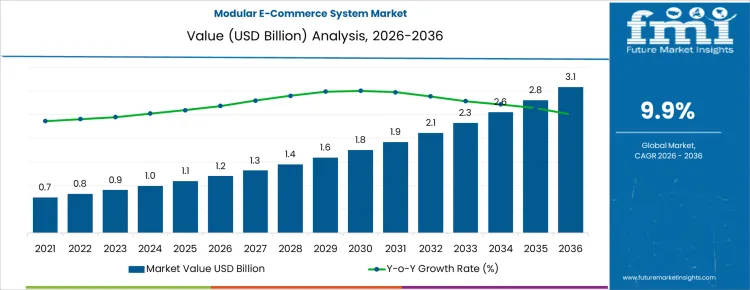
What is the Growth Forecast for the Modular E-Commerce System Market through 2036?
The growth forecast for the modular e-commerce system market shows steady growth with a rolling CAGR of 10.3%. The market is expected to grow from USD 1.2 billion in 2026 to USD 3.1 billion by 2036. The market will experience year-on-year growth, reaching USD 1.4 billion in 2027, USD 1.5 billion in 2028, and USD 1.6 billion in 2029. By 2030, the market will reach USD 1.8 billion, continuing its growth throughout the next few years.
From 2031 to 2036, the market will experience consistent expansion, reaching USD 2 billion in 2031, USD 2.1 billion in 2032, and USD 2.3 billion in 2033. By 2034, the market value will increase to USD 2.5 billion, followed by USD 2.8 billion in 2035. By 2036, the market is expected to reach USD 3.1 billion, reflecting strong demand and continued adoption of modular e-commerce solutions in a rapidly evolving digital landscape.
Modular E-Commerce System Market Key Takeaways
| Metric | Value |
|---|---|
| Industry Sales Value (2026) | USD 1.2 billion |
| Industry Forecast Value (2036) | USD 3.1 billion |
| Industry Forecast CAGR (2026-2036) | 10.3% |
What Is Driving the Demand for the Modular E-Commerce System Market Globally?
The global demand for modular e -commerce systems is driven by the need for agility, scalability, and cost -efficient digital commerce solutions as online retail continues to expand across regions, product categories, and customer expectations. Traditional monolithic e -commerce platforms often lock companies into rigid workflows and incremental upgrade costs, limiting the ability to adapt quickly to market shifts, seasonal demand swings, and new sales channels such as social commerce, marketplaces, and mobile -first customer journeys. Modular e -commerce systems break core functions—catalog management, pricing and promotions, checkout and payments, customer identity, search and recommendations, fulfillment orchestration—into loosely coupled components or services that can be independently developed, deployed, and scaled. This flexibility enables brands, retailers, and third -party developers to tailor solutions to specific business needs, integrate best -of -breed technologies, and reduce IT overhead by avoiding large -scale rewrites when adopting new capabilities. Growing competition among global retailers and digital natives alike, coupled with rising expectations for personalised experiences, faster page loads, and omnichannel consistency, reinforces the shift toward modular architectures. In emerging markets where digital adoption is accelerating, businesses are choosing modular systems to launch commerce capabilities rapidly, localise experiences, and meet diverse regulatory and payment requirements without heavy upfront investment.
Future demand for modular e -commerce systems is expected to grow as digital transformation remains a strategic priority for organisations of all sizes and industries. Advances in API -first design, headless commerce, composable architectures, and cloud -native deployment patterns will make modular systems more accessible, interoperable, and resilient to change, accelerating adoption across both B2C and B2B segments. Retailers and brands looking to innovate at the pace of customer behaviour will increasingly prefer modular components that can be replaced or upgraded without disrupting the broader platform, supporting iterative experimentation with personalisation engines, loyalty systems, and AI -driven merchandising. Growth of subscription commerce, direct -to -consumer models, and cross -border sales will sustain demand, as modularity supports localisation of tax, compliance, and fulfilment logic in diverse markets. As sustainability considerations and total cost of ownership influence technology decisions, modular systems that reduce technical debt and enable reuse of digital assets will appeal to organisations managing complex product portfolios and omni -channel fulfilment networks. Overall, continued preference for flexible, future -proofed commerce technology stacks that can evolve with market dynamics is expected to sustain steady global expansion of the modular e -commerce system market.
What are the Leading Segments in the Global Modular E-Commerce System Market?
The global modular e-commerce system market is segmented by application and packaging type. Among applications, D2C (Direct-to-Consumer) & omni-channel retail leads the market, accounting for 42% of the share, followed by fashion & electronics e-commerce, large marketplace fulfillment, D2C brands & marketplaces, domestic e-commerce, and high-precision fulfillment. The D2C & omni-channel retail segment is driven by the increasing preference for personalized, seamless shopping experiences across various platforms. On the packaging type side, modular boxes, inserts & mailers dominate the market, capturing 45% of the share, followed by adjustable cartons, modular shipping boxes, and mailer boxes & inserts. The demand for modular packaging solutions that can accommodate varying product sizes and ensure safe delivery is driving this trend.
What Drives the Growth of D2C & Omni-Channel Retail in the Modular E-Commerce System Market?
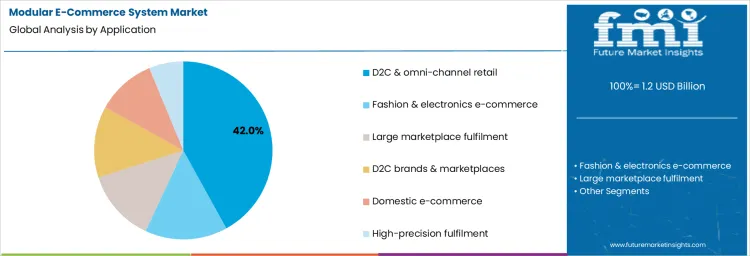
D2C & omni-channel retail is the leading application segment in the modular e-commerce system market, holding 42% of the share. This growth is driven by the increasing shift toward direct-to-consumer sales models, where brands sell products directly to consumers through their own websites, mobile apps, and other digital channels, bypassing traditional retail intermediaries. D2C businesses rely heavily on efficient and flexible e-commerce systems to manage inventory, track orders, and deliver a seamless customer experience. Omni-channel retail, which integrates online and offline channels, has also become a major driver as brands seek to provide a consistent and personalized experience across multiple touchpoints. The demand for modular e-commerce systems is further fueled by the need for scalable solutions that can handle the complexities of managing orders and inventory across various platforms, ensuring smooth operations for D2C brands. As the D2C & omni-channel retail market continues to grow, the demand for modular e-commerce systems that enable customization, efficiency, and real-time data processing is expected to rise.
What is Driving the Demand for Modular Boxes, Inserts & Mailers in the Modular E-Commerce System Market?
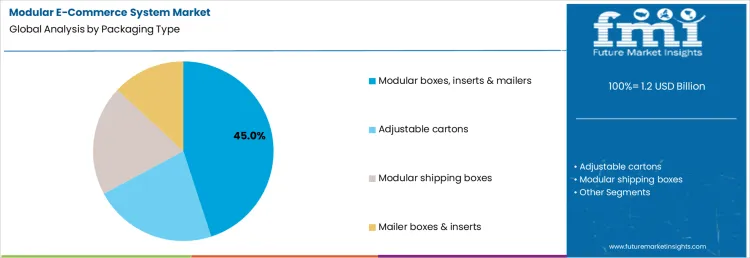
Modular boxes, inserts & mailers are the leading packaging type in the modular e-commerce system market, capturing 45% of the share. This packaging solution is highly valued for its flexibility and ability to accommodate a wide range of product sizes and shapes. Modular boxes and inserts allow for secure and efficient packaging, ensuring that products are protected during transit while reducing the amount of wasted space and material. This is particularly important in e-commerce, where packaging efficiency directly impacts shipping costs and customer satisfaction. The growing demand for eco-friendly packaging solutions is also contributing to the popularity of modular packaging, as it can be designed to be more sustainable while maintaining functionality. Additionally, the rise of personalized packaging in the e-commerce sector, particularly for D2C and omni-channel retail, further supports the demand for modular boxes, inserts, and mailers. As businesses continue to prioritize both the protection and presentation of products, modular packaging is expected to remain a key component in the e-commerce logistics process.
What is the Key Dynamics of the Global Modular E-Commerce System Market?
The global modular e-commerce system market is growing as brands and retailers adopt flexible, interoperable platform components that support rapid deployment and customisation of online commerce capabilities. Modular systems allow independent scaling of functions such as checkout, inventory, search, promotions and personalisation. Adoption is driven by need to support omnichannel selling, reduce time to market and improve digital experiences. Both established enterprises and emerging e-tailers invest in modular solutions to address evolving customer expectations, integrate with third-party services and manage complex product assortments with agility across global markets.
What are the Key Drivers for the Global Modular E-Commerce System Market?
Rising demand for flexible, composable digital commerce infrastructure motivates brands to shift from monolithic platforms to modular systems that separate capabilities into discrete, reusable services. Businesses seek to tailor experiences, accelerate innovation cycles and reduce dependency on single vendors. Growth of omnichannel retail and personalised customer journeys requires modular components that integrate with CRM, OMS and marketing tools. Expansion of mobile and social commerce encourages adoption of lightweight, API-first modules. Increasing investment in digital transformation across industries reinforces interest in solutions that support rapid feature rollout and streamlined integration with emerging technologies.
What are the Restraints for the Global Modular E-Commerce System Market?
Integration complexity is a restraint, as modular deployments require coordination of multiple services, APIs and data flows. Organisations may face technical challenges when aligning modules from different vendors or ensuring consistent data models, which can extend implementation timelines. Smaller retailers without in-house digital expertise may hesitate due to perceived resource requirements for configuration and maintenance. Initial investment in modular infrastructure, connectors and governance frameworks can be higher than using turnkey platforms with bundled features. Security configuration and compliance management across distributed modules adds operational considerations. Some companies postpone adoption until internal capabilities and ecosystem readiness align.
What is the Key Trends in the Global Modular E-Commerce System Market?
A key trend is emergence of headless commerce architectures that separate front-end presentation from back-end commerce services, enabling independent innovation on user interfaces. Adoption of API-first modules that support search, cart management, pricing and fulfillment accelerates composability. Use of cloud-native and microservices patterns supports scalability and resilience. Expansion of marketplace-oriented modules helps brands connect with third-party sellers and expand assortment. Integration of AI-enabled personalisation and real-time analytics modules drives improvements in conversion and retention. Ecosystems of modular partners and standardised connectors reduce friction for deployment across regions and digital channels.
What is the Country-Wise Analysis of the Modular E-Commerce System Market?
The modular e-commerce system market is expected to grow steadily, driven by the increasing demand for customizable, scalable, and efficient e-commerce solutions. These systems provide businesses with the flexibility to create personalized online stores by selecting and integrating various modules based on specific needs. As global e-commerce continues to expand, businesses are looking for cost-effective and adaptable solutions to meet changing consumer demands. High-growth markets like China and India are experiencing rapid digitalization, leading to strong demand for modular e-commerce platforms. Developed markets such as the USA, Germany, and Brazil are also witnessing steady growth, supported by the need for more advanced, flexible e-commerce solutions.
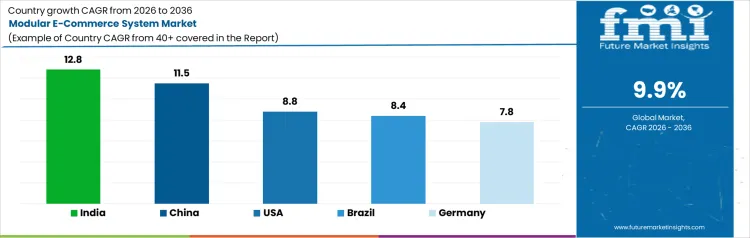
| Country | CAGR (%) |
|---|---|
| China | 11.5 |
| India | 12.8 |
| United States | 8.8 |
| Germany | 7.8 |
| Brazil | 8.4 |
What is the Growth Outlook for the Modular E-Commerce System Market in China?
The modular e-commerce system market in China is expected to grow at the highest rate, with a projected CAGR of 11.5%. China’s rapidly expanding e-commerce sector, fueled by a large online consumer base and increasing digital adoption, is driving the demand for modular e-commerce platforms. As businesses seek customizable solutions to meet specific operational needs and customer expectations, the demand for scalable, adaptable e-commerce systems is rising. Additionally, China’s growing number of small and medium-sized enterprises (SMEs) is further contributing to the market growth, as these businesses are increasingly adopting modular e-commerce platforms to scale their operations efficiently. With strong government support for digital economy initiatives, China is positioned to lead the global market for modular e-commerce systems.
What is the Market Outlook for the Modular E-Commerce System Market in India?
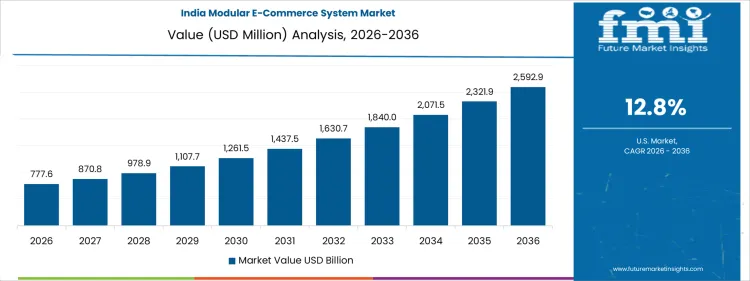
The modular e-commerce system market in India is projected to grow at a strong pace, with a projected CAGR of 12.8%. India’s booming e-commerce industry, fueled by rapid digitalization, rising disposable incomes, and increasing internet penetration, is creating a significant demand for modular e-commerce platforms. Businesses in India are adopting modular systems to create personalized online stores that cater to the diverse needs of Indian consumers. The country’s growing number of startups and SMEs, coupled with the increasing shift towards online shopping, is further driving the adoption of these flexible and cost-effective e-commerce solutions. As India continues to embrace digital transformation, the market for modular e-commerce systems is expected to experience robust growth.
What is the Growth Forecast for the Modular E-Commerce System Market in the United States?
The modular e-commerce system market in the United States is expected to grow steadily, with a projected CAGR of 8.8%. In the USA, the e-commerce sector continues to expand, driven by the increasing demand for personalized, scalable, and flexible solutions that can meet the needs of businesses of all sizes. The adoption of modular e-commerce platforms is being fueled by the need for businesses to offer unique shopping experiences, improve operational efficiency, and scale their online presence quickly. The growing number of SMEs in the USA and their increasing focus on digital commerce is further contributing to the steady growth of the modular e-commerce system market. As the USA market continues to mature, the demand for innovative, adaptable e-commerce platforms is expected to continue rising.
What is the Market Outlook for the Modular E-Commerce System Market in Germany?
The modular e-commerce system market in Germany is projected to grow at a steady pace, with a projected CAGR of 7.8%. Germany’s well-established e-commerce sector, coupled with its focus on innovation and digital transformation, is driving demand for modular e-commerce solutions. Businesses in Germany are increasingly seeking flexible, customizable platforms that allow them to deliver personalized and efficient shopping experiences. The country’s strong emphasis on data security and regulatory compliance is also pushing businesses to adopt advanced e-commerce systems that offer greater control and scalability. As Germany’s e-commerce market continues to evolve, the demand for modular systems that support growth and innovation is expected to remain steady.
What are the Growth Prospects for the Modular E-Commerce System Market in Brazil?
The modular e-commerce system market in Brazil is expected to grow at a moderate pace, with a projected CAGR of 8.4%. Brazil’s growing e-commerce market, driven by increasing internet penetration and digitalization, is fueling the demand for modular e-commerce platforms. As Brazilian businesses seek more adaptable and scalable solutions to meet consumer expectations and market demands, the adoption of modular e-commerce systems is rising. The rapid growth of online shopping in Brazil, particularly in retail and consumer goods, is driving the need for flexible, cost-effective e-commerce solutions. As Brazil’s e-commerce market continues to mature, the demand for modular systems will likely see steady growth, with businesses increasingly adopting these platforms to scale and optimize their operations.
What is the Competitive Landscape for the Modular E-Commerce System Market?
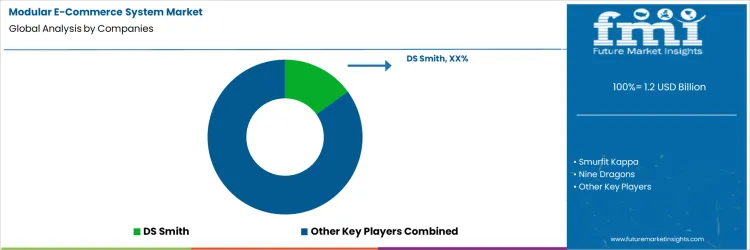
The modular e-commerce system market is expanding as companies seek efficient and customizable packaging solutions to meet the growing demands of online retail. DS Smith leads the market with its innovative modular e-commerce systems, offering sustainable, adaptable packaging solutions designed to optimize e-commerce logistics. Their focus on sustainability and performance has positioned them as a dominant player. Smurfit Kappa, Nine Dragons, and UFlex (corrugated) are key competitors, providing specialized modular packaging systems that enhance e-commerce efficiency. Smurfit Kappa focuses on creating innovative, eco-friendly solutions, while Nine Dragons and UFlex offer cost-effective, durable systems tailored to meet the needs of the e-commerce market.
Klabin, Rengo, WestRock, Packsize, Mondi, Shunxing, and TCPL further contribute to the competitive landscape by offering a range of modular e-commerce packaging solutions. Klabin and Rengo provide high-quality, sustainable packaging systems for online retail, while WestRock and Packsize focus on creating customizable solutions that improve packaging efficiency and reduce waste. Mondi offers versatile systems designed for e-commerce logistics, and Shunxing and TCPL provide cost-effective modular solutions with a focus on functionality and performance. These companies compete by focusing on product innovation, customization, and their ability to meet the increasing demand for efficient, sustainable e-commerce packaging systems.
Key Players of the Modular E-Commerce System Market
- DS Smith
- Smurfit Kappa
- Nine Dragons
- UFlex (corrugated)
- Klabin
- Rengo
- WestRock
- Packsize
- Mondi
- Shunxing
- TCPL
Scope of the Report
| Items | Values |
|---|---|
| Quantitative Units (2026) | USD Billion |
| Application | D2C & Omni-Channel Retail, Fashion & Electronics E-Commerce, Large Marketplace Fulfilment, D2C Brands & Marketplaces, Domestic E-Commerce, High-Precision Fulfilment |
| Packaging Type | Modular Boxes, Inserts & Mailers, Adjustable Cartons, Modular Shipping Boxes, Mailer Boxes & Inserts |
| Material | Corrugated Board, Molded Fibre, Corrugated + Paperboard, Corrugated & Hybrid Boards, Kraft Board |
| Technology | Modular Die-Cut Systems & Adaptive Sizing, On-Demand Box-Making, High-Speed Automated Packing Lines, Semi-Automated Modular Packing |
| Companies | DS Smith, Smurfit Kappa, Nine Dragons, UFlex (Corrugated), Klabin, Rengo, WestRock, Packsize, Mondi, Shunxing, TCPL |
| Regions Covered | North America, Latin America, Western Europe, Eastern Europe, South Asia and Pacific, East Asia, Middle East & Africa |
| Countries Covered | United States, Canada, Mexico, Brazil, Argentina, Germany, France, United Kingdom, Italy, Spain, Netherlands, China, India, Japan, South Korea, ANZ, GCC Countries, South Africa |
| Additional Attributes | Dollar by sales by application, packaging type, material, technology, and region. Includes market trends in modular e-commerce systems, focusing on modular boxes, inserts, mailers, and shipping boxes. Highlights the role of die-cut systems, on-demand box-making, and high-speed automated packing in fashion, electronics, and D2C e-commerce. Focus on sustainability, cost-effectiveness, regulatory compliance, market share, and competitive positioning of key companies in the e-commerce packaging market. |
Modular E-Commerce System Market Segmentation
Application
- D2C & omni-channel retail
- Fashion & electronics e-commerce
- Large marketplace fulfilment
- D2C brands & marketplaces
- Domestic e-commerce
- High-precision fulfilment
Packaging Type
- Modular boxes, inserts & mailers
- Adjustable cartons
- Modular shipping boxes
- Mailer boxes & inserts
Material
- Corrugated board, molded fibre
- Corrugated + paperboard
- Corrugated & hybrid boards
- Kraft board
Technology
- Modular die-cut systems & adaptive sizing
- On-demand box-making
- High-speed automated packing lines
- Semi-automated modular packing
Region
- Asia Pacific
- China
- Japan
- South Korea
- India
- Australia & New Zealand
- ASEAN
- Rest of Asia Pacific
- Europe
- Germany
- United Kingdom
- France
- Italy
- Spain
- Nordic
- BENELUX
- Rest of Europe
- North America
- United States
- Canada
- Mexico
- Latin America
- Brazil
- Chile
- Rest of Latin America
- Middle East & Africa
- Kingdom of Saudi Arabia
- Other GCC Countries
- Turkey
- South Africa
- Other African Union
- Rest of Middle East & Africa
Frequently Asked Questions
How big is the modular e-commerce system market in 2026?
The global modular e-commerce system market is estimated to be valued at USD 1.2 billion in 2026.
What will be the size of modular e-commerce system market in 2036?
The market size for the modular e-commerce system market is projected to reach USD 3.1 billion by 2036.
How much will be the modular e-commerce system market growth between 2026 and 2036?
The modular e-commerce system market is expected to grow at a 9.9% CAGR between 2026 and 2036.
What are the key product types in the modular e-commerce system market?
The key product types in modular e-commerce system market are d2c & omni-channel retail, fashion & electronics e-commerce, large marketplace fulfilment, d2c brands & marketplaces, domestic e-commerce and high-precision fulfilment.
Which packaging type segment to contribute significant share in the modular e-commerce system market in 2026?
In terms of packaging type, modular boxes, inserts & mailers segment to command 45.0% share in the modular e-commerce system market in 2026.
Preview the report firsthand - request a free sample
Get SampleGet the brochure for pricing and purchase details.
Get PDFTable of Content
- Executive Summary
- Global Market Outlook
- Demand-side Trends
- Supply-side Trends
- Technology Roadmap Analysis
- Analysis and Recommendations
- Market Overview
- Market Coverage / Taxonomy
- Market Definition / Scope / Limitations
- Market Background
- Market Dynamics
- Drivers
- Restraints
- Opportunity
- Trends
- Scenario Forecast
- Demand in Optimistic Scenario
- Demand in Likely Scenario
- Demand in Conservative Scenario
- Opportunity Map Analysis
- Product Life Cycle Analysis
- Supply Chain Analysis
- Investment Feasibility Matrix
- Value Chain Analysis
- PESTLE and Porter’s Analysis
- Regulatory Landscape
- Regional Parent Market Outlook
- Production and Consumption Statistics
- Import and Export Statistics
- Market Dynamics
- Global Market Analysis 2021 to 2025 and Forecast, 2026 to 2036
- Historical Market Size Value (USD Million) Analysis, 2021 to 2025
- Current and Future Market Size Value (USD Million) Projections, 2026 to 2036
- Y-o-Y Growth Trend Analysis
- Absolute $ Opportunity Analysis
- Global Market Pricing Analysis 2021 to 2025 and Forecast 2026 to 2036
- Global Market Analysis 2021 to 2025 and Forecast 2026 to 2036, By Application
- Introduction / Key Findings
- Historical Market Size Value (USD Million) Analysis By Application , 2021 to 2025
- Current and Future Market Size Value (USD Million) Analysis and Forecast By Application , 2026 to 2036
- D2C & omni-channel retail
- Fashion & electronics e-commerce
- Large marketplace fulfilment
- D2C brands & marketplaces
- Domestic e-commerce
- High-precision fulfilment
- Y-o-Y Growth Trend Analysis By Application , 2021 to 2025
- Absolute $ Opportunity Analysis By Application , 2026 to 2036
- Global Market Analysis 2021 to 2025 and Forecast 2026 to 2036, By Packaging Type
- Introduction / Key Findings
- Historical Market Size Value (USD Million) Analysis By Packaging Type, 2021 to 2025
- Current and Future Market Size Value (USD Million) Analysis and Forecast By Packaging Type, 2026 to 2036
- Modular boxes, inserts & mailers
- Adjustable cartons
- Modular shipping boxes
- Mailer boxes & inserts
- Y-o-Y Growth Trend Analysis By Packaging Type, 2021 to 2025
- Absolute $ Opportunity Analysis By Packaging Type, 2026 to 2036
- Global Market Analysis 2021 to 2025 and Forecast 2026 to 2036, By Material
- Introduction / Key Findings
- Historical Market Size Value (USD Million) Analysis By Material, 2021 to 2025
- Current and Future Market Size Value (USD Million) Analysis and Forecast By Material, 2026 to 2036
- Corrugated board, molded fibre
- Corrugated + paperboard
- Corrugated & hybrid boards
- Kraft board
- Y-o-Y Growth Trend Analysis By Material, 2021 to 2025
- Absolute $ Opportunity Analysis By Material, 2026 to 2036
- Global Market Analysis 2021 to 2025 and Forecast 2026 to 2036, By Technology
- Introduction / Key Findings
- Historical Market Size Value (USD Million) Analysis By Technology, 2021 to 2025
- Current and Future Market Size Value (USD Million) Analysis and Forecast By Technology, 2026 to 2036
- Modular die-cut systems & adaptive sizing
- On-demand box-making
- High-speed automated packing lines
- Semi-automated modular packing
- Y-o-Y Growth Trend Analysis By Technology, 2021 to 2025
- Absolute $ Opportunity Analysis By Technology, 2026 to 2036
- Global Market Analysis 2021 to 2025 and Forecast 2026 to 2036, By Region
- Introduction
- Historical Market Size Value (USD Million) Analysis By Region, 2021 to 2025
- Current Market Size Value (USD Million) Analysis and Forecast By Region, 2026 to 2036
- North America
- Latin America
- Western Europe
- Eastern Europe
- East Asia
- South Asia and Pacific
- Middle East & Africa
- Market Attractiveness Analysis By Region
- North America Market Analysis 2021 to 2025 and Forecast 2026 to 2036, By Country
- Historical Market Size Value (USD Million) Trend Analysis By Market Taxonomy, 2021 to 2025
- Market Size Value (USD Million) Forecast By Market Taxonomy, 2026 to 2036
- By Country
- USA
- Canada
- Mexico
- By Application
- By Packaging Type
- By Material
- By Technology
- By Country
- Market Attractiveness Analysis
- By Country
- By Application
- By Packaging Type
- By Material
- By Technology
- Key Takeaways
- Latin America Market Analysis 2021 to 2025 and Forecast 2026 to 2036, By Country
- Historical Market Size Value (USD Million) Trend Analysis By Market Taxonomy, 2021 to 2025
- Market Size Value (USD Million) Forecast By Market Taxonomy, 2026 to 2036
- By Country
- Brazil
- Chile
- Rest of Latin America
- By Application
- By Packaging Type
- By Material
- By Technology
- By Country
- Market Attractiveness Analysis
- By Country
- By Application
- By Packaging Type
- By Material
- By Technology
- Key Takeaways
- Western Europe Market Analysis 2021 to 2025 and Forecast 2026 to 2036, By Country
- Historical Market Size Value (USD Million) Trend Analysis By Market Taxonomy, 2021 to 2025
- Market Size Value (USD Million) Forecast By Market Taxonomy, 2026 to 2036
- By Country
- Germany
- UK
- Italy
- Spain
- France
- Nordic
- BENELUX
- Rest of Western Europe
- By Application
- By Packaging Type
- By Material
- By Technology
- By Country
- Market Attractiveness Analysis
- By Country
- By Application
- By Packaging Type
- By Material
- By Technology
- Key Takeaways
- Eastern Europe Market Analysis 2021 to 2025 and Forecast 2026 to 2036, By Country
- Historical Market Size Value (USD Million) Trend Analysis By Market Taxonomy, 2021 to 2025
- Market Size Value (USD Million) Forecast By Market Taxonomy, 2026 to 2036
- By Country
- Russia
- Poland
- Hungary
- Balkan & Baltic
- Rest of Eastern Europe
- By Application
- By Packaging Type
- By Material
- By Technology
- By Country
- Market Attractiveness Analysis
- By Country
- By Application
- By Packaging Type
- By Material
- By Technology
- Key Takeaways
- East Asia Market Analysis 2021 to 2025 and Forecast 2026 to 2036, By Country
- Historical Market Size Value (USD Million) Trend Analysis By Market Taxonomy, 2021 to 2025
- Market Size Value (USD Million) Forecast By Market Taxonomy, 2026 to 2036
- By Country
- China
- Japan
- South Korea
- By Application
- By Packaging Type
- By Material
- By Technology
- By Country
- Market Attractiveness Analysis
- By Country
- By Application
- By Packaging Type
- By Material
- By Technology
- Key Takeaways
- South Asia and Pacific Market Analysis 2021 to 2025 and Forecast 2026 to 2036, By Country
- Historical Market Size Value (USD Million) Trend Analysis By Market Taxonomy, 2021 to 2025
- Market Size Value (USD Million) Forecast By Market Taxonomy, 2026 to 2036
- By Country
- India
- ASEAN
- Australia & New Zealand
- Rest of South Asia and Pacific
- By Application
- By Packaging Type
- By Material
- By Technology
- By Country
- Market Attractiveness Analysis
- By Country
- By Application
- By Packaging Type
- By Material
- By Technology
- Key Takeaways
- Middle East & Africa Market Analysis 2021 to 2025 and Forecast 2026 to 2036, By Country
- Historical Market Size Value (USD Million) Trend Analysis By Market Taxonomy, 2021 to 2025
- Market Size Value (USD Million) Forecast By Market Taxonomy, 2026 to 2036
- By Country
- Kingdom of Saudi Arabia
- Other GCC Countries
- Turkiye
- South Africa
- Other African Union
- Rest of Middle East & Africa
- By Application
- By Packaging Type
- By Material
- By Technology
- By Country
- Market Attractiveness Analysis
- By Country
- By Application
- By Packaging Type
- By Material
- By Technology
- Key Takeaways
- Key Countries Market Analysis
- USA
- Pricing Analysis
- Market Share Analysis, 2025
- By Application
- By Packaging Type
- By Material
- By Technology
- Canada
- Pricing Analysis
- Market Share Analysis, 2025
- By Application
- By Packaging Type
- By Material
- By Technology
- Mexico
- Pricing Analysis
- Market Share Analysis, 2025
- By Application
- By Packaging Type
- By Material
- By Technology
- Brazil
- Pricing Analysis
- Market Share Analysis, 2025
- By Application
- By Packaging Type
- By Material
- By Technology
- Chile
- Pricing Analysis
- Market Share Analysis, 2025
- By Application
- By Packaging Type
- By Material
- By Technology
- Germany
- Pricing Analysis
- Market Share Analysis, 2025
- By Application
- By Packaging Type
- By Material
- By Technology
- UK
- Pricing Analysis
- Market Share Analysis, 2025
- By Application
- By Packaging Type
- By Material
- By Technology
- Italy
- Pricing Analysis
- Market Share Analysis, 2025
- By Application
- By Packaging Type
- By Material
- By Technology
- Spain
- Pricing Analysis
- Market Share Analysis, 2025
- By Application
- By Packaging Type
- By Material
- By Technology
- France
- Pricing Analysis
- Market Share Analysis, 2025
- By Application
- By Packaging Type
- By Material
- By Technology
- India
- Pricing Analysis
- Market Share Analysis, 2025
- By Application
- By Packaging Type
- By Material
- By Technology
- ASEAN
- Pricing Analysis
- Market Share Analysis, 2025
- By Application
- By Packaging Type
- By Material
- By Technology
- Australia & New Zealand
- Pricing Analysis
- Market Share Analysis, 2025
- By Application
- By Packaging Type
- By Material
- By Technology
- China
- Pricing Analysis
- Market Share Analysis, 2025
- By Application
- By Packaging Type
- By Material
- By Technology
- Japan
- Pricing Analysis
- Market Share Analysis, 2025
- By Application
- By Packaging Type
- By Material
- By Technology
- South Korea
- Pricing Analysis
- Market Share Analysis, 2025
- By Application
- By Packaging Type
- By Material
- By Technology
- Russia
- Pricing Analysis
- Market Share Analysis, 2025
- By Application
- By Packaging Type
- By Material
- By Technology
- Poland
- Pricing Analysis
- Market Share Analysis, 2025
- By Application
- By Packaging Type
- By Material
- By Technology
- Hungary
- Pricing Analysis
- Market Share Analysis, 2025
- By Application
- By Packaging Type
- By Material
- By Technology
- Kingdom of Saudi Arabia
- Pricing Analysis
- Market Share Analysis, 2025
- By Application
- By Packaging Type
- By Material
- By Technology
- Turkiye
- Pricing Analysis
- Market Share Analysis, 2025
- By Application
- By Packaging Type
- By Material
- By Technology
- South Africa
- Pricing Analysis
- Market Share Analysis, 2025
- By Application
- By Packaging Type
- By Material
- By Technology
- USA
- Market Structure Analysis
- Competition Dashboard
- Competition Benchmarking
- Market Share Analysis of Top Players
- By Regional
- By Application
- By Packaging Type
- By Material
- By Technology
- Competition Analysis
- Competition Deep Dive
- DS Smith
- Overview
- Product Portfolio
- Profitability by Market Segments (Product/Age /Sales Channel/Region)
- Sales Footprint
- Strategy Overview
- Marketing Strategy
- Product Strategy
- Channel Strategy
- Smurfit Kappa
- Nine Dragons
- UFlex (corrugated)
- Klabin
- Rengo
- WestRock
- Packsize
- Mondi
- Shunxing
- TCPL
- DS Smith
- Competition Deep Dive
- Assumptions & Acronyms Used
- Research Methodology


