

- Industry Size (2025)
- USD 5.3 Bn
- Forecast (2035)
- USD 19.2 Bn
- CAGR (2025 to 2035)
- 13.7%
Ecommerce Software and Platform Market Outlook from 2025 to 2035
The Ecommerce Software and Platform market is experiencing significant growth driven by the accelerating adoption of digital commerce solutions across industries. The future outlook for this market is shaped by the increasing need for scalable, customizable, and integrated ecommerce platforms that enhance operational efficiency and improve customer experience. Large enterprises are increasingly investing in enterprise-grade solutions to manage complex operations, streamline supply chains, and offer omnichannel experiences.
The market is further supported by the rapid expansion of online retail, growing internet penetration, and the rising preference for digital payment solutions. Technological advancements, including AI-driven analytics, personalization, and automation, are enhancing platform capabilities, enabling businesses to respond to changing consumer behavior more effectively.
Additionally, the need for secure, reliable, and cloud-enabled solutions is driving adoption across regions As companies focus on digital transformation and improving online engagement, the demand for ecommerce software and platforms is expected to sustain its growth trajectory, with large enterprises leading adoption due to their operational scale and digital maturity.
Quick Stats for Ecommerce Software and Platform Market
- Ecommerce Software and Platform Market Industry Value (2025): USD 5.3 billion
- Ecommerce Software and Platform Market Forecast Value (2035): USD 19.2 billion
- Ecommerce Software and Platform Market Forecast CAGR: 13.7%
- Leading Segment in Ecommerce Software and Platform Market in 2025: Solution (65.3%)
- Key Growth Region in Ecommerce Software and Platform Market: North America, Asia-Pacific, Europe
- Top Key Players in Ecommerce Software and Platform Market: Shopify Inc., BigCommerce, WooCommerce, Adobe (Magento), Nuvemshop, Salesforce.com, Inc., Oracle Corporation, SAP, Wix.com, Inc., MATRIXX Software, Squarespace, Volusion, Ecwid, Klaviyo, Gambio
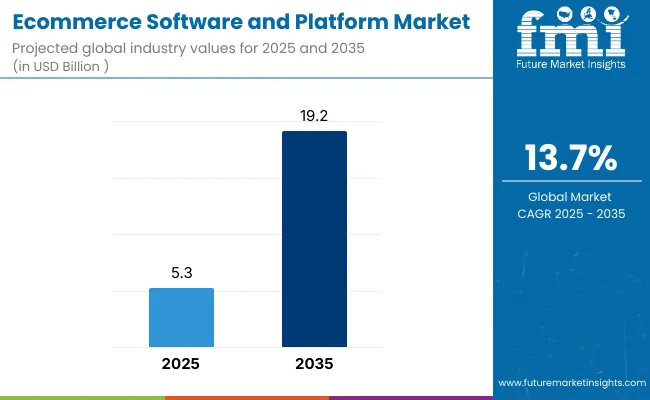
| Metric | Value |
|---|---|
| Ecommerce Software and Platform Market Estimated Value in (2025 E) | USD 5.3 billion |
| Ecommerce Software and Platform Market Forecast Value in (2035 F) | USD 19.2 billion |
| Forecast CAGR (2025 to 2035) | 13.7% |
Segmental Analysis
The market is segmented by Component, Enterprise Size, and Industry and region. By Component, the market is divided into Solution and Services. In terms of Enterprise Size, the market is classified into Large Enterprises and Small & Medium Enterprises. Based on Industry, the market is segmented into Electronics, Fashion & Apparel, Food & Beverages, Health & Beauty, Automotive, Home & Furniture, Media & Entertainment, and Others. Regionally, the market is classified into North America, Latin America, Western Europe, Eastern Europe, Balkan & Baltic Countries, Russia & Belarus, Central Asia, East Asia, South Asia & Pacific, and the Middle East & Africa.
Insights into the Solution Component Segment
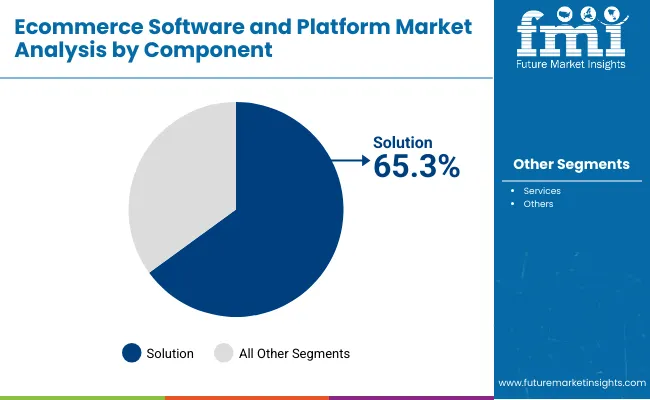
The solution component segment is projected to hold 65.30% of the Ecommerce Software and Platform market revenue share in 2025, making it the leading component type. This dominance is attributed to the comprehensive functionality offered by software solutions, including inventory management, customer relationship management, order processing, and analytics.
Solutions provide enterprises with end-to-end capabilities that streamline operations, reduce errors, and improve efficiency. The increasing demand for integrated platforms that can support omnichannel strategies has further reinforced the adoption of solutions over standalone services.
Additionally, enterprise-grade solutions offer advanced security, scalability, and customization options, which are critical for large organizations managing high transaction volumes and complex workflows The availability of cloud-based deployment models and continuous software updates has enhanced flexibility and reduced operational costs, further driving the growth of the solution component segment in the Ecommerce Software and Platform market.
Insights into the Large Enterprises Segment
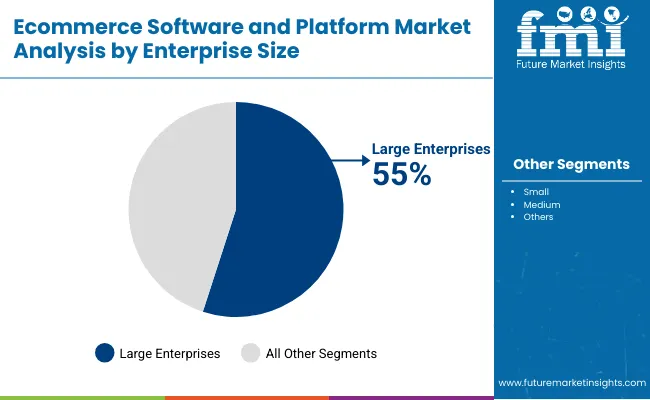
The large enterprises segment is expected to account for 55.00% of the market revenue in 2025, positioning it as the leading enterprise size segment. This growth is driven by the need for robust and scalable ecommerce platforms capable of managing extensive operations and high customer volumes.
Large enterprises leverage software and platform solutions to integrate multiple functions, including supply chain management, marketing automation, and analytics, ensuring operational efficiency and enhanced customer experience. The ability to deploy enterprise-grade solutions across multiple regions and business units has further strengthened adoption.
Additionally, the focus on digital transformation initiatives and maintaining competitive advantage in the rapidly evolving ecommerce landscape has reinforced the demand for comprehensive platforms The large enterprises segment continues to dominate due to its scale, financial capability, and strategic investments in digital infrastructure.
Insights into the Electronics Industry Segment
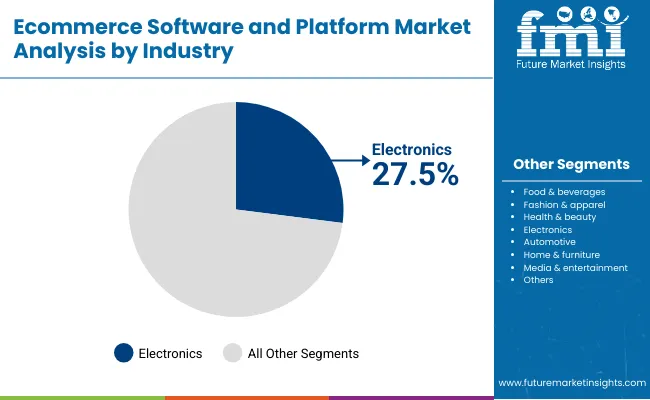
The electronics industry segment is projected to hold 27.50% of the market revenue in 2025, making it the leading industry vertical. The growth in this segment is fueled by the increasing online demand for consumer electronics and smart devices, which necessitates efficient ecommerce platforms for inventory management, order fulfillment, and customer engagement.
Electronics companies are increasingly adopting advanced software solutions to support omnichannel retailing, personalized marketing, and real-time analytics, ensuring seamless shopping experiences. The sector’s high transaction volume, diverse product range, and rapid product lifecycle require scalable and flexible platforms that can manage operational complexity.
Moreover, the emphasis on digital marketing, customer retention, and post-purchase support has accelerated the adoption of integrated ecommerce solutions The electronics industry remains a dominant end-use segment due to its technology-driven nature and the growing consumer preference for online purchases of electronic goods.
Semi Annual Market Update
The below table presents the anticipated CAGR for the global ecommerce software and platform market over several semi-annual periods spanning from 2025 to 2035. This assessment outlines changes in the ecommerce software and platform industry and identify revenue trends, offering key decision makers an understanding about market performance throughout the year.
H1 symbolizes first half of the year from January to June, H2 spans from July to December, which is the second half. In the first half (H1) of the year from 2025 to 2035, the business is expected to grow at a CAGR of 13.5%, followed by an increased growth rate of 14.0% in the second half (H2) of the same year.
| Particular | Value CAGR |
|---|---|
| H1, 2025 | 13.5% (2025 to 2035) |
| H2, 2025 | 14.0% (2025 to 2035) |
| H1, 2025 | 13.4% (2025 to 2035) |
| H2, 2025 | 14.3% (2025 to 2035) |
Moving into the subsequent period, from H1 2025 to H2 2035, the CAGR is projected to increase slightly to 13.4% in the first half and remain higher at 14.3% in the second half. In the first half (H1) the market witnessed a decrease of 10 BPS while in the second half (H2), the market witnessed an increase of 30 BPS.
Key Industry Highlights
Mobile Commerce (m-commerce) Surge is an Escalating Trend in Ecommerce Software and Platform Market
With more consumers depend on on smartphones for online activities, including shopping, there is increased demand for mobile optimization in e-commerce software and platforms. Mobile devices offer convenience and accessibility, encouraging businesses to focus on platforms that provide smooth and user-friendly mobile experiences.
E-commerce solutions that address the m-commerce rush are well-positioned to capture a major market share. Consumers are preferring the flexibility of shopping on-the-go. They also seek personalized shopping experiences, spotting diverse preferences and cultural gradations across regions.
E-commerce platforms using advanced technologies like artificial intelligence and machine learning are gaining traction. These platforms provide custom-made product recommendations and customized interfaces for users. Understanding and catering to individual preferences enhances user engagement.
This approach fosters brand loyalty and contributes to a more satisfying shopping experience. As consumer expectations for personalization rise, e-commerce platforms prioritizing these features are better positioned. They can more effectively meet the evolving demands of the market.
Omnichannel Retail Strategies by Businesses is fueling the Ecommerce Software and Platform Market Growth
Businesses are identifying the value of smooth shopping experience across multiple channel owing to changing customer expectations. Ecommerce platforms help companies enhance their omnichannel strategies. This response is driven by the changing demands of technologically inclined consumers.
Further, this software and platform also supports omnichannel retail that assist firms in managing orders & inventory and customer interaction across all channels.
Customers will always have a consistent experience because to this integration, whether they shop online, in-person, or through other touchpoints. E-commerce platforms that allow this services are in high demand. This is due to various firms emphasize on improve consumer satisfaction and loyalty by providing a unified buying experience.
Additionally, by using data and insights from multiple touchpoints, omnichannel methods permit firms to gain a deeper understanding of customer behavior and preferences. Ecommerce platforms possess enhanced analytical abilities. This allows businesses to adjust their marketing strategies, make informed choices, and improve their overall retail operations.
Businesses need to use data-driven strategies in order to stay competitive. This is fueling the growth of ecommerce software and platform market.
Increasing Adoption of Digital Payments is Creating Ample Opportunities for Ecommerce Software and Platform Market
E-commerce platforms have an enormous opportunity of benefiting on this changing market trend as customers appreciate the ease and security that digital payment methods provide. Digital payment solutions including non-intermediated transfers and mobile wallets are growing in popularity, creating positive outlook for ecommerce software and platform market.
Customers are looking for ways to transact online that are quicker, safer, and more effective. E-commerce platforms and software that incorporate these digital payment methods provide a smooth and intuitive payment experience that caters to the tastes of a population are more inclined towards technology.
Additionally, the move to digital payments helps to streamline the payment process and solves issues with conventional payment options like cash on delivery. The integration of secure and varied digital payment alternatives is a top priority for e-commerce platforms since it improves the overall customer experience, builds trust, and promotes more online transactions.
Since digital payments are becoming more widely accepted, e-commerce platforms may reach a wider audience. This is especially important, where a large percentage of the population uses digital wallets and other similar alternatives instead of traditional banking services.
E-commerce software and platforms may utilize the growing trend of digital payments to expand their reach into new regions, improve financial inclusion, and propel future expansion of the digital commerce sector worldwide.
Concerns Related to Data Security may affect Ecommerce Software and Platform Market Growth in the Projected Timeframe
Increasing cyber-attacks globally may restrict the market growth in the forecast period. The growing adoption of Internet-connected technologies is creating several opportunities for potential data breaches. When it comes to digital commerce, one of the major challenges happens to be the breach of security.
There is a lot of information that is involved while dealing with eCommerce and a technical issue with data can cause severe damage to the operations of the retailer, as well as the brand image.
Owing to this, various country’s governments are beginning to develop Computer Security Incident Response Teams (CSIRTs) and Cyber Emergency Response Teams (CERTs) in order to handle attacks, but few countries have been found to have an intermediate level of preparedness.
Moreover, several countries have recently adopted national strategies on cyber security in order to improve public awareness while several others are making progress.
Furthermore, to deal with the cyber and data security, the ecommerce software and platform companies are expected to ramp up their cybersecurity investments while making security awareness training a priority in the process. With proper training, an organization can avoid many of the common vulnerabilities that attract cyberattacks.
2020 to 2025 Global Ecommerce Software and Platform Sales Outlook Compared to Demand Forecast from 2025 to 2035
The global ecommerce software and platform market registered a CAGR of 10.7% during the historic period between 2020 and 2025. The growth of ecommerce software and platform industry was progressive as it reached a value of USD 4,112.3 million in 2025 from USD 2,452.0 million in 2020.
The market for e-commerce platforms and software saw remarkable growth from 2020 to 2025. The expansion of internet access, rising usage of mobile devices, and changing consumer behavior were the main drivers of this growth. Companies from a variety of sectors began investing money into e-commerce platforms.
The goal of this initiative was to gain profit from the expanding online shopping trend. The year marked the initial acceleration phase for the market. The growing importance of omnichannel retail strategies also contributed to the industry expansion.
In 2025, market saw notable increase, primarily as a result of the COVID-19 pandemic. The worldwide health crisis LED to prevalent lockdowns and restrictions. Customers were therefore forced to switch from in-person to online shopping. The use of e-commerce software increased considerably as a result of the rapid increase in demand for online shopping.
To adapt to this new reality, many businesses including small and medium-sized launched their e-commerce platforms'. The market grew rapidly during this period as e-commerce became a necessary lifeline for businesses.
Following the pandemic, the market continued to grow as companies focused on changing their e-commerce tactics. The focus has turned to strengthening omnichannel capabilities, increasing customer interaction, and optimizing mobile experiences.
Market growth was further aided by the emergence of social commerce, as companies used social media platforms for marketing and direct sales. Companies become progressively more aware of the demand for versatile e-commerce solutions. They also saw the importance of flexibility in these platforms.
This recognition was essential to meet evolving consumer expectations. As a result, ecommerce software and platform growth was further fueled.
Market Concentration
In the global ecommerce software and platform market, Tier 1 companies hold a notable market share of 40% to 45%, making them the market leaders. These companies have extensive global reach and customer bases.
Tier 1 players actively invests in R&D to enhance the performance of their market solutions. Key companies in the tier 1 are Shopify Inc., BigCommerce, WooCommerce, Adobe (Magento), Nuvemshop, and Salesforce.com, Inc.
Tier 2 companies may not have extensive global reach as tier 1 players but holds respectable market share. This players partners with technology provides, system integrators, and distributors to expand their product portfolio and increase their net sales. These players have strong knowledge of the local markets and thus designs the solutions as per the local market needs.
Prominent companies in tier 2 contain Oracle Corporation, SAP, Wix.com, Inc., MATRIXX Software, and Squarespace.
Tier 3 businesses are small sized firms and emerging startups that may lacks the global customer network as compared to tier 1 and tier 2 players. This players majorly targets the online businesses with limited budgets. This players are known for their innovative and cost-effective ecommerce software and platform.
Country-wise Insights
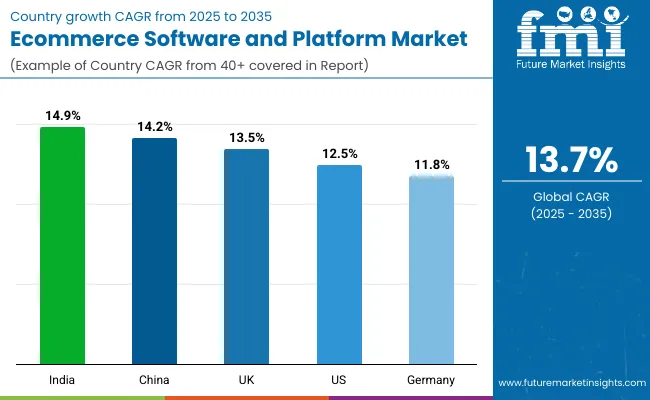
The section below covers the industry analysis for the ecommerce software and platform market for different countries. Market demand analysis on key countries in several regions of the globe, including the USA, Germany, China, India, Brazil, and UK is provided.
The United States is anticipated to remain at the forefront in North America, with a value share of 81.32% through 2035. In East Asia Pacific, South Korea is projected to witness a CAGR of 13.2% by 2035.
| Countries | Value CAGR (2025 to 2035) |
|---|---|
| USA | 12.5% |
| Germany | 11.8% |
| China | 14.2% |
| India | 14.9% |
| UK | 13.5% |
Diverse Offerings by Established Market Players is fueling the Market Growth in USA
North America, spearheaded by the USA which currently holds around 81.32% share of the North America ecommerce software and platform industry. USA ecommerce software and platform market is anticipated to grow at a CAGR of 12.5% throughout the forecast period.
As per USA Today, around 5.3 million of global ecommerce websites, 13 million are based in USA as of 2025. Moreover, USA is home to various established market players such as Adobe, Salesforce.com, Inc., and Oracle Corporation.
These market players are actively engaged in invest in R&D to expand their solution portfolio and achieve higher profitability from this potential region. This includes adopting new technologies, expanding into emerging niches, and offering value-added services. These strategies set them apart from competitors.
As a result, these players can retain their existing customer base and attract new clients. This approach contributes to overall market growth in USA
Vast Online Customer Base in China is creating Opportunities for the Ecommerce Software and Platform Market Growth
China’s ecommerce software and platform market is poised to exhibit a CAGR of 14.2% between 2025 and 2035. Currently, it holds the significant market share in the East Asia market, and the dominance is expected to continue through the forecast period.
The country’s vast online consumer base has over 1 billion internet users. This creates considerable demand for advanced ecommerce solutions. The extensive user base provides a fertile ground for ecommerce platform expansion. Businesses strive to cater to a diverse and growing customer audience.
In addition, consumers are spending more money online due to the country's remarkable urbanization and growing disposable income. The increasing online shopping encourages businesses to invest in advanced e-commerce platforms. These platforms offer better user experiences and can manage high transaction volumes, driving the market growth.
Exponential Growth in Ecommerce Sector in India is supporting the Industry Trend
India’s ecommerce software and platform market is expected to witness a CAGR of 14.9% in the forecast period and hold considerable market share in South Asia & Pacific region through 2035.
Booming Indian ecommerce sector is supporting the expansion of the ecommerce software and platform market. With a speedily growing internet user base and smartphone penetration, Indian consumers are turning to online shopping. This shift is driving demand for advanced ecommerce solutions.
The emergence of digital payment methods and government programs encouraging digitalization also improve the market's growth prospects. To take advantage of these changes, companies are making major investments in e-commerce software. Features like flexible infrastructure, tailored recommendations, and AI-driven analytics are being incorporated.
Category-wise Insights
The section contains information about the leading segments in the industry. By component, services segment is estimated to grow at a CAGR of 14.6% throughout 2035. Additionally, the by industry, fashion & apparel segment is projected to expand at 14.1% till 2035.
Solution Segment Dominate the Ecommerce Software and Platform Market in terms of Component
| Component | Solution |
|---|---|
| Value Share (2025) | 65.3% |
Solution segment is expected to acquire share of 65.3% in the market in terms of solution in 2025. The solution plays critical role in initiating various ecommerce functions. These includes order management, inventory optimziati0n, payment gateways, and content management. Businesses rely on these integrated solutions to streamline their operations, enhance user experiences, and ensure secure transactions.
Ecommerce Software and Platform are Mostly Utilized in the Electronics Industry
| Industry | Electronics |
|---|---|
| Value Share (2025) | 27.5% |
The electronics segment is expected to capture share of 27.5% in 2025. Ecommerce software and platforms are widely used in the electronics industry because they can handle complicated product listings and high transaction volumes. Electronics merchants frequently sell a diverse range of products, including gadgets, components, and accessories, necessitating precise descriptions, specs, and real-time inventory management.
Ecommerce systems include key features such as extensive search capabilities, filtering options, and comparison tools, which improve the purchasing experience for tech-savvy customers.
Competitive Landscape
Key players operating in the ecommerce software and platform market are investing in advanced technologies and also entering into partnerships. Key ecommerce software and platform providers have also been acquiring smaller players to grow their presence to further penetrate the market across multiple regions.
Recent Industry Developments in Ecommerce Software and Platform Market
- In April 2025, ecommerce company Swap Commerce Ltd raised USD 9 million in a Series A round to launch its global Ecommerce platform. The new Swap Global will enable the company to help direct-to-consumer (DTC) brands unlock new markets with delivered duty paid (DDP) shipping, automated tax remittance and express customs clearance.
- In April 2025, technology consulting company, Cognizant partnered with Shopify and Google Cloud to enhance eCommerce solutions. TH companies will assist retailers in upgrading their online shops by integrating features such as personalized shopping, AI assistants, and fraud protection.
- In December 2025 Nuvemshop acquired Perfit, an Argentinian startup focused on marketing automation, Perfit offers an AI-powered platform that manages and stores customer data and automates email marketing. This will enable company to expand its offering for ecommerce companies and increase its net sales.
Key Players of Ecommerce Software and Platform Industry
- Shopify Inc.
- BigCommerce
- WooCommerce
- Adobe (Magento)
- Nuvemshop
- Salesforce.com, Inc.
- Oracle Corporation
- SAP
- Wix.com, Inc.
- MATRIXX Software
- Squarespace
- Volusion
- Ecwid
- Klaviyo
- Gambio
Key Segments of Ecommerce Software and Platform Industry
By Component:
In terms of component, the industry is divided into solution and services.
By Enterprise Size:
In terms of enterprise size, the industry is divided into small & medium enterprises and large enterprises.
By Industry:
The industry is classified by industry as food & beverages, fashion & apparel, health & beauty, electronics, automotive, home & furniture, media & entertainment, and others.
By Region:
Key countries of North America, Latin America, East Asia, South Asia & Pacific, Western Europe, Eastern Europe, and Middle East & Africa (MEA) have been covered in the report.
Frequently Asked Questions
How big is the ecommerce software and platform market in 2025?
The global ecommerce software and platform market is estimated to be valued at USD 5.3 billion in 2025.
What will be the size of ecommerce software and platform market in 2035?
The market size for the ecommerce software and platform market is projected to reach USD 19.2 billion by 2035.
How much will be the ecommerce software and platform market growth between 2025 and 2035?
The ecommerce software and platform market is expected to grow at a 13.7% CAGR between 2025 and 2035.
What are the key product types in the ecommerce software and platform market?
The key product types in ecommerce software and platform market are solution and services.
Which enterprise size segment to contribute significant share in the ecommerce software and platform market in 2025?
In terms of enterprise size, large enterprises segment to command 55.0% share in the ecommerce software and platform market in 2025.
Preview the report firsthand - request a free sample
Get SampleGet the brochure for pricing and purchase details.
Get PDFTable of Content
- Executive Summary
- Global Market Outlook
- Demand-side Trends
- Supply-side Trends
- Technology Roadmap Analysis
- Analysis and Recommendations
- Market Overview
- Market Coverage / Taxonomy
- Market Definition / Scope / Limitations
- Market Background
- Market Dynamics
- Drivers
- Restraints
- Opportunity
- Trends
- Scenario Forecast
- Demand in Optimistic Scenario
- Demand in Likely Scenario
- Demand in Conservative Scenario
- Opportunity Map Analysis
- Product Life Cycle Analysis
- Supply Chain Analysis
- Investment Feasibility Matrix
- Value Chain Analysis
- PESTLE and Porter’s Analysis
- Regulatory Landscape
- Regional Parent Market Outlook
- Production and Consumption Statistics
- Import and Export Statistics
- Market Dynamics
- Global Market Analysis 2020 to 2025 and Forecast, 2025 to 2035
- Historical Market Size Value (USD Million) Analysis, 2020 to 2025
- Current and Future Market Size Value (USD Million) Projections, 2025 to 2035
- Y-o-Y Growth Trend Analysis
- Absolute $ Opportunity Analysis
- Global Market Pricing Analysis 2020 to 2025 and Forecast 2025 to 2035
- Global Market Analysis 2020 to 2025 and Forecast 2025 to 2035, By Component
- Introduction / Key Findings
- Historical Market Size Value (USD Million) Analysis By Component , 2020 to 2025
- Current and Future Market Size Value (USD Million) Analysis and Forecast By Component , 2025 to 2035
- Solution
- Services
- Y-o-Y Growth Trend Analysis By Component , 2020 to 2025
- Absolute $ Opportunity Analysis By Component , 2025 to 2035
- Global Market Analysis 2020 to 2025 and Forecast 2025 to 2035, By Enterprise Size
- Introduction / Key Findings
- Historical Market Size Value (USD Million) Analysis By Enterprise Size, 2020 to 2025
- Current and Future Market Size Value (USD Million) Analysis and Forecast By Enterprise Size, 2025 to 2035
- Large Enterprises
- Small & Medium Enterprises
- Y-o-Y Growth Trend Analysis By Enterprise Size, 2020 to 2025
- Absolute $ Opportunity Analysis By Enterprise Size, 2025 to 2035
- Global Market Analysis 2020 to 2025 and Forecast 2025 to 2035, By Industry
- Introduction / Key Findings
- Historical Market Size Value (USD Million) Analysis By Industry, 2020 to 2025
- Current and Future Market Size Value (USD Million) Analysis and Forecast By Industry, 2025 to 2035
- Electronics
- Fashion & Apparel
- Food & Beverages
- Health & Beauty
- Automotive
- Home & Furniture
- Media & Entertainment
- Others
- Y-o-Y Growth Trend Analysis By Industry, 2020 to 2025
- Absolute $ Opportunity Analysis By Industry, 2025 to 2035
- Global Market Analysis 2020 to 2025 and Forecast 2025 to 2035, By Region
- Introduction
- Historical Market Size Value (USD Million) Analysis By Region, 2020 to 2025
- Current Market Size Value (USD Million) Analysis and Forecast By Region, 2025 to 2035
- North America
- Latin America
- Western Europe
- Eastern Europe
- East Asia
- South Asia and Pacific
- Middle East & Africa
- Market Attractiveness Analysis By Region
- North America Market Analysis 2020 to 2025 and Forecast 2025 to 2035, By Country
- Historical Market Size Value (USD Million) Trend Analysis By Market Taxonomy, 2020 to 2025
- Market Size Value (USD Million) Forecast By Market Taxonomy, 2025 to 2035
- By Country
- USA
- Canada
- Mexico
- By Component
- By Enterprise Size
- By Industry
- By Country
- Market Attractiveness Analysis
- By Country
- By Component
- By Enterprise Size
- By Industry
- Key Takeaways
- Latin America Market Analysis 2020 to 2025 and Forecast 2025 to 2035, By Country
- Historical Market Size Value (USD Million) Trend Analysis By Market Taxonomy, 2020 to 2025
- Market Size Value (USD Million) Forecast By Market Taxonomy, 2025 to 2035
- By Country
- Brazil
- Chile
- Rest of Latin America
- By Component
- By Enterprise Size
- By Industry
- By Country
- Market Attractiveness Analysis
- By Country
- By Component
- By Enterprise Size
- By Industry
- Key Takeaways
- Western Europe Market Analysis 2020 to 2025 and Forecast 2025 to 2035, By Country
- Historical Market Size Value (USD Million) Trend Analysis By Market Taxonomy, 2020 to 2025
- Market Size Value (USD Million) Forecast By Market Taxonomy, 2025 to 2035
- By Country
- Germany
- UK
- Italy
- Spain
- France
- Nordic
- BENELUX
- Rest of Western Europe
- By Component
- By Enterprise Size
- By Industry
- By Country
- Market Attractiveness Analysis
- By Country
- By Component
- By Enterprise Size
- By Industry
- Key Takeaways
- Eastern Europe Market Analysis 2020 to 2025 and Forecast 2025 to 2035, By Country
- Historical Market Size Value (USD Million) Trend Analysis By Market Taxonomy, 2020 to 2025
- Market Size Value (USD Million) Forecast By Market Taxonomy, 2025 to 2035
- By Country
- Russia
- Poland
- Hungary
- Balkan & Baltic
- Rest of Eastern Europe
- By Component
- By Enterprise Size
- By Industry
- By Country
- Market Attractiveness Analysis
- By Country
- By Component
- By Enterprise Size
- By Industry
- Key Takeaways
- East Asia Market Analysis 2020 to 2025 and Forecast 2025 to 2035, By Country
- Historical Market Size Value (USD Million) Trend Analysis By Market Taxonomy, 2020 to 2025
- Market Size Value (USD Million) Forecast By Market Taxonomy, 2025 to 2035
- By Country
- China
- Japan
- South Korea
- By Component
- By Enterprise Size
- By Industry
- By Country
- Market Attractiveness Analysis
- By Country
- By Component
- By Enterprise Size
- By Industry
- Key Takeaways
- South Asia and Pacific Market Analysis 2020 to 2025 and Forecast 2025 to 2035, By Country
- Historical Market Size Value (USD Million) Trend Analysis By Market Taxonomy, 2020 to 2025
- Market Size Value (USD Million) Forecast By Market Taxonomy, 2025 to 2035
- By Country
- India
- ASEAN
- Australia & New Zealand
- Rest of South Asia and Pacific
- By Component
- By Enterprise Size
- By Industry
- By Country
- Market Attractiveness Analysis
- By Country
- By Component
- By Enterprise Size
- By Industry
- Key Takeaways
- Middle East & Africa Market Analysis 2020 to 2025 and Forecast 2025 to 2035, By Country
- Historical Market Size Value (USD Million) Trend Analysis By Market Taxonomy, 2020 to 2025
- Market Size Value (USD Million) Forecast By Market Taxonomy, 2025 to 2035
- By Country
- Kingdom of Saudi Arabia
- Other GCC Countries
- Turkiye
- South Africa
- Other African Union
- Rest of Middle East & Africa
- By Component
- By Enterprise Size
- By Industry
- By Country
- Market Attractiveness Analysis
- By Country
- By Component
- By Enterprise Size
- By Industry
- Key Takeaways
- Key Countries Market Analysis
- USA
- Pricing Analysis
- Market Share Analysis, 2025
- By Component
- By Enterprise Size
- By Industry
- Canada
- Pricing Analysis
- Market Share Analysis, 2025
- By Component
- By Enterprise Size
- By Industry
- Mexico
- Pricing Analysis
- Market Share Analysis, 2025
- By Component
- By Enterprise Size
- By Industry
- Brazil
- Pricing Analysis
- Market Share Analysis, 2025
- By Component
- By Enterprise Size
- By Industry
- Chile
- Pricing Analysis
- Market Share Analysis, 2025
- By Component
- By Enterprise Size
- By Industry
- Germany
- Pricing Analysis
- Market Share Analysis, 2025
- By Component
- By Enterprise Size
- By Industry
- UK
- Pricing Analysis
- Market Share Analysis, 2025
- By Component
- By Enterprise Size
- By Industry
- Italy
- Pricing Analysis
- Market Share Analysis, 2025
- By Component
- By Enterprise Size
- By Industry
- Spain
- Pricing Analysis
- Market Share Analysis, 2025
- By Component
- By Enterprise Size
- By Industry
- France
- Pricing Analysis
- Market Share Analysis, 2025
- By Component
- By Enterprise Size
- By Industry
- India
- Pricing Analysis
- Market Share Analysis, 2025
- By Component
- By Enterprise Size
- By Industry
- ASEAN
- Pricing Analysis
- Market Share Analysis, 2025
- By Component
- By Enterprise Size
- By Industry
- Australia & New Zealand
- Pricing Analysis
- Market Share Analysis, 2025
- By Component
- By Enterprise Size
- By Industry
- China
- Pricing Analysis
- Market Share Analysis, 2025
- By Component
- By Enterprise Size
- By Industry
- Japan
- Pricing Analysis
- Market Share Analysis, 2025
- By Component
- By Enterprise Size
- By Industry
- South Korea
- Pricing Analysis
- Market Share Analysis, 2025
- By Component
- By Enterprise Size
- By Industry
- Russia
- Pricing Analysis
- Market Share Analysis, 2025
- By Component
- By Enterprise Size
- By Industry
- Poland
- Pricing Analysis
- Market Share Analysis, 2025
- By Component
- By Enterprise Size
- By Industry
- Hungary
- Pricing Analysis
- Market Share Analysis, 2025
- By Component
- By Enterprise Size
- By Industry
- Kingdom of Saudi Arabia
- Pricing Analysis
- Market Share Analysis, 2025
- By Component
- By Enterprise Size
- By Industry
- Turkiye
- Pricing Analysis
- Market Share Analysis, 2025
- By Component
- By Enterprise Size
- By Industry
- South Africa
- Pricing Analysis
- Market Share Analysis, 2025
- By Component
- By Enterprise Size
- By Industry
- USA
- Market Structure Analysis
- Competition Dashboard
- Competition Benchmarking
- Market Share Analysis of Top Players
- By Regional
- By Component
- By Enterprise Size
- By Industry
- Competition Analysis
- Competition Deep Dive
- Shopify Inc.
- Overview
- Product Portfolio
- Profitability by Market Segments (Product/Age /Sales Channel/Region)
- Sales Footprint
- Strategy Overview
- Marketing Strategy
- Product Strategy
- Channel Strategy
- BigCommerce
- WooCommerce
- Adobe (Magento)
- Nuvemshop
- Salesforce.com, Inc.
- Oracle Corporation
- SAP
- Wix.com, Inc.
- MATRIXX Software
- Squarespace
- Volusion
- Ecwid
- Klaviyo
- Gambio
- Shopify Inc.
- Competition Deep Dive
- Assumptions & Acronyms Used
- Research Methodology


