

- Industry Size (2026)
- USD 1600.0 Mn
- Forecast (2036)
- USD 3147.0 Mn
- CAGR (2026 to 2036)
- 7.0%
Modular Construction Fasteners Market Forecast and Outlook 2026 to 2036
The modular construction fasteners market stands at the intersection of advanced manufacturing and construction innovation, projected to expand from USD 1,600.0 million in 2026 to USD 3,147.0 million by 2036, achieving a compound annual growth rate of 7.0% throughout the forecast period.
Quick Stats for Modular Construction Fasteners Market
- Modular Construction Fasteners Market Value (2026): USD 1,600.0 million
- Modular Construction Fasteners Market Forecast Value (2036): USD 3,147.0 million
- Modular Construction Fasteners Market Forecast CAGR: 7.0%
- Leading Material in Modular Construction Fasteners Market: Carbon Steel (46%)
- Key Growth Countries in Modular Construction Fasteners Market: China, Brazil, Europe, USA., U.K., Germany, South Korea, Japan
- Key Players in Modular Construction Fasteners Market: Hilti, Simpson Strong-Tie, ITW Construction Products, fischer Group, Würth
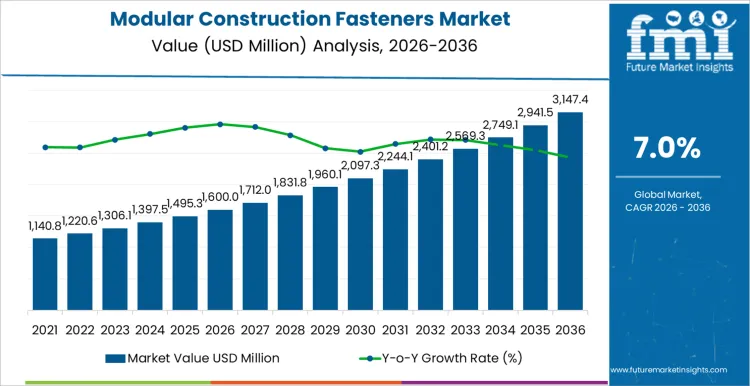
This specialized market encompasses engineered fastening solutions specifically designed for modular construction methodologies where building components are manufactured off-site and assembled on location using precision connection systems that ensure structural integrity, dimensional accuracy, and rapid installation.
The growth trajectory of modular construction fasteners reflects the construction industry's fundamental transformation toward industrialized building processes that demand fastening technologies capable of supporting diverse module types, repeated assembly-disassembly cycles, and stringent quality standards.
Modular construction fasteners differ fundamentally from traditional construction hardware by addressing unique challenges including dimensional tolerance management, connection accessibility, structural load transfer between prefabricated components, and installation speed optimization that characterize factory-built construction systems.
These specialized fasteners must accommodate the precision requirements of computer-controlled manufacturing while providing reliable structural performance under diverse loading conditions including seismic events, wind loads, and thermal cycling. Advanced fastening systems enable modular construction to achieve building performance equivalent to conventional construction while reducing installation time, labor requirements, and construction site complexity.
Modular Construction Fasteners Market Key Takeaways
| Metric | Value |
|---|---|
| Market Value (2026) | USD 1,600.0 million |
| Market Forecast Value (2036) | USD 3,147.0 million |
| Forecast CAGR 2026 to 2036 | 7.0% |
Why is Labor Shortage Crisis Accelerating Modular Construction Adoption?
The construction industry's unprecedented skilled labor shortage creates compelling economic incentives for adopting modular construction methodologies that require specialized fastening systems capable of supporting factory-based manufacturing processes and simplified field assembly procedures.
Traditional construction faces chronic workforce shortages across multiple trades while aging demographics and reduced vocational training programs exacerbate recruitment challenges that threaten project delivery capabilities.
Modular construction addresses these challenges by transferring complex construction tasks to controlled factory environments where standardized processes and specialized equipment enable higher productivity while reducing dependence on highly skilled field labor.
How is the Market Structured across Construction Technology Platforms?
The modular construction fasteners market exhibits sophisticated segmentation reflecting diverse modular construction methodologies, fastening technology approaches, and application-specific requirements that create distinct market segments with unique technical specifications and performance criteria.
Market structure encompasses fastener type categories representing different structural connection mechanisms, construction system classifications addressing varying modular approaches, and end-use segments reflecting different building types and performance requirements.
This multidimensional segmentation reflects the specialized nature of modular construction where generic fastening solutions prove inadequate for addressing specific structural, installation, and performance requirements.
Which Fastener Technology Dominates Structural Applications?
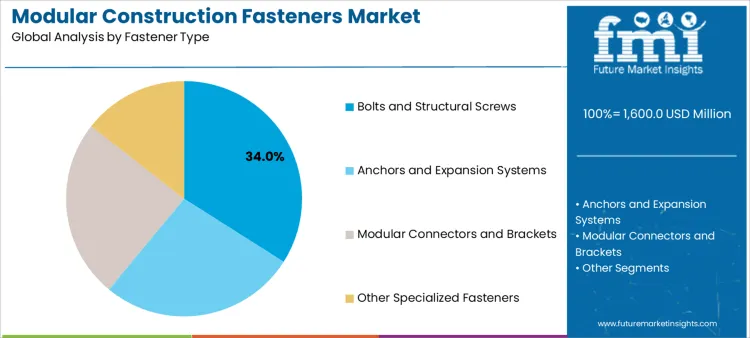
Bolts and structural screws command 34.0% market share, representing the primary fastening category for high-load structural connections between modular components where reliable strength transfer and installation precision constitute critical performance requirements.
Structural bolting systems for modular construction must accommodate tight tolerance requirements while providing accessible installation procedures that enable rapid field assembly without compromising connection reliability.
High-strength structural screws increasingly replace traditional bolt assemblies in applications where self-drilling capabilities and reduced installation time provide advantages while maintaining required load capacity.
Which Construction System Platform drives Demand in the Modular Construction Fasteners Market?
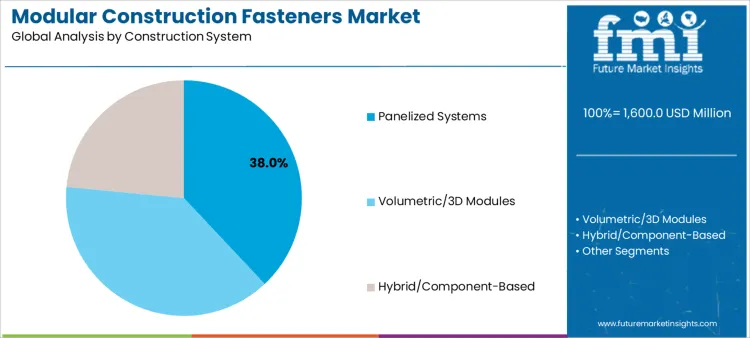
Panelized construction systems dominate with 38.0% market share, representing the most widely adopted modular construction methodology due to transportation advantages, design flexibility, and compatibility with diverse building types that create substantial demand for specialized panel fastening systems.
Panelized construction utilizes factory-manufactured wall, floor, and roof panels that are transported to sites and assembled using structural fastening systems optimized for panel-to-panel connections and panel-to-frame attachments.
Panel fastening requirements encompass both structural connections that transfer loads between panels and non-structural connections that maintain dimensional alignment and building envelope integrity.
Which End-Use Category leads Expansion?
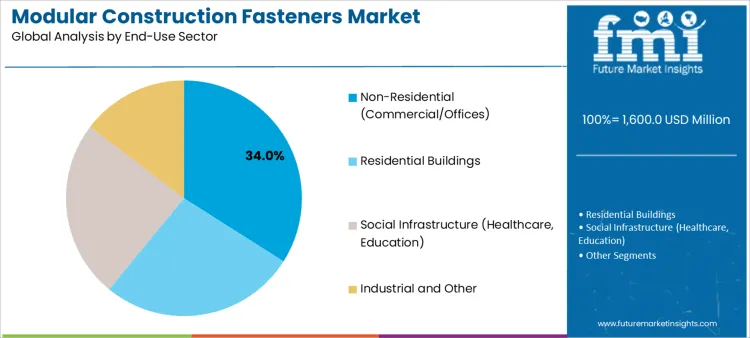
Non-residential commercial and office applications dominate with 34.0% market share, reflecting the commercial construction sector's embrace of modular methodologies that enable rapid project delivery, cost control, and quality consistency that address competitive pressures in commercial development markets.
Office building applications often emphasize speed of construction while maintaining high-quality finishes and building system integration that require sophisticated fastening solutions. Commercial modular construction frequently involves complex building geometries and mixed-use requirements that challenge fastening system design while demanding reliable structural performance.
Which Material Platform Optimizes Performance?
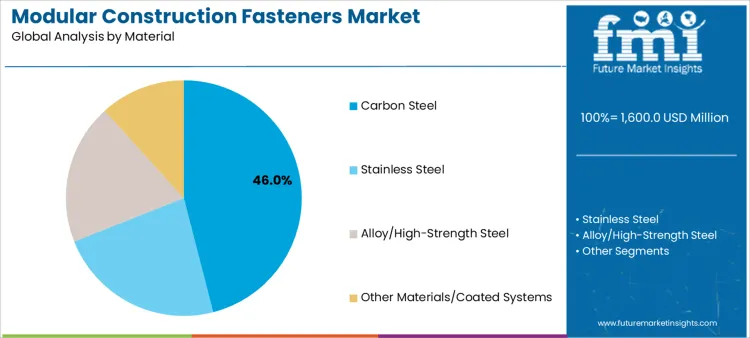
Carbon steel fasteners dominate with 46.0% market share, representing the primary material choice for modular construction applications due to optimal strength-to-cost characteristics, established manufacturing infrastructure, and proven performance across diverse structural applications.
Carbon steel provides excellent mechanical properties for structural fastening while enabling cost-effective production methods that support the economic objectives of modular construction projects. Advanced carbon steel fasteners often incorporate specialized heat treatments and coating systems that optimize performance for specific modular construction requirements.
How are Building Code Evolution Requirements Shaping Fastener Development?
The continuous evolution of building codes and structural design standards creates ongoing challenges for modular construction fastener development as regulatory agencies adapt traditional construction requirements to address unique characteristics of prefabricated building systems.
Modern building codes increasingly recognize modular construction methods while establishing specific requirements for component connections, structural load paths, and quality assurance procedures that influence fastener design and testing protocols. International Building Code provisions addressing modular construction create standardized requirements while regional amendments may establish additional criteria that affect fastener specifications.
Seismic design requirements for modular construction often require specialized fastening systems that provide predictable performance under earthquake loading while enabling the connection redundancy essential for life safety protection. Wind resistance provisions may establish specific connection requirements that influence fastener selection and installation procedures while fire resistance requirements affect material selection and connection details. Accessibility requirements increasingly influence fastening system design to ensure installation procedures accommodate workforce capabilities and safety requirements.
Do Quality Assurance Requirements drive Technology Innovation?
The stringent quality assurance requirements associated with modular construction drive innovation in fastener technology, installation methods, and documentation systems that ensure consistent connection performance across factory and field environments.
Modular construction quality control often requires fastener systems that enable real-time installation monitoring while providing permanent documentation of connection integrity for building certification processes. Advanced fastening systems incorporate features that facilitate automated quality control while ensuring consistent installation procedures across production environments.
Factory quality control systems for modular construction often require fastener technologies that integrate with manufacturing execution systems while providing traceability and verification capabilities that support third-party inspection and building code compliance. Installation documentation systems may incorporate digital technologies that record fastener installation parameters while ensuring compliance with specified procedures and performance criteria.
How do Transportation Constraints Influence Fastener Selection?
The transportation requirements for modular construction components create unique constraints that influence fastener selection and connection design while addressing dimensional limitations, load securing requirements, and handling procedures that affect component integrity during shipping. Fastener systems must accommodate transportation vibration and handling loads while avoiding loosening or degradation that could compromise field assembly procedures. Component securing systems often require specialized fasteners that provide temporary connections during transportation while enabling removal for final assembly procedures.
Road transportation dimensional limits influence module size and connection accessibility that affect fastener selection and installation procedures while shipping protection requirements may necessitate temporary fastening systems that maintain component integrity during transport. International transportation requirements may establish specific fastener specifications and documentation requirements that influence product design and quality control procedures.
How is the Modular Construction Fasteners Market Expected to Evolve across Major Nations?
The global modular construction fasteners market demonstrates distinct regional development patterns reflecting varying construction industry maturity, regulatory frameworks, labor market conditions, and housing policy priorities that influence modular construction adoption and technology requirements.
Regional market evolution encompasses both established construction markets implementing advanced modular technologies and emerging markets developing modular capabilities to address housing shortage and infrastructure development challenges.
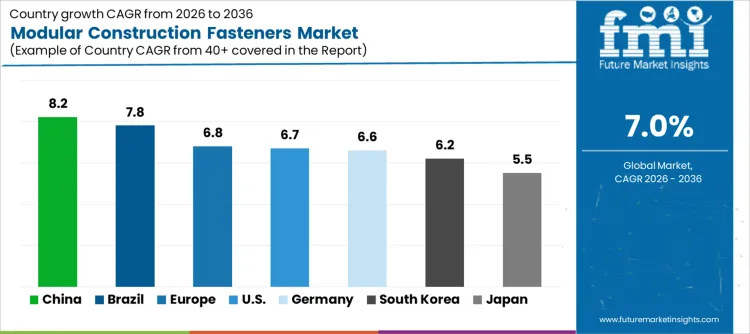
| Country | CAGR (%) |
|---|---|
| China | 8.2% |
| Brazil | 7.8% |
| Europe | 6.8% |
| USA. | 6.7% |
| Germany | 6.6% |
| South Korea | 6.2% |
| Japan | 5.5% |
What drives China's Market Leadership?
China's modular construction fasteners market is projected to achieve a CAGR of 8.2%, representing the highest growth rate globally and reflecting the country's massive urbanization program, government support for prefabricated construction, and manufacturing capabilities that enable large-scale modular building implementation.
Chinese government initiatives including the National New-type Urbanization Plan promote industrialized construction methods while establishing specific targets for prefabricated building adoption that drive demand for specialized fastening systems. The integration of modular construction with smart city development creates opportunities for advanced fastening technologies that support intelligent building systems.
Chinese manufacturing capabilities in steel processing and fastener production enable cost-effective modular construction fastener development while serving both domestic and export markets with growing modular construction adoption.
Government policies promoting construction industrialization include incentives for modular construction projects while establishing quality standards that drive demand for reliable fastening systems. Research institutions and companies collaborate on developing advanced fastening technologies specifically designed for Chinese modular construction requirements and building practices.
Why Is Brazil Emerging as a Strategic Growth Market?
Brazil's modular construction fasteners market is expected to grow at a CAGR of 7.8%, driven by the country's housing shortage, government programs promoting affordable housing construction, and increasing adoption of modular building methods that address cost and speed challenges in residential development. Brazilian housing programs including Minha Casa Minha Vida create substantial demand for cost-effective construction methods while modular approaches provide advantages in project delivery speed and quality control that support program objectives.
The establishment of modular construction manufacturing facilities by domestic and international companies creates demand for specialized fastening systems while building local expertise in prefabricated construction methods. Brazil's construction industry increasingly recognizes modular construction benefits while developing supply chain capabilities that support growing market adoption. Government initiatives promoting construction innovation include support for modular construction technology development and implementation programs.
How Are European Standards Driving Global Technology Development?
Europe's modular construction fasteners market is likely to rise at a CAGR of 6.8%, supported by comprehensive regulatory frameworks, environmental sustainability requirements, and advanced construction technology development that creates demand for sophisticated fastening solutions meeting stringent performance standards. European building codes increasingly accommodate modular construction while establishing specific requirements for component connections and quality assurance that influence fastener development across global markets.
European research institutions and companies advance modular construction technology through collaborative programs while developing innovative fastening solutions that address sustainability and performance requirements. The emphasis on circular economy principles drives development of fastening systems that support building disassembly and component reuse while maintaining structural performance throughout building lifecycle. Energy efficiency requirements increasingly influence fastening system design to minimize thermal bridging while maintaining structural integrity.
How Are US Housing Challenges Accelerating Technology Adoption?
The United States modular construction fasteners market is projected to record a CAGR of 6.7%, reflecting housing affordability challenges, skilled labor shortages, and increasing recognition of modular construction benefits that drive adoption across residential and commercial construction sectors. American housing policy increasingly supports innovative construction methods while state and local governments implement programs that encourage modular construction adoption for affordable housing development.
US building code development increasingly addresses modular construction requirements while research institutions advance technology development through collaborative programs with industry partners. The emphasis on disaster-resilient construction creates opportunities for modular building methods using specialized fastening systems that provide enhanced structural performance while enabling rapid construction for disaster recovery applications.
How Does Germany's Engineering Excellence Shape Technology Standards?
Germany's modular construction fasteners market is likely to rise at a CAGR of 6.6%, reflecting the country's engineering excellence in construction technology and systematic approach to building innovation that creates demand for precision fastening solutions meeting exceptional performance standards. German building standards often establish global benchmarks while research institutions advance fundamental understanding of modular construction structural behavior and connection performance requirements.
German companies leverage expertise in precision manufacturing and materials science to develop advanced fastening solutions while established construction practices create stable demand for proven modular construction technologies. The focus on building performance optimization drives development of fastening systems that provide measurable advantages in structural efficiency while maintaining compatibility with established German construction practices and quality standards.
Why does South Korea Emphasize Technology Integration?
South Korea's modular construction fasteners market is projected to increase at a CAGR of 6.2%, driven by advanced manufacturing capabilities, smart construction initiatives, and government support for construction innovation that creates opportunities for sophisticated fastening technologies integrated with building automation and monitoring systems. Korean companies invest heavily in advanced construction technology while building expertise in automated construction methods and quality control systems.
Government support for smart city development includes promotion of intelligent building systems while modular construction provides platforms for implementing advanced building technologies. Korean manufacturers focus on developing fastening systems that integrate with building information modeling and construction automation while meeting international standards for structural performance and quality assurance.
How does Japan's Quality Culture Drive Premium Technology Adoption?
Japan's modular construction fasteners market is likely to expand at a CAGR of 5.5%, reflecting the country's emphasis on precision manufacturing and quality excellence that creates demand for premium fastening solutions meeting exceptional reliability and performance standards. Japanese construction practices emphasize systematic quality control while modular construction methods align with traditional Japanese manufacturing principles including continuous improvement and defect elimination.
Japanese companies prioritize fastening technologies that demonstrate superior long-term performance while addressing specific requirements including seismic resistance and dimensional precision that characterize Japanese construction practices. The focus on disaster-resilient construction drives development of fastening systems that provide enhanced structural performance while enabling rapid construction for disaster recovery and infrastructure replacement applications.
How are Manufacturers Securing Market Share in Modular Construction Fasteners?
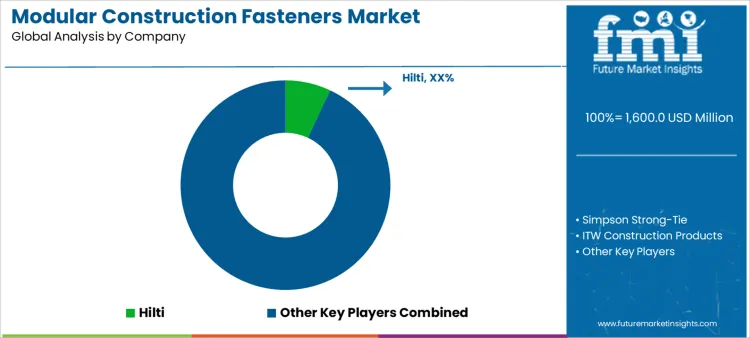
Manufacturers are winning share by solving the on-site pain points that modular builders care about most: fast installation, repeatable structural performance, and fewer inspection issues. Established hardware brands, specialist fastener firms, and newer connection-system players compete on how quickly crews can make a compliant connection with minimal tools, and how reliably that joint performs after transport loads, lifting, and final set.
Ease of installation matters as much as strength because modular projects run on tight schedules and fixed labor windows. Suppliers that can provide clear installation tolerances, traceability, and documented performance against relevant building codes tend to get specified more often.
Product development is aimed at modular-specific needs rather than traditional framing. That includes connection designs that self-align, reduce rework, and support quality checks in factory settings, plus systems that handle repeated handling and dimensional variation between modules. Leading companies back this with testing and validation programs, then translate the results into standard connection details that modular manufacturers can reuse across projects.
The strongest players also sell support, not just parts. They offer connection design input, installer training, project-specific engineering help, and reliable supply so factories do not stop for missing components. As modular expands into new regions, suppliers with local inventory and code familiarity gain an edge.
Key Players in the Modular Construction Fasteners Market
- Hilti
- Simpson Strong-Tie
- ITW Construction Products
- fischer Group
- Würth
- SPAX International
- SFS Group
- Lindapter
- DEWALT Construction Fasteners
- BTM Fasteners
Scope of Report
| Items | Values |
|---|---|
| Quantitative Units | USD Million |
| Fastener Type Segments | Bolts and Structural Screws; Anchors and Expansion Systems; Modular Connectors and Brackets; Other Specialized Fasteners |
| Construction System Categories | Volumetric/3D Modules; Panelized Systems; Hybrid/Component-Based |
| End-Use Sector Types | Residential Buildings; Non-Residential; Social Infrastructure; Industrial and Other |
| Material Categories | Carbon Steel; Stainless Steel; Alloy/High-Strength Steel; Other Materials/Coated Systems |
| Regions Covered | North America, Europe, Asia Pacific, Latin America, Middle East & Africa |
| Key Countries | USA, Germany, China, Brazil, U.K., South Korea, Japan |
| Key Companies Profiled | Hilti, Simpson Strong-Tie, ITW Construction Products, fischer Group, Würth, and others |
Modular Construction Fasteners Market by Segments
By Fastener Type
- Bolts and Structural Screws
- Anchors and Expansion Systems
- Modular Connectors and Brackets
- Other Specialized Fasteners
By Construction System
- Volumetric/3D Modules
- Panelized Systems
- Hybrid/Component-Based
By End-Use Sector
- Residential Buildings
- Non-Residential (Commercial/Offices)
- Social Infrastructure (Healthcare, Education)
- Industrial and Other
By Material
- Carbon Steel
- Stainless Steel
- Alloy/High-Strength Steel
- Other Materials/Coated Systems
Bibliography
- International Code Council. (2024). International Building Code: Provisions for modular and prefabricated construction. ICC Publications.
- Modular Building Institute. (2024). Fastening systems for permanent modular construction: Technical guidelines. MBI Technical Report Series.
- National Institute of Standards and Technology. (2024). Structural performance of modular construction connections. (NIST Special Publication 1800 28).
Frequently Asked Questions
How big is the modular construction fasteners market in 2026?
The global modular construction fasteners market is estimated to be valued at USD 1,600.0 million in 2026.
What will be the size of modular construction fasteners market in 2036?
The market size for the modular construction fasteners market is projected to reach USD 3,147.4 million by 2036.
How much will be the modular construction fasteners market growth between 2026 and 2036?
The modular construction fasteners market is expected to grow at a 7.0% CAGR between 2026 and 2036.
What are the key product types in the modular construction fasteners market?
The key product types in modular construction fasteners market are bolts and structural screws, anchors and expansion systems, modular connectors and brackets and other specialized fasteners.
Which construction system segment to contribute significant share in the modular construction fasteners market in 2026?
In terms of construction system, panelized systems segment to command 38.0% share in the modular construction fasteners market in 2026.
Preview the report firsthand - request a free sample
Get SampleGet the brochure for pricing and purchase details.
Get PDFTable of Content
- Executive Summary
- Global Market Outlook
- Demand-side Trends
- Supply-side Trends
- Technology Roadmap Analysis
- Analysis and Recommendations
- Market Overview
- Market Coverage / Taxonomy
- Market Definition / Scope / Limitations
- Market Background
- Market Dynamics
- Drivers
- Restraints
- Opportunity
- Trends
- Scenario Forecast
- Demand in Optimistic Scenario
- Demand in Likely Scenario
- Demand in Conservative Scenario
- Opportunity Map Analysis
- Product Life Cycle Analysis
- Supply Chain Analysis
- Investment Feasibility Matrix
- Value Chain Analysis
- PESTLE and Porter’s Analysis
- Regulatory Landscape
- Regional Parent Market Outlook
- Production and Consumption Statistics
- Import and Export Statistics
- Market Dynamics
- Global Market Analysis 2021 to 2025 and Forecast, 2026 to 2036
- Historical Market Size Value (USD Million) Analysis, 2021 to 2025
- Current and Future Market Size Value (USD Million) Projections, 2026 to 2036
- Y-o-Y Growth Trend Analysis
- Absolute $ Opportunity Analysis
- Global Market Pricing Analysis 2021 to 2025 and Forecast 2026 to 2036
- Global Market Analysis 2021 to 2025 and Forecast 2026 to 2036, By Fastener Type
- Introduction / Key Findings
- Historical Market Size Value (USD Million) Analysis By Fastener Type , 2021 to 2025
- Current and Future Market Size Value (USD Million) Analysis and Forecast By Fastener Type , 2026 to 2036
- Bolts and Structural Screws
- Anchors and Expansion Systems
- Modular Connectors and Brackets
- Other Specialized Fasteners
- Bolts and Structural Screws
- Y-o-Y Growth Trend Analysis By Fastener Type , 2021 to 2025
- Absolute $ Opportunity Analysis By Fastener Type , 2026 to 2036
- Global Market Analysis 2021 to 2025 and Forecast 2026 to 2036, By Construction System
- Introduction / Key Findings
- Historical Market Size Value (USD Million) Analysis By Construction System, 2021 to 2025
- Current and Future Market Size Value (USD Million) Analysis and Forecast By Construction System, 2026 to 2036
- Panelized Systems
- Volumetric/3D Modules
- Hybrid/Component-Based
- Panelized Systems
- Y-o-Y Growth Trend Analysis By Construction System, 2021 to 2025
- Absolute $ Opportunity Analysis By Construction System, 2026 to 2036
- Global Market Analysis 2021 to 2025 and Forecast 2026 to 2036, By End-Use Sector
- Introduction / Key Findings
- Historical Market Size Value (USD Million) Analysis By End-Use Sector, 2021 to 2025
- Current and Future Market Size Value (USD Million) Analysis and Forecast By End-Use Sector, 2026 to 2036
- Non-Residential (Commercial/Offices)
- Residential Buildings
- Social Infrastructure (Healthcare, Education)
- Industrial and Other
- Non-Residential (Commercial/Offices)
- Y-o-Y Growth Trend Analysis By End-Use Sector, 2021 to 2025
- Absolute $ Opportunity Analysis By End-Use Sector, 2026 to 2036
- Global Market Analysis 2021 to 2025 and Forecast 2026 to 2036, By Material
- Introduction / Key Findings
- Historical Market Size Value (USD Million) Analysis By Material, 2021 to 2025
- Current and Future Market Size Value (USD Million) Analysis and Forecast By Material, 2026 to 2036
- Carbon Steel
- Stainless Steel
- Alloy/High-Strength Steel
- Other Materials/Coated Systems
- Carbon Steel
- Y-o-Y Growth Trend Analysis By Material, 2021 to 2025
- Absolute $ Opportunity Analysis By Material, 2026 to 2036
- Global Market Analysis 2021 to 2025 and Forecast 2026 to 2036, By Region
- Introduction
- Historical Market Size Value (USD Million) Analysis By Region, 2021 to 2025
- Current Market Size Value (USD Million) Analysis and Forecast By Region, 2026 to 2036
- North America
- Latin America
- Western Europe
- Eastern Europe
- East Asia
- South Asia and Pacific
- Middle East & Africa
- Market Attractiveness Analysis By Region
- North America Market Analysis 2021 to 2025 and Forecast 2026 to 2036, By Country
- Historical Market Size Value (USD Million) Trend Analysis By Market Taxonomy, 2021 to 2025
- Market Size Value (USD Million) Forecast By Market Taxonomy, 2026 to 2036
- By Country
- USA
- Canada
- Mexico
- By Fastener Type
- By Construction System
- By End-Use Sector
- By Material
- By Country
- Market Attractiveness Analysis
- By Country
- By Fastener Type
- By Construction System
- By End-Use Sector
- By Material
- Key Takeaways
- Latin America Market Analysis 2021 to 2025 and Forecast 2026 to 2036, By Country
- Historical Market Size Value (USD Million) Trend Analysis By Market Taxonomy, 2021 to 2025
- Market Size Value (USD Million) Forecast By Market Taxonomy, 2026 to 2036
- By Country
- Brazil
- Chile
- Rest of Latin America
- By Fastener Type
- By Construction System
- By End-Use Sector
- By Material
- By Country
- Market Attractiveness Analysis
- By Country
- By Fastener Type
- By Construction System
- By End-Use Sector
- By Material
- Key Takeaways
- Western Europe Market Analysis 2021 to 2025 and Forecast 2026 to 2036, By Country
- Historical Market Size Value (USD Million) Trend Analysis By Market Taxonomy, 2021 to 2025
- Market Size Value (USD Million) Forecast By Market Taxonomy, 2026 to 2036
- By Country
- Germany
- UK
- Italy
- Spain
- France
- Nordic
- BENELUX
- Rest of Western Europe
- By Fastener Type
- By Construction System
- By End-Use Sector
- By Material
- By Country
- Market Attractiveness Analysis
- By Country
- By Fastener Type
- By Construction System
- By End-Use Sector
- By Material
- Key Takeaways
- Eastern Europe Market Analysis 2021 to 2025 and Forecast 2026 to 2036, By Country
- Historical Market Size Value (USD Million) Trend Analysis By Market Taxonomy, 2021 to 2025
- Market Size Value (USD Million) Forecast By Market Taxonomy, 2026 to 2036
- By Country
- Russia
- Poland
- Hungary
- Balkan & Baltic
- Rest of Eastern Europe
- By Fastener Type
- By Construction System
- By End-Use Sector
- By Material
- By Country
- Market Attractiveness Analysis
- By Country
- By Fastener Type
- By Construction System
- By End-Use Sector
- By Material
- Key Takeaways
- East Asia Market Analysis 2021 to 2025 and Forecast 2026 to 2036, By Country
- Historical Market Size Value (USD Million) Trend Analysis By Market Taxonomy, 2021 to 2025
- Market Size Value (USD Million) Forecast By Market Taxonomy, 2026 to 2036
- By Country
- China
- Japan
- South Korea
- By Fastener Type
- By Construction System
- By End-Use Sector
- By Material
- By Country
- Market Attractiveness Analysis
- By Country
- By Fastener Type
- By Construction System
- By End-Use Sector
- By Material
- Key Takeaways
- South Asia and Pacific Market Analysis 2021 to 2025 and Forecast 2026 to 2036, By Country
- Historical Market Size Value (USD Million) Trend Analysis By Market Taxonomy, 2021 to 2025
- Market Size Value (USD Million) Forecast By Market Taxonomy, 2026 to 2036
- By Country
- India
- ASEAN
- Australia & New Zealand
- Rest of South Asia and Pacific
- By Fastener Type
- By Construction System
- By End-Use Sector
- By Material
- By Country
- Market Attractiveness Analysis
- By Country
- By Fastener Type
- By Construction System
- By End-Use Sector
- By Material
- Key Takeaways
- Middle East & Africa Market Analysis 2021 to 2025 and Forecast 2026 to 2036, By Country
- Historical Market Size Value (USD Million) Trend Analysis By Market Taxonomy, 2021 to 2025
- Market Size Value (USD Million) Forecast By Market Taxonomy, 2026 to 2036
- By Country
- Kingdom of Saudi Arabia
- Other GCC Countries
- Turkiye
- South Africa
- Other African Union
- Rest of Middle East & Africa
- By Fastener Type
- By Construction System
- By End-Use Sector
- By Material
- By Country
- Market Attractiveness Analysis
- By Country
- By Fastener Type
- By Construction System
- By End-Use Sector
- By Material
- Key Takeaways
- Key Countries Market Analysis
- USA
- Pricing Analysis
- Market Share Analysis, 2025
- By Fastener Type
- By Construction System
- By End-Use Sector
- By Material
- Canada
- Pricing Analysis
- Market Share Analysis, 2025
- By Fastener Type
- By Construction System
- By End-Use Sector
- By Material
- Mexico
- Pricing Analysis
- Market Share Analysis, 2025
- By Fastener Type
- By Construction System
- By End-Use Sector
- By Material
- Brazil
- Pricing Analysis
- Market Share Analysis, 2025
- By Fastener Type
- By Construction System
- By End-Use Sector
- By Material
- Chile
- Pricing Analysis
- Market Share Analysis, 2025
- By Fastener Type
- By Construction System
- By End-Use Sector
- By Material
- Germany
- Pricing Analysis
- Market Share Analysis, 2025
- By Fastener Type
- By Construction System
- By End-Use Sector
- By Material
- UK
- Pricing Analysis
- Market Share Analysis, 2025
- By Fastener Type
- By Construction System
- By End-Use Sector
- By Material
- Italy
- Pricing Analysis
- Market Share Analysis, 2025
- By Fastener Type
- By Construction System
- By End-Use Sector
- By Material
- Spain
- Pricing Analysis
- Market Share Analysis, 2025
- By Fastener Type
- By Construction System
- By End-Use Sector
- By Material
- France
- Pricing Analysis
- Market Share Analysis, 2025
- By Fastener Type
- By Construction System
- By End-Use Sector
- By Material
- India
- Pricing Analysis
- Market Share Analysis, 2025
- By Fastener Type
- By Construction System
- By End-Use Sector
- By Material
- ASEAN
- Pricing Analysis
- Market Share Analysis, 2025
- By Fastener Type
- By Construction System
- By End-Use Sector
- By Material
- Australia & New Zealand
- Pricing Analysis
- Market Share Analysis, 2025
- By Fastener Type
- By Construction System
- By End-Use Sector
- By Material
- China
- Pricing Analysis
- Market Share Analysis, 2025
- By Fastener Type
- By Construction System
- By End-Use Sector
- By Material
- Japan
- Pricing Analysis
- Market Share Analysis, 2025
- By Fastener Type
- By Construction System
- By End-Use Sector
- By Material
- South Korea
- Pricing Analysis
- Market Share Analysis, 2025
- By Fastener Type
- By Construction System
- By End-Use Sector
- By Material
- Russia
- Pricing Analysis
- Market Share Analysis, 2025
- By Fastener Type
- By Construction System
- By End-Use Sector
- By Material
- Poland
- Pricing Analysis
- Market Share Analysis, 2025
- By Fastener Type
- By Construction System
- By End-Use Sector
- By Material
- Hungary
- Pricing Analysis
- Market Share Analysis, 2025
- By Fastener Type
- By Construction System
- By End-Use Sector
- By Material
- Kingdom of Saudi Arabia
- Pricing Analysis
- Market Share Analysis, 2025
- By Fastener Type
- By Construction System
- By End-Use Sector
- By Material
- Turkiye
- Pricing Analysis
- Market Share Analysis, 2025
- By Fastener Type
- By Construction System
- By End-Use Sector
- By Material
- South Africa
- Pricing Analysis
- Market Share Analysis, 2025
- By Fastener Type
- By Construction System
- By End-Use Sector
- By Material
- USA
- Market Structure Analysis
- Competition Dashboard
- Competition Benchmarking
- Market Share Analysis of Top Players
- By Regional
- By Fastener Type
- By Construction System
- By End-Use Sector
- By Material
- Competition Analysis
- Competition Deep Dive
- Hilti
- Overview
- Product Portfolio
- Profitability by Market Segments (Product/Age /Sales Channel/Region)
- Sales Footprint
- Strategy Overview
- Marketing Strategy
- Product Strategy
- Channel Strategy
- Simpson Strong-Tie
- ITW Construction Products
- fischer Group
- Würth
- SPAX International
- SFS Group
- Lindapter
- DEWALT Construction Fasteners
- BTM Fasteners
- Hilti
- Competition Deep Dive
- Assumptions & Acronyms Used
- Research Methodology


