

- Industry Size (2026)
- USD 690.0 Mn
- Forecast (2036)
- USD 1031.2 Mn
- CAGR (2026 to 2036)
- 4.1%
Air Compressor Pressure Switch Market Forecast and Outlook 2026 to 2036
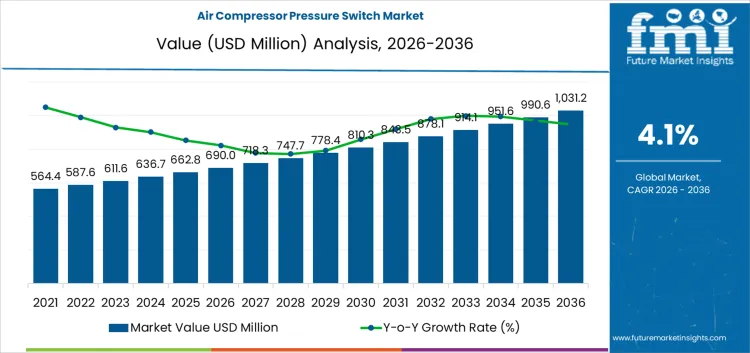
The air compressor pressure switch market is growing from USD 690.0 million in 2026 and is projected to reach USD 1,031.2 million by 2036, reflecting a CAGR of 4.10%. Early demand is shaped by inspection regimes, insurance requirements, and plant safety audits that treat overpressure incidents as reportable events. Switch specifications are often written into compliance checklists, which limits substitution after approval. Purchasing decisions favor devices with proven trip accuracy, sealed housings, and traceable test records. As the period advances, buying behavior becomes more influenced by documentation standards and liability management practices.
Equipment owners prioritize components that simplify audit trails and incident investigations. Product selection becomes less about control strategy and more about defensibility in failure reviews. Supplier lists narrow around manufacturers able to support certification and long term documentation. Pricing remains under pressure, yet minimum compliance thresholds prevent quality dilution. Growth follows the expansion of regulated industrial capacity and stricter enforcement routines rather than shifts in compressor technology or workshop tool usage.
Quick Stats of the Air Compressor Pressure Switch Market
- Air Compressor Pressure Switch Market Value (2026): USD 690.0 million
- Air Compressor Pressure Switch Forecast Value (2036): USD 1,031.2 million
- Air Compressor Pressure Switch Forecast CAGR 2026 to 2036: 4.1%
- Leading Control Method in Air Compressor Pressure Switch Market: Mechanical Switches (54 % share)
- Leading Pressure Range in Air Compressor Pressure Switch Market: Up to 10 bar (44 % share)
- Key Growth Regions in Air Compressor Pressure Switch Market: India, Vietnam, Mexico, China, Brazil
- Top Players in Air Compressor Pressure Switch Market: Danfoss, Schneider Electric, Honeywell, Emerson, Siemens, ABB, Eaton, SMC Corporation, Parker Hannifin
What is the Growth Forecast for Air Compressor Pressure Switch Market through 2036?
Between 2026 and 2031, the air compressor pressure switch market is projected to increase from USD 690.0 million along a moderate trajectory consistent with a 4.1% CAGR, reflecting its role as a control and safety component rather than a value-driving system upgrade. Mechanical switches continue to dominate volumes because they satisfy most industrial duty cycles at low cost and with predictable behavior. Demand is anchored in industrial compressors and replacement needs within existing installations, not in frequent redesigns of compressor platforms. Purchasing often occurs through automation distributors and OEM channels as part of broader maintenance or equipment supply contracts. Specification decisions emphasize reliability, repeatability, and compliance with electrical and pressure safety standards rather than feature differentiation.
From 2031 to 2036, the market is expected to reach USD 1,031.2 million, with growth shaped by gradual shifts in compressor usage patterns and safety expectations rather than by disruptive technology change. Electronic and higher-pressure rated switches gain selective share in applications where monitoring accuracy, diagnostics, or hazardous area certification are required. Even so, the category remains driven by installed base expansion and service replacement cycles. Competitive positioning depends on certification portfolios, manufacturing scale, and distribution reach more than on product novelty. This supports established automation and control suppliers such as Danfoss, Schneider Electric, Honeywell, Emerson, Siemens, ABB, Eaton, SMC Corporation, Parker Hannifin, and a wide set of regional suppliers.
Air Compressor Pressure Switch Market Key Takeaways
| Metric | Value |
|---|---|
| Market Value (2026) | USD 690.0 million |
| Forecast Value (2036) | USD 1,031.2 million |
| Forecast CAGR 2026 to 2036 | 4.1% |
How Are Air Compressor Pressure Switches Enhancing System Control and Efficiency?
Air compressor pressure switches are increasingly adopted to regulate compressor operation, maintain desired system pressure, and protect equipment from over-pressurization. Historically, manual monitoring or basic mechanical switches provided limited control, resulting in pressure fluctuations, energy inefficiency, and increased wear on compressor components. Modern pressure switches integrate precise sensing, adjustable setpoints, and electronic or mechanical actuation to optimize start-stop cycles, reduce energy consumption, and ensure safety. Industrial equipment manufacturers, facility operators, and OEMs prioritize reliability, response accuracy, and compatibility with various compressor types. Early adoption focused on high-demand industrial environments, while current demand spans manufacturing plants, automotive workshops, and commercial facilities, driven by automation, energy efficiency goals, and operational safety standards. Pressure sensitivity, response time, and durability influence supplier selection.
Increasing industrial automation, energy management requirements, and equipment safety regulations are shaping market growth. Compared with conventional mechanical switches, modern pressure switches emphasize precise pressure control, long service life, and integration with automated compressor systems. Cost structures depend on sensor accuracy, actuation mechanisms, and manufacturing quality, concentrating margins among suppliers capable of delivering high-performance, reliable components. Operators adopt these switches to optimize air system performance, reduce energy waste, and maintain safe operating conditions. By 2036, air compressor pressure switches are expected to become standard across industrial, commercial, and automotive applications, supporting energy efficiency, operational reliability, and system protection.
What Factors Are Shaping the Demand for Air Compressor Pressure Switches by Control Method and Operating Pressure in 2026?
The air compressor pressure switch market in 2026 is segmented by switch type and by pressure range. By control method, demand is divided into mechanical, electronic, explosion proof, and other switch formats that differ in sensing method, durability, and integration depth. By pressure range, demand is organized around applications up to 10 bar, 10 to 25 bar, above 25 bar, and other ranges that reflect compressor class and end use requirements. These segments reflect how users balance reliability, safety certification, control precision, and cost while specifying components that directly govern compressor cycling behavior and system protection.
Why Do Mechanical Pressure Switches Retain the Majority of the Installed Base?
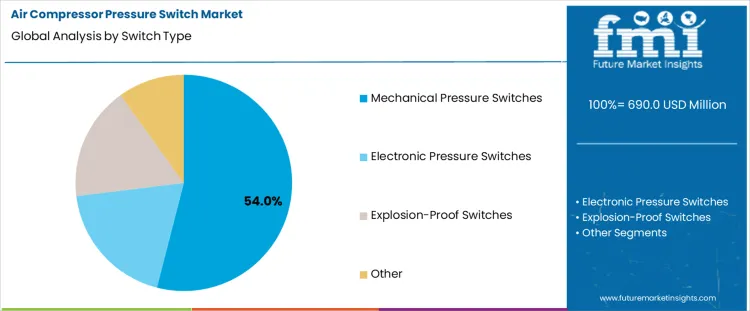
Mechanical pressure switches account for about 54% of demand in 2026, reflecting their long record of dependable operation in basic compressor control. These devices rely on springs and diaphragms rather than electronics, which makes them tolerant to heat, vibration, and electrical noise. Many compressors operate in workshops or industrial spaces where environmental conditions are not tightly controlled, and mechanical designs continue to function without calibration drift or software issues. Their simple construction also keeps unit costs low and replacement straightforward. Technicians are familiar with their adjustment and failure modes, which reduces service time. This combination of robustness, low cost, and field familiarity keeps mechanical switches as the default choice in many standard air systems.
Electronic and explosion proof switches serve more specialized requirements. Electronic units provide finer control resolution, digital displays, and communication capabilities, which suits automated or monitored installations. Explosion proof switches address hazardous environments where ignition risk must be contained through certified enclosures and materials. Both categories involve higher purchase cost and more complex installation or approval processes. Their use is driven by regulatory or process needs rather than by basic compressor operation. As a result, these switches grow in specific industries such as chemicals, oil and gas, or highly automated plants, while mechanical designs continue to dominate the broad base of general purpose compressor applications.
Why Does the Up to 10 Bar Segment Dominate Pressure Range Demand?
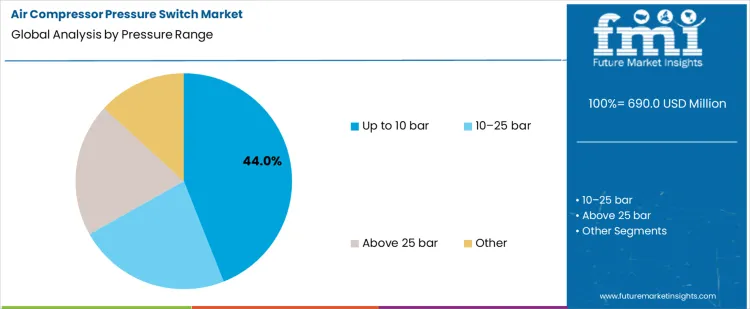
Applications up to 10 bar represent about 44% of demand in 2026 because this range covers the majority of workshop, service, and light industrial compressors. Many pneumatic tools and small machines are designed around this pressure class, which makes it the most common specification point for new installations and replacements. Systems in this range also place less stress on components, which allows the use of simpler and lower cost switches. The large population of such compressors in garages, small factories, and maintenance facilities drives high replacement volume. This broad and fragmented installed base explains why the lowest pressure range accounts for the largest share of pressure switch demand.
The 10 to 25 bar and above 25 bar segments serve heavier industrial processes and specialized equipment. These systems require more robust components, tighter safety margins, and in some cases certified explosion proof designs. Their installations are fewer in number and usually planned as part of larger projects rather than routine purchases. Replacement cycles are also longer because maintenance is more controlled. While these segments represent significant value per unit, their overall volumes remain lower because the number of high pressure compressor systems is small compared with the widespread population of low pressure units used in everyday industrial and service applications.
Why Are Equipment Protection Needs and Automation Simplicity Keeping Pressure Switches Central to Air Compressor Systems through 2036?
Demand persists because pressure switches perform a basic control and safety role that is difficult to remove. They define cut in and cut out points, protect compressors from overpressure, and provide a simple, independent control loop that does not rely on software or networks. In many workshops and industrial plants, this simplicity is valued because it is easy to understand, troubleshoot, and certify. Even where variable speed drives and digital controllers are used, a mechanical or electromechanical switch is often retained as a backup. Replacement demand from the vast installed base keeps volumes steady regardless of new compressor sales cycles.
What Accuracy Limits, Wear, and Substitution Risk Are Constraining Value Growth in This Segment?
Constraints come from both physics and system design. Mechanical contacts wear, calibration drifts, and switching accuracy is limited compared with electronic sensors. In applications that require tight pressure bands or frequent cycling, users increasingly prefer transducers feeding into digital controllers. This shifts value away from simple switches. At the same time, pressure switches are treated as low cost components, which encourages price competition and frequent supplier changes. Failures are tolerated because replacement is easy and cheap, further reducing willingness to pay for premium designs. These factors keep unit volumes healthy but cap average selling prices and innovation budgets.
How Are Control Architecture Changes and Safety Practices Reshaping the Role of Pressure Switches?
The role is being redefined rather than eliminated. As compressors adopt integrated controllers and remote monitoring, pressure switches are moving toward secondary or safety functions instead of primary regulation. Some systems use them purely as hard stop devices to satisfy safety codes. Modular compressor packages standardize switch specifications across multiple models, reducing variation but increasing volumes per part number. In parallel, stricter machinery safety audits emphasize redundant protection layers, which preserves a place for simple, independent devices. The category is shifting from a control centerpiece to a reliability and compliance component embedded within more complex automation environments.
What is the Demand for Air Compressor Pressure Switch by Country?
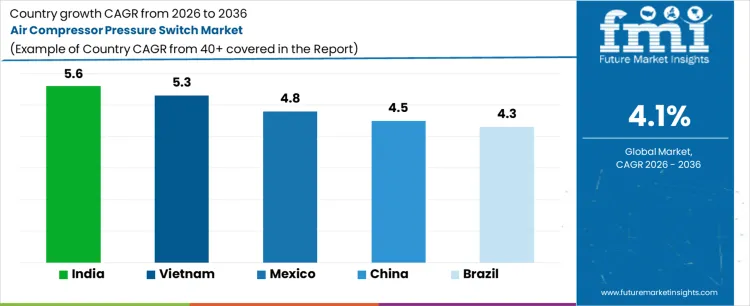
| Country | CAGR (%) |
|---|---|
| India | 5.6% |
| Vietnam | 5.3% |
| Mexico | 4.8% |
| China | 4.5% |
| Brazil | 4.3% |
Demand for air compressor pressure switches is rising as industrial and manufacturing facilities adopt reliable components for maintaining optimal air pressure, ensuring safety, and enhancing operational efficiency. India leads with a 5.6% CAGR, driven by rapid industrialization, expansion of manufacturing plants, and rising adoption of automated compressed air systems. Vietnam follows at 5.3%, supported by growth in industrial sectors and installation of air compressors in production facilities. Mexico records 4.8% growth, shaped by industrial equipment modernization. China grows at 4.5%, reflecting steady adoption in manufacturing and maintenance operations. Brazil shows 4.3% CAGR, influenced by moderate industrial expansion and replacement demand for air compressor components.
How is India experiencing growth in the air compressor pressure switch market?
India is experiencing growth at a CAGR of 5.6%, driven by rapid industrial expansion in automotive, textiles, and manufacturing clusters such as Pune, Chennai, and Bengaluru. Increasing adoption of automated production lines has raised demand for precise pressure regulation in compressed air systems. Suppliers are providing switches optimized for high reliability under heavy-duty operations in tropical climates where humidity can affect air quality. Investments focus on durability, material resilience, and compliance with national industrial standards. Growth is supported by government initiatives to enhance manufacturing competitiveness and the expansion of mid-sized and large-scale factories across Tier-1 and Tier-2 cities.
- Industrial expansion in automotive and textiles drives adoption.
- Switches optimize reliability in high-humidity conditions.
- Manufacturing hubs like Pune and Chennai concentrate demand.
- Material durability and compliance with national standards guide investment.
How is Vietnam witnessing growth in the air compressor pressure switch market?
Vietnam is witnessing growth at a CAGR of 5.3%, fueled by the growth of export-oriented manufacturing zones in Ho Chi Minh City and Hanoi. Industries such as electronics, textiles, and food processing require precise compressed air control to maintain quality standards. Local suppliers are producing switches designed for consistent pressure stability in high-temperature tropical conditions. Investments focus on energy-efficient operation and compliance with industrial safety regulations. Growth reflects increasing foreign direct investment in manufacturing, expansion of industrial parks, and modernization of older air systems to support automated production lines.
- Export-oriented manufacturing drives adoption.
- Switches provide stable pressure control in tropical climates.
- Ho Chi Minh City and Hanoi industrial zones concentrate demand.
- Energy efficiency and industrial compliance guide investment.
How is Mexico experiencing growth in the air compressor pressure switch market?
Mexico is experiencing growth at a CAGR of 4.8%, supported by the growth of automotive and aerospace clusters in Querétaro, Guanajuato, and Nuevo León. Compressed air systems are critical in assembly lines, where maintaining consistent pressure ensures quality and reduces downtime. Suppliers are offering switches optimized for long-term durability in industrial environments with fluctuating temperature and humidity. Investments focus on system reliability, material quality, and adherence to Mexican safety and manufacturing standards. Growth reflects strong foreign investment, expansion of maquiladora plants, and modernization of legacy industrial equipment.
- Automotive and aerospace clusters drive adoption.
- Switches optimize durability in variable environments.
- Industrial hubs like Querétaro and Guanajuato concentrate demand.
- Material quality and regulatory compliance guide investment.
How is China witnessing growth in the air compressor pressure switch market?
China is witnessing growth at a CAGR of 4.5%, driven by extensive industrial zones in Jiangsu, Guangdong, and Zhejiang where heavy machinery, automotive, and electronics manufacturing dominate. High-volume production requires precise compressed air regulation to prevent equipment damage and maintain efficiency. Suppliers are producing switches designed for high reliability in high-temperature and dusty environments typical of large factories. Investments prioritize system performance, longevity, and adherence to national industrial and electrical standards. Growth reflects industrial expansion, modernization of air systems, and adoption of automated production lines in key manufacturing provinces.
- Heavy manufacturing drives adoption.
- Switches maintain reliable pressure in high-temperature, dusty environments.
- Jiangsu, Guangdong, and Zhejiang industrial zones concentrate demand.
- System longevity and standards compliance guide investment.
How is Brazil experiencing growth in the air compressor pressure switch market?
Brazil is experiencing growth at a CAGR of 4.3%, supported by expansion in automotive, food processing, and agribusiness manufacturing hubs such as São Paulo, Minas Gerais, and Paraná. Compressed air is critical in production lines, requiring switches that maintain pressure stability under tropical heat and humidity. Suppliers are providing switches optimized for energy-efficient operation and long-term reliability. Investments focus on material performance, compliance with Brazilian industrial standards, and support for growing industrial automation. Growth reflects increased mechanization, industrial modernization programs, and rising demand for operational efficiency in manufacturing sectors.
- Automotive and agribusiness hubs drive adoption.
- Switches ensure stable operation in tropical conditions.
- São Paulo and Paraná industrial zones concentrate demand.
- Material performance and energy efficiency guide investment.
Who Competes in the Air Compressor Pressure Switch Market and What Defines Their Capabilities?
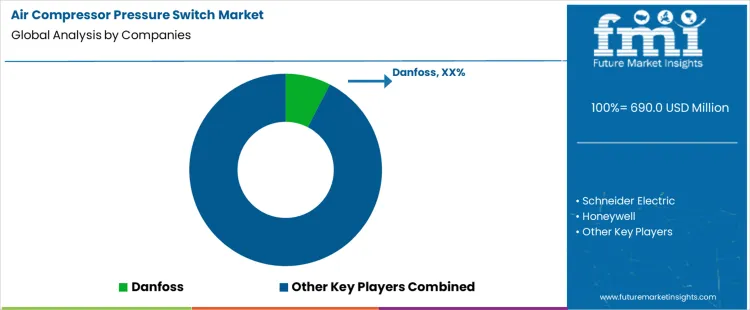
Competition in the air compressor pressure switch market is defined by switching accuracy, durability, and compatibility with industrial and commercial air systems. Danfoss supplies pressure switches engineered for precise activation, high reliability, and long operational life in diverse compressor applications. Schneider Electric develops switches optimized for industrial automation integration, stable performance, and environmental resilience. Honeywell provides switches with high sensitivity, repeatability, and compatibility with multiple compressor types. Emerson delivers components designed for robust operation under fluctuating pressures and temperatures. Siemens supplies pressure switches integrated with industrial control systems for consistent monitoring and operation.
ABB offers durable switches designed for high-pressure applications with reliable electrical contacts. Eaton provides pressure switch solutions optimized for energy efficiency and long-term stability. SMC Corporation delivers compact switches suitable for pneumatic and air compressor systems. Parker Hannifin supplies switches engineered for precise response and mechanical reliability. Other regional suppliers focus on cost-effective, customizable solutions for local markets. Competitive differentiation arises from switching precision, durability, temperature tolerance, ease of integration, and compatibility with various industrial and commercial air compressor systems.
Key Players in the Air Compressor Pressure Switch Market
- Danfoss
- Schneider Electric
- Honeywell
- Emerson
- Siemens
- ABB
- Eaton
- SMC Corporation
- Parker Hannifin
Scope of the Report
| Items | Values |
|---|---|
| Quantitative Units (2026) | USD million |
| Switch Type | Mechanical Pressure Switches, Electronic Pressure Switches, Explosion-Proof Switches, Other |
| Pressure Range | Up to 10 bar, 10-25 bar, Above 25 bar, Other |
| End Use | Industrial Compressors, Portable Compressors, Workshop/DIY, Other |
| Sales Channel | Automation Distributors, Compressor OEMs, E-commerce, Other |
| Regions Covered | Asia Pacific, Europe, North America, Latin America, Middle East & Africa |
| Countries Covered | China, Japan, South Korea, India, Australia & New Zealand, ASEAN, Germany, United Kingdom, France, Italy, Spain, Nordic, BENELUX, United States, Canada, Mexico, Brazil, Chile, Saudi Arabia, Turkey, South Africa, and other regional markets |
| Key Companies Profiled | Danfoss, Schneider Electric, Honeywell, Emerson, Siemens, ABB, Eaton, SMC Corporation, Parker Hannifin |
| Additional Attributes | Dollar sales by switch type, pressure range, end use, and sales channel, demand driven by inspection regimes, insurance requirements, and safety audits rather than by control system upgrades, mechanical switches dominating volumes due to simplicity and field familiarity, up to 10 bar range anchoring the majority of installations, procurement influenced by documentation, certification, and audit trail requirements, narrow supplier lists centered on certified manufacturers, replacement demand from a large installed base, and market growth tied to expansion of regulated industrial capacity and stricter enforcement routines rather than changes in compressor technology. |
Air Compressor Pressure Switch Market Segmentation
Switch Type:
- Mechanical Pressure Switches
- Electronic Pressure Switches
- Explosion-Proof Switches
- Other
Pressure Range:
- Up to 10 bar
- 10-25 bar
- Above 25 bar
- Other
End Use:
- Industrial Compressors
- Portable Compressors
- Workshop/DIY
- Other
Sales Channel:
- Automation Distributors
- Compressor OEMs
- E-commerce
- Other
Region:
- Asia Pacific
- China
- Japan
- South Korea
- India
- Australia & New Zealand
- ASEAN
- Rest of Asia Pacific
- Europe
- Germany
- United Kingdom
- France
- Italy
- Spain
- Nordic
- BENELUX
- Rest of Europe
- North America
- United States
- Canada
- Mexico
- Latin America
- Brazil
- Chile
- Rest of Latin America
- Middle East & Africa
- Kingdom of Saudi Arabia
- Other GCC Countries
- Turkey
- South Africa
- Other African Union
- Rest of Middle East & Africa
Bibliography
- American Society of Mechanical Engineers. (2023). ASME Boiler and Pressure Vessel Code, Section VIII: Pressure vessels.
- International Electrotechnical Commission. (2023). IEC 60947-5-1: Low-voltage switchgear and controlgear - Control circuit devices and switching elements.
- International Organization for Standardization. (2023). ISO 12100: Safety of machinery - General principles for design - Risk assessment and risk reduction.
- International Organization for Standardization. (2023). ISO 4126: Safety valves and bursting discs for overpressure protection.
- USA Department of Energy. (2023). Improving compressed air system performance: A sourcebook for industry.
Frequently Asked Questions
How big is the air compressor pressure switch market in 2026?
The global air compressor pressure switch market is estimated to be valued at USD 690.0 million in 2026.
What will be the size of air compressor pressure switch market in 2036?
The market size for the air compressor pressure switch market is projected to reach USD 1,031.2 million by 2036.
How much will be the air compressor pressure switch market growth between 2026 and 2036?
The air compressor pressure switch market is expected to grow at a 4.1% CAGR between 2026 and 2036.
What are the key product types in the air compressor pressure switch market?
The key product types in air compressor pressure switch market are mechanical pressure switches, electronic pressure switches, explosion-proof switches and other.
Which pressure range segment to contribute significant share in the air compressor pressure switch market in 2026?
In terms of pressure range, up to 10 bar segment to command 44.0% share in the air compressor pressure switch market in 2026.
Preview the report firsthand - request a free sample
Get SampleGet the brochure for pricing and purchase details.
Get PDFTable of Content
- Executive Summary
- Global Market Outlook
- Demand-side Trends
- Supply-side Trends
- Technology Roadmap Analysis
- Analysis and Recommendations
- Market Overview
- Market Coverage / Taxonomy
- Market Definition / Scope / Limitations
- Market Background
- Market Dynamics
- Drivers
- Restraints
- Opportunity
- Trends
- Scenario Forecast
- Demand in Optimistic Scenario
- Demand in Likely Scenario
- Demand in Conservative Scenario
- Opportunity Map Analysis
- Product Life Cycle Analysis
- Supply Chain Analysis
- Investment Feasibility Matrix
- Value Chain Analysis
- PESTLE and Porter’s Analysis
- Regulatory Landscape
- Regional Parent Market Outlook
- Production and Consumption Statistics
- Import and Export Statistics
- Market Dynamics
- Global Market Analysis 2021 to 2025 and Forecast, 2026 to 2036
- Historical Market Size Value (USD Million) Analysis, 2021 to 2025
- Current and Future Market Size Value (USD Million) Projections, 2026 to 2036
- Y-o-Y Growth Trend Analysis
- Absolute $ Opportunity Analysis
- Global Market Pricing Analysis 2021 to 2025 and Forecast 2026 to 2036
- Global Market Analysis 2021 to 2025 and Forecast 2026 to 2036, By Switch Type
- Introduction / Key Findings
- Historical Market Size Value (USD Million) Analysis By Switch Type, 2021 to 2025
- Current and Future Market Size Value (USD Million) Analysis and Forecast By Switch Type, 2026 to 2036
- Mechanical Pressure Switches
- Electronic Pressure Switches
- Explosion-Proof Switches
- Other
- Mechanical Pressure Switches
- Y-o-Y Growth Trend Analysis By Switch Type, 2021 to 2025
- Absolute $ Opportunity Analysis By Switch Type, 2026 to 2036
- Global Market Analysis 2021 to 2025 and Forecast 2026 to 2036, By Pressure Range
- Introduction / Key Findings
- Historical Market Size Value (USD Million) Analysis By Pressure Range, 2021 to 2025
- Current and Future Market Size Value (USD Million) Analysis and Forecast By Pressure Range, 2026 to 2036
- Up to 10 bar
- 10-25 bar
- Above 25 bar
- Other
- Up to 10 bar
- Y-o-Y Growth Trend Analysis By Pressure Range, 2021 to 2025
- Absolute $ Opportunity Analysis By Pressure Range, 2026 to 2036
- Global Market Analysis 2021 to 2025 and Forecast 2026 to 2036, By End Use
- Introduction / Key Findings
- Historical Market Size Value (USD Million) Analysis By End Use, 2021 to 2025
- Current and Future Market Size Value (USD Million) Analysis and Forecast By End Use, 2026 to 2036
- Industrial Compressors
- Portable Compressors
- Workshop/DIY
- Other
- Industrial Compressors
- Y-o-Y Growth Trend Analysis By End Use, 2021 to 2025
- Absolute $ Opportunity Analysis By End Use, 2026 to 2036
- Global Market Analysis 2021 to 2025 and Forecast 2026 to 2036, By Sales Channel
- Introduction / Key Findings
- Historical Market Size Value (USD Million) Analysis By Sales Channel, 2021 to 2025
- Current and Future Market Size Value (USD Million) Analysis and Forecast By Sales Channel, 2026 to 2036
- Automation Distributors
- Compressor OEMs
- E-commerce
- Other
- Automation Distributors
- Y-o-Y Growth Trend Analysis By Sales Channel, 2021 to 2025
- Absolute $ Opportunity Analysis By Sales Channel, 2026 to 2036
- Global Market Analysis 2021 to 2025 and Forecast 2026 to 2036, By Region
- Introduction
- Historical Market Size Value (USD Million) Analysis By Region, 2021 to 2025
- Current Market Size Value (USD Million) Analysis and Forecast By Region, 2026 to 2036
- North America
- Latin America
- Western Europe
- Eastern Europe
- East Asia
- South Asia and Pacific
- Middle East & Africa
- Market Attractiveness Analysis By Region
- North America Market Analysis 2021 to 2025 and Forecast 2026 to 2036, By Country
- Historical Market Size Value (USD Million) Trend Analysis By Market Taxonomy, 2021 to 2025
- Market Size Value (USD Million) Forecast By Market Taxonomy, 2026 to 2036
- By Country
- USA
- Canada
- Mexico
- By Switch Type
- By Pressure Range
- By End Use
- By Sales Channel
- By Country
- Market Attractiveness Analysis
- By Country
- By Switch Type
- By Pressure Range
- By End Use
- By Sales Channel
- Key Takeaways
- Latin America Market Analysis 2021 to 2025 and Forecast 2026 to 2036, By Country
- Historical Market Size Value (USD Million) Trend Analysis By Market Taxonomy, 2021 to 2025
- Market Size Value (USD Million) Forecast By Market Taxonomy, 2026 to 2036
- By Country
- Brazil
- Chile
- Rest of Latin America
- By Switch Type
- By Pressure Range
- By End Use
- By Sales Channel
- By Country
- Market Attractiveness Analysis
- By Country
- By Switch Type
- By Pressure Range
- By End Use
- By Sales Channel
- Key Takeaways
- Western Europe Market Analysis 2021 to 2025 and Forecast 2026 to 2036, By Country
- Historical Market Size Value (USD Million) Trend Analysis By Market Taxonomy, 2021 to 2025
- Market Size Value (USD Million) Forecast By Market Taxonomy, 2026 to 2036
- By Country
- Germany
- UK
- Italy
- Spain
- France
- Nordic
- BENELUX
- Rest of Western Europe
- By Switch Type
- By Pressure Range
- By End Use
- By Sales Channel
- By Country
- Market Attractiveness Analysis
- By Country
- By Switch Type
- By Pressure Range
- By End Use
- By Sales Channel
- Key Takeaways
- Eastern Europe Market Analysis 2021 to 2025 and Forecast 2026 to 2036, By Country
- Historical Market Size Value (USD Million) Trend Analysis By Market Taxonomy, 2021 to 2025
- Market Size Value (USD Million) Forecast By Market Taxonomy, 2026 to 2036
- By Country
- Russia
- Poland
- Hungary
- Balkan & Baltic
- Rest of Eastern Europe
- By Switch Type
- By Pressure Range
- By End Use
- By Sales Channel
- By Country
- Market Attractiveness Analysis
- By Country
- By Switch Type
- By Pressure Range
- By End Use
- By Sales Channel
- Key Takeaways
- East Asia Market Analysis 2021 to 2025 and Forecast 2026 to 2036, By Country
- Historical Market Size Value (USD Million) Trend Analysis By Market Taxonomy, 2021 to 2025
- Market Size Value (USD Million) Forecast By Market Taxonomy, 2026 to 2036
- By Country
- China
- Japan
- South Korea
- By Switch Type
- By Pressure Range
- By End Use
- By Sales Channel
- By Country
- Market Attractiveness Analysis
- By Country
- By Switch Type
- By Pressure Range
- By End Use
- By Sales Channel
- Key Takeaways
- South Asia and Pacific Market Analysis 2021 to 2025 and Forecast 2026 to 2036, By Country
- Historical Market Size Value (USD Million) Trend Analysis By Market Taxonomy, 2021 to 2025
- Market Size Value (USD Million) Forecast By Market Taxonomy, 2026 to 2036
- By Country
- India
- ASEAN
- Australia & New Zealand
- Rest of South Asia and Pacific
- By Switch Type
- By Pressure Range
- By End Use
- By Sales Channel
- By Country
- Market Attractiveness Analysis
- By Country
- By Switch Type
- By Pressure Range
- By End Use
- By Sales Channel
- Key Takeaways
- Middle East & Africa Market Analysis 2021 to 2025 and Forecast 2026 to 2036, By Country
- Historical Market Size Value (USD Million) Trend Analysis By Market Taxonomy, 2021 to 2025
- Market Size Value (USD Million) Forecast By Market Taxonomy, 2026 to 2036
- By Country
- Kingdom of Saudi Arabia
- Other GCC Countries
- Turkiye
- South Africa
- Other African Union
- Rest of Middle East & Africa
- By Switch Type
- By Pressure Range
- By End Use
- By Sales Channel
- By Country
- Market Attractiveness Analysis
- By Country
- By Switch Type
- By Pressure Range
- By End Use
- By Sales Channel
- Key Takeaways
- Key Countries Market Analysis
- USA
- Pricing Analysis
- Market Share Analysis, 2025
- By Switch Type
- By Pressure Range
- By End Use
- By Sales Channel
- Canada
- Pricing Analysis
- Market Share Analysis, 2025
- By Switch Type
- By Pressure Range
- By End Use
- By Sales Channel
- Mexico
- Pricing Analysis
- Market Share Analysis, 2025
- By Switch Type
- By Pressure Range
- By End Use
- By Sales Channel
- Brazil
- Pricing Analysis
- Market Share Analysis, 2025
- By Switch Type
- By Pressure Range
- By End Use
- By Sales Channel
- Chile
- Pricing Analysis
- Market Share Analysis, 2025
- By Switch Type
- By Pressure Range
- By End Use
- By Sales Channel
- Germany
- Pricing Analysis
- Market Share Analysis, 2025
- By Switch Type
- By Pressure Range
- By End Use
- By Sales Channel
- UK
- Pricing Analysis
- Market Share Analysis, 2025
- By Switch Type
- By Pressure Range
- By End Use
- By Sales Channel
- Italy
- Pricing Analysis
- Market Share Analysis, 2025
- By Switch Type
- By Pressure Range
- By End Use
- By Sales Channel
- Spain
- Pricing Analysis
- Market Share Analysis, 2025
- By Switch Type
- By Pressure Range
- By End Use
- By Sales Channel
- France
- Pricing Analysis
- Market Share Analysis, 2025
- By Switch Type
- By Pressure Range
- By End Use
- By Sales Channel
- India
- Pricing Analysis
- Market Share Analysis, 2025
- By Switch Type
- By Pressure Range
- By End Use
- By Sales Channel
- ASEAN
- Pricing Analysis
- Market Share Analysis, 2025
- By Switch Type
- By Pressure Range
- By End Use
- By Sales Channel
- Australia & New Zealand
- Pricing Analysis
- Market Share Analysis, 2025
- By Switch Type
- By Pressure Range
- By End Use
- By Sales Channel
- China
- Pricing Analysis
- Market Share Analysis, 2025
- By Switch Type
- By Pressure Range
- By End Use
- By Sales Channel
- Japan
- Pricing Analysis
- Market Share Analysis, 2025
- By Switch Type
- By Pressure Range
- By End Use
- By Sales Channel
- South Korea
- Pricing Analysis
- Market Share Analysis, 2025
- By Switch Type
- By Pressure Range
- By End Use
- By Sales Channel
- Russia
- Pricing Analysis
- Market Share Analysis, 2025
- By Switch Type
- By Pressure Range
- By End Use
- By Sales Channel
- Poland
- Pricing Analysis
- Market Share Analysis, 2025
- By Switch Type
- By Pressure Range
- By End Use
- By Sales Channel
- Hungary
- Pricing Analysis
- Market Share Analysis, 2025
- By Switch Type
- By Pressure Range
- By End Use
- By Sales Channel
- Kingdom of Saudi Arabia
- Pricing Analysis
- Market Share Analysis, 2025
- By Switch Type
- By Pressure Range
- By End Use
- By Sales Channel
- Turkiye
- Pricing Analysis
- Market Share Analysis, 2025
- By Switch Type
- By Pressure Range
- By End Use
- By Sales Channel
- South Africa
- Pricing Analysis
- Market Share Analysis, 2025
- By Switch Type
- By Pressure Range
- By End Use
- By Sales Channel
- USA
- Market Structure Analysis
- Competition Dashboard
- Competition Benchmarking
- Market Share Analysis of Top Players
- By Regional
- By Switch Type
- By Pressure Range
- By End Use
- By Sales Channel
- Competition Analysis
- Competition Deep Dive
- Danfoss
- Overview
- Product Portfolio
- Profitability by Market Segments (Product/Age /Sales Channel/Region)
- Sales Footprint
- Strategy Overview
- Marketing Strategy
- Product Strategy
- Channel Strategy
- Schneider Electric
- Honeywell
- Emerson
- Siemens
- ABB
- Eaton
- SMC Corporation
- Parker Hannifin
- Danfoss
- Competition Deep Dive
- Assumptions & Acronyms Used
- Research Methodology


