

- Industry Size (2025)
- USD 1.7 Bn
- Forecast (2035)
- USD 2.9 Bn
- CAGR (2025 to 2035)
- 5.4%
Demand for Air Pressure Booster System in USA 2025 to 2035
The USA air pressure booster system demand is valued at USD 1.7 billion in 2025 and is expected to reach USD 2.9 billion by 2035, reflecting a CAGR of 5.4%. Growth is supported by expanding industrial automation, rising pneumatic tool usage, and increased demand for stable compressed air supply across manufacturing, energy, and processing facilities. System upgrades that enhance operational efficiency and maintain pressure consistency continue to drive procurement.
The 100–250 PSI segment leads adoption because this range aligns with requirements in assembly lines, material handling, and general industrial operations. Booster systems in this category provide reliable pressure amplification without excessive energy consumption. Manufacturers focus on improved cooling efficiency, noise reduction, and compact designs that support integration into existing compressed air networks.
The West, South, and Northeast regions show strong demand tied to concentrated industrial bases and investments in equipment modernization. Key suppliers include ELGi Equipments, Danfoss, Sullair LLC, Quincy Compressor, and Airmac Compressor. Their strategies emphasize durability, advanced control systems, and energy-optimized booster technologies suited for continuous-duty environments that depend on high-pressure air reliability.
Quick Stats for USA Air Pressure Booster System Demand
- USA Air Pressure Booster System Sales Value (2025): USD 1.7 billion
- USA Air Pressure Booster System Forecast Value (2035): USD 2.9 billion
- USA Air Pressure Booster System Forecast CAGR (2025 to 2035): 5.4%
- Leading Pressure Type in USA Air Pressure Booster System Demand: 100-250 PSI
- Key Growth Regions in USA Air Pressure Booster System Demand: West USA, South USA, Northeast USA
- Top Players in USA Air Pressure Booster System Demand: ELGi Equipments, Danfoss, Sullair LLC, Quincy Compressor, Airmac Compressor
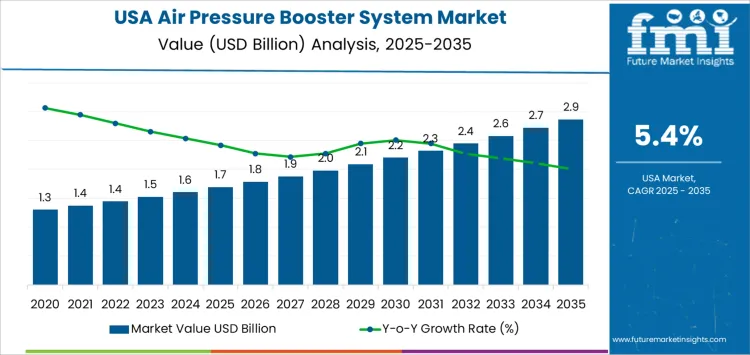
What is the Growth Forecast for Air Pressure Booster System Industry in USA through 2035?
Peak-to-Trough Analysis for air pressure booster system demand in the United States shows identifiable highs and lows shaped by operational cycles, equipment maintenance patterns, and capital planning behavior. Peak periods arise when industrial facilities schedule coordinated upgrades to compressed air infrastructure. These peaks align with multi-year capital expenditure plans in sectors where high-pressure delivery supports machining, material handling, and continuous processing. Peak intensity increases when supply reliability concerns prompt investment in systems that stabilize downstream pneumatic performance.
Trough periods appear when facilities extend maintenance intervals or postpone equipment replacement during cost-control phases. These pauses reduce short-term procurement and create observable dips in the demand curve. Trough depth becomes more pronounced in sectors sensitive to fluctuations in production utilization because booster systems are procured only when performance constraints become evident. Peaks return when throughput expansion or system recalibration requires higher discharge pressure to maintain equipment efficiency. These periods restore demand momentum because booster integration directly supports operational continuity.
Midsize facilities contribute intermittent variation because procurement depends on localized performance audits rather than cyclical planning. This creates smaller oscillations between peaks and troughs that add granularity to the overall pattern. The resulting curve shows structured peaks driven by planned upgrades and defined troughs shaped by deferred investment across industrial settings.
USA Air Pressure Booster System Key Takeaways
| Metric | Value |
|---|---|
| USA Air Pressure Booster System Sales Value (2025) | USD 1.7 billion |
| USA Air Pressure Booster System Forecast Value (2035) | USD 2.9 billion |
| USA Air Pressure Booster System Forecast CAGR (2025 to 2035) | 5.4% |
Why is the Demand for Air Pressure Booster System in USA Growing?
Demand for air pressure booster systems in the United States rises due to expanding requirements across manufacturing, energy, automotive services, and industrial processing facilities that rely on stable high pressure air output. Production lines using pneumatic actuators require consistent pressure levels to maintain equipment performance, and booster units’ address gaps created by fluctuating supply from central compressors. Assembly plants adopt booster systems to support fastening tools, robotic operations, and material handling tasks that depend on elevated air pressure in localized zones. Oil and gas operations use boosters to maintain instrument air performance in remote environments with variable supply conditions.
Growth in additive manufacturing and precision machining strengthens usage due to pressure sensitive tools and cleaning processes. Automotive workshops integrate booster units for torque controlled fastening, tire inflation, and component testing. Food and beverage processors apply controlled air pressure for filling, packaging, and conveying tasks that require stable output across extended production cycles. Facilities with aging compressed air networks use booster systems to avoid full system upgrades by raising pressure only at required points. E commerce distribution centers adopt pneumatic equipment that benefits from localized pressure enhancement.
Which Pressure Type and Application Segments Lead Demand for Air Pressure Booster Systems in USA?
Demand for air pressure booster systems in the USA is shaped by operational pressure requirements, equipment compatibility, and workflow needs across industrial, maintenance, and testing environments. Buyers evaluate stability, energy efficiency, and pressure amplification range for tasks involving leak checks, actuator operation, and component integrity testing. Distribution reflects facility-level pressure thresholds, tool specifications, and performance expectations across regulated industrial processes.
By Pressure Type, 100-250 PSI Accounts for the Largest Share of Demand
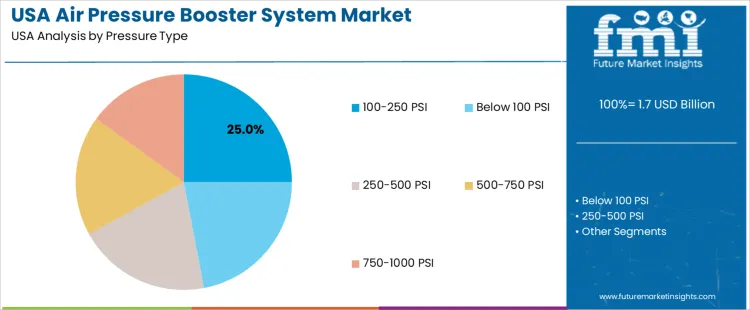
The 100-250 PSI range holds 25.0%, making it the leading pressure type segment. This range supports general industrial workflows, shop-floor operations, and maintenance activities requiring moderate amplification without stressing downstream components. Below 100 PSI holds 22.0%, driven by light-duty operations, pneumatic tool support, and applications where controlled low-pressure output protects sensitive assemblies. The 250-500 PSI segment holds 20.0%, used in mid-intensity testing and production lines requiring consistent amplification levels. The 500-750 PSI range holds 18.0%, supporting higher-load operations and specialized equipment. The 750-1000 PSI segment holds 15.0%, serving demanding applications needing elevated amplification. Distribution reflects operational tolerance and equipment-rated pressure windows.
Key Points:
- 100–250 PSI supports general industrial use.
- Below 100 PSI fits light-duty and sensitive tasks.
- Higher ranges meet specialized or heavy-load requirements.
- Pressure selection aligns with equipment ratings and workflow needs.
By Application, Leak Detection Represents the Largest Segment
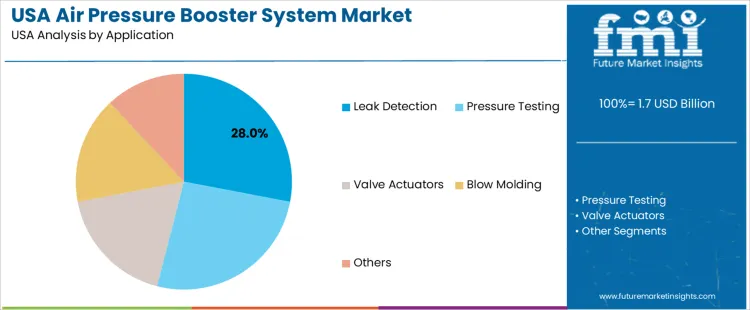
Leak detection holds 28.0%, making it the largest application segment in USA demand. Facilities rely on amplified air pressure to identify system losses, seal failures, and line integrity issues across mechanical, pneumatic, and utility systems. Pressure testing holds 26.0%, supporting verification of pipes, components, and assemblies requiring controlled high-pressure environments. Valve actuators hold 18.0%, using booster systems to achieve required actuation forces in industrial settings. Blow molding holds 16.0%, driven by pressure requirements for container forming processes. Others hold 12.0%, covering diverse operational needs. Distribution reflects verification requirements, production workflows, and component performance standards.
Key Points:
- Leak detection requires amplified pressures for system integrity checks.
- Pressure testing supports regulated verification workflows.
- Valve actuators depend on stable amplified pressure.
- Application demand reflects operational testing and production needs.
What are the Key Dynamics in the Air Pressure Booster System Industry?
Industrial throughput, equipment performance, and facility-level pressure requirements are driving adoption.
Demand increases as USA manufacturing plants rely on air pressure booster systems to stabilize pneumatic output in production lines that require consistent high-pressure delivery. Automotive suppliers use boosters to maintain torque accuracy in fastening tools. Food and beverage processors integrate pressure augmentation for packaging operations that depend on stable airflow. Oil and gas facilities apply booster systems to support instrumentation that requires elevated line pressure. Regional distribution centers adopt pneumatic equipment for material handling tasks that depend on reliable pressure control. Maintenance teams prefer boosters that prevent performance drops in ageing compressed air networks. Industrial clusters in the Midwest and Gulf Coast sustain steady consumption aligned with established production activity.
Capital expenditure, energy use, and maintenance requirements restrain broader deployment.
Procurement teams face budget sensitivity when evaluating booster systems that require dedicated compressors, plumbing changes, or upgraded control units. Facilities monitor energy consumption closely because pressure amplification increases electrical load during extended production cycles. Smaller plants report difficulty allocating technician hours for scheduled maintenance involving valves, seals, and regulators. Several states enforce equipment-efficiency standards that influence decisions when older boosters lack compliant performance. Supply chain delays for specialized components affect replacement planning. Facilities with limited floor space restrict installation of larger booster assemblies that require stable environmental conditions for safe operation.
Automation integration, efficiency upgrades, and sector-specific engineering shape current trends.
US manufacturers evaluate digitally controlled booster systems equipped with pressure sensors that integrate with plant automation platforms. Engineering teams request variable-flow boosters designed to minimize energy use during low-demand intervals. Packaging operations adopt compact boosters that reduce noise output and support workstation ergonomics. Oil and gas facilities incorporate corrosion-resistant materials for equipment exposed to harsh operating environments. Warehousing operations select modular boosters that align with scalable pneumatic tools used in fast-moving logistics settings. Maintenance departments adopt predictive monitoring tools that track seal wear and regulator performance. Energy-management programmes influence interest in high-efficiency booster configurations across large industrial campuses.
Analysis of the Demand for Air Pressure Booster Systems in the USA by Region
Demand for air pressure booster systems in the USA is increasing due to expanding industrial automation, rising use of pneumatic equipment, and the need for stable compressed-air performance across manufacturing and service operations. West USA records a CAGR of 6.2% supported by strong activity in high-precision industries and advanced production lines. South USA shows a 5.6% CAGR driven by large-scale industrial facilities and growing equipment modernization. Northeast USA posts a 5.0% CAGR supported by dense commercial and industrial clusters. Midwest USA holds a 4.3% CAGR due to stable manufacturing operations requiring consistent pressure-boosting solutions.
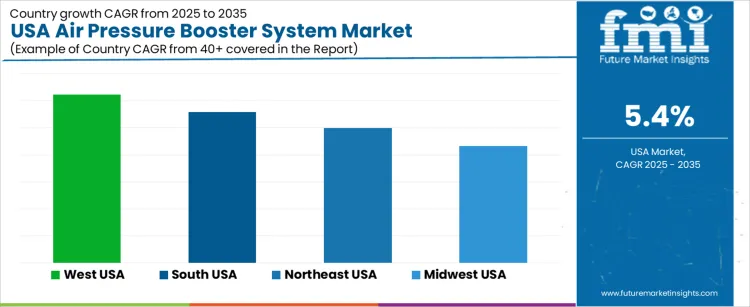
| Region | CAGR (2025-2035) |
|---|---|
| West USA | 6.2% |
| South USA | 5.6% |
| Northeast USA | 5.0% |
| Midwest USA | 4.3% |
How is the West USA driving demand for Air Pressure Booster Systems?
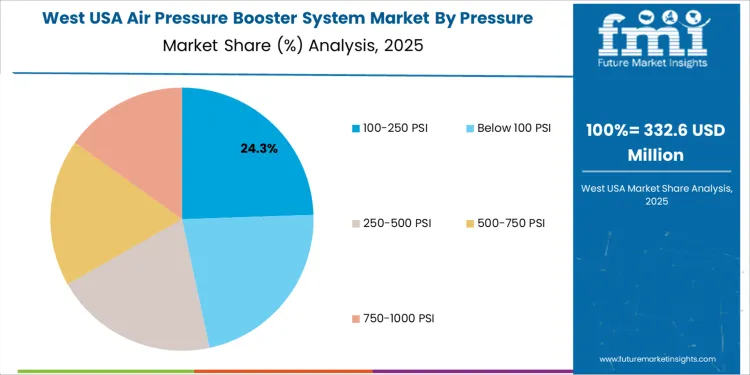
West USA drives demand due to its strong presence of advanced manufacturing, high-precision assembly operations, and technology-driven industrial activity. The region’s CAGR of 6.2% reflects steady adoption of air pressure booster systems across semiconductor facilities, aerospace assembly lines, and automated production units requiring stable high-pressure air streams. Industrial users maintain predictable procurement for equipment designed to optimize pneumatic tool performance in controlled environments. Commercial buildings adopt pressure-boosting systems to support maintenance operations and facility infrastructure that relies on compressed-air systems. Strong research and industrial innovation support continued use of precision air-management equipment.
- Strong advanced manufacturing presence
- High usage across semiconductor and aerospace operations
- Consistent demand for pneumatic tool optimization
- Adoption of pressure-boosting systems in commercial facilities
How is the South USA driving demand for Air Pressure Booster Systems?
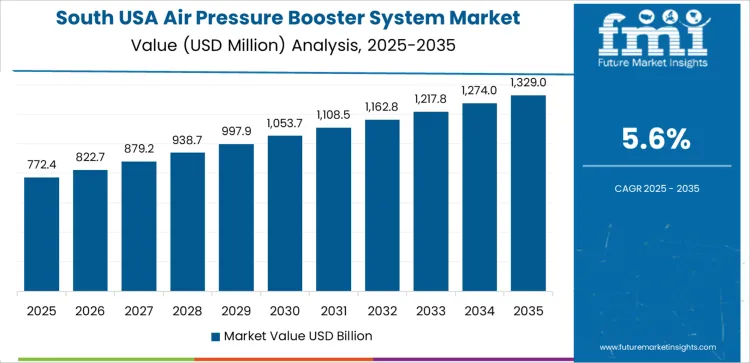
South USA supports rising demand due to its extensive industrial footprint and expansion of automation across manufacturing corridors. The region’s CAGR of 5.6% reflects increasing integration of pressure-boosting units in sectors such as automotive, petrochemical, and equipment fabrication. Industrial plants rely on high-pressure air to maintain efficient pneumatic tool performance and stable operation of automated processes. Regional logistics and warehousing facilities use booster systems to support maintenance tasks involving compressed air. Continuous industrial expansion in suburban and urban areas supports steady procurement cycles for air-management infrastructure.
- Expanding industrial automation across multiple sectors
- Routine use of high-pressure air in fabrication processes
- Adoption in logistics and warehousing facilities
- Stable procurement for facility maintenance operations
How is the Northeast USA driving demand for Air Pressure Booster Systems?
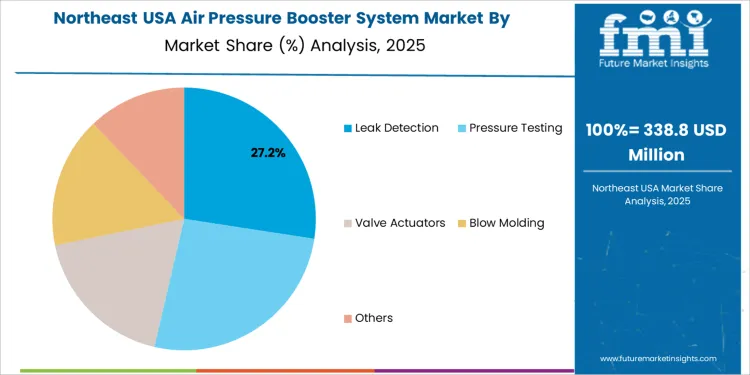
Northeast USA drives demand due to its dense industrial and commercial clusters that depend on stable compressed-air systems for operational efficiency. The region’s CAGR of 5.0% reflects steady use of booster systems across equipment maintenance, manufacturing lines, and specialized service applications requiring pressure stability. Commercial buildings rely on compressed-air infrastructure for routine maintenance operations. Industrial users maintain structured procurement for equipment supporting pneumatic tools and automated systems. Regional service providers use pressure-boosting units to ensure consistent air delivery during technical and field operations.
- Dense distribution of industrial and commercial facilities
- Routine use of pneumatic tools in service operations
- Stable integration in manufacturing and maintenance tasks
- Regular procurement across high-volume operational sites
How is the Midwest USA driving demand for Air Pressure Booster Systems?
Midwest USA maintains stable demand due to its broad manufacturing base and reliance on pneumatic equipment across production lines. The region’s CAGR of 4.3% reflects regular adoption of air pressure booster systems in automotive, machinery, and metal-processing operations. Manufacturing plants depend on consistent air pressure to support controlled tool performance and automated workflows. Facilities across mid-sized cities maintain predictable procurement for maintenance and operational tasks requiring stable compressed air. Industrial service providers use booster systems to support field operations involving precision pneumatic equipment.
- Wide manufacturing and industrial presence
- Routine use of pneumatic tools across production lines
- Stable procurement for maintenance and operations
- Use of booster systems in industrial service activities
What is the competitive landscape of the demand for air pressure booster systems in the USA?
Demand for air pressure booster systems in the USA is shaped by requirements for stable output pressure, energy efficiency, equipment reliability, and compatibility with industrial compressed air networks. Buyers evaluate pressure ratios, duty cycles, cooling configurations, and integration with existing compressor installations across manufacturing, automotive, food processing, and process industries. Procurement teams prioritize dependable after-sales support, service part availability, and documented performance testing aligned with facility safety standards. Adoption patterns reflect needs for consistent pneumatic performance in applications involving high-pressure tools, material handling, and precision manufacturing.
Danfoss remains active through pressure management technologies supporting automated equipment and fluid handling systems. Sullair LLC maintains visibility in industrial environments using heavy-duty booster units integrated with rotary screw compressors. Quincy Compressor supplies booster systems to fabrication, packaging, and general industrial users requiring reliable pressure enhancement within existing air networks. Airmac Compressor participates through niche industrial solutions supported by regional distributors serving small and mid-sized facilities. Competitive positioning in the USA reflects service capability, system durability, parts accessibility, and integration flexibility supporting diverse industrial operating conditions.
Key Players in USA Air Pressure Booster System Demand
- ELGi Equipments
- Danfoss
- Sullair LLC
- Quincy Compressor
- Airmac Compressor
Scope of the Report
| Items | Values |
|---|---|
| Quantitative Units | USD billion |
| Pressure Type | 100-250 PSI, Below 100 PSI, 250-500 PSI, 500-750 PSI, 750-1000 PSI |
| Application | Leak Detection, Pressure Testing, Valve Actuators, Blow Molding, Others |
| Regions Covered | West USA, South USA, Northeast USA, Midwest USA |
| Key Companies Profiled | ELGi Equipments, Danfoss, Sullair LLC, Quincy Compressor, Airmac Compressor |
| Additional Attributes | Dollar sales by pressure range and application category; adoption trends across West, South, Northeast, and Midwest USA; competitive landscape of air pressure booster system providers; demand shifts driven by leak detection, blow molding, valve actuation, and industrial pressure testing operations; integration with high-pressure pneumatic systems, energy-efficient booster technologies, and manufacturing automation. |
USA Air Pressure Booster System Demand by Segments
Pressure Type:
- 100-250 PSI
- Below 100 PSI
- 250-500 PSI
- 500-750 PSI
- 750-1000 PSI
Application:
- Leak Detection
- Pressure Testing
- Valve Actuators
- Blow Molding
- Others
Region:
- West USA
- South USA
- Northeast USA
- Midwest USA
Frequently Asked Questions
How big is the demand for air pressure booster system in USA in 2025?
The demand for air pressure booster system in USA is estimated to be valued at USD 1.7 billion in 2025.
What will be the size of air pressure booster system in USA in 2035?
The market size for the air pressure booster system in USA is projected to reach USD 2.9 billion by 2035.
How much will be the demand for air pressure booster system in USA growth between 2025 and 2035?
The demand for air pressure booster system in USA is expected to grow at a 5.4% CAGR between 2025 and 2035.
What are the key product types in the air pressure booster system in USA?
The key product types in air pressure booster system in USA are 100-250 psi, below 100 psi, 250-500 psi, 500-750 psi and 750-1000 psi.
Which application segment is expected to contribute significant share in the air pressure booster system in USA in 2025?
In terms of application, leak detection segment is expected to command 28.0% share in the air pressure booster system in USA in 2025.
Preview the report firsthand - request a free sample
Get SampleGet the brochure for pricing and purchase details.
Get PDFTable of Content
- Executive Summary
- USA Market Outlook
- Demand-side Trends
- Supply-side Trends
- Technology Roadmap Analysis
- Analysis and Recommendations
- Market Overview
- Market Coverage / Taxonomy
- Market Definition / Scope / Limitations
- Market Background
- Market Dynamics
- Drivers
- Restraints
- Opportunity
- Trends
- Scenario Forecast
- Demand in Optimistic Scenario
- Demand in Likely Scenario
- Demand in Conservative Scenario
- Opportunity Map Analysis
- Product Life Cycle Analysis
- Supply Chain Analysis
- Investment Feasibility Matrix
- Value Chain Analysis
- PESTLE and Porter’s Analysis
- Regulatory Landscape
- Regional Parent Market Outlook
- Production and Consumption Statistics
- Import and Export Statistics
- Market Dynamics
- USA Market Analysis 2020 to 2024 and Forecast, 2025 to 2035
- Historical Market Size Value (USD Million) Analysis, 2020 to 2024
- Current and Future Market Size Value (USD Million) Projections, 2025 to 2035
- Y-o-Y Growth Trend Analysis
- Absolute $ Opportunity Analysis
- USA Market Pricing Analysis 2020 to 2024 and Forecast 2025 to 2035
- USA Market Analysis 2020 to 2024 and Forecast 2025 to 2035, By Pressure Type
- Introduction / Key Findings
- Historical Market Size Value (USD Million) Analysis By Pressure Type , 2020 to 2024
- Current and Future Market Size Value (USD Million) Analysis and Forecast By Pressure Type , 2025 to 2035
- 100-250 PSI
- Below 100 PSI
- 250-500 PSI
- 500-750 PSI
- 750-1000 PSI
- Y-o-Y Growth Trend Analysis By Pressure Type , 2020 to 2024
- Absolute $ Opportunity Analysis By Pressure Type , 2025 to 2035
- USA Market Analysis 2020 to 2024 and Forecast 2025 to 2035, By Application
- Introduction / Key Findings
- Historical Market Size Value (USD Million) Analysis By Application, 2020 to 2024
- Current and Future Market Size Value (USD Million) Analysis and Forecast By Application, 2025 to 2035
- Leak Detection
- Pressure Testing
- Valve Actuators
- Blow Molding
- Others
- Y-o-Y Growth Trend Analysis By Application, 2020 to 2024
- Absolute $ Opportunity Analysis By Application, 2025 to 2035
- Market Structure Analysis
- Competition Dashboard
- Competition Benchmarking
- Market Share Analysis of Top Players
- By Regional
- By Pressure Type
- By Application
- Competition Analysis
- Competition Deep Dive
- ELGi Equipments
- Overview
- Product Portfolio
- Profitability by Market Segments (Product/Age /Sales Channel/Region)
- Sales Footprint
- Strategy Overview
- Marketing Strategy
- Product Strategy
- Channel Strategy
- Danfoss
- Sullair LLC
- Quincy Compressor
- Airmac Compressor
- ELGi Equipments
- Competition Deep Dive
- Assumptions & Acronyms Used
- Research Methodology


