

- Industry Size (2025)
- USD 0.4 Bn
- Forecast (2035)
- USD 1.6 Bn
- CAGR (2025 to 2035)
- 14.7%
Demand for Solar Air Conditioning System in USA 2025 to 2035
The demand for solar air conditioning systems in the USA is valued at USD 0.4 billion in 2025 and is forecasted to reach USD 1.6 billion by 2035. The CAGR during 2025–2035 is estimated at 14.7%. Growth is driven by interest in reducing grid dependence, improving cooling efficiency, and lowering lifecycle energy costs for residential, commercial, and institutional buildings. Federal and state-level clean-energy incentives accelerate the replacement of conventional units with solar-assisted systems, especially in regions with prolonged cooling seasons and high electricity tariffs. Building owners also favor solutions that lower carbon emissions and enhance energy security during peak-load conditions.
Standalone solar air conditioners lead demand due to their ability to function independently from grid power during daylight hours. These systems directly convert solar radiation into cooling output, supporting uninterrupted operation in high-insolation environments and limiting peak-period electricity draw. Technological improvements in photovoltaic performance, compressor efficiency, and thermal energy storage continue to increase overall system reliability and return-on-investment potential.
Demand is strongest in West USA, South USA, and Northeast USA. The West and South experience high cooling loads, and the Northeast prioritizes sustainable building upgrades through regulatory frameworks and public-sector procurement. Key suppliers include Trane Technologies, Lennox International Inc., Carrier Global Corporation, Midea America Corp., and LG Electronics USA. Product development efforts emphasize higher solar conversion efficiency, low-maintenance designs, and integration with smart-building energy-management platforms.
Quick Stats for USA Solar Air Conditioning System Demand
- USA Solar Air Conditioning System Sales Value (2025): USD 0.4 billion
- USA Solar Air Conditioning System Forecast Value (2035): USD 1.6 billion
- USA Solar Air Conditioning System Forecast CAGR (2025–2035): 14.7%
- Leading Product Type in USA Solar Air Conditioning System Demand: Standalone Solar Air Conditioners
- Key Growth Regions in USA Solar Air Conditioning System Demand: West USA, South USA, Northeast USA
- Top Players in USA Solar Air Conditioning System Demand: Trane Technologies, Lennox International Inc., Carrier Global Corporation, Midea America Corp., LG Electronics USA
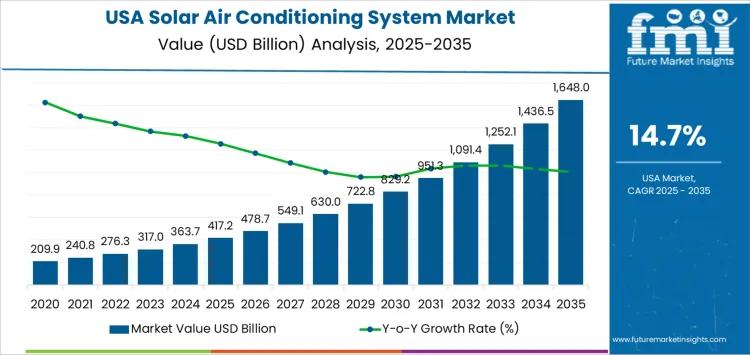
What is the Growth Forecast for Solar Air Conditioning System Industry in USA through 2035?
Demand for solar air conditioning systems in the United States shows a notable acceleration pattern in the early forecast phase as commercial and residential customers pursue energy-cost reduction and reduced grid dependence. Growth is supported by federal renewable incentives, state-level clean-energy mandates, and rising electricity tariffs in warm-climate regions. The integration of photovoltaic systems with high-efficiency cooling equipment expands adoption among new construction projects where energy codes emphasize reduced emissions. Public facilities and large retail buildings contribute additional lift as sustainability targets influence procurement decisions.
Acceleration also reflects improvements in system performance and easier financing through utility-linked programs. Manufacturers promote hybrid cooling models that offset intermittency concerns, making adoption more practical in diverse climate zones. Deceleration pressures appear later when penetration in early-adopting states matures. Cost remains a limiting factor for retrofits in older buildings where structural modifications are required. Seasonal variability in solar yield draws attention to backup requirements, which can slow commitment among risk-averse buyers. Despite these moderating elements, the long-term pattern maintains a rising slope, with acceleration driven by policy alignment and technology advances, while deceleration is contained by ongoing efficiency gains and expanding regional applicability across the United States.
USA Solar Air Conditioning System Key Takeaways
| Metric | Value |
|---|---|
| USA Solar Air Conditioning System Sales Value (2025) | USD 0.4 billion |
| USA Solar Air Conditioning System Forecast Value (2035) | USD 1.6 billion |
| USA Solar Air Conditioning System Forecast CAGR (2025-2035) | 14.7% |
Why is the Demand for Solar Air Conditioning Systems in the USA Growing?
Demand for solar air conditioning systems in the USA is increasing because households and commercial buildings look for ways to reduce electricity consumption during peak cooling seasons. Rising temperatures during summer months place heavy stress on the electrical grid, and energy costs continue to increase in several states. Solar powered cooling systems provide an alternative that lowers reliance on grid electricity and offers long term savings through renewable energy use.
Federal and state incentive programs for solar installations support adoption in residential and commercial properties. Builders and property managers integrate solar cooling solutions to help meet sustainability goals and improve building energy ratings. Technological improvements in photovoltaic panels and high efficiency HVAC units make solar air conditioning more practical for different climate zones across the country. Commercial users such as offices, schools and retail locations value lower operating costs during daytime hours when solar output is highest. Constraints include higher initial investment, the need for suitable installation space and variability in sunlight that may require hybrid systems with grid backup. Consumers also evaluate maintenance requirements and long payback periods before adoption.
Which Product Types, Technologies, and Capacity Ranges Lead Demand for Solar Air Conditioning Systems in the USA?
Demand for solar air conditioning systems in the United States is influenced by rising electricity costs, energy-efficiency mandates, and incentives promoting renewable HVAC solutions. Adoption aligns with decarbonization goals across commercial facilities, housing developments, and net-zero building projects. Performance selection depends on system installation flexibility, compatibility with existing HVAC units, and realistic solar output under regional climate settings. Growth is supported by increased awareness of lifecycle energy savings, reduced grid dependency during high-load summer periods, and rapid expansion of solar PV installations across USA rooftops.
By Product Type, Standalone Systems Lead Demand
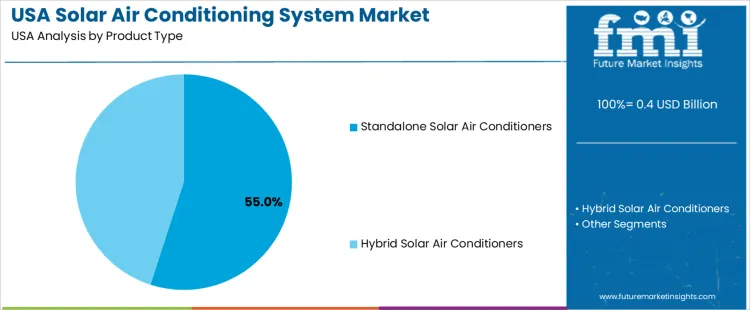
Standalone solar air conditioners account for 55.0%, supported by zero-grid dependency, allowing efficient operation during peak heat periods when electricity tariffs rise. These systems are common in remote or off-grid USA locations, vacation homes, and distributed commercial projects seeking autonomy from utility supply fluctuations. Hybrid systems represent 45.0%, valued for reliability when solar availability declines due to seasonal and weather-based variability. Hybrids integrate with the grid or conventional compressors, enabling consistent cooling output without performance drops. Product selection reflects system cost, maintenance planning, and household or facility power stability priorities in varying climates across the United States.
Key Points:
- Standalone systems lead due to full renewable operation
- Hybrids ensure backup cooling during low-irradiance periods
- Adoption depends on regional sun exposure and storage solutions
By Technology, Solar Thermal Systems Hold the Largest Share
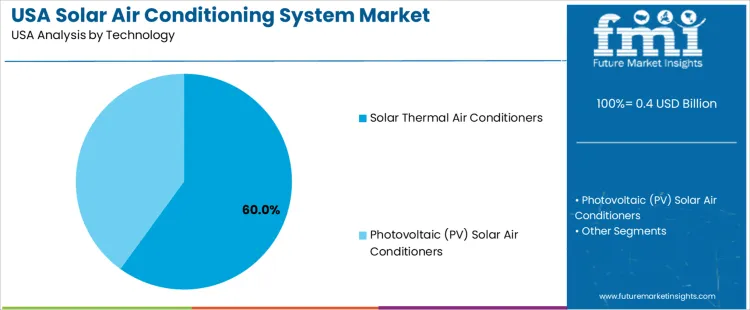
Solar thermal systems represent 60.0% of USAge due to strong suitability for large commercial buildings requiring high-capacity cooling with reduced electricity consumption. They offer efficient heat-driven absorption cooling performance across sunny USA states, especially in the Southwest. Photovoltaic (PV) systems account for 40.0%, benefiting from declining solar module costs and straightforward integration with standard split or ducted AC units. PV-based AC adoption is growing faster due to easier installation on existing rooftops and compatibility with smart-grid programs. Overall, technology choices reflect site-specific engineering requirements, payback targets, and incentives tied to renewable grid contribution programs.
Key Points:
- Thermal units dominate large-scale applications
- PV units expand through modular installation flexibility
- Incentives accelerate renewable alignment and grid relief
By Capacity, Above 3 Ton Units Lead Demand
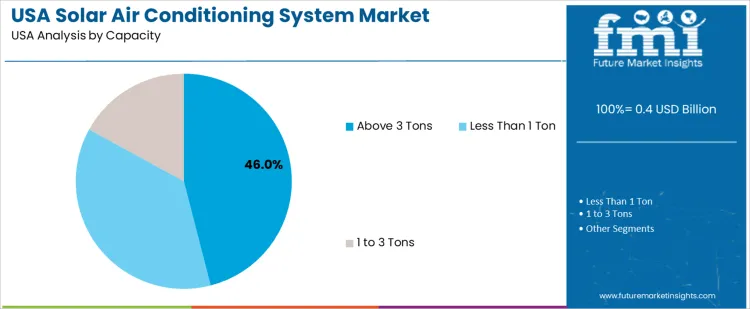
Systems above 3 tons hold 46.0%, driven by strong uptake in commercial offices, educational buildings, and high-occupancy residential projects prioritizing sustainability upgrades. Units below 1 ton represent 37.0%, supporting modular cooling in single rooms, small homes, and RVs popular in warm regions. Mid-range 1 to 3 ton systems hold 17.0%, typically used in suburban housing areas where hybrid adaptation remains affordable. Capacity preferences in the United States reflect regional HVAC loads, architectural variations, and retrofit opportunities as building owners pursue energy autonomy and reduced operational costs under summer demand spikes.
Key Points:
- Larger systems dominate commercial and institutional upgrades
- Small units enable adoption in budget-sensitive homes
- Mid-range applications support incremental retrofit modernization
What are the Drivers, Restraints, and Key Trends of the Demand for Solar Air Conditioning Systems in the USA?
Growth of residential electrification, increased energy-cost awareness and rising adoption of low-carbon cooling solutions drive demand.
In the United States, households and commercial buildings increasingly prioritize energy-efficient cooling options due to rising utility expenses and high summer temperatures in regions such as the South, Southwest and Midwest. Federal and state clean-energy incentives encourage installation of solar-assisted HVAC systems that reduce grid electricity use and lower long-term operating costs. Builders focused on sustainable housing integrate solar cooling into new home designs to meet green-building certifications. Businesses with large roof space, such as warehouses and schools, evaluate solar air conditioning to reduce peak-hour load charges and improve indoor comfort. These economic and policy factors support ongoing interest in solar-powered cooling alternatives.
High installation cost, performance variability in low-sunlight regions and limited contractor expertise restrain demand.
Upfront investment for solar panels, thermal collectors and compatible HVAC components often exceeds budgets for conventional air conditioners. Performance depends heavily on geographic sunlight availability, which can limit efficiency in cloudy or northern regions and discourage adoption in areas with lower solar resource. Installation requires contractors familiar with both solar systems and HVAC integration, and limited workforce experience increases project complexity and perceived risk for property owners. These obstacles slow broad industry penetration despite long-term cost benefits.
Shift toward hybrid solar-electric cooling models, increased adoption in commercial and public facilities and rising use of monitoring software define key trends.
Hybrid systems combining solar with high-efficiency heat pumps allow continuous operation during variable weather and support faster return on investment. Municipal buildings, educational campuses and retail chains incorporate solar cooling as part of sustainability and resilience strategies that maintain comfort while reducing emissions. Monitoring platforms optimize energy use by adjusting cooling output to available solar power, which appeals to facilities seeking operational intelligence. Small packaged units designed for retrofits gain traction among homeowners upgrading from older HVAC systems. These developments indicate selective but growing demand for solar air conditioning systems across the United States driven by energy efficiency goals, policy support and long-term savings priorities.
Analysis of the Demand for Solar Air Conditioning Systems in the USA by Region
Demand for solar air conditioning systems in the United States is increasing as building owners pursue energy-efficiency upgrades, seek relief from peak-electricity tariffs, and align with decarbonization commitments. Integration with net-metering programs, federal clean-energy tax credits, and rooftop solar expansion support broader adoption in both new construction and retrofits. Hybrid solar-thermal and photovoltaic-driven air conditioning solutions attract users seeking resilience against grid instability and rising cooling costs. West USA leads growth at 16.9% CAGR, followed by South USA at 15.2%, reflecting high cooling loads. Northeast USA reaches 13.5%, while Midwest USA grows at 11.8%, aided by policy-linked energy savings.
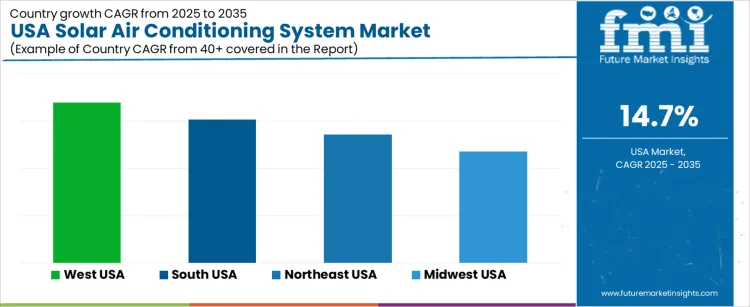
| Region | CAGR (2025-2035) |
|---|---|
| West USA | 16.9% |
| South USA | 15.2% |
| Northeast USA | 13.5% |
| Midwest USA | 11.8% |
How is the West USA driving demand for solar air conditioning systems?
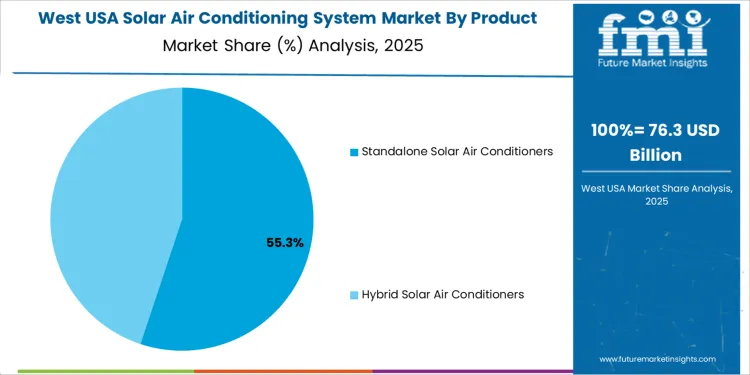
West USA records 16.9% CAGR, supported by high solar resource availability and strong adoption of rooftop PV systems in California, Nevada, and Arizona. Cooling demand from heat-intensive environments encourages commercial buildings, residential complexes, and public institutions to deploy solar-assisted HVAC for electricity-bill reduction. State policy frameworks and carbon-neutrality mandates accelerate replacement of high-emission cooling units. Distributed-energy installers integrate solar air conditioning with battery-backup configurations that maintain comfort during grid outages. Procurement emphasizes SEER ratings, heat-pump compatibility, and inverter-driven reliability under extreme temperatures. Urban construction projects use solar HVAC to meet green-building certification targets.
- High solar irradiation supporting efficient system output
- Policy mandates accelerating low-carbon HVAC transitions
- Battery integration improving resilience and peak-load management
- Green-building incentives influencing specification choices
How is the South USA shaping adoption momentum?
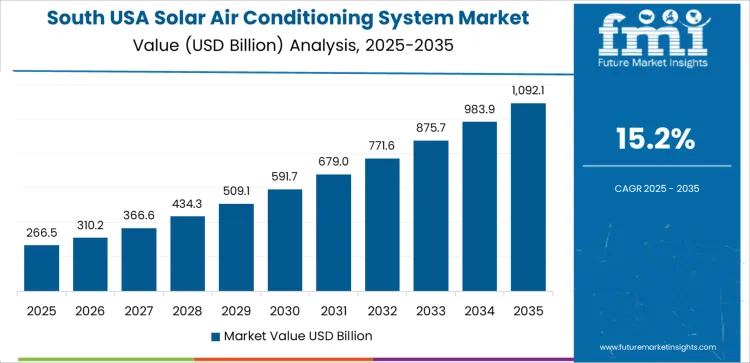
South USA expands at 15.2% CAGR, driven by some of the country’s most intense annual cooling loads across Texas, Florida, and Georgia. Electricity-price volatility motivates commercial and multifamily property owners to adopt solar-supplemented HVAC systems to reduce utility bills. Hot-humid environments push demand for hybrid solar-thermal absorption units capable of delivering enhanced dehumidification. Growing suburban construction allows for optimal roof-area utilization supporting PV system sizing. Procurement teams focus on units with corrosion-resistant components and long-life compressor technology due to coastal climate exposure. Local installers bundle HVAC upgrades with residential renewable-energy financing programs.
- Extended cooling seasons magnifying operational savings
- Hybrid absorption systems aiding humidity control
- Rooftop-friendly construction enabling PV integration
- Coastal durability requirements shaping product selection
How is the Northeast USA influencing technology deployment?
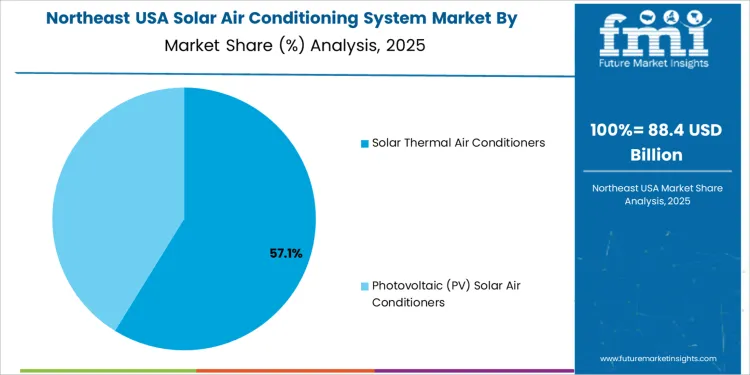
Northeast USA posts 13.5% CAGR, supported by peak-demand-reduction efforts in dense metropolitan areas including New York, New Jersey, and Massachusetts. Developers adopt solar-linked air conditioners to buffer grid load during heatwaves. Incentives under state clean-energy programs improve payback periods for commercial facilities. Compact building footprints drive interest in high-efficiency systems sized for constrained roof space. Cold-climate heat-pump functionality remains a core requirement for year-round USAge. Procurement reviews frost-resistant components, smart-meter compatibility, and performance under intermittent sunlight conditions common in winter seasons.
- Peak-load curtailment encouraging adoption
- Clean-energy incentives improving investment viability
- Space-efficient system designs aiding urban integration
- Smart-grid alignment driving technology requirements
How is the Midwest USA contributing to long-term growth?
Midwest USA grows at 11.8% CAGR, linked to energy-cost-reduction strategies in commercial, industrial, and institutional buildings across Illinois, Ohio, Michigan, and Wisconsin. Solar-air-conditioning adoption accelerates where grid-peak charges are rising and sustainability procurement standards are expanding. Building owners prioritize system reliability in variable climate conditions, requiring frost protection and adaptive thermal-storage designs. Rural facilities pair solar cooling with existing ground-source systems to enhance performance. Procurement plans emphasize lifecycle cost reduction, warranty coverage, and service-partner availability in dispersed regions.
- Energy-cost pressures encouraging hybrid-cooling upgrades
- Climate-resilient configurations shaping technology selection
- Integration with existing geothermal and HVAC infrastructure
- Warranty and service access guiding procurement reliability
How is competitive positioning structured among suppliers of solar air-conditioning systems in the United States?
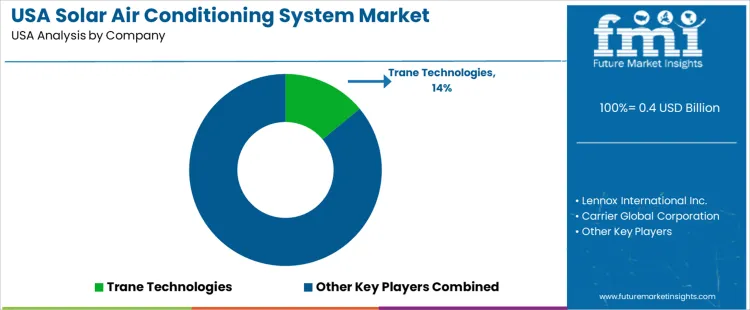
Competitive strength in USA solar air-conditioning reflects ability to integrate photovoltaic power with high-efficiency cooling, while meeting installation standards and after-sales reliability expectations. Trane Technologies holds an estimated 14%, supported by pilot deployments using solar-assisted variable-speed heat pumps and established networks of certified residential and light-commercial installers. Its position benefits from alignment with decarbonization programs and tax-credit compliant system designs.
Lennox International Inc. advances participation through high-SEER heat pumps engineered for optional photovoltaic coupling. Adoption grows in regions with strong rooftop-solar penetration, particularly where homeowners prioritize long-term operating-cost reduction. Carrier Global Corporation engages through hybrid cooling solutions integrated with third-party solar inverters. Its visibility links to broader HVAC replacement cycles in energy-conscious states.
Midea America Corp. competes through cost-efficient DC-inverter split systems adaptable to direct-PV configurations in off-grid or backup-power applications. Distribution reach through major retailers and installers supports incremental share. LG Electronics USA focuses on residential smart-energy ecosystems pairing solar generation with high-efficiency HVAC control, delivering advantages in load shifting and energy-use monitoring.
Competitive advantage increasingly depends on robust service coverage, inverter compatibility, compliance with state incentive structures, and demonstrated performance during grid constraints. Companies with mature HVAC portfolios and scalable solar integration maintain stronger positions than niche import-only producers within the United States solar air-conditioning segment.
Key Players in USA Solar Air Conditioning System Demand
- Trane Technologies
- Lennox International Inc.
- Carrier Global Corporation
- Midea America Corp.
- LG Electronics USA
Scope of the Report
| Items | Values |
|---|---|
| Quantitative Units | USD billion |
| Product Type | Standalone Solar Air Conditioners, Hybrid Solar Air Conditioners |
| Technology | Solar Thermal Air Conditioners, Photovoltaic (PV) Solar Air Conditioners |
| Capacity | Above 3 Tons, Less Than 1 Ton, 1 to 3 Tons |
| Installation Type | Centralized Solar Air Conditioners, Split Solar Air Conditioners, Window & Portable Air Conditioners |
| Regions Covered | West USA, South USA, Northeast USA, Midwest USA |
| Key Companies Profiled | Trane Technologies, Lennox International Inc., Carrier Global Corporation, Midea America Corp., LG Electronics USA |
| Additional Attributes | Dollar sales by product type, technology, capacity range, and installation format; regional adoption trends driven by energy savings, temperature zones, and solar infrastructure availability; competitive differentiation between PV-driven and thermal-absorption systems; growth in off-grid and hybrid HVAC demand for residential, commercial, and institutional buildings; incentives, sustainability initiatives, and decarbonization strategies supporting solar-assisted cooling in the United States. |
USA Solar Air Conditioning System Demand by Segments
Product Type:
- Standalone Solar Air Conditioners
- Hybrid Solar Air Conditioners
Technology:
- Solar Thermal Air Conditioners
- Photovoltaic (PV) Solar Air Conditioners
Capacity:
- Above 3 Tons
- Less Than 1 Ton
- 1 to 3 Tons
Installation Type:
- Centralized Solar Air Conditioners
- Split Solar Air Conditioners
- Window & Portable Air Conditioners
Region:
- West USA
- South USA
- Northeast USA
- Midwest USA
Frequently Asked Questions
How big is the demand for solar air conditioning system in USA in 2025?
The demand for solar air conditioning system in USA is estimated to be valued at USD 0.4 billion in 2025.
What will be the size of solar air conditioning system in USA in 2035?
The market size for the solar air conditioning system in USA is projected to reach USD 1.6 billion by 2035.
How much will be the demand for solar air conditioning system in USA growth between 2025 and 2035?
The demand for solar air conditioning system in USA is expected to grow at a 14.7% CAGR between 2025 and 2035.
What are the key product types in the solar air conditioning system in USA?
The key product types in solar air conditioning system in USA are standalone solar air conditioners and hybrid solar air conditioners.
Which technology segment is expected to contribute significant share in the solar air conditioning system in USA in 2025?
In terms of technology, solar thermal air conditioners segment is expected to command 60.0% share in the solar air conditioning system in USA in 2025.
Preview the report firsthand - request a free sample
Get SampleGet the brochure for pricing and purchase details.
Get PDFTable of Content
- Executive Summary
- USA Market Outlook
- Demand-side Trends
- Supply-side Trends
- Technology Roadmap Analysis
- Analysis and Recommendations
- Market Overview
- Market Coverage / Taxonomy
- Market Definition / Scope / Limitations
- Market Background
- Market Dynamics
- Drivers
- Restraints
- Opportunity
- Trends
- Scenario Forecast
- Demand in Optimistic Scenario
- Demand in Likely Scenario
- Demand in Conservative Scenario
- Opportunity Map Analysis
- Product Life Cycle Analysis
- Supply Chain Analysis
- Investment Feasibility Matrix
- Value Chain Analysis
- PESTLE and Porter’s Analysis
- Regulatory Landscape
- Regional Parent Market Outlook
- Production and Consumption Statistics
- Import and Export Statistics
- Market Dynamics
- USA Market Analysis 2020 to 2024 and Forecast, 2025 to 2035
- Historical Market Size Value (USD Million) Analysis, 2020 to 2024
- Current and Future Market Size Value (USD Million) Projections, 2025 to 2035
- Y-o-Y Growth Trend Analysis
- Absolute $ Opportunity Analysis
- USA Market Pricing Analysis 2020 to 2024 and Forecast 2025 to 2035
- USA Market Analysis 2020 to 2024 and Forecast 2025 to 2035, By Product Type
- Introduction / Key Findings
- Historical Market Size Value (USD Million) Analysis By Product Type , 2020 to 2024
- Current and Future Market Size Value (USD Million) Analysis and Forecast By Product Type , 2025 to 2035
- Standalone Solar Air Conditioners
- Hybrid Solar Air Conditioners
- Y-o-Y Growth Trend Analysis By Product Type , 2020 to 2024
- Absolute $ Opportunity Analysis By Product Type , 2025 to 2035
- USA Market Analysis 2020 to 2024 and Forecast 2025 to 2035, By Technology
- Introduction / Key Findings
- Historical Market Size Value (USD Million) Analysis By Technology, 2020 to 2024
- Current and Future Market Size Value (USD Million) Analysis and Forecast By Technology, 2025 to 2035
- Solar Thermal Air Conditioners
- Photovoltaic (PV) Solar Air Conditioners
- Y-o-Y Growth Trend Analysis By Technology, 2020 to 2024
- Absolute $ Opportunity Analysis By Technology, 2025 to 2035
- USA Market Analysis 2020 to 2024 and Forecast 2025 to 2035, By Capacity
- Introduction / Key Findings
- Historical Market Size Value (USD Million) Analysis By Capacity, 2020 to 2024
- Current and Future Market Size Value (USD Million) Analysis and Forecast By Capacity, 2025 to 2035
- Above 3 Tons
- Less Than 1 Ton
- 1 to 3 Tons
- Y-o-Y Growth Trend Analysis By Capacity, 2020 to 2024
- Absolute $ Opportunity Analysis By Capacity, 2025 to 2035
- USA Market Analysis 2020 to 2024 and Forecast 2025 to 2035, By Installation Type
- Introduction / Key Findings
- Historical Market Size Value (USD Million) Analysis By Installation Type, 2020 to 2024
- Current and Future Market Size Value (USD Million) Analysis and Forecast By Installation Type, 2025 to 2035
- Centralized Solar Air Conditioners
- Split Solar Air Conditioners
- Window & Portable Air Conditioners
- Y-o-Y Growth Trend Analysis By Installation Type, 2020 to 2024
- Absolute $ Opportunity Analysis By Installation Type, 2025 to 2035
- Market Structure Analysis
- Competition Dashboard
- Competition Benchmarking
- Market Share Analysis of Top Players
- By Regional
- By Product Type
- By Technology
- By Capacity
- By Installation Type
- Competition Analysis
- Competition Deep Dive
- Trane Technologies
- Overview
- Product Portfolio
- Profitability by Market Segments (Product/Age /Sales Channel/Region)
- Sales Footprint
- Strategy Overview
- Marketing Strategy
- Product Strategy
- Channel Strategy
- Lennox International Inc.
- Carrier Global Corporation
- Midea America Corp.
- LG Electronics USA
- Trane Technologies
- Competition Deep Dive
- Assumptions & Acronyms Used
- Research Methodology


