

- Industry Size (2026)
- USD 263.3 Mn
- Forecast (2036)
- USD 400.4 Mn
- CAGR (2026 to 2036)
- 4.3%
Demand for Air Pressure Booster System in Japan Forecast and Outlook 2026 to 2036
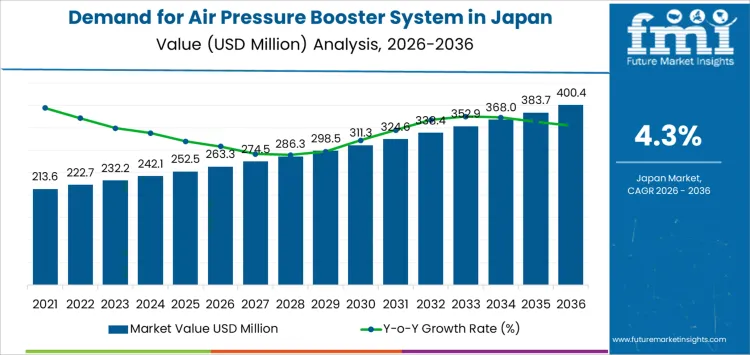
The demand for air pressure booster system in Japan is valued at USD 263.3 million in 2026 and is projected to reach USD 400.4 million by 2036, reflecting a CAGR of 4.3%. The rise from USD 204.8 million in 2020 to USD 263.3 million in 2026 is supported by steady use in leak detection, pressure testing, and valve actuation across industrial facilities. Mid-range pressure segments between 100 and 250 PSI anchor early demand, while higher pressure formats expand selectively.
From 2027 onward, values increase from USD 274.5 million to USD 324.6 million by 2031, then advance to USD 400.4 million by 2036 through consistent annual additions. Blow molding and precision testing environments maintain predictable procurement tied to equipment performance needs. Applications above 500 PSI grow gradually with specialized manufacturing lines. Long term expansion reflects maintenance driven replacement, incremental automation, and stable industrial output across Japan. Annual value movement remains moderate, indicating controlled and durable demand patterns.
Quick Stats of the Demand for Air Pressure Booster System in Japan
- Air Pressure Booster System Demand in Japan Value (2026): USD 263.3 million
- Air Pressure Booster System Demand in Japan Forecast Value (2036): USD 400.4 million
- Air Pressure Booster System Demand in Japan Forecast CAGR (2026-2036): 4.3%
- Air Pressure Booster System Leading Pressure Type: 100–250 PSI (28%)
- Air Pressure Booster System Key Growth Regions: Kyushu & Okinawa, Kanto, Kansai
- Air Pressure Booster System Top Players: ELGi Equipments, Sullair LLC, Danfoss
What is the Growth Forecast for Air Pressure Booster System in Japan through 2036?
Between 2026 and 2031, demand for air pressure booster systems in Japan rises from USD 263.3 million to USD 311.3 million, reflecting an increase of USD 48.0 million. Growth in this period is shaped by expanding pneumatic requirements in packaging, machining, and component assembly lines where consistent downstream pressure is essential. Earlier usage centered on spot installations within legacy plants, while the near-term pattern reflects broader deployment in facility-wide air networks, upgrades to stable pressure zones, and rising adoption among mid-scale industrial operators improving equipment responsiveness.
From 2031 to 2036, demand advances from USD 311.3 million to USD 400.4 million, adding USD 89.1 million and indicating a more assertive expansion. This acceleration is influenced by automation-driven production layouts, tighter tolerances in precision tools, and higher reliability expectations across electronics, automotive parts, and engineered materials manufacturing. Earlier increases were tied to incremental retrofits, whereas later growth stems from integrated system planning in new plants, higher compressor load balancing needs, and structured pressure management strategies. Broader use in logistics hubs, maintenance depots, and modular industrial spaces reinforces long-term stability in equipment procurement.
Air Pressure Booster System Industry in Japan Key Takeaways
| Metric | Value |
|---|---|
| Industry Value (2026) | USD 263.3 million |
| Forecast Value (2036) | USD 400.4 million |
| Forecast CAGR (2026-2036) | 4.3% |
What Is Driving the Demand for Air Pressure Booster Systems in Japan from 2026 to 2036?
Demand for air pressure booster systems in Japan has grown with rising use of compressed air across manufacturing, semiconductor fabs, and building services. Industries that require stable airflow at specific pressures installed boosters to maintain performance in pneumatic actuators, process lines, and control systems. Historical procurement emphasised reliability under continuous duty, ease of integration with existing compressors, and compliance with local noise and safety standards. Buyers in food processing, automotive assembly, and packaging valued consistent pressure delivery to prevent production variability. Maintenance practices supported scheduled replacement based on duty cycles rather than frequent redesign.
From 2026 to 2036 demand is expected to expand with automation growth, energy efficiency drives, and tighter process control requirements. Factories deploying advanced robotics, precision automation, and cleanroom environments need optimized air networks where boosters prevent pressure drops that impair cycle times. Demand also extends to HVAC systems in high-rise buildings and critical facility environments where reliable airflow supports ventilation and comfort control. Buyers prioritise systems that reduce energy loss, offer variable speed control, and integrate with predictive maintenance platforms. Expansion of next-generation facilities, refurbishment of aging infrastructure, and stricter performance standards shape procurement decisions across industrial and commercial sectors nationwide.
What Is the Demand for Air Pressure Booster Systems in Japan by Pressure Type and Application for 2026 to 2036?
The demand for air pressure booster systems in Japan from 2026 to 2036 reflects the country’s reliance on precision air-operated tools, leak verification routines, and controlled pressure delivery across industrial lines. Systems in the 100-250 PSI range hold a significant share due to their versatility in mid-pressure workflows. Leak detection maintains the leading application share as manufacturing plants continue strengthening inspection routines to reduce energy loss and meet equipment integrity requirements.
Why do 100–250 PSI systems account for 28% of the demand for air pressure booster systems in Japan by pressure type from 2026 to 2036?
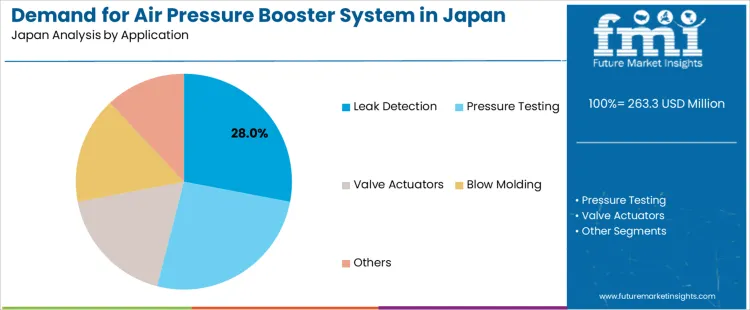
Air pressure booster systems within the 100-250 PSI range account for 28% of demand in Japan because this segment aligns with the operating needs of assembly plants, inspection lines, and maintenance teams handling pneumatic equipment. Consumption grows in facilities balancing output precision with moderate pressure levels that avoid stressing downstream components. Usage remains steady since this range supports predictable control across process checks, fastening tools, and calibration tasks. Procurement is driven by factories seeking units with stable output curves and low maintenance requirements. Price sensitivity stays moderate because mid-pressure units offer long service intervals and reliable duty cycles. Specification control emphasizes pressure repeatability, compact frame design, noise performance, and compatibility with centralized compressed air infrastructure. Demand remains consistent from 2026 to 2036 as industrial sites continue upgrading pneumatic testing environments and standardizing mid-range pressure for daily operations.
Why does leak detection represent 22.0% of the demand for air pressure booster systems in Japan by application?
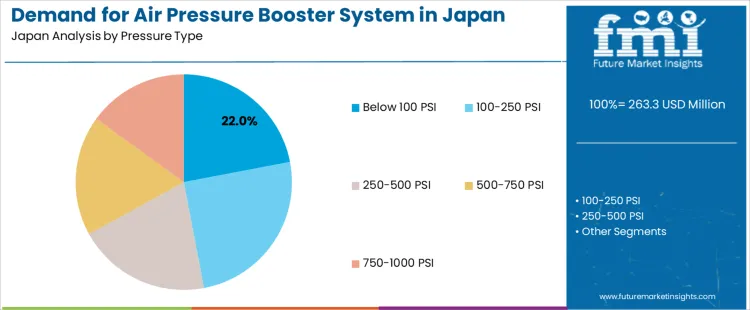
Leak detection represents 22.0% of the demand for air pressure booster systems in Japan because manufacturers prioritize airtightness verification to prevent energy loss, equipment degradation, and downstream contamination. Consumption is highest in automotive, electronics, and component machining plants where routine pressure integrity checks form part of daily inspection cycles. Usage remains steady since leak testing requires precise pressure increments that booster systems can sustain without output fluctuations. Procurement is shaped by the need for unit’s compatible with automated inspection stations and handheld testing setups. Price sensitivity stays moderate as consistent pressure delivery reduces retesting costs. Specification control focuses on stability under small-volume pressurization, rapid recharge capability, and clean output without oil carryover. Demand remains predictable from 2026 to 2036 as manufacturers expand quality-control checkpoints and integrate tighter leak detection standards into production workflows.
How Is Demand for Air Pressure Booster Systems in Japan Developing?
Which Local Operating Conditions Are Driving Demand for Air Pressure Booster Systems in Japan?
Drivers emerge from production areas where air pressure variation affects output quality. Automotive lines in Tochigi use boosters to stabilize torque on pneumatic tools. Packaging plants in Saitama rely on them to maintain seal stability on high speed machines. Water treatment sites in Fukuoka integrate boosters for remote valve actuation across older pipe sections. Electronics assembly units in Nagano adopt compact boosters to support benches with tight accuracy requirements. These examples show how local workflows guide adoption within Japan’s industrial landscape.
What Local Constraints Are Limiting Wider Adoption of Air Pressure Booster Systems in Japan?
Barriers relate to facility design, procurement routines, and operating budgets. Rural workshops avoid boosters because floor layouts leave little space near existing compressors. Factories with long term maintenance contracts often favor upgrades to central compressors instead of adding auxiliary units. Older water facilities face wiring and ventilation limits that slow installation. Small manufacturers in Shikoku and Tohoku prefer simple regulators due to predictable costs. These local conditions reduce wider use in regions where infrastructure, budgets, or long standing routines restrict equipment changes.
What is the Demand for Air Pressure Booster System in Japan by Region?
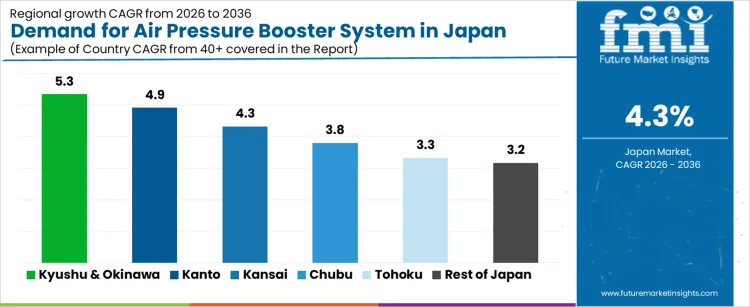
| Region | CAGR (%) |
|---|---|
| Kyushu & Okinawa | 5.3% |
| Kanto | 4.9% |
| Kansai | 4.3% |
| Chubu | 3.8% |
| Tohoku | 3.3% |
| Rest of Japan | 3.2% |
The demand for air pressure booster systems in Japan is increasing steadily across industrial automation, manufacturing, and precision equipment operations. Kyushu and Okinawa lead at a 5.3% CAGR, supported by active machinery production, localized manufacturing hubs, and expanding use of pneumatic systems in factories. Kanto follows at 4.9%, driven by diverse industrial bases, strong semiconductor and electronics activity, and higher adoption of energy efficient pneumatic solutions. Kansai records 4.3% growth, reflecting steady deployment across machinery, automotive parts, and food processing facilities. Chubu at 3.8% shows moderate uptake linked to industrial clusters serving automotive and heavy machinery sectors. Tohoku and the Rest of Japan, at 3.3% and 3.2%, reflect slower growth shaped by smaller manufacturing footprints, conservative equipment upgrades, and limited integration of advanced pneumatic infrastructure.
How Are Operational Requirements Supporting Air Pressure Booster System Demand in Kyushu and Okinawa?
Demand for air pressure booster systems in Kyushu and Okinawa is rising at a CAGR of 5.3% from 2026 to 2036 as industrial plants, workshops, and maintenance facilities rely on these systems to stabilize airflow for tools and machinery. Factories use booster systems to ensure consistent pressure during precision activities. Service centers adopt them to maintain reliable operation of pneumatic equipment. Retail and industrial distributors support routine procurement through steady stock availability. Regional growth reflects dependable industrial activity across manufacturing, repair services, and small production units that require controlled air pressure performance.
- Factories use systems for stable airflow
- Workshops rely on boosters for tool output
- Distributors maintain steady regional supply
What Drives Air Pressure Booster System Usage Across Kanto?
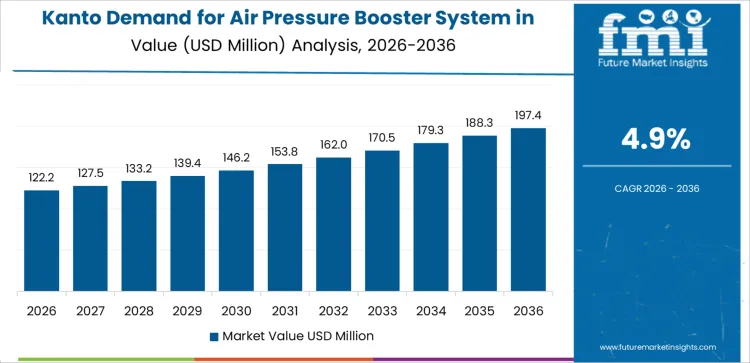
Demand for air pressure booster systems in Kanto is progressing at a CAGR of 4.9% from 2026 to 2036 as dense industrial zones, warehouses, and service facilities depend on stable air pressure for varied operations. Manufacturers integrate booster systems into production lines that require uniform pneumatic performance. Distribution centers use them to support packaging and automated equipment. Retail industrial suppliers manage frequent restocking due to consistent metropolitan demand. Regional growth follows broad industrial activity where controlled airflow supports operational efficiency across multiple sectors.
- Manufacturers rely on boosters for production lines
- Warehouses use systems for equipment stability
- Suppliers handle frequent replenishment cycles
How Is Industry Structure Shaping Booster System Demand in Kansai?
Demand for air pressure booster systems in Kansai is increasing at a CAGR of 4.3% from 2026 to 2036 as factories, machine shops, and logistics facilities adopt these systems to maintain consistent pneumatic performance. Plants integrate boosters into workflows requiring stable pressure for assembly and fabrication. Workshops use them to improve reliability of air driven tools. Distributors manage steady order cycles tied to regional industrial schedules. Growth reflects regular use across urban and suburban industrial clusters where stable air supply supports dependable operational routines.
- Plants use boosters for fabrication tasks
- Workshops rely on systems for tool efficiency
- Distributors track steady industrial demand
Which Conditions Influence Booster System Adoption Across Chubu?
Demand for air pressure booster systems in Chubu is trending at a CAGR of 3.8% from 2026 to 2036 as automotive, machinery, and component producers use these systems to support precise pneumatic operations. Factories rely on boosters to maintain regulated airflow during assembly and machining. Workshops integrate them for consistent tool handling. Retail industrial channels maintain measured stock levels aligned with local purchasing patterns. Growth continues as regional industries depend on controlled air pressure across multiple production environments.
- Factories use systems for regulated airflow
- Workshops adopt boosters for routine tasks
- Retailers manage measured inventory rotation
How Do Regional Workflows Shape Booster System Demand in Tohoku?
Demand for air pressure booster systems in Tohoku is moving at a CAGR of 3.3% from 2026 to 2036 as small and mid-sized industries require steady pneumatic support for operational tasks. Facilities use booster systems to maintain accurate airflow during equipment operation. Workshops incorporate them to improve tool reliability. Retail industrial suppliers follow stable procurement cycles shaped by predictable usage. Growth reflects practical adoption across manufacturing and repair locations that rely on consistent pressure delivery.
- Facilities rely on boosters for dependable airflow
- Workshops maintain steady equipment performance
- Suppliers follow regular procurement patterns
What Sustains Booster System Demand Across Rest of Japan?
Demand for air pressure booster systems in Rest of Japan is advancing at a CAGR of 3.2% from 2026 to 2036 as regional industries and service providers use these systems to support varied pneumatic tasks. Plants integrate boosters into daily operations requiring controlled pressure. Workshops use them for reliable tool function. Retail distributors manage modest but stable stock rotation. Growth follows routine industrial needs across dispersed communities where pressure stability ensures smooth workflow across multiple equipment types.
- Plants adopt systems for daily operations
- Workshops rely on boosters for tool handling
- Distributors maintain modest but steady supply
What Is Driving the Demand for Air Pressure Booster System in Japan and Which Companies Shape Industrial Adoption?
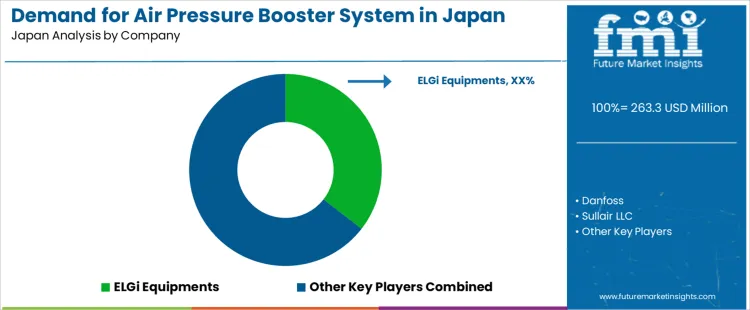
The demand for air pressure booster system in Japan is shaped by continuous operation of manufacturing plants, rising use of high pressure tools, and stricter process requirements in electronics, automotive, and food industries. Domestic compressor makers supply much of the installed base through compact boosters designed for clean, quiet operation in crowded factory floors. ELGi Equipments participates through oil free and oil lubricated booster units adopted in metalworking, packaging, and general engineering sites. Sullair LLC supports demand through high durability boosters used in heavy duty manufacturing and maintenance operations.
Product selection in Japan is governed by stable discharge pressure, low vibration, energy efficiency, and long duty cycle performance. Plants emphasize compatibility with existing compressor rooms, easy maintenance access, and well supported spare parts. Danfoss participates through pressure control components and drives that integrate with booster systems rather than full booster units. Buyers prefer systems that meet noise restrictions, withstand humid conditions, and maintain performance during multi shift operation. Usage spans pneumatic tooling, blow molding, leak testing, semiconductor equipment support, and automotive assembly lines. Demand visibility tracks factory modernization, growth in precision manufacturing, and steady investment in compressed air reliability across major industrial prefectures.
Key Players in the Air Pressure Booster System Industry in Japan
- ELGi Equipments
- Danfoss
- Sullair LLC
- Quincy Compressor
- Airmac Compressor
Scope of the Report
| Items | Values |
|---|---|
| Quantitative Units (2026) | USD million |
| Pressure Type | Below 100 PSI; 100–250 PSI; 250–500 PSI; 500–750 PSI; 750–1000 PSI |
| Application | Leak Detection; Pressure Testing; Valve Actuators; Blow Molding; Others |
| Regions Covered | Kyushu & Okinawa; Kanto; Kansai; Chubu; Tohoku; Rest of Japan |
| Countries Covered | Japan |
| Key Companies Profiled | ELGi Equipments; Sullair LLC; Danfoss (components); domestic compressor manufacturers |
| Additional Attributes | Dollar by sales across pressure types and application categories; airflow stabilization requirements; integration with centralized compressed air infrastructure; noise and vibration compliance; duty cycle and energy efficiency considerations; maintenance and spare part support patterns; adoption across automation, precision tooling, and leak verification workflows; facility level pressure zoning and load balancing requirements. |
Air Pressure Booster System Industry in Japan Segmentation
Pressure Type:
- Below 100 PSI
- 100-250 PSI
- 250-500 PSI
- 500-750 PSI
- 750-1000 PSI
Application:
- Leak Detection
- Pressure Testing
- Valve Actuators
- Blow Molding
- Others
Region:
- Kyushu & Okinawa
- Kanto
- Kansai
- Chubu
- Tohoku
- Rest of Japan
Frequently Asked Questions
How big is the demand for air pressure booster system in Japan in 2026?
The demand for air pressure booster system in Japan is estimated to be valued at USD 263.3 million in 2026.
What will be the size of air pressure booster system in Japan in 2036?
The market size for the air pressure booster system in Japan is projected to reach USD 400.4 million by 2036.
How much will be the demand for air pressure booster system in Japan growth between 2026 and 2036?
The demand for air pressure booster system in Japan is expected to grow at a 4.3% CAGR between 2026 and 2036.
What are the key product types in the air pressure booster system in Japan?
The key product types in air pressure booster system in Japan are below 100 psi, 100-250 psi, 250-500 psi, 500-750 psi and 750-1000 psi.
Which application segment is expected to contribute significant share in the air pressure booster system in Japan in 2026?
In terms of application, leak detection segment is expected to command 28.0% share in the air pressure booster system in Japan in 2026.
Preview the report firsthand - request a free sample
Get SampleGet the brochure for pricing and purchase details.
Get PDFTable of Content
- Executive Summary
- Japan Market Outlook
- Demand-side Trends
- Supply-side Trends
- Technology Roadmap Analysis
- Analysis and Recommendations
- Market Overview
- Market Coverage / Taxonomy
- Market Definition / Scope / Limitations
- Market Background
- Market Dynamics
- Drivers
- Restraints
- Opportunity
- Trends
- Scenario Forecast
- Demand in Optimistic Scenario
- Demand in Likely Scenario
- Demand in Conservative Scenario
- Opportunity Map Analysis
- Product Life Cycle Analysis
- Supply Chain Analysis
- Investment Feasibility Matrix
- Value Chain Analysis
- PESTLE and Porter’s Analysis
- Regulatory Landscape
- Regional Parent Market Outlook
- Production and Consumption Statistics
- Import and Export Statistics
- Market Dynamics
- Japan Market Analysis 2020 to 2024 and Forecast, 2025 to 2035
- Historical Market Size Value (USD Million) Analysis, 2020 to 2024
- Current and Future Market Size Value (USD Million) Projections, 2025 to 2035
- Y-o-Y Growth Trend Analysis
- Absolute $ Opportunity Analysis
- Japan Market Pricing Analysis 2020 to 2024 and Forecast 2025 to 2035
- Japan Market Analysis 2020 to 2024 and Forecast 2025 to 2035, By Pressure Type
- Introduction / Key Findings
- Historical Market Size Value (USD Million) Analysis By Pressure Type , 2020 to 2024
- Current and Future Market Size Value (USD Million) Analysis and Forecast By Pressure Type , 2025 to 2035
- Below 100 PSI
- 100-250 PSI
- 250-500 PSI
- 500-750 PSI
- 750-1000 PSI
- Y-o-Y Growth Trend Analysis By Pressure Type , 2020 to 2024
- Absolute $ Opportunity Analysis By Pressure Type , 2025 to 2035
- Japan Market Analysis 2020 to 2024 and Forecast 2025 to 2035, By Application
- Introduction / Key Findings
- Historical Market Size Value (USD Million) Analysis By Application, 2020 to 2024
- Current and Future Market Size Value (USD Million) Analysis and Forecast By Application, 2025 to 2035
- Leak Detection
- Pressure Testing
- Valve Actuators
- Blow Molding
- Others
- Y-o-Y Growth Trend Analysis By Application, 2020 to 2024
- Absolute $ Opportunity Analysis By Application, 2025 to 2035
- Market Structure Analysis
- Competition Dashboard
- Competition Benchmarking
- Market Share Analysis of Top Players
- By Regional
- By Pressure Type
- By Application
- Competition Analysis
- Competition Deep Dive
- ELGi Equipments
- Overview
- Product Portfolio
- Profitability by Market Segments (Product/Age /Sales Channel/Region)
- Sales Footprint
- Strategy Overview
- Marketing Strategy
- Product Strategy
- Channel Strategy
- Danfoss
- Sullair LLC
- Quincy Compressor
- Airmac Compressor
- ELGi Equipments
- Competition Deep Dive
- Assumptions & Acronyms Used
- Research Methodology


