

- Industry Size (2026)
- USD 1.5 Bn
- Forecast (2036)
- USD 2.4 Bn
- CAGR (2026 to 2036)
- 4.8%
Air Compressor Hose Market Forecast and Outlook 2026 to 2036
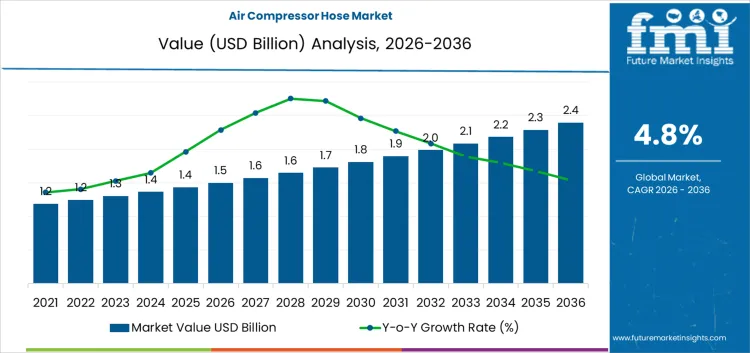
The air compressor hose market is forecast to expand to USD 2.4 billion by 2036, with growth averaging 4.8% CAGR, garnering around USD 1.5 billion in 2026. Demand shows clear geographic concentration, with heavy use in regions where construction activity, small manufacturing, and equipment repair networks remain labor intensive. Adoption patterns vary widely between countries with high workshop density and those relying more on centralized service centers. Production and sourcing benefit from low cost polymer processing hubs, which shapes trade flows and pricing. Buyers in mature regions focus on handling quality and durability, while price sensitivity dominates purchasing decisions in cost constrained markets.
Over time, growth remains uneven across regions because hose usage depends more on worksite organization than on compressor sales alone. In parts of Asia and Latin America, expanding contractor networks and informal workshops continue to add volume, while North America and Europe show steadier replacement driven demand. Freight cost, local extrusion capacity, and access to fittings supply chains influence where products are manufactured and assembled. Distribution remains fragmented, with strong roles for hardware chains and industrial distributors. The market expands through geographic spread of use cases rather than through technical shifts in air delivery systems.
Quick Stats of the Air Compressor Hose Market
- Air Compressor Hose Market Value (2026): USD 1.5 billion
- Air Compressor Hose Forecast Value (2036): USD 2.4 billion
- Air Compressor Hose Forecast CAGR 2026 to 2036: 4.8%
- Leading Material in Air Compressor Hose Market: Rubber Hoses (46 % share)
- Leading Pressure Class in Air Compressor Hose Market: Up to 10 bar (34 % share)
- Key Growth Regions in Air Compressor Hose Market: India, Mexico, Brazil, USA, Germany
- Top Players in Air Compressor Hose Market: Parker Hannifin, Continental, Gates Corporation, Eaton, Bridgestone, Manuli Rubber Industries, Alfagomma, Kuriyama, Toyox
Key Takeaways, Market Size, and Forecast
| Metric | Value |
|---|---|
| Market Size (2026) | USD 1.5 Billion |
| Market Size (2036) | USD 2.4 Billion |
| CAGR (2026–2036) | 4.8% |
| Leading Material | Rubber Hoses |
| Rubber Hoses Share | 46.0% |
| Leading Pressure Rating | Up To 10 Bar |
| Up To 10 Bar Share | 34.0% |
What is the Growth Forecast for Air Compressor Hose Market through 2036?
Between 2026 and 2031, the air compressor hose market is projected to grow from USD 1.5 billion along a steady path consistent with a 4.8% CAGR, reflecting the way this category is governed by usage intensity and wear rather than by equipment redesign cycles. Hoses are consumable components exposed to abrasion, bending fatigue, and accidental damage, which creates repeat demand even in stable industrial environments. Rubber and PVC products dominate high-volume use because cost, flexibility, and familiarity outweigh marginal gains in performance. Sales are closely tied to industrial distributors and retail channels that serve maintenance crews, contractors, and workshops. Purchasing decisions prioritize availability, compatibility with fittings, and acceptable service life over technical differentiation.
From 2031 to 2036, the market is expected to reach USD 2.4 billion, with growth sustained by continued expansion of tool usage in construction, automotive service, and small-scale manufacturing. Higher-pressure and polyurethane hoses gain share in applications where durability and weight reduction matter, though they remain a minority of total volume. OEM tool bundles contribute to baseline demand, but the aftermarket continues to define the category’s economics. Competitive positioning centers on manufacturing scale, breadth of sizes and pressure classes, and distribution coverage, supporting suppliers such as Parker Hannifin, Continental, Gates Corporation, Eaton, Bridgestone, Manuli Rubber Industries, Alfagomma, Kuriyama, Toyox, and a wide range of regional hose producers.
Air Compressor Hose Market Key Takeaways
| Metric | Value |
|---|---|
| Market Value (2026) | USD 1.5 billion |
| Forecast Value (2036) | USD 2.4 billion |
| Forecast CAGR 2026 to 2036 | 4.8% |
How Are Air Compressor Hoses Supporting Efficient Compressed Air Systems?
Air compressor hoses are increasingly adopted to transport compressed air safely and efficiently across industrial, commercial, and automotive applications. Historically, standard hoses lacked flexibility, pressure resistance, and durability, leading to leaks, bursts, and operational downtime. Modern hoses use reinforced materials such as synthetic rubber, PVC, or polyurethane with braided or spiral reinforcement to withstand high pressure, temperature variations, and mechanical stress while maintaining flexibility. Industrial operators, automotive service providers, and manufacturing facilities prioritize pressure rating, abrasion resistance, and compatibility with connectors and fittings. Early adoption focused on heavy-duty industrial plants, while current demand spans automotive workshops, construction sites, and general industrial facilities, driven by the need for reliable compressed air delivery and reduced maintenance. Hose material, flexibility, and pressure tolerance influence supplier selection.
Rising adoption of compressed air systems, safety regulations, and maintenance efficiency requirements are shaping market growth. Compared with conventional hoses, modern reinforced hoses emphasize high-pressure capacity, long-term durability, and resistance to environmental and mechanical wear. Cost structures depend on raw material quality, reinforcement method, and manufacturing precision, concentrating margins among suppliers capable of delivering reliable, high-performance hoses. Operators adopt these hoses to minimize leaks, reduce downtime, and ensure consistent airflow to pneumatic tools and equipment. By 2036, reinforced and high-performance air compressor hoses are expected to become standard across industrial, commercial, and automotive applications, supporting operational efficiency, safety, and system reliability.
What Factors Are Shaping the Demand for Air Compressor Hoses by Material Choice and Pressure Class in 2026?
The air compressor hose market in 2026 is segmented by material type and by pressure rating. By material, demand is divided into rubber, PVC, PU, and other hose constructions that differ in flexibility, abrasion resistance, and temperature tolerance. By pressure class, demand is organized around applications up to 10 bar, 10 to 20 bar, above 20 bar, and other ranges that reflect compressor size and tool requirements. These segments reflect how users balance handling comfort, durability, safety margins, and purchase cost while selecting hoses that must perform reliably under repeated bending, dragging, and pressure cycling in workshops and industrial environments.
Why Do Rubber Hoses Continue to Dominate the Installed Base?
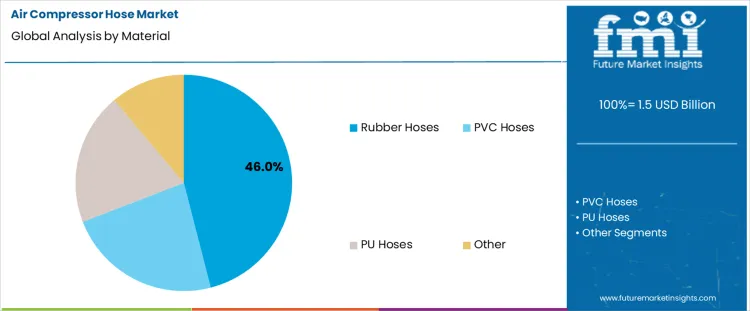
Rubber hoses account for about 46% of demand in 2026, reflecting their durability and tolerance to rough handling. In many workshops and construction sites, hoses are dragged across floors, exposed to oil, and bent around corners, which favors materials that resist cracking and abrasion. Rubber maintains flexibility across a wide temperature range, which reduces the risk of sudden stiffness or kinking during use. These hoses also damp vibration and pressure pulses, which improves tool behavior. Although they are heavier than plastic alternatives, users often accept the weight in exchange for longer service life. This reputation for reliability and predictable performance keeps rubber hoses as the default choice in many general purpose applications.
PVC and PU hoses serve segments where weight, cost, or handling comfort takes priority. PVC hoses are lighter and less expensive, which suits light duty or indoor use, though they can become stiff in cold conditions and wear faster under abrasion. PU hoses offer better flexibility and recoil behavior, which appeals in assembly lines and tool balancer setups, yet their higher price limits use in cost sensitive environments. Both materials also have narrower temperature and chemical resistance windows compared with rubber. Their adoption depends on specific work patterns and user preference rather than on universal suitability, which keeps their combined share below that of rubber across the broader installed base.
Why Does the Up to 10 Bar Pressure Class Represent the Largest Volume Segment?
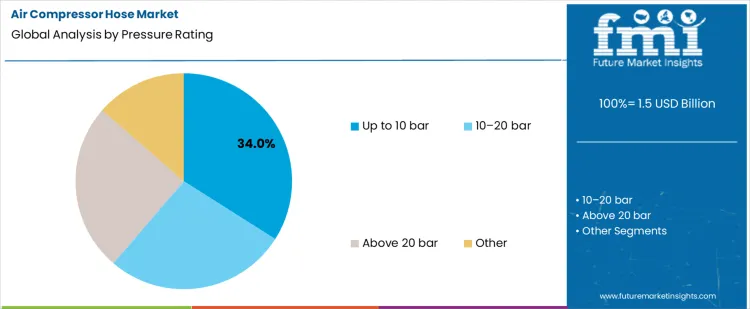
Hoses rated up to 10 bar represent about 34% of demand in 2026 because this pressure class covers most light industrial, service, and workshop applications. Many pneumatic tools and small compressors operate within this range, which makes these hoses the most frequently purchased and replaced. Lower pressure ratings also allow thinner walls and lower material cost, which encourages stocking and frequent change out rather than extended use. The large number of small facilities and mobile service operations multiplies unit demand in this category. This wide and fragmented user base explains why the lowest pressure class accounts for the largest share of hose volume even though higher pressure hoses carry more material per unit.
The 10 to 20 bar and above 20 bar segments serve heavier duty and specialized equipment. These hoses require thicker walls, stronger reinforcement, and more careful handling, which increases weight and cost. They are purchased mainly by industrial users with defined process requirements and longer replacement cycles. Installations are fewer in number and more centralized, which limits total unit shipments. Although these hoses are critical for safety and performance in high pressure systems, their overall market share remains lower because the population of such applications is small compared with the widespread use of low pressure air systems.
Why Are Workshop Utilization Patterns and Equipment Mobility Driving Steady Demand for Air Compressor Hoses through 2036?
Demand is shaped by how compressed air is used on the floor rather than by how compressors are sold. In workshops, factories, and service bays, tools are moved constantly, layouts change, and fixed piping rarely reaches every point of use. Hoses provide the last meter of flexibility between infrastructure and work. Wear, kinking, and accidental damage create regular replacement cycles that are largely independent of capital equipment spending. Growth in service operations, maintenance outsourcing, and small scale fabrication keeps usage hours high. This makes hose demand track activity levels and tool counts more closely than new compressor installations.
What Durability Tradeoffs, Safety Concerns, and Price Pressure Are Limiting Value Expansion?
Limits come from operating realities. Hoses are dragged, crushed, exposed to oil, and subjected to repeated pressure cycling, which shortens life regardless of material quality. Safety incidents from whip, burst, or fitting failure push some users toward heavier, more expensive assemblies, but many still choose low cost options and accept frequent replacement. Standards and certification requirements differ by region and application, complicating premium positioning. Because hoses are viewed as consumables, procurement often focuses on unit price rather than lifecycle cost. These behaviors keep volumes high but prevent consistent margin improvement for manufacturers and distributors.
How Are Workshop Layout Changes and Systemization of Air Distribution Affecting This Category?
Structural change comes from how air is delivered. Some facilities invest in overhead reels, quick connect grids, and modular piping to reduce hose lengths and trip hazards. This shifts demand toward shorter, purpose specific hoses and retractable assemblies rather than long generic lines. In mobile service and construction, lightweight and hybrid material hoses gain attention to reduce handling fatigue. Large plants also standardize hose types to simplify spares management. The category is moving from ad hoc purchases toward more systemized, layout driven specification, where hose selection is part of overall workstation and safety design.
What is the Demand for Air Compressor Hoses by Country?
| Country | CAGR (%) |
|---|---|
| India | 6.0% |
| Mexico | 5.0% |
| Brazil | 4.5% |
| USA | 2.9% |
| Germany | 2.4% |
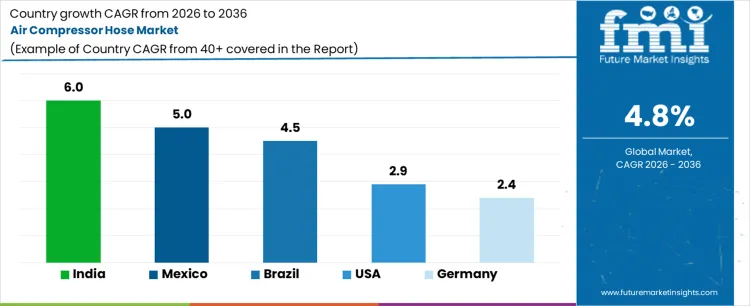
Demand for air compressor hoses is rising as industrial, manufacturing, and construction sectors adopt efficient pneumatic systems to improve operational performance, safety, and reliability. India leads with a 6.0% CAGR, driven by rapid industrial growth, expanding manufacturing base, and rising adoption of compressed air systems. Mexico follows at 5.0%, supported by growing industrial and commercial sectors. Brazil records 4.5% growth, shaped by infrastructure development and replacement demand. The USA grows at 2.9%, reflecting mature industrial markets and stable replacement cycles. Germany shows 2.4% CAGR, influenced by steady adoption in manufacturing facilities and long-term usage of air compressor systems.
How is India experiencing growth in the air compressor hose market?
India is experiencing growth at a CAGR of 6%, driven by expansion of industrial and automotive sectors in cities such as Pune, Chennai, and Ahmedabad. Compressed air hoses are critical for assembly lines, painting, and pneumatic tool operation in manufacturing hubs. Manufacturers are supplying hoses optimized for high-pressure resistance, flexibility, and durability under tropical climate conditions. Demand is concentrated in automotive manufacturing zones, industrial plants, and maintenance workshops. Investments focus on material quality, operational reliability, and adherence to national industrial standards. Growth reflects increasing industrial mechanization, adoption of pneumatic systems, and rising demand for durable hose solutions in diverse manufacturing sectors.
- Industrial and automotive expansion drives adoption.
- Hoses optimize pressure resistance and flexibility.
- Manufacturing hubs and maintenance centers concentrate demand.
- Material quality and compliance guide investment.
How is Mexico witnessing growth in the air compressor hose market?
Mexico is witnessing growth at a CAGR of 5%, supported by automotive and electronics production clusters in Querétaro, Guanajuato, and Nuevo León. Compressed air hoses are essential for assembly lines, spray painting, and pneumatic operations, requiring durability under variable temperature and humidity. Manufacturers are producing hoses optimized for high-pressure tolerance, abrasion resistance, and compatibility with industrial air systems. Demand is concentrated in industrial parks, automotive assembly plants, and maintenance workshops. Investments prioritize material reliability, system efficiency, and compliance with Mexican industrial standards. Growth reflects industrial expansion, modernization of pneumatic systems, and increased adoption of automated production lines.
- Automotive and electronics clusters drive adoption.
- Hoses enhance pressure tolerance and durability.
- Industrial parks and assembly plants concentrate demand.
- Material performance and standards compliance guide investment.
How is Brazil experiencing growth in the air compressor hose market?
Brazil is experiencing growth at a CAGR of 4.5%, fueled by industrial expansion in São Paulo, Minas Gerais, and Paraná, particularly in automotive, food processing, and construction sectors. Compressed air hoses are used extensively in assembly operations, pneumatic tools, and production lines. Suppliers are providing hoses optimized for high-pressure resistance, flexibility, and performance under tropical humidity and temperature. Demand is concentrated in manufacturing hubs, construction sites, and industrial workshops. Investments focus on material durability, operational reliability, and compliance with Brazilian industrial safety standards. Growth reflects rising mechanization, industrial modernization, and increasing adoption of pneumatic systems.
- Industrial sectors drive adoption.
- Hoses optimize pressure resistance and flexibility.
- Manufacturing hubs and construction sites concentrate demand.
- Material durability and compliance guide investment.
How is the United States witnessing growth in the air compressor hose market?
United States is witnessing growth at a CAGR of 2.9%, supported by adoption of air compressor hoses in automotive, construction, and industrial maintenance sectors. Manufacturers are producing hoses optimized for pressure tolerance, flexibility, and durability in moderate temperature conditions. Demand is concentrated in automotive assembly plants, industrial hubs, and maintenance facilities. Investments focus on material quality, operational reliability, and compliance with American industrial safety standards. Growth reflects moderate industrial expansion, continued use of pneumatic systems, and a focus on durable hose solutions for operational efficiency.
- Automotive and industrial sectors drive adoption.
- Hoses enhance pressure tolerance and flexibility.
- Assembly plants and maintenance hubs concentrate demand.
- Material quality and compliance guide investment.
How is Germany experiencing growth in the air compressor hose market?
Germany is experiencing growth at a CAGR of 2.4%, fueled by adoption of air compressor hoses in automotive, engineering, and industrial manufacturing hubs such as Stuttgart, Munich, and Wolfsburg. Hoses are critical for pneumatic systems, assembly automation, and workshop operations. Manufacturers supply hoses optimized for durability, high-pressure resistance, and compatibility with automated industrial systems. Demand is concentrated in automotive manufacturing zones, engineering plants, and maintenance workshops. Investments focus on material performance, operational reliability, and compliance with EU industrial standards. Growth reflects stable industrial activity, modernization of pneumatic systems, and adoption of high-quality hose solutions for precision manufacturing.
- Automotive and engineering hubs drive adoption.
- Hoses optimize durability and pressure resistance.
- Manufacturing zones and workshops concentrate demand.
- Material performance and EU compliance guide investment.
Who Competes in the Air Compressor Hose Market and What Defines Their Capabilities?
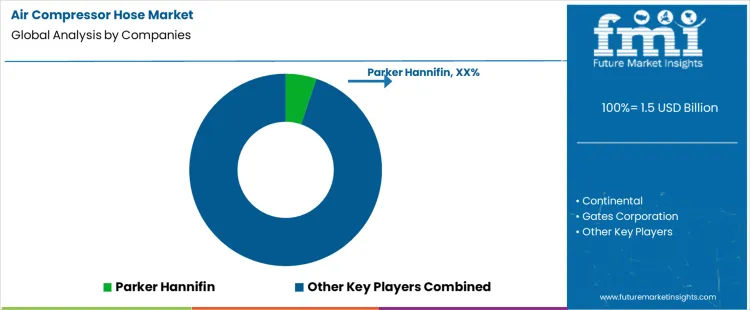
Competition in the air compressor hose market is shaped by materials engineering, pressure rating performance, and durability under repeated pressure cycles. Parker Hannifin supplies hoses designed for reliable air delivery with resistance to kinking and abrasion in industrial and workshop environments. Continental provides reinforced hose assemblies engineered for stable performance under fluctuating air pressures and broad temperature ranges. Gates Corporation offers elastomer and thermoplastic hoses optimized for sustained flexibility and consistent airflow in heavy duty applications.
Eaton delivers hoses engineered for pneumatic systems with focus on pressure retention and compatibility with automated equipment. Bridgestone supplies hoses with compound formulations that balance flexibility and tensile strength. Other competitors such as Manuli Rubber Industries, Alfagomma, Kuriyama, and Toyox contribute hoses tailored to specific pressure classes, chemical resistance requirements, and connection standards used across manufacturing, construction, and maintenance sectors.
Market participants differentiate through compound formulation, reinforcement design, and compliance with industry standards. Parker Hannifin focuses on hoses with high tensile strength, predictable fatigue life, and serviceability across varied compressor capacities. Continental develops multi layer hoses with reinforcement aimed at minimizing pressure loss and enhancing service life in continuous use. Gates Corporation emphasizes hose flexibility and resistance to environmental stress cracking. Eaton supplies hose solutions compatible with pneumatic tools and automated air systems. Bridgestone delivers hoses with balanced flexibility and abrasion resistance.
Manuli Rubber Industries and Alfagomma produce hoses with tailored reinforcement for industrial and mobile compressor applications. Kuriyama offers a range of hose profiles designed for specific fittings and installation constraints. Toyox provides hoses engineered for ease of installation and reliability under thermal cycling. Competitive differences arise from pressure tolerance, bend radius performance, material resistance to oil and ozone, and ability to meet standards set by ISO, SAE, or industry OEM specifications. These factors shape supplier relevance across industrial maintenance, construction, and high throughput pneumatic systems.
Key Players in the Air Compressor Hose Market
- Parker Hannifin
- Continental
- Gates Corporation
- Eaton
- Bridgestone
- Manuli Rubber Industries
- Alfagomma
- Kuriyama
- Toyox
Scope of the Report
| Items | Values |
|---|---|
| Quantitative Units (2026) | USD billion |
| Material | Rubber Hoses, PVC Hoses, PU Hoses, Other |
| Pressure Rating | Up to 10 bar, 10-20 bar, Above 20 bar, Other |
| End Use | Industrial & Factory Use, Construction Tools, Automotive Workshops, Other |
| Sales Channel | Industrial Distributors, Retail & E-commerce, OEM and Tool Bundles, Other |
| Regions Covered | Asia Pacific, Europe, North America, Latin America, Middle East & Africa |
| Countries Covered | China, Japan, South Korea, India, Australia & New Zealand, ASEAN, Germany, United Kingdom, France, Italy, Spain, Nordic, BENELUX, United States, Canada, Mexico, Brazil, Chile, Saudi Arabia, Turkey, South Africa, and other regional markets |
| Key Companies Profiled | Parker Hannifin, Continental, Gates Corporation, Eaton, Bridgestone, Manuli Rubber Industries, Alfagomma, Kuriyama, Toyox |
| Additional Attributes | Dollar sales by material, pressure rating, end use, and sales channel, rubber hoses accounting for the largest installed base due to durability and rough handling tolerance, up to 10 bar pressure class representing the largest volume segment, demand driven by wear, bending fatigue, and frequent replacement rather than by compressor sales, aftermarket and distribution channels dominating category economics, purchasing focused on availability, compatibility, and acceptable service life rather than technical differentiation, market growth shaped by workshop density, contractor activity, and small-scale manufacturing rather than system redesign, and regional demand influenced by construction activity, informal workshop networks, and distribution structure. |
Air Compressor Hose Market Segmentation
Material:
- Rubber Hoses
- PVC Hoses
- PU Hoses
- Other
Pressure Rating:
- Up to 10 bar
- 10-20 bar
- Above 20 bar
- Other
End Use:
- Industrial & Factory Use
- Construction Tools
- Automotive Workshops
- Other
Sales Channel:
- Industrial Distributors
- Retail & E-commerce
- OEM and Tool Bundles
- Other
Region:
- Asia Pacific
- China
- Japan
- South Korea
- India
- Australia & New Zealand
- ASEAN
- Rest of Asia Pacific
- Europe
- Germany
- United Kingdom
- France
- Italy
- Spain
- Nordic
- BENELUX
- Rest of Europe
- North America
- United States
- Canada
- Mexico
- Latin America
- Brazil
- Chile
- Rest of Latin America
- Middle East & Africa
- Kingdom of Saudi Arabia
- Other GCC Countries
- Turkey
- South Africa
- Other African Union
- Rest of Middle East & Africa
Bibliography
- International Organization for Standardization. (2023). ISO 8573-1: Compressed air - Contaminants and purity classes.
- International Organization for Standardization. (2024). ISO 18752: Rubber hoses and hose assemblies - Wire- or textile-reinforced - Specification for hydraulic and pneumatic applications.
- European Committee for Standardization. (2023). EN ISO 4414: Pneumatic fluid power - General rules and safety requirements for systems and their components.
- USA Department of Energy. (2024). Improving compressed air system performance: A sourcebook for industry (2024 edition).
- Occupational Safety and Health Administration. (2024). Safety and health information bulletin: Hazards of compressed air and pneumatic equipment.
Frequently Asked Questions
How big is the air compressor hose market in 2026?
The global air compressor hose market is estimated to be valued at USD 1.5 billion in 2026.
What will be the size of air compressor hose market in 2036?
The market size for the air compressor hose market is projected to reach USD 2.4 billion by 2036.
How much will be the air compressor hose market growth between 2026 and 2036?
The air compressor hose market is expected to grow at a 4.8% CAGR between 2026 and 2036.
What are the key product types in the air compressor hose market?
The key product types in air compressor hose market are rubber hoses, pvc hoses, pu hoses and other.
Which pressure rating segment to contribute significant share in the air compressor hose market in 2026?
In terms of pressure rating, up to 10 bar segment to command 34.0% share in the air compressor hose market in 2026.
Preview the report firsthand - request a free sample
Get SampleGet the brochure for pricing and purchase details.
Get PDFTable of Content
- Executive Summary
- Global Market Outlook
- Demand-side Trends
- Supply-side Trends
- Technology Roadmap Analysis
- Analysis and Recommendations
- Market Overview
- Market Coverage / Taxonomy
- Market Definition / Scope / Limitations
- Market Background
- Market Dynamics
- Drivers
- Restraints
- Opportunity
- Trends
- Scenario Forecast
- Demand in Optimistic Scenario
- Demand in Likely Scenario
- Demand in Conservative Scenario
- Opportunity Map Analysis
- Product Life Cycle Analysis
- Supply Chain Analysis
- Investment Feasibility Matrix
- Value Chain Analysis
- PESTLE and Porter’s Analysis
- Regulatory Landscape
- Regional Parent Market Outlook
- Production and Consumption Statistics
- Import and Export Statistics
- Market Dynamics
- Global Market Analysis 2021 to 2025 and Forecast, 2026 to 2036
- Historical Market Size Value (USD Million) Analysis, 2021 to 2025
- Current and Future Market Size Value (USD Million) Projections, 2026 to 2036
- Y-o-Y Growth Trend Analysis
- Absolute $ Opportunity Analysis
- Global Market Pricing Analysis 2021 to 2025 and Forecast 2026 to 2036
- Global Market Analysis 2021 to 2025 and Forecast 2026 to 2036, By Material
- Introduction / Key Findings
- Historical Market Size Value (USD Million) Analysis By Material, 2021 to 2025
- Current and Future Market Size Value (USD Million) Analysis and Forecast By Material, 2026 to 2036
- Rubber Hoses
- PVC Hoses
- PU Hoses
- Other
- Rubber Hoses
- Y-o-Y Growth Trend Analysis By Material, 2021 to 2025
- Absolute $ Opportunity Analysis By Material, 2026 to 2036
- Global Market Analysis 2021 to 2025 and Forecast 2026 to 2036, By Pressure Rating
- Introduction / Key Findings
- Historical Market Size Value (USD Million) Analysis By Pressure Rating, 2021 to 2025
- Current and Future Market Size Value (USD Million) Analysis and Forecast By Pressure Rating, 2026 to 2036
- Up to 10 bar
- 10-20 bar
- Above 20 bar
- Other
- Up to 10 bar
- Y-o-Y Growth Trend Analysis By Pressure Rating, 2021 to 2025
- Absolute $ Opportunity Analysis By Pressure Rating, 2026 to 2036
- Global Market Analysis 2021 to 2025 and Forecast 2026 to 2036, By End Use
- Introduction / Key Findings
- Historical Market Size Value (USD Million) Analysis By End Use, 2021 to 2025
- Current and Future Market Size Value (USD Million) Analysis and Forecast By End Use, 2026 to 2036
- Industrial & Factory Use
- Construction Tools
- Automotive Workshops
- Other
- Industrial & Factory Use
- Y-o-Y Growth Trend Analysis By End Use, 2021 to 2025
- Absolute $ Opportunity Analysis By End Use, 2026 to 2036
- Global Market Analysis 2021 to 2025 and Forecast 2026 to 2036, By Sales Channel
- Introduction / Key Findings
- Historical Market Size Value (USD Million) Analysis By Sales Channel, 2021 to 2025
- Current and Future Market Size Value (USD Million) Analysis and Forecast By Sales Channel, 2026 to 2036
- Industrial Distributors
- Retail & E-commerce
- OEM/Tool Bundles
- Other
- Industrial Distributors
- Y-o-Y Growth Trend Analysis By Sales Channel, 2021 to 2025
- Absolute $ Opportunity Analysis By Sales Channel, 2026 to 2036
- Global Market Analysis 2021 to 2025 and Forecast 2026 to 2036, By Region
- Introduction
- Historical Market Size Value (USD Million) Analysis By Region, 2021 to 2025
- Current Market Size Value (USD Million) Analysis and Forecast By Region, 2026 to 2036
- North America
- Latin America
- Western Europe
- Eastern Europe
- East Asia
- South Asia and Pacific
- Middle East & Africa
- Market Attractiveness Analysis By Region
- North America Market Analysis 2021 to 2025 and Forecast 2026 to 2036, By Country
- Historical Market Size Value (USD Million) Trend Analysis By Market Taxonomy, 2021 to 2025
- Market Size Value (USD Million) Forecast By Market Taxonomy, 2026 to 2036
- By Country
- USA
- Canada
- Mexico
- By Material
- By Pressure Rating
- By End Use
- By Sales Channel
- By Country
- Market Attractiveness Analysis
- By Country
- By Material
- By Pressure Rating
- By End Use
- By Sales Channel
- Key Takeaways
- Latin America Market Analysis 2021 to 2025 and Forecast 2026 to 2036, By Country
- Historical Market Size Value (USD Million) Trend Analysis By Market Taxonomy, 2021 to 2025
- Market Size Value (USD Million) Forecast By Market Taxonomy, 2026 to 2036
- By Country
- Brazil
- Chile
- Rest of Latin America
- By Material
- By Pressure Rating
- By End Use
- By Sales Channel
- By Country
- Market Attractiveness Analysis
- By Country
- By Material
- By Pressure Rating
- By End Use
- By Sales Channel
- Key Takeaways
- Western Europe Market Analysis 2021 to 2025 and Forecast 2026 to 2036, By Country
- Historical Market Size Value (USD Million) Trend Analysis By Market Taxonomy, 2021 to 2025
- Market Size Value (USD Million) Forecast By Market Taxonomy, 2026 to 2036
- By Country
- Germany
- UK
- Italy
- Spain
- France
- Nordic
- BENELUX
- Rest of Western Europe
- By Material
- By Pressure Rating
- By End Use
- By Sales Channel
- By Country
- Market Attractiveness Analysis
- By Country
- By Material
- By Pressure Rating
- By End Use
- By Sales Channel
- Key Takeaways
- Eastern Europe Market Analysis 2021 to 2025 and Forecast 2026 to 2036, By Country
- Historical Market Size Value (USD Million) Trend Analysis By Market Taxonomy, 2021 to 2025
- Market Size Value (USD Million) Forecast By Market Taxonomy, 2026 to 2036
- By Country
- Russia
- Poland
- Hungary
- Balkan & Baltic
- Rest of Eastern Europe
- By Material
- By Pressure Rating
- By End Use
- By Sales Channel
- By Country
- Market Attractiveness Analysis
- By Country
- By Material
- By Pressure Rating
- By End Use
- By Sales Channel
- Key Takeaways
- East Asia Market Analysis 2021 to 2025 and Forecast 2026 to 2036, By Country
- Historical Market Size Value (USD Million) Trend Analysis By Market Taxonomy, 2021 to 2025
- Market Size Value (USD Million) Forecast By Market Taxonomy, 2026 to 2036
- By Country
- China
- Japan
- South Korea
- By Material
- By Pressure Rating
- By End Use
- By Sales Channel
- By Country
- Market Attractiveness Analysis
- By Country
- By Material
- By Pressure Rating
- By End Use
- By Sales Channel
- Key Takeaways
- South Asia and Pacific Market Analysis 2021 to 2025 and Forecast 2026 to 2036, By Country
- Historical Market Size Value (USD Million) Trend Analysis By Market Taxonomy, 2021 to 2025
- Market Size Value (USD Million) Forecast By Market Taxonomy, 2026 to 2036
- By Country
- India
- ASEAN
- Australia & New Zealand
- Rest of South Asia and Pacific
- By Material
- By Pressure Rating
- By End Use
- By Sales Channel
- By Country
- Market Attractiveness Analysis
- By Country
- By Material
- By Pressure Rating
- By End Use
- By Sales Channel
- Key Takeaways
- Middle East & Africa Market Analysis 2021 to 2025 and Forecast 2026 to 2036, By Country
- Historical Market Size Value (USD Million) Trend Analysis By Market Taxonomy, 2021 to 2025
- Market Size Value (USD Million) Forecast By Market Taxonomy, 2026 to 2036
- By Country
- Kingdom of Saudi Arabia
- Other GCC Countries
- Turkiye
- South Africa
- Other African Union
- Rest of Middle East & Africa
- By Material
- By Pressure Rating
- By End Use
- By Sales Channel
- By Country
- Market Attractiveness Analysis
- By Country
- By Material
- By Pressure Rating
- By End Use
- By Sales Channel
- Key Takeaways
- Key Countries Market Analysis
- USA
- Pricing Analysis
- Market Share Analysis, 2025
- By Material
- By Pressure Rating
- By End Use
- By Sales Channel
- Canada
- Pricing Analysis
- Market Share Analysis, 2025
- By Material
- By Pressure Rating
- By End Use
- By Sales Channel
- Mexico
- Pricing Analysis
- Market Share Analysis, 2025
- By Material
- By Pressure Rating
- By End Use
- By Sales Channel
- Brazil
- Pricing Analysis
- Market Share Analysis, 2025
- By Material
- By Pressure Rating
- By End Use
- By Sales Channel
- Chile
- Pricing Analysis
- Market Share Analysis, 2025
- By Material
- By Pressure Rating
- By End Use
- By Sales Channel
- Germany
- Pricing Analysis
- Market Share Analysis, 2025
- By Material
- By Pressure Rating
- By End Use
- By Sales Channel
- UK
- Pricing Analysis
- Market Share Analysis, 2025
- By Material
- By Pressure Rating
- By End Use
- By Sales Channel
- Italy
- Pricing Analysis
- Market Share Analysis, 2025
- By Material
- By Pressure Rating
- By End Use
- By Sales Channel
- Spain
- Pricing Analysis
- Market Share Analysis, 2025
- By Material
- By Pressure Rating
- By End Use
- By Sales Channel
- France
- Pricing Analysis
- Market Share Analysis, 2025
- By Material
- By Pressure Rating
- By End Use
- By Sales Channel
- India
- Pricing Analysis
- Market Share Analysis, 2025
- By Material
- By Pressure Rating
- By End Use
- By Sales Channel
- ASEAN
- Pricing Analysis
- Market Share Analysis, 2025
- By Material
- By Pressure Rating
- By End Use
- By Sales Channel
- Australia & New Zealand
- Pricing Analysis
- Market Share Analysis, 2025
- By Material
- By Pressure Rating
- By End Use
- By Sales Channel
- China
- Pricing Analysis
- Market Share Analysis, 2025
- By Material
- By Pressure Rating
- By End Use
- By Sales Channel
- Japan
- Pricing Analysis
- Market Share Analysis, 2025
- By Material
- By Pressure Rating
- By End Use
- By Sales Channel
- South Korea
- Pricing Analysis
- Market Share Analysis, 2025
- By Material
- By Pressure Rating
- By End Use
- By Sales Channel
- Russia
- Pricing Analysis
- Market Share Analysis, 2025
- By Material
- By Pressure Rating
- By End Use
- By Sales Channel
- Poland
- Pricing Analysis
- Market Share Analysis, 2025
- By Material
- By Pressure Rating
- By End Use
- By Sales Channel
- Hungary
- Pricing Analysis
- Market Share Analysis, 2025
- By Material
- By Pressure Rating
- By End Use
- By Sales Channel
- Kingdom of Saudi Arabia
- Pricing Analysis
- Market Share Analysis, 2025
- By Material
- By Pressure Rating
- By End Use
- By Sales Channel
- Turkiye
- Pricing Analysis
- Market Share Analysis, 2025
- By Material
- By Pressure Rating
- By End Use
- By Sales Channel
- South Africa
- Pricing Analysis
- Market Share Analysis, 2025
- By Material
- By Pressure Rating
- By End Use
- By Sales Channel
- USA
- Market Structure Analysis
- Competition Dashboard
- Competition Benchmarking
- Market Share Analysis of Top Players
- By Regional
- By Material
- By Pressure Rating
- By End Use
- By Sales Channel
- Competition Analysis
- Competition Deep Dive
- Parker Hannifin
- Overview
- Product Portfolio
- Profitability by Market Segments (Product/Age /Sales Channel/Region)
- Sales Footprint
- Strategy Overview
- Marketing Strategy
- Product Strategy
- Channel Strategy
- Continental
- Gates Corporation
- Eaton
- Bridgestone
- Manuli Rubber Industries
- Alfagomma
- Kuriyama
- Toyox
- Regional Hose Producers
- Parker Hannifin
- Competition Deep Dive
- Assumptions & Acronyms Used
- Research Methodology


