

- Industry Size (2026)
- USD 4.84 Bn
- Forecast (2036)
- USD 6.51 Bn
- CAGR (2026 to 2036)
- 3%
Rotary Scroll Air Compressor Market Size, Market Forecast and Outlook By FMI
The rotary scroll air compressor market was valued at USD 4.70 billion in 2025, projected to reach USD 4.84 billion in 2026, and is forecast to expand to USD 6.51 billion by 2036 at a 3% CAGR. Based on Future Market Insights' analysis, this expansion translates to an incremental opportunity of USD 1.67 billion over the ten-year forecast window. FMI projects that demand patterns are shifting from standardized procurement cycles toward specification-driven purchasing, where buyers increasingly require product performance certifications and supply chain traceability documentation before approving orders. As per FMI, the structural transition underway is recalibrating supplier qualification criteria and contract renewal timelines across all major consuming regions.
Summary of Rotary Scroll Air Compressor Market
- The market is on track to reach USD 6.51 billion by 2036.
- Growth is pegged at a 3% CAGR over the 2026 to 2036 forecast window.
- As of 2025, the market was valued at USD 4.70 billion.
- Cumulative incremental value across the forecast stands at USD 1.67 billion.
- Oil-filled leads by Lubrication with 64% share in 2026.
- Medical & pharmaceuticals leads by Application with 36% share in 2026.
- The market is a compressed air equipment category where oil-free air quality certification, low noise operation, and compact footprint define procurement specifications in medical, pharmaceutical, and food processing environments.
- Among key countries, China at 4.1%, India at 3.8%, Germany at 3.5%, France at 3.2%, UK at 2.9%, USA at 2.6%, Brazil at 2.3% CAGR through 2036.
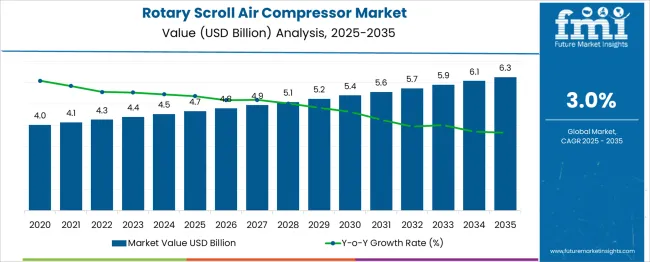
Rotary Scroll Air Compressor Market Key Takeaways
| Metric | Details |
|---|---|
| Industry Size (2026) | USD 4.84 billion |
| Industry Value (2036) | USD 6.51 billion |
| CAGR (2026-2036) | 3% |
Source: Future Market Insights, 2026
Clean compressed air requirements in medical facilities, pharmaceutical manufacturing, and food processing operations are sustaining demand for oil-free scroll compressors that deliver ISO 8573 Class 0 air quality without downstream filtration complexity. Hospital infrastructure expansion and medical device sterilization requirements are increasing installed base counts for scroll compressors serving surgical air, dental air, and instrument air applications. The shift toward decentralized compressed air systems in manufacturing facilities is favoring scroll compressors over larger reciprocating and screw units for point-of-use applications where quiet operation, compact footprint, and low maintenance requirements are procurement priorities.
Country-level growth trajectories reflect divergent industrial maturity and regulatory timelines. China leads with a 4.1% CAGR through 2036, supported by scaled manufacturing infrastructure and government procurement programs. Other key markets include India (3.8%), Germany (3.5%), France (3.2%), UK (2.9%), USA (2.6%), Brazil (2.3%). Mature markets such as Brazil maintain steady replacement demand cycles anchored by established supply contracts and quality compliance frameworks.
Rotary Scroll Air Compressor Market Definition
Rotary scroll air compressors are positive displacement machines that compress air through the orbital motion of two interleaved spiral elements, delivering pulsation-free airflow at low noise levels with minimal maintenance requirements. Product configurations include oil-filled units for general industrial applications and oil-free units certified for medical, pharmaceutical, food processing, and other contamination-sensitive environments. These compressors serve medical and pharmaceutical facilities, home appliance manufacturing, food and beverage processing, automotive and transportation operations, and biotechnology laboratories requiring clean, reliable compressed air supply.
Rotary Scroll Air Compressor Market Inclusions
Market scope includes oil-filled and oil-free scroll compressor configurations. Application coverage spans medical and pharmaceuticals, home appliances, food and beverage, automotive and transportation, biotechnology, and other industrial applications. Regional market sizing and competitive dynamics are included.
Rotary Scroll Air Compressor Market Exclusions
The scope excludes reciprocating piston compressors, rotary screw compressors, and centrifugal compressors. Compressed air treatment equipment including dryers, filters, and receivers sold independently of scroll compressor packages are omitted from the valuation.
Rotary Scroll Air Compressor Market Research Methodology
- Primary Research: Analysts conducted structured interviews with procurement managers, engineers, and supply chain directors across key rotary scroll air compressor operations to map decision triggers and specification requirements.
- Desk Research: Data collection aggregated publicly available trade statistics, regulatory filings, industry association reports, and company annual disclosures relevant to rotary scroll air compressor production and consumption patterns.
- Market-Sizing and Forecasting: Baseline values derive from a bottom-up aggregation of production volume data and average selling price benchmarks, applying region-specific adoption curves to project demand through 2036.
- Data Validation and Update Cycle: Projections are cross-validated against publicly reported financial disclosures from leading market participants and verified against national trade data registries.
Why is the Rotary Scroll Air Compressor Market Growing?
The rotary scroll air compressor market is gaining momentum, propelled by the increasing need for compact, vibration-free, and low-maintenance compression systems across industrial and medical sectors. These compressors are widely preferred for their quiet operation, fewer moving parts, and oil-free or low-oil designs that align with stringent quality and emission requirements.
As energy efficiency becomes a top priority in manufacturing and facility operations, scroll compressors are being adopted for their lower power consumption and enhanced reliability in continuous-duty cycles. Growth is also supported by the rising deployment of HVAC and pneumatic systems in urban infrastructure and commercial facilities.
Furthermore, technological improvements in scroll geometries, heat dissipation, and control integration are enhancing performance and extending lifecycle value, particularly in critical applications such as pharmaceuticals and food-grade processes.
Segmental Analysis
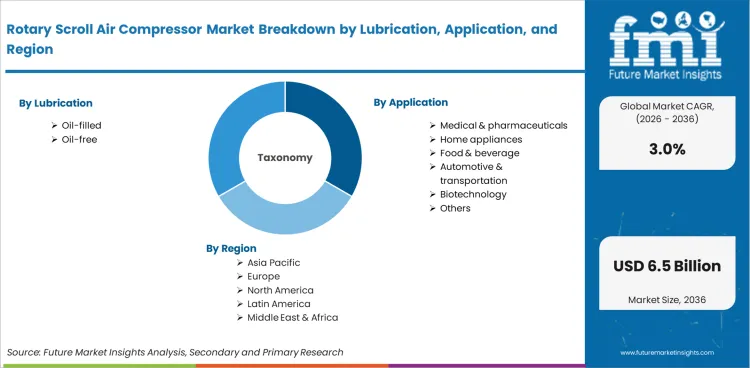
The rotary scroll air compressor market is segmented by lubrication, application, and geographic regions. The rotary scroll air compressor market is divided into Oil-filled and Oil-Free Types. In terms of application, the rotary scroll air compressor market is classified into Medical & pharmaceuticals, Home appliances, Food & beverage, Automotive & transportation, Biotechnology (research, etc.), and Others (semiconductor & electronics, commercial printing, etc.). Regionally, the rotary scroll air compressor industry is classified into North America, Latin America, Western Europe, Eastern Europe, Balkan & Baltic Countries, Russia & Belarus, Central Asia, East Asia, South Asia & Pacific, and the Middle East & Africa.
Insights into the Oil-filled Lubrication Segment
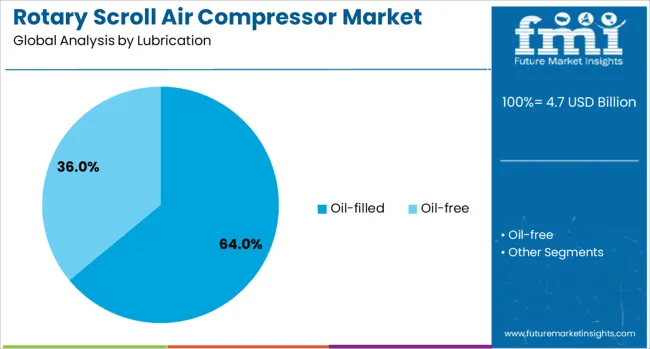
The oil-filled lubrication segment is projected to account for 64.00% of the rotary scroll air compressor market by 2026, making it the dominant lubrication type. This leadership is driven by oil-filled units’ superior cooling, sealing, and efficiency advantages, which allow them to operate at higher pressures with longer service intervals.
They are especially favored in industrial applications requiring sustained airflow under demanding conditions. The presence of lubricants reduces wear and extends component life, enhancing cost-effectiveness and uptime for users.
Additionally, advancements in filtration and separation systems have improved the environmental performance of oil-lubricated compressors, supporting broader industrial adoption while maintaining compliance with operational safety standards.
Insights into the Medical & Pharmaceuticals Application Segment
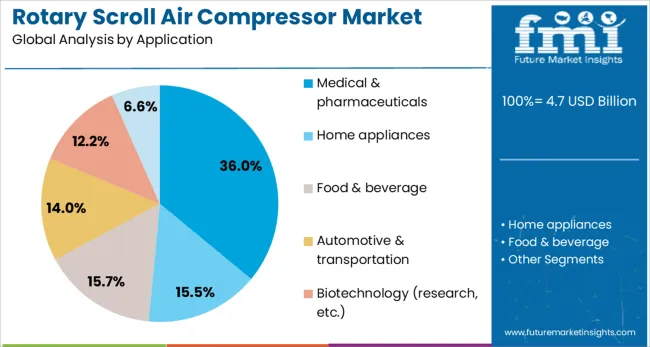
The medical and pharmaceuticals segment is expected to hold 36.00% of the total market share by 2026, positioning it as the leading application area. This growth is fueled by the critical need for clean, stable, and low-vibration air supply in laboratories, dental practices, and hospital environments.
Scroll compressors are well-suited for these conditions due to their ability to provide consistent pressure output with minimal noise and heat generation. Their compact footprint and oil-free design also help meet strict hygiene and air purity requirements, reducing the risk of contamination in sterile environments.
As the global healthcare infrastructure expands and demand for precision air systems increases, the role of scroll compressors in supporting diagnostic equipment, surgical tools, and pneumatic hospital systems will continue to grow.
What are the Drivers, Restraints, and Key Trends of the Rotary Scroll Air Compressor Market?
Rotary scroll air compressors have been increasingly adopted in manufacturing, food processing, electronics, and healthcare sectors for their oil-free operation, low noise, and compact design. These compressors operate using two interleaved spiral elements to compress air efficiently with minimal vibration. Demand has been driven by industries requiring clean, dry, and contaminant-free air for sensitive applications. Manufacturers have been focusing on energy-efficient designs, variable speed controls, and long service life components to improve operational reliability and reduce overall maintenance costs for end users.
Oil-Free and Low-Noise Operation Drive Adoption
Rotary scroll air compressors have been valued for their ability to provide 100% oil-free compressed air, making them suitable for applications in pharmaceuticals, food and beverage processing, and electronics manufacturing. The low-noise and low-vibration design has enabled installation closer to workstations, reducing the need for separate compressor rooms. In laboratory and medical environments, these compressors have been selected for operating diagnostic equipment and pneumatic tools without contamination risks. Compliance with ISO 8573-1 Class 0 air purity standards has further strengthened adoption in regulated industries. The combination of quiet operation, minimal maintenance, and clean air output has made rotary scroll compressors a preferred solution in facilities where air quality and operational comfort are critical.
Industrial and Healthcare Sectors Boost Demand
Industrial users have adopted rotary scroll compressors for precision manufacturing, assembly line automation, and pneumatic equipment operation. In healthcare, hospitals and dental clinics have used these compressors to power surgical tools, ventilators, and sterilization equipment. The absence of oil in the compression chamber has been crucial for preventing product contamination in sterile environments. Portable models have been utilized in field hospitals and temporary medical facilities for reliable compressed air supply. Manufacturing facilities in Japan, Germany, and the United States have reported operational cost savings due to reduced maintenance requirements and high energy efficiency. The ability to operate continuously without overheating has enhanced their suitability for mission-critical industrial and healthcare operations.
Technological Advancements Enhance Efficiency and Reliability
Advances in rotary scroll compressor technology have focused on improving energy efficiency, extending service life, and enabling intelligent control. Variable speed drives have been integrated to match compressor output with fluctuating air demand, reducing energy waste. Improved scroll element materials and precision manufacturing have increased durability and minimized wear. Digital monitoring systems have allowed real-time tracking of performance metrics, enabling predictive maintenance scheduling. Compact modular designs have been developed to facilitate installation in space-constrained environments. Manufacturers in South Korea, Italy, and the United States have emphasized hybrid cooling systems to optimize temperature control during continuous operation. These developments have reinforced rotary scroll compressors as a cost-effective and reliable choice for clean air applications across multiple industries.
High Initial Cost and Limited Capacity Restrict Broader Use
While rotary scroll air compressors offer several operational benefits, adoption has been limited by higher upfront purchase costs compared to conventional rotary screw or piston compressors. Their relatively lower maximum output capacity has restricted use in heavy-duty industrial applications with high-volume air demands. For small and medium-sized businesses, the investment may be challenging without clear long-term savings projections. Maintenance of precision scroll elements requires skilled technicians, adding to operational expenses in some regions. In sectors where air quality standards are less stringent, lower-cost oil-lubricated alternatives have been preferred. Without cost optimization, extended capacity ranges, and wider technician training availability, the broader market penetration of rotary scroll compressors may remain concentrated in specialized, quality-sensitive applications.
Analysis of Rotary Scroll Air Compressor Market By Key Countries
.webp "Top Country Growth Comparison Rotary Scroll Air Compressor Market Cagr (2026 2036)")
| Country | CAGR |
|---|---|
| China | 4.1% |
| India | 3.8% |
| Germany | 3.5% |
| France | 3.2% |
| UK | 2.9% |
| USA | 2.6% |
| Brazil | 2.3% |
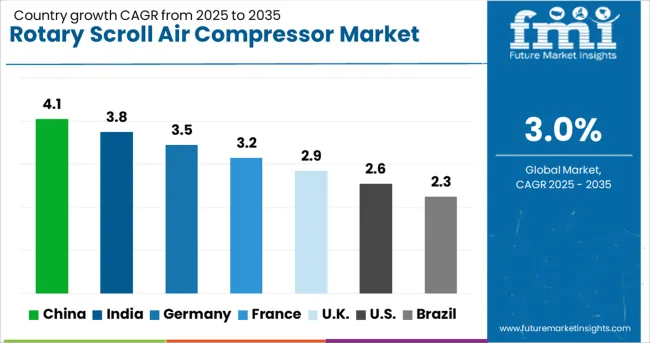
The rotary scroll air compressor market is expected to grow at a global CAGR of 3.0% between 2026 and 2036, driven by demand in manufacturing, HVAC, medical, and electronics industries due to their energy efficiency and low maintenance needs. China leads with a 4.1% CAGR, supported by large-scale industrial production and strong domestic demand. India follows at 3.8%, fueled by manufacturing sector expansion and infrastructure growth. Germany, at 3.5%, benefits from advanced engineering capabilities and high-quality compressor exports. The UK, projected at 2.9%, sees stable adoption in specialized industrial and healthcare applications. The USA, at 2.6%, reflects mature market conditions with steady replacement demand. The report provides insights for 40+ countries, with the five below highlighted for their strategic significance and growth outlook.
Market Outlook for Rotary Scroll Air Compressors in China
China is projected to grow at a CAGR of 4.1% from 2026 to 2036 in the rotary scroll air compressor market, supported by its large-scale manufacturing base and rising adoption of oil-free compressed air solutions in electronics, food processing, and medical applications. Domestic manufacturers such as Hanbell Precise Machinery, Guangzhou AirHorse, and Shanghai Screw Compressor are focusing on compact, energy-efficient scroll compressor designs to meet the needs of small-to-medium-scale industries. Growth is further driven by the expanding electronics assembly sector, where clean and stable air supply is critical. Additionally, government programs promoting energy efficiency in industrial equipment are encouraging the replacement of older compressor systems with advanced scroll models.
- Oil-free scroll compressor sales rose by 7% in 2024.
- Electronics sector adoption increased by 6% year on year.
- Energy-efficiency upgrade projects grew by 5% in 2024.
Adoption Trends for Rotary Scroll Air Compressors in India
India is forecasted to achieve a CAGR of 3.8% from 2026 to 2036, with strong demand from the pharmaceutical, food & beverage, and electronics manufacturing sectors. Local companies such as ELGi Equipments and Indo-Air Compressors are expanding their range of portable and stationary scroll compressors to cater to varied industrial needs. Demand for oil-free technology is increasing in sectors where product purity is critical, particularly in packaged food processing and injectable pharmaceutical manufacturing. Growth in small workshops and CNC machining centers is also contributing to the market as scroll compressors offer low maintenance and quiet operation.
- Oil-free compressor adoption grew by 6% in 2024.
- CNC workshop installations increased by 5% year on year.
- Food & beverage industry demand rose by 4% in 2024.
Technological Developments in Germany’s Rotary Scroll Air Compressor Market
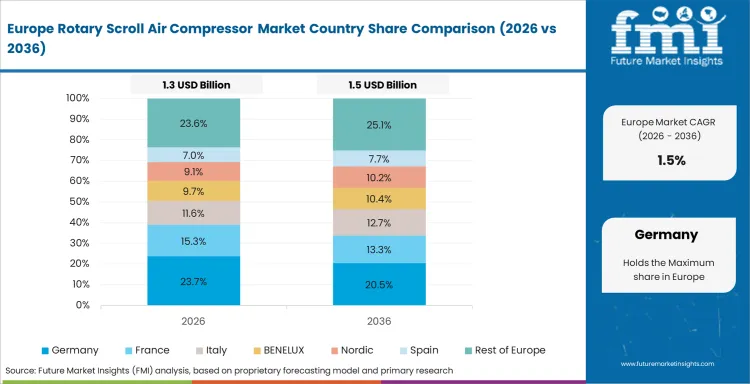
Germany is projected to post a CAGR of 3.5% from 2026 to 2036, driven by high-quality manufacturing standards and advanced engineering solutions. Leading brands such as Boge Kompressoren, Kaeser Kompressoren, and Aerzener Maschinenfabrik are integrating variable speed drives (VSD) into scroll compressors to improve energy efficiency. The medical and dental equipment manufacturing sectors are significant end-users, requiring consistent, oil-free compressed air. Germany’s focus on precision engineering is fostering the adoption of advanced sealing technologies to extend service life and reduce maintenance costs. Additionally, compliance with stringent EU environmental and safety regulations is shaping product design and performance standards.
- Variable speed scroll compressor sales rose by 5% in 2024.
- Dental clinic and equipment manufacturing adoption increased by 4% year on year.
- Advanced sealing technology integration grew by 3% in 2024.
Shifting Demand for Rotary Scroll Air Compressors in the United Kingdom
The United Kingdom is expected to record a CAGR of 2.9% from 2026 to 2036, supported by demand from the healthcare, packaging, and electronics repair sectors. Manufacturers and distributors such as HPC Compressed Air Systems and Air Equipment Sales are focusing on supplying compact, plug-and-play scroll compressors for space-limited operations. Growth is being driven by medical facilities requiring reliable compressed air for surgical and dental tools. The shift toward low-noise compressors in urban and indoor workspaces is influencing purchasing decisions. The integration of remote monitoring features is also gaining traction among UK buyers seeking predictive maintenance capabilities.
- Low-noise scroll compressor demand rose by 4% in 2024.
- Healthcare sector installations increased by 3% year on year.
- Remote monitoring-enabled models grew by 4% in 2024.
Growth Prospects for Rotary Scroll Air Compressors in the United States
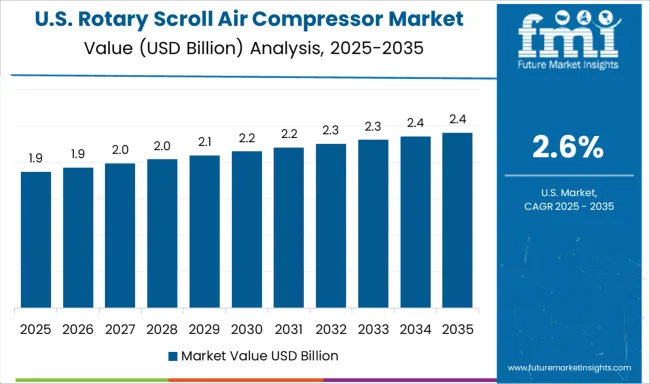
The United States is forecasted to grow at a CAGR of 2.6% from 2026 to 2036, with rising adoption in laboratories, electronics assembly, and specialty manufacturing. Companies such as Quincy Compressor, Sullair LLC, and Atlas Copco USA are focusing on oil-free scroll compressors with enhanced cooling systems to meet continuous-duty requirements. The growing demand for energy-efficient solutions is prompting investment in scroll models with integrated heat recovery systems. Small manufacturing units and repair workshops are also contributing to market growth due to scroll compressors’ lower operational noise and compact footprint.
- Integrated heat recovery scroll compressor sales rose by 3% in 2024.
- Electronics assembly industry demand increased by 3% year on year.
- Laboratory-grade oil-free compressor installations grew by 2% in 2024.
Competitive Landscape of Rotary Scroll Air Compressor Market
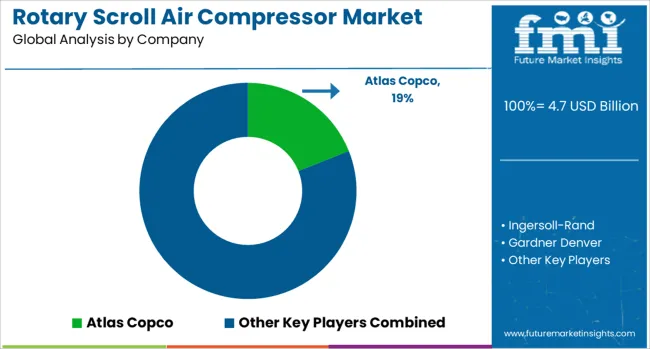
The rotary scroll air compressor market is led by established global industrial equipment manufacturers and specialized air system providers catering to applications in manufacturing, healthcare, food processing, electronics, and automotive sectors. Atlas Copco and Ingersoll-Rand dominate with a broad range of oil-free and lubricated scroll compressors, offering energy-efficient designs suited for continuous operation in critical environments. Gardner Denver and Sullair focus on industrial-grade units with advanced control systems for optimized performance and reduced maintenance requirements. Hitachi and Boge Compressors deliver compact, low-noise scroll compressors for precision industries such as electronics manufacturing and laboratory applications, while CompAir emphasizes modular, space-saving systems for flexible plant layouts.
Emerson and Parker Hannifin Manufacturing Ltd. integrate scroll compressor technology into HVAC and refrigeration systems, targeting both commercial and industrial markets. Ohio Medical Corp, Air Squared, and Powerex Inc. specialize in medical and dental air systems, ensuring oil-free, ultra-clean air supply compliant with healthcare standards. EMSE, Inc. and FS Curtis supply scroll compressors for niche industrial and OEM applications, often customizing units to meet specific flow, pressure, and footprint requirements. Frank Technologies serves regional industrial markets with cost-competitive solutions tailored to local demand. Key strategies in the sector include expanding product portfolios for oil-free and energy-efficient models, partnering with OEMs for integrated systems, and establishing regional service hubs to minimize downtime. Entry barriers include precision manufacturing capabilities, strict quality standards for sensitive applications, and long-standing relationships between established suppliers and major end-user industries.
Key Developments in Rotary Scroll Air Compressor Market
- In March 2025, Honeywell International announced the acquisition of Sundyne, a pump and compressor manufacturer, for approximately USD 2.2 billion. This strategic move strengthens Honeywell’s presence in critical compressor equipment and aligns with its restructuring into focused business units.
- In February 2024, Ingersoll Rand completed the USD 146 million acquisition of Friulair (Italy), expanding its air treatment portfolio to include advanced chillers and dryers, complementing its rotary scroll compressor offerings and enhancing its integrated compressed air system capabilities.
Scope of the Report
| Metric | Value |
|---|---|
| Quantitative Units | USD 4.84 billion to USD 6.51 billion, at a CAGR of 3% |
| Market Definition | Rotary scroll air compressors are positive displacement machines that compress air through the orbital motion of two interleaved spiral elements, delivering pulsation-free airflow at low noise levels with minimal maintenance requirements. Product configurations include oil-filled units for general industrial applications and oil-free units certified for medical, pharmaceutical, food processing, and other contamination-sensitive environments. These compressors serve medical and pharmaceutical facilities, home appliance manufacturing, food and beverage processing, automotive and transportation operations, and biotechnology laboratories requiring clean, reliable compressed air supply. |
| Lubrication, Application Segmentation | Lubrication: Oil-filled, Oil-free; Application: Medical & pharmaceuticals, Home appliances, Food & beverage, Automotive & transportation, Biotechnology, Others |
| Regions Covered | North America, Latin America, Europe, East Asia, South Asia, Oceania, Middle East & Africa |
| Countries Covered | China, India, Germany, France, UK, USA, Brazil, and 40 plus countries |
| Key Companies Profiled | Atlas Copco, Ingersoll Rand, Gardner Denver, Emerson, Sullair, Hitachi, Frank Technologies, Boge Compressors, CompAir, Ohio Medical Corp, Air Squared, Powerex Inc, EMSE, Inc., FS Curtis, Parker Hannifin Manufacturing Ltd. |
| Forecast Period | 2026 to 2036 |
| Approach | Forecasting models apply a bottom-up methodology starting with production volume benchmarks and average selling price data, cross-validated against public financial disclosures and trade statistics. |
Rotary Scroll Air Compressor Market by Segments
Lubrication:
- Oil-filled
- Oil-free
Application:
- Medical & pharmaceuticals
- Home appliances
- Food & beverage
- Automotive & transportation
- Biotechnology (research, etc.)
- Others (semiconductor & electronics, commercial printing, etc.)
Region:
- North America
- USA
- Canada
- Mexico
- Latin America
- Brazil
- Chile
- Rest of Latin America
- Western Europe
- Germany
- UK
- Italy
- Spain
- France
- Nordic
- BENELUX
- Rest of Western Europe
- Eastern Europe
- Russia
- Poland
- Hungary
- Balkan & Baltic
- Rest of Eastern Europe
- East Asia
- China
- Japan
- South Korea
- South Asia and Pacific
- India
- ASEAN
- Australia & New Zealand
- Rest of South Asia and Pacific
- Middle East & Africa
- Kingdom of Saudi Arabia
- Other GCC Countries
- Turkiye
- South Africa
- Other African Union
- Rest of Middle East & Africa
Bibliography
- International Organization for Standardization. (2024). ISO 8573:2024 Compressed air quality classes. ISO.
- United States Food and Drug Administration. (2024). Compressed air systems in pharmaceutical manufacturing. USA FDA.
- European Committee for Standardization. (2024). EN 12021:2024 Compressed air for breathing apparatus. CEN.
- National Fire Protection Association. (2024). NFPA 99: Health care facilities code. NFPA.
- Organisation for Economic Co-operation and Development. (2024). Healthcare infrastructure investment indicators. OECD.
This bibliography is provided for reader reference. The full Future Market Insights report contains the complete reference list with primary research documentation.
Frequently Asked Questions
How large is the demand for Rotary Scroll Air Compressor in the global market in 2026?
Demand for rotary scroll air compressor in the global market is estimated to be valued at USD 4.84 billion in 2026.
What will be the market size of Rotary Scroll Air Compressor in the global market by 2036?
Market size for rotary scroll air compressor is projected to reach USD 6.51 billion by 2036.
What is the expected demand growth for Rotary Scroll Air Compressor in the global market between 2026 and 2036?
Demand for rotary scroll air compressor is expected to grow at a CAGR of 3% between 2026 and 2036.
Which Lubrication is poised to lead global sales by 2026?
Oil-filled accounts for 64% share in 2026, as it remains the primary specification across established procurement channels.
How is the Application segment structured in 2026?
Medical & pharmaceuticals leads with 36% of segment share in 2026, driven by established buyer preference and supply chain compatibility.
What is China's growth outlook in this report?
China is projected to grow at a CAGR of 4.1% during 2026 to 2036.
What is Rotary Scroll Air Compressor and what is it mainly used for?
Rotary scroll air compressors are positive displacement machines that compress air through the orbital motion of two interleaved spiral elements, delivering pulsation-free airflow at low noise levels with minimal maintenance requirements. Product configurations include oil-filled units for general industrial applications and oil-free units certified for medical, pharmaceutical, food processing, and other contamination-sensitive environments.
What is included in the scope of this Rotary Scroll Air Compressor report?
Market scope includes oil-filled and oil-free scroll compressor configurations. Application coverage spans medical and pharmaceuticals, home appliances, food and beverage, automotive and transportation, biotechnology, and other industrial applications.
Preview the report firsthand - request a free sample
Get SampleGet the brochure for pricing and purchase details.
Get PDFTable of Content
- Executive Summary
- Global Market Outlook
- Demand-side Trends
- Supply-side Trends
- Technology Roadmap Analysis
- Analysis and Recommendations
- Market Overview
- Market Coverage / Taxonomy
- Market Definition / Scope / Limitations
- Research Methodology
- Chapter Orientation
- Analytical Lens and Working Hypotheses
- Market Structure, Signals, and Trend Drivers
- Benchmarking and Cross-market Comparability
- Market Sizing, Forecasting, and Opportunity Mapping
- Research Design and Evidence Framework
- Desk Research Programme (Secondary Evidence)
- Company Annual and Sustainability Reports
- Peer-reviewed Journals and Academic Literature
- Corporate Websites, Product Literature, and Technical Notes
- Earnings Decks and Investor Briefings
- Statutory Filings and Regulatory Disclosures
- Technical White Papers and Standards Notes
- Trade Journals, Industry Magazines, and Analyst Briefs
- Conference Proceedings, Webinars, and Seminar Materials
- Government Statistics Portals and Public Data Releases
- Press Releases and Reputable Media Coverage
- Specialist Newsletters and Curated Briefings
- Sector Databases and Reference Repositories
- FMI Internal Proprietary Databases and Historical Market Datasets
- Subscription Datasets and Paid Sources
- Social Channels, Communities, and Digital Listening Inputs
- Additional Desk Sources
- Expert Input and Fieldwork (Primary Evidence)
- Primary Modes
- Qualitative Interviews and Expert Elicitation
- Quantitative Surveys and Structured Data Capture
- Blended Approach
- Why Primary Evidence is Used
- Field Techniques
- Interviews
- Surveys
- Focus Groups
- Observational and In-context Research
- Social and Community Interactions
- Stakeholder Universe Engaged
- C-suite Leaders
- Board Members
- Presidents and Vice Presidents
- R&D and Innovation Heads
- Technical Specialists
- Domain Subject-matter Experts
- Scientists
- Physicians and Other Healthcare Professionals
- Governance, Ethics, and Data Stewardship
- Research Ethics
- Data Integrity and Handling
- Primary Modes
- Tooling, Models, and Reference Databases
- Desk Research Programme (Secondary Evidence)
- Data Engineering and Model Build
- Data Acquisition and Ingestion
- Cleaning, Normalisation, and Verification
- Synthesis, Triangulation, and Analysis
- Quality Assurance and Audit Trail
- Market Background
- Market Dynamics
- Drivers
- Restraints
- Opportunity
- Trends
- Scenario Forecast
- Demand in Optimistic Scenario
- Demand in Likely Scenario
- Demand in Conservative Scenario
- Opportunity Map Analysis
- Product Life Cycle Analysis
- Supply Chain Analysis
- Investment Feasibility Matrix
- Value Chain Analysis
- PESTLE and Porter’s Analysis
- Regulatory Landscape
- Regional Parent Market Outlook
- Production and Consumption Statistics
- Import and Export Statistics
- Market Dynamics
- Global Market Analysis 2021 to 2025 and Forecast, 2026 to 2036
- Historical Market Size Value (USD Million) Analysis, 2021 to 2025
- Current and Future Market Size Value (USD Million) Projections, 2026 to 2036
- Y-o-Y Growth Trend Analysis
- Absolute $ Opportunity Analysis
- Global Market Pricing Analysis 2021 to 2025 and Forecast 2026 to 2036
- Global Market Analysis 2021 to 2025 and Forecast 2026 to 2036, By Lubrication
- Introduction / Key Findings
- Historical Market Size Value (USD Million) Analysis By Lubrication , 2021 to 2025
- Current and Future Market Size Value (USD Million) Analysis and Forecast By Lubrication , 2026 to 2036
- Oil-filled
- Oil-free
- Oil-filled
- Y-o-Y Growth Trend Analysis By Lubrication , 2021 to 2025
- Absolute $ Opportunity Analysis By Lubrication , 2026 to 2036
- Global Market Analysis 2021 to 2025 and Forecast 2026 to 2036, By Application
- Introduction / Key Findings
- Historical Market Size Value (USD Million) Analysis By Application, 2021 to 2025
- Current and Future Market Size Value (USD Million) Analysis and Forecast By Application, 2026 to 2036
- Medical & pharmaceuticals
- Home appliances
- Food & beverage
- Automotive & transportation
- Biotechnology
- Others
- Medical & pharmaceuticals
- Y-o-Y Growth Trend Analysis By Application, 2021 to 2025
- Absolute $ Opportunity Analysis By Application, 2026 to 2036
- Global Market Analysis 2021 to 2025 and Forecast 2026 to 2036, By Region
- Introduction
- Historical Market Size Value (USD Million) Analysis By Region, 2021 to 2025
- Current Market Size Value (USD Million) Analysis and Forecast By Region, 2026 to 2036
- North America
- Latin America
- Western Europe
- Eastern Europe
- East Asia
- South Asia and Pacific
- Middle East & Africa
- Market Attractiveness Analysis By Region
- North America Market Analysis 2021 to 2025 and Forecast 2026 to 2036, By Country
- Historical Market Size Value (USD Million) Trend Analysis By Market Taxonomy, 2021 to 2025
- Market Size Value (USD Million) Forecast By Market Taxonomy, 2026 to 2036
- By Country
- USA
- Canada
- Mexico
- By Lubrication
- By Application
- By Country
- Market Attractiveness Analysis
- By Country
- By Lubrication
- By Application
- Key Takeaways
- Latin America Market Analysis 2021 to 2025 and Forecast 2026 to 2036, By Country
- Historical Market Size Value (USD Million) Trend Analysis By Market Taxonomy, 2021 to 2025
- Market Size Value (USD Million) Forecast By Market Taxonomy, 2026 to 2036
- By Country
- Brazil
- Chile
- Rest of Latin America
- By Lubrication
- By Application
- By Country
- Market Attractiveness Analysis
- By Country
- By Lubrication
- By Application
- Key Takeaways
- Western Europe Market Analysis 2021 to 2025 and Forecast 2026 to 2036, By Country
- Historical Market Size Value (USD Million) Trend Analysis By Market Taxonomy, 2021 to 2025
- Market Size Value (USD Million) Forecast By Market Taxonomy, 2026 to 2036
- By Country
- Germany
- UK
- Italy
- Spain
- France
- Nordic
- BENELUX
- Rest of Western Europe
- By Lubrication
- By Application
- By Country
- Market Attractiveness Analysis
- By Country
- By Lubrication
- By Application
- Key Takeaways
- Eastern Europe Market Analysis 2021 to 2025 and Forecast 2026 to 2036, By Country
- Historical Market Size Value (USD Million) Trend Analysis By Market Taxonomy, 2021 to 2025
- Market Size Value (USD Million) Forecast By Market Taxonomy, 2026 to 2036
- By Country
- Russia
- Poland
- Hungary
- Balkan & Baltic
- Rest of Eastern Europe
- By Lubrication
- By Application
- By Country
- Market Attractiveness Analysis
- By Country
- By Lubrication
- By Application
- Key Takeaways
- East Asia Market Analysis 2021 to 2025 and Forecast 2026 to 2036, By Country
- Historical Market Size Value (USD Million) Trend Analysis By Market Taxonomy, 2021 to 2025
- Market Size Value (USD Million) Forecast By Market Taxonomy, 2026 to 2036
- By Country
- China
- Japan
- South Korea
- By Lubrication
- By Application
- By Country
- Market Attractiveness Analysis
- By Country
- By Lubrication
- By Application
- Key Takeaways
- South Asia and Pacific Market Analysis 2021 to 2025 and Forecast 2026 to 2036, By Country
- Historical Market Size Value (USD Million) Trend Analysis By Market Taxonomy, 2021 to 2025
- Market Size Value (USD Million) Forecast By Market Taxonomy, 2026 to 2036
- By Country
- India
- ASEAN
- Australia & New Zealand
- Rest of South Asia and Pacific
- By Lubrication
- By Application
- By Country
- Market Attractiveness Analysis
- By Country
- By Lubrication
- By Application
- Key Takeaways
- Middle East & Africa Market Analysis 2021 to 2025 and Forecast 2026 to 2036, By Country
- Historical Market Size Value (USD Million) Trend Analysis By Market Taxonomy, 2021 to 2025
- Market Size Value (USD Million) Forecast By Market Taxonomy, 2026 to 2036
- By Country
- Kingdom of Saudi Arabia
- Other GCC Countries
- Turkiye
- South Africa
- Other African Union
- Rest of Middle East & Africa
- By Lubrication
- By Application
- By Country
- Market Attractiveness Analysis
- By Country
- By Lubrication
- By Application
- Key Takeaways
- Key Countries Market Analysis
- USA
- Pricing Analysis
- Market Share Analysis, 2025
- By Lubrication
- By Application
- Canada
- Pricing Analysis
- Market Share Analysis, 2025
- By Lubrication
- By Application
- Mexico
- Pricing Analysis
- Market Share Analysis, 2025
- By Lubrication
- By Application
- Brazil
- Pricing Analysis
- Market Share Analysis, 2025
- By Lubrication
- By Application
- Chile
- Pricing Analysis
- Market Share Analysis, 2025
- By Lubrication
- By Application
- Germany
- Pricing Analysis
- Market Share Analysis, 2025
- By Lubrication
- By Application
- UK
- Pricing Analysis
- Market Share Analysis, 2025
- By Lubrication
- By Application
- Italy
- Pricing Analysis
- Market Share Analysis, 2025
- By Lubrication
- By Application
- Spain
- Pricing Analysis
- Market Share Analysis, 2025
- By Lubrication
- By Application
- France
- Pricing Analysis
- Market Share Analysis, 2025
- By Lubrication
- By Application
- India
- Pricing Analysis
- Market Share Analysis, 2025
- By Lubrication
- By Application
- ASEAN
- Pricing Analysis
- Market Share Analysis, 2025
- By Lubrication
- By Application
- Australia & New Zealand
- Pricing Analysis
- Market Share Analysis, 2025
- By Lubrication
- By Application
- China
- Pricing Analysis
- Market Share Analysis, 2025
- By Lubrication
- By Application
- Japan
- Pricing Analysis
- Market Share Analysis, 2025
- By Lubrication
- By Application
- South Korea
- Pricing Analysis
- Market Share Analysis, 2025
- By Lubrication
- By Application
- Russia
- Pricing Analysis
- Market Share Analysis, 2025
- By Lubrication
- By Application
- Poland
- Pricing Analysis
- Market Share Analysis, 2025
- By Lubrication
- By Application
- Hungary
- Pricing Analysis
- Market Share Analysis, 2025
- By Lubrication
- By Application
- Kingdom of Saudi Arabia
- Pricing Analysis
- Market Share Analysis, 2025
- By Lubrication
- By Application
- Turkiye
- Pricing Analysis
- Market Share Analysis, 2025
- By Lubrication
- By Application
- South Africa
- Pricing Analysis
- Market Share Analysis, 2025
- By Lubrication
- By Application
- USA
- Market Structure Analysis
- Competition Dashboard
- Competition Benchmarking
- Market Share Analysis of Top Players
- By Regional
- By Lubrication
- By Application
- Competition Analysis
- Competition Deep Dive
- Atlas Copco
- Overview
- Product Portfolio
- Profitability by Market Segments (Product/Age /Sales Channel/Region)
- Sales Footprint
- Strategy Overview
- Marketing Strategy
- Product Strategy
- Channel Strategy
- Ingersoll Rand
- Gardner Denver
- Emerson
- Sullair
- Hitachi
- Frank Technologies
- Boge Compressors
- CompAir
- Ohio Medical Corp
- Air Squared
- Powerex Inc
- EMSE, Inc.
- FS Curtis
- Parker Hannifin Manufacturing Ltd.
- Atlas Copco
- Competition Deep Dive
- Assumptions & Acronyms Used


