

- Industry Size (2026)
- USD 4620.0 Mn
- Forecast (2036)
- USD 7038.6 Mn
- CAGR (2026 to 2036)
- 4.30%
Air Compressor Lubricants Market Forecast and Outlook 2026 to 2036
The air compressor lubricants market is likely to be valued at USD 4,620.0 million in 2026, is set to reach USD 7,038.6 million by 2036, and is projected to expand at a CAGR of 4.3% over the forecast period. Procurement behavior in this market is shaped by strong risk aversion, as lubricant failure can directly affect compressor reliability, energy efficiency, and warranty validity. Purchasing decisions are therefore guided less by unit price and more by confidence in oxidation stability, drain interval performance, and OEM approval status. Preference is commonly given to lubricants that are pre-qualified or recommended by compressor manufacturers, reinforcing vendor lock-in once a lubricant is validated within a maintenance program.
Switching costs are elevated due to flushing requirements, compatibility concerns, and the operational risk associated with lubricant changeovers. Budget holders are often influenced by total operating cost calculations rather than upfront lubricant expense, allowing suppliers of premium formulations to defend margins. Between 2026 and 2036, value capture is expected to concentrate with suppliers that align closely with OEM specifications, maintenance contracts, and long-cycle replacement economics rather than volume-driven sales models.
Quick Stats for Air Compressor Lubricants Market
- Air Compressor Lubricants Market Value (2026): USD 4,620.0 Million
- Air Compressor Lubricants Market Forecast Value (2036): USD 7,038.6 Million
- Air Compressor Lubricants Market Forecast CAGR 2026 to 2036: 4.30%
- Leading Compressor Type in Air Compressor Lubricants Market: Rotary Screw
- Leading End Use in Air Compressor Lubricants Market: Manufacturing
- Key Growth Regions in Air Compressor Lubricants Market: Asia Pacific, North America, Middle East & Africa
- Top Key Players in Air Compressor Lubricants Market: Shell, ExxonMobil, Chevron, Total Energies, BP Castrol, FUCHS, Petro-Canada Lubricants, Idemitsu Kosan, Lukoil Lubricants, Regional Blenders
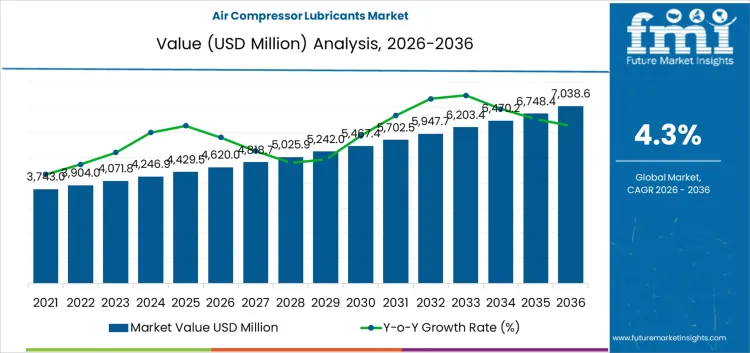
Air Compressor Lubricants Market Key Takeaways
| Metric | Value |
|---|---|
| Industry Value (2026) | USD 4,620.0 Million |
| Forecast Value (2036) | USD 7,038.6 Million |
| Forecast CAGR 2026 to 2036 | 4.30% |
How is the Global Air Compressor Lubricants Market Advancing?
The global air compressor lubricants market is advancing at a stable pace, driven by the widespread use of air compressors across industrial manufacturing, construction, mining, energy, and processing industries. Compressor lubricants are essential for reducing friction, managing heat, sealing compression chambers, and preventing corrosion, directly influencing compressor efficiency, reliability, and service life.
A key factor supporting market growth is the continued expansion of industrial activity and compressed air usage in production-intensive sectors. Manufacturing plants, refineries, and infrastructure projects rely on compressors for powering tools, automation systems, and material handling equipment, increasing demand for lubricants formulated for rotary screw, reciprocating, centrifugal, and portable compressors. Regular oil replacement cycles further support recurring lubricant consumption.
Another driver is the growing focus on operational efficiency and maintenance cost control. End users are increasingly adopting high-performance mineral and synthetic compressor oils that offer improved thermal stability, oxidation resistance, and extended drain intervals. These lubricants help reduce downtime, minimize deposit formation, and lower overall maintenance frequency, particularly in continuous-duty compressor applications.
Advancements in lubricant formulation are strengthening market adoption. Development of synthetic and semi-synthetic compressor oils with enhanced viscosity control and wear protection is improving performance under high pressure and temperature conditions. In addition, increased emphasis on equipment manufacturer recommendations and warranty compliance is shaping lubricant selection patterns. As compressors remain a critical utility across industrial operations, the air compressor lubricants market is expected to maintain steady growth over the forecast period.
What Is the Segment-Wise Overview of the Air Compressor Lubricants Market?
The air compressor lubricants market is shaped by compressor technology preferences and heavy industrial usage patterns. Rotary screw compressors dominate with a 58% share, as they are widely deployed in continuous-operation environments that demand consistent lubrication, heat dissipation, and wear protection. These compressors place high stress on lubricants, driving steady consumption and replacement demand. On the end-use side, manufacturing accounts for 32% of market demand, reflecting extensive use of compressed air across production lines, automation systems, and pneumatic equipment. Lubricant performance directly impacts compressor efficiency, uptime, and maintenance costs in these settings.
Why Do Rotary Screw Compressors Lead the Air Compressor Lubricants Market?
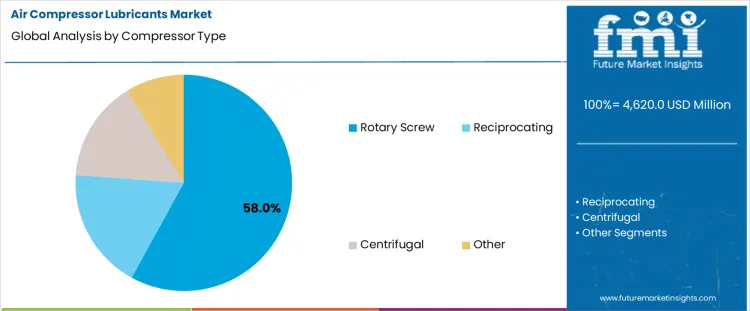
Rotary screw compressors account for 58% of demand in the air compressor lubricants market due to their dominance in continuous-duty industrial applications. These compressors operate at high temperatures and pressures, requiring lubricants that provide effective cooling, sealing, and wear protection over extended operating cycles. Lubricants play a crucial role in reducing friction between rotors, minimizing energy losses, and preventing deposit formation. Rotary screw systems typically demand specialized synthetic or semi-synthetic lubricants with longer drain intervals, increasing lubricant value per unit. Their widespread use in manufacturing plants, processing facilities, and infrastructure projects further strengthens lubricant consumption. As industries prioritize compressor efficiency, reduced downtime, and longer service intervals, rotary screw compressors continue to drive the largest share of lubricant demand.
How Does Manufacturing Drive Demand in the Air Compressor Lubricants Market?
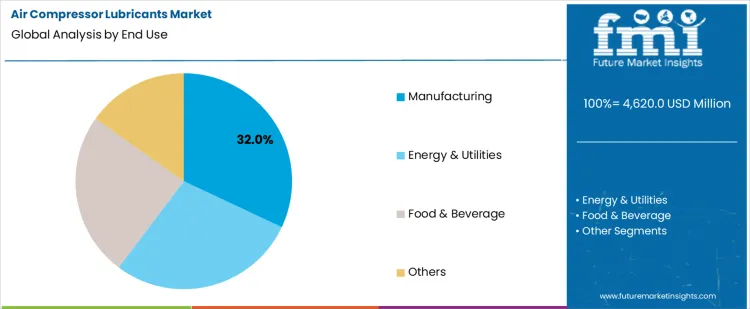
Manufacturing represents 32% of end-use demand, making it the largest application segment in the air compressor lubricants market. Manufacturing facilities rely heavily on compressed air to power machinery, automation systems, and assembly tools across diverse processes. Compressor lubricants are essential to maintaining equipment reliability, controlling operating temperatures, and preventing premature component wear. Poor lubrication can lead to increased maintenance costs, unplanned shutdowns, and reduced production efficiency. Industries such as automotive, metals, electronics, and general manufacturing require stable compressor performance to support continuous operations. Regular lubricant replacement and preventive maintenance are standard practices in these environments. As manufacturing becomes more automated and uptime-sensitive, demand for high-performance air compressor lubricants continues to grow steadily.
What Are the Key Dynamics for the Air Compressor Lubricants Market?
Air compressor lubricants reduce friction, dissipate heat, prevent wear, and protect internal components from corrosion and oxidation. Key market dynamics include increasing deployment of rotary screw, reciprocating, and centrifugal compressors in manufacturing, oil & gas, power generation, mining, and construction sectors. Rising emphasis on equipment uptime and maintenance cost reduction is reinforcing demand for high-performance lubricants. The shift toward continuous-duty compressor operation and higher operating pressures is increasing the need for lubricants with superior viscosity control, oxidation resistance, and deposit prevention characteristics.
How Are the Key Drivers Shaping the Air Compressor Lubricants Market?
Key drivers shaping the air compressor lubricants market include the transition toward high-efficiency and oil-free compressor technologies that demand advanced lubricant formulations. Synthetic and semi-synthetic compressor lubricants are increasingly adopted due to their longer drain intervals, improved thermal stability, and reduced carbon formation compared to mineral-based products. OEM specifications and warranty requirements strongly influence lubricant selection, driving demand for approved and application-specific formulations. Growth in predictive maintenance and condition monitoring practices is encouraging use of premium lubricants that maintain consistent viscosity and minimize varnish formation.
What Are the Challenges Impacting the Air Compressor Lubricants Market?
Challenges in the air compressor lubricants market include price sensitivity among industrial users, particularly in cost-driven sectors where lubricant upgrades are often deferred. Incorrect lubricant selection or use of non-recommended products can lead to reduced compressor efficiency and premature equipment failure, impacting overall market credibility. Volatility in base oil prices and additive supply can affect lubricant pricing and availability. Extended oil drain intervals, while beneficial to end users, may reduce replacement frequency and volume demand. Increasing adoption of oil-free compressors in certain applications may limit lubricant consumption growth in specific segments.
What is the Growth Outlook for the Air Compressor Lubricants Market by Country?
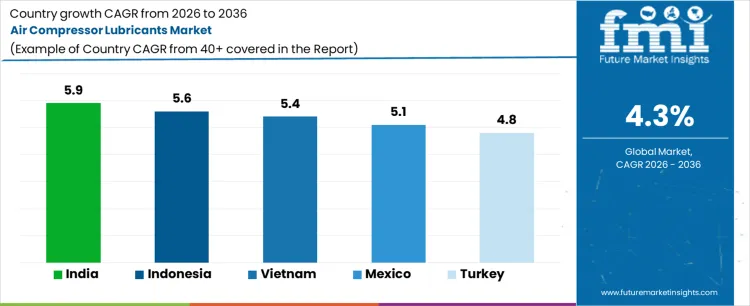
| Country | CAGR (%) |
|---|---|
| India | 5.9% |
| Indonesia | 5.6% |
| Vietnam | 5.4% |
| Mexico | 5.1% |
| Turkey | 4.8% |
The air compressor lubricants market is showing steady expansion as industries emphasize equipment protection and operational efficiency. India leads with a 5.9% CAGR, supported by manufacturing growth and preventive maintenance adoption. Indonesia follows at 5.6%, driven by heavy industry and infrastructure activity. Vietnam records 5.4% growth, supported by export-led manufacturing and automation. Mexico grows at 5.1%, reflecting stable demand from automotive and industrial production. Turkey expands at 4.8%, driven by maintenance-led consumption across manufacturing sectors. As compressed air systems remain critical to industrial operations, demand for reliable and performance-oriented compressor lubricants is expected to remain consistent across these regions.
Why is the Air Compressor Lubricants Market Gaining Momentum in India?
The air compressor lubricants market in India is growing at a CAGR of 5.9%, driven by expanding industrial output and rising focus on equipment reliability. Manufacturing sectors such as automotive, pharmaceuticals, food processing, cement, and chemicals rely heavily on compressed air systems, creating sustained demand for compressor lubricants. High operating hours and challenging conditions such as dust, heat, and humidity increase lubricant degradation rates, supporting regular replacement cycles. Industrial operators are prioritizing lubricants that improve energy efficiency, reduce friction, and extend compressor service life. Growth of small and mid-sized manufacturing units across industrial corridors is strengthening aftermarket demand. Shift toward rotary screw and centrifugal compressors is also influencing lubricant formulation preferences. Awareness around preventive maintenance and total cost of ownership is improving lubricant selection practices. As industrial activity continues to scale, demand for air compressor lubricants in India is expected to grow steadily.
What Factors Are Driving Air Compressor Lubricants Market Growth in Indonesia?
The air compressor lubricants market in Indonesia is expanding at a CAGR of 5.6%, supported by growth in manufacturing, mining, and processing industries. Compressed air systems are widely used in cement plants, metal fabrication, food processing, and packaging operations, creating consistent lubricant demand. High humidity and temperature variations increase oxidation and moisture contamination risks, reinforcing the need for high-performance lubricants. Industrial operators are focusing on reducing downtime and extending oil drain intervals, which supports adoption of premium and synthetic lubricant grades. Expansion of industrial estates and infrastructure projects is increasing compressor installations across regions. Maintenance-driven demand remains strong due to continuous-operation facilities. Local availability of industrial lubricants and distributor networks supports steady consumption. As Indonesia strengthens its industrial base and operational efficiency focus, demand for air compressor lubricants is expected to rise at a stable pace.
What is Supporting Air Compressor Lubricants Market Expansion in Vietnam?
The air compressor lubricants market in Vietnam is growing at a CAGR of 5.4%, driven by rapid industrialization and growth of export-oriented manufacturing. Electronics assembly, textiles, food processing, and industrial parks rely heavily on compressed air for automation and production processes. Continuous operation and high utilization rates increase lubricant consumption and replacement frequency. Manufacturers are placing greater emphasis on lubricant quality to protect compressors and meet international production standards. Humid climatic conditions further support demand for lubricants with strong moisture separation and oxidation stability properties. Rising labor costs are encouraging automation, indirectly increasing compressed air usage. Growing awareness of equipment lifecycle management is influencing lubricant selection toward higher-performance products. As Vietnam continues to attract foreign manufacturing investment, demand for air compressor lubricants is expected to grow consistently.
Why is the Air Compressor Lubricants Market Expanding Gradually in Mexico?
The air compressor lubricants market in Mexico is expanding at a CAGR of 5.1%, supported by steady growth in automotive, electronics, and industrial manufacturing sectors. Production facilities operating under high utilization conditions require reliable lubrication to maintain compressor efficiency and avoid production disruptions. Heat, dust, and continuous-duty cycles increase lubricant stress, supporting regular oil change intervals. Manufacturers are focusing on improving energy efficiency and equipment uptime, driving demand for lubricants that reduce friction and deposit formation. Growth of industrial clusters near export corridors is increasing the installed base of compressors. Availability of aftermarket lubricant suppliers ensures consistent supply and competitive pricing. While growth is moderate, maintenance-driven demand remains stable. As Mexico continues to strengthen its manufacturing role, demand for air compressor lubricants is expected to rise steadily.
What is Influencing Air Compressor Lubricants Market Development in Turkey?
The air compressor lubricants market in Turkey is growing at a CAGR of 4.8%, reflecting moderate expansion driven by manufacturing and construction activity. Industrial sectors such as metalworking, textiles, food processing, and cement rely on compressed air systems for daily operations. Equipment operators prioritize lubricants that improve compressor reliability and reduce wear under variable operating loads. Rising energy costs are encouraging use of lubricants that support efficient compressor performance. Industrial modernization and gradual replacement of older equipment are supporting steady lubricant consumption. Maintenance practices remain largely time-based, sustaining predictable replacement demand. While economic conditions influence capital expenditure, operational continuity requirements support lubricant usage. As Turkey continues to balance industrial growth with efficiency improvements, demand for air compressor lubricants is expected to grow at a measured pace.
How Are Companies Competing in the Air Compressor Lubricants Market?
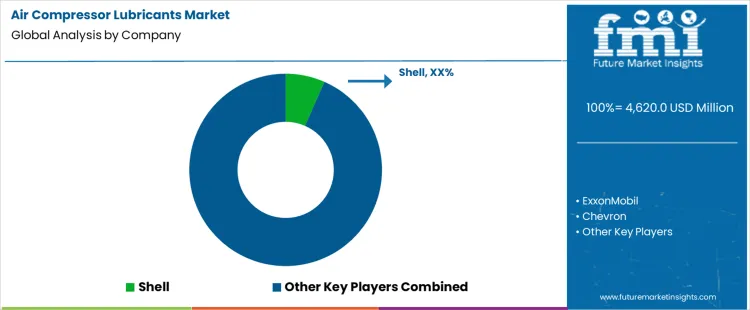
Competition in the air compressor lubricants market is driven by lubricant longevity, thermal and oxidative stability, equipment protection, and the ability to improve compressor efficiency across demanding industrial environments. Compressor lubricants are critical for reducing wear, controlling deposits, and maintaining air quality in rotary screw, reciprocating, and centrifugal compressors. Companies compete on base oil selection, additive chemistry, resistance to oxidation and varnish formation, and compatibility with high operating temperatures and extended drain intervals. Differentiation increasingly centers on extending oil life, reducing maintenance downtime, and supporting higher efficiency and reliability in modern compressor designs.
Shell, ExxonMobil, Chevron, Total Energies, BP Castrol, and FUCHS lead competition through advanced formulation expertise, global OEM approvals, and broad industrial lubricant portfolios. These companies leverage synthetic and semi-synthetic formulations to deliver longer service intervals and consistent performance under continuous operation. Shell and ExxonMobil differentiate with strong R&D backing and extensive field validation, while Total Energies, BP Castrol, and FUCHS emphasize application-specific compressor oils designed to balance protection, efficiency, and cost. Their global distribution networks and technical support reinforce adoption across industrial sectors.
Petro-Canada Lubricants, Idemitsu Kosan, Lukoil Lubricants, and regional blenders compete through niche formulations, regional strength, and cost-performance positioning. Petro-Canada differentiates with high-purity base oils and long-life synthetic compressor lubricants. Idemitsu and Lukoil focus on regionally tailored products and OEM compatibility. Regional blenders compete by offering customized formulations, faster supply, and competitive pricing for local industries. Across the market, competitive advantage is defined by oil life, thermal stability, deposit control, OEM endorsement, and the ability to lower total operating costs for compressed air systems.
Key Players in Air Compressor Lubricants Market
- Shell
- ExxonMobil
- Chevron
- Total Energies
- BP Castrol
- FUCHS
- Petro-Canada Lubricants
- Idemitsu Kosan
- Lukoil Lubricants
- Regional Blenders
Scope of Report
| Attributes | Description |
|---|---|
| Quantitative Unit (2026) | USD Million |
| Compressor Type | Rotary Screw, Reciprocating, Centrifugal, Other |
| End Use | Manufacturing, Energy & Utilities, Food & Beverage, Others |
| Regions Covered | Asia Pacific, Europe, North America, Latin America, Middle East & Africa |
| Countries Covered | China, Japan, South Korea, India, Australia & New Zealand, ASEAN, Rest of Asia Pacific, Germany, United Kingdom, France, Italy, Spain, Nordic, BENELUX, Rest of Europe, United States, Canada, Mexico, Brazil, Chile, Rest of Latin America, Kingdom of Saudi Arabia, Other GCC Countries, Turkey, South Africa, Other African Union, Rest of Middle East & Africa |
| Key Companies Profiled | Shell, ExxonMobil, Chevron, TotalEnergies, BP Castrol, FUCHS, Petro-Canada Lubricants, Idemitsu Kosan, Lukoil Lubricants, Regional Blenders |
| Additional Attributes | Dollar sales by compressor type and end use; regional market size and forecast analysis; growth outlook across major regions; adoption trends for mineral, synthetic, and food-grade compressor lubricants; assessment of operating temperature tolerance, service interval optimization, and demand patterns across industrial, utility, and food-processing applications. |
Air Compressor Lubricants Market by Key Segments
Compressor Type
- Rotary Screw
- Reciprocating
- Centrifugal
- Other
End Use
- Manufacturing
- Energy & Utilities
- Food & Beverage
- Others
Region
- Asia Pacific
- China
- Japan
- South Korea
- India
- Australia & New Zealand
- ASEAN
- Rest of Asia Pacific
- Europe
- Germany
- United Kingdom
- France
- Italy
- Spain
- Nordic
- BENELUX
- Rest of Europe
- North America
- United States
- Canada
- Mexico
- Latin America
- Brazil
- Chile
- Rest of Latin America
- Middle East & Africa
- Kingdom of Saudi Arabia
- Other GCC Countries
- Turkey
- South Africa
- Other African Union
- Rest of Middle East & Africa
Bibliography
- International Organization for Standardization. (2023). ISO 6743-3: Lubricants, industrial oils and related products (Class L) – Family C (Compressor oils).
- International Organization for Standardization. (2023). ISO 3448: Industrial liquid lubricants — ISO viscosity classification.
- U.S. Department of Energy. (2024). Improving Compressed Air System Performance: A Sourcebook for Industry (2024 Edition).
- European Committee for Standardization. (2023). EN ISO 4414: Pneumatic fluid power — General rules and safety requirements for systems and their components. CEN.
- International Energy Agency. (2023). Energy Efficiency in Industrial Utilities: Compressed Air Systems.
- Occupational Safety and Health Administration. (2024). Safety and health information bulletin: Hazards of compressed air and pneumatic equipment.
- Mang, T., & Dresel, W. (2023). Lubricants and Lubrication (3rd Updated Edition).
Frequently Asked Questions
How big is the air compressor lubricants market in 2026?
The global air compressor lubricants market is estimated to be valued at USD 4,620.0 million in 2026.
What will be the size of air compressor lubricants market in 2036?
The market size for the air compressor lubricants market is projected to reach USD 7,038.6 million by 2036.
How much will be the air compressor lubricants market growth between 2026 and 2036?
The air compressor lubricants market is expected to grow at a 4.3% CAGR between 2026 and 2036.
What are the key product types in the air compressor lubricants market?
The key product types in air compressor lubricants market are rotary screw, reciprocating, centrifugal and other.
Which end use segment to contribute significant share in the air compressor lubricants market in 2026?
In terms of end use, manufacturing segment to command 32.0% share in the air compressor lubricants market in 2026.
Preview the report firsthand - request a free sample
Get SampleGet the brochure for pricing and purchase details.
Get PDFTable of Content
- Executive Summary
- Global Market Outlook
- Demand-side Trends
- Supply-side Trends
- Technology Roadmap Analysis
- Analysis and Recommendations
- Market Overview
- Market Coverage / Taxonomy
- Market Definition / Scope / Limitations
- Market Background
- Market Dynamics
- Drivers
- Restraints
- Opportunity
- Trends
- Scenario Forecast
- Demand in Optimistic Scenario
- Demand in Likely Scenario
- Demand in Conservative Scenario
- Opportunity Map Analysis
- Product Life Cycle Analysis
- Supply Chain Analysis
- Investment Feasibility Matrix
- Value Chain Analysis
- PESTLE and Porter’s Analysis
- Regulatory Landscape
- Regional Parent Market Outlook
- Production and Consumption Statistics
- Import and Export Statistics
- Market Dynamics
- Global Market Analysis 2021 to 2025 and Forecast, 2026 to 2036
- Historical Market Size Value (USD Million) Analysis, 2021 to 2025
- Current and Future Market Size Value (USD Million) Projections, 2026 to 2036
- Y-o-Y Growth Trend Analysis
- Absolute $ Opportunity Analysis
- Global Market Pricing Analysis 2021 to 2025 and Forecast 2026 to 2036
- Global Market Analysis 2021 to 2025 and Forecast 2026 to 2036, By Compressor Type
- Introduction / Key Findings
- Historical Market Size Value (USD Million) Analysis By Compressor Type, 2021 to 2025
- Current and Future Market Size Value (USD Million) Analysis and Forecast By Compressor Type, 2026 to 2036
- Rotary Screw
- Reciprocating
- Centrifugal
- Other
- Rotary Screw
- Y-o-Y Growth Trend Analysis By Compressor Type, 2021 to 2025
- Absolute $ Opportunity Analysis By Compressor Type, 2026 to 2036
- Global Market Analysis 2021 to 2025 and Forecast 2026 to 2036, By End Use
- Introduction / Key Findings
- Historical Market Size Value (USD Million) Analysis By End Use, 2021 to 2025
- Current and Future Market Size Value (USD Million) Analysis and Forecast By End Use, 2026 to 2036
- Manufacturing
- Energy & Utilities
- Food & Beverage
- Others
- Manufacturing
- Y-o-Y Growth Trend Analysis By End Use, 2021 to 2025
- Absolute $ Opportunity Analysis By End Use, 2026 to 2036
- Global Market Analysis 2021 to 2025 and Forecast 2026 to 2036, By Region
- Introduction
- Historical Market Size Value (USD Million) Analysis By Region, 2021 to 2025
- Current Market Size Value (USD Million) Analysis and Forecast By Region, 2026 to 2036
- North America
- Latin America
- Western Europe
- Eastern Europe
- East Asia
- South Asia and Pacific
- Middle East & Africa
- Market Attractiveness Analysis By Region
- North America Market Analysis 2021 to 2025 and Forecast 2026 to 2036, By Country
- Historical Market Size Value (USD Million) Trend Analysis By Market Taxonomy, 2021 to 2025
- Market Size Value (USD Million) Forecast By Market Taxonomy, 2026 to 2036
- By Country
- USA
- Canada
- Mexico
- By Compressor Type
- By End Use
- By Country
- Market Attractiveness Analysis
- By Country
- By Compressor Type
- By End Use
- Key Takeaways
- Latin America Market Analysis 2021 to 2025 and Forecast 2026 to 2036, By Country
- Historical Market Size Value (USD Million) Trend Analysis By Market Taxonomy, 2021 to 2025
- Market Size Value (USD Million) Forecast By Market Taxonomy, 2026 to 2036
- By Country
- Brazil
- Chile
- Rest of Latin America
- By Compressor Type
- By End Use
- By Country
- Market Attractiveness Analysis
- By Country
- By Compressor Type
- By End Use
- Key Takeaways
- Western Europe Market Analysis 2021 to 2025 and Forecast 2026 to 2036, By Country
- Historical Market Size Value (USD Million) Trend Analysis By Market Taxonomy, 2021 to 2025
- Market Size Value (USD Million) Forecast By Market Taxonomy, 2026 to 2036
- By Country
- Germany
- UK
- Italy
- Spain
- France
- Nordic
- BENELUX
- Rest of Western Europe
- By Compressor Type
- By End Use
- By Country
- Market Attractiveness Analysis
- By Country
- By Compressor Type
- By End Use
- Key Takeaways
- Eastern Europe Market Analysis 2021 to 2025 and Forecast 2026 to 2036, By Country
- Historical Market Size Value (USD Million) Trend Analysis By Market Taxonomy, 2021 to 2025
- Market Size Value (USD Million) Forecast By Market Taxonomy, 2026 to 2036
- By Country
- Russia
- Poland
- Hungary
- Balkan & Baltic
- Rest of Eastern Europe
- By Compressor Type
- By End Use
- By Country
- Market Attractiveness Analysis
- By Country
- By Compressor Type
- By End Use
- Key Takeaways
- East Asia Market Analysis 2021 to 2025 and Forecast 2026 to 2036, By Country
- Historical Market Size Value (USD Million) Trend Analysis By Market Taxonomy, 2021 to 2025
- Market Size Value (USD Million) Forecast By Market Taxonomy, 2026 to 2036
- By Country
- China
- Japan
- South Korea
- By Compressor Type
- By End Use
- By Country
- Market Attractiveness Analysis
- By Country
- By Compressor Type
- By End Use
- Key Takeaways
- South Asia and Pacific Market Analysis 2021 to 2025 and Forecast 2026 to 2036, By Country
- Historical Market Size Value (USD Million) Trend Analysis By Market Taxonomy, 2021 to 2025
- Market Size Value (USD Million) Forecast By Market Taxonomy, 2026 to 2036
- By Country
- India
- ASEAN
- Australia & New Zealand
- Rest of South Asia and Pacific
- By Compressor Type
- By End Use
- By Country
- Market Attractiveness Analysis
- By Country
- By Compressor Type
- By End Use
- Key Takeaways
- Middle East & Africa Market Analysis 2021 to 2025 and Forecast 2026 to 2036, By Country
- Historical Market Size Value (USD Million) Trend Analysis By Market Taxonomy, 2021 to 2025
- Market Size Value (USD Million) Forecast By Market Taxonomy, 2026 to 2036
- By Country
- Kingdom of Saudi Arabia
- Other GCC Countries
- Turkiye
- South Africa
- Other African Union
- Rest of Middle East & Africa
- By Compressor Type
- By End Use
- By Country
- Market Attractiveness Analysis
- By Country
- By Compressor Type
- By End Use
- Key Takeaways
- Key Countries Market Analysis
- USA
- Pricing Analysis
- Market Share Analysis, 2025
- By Compressor Type
- By End Use
- Canada
- Pricing Analysis
- Market Share Analysis, 2025
- By Compressor Type
- By End Use
- Mexico
- Pricing Analysis
- Market Share Analysis, 2025
- By Compressor Type
- By End Use
- Brazil
- Pricing Analysis
- Market Share Analysis, 2025
- By Compressor Type
- By End Use
- Chile
- Pricing Analysis
- Market Share Analysis, 2025
- By Compressor Type
- By End Use
- Germany
- Pricing Analysis
- Market Share Analysis, 2025
- By Compressor Type
- By End Use
- UK
- Pricing Analysis
- Market Share Analysis, 2025
- By Compressor Type
- By End Use
- Italy
- Pricing Analysis
- Market Share Analysis, 2025
- By Compressor Type
- By End Use
- Spain
- Pricing Analysis
- Market Share Analysis, 2025
- By Compressor Type
- By End Use
- France
- Pricing Analysis
- Market Share Analysis, 2025
- By Compressor Type
- By End Use
- India
- Pricing Analysis
- Market Share Analysis, 2025
- By Compressor Type
- By End Use
- ASEAN
- Pricing Analysis
- Market Share Analysis, 2025
- By Compressor Type
- By End Use
- Australia & New Zealand
- Pricing Analysis
- Market Share Analysis, 2025
- By Compressor Type
- By End Use
- China
- Pricing Analysis
- Market Share Analysis, 2025
- By Compressor Type
- By End Use
- Japan
- Pricing Analysis
- Market Share Analysis, 2025
- By Compressor Type
- By End Use
- South Korea
- Pricing Analysis
- Market Share Analysis, 2025
- By Compressor Type
- By End Use
- Russia
- Pricing Analysis
- Market Share Analysis, 2025
- By Compressor Type
- By End Use
- Poland
- Pricing Analysis
- Market Share Analysis, 2025
- By Compressor Type
- By End Use
- Hungary
- Pricing Analysis
- Market Share Analysis, 2025
- By Compressor Type
- By End Use
- Kingdom of Saudi Arabia
- Pricing Analysis
- Market Share Analysis, 2025
- By Compressor Type
- By End Use
- Turkiye
- Pricing Analysis
- Market Share Analysis, 2025
- By Compressor Type
- By End Use
- South Africa
- Pricing Analysis
- Market Share Analysis, 2025
- By Compressor Type
- By End Use
- USA
- Market Structure Analysis
- Competition Dashboard
- Competition Benchmarking
- Market Share Analysis of Top Players
- By Regional
- By Compressor Type
- By End Use
- Competition Analysis
- Competition Deep Dive
- Shell
- Overview
- Product Portfolio
- Profitability by Market Segments (Product/Age /Sales Channel/Region)
- Sales Footprint
- Strategy Overview
- Marketing Strategy
- Product Strategy
- Channel Strategy
- ExxonMobil
- Chevron
- TotalEnergies
- BP Castrol
- FUCHS
- Petro-Canada Lubricants
- Idemitsu Kosan
- Lukoil Lubricants
- Regional Blenders
- Shell
- Competition Deep Dive
- Assumptions & Acronyms Used
- Research Methodology


