

- Industry Size (2026)
- USD 352.3 Mn
- Forecast (2036)
- USD 982.4 Mn
- CAGR (2026 to 2036)
- 10.8%
Power Semiconductor Wafer-Level Reliability Test Equipment Market Size, Market Forecast and Outlook By FMI
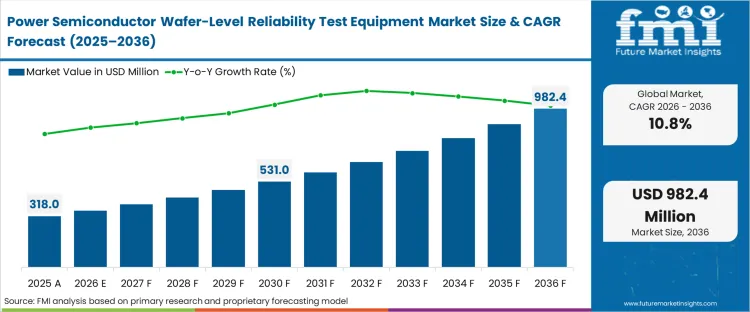
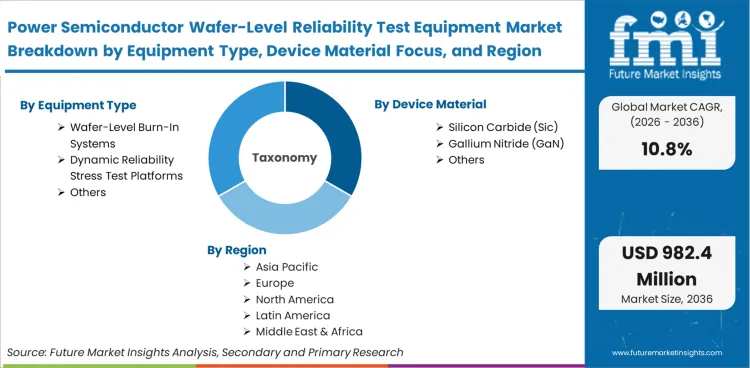
The power semiconductor wafer-level reliability test equipment market was calculated at USD 318.0 million in 2025, with the steady increase in demand projecting the market revenue to cross USD 352.3 million in 2026 at a CAGR of 10.8% during the forecast period. Industry expansion propels total valuation to USD 982.4 million through 2036 as yield requirements in SiC fabs dictate early identification of extrinsic defects before expensive packaging steps.
Summary of Power Semiconductor Wafer-Level Reliability Test Equipment Market
- Power Semiconductor Wafer-Level Reliability Test Equipment Market Definition
- Systems built to apply extreme electrical bias and thermal stress to bare semiconductor substrates, forcing latent defects to fail before expensive singulation and packaging phases.
- Demand Drivers in the Market
- Yield optimization pressures force foundry operations managers to deploy semiconductor burn-in and reliability equipment for SiC to catch basal plane dislocations before committing bad dies.
- Automotive supply contracts require quality assurance directors to implement wafer-level qualification tools for automotive power semiconductors to demonstrate zero-defect capabilities.
- Transitioning to 200mm SiC substrates compels fabrication vice presidents to invest in highly parallelized burn-in architectures to maintain acceptable throughput.
- Key Segments Analyzed in the FMI Report
- Wafer-Level Burn-In Systems: 34.0% share in 2026, driven by an economic imperative to intercept dielectric breakdowns at bare die stages.
- Silicon Carbide (Sic): 43.0% share in 2026, reflecting unique defect densities requiring extended stress times compared to traditional materials.
- Burn-In And Stabilization: 31.0% share in 2026, as foundational baseline protocols for all wide-bandgap qualification.
- IDMs: 38.0% share in 2026, due to internal requirements aligning epitaxy optimization directly with final reliability outcomes.
- Fully Automated Multi-Wafer Systems: 36.0% share in 2026, enabling high-volume manufacturing without breaking brittle substrates.
- China: Expanding at a robust 12.4% CAGR, reflecting intense domestic localization pushes by regional EV manufacturers demanding localized known-good-die supply.
- Analyst Opinion at FMI
- Rahul Pandita, Principal Analyst, Technology, at FMI, points out, "Foundries assume test capacity scales linearly with wafer starts. In reality, as SiC moves to 200mm formats, unique defect densities alter stress-time required per die, creating severe test-floor bottlenecks that pure math fails to predict. Purchasing managers evaluating the ROI of wafer-level burn-in for SiC production quickly discover that applying 3kV biases at 200°C across full SiC substrates introduces thermal runaway risks requiring entirely new contact architectures. Equipment suppliers solving this thermal dissipation challenge while scaling wafer-level stress testing for volume production will command massive premiums, while conventional automated test builders will struggle to qualify their platforms."
- Strategic Implications / Executive Takeaways
- Foundry procurement directors face immediate requirements to justify wafer-level burn-in system price premiums before automotive clients mandate 100% bare-die screening.
- Probe card suppliers must pivot R&D investments toward extreme high-voltage isolation materials or risk losing relevance in wide-bandgap ecosystems.
- Operations managers evaluating 200mm transitions risk severe cycle-time delays if parallel test channel density fails to match increased die counts per substrate.
- Methodology
- Primary Research: Direct consultations with test engineering directors and fab operations managers actively managing high-voltage qualification lines.
- Desk Research: Systematic review of AEC-Q101 certification registries and foundry capital expenditure filings to map equipment upgrade cycles.
- Market-Sizing and Forecasting: Volumetric modeling anchored to actual SiC/GaN wafer start trajectories and corresponding parallel test channel requirements.
- Data Validation and Update Cycle: Independent cross-validation against fab utilization metrics and publicly reported yield improvement curves.
Test engineering directors at pure-play foundries face mounting pressure from automotive tier-1s to provide known-good-die guarantees using specialized wafer-level reliability test equipment for power semiconductors. Delaying this transition risks losing multi-year EV supply contracts due to high module infant mortality rates. Procurement teams attempting to balance tester capital expenditure against fab output frequently discover how legacy package-level screening masks upstream epitaxy flaws until recovery becomes impossible. Managing wafer testing services capacity constraints further amplifies this commercial tension, accelerating investments in dedicated EV inverter semiconductor reliability test equipment.
Once automated multi-wafer test and burn-in systems achieve thermal uniformity across multiple 200mm SiC substrates simultaneously, throughput barriers collapse entirely. Passing this thermal management threshold allows facilities to implement complete bare-die screening without crippling fab cycle times. Device makers suddenly gain capability to sort infant mortality failures precisely at bare-die stages.
China scales rapidly at 12.4% as domestic electric vehicle makers mandate localized supply chains, forcing foundries to procure China power semiconductor test equipment to overcome lower initial yields through aggressive inline screening. India accelerates at 12.0%, capitalizing on the India semiconductor reliability testing equipment opportunity driven by greenfield fab investments prioritizing zero-defect power components. United States expands at 11.6%, driven by defense qualification mandates expanding the U.S. wafer-level reliability equipment footprint via rigorous advanced process control integrations. Taiwan registers 10.9% as pure-play foundries upgrade legacy silicon lines. South Korea follows at 10.5% with IDMs locking in specific thermal chuck geometries. Germany tracks at 9.8% under stringent automotive functional safety standards. Japan progresses at 9.3%, reflecting structural shifts among traditional power device suppliers toward heavily parallelized testing layouts.
Power Semiconductor Wafer-Level Reliability Test Equipment Market Definition
Power semiconductor reliability test equipment represents hardware and software systems designed to apply extreme electrical bias and thermal stress to bare semiconductor substrates before singulation. Equipment configurations simulate operational lifespans within hours, forcing latent defects to fail during testing rather than in field deployments. Core functional boundary centers on executing high-voltage stress protocols directly on intact substrates.
Power Semiconductor Wafer-Level Reliability Test Equipment Market Inclusions
Scope captures high-voltage wafer test systems for power semiconductors, multi-wafer burn-in chambers, specialized thermal chuck systems for wafer-level reliability, and dynamic gate stress platforms. Complete automated test equipment setups featuring specialized probe cards and interface hardware for high-current applications fall within analytical boundaries. Integrated software layers managing thermal profiles and defect mapping sequences form crucial components of measured revenue.
Power Semiconductor Wafer-Level Reliability Test Equipment Market Exclusions
Standard logic and memory wafer probers fall outside this analysis due to their inability to handle kilovolt-level biases or extreme thermal cycling. Package-level burn-in ovens remain excluded because they operate only after die singulation, highlighting the distinct technical divide in the wafer-level burn-in vs system-level burn-in comparison. Standalone metrology tools measuring physical wafer dimensions without applying electrical stress protocols also sit beyond defined boundaries.
Power Semiconductor Wafer-Level Reliability Test Equipment Market Research Methodology
- Primary Research: Test engineering directors, fab operations managers, and probe card tooling specialists directly responsible for high-voltage qualification workflows.
- Desk Research: AEC-Q101 certification registries, JEDEC standard compliance archives, and semiconductor foundry capital expenditure filings detailing equipment upgrade cycles.
- Market-Sizing and Forecasting: Baseline anchors rely on 200mm and 150mm SiC/GaN wafer start volumes mapped against typical parallel test channel density requirements.
- Data Validation and Update Cycle: Independent fab utilization metrics cross-validate adoption velocity against publicly reported yield improvement curves.
Segmental Analysis
Power Semiconductor Wafer-Level Reliability Test Equipment Market Analysis By Equipment Type
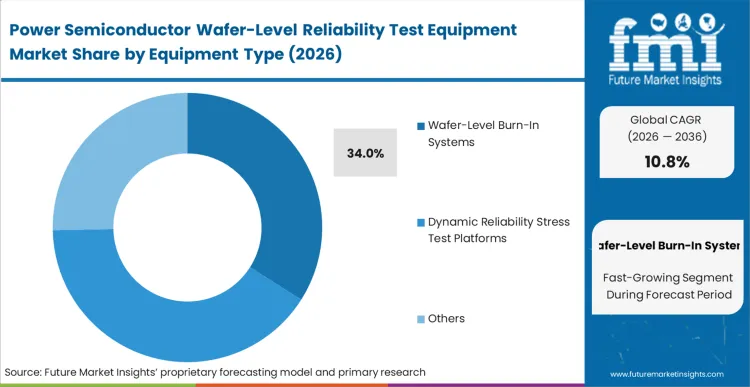
Catching a dielectric breakdown mechanism at bare die stages saves massive downstream assembly costs. Traditional logic testers simply lack thermal management capabilities to handle thousands of power devices switching simultaneously. High throughput is frequently marketed by equipment vendors, but actual fab bottlenecks remain probe card lifetimes under extreme thermal cycling, exacerbating the reliability bottlenecks in high-voltage wafer testing. Wafer-level burn-in systems is projected to command 34.0% share in 2026, and FMI observes that high volume manufacturing environments mandate this approach to protect profit margins. Quality assurance directors at pure-play foundries implement these wafer-level power semiconductor test systems to isolate infant mortality failures before committing expensive materials. Specialized semiconductor wafers processing facilities ignoring this wear-and-tear reality face unexpected line down events. Integrating high purity process systems further complicates layout planning. Engineering managers failing to account for consumable degradation face severe operational cost overruns.
- Thermal Dissipation Constraints: Simultaneous switching of power devices generates intense localized heating requiring active liquid cooling directly integrated into test chucks. Facility managers must upgrade chilled water infrastructure to support new installations or risk severe equipment throttling during peak operations.
- Contact Isolation Challenges: Applying thousands of volts across microscopic probe pitches necessitates advanced dielectric materials to prevent destructive arcing. Tooling engineers selecting inferior probe card and contactor solutions for wafer-level burn-in face catastrophic wafer damage events and immediate lot rejections.
- Parallelism Limits: Connecting thousands of individual dies simultaneously pushes electrical routing complexity beyond traditional printed circuit board capabilities. Hardware directors must source specialized multi-layer ceramic routing substrates to achieve desired throughput targets.
Power Semiconductor Wafer-Level Reliability Test Equipment Market Analysis By Device Material Focus
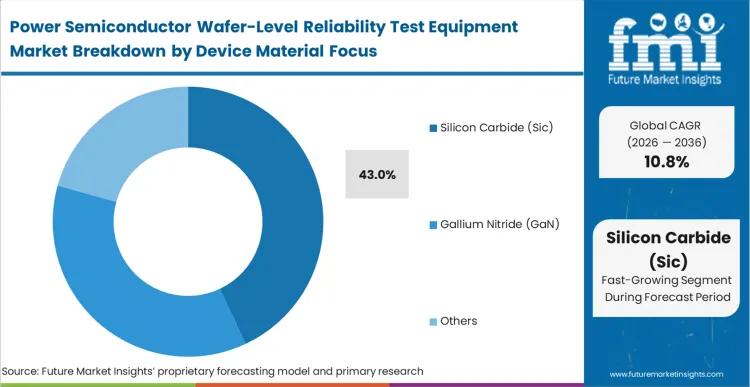
Specific defect densities found in wide-bandgap substrates require orders-of-magnitude longer stress times compared to legacy materials. Silicon carbide (SiC) is estimated to hold 43.0% share in 2026, reflecting unique metallurgical realities confronting every fabricator. FMI notes that basal plane dislocations in SiC crystals demand extensive screening protocols to guarantee automotive reliability standards. Device engineering leads specify rigorous voltage overstress routines to force emerging failure mechanisms in wide-bandgap semiconductors into observable failures. Gallium nitride receives significant media attention, but SiC drives true equipment revenue because its specific application in high-voltage traction inverters demands absolute perfection. Operating advanced wafer inspection system architectures alongside dedicated GaN wafer reliability test equipment provides comprehensive yield data. Operations managers attempting to shortcut these extended stress periods suffer massive module-level failures downstream.
- Crystal Defect Screening: Unique molecular structures in wide-bandgap materials host specific flaw types that only manifest under simultaneous thermal and electrical stress. Reliability engineers evaluating SiC vs GaN reliability test requirements must design custom stress profiles targeting exact failure mechanisms to ensure component longevity.
- Voltage Rating Escalation: Next-generation electric vehicles shifting to 800V bus architectures force component ratings above 1200V. Test facility managers must procure equipment capable of sourcing these extreme potentials safely without endangering surrounding fab infrastructure.
- Substrate Fragility: Extremely thin SiC wafers exhibit significant bow and warp, complicating automated handling and probing operations. Robotics engineers must implement ultra-precise vision alignment systems to prevent mechanical micro-cracks during chuck loading procedures.
Power Semiconductor Wafer-Level Reliability Test Equipment Market Analysis By Test Mode
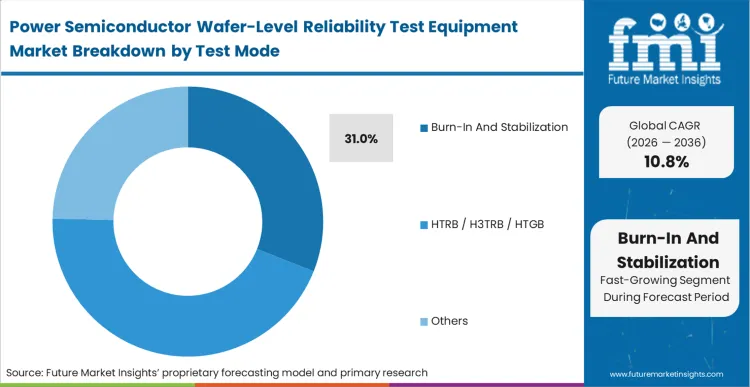
HTRB is considered standard industry practice, but real engineering challenges lie in dynamic gate stress routines that accurately mimic actual EV switching profiles. Incorporating advanced defect inspection equipment alongside dedicated dynamic H3TRB wafer-level test equipment helps isolate exact failure coordinates. Delaying implementation of DGS test systems for SiC and GaN leaves suppliers vulnerable to field returns resulting from complex transient voltage spikes. Utilizing a wafer batch aligner streamlines preparation before these extended stress cycles commence. Establishing foundational baseline protocols remains mandatory for all wide-bandgap qualification programs. Burn-in and stabilization is anticipated to capture 31.0% share in 2026, serving as primary gatekeepers for automotive component acceptance. FMI's analysis indicates that test engineering managers deploy these extended stress sequences to eliminate early-life failure populations definitively. Subjecting bare substrates to elevated temperatures under static bias forces weak gate oxides to rupture harmlessly inside test chambers.
- Oxide Degradation Triggering: Applying sustained gate biases at 200°C via specialized wafer-level HTRB equipment accelerates electron trapping mechanisms within insulating layers. Qualification directors use resulting data to predict long-term threshold voltage shifts under actual operating conditions.
- Avalanche Ruggedness Verification: Forcing devices into controlled breakdown states using a power device HTGB test platform verifies structural robustness against unexpected inductive load spikes. Design engineers rely on this feedback to optimize edge termination geometries during subsequent product iterations.
- Leakage Current Stabilization: Initial measurements often exhibit drift that must settle before true device performance becomes quantifiable. Yield management teams require precise stabilization periods to separate normal parametric shifting from genuine catastrophic defects.
Power Semiconductor Wafer-Level Reliability Test Equipment Market Analysis By End User
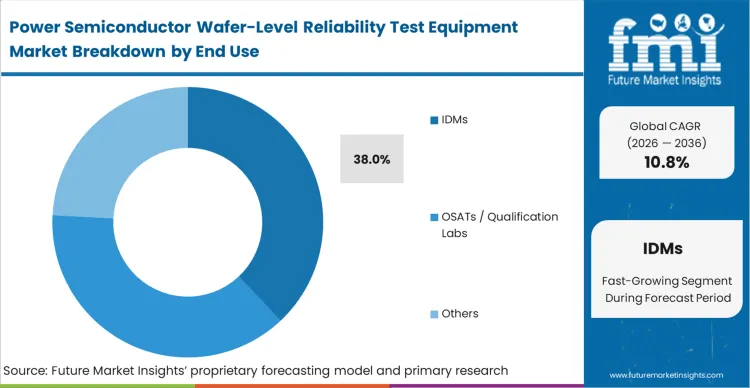
Internal requirements aligning epitaxy optimization directly with final reliability outcomes drive heavy investment patterns. IDMs is projected to account for 38.0% share in 2026 as vertically integrated manufacturers seek absolute control over their quality metrics. FMI analysts highlight that fabrication vice presidents at these organizations view wafer-level screening as a strategic differentiator rather than pure cost burden. Tight feedback loops between test floors and crystal growth departments enable rapid process tuning impossible in disaggregated supply chains. IDMs dominate purchasing today, but OSATs aggressively build wafer-level capabilities as automotive clients refuse to accept package-level fallout rates. Deploying highly sensitive semiconductor inspection system arrays alongside semiconductor equipment for automotive power modules inside OSAT facilities confirms this shifting responsibility landscape. Pure-play foundries failing to match IDM-level screening capabilities rapidly lose lucrative automotive contracts to vertically integrated competitors.
- Process Feedback Acceleration: Identifying exact physical coordinates of failed dies allows fab engineers to trace defects back to specific epitaxy reactor zones. Production directors use this precise spatial data to schedule targeted maintenance interventions before entire wafer lots degrade.
- Outsourced Screening Limitations: Relying on third-party test houses introduces logistical delays and data siloing that hampers rapid yield learning. Internal test managers advocate for captive equipment ownership of test equipment for EV power electronics manufacturing to maintain absolute control over proprietary stress protocols.
- Automotive Qualification Mandates: Tier-1 suppliers increasingly demand direct access to bare-die parametric data before authorizing volume shipments. Quality assurance executives must implement comprehensive tracking systems to trace individual component histories from ingot to final module.
Power Semiconductor Wafer-Level Reliability Test Equipment Market Analysis By Automation Architecture
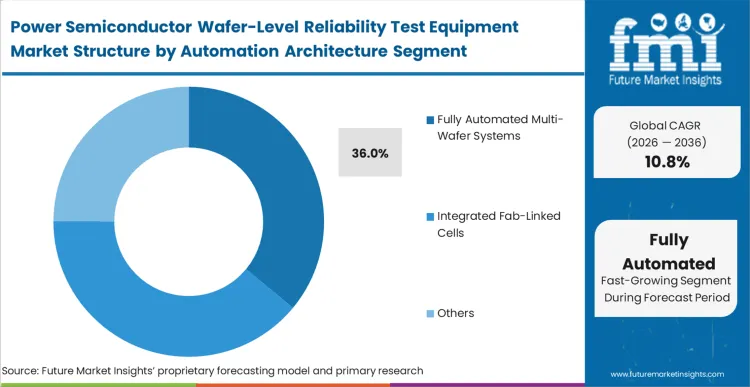
Fully automated systems win share rapidly, but their true value lies in robotic handling of ultra-thin substrates without inducing micro-cracks, rather than just saving operator labor. Advanced metrology and inspection loops confirm structural integrity before and after test cycles. Facilities clinging to manual engineering benches face crippling throughput bottlenecks as 200mm SiC volumes ramp aggressively. High-volume manufacturing environments cannot tolerate manual handling of fragile substrates leading fully automated multi-wafer systems set to secure a 36.0% share in 2026, solving critical material handling challenges inside advanced fabrication facilities. Based on FMI's assessment, factory automation directors mandate these architectures to eliminate human error during complex thermal testing sequences. Cassette-to-cassette robotics transfer warped substrates into massive parallel test chambers without operator intervention
- Warped Substrate Accommodation: Advanced vision systems map non-planar wafer surfaces precisely before commanding robotic end-effectors to engage. Automation engineers implement these complex software routines to prevent catastrophic shattering during high-force probe touchdowns.
- Thermal Soaking Coordination: Moving substrates from ambient conditions to 200°C chucks requires carefully orchestrated pre-heating stations. Facility operations teams sequence these material flows to maximize utilization of expensive high-voltage test channels.
- Data Pipeline Integration: Massive arrays of parametric results must stream directly into factory manufacturing execution systems in real time. IT infrastructure directors deploy wafer-level reliability data analytics for power devices to parse terabytes of stress data without overwhelming core fab networks.
Power Semiconductor Wafer-Level Reliability Test Equipment Market Drivers, Restraints, and Opportunities
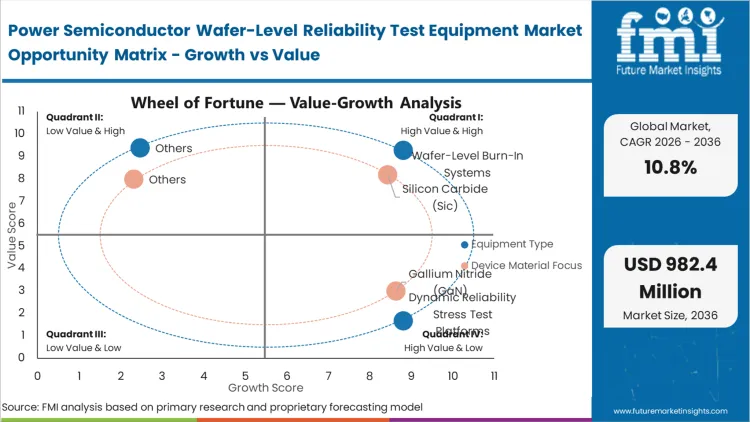
Automotive supply contracts mandate absolute zero-defect performance from traction inverters, forcing test engineering directors to procure dedicated automotive semiconductor qualification test equipment to push reliability screening upstream. Delaying this transition from package-level to bare-die screening leaves foundries exposed to crippling infant mortality rates that destroy profit margins during final assembly. EV manufacturers refuse to accept power module failures caused by extrinsic epitaxy defects that should have been caught during initial fabrication. Consequently, pure-play foundries must rapidly install highly parallelized stress testing platforms to guarantee known-good-die shipments. Procurement teams prioritize systems capable of handling 200mm SiC substrates, recognizing that legacy logic testers cannot deliver required thermal and electrical extremes needed for fast charger SiC MOSFET reliability screening. Integrating advanced wafer manufacturing equipment alongside these specialized reliability platforms ensures comprehensive quality control throughout entire fabrication lifecycles.
Integrating multi-wafer burn-in into existing fab manufacturing execution systems without violating stringent qualification standards for power semiconductor test equipment requires custom software bridges. This specific operational friction routinely delays tool qualification by several months, frustrating production vice presidents eager to ramp capacity. Strict data security parameters prevent newly installed high-voltage testers from automatically uploading complex parametric results to centralized fab databases. Software integration teams must carefully map proprietary tester outputs into standardized factory formats, a tedious process complicated by unique wide-bandgap data structures. Attempting to bypass these digital handshakes using temporary integrated photonics test reliability workarounds often creates severe data siloing that hampers long-term yield analysis.
Opportunities in the Power Semiconductor Wafer-Level Reliability Test Equipment Market
- Dynamic Gate Stress Algorithms: Implementing software capable of mimicking real-world EV acceleration profiles during bare-die testing. Test engineering leads capture premium pricing models by guaranteeing component performance under highly specific transient voltage conditions.
- Advanced Thermal Management Architectures: Designing liquid-cooled chucks outlining key features in a 3kV wafer test system capable of maintaining absolute temperature uniformity across heavily warped 200mm SiC substrates. Equipment design directors secure exclusive supply contracts with top-tier IDMs by solving this specific heat dissipation bottleneck.
- AI-Driven Stress Duration Optimization: Deploying machine learning models to dynamically adjust burn-in times based on upstream epitaxy defect maps. Fab operations managers partnering with emerging wafer-level reliability tester suppliers reduce overall test cell bottlenecking while maintaining rigorous quality standards.
Regional Analysis
Global demand for high-voltage testing infrastructure reveals distinct geographical divergences driven by localized supply chain mandates, defense reshoring, and stringent automotive safety standards. Facility planners and strategic sourcing directors across regions are actively customizing their procurement strategies to address these unique domestic qualification pressures with the market being segmented into North America, Europe, and Asia Pacific across 40 plus countries.
.webp "Top Country Growth Comparison Power Semiconductor Wafer Level Reliability Test Equipment Market Cagr (2026 2036)")
| Country | CAGR (2026 to 2036) |
|---|---|
| China | 12.4% |
| India | 12.0% |
| United States | 11.6% |
| Taiwan | 10.9% |
| South Korea | 10.5% |
| Germany | 9.8% |
| Japan | 9.3% |
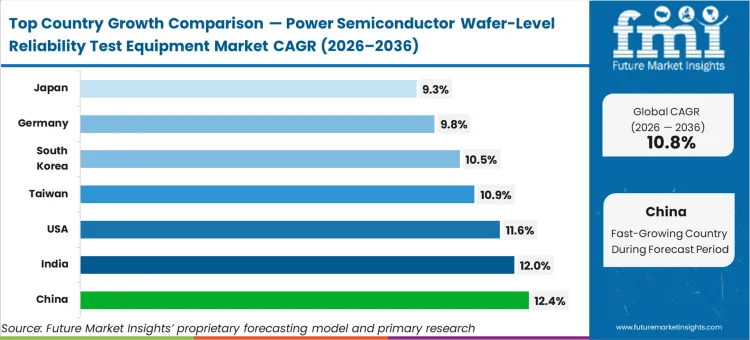
Source: Future Market Insights (FMI) analysis, based on proprietary forecasting model and primary research
Asia Pacific Power Semiconductor Wafer-Level Reliability Test Equipment Market Analysis
Supply chain sovereignty initiatives currently compel heavy capital expenditure into high-voltage testing infrastructure capable of supporting immense volume ramps across Asian fabrication centers. Quality assurance directors can no longer rely on high initial epitaxy yields, necessitating 100% wafer-level burn-in to filter extrinsic defects. Aggressive localization mandates issued by domestic EV manufacturers force regional foundries to deploy comprehensive bare-die screening architectures rapidly. By integrating specialized power board tester technologies locally, regional power module assemblers successfully insulate themselves from global supply shocks.
- China: Expanding at a 12.4% CAGR, this region positions its test facilities to dominate global known-good-die supply volumes. Domestic electric vehicle makers mandate localized supply chains, forcing foundries to overcome lower initial yields through aggressive inline screening. Operations managers must purchase massive parallel test fleets to maintain output and satisfy these internal fabrication requirements.
- India: Greenfield fab investments prioritizing zero-defect power components dictate an immediate procurement of advanced reliability platforms, driving a 12.0% CAGR. Facility planning directors build complete SiC ecosystems from scratch, avoiding legacy infrastructure constraints and establishing crucial alternative supply nodes for global automotive electronics procurement teams.
- Taiwan: Pure-play foundries upgrade legacy silicon lines to handle wide-bandgap materials, encountering severe thermal dissipation challenges during qualification. Test engineering leads must retrofit existing cleanrooms with specialized liquid-cooling loops, progressing at a 10.9% CAGR, and, maintaining deep competitive advantages through superior outsourced manufacturing capabilities.
- South Korea: Advancing at a 10.5% CAGR, vertically integrated memory giants pivot toward high-voltage power applications while locking in specific thermal chuck geometries. Strategic sourcing directors leverage massive capital reserves to monopolize premium test equipment allocations, reflecting aggressive IDM expansion strategies targeting automotive traction inverter dominance.
- Japan: Traditional power device suppliers shift toward heavily parallelized testing layouts, growing at a 9.3% CAGR to combat rising energy costs and space constraints. Fab managers replace outdated discrete testers with modern Japan power device qualification equipment architectures, revealing deep structural transitions inside historically conservative engineering cultures.
FMI's report includes extensive analysis of emerging Southeast Asian assembly hubs. Advanced packaging facilities in Malaysia and Vietnam rapidly adopt semiconductor assembly and testing platforms to intercept defective SiC substrates before costly advanced bonding processes begin, securing the region's position as a critical node in the global power electronics supply chain.
North America Power Semiconductor Wafer-Level Reliability Test Equipment Market Analysis
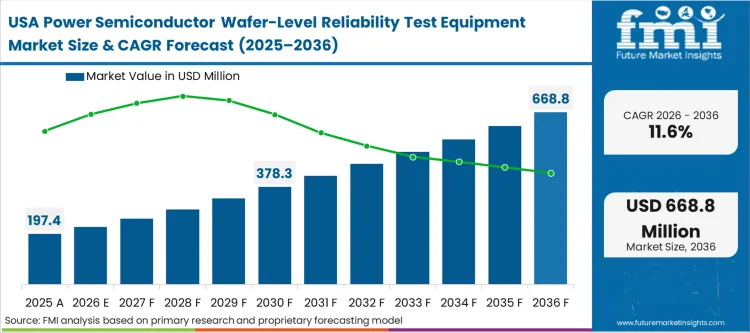
Reshoring initiatives driven by national security priorities inject massive capital into specialized wide-bandgap fabrication lines requiring immediate aerospace power semiconductor reliability testing upgrades. Aerospace procurement directors demand absolute proof of reliability screening under extreme voltage conditions before authorizing component integration into critical systems. Defense qualification mandates enforcing rigorous component traceability compel domestic foundries to integrate highly secure test data pipelines. Installing sophisticated automated test systems ensures compliance with these strict domestic sourcing protocols.
- United States: Defense and aerospace qualification mandates demand rigorous integrations to ensure absolute component reliability under extreme conditions. Hardware engineering leads must validate every bare die against classified mission profiles, while expanding at 11.6% of CAGR, securing critical technological sovereignty over next-generation military power electronics platforms.
FMI's report includes detailed assessments of Canadian compound semiconductor pilot lines. Academic research consortiums partner with commercial foundries to develop novel dynamic gate stress routines optimized for emerging ultra-wide-bandgap materials, establishing North America as a premier incubation hub for next-generation qualification methodologies.
Europe Power Semiconductor Wafer-Level Reliability Test Equipment Market Analysis
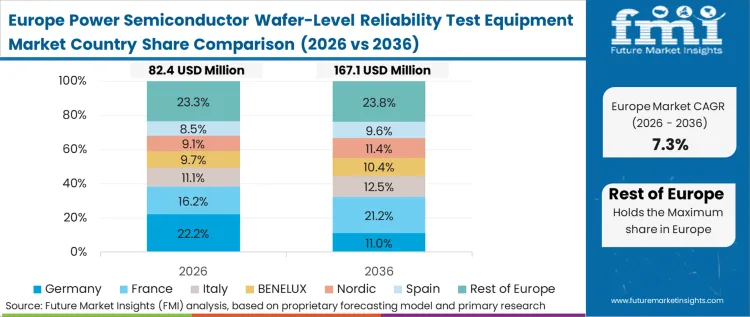
Deep integration between tier-1 automotive suppliers and specialized IDMs creates highly customized stress testing workflows that generic equipment builders struggle to support. Regional quality assurance executives mandate comprehensive wafer-level burn-in protocols to comply with ISO 26262 requirements governing electric vehicle traction inverters. Stringent automotive functional safety standards dictate every aspect of component qualification across continental fabrication centers. Deploying advanced test and measurement equipment ensuring renewable energy inverter power semiconductor qualification verifies absolute parameters before power modules ever reach final assembly lines.
- Germany: Scaling at a 9.8% CAGR, this country cements regional leadership in premium electric vehicle propulsion technologies. Stringent automotive functional safety standards require complete traceability of every high-voltage stress event applied to bare dies. Compliance officers mandate Germany automotive power semiconductor test equipment deployments to guarantee uninterrupted data streams linking fab-level testing directly to final vehicle identification numbers.
FMI's report includes analysis of specialized SiC substrate manufacturing clusters across Scandinavia and Italy. Materials engineering teams closely correlate semiconductor process chemicals purity metrics with downstream wafer-level reliability outcomes to optimize crystal growth parameters continually, reinforcing Europe's dedication to high-purity, defect-free automotive power architectures.
Competitive Aligners for Market Players
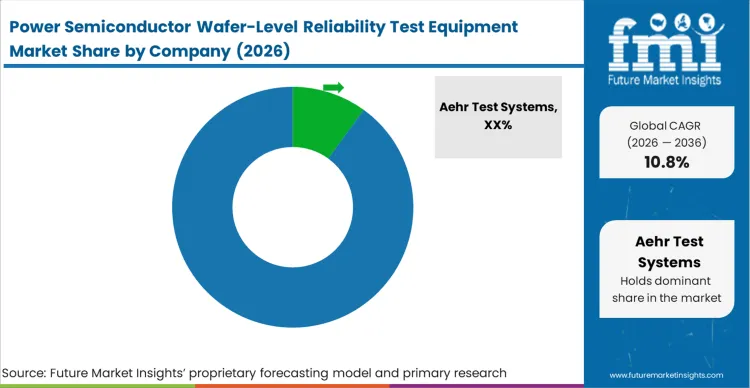
Managing extreme thermal dynamics during 3kV testing protocols separates dominant power semiconductor reliability test equipment manufacturers from marginalized catalog suppliers. Buyers qualify equipment based on thermal chuck stability at 200°C under severe electrical bias, rather than just raw test channel density metrics. Companies like Aehr Test Systems and Advantest command premium positioning by demonstrating proven capabilities to dissipate massive localized heat spikes without fracturing brittle SiC substrates. Quality assurance directors actively reject platforms exhibiting thermal runaway risks, regardless of aggressive pricing models offered by newer market entrants. Executing these flawless test protocols requires deep knowledge of complex semiconductor fabrication materials, separating the best power semiconductor reliability test equipment vendors from generic test providers.
Incumbents possess deep libraries of validated stress profiles aligned precisely with AEC-Q101 certification requirements, a capability challengers cannot replicate quickly. Decades spent co-developing proprietary metrology software integrations directly with leading automotive IDMs grant established vendors significant architectural lock-in. Technical buyers conducting an Aehr vs Keysight for power semiconductor wafer test evaluation often discover these established data pipelines ensure rapid fab deployment. Challengers attempting to displace these entrenched systems discover that foundry IT directors refuse to authorize unproven data bridges that might compromise factory manufacturing execution networks.
Foundry procurement teams actively resist absolute vendor lock-in by standardizing physical probe card interfaces across multiple equipment brands. Strategic sourcing directors issuing an RFQ for SiC burn-in test system architectures deliberately split massive capital expenditures among dual suppliers like Cohu and Chroma ATE to maintain pricing leverage during high-volume capacity ramps. Future competitive dynamics within the semiconductor industry point toward inline, AI-driven sorting gates that dynamically adjust stress profiles based on upstream epitaxy defect maps, moving those looking to buy high-voltage wafer test system for power semiconductors from a reactive quality gate into a proactive yield enhancement posture.
Key Players in Power Semiconductor Wafer-Level Reliability Test Equipment Market
- Aehr Test Systems
- Keysight Technologies
- National Instruments (NI, part of Emerson)
- MPI Corporation
- Cohu
- Advantest
- Chroma ATE
Scope of the Report
| Metric | Value |
|---|---|
| Quantitative Units | USD 352.3 million to USD 982.4 million, at a CAGR of 10.8% |
| Market Definition | Systems built to apply extreme electrical bias and thermal stress to bare semiconductor substrates, forcing latent defects to fail before expensive singulation and packaging phases. |
| Segmentation | Equipment type, Device material focus, Test mode, End user, Automation architecture |
| Regions Covered | North America, Europe, Asia Pacific |
| Countries Covered | China, India, United States, Taiwan, South Korea, Germany, Japan |
| Key Companies Profiled | Aehr Test Systems, Keysight Technologies, National Instruments (NI, part of Emerson), MPI Corporation, Cohu, Advantest, Chroma ATE |
| Forecast Period | 2026 to 2036 |
| Approach | Volumetric modeling anchored to actual SiC/GaN wafer start trajectories and corresponding parallel test channel requirements. |
Source: Future Market Insights (FMI) analysis, based on proprietary forecasting model and primary research
Segments
Equipment Type:
- Wafer-level burn-in systems
- High-voltage wafer parametric test systems
- Dynamic reliability stress test platforms
- Thermal chucks and temperature-forcing systems
- Probe-contact and WaferPak / interface hardware
Device Material Focus:
- Silicon carbide (SiC)
- Gallium nitride (GaN)
- High-voltage silicon power devices
- Emerging ultra-wide-bandgap / specialty power devices
Test Mode:
- Burn-in and stabilization
- HTRB / H3TRB / HTGB
- Dynamic gate stress (DGS)
- Wafer-level parametric reliability screening
- Combined electro-thermal stress qualification
End User:
- IDMs
- Pure-play foundries and specialty fabs
- OSATs / qualification labs
- Automotive and industrial power module suppliers
- R&D institutes / pilot lines
Automation Architecture:
- Fully automated multi-wafer systems
- Semi-automated engineering systems
- Lab-scale qualification benches
- Integrated fab-linked cells
- Software-orchestrated data / analytics layers
Regions:
- North America & Latin America
- United States
- Canada
- Mexico
- Brazil
- Argentina
- Chile
- Europe
- Germany
- United Kingdom
- France
- Italy
- Spain
- Asia-Pacific
- China
- Japan
- South Korea
- India
- ASEAN
- ANZ
- Middle East & Africa
- UAE
- Saudi Arabia
- South Africa
Bibliography
- Automotive Electronics Council. (2025). AEC Q101 workshop.
- Feil, M. W., Shumway, J., David, C., Ryu, H., Ramirez, A. D., Wang, L., Baker, G., Hobart, K. D., Tadjer, M. J., & Koehler, A. D. (2024). Time-gated optical spectroscopy of field-effect-stimulated defects in silicon carbide MOSFETs. Physical Review Applied.
- Gao, X., Chen, C., Sun, P., Han, J., Yang, G., & Sheng, K. (2024). Review on power cycling reliability of SiC power device. Batteries.
- Kamiński, M., & Rzepka, P. (2024). The Overview of Silicon Carbide Technology: Status, Challenges, Key Drivers, and Product Roadmap.
- Keysight Technologies. (2024). Keysight unveils 3kV high voltage wafer test system for power semiconductors.
This bibliography is provided for reader reference. The full FMI report contains the complete reference list with primary source documentation.
Addresses
- Transition velocity from package-level screening to 100% bare-die burn-in across tier-1 automotive supply chains.
- Thermal dissipation limits dictating maximum parallel test channel densities on 200mm SiC substrates.
- Software integration friction delaying high-voltage parametric test tool qualification inside legacy foundries.
- Competitive positioning shifts between vertically integrated device manufacturers and outsourced assembly test providers.
- Capital expenditure models required to deploy dynamic gate stress architectures effectively.
- Defect density impacts on total required stress time per die for emerging wide-bandgap materials.
- Regional supply chain localization mandates accelerating multi-wafer test system adoption across China.
- Consumable degradation rates impacting overall equipment effectiveness during extreme thermal cycling protocols.
Frequently Asked Questions
What is wafer-level reliability testing in power semiconductors?
These systems apply extreme electrical bias and thermal stress to bare semiconductor substrates before singulation to force latent defects to fail during testing rather than in field deployments.
Why do SiC devices need dynamic reliability testing?
Specific basal plane dislocations native to SiC crystals require extended stress durations under dynamic EV switching profiles to manifest as observable failures before assembly.
How is wafer-level burn-in different from package-level burn-in?
Wafer-level burn-in isolates infant mortality failures definitively before committing expensive substrates to advanced packaging processes, whereas package-level screening tests already singulated chips.
Which tests are used for GaN reliability qualification?
Establishing foundational baseline protocols for GaN requires extended stress sequences like burn-in and stabilization, HTRB, and dynamic gate stress to force weak gate oxides to rupture harmlessly inside specialized test chambers.
What voltage range is needed for power semiconductor wafer test?
Next-generation electric vehicle platforms transitioning to 800V bus architectures force component ratings above 1200V, often requiring test equipment capable of safely sourcing up to 3kV potentials.
Who makes SiC wafer-level burn-in systems?
Companies like Aehr Test Systems, Advantest, Keysight Technologies, and MPI Corporation provide robust solutions capable of dissipating massive localized heat spikes safely during severe electrical bias.
Which companies lead wafer-level reliability testing for SiC devices?
Incumbents possessing deep libraries of validated stress profiles aligned with AEC-Q101 certification requirements lead the sector by offering established data pipelines and proven liquid-cooling chuck architectures.
How fast will power semiconductor wafer-level test equipment grow by 2036?
Projections indicate a 10.8% CAGR through 2036, pushing total valuation to USD 982.4 million as electric vehicle platforms demand rigorous component qualification at extreme potentials.
Compare wafer-level burn-in and dynamic H3TRB tools for GaN?
While basic burn-in stabilizes early-life failure populations under static bias, dynamic H3TRB accurately mimics actual high-humidity, high-bias switching environments to prevent complex transient voltage spike failures.
What drives demand for high-voltage wafer test systems?
Automotive supply contracts mandating absolute zero-defect performance from traction inverters force foundries to adopt bare-die screening to avoid crippling infant mortality rates during final assembly.
Recommend suppliers for power semiconductor reliability test equipment?
Foundry procurement teams often evaluate Cohu, Chroma ATE, and National Instruments (NI) alongside established leaders to maintain pricing leverage and split capital expenditures during high-volume capacity ramps.
How does wafer-level burn-in compare to system-level burn-in?
Wafer-level burn-in catches basal plane dislocations directly on the 200mm substrate, whereas system-level burn-in evaluates fully assembled modules, masking upstream epitaxy flaws until recovery becomes impossible.
What are the differences in SiC vs GaN reliability test requirements?
While both materials host specific flaw types, SiC's application in high-voltage traction inverters demands absolute perfection under extreme 3kV/200°C stress, requiring specialized liquid-cooled chucks that many GaN applications do not yet mandate.
Why choose dynamic H3TRB vs static HTRB?
Test engineering leads implement dynamic stress algorithms over static reverse bias testing to verify oxide ruggedness under complex transient conditions that replicate actual EV acceleration profiles in humid environments.
How to detect early drift in SiC and GaN devices?
Yield management teams utilize advanced high-voltage parametric testers to provide precise stabilization periods that separate normal parametric shifting from genuine catastrophic defects.
How to choose a power semiconductor reliability test platform?
Procurement teams must prioritize systems capable of handling heavily warped 200mm SiC substrates using automated robotic handling and advanced thermal dissipation to guarantee high-volume manufacturing without breaking brittle materials.
Can you explain the demand for wafer-level reliability equipment in power semiconductors?
Yield optimization pressures force foundry operations managers to catch extrinsic defects before committing materials to advanced packaging, requiring highly parallelized architectures to maintain acceptable facility throughput.
What are the reliability bottlenecks in high-voltage wafer testing?
Applying kilovolt-level biases across microscopic probe pitches requires advanced dielectric materials to prevent destructive arcing, while extreme thermal cycling rapidly degrades interface hardware.
What is the ROI of wafer-level burn-in for SiC production?
Filtering out defective dies before they reach the power module stage saves massive downstream assembly costs and secures multi-year EV supply contracts without recall risks.
What are the qualification standards for power semiconductor test equipment?
Compliance officers rely on stringent automotive functional safety frameworks like ISO 26262 and AEC-Q101, demanding uninterrupted data streams linking fab-level testing directly to final vehicle identification numbers.
What are the key features in a 3kV wafer test system?
Essential features include active liquid cooling integrated directly into test chucks, advanced vision algorithms to map non-planar wafer surfaces, and specialized multi-layer ceramic routing substrates.
What are the emerging failure mechanisms in wide-bandgap semiconductors?
Applying sustained gate biases at 200°C accelerates electron trapping mechanisms within insulating layers, forcing devices into controlled breakdown states to verify structural robustness against unexpected inductive load spikes.
Preview the report firsthand - request a free sample
Get SampleGet the brochure for pricing and purchase details.
Get PDFTable of Content
- Executive Summary
- Global Market Outlook
- Demand-side Trends
- Supply-side Trends
- Technology Roadmap Analysis
- Analysis and Recommendations
- Market Overview
- Market Coverage / Taxonomy
- Market Definition / Scope / Limitations
- Research Methodology
- Chapter Orientation
- Analytical Lens and Working Hypotheses
- Market Structure, Signals, and Trend Drivers
- Benchmarking and Cross-market Comparability
- Market Sizing, Forecasting, and Opportunity Mapping
- Research Design and Evidence Framework
- Desk Research Programme (Secondary Evidence)
- Company Annual and Sustainability Reports
- Peer-reviewed Journals and Academic Literature
- Corporate Websites, Product Literature, and Technical Notes
- Earnings Decks and Investor Briefings
- Statutory Filings and Regulatory Disclosures
- Technical White Papers and Standards Notes
- Trade Journals, Industry Magazines, and Analyst Briefs
- Conference Proceedings, Webinars, and Seminar Materials
- Government Statistics Portals and Public Data Releases
- Press Releases and Reputable Media Coverage
- Specialist Newsletters and Curated Briefings
- Sector Databases and Reference Repositories
- FMI Internal Proprietary Databases and Historical Market Datasets
- Subscription Datasets and Paid Sources
- Social Channels, Communities, and Digital Listening Inputs
- Additional Desk Sources
- Expert Input and Fieldwork (Primary Evidence)
- Primary Modes
- Qualitative Interviews and Expert Elicitation
- Quantitative Surveys and Structured Data Capture
- Blended Approach
- Why Primary Evidence is Used
- Field Techniques
- Interviews
- Surveys
- Focus Groups
- Observational and In-context Research
- Social and Community Interactions
- Stakeholder Universe Engaged
- C-suite Leaders
- Board Members
- Presidents and Vice Presidents
- R&D and Innovation Heads
- Technical Specialists
- Domain Subject-matter Experts
- Scientists
- Physicians and Other Healthcare Professionals
- Governance, Ethics, and Data Stewardship
- Research Ethics
- Data Integrity and Handling
- Primary Modes
- Tooling, Models, and Reference Databases
- Desk Research Programme (Secondary Evidence)
- Data Engineering and Model Build
- Data Acquisition and Ingestion
- Cleaning, Normalisation, and Verification
- Synthesis, Triangulation, and Analysis
- Quality Assurance and Audit Trail
- Market Background
- Market Dynamics
- Drivers
- Restraints
- Opportunity
- Trends
- Scenario Forecast
- Demand in Optimistic Scenario
- Demand in Likely Scenario
- Demand in Conservative Scenario
- Opportunity Map Analysis
- Product Life Cycle Analysis
- Supply Chain Analysis
- Investment Feasibility Matrix
- Value Chain Analysis
- PESTLE and Porter’s Analysis
- Regulatory Landscape
- Regional Parent Market Outlook
- Production and Consumption Statistics
- Import and Export Statistics
- Market Dynamics
- Global Market Analysis 2021 to 2025 and Forecast, 2026 to 2036
- Historical Market Size Value (USD Million) Analysis, 2021 to 2025
- Current and Future Market Size Value (USD Million) Projections, 2026 to 2036
- Y-o-Y Growth Trend Analysis
- Absolute $ Opportunity Analysis
- Global Market Pricing Analysis 2021 to 2025 and Forecast 2026 to 2036
- Global Market Analysis 2021 to 2025 and Forecast 2026 to 2036, By Equipment Type
- Introduction / Key Findings
- Historical Market Size Value (USD Million) Analysis By Equipment Type , 2021 to 2025
- Current and Future Market Size Value (USD Million) Analysis and Forecast By Equipment Type , 2026 to 2036
- Wafer-Level Burn-In Systems
- Dynamic Reliability Stress Test Platforms
- Others
- Wafer-Level Burn-In Systems
- Y-o-Y Growth Trend Analysis By Equipment Type , 2021 to 2025
- Absolute $ Opportunity Analysis By Equipment Type , 2026 to 2036
- Global Market Analysis 2021 to 2025 and Forecast 2026 to 2036, By Device Material Focus
- Introduction / Key Findings
- Historical Market Size Value (USD Million) Analysis By Device Material Focus, 2021 to 2025
- Current and Future Market Size Value (USD Million) Analysis and Forecast By Device Material Focus, 2026 to 2036
- Silicon Carbide (Sic)
- Gallium Nitride (GaN)
- Others
- Silicon Carbide (Sic)
- Y-o-Y Growth Trend Analysis By Device Material Focus, 2021 to 2025
- Absolute $ Opportunity Analysis By Device Material Focus, 2026 to 2036
- Global Market Analysis 2021 to 2025 and Forecast 2026 to 2036, By Test Mode
- Introduction / Key Findings
- Historical Market Size Value (USD Million) Analysis By Test Mode, 2021 to 2025
- Current and Future Market Size Value (USD Million) Analysis and Forecast By Test Mode, 2026 to 2036
- Burn-In And Stabilization
- HTRB / H3TRB / HTGB
- Others
- Burn-In And Stabilization
- Y-o-Y Growth Trend Analysis By Test Mode, 2021 to 2025
- Absolute $ Opportunity Analysis By Test Mode, 2026 to 2036
- Global Market Analysis 2021 to 2025 and Forecast 2026 to 2036, By End Use
- Introduction / Key Findings
- Historical Market Size Value (USD Million) Analysis By End Use, 2021 to 2025
- Current and Future Market Size Value (USD Million) Analysis and Forecast By End Use, 2026 to 2036
- IDMs
- OSATs / Qualification Labs
- Others
- IDMs
- Y-o-Y Growth Trend Analysis By End Use, 2021 to 2025
- Absolute $ Opportunity Analysis By End Use, 2026 to 2036
- Global Market Analysis 2021 to 2025 and Forecast 2026 to 2036, By Automation Architecture
- Introduction / Key Findings
- Historical Market Size Value (USD Million) Analysis By Automation Architecture, 2021 to 2025
- Current and Future Market Size Value (USD Million) Analysis and Forecast By Automation Architecture, 2026 to 2036
- Fully Automated Multi-Wafer Systems
- Integrated Fab-Linked Cells
- Others
- Fully Automated Multi-Wafer Systems
- Y-o-Y Growth Trend Analysis By Automation Architecture, 2021 to 2025
- Absolute $ Opportunity Analysis By Automation Architecture, 2026 to 2036
- Global Market Analysis 2021 to 2025 and Forecast 2026 to 2036, By Region
- Introduction
- Historical Market Size Value (USD Million) Analysis By Region, 2021 to 2025
- Current Market Size Value (USD Million) Analysis and Forecast By Region, 2026 to 2036
- North America
- Latin America
- Western Europe
- Eastern Europe
- East Asia
- South Asia and Pacific
- Middle East & Africa
- Market Attractiveness Analysis By Region
- North America Market Analysis 2021 to 2025 and Forecast 2026 to 2036, By Country
- Historical Market Size Value (USD Million) Trend Analysis By Market Taxonomy, 2021 to 2025
- Market Size Value (USD Million) Forecast By Market Taxonomy, 2026 to 2036
- By Country
- USA
- Canada
- Mexico
- By Equipment Type
- By Device Material Focus
- By Test Mode
- By End Use
- By Automation Architecture
- By Country
- Market Attractiveness Analysis
- By Country
- By Equipment Type
- By Device Material Focus
- By Test Mode
- By End Use
- By Automation Architecture
- Key Takeaways
- Latin America Market Analysis 2021 to 2025 and Forecast 2026 to 2036, By Country
- Historical Market Size Value (USD Million) Trend Analysis By Market Taxonomy, 2021 to 2025
- Market Size Value (USD Million) Forecast By Market Taxonomy, 2026 to 2036
- By Country
- Brazil
- Chile
- Rest of Latin America
- By Equipment Type
- By Device Material Focus
- By Test Mode
- By End Use
- By Automation Architecture
- By Country
- Market Attractiveness Analysis
- By Country
- By Equipment Type
- By Device Material Focus
- By Test Mode
- By End Use
- By Automation Architecture
- Key Takeaways
- Western Europe Market Analysis 2021 to 2025 and Forecast 2026 to 2036, By Country
- Historical Market Size Value (USD Million) Trend Analysis By Market Taxonomy, 2021 to 2025
- Market Size Value (USD Million) Forecast By Market Taxonomy, 2026 to 2036
- By Country
- Germany
- UK
- Italy
- Spain
- France
- Nordic
- BENELUX
- Rest of Western Europe
- By Equipment Type
- By Device Material Focus
- By Test Mode
- By End Use
- By Automation Architecture
- By Country
- Market Attractiveness Analysis
- By Country
- By Equipment Type
- By Device Material Focus
- By Test Mode
- By End Use
- By Automation Architecture
- Key Takeaways
- Eastern Europe Market Analysis 2021 to 2025 and Forecast 2026 to 2036, By Country
- Historical Market Size Value (USD Million) Trend Analysis By Market Taxonomy, 2021 to 2025
- Market Size Value (USD Million) Forecast By Market Taxonomy, 2026 to 2036
- By Country
- Russia
- Poland
- Hungary
- Balkan & Baltic
- Rest of Eastern Europe
- By Equipment Type
- By Device Material Focus
- By Test Mode
- By End Use
- By Automation Architecture
- By Country
- Market Attractiveness Analysis
- By Country
- By Equipment Type
- By Device Material Focus
- By Test Mode
- By End Use
- By Automation Architecture
- Key Takeaways
- East Asia Market Analysis 2021 to 2025 and Forecast 2026 to 2036, By Country
- Historical Market Size Value (USD Million) Trend Analysis By Market Taxonomy, 2021 to 2025
- Market Size Value (USD Million) Forecast By Market Taxonomy, 2026 to 2036
- By Country
- China
- Japan
- South Korea
- By Equipment Type
- By Device Material Focus
- By Test Mode
- By End Use
- By Automation Architecture
- By Country
- Market Attractiveness Analysis
- By Country
- By Equipment Type
- By Device Material Focus
- By Test Mode
- By End Use
- By Automation Architecture
- Key Takeaways
- South Asia and Pacific Market Analysis 2021 to 2025 and Forecast 2026 to 2036, By Country
- Historical Market Size Value (USD Million) Trend Analysis By Market Taxonomy, 2021 to 2025
- Market Size Value (USD Million) Forecast By Market Taxonomy, 2026 to 2036
- By Country
- India
- ASEAN
- Australia & New Zealand
- Rest of South Asia and Pacific
- By Equipment Type
- By Device Material Focus
- By Test Mode
- By End Use
- By Automation Architecture
- By Country
- Market Attractiveness Analysis
- By Country
- By Equipment Type
- By Device Material Focus
- By Test Mode
- By End Use
- By Automation Architecture
- Key Takeaways
- Middle East & Africa Market Analysis 2021 to 2025 and Forecast 2026 to 2036, By Country
- Historical Market Size Value (USD Million) Trend Analysis By Market Taxonomy, 2021 to 2025
- Market Size Value (USD Million) Forecast By Market Taxonomy, 2026 to 2036
- By Country
- Kingdom of Saudi Arabia
- Other GCC Countries
- Turkiye
- South Africa
- Other African Union
- Rest of Middle East & Africa
- By Equipment Type
- By Device Material Focus
- By Test Mode
- By End Use
- By Automation Architecture
- By Country
- Market Attractiveness Analysis
- By Country
- By Equipment Type
- By Device Material Focus
- By Test Mode
- By End Use
- By Automation Architecture
- Key Takeaways
- Key Countries Market Analysis
- USA
- Pricing Analysis
- Market Share Analysis, 2025
- By Equipment Type
- By Device Material Focus
- By Test Mode
- By End Use
- By Automation Architecture
- Canada
- Pricing Analysis
- Market Share Analysis, 2025
- By Equipment Type
- By Device Material Focus
- By Test Mode
- By End Use
- By Automation Architecture
- Mexico
- Pricing Analysis
- Market Share Analysis, 2025
- By Equipment Type
- By Device Material Focus
- By Test Mode
- By End Use
- By Automation Architecture
- Brazil
- Pricing Analysis
- Market Share Analysis, 2025
- By Equipment Type
- By Device Material Focus
- By Test Mode
- By End Use
- By Automation Architecture
- Chile
- Pricing Analysis
- Market Share Analysis, 2025
- By Equipment Type
- By Device Material Focus
- By Test Mode
- By End Use
- By Automation Architecture
- Germany
- Pricing Analysis
- Market Share Analysis, 2025
- By Equipment Type
- By Device Material Focus
- By Test Mode
- By End Use
- By Automation Architecture
- UK
- Pricing Analysis
- Market Share Analysis, 2025
- By Equipment Type
- By Device Material Focus
- By Test Mode
- By End Use
- By Automation Architecture
- Italy
- Pricing Analysis
- Market Share Analysis, 2025
- By Equipment Type
- By Device Material Focus
- By Test Mode
- By End Use
- By Automation Architecture
- Spain
- Pricing Analysis
- Market Share Analysis, 2025
- By Equipment Type
- By Device Material Focus
- By Test Mode
- By End Use
- By Automation Architecture
- France
- Pricing Analysis
- Market Share Analysis, 2025
- By Equipment Type
- By Device Material Focus
- By Test Mode
- By End Use
- By Automation Architecture
- India
- Pricing Analysis
- Market Share Analysis, 2025
- By Equipment Type
- By Device Material Focus
- By Test Mode
- By End Use
- By Automation Architecture
- ASEAN
- Pricing Analysis
- Market Share Analysis, 2025
- By Equipment Type
- By Device Material Focus
- By Test Mode
- By End Use
- By Automation Architecture
- Australia & New Zealand
- Pricing Analysis
- Market Share Analysis, 2025
- By Equipment Type
- By Device Material Focus
- By Test Mode
- By End Use
- By Automation Architecture
- China
- Pricing Analysis
- Market Share Analysis, 2025
- By Equipment Type
- By Device Material Focus
- By Test Mode
- By End Use
- By Automation Architecture
- Japan
- Pricing Analysis
- Market Share Analysis, 2025
- By Equipment Type
- By Device Material Focus
- By Test Mode
- By End Use
- By Automation Architecture
- South Korea
- Pricing Analysis
- Market Share Analysis, 2025
- By Equipment Type
- By Device Material Focus
- By Test Mode
- By End Use
- By Automation Architecture
- Russia
- Pricing Analysis
- Market Share Analysis, 2025
- By Equipment Type
- By Device Material Focus
- By Test Mode
- By End Use
- By Automation Architecture
- Poland
- Pricing Analysis
- Market Share Analysis, 2025
- By Equipment Type
- By Device Material Focus
- By Test Mode
- By End Use
- By Automation Architecture
- Hungary
- Pricing Analysis
- Market Share Analysis, 2025
- By Equipment Type
- By Device Material Focus
- By Test Mode
- By End Use
- By Automation Architecture
- Kingdom of Saudi Arabia
- Pricing Analysis
- Market Share Analysis, 2025
- By Equipment Type
- By Device Material Focus
- By Test Mode
- By End Use
- By Automation Architecture
- Turkiye
- Pricing Analysis
- Market Share Analysis, 2025
- By Equipment Type
- By Device Material Focus
- By Test Mode
- By End Use
- By Automation Architecture
- South Africa
- Pricing Analysis
- Market Share Analysis, 2025
- By Equipment Type
- By Device Material Focus
- By Test Mode
- By End Use
- By Automation Architecture
- USA
- Market Structure Analysis
- Competition Dashboard
- Competition Benchmarking
- Market Share Analysis of Top Players
- By Regional
- By Equipment Type
- By Device Material Focus
- By Test Mode
- By End Use
- By Automation Architecture
- Competition Analysis
- Competition Deep Dive
- Aehr Test Systems
- Overview
- Product Portfolio
- Profitability by Market Segments (Product/Age /Sales Channel/Region)
- Sales Footprint
- Strategy Overview
- Marketing Strategy
- Product Strategy
- Channel Strategy
- Keysight Technologies
- National Instruments (NI, part of Emerson)
- MPI Corporation
- Cohu
- Advantest
- Chroma ATE
- Aehr Test Systems
- Competition Deep Dive
- Assumptions & Acronyms Used


