

- Market Size (2026)
- USD 400.0 Mn
- Forecast (2036)
- USD 720.0 Mn
- CAGR (2026 to 2036)
- 6.0%
Underground Power Cable Partial Discharge and Fault Location Test Equipment Market Size, Market Forecast and Outlook By FMI
Underground power cable partial discharge and fault location test equipment market was valued at USD 380.0 million in 2025 and is estimated to reach USD 400.0 million in 2026. Market value is projected to rise to USD 720.0 million by 2036, reflecting a 6.0% CAGR over 2026 to 2036. Growth is being driven by continued underground cable expansion and by utilities placing more emphasis on identifying defect type and fault location before approving repair or replacement work. That shift is becoming more important as denser cable networks raise the cost of outages and narrow the time available for restoration.
Summary of the Underground Power Cable Partial Discharge and Fault Location Test Equipment Market
- The underground power cable partial discharge and fault location test equipment market is projected to reach USD 720.0 million by 2036.
- Industry value is expected to grow at a 6.0% CAGR from 2026 to 2036.
- The market was valued at USD 380.0 million in 2025.
- Market size is estimated at USD 400.0 million in 2026.
- Partial discharge systems are expected to lead test function demand with 31.0% share in 2026.
- Medium voltage is projected to remain the leading voltage class with 54.0% share in 2026.
- Portable sets are expected to account for 63.0% share in 2026 as utilities continue to prefer field-ready equipment for scattered route diagnostics and outage work.
- Country-level expansion is strongest in China, where growth is projected at 7.2% CAGR through 2036
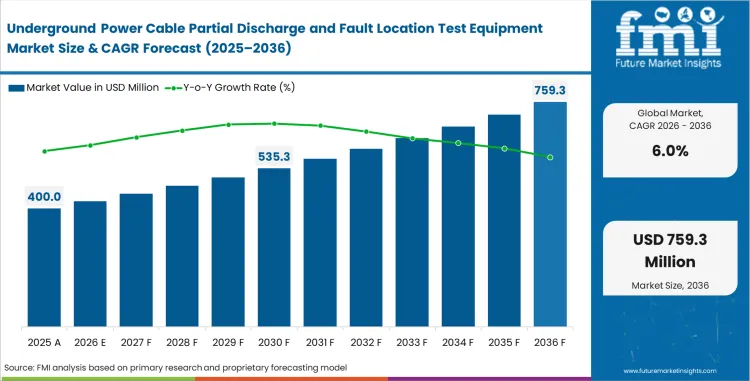
Key Takeaways, Market Size, and Forecast
- Underground Power Cable Partial Discharge and Fault Location Test Equipment Market is forecast to grow from USD 400.0 million in 2026 to USD 720.0 million by 2036, at a CAGR of 6.0%.
- The underground power cable partial discharge and fault location test equipment market was valued at USD 380.0 million in 2025.
- By 2036, the Underground Power Cable Partial Discharge and Fault Location Test Equipment Market is expected to be worth USD 720.0 million.
- From 2026 to 2036, the market is projected to expand at a CAGR of 6.0%.
- The market is expected to create an incremental opportunity of USD 320.0 million.
- In 2026, Partial discharge systems are expected to account for 31.0% of the test function segment.
- China (7.2%) and India (7.0%) are two of the fastest growing markets.
Underground Power Cable Partial Discharge and Fault Location Test Equipment Market Key Takeaways
| Parameter | Details |
|---|---|
| Market value (2026) | USD 400.0 million |
| Forecast value (2036) | USD 720.0 million |
| CAGR (2026 to 2036) | 6.0% |
| Estimated market value (2025) | USD 380.0 million |
| Incremental opportunity | USD 320.0 million |
| Leading test function and voltage class | Partial discharge systems and medium voltage |
| Leading deployment mode and test method | Portable sets and VLF offline |
| Leading fault location method | TDR prelocation |
| Leading end user and application stage | Utilities and maintenance diagnostics |
| Leading cable type | XLPE cables |
| Key supplier brands referenced in market landscape | Megger, BAUR, OMICRON, Doble Engineering |
Source: Future Market Insights (FMI) analysis, based on proprietary forecasting model and primary research.
Utility owners are being forced to make replacement decisions earlier in the cable life cycle and with better technical evidence behind them. Failure-led intervention was once acceptable across many underground circuits, but that approach becomes harder to justify when network density rises, and service interruption carries greater commercial and operational cost. Utilities are increasingly favoring equipment that combines insulation assessment and fault location in one field workflow, since separate instruments slow restoration and make field decisions harder. Utilities are also buying for repeatable field use rather than for isolated incidents. Acceptance testing, routine diagnostics, and emergency restoration all need to be supported across the same installed base, which is why adjacent demand for cable fault locators remains closely tied to this market.
Testing programs become more effective when utilities use one clear sequence for cable acceptance, routine condition checks, and fault response. Crews and contractors gain most when they can move from prelocation to pinpointing without breaking the job into separate diagnostic stages. That continuity shortens field time, improves decision quality, and makes replacement choices easier to defend internally. Wider standardization also supports demand for related tools such as cable line fault indicator, especially where operators want faster confirmation before excavation or sectional repair begins.
China is expected to post 7.2% CAGR in this market through 2036, supported by continued underground network expansion across dense urban load centers. India is projected to grow at 7.0% CAGR, where distribution reinforcement and cable deployment remain active. Germany is likely to register 6.2% CAGR, helped by ongoing underground grid planning and network modernization. Australia is estimated to record 5.8% CAGR, while the United States is set to reach 5.6% CAGR as resilience-led replacement activity supports testing demand across long feeder routes. Market growth in the United Kingdom is anticipated at 5.4% CAGR, with Japan at 5.1% CAGR during the forecast period.
Portable Testing Is Winning Where Crews Stay Lean
The key commercial shift is not simply more testing, but different testing formats. Utilities and service contractors are under pressure to cover wider networks with leaner specialist teams, which strengthens the case for portable, field-ready partial discharge and fault location platforms that shorten setup time and reduce repeat visits. This matters because many buyers are not trying to build high-end diagnostic laboratories; they are trying to equip crews to make faster asset decisions in live operating environments. The strategic implication is clear: vendors that simplify field deployment, data interpretation, and integration with maintenance workflows are better aligned with actual procurement logic than suppliers relying only on technical sensitivity claims. In practical terms, ease of mobilization and usable diagnostics are becoming more bankable features than maximum measurement sophistication in isolation.
Segmental Analysis
Key Facts of Segments
- Partial discharge systems are expected to account for 31.0% of market share in 2026.
- Routine utility testing keeps medium voltage as the leading voltage class, with 54.0% share expected in 2026.
- Field mobility continues to favor portable sets, which are anticipated to hold 63.0% share in 2026.
- VLF offline is projected to contribute 46.0% share in 2026 because it supports a familiar service sequence for withstand testing, tan delta analysis, and partial discharge work.
- First-step fault narrowing keeps TDR prelocation at 29.0% share in 2026.
- Network ownership keeps utilities as the largest end-user group, with 67.0% share projected in 2026.
- Repeated condition assessment supports maintenance diagnostics, which are set to account for 44.0% share in 2026.
- Newer underground deployment patterns keep XLPE cables at 61.0% share in 2026.
Underground Power Cable Partial Discharge and Fault Location Test Equipment Market Analysis by Test Function
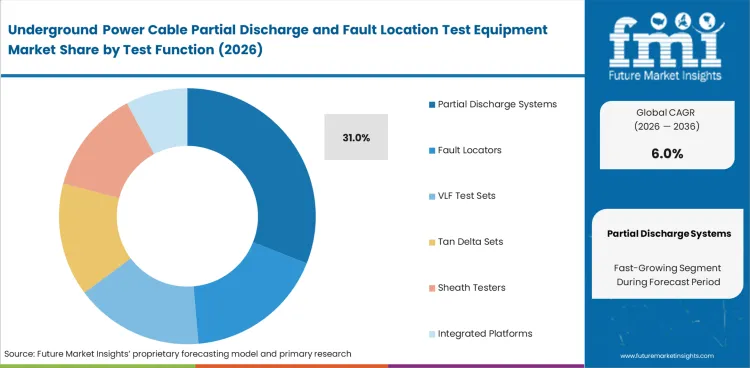
Partial discharge systems are expected to account for 31.0% share in 2026 because they give crews a defect-led view of cable condition instead of a basic pass-or-fail outcome. That matters in underground networks where owners want to understand whether insulation weakness is active before a route is opened, or a section is replaced too early. Fault locators, VLF sets, and sheath testers remain necessary parts of the workflow, but partial discharge capability often shapes the first shortlist because it improves condition judgment before location work begins. Utilities and service firms usually prefer tools that narrow down the repair question before excavation plans are finalized. Integrated platforms also gain attention where users want one field routine rather than a series of disconnected readings.
- Defect visibility: Partial discharge systems help crews identify active insulation weakness before route work begins.
- Repair timing discipline: Fault locators still matter because diagnosis has limited value if crews cannot narrow the fault zone quickly.
- Decision confidence: Integrated platforms attract buyers that want condition and location results read together in one field routine.
Underground Power Cable Partial Discharge and Fault Location Test Equipment Market Analysis by Voltage Class
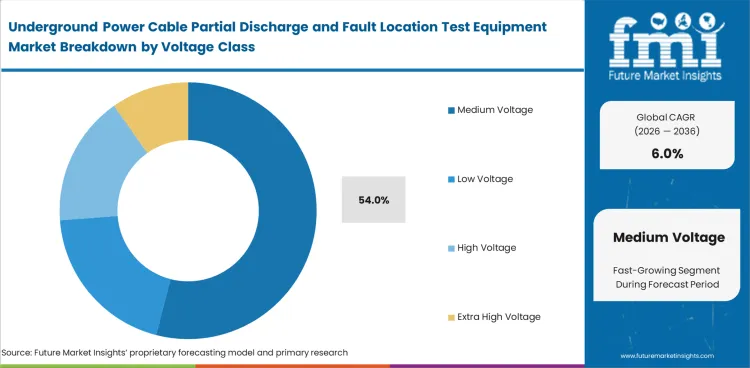
Distribution networks carry out the broadest day-to-day testing burden in underground systems, so buying activity stays concentrated where field jobs are frequent, and route density is high. Utilities usually need instruments that can support routine feeder work without turning every assignment into a specialist exercise or an oversized mobilization. Dense urban circuits strengthen that need because repeated diagnostics become part of normal network management rather than occasional exception work. Demand in this band also moves closely with medium voltage cable and accessory programs, where feeder reliability and accessory conditions shape the testing routine. High-voltage and extra-high-voltage assets still matter, but their installed base is narrower, and their testing cadence is more selective. Medium voltage is likely to represent 54.0% share in 2026 for those reasons. Poor equipment fit at the medium-voltage level can delay diagnosis without improving decision quality. Segment value rests on whether the platform can serve high-frequency utility work across widely distributed feeder assets without adding unnecessary field complexity.
- Insulation fit: Medium-voltage work leads because field jobs are frequent and widely distributed across feeder networks.
- Grid density pressure: Dense urban circuits increase the need for repeat diagnostics in medium-voltage cable systems.
- Asset-priority contrast: High-voltage classes justify deeper attention, though their narrower asset counts limit the revenue pool.
Underground Power Cable Partial Discharge and Fault Location Test Equipment Market Analysis by Deployment Mode
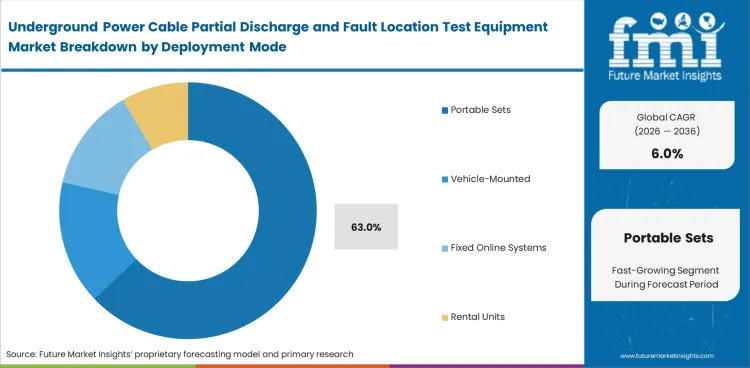
Field work favors equipment that reaches the job without forcing a complicated setup plan, especially when outages, route access, and contractor timing all compress the response window. Portable sets stay ahead because they match the practical realities of underground testing across scattered circuits, substations, joints, and urban sections where mobility matters as much as test capability. Vehicle-mounted systems still retain value where route length is high, and restoration work is heavier, but they do not fit the full spread of routine assignments. FMI treats this as a service-speed decision rather than a hardware contest. Demand also stays close to cable maintenance services, since equipment choice often follows the way testing work is scheduled, dispatched, and staffed in the field. Portable sets are forecast to make up 63.0% share in 2026 because they can move faster across both planned diagnostics and urgent outages. Poor deployment fit turns even capable instruments into slower job tools. Segment value depends on whether the equipment reaches the cable problem quickly enough to support usable diagnosis before downtime spreads.
- Field mobility: Portable sets match underground work across scattered routes and varied access conditions.
- Crew utilization balance: Vehicle-mounted systems remain useful where long routes or heavier fault work justify larger setups.
- Downtime avoidance: Faster site access shortens the time between first fault report and usable diagnostic evidence.
Underground Power Cable Partial Discharge and Fault Location Test Equipment Market Analysis by Test Method
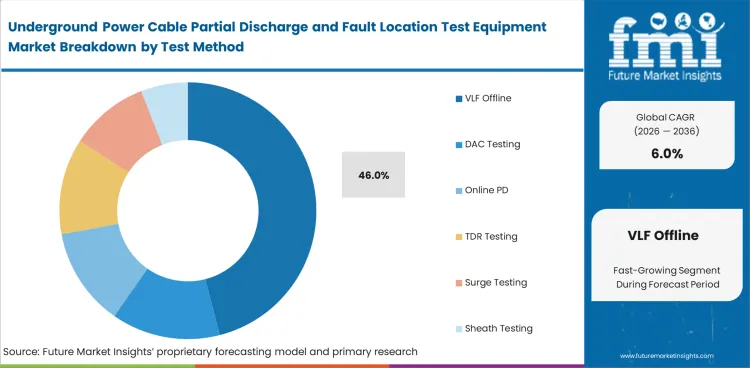
Field diagnosis still depends on methods that crews can apply with confidence on installed shielded cable systems under real operating constraints. Buyers continue to use VLF offline testing not only because it is familiar, but because it supports a practical field sequence for withstand testing, tan delta analysis, and partial discharge diagnostics. Online PD and DAC methods remain relevant in selected cases, especially where monitoring depth or philosophy differs, but they do not displace the main day-to-day workflow across most service groups. Category overlap with high voltage cable planning also matters because cable class influences how different methods are deployed and interpreted. VLF offline is anticipated to contribute 46.0% share in 2026 because it offers a familiar routine with enough diagnostic depth for broad field use. A method that is hard to apply consistently usually loses ground regardless of headline capability. Segment value depends on whether the method delivers usable condition insight without making routine field interpretation unnecessarily difficult.
- Field-sequence continuity: VLF offline remains attractive because crews can apply it within a familiar service process.
- Clearer signal interpretation: Buyers prefer methods that offer useful insight without making routine diagnosis too complex.
- Accessory-route sensitivity: Joints and accessory-heavy sections often determine how well test methods perform in practice.
Underground Power Cable Partial Discharge and Fault Location Test Equipment Market Analysis by Fault Location Method
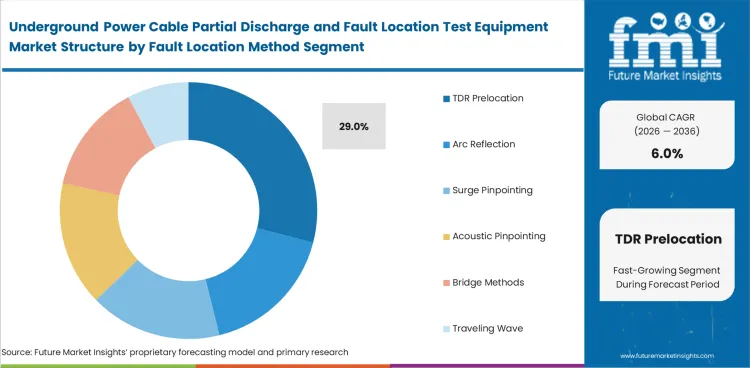
Distance estimate shapes nearly every underground repair job before crews move closer to the actual defect, so buyers still value a first-pass method that narrows the search field efficiently. Many field routines begin with prelocation because route access, crew planning, and next-step testing all become easier once a workable distance range is established. Arc reflection, surge pinpointing, and acoustic methods remain essential, yet they usually build an earlier estimate rather than replacing it. This reflects a workflow advantage rather than a preference for a single device type. Category ties with high voltage cable termination zones and joint-heavy routes strengthen the need for careful narrowing before excavation begins. Buyers want a first read that helps them decide where to dig, where to isolate, or whether more verification is needed. TDR prelocation is expected to secure 29.0% share in 2026 because it supports that first stage of practical decision-making better than methods that start deeper in the sequence. Weak prelocation increases labor time and route disturbance. Segment value depends on whether the method reduces uncertainty early enough to shorten the path from isolation to repair.
- Distance-estimate guidance: TDR prelocation gives crews an early view of where the problem likely sits on the route.
- Route-access planning: Arc reflection and surge-related methods still matter once crews move from estimate to confirmation.
- Outage-compression value: Fault location tools matter most when they shorten the interval between isolation and repair.
Underground Power Cable Partial Discharge and Fault Location Test Equipment Market Analysis by End User
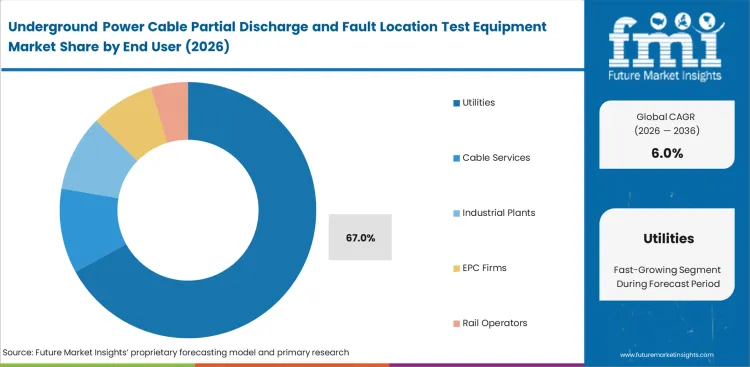
Ownership of the underground asset base determines who buys most of this equipment, since the organization carrying repeat outage exposure and long-cycle maintenance burden usually has the strongest reason to invest directly. Utilities remain at the center of demand because they manage the broadest spread of distribution cables and face recurring restoration accountability across large service territories. Independent service firms and industrial plants still matter, but their spending either follows utility work volume or stays tied to site-specific shutdown risk. Purchase decisions in this group are driven by network scale, restoration pressure, and the need to rank assets before replacement money is released. That logic also connects with broader power transmission lines and towers planning, where grid operators need clearer evidence before committing capital and field resources. Utilities are set to represent 67.0% share in 2026 because a large network owner cannot outsource or rent away every event. Smaller owners can treat parts of the workflow more flexibly, but utilities usually cannot. Segment value depends on whether the equipment serves the buyer with the largest recurring exposure to cable failure and restoration delay.
- Largest spending base: Utilities buy most because underground cable responsibility sits with them at operational scale.
- Service-demand linkage: Cable service firms remain important where utilities outsource specialized field diagnostics and restoration support.
- Replacement-pressure urgency: Industrial plants enter the category when shutdown risk makes cable failure too expensive to ignore.
Underground Power Cable Partial Discharge and Fault Location Test Equipment Market Analysis by Application Stage
Condition work now drives more buying than one-time commissioning alone because aging feeders create repeated questions around whether a section should be repaired, monitored, or replaced. Acceptance testing still matters in the installed-base story, but the larger equipment pool is shaped by repeat checks across mixed cable populations and older network sections. A diagnostic platform earns more value when it can be used across many existing circuits instead of only on newly installed assets. Linkage with electricity transmission infrastructure planning also matters because reinforcement cycles often reveal which legacy cable sections need deeper review before replacement capital is assigned. Maintenance diagnostics are likely to hold 44.0% share in 2026 because utilities need a clearer picture of cable health before broader intervention decisions are made. Skipping this stage often pushes owners toward wider replacement moves that do not match the true defect pattern. Better triage also helps ranking work when feeder conditions vary across the same network. Segment value depends on whether the equipment supports repeated condition-based decisions rather than a narrow commissioning-only role.
- Triage value: Maintenance diagnostics helps owners separate weak assets from routes that can stay in service.
- Condition-ranking discipline: Asset ranking grows more important when feeders age unevenly across one network.
- Life-planning relevance: Acceptance testing still supports new installations, but repeat use is stronger in maintenance work.
Underground Power Cable Partial Discharge and Fault Location Test Equipment Market Analysis by Cable Type
Insulation mix affects both how underground cables fail and how crews interpret the test results gathered in the field. XLPE remains dominant because newer underground systems rely heavily on it, and buyers want equipment that matches the insulation family seen most often across present installation and replacement activity. PILC and EPR circuits still matter, especially in older networks where replacement is incomplete, so practical buyers also look for tools that do not lose value on legacy sections. Common routines, accessory compatibility, and replacement planning become easier when the largest share of work sits around one insulation family. FMI also sees demand staying close to shifts in cable material, since material choice influences both failure behavior and diagnostic interpretation. XLPE cables are projected to account for 61.0% share in 2026 because they dominate newer underground deployment and related field work. A tool set that ignores material mix can weaken diagnosis across both modern and aging routes. Segment value therefore depends on whether the platform can handle the dominant insulation base without losing usefulness on the older circuit population that remains in service.
- Polymer-base dominance: XLPE leads because it sits at the center of newer underground cable deployment.
- Legacy-network relevance: PILC and EPR remain important where older systems have not been fully replaced.
- Circuit-balance practicality: Tools must perform across modern and aging circuits if owners want a workable fleet standard.
Underground Power Cable Partial Discharge and Fault Location Test Equipment Market Drivers, Restraints, and Opportunities
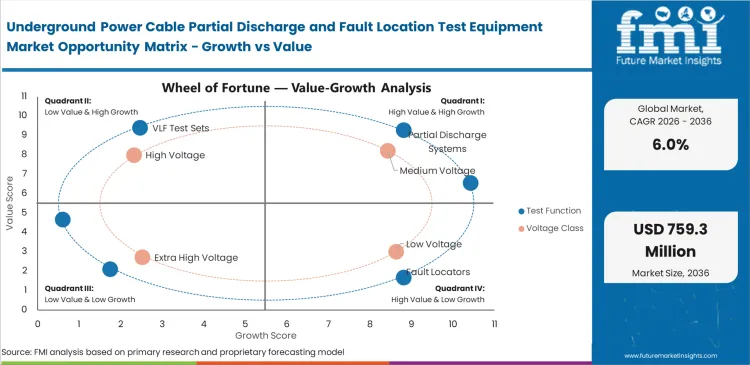
Underground cable owners now face a harder choice on when to intervene and what evidence should support that decision. Waiting for a fault is becoming a weaker operating option once route density rises and outage response becomes more visible. Demand for this equipment grows because owners want a clearer basis for maintenance planning, outage compression, and asset ranking across established underground networks. Category overlap with power and control cable investment adds to that demand, since every network expansion eventually increases the installed base that must be tested and maintained. Buyers are trying to identify which circuits need immediate attention and which can remain in service without creating avoidable failure risk.
Equipment selection still slows down when utilities cannot align field practice, interpretation skill, and maintenance routines around one common workflow. Partial discharge diagnosis, prelocation, and pinpointing may all be available, yet adoption weakens when results are read by separate groups or when crews are trained only part of the sequence. In many cases, adoption is limited more by execution gaps than by equipment cost. Tools that look capable on paper can lose ground if they add another layer of procedure instead of making route decisions easier. Similar discipline issues appear in nearby categories such as wire and cable management, where handling logic affects real-world use more than headline specifications do.
Opportunities in the Underground Power Cable Partial Discharge and Fault Location Test Equipment Market
- Lifecycle standardization: Opportunity is opening where utilities want one testing path from commissioning to maintenance and from diagnosis to location. Suppliers that support that routine can benefit from broader demand around HVDC cables and other cable-intensive grid programs.
- Accessory-focused diagnostics: Joints and terminations remain common failure points on underground routes, creating demand for equipment and services designed for targeted assessment. Buyers gain more value when test results help separate accessory weakness from full cable replacement needs through links with high voltage cable termination.
- Network reinforcement planning: Underground buildout tied to interconnection and grid strengthening raises future demand for acceptance and follow-on diagnostics. Demand can broaden further where HVDC transmission system investment expands cable-heavy infrastructure decisions.
Regional Analysis
Based on the regional analysis, the Underground Power Cable Partial Discharge and Fault Location Test Equipment market is segmented into North America, Europe, and Asia Pacific and Oceania across 40 plus countries.
Key Facts of Country
- Ongoing underground buildout and denser urban load centers keep China in the strongest growth position. The market in China is expected to expand at a 7.2% CAGR through 2036.
- Expanding distribution reinforcement and wider cable deployment continue to support India. Demand for underground power cable partial discharge and fault location test equipment in India is projected to rise at a 7.0% CAGR over the forecast period.
- Long-range underground planning and grid reliability requirements give Germany a steady growth path. Germany is likely to register 6.2% CAGR through 2036.
- Resilience concerns across long network stretches keep Australia commercially relevant in this market. Industry growth in Australia is expected at a 5.8% CAGR during 2026 to 2036.
- A large installed underground base and storm-related reliability pressures sustain the United States. Market growth for the United States is anticipated at 5.6% CAGR through 2036.
- Established underground networks and urban renewal needs continue to shape the United Kingdom. Sales in the U.K. are expected to increase at a 5.4% CAGR during the forecast period.
- Mature underground systems give Japan a more measured outlook than faster buildout markets. Japan is projected to grow at 5.1% CAGR through 2036.
.webp "Top Country Growth Comparison Underground Power Cable Partial Discharge And Fault Location Test Equipment Market Cagr (2026 2036)")
| Country | CAGR (2026 to 2036) |
|---|---|
| China | 7.2% |
| India | 7.0% |
| Germany | 6.2% |
| Australia | 5.8% |
| United States | 5.6% |
| United Kingdom | 5.4% |
| Japan | 5.1% |
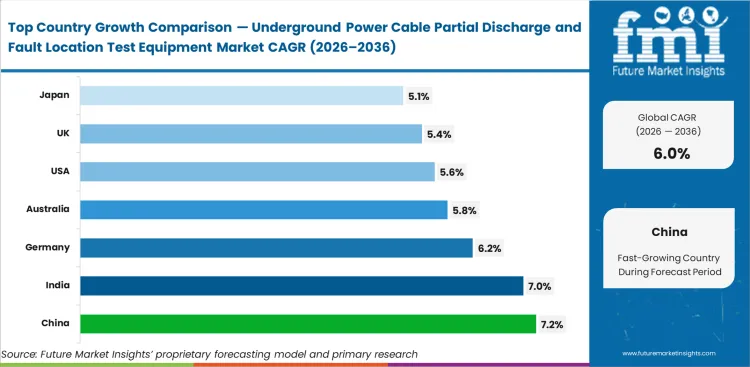
Source: Future Market Insights (FMI) analysis, based on proprietary forecasting model and primary research
North America Underground Power Cable Partial Discharge and Fault Location Test Equipment Market Analysis
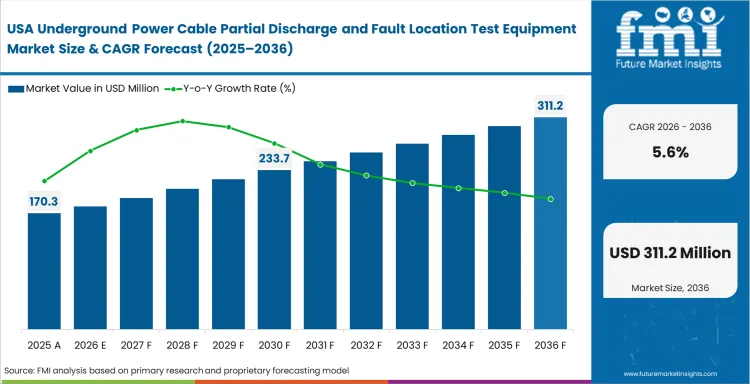
Storm exposure, wildfire-related resilience planning, and aging feeder networks keep underground cable condition work visible in North America. In North America, purchasing decisions are shaped by reliability pressure and by the need to justify maintenance budgets with diagnostic evidence rather than broad replacement plans. FMI also sees a steady link between underground diagnostics and adjacent investment in transmission substation assets, because wider grid reinforcement often brings older cable sections back into review. Field practicality matters here. Equipment that shortens job setup and supports a repeatable diagnostic path usually finds a stronger place in the regional spend mix.
- United States: Long feeder exposure and a large installed underground base keep the United States central to this category. Demand for underground cable partial discharge and fault location test equipment in the country is expected to rise at a CAGR of 5.6% through 2036 because utilities face a steady need to diagnose feeder condition before faults spread into longer service interruptions. Storm recovery and resilience planning strengthen that case, yet buying behavior still favors tools that can be used often across varied route types rather than highly specialized systems with a narrow use case.
Canada and other North America segment add to the regional opportunity where underground distribution reinforcement and service resilience remain active priorities. Spending tends to favor equipment that can move across mixed urban and suburban routes without adding a complex field routine.
Europe Underground Power Cable Partial Discharge and Fault Location Test Equipment Market Analysis
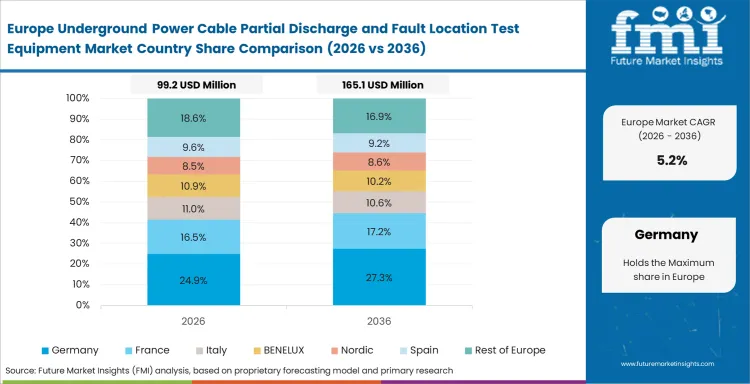
Europe’s role is shaped by underground planning, asset renewal, and tighter attention to route reliability in built-up power corridors. Demand here benefits from long-life network thinking, which makes condition diagnosis useful well before a section reaches obvious failure. FMI sees regional buying as more methodical than reactive, with equipment choices tied to maintenance discipline and route access constraints. Close connection with wire and cable management and accessory-heavy replacement work also matters because dense networks leave less room for trial-and-error fault search.
- Germany: Germany stays ahead in Europe because underground grid work is closely tied to long-range reinforcement and replacement planning. Demand for underground cable partial discharge and fault location test equipment is likely to expand at a CAGR of 6.2% from 2026 to 2036 as utilities continue to rely on diagnostic evidence when deciding how to manage cable sections in dense industrial and urban systems. Condition-led maintenance has a clearer place here than simple run-to-failure practice. Access limits on established routes also favor tools that help narrow the fault zone before route work starts.
- United Kingdom: Urban cable renewal and service continuity keep the United Kingdom active in this niche. Operators in the country often need tools that fit established underground networks where route access is limited, and fault search can become expensive if the first estimate is weak. Sales of underground cable partial discharge and fault location test equipment in the United Kingdom are expected to increase at a CAGR of 5.4% during the forecast period. Growth is more measured than in buildout-led markets, yet the need for practical diagnostics remains steady because replacement choices must be made carefully around aging circuits. Delayed testing can turn manageable insulation weakness into a wider restoration problem.
France, Italy, Spain, and other industries in Europe support a similar pattern, although local spending pace differs with network age and utility budgeting cycles. Regional demand leans toward tools that improve maintenance judgment rather than toward one-time buying tied only to new installation activity.
Asia Pacific and Oceania Underground Power Cable Partial Discharge and Fault Location Test Equipment Market Analysis
Asia Pacific and Oceania combine rapid underground expansion with large installed cable networks that already require ongoing condition assessment. China and India lift the regional growth profile, while Japan and Australia give the region a steadier layer of maintenance-led demand. FMI sees a broad connection here with commercial wire and cable deployment because urban load growth and infrastructure buildout widen the cable base that later requires testing.
- China: China leads the country set because underground power expansion and urban network reinforcement continue to enlarge the installed cable base. A CAGR of 7.2% is expected for underground cable partial discharge and fault location test equipment in the country by 2036, supported by the scale of distribution buildout and by the need to maintain service continuity on denser cable routes. Growth comes from both new cable acceptance work and from the future maintenance burden created by that same expansion.
- India: India remains close behind China because expanding urban distribution networks and wider electrification keep underground cable additions moving upward. Demand for underground cable partial discharge and fault location test equipment in India is anticipated to rise at a CAGR of 7.0% from 2026 to 2036. Growth is helped by the need to test new assets and by the pressure to improve reliability on feeders that serve dense city loads. Portable and field-ready equipment has particular appeal where route conditions vary widely from one job to the next. Owners that delay diagnostic discipline can end up relying on reactive repairs that consume more time and deliver weaker insight into the next likely failure point.
- Japan: Mature underground systems give Japan a different demand profile from the region’s faster buildout markets. Buyers in the country focus more on asset conditions, service continuity, and careful route intervention than on large first-time deployment. Underground cable partial discharge and fault location equipment sales in Japan are poised to grow at a CAGR of 5.1% during the assessment period because aging circuits still require accurate diagnosis even when overall expansion stays moderate. Precision matters here because route access is tight, and outage tolerance is low in dense network environments. Poor location accuracy can turn a contained repair into a longer operational burden.
- Australia: Long network stretches and resilience concerns give Australia a distinct place in the underground power cable partial discharge and fault location test equipment industry. Utilities often need equipment that supports both planned cable health checks and faster fault work across dispersed service areas. Underground cable partial discharge and fault location test equipment demand in Australia is expected to expand at a CAGR of 5.8% over the forecast period, with growth sitting above several mature markets because replacement needs and reliability pressure remain visible together. Buying logic favors practical field use over narrow specialization. That matters because slow diagnosis on long routes can increase crew time and delay service recovery for a wider customer base.
Competitive Aligners for Market Players
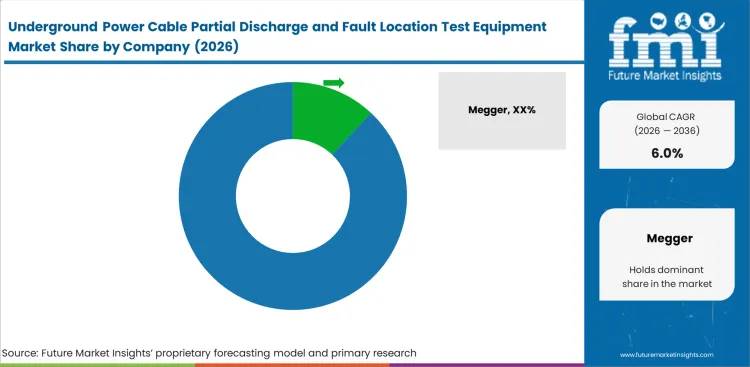
Competitive alignment in this segment is defined by how well suppliers support a structured transition from cable condition uncertainty to confident field execution. Decision makers look beyond visibility and focus on whether tools can support consistent testing diagnosis and location activities within normal operating routines. Megger and BAUR are commonly evaluated where organizations want a single platform to address multiple stages of cable assessment without disrupting established practices. FMI notes that this approach aligns closely with investment patterns in data center cabling where reliability requirements demand repeatable processes rather than standalone demonstrations. Equipment that integrates smoothly into everyday schedules gains traction because it reduces operational hesitation in the field.
Suppliers such as OMICRON and Doble Engineering remain relevant where analytical depth and condition interpretation play a central role in asset decisions. Their positioning reflects demand for confidence in results rather than speed alone. Incumbent strength in this market often comes from long-term use of familiarity and proven performance across mixed cable populations. Field teams value solutions that reinforce existing maintenance discipline instead of forcing procedural change. Challengers can still gain share when they simplify training demands and improve usability without compromising diagnostic credibility. FMI views this balance between sophistication and ease of use as central to sustained competitiveness.
Purchasing leverage remains meaningful because large network owners can compare workflows across internal crews and external service providers before standardizing fleets. Supplier lock-in remains limited because equipment still has to prove itself under real field conditions and across mixed infrastructure environments. This behavior mirrors selection logic seen in commercial wire and control cable segments, where operating compatibility often outweighs feature intensity. FMI expects market concentration to remain moderate through 2036 as asset owners continue to validate suppliers through applied job performance. Suppliers that reduce diagnosis time while avoiding added procedural burden are likely to hold stronger positioning over the forecast period.
Key Players in Underground Power Cable Partial Discharge and Fault Location Test Equipment Market
- Megger
- BAUR
- OMICRON
- Doble Engineering
- HVI
- HIGHVOLT
- EA Technology
Scope of the Report
| Metric | Value |
|---|---|
| Quantitative Units | USD 400.0 million to USD 720.0 million, at a CAGR of 6.0% |
| Market Definition | Covers equipment used to diagnose insulation condition and locate faults on installed underground power cables. Scope excludes cable manufacture, civil installation, and broad network hardware outside diagnostic and fault-location equipment. |
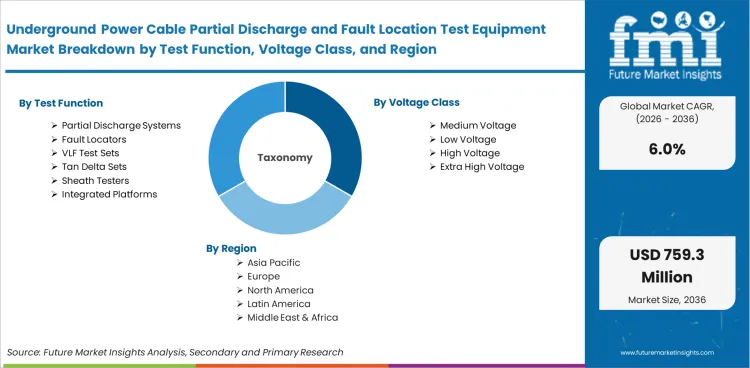
| Test Function Segmentation | Partial Discharge Systems, Fault Locators, VLF Test Sets, Tan Delta Sets, Sheath Testers, Integrated Platforms |
| Voltage Class Segmentation | Low Voltage, Medium Voltage, High Voltage, Extra High Voltage |
| Deployment Mode Segmentation | Portable Sets, Vehicle-Mounted, Fixed Online Systems, Rental Units |
| Test Method Segmentation | VLF Offline, DAC Testing, Online PD, TDR Testing, Surge Testing, Sheath Testing |
| Fault Location Method Segmentation | TDR Prelocation, Arc Reflection, Surge Pinpointing, Acoustic Pinpointing, Bridge Methods, Traveling Wave |
| Regions Covered | North America, Europe, Asia Pacific and Oceania |
| Countries Covered | China, India, Germany, Australia, United States, United Kingdom, Japan, and 40 plus countries |
| Key Companies Profiled | Megger, BAUR, OMICRON, Doble Engineering, HVI, HIGHVOLT, EA Technology |
Source: Future Market Insights (FMI) analysis, based on proprietary forecasting model and primary research
Underground Power Cable Partial Discharge and Fault Location Test Equipment Market Market Analysis by Segments
By Test Function:
- Partial Discharge Systems
- Fault Locators
- VLF Test Sets
- Tan Delta Sets
- Sheath Testers
- Integrated Platforms
By Voltage Class:
- Low Voltage
- Medium Voltage
- High Voltage
- Extra High Voltage
By Deployment Mode:
- Portable Sets
- Vehicle-Mounted
- Fixed Online Systems
- Rental Units
By Test Method:
- VLF Offline
- DAC Testing
- Online PD
- TDR Testing
- Surge Testing
- Sheath Testing
By Fault Location Method:
- TDR Prelocation
- Arc Reflection
- Surge Pinpointing
- Acoustic Pinpointing
- Bridge Methods
- Traveling Wave
By End User:
- Utilities
- Cable Services
- Industrial Plants
- EPC Firms
- Rail Operators
By Application Stage:
- Acceptance Testing
- Maintenance Diagnostics
- Fault Restoration
- Asset Ranking
- Life Extension
By Cable Type:
- XLPE Cables
- EPR Cables
- PILC Cables
- Hybrid Circuits
- HVDC Cables
By Region:
- North America
- United States
- Canada
- Europe
- Germany
- United Kingdom
- France
- Italy
- Spain
- Asia Pacific
- China
- Japan
- South Korea
- Taiwan
- Singapore
- Latin America
- Brazil
- Mexico
- Argentina
- Middle East & Africa
- GCC Countries
- South Africa
Bibliography
- U.S. Department of Energy. (2024). Undergrounding transmission and distribution lines.
- Pacific Northwest National Laboratory. (2024). First phase consensus roadmap for development of condition-based qualification for cable reliability assurance.
- Atsever, M. B., Aygun, M., Yildir, S., & Ermis, M. (2025). Onsite non-invasive partial discharge detection and location system for underground cables using customized envelope detection.
- Ali, H., Wang, S., Ghods, P., & Wu, J. (2025). Magnetic field sensing for 2D fault localization in underground cables.
- Shadi, M. R., Abdel-Galil, T. K., & El-Fouly, T. H. M. (2025). Partial Discharge-Based Cable Vulnerability Ranking with Fuzzy and FAHP Models: Application in a Danish Distribution Network.
This Report Addresses
- Market intelligence to support strategy across partial discharge systems, VLF test sets, fault locators, sheath testing, and integrated diagnostic platforms.
- Market size estimation and ten-year revenue forecasts from 2026 to 2036 supported by installed-base logic and underground cable diagnostic demand patterns.
- Growth opportunity mapping across test function, voltage class, deployment mode, fault location method, end user, application stage, cable type, and region.
- Segment and regional analysis covering utilities, cable services, industrial plants, medium-voltage networks, XLPE cable use, and maintenance-led demand.
- Competition assessment across workflow coverage, field usability, service support, interpretation confidence, and route-level operating fit.
- Evaluation of how acceptance testing, maintenance diagnostics, asset ranking, and fault restoration shape equipment demand.
- Scope boundaries that separate underground cable diagnostic and fault-location equipment from cable manufacture, civil work, and general network hardware.
- Frequently asked questions on market size, growth pattern, segment leadership, country outlook, methodology, exclusions, and buyer behavior.
Frequently Asked Questions
How large is the Underground Power Cable Partial Discharge and Fault Location Test Equipment Market in 2026?
Industry value is estimated at USD 400.0 million in 2026, reflecting a specialized utility test equipment category built around underground cable diagnostics, partial discharge testing, and fault location workflows.
What value is projected for the market by 2036?
The Underground Power Cable Partial Discharge and Fault Location Test Equipment Market is forecast to reach USD 720.0 million by 2036 as utilities keep expanding cable condition assessment and restoration programs.
What CAGR is projected for underground power cable partial discharge and fault location test equipment?
FMI estimates the market to grow at a 6.0% CAGR from 2026 to 2036, which points to steady replacement-led and diagnostics-led demand rather than a short buying spike.
FMI estimates the market to grow at a 6.0% CAGR from 2026 to 2036, which points to steady replacement-led and diagnostics-led demand rather than a short buying spike.
Partial discharge systems are expected to account for 31.0% of market share in 2026 because buyers want clearer insulation defect visibility before a cable failure turns into a service outage.
Which voltage class leads demand for cable diagnostics equipment?
Medium-voltage equipment is likely to represent 54.0% share in 2026 since distribution networks carry the largest installed base of underground power cables requiring routine testing and fault location.
Which deployment mode leads sales of underground cable test equipment?
Portable sets are anticipated to hold 63.0% share in 2026 because field crews need mobile cable testing systems that can move quickly between substations, feeders, and restoration sites.
Why is this market expanding at a healthy pace?
Growth comes from a larger installed underground cable base, a greater focus on preventive cable diagnostics, and the need to shorten fault isolation time when utilities face aging assets.
What is the main restraint for underground power cable partial discharge testing and fault location equipment?
Adoption slows when utilities take longer to approve new test routines, train field staff, and align different maintenance teams around one cable diagnostics workflow.
Which country shows the fastest growth in this market?
China leads with a projected 7.2% CAGR through 2036 because grid expansion and underground cable buildout continue to widen the installed base needing partial discharge testing and fault location tools.
Why does partial discharge testing matter so much in underground cable diagnostics?
Partial discharge testing helps identify insulation weakness earlier, which gives utilities a better chance to rank cable risk before a feeder outage forces emergency repair.
Why is VLF cable testing so closely linked with this market?
VLF cable testing remains central because many underground cable diagnostics programs use it as the practical field platform for withstand testing, tan delta assessment, and partial discharge evaluation.
What makes fault location test equipment different from general cable testing tools?
Fault location equipment is used to narrow the defect position in an underground cable route, while broader cable testing tools are more focused on insulation condition, acceptance testing, or maintenance diagnostics.
Why do utilities remain the largest end users?
Utilities are expected to capture 67.0% share in 2026 because they control the biggest underground power cable fleets and face the highest pressure to restore service fast after faults.
Which application stage leads demand for underground cable diagnostics systems?
Maintenance diagnostics are set to account for 44.0% of market share in 2026 since utilities increasingly test cables before failure instead of waiting for a fault to reveal the weak point.
Which cable type creates the largest demand for these testing systems?
XLPE cables are projected to contribute 61.0% share in 2026 because they dominate newer underground cable installations and therefore shape most current diagnostic buying patterns.
Which fault location method leads the market?
TDR prelocation is expected to represent 29.0% share in 2026 because it gives crews a useful first estimate of fault distance before they move to pinpointing methods on site.
How does online PD differ from offline PD in underground cable testing?
Online PD is used while the cable remains energized, while offline PD testing fits planned diagnostics where utilities want more controlled measurement conditions during maintenance work.
Why does medium-voltage cable testing stay ahead of high-voltage demand?
Medium-voltage networks carry more widespread feeder exposure, more routine restoration activity, and more frequent field intervention than high-voltage circuits, which keeps demand broader and steadier.
How is India positioned in the underground cable test equipment market?
India is projected to grow at 7.0% CAGR through 2036 as urban cable buildout, feeder strengthening, and asset reliability needs create more demand for portable diagnostics and fault location systems.
What supports growth in Germany for underground cable partial discharge and fault location test equipment?
Germany is likely to expand at 6.2% CAGR through 2036 because undergrounding priorities and grid reliability requirements continue to support condition-based cable testing.
How do the United States and the United Kingdom compare in this market?
The United States at 5.6% CAGR and the United Kingdom at 5.4% CAGR show similar replacement-led demand, though buying remains tied more to asset renewal cycles than to first-time cable deployment.
What role do Japan and Australia play in future demand?
Japan is expected to grow at 5.1% CAGR and Australia at 5.8% CAGR, showing that both markets remain relevant for underground cable diagnostics even when growth comes more from maintenance discipline than rapid network expansion.
Who are the key companies in underground power cable partial discharge and fault location test equipment?
Megger, BAUR, OMICRON, Doble Engineering, HVI, HIGHVOLT, and EA Technology remain the key names because buyers usually prefer suppliers with proven cable testing depth and reliable field support.
What do buyers usually look for when selecting cable fault location and partial discharge test equipment?
Buying decisions usually center on measurement reliability, ease of field use, speed of fault isolation, software clarity, and confidence that one platform can support real underground cable maintenance work.
Preview the report firsthand - request a free sample
Get SampleGet the brochure for pricing and purchase details.
Get PDFTable of Content
- Executive Summary
- Global Market Outlook
- Demand-side Trends
- Supply-side Trends
- Technology Roadmap Analysis
- Analysis and Recommendations
- Market Overview
- Market Coverage / Taxonomy
- Market Definition / Scope / Limitations
- Research Methodology
- Chapter Orientation
- Analytical Lens and Working Hypotheses
- Market Structure, Signals, and Trend Drivers
- Benchmarking and Cross-market Comparability
- Market Sizing, Forecasting, and Opportunity Mapping
- Research Design and Evidence Framework
- Desk Research Programme (Secondary Evidence)
- Company Annual and Sustainability Reports
- Peer-reviewed Journals and Academic Literature
- Corporate Websites, Product Literature, and Technical Notes
- Earnings Decks and Investor Briefings
- Statutory Filings and Regulatory Disclosures
- Technical White Papers and Standards Notes
- Trade Journals, Industry Magazines, and Analyst Briefs
- Conference Proceedings, Webinars, and Seminar Materials
- Government Statistics Portals and Public Data Releases
- Press Releases and Reputable Media Coverage
- Specialist Newsletters and Curated Briefings
- Sector Databases and Reference Repositories
- FMI Internal Proprietary Databases and Historical Market Datasets
- Subscription Datasets and Paid Sources
- Social Channels, Communities, and Digital Listening Inputs
- Additional Desk Sources
- Expert Input and Fieldwork (Primary Evidence)
- Primary Modes
- Qualitative Interviews and Expert Elicitation
- Quantitative Surveys and Structured Data Capture
- Blended Approach
- Why Primary Evidence is Used
- Field Techniques
- Interviews
- Surveys
- Focus Groups
- Observational and In-context Research
- Social and Community Interactions
- Stakeholder Universe Engaged
- C-suite Leaders
- Board Members
- Presidents and Vice Presidents
- R&D and Innovation Heads
- Technical Specialists
- Domain Subject-matter Experts
- Scientists
- Physicians and Other Healthcare Professionals
- Governance, Ethics, and Data Stewardship
- Research Ethics
- Data Integrity and Handling
- Primary Modes
- Tooling, Models, and Reference Databases
- Desk Research Programme (Secondary Evidence)
- Data Engineering and Model Build
- Data Acquisition and Ingestion
- Cleaning, Normalisation, and Verification
- Synthesis, Triangulation, and Analysis
- Quality Assurance and Audit Trail
- Market Background
- Market Dynamics
- Drivers
- Restraints
- Opportunity
- Trends
- Scenario Forecast
- Demand in Optimistic Scenario
- Demand in Likely Scenario
- Demand in Conservative Scenario
- Opportunity Map Analysis
- Product Life Cycle Analysis
- Supply Chain Analysis
- Investment Feasibility Matrix
- Value Chain Analysis
- PESTLE and Porter’s Analysis
- Regulatory Landscape
- Regional Parent Market Outlook
- Production and Consumption Statistics
- Import and Export Statistics
- Market Dynamics
- Global Market Analysis 2021 to 2025 and Forecast, 2026 to 2036
- Historical Market Size Value (USD Million) Analysis, 2021 to 2025
- Current and Future Market Size Value (USD Million) Projections, 2026 to 2036
- Y-o-Y Growth Trend Analysis
- Absolute $ Opportunity Analysis
- Global Market Pricing Analysis 2021 to 2025 and Forecast 2026 to 2036
- Global Market Analysis 2021 to 2025 and Forecast 2026 to 2036, By Test Function
- Introduction / Key Findings
- Historical Market Size Value (USD Million) Analysis By Test Function , 2021 to 2025
- Current and Future Market Size Value (USD Million) Analysis and Forecast By Test Function , 2026 to 2036
- Partial Discharge Systems
- Fault Locators
- VLF Test Sets
- Tan Delta Sets
- Sheath Testers
- Integrated Platforms
- Partial Discharge Systems
- Y-o-Y Growth Trend Analysis By Test Function , 2021 to 2025
- Absolute $ Opportunity Analysis By Test Function , 2026 to 2036
- Global Market Analysis 2021 to 2025 and Forecast 2026 to 2036, By Voltage Class
- Introduction / Key Findings
- Historical Market Size Value (USD Million) Analysis By Voltage Class, 2021 to 2025
- Current and Future Market Size Value (USD Million) Analysis and Forecast By Voltage Class, 2026 to 2036
- Medium Voltage
- Low Voltage
- High Voltage
- Extra High Voltage
- Medium Voltage
- Y-o-Y Growth Trend Analysis By Voltage Class, 2021 to 2025
- Absolute $ Opportunity Analysis By Voltage Class, 2026 to 2036
- Global Market Analysis 2021 to 2025 and Forecast 2026 to 2036, By Deployment Mode
- Introduction / Key Findings
- Historical Market Size Value (USD Million) Analysis By Deployment Mode, 2021 to 2025
- Current and Future Market Size Value (USD Million) Analysis and Forecast By Deployment Mode, 2026 to 2036
- Portable Sets
- Vehicle-Mounted
- Fixed Online Systems
- Rental Value (USD Million)s
- Portable Sets
- Y-o-Y Growth Trend Analysis By Deployment Mode, 2021 to 2025
- Absolute $ Opportunity Analysis By Deployment Mode, 2026 to 2036
- Global Market Analysis 2021 to 2025 and Forecast 2026 to 2036, By Test Method
- Introduction / Key Findings
- Historical Market Size Value (USD Million) Analysis By Test Method, 2021 to 2025
- Current and Future Market Size Value (USD Million) Analysis and Forecast By Test Method, 2026 to 2036
- VLF Offline
- DAC Testing
- Online PD
- TDR Testing
- Surge Testing
- Sheath Testing
- VLF Offline
- Y-o-Y Growth Trend Analysis By Test Method, 2021 to 2025
- Absolute $ Opportunity Analysis By Test Method, 2026 to 2036
- Global Market Analysis 2021 to 2025 and Forecast 2026 to 2036, By Fault Location Method
- Introduction / Key Findings
- Historical Market Size Value (USD Million) Analysis By Fault Location Method, 2021 to 2025
- Current and Future Market Size Value (USD Million) Analysis and Forecast By Fault Location Method, 2026 to 2036
- TDR Prelocation
- Arc Reflection
- Surge Pinpointing
- Acoustic Pinpointing
- Bridge Methods
- Traveling Wave
- TDR Prelocation
- Y-o-Y Growth Trend Analysis By Fault Location Method, 2021 to 2025
- Absolute $ Opportunity Analysis By Fault Location Method, 2026 to 2036
- Global Market Analysis 2021 to 2025 and Forecast 2026 to 2036, By End User
- Introduction / Key Findings
- Historical Market Size Value (USD Million) Analysis By End User, 2021 to 2025
- Current and Future Market Size Value (USD Million) Analysis and Forecast By End User, 2026 to 2036
- Utilities
- Cable Services
- Industrial Plants
- EPC Firms
- Rail Operators
- Utilities
- Y-o-Y Growth Trend Analysis By End User, 2021 to 2025
- Absolute $ Opportunity Analysis By End User, 2026 to 2036
- Global Market Analysis 2021 to 2025 and Forecast 2026 to 2036, By Application Stage
- Introduction / Key Findings
- Historical Market Size Value (USD Million) Analysis By Application Stage, 2021 to 2025
- Current and Future Market Size Value (USD Million) Analysis and Forecast By Application Stage, 2026 to 2036
- Maintenance Diagnostics
- Acceptance Testing
- Fault Restoration
- Asset Ranking
- Life Extension
- Maintenance Diagnostics
- Y-o-Y Growth Trend Analysis By Application Stage, 2021 to 2025
- Absolute $ Opportunity Analysis By Application Stage, 2026 to 2036
- Global Market Analysis 2021 to 2025 and Forecast 2026 to 2036, By Region
- Introduction
- Historical Market Size Value (USD Million) Analysis By Region, 2021 to 2025
- Current Market Size Value (USD Million) Analysis and Forecast By Region, 2026 to 2036
- North America
- Latin America
- Western Europe
- Eastern Europe
- East Asia
- South Asia and Pacific
- Middle East & Africa
- Market Attractiveness Analysis By Region
- North America Market Analysis 2021 to 2025 and Forecast 2026 to 2036, By Country
- Historical Market Size Value (USD Million) Trend Analysis By Market Taxonomy, 2021 to 2025
- Market Size Value (USD Million) Forecast By Market Taxonomy, 2026 to 2036
- By Country
- USA
- Canada
- Mexico
- By Test Function
- By Voltage Class
- By Deployment Mode
- By Test Method
- By Fault Location Method
- By End User
- By Application Stage
- By Country
- Market Attractiveness Analysis
- By Country
- By Test Function
- By Voltage Class
- By Deployment Mode
- By Test Method
- By Fault Location Method
- By End User
- By Application Stage
- Key Takeaways
- Latin America Market Analysis 2021 to 2025 and Forecast 2026 to 2036, By Country
- Historical Market Size Value (USD Million) Trend Analysis By Market Taxonomy, 2021 to 2025
- Market Size Value (USD Million) Forecast By Market Taxonomy, 2026 to 2036
- By Country
- Brazil
- Chile
- Rest of Latin America
- By Test Function
- By Voltage Class
- By Deployment Mode
- By Test Method
- By Fault Location Method
- By End User
- By Application Stage
- By Country
- Market Attractiveness Analysis
- By Country
- By Test Function
- By Voltage Class
- By Deployment Mode
- By Test Method
- By Fault Location Method
- By End User
- By Application Stage
- Key Takeaways
- Western Europe Market Analysis 2021 to 2025 and Forecast 2026 to 2036, By Country
- Historical Market Size Value (USD Million) Trend Analysis By Market Taxonomy, 2021 to 2025
- Market Size Value (USD Million) Forecast By Market Taxonomy, 2026 to 2036
- By Country
- Germany
- UK
- Italy
- Spain
- France
- Nordic
- BENELUX
- Rest of Western Europe
- By Test Function
- By Voltage Class
- By Deployment Mode
- By Test Method
- By Fault Location Method
- By End User
- By Application Stage
- By Country
- Market Attractiveness Analysis
- By Country
- By Test Function
- By Voltage Class
- By Deployment Mode
- By Test Method
- By Fault Location Method
- By End User
- By Application Stage
- Key Takeaways
- Eastern Europe Market Analysis 2021 to 2025 and Forecast 2026 to 2036, By Country
- Historical Market Size Value (USD Million) Trend Analysis By Market Taxonomy, 2021 to 2025
- Market Size Value (USD Million) Forecast By Market Taxonomy, 2026 to 2036
- By Country
- Russia
- Poland
- Hungary
- Balkan & Baltic
- Rest of Eastern Europe
- By Test Function
- By Voltage Class
- By Deployment Mode
- By Test Method
- By Fault Location Method
- By End User
- By Application Stage
- By Country
- Market Attractiveness Analysis
- By Country
- By Test Function
- By Voltage Class
- By Deployment Mode
- By Test Method
- By Fault Location Method
- By End User
- By Application Stage
- Key Takeaways
- East Asia Market Analysis 2021 to 2025 and Forecast 2026 to 2036, By Country
- Historical Market Size Value (USD Million) Trend Analysis By Market Taxonomy, 2021 to 2025
- Market Size Value (USD Million) Forecast By Market Taxonomy, 2026 to 2036
- By Country
- China
- Japan
- South Korea
- By Test Function
- By Voltage Class
- By Deployment Mode
- By Test Method
- By Fault Location Method
- By End User
- By Application Stage
- By Country
- Market Attractiveness Analysis
- By Country
- By Test Function
- By Voltage Class
- By Deployment Mode
- By Test Method
- By Fault Location Method
- By End User
- By Application Stage
- Key Takeaways
- South Asia and Pacific Market Analysis 2021 to 2025 and Forecast 2026 to 2036, By Country
- Historical Market Size Value (USD Million) Trend Analysis By Market Taxonomy, 2021 to 2025
- Market Size Value (USD Million) Forecast By Market Taxonomy, 2026 to 2036
- By Country
- India
- ASEAN
- Australia & New Zealand
- Rest of South Asia and Pacific
- By Test Function
- By Voltage Class
- By Deployment Mode
- By Test Method
- By Fault Location Method
- By End User
- By Application Stage
- By Country
- Market Attractiveness Analysis
- By Country
- By Test Function
- By Voltage Class
- By Deployment Mode
- By Test Method
- By Fault Location Method
- By End User
- By Application Stage
- Key Takeaways
- Middle East & Africa Market Analysis 2021 to 2025 and Forecast 2026 to 2036, By Country
- Historical Market Size Value (USD Million) Trend Analysis By Market Taxonomy, 2021 to 2025
- Market Size Value (USD Million) Forecast By Market Taxonomy, 2026 to 2036
- By Country
- Kingdom of Saudi Arabia
- Other GCC Countries
- Turkiye
- South Africa
- Other African Union
- Rest of Middle East & Africa
- By Test Function
- By Voltage Class
- By Deployment Mode
- By Test Method
- By Fault Location Method
- By End User
- By Application Stage
- By Country
- Market Attractiveness Analysis
- By Country
- By Test Function
- By Voltage Class
- By Deployment Mode
- By Test Method
- By Fault Location Method
- By End User
- By Application Stage
- Key Takeaways
- Key Countries Market Analysis
- USA
- Pricing Analysis
- Market Share Analysis, 2025
- By Test Function
- By Voltage Class
- By Deployment Mode
- By Test Method
- By Fault Location Method
- By End User
- By Application Stage
- Canada
- Pricing Analysis
- Market Share Analysis, 2025
- By Test Function
- By Voltage Class
- By Deployment Mode
- By Test Method
- By Fault Location Method
- By End User
- By Application Stage
- Mexico
- Pricing Analysis
- Market Share Analysis, 2025
- By Test Function
- By Voltage Class
- By Deployment Mode
- By Test Method
- By Fault Location Method
- By End User
- By Application Stage
- Brazil
- Pricing Analysis
- Market Share Analysis, 2025
- By Test Function
- By Voltage Class
- By Deployment Mode
- By Test Method
- By Fault Location Method
- By End User
- By Application Stage
- Chile
- Pricing Analysis
- Market Share Analysis, 2025
- By Test Function
- By Voltage Class
- By Deployment Mode
- By Test Method
- By Fault Location Method
- By End User
- By Application Stage
- Germany
- Pricing Analysis
- Market Share Analysis, 2025
- By Test Function
- By Voltage Class
- By Deployment Mode
- By Test Method
- By Fault Location Method
- By End User
- By Application Stage
- UK
- Pricing Analysis
- Market Share Analysis, 2025
- By Test Function
- By Voltage Class
- By Deployment Mode
- By Test Method
- By Fault Location Method
- By End User
- By Application Stage
- Italy
- Pricing Analysis
- Market Share Analysis, 2025
- By Test Function
- By Voltage Class
- By Deployment Mode
- By Test Method
- By Fault Location Method
- By End User
- By Application Stage
- Spain
- Pricing Analysis
- Market Share Analysis, 2025
- By Test Function
- By Voltage Class
- By Deployment Mode
- By Test Method
- By Fault Location Method
- By End User
- By Application Stage
- France
- Pricing Analysis
- Market Share Analysis, 2025
- By Test Function
- By Voltage Class
- By Deployment Mode
- By Test Method
- By Fault Location Method
- By End User
- By Application Stage
- India
- Pricing Analysis
- Market Share Analysis, 2025
- By Test Function
- By Voltage Class
- By Deployment Mode
- By Test Method
- By Fault Location Method
- By End User
- By Application Stage
- ASEAN
- Pricing Analysis
- Market Share Analysis, 2025
- By Test Function
- By Voltage Class
- By Deployment Mode
- By Test Method
- By Fault Location Method
- By End User
- By Application Stage
- Australia & New Zealand
- Pricing Analysis
- Market Share Analysis, 2025
- By Test Function
- By Voltage Class
- By Deployment Mode
- By Test Method
- By Fault Location Method
- By End User
- By Application Stage
- China
- Pricing Analysis
- Market Share Analysis, 2025
- By Test Function
- By Voltage Class
- By Deployment Mode
- By Test Method
- By Fault Location Method
- By End User
- By Application Stage
- Japan
- Pricing Analysis
- Market Share Analysis, 2025
- By Test Function
- By Voltage Class
- By Deployment Mode
- By Test Method
- By Fault Location Method
- By End User
- By Application Stage
- South Korea
- Pricing Analysis
- Market Share Analysis, 2025
- By Test Function
- By Voltage Class
- By Deployment Mode
- By Test Method
- By Fault Location Method
- By End User
- By Application Stage
- Russia
- Pricing Analysis
- Market Share Analysis, 2025
- By Test Function
- By Voltage Class
- By Deployment Mode
- By Test Method
- By Fault Location Method
- By End User
- By Application Stage
- Poland
- Pricing Analysis
- Market Share Analysis, 2025
- By Test Function
- By Voltage Class
- By Deployment Mode
- By Test Method
- By Fault Location Method
- By End User
- By Application Stage
- Hungary
- Pricing Analysis
- Market Share Analysis, 2025
- By Test Function
- By Voltage Class
- By Deployment Mode
- By Test Method
- By Fault Location Method
- By End User
- By Application Stage
- Kingdom of Saudi Arabia
- Pricing Analysis
- Market Share Analysis, 2025
- By Test Function
- By Voltage Class
- By Deployment Mode
- By Test Method
- By Fault Location Method
- By End User
- By Application Stage
- Turkiye
- Pricing Analysis
- Market Share Analysis, 2025
- By Test Function
- By Voltage Class
- By Deployment Mode
- By Test Method
- By Fault Location Method
- By End User
- By Application Stage
- South Africa
- Pricing Analysis
- Market Share Analysis, 2025
- By Test Function
- By Voltage Class
- By Deployment Mode
- By Test Method
- By Fault Location Method
- By End User
- By Application Stage
- USA
- Market Structure Analysis
- Competition Dashboard
- Competition Benchmarking
- Market Share Analysis of Top Players
- By Regional
- By Test Function
- By Voltage Class
- By Deployment Mode
- By Test Method
- By Fault Location Method
- By End User
- By Application Stage
- Competition Analysis
- Competition Deep Dive
- Megger
- Overview
- Product Portfolio
- Profitability by Market Segments (Product/Age /Sales Channel/Region)
- Sales Footprint
- Strategy Overview
- Marketing Strategy
- Product Strategy
- Channel Strategy
- BAUR
- OMICRON
- Doble Engineering
- HVI
- HIGHVOLT
- EA Technology
- Megger
- Competition Deep Dive
- Assumptions & Acronyms Used


