

- Industry Size (2025)
- USD 29.9 Bn
- Forecast (2035)
- USD 87.9 Bn
- CAGR (2025 to 2035)
- 11.4%
High Voltage Cable Market Size and Share Forecast Outlook 2025 to 2035
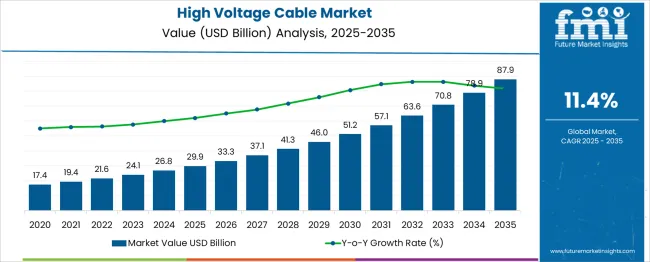
The High Voltage Cable Market is estimated to be valued at USD 29.9 billion in 2025 and is projected to reach USD 87.9 billion by 2035, registering a compound annual growth rate (CAGR) of 11.4% over the forecast period. A rolling CAGR analysis highlights significant phases of acceleration and steady expansion over the forecast period. Between 2025 and 2030, the market grows from USD 29.9 billion to USD 51.2 billion, contributing USD 21.3 billion in growth, with a CAGR of 13.3%. This phase experiences higher-than-average growth due to the increasing demand for high-voltage cables in power transmission and distribution, driven by growing urbanization, infrastructure development, and the global shift toward renewable energy sources.
The demand for high voltage cables is especially strong in emerging economies, where electrification projects are expanding rapidly. From 2030 to 2035, the market continues to grow, moving from USD 51.2 billion to USD 87.9 billion, contributing USD 36.7 billion in growth, with a slightly lower CAGR of 9.6%. This phase reflects the market's maturation, where growth stabilizes as the technology becomes more widespread and a larger portion of global infrastructure projects are completed. The overall rolling CAGR analysis indicates robust early-stage growth driven by new infrastructure investments, followed by a steady expansion phase as high voltage cable technology becomes an integral part of global energy networks.
Quick Stats for High Voltage Cable Market
- High Voltage Cable Market Value (2025): USD 29.9 billion
- High Voltage Cable Market Forecast Value (2035): USD 87.9 billion
- High Voltage Cable Market Forecast CAGR: 11.4%
- Leading Segment in High Voltage Cable Market in 2025: > 220 kV (54.7%)
- Key Growth Regions in High Voltage Cable Market: North America, Asia-Pacific, Europe
- Top Key Players in High Voltage Cable Market: Prysmian Group, Nexans, Southwire Company, LSCable&System, Sumitomo Electric Industries, Mitsubishi Electric, NKT, Furukawa Electric, Taihan Cables & Solution, Elsewedy Electric, Brugg Kabel, Alfanar Group, Riyadh Cables, Ducab, Jeddah Cables, TF Kable, Power Plus Cable, Iljin Electric, Gupta Power, ZMS Cable, ZTT Cable
High Voltage Cable Market Key Takeaways
| Metric | Value |
|---|---|
| High Voltage Cable Market Estimated Value in (2025 E) | USD 29.9 billion |
| High Voltage Cable Market Forecast Value in (2035 F) | USD 87.9 billion |
| Forecast CAGR (2025 to 2035) | 11.4% |
Why is the High Voltage Cable Market Growing?
The high voltage cable market is expanding significantly, supported by global initiatives focused on upgrading power transmission networks and integrating renewable energy sources. The emphasis on reducing transmission losses and enhancing grid reliability has accelerated investments in advanced cable technologies capable of handling higher voltages and currents. Aging infrastructure in developed regions and rapid electrification in emerging economies are fueling the demand for cables that support long-distance, high-capacity power transfer.
Innovations in insulation materials and manufacturing processes have improved cable durability and safety, enabling their use in increasingly challenging environments. Regulatory frameworks encouraging underground cabling for urban and environmentally sensitive areas have further shaped market dynamics.
The integration of smart grid technologies and digital monitoring solutions complements the evolution of high voltage cables, optimizing operational efficiency. Moving forward, the market is expected to benefit from rising infrastructure development and the transition towards cleaner energy systems worldwide.
Segmental Analysis
The high voltage cable market is segmented by voltage, current, installation, and geographic regions. By voltage, the high-voltage cable market is divided into > 220 kV and 110 kV - 220 kV. In terms of the current high voltage cable market, it is classified into HVAC and HVDC. Based on the installation of the high voltage cable, the market is segmented into Underground, Overhead, and Submarine. Regionally, the high voltage cable industry is classified into North America, Latin America, Western Europe, Eastern Europe, Balkan & Baltic Countries, Russia & Belarus, Central Asia, East Asia, South Asia & Pacific, and the Middle East & Africa.
Insights into the > 220 kV Voltage Segment
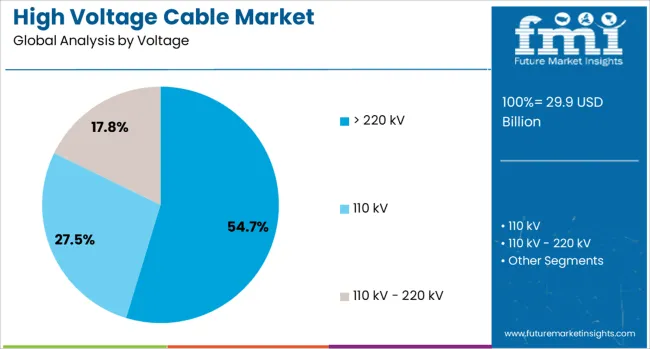
The voltage segment exceeding 220 kV is anticipated to capture 54.7% of the high voltage cable market revenue in 2025, reflecting its critical role in bulk power transmission across long distances. This segment's dominance is supported by the increasing need for high-capacity transmission lines to connect power generation sources such as renewables and thermal plants to load centers.
Cables operating above 220 kV provide the necessary insulation and mechanical strength to withstand higher electrical stresses and environmental factors. Their ability to minimize energy losses and maintain system stability has been a key factor driving their widespread adoption.
Technological advancements in conductor design and insulation materials have enhanced the performance and lifespan of cables in this category. Furthermore, the integration of these cables within expanding smart grid infrastructures supports efficient power management and fault detection, reinforcing their importance in modern power networks.
Insights into the HVAC Current Segment
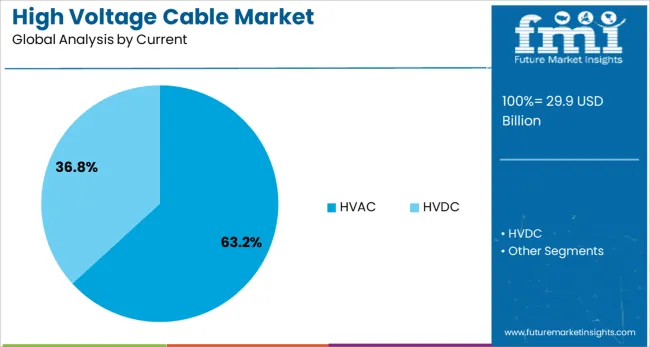
The HVAC current segment is projected to hold 63.2% revenue share in the high voltage cable market by 2025, primarily due to its widespread use in alternating current power transmission systems globally. HVAC cables offer advantages in terms of established infrastructure compatibility and cost-effectiveness for medium to high voltage applications.
Their operational reliability and maturity in design make them preferable for grid operators managing conventional and renewable energy integration. Advances in HVAC cable manufacturing, including improved conductor and insulation technologies, have enhanced their efficiency and thermal performance.
Additionally, the flexibility in installation and maintenance procedures associated with HVAC systems supports their continued preference in utility and industrial sectors. The ongoing evolution of HVAC technology to support higher voltages and increased load capacities is expected to sustain this segment’s growth in the foreseeable future.
Insights into the Underground Installation Segment
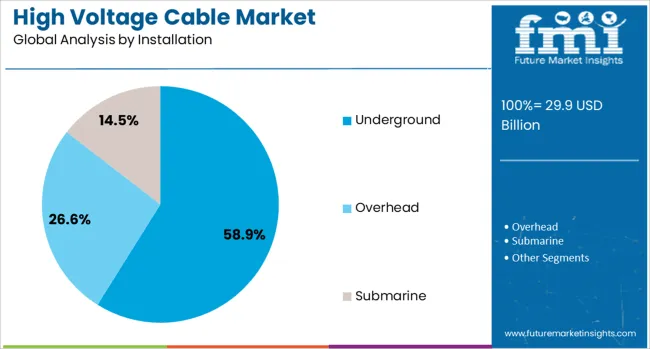
The underground installation segment is forecasted to hold 58.9% share of the high voltage cable market revenue in 2025, driven by growing urbanization and environmental considerations. Underground cables are increasingly favored for their ability to reduce transmission losses, protect against weather-related disruptions, and minimize visual and land use impacts compared to overhead lines.
Regulatory policies promoting urban development and ecosystem preservation have accelerated the deployment of underground cabling systems. Technological improvements in cable materials and installation techniques have made underground cables more reliable and easier to maintain, addressing previous cost and accessibility challenges.
The segment’s expansion is also supported by heightened safety standards and increasing demand for resilient power infrastructure in densely populated and industrial areas. As smart city initiatives progress, underground cable installations are anticipated to become the backbone of modern, secure power networks.
What are the Drivers, Restraints, and Key Trends of the High Voltage Cable Market?
The high voltage cable market is expanding due to the increasing demand for efficient, reliable power transmission over long distances. These cables are essential in the transmission of electricity from power plants to end-users, especially in industries and large infrastructure projects. With the growth of renewable energy integration, smart grid development, and urbanization, high voltage cables are playing a critical role in modern energy infrastructure. Despite challenges like high installation costs and technological complexities, opportunities are emerging with innovations in cable technology and growing global energy demands.
Rising Demand for Energy and Renewable Energy Integration
The growing demand for energy, particularly from renewable sources such as wind and solar, is driving the adoption of high voltage cables. These cables are critical for the transmission of electricity generated from renewable sources, especially when located far from urban centers. The shift toward renewable energy is increasing the need for long-distance transmission, further boosting the demand for high voltage cables. Urbanization and industrialization also play a role, as more cities and industries require reliable power distribution. The expansion of smart grid systems to enhance grid efficiency and reduce losses is another key factor contributing to the growing demand for high voltage cables.
High Installation Costs and Technical Complexity
The high voltage cable market faces several challenges, particularly the high installation costs involved in laying the cables. These cables are often installed underground or underwater, which increases both the complexity and expense of the process. Moreover, ensuring the reliability and safety of high voltage cables over time requires advanced monitoring systems and regular maintenance. These cables also need to withstand various environmental conditions, adding to the operational cost. Additionally, technological advancements in cable insulation and materials are necessary to maintain high performance, but these advancements often come with increased costs, making it challenging for utilities to implement upgrades cost-effectively.
Technological Innovations and Grid Expansion
There are significant opportunities in the high voltage cable market driven by technological advancements and the expansion of power grids. Innovations such as improved insulation materials and advanced monitoring systems are enhancing the efficiency, reliability, and durability of high voltage cables. The integration of smart grid technology offers another growth opportunity, as it requires the deployment of more advanced transmission infrastructure, including high voltage cables. The global push towards renewable energy sources creates a need for new and expanded transmission networks to connect distant renewable power plants to urban centers, driving the demand for high voltage cables.
Development of Underground and Cross-border Cable Solutions
A prominent trend in the high voltage cable market is the increasing deployment of underground cables, especially in urban areas where space is limited and aesthetic concerns are important. Underground cables also offer better protection from environmental damage, making them a preferred choice in sensitive or high-risk areas. Another trend is the growth of cross-border electricity transmission, which is driving the need for international high voltage cable networks to facilitate electricity trade and improve grid reliability across regions. These trends highlight the growing demand for advanced cable solutions to meet the evolving needs of the global energy infrastructure.
Analysis of High Voltage Cable Market By Key Countries
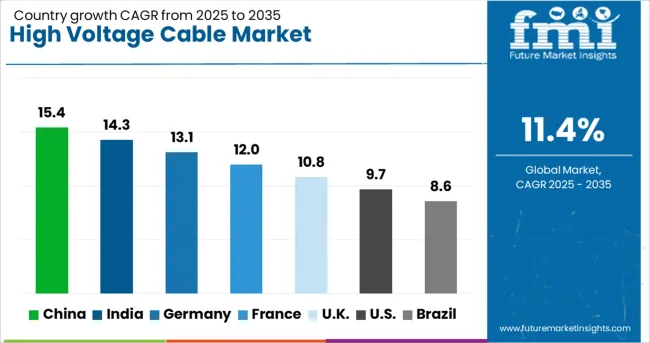
| Country | CAGR |
|---|---|
| China | 15.4% |
| India | 14.3% |
| Germany | 13.1% |
| France | 12.0% |
| UK | 10.8% |
| USA | 9.7% |
| Brazil | 8.6% |
The global high voltage cable market is projected to grow at a CAGR of 11.4% from 2025 to 2035. China leads the market with a strong 15.4% growth rate, driven by rapid urbanization, industrial expansion, and major infrastructure projects. India follows with a 14.3% CAGR, fueled by the growing power needs and ongoing renewable energy projects. Germany is experiencing steady growth at 13.1%, supported by its energy transition strategy and power grid upgrades. The UK shows moderate growth at 10.8%, driven by renewable energy integration and offshore wind farm expansion. The United States, with a 9.7% CAGR, has slower growth due to its mature infrastructure but continues to benefit from energy transition initiatives. The analysis includes over 40 countries, with the top five detailed below.
High Voltage Cable Market Expansion in China
China is expected to grow at a CAGR of 15.4% through 2035 in the high voltage cable market. The country’s rapid industrialization and infrastructural expansion have led to a significant increase in power generation and distribution needs. China is heavily investing in renewable energy projects, which require efficient power transmission systems, including high voltage cables. The government's commitment to improving energy infrastructure and promoting sustainable energy solutions is driving the demand for high voltage cables. China's efforts to modernize its power grid, particularly through smart grid technologies, are also contributing to the market’s growth.
- Government investments in renewable energy and smart grid technologies drive high voltage cable demand in China.
- Urbanization and industrial expansion lead to increased need for efficient power transmission systems.
- Energy infrastructure development and grid modernization continue to boost market growth in China.
Sales Analysis of High Voltage Cable Market in India
India is projected to grow at a CAGR of 14.3% through 2035 in the high voltage cable market. The country's rapid infrastructure development, coupled with the expansion of power generation and distribution networks, is significantly increasing the demand for high voltage cables. India’s growing focus on renewable energy sources, such as solar and wind power, requires advanced power transmission systems, driving demand for high voltage cables. Government initiatives such as the “Power for All” program and investments in grid modernization are further contributing to the market’s expansion. As India strives to achieve energy efficiency and sustainable infrastructure, the market for high voltage cables continues to grow.
- India’s focus on infrastructure development and energy efficiency drives high voltage cable market growth.
- Government programs and renewable energy investments fuel demand for efficient power transmission systems.
- Grid modernization and smart grid initiatives contribute to the rising need for high voltage cables in India.
Growth Outlook of High Voltage Cable Market in Germany
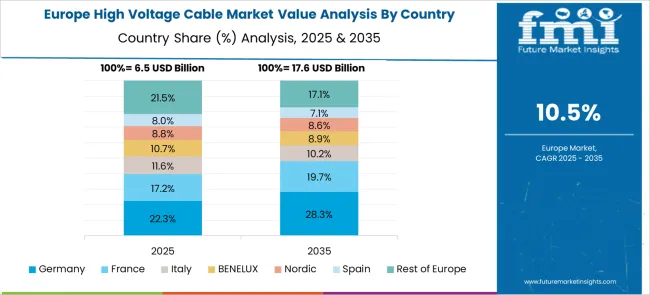
Germany is projected to grow at a CAGR of 13.1% through 2035 in the high voltage cable market. As Europe’s largest economy, Germany is investing heavily in renewable energy projects and grid modernization. The transition towards cleaner energy, supported by government incentives and regulations, is driving the adoption of high voltage cables in the country. Germany’s efforts to improve energy efficiency and meet its climate goals are increasing the demand for efficient power transmission systems. Furthermore, Germany’s leadership in the manufacturing of electrical equipment and technology for renewable energy systems is supporting the expansion of the high voltage cable market.
- Germany’s transition to renewable energy and grid modernization fuels high voltage cable demand.
- Government incentives and regulations drive the adoption of high voltage cables in renewable energy projects.
- Technological advancements in energy-efficient transmission systems support the market growth in Germany.
Demand for High Voltage Cable Market in the United States
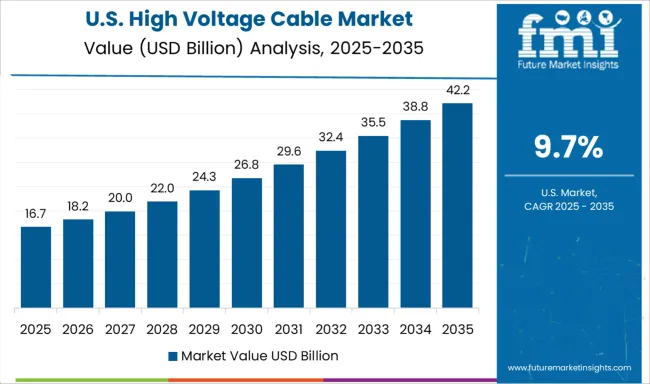
The United States is projected to grow at a CAGR of 9.7% through 2035 in the high voltage cable market. The USA is investing heavily in upgrading its aging infrastructure and transitioning to renewable energy sources. With the push for clean energy, the demand for high voltage cables is growing to support the transmission of electricity from renewable energy sources such as solar and wind power. Additionally, the USA government’s emphasis on modernizing the power grid and improving energy efficiency is further driving the need for advanced power transmission systems. The continued focus on electric vehicles and smart cities also supports the growing adoption of high voltage cables.
- Upgrading infrastructure and transitioning to renewable energy drive high voltage cable demand in the USA
- Smart grid technologies and electric vehicle adoption contribute to the market’s growth.
- The government’s focus on modernizing power infrastructure supports the adoption of high voltage cables in the USA
High Voltage Cable Market in the United Kingdom
The United Kingdom is expected to grow at a CAGR of 10.8% through 2035 in the high voltage cable market. The UK is heavily investing in offshore wind farms, solar power plants, and grid modernization to meet its climate goals. The country’s focus on achieving net-zero emissions by 2050 and improving energy efficiency is driving the demand for high voltage cables in the transmission and distribution of power. The UK’s commitment to renewable energy, coupled with increasing energy demands, is pushing the market for high voltage cables forward. With a growing need for power infrastructure and the rise in renewable energy projects, the UK market is set to see significant growth in the coming years.
- Government commitments to renewable energy and net-zero emissions goals support the demand for high voltage cables in the UK
- Offshore wind farms, solar power projects, and grid modernization initiatives drive market growth.
- The demand for energy-efficient power transmission systems is pushing the adoption of high voltage cables in the UK
Competitive Landscape of High Voltage Cable Market
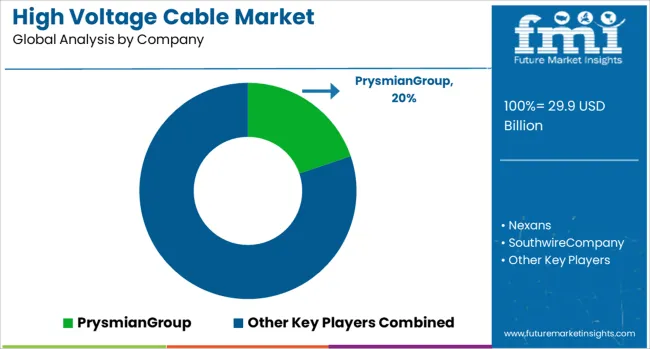
The high voltage cable market is shaped by a combination of multinational engineering leaders, regional specialists, and integrated energy solution providers catering to power transmission, renewable energy, and industrial infrastructure projects. Nexans stands out as a global leader with a broad portfolio of extruded and insulated high voltage cables, leveraging technological expertise and large-scale project execution capabilities. Prysmian Group dominates through advanced conductor design, HVDC solutions, and integrated system offerings, emphasizing reliability and long-term performance in demanding transmission networks. Southwire Company and General Cable, now part of Prysmian, maintain strong positions in North America, offering engineered solutions for utility and industrial clients with an emphasis on turnkey project support.
Regional players such as LS Cable & System, KEI Industries, and Sumitomo Electric Industries specialize in high-quality local manufacturing, enabling competitive pricing and rapid deployment for grid modernization and renewable energy projects. Hitachi Cable and Furukawa Electric focus on research-driven differentiation, providing advanced insulation technologies, high-capacity conductors, and fire-resistant cables for critical infrastructure applications. Expansion strategies include greenfield manufacturing plants, joint ventures with EPC contractors, and long-term supply agreements with utilities.
Competition is driven by technological innovation, project execution capabilities, and regulatory compliance with IEC, IEEE, and local grid standards. Companies differentiate through lifecycle performance, fault tolerance, and maintenance-friendly designs. Emerging market penetration, particularly in Asia-Pacific, the Middle East, and Africa, along with the growing adoption of offshore wind, HVDC lines, and smart grids, offers substantial growth opportunities for leading and emerging players in the high voltage cable ecosystem.
Scope of the Report
| Item | Value |
|---|---|
| Quantitative Units | USD 29.9 Billion |
| Voltage | > 220 kV, 110 kV, and 110 kV - 220 kV |
| Current | HVAC and HVDC |
| Installation | Underground, Overhead, and Submarine |
| Regions Covered | North America, Europe, Asia-Pacific, Latin America, Middle East & Africa |
| Country Covered | United States, Canada, Germany, France, United Kingdom, China, Japan, India, Brazil, South Africa |
| Key Companies Profiled | PrysmianGroup, Nexans, SouthwireCompany, LSCable&System, SumitomoElectricIndustries, MitsubishiElectric, NKT, FurukawaElectric, TaihanCables&Solution, ElsewedyElectric, BruggKabel, alfanarGroup, RiyadhCables, Ducab, JeddahCables, TFKable, PowerPlusCable, IljinElectric, GuptaPower, ZMSCable, and ZTTCable |
| Additional Attributes | Dollar sales by cable type (underground, overhead, submarine) and end-use segments (power transmission, renewable energy, industrial applications, infrastructure). Demand dynamics are driven by the increasing need for efficient power transmission systems, the growth of renewable energy projects, and the expanding infrastructure development in emerging markets. Regional trends show strong growth in North America and Europe, where energy efficiency and grid modernization are a priority, while Asia-Pacific is experiencing rapid expansion driven by industrialization and infrastructure development. |
High Voltage Cable Market by Segments
Voltage:
- > 220 kV
- 110 kV
- 110 kV - 220 kV
Current:
- HVAC
- HVDC
Installation:
- Underground
- Overhead
- Submarine
Region:
- North America
- USA
- Canada
- Mexico
- Latin America
- Brazil
- Chile
- Rest of Latin America
- Western Europe
- Germany
- UK
- Italy
- Spain
- France
- Nordic
- BENELUX
- Rest of Western Europe
- Eastern Europe
- Russia
- Poland
- Hungary
- Balkan & Baltic
- Rest of Eastern Europe
- East Asia
- China
- Japan
- South Korea
- South Asia and Pacific
- India
- ASEAN
- Australia & New Zealand
- Rest of South Asia and Pacific
- Middle East & Africa
- Kingdom of Saudi Arabia
- Other GCC Countries
- Turkiye
- South Africa
- Other African Union
- Rest of Middle East & Africa
Frequently Asked Questions
How big is the high voltage cable market in 2025?
The global high voltage cable market is estimated to be valued at USD 29.9 billion in 2025.
What will be the size of high voltage cable market in 2035?
The market size for the high voltage cable market is projected to reach USD 87.9 billion by 2035.
How much will be the high voltage cable market growth between 2025 and 2035?
The high voltage cable market is expected to grow at a 11.4% CAGR between 2025 and 2035.
What are the key product types in the high voltage cable market?
The key product types in high voltage cable market are > 220 kv, 110 kv and 110 kv - 220 kv.
Which current segment to contribute significant share in the high voltage cable market in 2025?
In terms of current, HVAC segment to command 63.2% share in the high voltage cable market in 2025.
Preview the report firsthand - request a free sample
Get SampleGet the brochure for pricing and purchase details.
Get PDFTable of Content
- Executive Summary
- Global Market Outlook
- Demand-side Trends
- Supply-side Trends
- Technology Roadmap Analysis
- Analysis and Recommendations
- Market Overview
- Market Coverage / Taxonomy
- Market Definition / Scope / Limitations
- Market Background
- Market Dynamics
- Drivers
- Restraints
- Opportunity
- Trends
- Scenario Forecast
- Demand in Optimistic Scenario
- Demand in Likely Scenario
- Demand in Conservative Scenario
- Opportunity Map Analysis
- Product Life Cycle Analysis
- Supply Chain Analysis
- Investment Feasibility Matrix
- Value Chain Analysis
- PESTLE and Porter’s Analysis
- Regulatory Landscape
- Regional Parent Market Outlook
- Production and Consumption Statistics
- Import and Export Statistics
- Market Dynamics
- Global High Voltage Cable Market Analysis 2020-2024 and Forecast, 2025-2035
- Historical Market Size Value (USD Mn) Analysis, 2020-2024
- Current and Future Market Size Value (USD Mn) Projections, 2025-2035
- Y-o-Y Growth Trend Analysis
- Absolute Dollar Opportunity Analysis
- Global High Voltage Cable Market Pricing Analysis 2020-2024 and Forecast 2025-2035
- Global High Voltage Cable Market Analysis 2020-2024 and Forecast 2025-2035, By Voltage
- Introduction / Key Findings
- Historical Market Size Value (USD Mn) Analysis By Voltage , 2020-2024
- Current and Future Market Size Value (USD Mn) Analysis and Forecast By Voltage , 2025-2035
- > 220 kV
- 110 kV
- 110 kV - 220 kV
- Y-o-Y Growth Trend Analysis By Voltage , 2020-2024
- Absolute Dollar Opportunity Analysis By Voltage , 2025-2035
- Global High Voltage Cable Market Analysis 2020-2024 and Forecast 2025-2035, By Current
- Introduction / Key Findings
- Historical Market Size Value (USD Mn) Analysis By Current, 2020-2024
- Current and Future Market Size Value (USD Mn) Analysis and Forecast By Current, 2025-2035
- HVAC
- HVDC
- Y-o-Y Growth Trend Analysis By Current, 2020-2024
- Absolute Dollar Opportunity Analysis By Current, 2025-2035
- Global High Voltage Cable Market Analysis 2020-2024 and Forecast 2025-2035, By Installation
- Introduction / Key Findings
- Historical Market Size Value (USD Mn) Analysis By Installation, 2020-2024
- Current and Future Market Size Value (USD Mn) Analysis and Forecast By Installation, 2025-2035
- Underground
- Overhead
- Submarine
- Y-o-Y Growth Trend Analysis By Installation, 2020-2024
- Absolute Dollar Opportunity Analysis By Installation, 2025-2035
- Global High Voltage Cable Market Analysis 2020-2024 and Forecast 2025-2035, By Region
- Introduction
- Historical Market Size Value (USD Mn) Analysis By Region, 2020-2024
- Current Market Size Value (USD Mn) Analysis and Forecast By Region, 2025-2035
- North America
- Latin America
- Western Europe
- Eastern Europe
- East Asia
- South Asia and Pacific
- Middle East & Africa
- Market Attractiveness Analysis By Region
- North America High Voltage Cable Market Analysis 2020-2024 and Forecast 2025-2035, By Country
- Historical Market Size Value (USD Mn) Trend Analysis By Market Taxonomy, 2020-2024
- Market Size Value (USD Mn) Forecast By Market Taxonomy, 2025-2035
- By Country
- USA
- Canada
- Mexico
- By Voltage
- By Current
- By Installation
- By Country
- Market Attractiveness Analysis
- By Country
- By Voltage
- By Current
- By Installation
- Key Takeaways
- Latin America High Voltage Cable Market Analysis 2020-2024 and Forecast 2025-2035, By Country
- Historical Market Size Value (USD Mn) Trend Analysis By Market Taxonomy, 2020-2024
- Market Size Value (USD Mn) Forecast By Market Taxonomy, 2025-2035
- By Country
- Brazil
- Chile
- Rest of Latin America
- By Voltage
- By Current
- By Installation
- By Country
- Market Attractiveness Analysis
- By Country
- By Voltage
- By Current
- By Installation
- Key Takeaways
- Western Europe High Voltage Cable Market Analysis 2020-2024 and Forecast 2025-2035, By Country
- Historical Market Size Value (USD Mn) Trend Analysis By Market Taxonomy, 2020-2024
- Market Size Value (USD Mn) Forecast By Market Taxonomy, 2025-2035
- By Country
- Germany
- UK
- Italy
- Spain
- France
- Nordic
- BENELUX
- Rest of Western Europe
- By Voltage
- By Current
- By Installation
- By Country
- Market Attractiveness Analysis
- By Country
- By Voltage
- By Current
- By Installation
- Key Takeaways
- Eastern Europe High Voltage Cable Market Analysis 2020-2024 and Forecast 2025-2035, By Country
- Historical Market Size Value (USD Mn) Trend Analysis By Market Taxonomy, 2020-2024
- Market Size Value (USD Mn) Forecast By Market Taxonomy, 2025-2035
- By Country
- Russia
- Poland
- Hungary
- Balkan & Baltic
- Rest of Eastern Europe
- By Voltage
- By Current
- By Installation
- By Country
- Market Attractiveness Analysis
- By Country
- By Voltage
- By Current
- By Installation
- Key Takeaways
- East Asia High Voltage Cable Market Analysis 2020-2024 and Forecast 2025-2035, By Country
- Historical Market Size Value (USD Mn) Trend Analysis By Market Taxonomy, 2020-2024
- Market Size Value (USD Mn) Forecast By Market Taxonomy, 2025-2035
- By Country
- China
- Japan
- South Korea
- By Voltage
- By Current
- By Installation
- By Country
- Market Attractiveness Analysis
- By Country
- By Voltage
- By Current
- By Installation
- Key Takeaways
- South Asia and Pacific High Voltage Cable Market Analysis 2020-2024 and Forecast 2025-2035, By Country
- Historical Market Size Value (USD Mn) Trend Analysis By Market Taxonomy, 2020-2024
- Market Size Value (USD Mn) Forecast By Market Taxonomy, 2025-2035
- By Country
- India
- ASEAN
- Australia & New Zealand
- Rest of South Asia and Pacific
- By Voltage
- By Current
- By Installation
- By Country
- Market Attractiveness Analysis
- By Country
- By Voltage
- By Current
- By Installation
- Key Takeaways
- Middle East & Africa High Voltage Cable Market Analysis 2020-2024 and Forecast 2025-2035, By Country
- Historical Market Size Value (USD Mn) Trend Analysis By Market Taxonomy, 2020-2024
- Market Size Value (USD Mn) Forecast By Market Taxonomy, 2025-2035
- By Country
- Kingdom of Saudi Arabia
- Other GCC Countries
- Turkiye
- South Africa
- Other African Union
- Rest of Middle East & Africa
- By Voltage
- By Current
- By Installation
- By Country
- Market Attractiveness Analysis
- By Country
- By Voltage
- By Current
- By Installation
- Key Takeaways
- Key Countries High Voltage Cable Market Analysis
- USA
- Pricing Analysis
- Market Share Analysis, 2024
- By Voltage
- By Current
- By Installation
- Canada
- Pricing Analysis
- Market Share Analysis, 2024
- By Voltage
- By Current
- By Installation
- Mexico
- Pricing Analysis
- Market Share Analysis, 2024
- By Voltage
- By Current
- By Installation
- Brazil
- Pricing Analysis
- Market Share Analysis, 2024
- By Voltage
- By Current
- By Installation
- Chile
- Pricing Analysis
- Market Share Analysis, 2024
- By Voltage
- By Current
- By Installation
- Germany
- Pricing Analysis
- Market Share Analysis, 2024
- By Voltage
- By Current
- By Installation
- UK
- Pricing Analysis
- Market Share Analysis, 2024
- By Voltage
- By Current
- By Installation
- Italy
- Pricing Analysis
- Market Share Analysis, 2024
- By Voltage
- By Current
- By Installation
- Spain
- Pricing Analysis
- Market Share Analysis, 2024
- By Voltage
- By Current
- By Installation
- France
- Pricing Analysis
- Market Share Analysis, 2024
- By Voltage
- By Current
- By Installation
- India
- Pricing Analysis
- Market Share Analysis, 2024
- By Voltage
- By Current
- By Installation
- ASEAN
- Pricing Analysis
- Market Share Analysis, 2024
- By Voltage
- By Current
- By Installation
- Australia & New Zealand
- Pricing Analysis
- Market Share Analysis, 2024
- By Voltage
- By Current
- By Installation
- China
- Pricing Analysis
- Market Share Analysis, 2024
- By Voltage
- By Current
- By Installation
- Japan
- Pricing Analysis
- Market Share Analysis, 2024
- By Voltage
- By Current
- By Installation
- South Korea
- Pricing Analysis
- Market Share Analysis, 2024
- By Voltage
- By Current
- By Installation
- Russia
- Pricing Analysis
- Market Share Analysis, 2024
- By Voltage
- By Current
- By Installation
- Poland
- Pricing Analysis
- Market Share Analysis, 2024
- By Voltage
- By Current
- By Installation
- Hungary
- Pricing Analysis
- Market Share Analysis, 2024
- By Voltage
- By Current
- By Installation
- Kingdom of Saudi Arabia
- Pricing Analysis
- Market Share Analysis, 2024
- By Voltage
- By Current
- By Installation
- Turkiye
- Pricing Analysis
- Market Share Analysis, 2024
- By Voltage
- By Current
- By Installation
- South Africa
- Pricing Analysis
- Market Share Analysis, 2024
- By Voltage
- By Current
- By Installation
- USA
- Market Structure Analysis
- Competition Dashboard
- Competition Benchmarking
- Market Share Analysis of Top Players
- By Regional
- By Voltage
- By Current
- By Installation
- Competition Analysis
- Competition Deep Dive
- PrysmianGroup
- Overview
- Product Portfolio
- Profitability by Market Segments (Product/Age /Sales Channel/Region)
- Sales Footprint
- Strategy Overview
- Marketing Strategy
- Product Strategy
- Channel Strategy
- Nexans
- SouthwireCompany
- LSCable&System
- SumitomoElectricIndustries
- MitsubishiElectric
- NKT
- FurukawaElectric
- TaihanCables&Solution
- ElsewedyElectric
- BruggKabel
- alfanarGroup
- RiyadhCables
- Ducab
- JeddahCables
- TFKable
- PowerPlusCable
- IljinElectric
- GuptaPower
- ZMSCable
- PrysmianGroup
- Competition Deep Dive
- Assumptions & Acronyms Used
- Research Methodology


