

- Industry Size (2026)
- USD 1386.3 Mn
- Forecast (2036)
- USD 3902.5 Mn
- CAGR (2026 to 2036)
- 10.9%
Integrated Photonics Test & Reliability Systems Market Forecast and Outlook 2026 to 2036
The integrated photonics test & reliability systems market is valued at USD 1,386.3 million in 2026 and is projected to reach USD 3,902.5 million by 2036, expanding at a CAGR of 10.9%. Demand growth is supported by rapid scaling of photonic integrated circuits, rising data center bandwidth requirements, and reliability validation needs across telecom, data communications, and advanced computing applications.
Optical transceiver test systems represent the leading system type in global demand due to their critical role in validating signal integrity, optical power stability, wavelength accuracy, and long-term reliability of integrated photonic devices. Adoption focuses on automated testing, high-throughput characterization, and accelerated life testing to meet volume manufacturing and qualification requirements.
China, Brazil, South Korea, USA, and United Kingdom rank among fastest-growing countries, driven by investments in silicon photonics fabrication, domestic semiconductor programs, and expansion of high-speed optical networks. Keysight Technologies, Advantest, Teradyne, VIAVI Solutions, EXFO, Yokogawa Test & Measurement, Anritsu, Luna Innovations, FormFactor, and MPI Corporation maintain strong positions through advanced optical test platforms, reliability-focused system design, and close alignment with evolving photonics standards.
Quick Stats for Integrated Photonics Test & Reliability Systems Market
- Integrated Photonics Test & Reliability Systems Market Value (2026): USD 1,386.3 million
- Integrated Photonics Test & Reliability Systems Market Forecast Value (2036): USD 3,902.5 million
- Integrated Photonics Test & Reliability Systems Market Forecast CAGR (2026–2036): 10.9%
- Leading System Type in Global Demand: Optical Transceiver Test Systems
- Fastest-Growing Countries: China, Brazil, South Korea, USA, United Kingdom
- Top Players in Global Demand: Keysight Technologies, Advantest, Teradyne, VIAVI Solutions, EXFO, Yokogawa Test & Measurement, Anritsu, Luna Innovations, FormFactor, MPI Corporation
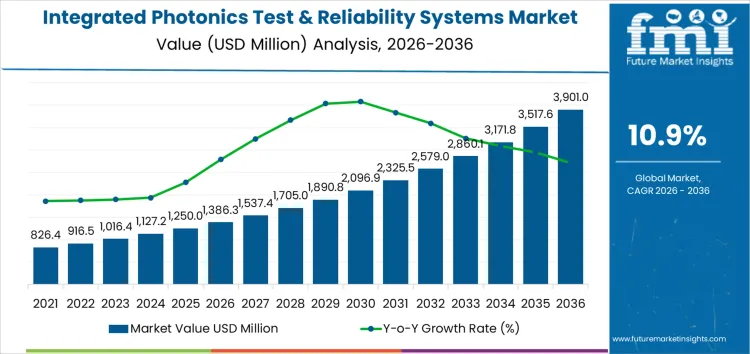
Integrated Photonics Test & Reliability Systems Market Key Takeaways
| Metric | Value |
|---|---|
| Market Value (2026) | USD 1,386.3 million |
| Market Forecast Value (2036) | USD 3,902.5 million |
| Forecast CAGR (2026-2036) | 10.9% |
Why is the Demand for Integrated Photonics Test & Reliability Systems Market Growing?
Demand for integrated photonics test and reliability systems is growing globally due to expanding adoption of photonic components in telecommunications, data communications, sensing, and emerging quantum technologies. Photonic integrated circuits, optical transceivers, and sensor modules require precise characterization of optical performance, signal integrity, and environmental stability during development and production. Telecommunications operators and data center firms deploy photonics based solutions to support high speed, low latency networks, increasing the need for automated test platforms that verify performance at scale.
Growth in LIDAR, optical sensing, and biomedical imaging applications strengthens demand for reliability systems that evaluate device endurance, thermal stability, and mechanical robustness. Research institutions and advanced manufacturing centers invest in integrated test solutions to accelerate design iteration and support qualification benchmarks for mass production. Standardization initiatives across regions emphasize consistent measurement criteria, which reinforces structured testing across supply chains. Test equipment suppliers develop scalable, high throughput systems that incorporate optical alignment, spectral analysis, and environmental stress testing to address diverse photonic architectures. Academic and industry partnerships expand usage of reliability platforms to support material research and next generation component validation.
How Are the Segments Classified in the Integrated Photonics Test and Reliability Systems Market?
Demand for integrated photonics test and reliability systems globally is shaped by rising photonic integration density, high-speed data transmission requirements, and reliability qualification mandates. Stakeholders evaluate optical accuracy, wafer-level access, lifecycle stress validation, and packaging compatibility. Adoption patterns reflect expanding deployment across data communication, telecom infrastructure, sensing applications, and photonics research, supported by emphasis on yield optimization, performance consistency, and long-term operational stability.
Which System Type Accounts for the Largest Share of Global Demand?
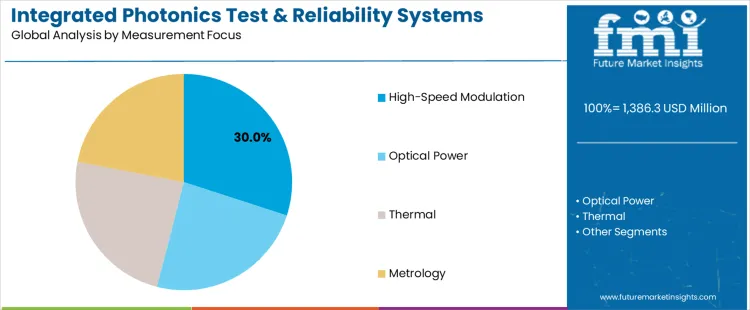
Optical transceiver test systems hold 30.0%, accounting for the largest share of global demand. These systems validate signal integrity, modulation accuracy, and thermal behavior of integrated photonic transceivers used in high-speed links. Wafer probe systems hold 28.0%, enabling early-stage testing to identify defects before packaging, supporting yield improvement. Reliability test systems account for 22.0%, addressing thermal cycling, humidity exposure, and accelerated lifetime validation. Packaging-related test systems hold 20.0%, supporting optical alignment and final assembly verification. System-type distribution reflects priority for performance validation at transceiver and wafer stages.
Key Points
- Optical transceiver testing leads due to high-speed link validation needs.
- Wafer probing supports early defect detection and yield control.
- Reliability systems ensure long-term operational stability.
Which Application Segment Drives the Highest Demand for Integrated Photonics Testing Globally?
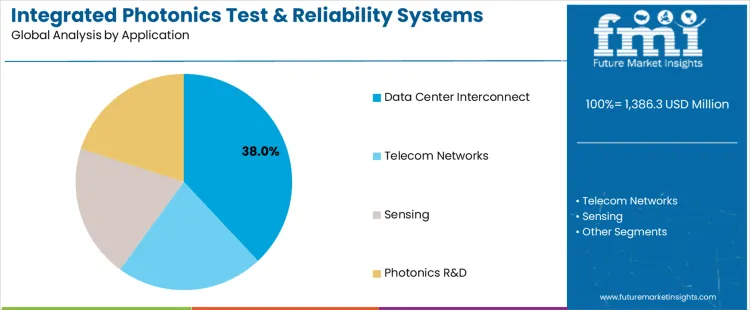
Data center interconnect applications hold 38.0%, driving the highest global demand. These applications require high-bandwidth, low-latency optical links validated under strict performance margins. Telecom networks hold 22.0%, supporting backbone and access infrastructure modernization. Sensing applications account for 20.0%, covering lidar, environmental, and industrial photonic sensing systems. Photonics R&D also holds 20.0%, advancing new device architectures and materials. Application distribution reflects dominance of data-driven infrastructure expansion worldwide.
Key Points
- Data center interconnect leads due to bandwidth scaling needs.
- Telecom networks require robust and reliable optical validation.
- Sensing and R&D support diversified photonic innovation.
Which End-User Category Represents the Largest Share of Global Demand?
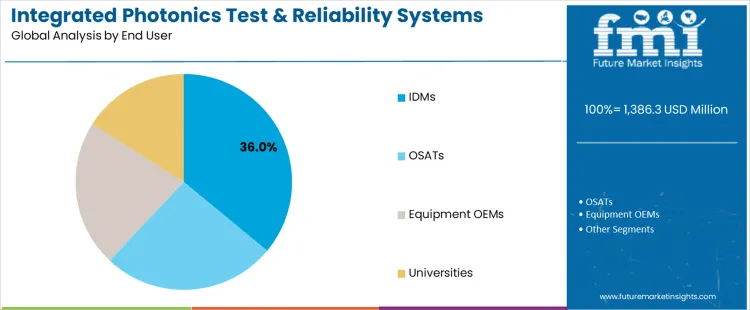
Integrated device manufacturers hold 36.0%, representing the largest end-user share globally. IDMs require comprehensive test coverage across design, fabrication, and qualification stages. OSATs hold 26.0%, supporting outsourced wafer testing and packaging verification. Equipment OEMs account for 22.0%, validating subsystem performance before customer delivery. Universities hold 16.0%, supporting research and prototyping activities. End-user distribution reflects concentration of testing responsibility within vertically integrated manufacturing environments.
Key Points
- IDMs lead due to end-to-end photonic production control.
- OSATs support outsourced testing and assembly workflows.
- Universities contribute to research-driven system validation.
What are the Key Dynamics in the Integrated Photonics Test & Reliability Systems Market?
Global demand rises as semiconductor, telecommunications, data center, and sensing industries adopt integrated photonics for high-speed data transfer, optical connectivity, and advanced sensing applications. Test and reliability systems evaluate performance, signal integrity, and long-term stability of photonic components and assemblies under varied conditions. Adoption aligns with expansion of optical interconnects, silicon photonics integration, and emerging applications in LIDAR, quantum computing, and 5G/6G networks. Usage spans academic research, commercial production, and qualification labs worldwide.
How do integrated photonics deployment and performance assurance needs shape global demand?
Manufacturers developing integrated photonic devices require test systems to measure insertion loss, crosstalk, wavelength fidelity, and thermal stability. As optical interconnects replace electrical links in data centers and high-performance computing, high-throughput test platforms become essential for production yield and quality control. Telecommunications operators validate photonic integrated circuits (PICs) for optical transport in fiber networks, requiring standardized measurement workflows. Automotive and sensing applications use integrated photonics for LIDAR and environmental monitoring, prompting reliability assessment under dynamic operating stresses. Research institutions contribute to protocol development and performance benchmarking, underscoring need for precise, repeatable test equipment that spans R&D and manufacturing environments.
How do capital costs, technology integration challenges, and standardization influence market growth?
Integrated photonics test and reliability systems involve significant capital expenditure for optical benches, alignment automation, and environmental control modules. Scaling production test requires sophisticated fixtures and coupling technology to manage high channel counts with minimal signal degradation. Integration of electronic and photonic test interfaces adds complexity, demanding multidisciplinary expertise. Lack of unified industry standards for measurement and reliability criteria increases need for flexible, configurable platforms that can adapt to diverse component formats. Regional discrepancies in manufacturing infrastructure concentrate advanced test capability in technology hubs, while emerging regions rely on outsourced test services or shared facilities. Long-term expansion depends on development of automated, cost-effective test solutions and wider alignment of global measurement standards that support multi-vendor interoperability and accelerated photonics adoption.
How Is Demand for Integrated Photonics Test and Reliability Systems Evolving?
Demand for integrated photonics test and reliability systems is increasing globally due to expansion of data centers, photonic integrated circuit adoption, and need for long-term device qualification. China leads with a 12.4% CAGR, supported by domestic semiconductor and telecom investment. Brazil follows at 11.8%, driven by academic research and emerging photonics manufacturing. South Korea records an 11.0% CAGR, shaped by optoelectronics integration and precision testing requirements. USA posts 10.6%, reflecting commercial deployment of silicon photonics and defense applications. UK records 10.3%, supported by collaborative research infrastructure and export-oriented validation services. Growth reflects higher device complexity, reliability expectations, and volume testing needs worldwide.
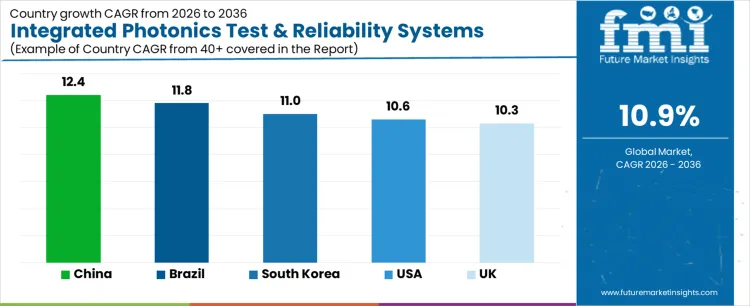
| Country | CAGR (%) |
|---|---|
| China | 12.4 |
| Brazil | 11.8 |
| South Korea | 11.0 |
| USA | 10.6 |
| UK | 10.3 |
What factors are accelerating adoption of photonics test systems in China?
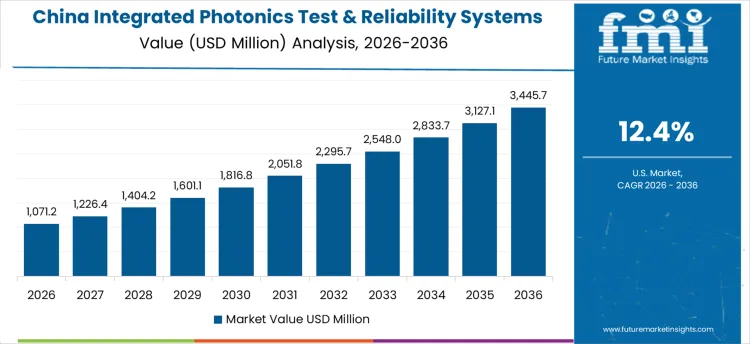
China drives demand through rapid scaling of photonic integrated circuit manufacturing, data center interconnect deployment, and telecom equipment production. Country’s CAGR of 12.4% reflects extensive use of wafer-level testing, optical performance characterization, and accelerated aging systems. Manufacturers prioritize in-house reliability validation to reduce failure risk and ensure supply chain control. Test platforms support temperature cycling, optical loss measurement, and high-speed modulation analysis. Government-backed semiconductor programs expand testing capacity across fabs and research institutes. Growth remains volume-driven and policy-aligned, supported by domestic substitution strategies and rising photonics production throughput.
- Expansion of photonic integrated circuit manufacturing
- In-house wafer-level and reliability testing
- Government-supported semiconductor programs
- High-volume optical performance validation
Why is Brazil emerging as a fast-growing adopter of photonics reliability systems?
Brazil demand is shaped by development of photonics research centers, university-led fabrication programs, and early-stage manufacturing initiatives. Country’s CAGR of 11.8% reflects investment in test systems for device characterization, packaging validation, and reliability studies. Shared laboratories enable efficient access to optical and environmental stress testing. International collaboration encourages adoption of global test methodologies. Demand favors modular platforms suitable for low-to-mid volume production and research environments. Growth remains capability-building focused, aligned with gradual progression toward domestic photonics component development.
- Academic and research-driven photonics programs
- Shared testing and characterization facilities
- Alignment with international test standards
- Modular and flexible test system preference
How does South Korea’s optoelectronics ecosystem influence demand growth?
South Korea demand reflects strong optoelectronics manufacturing, display technology leadership, and integration of photonics into advanced electronics. Country’s CAGR of 11.0% is supported by need for precise optical testing, thermal reliability assessment, and lifetime validation. Manufacturers emphasize accuracy, repeatability, and automation to support scaled production. Government-backed initiatives promote standardization of photonics testing processes. Test systems prioritize compact design and high-speed measurement capability. Growth remains technology-driven, aligned with integration of photonics into telecom, sensing, and computing applications.
- Optoelectronics and photonics integration
- Precision-focused optical and thermal testing
- Automation for scaled manufacturing
- Standardized reliability validation practices
What market dynamics sustain steady growth of photonics test systems in the USA?
USA demand is driven by silicon photonics adoption, data center infrastructure expansion, and defense-related optical systems. Country’s CAGR of 10.6% reflects investment in test and reliability platforms supporting high-speed interconnects and advanced packaging. Companies require comprehensive characterization of optical loss, bandwidth, and long-term stability. Testing integrates with design-for-reliability workflows and qualification standards. Outsourced testing complements internal labs for peak demand periods. Growth remains commercialization-led, aligned with rapid product cycles and stringent reliability expectations.
- Silicon photonics and data center demand
- High-speed interconnect testing needs
- Design-for-reliability integration
- Mix of internal and outsourced testing
How is the UK positioning itself within the global photonics test ecosystem?
UK demand reflects strong academic photonics research, startup activity, and collaborative testing models. Country’s CAGR of 10.3% is supported by investment in shared reliability labs serving multiple developers. Test systems support prototype validation, environmental stress testing, and customer qualification. Public funding encourages infrastructure development and industry-academia collaboration. Demand favors versatile platforms adaptable to diverse photonics designs. Growth remains ecosystem-driven, aligned with positioning as a hub for photonics innovation and export-ready component validation.
- Academic and startup-led photonics development
- Shared reliability and test laboratories
- Prototype and customer qualification focus
- Government-supported collaborative infrastructure
What is the competitive landscape of demand for integrated photonics test and reliability systems?
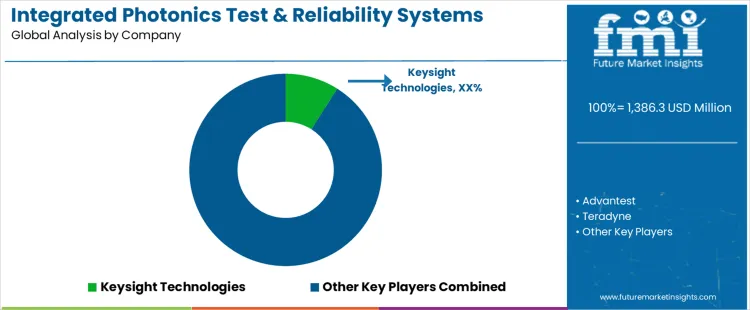
Demand for integrated photonics test and reliability systems is driven by adoption of silicon photonics in data centers, telecom, and advanced sensing. Testing requirements cover optical loss, modulation bandwidth, wavelength accuracy, thermal stability, and long-term reliability under accelerated stress conditions. Buyers prioritize high-throughput wafer-level testing, precise optical-electrical characterization, and repeatable reliability data supporting volume manufacturing. Procurement teams assess automation capability, compatibility with heterogeneous photonic platforms, and integration with semiconductor test workflows. Reliability validation under temperature cycling, humidity exposure, and high-power operation influences equipment selection decisions. Trend in the global market reflects scaling of photonic integrated circuits into mass production and tighter performance margins.
Keysight Technologies holds strong positioning through optical and electrical test platforms supporting coherent photonics and high-speed transceivers. Advantest supplies automated test systems adapted for photonic-electronic co-packaged devices in high-volume manufacturing environments. Teradyne supports production testing through flexible platforms integrated with optical interfaces and semiconductor automation. VIAVI Solutions and EXFO provide optical performance and network-layer validation tools used across development and deployment stages. Yokogawa Test and Measurement and Anritsu contribute high-precision optical analyzers and signal integrity solutions. Luna Innovations focuses on interferometric measurement and fiber-based photonics characterization supporting advanced device validation. FormFactor and MPI Corporation enable wafer-level probing and thermal control essential for photonic device testing. Competitive differentiation depends on measurement accuracy, automation depth, wafer-scale capability, and proven reliability methodologies.
Key Players in the Integrated Photonics Test & Reliability Systems Market
- Keysight Technologies
- Advantest
- Teradyne
- VIAVI Solutions
- EXFO
- Yokogawa Test & Measurement
- Anritsu
- Luna Innovations
- FormFactor
- MPI Corporation
Scope of the Report
| Items | Values |
|---|---|
| Quantitative Units | USD million |
| System Type | Optical Transceiver Test Systems; Wafer Probe Systems; Reliability & Burn-In Systems; Photonics Packaging Test Systems |
| Application | Data Center Interconnect; Telecom Networks; Optical Sensing; Photonics Research and Development |
| End User | Integrated Device Manufacturers (IDMs); OSATs; Test & Measurement Equipment OEMs; Universities & Research Institutes |
| Measurement Focus | High-Speed Modulation Analysis; Optical Power Measurement; Thermal Characterization; Optical & Dimensional Metrology |
| Regions Covered | Asia Pacific; Europe; North America; Latin America; Middle East & Africa |
| Countries Covered | China; USA; South Korea; Brazil; UK; and 40+ countries |
| Key Companies Profiled | Keysight Technologies; Advantest; Teradyne; VIAVI Solutions; EXFO; Yokogawa Test & Measurement; Anritsu; Luna Innovations; FormFactor; MPI Corporation |
| Additional Attributes | Dollar sales by system type and application; adoption trends in silicon photonics manufacturing; demand driven by data center optics and telecom upgrades; focus on wafer-level probing and reliability testing; integration with high-speed modulation standards; influence of advanced packaging and photonics R&D investments. |
Integrated Photonics Test & Reliability Systems Market by Segment
System Type:
- Optical Transceiver Test
- Wafer Probe
- Reliability
- Packaging
Application:
- Data Center Interconnect
- Telecom Networks
- Sensing
- Photonics R&D
End User:
- IDMs
- OSATs
- Equipment OEMs
- Universities
Measurement Focus:
- High-Speed Modulation
- Optical Power
- Thermal
- Metrology
Region:
- Asia Pacific
- China
- Japan
- South Korea
- India
- Australia & New Zealand
- ASEAN
- Rest of Asia Pacific
- Europe
- Germany
- United Kingdom
- France
- Italy
- Spain
- Nordic
- BENELUX
- Rest of Europe
- North America
- United States
- Canada
- Mexico
- Latin America
- Brazil
- Chile
- Rest of Latin America
- Middle East & Africa
- Kingdom of Saudi Arabia
- Other GCC Countries
- Turkey
- South Africa
- Other African Union
- Rest of Middle East & Africa
Bibliography
- International Electrotechnical Commission. (2023). Optoelectronic component reliability testing standards and photonics test methodologies. IEC Standards and Technical Reports.
- Institute of Electrical and Electronics Engineers. (2023). Test and measurement practices for integrated photonics, optical communications, and reliability assessment. IEEE Standards and Technical Papers.
- Photonics Society. (2023). Best practices in photonic integrated circuit characterization and reliability evaluation. Photonics Society Technical Publications.
- European Telecommunications Standards Institute. (2023). Standards and frameworks for photonics test systems and reliability performance metrics. ETSI Technical Specifications.
Frequently Asked Questions
How big is the integrated photonics test & reliability systems market in 2026?
The global integrated photonics test & reliability systems market is estimated to be valued at USD 1,386.3 million in 2026.
What will be the size of integrated photonics test & reliability systems market in 2036?
The market size for the integrated photonics test & reliability systems market is projected to reach USD 3,901.0 million by 2036.
How much will be the integrated photonics test & reliability systems market growth between 2026 and 2036?
The integrated photonics test & reliability systems market is expected to grow at a 10.9% CAGR between 2026 and 2036.
What are the key product types in the integrated photonics test & reliability systems market?
The key product types in integrated photonics test & reliability systems market are optical transceiver test, wafer probe, reliability and packaging.
Which application segment to contribute significant share in the integrated photonics test & reliability systems market in 2026?
In terms of application, data center interconnect segment to command 38.0% share in the integrated photonics test & reliability systems market in 2026.
Preview the report firsthand - request a free sample
Get SampleGet the brochure for pricing and purchase details.
Get PDFTable of Content
- Executive Summary
- Global Market Outlook
- Demand-side Trends
- Supply-side Trends
- Technology Roadmap Analysis
- Analysis and Recommendations
- Market Overview
- Market Coverage / Taxonomy
- Market Definition / Scope / Limitations
- Market Background
- Market Dynamics
- Drivers
- Restraints
- Opportunity
- Trends
- Scenario Forecast
- Demand in Optimistic Scenario
- Demand in Likely Scenario
- Demand in Conservative Scenario
- Opportunity Map Analysis
- Product Life Cycle Analysis
- Supply Chain Analysis
- Investment Feasibility Matrix
- Value Chain Analysis
- PESTLE and Porter’s Analysis
- Regulatory Landscape
- Regional Parent Market Outlook
- Production and Consumption Statistics
- Import and Export Statistics
- Market Dynamics
- Global Market Analysis 2021 to 2025 and Forecast, 2026 to 2036
- Historical Market Size Value (USD Million) Analysis, 2021 to 2025
- Current and Future Market Size Value (USD Million) Projections, 2026 to 2036
- Y-o-Y Growth Trend Analysis
- Absolute $ Opportunity Analysis
- Global Market Pricing Analysis 2021 to 2025 and Forecast 2026 to 2036
- Global Market Analysis 2021 to 2025 and Forecast 2026 to 2036, By System Type
- Introduction / Key Findings
- Historical Market Size Value (USD Million) Analysis By System Type , 2021 to 2025
- Current and Future Market Size Value (USD Million) Analysis and Forecast By System Type , 2026 to 2036
- Optical Transceiver Test
- Wafer Probe
- Reliability
- Packaging
- Optical Transceiver Test
- Y-o-Y Growth Trend Analysis By System Type , 2021 to 2025
- Absolute $ Opportunity Analysis By System Type , 2026 to 2036
- Global Market Analysis 2021 to 2025 and Forecast 2026 to 2036, By Application
- Introduction / Key Findings
- Historical Market Size Value (USD Million) Analysis By Application, 2021 to 2025
- Current and Future Market Size Value (USD Million) Analysis and Forecast By Application, 2026 to 2036
- Data Center Interconnect
- Telecom Networks
- Sensing
- Photonics R&D
- Data Center Interconnect
- Y-o-Y Growth Trend Analysis By Application, 2021 to 2025
- Absolute $ Opportunity Analysis By Application, 2026 to 2036
- Global Market Analysis 2021 to 2025 and Forecast 2026 to 2036, By End User
- Introduction / Key Findings
- Historical Market Size Value (USD Million) Analysis By End User, 2021 to 2025
- Current and Future Market Size Value (USD Million) Analysis and Forecast By End User, 2026 to 2036
- IDMs
- OSATs
- Equipment OEMs
- Universities
- IDMs
- Y-o-Y Growth Trend Analysis By End User, 2021 to 2025
- Absolute $ Opportunity Analysis By End User, 2026 to 2036
- Global Market Analysis 2021 to 2025 and Forecast 2026 to 2036, By Measurement Focus
- Introduction / Key Findings
- Historical Market Size Value (USD Million) Analysis By Measurement Focus, 2021 to 2025
- Current and Future Market Size Value (USD Million) Analysis and Forecast By Measurement Focus, 2026 to 2036
- High-Speed Modulation
- Optical Power
- Thermal
- Metrology
- High-Speed Modulation
- Y-o-Y Growth Trend Analysis By Measurement Focus, 2021 to 2025
- Absolute $ Opportunity Analysis By Measurement Focus, 2026 to 2036
- Global Market Analysis 2021 to 2025 and Forecast 2026 to 2036, By Region
- Introduction
- Historical Market Size Value (USD Million) Analysis By Region, 2021 to 2025
- Current Market Size Value (USD Million) Analysis and Forecast By Region, 2026 to 2036
- North America
- Latin America
- Western Europe
- Eastern Europe
- East Asia
- South Asia and Pacific
- Middle East & Africa
- Market Attractiveness Analysis By Region
- North America Market Analysis 2021 to 2025 and Forecast 2026 to 2036, By Country
- Historical Market Size Value (USD Million) Trend Analysis By Market Taxonomy, 2021 to 2025
- Market Size Value (USD Million) Forecast By Market Taxonomy, 2026 to 2036
- By Country
- USA
- Canada
- Mexico
- By System Type
- By Application
- By End User
- By Measurement Focus
- By Country
- Market Attractiveness Analysis
- By Country
- By System Type
- By Application
- By End User
- By Measurement Focus
- Key Takeaways
- Latin America Market Analysis 2021 to 2025 and Forecast 2026 to 2036, By Country
- Historical Market Size Value (USD Million) Trend Analysis By Market Taxonomy, 2021 to 2025
- Market Size Value (USD Million) Forecast By Market Taxonomy, 2026 to 2036
- By Country
- Brazil
- Chile
- Rest of Latin America
- By System Type
- By Application
- By End User
- By Measurement Focus
- By Country
- Market Attractiveness Analysis
- By Country
- By System Type
- By Application
- By End User
- By Measurement Focus
- Key Takeaways
- Western Europe Market Analysis 2021 to 2025 and Forecast 2026 to 2036, By Country
- Historical Market Size Value (USD Million) Trend Analysis By Market Taxonomy, 2021 to 2025
- Market Size Value (USD Million) Forecast By Market Taxonomy, 2026 to 2036
- By Country
- Germany
- UK
- Italy
- Spain
- France
- Nordic
- BENELUX
- Rest of Western Europe
- By System Type
- By Application
- By End User
- By Measurement Focus
- By Country
- Market Attractiveness Analysis
- By Country
- By System Type
- By Application
- By End User
- By Measurement Focus
- Key Takeaways
- Eastern Europe Market Analysis 2021 to 2025 and Forecast 2026 to 2036, By Country
- Historical Market Size Value (USD Million) Trend Analysis By Market Taxonomy, 2021 to 2025
- Market Size Value (USD Million) Forecast By Market Taxonomy, 2026 to 2036
- By Country
- Russia
- Poland
- Hungary
- Balkan & Baltic
- Rest of Eastern Europe
- By System Type
- By Application
- By End User
- By Measurement Focus
- By Country
- Market Attractiveness Analysis
- By Country
- By System Type
- By Application
- By End User
- By Measurement Focus
- Key Takeaways
- East Asia Market Analysis 2021 to 2025 and Forecast 2026 to 2036, By Country
- Historical Market Size Value (USD Million) Trend Analysis By Market Taxonomy, 2021 to 2025
- Market Size Value (USD Million) Forecast By Market Taxonomy, 2026 to 2036
- By Country
- China
- Japan
- South Korea
- By System Type
- By Application
- By End User
- By Measurement Focus
- By Country
- Market Attractiveness Analysis
- By Country
- By System Type
- By Application
- By End User
- By Measurement Focus
- Key Takeaways
- South Asia and Pacific Market Analysis 2021 to 2025 and Forecast 2026 to 2036, By Country
- Historical Market Size Value (USD Million) Trend Analysis By Market Taxonomy, 2021 to 2025
- Market Size Value (USD Million) Forecast By Market Taxonomy, 2026 to 2036
- By Country
- India
- ASEAN
- Australia & New Zealand
- Rest of South Asia and Pacific
- By System Type
- By Application
- By End User
- By Measurement Focus
- By Country
- Market Attractiveness Analysis
- By Country
- By System Type
- By Application
- By End User
- By Measurement Focus
- Key Takeaways
- Middle East & Africa Market Analysis 2021 to 2025 and Forecast 2026 to 2036, By Country
- Historical Market Size Value (USD Million) Trend Analysis By Market Taxonomy, 2021 to 2025
- Market Size Value (USD Million) Forecast By Market Taxonomy, 2026 to 2036
- By Country
- Kingdom of Saudi Arabia
- Other GCC Countries
- Turkiye
- South Africa
- Other African Union
- Rest of Middle East & Africa
- By System Type
- By Application
- By End User
- By Measurement Focus
- By Country
- Market Attractiveness Analysis
- By Country
- By System Type
- By Application
- By End User
- By Measurement Focus
- Key Takeaways
- Key Countries Market Analysis
- USA
- Pricing Analysis
- Market Share Analysis, 2025
- By System Type
- By Application
- By End User
- By Measurement Focus
- Canada
- Pricing Analysis
- Market Share Analysis, 2025
- By System Type
- By Application
- By End User
- By Measurement Focus
- Mexico
- Pricing Analysis
- Market Share Analysis, 2025
- By System Type
- By Application
- By End User
- By Measurement Focus
- Brazil
- Pricing Analysis
- Market Share Analysis, 2025
- By System Type
- By Application
- By End User
- By Measurement Focus
- Chile
- Pricing Analysis
- Market Share Analysis, 2025
- By System Type
- By Application
- By End User
- By Measurement Focus
- Germany
- Pricing Analysis
- Market Share Analysis, 2025
- By System Type
- By Application
- By End User
- By Measurement Focus
- UK
- Pricing Analysis
- Market Share Analysis, 2025
- By System Type
- By Application
- By End User
- By Measurement Focus
- Italy
- Pricing Analysis
- Market Share Analysis, 2025
- By System Type
- By Application
- By End User
- By Measurement Focus
- Spain
- Pricing Analysis
- Market Share Analysis, 2025
- By System Type
- By Application
- By End User
- By Measurement Focus
- France
- Pricing Analysis
- Market Share Analysis, 2025
- By System Type
- By Application
- By End User
- By Measurement Focus
- India
- Pricing Analysis
- Market Share Analysis, 2025
- By System Type
- By Application
- By End User
- By Measurement Focus
- ASEAN
- Pricing Analysis
- Market Share Analysis, 2025
- By System Type
- By Application
- By End User
- By Measurement Focus
- Australia & New Zealand
- Pricing Analysis
- Market Share Analysis, 2025
- By System Type
- By Application
- By End User
- By Measurement Focus
- China
- Pricing Analysis
- Market Share Analysis, 2025
- By System Type
- By Application
- By End User
- By Measurement Focus
- Japan
- Pricing Analysis
- Market Share Analysis, 2025
- By System Type
- By Application
- By End User
- By Measurement Focus
- South Korea
- Pricing Analysis
- Market Share Analysis, 2025
- By System Type
- By Application
- By End User
- By Measurement Focus
- Russia
- Pricing Analysis
- Market Share Analysis, 2025
- By System Type
- By Application
- By End User
- By Measurement Focus
- Poland
- Pricing Analysis
- Market Share Analysis, 2025
- By System Type
- By Application
- By End User
- By Measurement Focus
- Hungary
- Pricing Analysis
- Market Share Analysis, 2025
- By System Type
- By Application
- By End User
- By Measurement Focus
- Kingdom of Saudi Arabia
- Pricing Analysis
- Market Share Analysis, 2025
- By System Type
- By Application
- By End User
- By Measurement Focus
- Turkiye
- Pricing Analysis
- Market Share Analysis, 2025
- By System Type
- By Application
- By End User
- By Measurement Focus
- South Africa
- Pricing Analysis
- Market Share Analysis, 2025
- By System Type
- By Application
- By End User
- By Measurement Focus
- USA
- Market Structure Analysis
- Competition Dashboard
- Competition Benchmarking
- Market Share Analysis of Top Players
- By Regional
- By System Type
- By Application
- By End User
- By Measurement Focus
- Competition Analysis
- Competition Deep Dive
- Keysight Technologies
- Overview
- Product Portfolio
- Profitability by Market Segments (Product/Age /Sales Channel/Region)
- Sales Footprint
- Strategy Overview
- Marketing Strategy
- Product Strategy
- Channel Strategy
- Advantest
- Teradyne
- VIAVI Solutions
- EXFO
- Yokogawa Test & Measurement
- Anritsu
- Luna Innovations
- FormFactor
- MPI Corporation
- Keysight Technologies
- Competition Deep Dive
- Assumptions & Acronyms Used
- Research Methodology


