

- Market Size (2026)
- USD 170.0 Mn
- Forecast (2036)
- USD 340.7 Mn
- CAGR (2026 to 2036)
- 7.2%
Miniaturized Package Solder Joint Reliability Test Equipment Market Size, Forecast and Outlook By FMI
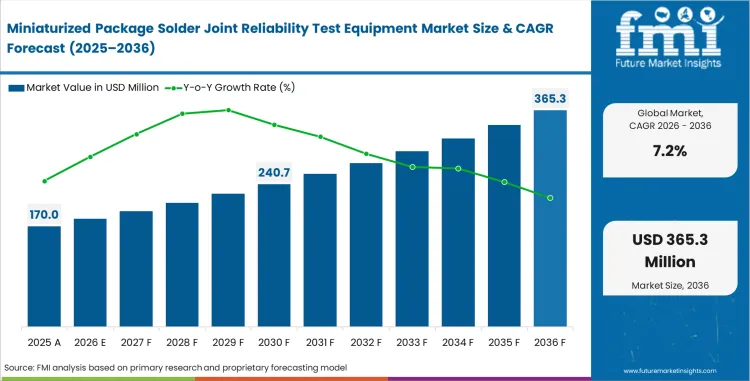
The miniaturized package solder joint reliability test equipment market crossed a valuation of USD 158.6 million in 2025. Market value is estimated to reach USD 170.0 million in 2026, and demand is projected to rise at a CAGR of 7.2% from 2026 to 2036. Total valuation is expected to reach USD 340.7 million by 2036 as smaller package formats make thermal cycling, mechanical stress testing, and continuity validation more critical before release. Growing complexity in advanced packaging programs and tighter package structures are increasing the need for test platforms that can deliver repeatable reliability evidence without slowing qualification flow.
Summary of Miniaturized Package Solder Joint Reliability Test Equipment Market
- Miniaturized Package Solder Joint Reliability Test Equipment Market Snapshot
- The Miniaturized Package Solder Joint Reliability Test Equipment Market is valued at USD 158.6 million in 2025 and is projected to reach USD 340.7 million by 2036.
- Industry value is expected to move from USD 170.0 million in 2026 at a CAGR of 7.20%, creating an incremental opportunity of USD 170.7 million through 2036.
- This category covers dedicated equipment used to check solder-joint durability in compact semiconductor packages through thermal, mechanical, and electrical reliability routines.
- Scope remains tied to qualification-heavy tools rather than broad production test hardware, and package behavior still depends heavily on package materials and process discipline.
- Miniaturized Package Solder Joint Reliability Test Equipment Market Demand and Growth Drivers
- Smaller package footprints are forcing reliability labs to prove joint stability under harsher thermal and mechanical stress before customer release.
- More advanced package designs are raising the value of test setups that can explain failure clearly rather than only confirm that a failure happened.
- Demand rises faster when even a small package change can delay qualification and hold up customer approval.
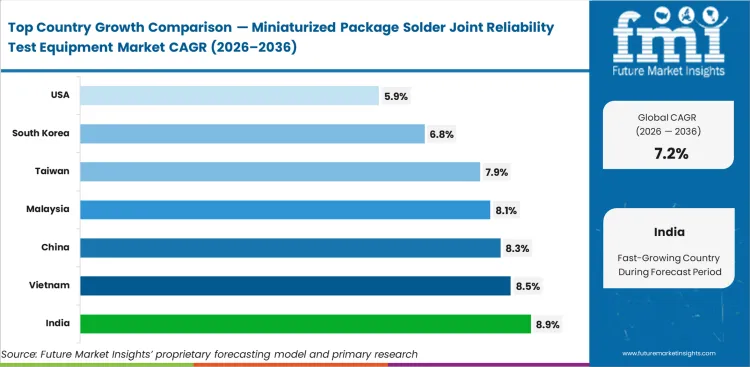
- Among key countries, India leads at 8.9%, followed by Vietnam at 8.5%, China at 8.3%, Malaysia at 8.1%, Taiwan at 7.9%, South Korea at 6.8%, and the United States at 5.9%.
- Growth stays measured because many labs keep older benches in service until repeatability gaps begin to threaten release timelines.
- Miniaturized Package Solder Joint Reliability Test Equipment Market Product and Segment View
- Thermal cycling chambers lead product type and are expected to account for 29.0% share in 2026 because fatigue-style screening remains the most familiar route for solder-joint life assessment.
- BGA packages stay ahead in package type, with 34.0% share expected in 2026, because board-level and package-level validation still center on mature high-I/O footprints used across many release programs.
- In stress mode, thermomechanical testing is projected to represent 38.0% share in 2026 since thermal mismatch remains the main failure path in many solder-joint studies.
- Semi-automatic platforms are likely to contribute 41.0% share in 2026 as labs continue to value flexibility, method control, and manageable upgrade cost.
- OSATs are anticipated to secure 30.0% share in end user demand in 2026 because outsourced packaging houses sit close to customer sign-off and package turnover.
- Mid throughput systems are set to make up 44.0% share in 2026 since most labs need balanced channel count and cost rather than either minimal or extreme output.
- Qualification labs are expected to represent 36.0% share in 2026 because formal release decisions absorb more of the budget than routine troubleshooting alone.
- Scope includes chamber-linked and bench-based solder-joint reliability tools, while broader inline inspection and general-purpose production electronics remain outside this study even though related validation demand supports the wider testing base.
- Miniaturized Package Solder Joint Reliability Test Equipment Market Geography and Competitive Outlook
- India, Vietnam, and China stand out as the faster-expanding demand bases because new assembly, packaging, and qualification capacity is still being added to the regional base.
- Taiwan remains strategically important because advanced package density and package turnover keep reliability work close to core commercialization activity.
- Competitive conditions stay fragmented because chamber suppliers, bond test specialists, and impact-system providers address different points in the workflow instead of selling one fully unified stack.
- ESPEC Corporation, Weiss Technik, Nordson Corporation, Thermotron Industries, Cincinnati Sub-Zero, and Associated Environmental Systems remain the main names shaping buyer choice in this space.
Key Takeaways, Market Size, and Forecast
- Miniaturized Package Solder Joint Reliability Test Equipment Market is projected to grow from USD 170.0 million in 2026 to USD 340.7 million by 2036, at a CAGR of 7.2%.
- The miniaturized package solder joint reliability test equipment market was valued at USD 158.6 million in 2025.
- By 2036, the Miniaturized Package Solder Joint Reliability Test Equipment Market is expected to be worth USD 340.7 million.
- From 2026 to 2036, the market is projected to expand at a CAGR of 7.2%.
- The market is projected to create an incremental opportunity of USD 170.7 million between 2026 and 2036.
- In 2026, Thermal cycling chambers are expected to account for 29.0% of the product type segment.
- India (8.9%) and Vietnam (8.5%) are two of the fastest growing markets.
Older reliability benches are coming under more pressure as interconnect density rises, solder spacing tightens, and package change cycles shorten. Legacy systems still support routine workloads, but confidence weakens once package geometry becomes harder to compare across runs, and customer approval depends on a clear failure explanation. FMI sees this transition more clearly in advanced package build programs and more complex package structures, where qualification work is moving closer to release decisions rather than staying at the edge of development. In most labs, purchase decisions depend more on repeatability and result defense than on adding the widest feature set. Labs usually place more weight on continuity, repeatability, and method stability than on the broadest feature list, since customer-facing validation depends more on consistent results than on technical range alone.
India is expected to register a CAGR of 8.9% through 2036 as outsourced packaging activity expands and qualification needs rise across newer device programs. Vietnam is projected to grow at 8.5%, while China is likely to record 8.3%, supported by scale expansion across packaging lines and broader domestic electronics output. Malaysia is estimated to post 8.1% CAGR as export-oriented semiconductor operations continue to add test and packaging depth. Taiwan is anticipated to advance at 7.9%, reflecting steady demand from dense packaging ecosystems and technically demanding package qualification work. South Korea is expected to see 6.8% CAGR, while the United States is likely to grow at 5.9%, where demand leans more on specialized package mix, upgrade timing, and customer approval rigor than on first-time lab build-out. Faster-growth countries are adding assembly services capacity and widening wafer supply, whereas mature locations rely more on process refinement and replacement demand across established operations.
Segmental Analysis
Miniaturized Package Solder Joint Reliability Test Equipment Market Analysis by Product Type
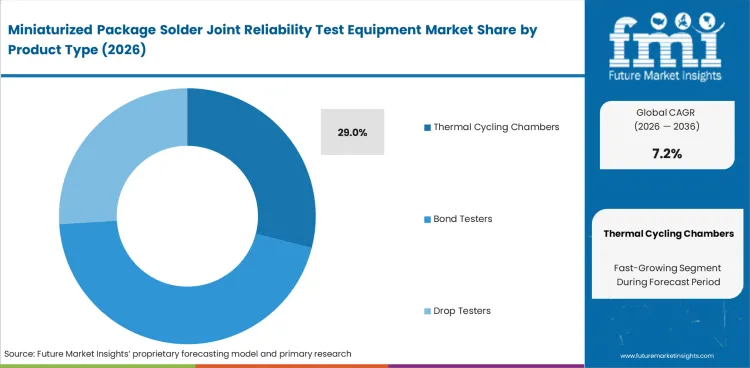
Thermal cycling chambers are expected to account for 29.0% share in 2026. Product choice in this market still begins with equipment that can show how solder joints respond to repeated temperature change rather than to one isolated event. Buyers prefer systems that let qualification labs build fatigue evidence in a form that is already familiar to customer approval teams and internal release reviewers. Wider use of environmental test chambers also reflects the advantage of extending established methods without forcing a full rewrite of acceptance routines every time package geometry changes. Comparable results across package revisions, longer stress windows, and clearer links between thermal history and electrical drift keep this category commercially relevant.
- Temperature discipline: Repeated cycling helps labs judge solder fatigue through a method that is easier to explain during release review.
- Workflow continuity: Existing qualification routines move more smoothly when the same stress logic can carry from older packages into smaller designs.
- Program-level fit: Buyers favor equipment that supports repeatable approval work without creating a fresh validation burden.
Miniaturized Package Solder Joint Reliability Test Equipment Market Analysis by Package Type
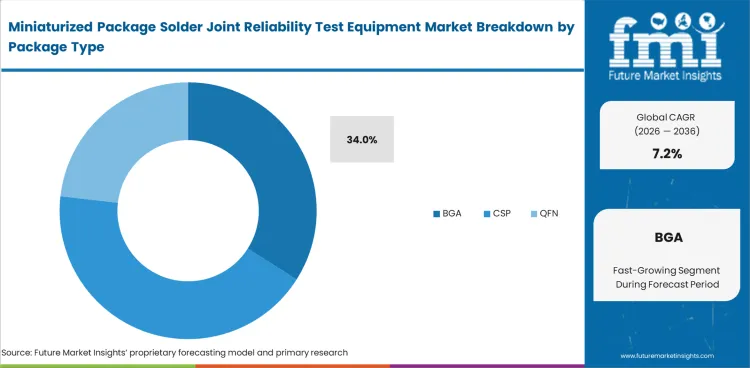
Package qualification stays anchored to formats that appear often enough to shape sample planning, method choice, and approval timing across regular release work. BGA is projected to contribute 34.0% of total share in 2026 because it remains central to board-level reliability programs even as stacked dies and other advanced designs expand. Buyers keep returning to BGA-focused evaluation because it offers a familiar route for tracking solder-joint fatigue, continuity shift, and board interaction under thermal loading. That familiarity lowers the effort required to compare current designs with legacy datasets and shortens the path to defensible review. Pressure still rises as pitch shrinks and density climbs, so package coverage cannot rely on familiarity alone.
- Common-footprint coverage: High-I/O package formats keep BGA at the center of many qualification plans and equipment evaluations.
- Board-coupling relevance: BGA testing gives clearer visibility into how package and board interaction shapes joint fatigue over time.
- Approval-cycle continuity: Frequent design updates make familiar package families easier to evaluate across repeated customer review cycles.
Miniaturized Package Solder Joint Reliability Test Equipment Market Analysis by Stress Mode
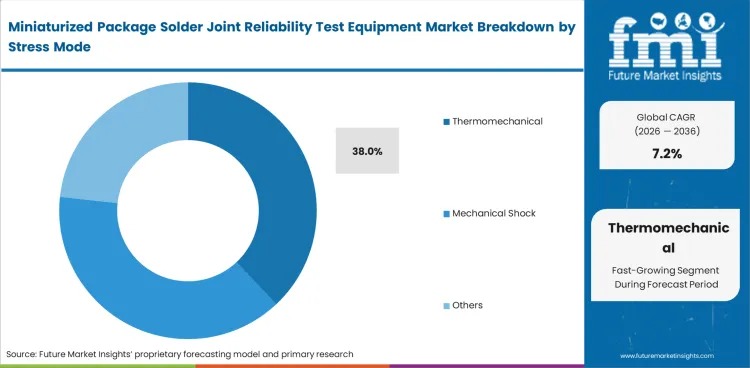
Failure analysis becomes more useful when the applied stress matches the way solder joints usually degrade in service rather than in isolated abuse conditions. Repeated expansion mismatch across package, board, and joint interfaces still explains a large share of field-relevant failure behavior in miniaturized electronics. Thermomechanical testing is expected to represent 38.0% share in 2026 because that logic stays closely tied to solder materials and to the way temperature-driven strain accumulates over time. Buyers value this mode because it converts a broad reliability concern into a readable fatigue sequence that is easier to compare across package revisions.
- Expansion-mismatch focus: Thermal strain differences remain the main source of repeated loading in many solder-joint reliability studies.
- Crack-formation visibility: Thermomechanical methods provide a clearer route from stress history to resistance shift and damage progression.
- Cross-program stability: Buyers compare package revisions more easily when fatigue evidence is built on the same stress logic.
Miniaturized Package Solder Joint Reliability Test Equipment Market Analysis by Automation Level
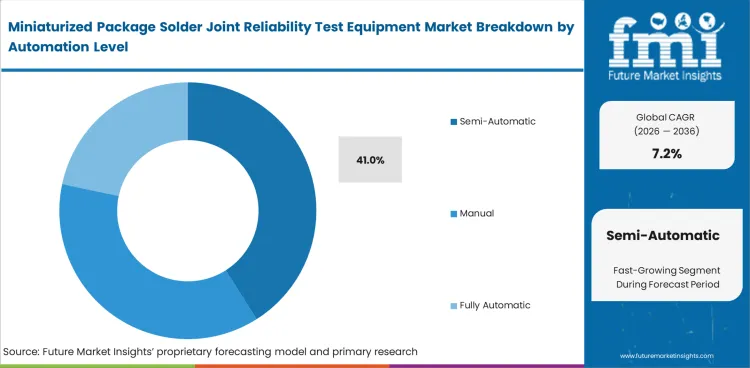
Lab workflows in this category usually need flexibility and method control at the same time, so full automation does not become the default answer for every qualification program. Package mix, fixture changes, and irregular approval schedules often require operators to intervene without disrupting the broader test sequence. FMI sees that balance reflected in demand for adaptable test tools that can support mixed workloads instead of one rigid production pattern. Semi-automatic systems are likely to secure 41.0% share in 2026 because they let users manage sample handling and setup changes without absorbing the full cost of highly integrated automation. That balance matters most where customer jobs vary in package size, validation scope, and turnaround pressure. A lab can gain speed from heavier automation on stable programs, but it may lose flexibility and overspend where method changeovers stay frequent. The benefit comes from enabling labs to handle variability without compromising effective throughput.
- Workflow-control balance: Semi-automatic setups support disciplined testing without forcing every stage into a fixed sequence.
- Fixture-adjustment ease: Users can adapt samples and holders more easily when package mix changes across customer programs.
- Practical upgrade path: Buyers can add capability without taking on the full cost and rigidity of top-end automation.
Miniaturized Package Solder Joint Reliability Test Equipment Market Analysis by End User
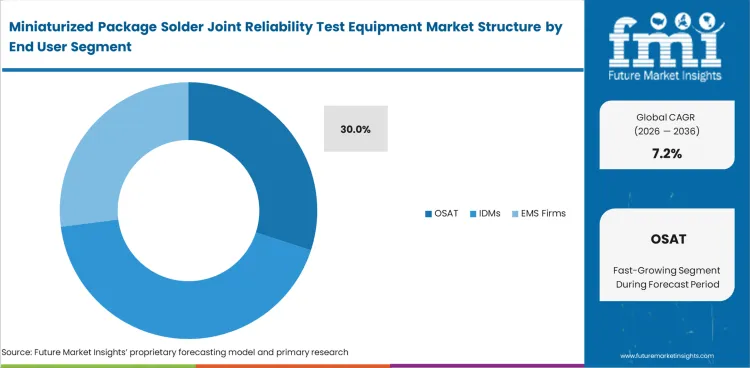
Customer-facing package approval sits close to outsourced assembly and test activity, so buying intensity in this market follows the organizations that handle frequent sign-off work. OSATs deal with more package transitions, more customer qualification requests, and more validation activity between development and volume release than many captive labs. Turnover is usually faster here, which makes dedicated reliability capability easier to justify on commercial grounds. FMI views this demand as part of a broader testing equipment base where buyers compare method fit, cycle time, and result credibility before spending. OSATs are expected to account for 30.0% share in 2026 because package variety and tighter review windows create stronger need for repeatable proof. Research centers and internal labs still buy equipment, but their purchasing cadence is often less tightly linked to release pressure. Suppliers have a better chance of winning business at OSATs and qualification labs where approval work is continuous.
- Customer-approval proximity: Outsourced packaging houses stay close to sign-off work that depends on repeatable reliability evidence.
- Faster package turnover: More frequent package updates make dedicated qualification tools easier to justify commercially.
- Broader outsourcing depth: External assembly specialists often face wider customer mix and tighter review timing than captive labs.
Miniaturized Package Solder Joint Reliability Test Equipment Market Analysis by Throughput
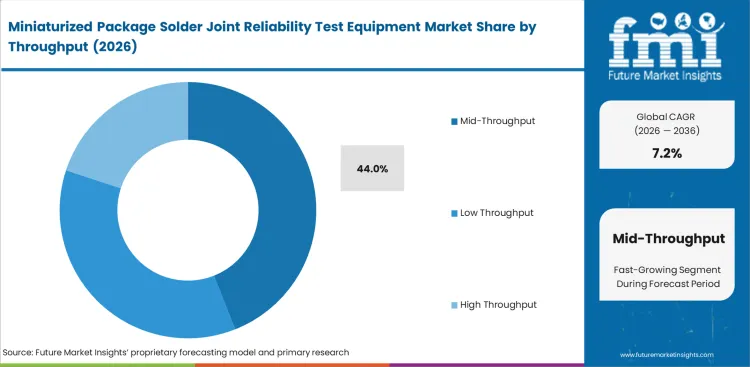
Most solder-joint reliability labs do not buy for the smallest sample set or for the most extreme output target because qualification work rarely follows either of those edges consistently. Buyers usually need enough channels and run depth to keep programs moving, but not so much specialization that the system becomes underused during quieter periods. FMI links planning logic to wafer-level screening, where capacity also must balance utilization, flexibility, and budget discipline. Mid-throughput systems are anticipated to make up 44.0% share in 2026 because they sit in the practical middle between cost control and usable sample volume. Very low throughput stretches approval timelines and narrows lab productivity once programs stack up. Very high throughput can raise cost and reduce fit for sites still handling varied package sizes and changing test plans. Optimal outcomes are achieved by sizing equipment to actual qualification throughput rather than to nominal peak capacity assumptions.
- Qualification-lab rhythm: Mid-range capacity matches the stop-start workload pattern common in customer approval programs.
- Usable sample volume: Buyers get enough run depth to support review work without committing to oversized hardware.
- Defensible cost balance: Spending stays easier to justify when throughput reflects actual workload rather than peak assumptions.
Miniaturized Package Solder Joint Reliability Test Equipment Market Analysis by Application
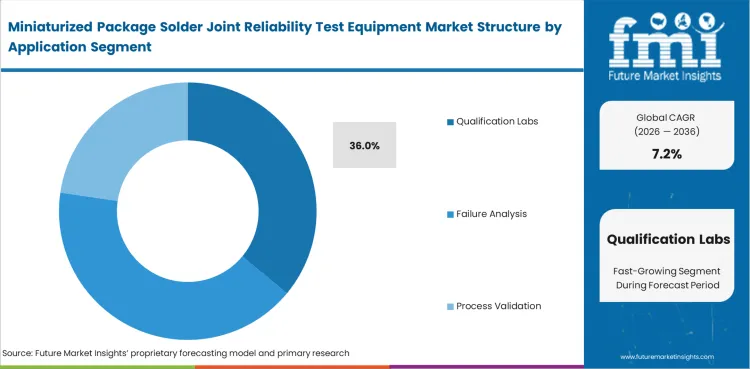
Release-driven qualification absorbs more reliability spending than routine troubleshooting alone because final approval, customer submission, and package change control all depend on evidence that can withstand formal review. Buyers in this application group prioritize repeatability first, then consider how clearly the method can be explained across internal engineering, customer quality teams, and supplier comparisons. Weak application fit can still produce useful diagnostic information, but it becomes harder to justify when the system does not support the formal release path that drives most budget allocation. FMI sees similar discipline in wide-bandgap testing, where equipment value rises when the result must support a go-or-no-go decision rather than a simple lab check. Share from qualification labs is expected to reach 36.0% in 2026 because approval workflows remain the main budget center for solder-joint reliability testing. Package updates keep these labs active, as each revision must be checked against prior expectations. Segment value depends on supporting defensible release decisions, not only on helping engineers investigate failure after the fact.
- Release-gating priority: Qualification work remains the main budget center because approval depends on defensible test evidence.
- Root-cause support value: Diagnostic capability still matters most when it strengthens release confidence rather than standing alone.
- Package-change validation: Ongoing design updates keep labs busy because each revision must be checked against prior reliability expectations.
Miniaturized Package Solder Joint Reliability Test Equipment Market Drivers, Restraints, and Opportunities
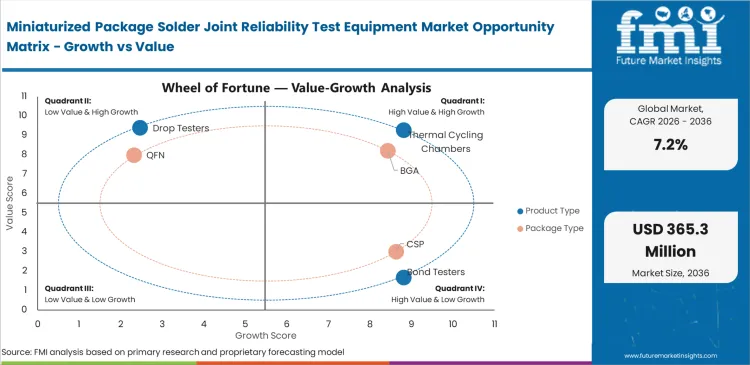
Qualification budgets rise when smaller package designs create less room for result ambiguity and less patience for long approval cycles. Buyers need equipment that shows how the joint fails, when resistance starts to drift, and whether a package revision changes reliability risk. FMI links that need tighter metrology control across package development and release review. Faster package change cycles add pressure as well. A lab that can explain reliability cleanly helps move product decisions forward, while a lab that depends on weak correlation or manual comparison can slow-release timing and weaken customer confidence in the final evidence set.
Installed methods create a barrier because many labs care more about continuity with past results than about adding new features. Changing equipment may improve capability, yet it can also force fresh correlation work, new acceptance routines, and longer internal debate about whether new readings match old decision thresholds. FMI sees this tension in the wider need for chamber demand across electronics testing, where buyers still move carefully when method history matters. Skills and workflow adaptation add to the drag. A system that looks better on paper can still lose if users expect a long relearning period or fear a break in customer-facing qualification continuity.
Opportunities in the Miniaturized Package Solder Joint Reliability Test Equipment Market
- Package redesign support: Smaller packages and denser interconnect layouts create room for suppliers that can help labs move from simple stress exposure to clearer failure explanation during release review.
- Workflow integration: Buyers can capture more value when chamber control, resistance monitoring, and result review work together in one method, especially when bench instruments still need to feed broader reliability programs.
- Regional capacity build-out: New assembly and qualification sites in India, Vietnam, and Malaysia open room for equipment suppliers that can support early method setup without making the lab carry a long integration burden.
Regional Analysis
Based on the regional analysis, the Miniaturized Package Solder Joint Reliability Test Equipment Market is segmented into North America, East Asia, and South Asia and Southeast Asia across 40 plus countries.
.webp "Top Country Growth Comparison Miniaturized Package Solder Joint Reliability Test Equipment Market Cagr (2026 2036)")
| Country | CAGR (2026 to 2036) |
|---|---|
| India | 8.9% |
| Vietnam | 8.5% |
| China | 8.3% |
| Malaysia | 8.1% |
| Taiwan | 7.9% |
| South Korea | 6.8% |
| United States | 5.9% |
Source: Future Market Insights (FMI) analysis, based on proprietary forecasting model and primary research
East Asia Miniaturized Package Solder Joint Reliability Test Equipment Market Analysis
Package density and approval intensity give East Asia a different position from newer assembly locations. Buyers here do not purchase only to add lab hardware. They buy to protect release timing when package complexity rises and customer expectations stay tight. FMI sees that pressure most clearly where advanced package work stays close to core commercialization decisions and where sample comparison must remain consistent across frequent design revisions. Installed capability is already deep in this region, so new demand often comes from method refinement, higher sample discipline, and the need to keep qualification work aligned with smaller and more complex package formats.
- China: Demand for miniaturized package solder joint reliability test equipment in China is expected to rise at a CAGR of 8.3% from 2026 to 2036, supported by the scale of domestic electronics manufacturing and the need to keep qualification work closer to production decisions. China's large packaging base keeps solder-joint reliability equipment relevant because broad electronics output and expanding package diversity create steady qualification needs across many device categories. Local buyers often compare cost discipline with method credibility, so equipment must support release work without looking oversized for the workload.
- Taiwan: Advanced package density defines Taiwan's position in this space because packaging houses and device firms there handle demanding interconnect structures and quick product transitions. Reliability work often sits close to commercialization rather than far downstream as a separate lab task. Buyers value equipment that keeps comparisons stable across revisions and preserves confidence in release evidence. FMI expects the Taiwan demand to expand at a CAGR of 7.9% through 2036 as package complexity continues to pull more attention into qualification routines. Installed capability is already deep. Growth remains tied less to first-time buying and more to whether existing methods can keep pace with smaller and more layered package designs.
- South Korea: Automotive electronics, memory-related package needs, and a mature semiconductor base keep South Korea active even though the buying pattern is more selective than in newer assembly locations. Users here often look for systems that improve method consistency without disrupting existing qualification logic. Pace stays measured for that reason. By 2036, South Korea is expected to post 6.8% CAGR in this industry as replacement cycles, package complexity, and high-value application needs continue to support demand. High installed capability limits the speed of first-cycle expansion, yet strong technical expectations keep reliability equipment spending from becoming optional when package changes move into release review.
FMI's report includes Japan and other East Asian demand pockets within this regional view. Most of those markets show steadier replacement-led movement than India or Vietnam. Package sophistication keeps spending relevant, yet buying logic is usually shaped by method quality and upgrade timing rather than first-time lab build-out. That difference matters because it keeps regional demand resilient even when broad capacity additions slow.
South Asia and Southeast Asia Miniaturized Package Solder Joint Reliability Test Equipment Market Analysis
Fresh assembly growth gives South Asia and Southeast Asia a more expansion-led profile. Buyers in this group are still building capability in places where package qualification infrastructure is not as deep as in East Asia. New site creation matters here. Each additional assembly or testing program can bring real equipment demand because labs often need to establish methods, train users, and support customer release work at the same time. FMI sees this region as the clearest source of first-cycle buying, though buyers still prefer equipment that can be defended easily during approval review and not just installed quickly.
- India: Growth of miniaturized package solder joint reliability test equipment industry in India is expected to run at a CAGR of 8.9% during the forecast period, the fastest pace among the countries covered in this study. A smaller installed base explains part of the growth, but local demand is also tied to new assembly, packaging, and qualification activity. New semiconductor and electronics build-out gives India a strong growth position because each added assembly, packaging, or qualification program can create a fresh need for reliability capability. Local users often build methods, and equipment plans at the same time, which makes supplier support and workflow clarity especially important. Buyers still favor equipment that can move quickly from setup into defensible release testing without creating a long learning burden.
- Vietnam: Vietnam's electronics manufacturing expansion keeps qualification demand moving because more exported devices and subassemblies need support from local validation capability rather than only from offshore labs. Buyers here usually seek equipment that is practical to install and simple to defend during approval work. Faster movement depends on that balance. Sales in Vietnam are poised to grow at a CAGR of 8.5% during the assessment period as the local manufacturing base widens and more package-related testing activity stays closer to production. New capacity helps, but method readiness matters just as much. A lab that cannot support quick customer-facing evidence may struggle to keep work local once qualification pressure rises.
- Malaysia: Malaysia benefits from a long electronics manufacturing presence, yet current demand gains come from how packaging and testing activity continue to broaden rather than from a blank sheet build cycle. Users here often look for equipment that strengthens existing qualification capability without pushing costs too far above real program needs. That practical balance shapes buying. Malaysia is likely to post a CAGR of 8.1% in this industry by 2036 as more release work, package variation, and customer approval demands sit within regional assembly and testing networks. Growth remains solid because the country combines operational familiarity with room for capability extension. Weak method fit can still slow that gain if new tools add complexity without making the release process easier to defend.
FMI's report also covers Thailand, Singapore, the Philippines, and other Southeast Asian locations inside this broader regional block. Many of those markets benefit from electronics manufacturing depth and steady cross-border supply links. Growth still varies by how much package qualification stays local instead of moving to another country in the chain. That is why capacity headlines alone do not explain the full regional picture.
North America Miniaturized Package Solder Joint Reliability Test Equipment Market Analysis
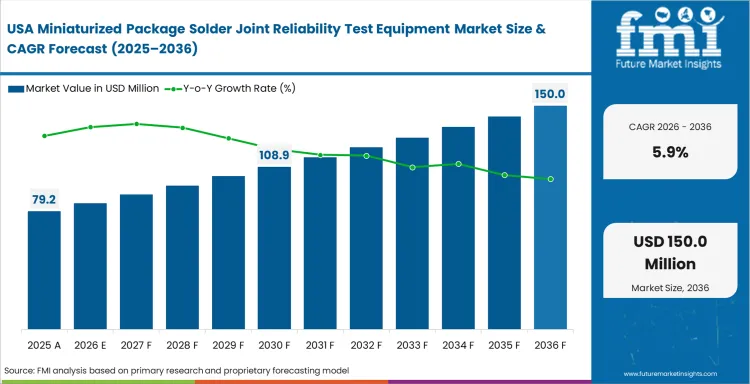
North America behaves more like a selective upgrade market than a broad first-build market. Reliability capability is already established in many device makers, automotive electronics programs, and specialized labs, so buying decisions depend more on fit, method continuity, and customer requirements than on simple capacity addition. FMI sees this region staying important because high-value applications and strict approval standards keep reliability evidence close to release decisions. Replacement cycles remain selective. Older setups often remain in use until package complexity makes method limits too visible to ignore. Package stacking pressure also keeps some buyers focused on whether older methods can still explain failure cleanly.
- United States: Established reliability practice keeps the United States important but installed lab depth makes this a more replacement-led and application-focused industry than a broad expansion story. Buyers usually upgrade when package complexity, customer review standards, or internal method limits become hard to ignore. Pace remains steadier for that reason. A CAGR of 5.9% is expected for this industry in the United States through 2036 as automotive, defense, industrial, and specialized semiconductor programs continue to need credible solder-joint validation. Lower growth does not mean weak relevance. It reflects a market where capability already exists, and spending rises mainly when existing workflows no longer fit the package mix under review.
FMI's report includes Canada and other North American demand pockets within this regional view. Demand outside the United States remains smaller, yet it still benefits from close ties to electronics manufacturing, defense work, and automotive supply chains. Buying patterns across the region remains practical. Users upgrade when package mix, customer expectations, or approval risk make existing workflows harder to defend.
Competitive Aligners for Market Players
The market remains fragmented because no supplier leads across thermal exposure, mechanical evaluation, monitoring, and review workflow at the same time. Environmental chamber specialists such as ESPEC Corporation and Weiss Technik are preferred when conditioning-driven workflows define test programs. Mechanical evaluation providers such as Nordson Corporation remain important where strength behavior or impact response adds confidence to qualification outcomes. Laboratories place greater weight on method relevance, clarity of results, and service responsiveness than on feature breadth. Consolidation is limited in this way and leaves buyers comparing specialists rather than full-stack vendors.
Installed method familiarity continues to influence selection across many regions. Suppliers with a long presence benefit when teams want continuity with established chamber practices and historic datasets. Mechanical testing specialists retain influence where physical evidence supports critical design decisions. Firms such as Thermotron Industries, Cincinnati Sub‑Zero and Associated Environmental Systems remain competitive because reliability and support consistency shape daily laboratory operations. New entrants can still gain share by lowering setup complexity and by improving application guidance while also addressing risk concerns tied to supplier concentration.
Large organizations actively avoid dependence on a single testing path by keeping multiple methods under review. Chamber systems, mechanical tools, and blended laboratory workflows are evaluated in parallel to preserve flexibility. This behavior slows consolidation and reinforces the need to align new studies with legacy data. Market structure is therefore expected to remain moderately fragmented through 2036. Variation in package formats and stress approaches continues to prevent convergence toward one purchasing model. Suppliers that ease correlation work and reduce ongoing service demands should be better positioned in this landscape.
Key Players in Miniaturized Package Solder Joint Reliability Test Equipment Market
- ESPEC Corporation
- Weiss Technik
- Nordson Corporation
- Thermotron Industries
- Cincinnati Sub-Zero
- Associated Environmental Systems
Scope of the Report
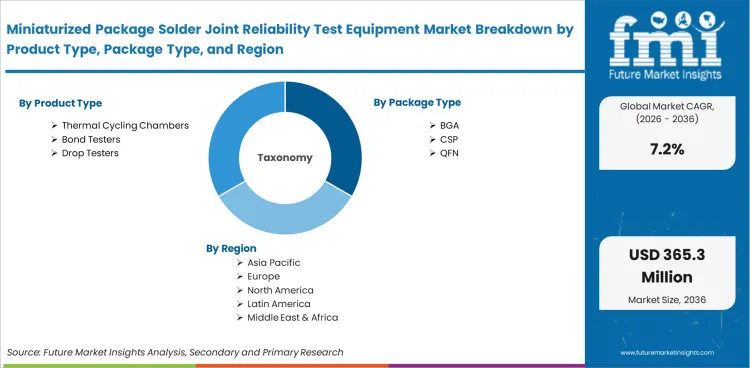
| Metric | Value |
|---|---|
| Quantitative Units | USD 170.0 million to USD 340.7 million, at a CAGR of 7.20% |
| Market Definition | Equipment used to evaluate solder-joint durability in miniaturized semiconductor packages through thermal, mechanical, electrical, and qualification-centered reliability methods. |
| Product Type Segmentation | Thermal Cycling Chambers, Thermal Shock Chambers, Bond Testers, Drop Testers, Resistance Monitors, Combo Systems |
| Package Type Segmentation | BGA, CSP, QFN, WLCSP, Flip Chip, SiP |
| Stress Mode Segmentation | Thermomechanical, Mechanical Shock, Electrical Continuity, Combined Stress |
| Automation Level Segmentation | Manual, Semi-automatic, Fully automatic |
| End User Segmentation | OSATs, IDMs, EMS Firms, Auto Labs, Research Labs |
| Throughput Segmentation | Low Throughput, Mid Throughput, High Throughput |
| Application Segmentation | Qualification Labs, Failure Analysis, Process Validation, Supplier Approval, Life-cycle R&D |
| Regions Covered | North America, East Asia, South Asia and Southeast Asia |
| Countries Covered | India, Vietnam, China, Malaysia, Taiwan, South Korea, United States, and 40 plus countries |
| Key Companies Profiled | ESPEC Corporation, Weiss Technik, Nordson Corporation, Thermotron Industries, Cincinnati Sub-Zero, Associated Environmental Systems |
| Forecast Period | 2026 to 2036 |
| Approach | Primary interviews with reliability labs, package engineering users, and equipment suppliers were combined with public company filings, industry association material, and package qualification literature to build and validate the forecast. |
Source: Future Market Insights (FMI) analysis, based on proprietary forecasting model and primary research
Miniaturized Package Solder Joint Reliability Test Equipment Market Analysis by Segments
Product Type:
- Thermal Cycling Chambers
- Thermal Shock Chambers
- Bond Testers
- Drop Testers
- Resistance Monitors
- Combo Systems
Package Type:
- BGA
- CSP
- QFN
- WLCSP
- Flip Chip
- SiP
Stress Mode:
- Thermomechanical
- Mechanical Shock
- Electrical Continuity
- Combined Stress
Automation Level:
- Manual
- Semi-automatic
- Fully automatic
End User:
- OSATs
- IDMs
- EMS Firms
- Auto Labs
- Research Labs
Throughput:
- Low Throughput
- Mid Throughput
- High Throughput
Application:
- Qualification Labs
- Failure Analysis
- Process Validation
- Supplier Approval
- Life-cycle R&D
Region:
- North America
- United States
- Canada
- Europe
- Germany
- United Kingdom
- France
- Italy
- Spain
- Asia Pacific
- China
- Japan
- South Korea
- Taiwan
- Singapore
- Latin America
- Brazil
- Mexico
- Argentina
- Middle East & Africa
- GCC Countries
- South Africa
Bibliography
- Fowler, H. N., & Buckner, J. L. (2024). Solder joint reliability in fine pitch ball grid arrays.
- Kim, H., & Lee, Y.-S. (2024). Estimation of solder joint reliability in electronic packaging: Insights from finite element analysis on intermetallic compounds and voids.
- Liao, H. H., Su, Q., & Chiang, K.-N. (2024). Combining polynomial regression with unsupervised machine learning on wafer-level packaging reliability prediction.
- Tao, R., Centellas, P., Romberg, S., Kotula, A., Holmes, G., Forster, A., Soles, C., Allen, B., Cetegen, E., Chen, W., Gotro, J., & Poliks, M. (2025). Material needs and measurement challenges for advanced semiconductor packaging: Understanding the soft side of science.
- Bhetuwal, U., Zhou, J., & Fan, X. (2025). Analytical prediction of thermomechanical shear strain in solder joints with FEA validation in electronic packaging. This bibliography is provided for the reader’s reference. The full FMI report contains the complete reference list with primary source documentation.
This Report Addresses
- Market intelligence to support strategic decision making across thermal cycling chambers, thermal shock chambers, bond testers, drop testers, and resistance monitors.
- Market size estimation and ten-year forecasts from 2026 to 2036, supported by qualification workflow analysis and primary market interpretation.
- Growth opportunity mapping across product type, package type, stress mode, automation level, end user, throughput, and application.
- Segment and regional outlooks covering BGA, CSP, QFN, WLCSP, flip chip, and SiP across key electronics and semiconductor manufacturing locations.
- Competition assessment covering method fit, service support, workflow familiarity, and release-oriented reliability capability.
- Application analysis spanning qualification labs, failure analysis, process validation, supplier approval, and life-cycle R&D.
- Country-level growth interpretation for India, Vietnam, China, Malaysia, Taiwan, South Korea, and the United States.
- Scope boundaries that separate dedicated solder-joint reliability equipment from broad ATE, general inline inspection, and non-specialized lab tools.
Frequently Asked Questions
How big is the miniaturized package solder joint reliability test equipment market?
The market is expected to reach USD 170.0 million in 2026.
What is miniaturized package solder joint reliability test equipment?
It includes dedicated systems used to evaluate solder-joint durability in compact semiconductor packages.
Why is this equipment becoming more important?
Smaller package structures are increasing the need for repeatable reliability evidence before release.
How is this different from general semiconductor test equipment?
It focuses on solder-joint durability under stress rather than broad electrical production testing.
Why do thermal cycling chambers lead product demand?
They remain the preferred choice because they fit common fatigue-based qualification routines.
Why does BGA remain the leading package type?
BGA stays ahead because it remains widely used in board-level and package-level reliability programs.
What makes thermomechanical testing the leading stress mode?
It leads because temperature-driven strain remains a major cause of solder-joint failure.
Why do semi-automatic systems stay ahead of fully automatic platforms?
They offer a better balance between workflow control, flexibility, and upgrade cost.
Why do OSATs account for a large share of demand?
OSATs handle frequent customer qualification work and package turnover.
Why do mid throughput systems lead adoption?
They provide practical sample volume without pushing cost too high.
Why do qualification labs lead application demand?
They absorb the most spending because release approval depends on defensible test evidence.
What is the main restraint in this market?
Method continuity remains the main restraint because labs hesitate to break correlation with older approval history.
What creates the next buying wave?
Demand rises when chamber exposure, monitoring, and review can run inside one repeatable method.
Why does India grow faster than mature markets?
India is adding more first-cycle assembly, packaging, and qualification capacity.
Why does the United States grow more slowly?
United States demand depends more on selective upgrades than on first-time lab build-out.
How do older reliability benches lose ground?
They lose ground when repeatability and result defense become harder across smaller package revisions.
What do buyers compare first when selecting equipment?
Buyers usually compare method fit, repeatability, result clarity, and service support first.
Is this a concentrated market?
No, it remains moderately fragmented across different workflow specialists.
Who are the main companies in this market?
Key participants include ESPEC Corporation, Weiss Technik, Nordson Corporation, Thermotron Industries, Cincinnati Sub-Zero, and Associated Environmental Systems.
What falls outside the scope of this market?
General-purpose ATE, broad inline inspection systems, and non-specialized lab tools fall outside the scope.
What happens if labs delay reliability upgrades too long?
Qualification cycles can slow as results become harder to compare and defend.
Why does repeatability matter more than feature range?
Labs value consistent and defensible evidence more than the widest technical feature list.
How do package revisions affect equipment demand?
Frequent package revisions increase demand for systems that preserve method continuity and support clear comparison.
Preview the report firsthand - request a free sample
Get SampleGet the brochure for pricing and purchase details.
Get PDFTable of Content
- Executive Summary
- Global Market Outlook
- Demand-side Trends
- Supply-side Trends
- Technology Roadmap Analysis
- Analysis and Recommendations
- Market Overview
- Market Coverage / Taxonomy
- Market Definition / Scope / Limitations
- Research Methodology
- Chapter Orientation
- Analytical Lens and Working Hypotheses
- Market Structure, Signals, and Trend Drivers
- Benchmarking and Cross-market Comparability
- Market Sizing, Forecasting, and Opportunity Mapping
- Research Design and Evidence Framework
- Desk Research Programme (Secondary Evidence)
- Company Annual and Sustainability Reports
- Peer-reviewed Journals and Academic Literature
- Corporate Websites, Product Literature, and Technical Notes
- Earnings Decks and Investor Briefings
- Statutory Filings and Regulatory Disclosures
- Technical White Papers and Standards Notes
- Trade Journals, Industry Magazines, and Analyst Briefs
- Conference Proceedings, Webinars, and Seminar Materials
- Government Statistics Portals and Public Data Releases
- Press Releases and Reputable Media Coverage
- Specialist Newsletters and Curated Briefings
- Sector Databases and Reference Repositories
- FMI Internal Proprietary Databases and Historical Market Datasets
- Subscription Datasets and Paid Sources
- Social Channels, Communities, and Digital Listening Inputs
- Additional Desk Sources
- Expert Input and Fieldwork (Primary Evidence)
- Primary Modes
- Qualitative Interviews and Expert Elicitation
- Quantitative Surveys and Structured Data Capture
- Blended Approach
- Why Primary Evidence is Used
- Field Techniques
- Interviews
- Surveys
- Focus Groups
- Observational and In-context Research
- Social and Community Interactions
- Stakeholder Universe Engaged
- C-suite Leaders
- Board Members
- Presidents and Vice Presidents
- R&D and Innovation Heads
- Technical Specialists
- Domain Subject-matter Experts
- Scientists
- Physicians and Other Healthcare Professionals
- Governance, Ethics, and Data Stewardship
- Research Ethics
- Data Integrity and Handling
- Primary Modes
- Tooling, Models, and Reference Databases
- Desk Research Programme (Secondary Evidence)
- Data Engineering and Model Build
- Data Acquisition and Ingestion
- Cleaning, Normalisation, and Verification
- Synthesis, Triangulation, and Analysis
- Quality Assurance and Audit Trail
- Market Background
- Market Dynamics
- Drivers
- Restraints
- Opportunity
- Trends
- Scenario Forecast
- Demand in Optimistic Scenario
- Demand in Likely Scenario
- Demand in Conservative Scenario
- Opportunity Map Analysis
- Product Life Cycle Analysis
- Supply Chain Analysis
- Investment Feasibility Matrix
- Value Chain Analysis
- PESTLE and Porter’s Analysis
- Regulatory Landscape
- Regional Parent Market Outlook
- Production and Consumption Statistics
- Import and Export Statistics
- Market Dynamics
- Global Market Analysis 2021 to 2025 and Forecast, 2026 to 2036
- Historical Market Size Value (USD Million) Analysis, 2021 to 2025
- Current and Future Market Size Value (USD Million) Projections, 2026 to 2036
- Y-o-Y Growth Trend Analysis
- Absolute $ Opportunity Analysis
- Global Market Pricing Analysis 2021 to 2025 and Forecast 2026 to 2036
- Global Market Analysis 2021 to 2025 and Forecast 2026 to 2036, By Product Type
- Introduction / Key Findings
- Historical Market Size Value (USD Million) Analysis By Product Type , 2021 to 2025
- Current and Future Market Size Value (USD Million) Analysis and Forecast By Product Type , 2026 to 2036
- Thermal Cycling Chambers
- Bond Testers
- Drop Testers
- Thermal Cycling Chambers
- Y-o-Y Growth Trend Analysis By Product Type , 2021 to 2025
- Absolute $ Opportunity Analysis By Product Type , 2026 to 2036
- Global Market Analysis 2021 to 2025 and Forecast 2026 to 2036, By Package Type
- Introduction / Key Findings
- Historical Market Size Value (USD Million) Analysis By Package Type, 2021 to 2025
- Current and Future Market Size Value (USD Million) Analysis and Forecast By Package Type, 2026 to 2036
- BGA
- CSP
- QFN
- BGA
- Y-o-Y Growth Trend Analysis By Package Type, 2021 to 2025
- Absolute $ Opportunity Analysis By Package Type, 2026 to 2036
- Global Market Analysis 2021 to 2025 and Forecast 2026 to 2036, By Stress Mode
- Introduction / Key Findings
- Historical Market Size Value (USD Million) Analysis By Stress Mode, 2021 to 2025
- Current and Future Market Size Value (USD Million) Analysis and Forecast By Stress Mode, 2026 to 2036
- Thermomechanical
- Mechanical Shock
- Others
- Thermomechanical
- Y-o-Y Growth Trend Analysis By Stress Mode, 2021 to 2025
- Absolute $ Opportunity Analysis By Stress Mode, 2026 to 2036
- Global Market Analysis 2021 to 2025 and Forecast 2026 to 2036, By Automation Level
- Introduction / Key Findings
- Historical Market Size Value (USD Million) Analysis By Automation Level, 2021 to 2025
- Current and Future Market Size Value (USD Million) Analysis and Forecast By Automation Level, 2026 to 2036
- Semi-Automatic
- Manual
- Fully Automatic
- Semi-Automatic
- Y-o-Y Growth Trend Analysis By Automation Level, 2021 to 2025
- Absolute $ Opportunity Analysis By Automation Level, 2026 to 2036
- Global Market Analysis 2021 to 2025 and Forecast 2026 to 2036, By End User
- Introduction / Key Findings
- Historical Market Size Value (USD Million) Analysis By End User, 2021 to 2025
- Current and Future Market Size Value (USD Million) Analysis and Forecast By End User, 2026 to 2036
- OSAT
- IDMs
- EMS Firms
- OSAT
- Y-o-Y Growth Trend Analysis By End User, 2021 to 2025
- Absolute $ Opportunity Analysis By End User, 2026 to 2036
- Global Market Analysis 2021 to 2025 and Forecast 2026 to 2036, By Throughput
- Introduction / Key Findings
- Historical Market Size Value (USD Million) Analysis By Throughput, 2021 to 2025
- Current and Future Market Size Value (USD Million) Analysis and Forecast By Throughput, 2026 to 2036
- Mid-Throughput
- Low Throughput
- High Throughput
- Mid-Throughput
- Y-o-Y Growth Trend Analysis By Throughput, 2021 to 2025
- Absolute $ Opportunity Analysis By Throughput, 2026 to 2036
- Global Market Analysis 2021 to 2025 and Forecast 2026 to 2036, By Application
- Introduction / Key Findings
- Historical Market Size Value (USD Million) Analysis By Application, 2021 to 2025
- Current and Future Market Size Value (USD Million) Analysis and Forecast By Application, 2026 to 2036
- Qualification Labs
- Failure Analysis
- Process Validation
- Qualification Labs
- Y-o-Y Growth Trend Analysis By Application, 2021 to 2025
- Absolute $ Opportunity Analysis By Application, 2026 to 2036
- Global Market Analysis 2021 to 2025 and Forecast 2026 to 2036, By Region
- Introduction
- Historical Market Size Value (USD Million) Analysis By Region, 2021 to 2025
- Current Market Size Value (USD Million) Analysis and Forecast By Region, 2026 to 2036
- North America
- Latin America
- Western Europe
- Eastern Europe
- East Asia
- South Asia and Pacific
- Middle East & Africa
- Market Attractiveness Analysis By Region
- North America Market Analysis 2021 to 2025 and Forecast 2026 to 2036, By Country
- Historical Market Size Value (USD Million) Trend Analysis By Market Taxonomy, 2021 to 2025
- Market Size Value (USD Million) Forecast By Market Taxonomy, 2026 to 2036
- By Country
- USA
- Canada
- Mexico
- By Product Type
- By Package Type
- By Stress Mode
- By Automation Level
- By End User
- By Throughput
- By Application
- By Country
- Market Attractiveness Analysis
- By Country
- By Product Type
- By Package Type
- By Stress Mode
- By Automation Level
- By End User
- By Throughput
- By Application
- Key Takeaways
- Latin America Market Analysis 2021 to 2025 and Forecast 2026 to 2036, By Country
- Historical Market Size Value (USD Million) Trend Analysis By Market Taxonomy, 2021 to 2025
- Market Size Value (USD Million) Forecast By Market Taxonomy, 2026 to 2036
- By Country
- Brazil
- Chile
- Rest of Latin America
- By Product Type
- By Package Type
- By Stress Mode
- By Automation Level
- By End User
- By Throughput
- By Application
- By Country
- Market Attractiveness Analysis
- By Country
- By Product Type
- By Package Type
- By Stress Mode
- By Automation Level
- By End User
- By Throughput
- By Application
- Key Takeaways
- Western Europe Market Analysis 2021 to 2025 and Forecast 2026 to 2036, By Country
- Historical Market Size Value (USD Million) Trend Analysis By Market Taxonomy, 2021 to 2025
- Market Size Value (USD Million) Forecast By Market Taxonomy, 2026 to 2036
- By Country
- Germany
- UK
- Italy
- Spain
- France
- Nordic
- BENELUX
- Rest of Western Europe
- By Product Type
- By Package Type
- By Stress Mode
- By Automation Level
- By End User
- By Throughput
- By Application
- By Country
- Market Attractiveness Analysis
- By Country
- By Product Type
- By Package Type
- By Stress Mode
- By Automation Level
- By End User
- By Throughput
- By Application
- Key Takeaways
- Eastern Europe Market Analysis 2021 to 2025 and Forecast 2026 to 2036, By Country
- Historical Market Size Value (USD Million) Trend Analysis By Market Taxonomy, 2021 to 2025
- Market Size Value (USD Million) Forecast By Market Taxonomy, 2026 to 2036
- By Country
- Russia
- Poland
- Hungary
- Balkan & Baltic
- Rest of Eastern Europe
- By Product Type
- By Package Type
- By Stress Mode
- By Automation Level
- By End User
- By Throughput
- By Application
- By Country
- Market Attractiveness Analysis
- By Country
- By Product Type
- By Package Type
- By Stress Mode
- By Automation Level
- By End User
- By Throughput
- By Application
- Key Takeaways
- East Asia Market Analysis 2021 to 2025 and Forecast 2026 to 2036, By Country
- Historical Market Size Value (USD Million) Trend Analysis By Market Taxonomy, 2021 to 2025
- Market Size Value (USD Million) Forecast By Market Taxonomy, 2026 to 2036
- By Country
- China
- Japan
- South Korea
- By Product Type
- By Package Type
- By Stress Mode
- By Automation Level
- By End User
- By Throughput
- By Application
- By Country
- Market Attractiveness Analysis
- By Country
- By Product Type
- By Package Type
- By Stress Mode
- By Automation Level
- By End User
- By Throughput
- By Application
- Key Takeaways
- South Asia and Pacific Market Analysis 2021 to 2025 and Forecast 2026 to 2036, By Country
- Historical Market Size Value (USD Million) Trend Analysis By Market Taxonomy, 2021 to 2025
- Market Size Value (USD Million) Forecast By Market Taxonomy, 2026 to 2036
- By Country
- India
- ASEAN
- Australia & New Zealand
- Rest of South Asia and Pacific
- By Product Type
- By Package Type
- By Stress Mode
- By Automation Level
- By End User
- By Throughput
- By Application
- By Country
- Market Attractiveness Analysis
- By Country
- By Product Type
- By Package Type
- By Stress Mode
- By Automation Level
- By End User
- By Throughput
- By Application
- Key Takeaways
- Middle East & Africa Market Analysis 2021 to 2025 and Forecast 2026 to 2036, By Country
- Historical Market Size Value (USD Million) Trend Analysis By Market Taxonomy, 2021 to 2025
- Market Size Value (USD Million) Forecast By Market Taxonomy, 2026 to 2036
- By Country
- Kingdom of Saudi Arabia
- Other GCC Countries
- Turkiye
- South Africa
- Other African Union
- Rest of Middle East & Africa
- By Product Type
- By Package Type
- By Stress Mode
- By Automation Level
- By End User
- By Throughput
- By Application
- By Country
- Market Attractiveness Analysis
- By Country
- By Product Type
- By Package Type
- By Stress Mode
- By Automation Level
- By End User
- By Throughput
- By Application
- Key Takeaways
- Key Countries Market Analysis
- USA
- Pricing Analysis
- Market Share Analysis, 2025
- By Product Type
- By Package Type
- By Stress Mode
- By Automation Level
- By End User
- By Throughput
- By Application
- Canada
- Pricing Analysis
- Market Share Analysis, 2025
- By Product Type
- By Package Type
- By Stress Mode
- By Automation Level
- By End User
- By Throughput
- By Application
- Mexico
- Pricing Analysis
- Market Share Analysis, 2025
- By Product Type
- By Package Type
- By Stress Mode
- By Automation Level
- By End User
- By Throughput
- By Application
- Brazil
- Pricing Analysis
- Market Share Analysis, 2025
- By Product Type
- By Package Type
- By Stress Mode
- By Automation Level
- By End User
- By Throughput
- By Application
- Chile
- Pricing Analysis
- Market Share Analysis, 2025
- By Product Type
- By Package Type
- By Stress Mode
- By Automation Level
- By End User
- By Throughput
- By Application
- Germany
- Pricing Analysis
- Market Share Analysis, 2025
- By Product Type
- By Package Type
- By Stress Mode
- By Automation Level
- By End User
- By Throughput
- By Application
- UK
- Pricing Analysis
- Market Share Analysis, 2025
- By Product Type
- By Package Type
- By Stress Mode
- By Automation Level
- By End User
- By Throughput
- By Application
- Italy
- Pricing Analysis
- Market Share Analysis, 2025
- By Product Type
- By Package Type
- By Stress Mode
- By Automation Level
- By End User
- By Throughput
- By Application
- Spain
- Pricing Analysis
- Market Share Analysis, 2025
- By Product Type
- By Package Type
- By Stress Mode
- By Automation Level
- By End User
- By Throughput
- By Application
- France
- Pricing Analysis
- Market Share Analysis, 2025
- By Product Type
- By Package Type
- By Stress Mode
- By Automation Level
- By End User
- By Throughput
- By Application
- India
- Pricing Analysis
- Market Share Analysis, 2025
- By Product Type
- By Package Type
- By Stress Mode
- By Automation Level
- By End User
- By Throughput
- By Application
- ASEAN
- Pricing Analysis
- Market Share Analysis, 2025
- By Product Type
- By Package Type
- By Stress Mode
- By Automation Level
- By End User
- By Throughput
- By Application
- Australia & New Zealand
- Pricing Analysis
- Market Share Analysis, 2025
- By Product Type
- By Package Type
- By Stress Mode
- By Automation Level
- By End User
- By Throughput
- By Application
- China
- Pricing Analysis
- Market Share Analysis, 2025
- By Product Type
- By Package Type
- By Stress Mode
- By Automation Level
- By End User
- By Throughput
- By Application
- Japan
- Pricing Analysis
- Market Share Analysis, 2025
- By Product Type
- By Package Type
- By Stress Mode
- By Automation Level
- By End User
- By Throughput
- By Application
- South Korea
- Pricing Analysis
- Market Share Analysis, 2025
- By Product Type
- By Package Type
- By Stress Mode
- By Automation Level
- By End User
- By Throughput
- By Application
- Russia
- Pricing Analysis
- Market Share Analysis, 2025
- By Product Type
- By Package Type
- By Stress Mode
- By Automation Level
- By End User
- By Throughput
- By Application
- Poland
- Pricing Analysis
- Market Share Analysis, 2025
- By Product Type
- By Package Type
- By Stress Mode
- By Automation Level
- By End User
- By Throughput
- By Application
- Hungary
- Pricing Analysis
- Market Share Analysis, 2025
- By Product Type
- By Package Type
- By Stress Mode
- By Automation Level
- By End User
- By Throughput
- By Application
- Kingdom of Saudi Arabia
- Pricing Analysis
- Market Share Analysis, 2025
- By Product Type
- By Package Type
- By Stress Mode
- By Automation Level
- By End User
- By Throughput
- By Application
- Turkiye
- Pricing Analysis
- Market Share Analysis, 2025
- By Product Type
- By Package Type
- By Stress Mode
- By Automation Level
- By End User
- By Throughput
- By Application
- South Africa
- Pricing Analysis
- Market Share Analysis, 2025
- By Product Type
- By Package Type
- By Stress Mode
- By Automation Level
- By End User
- By Throughput
- By Application
- USA
- Market Structure Analysis
- Competition Dashboard
- Competition Benchmarking
- Market Share Analysis of Top Players
- By Regional
- By Product Type
- By Package Type
- By Stress Mode
- By Automation Level
- By End User
- By Throughput
- By Application
- Competition Analysis
- Competition Deep Dive
- Competition Deep Dive
- Assumptions & Acronyms Used


