

- Market Size (2026)
- USD 2.80 Bn
- Forecast (2036)
- USD 6.40 Bn
- CAGR (2026 to 2036)
- 8.4%
Modular Linear Industrial Lighting Market Size, Forecast, and Outlook By FMI
Summary of the Modular Linear Industrial Lighting Market
- Demand and Growth Drivers
- Warehouse refurbishment is the leading demand trigger as operators need even aisle lighting and faster installation.
- Manufacturing buyers prefer row systems that can be moved or extended when production lines change.
- Controls readiness supports the forecast as buyers avoid rewiring costs after sensors are added.
- Lighting contractors favor trunking rails when projects need repeat mounting points and cleaner cable routing.
- Product and Segment View
- Trunking systems are projected to hold 35.0% share in 2026 as they combine power distribution and luminaire mounting.
- Warehouses are expected to account for 34.0% share in 2026 due to aisle length and high fixture count.
- Track mounted installation is forecast to hold 42.0% share in 2026 as rows are specified before final fixture placement.
- Sensor-ready products are projected to account for 46.0% share in 2026 as energy reporting becomes easier to add.
- Geography and Competitive Outlook
- Japan is forecast to record 10.6% CAGR through 2036 as factory renewal supports premium row systems.
- France is expected to expand at 10.0% CAGR through 2036 as output recovery supports industrial upgrades.
- Zumtobel Group and TRILUX lead on trunking depth while Signify and Acuity Brands extend channel reach.
- Legrand and Schneider Electric shape controls readiness through lighting control and building management interfaces.
- Analyst Opinion
- Nikhil Kaitwade, Principal Consultant at FMI, says, “The opportunity in modular linear industrial lighting extends well beyond routine fixture replacement. Buying decisions are increasingly shifting toward row‑based infrastructure that integrates power distribution and controls readiness within a single system, enabling plants and warehouses to adapt as layouts, automation, and monitoring needs evolve. Suppliers that can demonstrate fast, low‑error installation and a clean handover for sensors and controls are more likely to be viewed as long‑term project partners and not commodity vendors. "
- Modular Linear Industrial Lighting Market Value Analysis
- Warehouse expansion and layout churn are accelerating adoption as e‑commerce growth and higher SKU turnover push operators toward modular linear systems that can be extended or re‑spaced without full rewiring and retrofit costs.
- Controls and sensor readiness requirements are driving demand as industrial buyers increasingly specify lighting rows as platforms for sensing and future automation rather than standalone illumination.
- Pressure to reduce installed energy load continues to support market value as modular linear systems combine high‑efficiency solid‑state luminaires with system‑level gains from optimized spacing and smart‑control compatibility.
- A shift from fixture purchasing to project risk management is favoring integrated row‑based systems as buyers prioritize installation speed and long‑term flexibility over lowest unit price.
Key Takeaways, Market Size, and Forecast
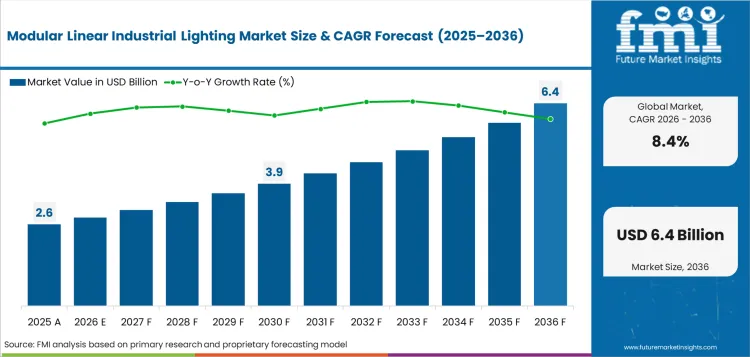
- The modular linear industrial lighting market was valued at USD 2.58 billion in 2025 after the supplied forecast anchors were normalized.
- Revenue is projected to reach USD 2.80 billion in 2026 and USD 6.40 billion by 2036.
- From 2026 to 2036, the industry is forecast to expand at 8.4% CAGR under the supplied forecast case.
- The sector is projected to create USD 3.60 billion in incremental opportunity between 2026 and 2036.
- Trunking systems are projected to account for 35.0% of product type demand in 2026.
- Warehouses are expected to hold 34.0% of end-use demand in 2026 as rack aisles need long continuous rows.
- Sensor-ready systems are projected to account for 46.0% of controls readiness demand in 2026.
- Japan at 10.6% CAGR and France at 10.0% CAGR are forecast above the global pace through 2036.
Multi-zone coverage helps distributors reduce fixture complexity. Raytec Warrior Linear documentation from 2024 states that non-emergency products are available as DALI 2.0-enabled variants. Control-ready linear lighting supports dimming and monitoring in process corridors. Lena Lighting’s 2025 catalogue lists Linea S LED with luminous efficacy above 172 lm/W for industrial and warehouse use. Efficiency gives buyers a direct operating-cost reason to replace older linear strips and battens.
Modular Linear Industrial Lighting Market Definition
The modular linear industrial lighting market covers linear LED luminaires and rail-based systems used in warehouses and factories. Retail back-of-house areas and parking structures are included when linear industrial rows are specified. The scope touches led displays lighting and fixtures only when lighting fixtures are sold for illumination. Scope includes trunking systems and batten modules. Continuous rows and hybrid high-bay linear fixtures are included as fixture-ready systems. It covers fixture-ready modules and row infrastructure that can carry power and control signals. It excludes decorative architectural strips and consumer lighting products.
Modular Linear Industrial Lighting Market Inclusions
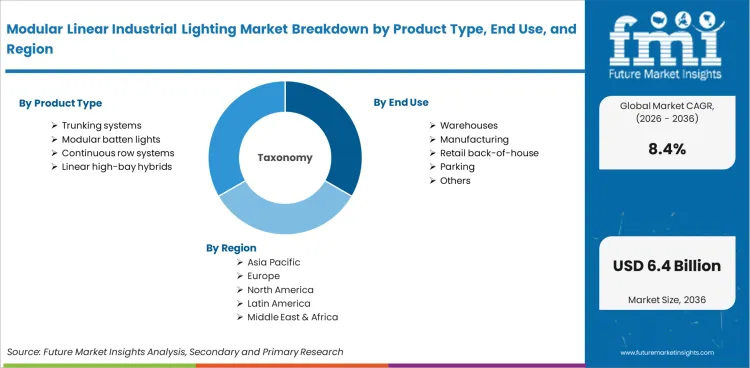
The modular linear industrial lighting market includes linear LED luminaires and rail‑based systems designed for industrial operating spaces, with product scope covering trunking systems, modular batten lights, continuous row configurations, and linear high‑bay hybrid fixtures. End‑use coverage focuses primarily on warehouses and manufacturing facilities, while also extending to retail back‑of‑house areas and parking support spaces where industrial linear rows are specified. Installation formats within scope include track‑mounted, suspended, and surface‑mounted systems suited to industrial ceilings and workspace layouts. The controls dimension encompasses basic, sensor‑ready, and networked products aligned with intelligent lighting control requirements, including future compatibility with sensing and automation functions.
Modular Linear Industrial Lighting Market Exclusions
The scope excludes consumer lamps, decorative architectural strips, and non‑linear general ceiling products that are sold outside industrial applications. Large outdoor pole‑mounted lighting is not included unless explicitly specified as a linear industrial row solution. Standalone building automation software is excluded when it is sold independently of the luminaire or control hardware, as the market definition centers on lighting system revenue rather than software platforms. General electrical cable trays are also excluded unless they are supplied as an integrated component of a lighting trunking system.
Modular Linear Industrial Lighting Market Research Methodology
- Primary Research: FMI analysts reviewed supplier portfolios and contractor workflows. Warehouse lighting plans and control-readiness needs were checked across major industrial countries.
- Desk Research: The study used public data from energy agencies and national statistics bodies. Trade sources and official company announcements were used for company signals.
- Market Sizing and Forecasting: Market size was estimated using supplied anchors, parent lighting checks and end-use demand mapping across industrial buildings.
- Data Validation: Forecast checks compared industrial lighting shipments and warehouse retrofit exposure. Manufacturing output and supplier launches were checked for row lighting signals.
Why is the Modular Linear Industrial Lighting Market Growing?
- Warehouse operators need long aisle rows that can deliver even light with fewer mounting changes during retrofit work.
- Factory teams choose modular rows when production areas need repeat fixture spacing and future line changes.
- Sensor-ready products lower later upgrade cost by allowing controls to be added after the lighting row is installed.
- Contractors prefer trunking rails as prewired rows reduce on-site wiring time and improve handover clarity.
Industrial buildings are turning lighting rows into part of the operating system. The United States Census Bureau reported USD 1.558 billion in electric lighting equipment shipments for March 2026. This shows a sizable product pool in which modular linear systems can gain share. Modular products have room to expand when buyers replace old point fixtures with cleaner rows and light management system compatibility.
Energy and labor cost pressure both support row-based purchases. A trunking line can carry fixtures, emergency units and sensors on one continuous rail. That lowers change work when rack layouts or production cells move. Buyers that once bought a simple led lamp now ask whether the full row can support controls and service access.
Market Segmentation Analysis
- Trunking systems are projected to account for 35.0% of product type demand in 2026 due to faster row setup.
- Warehouses are expected to account for 34.0% of end-use demand in 2026 as aisle lighting needs repeat spacing.
- Track mounted installation is forecast to capture 42.0% share in 2026 as contractors prefer adjustable fixture placement.
- Sensor-ready systems are projected to hold 46.0% share in 2026 as buyers prepare for later control upgrades.
The market is divided into four primary segment groups. These groups cover product type and end use. Installation and controls readiness complete the breakdown. Product type explains the mechanical system that buyers specify first. End use shows where rows are installed and which operating needs drive the order. Installation and controls readiness show whether the system is a basic lighting purchase or a platform for future building intelligence.
Insights into the Trunking Systems Product Type Segment
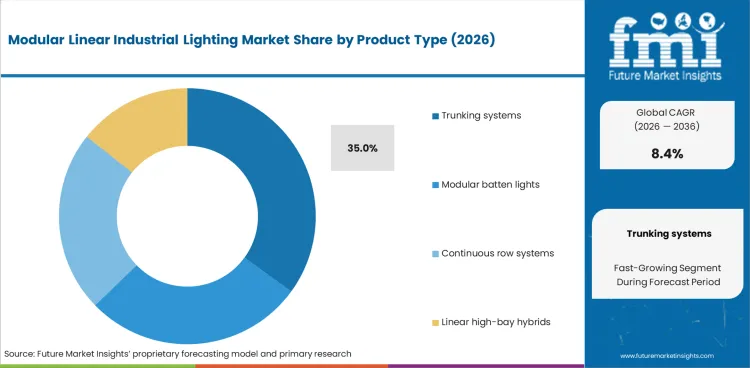
- Trunking systems are projected to account for 35.0% of product type demand in 2026. These systems give buyers a single rail for power and control pathways.
- Continuous rows and modular battens serve similar spaces but do not always provide the same wiring flexibility.
Insights into the Warehouses End Use Segment
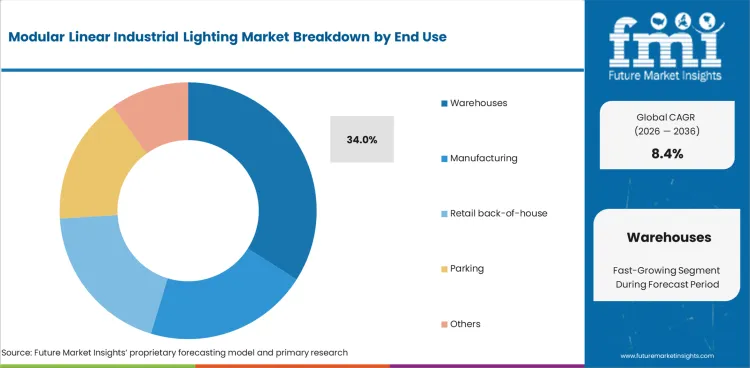
- Warehouses are expected to account for 34.0% of end-use demand in 2026. Long racking aisles need consistent row spacing and light levels that match movement zones. The segment gains support from automation areas where pick to light and scanning work need clear visual cues.
- Manufacturing follows warehouses because production floors require task-specific optics and fixture protection. Metallurgical lighting shows how harsh industrial areas shape fixture durability.
Insights into the Track Mounted Installation Segment
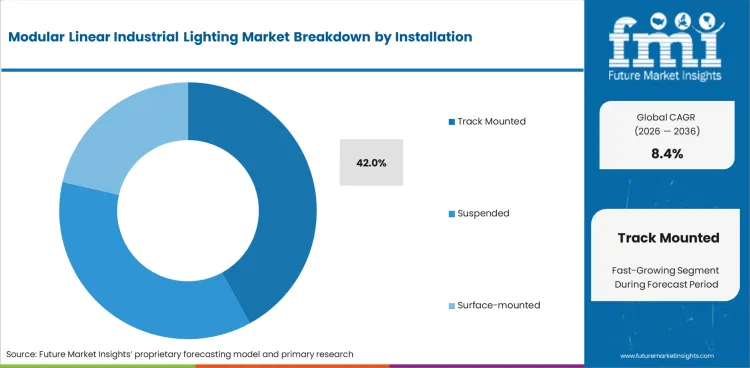
- Track mounted installation is forecast to hold 42.0% share in 2026. Contractors prefer this format when final fixture positions may change during project commissioning.
- Suspended systems remain useful in open halls where ceiling height and beam angle need careful adjustment. Surface-mounted rows fit lower ceilings and back-of-house rooms.
Insights into the Sensor-ready Controls Readiness Segment
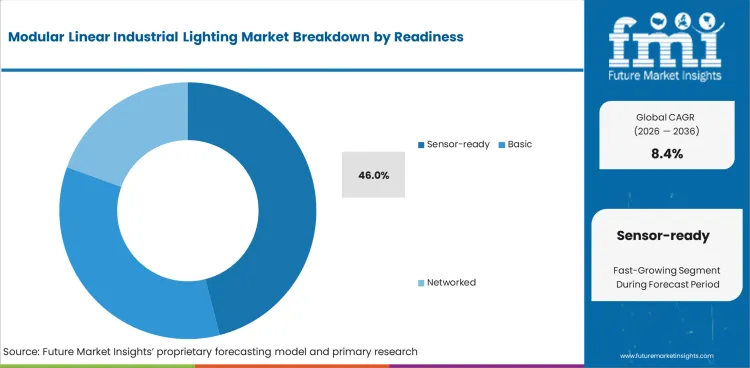
- Sensor-ready systems are projected to account for 46.0% of controls readiness demand in 2026. Buyers often install the lighting row before the full control plan is approved.
- A sensor-ready fixture gives them a lower-risk path to add dimming, occupancy response and data points later. The occupancy sensor link is becoming more important in aisle and zone control.
Modular Linear Industrial Lighting Market Drivers Restraints and Opportunities
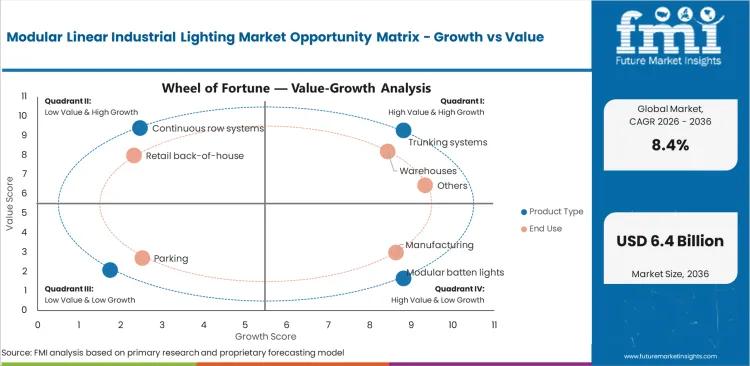
- Warehouse row replacement is expected to increase modular system use in tall aisles and order packing areas.
- Controls readiness creates an upgrade route as sensors and light control switches move into industrial spaces.
- Fixture price remains a restraint where buyers compare linear systems against basic LED replacements.
- Service-backed supply creates an opportunity for lighting as a service contracts in multi-site portfolios.
Energy cost and site labor are the two significant drivers behind modular linear lighting adoption. The International Energy Agency linked lighting to about 8% of global electricity demand in 2024 across buildings and outdoor uses. That figure gives building owners a reason to keep lighting efficiency on the capital plan. Modular systems gain when one rail can serve lighting, controls and future spacing changes.
Price pressure remains the main restraint for smaller sites. Eurostat reported in May 2026 that industrial producer prices rose 3.2% month on month in the European Union during March 2026. Higher input costs make buyers compare fixture cost against payback. Suppliers can offset this pressure when they show faster installation and lower service disruption.
Sensor Rail Upgrades
The strongest opportunity is the sensor-ready rail. This format lets a facility begin with efficient lighting and add controls after operating patterns are clearer. This supports human-centric lighting in work areas that need visual comfort. Buyers will favor suppliers that document driver choice, sensor fit and commissioning steps before the order closes.
Analysis of Modular Linear Industrial Lighting Market by Key Countries
.webp "Top Country Growth Comparison Modular Linear Industrial Lighting Market Cagr (2026 2036)")
| Country | CAGR |
|---|---|
| Japan | 10.6% |
| France | 10.0% |
| United Kingdom | 9.3% |
| Germany | 8.7% |
| India | 7.8% |
| China | 7.5% |
| United States | 7.0% |
Source: Future Market Insights, 2026.
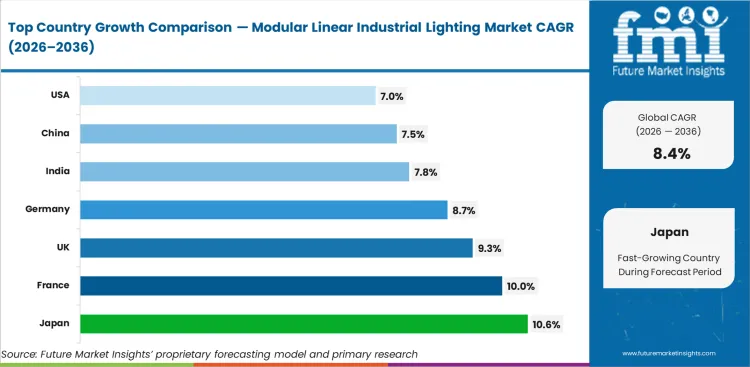
Modular Linear Industrial Lighting Market CAGR Analysis by Country
- Japan is projected to record a 10.6% CAGR through 2036 as precision factories invest in controlled lighting rows.
- France is expected to expand at 10.0% CAGR through 2036 as industrial output recovery supports lighting upgrades.
- The United Kingdom is forecast to grow at 9.3% CAGR through 2036 as refurbishment channels support back-of-house rows.
- Germany is expected to advance at 8.7% CAGR through 2036 as factory orders support production-area renewals.
- India is projected to rise at 7.8% CAGR through 2036 as electronics and logistics spaces expand.
- China is forecast at 7.5% CAGR through 2036 as manufacturing scale supports broad but price-aware adoption.
- The United States is expected to post 7.0% CAGR through 2036 as mature replacement activity drives steady row demand.
Country performance is tied to facility renewal, manufacturing activity and controls readiness. Japan and France track above the global pace because premium industrial sites can justify structured row systems. India, China and the United States grow below the global pace in this forecast because price checks and mature replacement cycles slow the move to higher-value systems.
Demand Outlook for Modular Linear Industrial Lighting in Japan
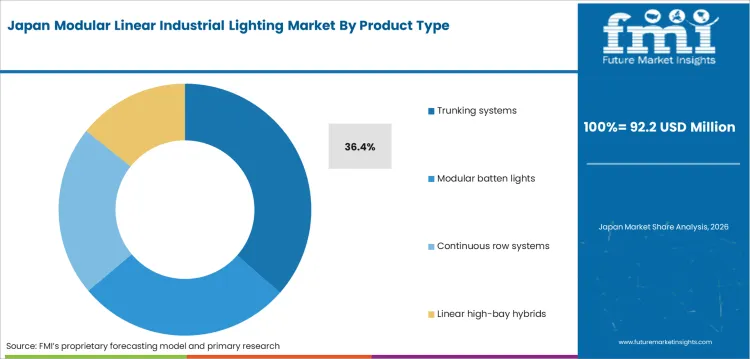
Japan is projected to record a 10.6% CAGR through 2036 as precision production sites require stable visual conditions. Japan Electronics and Information Technology Industries Association data showed electronic components and devices production at 645,673 million yen in June 2025. This production setting supports lighting rows near inspection benches and equipment lines. Suppliers with low-glare optics and reliable driver data should find stronger acceptance.
- Electronics factories need uniform rows around inspection and assembly lines that require visual accuracy.
- Automotive suppliers can use suspended linear rows in trim and parts handling spaces.
- Premium buyers will favor sensor-ready systems that can support later control upgrades.
Sales Analysis of Modular Linear Industrial Lighting in France
France is expected to expand at 10.0% CAGR through 2036 as industrial output improves after uneven demand cycles. Institut National de la Statistique et des Etudes Economiques reported that manufacturing output increased 1.2% in March 2026. That gain supports lighting upgrades in plants that are restarting deferred work. Modular battens and trunking rows should benefit when contractors need shorter installation windows.
- Food and logistics sites can use linear rows where hygiene access and clear aisles both matter.
- Industrial renovation work supports trunking systems that allow fixtures to be repositioned after layout changes.
- Lighting groups with local specification teams can defend value against low-cost replacement products.
Future Outlook for Modular Linear Industrial Lighting in the United Kingdom
The United Kingdom is forecast to grow at 9.3% CAGR through 2036 as refurbishment channels favor installer-ready products. The Office for National Statistics reported that computer, electronic and optical products rose 3.3% in the fourth quarter of 2025. This supports demand from technical workspaces and warehouse service zones. Ecolink-style trade channels will make basic linear products easier to source for smaller projects.
- Installer-led projects are expected to favor modular battens and simple track rows.
- Retail back-of-house areas create demand for short continuous runs near loading and stock rooms.
- Connected products will gain where energy managers want dimming and timed zone control.
Opportunity Analysis of Modular Linear Industrial Lighting in Germany
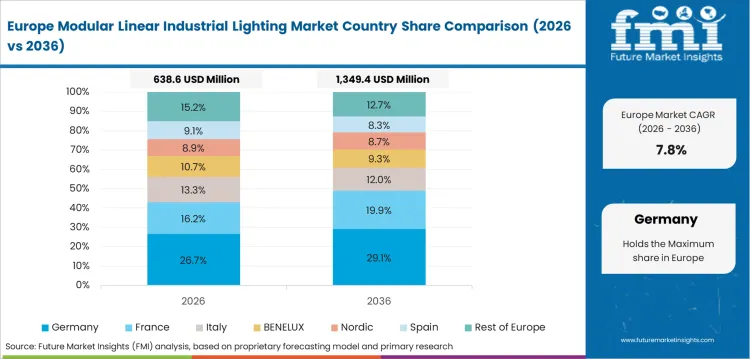
Germany is expected to advance at 8.7% CAGR through 2036 as factory order recovery supports industrial relighting. The Federal Statistical Office reported a 21.5% monthly rise in new orders for electrical equipment in March 2026. That order flow supports projects linked to machinery, automation and workcell upgrades. German buyers will test row systems on installation quality before scaling across sites.
- Automotive and machinery halls need continuous rows that can adjust to new process layouts.
- Specification teams will favor ENEC-tested systems where safety evidence is easy to document.
- TRILUX and Zumtobel Group hold strong positions in trunking and continuous row projects.
Demand Outlook for Modular Linear Industrial Lighting in India
India is projected to rise at 7.8% CAGR through 2036 as electronics and logistics spaces add controlled lighting. The Press Information Bureau of India reported electronics production of Rs. 11.3 lakh crore in 2024 to 2025. This raises the number of plants that need efficient row lighting in assembly and testing areas. Price-sensitive projects will still favor basic systems unless payback is clear.
- Electronics clusters can use modular battens near work benches and component assembly areas.
- Warehouse growth supports track mounted rows where rack plans change after building handover.
- Networked controls will grow slowly until buyers see clear energy savings and service support.
Sales Analysis of Modular Linear Industrial Lighting in China
China is forecast at 7.5% CAGR through 2036 as manufacturing scale supports broad replacement demand. National Bureau of Statistics of China data showed electrical machinery and apparatus manufacturing up 8.7% from January to February 2026. Computers and communication equipment manufacturing rose 14.2% during the same period. This supports modular lighting in plants but price competition will keep margins under pressure.
- Local factories can use trunking systems in electronics, machinery and storage buildings.
- Suppliers must balance fixture cost with service support as buyers compare many domestic options.
- Networked rows can gain in export-oriented factories that track energy and maintenance data.
Demand Outlook for Modular Linear Industrial Lighting in the United States
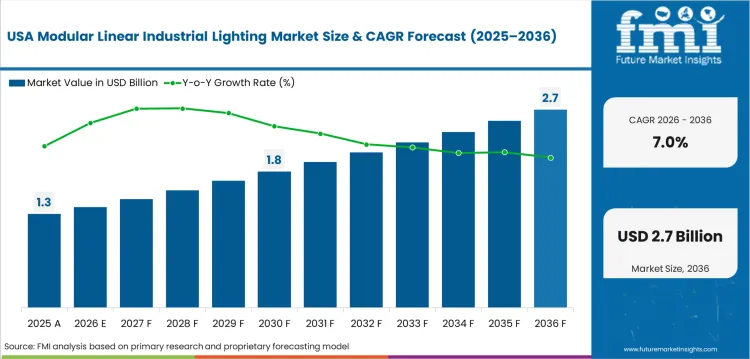
The United States is expected to post 7.0% CAGR through 2036 as replacement work stays steady across warehouses and plants. The United States Census Bureau reported USD 4.487 billion in electric lighting equipment shipments during the first three months of 2026. That figure was 6.3% above the same period in 2025. Modular rows should gain in warehouses where buyers need better aisle control and fewer service visits.
- Large distribution centers can use track mounted rows to match racking and picking zones.
- Manufacturing sites will keep buying linear high-bay hybrids for taller production halls.
- Acuity Brands and Eaton provide local channel strength across industrial lighting and controls.
Competitive Landscape and Strategic Positioning
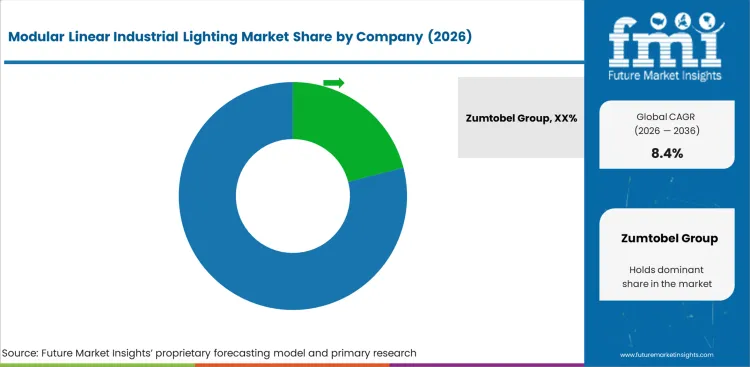
- The market is led by suppliers that combine trunking depth, controls options and contractor support.
- Zumtobel Group and TRILUX stand out in continuous row systems for Europe-based industrial projects.
- Signify and Acuity Brands bring wider channel access across trade and specification-led projects.
- Legrand, Schneider Electric and Eaton shape controls readiness through interfaces and building systems.
- ABB and Panasonic Lighting support adjacent electrical and lighting ecosystems in selected regions.
Competitive advantage is shifting from luminaire catalog size to project execution. Buyers ask whether rows can be installed quickly and handed over with clear control options. Zumtobel Group points to TECTON II with 15 poles for connectivity. This matters for continuous rows that need lighting, emergency features and data-ready pathways inside one trunking rail.
Controls suppliers are becoming more relevant to linear lighting orders. Legrand launched Wattstopper i3 in April 2025 to combine lighting and occupancy sensor data into one interface. Schneider Electric moved in the same direction with mid-market building platforms. These developments show how modular lighting is moving closer to building intelligence than simple fixture replacement.
Industrial and warehouse channels create another split. Acuity Brands, Eaton and Signify can reach contractors who need available stock and support for phased replacement. TRILUX and Fagerhult Group defend specification positions through technical systems and connected lighting. Panasonic Lighting and ABB remain relevant where electrical infrastructure and regional project channels shape buying choices.
Key Companies in the Modular Linear Industrial Lighting Market
Competition is best read by role because trunking supply, lighting integration and control readiness differ sharply.
- Trunking and Row System Leaders: Zumtobel Group, TRILUX and Fagerhult Group compete through continuous row platforms and industrial specification support.
- Industrial Lighting Integrators: Signify, Acuity Brands and Panasonic Lighting serve project channels with linear fixtures and trade-ready ranges.
- Controls and Electrical Infrastructure Firms: Legrand and Schneider Electric support sensor-ready systems. Eaton and ABB support building-level control integration.
Competitive Benchmarking: Modular Linear Industrial Lighting Market
| Company | Trunking Depth | Controls Interface | Retrofit Support | Footprint |
|---|---|---|---|---|
| Zumtobel Group | High | Strong | Strong | Global with Europe strength |
| Signify | Medium | Strong | Strong | Global trade and project reach |
| Acuity Brands | Medium | Strong | Strong | North America centered |
| TRILUX | High | Strong | Strong | Europe centered |
| Legrand | Low | High | Medium | Global controls reach |
| Schneider Electric | Low | High | Medium | Global building systems reach |
| Eaton | Medium | Strong | Strong | North America and industrial channels |
| ABB | Low | Strong | Medium | Global electrical infrastructure reach |
| Fagerhult Group | Medium | Strong | Medium | Europe and Nordic strength |
| Panasonic Lighting | Medium | Medium | Medium | Japan and Asia centered |
Source: Future Market Insights competitive analysis, 2026. Ratings reflect relative positioning across trunking depth, controls interface and retrofit support.
Key Developments in Modular Linear Industrial Lighting Market
- In May 2025, Zumtobel launched TECTON II as the second generation of its continuous-row lighting system.
- In March 2026, TRILUX presented E-Line Pro IP50 certification and Yonos ENEC certification progress.
- In April 2025, Legrand launched Wattstopper i3 with KODE Labs for lighting and building intelligence.
- In December 2025 Eaton expanded intelligent fixture documentation for Champ PVML lighting controls.
- In July 2025 Schneider Electric launched EcoStruxure Building Activate for mid-market facilities in Australia and New
Market Analysis by Segments
-
By Product Type:
- Trunking systems
- Modular batten lights
- Continuous row systems
- Linear high-bay hybrids
-
By End Use:
- Warehouses
- Manufacturing
- Retail back-of-house
- Parking and other
-
By Installation:
- Track mounted
- Suspended
- Surface-mounted
-
By Controls Readiness:
- Sensor-ready
- Basic
- Networked
-
By Region:
- North America
- Latin America
- Western Europe
- Eastern Europe
- East Asia
- South Asia and Pacific
- Middle East and Africa
Scope of the Report
| Item | Value |
|---|---|
| Quantitative Units | Revenue in USD billion and CAGR from 2026 to 2036 |
| Market Definition | Linear modular LED systems for industrial and commercial operating spaces |
| Product Type | Trunking systems; Modular batten lights; Continuous row systems; Linear high-bay hybrids |
| End Use | Warehouses; Manufacturing; Retail back-of-house; Parking and other |
| Installation | Track mounted; Suspended; Surface-mounted |
| Controls Readiness | Sensor-ready; Basic; Networked |
| Regions Covered | North America; Europe; East Asia; South Asia and Pacific; Latin America; Middle East and Africa |
| Countries Covered | Japan; France; United Kingdom; Germany; India; China; United States |
| Key Companies Profiled | Zumtobel Group; Signify; Acuity Brands; TRILUX; Legrand; Schneider Electric; Eaton; ABB; Fagerhult Group; Panasonic Lighting |
| Forecast Period | 2026 to 2036 |
| Approach | Supplied forecast anchors with official statistics and company-source validation |
Bibliography
- [1] International Energy Agency. (2026, March 6). The next wave of LED lighting: Smarter, circular and more efficient.
- [2] United States Census Bureau. (2026, May 4). Value of manufacturers' shipments for industry groups and industries.
- [3] Eurostat. (2026, May 6). Industrial producer prices up by 3.4% in the euro area and by 3.2% in the EU.
- [4] Japan Electronics and Information Technology Industries Association. (2025, June). June 2025 production by the Japanese electronics industry.
- [5] Institut National de la Statistique et des Etudes Economiques. (2026, May 6). In March 2026, manufacturing output increased by 1.2%.
- [6] Office for National Statistics. (2026, February 12). Index of production, UK: December 2025.
- [7] Federal Statistical Office of Germany. (2026, May 7). New orders in manufacturing in March 2026: +5.0% on the previous month.
- [8] Press Information Bureau, Government of India. (2026, February 3). Electronics Components Manufacturing Scheme.
- [9] National Bureau of Statistics of China. (2026, March 17). Industrial production operation from January to February 2026.
- [10] Zumtobel. (2025, May 15). TECTON II: Zumtobel launches the second generation of its successful continuous-row lighting system.
- [11] TRILUX. (2024, September 12). TRILUX opens new factory in Poland.
- [12] TRILUX. (2026, April 13). ENEC certification: Certification mark for safe lighting.
- [14] Legrand. (2025, April 29). Global lighting controls leader Legrand unveils Wattstopper i3.
- [15] Eaton. (2025, December). Crouse-Hinds series Champ PVML M2/M3 intelligent lighting.
- [16] Schneider Electric. (2025, July 30). Schneider Electric launches EcoStruxure Building Activate to empower mid-market facilities with scalable energy efficiency.
- [17] Fagerhult Group. (2025, August 4). Fagerhult Group has completed the acquisition of Capelon.
- [18] Acuity Brands Lighting. (2025, August 25). Nine innovative lighting solutions from Acuity Brands Lighting selected for the 2025 IES Progress Report.
- [19] Eaton. (2025, November). Crouse-Hinds series Champ VMVL LED intelligent lighting.
This Report Answers
- What is the current and future value of the modular linear industrial lighting market from 2026 to 2036?
- What CAGR is expected for the modular linear industrial lighting market during the forecast period?
- Which product type is projected to lead modular linear industrial lighting demand in 2026?
- Which end-use segment is expected to hold the strongest share in modular linear industrial lighting?
- How does installation format affect supplier selection in modular linear industrial lighting projects?
- How does controls readiness change buying behavior for modular linear industrial lighting systems?
- Which countries are expected to grow faster in modular linear industrial lighting during the forecast period?
- Which companies are positioned across trunking systems, controls and industrial lighting channels?
- How does FMI define the modular linear industrial lighting revenue scope?
- What forecasting approach was used to estimate modular linear industrial lighting demand from 2026 to 2036?
Frequently Asked Questions
What is the modular linear industrial lighting market value in 2026?
The modular linear industrial lighting market is projected to reach USD 2.80 billion in 2026 as warehouses and plants upgrade rows.
How big will the modular linear industrial lighting market be by 2036?
By 2036, the modular linear industrial lighting market is expected to reach USD 6.40 billion as sensor-ready systems gain use.
What CAGR is forecast for the modular linear industrial lighting market?
The modular linear industrial lighting market is forecast to expand at 8.4% CAGR from 2026 to 2036 under the supplied case.
Which product type leads the modular linear industrial lighting market in 2026?
Trunking systems are projected to lead product type demand with 35.0% share in 2026 due to faster row installation.
Which end use leads the modular linear industrial lighting market in 2026?
Warehouses are expected to lead end-use demand with 34.0% share in 2026 as aisle lighting needs repeat row spacing.
Which installation type leads the modular linear industrial lighting market?
Track mounted installation is forecast to hold 42.0% share in 2026 as contractors need adjustable fixture placement.
Which controls readiness segment leads the modular linear industrial lighting market?
Sensor-ready systems are projected to hold 46.0% share in 2026 as buyers prepare for later control upgrades.
Which country grows fastest in the modular linear industrial lighting market?
Japan is projected to record 10.6% CAGR through 2036 as precision factories invest in controlled lighting rows.
What does the modular linear industrial lighting market include?
The market includes trunking systems and modular battens. Continuous rows and linear high-bay hybrids are used in industrial spaces.
How does FMI estimate the modular linear industrial lighting market?
FMI estimates the market using supplied forecast anchors, official manufacturing data and company-source evidence on row lighting systems.
Preview the report firsthand - request a free sample
Get SampleGet the brochure for pricing and purchase details.
Get PDFTable of Content
- Key Takeaways
- Market Size and CAGR
- Top Growth Driver
- Fastest Growing Segment
- Leading Region
- Key Companies
- Emerging Opportunities
- Executive Summary
- Global Market Outlook
- Demand-side Trends
- Supply-side Trends
- Technology Roadmap Analysis
- Analysis and Recommendations
- Analyst Perspective (What is happening? Why now? What should investors know?)
- Key Questions Answered
- How large is the market?
- What is the CAGR?
- What are key trends?
- Which region dominates?
- Who are the leaders?
- Market Overview
- Market Coverage / Taxonomy
- Market Definition / Scope / Limitations
- Research Methodology
- Chapter Orientation
- Analytical Lens and Working Hypotheses
- Market Structure, Signals, and Trend Drivers
- Benchmarking and Cross-market Comparability
- Market Sizing, Forecasting, and Opportunity Mapping
- Research Design and Evidence Framework
- Desk Research Programme (Secondary Evidence)
- Expert Input and Fieldwork (Primary Evidence)
- Tooling, Models, and Reference Databases
- Data Engineering and Model Build
- Quality Assurance and Audit Trail
- Market Background
- Market Dynamics (Drivers, Restraints, Opportunity, Trends)
- Scenario Forecast (Optimistic, Likely, Conservative)
- Impact Analysis
- AI Impact
- Sustainability Impact
- Regulatory Impact
- Technology Impact
- Consumer / Buyer Analysis
- Purchase Drivers
- Adoption Barriers
- Buyer Journey
- Opportunity Map Analysis
- Product Life Cycle Analysis
- Supply Chain Analysis
- Investment Feasibility Matrix
- Value Chain Analysis
- PESTLE and Porter's Analysis
- Regulatory Landscape
- Regional Parent Market Outlook
- Production and Consumption Statistics
- Import and Export Statistics
- Global Market Analysis and Forecast, 2021 to 2036
- Historical Market Size Value (USD Billion) & Volume (Unit) Analysis, 2021 to 2025
- Current and Future Market Size Value (USD Billion) & Volume (Unit) Projections, 2026 to 2036
- Y-o-Y Growth Trend Analysis
- Absolute $ Opportunity Analysis
- Global Market Pricing Analysis, 2021 to 2036
- Global Market Analysis and Forecast, By Product Type, 2021 to 2036
- Introduction / Key Findings
- Historical Market Size Value (USD Billion) & Volume (Unit) Analysis By Product Type, 2021 to 2025
- Current and Future Market Size Value (USD Billion) & Volume (Unit) Analysis and Forecast By Product Type, 2026 to 2036
- Trunking systems
- Modular batten lights
- Continuous row systems
- Linear high-bay hybrids
- Trunking systems
- Y-o-Y Growth Trend Analysis By Product Type, 2021 to 2025
- Absolute $ Opportunity Analysis By Product Type, 2026 to 2036
- Global Market Analysis and Forecast, By End Use, 2021 to 2036
- Introduction / Key Findings
- Historical Market Size Value (USD Billion) & Volume (Unit) Analysis By End Use, 2021 to 2025
- Current and Future Market Size Value (USD Billion) & Volume (Unit) Analysis and Forecast By End Use, 2026 to 2036
- Warehouses
- Manufacturing
- Retail back-of-house
- Parking and other
- Warehouses
- Y-o-Y Growth Trend Analysis By End Use, 2021 to 2025
- Absolute $ Opportunity Analysis By End Use, 2026 to 2036
- Global Market Analysis and Forecast, By Installation, 2021 to 2036
- Introduction / Key Findings
- Historical Market Size Value (USD Billion) & Volume (Unit) Analysis By Installation, 2021 to 2025
- Current and Future Market Size Value (USD Billion) & Volume (Unit) Analysis and Forecast By Installation, 2026 to 2036
- Track mounted
- Suspended
- Surface-mounted
- Track mounted
- Y-o-Y Growth Trend Analysis By Installation, 2021 to 2025
- Absolute $ Opportunity Analysis By Installation, 2026 to 2036
- Global Market Analysis and Forecast, By Controls Readiness, 2021 to 2036
- Introduction / Key Findings
- Historical Market Size Value (USD Billion) & Volume (Unit) Analysis By Controls Readiness, 2021 to 2025
- Current and Future Market Size Value (USD Billion) & Volume (Unit) Analysis and Forecast By Controls Readiness, 2026 to 2036
- Sensor-ready
- Basic
- Networked
- Sensor-ready
- Y-o-Y Growth Trend Analysis By Controls Readiness, 2021 to 2025
- Absolute $ Opportunity Analysis By Controls Readiness, 2026 to 2036
- Global Market Analysis and Forecast, By Region, 2021 to 2036
- Introduction
- Historical Market Size Value (USD Billion) & Volume (Unit) Analysis By Region, 2021 to 2025
- Current Market Size Value (USD Billion) & Volume (Unit) Analysis and Forecast By Region, 2026 to 2036
- North America
- Latin America
- Western Europe
- Eastern Europe
- East Asia
- South Asia and Pacific
- Middle East & Africa
- Market Attractiveness Analysis By Region
- North America Market Analysis and Forecast, By Country, 2021 to 2036
- Historical Market Size Value (USD Billion) & Volume (Unit) Trend Analysis By Market Taxonomy, 2021 to 2025
- Market Size Value (USD Billion) & Volume (Unit) Forecast By Market Taxonomy, 2026 to 2036
- By Country
- USA
- Canada
- Mexico
- By Product Type
- By End Use
- By Installation
- By Controls Readiness
- By Country
- Market Attractiveness Analysis
- By Country
- By Product Type
- By End Use
- By Installation
- By Controls Readiness
- Key Takeaways
- Latin America Market Analysis and Forecast, By Country
- Historical Market Size Value (USD Billion) & Volume (Unit) Trend Analysis By Market Taxonomy, 2021 to 2025
- Market Size Value (USD Billion) & Volume (Unit) Forecast By Market Taxonomy, 2026 to 2036
- By Country
- Brazil
- Chile
- Rest of Latin America
- By Product Type
- By End Use
- By Installation
- By Controls Readiness
- By Country
- Market Attractiveness Analysis
- By Country
- By Product Type
- By End Use
- By Installation
- By Controls Readiness
- Key Takeaways
- Western Europe Market Analysis and Forecast, By Country
- Historical Market Size Value (USD Billion) & Volume (Unit) Trend Analysis By Market Taxonomy, 2021 to 2025
- Market Size Value (USD Billion) & Volume (Unit) Forecast By Market Taxonomy, 2026 to 2036
- By Country
- Germany
- UK
- Italy
- Spain
- France
- Nordic
- BENELUX
- Rest of Western Europe
- By Product Type
- By End Use
- By Installation
- By Controls Readiness
- By Country
- Market Attractiveness Analysis
- By Country
- By Product Type
- By End Use
- By Installation
- By Controls Readiness
- Key Takeaways
- Eastern Europe Market Analysis and Forecast, By Country
- Historical Market Size Value (USD Billion) & Volume (Unit) Trend Analysis By Market Taxonomy, 2021 to 2025
- Market Size Value (USD Billion) & Volume (Unit) Forecast By Market Taxonomy, 2026 to 2036
- By Country
- Russia
- Poland
- Hungary
- Balkan & Baltic
- Rest of Eastern Europe
- By Product Type
- By End Use
- By Installation
- By Controls Readiness
- By Country
- Market Attractiveness Analysis
- By Country
- By Product Type
- By End Use
- By Installation
- By Controls Readiness
- Key Takeaways
- East Asia Market Analysis and Forecast, By Country
- Historical Market Size Value (USD Billion) & Volume (Unit) Trend Analysis By Market Taxonomy, 2021 to 2025
- Market Size Value (USD Billion) & Volume (Unit) Forecast By Market Taxonomy, 2026 to 2036
- By Country
- China
- Japan
- South Korea
- By Product Type
- By End Use
- By Installation
- By Controls Readiness
- By Country
- Market Attractiveness Analysis
- By Country
- By Product Type
- By End Use
- By Installation
- By Controls Readiness
- Key Takeaways
- South Asia and Pacific Market Analysis and Forecast, By Country
- Historical Market Size Value (USD Billion) & Volume (Unit) Trend Analysis By Market Taxonomy, 2021 to 2025
- Market Size Value (USD Billion) & Volume (Unit) Forecast By Market Taxonomy, 2026 to 2036
- By Country
- India
- ASEAN
- Australia & New Zealand
- Rest of South Asia and Pacific
- By Product Type
- By End Use
- By Installation
- By Controls Readiness
- By Country
- Market Attractiveness Analysis
- By Country
- By Product Type
- By End Use
- By Installation
- By Controls Readiness
- Key Takeaways
- Middle East & Africa Market Analysis and Forecast, By Country
- Historical Market Size Value (USD Billion) & Volume (Unit) Trend Analysis By Market Taxonomy, 2021 to 2025
- Market Size Value (USD Billion) & Volume (Unit) Forecast By Market Taxonomy, 2026 to 2036
- By Country
- Kingdom of Saudi Arabia
- Other GCC Countries
- Türkiye
- South Africa
- Other African Union
- Rest of Middle East & Africa
- By Product Type
- By End Use
- By Installation
- By Controls Readiness
- By Country
- Market Attractiveness Analysis
- By Country
- By Product Type
- By End Use
- By Installation
- By Controls Readiness
- Key Takeaways
- Key Countries Market Analysis
- USA
- Pricing Analysis
- Market Share Analysis, 2025
- By Product Type
- By End Use
- By Installation
- By Controls Readiness
- Canada
- Pricing Analysis
- Market Share Analysis, 2025
- By Product Type
- By End Use
- By Installation
- By Controls Readiness
- Mexico
- Pricing Analysis
- Market Share Analysis, 2025
- By Product Type
- By End Use
- By Installation
- By Controls Readiness
- Brazil
- Pricing Analysis
- Market Share Analysis, 2025
- By Product Type
- By End Use
- By Installation
- By Controls Readiness
- Chile
- Pricing Analysis
- Market Share Analysis, 2025
- By Product Type
- By End Use
- By Installation
- By Controls Readiness
- Germany
- Pricing Analysis
- Market Share Analysis, 2025
- By Product Type
- By End Use
- By Installation
- By Controls Readiness
- UK
- Pricing Analysis
- Market Share Analysis, 2025
- By Product Type
- By End Use
- By Installation
- By Controls Readiness
- Italy
- Pricing Analysis
- Market Share Analysis, 2025
- By Product Type
- By End Use
- By Installation
- By Controls Readiness
- Spain
- Pricing Analysis
- Market Share Analysis, 2025
- By Product Type
- By End Use
- By Installation
- By Controls Readiness
- France
- Pricing Analysis
- Market Share Analysis, 2025
- By Product Type
- By End Use
- By Installation
- By Controls Readiness
- India
- Pricing Analysis
- Market Share Analysis, 2025
- By Product Type
- By End Use
- By Installation
- By Controls Readiness
- ASEAN
- Pricing Analysis
- Market Share Analysis, 2025
- By Product Type
- By End Use
- By Installation
- By Controls Readiness
- Australia & New Zealand
- Pricing Analysis
- Market Share Analysis, 2025
- By Product Type
- By End Use
- By Installation
- By Controls Readiness
- China
- Pricing Analysis
- Market Share Analysis, 2025
- By Product Type
- By End Use
- By Installation
- By Controls Readiness
- Japan
- Pricing Analysis
- Market Share Analysis, 2025
- By Product Type
- By End Use
- By Installation
- By Controls Readiness
- South Korea
- Pricing Analysis
- Market Share Analysis, 2025
- By Product Type
- By End Use
- By Installation
- By Controls Readiness
- Russia
- Pricing Analysis
- Market Share Analysis, 2025
- By Product Type
- By End Use
- By Installation
- By Controls Readiness
- Poland
- Pricing Analysis
- Market Share Analysis, 2025
- By Product Type
- By End Use
- By Installation
- By Controls Readiness
- Hungary
- Pricing Analysis
- Market Share Analysis, 2025
- By Product Type
- By End Use
- By Installation
- By Controls Readiness
- Kingdom of Saudi Arabia
- Pricing Analysis
- Market Share Analysis, 2025
- By Product Type
- By End Use
- By Installation
- By Controls Readiness
- Türkiye
- Pricing Analysis
- Market Share Analysis, 2025
- By Product Type
- By End Use
- By Installation
- By Controls Readiness
- South Africa
- Pricing Analysis
- Market Share Analysis, 2025
- By Product Type
- By End Use
- By Installation
- By Controls Readiness
- USA
- Market Structure Analysis
- Competition Dashboard
- Competition Benchmarking
- Market Share Analysis of Top Players
- By Regional
- By Product Type
- By End Use
- By Installation
- By Controls Readiness
- Emerging Startups
- Innovation Benchmarking
- Competition Analysis
- Competition Deep Dive
- Zumtobel Group
- Overview
- Product Portfolio
- Profitability by Market Segments (Product/Region/Sales Channel)
- Sales Footprint
- Strategy Overview
- Marketing Strategy
- Product Strategy
- Channel Strategy
- Signify
- Acuity Brands
- TRILUX
- Legrand
- Schneider Electric
- Eaton
- ABB
- Fagerhult Group
- Panasonic Lighting
- Zumtobel Group
- Case Studies
- Success Stories
- Recent Developments
- Competition Deep Dive
- Assumptions & Acronyms Used


