

- Market Size (2026)
- USD 4.20 Bn
- Forecast (2036)
- USD 9.00 Bn
- CAGR (2026 to 2036)
- 8.0%
Industrial Lighting Lifecycle Services Market Size, Market Forecast and Outlook By FMI
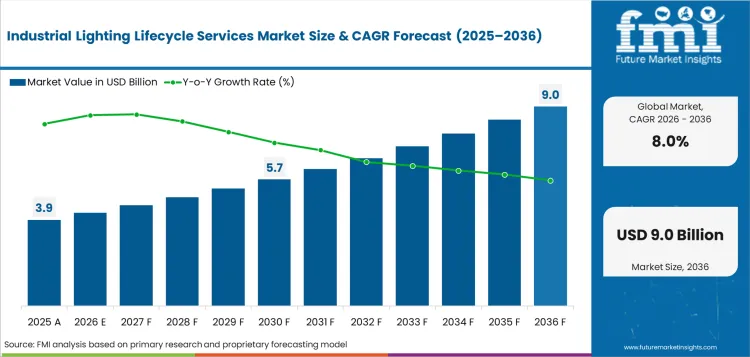
Industrial lighting lifecycle services market was valued at USD 3.89 billion in 2025 and are projected to reach USD 4.20 billion in 2026. The market is forecast to reach USD 9.00 billion by 2036 at 8.0% CAGR. Maintenance and repairs are projected to lead service type demand with 34.0% share in 2026. AMC annual contracts are expected to hold 46.0% share of contract type demand in 2026.
Summary of the Industrial Lighting Lifecycle Services Market Demand and Growth Drivers
- Demand and Growth Drivers
- Factories are shifting service buying from reactive repairs toward annual response terms that reduce downtime exposure.
- Energy audits gain value as plants need savings proof before approving broader retrofit budgets internally.
- Remote monitoring is becoming a contract feature in larger sites with dispersed lighting assets and stricter uptime expectations.
- Product and Segment View
- Maintenance and repairs are projected to account for 34.0% share of service type in 2026.
- AMC annual contracts are expected to hold 46.0% share of contract type in 2026.
- Manufacturing is projected to account for 35.0% share in 2026.
- Remote monitoring is expected to hold 41.0% share in 2026.
- Geography and Competitive Outlook
- Japan is forecast at 10.2% CAGR as higher factory electricity needs support service review.
- France is expected at 9.6% CAGR as energy aid and building rules support retrofit planning.
- Signify and Schneider Electric are positioned around controls and service platforms.
- Siemens, Johnson Controls and ABB add building automation depth to the supplier field.
- Analyst Opinion
- Principal Consultant at FMI, Nikhil Kaitwade, says "The opportunity in industrial lighting lifecycle services goes beyond lamp replacement. Buyers prioritize fewer outages and a documented service history that withstands internal review. Suppliers gain advantage by combining rapid field response with clear, data‑backed evidence of lighting performance.”
- Industrial Lighting Lifecycle Services Market Value Analysis
- The market is priced around service continuity rather than one-time fixture supply. Providers gain margin when intelligent lighting control data reduces truck visits and helps technicians plan repair work.
- Large facilities use lifecycle services to plan lighting maintenance before failures affect production areas.
- Service contracts help manufacturers manage inspections and upgrades across multiple sites.
- Lifecycle programs support cost control by extending fixture performance and reducing unplanned maintenance.
- Demand rises as connected lighting systems require software updates and data monitoring.
Key Takeaways
- The industrial lighting lifecycle services market was valued at USD 3.89 billion in 2025.
- The market is projected to reach USD 4.20 billion in 2026 and USD 9.00 billion by 2036.
- Industrial lighting lifecycle services are expected to expand at 8.0% CAGR from 2026 to 2036.
- The market is forecast to create USD 4.80 billion in incremental opportunity across the forecast decade.
- Maintenance and repairs are projected to hold 34.0% share of service type demand in 2026.
- AMC annual contracts are expected to account for 46.0% share of contract type demand in 2026.
- Japan at 10.2% CAGR and France at 9.6% CAGR are the faster expanding country markets.
Industrial lighting owners are asking for longer operating life and easier maintenance after LED conversion. Signify states that Lifecycle Services offers customized maintenance plans to keep lighting systems working over time. That moves supplier value beyond installation. Signify also states that circularity services can include design, build, operation and maintenance aligned with key performance indicators. Service contracts therefore become a way to link lighting performance with sustainability goals. Signify states that Service tag is a QR-based identification system that provides installation, maintenance and spare part information.
Field technicians can reduce time spent identifying luminaires and parts. Signify’s Brighter Lives document states that intelligent systems monitor serviceable luminaires and enable preventive maintenance. Predictive service is likely to appeal to plants where lift access and shutdown windows are expensive. Signify stated in June 2025 that Interact emergency lighting provides cloud-based monitoring and testing. Compliance reporting becomes another lifecycle-service anchor.
Industrial Lighting Lifecycle Services Market Definition
The industrial lighting lifecycle services market covers work used to assess, maintain and improve lighting systems across industrial sites. Scope includes maintenance visits, emergency repairs and energy audits for installed lighting product portfolios. It also covers managed lighting contracts and digital monitoring tied to lighting uptime. Revenue includes service fees, repair labor and recurring performance contracts.
Industrial Lighting Lifecycle Services Market Inclusions
Market scope includes industrial LED system maintenance and emergency lighting checks. It includes managed service terms that bundle light control switches with energy savings review. Contract scope includes AMC annual contracts and performance terms. Service delivery includes ESCO contractor work, OEM service and distributor service. Digital scope includes remote monitoring and predictive diagnostics.
Industrial Lighting Lifecycle Services Market Exclusions
Scope excludes standalone fixture sales without a service term. It excludes public street and roadway lighting unless the work covers industrial estates or utilities. Pure electrical contracting is outside scope unless lighting lifecycle service is separately billed. Decorative lighting is excluded unless it serves industrial service needs.
Industrial Lighting Lifecycle Services Market Research Methodology
- Primary Research: FMI analysts reviewed lighting OEM service teams, ESCO contractors and facility maintenance buyers in major industrial countries.
- Desk Research: The study used public data from energy agencies, national statistics bodies and official company releases.
- Market sizing and forecasting: The forecast combined supplied market anchors with ESCO activity and industrial lighting service penetration checks.
- Data validation: Forecast checks compared lighting equipment orders, industrial energy policy and supplier developments in digital service platforms.
Why is the Industrial Lighting Lifecycle Services Market Growing?
- Factories are renewing service contracts as lighting outages affect safety checks and production continuity.
- Energy audit demand is rising in 2026 as industrial sites track savings before wider retrofit approval.
- Remote monitoring is widening service value as facilities use led smart light pole data concepts inside large industrial campuses.
The market is expanding as buyers treat lighting as an energy and uptime asset. The revised Energy Performance of Buildings Directive was adopted in April 2024 and raises pressure on workplace energy performance. Lighting service providers gain from this rule when audits and controls become part of compliance planning. This supports demand for light management system upgrades in factories and logistics sites.
Cost discipline also supports the lifecycle service model. A plant can delay a full lighting replacement if the service provider restores performance through repairs and controls. Managed terms let buyers spread upgrades across budget cycles. This makes lighting as a service most useful in multi-site portfolios that need predictable spending.
Market Segmentation Analysis
- Maintenance and repairs are projected to account for 34.0% share in 2026 as service calls protect uptime.
- AMC annual contracts are expected to represent 46.0% share in 2026 as facilities prefer planned terms.
- Manufacturing is forecast to hold 35.0% share in 2026 due to long operating hours and safety needs.
- ESCO contractor service is projected to account for 44.0% share in 2026 as savings proof shapes contracts.
- Remote monitoring is expected to capture 41.0% share in 2026 as buyers track failures across facilities.
The market is divided into five parent segment groups based on how buyers specify service work. Service type covers maintenance, audits and managed lighting. Contract type separates annual terms from project or performance work. End use shows where service intensity is strongest. Digital layer shows how far providers move from field visits toward wireless lighting support and predictive service.
Insights into the Maintenance and Repairs Service Type Segment
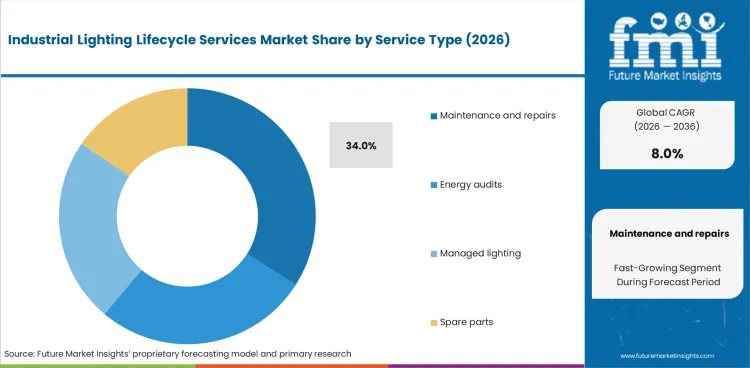
- Maintenance and repairs are projected to account for 34.0% share of service type demand in 2026. This segment leads because factories need fast repair response when lighting failures affect inspection areas or high-bay work zones.
- Energy audits and managed lighting are forecast to gain share during the forecast period. Maintenance stays the entry point because it creates service records that later support led lights upgrades and monitoring contracts.
Insights into the AMC Annual Contracts Contract Type Segment
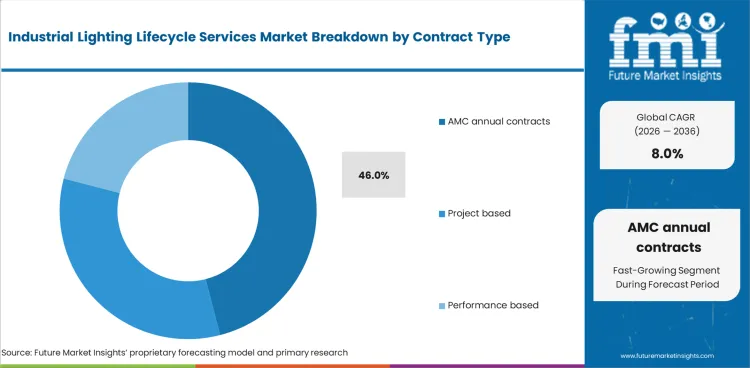
- AMC annual contracts are expected to account for 46.0% share of contract type demand in 2026. Buyers prefer annual terms because lighting service can be budgeted with other facility upkeep.
- Project-based contracts remain useful for retrofits and one-time audits. Performance-based contracts should advance where providers can connect savings data with solid state lighting assets and utility reporting.
Insights into the Manufacturing End Use Segment
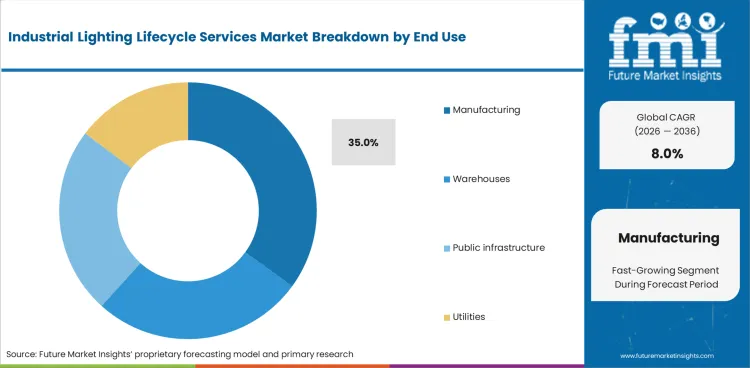
- Manufacturing is projected to hold 35.0% share of end-use demand in 2026. Plants operate for long hours and need reliable lighting around machines, inspection benches and loading zones.
- Warehouses are close behind because rack aisles need steady illumination and faster repair cycles. That makes rack ready luminaires relevant for service providers working around logistics layouts.
Insights into the ESCO Contractor Service Delivery Segment
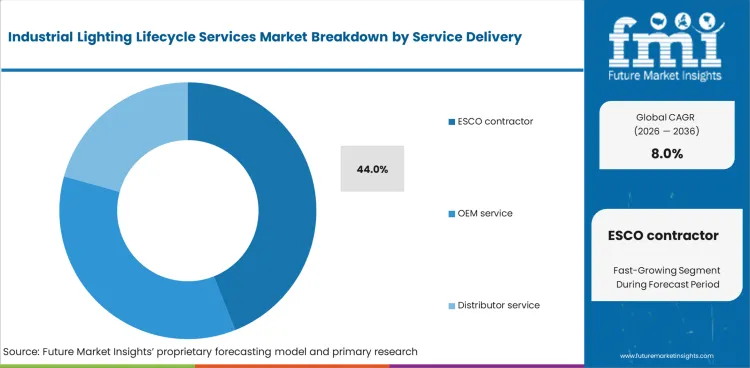
- ESCO contractor service is projected to account for 44.0% share of service delivery demand in 2026. Energy service companies have a natural role because savings proof and performance terms match lighting upgrade work.
- OEM service will remain important when warranties and fixture compatibility guide buying choices. Distributor service serves smaller industrial sites that need parts availability and basic field response.
Insights into the Remote Monitoring Digital Layer Segment
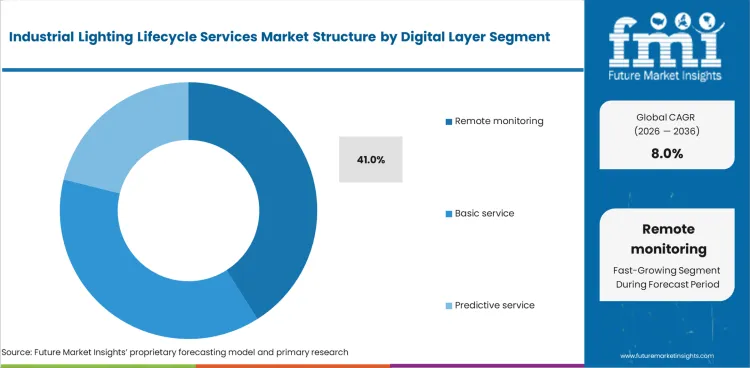
- Remote monitoring is expected to hold 41.0% share of digital layer demand in 2026. Providers use sensors and led control unit data to flag outages before work teams report failures.
- Basic service remains common in smaller sites with limited controls. Predictive service should grow as buyers connect lighting data with wider facility maintenance systems.
Industrial Lighting Lifecycle Services Market Drivers Restraints and Opportunities
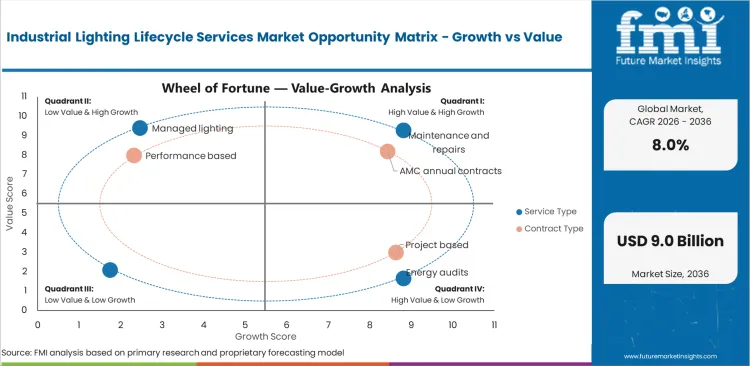
- Annual service buying is rising as factories prefer planned response terms over reactive repairs.
- Integration cost is a restraint because older lighting circuits may not support monitoring tools.
- Predictive service creates opportunity as data connects lighting assets with repair scheduling.
A primary growth driver in the market is the shift from fixture care toward energy and uptime proof. The United States Census Bureau reported USD 1.56 billion in seasonally adjusted electric lighting equipment shipments in March 2026. This shows that lighting remains a large equipment category with regular replacement flow. Service providers can use outdoor led lighting and indoor retrofit knowledge to build repeat contracts around upkeep.
One significant restraint is system mismatch across older facilities. Some plants have mixed drivers and wiring that make monitoring expensive. Service providers must inspect the installed lighting stock before promising savings or response levels. A better opportunity is to connect lighting with industrial energy management system data so energy teams can justify longer contracts.
Analysis of Industrial Lighting Lifecycle Services Market by Key Countries
.webp "Top Country Growth Comparison Industrial Lighting Lifecycle Services Market Cagr (2026 2036)")
| Country | CAGR |
|---|---|
| Japan | 10.2% |
| France | 9.6% |
| United Kingdom | 8.9% |
| Germany | 8.3% |
| India | 7.4% |
| China | 7.1% |
| United States | 6.6% |
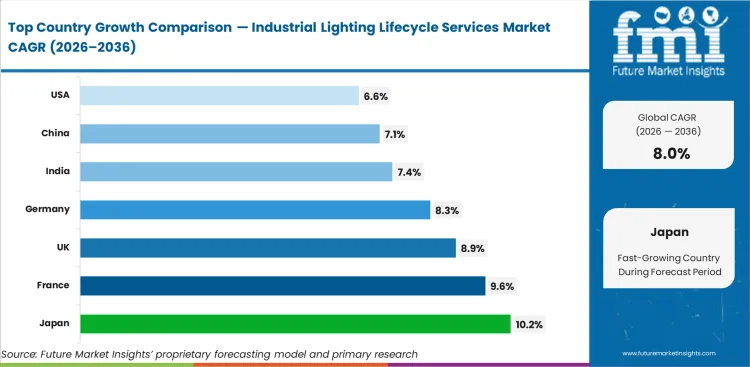
Source: Future Market Insights, 2026.
Industrial Lighting Lifecycle Services Market CAGR Analysis by Country
- Japan is projected to record a 10.2% CAGR through 2036 as factory electricity planning raises service needs.
- France is expected to expand at 9.6% CAGR through 2036 as energy aid supports building upgrades.
- The United Kingdom is forecast to grow at 8.9% CAGR through 2036 as public energy programs support audits.
- Germany is expected to advance at 8.3% CAGR through 2036 as factory automation supports lighting service work.
- India is projected to rise at 7.4% CAGR through 2036 as energy-intensive plants widen audit activity.
- China is forecast at 7.1% CAGR through 2036 as industrial efficiency rules support lighting upgrades.
- The United States is expected to post 6.6% CAGR through 2036 as mature service channels slow the pace.
Demand Outlook for Industrial Lighting Lifecycle Services in Japan
Japan is projected to record a 10.2% CAGR through 2036 as energy planning focuses on factory power use. Japan’s Ministry of Economy, Trade and Industry stated in February 2025 that power demand is expected to rise from fiscal year 2024 due to data centers and semiconductor factories. This favors audited lighting work in high-load industrial sites.
- Service providers with automotive lighting and factory channel ties can reach early service buyers.
- Semiconductor facilities need measured lighting performance around clean zones and inspection benches.
- Automotive plants value repair response where assembly lighting affects visual checks and safety routines.
Demand Outlook for Industrial Lighting Lifecycle Services in France
France is expected to expand at 9.6% CAGR through 2036 as energy grants and public building upgrades support service buying. The European Commission approved a EUR 4 billion French state aid scheme in May 2024 for energy efficiency work in buildings. That scheme improves the case for lighting audits and staged retrofit service.
- Industrial estates with high mast lighting needs can use contractor support to manage safety and outdoor coverage.
- Public infrastructure buyers are expected to favor service providers with grant and audit documentation skills.
- Manufacturing sites need lighting checks that fit production schedules and avoid shutdown pressure.
Demand Outlook for Industrial Lighting Lifecycle Services in the United Kingdom
The United Kingdom is forecast to grow at 8.9% CAGR through 2036 as industrial energy funding supports audit work. The Industrial Energy Transformation Fund provides up to GBP 500 million until 2028 for energy-intensive businesses. This encourages service providers to position lighting work beside controls and building automation system upgrades.
- Industrial lighting lifecycle services are growing steadily as energy funding encourages audits and integration with controls and building automation.
- Warehouses need planned lighting service because high racking raises access cost for repairs.
- Public assets can use framework contracts to combine audits with ongoing maintenance response.
Opportunity Analysis for Industrial Lighting Lifecycle Services in Germany
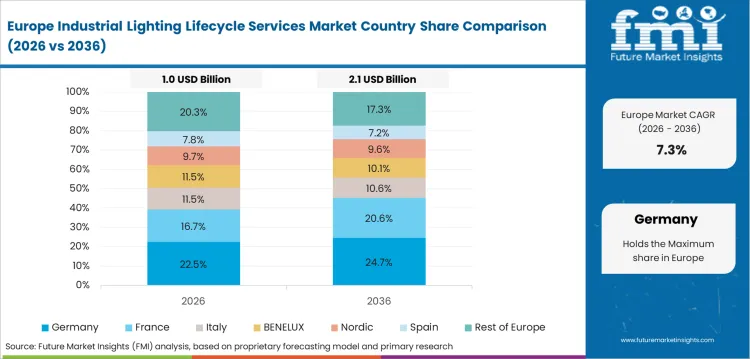
Germany is expected to advance at 8.3% CAGR through 2036 as machinery orders and automation investment support facility service work. The Federal Statistical Office reported that new manufacturing orders rose 7.8% month on month in December 2025. This gives lighting providers a route into plants that are renewing production assets. Heavy industrial sites also need metallurgical lighting service where heat and dust raise failure risk.
- Growth is driven by rising machinery orders and automation investment, creating demand for lighting services that withstand harsh industrial conditions and align with plant shutdown schedules and safety audits.
- Automotive plants need service terms that align with plant shutdown windows and safety audits.
- Machinery facilities prefer providers that can support controls without disrupting production lines.
Sales Analysis for Industrial Lighting Lifecycle Services in India
India is projected to rise at 7.4% CAGR through 2036 as industrial efficiency schemes widen the audit pool. The Bureau of Energy Efficiency dashboard listed 1,333 energy-intensive units and 25.78 million tonnes of oil equivalent savings as of April 2026. This shows a large buyer pool for energy review and maintenance programs. Industrial parks can link lighting service with facility management services when multiple sites need one response structure.
- Expanding industrial efficiency programs are boosting audit-led lighting contracts, with multi-site factories and warehouses favoring centralized service models to manage high-usage areas and nighttime operations.
- Factories in Gujarat and Tamil Nadu are expected to need audit-led lighting contracts for high-use production areas.
- Warehouses around Delhi NCR can use annual service terms to reduce outage risk during night operations.
Sales Analysis for Industrial Lighting Lifecycle Services in China
China is forecast at 7.1% CAGR through 2036 as industrial output and efficiency rules support lighting upgrades. The National Bureau of Statistics of China reported 6.3% growth in industrial value added for January to February 2026. China’s 2024 energy plan also targeted a 2.5% cut in energy use per unit of GDP. That supports service demand for light management system upgrades across large industrial estates.
- Industrial output growth and efficiency targets are supporting demand for lighting lifecycle services, particularly monitored and managed systems in electronics manufacturing, utilities, and large industrial estates.
- Electronics plants need monitored lighting around assembly zones and clean production areas.
- Utility sites can use contractor service to keep lighting records aligned with safety checks.
Demand Outlook for Industrial Lighting Lifecycle Services in the United States
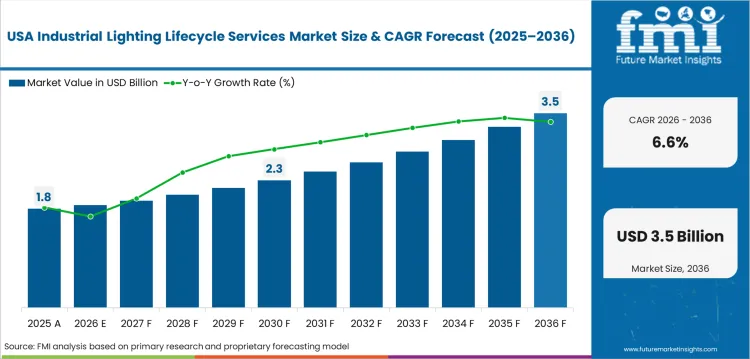
The United States is expected to post 6.6% CAGR through 2036 as mature facility service channels keep growth steadier than in Japan or France. The United States Census Bureau reported USD 1.56 billion in seasonally adjusted electric lighting equipment shipments in March 2026. This supports a large serviceable lighting stock across manufacturing and warehousing. Larger portfolios can connect lifecycle service to rack ready luminaires upkeep in logistics facilities.
- A large installed base of industrial lighting supports moderate growth, with manufacturers and logistics operators prioritizing annual repair contracts and upkeep of high-bay and rack-ready luminaires.
- Manufacturers in the Midwest need annual repair terms that cover high-bay and task lighting.
- Warehouse owners value fast parts support where lighting failure affects worker safety and order flow.
Competitive Landscape and Strategic Positioning
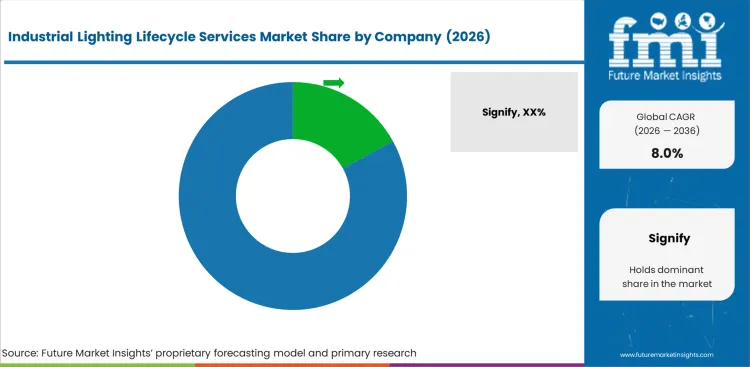
- Digital platforms are becoming the main differentiator, as suppliers that enable centralized, real-time lighting control can deliver faster fault detection and more efficient maintenance.
- Integration depth matters more than standalone service, with providers combining field service capabilities and smart controls gaining an edge over manual inspection competitors.
- Local service strength remains relevant, but smaller players must link fast on-site response with energy and performance data to meet the expectations of large industrial buyers.
Competition in industrial lighting lifecycle services is increasingly defined by post-installation reliability. In March 2026, Signify advanced its Interact platform toward centralized, real-time control for professional indoor environments, enabling quicker fault detection and more efficient maintenance scheduling. This shift allows suppliers that integrate lighting data with building automation systems to move beyond reactive repair work and deliver performance-driven service models.
Leading lighting specialists strengthen their position by combining field service teams with deep controls expertise. The February 2024 partnership between Siemens and Zumtobel Group, which integrates Enlighted smart sensors into Zumtobel’s lighting portfolio, reflects this trend. Such collaborations raise expectations across the market and challenge facility management service providers that rely primarily on manual inspections.
Smaller and regional service providers can still compete by focusing on hard-to-reach locations and localized service routes. TRILUX reported in April 2025 that its LiveLink system surpassed 100,000 installations across diverse applications, highlighting strong adoption. However, the key challenge for these companies is aligning rapid local response with industrial energy management system data, which large and multi-site customers increasingly demand.
Key Companies in the Industrial Lighting Lifecycle Services Market
Competition is best read by role because controls, service labor and energy contracting strengths differ sharply.
Lighting and controls leaders
- Signify
- Acuity Brands
- Zumtobel Group
- Trilux
Building automation and energy service companies
- Schneider Electric
- Siemens
- ABB
- Johnson Controls
- Eaton
- Legrand
Competitive Benchmarking: Industrial Lighting Lifecycle Services Market
| Company | Service Platform Depth | Controls Integration | Field Response Strength | Geographic Footprint |
|---|---|---|---|---|
| Signify | High | High | Strong | Global lighting service footprint |
| Schneider Electric | High | High | Medium | Global energy management reach |
| Siemens | High | High | Medium | Global automation and buildings reach |
| Acuity Brands | Medium | High | Strong | North America lighting channel strength |
| Eaton | Medium | Medium | Strong | Industrial electrical service footprint |
| ABB | Medium | High | Medium | Global electrification and automation reach |
| Legrand | Medium | Medium | Medium | Global building control channel |
| Johnson Controls | High | High | Strong | Global building service footprint |
| Zumtobel Group | Medium | High | Strong | Europe-centered lighting service reach |
| Trilux | Medium | Medium | Strong | Europe-centered industrial lighting base |
Source: Future Market Insights competitive analysis, 2026. Ratings reflect service platform depth, controls integration and field response strength.
Key Developments in Industrial Lighting Lifecycle Services Market
- In March 2026, Signify launched next-generation Interact solutions for intelligent buildings and cities.
- In February 2024, Siemens partnered with Enlighted and Zumtobel Group to advance smart building solutions.
- In April 2025, TRILUX stated that LiveLink had passed 100 thousand installations across many applications.
- In May 2025, Schneider Electric launched its Impact Buildings Program with a first site in Dubai.
Key Players in the Industrial Lighting Lifecycle Services Market
- Signify
- Schneider Electric
- Siemens
- Acuity Brands
- Eaton
- ABB
- Legrand
- Johnson Controls
- Zumtobel Group
- Trilux
Report Scope and Coverage
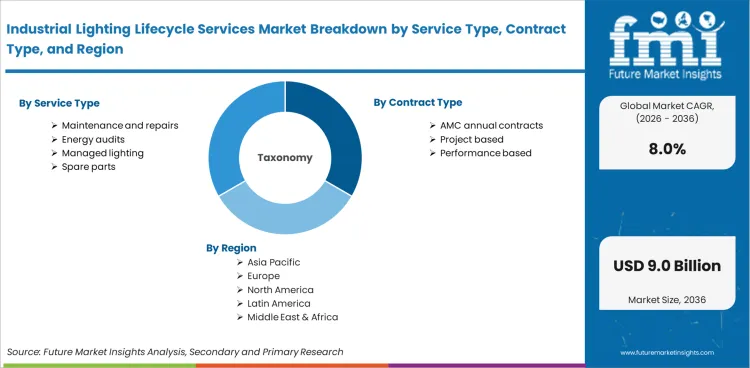
Industrial Lighting Lifecycle Services Market Breakdown By Service Type, Contract Type, End Use, Service Delivery, Digital Layer, and Region
| Parameter | Details |
|---|---|
| Quantitative Units | USD 4.20 billion to USD 9.00 billion at 8.0% CAGR |
| Market Definition | Lifecycle services tied to industrial lighting assets and performance |
| Service Type | Maintenance and repairs, Energy audits, Managed lighting, Spare parts |
| Contract Type | AMC annual contracts, Project based, Performance based |
| End Use | Manufacturing, Warehouses, Public infrastructure, Utilities |
| Service Delivery | ESCO contractor, OEM service, Distributor service |
| Digital Layer | Remote monitoring, Basic service, Predictive service |
| Regions Covered | North America, Latin America, Western Europe, Eastern Europe, East Asia, South Asia and Pacific, Middle East and Africa |
| Countries Covered | Japan, France, United Kingdom, Germany, India, China, United States, and 30+ countries |
| Key Companies Profiled | Signify, Schneider Electric, Siemens, Acuity Brands, Eaton, ABB, Legrand, Johnson Controls, Zumtobel Group, Trilux |
| Forecast Period | 2026 to 2036 |
| Approach | Hybrid forecast using supplied values, ESCO activity, country energy signals and supplier developments |
Industrial Lighting Lifecycle Services Market by Segments
Industrial Lighting Lifecycle Services Market by Service Type
- Maintenance and repairs
- Energy audits
- Managed lighting
- Spare parts
Industrial Lighting Lifecycle Services Market by Contract Type
- AMC annual contracts
- Project based
- Performance based
Industrial Lighting Lifecycle Services Market by End Use
- Manufacturing
- Warehouses
- Public infrastructure
- Utilities
Industrial Lighting Lifecycle Services Market by Service Delivery
- ESCO contractor
- OEM service
- Distributor service
Industrial Lighting Lifecycle Services Market by Digital Layer
- Remote monitoring
- Basic service
- Predictive service
Industrial Lighting Lifecycle Services Market by Region
- North America
- United States
- Canada
- Mexico
- Latin America
- Brazil
- Chile
- Rest of Latin America
- Western Europe
- Germany
- United Kingdom
- France
- Italy
- Spain
- BENELUX
- Nordic
- Eastern Europe
- Poland
- Hungary
- Rest of Eastern Europe
- East Asia
- China
- Japan
- South Korea
- South Asia and Pacific
- India
- ASEAN
- Australia and New Zealand
- Middle East and Africa
- Kingdom of Saudi Arabia
- Other GCC Countries
- South Africa
- Rest of Middle East and Africa
Research Sources and Bibliography
- [1] International Energy Agency. (2024, November). Energy Efficiency 2024.
- [2] International Energy Agency. (2024, November). Distribution of ESCO projects by sector.
- [3] United States Census Bureau. (2026, May). Manufacturers shipments inventories and orders: March 2026.
- [4] Ministry of Economy Trade and Industry. (2025, February). Strategic Energy Plan.
- [5] European Commission. (2024, May). Commission approves EUR 4 billion French State aid scheme.
- [6] Department for Energy Security and Net Zero. (2026, March). Industrial Energy Transformation Fund.
- [7] Federal Statistical Office of Germany. (2026, February). New orders in manufacturing in December 2025.
- [8] Bureau of Energy Efficiency. (2026, April). Industrial Energy Efficiency dashboard.
- [9] National Bureau of Statistics of China. (2026, March). Industrial production operation from January to February 2026.
- [10] State Council of the People’s Republic of China. (2024, May). China to take action for energy conservation and carbon reduction.
- [11] European Commission. (2024, April). Energy performance of buildings: Commission welcomes adoption of revised directive.
- [12] Signify. (2026, March). Next-generation Signify Interact solutions provide smarter lighting for intelligent buildings and cities.
- [13] Siemens. (2024, February). Siemens, Enlighted and Zumtobel Group partner to advance smart building solutions.
- [14] Johnson Controls. (2024, November). Johnson Controls expands AI features in OpenBlue digital ecosystem.
- [15] ABB. (2024, February). ABB at Light and Building 2024.
- [16] Eaton. (2024, March). Eaton to unveil its latest products and software at Light plus Building 2024.
- [17] Legrand. (2024). Legrand announces Matter-enabled smart lighting products.
- [18] Acuity Brands. (2024, August). Seven innovative lighting and components solutions selected for the 2024 IES Progress Report.
- [19] TRILUX. (2025, April). Lighting management from the industry pioneer.
- [20] Schneider Electric. (2025, May). Schneider Electric launches Impact Buildings Program with first site in Dubai.
This Report Answers
- What is the current and future value of the industrial lighting lifecycle services market from 2026 to 2036?
- What CAGR is expected for the industrial lighting lifecycle services market during the forecast period?
- Which service type segment is projected to lead industrial lighting lifecycle services demand in 2026?
- Which contract type segment is expected to hold the leading share in industrial lighting lifecycle services?
- What factors are driving industrial lighting lifecycle services across manufacturing facilities?
- How do energy audits affect supplier selection in the industrial lighting lifecycle services market?
- Which countries are expected to grow fastest in industrial lighting lifecycle services?
- Which companies are positioned across lighting service and building energy platforms?
- How does FMI define the industrial lighting lifecycle services revenue scope?
- What forecasting approach was used to estimate industrial lighting lifecycle services from 2026 to 2036?
Frequently Asked Questions
What is the global market value for Industrial Lighting Lifecycle Services in 2026?
The industrial lighting lifecycle services market is expected to reach USD 4.20 billion in 2026 as factories move toward planned service terms.
How big will the Industrial Lighting Lifecycle Services Market be in 2036?
By 2036, the industrial lighting lifecycle services market is forecast to reach USD 9.00 billion as monitored contracts widen across facilities.
How fast will Industrial Lighting Lifecycle Services demand expand between 2026 and 2036?
Industrial lighting lifecycle services demand is projected to expand at 8.0% CAGR from 2026 to 2036 as service models mature.
Which service type will lead the Industrial Lighting Lifecycle Services Market in 2026?
Maintenance and repairs are projected to lead service type demand with 34.0% share in 2026 due to frequent field service needs.
Which contract type will lead the Industrial Lighting Lifecycle Services Market in 2026?
AMC annual contracts are expected to lead contract type demand with 46.0% share in 2026 as buyers prefer planned budgets.
Which country is forecast to grow fastest in the Industrial Lighting Lifecycle Services Market?
Japan is expected to record the fastest pace at 10.2% CAGR through 2036 as factory energy planning strengthens service demand.
What does the Industrial Lighting Lifecycle Services Market include?
The market includes audits, maintenance, repairs, managed lighting, spare parts, remote monitoring and predictive service tied to industrial lighting assets.
How does FMI estimate the Industrial Lighting Lifecycle Services Market forecast?
FMI uses supplied anchors, ESCO activity and service penetration checks. Industrial policy signals and company developments then validate the forecast.
How do remote monitoring tools support Industrial Lighting Lifecycle Services?
Remote monitoring tools flag outages and performance issues earlier. Service teams can plan repairs before lighting failures affect plant operations.
Who buys Industrial Lighting Lifecycle Services?
Manufacturers, warehouses, utilities and public infrastructure owners buy these services when lighting reliability affects safety, compliance or energy cost control.
Preview the report firsthand - request a free sample
Get SampleGet the brochure for pricing and purchase details.
Get PDFTable of Content
- Key Takeaways
- Market Size and CAGR
- Top Growth Driver
- Fastest Growing Segment
- Leading Region
- Key Companies
- Emerging Opportunities
- Executive Summary
- Global Market Outlook
- Demand-side Trends
- Supply-side Trends
- Technology Roadmap Analysis
- Analysis and Recommendations
- Analyst Perspective (What is happening? Why now? What should investors know?)
- Key Questions Answered
- How large is the market?
- What is the CAGR?
- What are key trends?
- Which region dominates?
- Who are the leaders?
- Market Overview
- Market Coverage / Taxonomy
- Market Definition / Scope / Limitations
- Research Methodology
- Chapter Orientation
- Analytical Lens and Working Hypotheses
- Market Structure, Signals, and Trend Drivers
- Benchmarking and Cross-market Comparability
- Market Sizing, Forecasting, and Opportunity Mapping
- Research Design and Evidence Framework
- Desk Research Programme (Secondary Evidence)
- Expert Input and Fieldwork (Primary Evidence)
- Tooling, Models, and Reference Databases
- Data Engineering and Model Build
- Quality Assurance and Audit Trail
- Market Background
- Market Dynamics (Drivers, Restraints, Opportunity, Trends)
- Scenario Forecast (Optimistic, Likely, Conservative)
- Impact Analysis
- AI Impact
- Sustainability Impact
- Regulatory Impact
- Technology Impact
- Consumer / Buyer Analysis
- Purchase Drivers
- Adoption Barriers
- Buyer Journey
- Opportunity Map Analysis
- Product Life Cycle Analysis
- Supply Chain Analysis
- Investment Feasibility Matrix
- Value Chain Analysis
- PESTLE and Porter's Analysis
- Regulatory Landscape
- Regional Parent Market Outlook
- Production and Consumption Statistics
- Import and Export Statistics
- Global Market Analysis and Forecast, 2021 to 2036
- Historical Market Size Value (USD Billion) Analysis, 2021 to 2025
- Current and Future Market Size Value (USD Billion) Projections, 2026 to 2036
- Y-o-Y Growth Trend Analysis
- Absolute $ Opportunity Analysis
- Global Market Pricing Analysis, 2021 to 2036
- Global Market Analysis and Forecast, By Service, 2021 to 2036
- Introduction / Key Findings
- Historical Market Size Value (USD Billion) Analysis By Service, 2021 to 2025
- Current and Future Market Size Value (USD Billion) Analysis and Forecast By Service, 2026 to 2036
- Maintenance and Repairs
- Energy Audits
- Managed Lighting
- Spare Parts
- Maintenance and Repairs
- Y-o-Y Growth Trend Analysis By Service, 2021 to 2025
- Absolute $ Opportunity Analysis By Service, 2026 to 2036
- Global Market Analysis and Forecast, By Contract, 2021 to 2036
- Introduction / Key Findings
- Historical Market Size Value (USD Billion) Analysis By Contract, 2021 to 2025
- Current and Future Market Size Value (USD Billion) Analysis and Forecast By Contract, 2026 to 2036
- AMC Annual Contracts
- Project Based
- Performance Based
- AMC Annual Contracts
- Y-o-Y Growth Trend Analysis By Contract, 2021 to 2025
- Absolute $ Opportunity Analysis By Contract, 2026 to 2036
- Global Market Analysis and Forecast, By End Use, 2021 to 2036
- Introduction / Key Findings
- Historical Market Size Value (USD Billion) Analysis By End Use, 2021 to 2025
- Current and Future Market Size Value (USD Billion) Analysis and Forecast By End Use, 2026 to 2036
- Manufacturing
- Warehouses
- Public Infrastructure
- Utilities
- Manufacturing
- Y-o-Y Growth Trend Analysis By End Use, 2021 to 2025
- Absolute $ Opportunity Analysis By End Use, 2026 to 2036
- Global Market Analysis and Forecast, By Service Delivery, 2021 to 2036
- Introduction / Key Findings
- Historical Market Size Value (USD Billion) Analysis By Service Delivery, 2021 to 2025
- Current and Future Market Size Value (USD Billion) Analysis and Forecast By Service Delivery, 2026 to 2036
- ESCO Contractor
- OEM Service
- Distributor Service
- ESCO Contractor
- Y-o-Y Growth Trend Analysis By Service Delivery, 2021 to 2025
- Absolute $ Opportunity Analysis By Service Delivery, 2026 to 2036
- Global Market Analysis and Forecast, By Digital Layer, 2021 to 2036
- Introduction / Key Findings
- Historical Market Size Value (USD Billion) Analysis By Digital Layer, 2021 to 2025
- Current and Future Market Size Value (USD Billion) Analysis and Forecast By Digital Layer, 2026 to 2036
- Remote Monitoring
- Basic Service
- Predictive Service
- Remote Monitoring
- Y-o-Y Growth Trend Analysis By Digital Layer, 2021 to 2025
- Absolute $ Opportunity Analysis By Digital Layer, 2026 to 2036
- Global Market Analysis and Forecast, By Region, 2021 to 2036
- Introduction
- Historical Market Size Value (USD Billion) Analysis By Region, 2021 to 2025
- Current Market Size Value (USD Billion) Analysis and Forecast By Region, 2026 to 2036
- North America
- Latin America
- Western Europe
- Eastern Europe
- East Asia
- South Asia and Pacific
- Middle East & Africa
- Market Attractiveness Analysis By Region
- North America Market Analysis and Forecast, By Country, 2021 to 2036
- Historical Market Size Value (USD Billion) Trend Analysis By Market Taxonomy, 2021 to 2025
- Market Size Value (USD Billion) Forecast By Market Taxonomy, 2026 to 2036
- By Country
- USA
- Canada
- By Service
- By Contract
- By End Use
- By Service Delivery
- By Digital Layer
- By Country
- Market Attractiveness Analysis
- By Country
- By Service
- By Contract
- By End Use
- By Service Delivery
- By Digital Layer
- Key Takeaways
- Latin America Market Analysis and Forecast, By Country
- Historical Market Size Value (USD Billion) Trend Analysis By Market Taxonomy, 2021 to 2025
- Market Size Value (USD Billion) Forecast By Market Taxonomy, 2026 to 2036
- By Country
- Brazil
- Mexico
- Chile
- Rest of Latin America
- By Service
- By Contract
- By End Use
- By Service Delivery
- By Digital Layer
- By Country
- Market Attractiveness Analysis
- By Country
- By Service
- By Contract
- By End Use
- By Service Delivery
- By Digital Layer
- Key Takeaways
- Western Europe Market Analysis and Forecast, By Country
- Historical Market Size Value (USD Billion) Trend Analysis By Market Taxonomy, 2021 to 2025
- Market Size Value (USD Billion) Forecast By Market Taxonomy, 2026 to 2036
- By Country
- Germany
- UK
- Italy
- Spain
- France
- Nordic
- BENELUX
- Rest of Western Europe
- By Service
- By Contract
- By End Use
- By Service Delivery
- By Digital Layer
- By Country
- Market Attractiveness Analysis
- By Country
- By Service
- By Contract
- By End Use
- By Service Delivery
- By Digital Layer
- Key Takeaways
- Eastern Europe Market Analysis and Forecast, By Country
- Historical Market Size Value (USD Billion) Trend Analysis By Market Taxonomy, 2021 to 2025
- Market Size Value (USD Billion) Forecast By Market Taxonomy, 2026 to 2036
- By Country
- Russia
- Poland
- Hungary
- Balkan & Baltic
- Rest of Eastern Europe
- By Service
- By Contract
- By End Use
- By Service Delivery
- By Digital Layer
- By Country
- Market Attractiveness Analysis
- By Country
- By Service
- By Contract
- By End Use
- By Service Delivery
- By Digital Layer
- Key Takeaways
- East Asia Market Analysis and Forecast, By Country
- Historical Market Size Value (USD Billion) Trend Analysis By Market Taxonomy, 2021 to 2025
- Market Size Value (USD Billion) Forecast By Market Taxonomy, 2026 to 2036
- By Country
- China
- Japan
- South Korea
- By Service
- By Contract
- By End Use
- By Service Delivery
- By Digital Layer
- By Country
- Market Attractiveness Analysis
- By Country
- By Service
- By Contract
- By End Use
- By Service Delivery
- By Digital Layer
- Key Takeaways
- South Asia and Pacific Market Analysis and Forecast, By Country
- Historical Market Size Value (USD Billion) Trend Analysis By Market Taxonomy, 2021 to 2025
- Market Size Value (USD Billion) Forecast By Market Taxonomy, 2026 to 2036
- By Country
- India
- ASEAN
- Australia & New Zealand
- Rest of South Asia and Pacific
- By Service
- By Contract
- By End Use
- By Service Delivery
- By Digital Layer
- By Country
- Market Attractiveness Analysis
- By Country
- By Service
- By Contract
- By End Use
- By Service Delivery
- By Digital Layer
- Key Takeaways
- Middle East & Africa Market Analysis and Forecast, By Country
- Historical Market Size Value (USD Billion) Trend Analysis By Market Taxonomy, 2021 to 2025
- Market Size Value (USD Billion) Forecast By Market Taxonomy, 2026 to 2036
- By Country
- Kingdom of Saudi Arabia
- Other GCC Countries
- Türkiye
- South Africa
- Other African Union
- Rest of Middle East & Africa
- By Service
- By Contract
- By End Use
- By Service Delivery
- By Digital Layer
- By Country
- Market Attractiveness Analysis
- By Country
- By Service
- By Contract
- By End Use
- By Service Delivery
- By Digital Layer
- Key Takeaways
- Key Countries Market Analysis
- USA
- Pricing Analysis
- Market Share Analysis, 2025
- By Service
- By Contract
- By End Use
- By Service Delivery
- By Digital Layer
- Canada
- Pricing Analysis
- Market Share Analysis, 2025
- By Service
- By Contract
- By End Use
- By Service Delivery
- By Digital Layer
- Mexico
- Pricing Analysis
- Market Share Analysis, 2025
- By Service
- By Contract
- By End Use
- By Service Delivery
- By Digital Layer
- Brazil
- Pricing Analysis
- Market Share Analysis, 2025
- By Service
- By Contract
- By End Use
- By Service Delivery
- By Digital Layer
- Chile
- Pricing Analysis
- Market Share Analysis, 2025
- By Service
- By Contract
- By End Use
- By Service Delivery
- By Digital Layer
- Germany
- Pricing Analysis
- Market Share Analysis, 2025
- By Service
- By Contract
- By End Use
- By Service Delivery
- By Digital Layer
- UK
- Pricing Analysis
- Market Share Analysis, 2025
- By Service
- By Contract
- By End Use
- By Service Delivery
- By Digital Layer
- Italy
- Pricing Analysis
- Market Share Analysis, 2025
- By Service
- By Contract
- By End Use
- By Service Delivery
- By Digital Layer
- Spain
- Pricing Analysis
- Market Share Analysis, 2025
- By Service
- By Contract
- By End Use
- By Service Delivery
- By Digital Layer
- France
- Pricing Analysis
- Market Share Analysis, 2025
- By Service
- By Contract
- By End Use
- By Service Delivery
- By Digital Layer
- India
- Pricing Analysis
- Market Share Analysis, 2025
- By Service
- By Contract
- By End Use
- By Service Delivery
- By Digital Layer
- ASEAN
- Pricing Analysis
- Market Share Analysis, 2025
- By Service
- By Contract
- By End Use
- By Service Delivery
- By Digital Layer
- Australia & New Zealand
- Pricing Analysis
- Market Share Analysis, 2025
- By Service
- By Contract
- By End Use
- By Service Delivery
- By Digital Layer
- China
- Pricing Analysis
- Market Share Analysis, 2025
- By Service
- By Contract
- By End Use
- By Service Delivery
- By Digital Layer
- Japan
- Pricing Analysis
- Market Share Analysis, 2025
- By Service
- By Contract
- By End Use
- By Service Delivery
- By Digital Layer
- South Korea
- Pricing Analysis
- Market Share Analysis, 2025
- By Service
- By Contract
- By End Use
- By Service Delivery
- By Digital Layer
- Russia
- Pricing Analysis
- Market Share Analysis, 2025
- By Service
- By Contract
- By End Use
- By Service Delivery
- By Digital Layer
- Poland
- Pricing Analysis
- Market Share Analysis, 2025
- By Service
- By Contract
- By End Use
- By Service Delivery
- By Digital Layer
- Hungary
- Pricing Analysis
- Market Share Analysis, 2025
- By Service
- By Contract
- By End Use
- By Service Delivery
- By Digital Layer
- Kingdom of Saudi Arabia
- Pricing Analysis
- Market Share Analysis, 2025
- By Service
- By Contract
- By End Use
- By Service Delivery
- By Digital Layer
- Türkiye
- Pricing Analysis
- Market Share Analysis, 2025
- By Service
- By Contract
- By End Use
- By Service Delivery
- By Digital Layer
- South Africa
- Pricing Analysis
- Market Share Analysis, 2025
- By Service
- By Contract
- By End Use
- By Service Delivery
- By Digital Layer
- USA
- Market Structure Analysis
- Competition Dashboard
- Competition Benchmarking
- Market Share Analysis of Top Players
- By Regional
- By Service
- By Contract
- By End Use
- By Service Delivery
- By Digital Layer
- Emerging Startups
- Innovation Benchmarking
- Competition Analysis
- Competition Deep Dive
- Signify
- Overview
- Product Portfolio
- Profitability by Market Segments
- Sales Footprint
- Strategy Overview
- Marketing Strategy
- Product Strategy
- Channel Strategy
- Schneider Electric
- Siemens
- Acuity Brands
- Eaton
- ABB
- Legrand
- Johnson Controls
- Zumtobel Group
- Trilux
- Signify
- Case Studies
- Success Stories
- Recent Developments
- Competition Deep Dive
- Assumptions & Acronyms Used


