

- Market Size (2026)
- USD 0.6 Bn
- Forecast (2036)
- USD 2.1 Bn
- CAGR (2026 to 2036)
- 14.2%
Industrial Lighting Cybersecurity Market Size, Market Forecast and Outlook By FMI
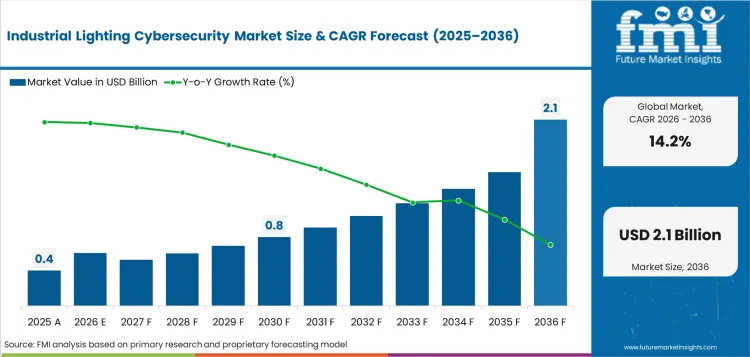
Industrial lighting cybersecurity market is valued at USD 0.6 billion in 2026 and is forecast to reach USD 2.1 billion by 2036 at 14.2% CAGR. Secure gateways and firmware controls are projected to hold 34.0% share in 2026. Hybrid setup is anticipated to record around 44.0% share as buyers keep plant controls local but use cloud dashboards for policy checks.
Summary of the Industrial Lighting Cybersecurity Market
- Demand and Growth Drivers
- Connected lighting systems require cybersecurity controls because sensors and gateways can become network entry points.
- Industrial facilities adopt secure lighting platforms to protect building automation networks from unauthorized access.
- Remote monitoring increases the need for authentication, firmware updates, and device-level security.
- Cybersecurity demand rises as lighting becomes linked with occupancy data, access systems, and operational software.
- Product and Segment View
- Secure gateways are projected to account for 34.0% share of offering demand in 2026.
- Network monitoring is expected to gain attention as plant teams need traffic visibility before remote access decisions.
- Identity and access control is expected to widen in sites using contractor access and managed lighting platforms.
- Managed security is expected to support smaller teams that lack full-time operational technology cyber staff.
- Geography and Competitive Outlook
- South Korea is projected to record 16.4% CAGR by 2036 as smart factories and connected building controls expand.
- Japan is expected to expand at 15.8% CAGR by 2036 as semiconductor and precision manufacturing sites harden factory networks.
- Siemens is estimated to hold 13.0% share of 2026 revenue as its industrial automation channel reaches secure gateway buyers.
- Claroty and Nozomi Networks shape specialist positioning through cyber-physical asset discovery and exposure management.
- Analyst Opinion
- Nikhil Kaitwade, Principal Analyst at FMI says, “Industrial lighting cybersecurity should be approached first as a governance and control challenge rather than a purely software-led issue. Buyers are not motivated by abstract notions of protection; they invest in clearly defined control points such as secure gateways, enforced access rules, and visibility into device behavior.”
- Industrial Lighting Cybersecurity Market Value Analysis
- The market value reflects connected lighting nodes and secure gateway software. Identity layers and monitoring services sold for industrial environments complete the revenue scope.
- Industrial security systems provide the closest parent spending pool for secure gateway checks. This gives the forecast a practical boundary against broader cyber budgets.
- Intelligent lighting control creates the buyer trigger for this security layer. Sites first connect lighting for energy or safety and then add cyber rules.
- Cloud services shape the hybrid portion of the forecast when policy tools sit outside the plant. Local controllers continue to manage direct lighting commands.
Key Takeaways
- The industrial lighting cybersecurity market is valued at USD 0.6 billion in 2026.
- By 2036, the industrial lighting cybersecurity market is expected to reach USD 2.1 billion.
- From 2026 to 2036, the market is projected to expand at 14.2% CAGR.
- The market is projected to create an incremental opportunity of USD 1.5 billion between 2026 and 2036.
- Secure gateways are projected to account for 34.0% share of offering demand in 2026.
- Unauthorized access is expected to account for 34.0% share of threat focus demand in 2026.
- Hybrid setup is projected to capture 44.0% share of deployment demand in 2026.
- Large industrials are expected to hold 39.0% share of customer type demand in 2026.
- South Korea at 16.4% CAGR and Japan at 15.8% CAGR are the faster expanding country opportunities.
Industrial IoT brings lighting data into wider plant networks. Building automation systems add facility controls to the same device layer. Connected industrial lighting creates a new cyber surface because sensors and gateways now exchange operational data. DesignLights Consortium published NLC5.1 in June 2024 with updated cybersecurity criteria for acceptable standards and services. That makes cybersecurity part of qualification rather than a late IT review. Signify states that Interact combines connected devices with a secure gateway and commissioning tools. Gateway architecture gives buyers a clearer boundary for connected lighting traffic.
CISA states that technology providers must take executive ownership for secure-by-design products. That expectation raises the bar for lighting software and firmware suppliers. GSA guidance also states that cybersecurity scanning is unnecessary unless a smart TLED is installed. Retrofit buyers therefore need to distinguish simple lamp replacement from connected-device deployment. DALI Alliance states that D4i includes mandatory smart-data capabilities. Smart-data features are likely to strengthen demand for secure device management.
Industrial Lighting Cybersecurity Market Definition
The industrial lighting cybersecurity market covers hardware and software that protect connected lighting systems used in factories and industrial buildings. Services are included when they secure connected lighting controls. Scope includes secure gateways and firmware controls. Network monitoring and access rules cover lighting controllers. Managed security adds support for teams with fewer cyber staff.
Industrial Lighting Cybersecurity Market Inclusions
Market scope includes secure gateways and firmware hardening for connected industrial lighting systems. Identity and access control is included when it governs lighting assets. Network monitoring and managed security are included when they secure lighting assets in plants or warehouses. Customer scope includes large industrials and warehousing sites. Critical infrastructure operators and small or midsize industrial firms are included when lighting controls are connected. The assessment includes access control and authentication when those functions govern lighting controllers or gateways.
Industrial Lighting Cybersecurity Market Exclusions
Scope excludes general cybersecurity software that does not protect lighting systems or cyber-physical building assets. It excludes consumer smart bulbs and home automation security sold outside industrial settings. General lighting hardware revenue is excluded unless secure connectivity is separately priced or specified. Broad cloud computing spend is excluded unless the service secures industrial lighting devices or control traffic.
Industrial Lighting Cybersecurity Market Research Methodology
- Primary Research: FMI analysts reviewed supplier portfolios and industrial buyer needs. Integrator interviews and lighting control security requirements were checked across major countries.
- Desk Research: The study used official cyber agencies and standards bodies. Company releases and public operational technology security guidance were used for supplier evidence.
- Market sizing and forecasting: The model combined supplied market anchors with bottom-up assumptions on connected lighting nodes and gateway pricing. Monitoring seats and managed service uptake shaped the forecast curve.
- Data validation: Forecast checks compared industrial cyber budgets and connected lighting growth. Factory security guidance and supplier product evidence were used as control points.
Why is the Industrial Lighting Cybersecurity Market Growing?
- Lighting controllers now connect with facility networks, so unauthorized access can spread beyond lighting commands.
- Cloud dashboards create value for energy teams but raise the need for identity checks and access limits.
- Cybersecurity and Infrastructure Security Agency guidance in January 2025 pushed operational technology buyers to assess product security before selection.
Industrial buyers are treating connected lighting as part of the plant network instead of a separate facilities system. The Cybersecurity and Infrastructure Security Agency released Secure by Demand guidance in January 2025 for operational technology product selection. That guidance raises the bar for lighting gateways and firmware because buyers can ask vendors to show security support before installation. This shifts the buying process toward secure-by-design devices and documented update paths. Lighting security spending is expanding into cloud access security brokers and card-based electronic access control systems as more users manage permissions across sites.
Market Segmentation Analysis
- Secure gateways are projected to account for 34.0% share of offering demand in 2026 as buyers protect the network edge.
- Unauthorized access is expected to represent 34.0% share of threat focus demand in 2026 as shared credentials create exposure.
- Hybrid setup is projected to capture 44.0% share of deployment demand in 2026 as local control and cloud policy checks run together.
- Large industrials are expected to account for 39.0% share of customer type demand in 2026 as multi-site security rules become common.
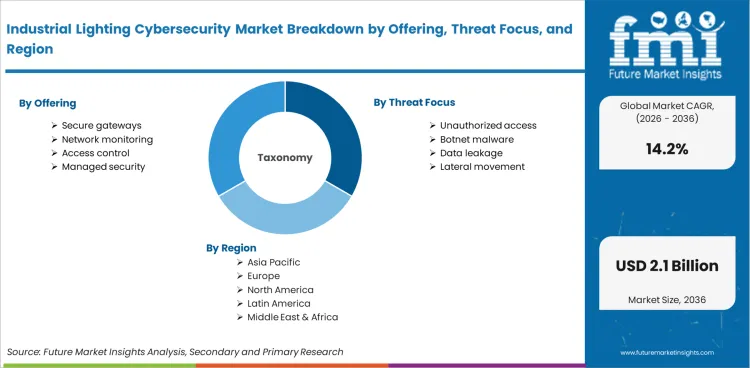
The market is divided into four primary segment groups based on offering and threat focus. Deployment and customer type complete the segmentation view. Offering includes secure gateways and network monitoring. Access control and managed security complete the offering view. Threat focus covers unauthorized access and botnet malware. Data leakage and lateral movement complete the threat view.
Insights into the Secure Gateways Offering Segment
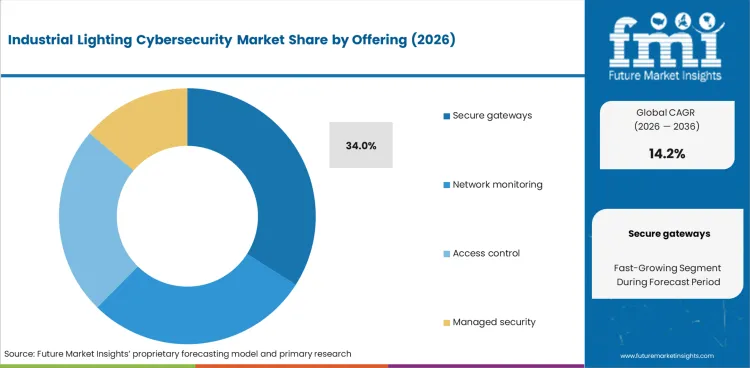
- Secure gateways are projected to account for 34.0% share of offering demand in 2026 as lighting networks need a controlled boundary point.
- Siemens SINEC Security Guard mapped known vulnerabilities to production assets in April 2024, which shows why automated gateway visibility is gaining buyer attention.
Insights into the Unauthorized Access Threat Focus Segment
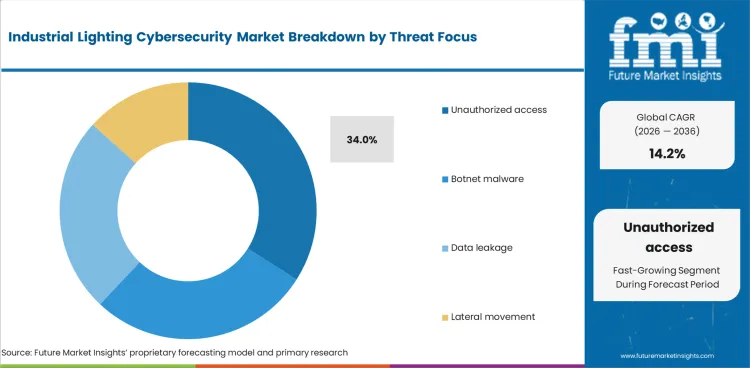
- Unauthorized access is expected to account for 34.0% share of threat focus demand in 2026 as shared accounts weaken lighting control security.
- The United Kingdom Department for Science, Innovation and Technology reported 43.0% of businesses experienced a breach or attack in its 2026 survey.
Insights into the Hybrid Deployment Segment
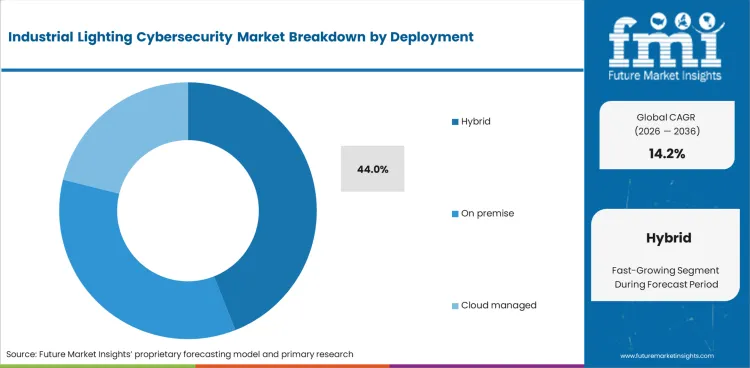
- Hybrid setup is projected to account for 44.0% share of deployment demand in 2026 as plants keep control traffic near operations.
- Signify received DEKRA IEC 62443-3-3 certification for its Interact cloud-based wireless lighting system in November 2024, supporting hybrid security claims.
Insights into the Large Industrials Customer Type Segment
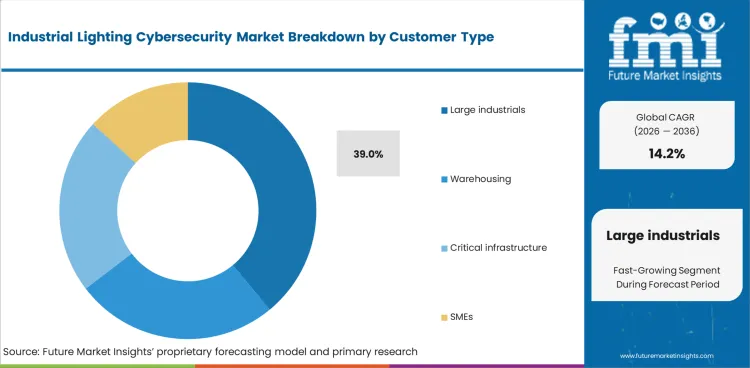
- Large industrials are expected to hold 39.0% share of customer type demand in 2026 as large sites need common security rules.
- Claroty reported in May 2024 that 38.0% of riskiest cyber-physical assets were overlooked by traditional vulnerability tools.
Industrial Lighting Cybersecurity Market Drivers and Restraints
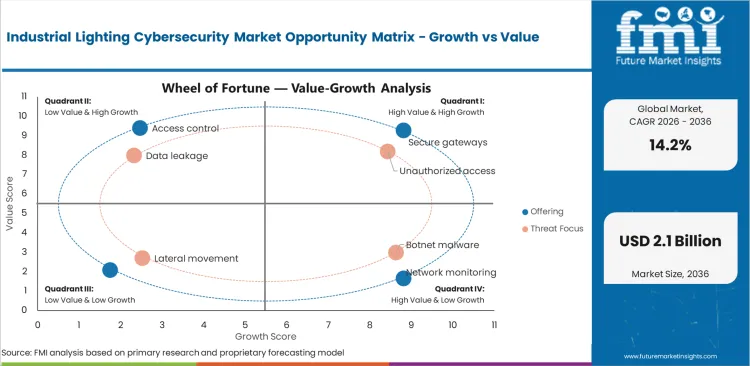
- Gateway hardening is expected to scale as lighting controllers move onto shared industrial networks.
- Legacy lighting controls create a restraint as older gateways lack update support and identity controls.
- Managed security creates an opportunity for plants without dedicated operational technology cyber teams.
Gateway hardening is emerging as the primary growth driver as industrial lighting controls become reachable from plant networks and cloud-based remote dashboards. Once isolated, lighting controllers are now integrated into broader operational technology environments, increasing their exposure to unauthorized access and lateral movement risks. As a result, buyers are prioritizing secure gateways as defined control points that segment lighting traffic and enforce authentication and policy rules. Product development is reinforcing this shift. Cisco’s Cyber Vision Release 5.4.x, launched in March 2026, added user access control and large-scale sensor onboarding features, reflecting growing demand for visibility and governance at the network edge. These capabilities align lighting cybersecurity investment with plant-wide network security strategies rather than isolated controls.
Legacy Lighting Controls
Legacy lighting infrastructure remains the main restraint to industrial lighting cybersecurity adoption. Many installed controllers were designed without secure update paths, identity management, or modern encryption support, limiting their ability to meet current cybersecurity requirements. As lighting systems become connected to plant networks, these limitations create uneven security coverage across zones and production areas. Buyers face a structural challenge: cybersecurity policies can only be applied consistently once incompatible controllers are replaced or segmented, requiring upfront capital expenditure beyond software upgrades. This dependency on hardware refresh cycles slows penetration, particularly in brownfield facilities where lighting replacements compete with core production investments.
Managed Security Services
Managed security services represent the clearest growth opportunity, particularly for smaller manufacturing plants, logistics hubs, and warehousing sites that lack dedicated operational technology cybersecurity teams. These buyers increasingly prefer outsourced monitoring, threat detection, and policy management rather than deploying in-house expertise. Nozomi Networks raised USD 100.0 million in March 2024 to expand industrial cyber defenses and global go-to-market coverage, underscoring investor confidence in service-led OT security expansion. As connected lighting scales across multi-site industrial operators, managed security offerings are positioned to convert fragmented demand into recurring, service-driven revenue streams.
Analysis of Industrial Lighting Cybersecurity Market by Key Countries
.webp "Top Country Growth Comparison Industrial Lighting Cybersecurity Market Cagr (2026 2036)")
| Country | CAGR |
|---|---|
| South Korea | 16.4% |
| Japan | 15.8% |
| United Kingdom | 15.1% |
| Germany | 14.5% |
| India | 13.6% |
| China | 13.3% |
| United States | 12.8% |
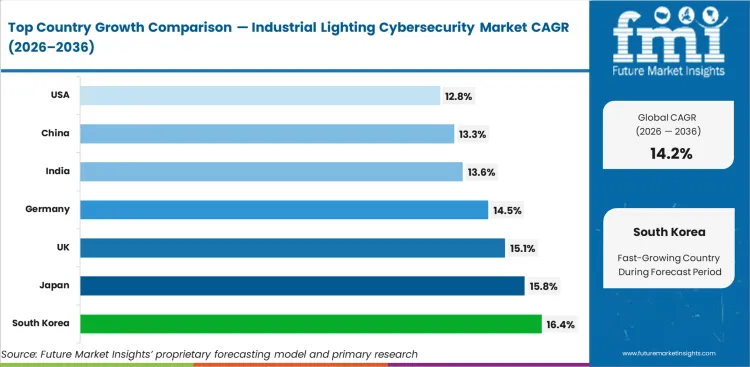
Source: Future Market Insights, 2026.
South Korea and Japan are forecast above the global pace as smart factory programs and precision manufacturing raise the need for cyber-physical device control. The United States is forecast below the global pace because early industrial cybersecurity adoption has already absorbed part of the near-term opportunity.
Sales Analysis of Industrial Lighting Cybersecurity Market in South Korea
South Korea is projected to record a 16.4% CAGR through 2036 as connected factories and building automation create dense device networks. Korea Internet and Security Agency announced Korea’s 2024 National Cybersecurity White Paper in November 2024 with 913,869 page hits recorded on the notice page, which indicates high public and industry attention to national cyber readiness.
- Gyeonggi manufacturing sites can use secure gateways to separate lighting traffic from production control layers.
- Seoul technology campuses need access rules for contractors that work across buildings and industrial labs.
- Incheon logistics hubs can favor hybrid monitoring where lighting networks support safety and energy operations.
Future Outlook for Industrial Lighting Cybersecurity Market in Japan
Japan is expected to expand at 15.8% CAGR through 2036 as semiconductor factories and precision plants harden operational technology networks. Japan’s National Center of Incident Readiness and Strategy for Cybersecurity recorded 861 government agency incident notifications in fiscal 2023 within its 2024 overview. The same cyber posture affects factory operators that want connected lighting without adding unmanaged entry points.
- Kumamoto semiconductor sites need segmented lighting controllers near cleanroom and service areas.
- Tokyo automation teams can prefer access control for contractors working across mixed-use industrial buildings.
- Nagoya automotive suppliers need gateway logs when lighting systems connect with factory management dashboards.
Demand Outlook for Industrial Lighting Cybersecurity Market in the United Kingdom
The United Kingdom is forecast to grow at 15.1% CAGR through 2036 as connected facilities add cloud-managed controls. The United Kingdom government’s 2026 cyber survey estimated that 612,000 businesses had experienced a breach or attack in the prior year. Such exposure keeps cyber checks in scope for lighting upgrades and building control refresh projects.
- Midlands warehouses need device monitoring as lighting networks support safety zones and energy reporting.
- London industrial estates can use identity controls when multiple service firms access building systems.
- Manchester retrofit projects may link lighting controls with broader facility cybersecurity reviews.
Opportunity Analysis of Industrial Lighting Cybersecurity Market in Germany
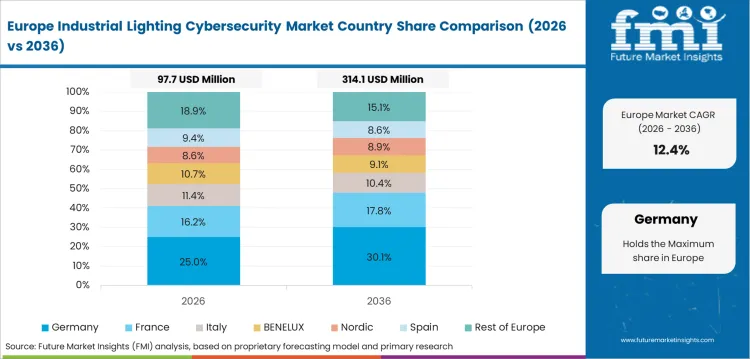
Germany is expected to advance at 14.5% CAGR through 2036 as automation-heavy factories align cyber checks with production continuity. The German Federal Office for Information Security reported in 2024 that high-bandwidth distributed denial-of-service attacks doubled against the long-term average, this makes connected lighting security part of wider resilience planning for factory networks.
- Bavaria automation plants need secure firmware controls for connected lighting near machine areas.
- Baden-Württemberg automotive sites can evaluate network monitoring for lighting and building control traffic.
- Saxony electronics facilities need gateway rules that limit lateral movement across production support systems.
Sales Analysis of Industrial Lighting Cybersecurity Market in India
India is projected to rise at 13.6% CAGR through 2036 as electronics plants and logistics parks add connected controls. Indian Computer Emergency Response Team handled 2.04 million cybersecurity incidents in 2024. That incident load supports stronger interest in secure gateways and managed monitoring for industrial lighting assets.
- Gujarat industrial parks can use managed security where facility teams lack full-time cyber staff.
- Tamil Nadu electronics clusters need lighting access checks around test benches and assembly floors.
- Noida warehouse operators may prefer hybrid dashboards that show lighting asset status and policy exceptions.
Future Outlook for Industrial Lighting Cybersecurity Market in China
China is forecast at 13.3% CAGR through 2036 as industrial data security rules push factories toward device control. China’s Ministry of Industry and Information Technology set a 2026 target to cover over 45,000 enterprises with data classification protection work. The target supports cybersecurity purchasing across industrial equipment and connected facility systems.
- Guangdong electronics factories need secure gateways where lighting controllers support dense production floors.
- Jiangsu industrial parks can use network monitoring to detect abnormal lighting controller traffic.
- Shanghai logistics sites may adopt cloud-managed policy tools when operators manage several buildings together.
Demand Outlook for Industrial Lighting Cybersecurity Market in the United States
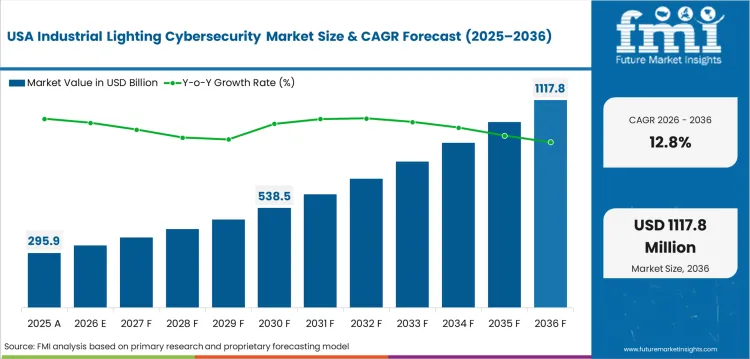
The United States is expected to post 12.8% CAGR through 2036 as industrial cybersecurity buyers add lighting systems to asset inventories. The Cybersecurity and Infrastructure Security Agency released ten industrial control system advisories on December 12, 2024. This advisory flow keeps industrial control risk visible for buyers that manage connected lighting and building systems.
- Texas energy facilities need secure gateway rules for lighting zones near operational technology equipment.
- Michigan automotive plants can connect lighting protection with factory network segmentation work.
- California logistics campuses may evaluate cloud-managed access as contractors service multiple facilities.
Competitive Landscape and Strategic Positioning
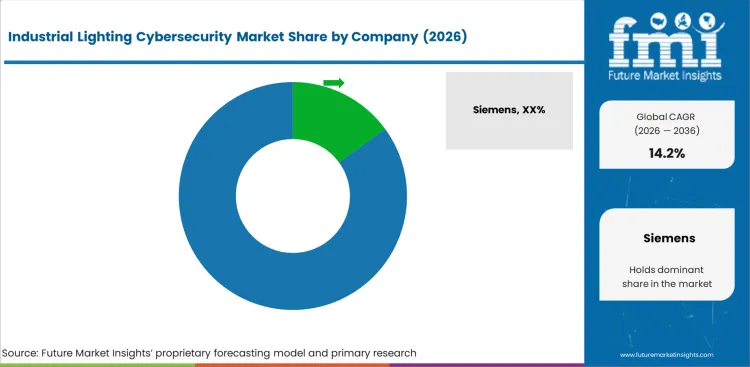
- The market is split between automation vendors and cybersecurity specialists. Lighting control suppliers form a third competitive group.
- Automation vendors win when they connect secure gateways with plant control knowledge.
- Specialist cyber firms gain buyers through deep asset discovery and exposure management.
- Lighting groups stand out when certified connected systems reduce buyer concern around building networks.
The competitive landscape is shaped by how buyers position industrial lighting cybersecurity, either as an extension of plant network security or as part of facility and building control systems. Automation and controls vendors such as Siemens and Schneider Electric are well positioned where lighting security is assessed within broader plant network architectures, leveraging their deep integration with industrial automation platforms. ABB benefits from long-standing relationships across large industrial sites, allowing it to influence security decisions tied to legacy and multi-site environments.
Cybersecurity specialists differentiate themselves through advanced asset discovery, network visibility, and threat detection capabilities. Vendors such as Palo Alto Networks focus on extending operational technology security into industrial environments, addressing harsh operating conditions and remote operations where lighting systems converge with production networks.
Lighting and building technology providers compete by lowering adoption risk for facility-focused buyers. Companies such as Johnson Controls and Signify use certifications, lifecycle services, and integrated building platforms to position lighting cybersecurity as an incremental upgrade rather than a disruptive infrastructure replacement. This approach resonates with facility managers seeking to add cybersecurity controls without overhauling existing lighting estates.
Key Companies in the Industrial Lighting Cybersecurity Market
Competition is best read by role because gateways and monitoring differ sharply. Connected lighting channels create a separate route to buyers.
- Automation and Controls Providers: Siemens and Schneider Electric hold strong access through plant controls. ABB and Honeywell add building automation relationships. Johnson Controls adds access through building technology service channels. These companies influence gateway selection and firmware support.
- Cybersecurity Specialists: Cisco and Palo Alto Networks are better placed for network monitoring. Nozomi Networks and Claroty add exposure management and identity policy work. Their strength is visibility across mixed operational technology assets.
- Lighting Integration Specialists: Signify holds a distinct role where connected lighting and wireless control must be sold as one system. Certified cybersecurity supports that lighting package. Light control switches connect the lighting channel with security review. LED control units create another point where firmware and access policy must be checked.
Competitive Benchmarking: Industrial Lighting Cybersecurity Market
| Company | Gateway Security Depth | OT Monitoring Fit | Lighting Channel Access | Geographic Footprint |
|---|---|---|---|---|
| Siemens | High | Strong | Medium | Global with strong Europe and industrial automation reach |
| Schneider Electric | High | Strong | Medium | Global with energy management and industrial automation channels |
| ABB | Medium | Strong | Medium | Global with factory automation and electrification presence |
| Cisco | Medium | Strong | Low | Global with enterprise network and OT visibility reach |
| Palo Alto Networks | Medium | Strong | Low | Global with OT security and remote operations coverage |
| Nozomi Networks | Medium | Strong | Low | Global specialist with critical infrastructure focus |
| Claroty | Medium | Strong | Low | Global specialist with cyber-physical exposure management depth |
| Honeywell | Medium | Medium | Strong | Global with building controls and industrial software access |
| Johnson Controls | Medium | Medium | Strong | Global with building automation and chiller security presence |
| Signify | Medium | Low | Strong | Global with connected lighting and Interact platform footprint |
Source: Future Market Insights competitive analysis, 2026. Ratings reflect relative positioning based on gateway security depth and OT monitoring fit. Lighting channel access completes the comparison.
Key Developments in Industrial Lighting Cybersecurity Market
- In April 2024, Siemens introduced SINEC Security Guard to automate vulnerability mapping and security management for industrial operators.
- In February 2024, Schneider Electric worked with Intel and Red Hat on an open automation infrastructure for software-defined industrial control.
- In March 2026, Cisco released Cyber Vision 5.4.x with user access control and sensor onboarding improvements.
Key Players in the Industrial Lighting Cybersecurity Market
Automation and Controls Providers:
- Siemens
- Schneider Electric
- ABB
- Honeywell
- Johnson Controls
Cybersecurity Specialists:
- Cisco
- Palo Alto Networks
- Nozomi Networks
- Claroty
Lighting Integration Specialists:
- Signify
Report Scope and Coverage
| Parameter | Details |
|---|---|
| Quantitative Units | USD 0.6 billion to USD 2.1 billion at 14.2% CAGR |
| Market Definition | Cybersecurity hardware and software for connected industrial lighting systems. Services are included when sold for this scope. |
| Offering | Secure gateways; Network monitoring; Access control; Managed security |
| Threat Focus | Unauthorized access; Botnet malware; Data leakage; Lateral movement |
| Deployment | Hybrid; On premise; Cloud managed |
| Customer Type | Large industrials; Warehousing; Critical infrastructure; SMEs |
| Regions Covered | North America; Latin America; Western Europe; Eastern Europe; East Asia; South Asia and Pacific; Middle East and Africa |
| Countries Covered | United States; China; India; Germany; Japan; South Korea; United Kingdom; and 30+ countries |
| Key Companies Profiled | Siemens; Schneider Electric; ABB; Cisco; Palo Alto Networks; Nozomi Networks; Claroty; Honeywell; Johnson Controls; Signify |
| Forecast Period | 2026 to 2036 |
| Approach | Hybrid bottom-up and top-down method using supplied values and cyber guidance. Company evidence and connected lighting signals were used as checks. |
Source: Future Market Insights, 2026.
Industrial Lighting Cybersecurity Market by Segments
Industrial Lighting Cybersecurity Market Segmented by Offering:
- Secure gateways
- Network monitoring
- Access control
- Managed security
Industrial Lighting Cybersecurity Market Segmented by Threat Focus:
- Unauthorized access
- Botnet malware
- Data leakage
- Lateral movement
Industrial Lighting Cybersecurity Market Segmented by Deployment:
- Hybrid
- On premise
- Cloud managed
Industrial Lighting Cybersecurity Market Segmented by Customer Type:
- Large industrials
- Warehousing
- Critical infrastructure
- SMEs
Industrial Lighting Cybersecurity Market by Region:
- North America
- United States
- Canada
- Mexico
- Latin America
- Brazil
- Chile
- Rest of Latin America
- Western Europe
- Germany
- United Kingdom
- Italy
- Spain
- France
- Nordic
- BENELUX
- Rest of Western Europe
- Eastern Europe
- Poland
- Hungary
- Balkan and Baltic
- Rest of Eastern Europe
- East Asia
- China
- Japan
- South Korea
- South Asia and Pacific
- India
- ASEAN
- Australia and New Zealand
- Rest of South Asia and Pacific
- Middle East and Africa
- Kingdom of Saudi Arabia
- Other GCC Countries
- Turkiye
- South Africa
- Other African Union
- Rest of Middle East and Africa
Research Sources and Bibliography
- Cybersecurity and Infrastructure Security Agency. (2025, January 13). Secure by Demand: Priority considerations for operational technology owners and operators when selecting digital products.
- Cybersecurity and Infrastructure Security Agency. (2024, December 12). Industrial control systems advisories.
- United Kingdom Department for Science, Innovation and Technology. (2026, April). Cyber security breaches survey 2026.
- German Federal Office for Information Security. (2024, September). The state of IT security in Germany in 2024.
- Indian Computer Emergency Response Team. (2024, November 29). Annual report 2024.
- National Center of Incident Readiness and Strategy for Cybersecurity. (2024). Overview of cybersecurity 2024.
- Ministry of Industry and Information Technology of the People’s Republic of China. (2024, February). Industrial data security capability enhancement implementation plan 2024 to 2026
- Korea Internet and Security Agency. (2024, November 29). Korea’s 2024 national cybersecurity white paper.
- European Union Agency for Cybersecurity. (2025, March 5). NIS360 2024.
- Siemens. (2024, April). Siemens makes the security status of production plants transparent.
- Schneider Electric. (2024, February 6). Schneider Electric delivers next-generation open automation infrastructure in collaboration with Intel and Red Hat.
- Cisco. (2026, March). Cisco Cyber Vision Release 5.4.x.
- Palo Alto Networks. (2024, October 21). New OT security solutions from Palo Alto Networks address growing cybersecurity threats to industrial operations.
- Nozomi Networks. (2024, March 13). Nozomi Networks secures $100 million investment to accelerate critical infrastructure defense
- Claroty. (2024, May 7). 38% of riskiest cyber-physical systems overlooked by traditional vulnerability management approaches.
- Honeywell. (2024, January 22). Honeywell transforms building management with first-of-its-kind technology.
- Johnson Controls. (2024, March 12). Three YORK chiller solutions earn ISASecure Component Security Assurance certification.
- Signify. (2024, November 11). Signify Interact cloud-based wireless lighting system awarded DEKRA IEC 62443-3-3 certification.
The bibliography is provided for reader reference and uses primary government, regulatory, trade body, and official company sources relevant to industrial lighting cybersecurity.
This Report Answers
- What is the current and future value of the industrial lighting cybersecurity market from 2026 to 2036?
- What CAGR is expected for the industrial lighting cybersecurity market during the forecast period?
- Which offering segment is projected to lead industrial lighting cybersecurity demand in 2026?
- Which threat focus segment is expected to hold the leading share in industrial lighting cybersecurity?
- How do secure gateways and firmware controls shape buying in connected industrial lighting?
- How does hybrid deployment affect cybersecurity selection for lighting control systems?
- Which countries are expected to grow faster in industrial lighting cybersecurity?
- Which companies are positioned across industrial lighting cybersecurity and operational technology security?
- How does FMI define the revenue scope for industrial lighting cybersecurity?
- What forecasting approach was used to estimate demand from 2026 to 2036?
Frequently Asked Questions
What is the global market demand for Industrial Lighting Cybersecurity in 2026?
In 2026, the global industrial lighting cybersecurity market is expected to be worth USD 0.6 billion as connected lighting systems need security.
How big will the Industrial Lighting Cybersecurity Market be in 2036?
By 2036, the industrial lighting cybersecurity market is expected to reach USD 2.1 billion as factories add secure lighting control layers.
How much is Industrial Lighting Cybersecurity demand expected to expand between 2026 and 2036?
Between 2026 and 2036, industrial lighting cybersecurity demand is projected to expand at 14.2% CAGR as gateway protection scales.
Which offering is expected to lead the Industrial Lighting Cybersecurity Market by 2026?
Secure gateways are projected to lead offering demand with 34.0% share in 2026 due to firmware hardening and network boundary needs.
Which threat focus is expected to lead Industrial Lighting Cybersecurity demand in 2026?
Unauthorized access is expected to lead threat focus demand with 34.0% share in 2026 as shared credentials create system exposure.
Which country is forecast to grow fastest in the Industrial Lighting Cybersecurity Market?
South Korea is projected to record 16.4% CAGR by 2036 as connected factories and building automation expand device security needs.
What does the Industrial Lighting Cybersecurity Market include?
The market includes secure gateways, firmware controls, access rules, monitoring tools, and managed security for connected industrial lighting systems.
How does FMI estimate the Industrial Lighting Cybersecurity Market forecast?
FMI uses supplied market anchors, connected lighting assumptions, official cyber guidance, company evidence, and adjacent industrial security spending checks.
How does industrial lighting cybersecurity work in a plant?
It separates lighting controllers from unsafe access, checks traffic, limits user permissions, and alerts teams when device behavior looks unusual.
How does industrial lighting cybersecurity compare with standard lighting controls?
Standard controls manage switching and dimming, but cybersecurity layers protect gateways, users, firmware, and network traffic around connected lighting systems.
What affects the cost or payback of industrial lighting cybersecurity?
Cost depends on connected asset count, gateway replacement needs, monitoring depth, and service support. Payback comes from reduced downtime risk.
Preview the report firsthand - request a free sample
Get SampleGet the brochure for pricing and purchase details.
Get PDFTable of Content
- Key Takeaways
- Market Size and CAGR
- Top Growth Driver
- Fastest Growing Segment
- Leading Region
- Key Companies
- Emerging Opportunities
- Executive Summary
- Global Market Outlook
- Demand-side Trends
- Supply-side Trends
- Technology Roadmap Analysis
- Analysis and Recommendations
- Analyst Perspective (What is happening? Why now? What should investors know?)
- Key Questions Answered
- How large is the market?
- What is the CAGR?
- What are key trends?
- Which region dominates?
- Who are the leaders?
- Market Overview
- Market Coverage / Taxonomy
- Market Definition / Scope / Limitations
- Research Methodology
- Chapter Orientation
- Analytical Lens and Working Hypotheses
- Market Structure, Signals, and Trend Drivers
- Benchmarking and Cross-market Comparability
- Market Sizing, Forecasting, and Opportunity Mapping
- Research Design and Evidence Framework
- Desk Research Programme (Secondary Evidence)
- Expert Input and Fieldwork (Primary Evidence)
- Tooling, Models, and Reference Databases
- Data Engineering and Model Build
- Quality Assurance and Audit Trail
- Market Background
- Market Dynamics (Drivers, Restraints, Opportunity, Trends)
- Scenario Forecast (Optimistic, Likely, Conservative)
- Impact Analysis
- AI Impact
- Sustainability Impact
- Regulatory Impact
- Technology Impact
- Consumer / Buyer Analysis
- Purchase Drivers
- Adoption Barriers
- Buyer Journey
- Opportunity Map Analysis
- Product Life Cycle Analysis
- Supply Chain Analysis
- Investment Feasibility Matrix
- Value Chain Analysis
- PESTLE and Porter's Analysis
- Regulatory Landscape
- Regional Parent Market Outlook
- Production and Consumption Statistics
- Import and Export Statistics
- Global Market Analysis and Forecast, 2021 to 2036
- Historical Market Size Value (USD Billion) & Volume (Unit) Analysis, 2021 to 2025
- Current and Future Market Size Value (USD Billion) & Volume (Unit) Projections, 2026 to 2036
- Y-o-Y Growth Trend Analysis
- Absolute $ Opportunity Analysis
- Global Market Pricing Analysis, 2021 to 2036
- Global Market Analysis and Forecast, By Offering, 2021 to 2036
- Introduction / Key Findings
- Historical Market Size Value (USD Billion) & Volume (Unit) Analysis By Offering, 2021 to 2025
- Current and Future Market Size Value (USD Billion) & Volume (Unit) Analysis and Forecast By Offering, 2026 to 2036
- Secure gateways
- Network monitoring
- Access control
- Managed security
- Secure gateways
- Y-o-Y Growth Trend Analysis By Offering, 2021 to 2025
- Absolute $ Opportunity Analysis By Offering, 2026 to 2036
- Global Market Analysis and Forecast, By Threat Focus, 2021 to 2036
- Introduction / Key Findings
- Historical Market Size Value (USD Billion) & Volume (Unit) Analysis By Threat Focus, 2021 to 2025
- Current and Future Market Size Value (USD Billion) & Volume (Unit) Analysis and Forecast By Threat Focus, 2026 to 2036
- Unauthorized access
- Botnet malware
- Data leakage
- Lateral movement
- Unauthorized access
- Y-o-Y Growth Trend Analysis By Threat Focus, 2021 to 2025
- Absolute $ Opportunity Analysis By Threat Focus, 2026 to 2036
- Global Market Analysis and Forecast, By Deployment, 2021 to 2036
- Introduction / Key Findings
- Historical Market Size Value (USD Billion) & Volume (Unit) Analysis By Deployment, 2021 to 2025
- Current and Future Market Size Value (USD Billion) & Volume (Unit) Analysis and Forecast By Deployment, 2026 to 2036
- Hybrid
- On premise
- Cloud managed
- Hybrid
- Y-o-Y Growth Trend Analysis By Deployment, 2021 to 2025
- Absolute $ Opportunity Analysis By Deployment, 2026 to 2036
- Global Market Analysis and Forecast, By Customer Type, 2021 to 2036
- Introduction / Key Findings
- Historical Market Size Value (USD Billion) & Volume (Unit) Analysis By Customer Type, 2021 to 2025
- Current and Future Market Size Value (USD Billion) & Volume (Unit) Analysis and Forecast By Customer Type, 2026 to 2036
- Large industrials
- Warehousing
- Critical infrastructure
- SMEs
- Large industrials
- Y-o-Y Growth Trend Analysis By Customer Type, 2021 to 2025
- Absolute $ Opportunity Analysis By Customer Type, 2026 to 2036
- Global Market Analysis and Forecast, By Region, 2021 to 2036
- Introduction
- Historical Market Size Value (USD Billion) & Volume (Unit) Analysis By Region, 2021 to 2025
- Current Market Size Value (USD Billion) & Volume (Unit) Analysis and Forecast By Region, 2026 to 2036
- North America
- Latin America
- Western Europe
- Eastern Europe
- East Asia
- South Asia and Pacific
- Middle East & Africa
- Market Attractiveness Analysis By Region
- North America Market Analysis and Forecast, By Country, 2021 to 2036
- Historical Market Size Value (USD Billion) & Volume (Unit) Trend Analysis By Market Taxonomy, 2021 to 2025
- Market Size Value (USD Billion) & Volume (Unit) Forecast By Market Taxonomy, 2026 to 2036
- By Country
- USA
- Canada
- Mexico
- By Offering
- By Threat Focus
- By Deployment
- By Customer Type
- By Country
- Market Attractiveness Analysis
- By Country
- By Offering
- By Threat Focus
- By Deployment
- By Customer Type
- Key Takeaways
- Latin America Market Analysis and Forecast, By Country
- Historical Market Size Value (USD Billion) & Volume (Unit) Trend Analysis By Market Taxonomy, 2021 to 2025
- Market Size Value (USD Billion) & Volume (Unit) Forecast By Market Taxonomy, 2026 to 2036
- By Country
- Brazil
- Chile
- Rest of Latin America
- By Offering
- By Threat Focus
- By Deployment
- By Customer Type
- By Country
- Market Attractiveness Analysis
- By Country
- By Offering
- By Threat Focus
- By Deployment
- By Customer Type
- Key Takeaways
- Western Europe Market Analysis and Forecast, By Country
- Historical Market Size Value (USD Billion) & Volume (Unit) Trend Analysis By Market Taxonomy, 2021 to 2025
- Market Size Value (USD Billion) & Volume (Unit) Forecast By Market Taxonomy, 2026 to 2036
- By Country
- Germany
- UK
- Italy
- Spain
- France
- Nordic
- BENELUX
- Rest of Western Europe
- By Offering
- By Threat Focus
- By Deployment
- By Customer Type
- By Country
- Market Attractiveness Analysis
- By Country
- By Offering
- By Threat Focus
- By Deployment
- By Customer Type
- Key Takeaways
- Eastern Europe Market Analysis and Forecast, By Country
- Historical Market Size Value (USD Billion) & Volume (Unit) Trend Analysis By Market Taxonomy, 2021 to 2025
- Market Size Value (USD Billion) & Volume (Unit) Forecast By Market Taxonomy, 2026 to 2036
- By Country
- Russia
- Poland
- Hungary
- Balkan & Baltic
- Rest of Eastern Europe
- By Offering
- By Threat Focus
- By Deployment
- By Customer Type
- By Country
- Market Attractiveness Analysis
- By Country
- By Offering
- By Threat Focus
- By Deployment
- By Customer Type
- Key Takeaways
- East Asia Market Analysis and Forecast, By Country
- Historical Market Size Value (USD Billion) & Volume (Unit) Trend Analysis By Market Taxonomy, 2021 to 2025
- Market Size Value (USD Billion) & Volume (Unit) Forecast By Market Taxonomy, 2026 to 2036
- By Country
- China
- Japan
- South Korea
- By Offering
- By Threat Focus
- By Deployment
- By Customer Type
- By Country
- Market Attractiveness Analysis
- By Country
- By Offering
- By Threat Focus
- By Deployment
- By Customer Type
- Key Takeaways
- South Asia and Pacific Market Analysis and Forecast, By Country
- Historical Market Size Value (USD Billion) & Volume (Unit) Trend Analysis By Market Taxonomy, 2021 to 2025
- Market Size Value (USD Billion) & Volume (Unit) Forecast By Market Taxonomy, 2026 to 2036
- By Country
- India
- ASEAN
- Australia & New Zealand
- Rest of South Asia and Pacific
- By Offering
- By Threat Focus
- By Deployment
- By Customer Type
- By Country
- Market Attractiveness Analysis
- By Country
- By Offering
- By Threat Focus
- By Deployment
- By Customer Type
- Key Takeaways
- Middle East & Africa Market Analysis and Forecast, By Country
- Historical Market Size Value (USD Billion) & Volume (Unit) Trend Analysis By Market Taxonomy, 2021 to 2025
- Market Size Value (USD Billion) & Volume (Unit) Forecast By Market Taxonomy, 2026 to 2036
- By Country
- Kingdom of Saudi Arabia
- Other GCC Countries
- Türkiye
- South Africa
- Other African Union
- Rest of Middle East & Africa
- By Offering
- By Threat Focus
- By Deployment
- By Customer Type
- By Country
- Market Attractiveness Analysis
- By Country
- By Offering
- By Threat Focus
- By Deployment
- By Customer Type
- Key Takeaways
- Key Countries Market Analysis
- USA
- Pricing Analysis
- Market Share Analysis, 2025
- By Offering
- By Threat Focus
- By Deployment
- By Customer Type
- Canada
- Pricing Analysis
- Market Share Analysis, 2025
- By Offering
- By Threat Focus
- By Deployment
- By Customer Type
- Mexico
- Pricing Analysis
- Market Share Analysis, 2025
- By Offering
- By Threat Focus
- By Deployment
- By Customer Type
- Brazil
- Pricing Analysis
- Market Share Analysis, 2025
- By Offering
- By Threat Focus
- By Deployment
- By Customer Type
- Chile
- Pricing Analysis
- Market Share Analysis, 2025
- By Offering
- By Threat Focus
- By Deployment
- By Customer Type
- Germany
- Pricing Analysis
- Market Share Analysis, 2025
- By Offering
- By Threat Focus
- By Deployment
- By Customer Type
- UK
- Pricing Analysis
- Market Share Analysis, 2025
- By Offering
- By Threat Focus
- By Deployment
- By Customer Type
- Italy
- Pricing Analysis
- Market Share Analysis, 2025
- By Offering
- By Threat Focus
- By Deployment
- By Customer Type
- Spain
- Pricing Analysis
- Market Share Analysis, 2025
- By Offering
- By Threat Focus
- By Deployment
- By Customer Type
- France
- Pricing Analysis
- Market Share Analysis, 2025
- By Offering
- By Threat Focus
- By Deployment
- By Customer Type
- India
- Pricing Analysis
- Market Share Analysis, 2025
- By Offering
- By Threat Focus
- By Deployment
- By Customer Type
- ASEAN
- Pricing Analysis
- Market Share Analysis, 2025
- By Offering
- By Threat Focus
- By Deployment
- By Customer Type
- Australia & New Zealand
- Pricing Analysis
- Market Share Analysis, 2025
- By Offering
- By Threat Focus
- By Deployment
- By Customer Type
- China
- Pricing Analysis
- Market Share Analysis, 2025
- By Offering
- By Threat Focus
- By Deployment
- By Customer Type
- Japan
- Pricing Analysis
- Market Share Analysis, 2025
- By Offering
- By Threat Focus
- By Deployment
- By Customer Type
- South Korea
- Pricing Analysis
- Market Share Analysis, 2025
- By Offering
- By Threat Focus
- By Deployment
- By Customer Type
- Russia
- Pricing Analysis
- Market Share Analysis, 2025
- By Offering
- By Threat Focus
- By Deployment
- By Customer Type
- Poland
- Pricing Analysis
- Market Share Analysis, 2025
- By Offering
- By Threat Focus
- By Deployment
- By Customer Type
- Hungary
- Pricing Analysis
- Market Share Analysis, 2025
- By Offering
- By Threat Focus
- By Deployment
- By Customer Type
- Kingdom of Saudi Arabia
- Pricing Analysis
- Market Share Analysis, 2025
- By Offering
- By Threat Focus
- By Deployment
- By Customer Type
- Türkiye
- Pricing Analysis
- Market Share Analysis, 2025
- By Offering
- By Threat Focus
- By Deployment
- By Customer Type
- South Africa
- Pricing Analysis
- Market Share Analysis, 2025
- By Offering
- By Threat Focus
- By Deployment
- By Customer Type
- USA
- Market Structure Analysis
- Competition Dashboard
- Competition Benchmarking
- Market Share Analysis of Top Players
- By Regional
- By Offering
- By Threat Focus
- By Deployment
- By Customer Type
- Emerging Startups
- Innovation Benchmarking
- Competition Analysis
- Competition Deep Dive
- Siemens
- Overview
- Product Portfolio
- Profitability by Market Segments (Product/Region/Sales Channel)
- Sales Footprint
- Strategy Overview
- Marketing Strategy
- Product Strategy
- Channel Strategy
- Schneider Electric
- ABB
- Honeywell
- Johnson Controls
- Cisco
- Palo Alto Networks
- Nozomi Networks
- Claroty
- Signify
- Siemens
- Case Studies
- Success Stories
- Recent Developments
- Competition Deep Dive
- Assumptions & Acronyms Used


