

- Market Size (2026)
- USD 0.38 Bn
- Forecast (2036)
- USD 1.69 Bn
- CAGR (2026 to 2036)
- 16.1%
Industrial LiDAR Integrated Lighting Market Size, Market Forecast and Outlook By FMI
Industrial LiDAR integrated lighting market was valued at USD 0.33 billion in 2025 and is projected to reach USD 0.38 billion in 2026. It is forecast to reach USD 1.69 billion by 2036 at 16.1% CAGR through 2036. Industrial LiDAR integrated lighting is forming around occupancy sensing rather than light output alone. Daviteq documentation from August 2024 describes a LoRaWAN LiDAR sensor that counts people in two directions with over 95% accuracy. That gives lighting platforms a stronger input for occupancy-led dimming.
Summary of Industrial LiDAR Integrated Lighting Market
- Demand and Growth Drivers
- Forklift and automated guided vehicle safety is expected to promoted demand as facilities need zone-level awareness.
- People counting and zone safety is forecast to gain use as buildings link lighting with occupancy sensing.
- Navigation assistance is expected to support adoption in sites using automated movement across shared work areas.
- Asset tracking is projected to expand as facility teams seek better visibility across pallets and mobile equipment.
- Product and Segment View
- LiDAR plus sensor hub systems are projected to hold 41.0% share in 2026 as buyers prefer one sensing node above high-risk routes.
- LiDAR-in-luminaire systems are expected to gain attention as lighting makers add sensing into ceiling and aisle fixtures.
- Standalone LiDAR nodes for lighting systems are forecast to serve retrofit projects that cannot replace full luminaires.
- Solid-state LiDAR is projected to account for 52.0% share in 2026 as sealed modules fit lighting housings better.
- Warehouses and distribution centers are forecast to hold 39.0% share in 2026 as traffic around people and pallets needs stronger detection.
- System integrators are expected to account for 46.0% share in 2026 as buyers need lighting controls and safety sensing joined on site.
- Geography and Competitive Outlook
- Workplace transport safety keeps the United Kingdom ahead of the global pace, with the market expected to expand at 18.3% CAGR by 2036.
- South Korea is projected at 17.7% CAGR across the forecast decade as robotics depth and electronics supply support faster facility trials.
- Japan’s demand is forecast to rise at 17.0% CAGR by 2036 as automated factories add compact sensing around work zones.
- Germany is expected to advance at 16.4% CAGR over the assessment period as industrial safety upgrades lift sensor-based lighting use.
- India’s warehouse automation activity supports a 15.5% CAGR outlook by 2036 as logistics and manufacturing sites add safer traffic systems.
- China is forecast at 15.2% CAGR across the forecast decade as electronics production and robotics activity widen integrated sensing use.
- Large distribution networks keep the United States on a steady path, with demand expected to record 14.7% CAGR by 2036.
- Competitive positioning is split between lighting integration and LiDAR supply as ams OSRAM and Signify focus on fixtures. Ouster and Hesai Technology support sensing hardware depth.
- Analyst Opinion
- Nikhil Kaitwade, Principal Consultant at FMI says, “Industrial LiDAR integrated lighting will be judged as a combined safety and data layer. The strongest suppliers will demonstrate that a single ceiling-mounted point can illuminate a zone and deliver actionable event data to facility software. This reframes the buying decision away from fixture cost and toward risk reduction and workflow value.”
- Industrial LiDAR Integrated Lighting Market Value Analysis
- The market is part of total industrial lighting expenditure, but it has a sharper value path than ordinary fixture replacement.
- LiDAR integration is predicted to garner demand from high-risk zones first.
- Buyers are likely to compare systems with lighting products by asking whether the same installation can reduce blind spots and support safety records.
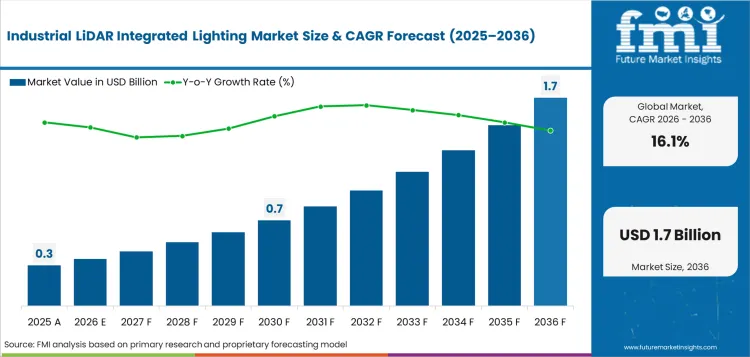
Key Takeaways
- The industrial LiDAR integrated lighting market is valued at USD 0.38 billion in 2026.
- The sector is forecast to reach USD 1.69 billion by 2036 at 16.1% CAGR.
- The forecast implies an incremental opportunity of USD 1.31 billion across the assessment period.
- LiDAR sensor hub systems are projected to account for 41.0% share of integration type demand in 2026.
- Forklift and automated guided vehicle safety is expected to hold 34.0% share of use case demand in 2026.
- Warehousing is projected to hold 39.0% share of facility type demand in 2026.
- System integrators are expected to account for 46.0% share of buyer demand in 2026.
- Solid-state LiDAR is projected to account for 52.0% share of LiDAR class demand in 2026.
- The United Kingdom at 18.3% CAGR and South Korea at 17.7% CAGR are some significant country markets.
SICK AG documentation from December 2024 states that PeopleCounter uses an MRS1000 3D LiDAR sensor and SensorApp to identify people by contours. Privacy-aware movement data is useful in entrances, corridors and shared industrial spaces. Signify stated in November 2025 that its Interact DALI sensor covers 2 m to 16 m ceiling heights for manufacturing sites and warehouses. High-ceiling sensing supports lighting control in spaces where basic PIR sensors lose accuracy. Signify also states that connected manufacturing lighting combines luminaires, controls, sensors, data and software. Lighting infrastructure is therefore positioned to host LiDAR-led occupancy intelligence.
Industrial LiDAR Integrated Lighting Market Definition
The industrial LiDAR integrated lighting market covers lighting systems that include LiDAR sensing as part of the fixture, hub or connected lighting network. LiDAR measures distance by using light pulses to detect people, pallets and moving vehicles. The scope includes luminaires with built-in LiDAR and sensor hubs mounted with lighting systems. It also includes standalone LiDAR nodes that feed lighting control software and safety dashboards.
Industrial LiDAR Integrated Lighting Market Inclusions
Market scope includes LiDAR sensor hubs, luminaire LiDAR and standalone nodes used inside industrial lighting systems. Included use cases cover forklift safety, people counting, asset tracking and navigation support. Facility scope covers warehouses, distribution centers, manufacturing plants, ports, yards and mining facilities. Related smart warehouse technologies are included only when the lighting layer carries the sensing function. Revenue includes sensor hardware, fixture integration and software-ready system value when it is sold with the lighting package. Installation labor is excluded unless the hardware value is separately stated.
Industrial LiDAR Integrated Lighting Market Exclusions
The scope excludes LiDAR units sold only for vehicles, drones or survey equipment. It also excludes ordinary security cameras and passive infrared occupancy sensors. General building management software is excluded unless the platform is bundled with LiDAR-enabled lighting. Standalone time-of-flight cameras are outside scope unless they are specified as part of the lighting system. Retrofit electrical work and maintenance contracts are not counted as product revenue. They are considered channel activity around the core hardware and control layer.
Industrial LiDAR Integrated Lighting Market Research Methodology
- Primary Research: FMI analysts reviewed supplier portfolios, integrator buying patterns and safety needs across industrial facilities.
- Desk Research: The study used public data from safety agencies, national statistics bodies, robotics associations and official company releases.
- Market Sizing and Forecasting: The forecast used supplied market anchors and a hybrid method based on sensor cost, lighting attachment rates and facility adoption.
- Data Validation: Forecast checks compared industrial lighting shipments, robotics installations, LiDAR unit shipments and warehouse automation signals.
Why is the Industrial LiDAR Integrated Lighting Market Growing?
- Forklift safety is pushing buyers toward zone sensing that can detect people and moving trucks before contact happens.
- Warehouse automation is raising demand for overhead sensing that supports both lighting control and movement data.
- System integrators are shaping early orders as buyers want one contractor to connect lighting, sensors and software.
Workplace transport risk is one of the prominent factor driving the market growth. For instance, the United States Occupational Safety and Health Administration reported 67 workplace fatalities in forklift-related incidents during 2023 and more than 2,400 powered industrial truck citations in fiscal 2024. That safety signal supports LiDAR points near intersections, loading lanes and automated guided vehicle routes. Buyers view automated material handling systems as a reason to make overhead lighting smarter. Another significant factor is operational data. Ouster launched a Gemini cloud portal in March 2025 that lets users manage LiDAR sensors and software across sites, which shows how sensing value is moving beyond hardware.
Market Segmentation Analysis
The market is divided into five level one segment groups. Integration type explains how the sensor attaches to the lighting layer, while use case explains the buyer problem being solved.
Facility type and buyer type show where the commercial order starts. LiDAR class shows whether the system uses solid-state, mechanical scanning or hybrid sensing components.
- LiDAR sensor hub systems are projected to account for 41.0% share in 2026 as they can cover lanes and dock zones from one point.
- Forklift and automated guided vehicle safety is expected to represent 34.0% share in 2026 as moving equipment creates the clearest budget case.
- Warehousing is forecast to hold 39.0% share in 2026 as distribution centers use dense vehicle routes and short delivery windows.
- System integrators are projected to capture 46.0% share in 2026 as facility buyers prefer accountable installation partners.
- Solid-state LiDAR is expected to account for 52.0% share in 2026 as it fits sealed fixtures and lower service access points.
Insights into the LiDAR Sensor Hub Integration Type Segment
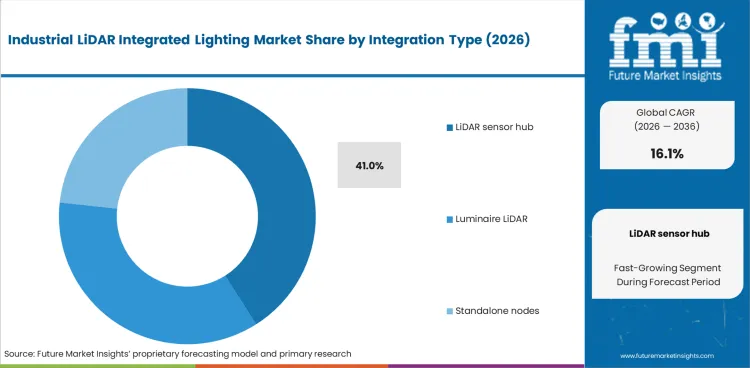
- LiDAR sensor hub systems are projected to account for 41.0% share in 2026. The hub design suits facilities that want a sensing point above a busy aisle without replacing every fixture.
- This route gives integrators room to link sensors with lighting controls and safety software. Luminaire LiDAR will gain attention as fixture makers embed sensing deeper into high-bay products.
Insights into the Forklift and Automated Guided Vehicle Safety Use Case Segment
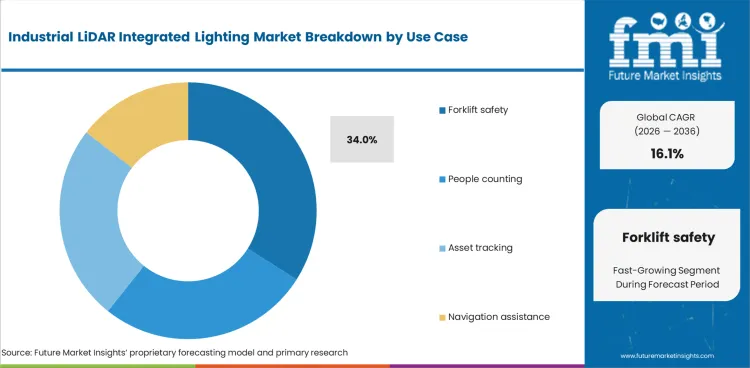
- Forklift and automated guided vehicle safety is expected to represent 34.0% share in 2026. Safety teams can justify spending when a system detects moving equipment and nearby workers in the same zone.
- The Health and Safety Executive reported in October 2025 that being struck by a moving vehicle accounted for 16.0% of fatal work injuries in Great Britain. That evidence supports LiDAR coverage near reversing routes and loading bays.
Insights into the Warehousing Facility Type Segment
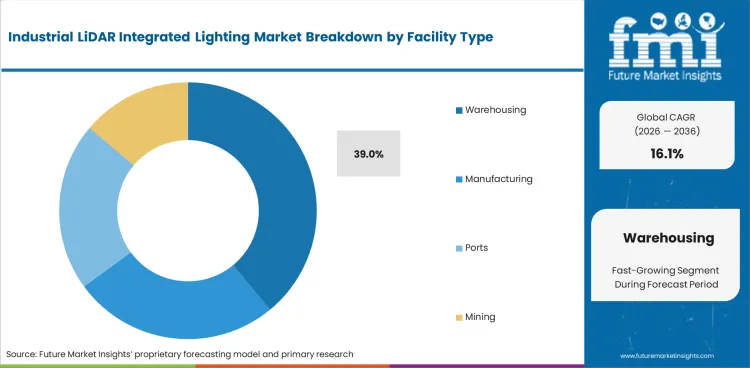
- Warehousing is forecast to account for 39.0% share of facility type demand in 2026. High traffic density makes lighting poles and high bays useful mounting points for sensing coverage.
- International Federation of Robotics data showed 542,000 industrial robot installations globally in 2024. This automation setting supports autonomous mobile robots that need cleaner zone awareness around people.
Insights into the System Integrators Buyer Segment
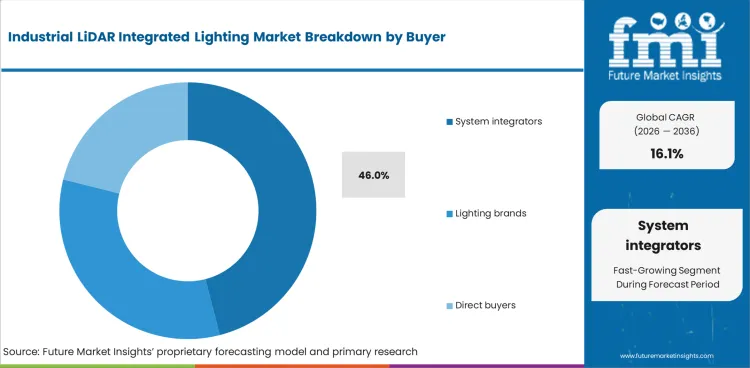
- System integrators are projected to account for 46.0% share of buyer demand in 2026. Facility owners often want one party to handle fixtures, sensing placement and data connection.
- This buyer route favors companies that understand lighting layouts and safety rules. It also supports lighting as a service when customers prefer measured outcomes over upfront fixture buying.
Insights into the Solid-State LiDAR Class Segment
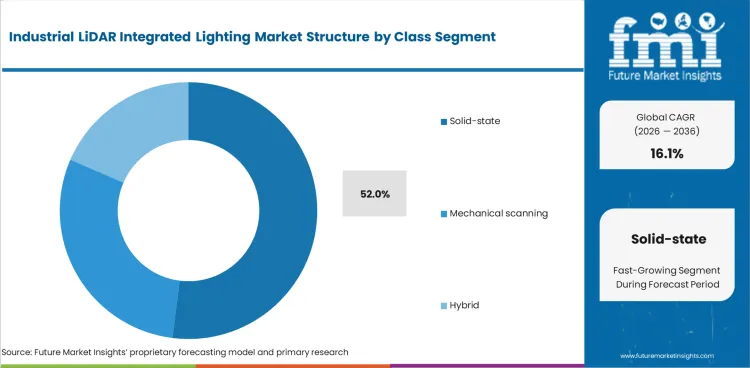
- Solid-state LiDAR is expected to account for 52.0% share of LiDAR class demand in 2026. Fewer moving parts make it easier to place sensing in sealed lighting housings.
- This class fits indoor industrial use because fixtures are mounted high and service access can be costly. Adjacent solid-state LiDAR sensors show how compact modules are becoming easier to specify across automation systems. The shift also connects with solid-state lighting as fixtures become smaller and smarter.
Industrial LiDAR Integrated Lighting Market Drivers, Restraints, and Opportunities
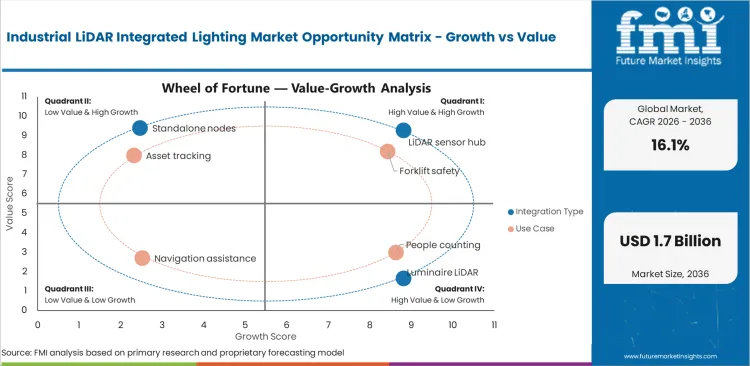
- Forklift corridor risk is increasing interest in LiDAR lighting systems for vehicle and worker separation.
- Fixture replacement cycles can slow adoption when buyers treat LiDAR as a lighting add-on.
- Software-ready sensing opens opportunity for event logs, heat maps and zone-level safety reports.
Risk Control in Mixed-Traffic Facilities
A primary driver is risk control inside facilities that mix workers with moving vehicles, where blind corners and shared aisles create recurring near-miss conditions. In these environments, LiDAR-enabled lighting positions sensing overhead, so detection is not blocked by pallets, racking, or temporary obstructions on the floor. The value proposition is practical: earlier awareness, fewer unexpected interactions, and faster incident investigation when events do occur. SICK safety documentation published in September 2024 describes laser scanners monitoring up to eight zones as independent protective fields for human-robot work areas. This concept aligns with LiDAR integrated lighting because fixtures can be mapped to zones and configured for speed reduction, warnings, or access control based on real-time movement.
Cost Comparison vs. Basic Sensors
Cost is one of the main growth restraint, particularly when procurement teams benchmark LiDAR integrated lighting against low-cost occupancy sensors or camera-based alternatives without accounting for the value of three-dimensional detection. Total cost of ownership is also shaped by component selection and maintenance access in high-ceiling environments. Component choices such as LiDAR pulsed fiber lasers affect range and they can push system costs higher if buyers specify longer-distance performance than the site layout truly needs. Suppliers that simplify commissioning and prove ROI in high-risk zones will reduce resistance.
Operational Data and Digital-Twin Readiness
The strongest opportunity is data value. Beyond incident prevention, LiDAR integrated lighting can generate continuous, zone-level movement data that facility teams can use for layout optimization, congestion reduction, and productivity analysis. Because sensing is mounted overhead and distributed across lighting points, it can build consistent coverage without adding trip hazards or floor-mounted hardware that competes with operations. This creates a natural pathway into Warehouse digital twins, which need live movement inputs to validate simulations, track bottlenecks, and test changes before physical rearrangement. Higher-end 1550nm LiDAR pulsed fiber lasers may serve special yards that need longer sensing distance, extending the concept from indoor aisles to large bays and perimeter routes where range and robustness matter most.
Analysis of Industrial LiDAR Integrated Lighting Market by Key Countries
Country growth reflects safety rules, robotics density, lighting retrofit channels and sensor supply depth. The faster markets combine workplace movement risk with integrators able to connect lighting and sensing.
Source: Future Market Insights, 2026.
.webp "Top Country Growth Comparison Industrial Lidar Integrated Lighting Market Cagr (2026 2036)")
| Country | CAGR |
|---|---|
| United Kingdom | 18.3% CAGR |
| South Korea | 17.7% CAGR |
| Japan | 17.0% CAGR |
| Germany | 16.4% CAGR |
| India | 15.5% CAGR |
| China | 15.2% CAGR |
| United States | 14.7% CAGR |
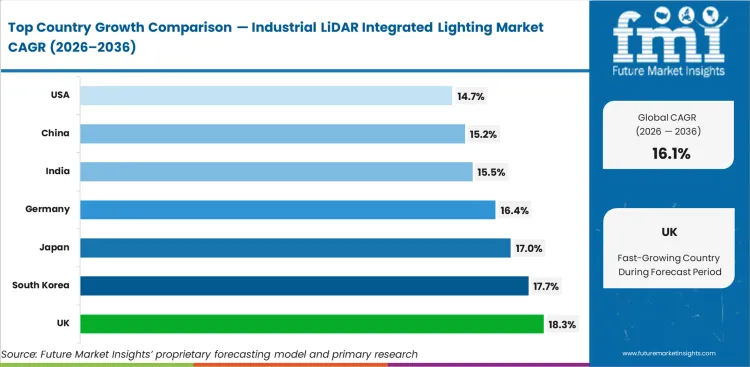
Industrial LiDAR Integrated Lighting Market CAGR Analysis by Country
- The United Kingdom is expected to post 18.3% CAGR through 2036 as workplace transport risk raises interest in overhead sensing.
- South Korea is projected to record 17.7% CAGR through 2036 as electronics and robotics suppliers support fast industrial trials.
- Japan is expected to expand at 17.0% CAGR through 2036 as precision factories need safer mobile robot routes.
- Germany is forecast to grow at 16.4% CAGR through 2036 as automation buyers connect lighting with safety controls.
- India is projected to rise at 15.5% CAGR through 2036 as electronics plants and logistics hubs expand sensing budgets.
- China is forecast at 15.2% CAGR through 2036 as high-volume automation supports LiDAR cost reduction.
- The United States is expected to advance at 14.7% CAGR through 2036 as warehouse safety spending supports selective adoption.
Demand Outlook for Industrial LiDAR Integrated Lighting in the United States
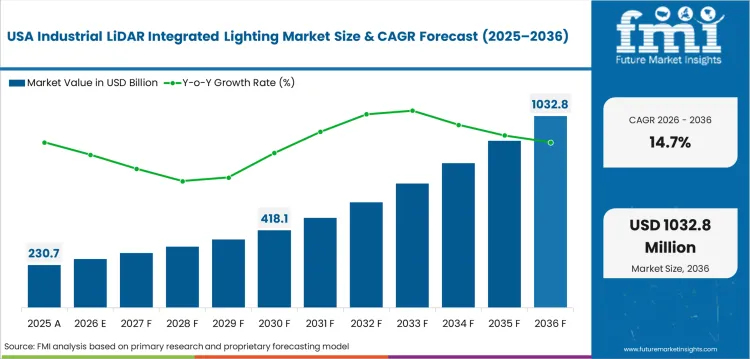
The United States is expected to advance at 14.7% CAGR through 2036 as warehouse safety and lighting retrofits meet. For instance, the United States Census Bureau reported USD 1.56 billion in electric lighting equipment shipments for March 2026. That product pool gives LiDAR vendors a channel through industrial lighting suppliers. Adoption will stay focused on cross aisles and high-traffic zones where vehicle risk is visible.
- Large fulfillment centers can test LiDAR hubs above forklift intersections before wider facility rollouts.
- Lighting contractors need simple commissioning tools that reduce setup time during retrofit work.
- Ouster and Acuity Inc. give the United States a mix of LiDAR software and lighting channel access.
Sales Analysis of Industrial LiDAR Integrated Lighting in China
China is forecast at 15.2% CAGR through 2036 as factory automation supports dense sensing use. The National Bureau of Statistics of China reported 14.2% growth in computer and communication equipment manufacturing for January to February 2026. This electronics activity supports local buyers that can adopt LiDAR hardware at scale. Hesai Technology and RoboSense give China strong access to compact sensors and robotics channels.
- Shenzhen factories can trial LiDAR lighting near assembly benches and automated material routes.
- Hefei and Wuhan facilities can connect lighting projects with electronics and sensor supply chains.
- Chinese suppliers can push cost down when robotics LiDAR volumes support shared component platforms.
Demand Outlook for Industrial LiDAR Integrated Lighting in India
India is projected to rise at 15.5% CAGR through 2036 as electronics and logistics sites scale. India’s Press Information Bureau reported electronics goods production of about Rs. 11.3 lakh crore for 2024 to 2025. That production growth creates more factories that need safer internal movement and stronger inspection zones. Early demand will come from new plants that can plan sensing before lighting installation closes.
- Tamil Nadu electronics plants can place LiDAR nodes near quality rooms and material transfer routes.
- Gujarat industrial corridors can use sensor hubs in warehouses tied to new manufacturing projects.
- Noida equipment makers need integrators that can explain LiDAR coverage in plain safety terms.
Opportunity Analysis of Industrial LiDAR Integrated Lighting in Germany
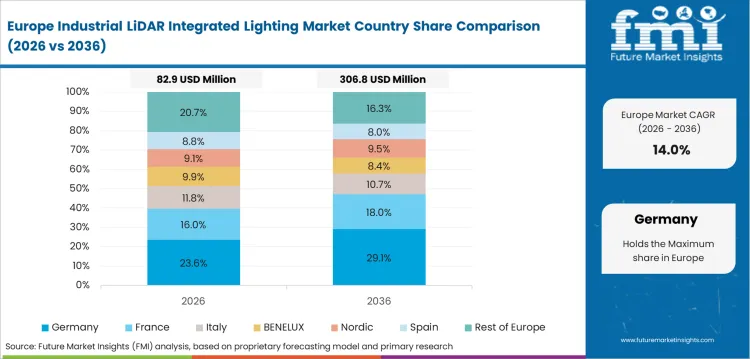
Germany is forecast to grow at 16.4% CAGR through 2036 as automation buyers connect lighting with machine safety. The Federal Statistical Office of Germany reported that real manufacturing orders rose 7.8% in December 2025.Machinery and electrical equipment demand supports plant upgrades that may include smart high bays. Suppliers must prove compliance fit and reliable integration with existing industrial control networks.
- Bavaria automation sites can test LiDAR lighting around mobile robot routes and service aisles.
- Saxony electronics plants can use solid-state modules where compact sensing and lighting fit matter.
- Ruhr logistics hubs can treat LiDAR lighting as a safety layer near loading lanes.
Future Outlook for Industrial LiDAR Integrated Lighting in Japan
Japan is expected to expand at 17.0% CAGR through 2036 as precision factories use safer mobile automation. Japan Electronics and Information Technology Industries Association data showed electronic components and devices production of 645,673 million yen in June 2025.That production setting supports careful trials in inspection rooms and equipment lines. Suppliers with compact solid-state modules can serve facilities that avoid bulky ceiling hardware.
- Tokyo automation labs can test mobile LiDAR scanners for movement mapping before fixed lighting integration.
- Nagoya vehicle suppliers can trial LiDAR lighting around component logistics and trim stations.
- Osaka electronics sites need sensor placement plans that fit narrow factory aisles.
Sales Analysis of Industrial LiDAR Integrated Lighting in South Korea
South Korea is projected to record 17.7% CAGR through 2036 as sensor and robotics supply operate close together. KOTRA Invest Korea reported a KRW 484 billion government plan by 2032 for next-generation display technologies in August 2025. That technology funding climate supports optical sensing and advanced factory trials. Seoul and Cheonan are likely early locations for LiDAR lighting pilots tied to electronics and automation.
- Gyeonggi factories can connect LiDAR sensing with control rooms and robotic work cells.
- Cheonan electronics sites can use ceiling sensing to reduce blind spots near automated carts.
- Local display and sensor depth can shorten the test cycle for industrial lighting brands.
Future Outlook for Industrial LiDAR Integrated Lighting in the United Kingdom
The United Kingdom is expected to post 18.3% CAGR through 2036 as workplace transport safety keeps buyer pressure high. The Office for National Statistics reported that computer, electronic and optical products rose 3.3% in the fourth quarter of 2025. The Health and Safety Executive focus on workplace transport gives suppliers a clear safety message. Buyers will favor simple retrofit packages for warehouses, manufacturing sites and mixed-use industrial buildings.
- Midlands distribution centers can test LiDAR lighting near reversing lanes and loading points.
- Cambridge labs can use LiDAR lighting to pair low glare with people flow sensing.
- Manchester facilities can link wireless lighting with sensor data during retrofit projects.
Competitive Landscape and Strategic Positioning
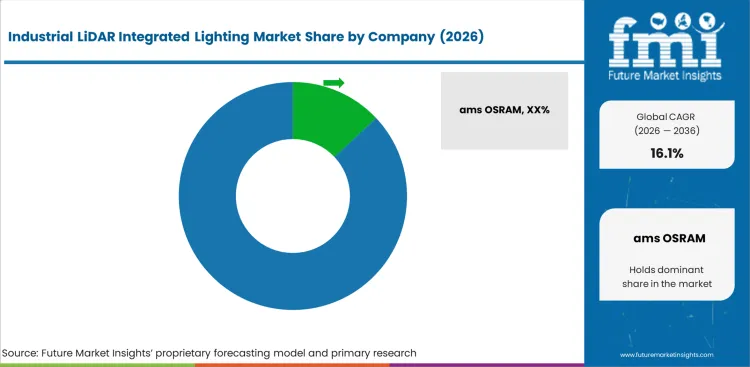
- Competition is split between LiDAR sensor makers and lighting integration firms.
- Sensor firms win on point-cloud quality, software and rugged module supply.
- Lighting firms win when they control fixture channels and installation support.
- Industrial automation groups win where the project touches controls and safety systems.
Competition in industrial LiDAR integrated lighting market is defined by clearly separated roles across sensing hardware and installation channels. Early momentum favors suppliers that can anchor projects either through software-led perception capability or through control of lighting and automation channels. The competitive field therefore spans LiDAR specialists that bring sensing depth and data platforms, alongside lighting and automation groups that control specification and compliance.
Ouster is one of the strongest software-linked LiDAR suppliers positioned for industrial sites, setting early benchmarks for how sensing value is monetized beyond hardware alone. In March 2026, the company reported USD 169 million in 2025 revenue and more than 25,000 sensors shipped for revenue, demonstrating traction in pairing LiDAR hardware with perception software and cloud management tools. This positioning aligns with industrial lighting environments where buyers increasingly expect centralized monitoring and analytics across zones and facilities. Ouster’s approach fits projects where LiDAR integrated lighting functions as part of a connected safety and data layer rather than a standalone sensor deployment.
Hesai Technology and RoboSense bring volume strength through China’s robotics-focused LiDAR supply base, with Hesai reporting about 239,273 robotics LiDAR shipments in 2025 and RoboSense about 303,000 shipments in the same year. This scale supports faster cost reduction and broader experimentation but does not on its own guarantee access to facility buyers. Lighting and automation companies, including Acuity Brands Lighting, Signify, Siemens, ABB, and SICK,will ultimately decide adoption speed by translating sensing capability into installation packages, safety workflows, and standards that facility managers trust.
Key Companies in the Industrial LiDAR Integrated Lighting Market
A role-based view is clearer than a size-only view because the market blends LiDAR hardware, lighting channels and industrial controls. FMI analysts classify companies by the function they bring to a buyer project.
- LiDAR Sensor Leaders: Ouster, Hesai Technology and RoboSense provide core sensing platforms for industrial and robotics use.
- Lighting Integration Specialists: ams OSRAM, Signify and Acuity Inc. connect sensing with lighting channels and fixture design.
- Automation and Safety Specialists: Siemens, ABB and SICK connect LiDAR lighting with controls, robotics and safety systems.
- Legacy Position: Velodyne is treated as an Ouster legacy line after the completed Ouster and Velodyne merger.
Competitive Benchmarking: Industrial LiDAR Integrated Lighting Market
Source: Future Market Insights competitive analysis, 2026. Ratings reflect relative positioning based on LiDAR sensing depth, lighting channel fit and industrial safety integration.
| Company | LiDAR Sensing Depth | Lighting Channel Fit | Industrial Safety Integration | Geographic Footprint |
|---|---|---|---|---|
| Ouster | High | Medium | Strong | Global with United States software depth and Velodyne legacy portfolio |
| Hesai Technology | High | Low | Medium | China centered with global robotics and industrial reach |
| RoboSense | High | Low | Medium | China centered with strong robotics LiDAR scale |
| ams OSRAM | Medium | Strong | Medium | Europe centered with light and sensor component depth |
| Signify | Low | High | Medium | Global lighting channel footprint with connected lighting strength |
| Acuity Inc. | Low | High | Medium | North America centered with industrial lighting and controls access |
| Siemens | Low | Medium | Strong | Global building and industrial controls footprint |
| ABB | Low | Medium | Strong | Global robotics and automation footprint |
| SICK | Medium | Low | Strong | Global safety scanner and industrial sensor footprint |
Key Developments in Industrial LiDAR Integrated Lighting Market
- In January 2026, Hesai Technology said its JT series had surpassed 200,000 cumulative deliveries and planned to double annual LiDAR production capacity.
- In October 2025, RoboSense launched AC2 with direct time-of-flight sensing, RGB stereo and an inertial measurement unit in one sensor system.
- In June 2025, Acuity Brands Lighting launched the SensorSwitch TLS occupancy sensor for industrial lighting in warehouses and manufacturing facilities.
Key Players in the Industrial LiDAR Integrated Lighting Market
Major Global Players:
- ams OSRAM
- Signify
- Acuity Inc.
- Ouster
- Hesai Technology
- RoboSense
- Siemens
- ABB
- SICK
- Specialist and Legacy Participants:
- Ouster Velodyne legacy portfolio
- SensorSwitch by Acuity Brands Lighting
- SICK safety scanner portfolio
Report Scope and Coverage
| Parameter | Details |
|---|---|
| Quantitative Units | USD 0.38 billion to USD 1.69 billion at 16.1% CAGR |
| Market Definition | Lighting systems that include LiDAR sensing in fixtures; hubs; or connected nodes |
| Integration Type | LiDAR sensor hub; luminaire LiDAR; standalone nodes |
| Use Case | forklift safety; people counting; asset tracking; navigation assistance |
| Facility Type | warehousing; manufacturing; ports; mining |
| Buyer | system integrators; lighting brands; direct buyers |
| LiDAR Class | solid-state; mechanical scanning; hybrid |
| Regions Covered | North America; Latin America; Western Europe; Eastern Europe; East Asia; South Asia and Pacific; Middle East and Africa |
| Countries Covered | United States; China; India; Germany; Japan; South Korea; United Kingdom; and 30+ countries |
| Key Companies Profiled | ams OSRAM; Signify; Acuity Inc.; Ouster; Hesai Technology; RoboSense; Siemens; ABB; SICK |
| Forecast Period | 2026 to 2036 |
| Approach | Hybrid bottom-up and top-down method using supplied values; safety data; LiDAR shipments; robotics signals; lighting shipments |
Source: Future Market Insights, 2026.
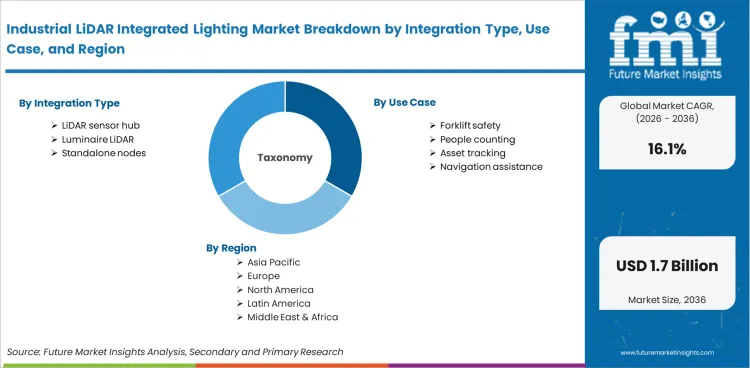
Industrial LiDAR Integrated Lighting Market Breakdown By Integration Type, Use Case, Facility Type, Buyer, LiDAR Class, and Region
Industrial LiDAR Integrated Lighting Market Segmented by Integration Type:
- LiDAR sensor hub
- Luminaire LiDAR
- Standalone nodes
Industrial LiDAR Integrated Lighting Market Segmented by Use Case:
- Forklift safety
- People counting
- Asset tracking
- Navigation assistance
Industrial LiDAR Integrated Lighting Market Segmented by Facility Type:
- Warehousing
- Manufacturing
- Ports
- Mining
Industrial LiDAR Integrated Lighting Market Segmented by Buyer:
- System integrators
- Lighting brands
- Direct buyers
Industrial LiDAR Integrated Lighting Market Segmented by LiDAR Class:
- Solid-state
- Mechanical scanning
- Hybrid
Industrial LiDAR Integrated Lighting Market by Region:
- North America
- United States
- Canada
- Mexico
- Latin America
- Brazil
- Chile
- Rest of Latin America
- Western Europe
- Germany
- United Kingdom
- France
- Italy
- Spain
- BENELUX
- Rest of Western Europe
- Eastern Europe
- Poland
- Russia
- Rest of Eastern Europe
- East Asia
- China
- Japan
- South Korea
- South Asia and Pacific
- India
- ASEAN
- Australia and New Zealand
- Rest of South Asia and Pacific
- Middle East and Africa
- GCC Countries
- South Africa
- Rest of Middle East and Africa
Research Sources and Bibliography
- United States Census Bureau. (2026, May 4). Monthly full report on manufacturers’ shipments, inventories, and orders: March 2026.
- Occupational Safety and Health Administration. (2026, April). 2024 annual report of severe injuries and illnesses reported from employers covered by Federal OSHA.
- Occupational Safety and Health Administration. (2025, June 10). Industrial Truck Association National Forklift Safety Day.
- National Bureau of Statistics of China. (2026, March 17). Industrial production operation from January to February 2026.
- Press Information Bureau. (2026, February 6). Electronics manufacturing in India expanded significantly. Government of India.
- Japan Electronics and Information Technology Industries Association. (2025, August 28). June 2025 production by the Japanese electronics industry.
- Office for National Statistics. (2026, February 12). Index of production, UK: December 2025.
- Federal Statistical Office of Germany. (2026, February 5). New orders in manufacturing in December 2025: +7.8% on the previous month.
- Health and Safety Executive. (2025, October 23). Protecting workers from workplace transport: getting the basics right.
- International Federation of Robotics. (2025, September 25). Global robot demand in factories doubles over 10 years.
- Ouster. (2026, March 2). Ouster announces results for fourth quarter and full year 2025.
- Ouster. (2025, March 18). Ouster launches cloud portal for Ouster Gemini digital LiDAR perception platform.
- Ouster. (2023, February 13). Ouster and Velodyne complete merger of equals to accelerate LiDAR adoption.
- Hesai Group. (2026, March 24). Hesai Group reports fourth quarter and full year 2025 unaudited financial results.
- Hesai Technology. (2026, January 5). Hesai announces plan to double annual LiDAR production capacity at CES 2026.
- RoboSense. (2026, March 25). RoboSense beats expectations, achieves first-ever quarterly profit on strong robotics growth.
- RoboSense. (2025, October 21). RoboSense debuts next-gen Eyes of Robots Active Camera 2 at IROS 2025.
- ABB. (2025, June 24). ABB introduces most compact, AI-powered AMR for payloads up to 1500 kg.
- Acuity Brands Lighting. (2025, June 12). SensorSwitch debuts TLS twist-to-lock occupancy sensor for industrial lighting.
- Siemens. (2026, March 2). Siemens showcases journey from smart to autonomous buildings at Light + Building 2026.
- ams OSRAM. (2025, November 6). New LiDAR laser for the next generation of vehicles.
- SICK. (2024, September 15). Distribution and fulfillment: Intelligent safety solutions.
- SICK. (2024, November). Safely designing mobile robots.
The bibliography is provided for reader reference and uses government, trade body, company and official technical sources relevant to industrial LiDAR integrated lighting.
This Report Answers
- What is the current and future value of the industrial LiDAR integrated lighting market from 2026 to 2036?
- What CAGR is expected for the industrial LiDAR integrated lighting market during the forecast period?
- Which integration type segment is projected to lead industrial LiDAR integrated lighting demand in 2026?
- Which use case is expected to hold the strongest share in industrial LiDAR integrated lighting systems?
- What factors are driving LiDAR lighting use in warehouses and distribution centers?
- How do forklift safety rules and workplace transport risks affect supplier selection?
- Which countries are expected to grow faster in industrial LiDAR integrated lighting?
- Which companies are positioned across LiDAR sensing, lighting integration and industrial safety systems?
- How does FMI define the industrial LiDAR integrated lighting revenue scope?
- What forecasting approach was used to estimate industrial LiDAR integrated lighting demand from 2026 to 2036?
Frequently Asked Questions
What is the global market demand for Industrial LiDAR Integrated Lighting in 2026?
In 2026, the global industrial LiDAR integrated lighting market is expected to be worth USD 0.38 billion as safety-linked sensing projects scale.
How big will the Industrial LiDAR Integrated Lighting Market be in 2036?
By 2036, the industrial LiDAR integrated lighting market is expected to be worth USD 1.69 billion as warehouse and factory systems expand.
How much is demand for Industrial LiDAR Integrated Lighting expected to expand between 2026 and 2036?
Between 2026 and 2036, industrial LiDAR integrated lighting demand is expected to expand at 16.1% CAGR as sensing becomes part of lighting plans.
Which integration type is expected to lead the Industrial LiDAR Integrated Lighting Market by 2026?
LiDAR sensor hub systems are projected to lead integration type demand with 41.0% share in 2026 due to easier retrofit placement.
Which use case is expected to lead Industrial LiDAR Integrated Lighting demand in 2026?
Forklift and automated guided vehicle safety is expected to lead use case demand with 34.0% share in 2026 as movement risk drives spending.
Which country is forecast to grow fastest in the Industrial LiDAR Integrated Lighting Market?
The United Kingdom is expected to post 18.3% CAGR through 2036 as workplace transport safety keeps buyer attention on overhead sensing.
What does the Industrial LiDAR Integrated Lighting Market include?
The market includes lighting systems with LiDAR sensing in fixtures, hubs or connected nodes for industrial safety and facility data use.
How does FMI estimate the Industrial LiDAR Integrated Lighting Market forecast?
FMI uses supplied market anchors, lighting shipment checks, safety data, LiDAR shipments and robotics signals to validate the forecast.
How does industrial LiDAR integrated lighting work in a warehouse?
It combines a light point with LiDAR sensing that measures distance and movement, so the system can detect people, pallets and vehicles.
Is LiDAR lighting better than normal occupancy sensing?
LiDAR lighting gives richer distance and movement data than basic occupancy sensing, which makes it better for forklift routes and automated vehicle zones.
Who buys industrial LiDAR integrated lighting systems first?
System integrators buy first in many projects because they can connect fixtures, sensors and software into one accountable facility package.
What makes solid-state LiDAR important for industrial lighting?
Solid-state LiDAR has fewer moving parts and a compact shape, which makes it easier to place in sealed or hard-to-reach lighting hardware.
Preview the report firsthand - request a free sample
Get SampleGet the brochure for pricing and purchase details.
Get PDFTable of Content
- Key Takeaways
- Market Size and CAGR
- Top Growth Driver
- Fastest Growing Segment
- Leading Region
- Key Companies
- Emerging Opportunities
- Executive Summary
- Global Market Outlook
- Demand-side Trends
- Supply-side Trends
- Technology Roadmap Analysis
- Analysis and Recommendations
- Analyst Perspective (What is happening? Why now? What should investors know?)
- Key Questions Answered
- How large is the market?
- What is the CAGR?
- What are key trends?
- Which region dominates?
- Who are the leaders?
- Market Overview
- Market Coverage / Taxonomy
- Market Definition / Scope / Limitations
- Research Methodology
- Chapter Orientation
- Analytical Lens and Working Hypotheses
- Market Structure, Signals, and Trend Drivers
- Benchmarking and Cross-market Comparability
- Market Sizing, Forecasting, and Opportunity Mapping
- Research Design and Evidence Framework
- Desk Research Programme (Secondary Evidence)
- Expert Input and Fieldwork (Primary Evidence)
- Tooling, Models, and Reference Databases
- Data Engineering and Model Build
- Quality Assurance and Audit Trail
- Market Background
- Market Dynamics (Drivers, Restraints, Opportunity, Trends)
- Scenario Forecast (Optimistic, Likely, Conservative)
- Impact Analysis
- AI Impact
- Sustainability Impact
- Regulatory Impact
- Technology Impact
- Consumer / Buyer Analysis
- Purchase Drivers
- Adoption Barriers
- Buyer Journey
- Opportunity Map Analysis
- Product Life Cycle Analysis
- Supply Chain Analysis
- Investment Feasibility Matrix
- Value Chain Analysis
- PESTLE and Porter's Analysis
- Regulatory Landscape
- Regional Parent Market Outlook
- Production and Consumption Statistics
- Import and Export Statistics
- Global Market Analysis and Forecast, 2021 to 2036
- Historical Market Size Value (USD Billion) Analysis, 2021 to 2025
- Current and Future Market Size Value (USD Billion) Projections, 2026 to 2036
- Y-o-Y Growth Trend Analysis
- Absolute $ Opportunity Analysis
- Global Market Pricing Analysis, 2021 to 2036
- Global Market Analysis and Forecast, By Integration Type, 2021 to 2036
- Introduction / Key Findings
- Historical Market Size Value (USD Billion) Analysis By Integration Type, 2021 to 2025
- Current and Future Market Size Value (USD Billion) Analysis and Forecast By Integration Type, 2026 to 2036
- LiDAR sensor hub
- Luminaire LiDAR
- Standalone nodes
- LiDAR sensor hub
- Y-o-Y Growth Trend Analysis By Integration Type, 2021 to 2025
- Absolute $ Opportunity Analysis By Integration Type, 2026 to 2036
- Global Market Analysis and Forecast, By Use Case, 2021 to 2036
- Introduction / Key Findings
- Historical Market Size Value (USD Billion) Analysis By Use Case, 2021 to 2025
- Current and Future Market Size Value (USD Billion) Analysis and Forecast By Use Case, 2026 to 2036
- Forklift safety
- People counting
- Asset tracking
- Navigation assistance
- Forklift safety
- Y-o-Y Growth Trend Analysis By Use Case, 2021 to 2025
- Absolute $ Opportunity Analysis By Use Case, 2026 to 2036
- Global Market Analysis and Forecast, By Facility Type, 2021 to 2036
- Introduction / Key Findings
- Historical Market Size Value (USD Billion) Analysis By Facility Type, 2021 to 2025
- Current and Future Market Size Value (USD Billion) Analysis and Forecast By Facility Type, 2026 to 2036
- Warehousing
- Manufacturing
- Ports
- Mining
- Warehousing
- Y-o-Y Growth Trend Analysis By Facility Type, 2021 to 2025
- Absolute $ Opportunity Analysis By Facility Type, 2026 to 2036
- Global Market Analysis and Forecast, By Buyer, 2021 to 2036
- Introduction / Key Findings
- Historical Market Size Value (USD Billion) Analysis By Buyer, 2021 to 2025
- Current and Future Market Size Value (USD Billion) Analysis and Forecast By Buyer, 2026 to 2036
- System integrators
- Lighting brands
- Direct buyers
- System integrators
- Y-o-Y Growth Trend Analysis By Buyer, 2021 to 2025
- Absolute $ Opportunity Analysis By Buyer, 2026 to 2036
- Global Market Analysis and Forecast, By LiDAR Class, 2021 to 2036
- Introduction / Key Findings
- Historical Market Size Value (USD Billion) Analysis By LiDAR Class, 2021 to 2025
- Current and Future Market Size Value (USD Billion) Analysis and Forecast By LiDAR Class, 2026 to 2036
- Solid-state
- Mechanical scanning
- Hybrid
- Solid-state
- Y-o-Y Growth Trend Analysis By LiDAR Class, 2021 to 2025
- Absolute $ Opportunity Analysis By LiDAR Class, 2026 to 2036
- Global Market Analysis and Forecast, By Region, 2021 to 2036
- Introduction
- Historical Market Size Value (USD Billion) Analysis By Region, 2021 to 2025
- Current Market Size Value (USD Billion) Analysis and Forecast By Region, 2026 to 2036
- North America
- Latin America
- Western Europe
- Eastern Europe
- East Asia
- South Asia and Pacific
- Middle East & Africa
- Market Attractiveness Analysis By Region
- North America Market Analysis and Forecast, By Country, 2021 to 2036
- Historical Market Size Value (USD Billion) Trend Analysis By Market Taxonomy, 2021 to 2025
- Market Size Value (USD Billion) Forecast By Market Taxonomy, 2026 to 2036
- By Country
- USA
- Canada
- By Integration Type
- By Use Case
- By Facility Type
- By Buyer
- By LiDAR Class
- By Country
- Market Attractiveness Analysis
- By Country
- By Integration Type
- By Use Case
- By Facility Type
- By Buyer
- By LiDAR Class
- Key Takeaways
- Latin America Market Analysis and Forecast, By Country
- Historical Market Size Value (USD Billion) Trend Analysis By Market Taxonomy, 2021 to 2025
- Market Size Value (USD Billion) Forecast By Market Taxonomy, 2026 to 2036
- By Country
- Brazil
- Mexico
- Chile
- Rest of Latin America
- By Integration Type
- By Use Case
- By Facility Type
- By Buyer
- By LiDAR Class
- By Country
- Market Attractiveness Analysis
- By Country
- By Integration Type
- By Use Case
- By Facility Type
- By Buyer
- By LiDAR Class
- Key Takeaways
- Western Europe Market Analysis and Forecast, By Country
- Historical Market Size Value (USD Billion) Trend Analysis By Market Taxonomy, 2021 to 2025
- Market Size Value (USD Billion) Forecast By Market Taxonomy, 2026 to 2036
- By Country
- Germany
- UK
- Italy
- Spain
- France
- Nordic
- BENELUX
- Rest of Western Europe
- By Integration Type
- By Use Case
- By Facility Type
- By Buyer
- By LiDAR Class
- By Country
- Market Attractiveness Analysis
- By Country
- By Integration Type
- By Use Case
- By Facility Type
- By Buyer
- By LiDAR Class
- Key Takeaways
- Eastern Europe Market Analysis and Forecast, By Country
- Historical Market Size Value (USD Billion) Trend Analysis By Market Taxonomy, 2021 to 2025
- Market Size Value (USD Billion) Forecast By Market Taxonomy, 2026 to 2036
- By Country
- Russia
- Poland
- Hungary
- Balkan & Baltic
- Rest of Eastern Europe
- By Integration Type
- By Use Case
- By Facility Type
- By Buyer
- By LiDAR Class
- By Country
- Market Attractiveness Analysis
- By Country
- By Integration Type
- By Use Case
- By Facility Type
- By Buyer
- By LiDAR Class
- Key Takeaways
- East Asia Market Analysis and Forecast, By Country
- Historical Market Size Value (USD Billion) Trend Analysis By Market Taxonomy, 2021 to 2025
- Market Size Value (USD Billion) Forecast By Market Taxonomy, 2026 to 2036
- By Country
- China
- Japan
- South Korea
- By Integration Type
- By Use Case
- By Facility Type
- By Buyer
- By LiDAR Class
- By Country
- Market Attractiveness Analysis
- By Country
- By Integration Type
- By Use Case
- By Facility Type
- By Buyer
- By LiDAR Class
- Key Takeaways
- South Asia and Pacific Market Analysis and Forecast, By Country
- Historical Market Size Value (USD Billion) Trend Analysis By Market Taxonomy, 2021 to 2025
- Market Size Value (USD Billion) Forecast By Market Taxonomy, 2026 to 2036
- By Country
- India
- ASEAN
- Australia & New Zealand
- Rest of South Asia and Pacific
- By Integration Type
- By Use Case
- By Facility Type
- By Buyer
- By LiDAR Class
- By Country
- Market Attractiveness Analysis
- By Country
- By Integration Type
- By Use Case
- By Facility Type
- By Buyer
- By LiDAR Class
- Key Takeaways
- Middle East & Africa Market Analysis and Forecast, By Country
- Historical Market Size Value (USD Billion) Trend Analysis By Market Taxonomy, 2021 to 2025
- Market Size Value (USD Billion) Forecast By Market Taxonomy, 2026 to 2036
- By Country
- Kingdom of Saudi Arabia
- Other GCC Countries
- Türkiye
- South Africa
- Other African Union
- Rest of Middle East & Africa
- By Integration Type
- By Use Case
- By Facility Type
- By Buyer
- By LiDAR Class
- By Country
- Market Attractiveness Analysis
- By Country
- By Integration Type
- By Use Case
- By Facility Type
- By Buyer
- By LiDAR Class
- Key Takeaways
- Key Countries Market Analysis
- USA
- Pricing Analysis
- Market Share Analysis, 2025
- By Integration Type
- By Use Case
- By Facility Type
- By Buyer
- By LiDAR Class
- Canada
- Pricing Analysis
- Market Share Analysis, 2025
- By Integration Type
- By Use Case
- By Facility Type
- By Buyer
- By LiDAR Class
- Mexico
- Pricing Analysis
- Market Share Analysis, 2025
- By Integration Type
- By Use Case
- By Facility Type
- By Buyer
- By LiDAR Class
- Brazil
- Pricing Analysis
- Market Share Analysis, 2025
- By Integration Type
- By Use Case
- By Facility Type
- By Buyer
- By LiDAR Class
- Chile
- Pricing Analysis
- Market Share Analysis, 2025
- By Integration Type
- By Use Case
- By Facility Type
- By Buyer
- By LiDAR Class
- Germany
- Pricing Analysis
- Market Share Analysis, 2025
- By Integration Type
- By Use Case
- By Facility Type
- By Buyer
- By LiDAR Class
- UK
- Pricing Analysis
- Market Share Analysis, 2025
- By Integration Type
- By Use Case
- By Facility Type
- By Buyer
- By LiDAR Class
- Italy
- Pricing Analysis
- Market Share Analysis, 2025
- By Integration Type
- By Use Case
- By Facility Type
- By Buyer
- By LiDAR Class
- Spain
- Pricing Analysis
- Market Share Analysis, 2025
- By Integration Type
- By Use Case
- By Facility Type
- By Buyer
- By LiDAR Class
- France
- Pricing Analysis
- Market Share Analysis, 2025
- By Integration Type
- By Use Case
- By Facility Type
- By Buyer
- By LiDAR Class
- India
- Pricing Analysis
- Market Share Analysis, 2025
- By Integration Type
- By Use Case
- By Facility Type
- By Buyer
- By LiDAR Class
- ASEAN
- Pricing Analysis
- Market Share Analysis, 2025
- By Integration Type
- By Use Case
- By Facility Type
- By Buyer
- By LiDAR Class
- Australia & New Zealand
- Pricing Analysis
- Market Share Analysis, 2025
- By Integration Type
- By Use Case
- By Facility Type
- By Buyer
- By LiDAR Class
- China
- Pricing Analysis
- Market Share Analysis, 2025
- By Integration Type
- By Use Case
- By Facility Type
- By Buyer
- By LiDAR Class
- Japan
- Pricing Analysis
- Market Share Analysis, 2025
- By Integration Type
- By Use Case
- By Facility Type
- By Buyer
- By LiDAR Class
- South Korea
- Pricing Analysis
- Market Share Analysis, 2025
- By Integration Type
- By Use Case
- By Facility Type
- By Buyer
- By LiDAR Class
- Russia
- Pricing Analysis
- Market Share Analysis, 2025
- By Integration Type
- By Use Case
- By Facility Type
- By Buyer
- By LiDAR Class
- Poland
- Pricing Analysis
- Market Share Analysis, 2025
- By Integration Type
- By Use Case
- By Facility Type
- By Buyer
- By LiDAR Class
- Hungary
- Pricing Analysis
- Market Share Analysis, 2025
- By Integration Type
- By Use Case
- By Facility Type
- By Buyer
- By LiDAR Class
- Kingdom of Saudi Arabia
- Pricing Analysis
- Market Share Analysis, 2025
- By Integration Type
- By Use Case
- By Facility Type
- By Buyer
- By LiDAR Class
- Türkiye
- Pricing Analysis
- Market Share Analysis, 2025
- By Integration Type
- By Use Case
- By Facility Type
- By Buyer
- By LiDAR Class
- South Africa
- Pricing Analysis
- Market Share Analysis, 2025
- By Integration Type
- By Use Case
- By Facility Type
- By Buyer
- By LiDAR Class
- USA
- Market Structure Analysis
- Competition Dashboard
- Competition Benchmarking
- Market Share Analysis of Top Players
- By Regional
- By Integration Type
- By Use Case
- By Facility Type
- By Buyer
- By LiDAR Class
- Emerging Startups
- Innovation Benchmarking
- Competition Analysis
- Competition Deep Dive
- ams OSRAM
- Overview
- Product Portfolio
- Profitability by Market Segments
- Sales Footprint
- Strategy Overview
- Marketing Strategy
- Product Strategy
- Channel Strategy
- Signify
- Acuity Inc.
- Ouster
- Hesai Technology
- RoboSense
- Siemens
- ABB
- SICK
- Specialist and Legacy Participants:
- Ouster Velodyne legacy portfolio
- SensorSwitch by Acuity Brands Lighting
- SICK safety scanner portfolio
- ams OSRAM
- Case Studies
- Success Stories
- Recent Developments
- Competition Deep Dive
- Assumptions & Acronyms Used


