

- Industry Size (2026)
- USD 1.0 Bn
- Forecast (2036)
- USD 4.4 Bn
- CAGR (2026 to 2036)
- 15.9%
Warehouse Digital Twin Simulation and Optimization Market Size, Market Forecast and Outlook By FMI
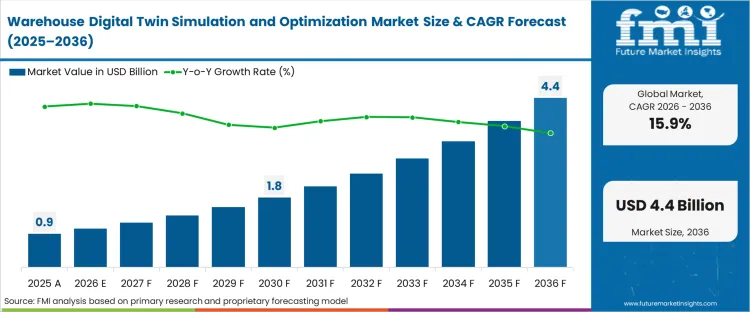
The warehouse digital twin market was valued at USD 0.9 billion in 2025. The industry is expected to reach USD 1.0 billion in 2026 at a CAGR of 15.9% during the forecast period. Demand outlook carries the market valuation to USD 4.4 billion by 2036 as rising automation complexity drives adoption of simulation-driven warehouse optimization platforms.
Summary of Warehouse Digital Twin Simulation and Optimization Market
- Warehouse Digital Twin Simulation and Optimization Market Definition
- This category captures computational intelligence engines that continuously evaluate and replicate physical inventory locations, mechanical kinematics, and workflow logic within digital environments. It includes systems built to simulate operational behavior, test spatial interactions, and improve warehouse decision-making through model-based analysis. Value is created by converting physical warehouse conditions into computational frameworks that support optimization, forecasting, and more accurate execution planning.
- Demand Drivers in the Market
- E-commerce piece-picking velocity requirements force logistics directors to eliminate wasted human travel time using predictive computational modeling.
- Chronic warehouse labor shortages compel operations managers to maximize picker efficiency through hyper-optimized virtual routing algorithms.
- Real estate cost escalation pushes supply chain planners to extract maximum cube utilization from existing facilities via computational geometry.
- Key Segments Analyzed in the FMI Report
- Offering: Software is expected to hold 63.0% share in 2026, dominating as enterprises demand complex physics engines for accurate mechanical testing.
- Twin Type: Operational twins is projected to capture 31.0% share in 2026, reflecting intense focus on live continuous performance synchronization.
- Deployment: Cloud is anticipated to lead with 58.0% share, transforming centralized visibility profiles across immense enterprise networks.
- Warehouse Type: E-commerce DCs is set to command 34.0% share, minimizing complex third-party integration friction during robotic deployment.
- Use Case: Layout planning is estimated to account for 29.0% share, aligning capital expenditure directly with proven virtual throughput metrics.
- China: 18.2% compound growth, driven by rapid deployment of hyper-dense automated logistics networks replacing human labor.
- Analyst Opinion at FMI
- Rahul Pandita, Principal Analyst, Technology, at FMI, points out, "Procurement committees consistently ask analysts to give me the warehouse digital twin market size and forecast before approving software budgets. Executives track simulation accuracy based entirely on pristine throughput outputs but ignore massive manual labor required cleaning incoming execution data before virtual models run. Perfect 3D rendering means absolutely nothing if underlying inventory telemetry contains critical latency gaps. Supply chain directors buying expensive visual twins without upgrading fundamental database architecture merely simulate operational bottlenecks in high definition."
- Strategic Implications / Executive Takeaways
- Facility design directors must prioritize spatial analytics integration before authorizing physical racking installations.
- Procurement heads evaluating robotic fleets should mandate continuous data synchronization capabilities across vendor contracts.
- Operations managers running brownfield sites face unavoidable gridlock unless transitioning away from static seasonal spreadsheet planning.
- Methodology
- Primary Research: Direct engagement with automation architects designing complex virtual execution environments.
- Desk Research: Evaluation of proprietary physics engine documentation identifying exact computational limitations.
- Market-Sizing and Forecasting: Aggregation of declared SaaS subscription revenues across major industrial automation developers.
- Data Validation and Update Cycle: Global robotic hardware shipment data corroborates underlying software license activation requirements.
Supply chain architects face severe pressure testing complex multi-vendor automation workflows computationally prior to procurement. Post-deployment integration failures cause massive facility downtime during peak retail seasons. Operations teams resolving this hardware friction direct significant capital toward the market. Facilities deploying virtual testing nodes eliminate catastrophic bottleneck scenarios before concrete pouring begins, relying heavily on accurate digital twin logistics frameworks.
Once facility managers connect live execution data streams with 3D physical models, spatial analytics moves beyond manual batch review into continuous algorithmic rendering. From that point, warehouse digital twin optimization depends on accurate virtual stress testing to evaluate congestion, throughput shifts, and layout performance. These simulations allow operators to identify constraints earlier, refine workflows faster, and support more precise orchestration across increasingly complex warehouse environments.
China leads at 18.2% replacing human labor with hyper-dense autonomous grids requiring constant virtual monitoring. India tracks at 17.4% formalizing massive greenfield fulfillment networks computationally. South Korea advances at 16.1% coordinating high-velocity piece picking hubs. United States operations register 15.8% overcoming severe domestic labor shortages via automation testing. United Kingdom sites hit 14.9% mapping complex omnichannel fulfillment constraints. Japan expands at 14.6% deploying automated retrieval architectures rapidly. Germany follows at 14.2% integrating heavy industrial automotive part buffering computationally. Structural divergence across these geographies centers entirely on greenfield computational implementation versus difficult brownfield data mapping.
Warehouse Digital Twin Simulation and Optimization Market Definition
Defining exactly what is a warehouse digital twin requires establishing clear boundaries around computational intelligence. The category encompasses engines replicating physical facility layouts, automation kinematics, and human workflows computationally. Scope mandates active continuous replication of material handling environments ensuring exact physical-to-digital fidelity. Purely static spreadsheet planning tools fall strictly outside this boundary. Continuous data synchronization distinguishes modern computational rendering from historical computer-aided drafting techniques.
Warehouse Digital Twin Simulation and Optimization Market Inclusions
The market includes 3D layout rendering software, material flow logic testers, virtual commissioning platforms, and predictive labor modeling algorithms. Deployments centered on warehouse layout design intelligence that capture spatial constraints remain fully within coverage. Professional consulting services required to translate physical facility dimensions into computational models also belong within this boundary, as they directly support simulation accuracy, workflow testing, and warehouse optimization planning.
Warehouse Digital Twin Simulation and Optimization Market Exclusions
This analysis excludes standalone physical conveyor belts and radio frequency identification tags. Automated hardware maintenance contracts fall outside coverage because they lack computational replication logic. Basic execution software without dedicated 3D visualization capability is classified under broader enterprise software categories. General enterprise resource planning deployments disconnected from exact physical spatial coordinates are likewise excluded from the boundaries of this market.
Warehouse Digital Twin Simulation and Optimization Market Research Methodology
- Primary Research: Fulfillment network directors, automation facility architects, and chief supply chain officers detail algorithmic deployment timelines.
- Desk Research: Software patent filings, integrator implementation disclosures, and retail compliance standards provide essential structural context.
- Market-Sizing and Forecasting: Declared software subscription volumes and enterprise license agreements baseline current computational spending.
- Data Validation and Update Cycle: Industrial automation hardware shipment metrics cross-validate spatial optimization software demand curves quarterly.
Segmental Analysis
Warehouse Digital Twin Simulation and Optimization Market Analysis by Offering
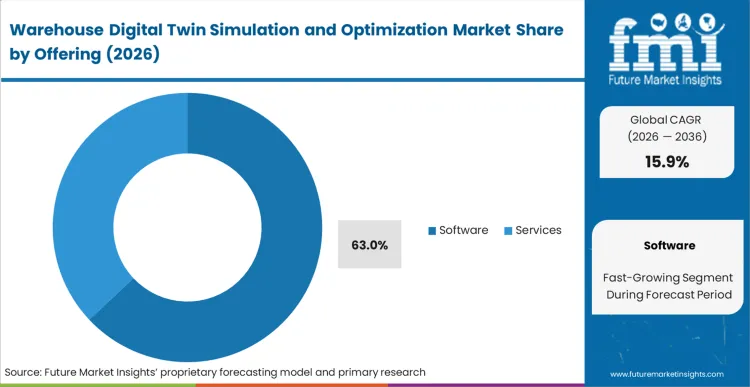
The warehouse twin software market holds 63.0% share in 2026 because intralogistics engineers refuse authorizing automated fleet expenditures without exhaustive virtual validation. FMI's analysis indicates procurement directors depend entirely on exact replica engines predicting throughput capacities accurately. Digital rehearsals eliminate expensive physical rework costs during actual site commissioning. Vendors controlling proprietary physics algorithms extract premium margins before any material handling equipment ships. When evaluating warehouse digital twin platform pricing, pure financial planners often overlook how SaaS licensing fees quietly overshadow initial setup expenditures. Planners attempting sudden platform transitions inevitably face catastrophic project delays when transferring complex kinematics data across incompatible software standards. Logistics directors seeking the best warehouse digital twin software require advanced digital twin technology ensuring precise physical emulation capabilities.
- Initial evaluation: Virtual rendering identifies acute bottleneck zones before hardware installations begin. Facility architects prevent costly layout redesigns.
- Validation requirement: Detailed capacity modeling secures executive project funding. Procurement directors confidently sign massive robotics contracts.
- Expansion cycle: System upgrades require continuous virtual stress testing. Operations managers constantly refine spatial routing logic computationally.
Warehouse Digital Twin Simulation and Optimization Market Analysis by Twin Type
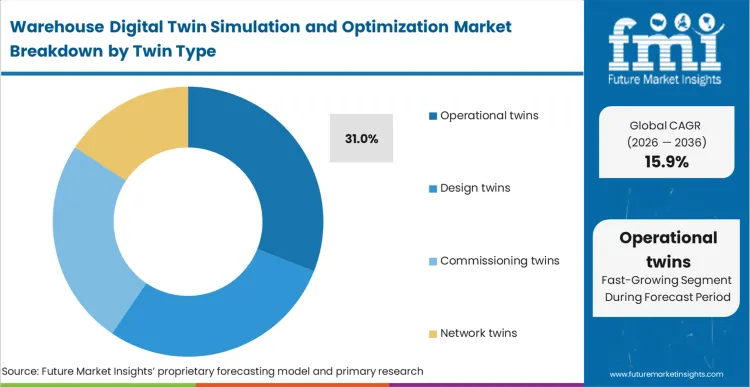
Mapping live data streams into 3D environments creates immense operational advantages. A real time warehouse digital twin captures 31.0% share in 2026 as industrial engineers demand absolute visibility across the intralogistics digital twin environment. According to FMI's estimates, facility managers implementing active models drastically reduce deadhead travel time across massive automation deployments. Establishing fundamental virtual hierarchies prevents overlapping traffic congestion entirely. Sophisticated computational engines look past immediate velocity, predicting equipment failure before mechanical breakdowns halt operations. Interestingly, highly detailed operational models frequently drift out of sync if floor supervisors physically move storage racks without manually updating corresponding virtual coordinates, a common human error rendering predictive algorithms useless. Brands delaying analytical upgrades struggle permanently balancing machine workloads. Operators secure critical simulation software insights utilizing active execution synchronization.
- Procurement savings: Software centralization reduces overall travel time. Financial controllers calculate immense operational expense reductions.
- Hidden maintenance: Dedicated algorithmic tuning teams become necessary. Human resources directors struggle recruiting specialized spatial engineers.
- Lifecycle analysis: Continuous digital tracking proves cheaper than physical audits. Technology officers redirect capital toward software licenses.
Warehouse Digital Twin Simulation and Optimization Market Analysis by Deployment
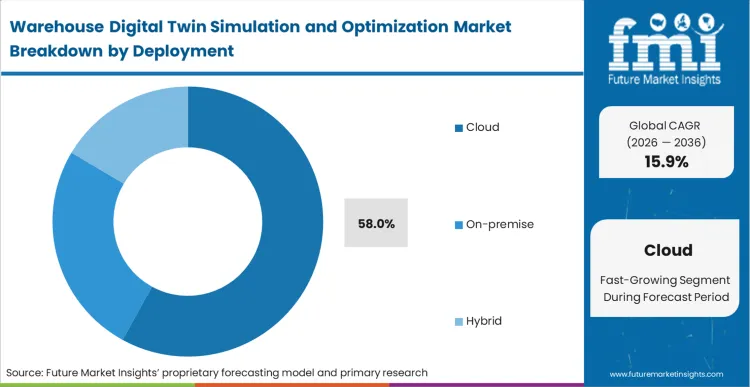
Friction between localized execution and network visibility dictates modern architectural choices. Cloud environments command 58.0% share in 2026 because chief information officers prioritize remote fleet monitoring across multiple geographic nodes simultaneously. Based on FMI's assessment, navigating warehouse digital twin implementation challenges forces operations directors managing regional distribution networks to require unified dashboards tracking billions of discrete simulated objects without installing massive local servers. Centralized processing allows continuous algorithm refinement utilizing aggregated enterprise data. What enterprise IT teams rarely acknowledge is that cloud dependency introduces micro-latency into computational rendering, frustrating on-site engineers trying to resolve acute hardware jams requiring instant virtual feedback. Facilities overlooking this latency trade-off inevitably experience slight diagnostic degradation during extreme mechanical failures. Executives deploy advanced digital logistics frameworks requiring massive centralized processing power.
- Network blackout: Server disconnections instantly blind remote command centers. IT directors establish redundant backup connections preventing visibility loss.
- Data latency: Upload delays compromise collision detection algorithms. Automation engineers must accept minor reporting discrepancies.
- Recovery action: Localized edge computing handles acute emergency shutoffs. Safety compliance officers ensure immediate hardware braking protocols remain intact.
Warehouse Digital Twin Simulation and Optimization Market Analysis by Warehouse Type
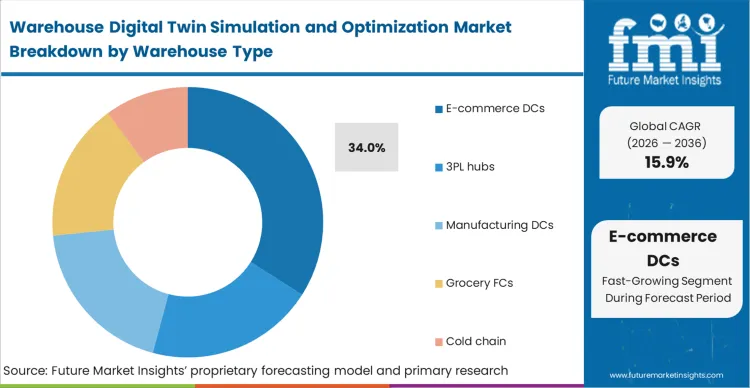
Intense piece-picking volume density creates extreme computational constraints. An e-commerce warehouse digital twin accounts for 34.0% share in 2026 because online retailers aggressively deploy software maximizing individual machine efficiency. FMI analysts note fulfillment directors completely redesign workflows computationally around advanced fulfillment center optimization software maintaining acceptable delivery windows. This specific environment requires continuous dynamic rerouting simulations evaluating billions of shifting order profiles. Traditional pallet-focused operations lacking specialized routing demands face massive operational disadvantages attempting individual item fulfillment. Many operators utilizing smart warehouse technologies mistakenly assume optimization easily handles massive return processing, yet unpredictable reverse logistics dimensions frequently crash rigid forward-fulfillment models. Operators attempting massive facility scaling face severe network architecture hurdles without flexible spatial logic.
- Baseline execution: Standard order profiles render perfectly within virtual constraints. Shift supervisors easily predict daily shipping capacities.
- Peak degradation: Extreme promotional spikes overwhelm baseline physics engines. Logistics planners must adjust processing parameters manually.
- Acceptability metric: High-fidelity modeling requires extreme accuracy comparing virtual outputs against physical benchmarks. Quality assurance directors reject faulty simulation algorithms.
Warehouse Digital Twin Simulation and Optimization Market Analysis by Use Case
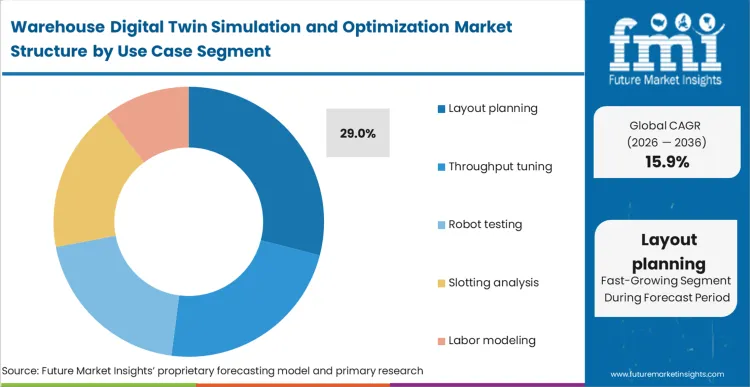
Optimizing spatial geometry before pouring concrete defines modern industrial construction. Deploying a digital twin for warehouse layout planning captures 29.0% share in 2026 as logistics architects abandon traditional static blueprints favoring dynamic 3D rendering. In FMI's view, testing warehouse throughput simulation software guarantees immediate spatial conflict identification across fragmented hardware designs. Construction directors executing precise warehouse layout optimization absorb timeline risks while demanding perfect physical blueprints. A dedicated warehouse commissioning digital twin prevents fragmented localized planning requiring internal floorpan adjustments from intimidating early adopters. While virtual planning promises perfect execution, these models frequently ignore exact structural floor load-bearing limits, quietly forcing operators into expensive physical reinforcement projects post-simulation. Organizations attempting complex building retrofits without an warehouse AMR simulation platform or specific warehouse slotting simulation software suffer massive mechanical integration bottlenecks. Sourcing managers utilizing warehouse robotics regain critical flexibility analyzing varied spatial scenarios continuously.
- Pioneer adoption: Major third-party logistics firms test virtual layouts rapidly. Operations directors gain immediate spatial efficiency across greenfield builds.
- Mainstream expansion: Traditional retail brands transition toward computational planning. IT managers eliminate expensive manual drafting requirements.
- Lagging conversion: Legacy manufacturing plants finally embrace digital drafting. Compliance officers slowly approve complex virtual layout transitions.
Warehouse Digital Twin Simulation and Optimization Market Drivers, Restraints, and Opportunities
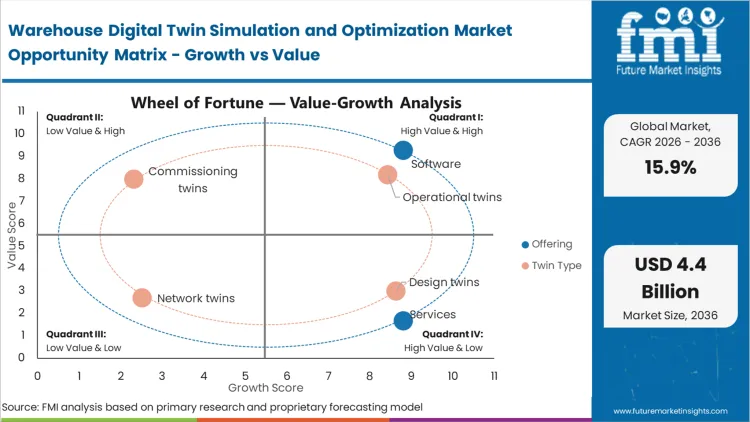
Unrelenting consumer demand for next-day delivery forces operations directors to deploy multi-variant robotics strategies immediately. Failing to computationally test internal routing logic guarantees catastrophic mechanical collisions upon physical deployment. Logistics architects urgently require expert warehouse simulation and optimization software mapping complex autonomous fleets across existing floor plans. This pressure accelerates aggressive spatial simulation integration across major distribution hubs. Attempting manual spatial planning without algorithmic middleware routinely crashes legacy physical workflows during promotional peaks. Supply chain leaders secure multi-billion dollar software contracts simply ensuring human pickers and automated assets interact efficiently. Calculating exact warehouse digital twin ROI proves that advanced retail warehouse management systems rely entirely on accurate computational representation preventing hardware gridlock.
Legacy execution software architecture creates massive friction slowing algorithmic deployment continuously. Older execution codebases cannot process continuous spatial recalculation data generated by modern automated guided vehicles. IT directors attempting patching outdated systems inevitably face catastrophic system latency when continuous virtual rendering logic overwhelms baseline database capacities. This structural software barrier severely throttles physical facility efficiency. Middleware bridges offer partial relief but introduce additional points of failure across critical operational pathways.
Opportunities in the Warehouse Digital Twin Simulation and Optimization Market
- Intelligent modeling deployment: Engineering teams building an AI warehouse digital twin capture premium revenue utilizing advanced supply chain visibility software to predict future hardware constraints autonomously.
- Financial risk mitigation: Executives executing exact warehouse capex planning with digital twin architectures avoid massive stranded capital by simulating robotic throughput before finalizing purchasing contracts.
- Swarm intelligence testing: Developers transitioning from single-robot evaluation to comprehensive logistics visibility software build lucrative recurring revenue models mapping complex fleet interactions.
Regional Analysis
Based on regional analysis, Warehouse Digital Twin Simulation and Optimization Market is segmented into East Asia, South Asia & Pacific, North America, and Europe across 40 plus countries.
.webp "Top Country Growth Comparison Warehouse Digital Twin Simulation And Optimization Market Cagr (2026 2036)")
| Country | CAGR (2026 to 2036) |
|---|---|
| China | 18.2% |
| India | 17.4% |
| South Korea | 16.1% |
| United States | 15.8% |
| United Kingdom | 14.9% |
| Japan | 14.6% |
| Germany | 14.2% |
Source: Future Market Insights (FMI) analysis, based on proprietary forecasting model and primary research
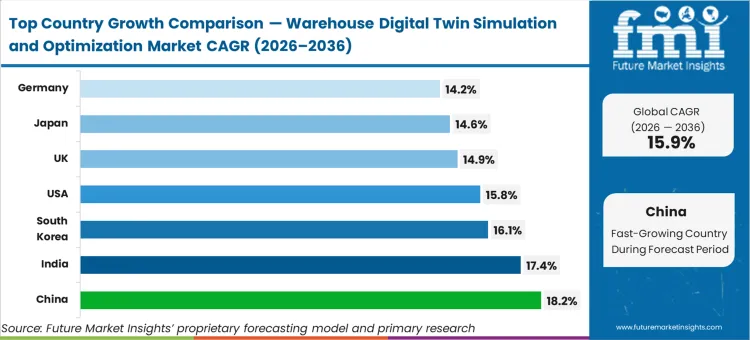
South Asia & Pacific Warehouse Digital Twin Simulation and Optimization Market Analysis
Widespread formalization in domestic retail supply chains is driving major software architectural transformation. FMI estimates indicate that regional logistics groups are replacing fragmented manual planning methods with high-throughput nodes managed through algorithmic modeling. Developers capable of supporting this sharp technology transition are winning large early-stage contracts. At the same time, local operations managers continue to face difficulty with complex computational pathways when outside spatial modeling expertise is missing.
- India: Immediate digital modernization is becoming essential as intralogistics expansion accelerates across India. Supply chain directors facing large e-commerce volume surges are commissioning advanced virtual planning models to support better facility design and operating performance. India is forecast to record 17.4% CAGR as warehouse digitization gains pace. Vendors that establish reliable local integration support networks are securing major greenfield infrastructure contracts by offering the execution confidence needed in high-growth fulfillment environments.
East Asia Warehouse Digital Twin Simulation and Optimization Market Analysis
Heavy piece-picking demand is placing logistics networks under severe physical strain. According to FMI analysis, major regional e-commerce companies are deploying dense robotic grid models computationally before finalizing hardware investments. Managing fleets of this size requires exceptional spatial orchestration capability. Architects are continually stretching virtual design limits in pursuit of small but valuable storage density gains, while new urban automated facilities depend on aggressive vertical cube utilization to remain commercially viable.
- China: China’s immense manufacturing scale is forcing continuous facility upgrades and stronger digital planning capabilities. Logistics architects are implementing large-scale algorithms to lift daily throughput performance through detailed supply chain analytics, layout modeling, and operational forecasting. The market is expected to grow at 18.2% CAGR as domestic software developers export hyper-dense computational models throughout neighboring Asian territories. Expanding warehouse automation, rising demand for precision planning, and broader regional adoption of simulation-led fulfillment strategies are helping China build a stronger position in advanced logistics software and optimization system development.
- South Korea: Acute real estate constraints are compelling extreme facility automation across South Korea’s logistics network. Operations directors are integrating full algorithmic workflows to evaluate robotic kinematics with greater precision before physical deployment begins. South Korea is projected to expand at 16.1% CAGR as facilities adopt computational control tower mapping to reduce implementation risk. These digitally modeled environments help operators avoid costly deployment errors, improve space efficiency, and support more reliable automation performance in highly constrained warehouse settings.
- Japan: Persistent labor shortages are accelerating the shift toward digitally optimized warehouse environments in Japan. Operations managers are using simulation platforms to validate robotic movement, order sequencing, and material flow logic before committing to physical system rollouts. Japan is forecast to grow at 14.6% CAGR as fulfillment operators pursue precise automation planning with lower execution risk. Software vendors capable of supporting highly structured deployment workflows are gaining strategic relevance across the market.
North America Warehouse Digital Twin Simulation and Optimization Market Analysis
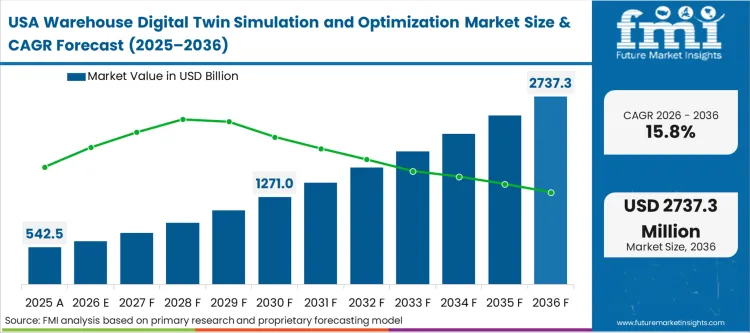
Aging distribution infrastructure is forcing operators to redesign warehouse flows with greater computational precision. Based on FMI assessment, major retail and third-party logistics networks are using simulation-led planning to modernize brownfield facilities without disrupting fulfillment continuity. These environments require exact modeling of labor paths, robotic movement, slotting logic, and throughput bottlenecks before execution begins. Operators relying on digital twins gain stronger confidence in capex deployment and phased automation strategies.
- United States: Legacy fulfillment infrastructure across the United States is creating urgent demand for advanced virtual redesign capabilities. Engineering directors are deploying warehouse digital twin software to evaluate automation scenarios, labor rebalancing, and high-volume order routing before committing physical capital. The market is projected to grow at 15.8% CAGR as omnichannel retail expansion and brownfield modernization programs accelerate. Vendors capable of linking simulation outputs with real execution workflows are strengthening their position across large-scale distribution networks.
Europe Warehouse Digital Twin Simulation and Optimization Market Analysis
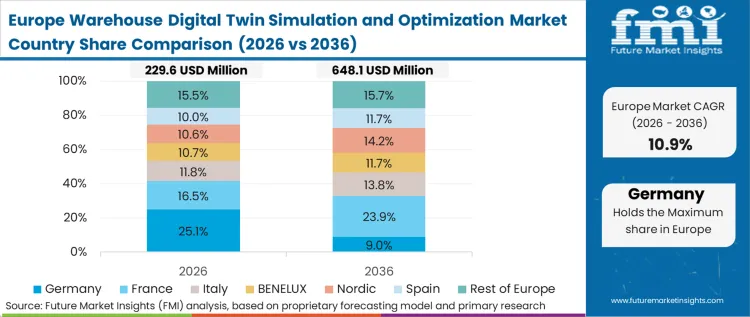
Industrial discipline and engineering rigor are supporting wider adoption of simulation-based warehouse planning across Germany. FMI observes that logistics and manufacturing-linked distribution operators are using digital twins to improve layout efficiency, material handling coordination, and automation synchronization before site modifications begin. Brownfield facilities require careful validation of every process change. Simulation tools reduce commissioning risk while helping operators maintain throughput stability during modernization projects.
Fast parcel movement and dense fulfillment formats are increasing demand for highly adaptive planning systems. FMI analysis indicates that logistics operators across the United Kingdom are relying on simulation environments to test storage density, picking logic, and automation integration before site deployment. Physical constraints inside older facilities make virtual scenario modeling especially valuable. Companies that optimize warehouse flows digitally improve implementation speed while reducing the risk of layout errors and operational downtime.
- United Kingdom: Growing e-commerce intensity is pushing warehouse operators in the United Kingdom toward simulation-led facility planning. Supply chain managers are adopting digital twin optimization tools to improve space utilization, reduce congestion, and strengthen fulfillment speed across compact operating footprints. The market is expected to expand at 14.9% CAGR as retailers and logistics firms seek better planning accuracy under rising service expectations. Providers with strong modeling and warehouse execution integration capabilities are capturing sustained deployment interest.
- Germany: Strong industrial warehousing activity is increasing demand for advanced warehouse simulation platforms across Germany. Facility planners are adopting digital twin systems to model intralogistics flows, automation interactions, and storage efficiency under highly controlled operating conditions. The market is projected to expand at 14.2% CAGR as operators prioritize precision planning and long-term process stability. Vendors delivering high-fidelity modeling with measurable operational value are securing stronger traction in modernization-led projects.
FMI's report includes United States, United Kingdom, Japan, and Germany. Rapid expansion of regional omnichannel fulfillment centers drives continuous demand for flexible virtual orchestration layers.
Competitive Aligners for Market Players
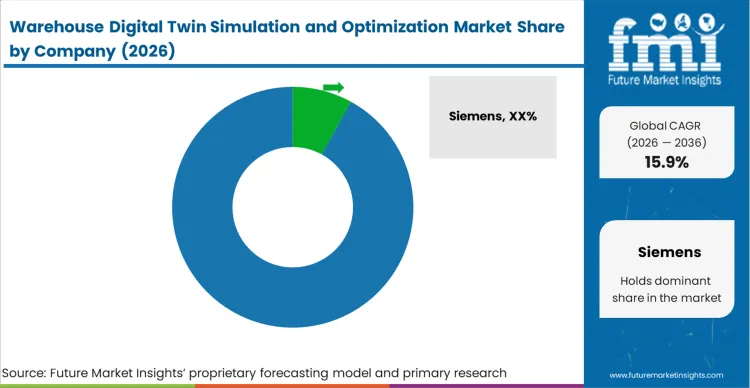
Mastering physics engine accuracy defines competitive success across this computational landscape. Establishing which companies lead warehouse digital twin simulation reveals that equipment buyers care far less about beautiful graphic interfaces than guaranteed mechanical fidelity matching real-world robot acceleration rates. Software vendors like Siemens and Dassault Systèmes win massive enterprise contracts because proprietary spatial algorithms bridge fragmented execution systems seamlessly. Buyers asking who sells warehouse digital twin software quickly discover that vendors selling isolated reporting tools continually lose bids against full-service platform providers promising comprehensive predictive orchestration mapping material handling integration.
Top warehouse digital twin software vendors possess massive libraries containing validated equipment kinematics data. AnyLogic and FlexSim leverage years of documented mechanical benchmarks, allowing rapid deployment across complex legacy facilities combining diverse material handling formats. New entrants building rendering logic from scratch face intense margin pressure trying recreate established physical constraints. Operations directors trust proven physics libraries far more than theoretical optimization promises evaluating automated material handling systems.
Massive retail buyers aggressively resist absolute software lock-in. Conducting a strict warehouse digital twin software comparison during extensive procurement evaluations, sourcing directors deliberately fragment digital purchases forcing developers utilizing open communication standards. This friction between native proprietary engines and best-of-breed open architecture shapes future deployment strategies heavily. Platform providers adopting hardware-agnostic export frameworks capture significant momentum among highly sophisticated networks seeking maximum future flexibility.
Key Players in Warehouse Digital Twin Simulation and Optimization Market
- Siemens
- Dassault Systèmes
- NVIDIA
- Rockwell Automation
- AnyLogic
- FlexSim
- Accenture
Scope of the Report
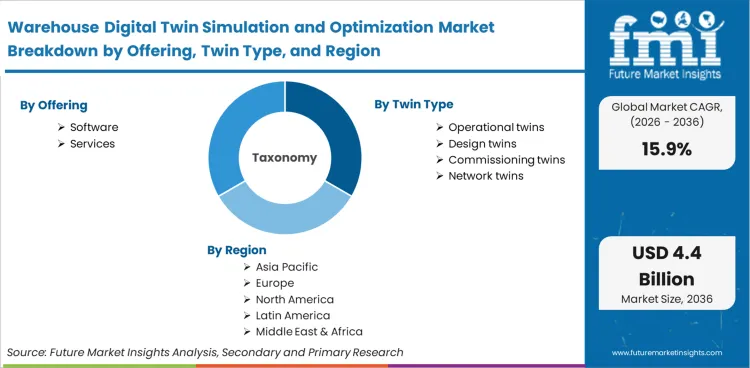
| Metric | Value |
|---|---|
| Quantitative Units | USD 1.0 billion to USD 4.4 billion, at a CAGR of 15.90% |
| Market Definition | Warehouse Digital Twin Simulation and Optimization encompasses computational engines replicating physical facility layouts, automation kinematics, and human workflows computationally. |
| Segmentation | Offering, Twin Type, Deployment, Warehouse Type, Use Case, Region |
| Regions Covered | North America, Europe, East Asia, South Asia & Pacific |
| Countries Covered | China, India, South Korea, United States, United Kingdom, Japan, Germany |
| Key Companies Profiled | Siemens, Dassault Systèmes, NVIDIA, Rockwell Automation, AnyLogic, FlexSim, Accenture |
| Forecast Period | 2026 to 2036 |
| Approach | Declared software subscription volumes and enterprise license agreements baseline current computational spending. |
Source: Future Market Insights (FMI) analysis, based on proprietary forecasting model and primary research
Warehouse Digital Twin Simulation and Optimization Market Analysis by Segments
Offering:
- Software
- Services
Twin Type:
- Operational twins
- Design twins
- Commissioning twins
- Network twins
Deployment:
- Cloud
- On-premise
- Hybrid
Warehouse Type:
- E-commerce DCs
- 3PL hubs
- Manufacturing DCs
- Grocery FCs
- Cold chain
Use Case:
- Layout planning
- Throughput tuning
- Robot testing
- Slotting analysis
- Labor modeling
Region:
- North America
- Europe
- East Asia
- South Asia & Pacific
Bibliography
- Rizqi, Z. U., Chou, S.-Y., & Cahyo, W. N. (2024). A simulation-based digital twin for smart warehouse: Towards standardization. Decision Analytics Journal, 12, 100509.
- Aretoulaki, E., (2024). Discrete event simulation and Digital Twins in warehouse logistics: A systematic literature review. International Journal of Computer Integrated Manufacturing.
- Pracucci, A. (2024). Designing Digital Twin with IoT and AI in Warehouse to Support Optimization and Safety in Engineer-to-Order Manufacturing Process for Prefabricated Building Products. Applied Sciences, 14(15), 6835.
- Chen, H., Li, Y., & collaborators. (2024, November 8). Digital Twin Warehouse Management Platform Developed on the Basis of Multimodal Data Fusion. In Proceedings of the 2024 6th International Conference on Software Engineering and Development. Association for Computing Machinery.
- Ferrari, A., Mangano, G., & Zenezini, G. (2025). Digital Twin Applications for Intralogistics Processes: A Literature Review. IFAC-PapersOnLine, 59(10), 1630–1635.
This bibliography is provided for reader reference. The full FMI report contains the complete reference list with primary source documentation.
This Report Addresses
- Mapping diverse warehouse digital twin use cases accelerates unified remote facility visualization metrics continuously.
- Simulation deployment eliminating severe physical inventory reorganization bottlenecks before concrete pouring.
- Subscription billing models transforming traditional capital expenditure planning regarding simulation software.
- Legacy warehouse software latency causing massive computational hardware integration friction.
- Predictive physical routing reducing massive deadhead travel times utilizing exact kinematics.
- China leading regional compound growth through rapid digital modernization across automated hubs.
- Proprietary physics engines generating significant operational lock-in friction post-deployment.
- Grocers implementing specialized thermal rendering securing critical cold-chain advantages computationally.
Frequently Asked Questions
What is warehouse digital twin simulation software?
Computational systems serve as algorithmic intelligence engines continuously replicating physical facility layouts, automation kinematics, and human workflows computationally, ensuring exact physical-to-digital fidelity.
What is the difference between warehouse simulation and digital twin?
Static drafting or basic simulation relies on historical data creating rigid floor plans, whereas what is the difference between warehouse simulation and digital twin platforms centers on live telemetry. A true twin continuously ingests live execution data, rendering physical kinematics algorithmically to prevent intense mechanical collision during unexpected promotional volume spikes.
How does a virtual model compare to execution systems?
Evaluating warehouse digital twin vs WMS reveals that a WMS dictates tasks and manages inventory flow transactionally. A digital twin ingests that WMS data to visualize spatial physics, testing robotic routing and mechanical stress computationally before the WMS issues physical commands.
How much does digital twin software cost?
Capital requirements range from USD 1.0 billion globally in 2026, scaling rapidly through 2036. Individual facility deployment costs vary dramatically based on required depth regarding robotic integration, continuous recalculation processing, and physical spatial constraints confronting brownfield retrofits.
Which companies offer leading simulation software?
Major global players include Siemens, Dassault Systèmes, NVIDIA, Rockwell Automation, AnyLogic, FlexSim, and Accenture. Operations directors evaluate firms based on proprietary physics libraries and proven ability orchestrating complex equipment ecosystems computationally.
How to choose digital twin simulation software?
Procurement heads should evaluate potential partners strictly on architectural interoperability standards rather than native graphic interfaces. Master integrators guaranteeing open API communication paths prevent costly vendor lock-in during future facility capacity expansions.
What value does Warehouse Digital Twin Simulation and Optimization Market generate currently?
Valuation hits USD 1.0 billion in 2026. Rapidly scaling logistics networks demand precise spatial orchestration eliminating massive mechanical collision before physical operations begin.
What growth rate applies to simulation optimization platforms?
Demand expands at 15.90% CAGR through 2036. Logistics operators face immense pressure upgrading obsolete static layouts into highly fluid environments without halting daily operations physically.
Which deployment model captures highest spending?
Cloud platforms hold 58.0% share in 2026. Chief information officers refuse authorizing massive local server installations preferring unified dashboards tracking immense simulated inventory nodes remotely.
Why do software platforms dominate offering scope?
Software captures 63.0% share. Risk-averse logistics directors historically demanded continuous rendering capabilities avoiding massive API friction between disparate execution systems requiring proprietary physics engines.
How does intense volume density influence simulation strategy?
E-commerce DCs command 34.0% share across warehouse types. Processing direct-to-consumer orders requires extremely fluid physical layouts and highly sophisticated spatial rendering logic managing continuous robotic replenishment.
What structural constraint slows hardware deployment computationally?
Legacy warehouse management software architecture causes immense friction. Older codebases cannot process massive real-time spatial datasets generated continuously by modern autonomous robot fleets rendering operational twins useless.
Why does China lead regional growth trajectories?
China tracks at 18.2% compound growth. Rapid formalization across domestic logistics networks forces massive immediate software upgrades moving regional hubs from disorganized manual layouts toward computationally simulated facilities.
How does cloud latency impact simulation performance?
Cloud dependency introduces micro-latency into computational decisions occasionally causing momentary virtual hesitations. Uncovering structural constraints early prevents catastrophic schedule overruns during extreme holiday volume spikes.
What risk accompanies proprietary physics engine integration?
Proprietary software architecture heavily favors incumbent execution platforms. Specific software frameworks severely limit future competitive bidding when facilities expand spatial requirements demanding best-of-breed algorithm compatibility.
How do cold-chain facilities represent specific computational opportunities?
Temperature-controlled distribution centers face extreme human labor shortages. Engineering teams capable deploying algorithmic thermal rendering logic secure premium specialized integration revenue streams computationally.
Why do e-commerce hubs require continuous dynamic rendering?
E-commerce environments prioritize maximum individual machine efficiency. Traditional pallet-focused operations lacking specialized rendering demands face massive operational disadvantages attempting individual piece-picking fulfillment computationally.
How do operations directors validate simulation performance?
Executives rely almost entirely on advanced predictive algorithms ensuring guaranteed physical compliance metrics. Orchestration engines calculate exact kinematics and collision parameters before dispatching mechanical assets optimizing overall shift safety.
Why do brownfield retrofits present unique simulation challenges?
Updating existing facilities requires orchestrating complex algorithmic models without stopping daily volume flows. Planners executing phased software deployment strategies successfully avoid devastating operational shutdowns.
What advantage do established developers hold over new entrants?
Incumbent providers control massive libraries containing validated kinematic behaviors. Accessing proven codebases allows operations directors accelerating deployment schedules significantly compared building software architecture entirely from scratch.
How does SaaS software generate recurring revenue computationally?
Facilities demand continuous algorithm optimization well past initial launch dates. Software providers transitioning traditional perpetual licenses toward ongoing monthly subscriptions build extremely stable recurring revenue models.
What friction do open API standards address directly?
Sourcing directors deliberately fragment digital purchases demanding open architecture. Forcing developers utilizing hardware-agnostic software frameworks ensures operators maintain maximum flexibility during future simulation expansions.
How does delivery velocity impact computational logic?
Unrelenting consumer expectations demanding next-day delivery eliminate basic static spreadsheet planning viability completely. Industrial engineers designing automated rendering systems maximize vertical cube utilization radically accelerating virtual stress testing.
Why do isolated reporting vendors struggle securing enterprise contracts?
Equipment buyers prioritize guaranteed daily throughput metrics matching exact physical constraints over specific graphic interfaces. Vendors failing offering comprehensive spatial orchestration continually lose competitive bids against full-service platform providers.
How do predictable operating expenses impact procurement computationally?
Subscription software models lower deployment barriers significantly. Financial controllers approve operational expense budgets quickly bypassing rigorous internal capital expenditure review boards entirely.
What drives orchestration demand across European markets?
Germany advances at 14.2% compound growth. Regional automotive manufacturers modernizing local distribution networks aggressively commission expert software services orchestrating complex industrial part buffering workflows computationally.
How does robotic kinematics influence software architecture?
Operators attempting high-density storage zones face severe mechanical constraints. Software engineers designing clear predictive boundaries preventing excessive physical collisions successfully avoid devastating hardware repair costs computationally.
What metric cross-validates simulation software demand forecasting?
Automated material handling hardware shipment volumes track closely alongside integration software requirements. Surging robotic deliveries correlate directly with corresponding spatial optimization license activations securing physical deployment success computationally.
Preview the report firsthand - request a free sample
Get SampleGet the brochure for pricing and purchase details.
Get PDFTable of Content
- Executive Summary
- Global Market Outlook
- Demand-side Trends
- Supply-side Trends
- Technology Roadmap Analysis
- Analysis and Recommendations
- Market Overview
- Market Coverage / Taxonomy
- Market Definition / Scope / Limitations
- Research Methodology
- Chapter Orientation
- Analytical Lens and Working Hypotheses
- Market Structure, Signals, and Trend Drivers
- Benchmarking and Cross-market Comparability
- Market Sizing, Forecasting, and Opportunity Mapping
- Research Design and Evidence Framework
- Desk Research Programme (Secondary Evidence)
- Company Annual and Sustainability Reports
- Peer-reviewed Journals and Academic Literature
- Corporate Websites, Product Literature, and Technical Notes
- Earnings Decks and Investor Briefings
- Statutory Filings and Regulatory Disclosures
- Technical White Papers and Standards Notes
- Trade Journals, Industry Magazines, and Analyst Briefs
- Conference Proceedings, Webinars, and Seminar Materials
- Government Statistics Portals and Public Data Releases
- Press Releases and Reputable Media Coverage
- Specialist Newsletters and Curated Briefings
- Sector Databases and Reference Repositories
- FMI Internal Proprietary Databases and Historical Market Datasets
- Subscription Datasets and Paid Sources
- Social Channels, Communities, and Digital Listening Inputs
- Additional Desk Sources
- Expert Input and Fieldwork (Primary Evidence)
- Primary Modes
- Qualitative Interviews and Expert Elicitation
- Quantitative Surveys and Structured Data Capture
- Blended Approach
- Why Primary Evidence is Used
- Field Techniques
- Interviews
- Surveys
- Focus Groups
- Observational and In-context Research
- Social and Community Interactions
- Stakeholder Universe Engaged
- C-suite Leaders
- Board Members
- Presidents and Vice Presidents
- R&D and Innovation Heads
- Technical Specialists
- Domain Subject-matter Experts
- Scientists
- Physicians and Other Healthcare Professionals
- Governance, Ethics, and Data Stewardship
- Research Ethics
- Data Integrity and Handling
- Primary Modes
- Tooling, Models, and Reference Databases
- Desk Research Programme (Secondary Evidence)
- Data Engineering and Model Build
- Data Acquisition and Ingestion
- Cleaning, Normalisation, and Verification
- Synthesis, Triangulation, and Analysis
- Quality Assurance and Audit Trail
- Market Background
- Market Dynamics
- Drivers
- Restraints
- Opportunity
- Trends
- Scenario Forecast
- Demand in Optimistic Scenario
- Demand in Likely Scenario
- Demand in Conservative Scenario
- Opportunity Map Analysis
- Product Life Cycle Analysis
- Supply Chain Analysis
- Investment Feasibility Matrix
- Value Chain Analysis
- PESTLE and Porter’s Analysis
- Regulatory Landscape
- Regional Parent Market Outlook
- Production and Consumption Statistics
- Import and Export Statistics
- Market Dynamics
- Global Market Analysis 2021 to 2025 and Forecast, 2026 to 2036
- Historical Market Size Value (USD Million) Analysis, 2021 to 2025
- Current and Future Market Size Value (USD Million) Projections, 2026 to 2036
- Y-o-Y Growth Trend Analysis
- Absolute $ Opportunity Analysis
- Global Market Pricing Analysis 2021 to 2025 and Forecast 2026 to 2036
- Global Market Analysis 2021 to 2025 and Forecast 2026 to 2036, By Offering
- Introduction / Key Findings
- Historical Market Size Value (USD Million) Analysis By Offering , 2021 to 2025
- Current and Future Market Size Value (USD Million) Analysis and Forecast By Offering , 2026 to 2036
- Software
- Services
- Software
- Y-o-Y Growth Trend Analysis By Offering , 2021 to 2025
- Absolute $ Opportunity Analysis By Offering , 2026 to 2036
- Global Market Analysis 2021 to 2025 and Forecast 2026 to 2036, By Twin Type
- Introduction / Key Findings
- Historical Market Size Value (USD Million) Analysis By Twin Type, 2021 to 2025
- Current and Future Market Size Value (USD Million) Analysis and Forecast By Twin Type, 2026 to 2036
- Operational twins
- Design twins
- Commissioning twins
- Network twins
- Operational twins
- Y-o-Y Growth Trend Analysis By Twin Type, 2021 to 2025
- Absolute $ Opportunity Analysis By Twin Type, 2026 to 2036
- Global Market Analysis 2021 to 2025 and Forecast 2026 to 2036, By Deployment
- Introduction / Key Findings
- Historical Market Size Value (USD Million) Analysis By Deployment, 2021 to 2025
- Current and Future Market Size Value (USD Million) Analysis and Forecast By Deployment, 2026 to 2036
- Cloud
- On-premise
- Hybrid
- Cloud
- Y-o-Y Growth Trend Analysis By Deployment, 2021 to 2025
- Absolute $ Opportunity Analysis By Deployment, 2026 to 2036
- Global Market Analysis 2021 to 2025 and Forecast 2026 to 2036, By Warehouse Type
- Introduction / Key Findings
- Historical Market Size Value (USD Million) Analysis By Warehouse Type, 2021 to 2025
- Current and Future Market Size Value (USD Million) Analysis and Forecast By Warehouse Type, 2026 to 2036
- E-commerce DCs
- 3PL hubs
- Manufacturing DCs
- Grocery FCs
- Cold chain
- E-commerce DCs
- Y-o-Y Growth Trend Analysis By Warehouse Type, 2021 to 2025
- Absolute $ Opportunity Analysis By Warehouse Type, 2026 to 2036
- Global Market Analysis 2021 to 2025 and Forecast 2026 to 2036, By Use Case
- Introduction / Key Findings
- Historical Market Size Value (USD Million) Analysis By Use Case, 2021 to 2025
- Current and Future Market Size Value (USD Million) Analysis and Forecast By Use Case, 2026 to 2036
- Layout planning
- Throughput tuning
- Robot testing
- Slotting analysis
- Labor modeling
- Layout planning
- Y-o-Y Growth Trend Analysis By Use Case, 2021 to 2025
- Absolute $ Opportunity Analysis By Use Case, 2026 to 2036
- Global Market Analysis 2021 to 2025 and Forecast 2026 to 2036, By Region
- Introduction
- Historical Market Size Value (USD Million) Analysis By Region, 2021 to 2025
- Current Market Size Value (USD Million) Analysis and Forecast By Region, 2026 to 2036
- North America
- Latin America
- Western Europe
- Eastern Europe
- East Asia
- South Asia and Pacific
- Middle East & Africa
- Market Attractiveness Analysis By Region
- North America Market Analysis 2021 to 2025 and Forecast 2026 to 2036, By Country
- Historical Market Size Value (USD Million) Trend Analysis By Market Taxonomy, 2021 to 2025
- Market Size Value (USD Million) Forecast By Market Taxonomy, 2026 to 2036
- By Country
- USA
- Canada
- Mexico
- By Offering
- By Twin Type
- By Deployment
- By Warehouse Type
- By Use Case
- By Country
- Market Attractiveness Analysis
- By Country
- By Offering
- By Twin Type
- By Deployment
- By Warehouse Type
- By Use Case
- Key Takeaways
- Latin America Market Analysis 2021 to 2025 and Forecast 2026 to 2036, By Country
- Historical Market Size Value (USD Million) Trend Analysis By Market Taxonomy, 2021 to 2025
- Market Size Value (USD Million) Forecast By Market Taxonomy, 2026 to 2036
- By Country
- Brazil
- Chile
- Rest of Latin America
- By Offering
- By Twin Type
- By Deployment
- By Warehouse Type
- By Use Case
- By Country
- Market Attractiveness Analysis
- By Country
- By Offering
- By Twin Type
- By Deployment
- By Warehouse Type
- By Use Case
- Key Takeaways
- Western Europe Market Analysis 2021 to 2025 and Forecast 2026 to 2036, By Country
- Historical Market Size Value (USD Million) Trend Analysis By Market Taxonomy, 2021 to 2025
- Market Size Value (USD Million) Forecast By Market Taxonomy, 2026 to 2036
- By Country
- Germany
- UK
- Italy
- Spain
- France
- Nordic
- BENELUX
- Rest of Western Europe
- By Offering
- By Twin Type
- By Deployment
- By Warehouse Type
- By Use Case
- By Country
- Market Attractiveness Analysis
- By Country
- By Offering
- By Twin Type
- By Deployment
- By Warehouse Type
- By Use Case
- Key Takeaways
- Eastern Europe Market Analysis 2021 to 2025 and Forecast 2026 to 2036, By Country
- Historical Market Size Value (USD Million) Trend Analysis By Market Taxonomy, 2021 to 2025
- Market Size Value (USD Million) Forecast By Market Taxonomy, 2026 to 2036
- By Country
- Russia
- Poland
- Hungary
- Balkan & Baltic
- Rest of Eastern Europe
- By Offering
- By Twin Type
- By Deployment
- By Warehouse Type
- By Use Case
- By Country
- Market Attractiveness Analysis
- By Country
- By Offering
- By Twin Type
- By Deployment
- By Warehouse Type
- By Use Case
- Key Takeaways
- East Asia Market Analysis 2021 to 2025 and Forecast 2026 to 2036, By Country
- Historical Market Size Value (USD Million) Trend Analysis By Market Taxonomy, 2021 to 2025
- Market Size Value (USD Million) Forecast By Market Taxonomy, 2026 to 2036
- By Country
- China
- Japan
- South Korea
- By Offering
- By Twin Type
- By Deployment
- By Warehouse Type
- By Use Case
- By Country
- Market Attractiveness Analysis
- By Country
- By Offering
- By Twin Type
- By Deployment
- By Warehouse Type
- By Use Case
- Key Takeaways
- South Asia and Pacific Market Analysis 2021 to 2025 and Forecast 2026 to 2036, By Country
- Historical Market Size Value (USD Million) Trend Analysis By Market Taxonomy, 2021 to 2025
- Market Size Value (USD Million) Forecast By Market Taxonomy, 2026 to 2036
- By Country
- India
- ASEAN
- Australia & New Zealand
- Rest of South Asia and Pacific
- By Offering
- By Twin Type
- By Deployment
- By Warehouse Type
- By Use Case
- By Country
- Market Attractiveness Analysis
- By Country
- By Offering
- By Twin Type
- By Deployment
- By Warehouse Type
- By Use Case
- Key Takeaways
- Middle East & Africa Market Analysis 2021 to 2025 and Forecast 2026 to 2036, By Country
- Historical Market Size Value (USD Million) Trend Analysis By Market Taxonomy, 2021 to 2025
- Market Size Value (USD Million) Forecast By Market Taxonomy, 2026 to 2036
- By Country
- Kingdom of Saudi Arabia
- Other GCC Countries
- Turkiye
- South Africa
- Other African Union
- Rest of Middle East & Africa
- By Offering
- By Twin Type
- By Deployment
- By Warehouse Type
- By Use Case
- By Country
- Market Attractiveness Analysis
- By Country
- By Offering
- By Twin Type
- By Deployment
- By Warehouse Type
- By Use Case
- Key Takeaways
- Key Countries Market Analysis
- USA
- Pricing Analysis
- Market Share Analysis, 2025
- By Offering
- By Twin Type
- By Deployment
- By Warehouse Type
- By Use Case
- Canada
- Pricing Analysis
- Market Share Analysis, 2025
- By Offering
- By Twin Type
- By Deployment
- By Warehouse Type
- By Use Case
- Mexico
- Pricing Analysis
- Market Share Analysis, 2025
- By Offering
- By Twin Type
- By Deployment
- By Warehouse Type
- By Use Case
- Brazil
- Pricing Analysis
- Market Share Analysis, 2025
- By Offering
- By Twin Type
- By Deployment
- By Warehouse Type
- By Use Case
- Chile
- Pricing Analysis
- Market Share Analysis, 2025
- By Offering
- By Twin Type
- By Deployment
- By Warehouse Type
- By Use Case
- Germany
- Pricing Analysis
- Market Share Analysis, 2025
- By Offering
- By Twin Type
- By Deployment
- By Warehouse Type
- By Use Case
- UK
- Pricing Analysis
- Market Share Analysis, 2025
- By Offering
- By Twin Type
- By Deployment
- By Warehouse Type
- By Use Case
- Italy
- Pricing Analysis
- Market Share Analysis, 2025
- By Offering
- By Twin Type
- By Deployment
- By Warehouse Type
- By Use Case
- Spain
- Pricing Analysis
- Market Share Analysis, 2025
- By Offering
- By Twin Type
- By Deployment
- By Warehouse Type
- By Use Case
- France
- Pricing Analysis
- Market Share Analysis, 2025
- By Offering
- By Twin Type
- By Deployment
- By Warehouse Type
- By Use Case
- India
- Pricing Analysis
- Market Share Analysis, 2025
- By Offering
- By Twin Type
- By Deployment
- By Warehouse Type
- By Use Case
- ASEAN
- Pricing Analysis
- Market Share Analysis, 2025
- By Offering
- By Twin Type
- By Deployment
- By Warehouse Type
- By Use Case
- Australia & New Zealand
- Pricing Analysis
- Market Share Analysis, 2025
- By Offering
- By Twin Type
- By Deployment
- By Warehouse Type
- By Use Case
- China
- Pricing Analysis
- Market Share Analysis, 2025
- By Offering
- By Twin Type
- By Deployment
- By Warehouse Type
- By Use Case
- Japan
- Pricing Analysis
- Market Share Analysis, 2025
- By Offering
- By Twin Type
- By Deployment
- By Warehouse Type
- By Use Case
- South Korea
- Pricing Analysis
- Market Share Analysis, 2025
- By Offering
- By Twin Type
- By Deployment
- By Warehouse Type
- By Use Case
- Russia
- Pricing Analysis
- Market Share Analysis, 2025
- By Offering
- By Twin Type
- By Deployment
- By Warehouse Type
- By Use Case
- Poland
- Pricing Analysis
- Market Share Analysis, 2025
- By Offering
- By Twin Type
- By Deployment
- By Warehouse Type
- By Use Case
- Hungary
- Pricing Analysis
- Market Share Analysis, 2025
- By Offering
- By Twin Type
- By Deployment
- By Warehouse Type
- By Use Case
- Kingdom of Saudi Arabia
- Pricing Analysis
- Market Share Analysis, 2025
- By Offering
- By Twin Type
- By Deployment
- By Warehouse Type
- By Use Case
- Turkiye
- Pricing Analysis
- Market Share Analysis, 2025
- By Offering
- By Twin Type
- By Deployment
- By Warehouse Type
- By Use Case
- South Africa
- Pricing Analysis
- Market Share Analysis, 2025
- By Offering
- By Twin Type
- By Deployment
- By Warehouse Type
- By Use Case
- USA
- Market Structure Analysis
- Competition Dashboard
- Competition Benchmarking
- Market Share Analysis of Top Players
- By Regional
- By Offering
- By Twin Type
- By Deployment
- By Warehouse Type
- By Use Case
- Competition Analysis
- Competition Deep Dive
- Siemens
- Overview
- Product Portfolio
- Profitability by Market Segments (Product/Age /Sales Channel/Region)
- Sales Footprint
- Strategy Overview
- Marketing Strategy
- Product Strategy
- Channel Strategy
- Dassault Systèmes
- NVIDIA
- Rockwell Automation
- AnyLogic
- FlexSim
- Accenture
- Siemens
- Competition Deep Dive
- Assumptions & Acronyms Used


