

- Industry Size (2025)
- USD 491.4 Mn
- Forecast (2035)
- USD 1385.9 Mn
- CAGR (2025 to 2035)
- 10.9%
Demand for Electrical Digital Twin in USA 2026 to 2036
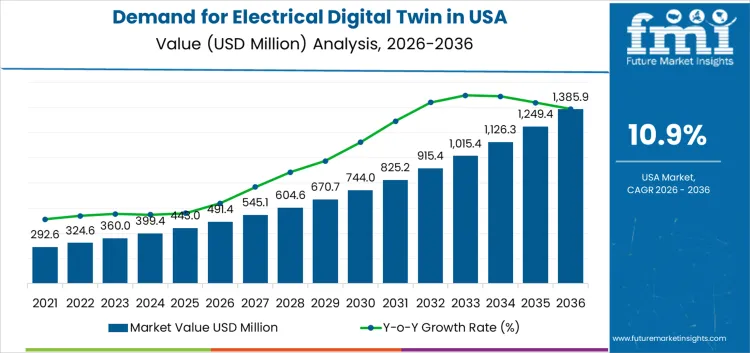
The USA electrical digital twin demand is valued at USD 491.4 million in 2026 and is projected to reach USD 1,385.9 million by 2036, reflecting a CAGR of 10.9%. Growth is driven by modernization of power infrastructure, rising use of predictive maintenance, and increased integration of advanced simulation tools for grid reliability. Utilities and energy operators adopt digital twins to model system performance, reduce downtime, and manage real-time operational risks.
Digital gas and steam power plant twins lead adoption because they enable detailed monitoring of turbine components, heat-rate optimization, and lifecycle asset management. These models support performance benchmarking, early anomaly detection, and fuel efficiency improvements. Operators use high-fidelity simulations to evaluate load variations and extend equipment life through precise maintenance planning.
Quick Stats for USA Electrical Digital Twin Demand
- USA Electrical Digital Twin Sales Value (2026): USD 491.4 million
- USA Electrical Digital Twin Forecast Value (2036): USD 1,385.9 million
- USA Electrical Digital Twin Forecast CAGR (2026–2036): 10.9%
- Leading Twin Type in USA Electrical Digital Twin Demand: Digital Gas & Steam Power Plant Twins
- Key Growth Regions in USA Electrical Digital Twin Demand: West USA, South USA, Northeast USA
- Top Players in USA Electrical Digital Twin Demand: AVEVA Group, Bentley Systems, Inc., Emerson Electric Co., IBM Corporation, Microsoft Corporation
The West, South, and Northeast regions reflect strong uptake due to extensive power generation capacity and investment in digital transformation across utility networks. Key suppliers include AVEVA Group, Bentley Systems, Inc., Emerson Electric Co., IBM Corporation, and Microsoft Corporation. Their strategies focus on AI-driven analytics, secure cloud integration, and scalable twin platforms designed to support complex electrical assets and evolving grid stability requirements.
What is the Growth Forecast for Electrical Digital Twin Industry in USA through 2036?
The 10-Year Growth Comparison for electrical digital twin demand in the United States shows distinct differences between early-period and late-period expansion. Early growth remains measured because adoption depends on pilot-scale implementations within utilities and industrial facilities evaluating simulation accuracy, integration effort, and data governance requirements. Early-period activity focuses on asset monitoring and limited system modeling, which restricts the growth slope. Procurement decisions occur slowly because digital infrastructure, interoperability standards, and workforce familiarity develop at a gradual pace.
Late-period growth shows stronger acceleration as grid modernization programs expand and industrial operators adopt predictive maintenance frameworks. Higher sensor density, improved SCADA integration, and wider availability of real-time analytics increase the utility of digital replicas across transmission, distribution, and plant-level environments. These improvements elevate the contribution of late-period adoption because system-level modeling becomes feasible for larger asset groups. Regulatory attention to resilience and reliability strengthens demand during the later years through structured investment cycles that incorporate digital planning tools.
Software advancements and cloud-based simulation environments add further momentum by reducing deployment barriers. The comparative pattern shows a transition from cautious early adoption shaped by technical and organizational constraints toward stronger late-period growth supported by operational reliability needs, data availability, and maturing digital engineering practices.
USA Electrical Digital Twin Key Takeaways
| Metric | Value |
|---|---|
| USA Electrical Digital Twin Sales Value (2026) | USD 491.4 million |
| USA Electrical Digital Twin Forecast Value (2036) | USD 1,385.9 million |
| USA Electrical Digital Twin Forecast CAGR (2026-2036) | 10.9% |
Why is the Demand for Electrical Digital Twin in USA Growing?
Demand for electrical digital twin technology in the United States grows due to increasing requirements across utilities, industrial plants, data centers, and infrastructure operators seeking accurate modeling of electrical systems. Grid modernization programs rely on digital replicas to simulate load behavior, evaluate equipment performance, and support predictive maintenance. Utilities use digital twins to analyze transformer aging, substation reliability, and distributed energy integration. Industrial facilities adopt system models to improve fault detection, reduce downtime, and validate protection schemes before operational changes. Data centers implement digital replicas to manage power distribution, cooling interaction, and energy efficiency across expanding server capacity.
Growth in renewable energy deployments increases the need to assess grid stability and evaluate scenarios involving variable generation. Engineering firms apply digital twin platforms during design and commissioning to predict equipment response under diverse conditions. Regulatory expectations for system resilience lead operators to use simulation tools that identify vulnerabilities in critical electrical networks. Workforce optimization across large facilities supports the use of virtual models that centralize monitoring and streamline maintenance planning. Software integration with sensors and SCADA systems strengthens real time analysis across distributed assets.
Which Twin Type and Usage Type Segments Lead Demand for Electrical Digital Twins in USA?
Demand for electrical digital twins in the USA is shaped by grid modernization efforts, equipment lifecycle management, and predictive maintenance requirements across energy systems. Utilities and asset operators use digital replicas to monitor performance, reduce downtime, and improve operational forecasting. Adoption patterns reflect the diversity of energy assets, integration needs, and digitalization strategies across production, transmission, and distributed energy environments.
By Twin Type, Digital Gas & Steam Power Plant Twins Account for the Largest Share of Demand
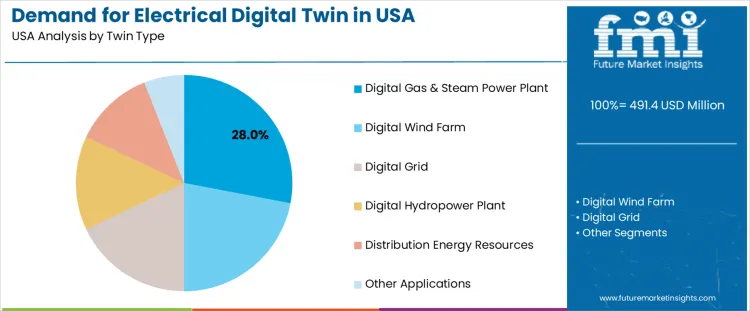
Digital gas and steam power plant twins hold 28.0%, making them the leading segment in USA demand. These models support efficiency optimization, combustion analysis, and predictive maintenance for large thermal assets. Digital wind farms hold 22.0%, driven by turbine-level monitoring and power-curve performance evaluation across distributed onshore installations. Digital grid twins hold 18.0%, supporting real-time load modeling, fault simulation, and resilience planning within transmission and distribution networks. Digital hydropower plant twins hold 14.0%, enabling hydraulic performance assessment and turbine health monitoring. Distributed energy resources hold 12.0%, supporting inverter coordination and distributed asset aggregation. Other applications hold 6.0%, covering niche or facility-level replicas.
Key Points:
- Gas and steam plant twins support efficiency and reliability improvement.
- Wind farm twins enable turbine optimization and forecasting.
- Grid twins support stability modeling and load simulation.
- Distribution reflects asset complexity and digital readiness.
By Usage Type, Production Digital Twins Represent the Largest Segment
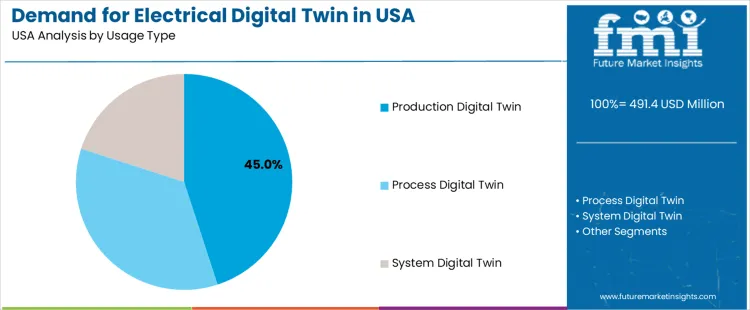
Production digital twins hold 45.0%, making them the leading usage type in the USA. These twins model operational performance across power-generation assets, supporting optimization, predictive analytics, and maintenance scheduling. Process digital twins hold 35.0%, used to simulate workflows, operational sequences, and system interactions across generation, transmission, and distributed resources. System digital twins hold 20.0%, providing holistic modeling of interconnected infrastructure for planning, reliability assessment, and scenario evaluation. Usage distribution reflects the priority placed on operational efficiency, system predictability, and data-driven asset management within USA energy networks.
Key Points:
- Production twins enhance equipment-level performance and forecasting.
- Process twins support workflow simulation and operational optimization.
- System twins provide infrastructure-wide visibility.
- Usage reflects digitalization depth and operational planning needs.
What are the Key Dynamics in the Electrical Digital Twin Industry?
Grid modernization, utility planning needs, and industrial performance requirements are driving adoption.
Demand increases as US utilities strengthen grid planning, asset monitoring, and predictive maintenance across transmission and distribution networks. Electrical digital twins support modelling of load flow, outage behaviour, and equipment ageing, which aids investment decisions. Industrial facilities adopt digital replicas to evaluate energy usage, equipment failure risk, and system optimization. Renewable energy integration creates operational complexity that requires real-time simulation of inverters, substations, and storage assets. Data from advanced metering infrastructure improves simulation accuracy used by engineering teams. Manufacturers implement digital twins to streamline commissioning of electrical systems in factories and data centres. Regional utilities with ageing infrastructure rely on simulation tools to support upgrade scheduling.
High implementation cost, data integration challenges, and workforce limitations restrain wider deployment.
Utilities face substantial expenditure when integrating digital twins with legacy SCADA systems, protection relays, and distributed energy resources. Several organizations encounter difficulty consolidating historical asset data, geospatial files, and sensor outputs into unified models. Smaller utilities report limited internal expertise in systems engineering, which extends project timelines. Cybersecurity requirements increase spending on access controls and network segmentation for simulation platforms. Procurement teams evaluate long-term software maintenance fees that influence multi-year budgets. Industrial facilities operating older equipment experience compatibility issues that restrict adoption of advanced modelling functions.
AI-enhanced analytics, DER simulation, and real-time operational integration shape current trends.
US utilities evaluate digital twins equipped with machine learning tools that predict transformer degradation, cable faults, and voltage instability. Engineering teams adopt models designed to simulate distributed energy resources, electric vehicle charging loads, and microgrid behaviour. Data centres implement twins that optimize electrical redundancy and cooling interactions. Manufacturers use real-time operational twins to support energy optimization across connected machinery. Software providers introduce modular architectures that simplify updates across large asset portfolios. Utilities expand use of twins for storm impact modelling to improve restoration planning. Regulatory interest in grid resilience encourages adoption of simulation platforms that support transparent operational analysis.
Analysis of the Demand for Electrical Digital Twin in the USA by Region
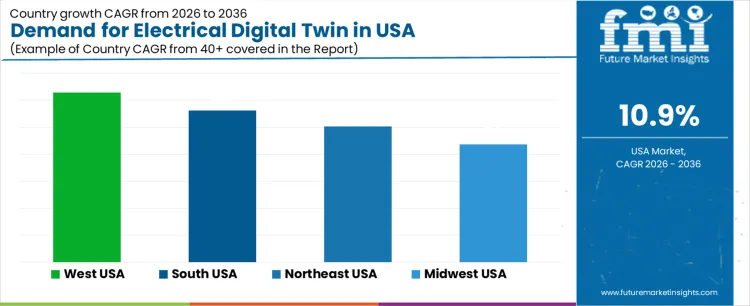
Demand for electrical digital twin technology in the USA is increasing due to rising grid modernization efforts, adoption of advanced asset-management systems, and growing integration of renewable energy requiring predictive modeling. West USA records a CAGR of 12.6% supported by strong investment in smart-grid infrastructure and utility-driven digitalization. South USA shows an 11.3% CAGR driven by expanding energy networks and industrial facilities adopting simulation-based monitoring. Northeast USA posts a 10.1% CAGR due to dense utility systems and early adoption of analytical modeling tools. Midwest USA holds an 8.7% CAGR supported by manufacturing-linked power systems requiring reliable simulation environments.
| Region | CAGR (2026-2036) |
|---|---|
| West USA | 12.6% |
| South USA | 11.3% |
| Northeast USA | 10.1% |
| Midwest USA | 8.7% |
How is the West USA driving demand for Electrical Digital Twin?
West USA drives demand due to its extensive smart-grid development activity and strong presence of technology-driven utilities. The region’s CAGR of 12.6% reflects broad deployment of digital models used for predictive maintenance, real-time grid analytics, and simulation of renewable energy inputs. Utilities rely on digital twin platforms to evaluate equipment performance and forecast asset conditions across distributed energy systems. High integration of solar and wind resources supports continuous usage of simulation tools that track load behavior and grid stability. Research institutions and technology firms engage in development work that strengthens adoption across operational networks.
- Strong smart-grid modernization initiatives
- Heavy integration of renewable energy resources
- Broad use of predictive asset-management tools
- Continuous development activity within regional research hubs
How is the South USA driving demand for Electrical Digital Twin?
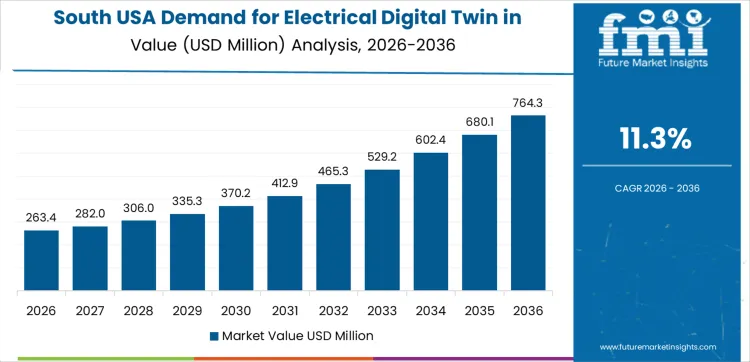
South USA supports rising demand due to its expanding energy infrastructure and industrial sectors that rely on digital modeling to manage operational efficiency. The region’s CAGR of 11.3% reflects steady adoption of electrical digital twins for equipment diagnostics, outage prediction, and real-time system visibility. Utilities utilize simulation platforms to coordinate diverse power assets across large service territories. Industrial facilities depend on digital twins to model electrical loads and maintain operational reliability. Growth in regional data centers increases reliance on predictive modeling to manage power-quality requirements and mitigate risk in electrical networks.
- Expanding regional energy and utility infrastructure
- Strong industrial usage for equipment modeling
- Increasing adoption across data-center operations
- Routine use of simulation tools for grid reliability
How is the Northeast USA driving demand for Electrical Digital Twin?
Northeast USA drives demand due to its dense grid networks, aging infrastructure, and strong adoption of digital tools for system assessment. The region’s CAGR of 10.1% reflects steady utilization of electrical digital twins for fault prediction, load forecasting, and asset health monitoring. Utilities with complex distribution systems rely on simulation platforms to address congestion, reliability needs, and operational planning. Urban energy systems require continuous visibility supported by high-fidelity digital models. Research institutions and advanced analytics providers contribute to strong uptake across utilities seeking data-driven decision support.
- Dense and complex electrical networks
- Strong adoption of load-forecasting and fault-analysis tools
- Continuous modernization of urban distribution systems
- Engagement of research and analytics institutions
How is the Midwest USA driving demand for Electrical Digital Twin?
Midwest USA maintains steady demand due to its manufacturing-intensive landscape and reliance on stable electrical systems that benefit from predictive modeling. The region’s CAGR of 8.7% reflects consistent adoption of digital twins for equipment reliability, maintenance scheduling, and simulation of industrial electrical loads. Utilities across mid-sized cities use digital models for operational planning and asset-condition tracking. Industrial plants integrate digital twin platforms to manage power-quality issues and prevent disruptions in automated environments. Regional energy operators rely on modeling workflows to support grid-stability initiatives.
- Strong industrial base requiring stable electrical systems
- Routine use of digital twins for predictive maintenance
- Utility adoption for grid-planning and reliability tasks
- Integration of modeling tools across manufacturing operations
What is the competitive landscape of the demand for electrical digital twin solutions in the USA?
Demand for electrical digital twin solutions in the USA is driven by requirements for grid reliability, predictive maintenance, asset visualization, and real-time system modeling across utilities, industrial plants, and large infrastructure operators. Buyers evaluate simulation accuracy, integration with control systems, cybersecurity features, and compatibility with operational technology environments. Procurement teams consider data handling capability, interoperability with SCADA and EMS platforms, and the ability to support lifecycle asset management. Adoption patterns reflect the need to improve fault analysis, optimize energy performance, and enhance operational efficiency within aging electrical infrastructure.
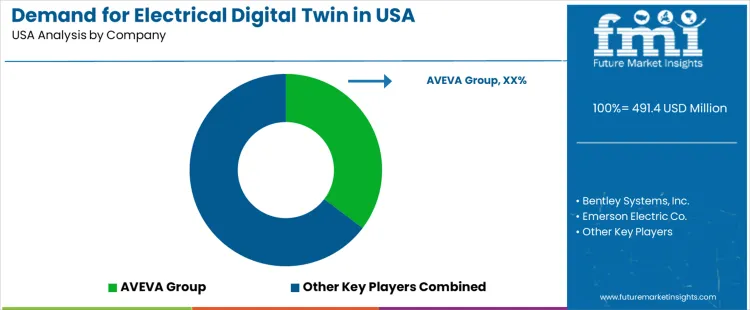
AVEVA Group holds an estimated 35.3% share. Its position reflects strong modeling platforms, integration with industrial operations software, and established relationships with energy producers and utility operators. Bentley Systems, Inc. participates through infrastructure-focused modeling tools supporting substation design, grid planning, and asset visualization. Emerson Electric Co. maintains visibility through advanced monitoring systems and simulation tools aligned with industrial automation environments. IBM Corporation supports digital twin deployments through data analytics, enterprise integration, and cloud-based modeling frameworks suited for complex electrical networks. Microsoft Corporation contributes to the landscape through cloud infrastructure, IoT integration, and partner-driven digital twin solutions used across utility and commercial installations. Competitive positioning in the USA reflects modeling depth, platform scalability, data security, and integration capability supporting diverse electrical system requirements.
Key Players in USA Electrical Digital Twin Demand
- AVEVA Group
- Bentley Systems, Inc.
- Emerson Electric Co.
- IBM Corporation
- Microsoft Corporation
Scope of the Report
| Items | Values |
|---|---|
| Quantitative Units | USD million |
| Twin Type | Digital Gas & Steam Power Plant, Digital Wind Farm, Digital Grid, Digital Hydropower Plant, Distribution Energy Resources, Other Applications |
| Usage Type | Production Digital Twin, Process Digital Twin, System Digital Twin |
| Deployment Type | Cloud, On-premises |
| End User | Utility Service Providers, Grid Infrastructure Operators |
| Application | Asset Performance Management, Business & Operations Optimization, Digital Twin Aggregate |
| Regions Covered | West USA, South USA, Northeast USA, Midwest USA |
| Key Companies Profiled | AVEVA Group, Bentley Systems, Inc., Emerson Electric Co., IBM Corporation, Microsoft Corporation |
| Additional Attributes | Dollar sales by twin type, usage type, deployment mode, and end-user segments; regional demand variations across West, South, Northeast, and Midwest USA; adoption trends in power plant digitalization, grid simulation, and DER-integrated digital twins; competitive landscape of digital twin software providers; integration with predictive analytics, AI-driven monitoring, and real-time operational optimization tools for electric utilities. |
USA Electrical Digital Twin Demand by Segments
Twin Type:
- Digital Gas & Steam Power Plant
- Digital Wind Farm
- Digital Grid
- Digital Hydropower Plant
- Distribution Energy Resources
- Other Applications
Usage Type:
- Production Digital Twin
- Process Digital Twin
- System Digital Twin
Deployment Type:
- Cloud
- On-premises
End User:
- Utility Service Providers
- Grid Infrastructure Operators
Application:
- Asset Performance Management
- Business & Operations Optimization
- Digital Twin Aggregate
Region:
- West USA
- South USA
- Northeast USA
- Midwest USA
Frequently Asked Questions
How big is the demand for electrical digital twin in USA in 2026?
The demand for electrical digital twin in USA is estimated to be valued at USD 491.4 million in 2026.
What will be the size of electrical digital twin in USA in 2036?
The market size for the electrical digital twin in USA is projected to reach USD 1,385.9 million by 2036.
How much will be the demand for electrical digital twin in USA growth between 2026 and 2036?
The demand for electrical digital twin in USA is expected to grow at a 10.9% CAGR between 2026 and 2036.
What are the key product types in the electrical digital twin in USA?
The key product types in electrical digital twin in USA are digital gas & steam power plant, digital wind farm, digital grid, digital hydropower plant, distribution energy resources and other applications.
Which usage type segment is expected to contribute significant share in the electrical digital twin in USA in 2026?
In terms of usage type, production digital twin segment is expected to command 45.0% share in the electrical digital twin in USA in 2026.
Preview the report firsthand - request a free sample
Get SampleGet the brochure for pricing and purchase details.
Get PDFTable of Content
- Executive Summary
- USA Market Outlook
- Demand-side Trends
- Supply-side Trends
- Technology Roadmap Analysis
- Analysis and Recommendations
- Market Overview
- Market Coverage / Taxonomy
- Market Definition / Scope / Limitations
- Market Background
- Market Dynamics
- Drivers
- Restraints
- Opportunity
- Trends
- Scenario Forecast
- Demand in Optimistic Scenario
- Demand in Likely Scenario
- Demand in Conservative Scenario
- Opportunity Map Analysis
- Product Life Cycle Analysis
- Supply Chain Analysis
- Investment Feasibility Matrix
- Value Chain Analysis
- PESTLE and Porter’s Analysis
- Regulatory Landscape
- Regional Parent Market Outlook
- Production and Consumption Statistics
- Import and Export Statistics
- Market Dynamics
- USA Market Analysis 2020 to 2024 and Forecast, 2025 to 2035
- Historical Market Size Value (USD Million) Analysis, 2020 to 2024
- Current and Future Market Size Value (USD Million) Projections, 2025 to 2035
- Y-o-Y Growth Trend Analysis
- Absolute $ Opportunity Analysis
- USA Market Pricing Analysis 2020 to 2024 and Forecast 2025 to 2035
- USA Market Analysis 2020 to 2024 and Forecast 2025 to 2035, By Twin Type
- Introduction / Key Findings
- Historical Market Size Value (USD Million) Analysis By Twin Type , 2020 to 2024
- Current and Future Market Size Value (USD Million) Analysis and Forecast By Twin Type , 2025 to 2035
- Digital Gas & Steam Power Plant
- Digital Wind Farm
- Digital Grid
- Digital Hydropower Plant
- Distribution Energy Resources
- Other Applications
- Y-o-Y Growth Trend Analysis By Twin Type , 2020 to 2024
- Absolute $ Opportunity Analysis By Twin Type , 2025 to 2035
- USA Market Analysis 2020 to 2024 and Forecast 2025 to 2035, By Usage Type
- Introduction / Key Findings
- Historical Market Size Value (USD Million) Analysis By Usage Type, 2020 to 2024
- Current and Future Market Size Value (USD Million) Analysis and Forecast By Usage Type, 2025 to 2035
- Production Digital Twin
- Process Digital Twin
- System Digital Twin
- Y-o-Y Growth Trend Analysis By Usage Type, 2020 to 2024
- Absolute $ Opportunity Analysis By Usage Type, 2025 to 2035
- USA Market Analysis 2020 to 2024 and Forecast 2025 to 2035, By Deployment Type
- Introduction / Key Findings
- Historical Market Size Value (USD Million) Analysis By Deployment Type, 2020 to 2024
- Current and Future Market Size Value (USD Million) Analysis and Forecast By Deployment Type, 2025 to 2035
- Cloud
- On-premises
- Y-o-Y Growth Trend Analysis By Deployment Type, 2020 to 2024
- Absolute $ Opportunity Analysis By Deployment Type, 2025 to 2035
- USA Market Analysis 2020 to 2024 and Forecast 2025 to 2035, By End User
- Introduction / Key Findings
- Historical Market Size Value (USD Million) Analysis By End User, 2020 to 2024
- Current and Future Market Size Value (USD Million) Analysis and Forecast By End User, 2025 to 2035
- Utility Service Providers
- Grid Infrastructure Operators
- Y-o-Y Growth Trend Analysis By End User, 2020 to 2024
- Absolute $ Opportunity Analysis By End User, 2025 to 2035
- USA Market Analysis 2020 to 2024 and Forecast 2025 to 2035, By Application
- Introduction / Key Findings
- Historical Market Size Value (USD Million) Analysis By Application, 2020 to 2024
- Current and Future Market Size Value (USD Million) Analysis and Forecast By Application, 2025 to 2035
- Asset Performance Management
- Business & Operations Optimization
- Digital Twin Aggregate
- Y-o-Y Growth Trend Analysis By Application, 2020 to 2024
- Absolute $ Opportunity Analysis By Application, 2025 to 2035
- Market Structure Analysis
- Competition Dashboard
- Competition Benchmarking
- Market Share Analysis of Top Players
- By Regional
- By Twin Type
- By Usage Type
- By Deployment Type
- By End User
- By Application
- Competition Analysis
- Competition Deep Dive
- AVEVA Group
- Overview
- Product Portfolio
- Profitability by Market Segments (Product/Age /Sales Channel/Region)
- Sales Footprint
- Strategy Overview
- Marketing Strategy
- Product Strategy
- Channel Strategy
- Bentley Systems, Inc.
- Emerson Electric Co.
- IBM Corporation
- Microsoft Corporation
- AVEVA Group
- Competition Deep Dive
- Assumptions & Acronyms Used
- Research Methodology


