

- Industry Size (2025)
- USD 70.0 Mn
- Forecast (2035)
- USD 160.1 Mn
- CAGR (2025 to 2035)
- 8.6%
Demand for Electrical Digital Twin in Japan Forecast and Outlook 2026 to 2036
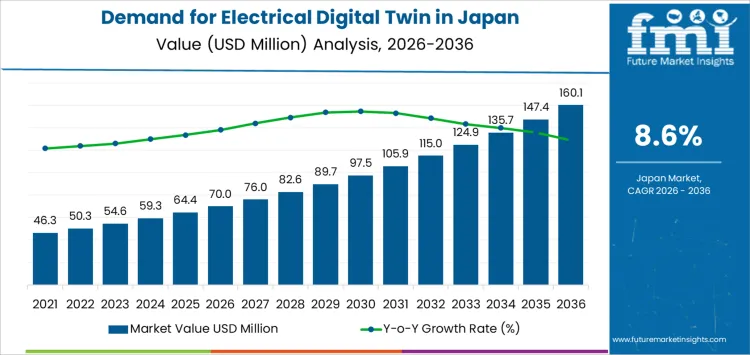
The demand for electrical digital twin in Japan is valued at USD 70.0 million in 2026 and is projected to reach USD 160.1 million by 2036, reflecting a CAGR of 8.6%. The increase from USD 46.3 million in 2020 to USD 70.0 million in 2026 is supported by early adoption across utilities, grid operators, and distributed energy environments. Production and process digital twins hold the largest shares as organizations prioritize real time monitoring and predictive modeling for power generation and grid stability.
From 2027 onward, values rise from USD 76.0 million to USD 115.0 million by 2031, then progress to USD 160.1 million by 2036 through widening annual gains. Cloud based deployments continue to expand due to scalability and integration flexibility, while on premises systems remain relevant for secure operational sites. Asset performance management and business optimization applications drive consistent investment. Long term demand reflects modernization of power infrastructure, system reliability requirements, and structured digitalization across Japan’s electricity ecosystem.
Quick Stats of the Demand for Electrical Digital Twin in Japan :
- Electrical Digital Twin Demand in Japan Value (2026): USD 70.0 million
- Electrical Digital Twin Demand in Japan Forecast Value (2036): USD 160.1 million
- Electrical Digital Twin Demand in Japan Forecast CAGR (2026–2036): 8.6%
- Electrical Digital Twin Leading Twin Type: Digital Gas & Steam Power Plant (28%)
- Electrical Digital Twin Key Growth Regions: Kyushu & Okinawa, Kanto, Kinki
- Electrical Digital Twin Top Players: AVEVA Group, Bentley Systems, Inc., Emerson Electric Co., IBM Corporation, Microsoft Corporation
What is the Growth Forecast for Electrical Digital Twin in Japan through 2036?
Between 2026 and 2031, demand for electrical digital twin systems in Japan rises from USD 70.0 million to USD 105.9 million, reflecting a notable increase driven by modernization of grid assets, wider deployment of predictive maintenance tools, and stronger interest in simulation-based planning across utilities and industrial power users. Earlier growth was tied to isolated pilot projects, while the near-term period shows a more coordinated shift as operators seek to map aging infrastructure, model load variability, and improve system reliability. Integration within substation upgrades and industrial power distribution networks strengthens early-phase momentum.
From 2031 to 2036, demand expands from USD 105.9 million to USD 160.1 million, marking a more forceful upward trajectory as digital twin platforms become embedded in long-horizon planning, real-time fault modeling, and distributed energy resource coordination. Growth in this phase is shaped by larger-scale grid reinforcement programs, increased renewable penetration requiring stronger simulation accuracy, and wider adoption among manufacturers managing interconnected electrical assets. Earlier gains reflected exploratory adoption, whereas later expansion signals structural integration of digital twins as core operational tools within Japan’s evolving, reliability-focused electrical ecosystem.
Electrical Digital Twin Industry in Japan Key Takeaways
| Metric | Value |
|---|---|
| Industry Value (2026) | USD 70.0 million |
| Forecast Value (2036) | USD 160.1 million |
| Forecast CAGR (2026–2036) | 8.6% |
What Is Driving the Demand for Electrical Digital Twin Solutions in Japan from 2026 to 2036?
Demand for electrical digital twin solutions in Japan has grown as industrial and infrastructure operators adopt digital simulation and monitoring to enhance system reliability. Electrical digital twins create virtual models of distribution networks, switchgear, and power electronics, enabling real-time tracking of performance and fault prediction. Utilities and large manufacturers deploy these tools to reduce unplanned outages, model equipment ageing, and optimise maintenance schedules within complex electrical systems. Historical demand reflected gradual integration of sensor networks and supervisory control systems that could feed accurate data into virtual models. Buyers valued compatibility with legacy control systems and adherence to domestic standards for industrial automation.
From 2026 to 2036 demand is expected to strengthen with accelerated digital transformation across smart grids, data centre power systems, and factory energy management. Electrical digital twins support predictive analytics that reduce downtime and help operators balance load patterns under distributed generation and variable renewable integration. Industrial facilities adopt twin models to simulate process electrification impacts, optimise energy use, and improve resilience. Buyers prioritise solutions that integrate with IoT platforms, edge data processing, and cybersecurity controls. Demand will depend on how well digital twin tools interface with existing building and plant systems, and the value seen in reduced maintenance costs and improved asset utilisation across urban and regional energy networks nationwide.
What Is the Demand for Electrical Digital Twin in Japan by Twin Type and Usage Type for 2026 to 2036?
The demand for electrical digital twins in Japan from 2026 to 2036 increases as operators modernize generation assets, stabilize variable power flows, and strengthen predictive oversight. Digital gas and steam power plants lead because their operational profiles benefit from continuous modeling. Production digital twins hold the highest usage share as utilities rely on real-time simulations to align equipment behavior with output targets while improving maintenance planning.
Why do digital gas and steam power plant twins account for 28% of the demand for electrical digital twins in Japan by twin type from 2026 to 2036?
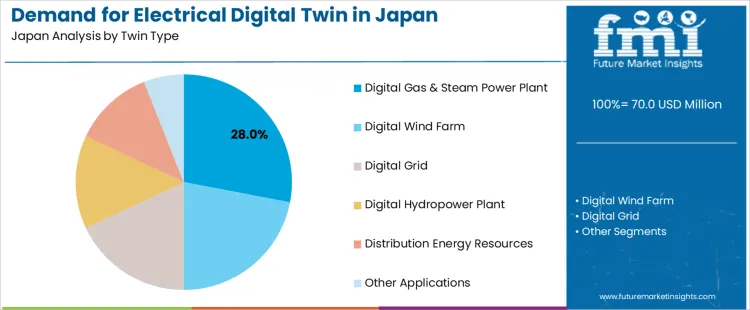
Digital gas and steam power plant twins account for 28% of the demand in Japan because utilities depend on accurate behavior modeling to manage wear cycles, fuel efficiency, and component stress patterns in baseload and mid-merit units. Consumption grows as operators integrate thermal assets with storage buffers and renewable inputs, requiring tighter operational balance. Usage remains steady since these plants rely on consistent optimization across burners, turbines, and heat-recovery sections. Procurement is directed by teams seeking long-term modeling stability, sensor compatibility, and scalable data capture frameworks. Price sensitivity stays moderate because improved equipment life and reduced unplanned outages offset software and integration costs. Specification control centers on model granularity, calibration intervals, and precise mapping of thermal profiles. Demand continues through 2026 to 2036 as Japan refines its thermal fleet to support grid stability during renewable expansion.
Why do production digital twins represent 45.0% of the demand for electrical digital twins in Japan by usage type?
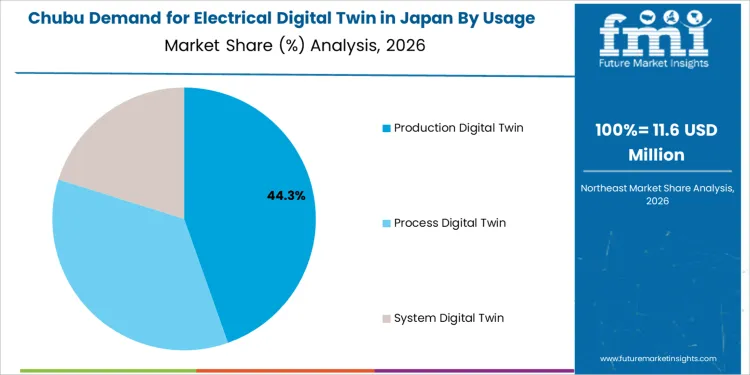
Production digital twins represent 45.0% of the demand in Japan because energy providers rely on continuous simulation to coordinate load patterns, generation schedules, and equipment behavior in near real time. Consumption increases in facilities linking field sensors with centralized monitoring to detect deviations and adjust operating parameters. Usage stays steady since production teams work with stable models that predict asset aging, fuel response, and output variability. Procurement is shaped by utilities selecting platforms with strong historical data fusion and flexible integration across legacy systems. Price sensitivity remains moderate as accurate modeling strengthens unit reliability and reduces corrective maintenance. Specification control emphasizes time-aligned data streams, strong anomaly detection, and stable forecast precision. Demand remains consistent from 2026 to 2036 as Japan maintains coordinated grid operation across diversified generation assets.
How Is Demand for Electrical Digital Twin Technology in Japan Emerging Across Local Industrial and Grid Operations?
Demand grows through Japan’s factories, utilities, and research centers that use modeling tools to support equipment monitoring and system planning. Power companies in Tokyo apply digital twins to track transformer behavior during peak cycles. Manufacturing plants in Aichi run simulations to manage load variation on production lines. Railway operators in Osaka use network models to study substation performance during service adjustments. University laboratories in Sendai test grid scenarios tied to regional research projects. These patterns reflect practical needs shaped by Japan’s operating environments and infrastructure layouts.
Which Local Operating Conditions Are Driving Demand for Electrical Digital Twin Technology in Japan?
Drivers arise from workflows that require clear visibility into equipment states across dense industrial areas. Power utilities in Fukuoka request digital models to study voltage patterns in older distribution zones. Automotive plants in Tochigi use them to predict electrical loads during high output shifts. Semiconductor facilities in Kumamoto rely on detailed simulations to maintain stable supply for sensitive equipment. Municipal energy offices in Nagano use localized grid twins to plan seasonal peak management. These needs support steady adoption shaped by region specific electrical demands and facility level operating routines.
What Local Constraints Are Limiting Wider Use of Electrical Digital Twin Technology in Japan?
Barriers link to data integration limits, staffing patterns, and infrastructure age. Smaller factories in rural prefectures avoid large scale models because legacy meters provide limited data. Utilities in older districts of Hiroshima face mapping gaps that slow accurate representation of underground lines. Municipal energy teams with small technical units rely on simpler monitoring tools due to workload constraints. Research centers outside major hubs face slower connectivity, which affects real time modeling. These conditions reduce uniform adoption across regions where resources, data quality, or staffing restrict implementation.
What is the Demand for Electrical Digital Twin in Japan by Region?
| Region | CAGR (%) |
|---|---|
| Kyushu & Okinawa | 10.8% |
| Kanto | 9.9% |
| Kinki | 8.7% |
| Chubu | 7.7% |
| Tohoku | 6.7% |
| Rest of Japan | 6.4% |
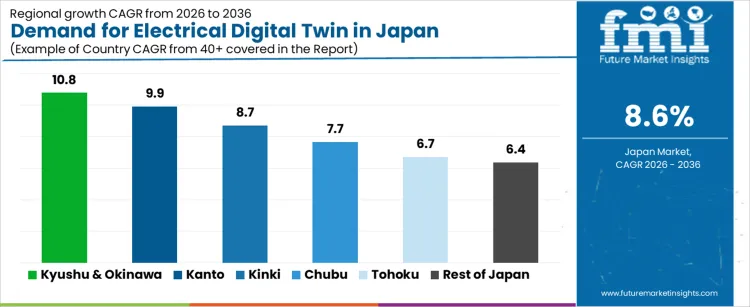
The demand for electrical digital twin solutions in Japan is expanding as utilities, manufacturing plants, and infrastructure operators adopt advanced simulation and predictive modeling tools. Kyushu and Okinawa lead at a 10.8% CAGR, supported by modernization of energy grids, stronger investments in renewable integration, and adoption of digital monitoring systems. Kanto follows at 9.9%, driven by dense industrial activity, smart grid initiatives, and increased use of digital twin platforms in power equipment lifecycle management. Kinki records 8.7% growth, reflecting steady deployment across manufacturing hubs and utility networks. Chubu at 7.7% shows moderate uptake aligned with industrial automation and grid reliability projects. Tohoku and the Rest of Japan, at 6.7% and 6.4%, demonstrate slower growth influenced by smaller infrastructure bases and more gradual adoption of digitalization technologies.
How Is System Modeling Activity Shaping Electrical Digital Twin Demand Across Kyushu and Okinawa?
Demand for electrical digital twin solutions in Kyushu and Okinawa is rising at a CAGR of 10.8% from 2026 to 2036 as utilities, industrial plants, and grid operators expand modeling work to manage asset performance. Utilities apply digital twin tools to study load behavior and support maintenance planning. Industrial plants use modeling to examine equipment conditions during production cycles. Grid operators integrate simulation workflows into network oversight tasks. Growth reflects steady adoption across sectors that depend on analytical insight for operational planning.
- Utilities study load behavior
- Plants examine equipment conditions
- Grid operators use simulation workflows
What Drives Electrical Digital Twin Adoption Across Kanto?
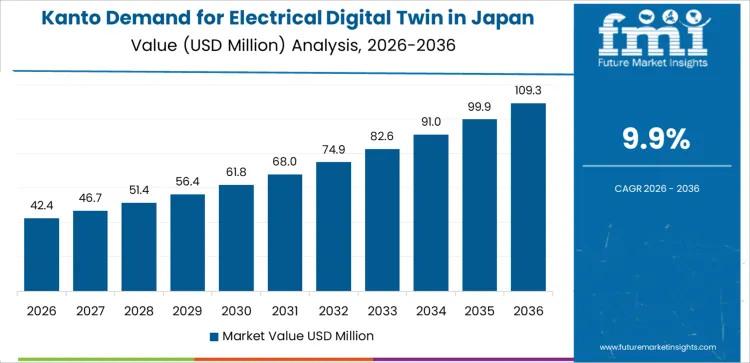
Demand for electrical digital twin solutions in Kanto is advancing at a CAGR of 9.9% from 2026 to 2036 as power networks, industrial clusters, and research-led facilities depend on modeling tools for system analysis. Power networks use digital twins to track asset conditions. Industrial clusters evaluate operating scenarios within structured models. Research-led facilities adopt simulation for controlled technical studies. Growth reflects consistent institutional engagement across a region with extensive electrical infrastructure.
- Networks track asset conditions
- Industrial clusters evaluate scenarios
- Research facilities apply structured simulation
How Are Technical Requirements Influencing Electrical Digital Twin Use in Kinki?
Demand for electrical digital twin solutions in Kinki is growing at a CAGR of 8.7% from 2026 to 2036 as manufacturing hubs, research parks, and utility networks integrate modeling into technical planning. Manufacturing hubs rely on digital twins to monitor equipment behavior. Research parks use structured models for project evaluations. Utility networks incorporate simulation tools to support asset oversight. Growth reflects coordinated use of modeling across sectors with well-defined technical processes.
- Manufacturing hubs monitor equipment behavior
- Research parks run project evaluations
- Networks support asset oversight
Which Operational Needs Shape Electrical Digital Twin Demand Across Chubu?
Demand for electrical digital twin solutions in Chubu is increasing at a CAGR of 7.7% from 2026 to 2036 as industrial facilities, energy companies, and engineering groups manage analysis through modeled systems. Industrial facilities study equipment cycles to support reliability planning. Energy companies use simulation for network evaluations. Engineering groups apply modeling workflows to guide technical decision making. Growth reflects structured use of analytical tools across entities that manage diverse electrical systems.
- Facilities study equipment cycles
- Energy firms run network evaluations
- Engineering groups guide decisions with modeling
How Do Regional Operations Influence Electrical Digital Twin Demand in Tohoku?
Demand for electrical digital twin solutions in Tohoku is rising at a CAGR of 6.7% from 2026 to 2036 as utilities, research units, and industrial sites incorporate modeling tasks into operational routines. Utilities review network behavior with structured models. Research units conduct controlled assessments using digital twins. Industrial sites evaluate equipment loads to maintain performance stability. Growth reflects steady integration of modeling within regions with dispersed electrical infrastructure.
- Utilities review network behavior
- Research units run controlled assessments
- Industrial sites evaluate equipment loads
What Supports Electrical Digital Twin Adoption Across Rest of Japan?
Demand for electrical digital twin solutions in Rest of Japan is expanding at a CAGR of 6.4% from 2026 to 2036 as smaller utilities, local plants, and technical institutes rely on modeling support. Smaller utilities apply simulation to guide network planning. Local plants evaluate equipment conditions to support maintenance cycles. Technical institutes rely on modeled systems for structured study. Growth reflects practical adoption across varied institutions with specific operational needs.
- Utilities guide network planning
- Plants evaluate equipment conditions
- Institutes rely on modeled systems
What Is Driving the Demand for Electrical Digital Twin in Japan and Which Companies Shape Industrial and Utility Adoption
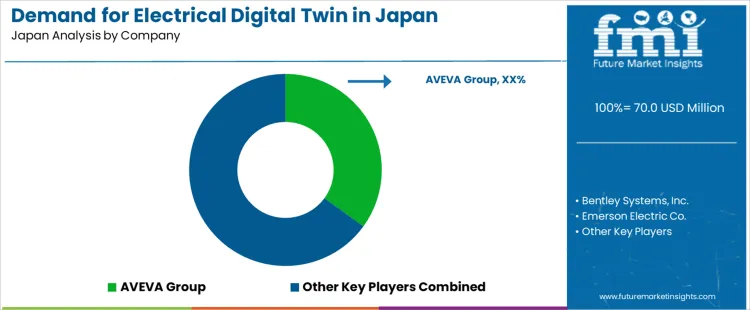
The demand for electrical digital twin in Japan is shaped by modernization of power infrastructure, expansion of renewable generation, and increased use of predictive maintenance across utilities and manufacturing plants. Domestic engineering firms and system integrators support most deployments through grid modeling tools, substation simulation, and equipment lifecycle analysis tailored to Japanese standards. AVEVA Group participates through digital engineering platforms used in industrial power networks and large facility electrification projects. Bentley Systems supports demand through substation and transmission modeling environments adopted by engineering consultancies. Emerson Electric Co contributes through digital replicas of control systems used in process industries that require continuous power stability. IBM Corporation participates in utility projects involving asset modeling and data integration. Microsoft Corporation supports cloud based simulation and analytics used in smart grid and distributed energy programs.
Platform selection in Japan is governed by model accuracy, compatibility with existing SCADA and protection systems, and secure integration with utility data centers. Power companies emphasize tools that support fault analysis, load forecasting, and equipment health monitoring under strict regulatory oversight. Industrial users focus on continuity of operations, rapid scenario testing, and clear visualization of electrical assets. Buyers prefer suppliers with localized engineering support, long term software maintenance, and documented performance in Japanese facilities. Demand visibility tracks smart substation projects, growth in distributed solar, upgrades of aging transmission assets, and wider adoption of data driven maintenance strategies across factories and energy intensive sectors.
Key Players in Electrical Digital Twin Industry in Japan
- AVEVA Group
- Bentley Systems, Inc.
- Emerson Electric Co.
- IBM Corporation
- Microsoft Corporation
Scope of the Report
| Items | Values |
|---|---|
| Quantitative Units (2026) | USD million |
| Twin Type | Digital Gas & Steam Power Plant; Digital Wind Farm; Digital Grid; Digital Hydropower Plant; Distributed Energy Resources; Other Applications |
| Usage Type | Production Digital Twin; Process Digital Twin; System Digital Twin |
| Deployment Type | Cloud; On premises |
| End User | Utility Service Providers; Grid Infrastructure Operators |
| Application | Asset Performance Management; Business & Operations Optimization; Digital Twin Aggregate |
| Regions Covered | Kyushu & Okinawa; Kanto; Kansai; Chubu; Tohoku; Rest of Japan |
| Countries Covered | Japan |
| Key Companies Profiled | AVEVA Group; Bentley Systems Inc; Emerson Electric Co; IBM Corporation; Microsoft Corporation |
| Additional Attributes | Dollar by sales across twin types, usage models, and deployment formats; model calibration and data ingestion requirements; integration depth with SCADA and protection systems; predictive maintenance utilization; grid modernization alignment; scenario simulation intensity; cybersecurity integration needs; digital infrastructure readiness; asset lifecycle modeling practices; regional grid planning considerations. |
Electrical Digital Twin Industry in Japan Segmentation
Twin Type:
- Digital Gas & Steam Power Plant
- Digital Wind Farm
- Digital Grid
- Digital Hydropower Plant
- Distribution Energy Resources
- Other Applications
Usage Type:
- Production Digital Twin
- Process Digital Twin
- System Digital Twin
Deployment Type:
- Cloud
- On-premises
End User:
- Utility Service Providers
- Grid Infrastructure Operators
Application:
- Asset Performance Management
- Business & Operations Optimization
- Digital Twin Aggregate
Region
- Kyushu & Okinawa
- Kanto
- Kansai
- Chubu
- Tohoku
- Rest of Japan
Frequently Asked Questions
How big is the demand for electrical digital twin in Japan in 2026?
The demand for electrical digital twin in Japan is estimated to be valued at USD 70.0 million in 2026.
What will be the size of electrical digital twin in Japan in 2036?
The market size for the electrical digital twin in Japan is projected to reach USD 160.1 million by 2036.
How much will be the demand for electrical digital twin in Japan growth between 2026 and 2036?
The demand for electrical digital twin in Japan is expected to grow at a 8.6% CAGR between 2026 and 2036.
What are the key product types in the electrical digital twin in Japan?
The key product types in electrical digital twin in Japan are digital gas & steam power plant, digital wind farm, digital grid, digital hydropower plant, distribution energy resources and other applications.
Which usage type segment is expected to contribute significant share in the electrical digital twin in Japan in 2026?
In terms of usage type, production digital twin segment is expected to command 45.0% share in the electrical digital twin in Japan in 2026.
Preview the report firsthand - request a free sample
Get SampleGet the brochure for pricing and purchase details.
Get PDFTable of Content
- Executive Summary
- Japan Market Outlook
- Demand-side Trends
- Supply-side Trends
- Technology Roadmap Analysis
- Analysis and Recommendations
- Market Overview
- Market Coverage / Taxonomy
- Market Definition / Scope / Limitations
- Market Background
- Market Dynamics
- Drivers
- Restraints
- Opportunity
- Trends
- Scenario Forecast
- Demand in Optimistic Scenario
- Demand in Likely Scenario
- Demand in Conservative Scenario
- Opportunity Map Analysis
- Product Life Cycle Analysis
- Supply Chain Analysis
- Investment Feasibility Matrix
- Value Chain Analysis
- PESTLE and Porter’s Analysis
- Regulatory Landscape
- Regional Parent Market Outlook
- Production and Consumption Statistics
- Import and Export Statistics
- Market Dynamics
- Japan Market Analysis 2020 to 2024 and Forecast, 2025 to 2035
- Historical Market Size Value (USD Million) Analysis, 2020 to 2024
- Current and Future Market Size Value (USD Million) Projections, 2025 to 2035
- Y-o-Y Growth Trend Analysis
- Absolute $ Opportunity Analysis
- Japan Market Pricing Analysis 2020 to 2024 and Forecast 2025 to 2035
- Japan Market Analysis 2020 to 2024 and Forecast 2025 to 2035, By Twin Type
- Introduction / Key Findings
- Historical Market Size Value (USD Million) Analysis By Twin Type , 2020 to 2024
- Current and Future Market Size Value (USD Million) Analysis and Forecast By Twin Type , 2025 to 2035
- Digital Gas & Steam Power Plant
- Digital Wind Farm
- Digital Grid
- Digital Hydropower Plant
- Distribution Energy Resources
- Other Applications
- Y-o-Y Growth Trend Analysis By Twin Type , 2020 to 2024
- Absolute $ Opportunity Analysis By Twin Type , 2025 to 2035
- Japan Market Analysis 2020 to 2024 and Forecast 2025 to 2035, By Usage Type
- Introduction / Key Findings
- Historical Market Size Value (USD Million) Analysis By Usage Type, 2020 to 2024
- Current and Future Market Size Value (USD Million) Analysis and Forecast By Usage Type, 2025 to 2035
- Production Digital Twin
- Process Digital Twin
- System Digital Twin
- Y-o-Y Growth Trend Analysis By Usage Type, 2020 to 2024
- Absolute $ Opportunity Analysis By Usage Type, 2025 to 2035
- Japan Market Analysis 2020 to 2024 and Forecast 2025 to 2035, By Deployment Type
- Introduction / Key Findings
- Historical Market Size Value (USD Million) Analysis By Deployment Type, 2020 to 2024
- Current and Future Market Size Value (USD Million) Analysis and Forecast By Deployment Type, 2025 to 2035
- Cloud
- On-premises
- Y-o-Y Growth Trend Analysis By Deployment Type, 2020 to 2024
- Absolute $ Opportunity Analysis By Deployment Type, 2025 to 2035
- Japan Market Analysis 2020 to 2024 and Forecast 2025 to 2035, By End User
- Introduction / Key Findings
- Historical Market Size Value (USD Million) Analysis By End User, 2020 to 2024
- Current and Future Market Size Value (USD Million) Analysis and Forecast By End User, 2025 to 2035
- Utility Service Providers
- Grid Infrastructure Operators
- Y-o-Y Growth Trend Analysis By End User, 2020 to 2024
- Absolute $ Opportunity Analysis By End User, 2025 to 2035
- Japan Market Analysis 2020 to 2024 and Forecast 2025 to 2035, By Application
- Introduction / Key Findings
- Historical Market Size Value (USD Million) Analysis By Application, 2020 to 2024
- Current and Future Market Size Value (USD Million) Analysis and Forecast By Application, 2025 to 2035
- Asset Performance Management
- Business & Operations Optimization
- Digital Twin Aggregate
- Y-o-Y Growth Trend Analysis By Application, 2020 to 2024
- Absolute $ Opportunity Analysis By Application, 2025 to 2035
- Market Structure Analysis
- Competition Dashboard
- Competition Benchmarking
- Market Share Analysis of Top Players
- By Regional
- By Twin Type
- By Usage Type
- By Deployment Type
- By End User
- By Application
- Competition Analysis
- Competition Deep Dive
- AVEVA Group
- Overview
- Product Portfolio
- Profitability by Market Segments (Product/Age /Sales Channel/Region)
- Sales Footprint
- Strategy Overview
- Marketing Strategy
- Product Strategy
- Channel Strategy
- Bentley Systems, Inc.
- Emerson Electric Co.
- IBM Corporation
- Microsoft Corporation
- AVEVA Group
- Competition Deep Dive
- Assumptions & Acronyms Used
- Research Methodology


