

- Industry Size (2025)
- USD 313.0 Mn
- Forecast (2035)
- USD 711.0 Mn
- CAGR (2025 to 2035)
- 8.6%
Demand for Digital Journal Apps in Japan Forecast and Outlook 2025 to 2035
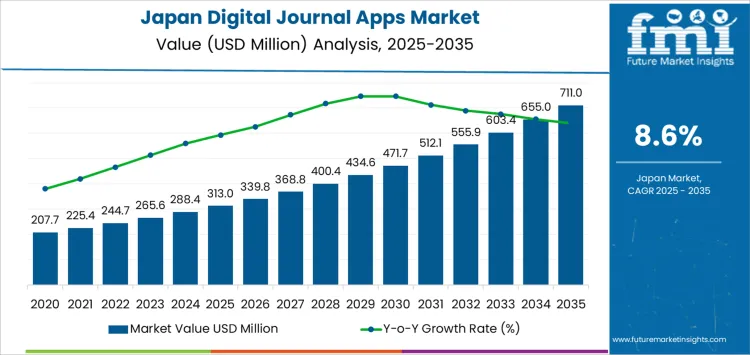
Demand for digital journal apps in Japan is valued at USD 313.0 million in 2025 and is projected to reach USD 711.0 million by 2035, reflecting a CAGR of 8.6%. The historical progression from USD 207.7 million in 2020 to USD 313.0 million by 2025 shows accelerating adoption across personal productivity and wellness use cases. Mobile phones account for the dominant share of applications due to daily usage patterns and preferences for controlling private data. Android holds the largest share of the platform, followed closely by iOS, reflecting the structure of the domestic smartphone base. Freemium service models lead user acquisition because entry costs remain low. Early demand reflects individual habit tracking, reflective writing, and routine scheduling rather than enterprise documentation. Tablet and desktop use remains secondary, centered on longer form entry and archival review.
From 2026 onward, values rise from USD 339.8 million to USD 512.1 million by 2031, then expand to USD 711.0 million by 2035 through sustained annual increments. Premium services gain share as subscription conversion improves among long-term users seeking enhanced storage, encryption, and cross-device syncing. Growth after 2030 reflects deeper app integration into daily planning, mood tracking, and personal data organization routines. The macOS and Windows platforms retain smaller but stable roles for users who prefer keyboard-based input. Annual value additions widen gradually, indicating rising spending intensity rather than rapid user expansion alone. Developer competition centers on interface simplicity, privacy safeguards, and data export functions. The long-range pattern reflects structured digital habit formation rather than short-cycle app usage volatility.
Quick Stats of the Demand for Digital Journal Apps in Japan
- Demand for Digital Journal Apps in Japan Value (2025): USD 313.0 million
- Demand for Digital Journal Apps in Japan Forecast Value (2035): USD 711.0 million
- Demand for Digital Journal Apps in Japan Forecast CAGR (2025–2035): 8.6%
- Demand for Digital Journal Apps in Japan Leading Platform: Android (42%)
- Demand for Digital Journal Apps in Japan Key Growth Regions: Kyushu & Okinawa, Kanto, Kansai
- Demand for Digital Journal Apps in Japan Top Players: Day One, Penzu, Journey, Reflectly, Daylio
What is the Growth Forecast for Digital Journal Apps in Japan through 2035?
Between 2025 and 2030, demand for digital journal apps in Japan is projected to rise from USD 313.0 million to USD 471.7 million, creating an absolute increase of USD 158.7 million and about 39.9% of the total decade expansion. Growth in this phase reflects steady uptake in personal organization tools, education-related journaling, and mental wellness tracking within consumer app ecosystems. Platform upgrades, subscription pricing models, and device-level integration support user acquisition. Historical growth relied on basic note-taking migration from paper, while near-term expansion is shaped by structured mood tracking, cloud synchronization, and localized content design anchored locally.
From 2030 to 2035, demand is forecast to expand from USD 471.7 million to USD 711.0 million, adding USD 239.3 million and representing nearly 60.1% of total ten year growth. This stage reflects deeper monetization of premium features, wider enterprise use in coaching and education platforms, and rising long term retention across multi device users. Integration with biometric data, calendar systems, and guided entry frameworks reshapes product structure.
Digital Journal Apps Industry in Japan Key Takeaways
| Metric | Value |
|---|---|
| Industry Value (2025) | USD 313.0 million |
| Forecast Value (2035) | USD 711.0 million |
| Forecast CAGR (2025-2035) | 8.6% |
What Is Driving the Demand for Digital Journal Apps in Japan Across Historical and Future Growth Cycles?
Demand for digital journal apps in Japan expanded with broad smartphone adoption, rising mobile internet reliability, and steady use of personal organization software. Early growth aligned with student note taking, workplace task tracking, and private diary keeping in digital form. Cultural familiarity with written reflection supported gradual migration from paper notebooks to mobile platforms. App use increased across commuting populations seeking portable record keeping. Historical demand relied on basic functions such as text entry, local storage, and calendar integration. Monetization remained limited as users favored free tools supported by device ecosystems. Growth followed hardware upgrade cycles and improvements in mobile operating systems. Trust in domestic software vendors supported stable domestic user retention across education and workplace segments.
Future demand for digital journal apps in Japan is projected to rely on privacy protection, structured data control, and integration with wellness tracking services. Expanding remote work and blended study models support sustained daily usage across professional and academic groups. Subscription based storage, encrypted backup, and cross device synchronization drive revenue growth potential. Historical growth relied on utility and device access. Future growth centers on long term data management, mental health tracking, and regulated information handling. Corporate licensing for employee wellness programs may increase institutional adoption. Domestic developers compete on compliance standards and language optimized interfaces. Growth will depend on regulatory alignment, consumer trust in data security, and steady renewal of mobile operating infrastructure across urban and regional user bases.
What Is the Demand for Digital Journal Apps in Japan by Platform and Application?
The demand for digital journal apps in Japan is shaped by mobile centric content creation, personal productivity habits, and high smartphone penetration across all age groups. Android leads by platform due to wider handset price coverage and strong domestic device circulation. Mobile phones lead by application because journaling activity is closely tied to daily personal device usage rather than stationary computing. Procurement is driven by individual consumers through app stores and subscription platforms. Import reliance remains present for cloud hosting infrastructure and analytics modules. Substitution pressure exists from note taking and mental wellness apps. Demand stability is supported by routine daily logging behavior and long term self-tracking use.
Why does Android account for 42% of the demand for digital journal apps in Japan by platform?
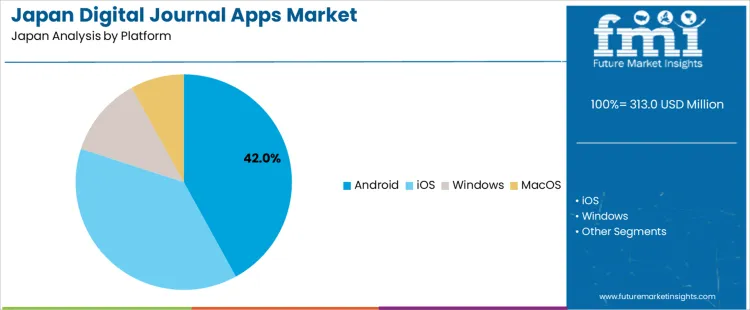
Android accounts for 42% of the demand for digital journal apps in Japan by platform, reflecting its broad device ecosystem and price tier coverage. Consumption intensity is driven by students, working professionals, and senior users who rely on mid-range smartphones for daily personal tracking. Usage remains stable because Android devices dominate prepaid and budget postpaid handset distribution. Procurement occurs through direct app store downloads funded by personal subscriptions. Price sensitivity remains moderate because many users favor freemium models with optional upgrades. Specification control emphasizes operating system compatibility stability, offline data retention, low battery consumption, and secure local storage performance.
Android based journal apps also generate steady repeat demand through subscription renewals and feature upgrades. Repeat utilization remains predictable due to daily or weekly entry habits. Developers favor Android first deployment strategies to maximize user reach in early lifecycle stages. Margin structure remains controlled under app store commission frameworks. Regulatory exposure centers on data privacy compliance and user consent control. Import reliance persists for third party analytics tools and cloud synchronization modules. Substitution pressure from browser based journaling tools remains limited due to lower offline usability.
Why do mobile phones represent 65.0% of the demand for digital journal apps in Japan by application?
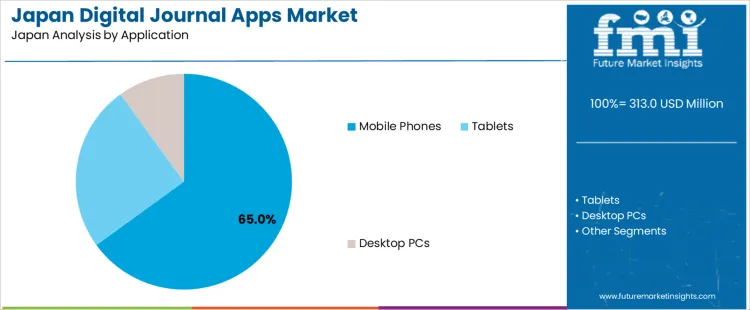
Mobile phones represent 65.0% of the demand for digital journal apps in Japan by application, reflecting dominant use of smartphones for private content creation and mood tracking. Consumption intensity is driven by daily commuting, personal reflection routines, and short form emotional logging behavior. Usage remains stable because journal entries are closely linked to spontaneous moments captured throughout the day. Procurement is dominated by individual consumers through in app purchases and subscription billing. Price sensitivity remains moderate because most users allocate limited monthly spending for productivity and wellness tools. Specification control emphasizes single hand usability, biometric access control, fast app load speed, and cloud backup reliability.
Mobile phone based journaling also generates consistent repeat demand through daily engagement streaks and notification driven habit formation. Repeat utilization remains predictable across long usage cycles. Developers favor mobile first interface design to support portrait orientation and touch optimized entry methods. Margin structure remains controlled under subscription churn management. Regulatory exposure centers on personal data handling and content encryption standards. Import reliance persists for push notification frameworks and cloud synchronization engines. Substitution pressure from tablet usage remains limited to creative writing and long form reflection use cases rather than routine daily journaling.
What Is Driving the Demand for Digital Journal Apps in Japan Personal Reflection and Mobile First Writing Habits?
Demand for digital journal apps in Japan reflects writing discipline, mobile centric lifestyles, and preference for private self tracking. Commuters capture notes during long rail journeys while students log study reflections and mood records between classes. App stores highlight minimalist interfaces, pen like input, and cloud sync across phones and tablets. Users value templates for gratitude logs, habit tracking, and sleep tagging without social exposure. Data privacy expectations remain high due to personal content sensitivity. Demand follows daily micro moments of reflection rather than long form blogging behavior. Growth ties to quiet personal utility inside crowded cities rather than display.
How Are Commuting Patterns and Mobile Writing Habits Shaping App Usage?
Japan rail based daily movement creates frequent short writing windows that suit digital journaling. Users record tasks, emotions, and memory cues while standing in crowded cars. Handwriting simulation and offline entry support become purchase drivers under weak signal conditions. Stylus compatible phones and tablets increase adoption among design students and planners. Audio note capture also supports hands free journaling during walking commutes. This behavior builds high open frequency with brief session length. App value links to speed, discretion, and silent operation in shared spaces. Demand rises with urban mobility density rather than with leisure time availability during daily transit routines.
Why Does Privacy and Mental Health Framing Influence Adoption in Japan?
Japanese users treat digital journals as private emotional storage rather than social storytelling. Many avoid cloud platforms that expose identity or cross share content. Apps that offer local encryption, passcode entry, and discrete icon designs gain stronger retention. Mental health oriented prompts support journaling for anxiety control, grief processing, and sleep reflection without clinical labeling. Companies include journaling in wellness allowances for employee stress monitoring without managerial visibility. This positioning frames journaling as quiet personal care. Demand strengthens through trust in data handling and safety rather than through community posting functions or influencer led sharing behavior common in regions.
How Do Language Input Friction and Monetization Models Limit Wider Use?
Japanese script input involves kanji conversion, predictive text, and stylus correction that slows rapid journaling for some users. Voice input accuracy varies under urban noise. Many free apps restrict storage space or template access which limits long term archiving. Subscription fatigue also affects willingness to maintain multiple self-care tools at once. Schools limit smartphone use during class which reduces daytime journaling windows for students. Older users avoid frequent interface updates that change icon placement. These factors slow universal uptake beyond core urban professionals and students who already accept mobile writing as routine personal management behavior within daily planning habits.
What is the Demand for Digital Journal Apps in Japan by Region?
| Region | CAGR (%) |
|---|---|
| Kyushu & Okinawa | 10.7% |
| Kanto | 9.8% |
| Kansai | 8.6% |
| Chubu | 7.6% |
| Tohoku | 6.7% |
| Rest of Japan | 6.3% |
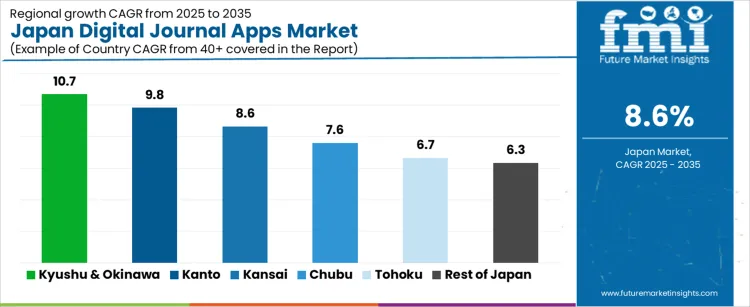
The demand for digital journal apps in Japan is expanding rapidly across all regions, led by Kyushu and Okinawa at a 10.7% CAGR. Growth in this region is supported by strong student adoption, rising use among wellness focused consumers, and increasing penetration of subscription-based productivity tools. Kanto follows at 9.8%, driven by dense urban populations, high smartphone usage, and widespread adoption among professionals, creatives, and education users. Kansai records 8.6% growth, reflecting steady demand from academic institutions, personal development users, and corporate wellness programs. Chubu at 7.6% shows moderate uptake linked to enterprise adoption and regional education platforms. Tohoku and the Rest of Japan, at 6.7% and 6.3%, reflect slower growth shaped by lower app monetization levels, aging demographics, and more gradual transitions from paper-based habits to digital journaling platforms.
How Is Student Engagement and Wellness Tracking Driving Digital Journal App Demand in Kyushu and Okinawa?
Demand for digital journal apps in Kyushu and Okinawa is advancing at a CAGR of 10.7% through 2035, supported by rising student adoption, wellness tracking use, and lifestyle content creation linked to tourism and outdoor living. Educational institutions and youth communities show steady use of guided journaling and habit tracking tools. This region shows strong engagement with mood tracking and creative writing features. Growth reflects increasing smartphone usage, expanding self care routines among young adults, and steady promotion of mental wellness support through digital platforms.
- Student communities support daily app engagement
- Wellness tracking features drive repeat usage
- Creative writing tools gain higher regional adoption
- Mobile first usage supports steady subscription growth
Why Is High Professional Density Sustaining Digital Journal App Growth in Kanto?
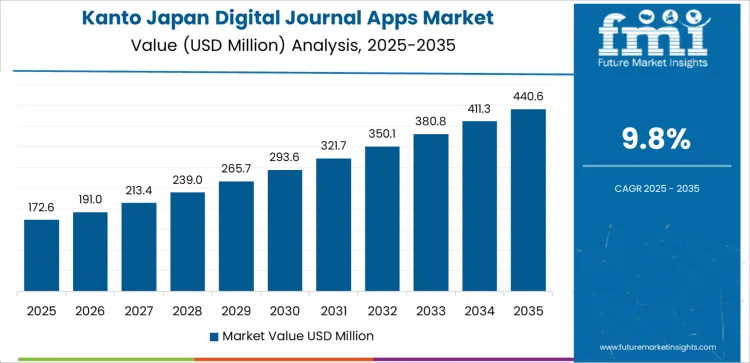
Demand for digital journal apps in Kanto is rising at a CAGR of 9.8% through 2035, driven by dense working population, strong use of productivity tools, and rising mental wellness awareness in metropolitan lifestyles. Kanto records high adoption of goal tracking, reflective writing, and task integrated journaling platforms. App usage aligns closely with work life balance management and structured self improvement habits. Growth reflects long commuting routines, digital lifestyle integration, and consistent uptake of premium subscription features across professional user segments.
- Productivity focused journaling supports weekday usage
- Premium subscriptions show higher conversion rates
- Work life balance tracking strengthens long term retention
- Digital ecosystem integration drives continuous engagement
What Is Supporting Balanced Digital Journal App Adoption Across Kansai?
Demand for digital journal apps in Kansai is progressing at a CAGR of 8.6% through 2035, supported by stable student populations, creative hobby communities, and steady use of reflection based apps for personal development. Kansai shows balanced usage across mental wellness journaling and creative writing platforms. App engagement remains tied to cultural activity planning, learning routines, and personal memory documentation. Growth remains guided by steady app store discovery, moderate subscription uptake, and consistent interest in guided journaling formats.
- Creative writing communities strengthen content based engagement
- Guided prompts support consistent daily journaling habits
- Learning routines sustain student usage volume
- Balanced free to paid conversion supports stable revenue
How Is Workforce Schedule Digitization Shaping Digital Journal App Demand in Chubu?
Demand for digital journal apps in Chubu is advancing at a CAGR of 7.6% through 2035, supported by workforce time management needs, steady education sector usage, and integration with digital calendars and planning tools. Chubu users favor structured logging, task reflection, and routine tracking features. App demand remains focused on practical productivity applications rather than expressive lifestyle content. Growth reflects regular weekday usage patterns, stable employment driven smartphone adoption, and rising interest in self-monitoring tools among mid-career users.
- Routine tracking features dominate daily usage
- Calendar integration supports task based journaling
- Education sector adoption drives stable user inflow
- Practical design orientation shapes feature preferences
Why Is Demographic Aging Influencing Digital Journal App Growth in Tohoku?
Demand for digital journal apps in Tohoku is advancing at a CAGR of 6.7% through 2035, supported by growing use among middle aged users, memory preservation habits, and wellness monitoring applications. Tohoku records rising interest in voice notes, photo journaling, and simplified daily reflection tools. App adoption remains gradual due to lower youth population density. Growth reflects stable smartphone usage among older adults, family oriented digital communication habits, and steady awareness of mental wellness documentation.
- Voice and photo journaling supports older user adoption
- Memory tracking functions drive family oriented usage
- Simplified interfaces improve accessibility levels
- Wellness documentation sustains consistent engagement
How Is Small City Smartphone Usage Supporting Digital Journal App Growth in Rest of Japan?
Demand for digital journal apps in Rest of Japan is advancing at a CAGR of 6.3% through 2035, supported by small city smartphone penetration, steady self-care awareness, and moderate uptake of habit tracking applications. These areas show stronger reliance on free app versions and limited premium upgrades. App usage remains centered on daily mood logs, basic note taking, and routine tracking. Growth remains steady and guided by household technology access, gradual digital literacy expansion, and stable local wellness interest.
- Free app versions dominate user acquisition
- Mood logging tools drive daily engagement
- Routine tracking supports habit formation needs
- Gradual digital literacy growth sustains adoption pace
What Is Driving the Demand for Digital Journal Apps in Japan and Which Platforms Shape Daily Use?
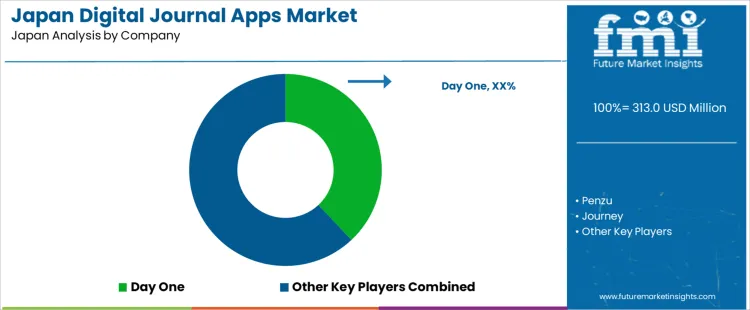
The demand for digital journal apps in Japan is shaped by mobile centric daily routines and mental wellness use. Day One holds a visible position among bilingual users through cloud sync and Apple device integration. Penzu supports privacy focused users through encrypted entries and long form writing formats. Journey maintains steady adoption through cross platform access across Android Windows and browser environments. Reflectly and Daylio shape mood tracking demand through emotion logs and habit correlation views. Students use these tools for reflection tied to academic pressure and time management. Office workers rely on short daily entries linked to commuting and late evening routines. Creative users adopt multimedia logging through photos voice notes and tagged location entries. Usage growth centers on urban prefectures with high smartphone penetration and subscription comfort.
App selection in Japan is governed by full Japanese language support and clear privacy assurances. Offline entry capability remains important due to transit tunnel coverage and battery limits. Users favor interfaces with low visual clutter and low notification intensity. Daily entries cluster around commuting hours late evening reflection and study breaks. Subscription renewal depends on perceived stress relief and habit tracking usefulness. University wellness programs reference journaling as part of self-management guidance. Employers promote optional digital wellness tools through internal benefit platforms. Data storage location and encryption transparency influence long term user retention. Younger users prefer visual summaries rather than long narrative diary formats. Demand visibility tracks growth in digital wellness spending and academic counseling referrals.
Key Players in the Digital Journal Apps Industry in Japan
- Day One
- Penzu
- Journey
- Reflectly
- Daylio
Scope of the Report
| Items | Values |
|---|---|
| Quantitative Units (2025) | USD million |
| Type | Android, iOS, Windows, MacOS |
| Application | Mobile Phones, Tablets, Desktop PCs |
| End User | Individual Consumers, Students, Working Professionals, Creative Users, Corporate Wellness Users |
| Regions Covered | Kyushu and Okinawa, Kanto, Kansai, Chubu, Tohoku, Rest of Japan |
| Countries Covered | Japan |
| Key Companies Profiled | Day One, Penzu, Journey, Reflectly, Daylio |
| Additional Attributes | Dollar sales by platform and service category, regional subscription adoption patterns, freemium to premium conversion structure, data privacy and encryption compliance requirements, cloud synchronization dependency, mobile first usage behavior, offline entry functionality, recurring revenue contribution from wellness and productivity use cases |
Digital Journal Apps Industry in Japan Segmentation
Platform:
- Android
- iOS
- Windows
- MacOS
Application:
- Mobile Phones
- Tablets
- Desktop PCs
Services:
- Freemium Services
- Premium Services
Region:
- Kyushu & Okinawa
- Kanto
- Kansai
- Chubu
- Tohoku
- Rest of Japan
Frequently Asked Questions
How big is the demand for digital journal apps in Japan in 2025?
The demand for digital journal apps in Japan is estimated to be valued at USD 313.0 million in 2025.
What will be the size of digital journal apps in Japan in 2035?
The market size for the digital journal apps in Japan is projected to reach USD 711.0 million by 2035.
How much will be the demand for digital journal apps in Japan growth between 2025 and 2035?
The demand for digital journal apps in Japan is expected to grow at a 8.6% CAGR between 2025 and 2035.
What are the key product types in the digital journal apps in Japan?
The key product types in digital journal apps in Japan are android, ios, windows and macos.
Which application segment is expected to contribute significant share in the digital journal apps in Japan in 2025?
In terms of application, mobile phones segment is expected to command 65.0% share in the digital journal apps in Japan in 2025.
Preview the report firsthand - request a free sample
Get SampleGet the brochure for pricing and purchase details.
Get PDFTable of Content
- Executive Summary
- Japan Market Outlook
- Demand-side Trends
- Supply-side Trends
- Technology Roadmap Analysis
- Analysis and Recommendations
- Market Overview
- Market Coverage / Taxonomy
- Market Definition / Scope / Limitations
- Market Background
- Market Dynamics
- Drivers
- Restraints
- Opportunity
- Trends
- Scenario Forecast
- Demand in Optimistic Scenario
- Demand in Likely Scenario
- Demand in Conservative Scenario
- Opportunity Map Analysis
- Product Life Cycle Analysis
- Supply Chain Analysis
- Investment Feasibility Matrix
- Value Chain Analysis
- PESTLE and Porter’s Analysis
- Regulatory Landscape
- Regional Parent Market Outlook
- Production and Consumption Statistics
- Import and Export Statistics
- Market Dynamics
- Japan Market Analysis 2020 to 2024 and Forecast, 2025 to 2035
- Historical Market Size Value (USD Million) Analysis, 2020 to 2024
- Current and Future Market Size Value (USD Million) Projections, 2025 to 2035
- Y-o-Y Growth Trend Analysis
- Absolute $ Opportunity Analysis
- Japan Market Pricing Analysis 2020 to 2024 and Forecast 2025 to 2035
- Japan Market Analysis 2020 to 2024 and Forecast 2025 to 2035, By Platform
- Introduction / Key Findings
- Historical Market Size Value (USD Million) Analysis By Platform , 2020 to 2024
- Current and Future Market Size Value (USD Million) Analysis and Forecast By Platform , 2025 to 2035
- Android
- iOS
- Windows
- MacOS
- Y-o-Y Growth Trend Analysis By Platform , 2020 to 2024
- Absolute $ Opportunity Analysis By Platform , 2025 to 2035
- Japan Market Analysis 2020 to 2024 and Forecast 2025 to 2035, By Application
- Introduction / Key Findings
- Historical Market Size Value (USD Million) Analysis By Application, 2020 to 2024
- Current and Future Market Size Value (USD Million) Analysis and Forecast By Application, 2025 to 2035
- Mobile Phones
- Tablets
- Desktop PCs
- Y-o-Y Growth Trend Analysis By Application, 2020 to 2024
- Absolute $ Opportunity Analysis By Application, 2025 to 2035
- Japan Market Analysis 2020 to 2024 and Forecast 2025 to 2035, By Services
- Introduction / Key Findings
- Historical Market Size Value (USD Million) Analysis By Services, 2020 to 2024
- Current and Future Market Size Value (USD Million) Analysis and Forecast By Services, 2025 to 2035
- Freemium Services
- Premium Services
- Y-o-Y Growth Trend Analysis By Services, 2020 to 2024
- Absolute $ Opportunity Analysis By Services, 2025 to 2035
- Market Structure Analysis
- Competition Dashboard
- Competition Benchmarking
- Market Share Analysis of Top Players
- By Regional
- By Platform
- By Application
- By Services
- Competition Analysis
- Competition Deep Dive
- Day One
- Overview
- Product Portfolio
- Profitability by Market Segments (Product/Age /Sales Channel/Region)
- Sales Footprint
- Strategy Overview
- Marketing Strategy
- Product Strategy
- Channel Strategy
- Penzu
- Journey
- Reflectly
- Daylio
- Day One
- Competition Deep Dive
- Assumptions & Acronyms Used
- Research Methodology


