

- Industry Size (2026)
- USD 162.0 Mn
- Forecast (2036)
- USD 690.0 Mn
- CAGR (2026 to 2036)
- 14.0%
Digital Watermark Detection Modules for Sorting Market Size, Market Forecast and Outlook By FMI
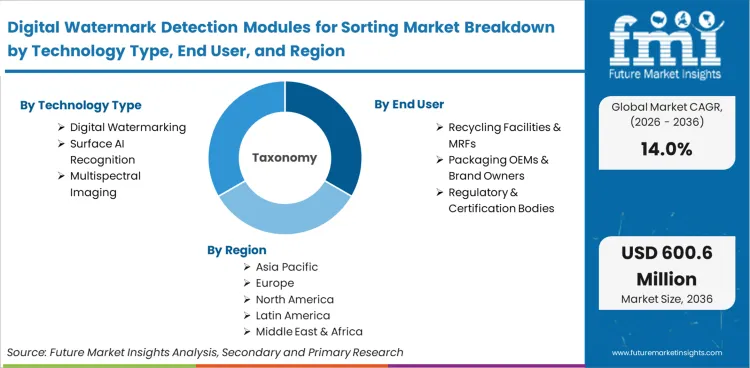
The digital watermark detection modules for sorting market was valued at USD 145.0 million in 2025. The industry is poised to reach USD 162.0 million in 2026 at a CAGR of 14.0% during the forecast. Demand outlook carries the market valuation to USD 690.0 million through 2036 as strict circularity mandates and brand‑owner-subsidized optical upgrades accelerate high-speed decoding deployments.
Optical sorting line engineers facing stringent food-contact material purity requirements cannot rely on traditional near-infrared spectroscopy to separate food-grade from non-food-grade polyethylene terephthalate. Deploying intelligent camera architectures capable of reading imperceptible topologies directly on the packaging substrate resolves this bottleneck. According to FMI's estimates, this transition forces sorting equipment manufacturers to embed high-definition image processing nodes directly into the ejection manifold control logic. Upgrading these analog separation lines with food grade PCR resin targeted detection units establishes a verifiable chain of custody. Facilities missing this integration window before the 2030 recycled content targets take effect risk complete exclusion from premium secondary material supply contracts.
Summary of Digital Watermark Detection Modules for Sorting Market
- Digital Watermark Detection Modules for Sorting Market Definition:
- The market encompasses high-speed optical hardware and intelligent processing software designed specifically to identify, decode, and act upon imperceptible digital codes embedded in consumer packaging substrates. These modules integrate into existing material recovery conveyor systems to separate complex plastic streams. A primary application involves sorting food-grade polyethylene terephthalate from non-food-grade identical plastics.
- Demand Drivers in the Market:
- Stringent recycled content legislation compels consumer packaged goods companies to secure highly purified secondary raw material streams.
- Near-infrared sorting technology limitations force material recovery facilities to adopt deterministic substrate identification logic.
- Consumer brand consortiums subsidizing intelligent sorting infrastructure accelerate the deployment of high-resolution camera modules across municipal recycling networks.
- Key Segments Analyzed in the FMI Report:
- Digital Watermarking (Invisible Codes): 46.0% volume share as brand owners embed microscopic topological variations directly into the injection molding tooling.
- Recycling Facilities & MRFs: 42.0% volume share reflecting the concentrated capital expenditure required to upgrade high-throughput optical ejection lines.
- rPET Packaging: 55.0% volume share driven by strict contamination tolerances required for food-contact regulatory approval.
- Analyst Opinion at FMI:
- Ismail Sutaria, Principal Consultant for Packaging, opines, ”Analog near-infrared sorting systems cannot differentiate a food-grade detergent bottle from a beverage container made of identical high-density polyethylene. This physical limitation forces material recovery facility operators to implement active digital watermarking detection logic to satisfy regulatory purity thresholds. Facilities that delay integrating high-definition multispectral decoding hardware will fail to secure premium post-consumer resin off-take agreements, effectively locking them into low-margin downcycling channels before the next municipal contract renewal cycle.”
- Strategic Implications / Executive Takeaways:
- Mandate verifiable digital code decoding capabilities for all upcoming optical sorter procurement contracts.
- Collaborate with brand owner consortiums to co-finance high-resolution camera hardware installations at the municipal level.
- Establish baseline decoding efficiency metrics for flexible multilayer films to capture high-value polyolefin streams.
- Methodology:
- Primary Research: Analysts conducted direct interviews with material recovery facility plant managers, optical sorting equipment design engineers, and packaging sustainability directors.
- Desk Research: Data compilation relied on published municipal recycling infrastructure investments and corporate sustainability milestone reports.
- Market-Sizing and Forecasting: Analysts constructed a bottom-up adoption model anchoring on regional plastic waste processing volumes and installed optical sorter bases.
- Data Validation and Update Cycle: Initial module shipment projections underwent cross-verification against post-consumer resin market supply constraints before integration.
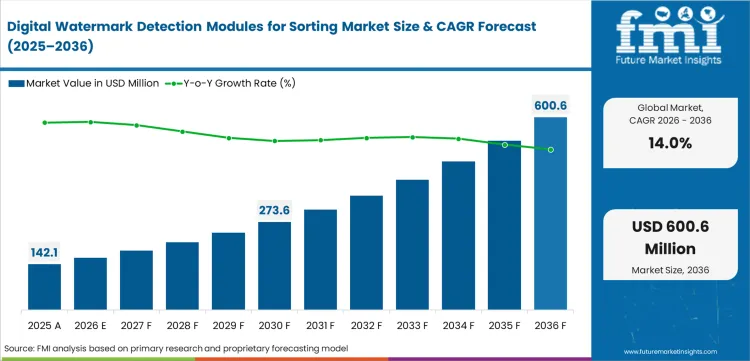
FMI analysts observe that the projected USD 690.0 million valuation represents the structural conversion of municipal waste sorting from probabilistic material guessing into deterministic data-driven separation. The 14.0% CAGR value reflects the absolute necessity of capturing high-purity food-grade plastics to meet imminent international recycled content minimums. This legislative pressure establishes an irreversible capital expenditure cycle across global recycling infrastructure, resetting baseline sorting capabilities from basic polymer identification to specific product and manufacturer recognition.
The European Union's aggressive packaging waste directives force Germany to lead adoption with a 15.2% CAGR, while the United Kingdom follows closely at a 13.6% CAGR as extended producer responsibility schemes penalize non-circular designs. In North America, the United States registers a 14.7% CAGR driven by massive private investments from brand owner consortiums desperate for high-quality post-consumer resins. Asia Pacific demonstrates accelerated modernization, with China at a 14.1% CAGR and India at a 13.3% CAGR as massive urban waste streams demand automated, high-throughput material recovery solutions. Brazil advances at a 12.8% CAGR through organized cooperative network upgrades, while Japan maintains a 12.0% CAGR focused on refining its already highly segregated municipal collection frameworks.
Digital Watermark Detection Modules for Sorting Market Definition
The Digital Watermark Detection Modules for Sorting Market comprises specialized machine vision hardware, high-speed illumination arrays, and the proprietary decoding software required to identify imperceptible codes embedded in packaging surfaces. These systems capture images of waste items traveling on conveyor belts at speeds exceeding three meters per second and process the embedded data to actuate pneumatic ejection valves. A primary example includes retrofitting existing near-infrared sorting stations with auxiliary high-definition camera bridges to separate identical polymers based on prior use.
Digital Watermark Detection Modules for Sorting Market Inclusions
Market coverage includes dedicated intelligent camera modules, edge computing processing units responsible for topological decoding, and specialized multispectral lighting rigs designed specifically for industrial waste environments. Software licensing for code recognition algorithms integrated into sorting machinery falls completely within the analytical scope. A concrete inclusion is a standalone vision system installed over an existing conveyor specifically configured to read encoded shrink sleeves on polyethylene terephthalate bottles.
Digital Watermark Detection Modules for Sorting Market Exclusions
The actual packaging materials, labels, and the injection molding tooling required to print or emboss the watermarks are explicitly excluded. Standard near-infrared polymer sorting systems lacking specific digital code decoding capabilities fall outside the analytical boundary. A concrete borderline exclusion is a basic artificial intelligence camera used solely for object recognition based on shape or brand logo, as it does not decode an intentionally embedded cryptographic or topological watermark.
Digital Watermark Detection Modules for Sorting Market Research Methodology
- Primary Research: Analysts engaged with sorting facility directors, recycling machinery original equipment manufacturers, and corporate sustainability officers across major regulatory zones to ascertain hardware deployment timelines.
- Desk Research: Data compilation evaluated public investment disclosures from circular economy consortiums and infrastructure grant allocations published by environmental ministries.
- Market-Sizing and Forecasting: Analysts utilized a bottom-up adoption model anchoring on the total installed base of near-infrared sorting machines capable of accepting modular vision upgrades.
- Data Validation and Update Cycle: Initial port-count projections underwent cross-verification against announced post-consumer resin capacity expansions before baseline integration.
Segmental Analysis
Digital Watermark Detection Modules for Sorting Market Analysis by Technology Type
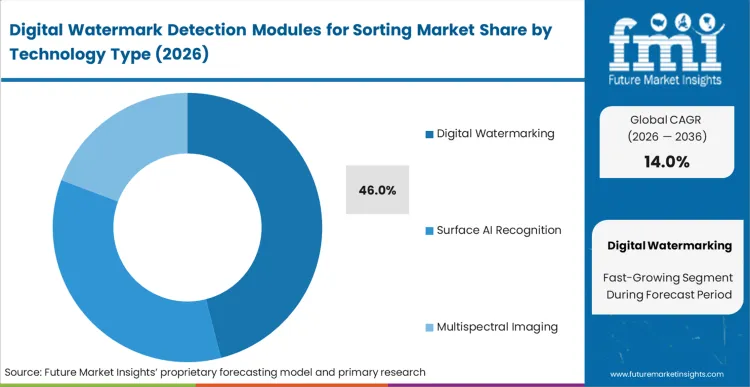
Identifying food-grade packaging from non-food-grade containers made of identical plastic requires deterministic data that standard spectroscopy cannot provide. As per FMI's projection, optical sorting equipment manufacturers are integrating proprietary decoding logic directly into their master controller architectures to read microscopic surface variations. With 46.0% of the 2026 market share, digital watermarking (invisible codes) dictates the core capital expenditure cycle for advanced material recovery facilities. Upgrading these lines with specific AI enabled sorting systems for dark plastics and watermark readers eliminates the contamination risk associated with manual picking. Facilities installing these intelligent vision bridges secure the capability to extract premium fractions from mixed waste streams. Sorter operators failing to implement these specific topological decoding protocols face immediate exclusion from highly lucrative food-grade recycled resin supply chains.
- Decoding Latency: High-speed conveyor belts traveling at three meters per second demand sub-millisecond image processing capabilities.
- Illumination Architecture: Capturing microscopic topological variations on crushed bottles requires specialized multi-angle lighting arrays to create necessary shadows.
- Software Integration: Edge processing units must communicate decoding results directly to pneumatic ejection controllers without disrupting existing line synchronization.
Digital Watermark Detection Modules for Sorting Market Analysis by End User
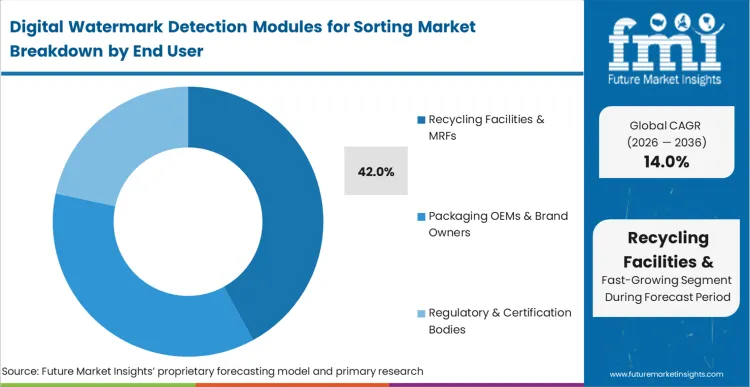
Recycling Facilities & MRFs absorb the primary financial burden of this technological transition, holding a 42.0% volume share as brand owners demand unprecedented material purity. Facilities operating without deterministic decoding capabilities remain trapped in low-value downcycling markets. The inability of analog sorting lines to differentiate between a bleach bottle and a milk jug made of identical high-density polyethylene creates a critical bottleneck for circular economy targets. According to FMI's estimates, facility managers must install dedicated intelligent vision systems to read the design for recycling packaging codes embedded by consumer goods manufacturers. Implementing these advanced decoding modules converts mixed plastic bales into highly specified, food-grade verified outputs. Material recovery operators undertaking these capital-intensive retrofits command significant price premiums for their sorted fractions.
- Capital Allocation: Facility directors prioritize modular vision upgrades that integrate seamlessly over existing conveyor belts rather than replacing entire sorting stations.
- Throughput Maintenance: Decoding hardware must process overlapping and deformed waste items without reducing the overall tons-per-hour processing metric.
- Data Monetization: Advanced sorting modules capture detailed brand and package-type analytics, creating a secondary revenue stream through data sales to extended producer responsibility schemes.
Digital Watermark Detection Modules for Sorting Market Analysis by Material Focus
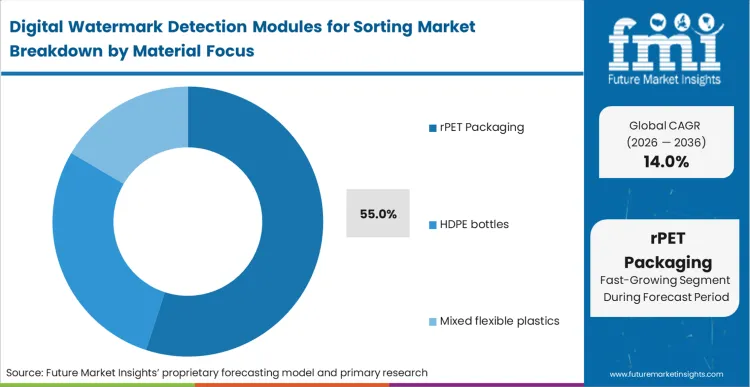
FMI analysts opine that integrating digital watermarking for food grade rPET sorting modules enables deterministic sorting based on the container's prior application rather than its chemical composition alone. The rPET packaging segment commands a dominant 55.0% share, driven by strict regulatory requirements governing the utilization of post-consumer resin in new food and beverage containers, achieving the purity thresholds required for European Food Safety Authority approval demands an absolute separation of food-contact materials from chemical containers. Optical sorting engineers utilizing these high-definition hardware upgrades effectively eliminate cross-contamination risks during the initial separation phase. Sorting lines equipped with digital watermark enabled sorting for flexible food packaging and rigid rPET detection units capture maximum value from incoming bales. Recyclers lacking this precise decoding capability cannot meet the strict quality specifications demanded by major beverage consortiums.
- Polymer Differentiation: Advanced camera systems decipher specific stock keeping unit data to separate mono-layer from multi-layer polyethylene terephthalate containers accurately.
- Sleeve Interference: Decoding algorithms must successfully read watermarks even when the primary packaging is obscured by damaged or misaligned shrink sleeves.
- Contamination Mitigation: Precise ejection valve timing synchronized with the decoding software prevents non-food grade plastics from entering the premium processing stream.
Digital Watermark Detection Modules for Sorting Market Drivers, Restraints, and Opportunities
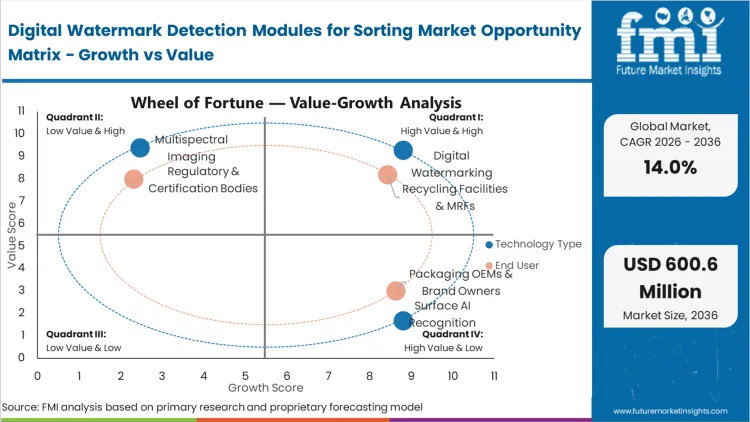
Replacing probabilistic material identification with deterministic digital code reading drives immediate purity gains across sorting operations. Identifying specific product histories allows material recovery facility managers to separate food-grade polyolefins from chemically identical containers previously holding hazardous materials. This absolute certainty provides the necessary foundation for scaling food-contact post-consumer resin production. Operations directors utilizing intelligent vision modules can drastically reduce manual quality control staffing while simultaneously increasing the commercial value of their final output bales.
Escalating hardware integration costs create severe friction for independent recycling cooperatives operating on razor-thin processing margins. Deploying specialized multispectral cameras and edge computing processors across multiple conveyor lines requires substantial upfront capital expenditure. This persistent financial barrier forces facility managers to delay optical sorting upgrades pending comprehensive return-on-investment analyses. Cooperative directors must negotiate co-investment agreements with consumer brand consortiums or secure government infrastructure grants to finance these necessary vision system installations.
- Flexible Packaging Recovery: Decoding modules enable the accurate separation of complex multilayer films. Integrating high-speed cameras above 2D sorting lines allows operators to capture valuable mono-material pouches.
- Dark Plastic Identification: Digital watermarks bypass the limitations of near-infrared sensors on carbon-black plastics. Facilities deploying surface decoders can successfully recover black food trays previously lost to landfill.
- Data-driven Extended Producer Responsibility: Intelligent sorting systems log every decoded package by brand and product type. Facility managers sell this granular recovery data to regulatory bodies verifying corporate recycling claims.
Regional Analysis
Based on the regional analysis, the Digital Watermark Detection Modules for Sorting Market is segmented into North America, Latin America, Europe, East Asia, South Asia, Oceania and Middle East & Africa across 40+ countries. The full report also offers market attractiveness analysis based on regional trends.
.webp "Top Country Growth Comparison Digital Watermark Detection Modules For Sorting Market Cagr (2026 2036)")
| Country | CAGR (2026 to 2036) |
|---|---|
| Germany | 15.2% |
| United States | 14.7% |
| China | 14.1% |
| United Kingdom | 13.6% |
| India | 13.3% |
| Brazil | 12.8% |
| Japan | 12.0% |
Source: Future Market Insights (FMI) analysis, based on proprietary forecasting model and primary research
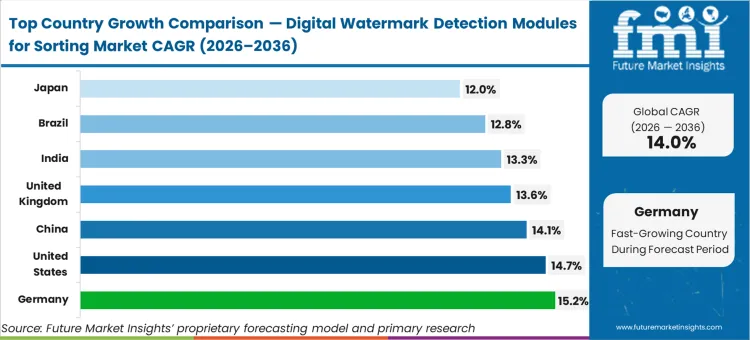
Asia Pacific Digital Watermark Detection Modules for Sorting Market Analysis
Municipal authorities managing vast metropolitan waste streams face an acute need to automate manual picking lines to handle escalating plastic volumes. Asia Pacific's waste management trajectory is defined by aggressive government-mandated infrastructure modernizations designed to formalize chaotic urban collection networks. This top-down directive forces domestic sorting equipment manufacturers to integrate sophisticated optical decoding logic capable of processing heavily contaminated material flows. As per FMI's projection, the implementation of dense urban recycling targets leaves facility managers with no option but to deploy deterministic vision modules to capture high-value resins. High-throughput facilities demand unified decoding algorithms to maintain sequence perfection across fast-moving conveyor systems. Regional operations directors must secure reliable imaging hardware to orchestrate massive material recovery targets successfully.
- China: Expanding at a 14.1% CAGR through 2036, China's intelligent sorting module sector undergoes structural modernization to eliminate manual labor dependencies across newly commissioned mega-recycling centers. State-driven directives mandate the immediate integration of automated optical sorting hardware. The Ministry of Ecology enforces strict purity thresholds on recycled resins utilized in domestic manufacturing, forging a compliance environment that necessitates deterministic decoding technology. This rapid transition from basic mechanical separation to data-driven material recovery requires plant managers operating within designated circular economy zones to install high-definition camera bridges before the 2028 infrastructure audit to access continued provincial processing subsidies.
- India: Massive infrastructure investments compel localized waste management hubs to rapidly scale automated separation capabilities for addressing the overwhelming influx of flexible packaging. This dynamic propels verifiable decoding modules to a 13.3% CAGR, directly reflecting corporate financial injections into municipal infrastructure to satisfy strict collection quotas. The implementation of Plastic Waste Management Rules enforces extended producer responsibility upon fast-moving consumer goods companies, effectively dictating specialized optical sorting installations. Material recovery operators must transition to standardized digital architectures featuring surface recognition algorithms before margin compression eliminates competitive bidding status for civic contracts.
- Japan: Highly segregated municipal collection frameworks demand exceptional precision from secondary optical sorting facilities processing complex multilayer plastics. The Ministry of the Environment enforces rigorous quality standards for recycled polyethylene terephthalate, compelling domestic recyclers to implement advanced topological decoding. This technological shift prevents cross-contamination from identical non-food containers while capital actively flows into specialized hardware enhancements. Quality assurance executives must mandate millisecond-level code verification protocols to guarantee food-grade outputs prior to negotiating supply contracts with major domestic beverage brands, culminating in a sustained 12.0% CAGR over the forecast period.
FMI's report includes comprehensive tracking of the Asia Pacific connectivity landscape, covering adoption rates in South Korea, Indonesia, and Australia. The localization of advanced plastic recycling technologies in these zones accelerates the requirement for unified decoding standards to accurately track brand-specific recovery rates across fragmented municipal systems.
North America Digital Watermark Detection Modules for Sorting Market Analysis
North America's material recovery landscape undergoes a massive recalibration as brand owner consortiums aggressively fund infrastructure upgrades to secure scarce post-consumer resin supplies. Plant managers are actively evaluating intelligent vision system add-ons to enhance the accuracy of their existing near-infrared sorting fleets. This capital injection from private industry changes the return-on-investment calculation for operators previously deferring network upgrades. The urgency to establish reliable food-grade recycled plastic streams dictates modern procurement strategies. Buyers prioritize optical modules that offer out-of-the-box compatibility with existing conveyor and ejection systems. Compliance officers must deploy certified high-speed imaging hardware to validate purity baselines demanded by major consumer packaged goods buyers.
- United States: Registering a robust 14.7% CAGR to the 2036 horizon, the United States market commands massive capital to retrofit hundreds of regional material recovery facilities. Strict corporate sustainability commitments regarding recycled content usage force sorting operators to deploy advanced intelligent vision grids across major municipal recycling networks. The Association of Plastic Recyclers actively promotes design-for-recyclability guidelines integrating digital watermarking, establishing a nationwide standard that equipment manufacturers must support. Facility directors are compelled to qualify and deploy compliant camera modules capable of identifying specific brand watermarks before the 2027 procurement cycle to secure lucrative long-term off-take agreements with global beverage conglomerates.
FMI's report includes deep-dive assessments of the North American market, detailing integration trends across Canada and Mexico. The cross-border integration of packaging supply chains forces secondary processors in these regions to adopt standardized decoding hardware to maintain acceptable purity levels for materials exported back to United States manufacturing centers.
Europe Digital Watermark Detection Modules for Sorting Market Analysis
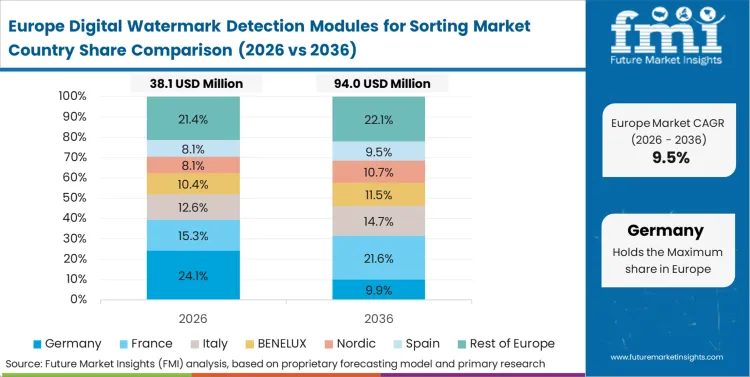
Integrating comprehensive pet bottle to bottle recycling plants meeting EU 30 recycled content mandate protocols guarantees output quality before facilities activate continuous production lines. Europe functions as the primary technical proving ground for advanced digital watermarking initiatives, driven heavily by strict Packaging and Packaging Waste Regulation mandates. Plant administrators managing highly automated recycling facilities require complex deterministic sorting capabilities that analog near-infrared sensors simply cannot accommodate. This structural shift reflects a broader opportunity: replacing probabilistic material sorting with verifiable, data-driven circularity. According to FMI's estimates, facility architects now view native watermark decoding compliance not as a premium feature, but as a mandatory prerequisite for any new optical equipment entering a European processing facility.
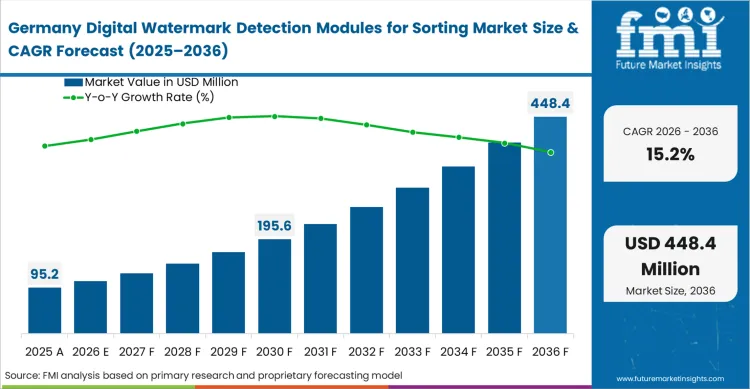
- Germany: The dense concentration of advanced material recovery infrastructure requires seamless data exchange and high-speed decoding across highly complex, multi-stage sorting lines. Strict enforcement of deposit return schemes and advanced extended producer responsibility fees anchors Germany's impressive 15.2% CAGR, creating a direct financial incentive for facilities to capture every identifiable piece of valuable packaging. This trajectory confirms the aggressive phase-out of legacy optical identification methods as administrators execute comprehensive hardware retrofits. Operations executives must establish unified decoding capabilities verified against stringent European Food Safety Authority purity standards across all operational streams before bidding on national supply contracts.
- United Kingdom: Post-Brexit packaging tax regulations mandate plastic producers to utilize a minimum of 30% recycled content, creating an immense supply constraint for high-quality secondary materials. The implementation of modulated extended producer responsibility fees explicitly rewards packaging designs featuring verifiable digital watermarks, forcing domestic sorting facilities to install compatible reading hardware to claim processing subsidies. Supply chain directors lacking deterministic decoding architectures face severe penalties from retail partners demanding food-grade certified resins from closed-loop recycling programs. The intelligent sorting module sector to a 13.6% CAGR is propelled by these aggressive domestic legislative pressures demand rapid deployment of advanced camera systems across regional hubs,
FMI's report includes detailed tracking of European protocol adoption, expanding coverage to France, Italy, and the Nordics. The rapid deployment of closed-loop recycling systems across these nations necessitates decentralized decoding capabilities to process mixed household waste streams efficiently.
Latin America Digital Watermark Detection Modules for Sorting Market Analysis
Fluctuating virgin polymer pricing and unstable global trade dynamics force regional recyclers to relentlessly optimize brownfield asset efficiency. Minimizing the loss of valuable plastics to landfill dictates the rapid adoption of intelligent optical upgrades capable of distinguishing specific material grades. Extraction facilities prioritize high-volume, cost-effective sorting enhancements over entirely new line installations to maintain competitive secondary material pricing. Affordability consistently outweighs specialized performance differentiation across the region. Facility administrators must route complex mixed plastic streams through standardized optical gateways, utilizing high-performance image processing algorithms to translate imperceptible package codes into actionable ejection commands reliably.
- Brazil: Advancing at a 12.8% CAGR across the 2026 to 2036 planning window, Brazil's investment represents a critical shift from manual labor to automated precision. Domestic packaging manufacturers continually expand the use of complex multilayer films to protect product margins, meaning effective sorting requires intelligent optical detection to prevent contamination of rigid plastic streams. The National Solid Waste Policy mandates shared responsibility for product lifecycles, prompting industry consortiums to invest directly in upgrading the optical sorting capabilities of major regional cooperatives. Cooperative directors must mandate the installation of intelligent camera bridges to ensure sorted plastic bales meet rigid corporate quality ceilings without sacrificing overall processing throughput metrics.
FMI's report includes detailed analysis of the Latin American processing sector, incorporating insights from Argentina and Chile. Vast municipal collection networks supply regional processing plants, forcing domestic operators to modernize optical isolation techniques to extract maximum functional value from every automated line deployed.
Competitive Aligners for Market Players
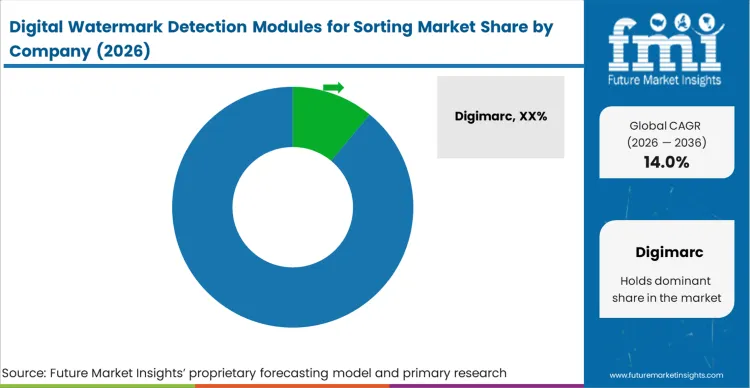
Strict European packaging waste directives and consortium-led validation thresholds mandate native interoperability between proprietary watermark algorithms and high-speed optical ejection manifolds to secure premium food-grade secondary resin contracts. The HolyGrail 2.0 initiative has shifted from conceptual validation to binding industrial reality, forcing sorting equipment manufacturers into a high-stakes arms race for detection accuracy. Pellenc ST and TOMRA Sorting Recycling established the early hardware baseline by co-developing the first detection add-on modules with Digimarc, achieving ejection rates exceeding 95% at belt speeds of three meters per second. Digimarc's recent rollout of Digimarc Recycle, which successfully sorted 56,000 rigid packaging items daily at SKU-level precision during commercial-scale trials at the Hündgen Entsorgung facility, has further raised the competitive ceiling. Retailers like Germany's Netto Marken-Discount are actively launching private-label packaging digitized with Digimarc's covert watermarks to unify checkout efficiency with downstream sortability. Sorting equipment original equipment manufacturers failing to integrate these validated decoding modules face immediate lockout from upcoming municipal infrastructure modernization bids.
Decentralizing the computational load of topological decoding directly onto the camera bridge fundamentally alters the capital expenditure threshold for independent material recovery operators. As high-throughput facilities seek to minimize brownfield network integration downtime, developers are launching solutions that drastically cut the hardware compute costs of watermark detection. Digimarc recently disrupted the processing cost barrier by releasing GPU-optimized sortation software, effectively halving the required server infrastructure for facility retrofits. Concurrently, challenger technologies are carving out specialized, low-capital niches. FiliGrade Sustainable Watermarks launched CurvCode, a single-purpose sorting watermark requiring only standard monochrome cameras and basic LED lighting. FiliGrade's aggressive market entry includes a collaborative industrial trial with ALPLA and Pellenc ST to sort Dutch HDPE milk bottles, alongside the commercial launch of the first CurvCode-stamped mono-PET fish trays in partnership with Bond Seafood. Capital allocation committees prioritize these scalable, self-sufficient modules, meaning component suppliers relying on legacy, cloud-heavy visual translation software forfeit critical engineering specification battles.
The mandatory implementation of the European Digital Product Passport forces brand-protection architectures originally developed for pharmaceutical supply chain authentication to converge directly with municipal extended producer responsibility compliance. Companies traditionally dominant in covert security are aggressively pivoting their serialization technologies to capture the lucrative recycling and circularity data market. Sorting software integrators lacking secure data-sharing interfaces with these advanced product-passport networks surrender the secondary revenue streams generated by validating corporate circularity claims across fragmented collection lines.
Key Players in Digital Watermark Detection Modules for Sorting Market
- Digimarc
- Pellenc ST
- TOMRA Sorting Recycling
- FiliGrade Sustainable Watermarks
- Securikett
- VerifyMe
- Systech
Scope of the Report
| Metric | Value |
|---|---|
| Quantitative Units | USD 162.0 million to USD 690.0 million, at a CAGR of 14.0% |
| Market Definition | The market encompasses high-speed optical hardware and intelligent processing software designed specifically to identify, decode, and act upon imperceptible digital codes embedded in consumer packaging substrates. |
| Technology Type Segmentation | Digital Watermarking (Invisible Codes), Surface AI Recognition, Multispectral Imaging |
| End User Segmentation | Recycling Facilities & MRFs, Packaging OEMs & Brand Owners, Regulatory & Certification Bodies |
| Material Focus Segmentation | rPET packaging, HDPE bottles, Mixed flexible plastics |
| Regions Covered | North America, Latin America, Europe, East Asia, South Asia, Oceania, Middle East and Africa |
| Countries Covered | Germany, United States, China, United Kingdom, India, Brazil, Japan, and 40 plus countries |
| Key Companies Profiled | Digimarc, Pellenc ST, TOMRA Sorting Recycling, FiliGrade Sustainable Watermarks, Securikett, VerifyMe, Systech |
| Forecast Period | 2026 to 2036 |
| Approach | Analysts constructed a bottom-up adoption model anchoring on regional plastic waste processing volumes and installed optical sorter bases. |
Source: Future Market Insights (FMI) analysis, based on proprietary forecasting model and primary research
Segmental Analysis
Technology Type:
- Digital Watermarking (Invisible Codes)
- Surface AI Recognition
- Multispectral Imaging
End User:
- Recycling Facilities & MRFs
- Packaging OEMs & Brand Owners
- Regulatory & Certification Bodies
Material Focus:
- rPET packaging
- HDPE bottles
- Mixed flexible plastics
Region:
- Asia Pacific
- India
- China
- Japan
- South Korea
- Indonesia
- Australia & New Zealand
- ASEAN
- Rest of Asia Pacific
- Europe
- Germany
- Italy
- France
- United Kingdom
- Spain
- Benelux
- Nordics
- Central & Eastern Europe
- Rest of Europe
- North America
- United States
- Canada
- Mexico
- Latin America
- Brazil
- Argentina
- Chile
- Rest of Latin America
- Middle East & Africa
- Kingdom of Saudi Arabia
- United Arab Emirates
- South Africa
- Turkey
- Rest of Middle East & Africa
Bibliography
- European Commission. (2024, April 24). Proposal for a revision of EU legislation on Packaging and Packaging Waste (Regulatory filing).
- Association of Plastic Recyclers (APR). (2024, August 15). APR Design Guide for Plastics Recyclability (Standards publication).
- AIM - European Brands Association. (2025, February 10). HolyGrail 2.0 Initiative Phase 3 Validation Report (Industry report).
- GS1 Global. (2024, November 05). GS1 Digital Link Standard Version 1.2 (Standards publication).
- The Consumer Goods Forum. (2025, January 22). Golden Design Rules for Optimal Plastic Design, Production and Recycling (Industry report).
- Digimarc Corporation. (2025, February 27). Digimarc Reports Fourth Quarter 2024 Financial Results (Press release).
- TOMRA Systems ASA. (2025, February 14). TOMRA Annual Report 2024 (Annual report).
- Pellenc ST. (2024, September 10). Advancements in Optical Sorting for Circular Economy Applications (Company news release).
- European Food Safety Authority (EFSA). (2024, July 12). Safety Assessment of Recycling Processes for PET (Government report)
- USA Environmental Protection Agency (EPA). (2024, November 15). National Recycling Strategy Final Report (Government report).
- Plastics Recyclers Europe (PRE). (2025, January 30). Installed Plastics Recycling Capacity in Europe 2024 (Sector survey).
- Ellen MacArthur Foundation. (2024, October 20). Global Commitment 2024 Progress Report (Industry report).
This bibliography is provided for reader reference. The full FMI report contains the complete reference list with primary research documentation.
This Report Addresses
- Market size estimation and revenue forecasts from 2026 to 2036, supported by validated processing capacity and hardware integration benchmarks across major municipal recovery hubs.
- Growth opportunity mapping across specific detection architectures with emphasis on deterministic optical sorting transitions optimizing high-speed material separation.
- Segment and regional revenue forecasts covering critical applications like digital watermarking and surface recognition structuring capital equipment investment allocation.
- Competition strategy assessment including modular retrofitting models, processing latency reduction, and edge computing positioning to evaluate market entry viability.
- Product compliance tracking covering key metrics such as decoding accuracy and ejection synchronization dictating food-grade resin validation.
- Regulatory impact analysis evaluating strict extended producer responsibility mandates, recycled content minimums, and circular economy guidelines dictating infrastructure compliance.
- Supply chain vulnerability assessment linking high-definition camera capacity directly to final operational sorting module availability mitigating facility upgrade delays.
- Market report delivery in PDF, Excel, PPT, and interactive dashboard formats for executive and operational use.
Frequently Asked Questions
How large is the demand for Digital Watermark Detection Modules for Sorting in the global market in 2026?
Demand for Digital Watermark Detection Modules for Sorting in the global market is estimated to be valued at USD 162.0 million in 2026.
What will be the market size of Digital Watermark Detection Modules for Sorting in the global market by 2036?
Market size for Digital Watermark Detection Modules for Sorting is projected to reach USD 690.0 million by 2036.
What is the expected demand growth for Digital Watermark Detection Modules for Sorting in the global market between 2026 and 2036?
Demand for Digital Watermark Detection Modules for Sorting is expected to grow at a CAGR of 14.0% between 2026 and 2036.
Which Technology Type is poised to lead global sales by 2026?
Digital Watermarking (Invisible Codes) commands 46.0% in 2026 as brand owners require absolute certainty to separate food-grade polyolefins from chemically identical packaging.
How significant is the role of Recycling Facilities & MRFs in driving Digital Watermark Detection Modules for Sorting adoption in 2026?
Recycling Facilities & MRFs represents 42.0% of segment share as plant operators undertake capital-intensive optical sorting retrofits to capture premium resin value.
What is driving demand in Germany?
Strict enforcement of packaging waste directives and advanced extended producer responsibility fees directly incentivize maximum material recovery.
What compliance standards or regulations are referenced for Germany?
European Food Safety Authority purity standards and the European Union Packaging and Packaging Waste Regulation.
What is the Germany growth outlook in this report?
Germany is projected to grow at a CAGR of 15.2% during 2026 to 2036.
Why is North America described as a priority region in this report?
Massive private investments from consumer packaged goods consortiums desperate for high-quality post-consumer resins accelerate infrastructure modernization thoroughly.
What type of demand dominates in North America?
Corporate sustainability-driven retrofits and optical line enhancements targeting verifiable food-grade polyethylene terephthalate recovery.
What is United States's growth outlook in this report?
United States is projected to expand at a CAGR of 14.7% during 2026 to 2036.
Does the report cover China in its regional analysis?
Yes, China is included within Asia Pacific under the regional scope of analysis.
What are the sources referred to for analyzing China?
Official provincial circular economy infrastructure targets and announced corporate sorting machinery deployments form the analytical basis.
What is the main demand theme linked to China in its region coverage?
State-mandated automation of mega-recycling centers to eliminate manual sorting dependencies and achieve stringent domestic resin purity thresholds.
Does the report cover United Kingdom in its regional analysis?
Yes, United Kingdom is included within Europe under the regional coverage framework.
What is the main United Kingdom related demand theme in its region coverage?
Post-Brexit plastic tax legislation forcing domestic sorting facilities to capture high-value materials to satisfy 30% recycled content minimums.
Which product formats or configurations are strategically important for Europe supply chains?
Modular, high-definition intelligent vision bridges capable of integrating directly over existing near-infrared conveyor lines hold immense strategic importance structurally.
What is Digital Watermark Detection Modules for Sorting and what is it mainly used for?
It involves advanced optical hardware and software utilized in recycling facilities to read imperceptible codes on packaging, enabling accurate separation of complex waste streams.
What does Digital Watermark Detection Modules for Sorting mean in this report?
The market refers to the industrial capital equipment, camera grids, and edge processing units deployed specifically to decode encoded topologies on conveyor lines.
What is included in the scope of this Digital Watermark Detection Modules for Sorting report?
Scope includes dedicated intelligent camera modules, edge computing processing units, and specialized multispectral lighting rigs designed for waste environments.
What is excluded from the scope of this report?
The actual packaging materials, printable labels, injection molding tooling, and standard near-infrared sensors lacking specific digital decoding capabilities are strictly excluded.
What does market forecast mean on this page?
The market forecast represents a model-based projection built on defined municipal recycling infrastructure investments and equipment deployment assumptions for strategic planning purposes.
How does FMI build and validate the Digital Watermark Detection Modules for Sorting forecast?
Forecasts combine bottom-up hardware adoption models with cross-verification against announced post-consumer resin capacity expansions and primary facility operator interviews securely.
What does zero reliance on speculative third party market research mean here?
Primary interviews, verified corporate infrastructure investments, and official municipal recycling expansion datasets are used exclusively instead of unverified syndicated estimates.
Preview the report firsthand - request a free sample
Get SampleGet the brochure for pricing and purchase details.
Get PDFTable of Content
- Executive Summary
- Global Market Outlook
- Demand-side Trends
- Supply-side Trends
- Technology Roadmap Analysis
- Analysis and Recommendations
- Market Overview
- Market Coverage / Taxonomy
- Market Definition / Scope / Limitations
- Research Methodology
- Chapter Orientation
- Analytical Lens and Working Hypotheses
- Market Structure, Signals, and Trend Drivers
- Benchmarking and Cross-market Comparability
- Market Sizing, Forecasting, and Opportunity Mapping
- Research Design and Evidence Framework
- Desk Research Programme (Secondary Evidence)
- Company Annual and Sustainability Reports
- Peer-reviewed Journals and Academic Literature
- Corporate Websites, Product Literature, and Technical Notes
- Earnings Decks and Investor Briefings
- Statutory Filings and Regulatory Disclosures
- Technical White Papers and Standards Notes
- Trade Journals, Industry Magazines, and Analyst Briefs
- Conference Proceedings, Webinars, and Seminar Materials
- Government Statistics Portals and Public Data Releases
- Press Releases and Reputable Media Coverage
- Specialist Newsletters and Curated Briefings
- Sector Databases and Reference Repositories
- FMI Internal Proprietary Databases and Historical Market Datasets
- Subscription Datasets and Paid Sources
- Social Channels, Communities, and Digital Listening Inputs
- Additional Desk Sources
- Expert Input and Fieldwork (Primary Evidence)
- Primary Modes
- Qualitative Interviews and Expert Elicitation
- Quantitative Surveys and Structured Data Capture
- Blended Approach
- Why Primary Evidence is Used
- Field Techniques
- Interviews
- Surveys
- Focus Groups
- Observational and In-context Research
- Social and Community Interactions
- Stakeholder Universe Engaged
- C-suite Leaders
- Board Members
- Presidents and Vice Presidents
- R&D and Innovation Heads
- Technical Specialists
- Domain Subject-matter Experts
- Scientists
- Physicians and Other Healthcare Professionals
- Governance, Ethics, and Data Stewardship
- Research Ethics
- Data Integrity and Handling
- Primary Modes
- Tooling, Models, and Reference Databases
- Desk Research Programme (Secondary Evidence)
- Data Engineering and Model Build
- Data Acquisition and Ingestion
- Cleaning, Normalisation, and Verification
- Synthesis, Triangulation, and Analysis
- Quality Assurance and Audit Trail
- Market Background
- Market Dynamics
- Drivers
- Restraints
- Opportunity
- Trends
- Scenario Forecast
- Demand in Optimistic Scenario
- Demand in Likely Scenario
- Demand in Conservative Scenario
- Opportunity Map Analysis
- Product Life Cycle Analysis
- Supply Chain Analysis
- Investment Feasibility Matrix
- Value Chain Analysis
- PESTLE and Porter’s Analysis
- Regulatory Landscape
- Regional Parent Market Outlook
- Production and Consumption Statistics
- Import and Export Statistics
- Market Dynamics
- Global Market Analysis 2021 to 2025 and Forecast, 2026 to 2036
- Historical Market Size Value (USD Million) Analysis, 2021 to 2025
- Current and Future Market Size Value (USD Million) Projections, 2026 to 2036
- Y-o-Y Growth Trend Analysis
- Absolute $ Opportunity Analysis
- Global Market Pricing Analysis 2021 to 2025 and Forecast 2026 to 2036
- Global Market Analysis 2021 to 2025 and Forecast 2026 to 2036, By Technology Type
- Introduction / Key Findings
- Historical Market Size Value (USD Million) Analysis By Technology Type , 2021 to 2025
- Current and Future Market Size Value (USD Million) Analysis and Forecast By Technology Type , 2026 to 2036
- Digital Watermarking
- Surface AI Recognition
- Multispectral Imaging
- Digital Watermarking
- Y-o-Y Growth Trend Analysis By Technology Type , 2021 to 2025
- Absolute $ Opportunity Analysis By Technology Type , 2026 to 2036
- Global Market Analysis 2021 to 2025 and Forecast 2026 to 2036, By End User
- Introduction / Key Findings
- Historical Market Size Value (USD Million) Analysis By End User, 2021 to 2025
- Current and Future Market Size Value (USD Million) Analysis and Forecast By End User, 2026 to 2036
- Recycling Facilities & MRFs
- Packaging OEMs & Brand Owners
- Regulatory & Certification Bodies
- Recycling Facilities & MRFs
- Y-o-Y Growth Trend Analysis By End User, 2021 to 2025
- Absolute $ Opportunity Analysis By End User, 2026 to 2036
- Global Market Analysis 2021 to 2025 and Forecast 2026 to 2036, By Material Focus
- Introduction / Key Findings
- Historical Market Size Value (USD Million) Analysis By Material Focus, 2021 to 2025
- Current and Future Market Size Value (USD Million) Analysis and Forecast By Material Focus, 2026 to 2036
- rPET Packaging
- HDPE bottles
- Mixed flexible plastics
- rPET Packaging
- Y-o-Y Growth Trend Analysis By Material Focus, 2021 to 2025
- Absolute $ Opportunity Analysis By Material Focus, 2026 to 2036
- Global Market Analysis 2021 to 2025 and Forecast 2026 to 2036, By Region
- Introduction
- Historical Market Size Value (USD Million) Analysis By Region, 2021 to 2025
- Current Market Size Value (USD Million) Analysis and Forecast By Region, 2026 to 2036
- North America
- Latin America
- Western Europe
- Eastern Europe
- East Asia
- South Asia and Pacific
- Middle East & Africa
- Market Attractiveness Analysis By Region
- North America Market Analysis 2021 to 2025 and Forecast 2026 to 2036, By Country
- Historical Market Size Value (USD Million) Trend Analysis By Market Taxonomy, 2021 to 2025
- Market Size Value (USD Million) Forecast By Market Taxonomy, 2026 to 2036
- By Country
- USA
- Canada
- Mexico
- By Technology Type
- By End User
- By Material Focus
- By Country
- Market Attractiveness Analysis
- By Country
- By Technology Type
- By End User
- By Material Focus
- Key Takeaways
- Latin America Market Analysis 2021 to 2025 and Forecast 2026 to 2036, By Country
- Historical Market Size Value (USD Million) Trend Analysis By Market Taxonomy, 2021 to 2025
- Market Size Value (USD Million) Forecast By Market Taxonomy, 2026 to 2036
- By Country
- Brazil
- Chile
- Rest of Latin America
- By Technology Type
- By End User
- By Material Focus
- By Country
- Market Attractiveness Analysis
- By Country
- By Technology Type
- By End User
- By Material Focus
- Key Takeaways
- Western Europe Market Analysis 2021 to 2025 and Forecast 2026 to 2036, By Country
- Historical Market Size Value (USD Million) Trend Analysis By Market Taxonomy, 2021 to 2025
- Market Size Value (USD Million) Forecast By Market Taxonomy, 2026 to 2036
- By Country
- Germany
- UK
- Italy
- Spain
- France
- Nordic
- BENELUX
- Rest of Western Europe
- By Technology Type
- By End User
- By Material Focus
- By Country
- Market Attractiveness Analysis
- By Country
- By Technology Type
- By End User
- By Material Focus
- Key Takeaways
- Eastern Europe Market Analysis 2021 to 2025 and Forecast 2026 to 2036, By Country
- Historical Market Size Value (USD Million) Trend Analysis By Market Taxonomy, 2021 to 2025
- Market Size Value (USD Million) Forecast By Market Taxonomy, 2026 to 2036
- By Country
- Russia
- Poland
- Hungary
- Balkan & Baltic
- Rest of Eastern Europe
- By Technology Type
- By End User
- By Material Focus
- By Country
- Market Attractiveness Analysis
- By Country
- By Technology Type
- By End User
- By Material Focus
- Key Takeaways
- East Asia Market Analysis 2021 to 2025 and Forecast 2026 to 2036, By Country
- Historical Market Size Value (USD Million) Trend Analysis By Market Taxonomy, 2021 to 2025
- Market Size Value (USD Million) Forecast By Market Taxonomy, 2026 to 2036
- By Country
- China
- Japan
- South Korea
- By Technology Type
- By End User
- By Material Focus
- By Country
- Market Attractiveness Analysis
- By Country
- By Technology Type
- By End User
- By Material Focus
- Key Takeaways
- South Asia and Pacific Market Analysis 2021 to 2025 and Forecast 2026 to 2036, By Country
- Historical Market Size Value (USD Million) Trend Analysis By Market Taxonomy, 2021 to 2025
- Market Size Value (USD Million) Forecast By Market Taxonomy, 2026 to 2036
- By Country
- India
- ASEAN
- Australia & New Zealand
- Rest of South Asia and Pacific
- By Technology Type
- By End User
- By Material Focus
- By Country
- Market Attractiveness Analysis
- By Country
- By Technology Type
- By End User
- By Material Focus
- Key Takeaways
- Middle East & Africa Market Analysis 2021 to 2025 and Forecast 2026 to 2036, By Country
- Historical Market Size Value (USD Million) Trend Analysis By Market Taxonomy, 2021 to 2025
- Market Size Value (USD Million) Forecast By Market Taxonomy, 2026 to 2036
- By Country
- Kingdom of Saudi Arabia
- Other GCC Countries
- Turkiye
- South Africa
- Other African Union
- Rest of Middle East & Africa
- By Technology Type
- By End User
- By Material Focus
- By Country
- Market Attractiveness Analysis
- By Country
- By Technology Type
- By End User
- By Material Focus
- Key Takeaways
- Key Countries Market Analysis
- USA
- Pricing Analysis
- Market Share Analysis, 2025
- By Technology Type
- By End User
- By Material Focus
- Canada
- Pricing Analysis
- Market Share Analysis, 2025
- By Technology Type
- By End User
- By Material Focus
- Mexico
- Pricing Analysis
- Market Share Analysis, 2025
- By Technology Type
- By End User
- By Material Focus
- Brazil
- Pricing Analysis
- Market Share Analysis, 2025
- By Technology Type
- By End User
- By Material Focus
- Chile
- Pricing Analysis
- Market Share Analysis, 2025
- By Technology Type
- By End User
- By Material Focus
- Germany
- Pricing Analysis
- Market Share Analysis, 2025
- By Technology Type
- By End User
- By Material Focus
- UK
- Pricing Analysis
- Market Share Analysis, 2025
- By Technology Type
- By End User
- By Material Focus
- Italy
- Pricing Analysis
- Market Share Analysis, 2025
- By Technology Type
- By End User
- By Material Focus
- Spain
- Pricing Analysis
- Market Share Analysis, 2025
- By Technology Type
- By End User
- By Material Focus
- France
- Pricing Analysis
- Market Share Analysis, 2025
- By Technology Type
- By End User
- By Material Focus
- India
- Pricing Analysis
- Market Share Analysis, 2025
- By Technology Type
- By End User
- By Material Focus
- ASEAN
- Pricing Analysis
- Market Share Analysis, 2025
- By Technology Type
- By End User
- By Material Focus
- Australia & New Zealand
- Pricing Analysis
- Market Share Analysis, 2025
- By Technology Type
- By End User
- By Material Focus
- China
- Pricing Analysis
- Market Share Analysis, 2025
- By Technology Type
- By End User
- By Material Focus
- Japan
- Pricing Analysis
- Market Share Analysis, 2025
- By Technology Type
- By End User
- By Material Focus
- South Korea
- Pricing Analysis
- Market Share Analysis, 2025
- By Technology Type
- By End User
- By Material Focus
- Russia
- Pricing Analysis
- Market Share Analysis, 2025
- By Technology Type
- By End User
- By Material Focus
- Poland
- Pricing Analysis
- Market Share Analysis, 2025
- By Technology Type
- By End User
- By Material Focus
- Hungary
- Pricing Analysis
- Market Share Analysis, 2025
- By Technology Type
- By End User
- By Material Focus
- Kingdom of Saudi Arabia
- Pricing Analysis
- Market Share Analysis, 2025
- By Technology Type
- By End User
- By Material Focus
- Turkiye
- Pricing Analysis
- Market Share Analysis, 2025
- By Technology Type
- By End User
- By Material Focus
- South Africa
- Pricing Analysis
- Market Share Analysis, 2025
- By Technology Type
- By End User
- By Material Focus
- USA
- Market Structure Analysis
- Competition Dashboard
- Competition Benchmarking
- Market Share Analysis of Top Players
- By Regional
- By Technology Type
- By End User
- By Material Focus
- Competition Analysis
- Competition Deep Dive
- Digimarc
- Overview
- Product Portfolio
- Profitability by Market Segments (Product/Age /Sales Channel/Region)
- Sales Footprint
- Strategy Overview
- Marketing Strategy
- Product Strategy
- Channel Strategy
- Pellenc ST
- TOMRA Sorting Recycling
- FiliGrade Sustainable Watermarks
- Securikett
- VerifyMe
- Systech
- Digimarc
- Competition Deep Dive
- Assumptions & Acronyms Used


